The HOA Locked His Farm Gate While the Cliff Fence Was Already Coming Down
Chapter 1: The Red Truck Was Already at the Gate
Mark Harris heard the machine before he saw the truck.
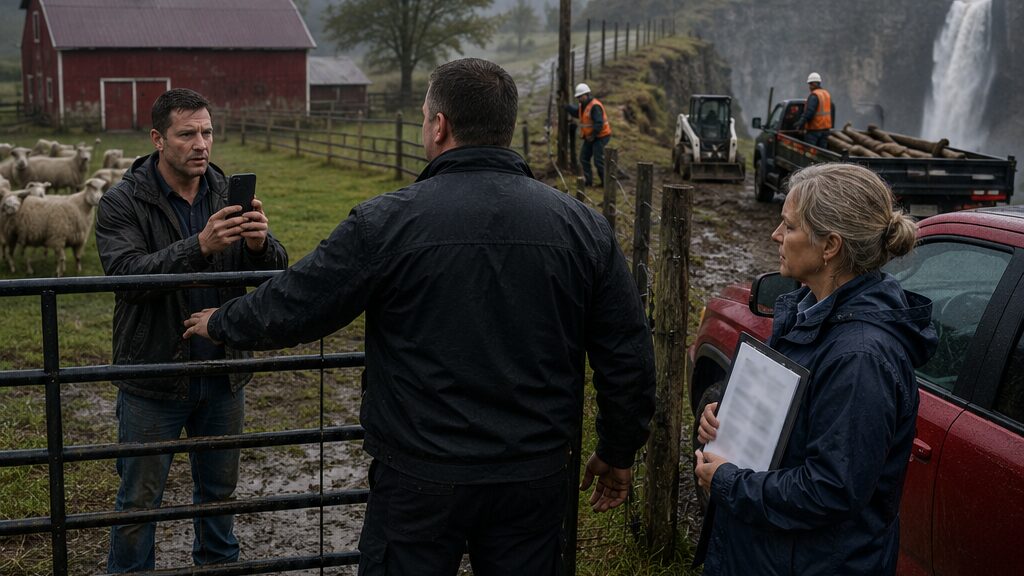
It was a low, grinding sound, too heavy for a pickup and too close to the cliff side of his pasture. He stopped halfway across the porch with one boot unlaced, coffee cooling in his hand, and listened again. The engine revved once, then settled into a hard idle beneath the steady rush of the waterfall beyond the lower field.
No one was supposed to be down there.
He set the mug on the porch rail and crossed the yard toward the driveway, mud tugging at the heels of his boots. The red barn stood behind him with its side apartment windows still dark. Sheep moved in a loose white cluster near the wet grass, their heads lifting at the same time, all of them facing the gate.
Then Mark saw the red truck.
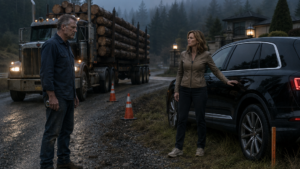
It sat outside his farm entrance at an angle, blocking half the gravel approach. White block letters on the door read HOA COMPLIANCE. Behind it, his own black metal gate was shut, a new chain looped through the bars. A man in a dark security jacket stood in front of it with his arms crossed as though the gate belonged to him.
Mark slowed, not because he was afraid, but because he knew the difference between a problem and a trap. A problem you walked straight into. A trap you made someone explain first.
The man at the gate watched him come. He was built thick through the shoulders, with short hair and a clipped radio on his collar. Another worker stood farther down the fence line near the pasture edge, orange vest bright against the green field. Beyond him, near the old cliff fence, Mark saw movement.
A worker bent over one of the new posts.
Mark’s jaw tightened.
He had set those posts with Paul Taylor two days earlier, after the rain split the ground along the cliff path and the old fence leaned six inches toward open air. It was temporary work, rough but solid. Treated posts, heavy wire, two braces where the earth had softened. It kept the sheep back from the drop and marked the safe edge of the path Lisa used when she came from the barn apartment to the house.
The worker raised a tool.
“Hey!” Mark called.
The security man lifted one hand, palm out. “Stay where you are, sir.”
Mark stopped three feet from the gate. “That’s my field.”
“Mark Harris?”
“You know it is.”
“I’m Ryan Brown. Contracted enforcement lead for the association.” The man said it cleanly, as if the words had been practiced in a mirror. “This entrance is temporarily secured pending removal of a non-compliant exterior structure.”
Mark stared at him, then at the chain. “You locked my gate.”
“The association authorized access control for the work area.”
“My animals are inside that work area.”
“They’re being kept back.”
Mark looked past him. One sheep had slipped away from the others and stood too close to the muddy lane that curved toward the cliff. The waterfall roared beyond the trees, louder after the night’s rain. The ground along that side always talked before it failed—first with water, then with soft edges, then with silence.
Ryan shifted enough to block Mark’s line of sight.
Mark pulled his phone from his pocket and started recording. “Say that again.”
Ryan’s expression changed, not much, but enough. “Sir, recording is your right. Interfering is not.”
“Good. Then say who told you to lock a farm gate with livestock behind it.”
Ryan touched his radio, then let his hand fall. “HOA compliance office issued the order.”
“Barbara Allen?”
“You can discuss that with the compliance chair when she arrives.”
“When she arrives?” Mark repeated. The machine down the hill revved again, followed by a metallic scrape. “The crew’s already here.”
Ryan glanced over his shoulder. “They were instructed to begin staging.”
“That’s not staging.”
Mark moved to the side of the gate, where the old hinge post met the stone wall. Ryan stepped with him. Not close enough to shove, close enough to make the message plain.
Mark felt heat rise into his throat. He swallowed it back. A shove would make Ryan’s report easy. A raised voice would make Barbara’s story cleaner. Angry farmer blocks lawful crew. Angry farmer refuses rules. Angry farmer creates safety concern.
He had lived long enough inside associations and county lines and insurance forms to know how quickly a man could be turned into a problem on paper.
So he held the phone steady and kept his voice flat. “That fence is there because the ground is washing out.”
Ryan’s eyes flicked toward the field. “I’m not here to evaluate the structure.”
“Then you’re not qualified to remove it.”
“I’m here to keep the work area secure.”
“That fence is the thing making it secure.”
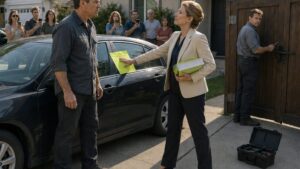
A white SUV came over the hill beyond the red truck, tires crunching over wet gravel. It stopped behind the HOA vehicle. Barbara Allen stepped out with a clipboard under one arm and a yellow folder pressed to her chest.
She wore rain boots that looked new and a navy jacket zipped to the throat. Her gray-blond hair was pulled back so tightly it sharpened her face. She took in Mark’s phone, Ryan at the gate, and the workers down the field in one fast scan.
“Mr. Harris,” she said, walking toward him. “I’m glad you’re here.”
“I live here.”
“This will go smoother if we keep it civil.”
Mark almost laughed. Instead he turned the phone slightly so the locked gate stayed in frame. “You put a chain on my gate and sent a crew into my pasture before sunrise.”
Barbara stopped on the other side of the gate. “The work order was scheduled after repeated noncompliance.”
“There was no repeated anything. I sent an email with photos yesterday.”
“You installed an exterior structure without approval.”
“I stabilized a failing fence.”
“You installed new posts along a protected scenic boundary.”
“Protected from what?” Mark pointed past her. “Looking too much like a farm?”
Her mouth tightened. She opened the folder and slid a paper halfway through the bars. Mark did not take it.
“This is your same-day removal notice,” she said. “Under Section 9.2, unauthorized exterior additions may be removed by the association if they create liability exposure or alter common visual standards.”
“It’s my land.”
“It is land governed by the Ridge View Homeowners Association.”
“It’s a cliff.”
“That does not exempt you from approval.”
The words landed wrong, too neat for the mud on his boots and the sound of the water below. Mark looked at the notice, then at the field. One worker had reached the fence line. Another stood beside a small utility loader, bucket lowered, engine running.
“Stop them,” Mark said.
Barbara did not look back. “The work has started.”
“Stop them anyway.”
“I can pause removal if you produce written approval for the modification.”
“You know I don’t have written approval. I sent emergency notice because the fence shifted after the storm.”
“Emergency notice is not approval.”
“Then what was I supposed to do? Wait until a sheep went over?”
Barbara’s eyes moved briefly toward the pasture, then back to the paper in her hand. “You were supposed to follow the process.”
Behind her, down the green slope, a worker bent at the base of one of Mark’s new posts. The tool whined. The sheep startled, bunching near the open lane. The worker rocked the post once, twice, then lifted it free from the wet ground.
Mark stepped forward until the gate bars touched his chest.
“Barbara,” he said, voice low, “that post is holding the line.”
She held the notice closer. “And this notice says it is coming out.”
The worker carried the post across the pasture and laid it into the bed of a utility truck as if it were scrap wood.
Chapter 2: Half the Cliff Fence Was in the Truck
By the time Mark got through the side pasture gap, the crew had already pulled the second post.
He had not opened the locked gate. He had not touched Ryan Brown. He had walked the long way around, through the old equipment lane behind the barn, across wet ground that sucked at his boots and slowed him just enough to make him watch another piece of his work disappear into the truck bed.
“Stop!” he shouted.
The worker at the fence straightened with both hands still on the post. The utility loader idled behind him, its bucket smeared with mud. A second worker stood beside the truck, looking from Mark to Barbara, waiting to see whose voice mattered.
Barbara Allen came down the slope behind Ryan, her clipboard held against her body. “Mr. Harris, you were told not to enter the work area.”
“This is my pasture.”
“It’s an active removal zone.”
“It became active because you brought a crew onto it.”
Ryan moved between Mark and the workers. He did not touch him. He did not need to. “Sir, keep ten feet back.”
Mark lifted his phone. “This fence line is five feet from a washout. You pull those posts and the sheep path opens straight toward the drop.”
Barbara turned to the crew supervisor. “Continue with the marked section only.”
“Do not continue,” Mark said.
The supervisor hesitated. He was older than the two workers, with a gray beard and a hard hat pushed back on his head. He had the look of a man who had thought he was coming to remove an ugly fence panel, not step into a fight beside a cliff.
Barbara looked at him. “You have the work order.”
Mark held the phone toward her. “Say what the order is for.”
“Removal of unauthorized fencing along a scenic boundary.”
“Say what’s behind the fence.”
Barbara’s lips thinned. “A drainage slope.”
“It’s not a drainage slope. It’s a cliff edge.”
The waterfall answered for him, loud beyond the trees. Mist hung in the air where the ground dropped away. From where Barbara stood, the fence line looked like any other rough pasture boundary: new posts, wire not yet trimmed, mud around the holes. From five steps farther, the land fell hard into rock and water.
Mark walked those five steps.
Ryan stepped with him. “Sir.”
Mark stopped at the edge of the safe ground and pointed his phone down. The camera caught the slick bank, the dark water below, the bent old posts leaning toward the drop. He turned back to Barbara. “Come look.”
Barbara did not move. “I’ve reviewed the submitted photographs.”
“No. You reviewed the photographs you liked.”
She opened her folder and pulled out a printed page sealed in a plastic sleeve. “This was the violation image received by the board.”
Mark knew the photo before she held it up. He had seen versions of it online in petty neighborhood arguments: a tight, angled shot that made a thing look worse by removing everything around it. His temporary fence filled the frame. New wood, uneven braces, wire curling loose at one end. No waterfall. No washout. No sheep path. No barn apartment trail. No reason.
“You cropped out the drop,” he said.
“I did not take this photo.”
“But you used it.”
“It shows the violation.”
“It hides the danger.”
Barbara lowered the photo. “The governing documents don’t allow property owners to unilaterally build new visible structures because they believe there is a danger.”
“Believe?” Mark’s hand tightened around the phone. “The ground moved.”
“You should have requested an emergency review.”
“I emailed you photos.”
“At 6:18 last night, after installation.”
“Because Paul and I were setting posts before the next rain.”
“Mr. Taylor was advised he should not have proceeded without approval.”
Mark turned toward the truck. Three posts lay in the bed now, wet dirt still clinging to their bases. “Paul knew what would happen if we waited.”
Barbara’s expression sharpened at the contractor’s name, as though the mention gave her a second violation to write down. “Your contractor’s opinion does not override association procedure.”
“No, but gravity does.”
The younger worker looked away.
Ryan spoke quietly. “Sir, I understand you’re upset.”
Mark looked at him. “Don’t do that.”
“Do what?”
“Turn danger into emotion.”
Ryan’s face stayed controlled, but his eyes shifted toward the cliff for the first time. He saw enough to pause. Mark saw that pause and held onto it.
Barbara saw it too. “Ryan, keep the area clear.”
Mark turned the phone back toward her. “You locked my gate, sent workers onto my land, and started removing a safety fence before handing me notice.”
“The notice was delivered.”
“When?”
“This morning.”
“When the crew was already here?”
Barbara did not answer immediately.
The supervisor cleared his throat. “Ma’am, do you want us to keep pulling?”
“Yes,” Barbara said.
“No,” Mark said at the same time.
The sheep bunched tighter near the lane, nervous from the machine noise. One ewe pushed through a gap in the temporary line where the first post had been removed. Mark moved instinctively, one arm out, guiding her back with a low sound. She turned, but the movement sent mud sliding under her hooves.
“Shut the engine off,” Mark said.
The supervisor looked to Barbara.
Barbara gave one short nod, annoyed but cautious. The loader engine died. The sudden quiet made the waterfall sound larger.
Mark exhaled through his nose. “That path is used every day.”
“For livestock,” Barbara said.
Mark looked at her. The full answer rose in him, heavy and immediate: not just livestock. Lisa used that path when the gravel drive was too steep after rain. Lisa, who had moved into the barn apartment because the house stairs were too much after the accident. Lisa, who hated being discussed in rooms where people made sympathetic faces and then forgot the ramp was still too slick.
He could say it. He should say it.
Instead he said, “For the farm.”
Barbara heard the missing words even if she did not know what they were. “Then document it properly.”
“I did.”
“You documented an after-the-fact violation.”
“I documented an emergency.”
“The board will decide that.”
“The board can’t vote the ground back into place.”
For the first time, Barbara’s voice lost some polish. “And if every owner builds first and explains later, this association becomes uninsurable. Do you understand that? Do you understand what happens when one person’s emergency becomes everyone’s liability?”
Mark stared at her. There it was: not just fence color, not just scenic standards. Fear dressed as order. Maybe real fear. Maybe useful fear. But still pointed at the wrong thing.
“I understand liability,” he said. “That’s why I built the fence.”
Barbara looked at the supervisor. “Remove only what’s marked in the notice. Do not go beyond the new posts.”
The supervisor picked up his tool again, slower this time.
Mark stepped into the space between the crew and the remaining posts.
Ryan’s hand came up. “Sir, don’t.”
“I’m not touching anyone.” Mark kept the phone high. “I want the order in writing. I want your name, her name, the time you entered, and the part where the HOA accepts responsibility if that edge fails before review.”
Barbara’s eyes hardened. “You don’t get to rewrite the process by filming people.”
“No. I get to make sure the process has a face.”
A drop of rain struck the phone screen. Then another. Across the slope, the sheep shifted. Water began to stipple the mud around the empty post holes.
Barbara looked at the sky, then at the half-removed fence, calculating.
The ground decided before she did.
Near the gap where the second post had stood, a strip of wet soil peeled away from the edge with a soft tearing sound. It slid two feet, then broke loose and vanished down the slope, taking a clump of grass with it. The sheep scattered from the sound. The crew supervisor swore under his breath.
Mark kept the camera steady, but his voice changed.
“That,” he said, “is what you just opened.”
Chapter 3: The Violation Photo Hid the Drop
The violation notice slid under Mark’s kitchen door while the crew was still visible from the window.
For a second he only stared at it, a white envelope lying on the worn floorboards with rainwater beading along one edge. He had come inside to print the photos from his phone, to call Paul Taylor, to find the email chain he had sent the night before. He had not expected another piece of paper to enter his house like it had a right to.
Outside, past the sink window, the red HOA truck remained near the gate. The crew had stopped pulling posts after the soil gave way, but they had not left. Ryan stood beside the chain with his radio near his mouth. Barbara was at her SUV, speaking into her phone and looking toward the cliff only when she thought no one was watching.
Mark picked up the envelope.
The paper inside was clean, official, and wrong.
NOTICE OF CONTINUED VIOLATION AND TEMPORARY ACCESS RESTRICTION.
He read it once standing by the door. Then again at the kitchen table, where his father’s old gate key lay in a chipped ceramic dish. The key had no use anymore; the old wooden gate it opened had been replaced with black metal after the HOA required “consistent roadside appearance.” Mark had kept the key anyway, because his father had kept things that once mattered.
His phone buzzed.
Paul Taylor’s name appeared on the screen.
“You all right?” Paul asked when Mark answered.
“No.”
“Barbara called me.”
Mark closed his eyes. “Of course she did.”
“She asked whether I installed those posts under permit.”
“You told her it was temporary stabilization.”
“I told her exactly that. I also told her I don’t have a death wish or a rich enough business to fight the association.”
Mark looked through the window. One of the workers was taking photos of the empty post holes. “I’m not asking you to fight them.”
“No, but you should’ve waited for me to put the emergency note on the invoice before you sent those pictures. They’re going to say we built first and invented the reason after.”
Mark said nothing.
Paul’s voice softened. “I’m not blaming you. I saw the ground. I’d have set the posts too.”
“Can you send me the estimate and the notes from when you came out?”
“Already doing it. But Mark?”
“What?”
“Don’t make this just about sheep if it isn’t.”
Mark’s hand went still on the notice.
Paul did not say Lisa’s name. He had repaired the barn apartment handrail after she moved in. He had seen the way Mark widened the gravel path himself, one wheelbarrow at a time, so she could make it from the barn to the house without asking for help. Around people like Paul, kindness came with the mercy of not naming what was obvious.
“I’ll use what I need,” Mark said.
“That’s what worries me.”
The call ended with the soft click of someone who knew he had said enough.
Mark spread the notice on the table. Attached behind it was the violation image Barbara had shown him in the field. The new fence posts filled the frame. Rough wire. Mud. No drop. No waterfall. No washed-out path. It looked ugly, sudden, unnecessary.
He placed his own phone beside it and pulled up the video from the cliff. In his footage, the same post stood three feet from open air, sheep tracks pressed into mud beside it.
Same fence. Different truth.
A knock came from the back porch.
Mark folded the notice halfway before opening the door.
Sarah Williams stood under the porch roof, a rain jacket pulled over her hair, one hand wrapped around the strap of a canvas bag. She lived up on the scenic road, where the view of the waterfall sold houses faster than any listing description ever could. She had served on the HOA board for three years, mostly quiet, mostly reasonable, until quiet people let louder ones use their silence.
“Mark,” she said. “Can I come in?”
He did not move aside. “Did you take the picture?”
Her face changed enough to answer.
Mark held up the notice. “You cropped out the cliff.”
“I didn’t crop it. I took it from the road. That’s all I could see.”
“You filed the complaint.”
“I asked for a review.”
“You filed the complaint.”
Sarah looked past him toward the kitchen table. “My grandson got out of the car last week. He ran toward that overlook before I could catch him. I saw your new posts the next day and thought—” She stopped, embarrassed by her own logic. “I thought if the board looked at it, they would make sure it was safe.”
“They’re removing it.”
“I didn’t know Barbara would send a crew.”
“But you knew Barbara.”
Sarah flinched.
Mark almost regretted it. Almost. Then he saw the red truck through the window again.
Sarah lowered her voice. “There’s an emergency maintenance clause.”
Mark stared at her.
“In the governing documents,” she said. “It allows temporary work without prior approval if there’s immediate risk to livestock, access, or structural safety. But you have to file the emergency form within twenty-four hours and request inspection.”
“I sent photos.”
“Not the form.”
“Nobody sent me a form.”
“You know they won’t volunteer the thing that weakens their position.”
Mark laughed once, without humor. “So the rule that lets me fix danger is hidden behind the people accusing me of breaking rules.”
Sarah looked at the floor. Rain tapped against the porch roof.
“I’m sorry,” she said. “I thought I was making someone look at it.”
“You did.”
“That isn’t fair.”
“No,” Mark said. “It isn’t.”
Her eyes lifted to his, and for the first time that morning he saw something besides board caution in her face. Fear, maybe. Not of him. Of what her one picture had become.
“The board scheduled an emergency meeting tonight,” she said. “Barbara wants the removal confirmed and the gate lock continued until county inspection.”
“Continued?”
“She says because you interfered with the crew.”
“I stopped them from making a hole bigger.”
“She’ll say you entered an active work zone.”
Mark stepped back from the door and grabbed a pen from the counter. “Where’s the form?”
Sarah reached into her bag and took out a folded packet. “I printed it before I came.”
He took it but did not thank her yet.
At the top of the first page, under the association seal, was a line for Description of emergency condition. Below it, a smaller line: Persons, animals, structures, or access routes at immediate risk.
Mark stared at that line longer than he meant to.
Sarah saw it. “Mark.”
“Don’t.”
“I’m not asking for details.”
“Good.”
“But if the board thinks this is only about a fence for sheep, Barbara can keep it inside property standards.”
“It is about sheep.”
Sarah said nothing.
Mark set the form on the table. His father’s old gate key sat beside the cropped photo, useless metal next to useful lies.
The side door opened behind him.
Lisa Mitchell stood in the doorway from the mudroom, one hand on the frame, the other gripping the cane she hated using in front of visitors. Her face was pale from the walk between the barn apartment and the house, her damp hair tucked behind one ear. Her eyes moved from Sarah to the notice, then to the line on the form beneath Mark’s hand.
“What is that?” she asked.
Mark folded the form too late.
Lisa came closer, slow and careful, and picked up the notice before he could stop her. She read the first page, then the second. When she reached the cropped photograph, her mouth tightened in a way that looked too much like his own.
“They used this picture?” she asked.
“Yes.”
Her eyes stayed on the fence that seemed to protect nothing. “Where am I in your paperwork, Mark?”
He did not answer.
Lisa lowered the paper.
“Why,” she asked quietly, “did you leave my name out?”
Chapter 4: The Board Called the Fence Cosmetic
The first thing on the screen was Mark’s fence with the cliff cut out of it.
The meeting room went quiet as the image appeared above the folding tables: three rough new posts, fresh wire, mud around the base, and nothing beyond it except a blur of green. No drop. No waterfall. No washed-out sheep path. No reason for a man to put wood in the ground before breakfast.
Barbara Allen stood beside the projector with a remote in one hand. “This is the structure in question.”
Mark sat in the second row with the emergency form in a folder on his lap, his phone beside it, still damp around the edges from the morning. Sarah Williams sat at the far end of the board table, eyes fixed on the photograph she had taken. She did not look at Mark.
Two other board members whispered to each other. Ryan Brown stood near the back wall, arms folded, no longer blocking a gate but carrying the same posture into the room.
Barbara clicked to the next slide. The same cropped photograph appeared, this time with a red circle around the fence posts.
“Unauthorized exterior modification,” she said. “Installed without prior approval along a protected scenic boundary.”
Mark raised his hand.
Barbara did not call on him.
“The association has clear procedures for structural changes, temporary or permanent. Those procedures exist for liability, visibility, and consistent enforcement. If one property owner decides his situation is exempt, every property owner becomes exempt.”
“Barbara,” Sarah said quietly, “he should be allowed to respond.”
Barbara’s jaw tightened, but she nodded toward Mark. “Briefly.”
Mark stood with the folder in his hand. He did not walk to the front. He did not want to stand under her cropped picture like a man defending the wrong evidence.
“That photograph leaves out the cliff,” he said.
A board member leaned forward. “What cliff?”
Mark looked at Barbara. She kept her face still.
He connected his phone to the room’s small screen with a cable the clerk gave him. His video appeared shaky at first, his boots and wet grass filling the frame. Then the camera lifted and caught the open drop: the black rock, the rush of white water, the leaning old fence, the empty holes where the new posts had been removed.
The whispers stopped.
“That’s the same line,” Mark said. “This morning. After the crew pulled two posts.”
He let the video run long enough for the sheep to shift near the gap. Long enough for the strip of soil to slide away and disappear. Long enough for the room to hear the small sound Sarah made before she covered it.
Barbara clicked her pen. “No one is disputing there is a drainage feature.”
“It is not a drainage feature,” Mark said.
“It is designated as a drainage slope in the community map.”
“The map doesn’t keep animals from walking over it.”
A board member turned toward Barbara. “Were the posts removed before this meeting?”
Barbara folded her hands over the remote. “Removal was paused when Mr. Harris entered the work area.”
“Were they removed before he received notice?”
Mark looked toward Ryan.
Ryan’s eyes moved to Barbara first. Then he said, “The crew was on-site when I made contact with Mr. Harris.”
“That’s not what I asked,” the board member said.
Ryan’s voice stayed professional. “The crew had begun staging. One post may have been loosened before the notice was physically delivered.”
Mark played the next clip without asking. It showed the first post already in the truck bed while Barbara stood at the gate with the paper in her hand.
No one spoke for several seconds.
Barbara set the remote down. “The timeline does not change the underlying violation.”
“It changes whether I had a chance to stop it,” Mark said.
“You had a chance when you decided to install it without approval.”
“I had a washed-out fence and rain coming.”
Barbara turned toward the board. “Emergency maintenance is addressed under Section 12.6. It does not allow indefinite unapproved structures. It requires immediate written notification, supporting documentation, inspection request, and board review.”
Mark lifted the packet Sarah had brought him. “I have the form now.”
“After enforcement began.”
“Because nobody sent it when I emailed you the photos.”
Barbara’s eyes sharpened. “The association is not responsible for completing an owner’s compliance obligations.”
“No,” Mark said. “Just for hiding the one that mattered.”
A few people shifted in their seats. Sarah looked down.
Barbara’s face colored, but her voice stayed even. “Mr. Harris, this association has an insurance audit this week. We cannot have undocumented structures on boundary land, especially near hazardous areas. If someone is injured near that fence, the association is exposed.”
“If someone is injured because you removed it?”
“That is exactly why the county needs to inspect before any further work occurs.”
Mark felt the trap close. The same danger that made the fence necessary now became the reason to keep him from fixing it.
He opened his folder and slid out Paul Taylor’s contractor note, his photos, the email he had sent the night before. “Paul Taylor inspected the line. He wrote that the old posts had shifted and temporary bracing was needed before the next storm.”
Barbara took the paper but did not read it closely. “Mr. Taylor is not the county.”
“He’s the man who saw the ground before you sent a crew.”
“He is also the man who performed unauthorized work.”
Mark gripped the back of the chair in front of him. For one moment he saw Lisa in the kitchen doorway, cane in hand, asking why he had left her out. He saw the line on the emergency form asking who used the route. He felt the words gather in his throat.
My sister lives there. She uses that path. She can’t climb the front grade when it’s slick. You’re not removing a fence. You’re cutting off her way home.
He looked at the board table. At Sarah, whose regret sat plain on her face. At Barbara, waiting for anything that could be turned into incomplete documentation, emotional pressure, special pleading. At the others, curious now, but not yet responsible.
Lisa hated being discussed as a condition.
Mark swallowed the words.
“The fence protects an access route,” he said.
Barbara waited. “For livestock?”
Mark’s silence answered too little.
Barbara turned back to the board. “There is no documented immediate human danger in the materials submitted.”
Sarah looked up quickly. “Barbara—”
“We cannot vote based on implications,” Barbara said. “We vote on records.”
Mark looked at the emergency form in his hand. The blank line seemed to widen.
After twenty minutes of procedural discussion, the board called a temporary vote. Sarah asked to postpone full removal. Another board member agreed. Barbara countered with a lockout until the county inspected the boundary and determined whether further work could be done safely.
The motion passed by one vote.
Mark stood very still while the clerk wrote it down.
Barbara gathered her folder. “The gate restriction remains in place until inspection. Any attempt to rebuild before county review will be treated as a continued violation.”
Ryan opened the meeting room door.
Mark looked once at the screen, where his uncropped video had frozen on the open drop. Then Barbara clicked the remote, and the cliff disappeared.
Chapter 5: The Water Took the Sheep Path First
The hoofprints led straight toward the open gap.
Mark found them at first light, pressed deep into the mud where the removed posts had left dark holes filling with brown water. One set, then three, then a churn of marks where the sheep had bunched and turned hard. A clump of wool hung on the sagging old wire.
Beyond it, the cliff edge had bitten farther into the path overnight.
Mark stood with one hand on the crooked fence brace and listened. The waterfall below was swollen from the storm, hammering the rocks with a steady white roar. The red barn was behind him, its apartment window lit. Lisa was awake. Of course she was. The board’s decision had not locked only the gate; it had locked the morning into place before either of them could pretend it was ordinary.
He crouched near the closest hoofprint. The mud at its edge trembled under his fingers.
“No more,” he said.
He walked back to the barn, took a coil of rope from the tack room, two orange cones from beside the mower, and four old fiberglass step-in posts he used for moving temporary grazing lines. They were not a fence. They were not a repair. They were a warning that could be lifted with one hand.
Still, before he touched the ground, he took out his phone.
“This is Mark Harris,” he said to the camera. His voice sounded rough from too little sleep. “Temporary visual barrier only. No digging. No structural installation. The HOA removed the existing temporary posts yesterday and barred rebuilding until inspection. Livestock tracks are within six feet of the open drop.”
He turned the camera to the hoofprints, the empty post holes, the broken edge.
Then he set the first fiberglass post.
By the time he tied the rope between them, Lisa had made it halfway down from the barn apartment, one hand on the rail, her cane planted carefully in the gravel.
“You said you weren’t rebuilding,” she called.
“I’m not.”
“That looks like building to people who like paper.”
“It’s rope.”
“It’s evidence, if Barbara wants it to be.”
Mark looked back at her. Her face was pale in the gray morning, but her mouth was set. She had dressed to come outside, not to watch from the window.
“You shouldn’t be on this grade,” he said.
“Then you should have put my name on the form.”
The rope slid through his hand too fast and burned his palm. He wrapped it around the post and pulled it tight.
Lisa came no closer. The path between them looked harmless from a distance, just gravel and wet grass, but Mark could see where the water had crossed it in thin sheets. He had spread that gravel himself after she moved in. He had told her it was temporary until he could pour something smoother. That had been eight months ago.
A shout came from the scenic road above.
Mark turned.
A child in a yellow jacket had slipped under the split-rail roadside barrier and was stepping down through the grass toward the overlook, drawn by the waterfall. A woman’s voice called from beyond the road, sharp with panic. The child stopped, then took another step, shoes sliding.
Mark dropped the rope and moved fast.
“Hey,” he called, not loud enough to scare. “Stay right there.”
The child froze. Mark crossed the slope at an angle, keeping himself between the child and the open line. The woman reached the roadside barrier, breathing hard, unable to get over it quickly. Mark held up a hand to her, then crouched.
“You see those orange cones?” he asked the child. “That means the ground is soft. Come toward me, not down.”
The child’s eyes filled, but he obeyed. Mark caught his sleeve when his shoes slipped and guided him back up toward the road. The woman grabbed the child and held him too tight, murmuring thanks into his hood.
Sarah Williams stood beside her car at the roadside, one hand over her mouth.
Mark saw in her face the thing she had tried to explain at his kitchen door: not malice, not exactly. Fear that had found the wrong door and knocked too hard.
“This is why I filed it,” she said, voice breaking. “Not to remove it. To make someone fix it.”
Mark looked from her to the open gap below. “Then help me make them see what they did.”
Before Sarah could answer, a county truck pulled up behind her car.
The inspector stepped out wearing a tan jacket and carrying a tablet sealed in a black case. Barbara’s SUV arrived less than a minute later, followed by Ryan in the red HOA truck.
Mark let out a breath through his teeth.
Barbara came through the roadside gate first. Her eyes went straight to the rope.
“Mr. Harris,” she said, “were you instructed not to rebuild?”
“It isn’t a rebuild.”
The inspector walked past them to the rope line. He took in the cones, the empty holes, the old leaning fence, the wet ground. He did not look impressed by anyone.
“Who authorized removal of the posts?” he asked.
Barbara stepped forward. “The association did, under exterior compliance authority.”
“Were the posts structural?”
“They were unauthorized.”
“That isn’t what I asked.”
Mark looked down so the inspector would not see the satisfaction cross his face.
Barbara’s tone cooled. “They appeared to be temporary fence supports.”
The inspector tapped notes into his tablet. “And this rope?”
“Temporary visual barrier,” Mark said. “No digging. I recorded before I placed it.”
The inspector nodded once, but then he walked the path from the barn apartment toward the house. He stopped where Lisa stood, then looked at the muddy grade beneath her cane.
“This path is currently unsafe for regular use,” he said.
Mark stepped forward. “Because they removed the posts.”
“Because the edge is unstable and the barrier is incomplete.” The inspector placed a red tag on one of the cones, then another on the barn-side path marker. “No livestock movement through this section. No pedestrian access along this route until stabilized.”
Lisa’s face went still.
Mark felt his restraint crack at the edge. “She lives there.”
The inspector looked at him, then at Lisa, then back to his tablet. “Then you need an approved safe route.”
“I had one.”
“You had a temporary fence with no inspection record.”
Barbara folded her arms. “That is what we’ve been saying.”
Mark turned on her so quickly Ryan shifted forward.
“No,” Mark said. “You’ve been saying it was cosmetic.”
The inspector looked between them. “I’m not here for association politics.”
“It’s not politics,” Lisa said.
Her voice was quiet, but everyone turned.
She stood with both hands around the cane now. Not weak. Angry enough to stay upright.
“That path is how I get from my apartment to my brother’s house when the driveway is slick,” she said. “Yesterday there was a fence. Today there’s a red tag.”
The inspector’s face softened only slightly. “Ma’am, I understand. I can’t clear an unstable edge because it was useful.”
Mark pressed his hand against the nearest post until the fiberglass bent.
The inspector looked down at his tablet again. “There may be another question here.”
Barbara’s head lifted. “What question?”
“This boundary.” He pointed toward the old fence line. “Some of these farm lots retained agricultural maintenance easements when the association was created. If this fence is part of retained agricultural safety infrastructure, HOA exterior approval may not be the only authority involved.”
Mark stared at him. “Where would that be?”
“Original subdivision documents. County records. Old survey map.”
The waterfall roared below them, filling the silence Barbara did not.
The inspector tapped the red tag flat against the cone. “Until someone proves otherwise, this path stays closed.”
Chapter 6: The Old Survey Made the Room Go Quiet
Mark found the survey in a rusted file box his father had labeled with a strip of masking tape that had nearly gone brown with age.
The box sat under the barn office workbench behind cracked mineral buckets, a broken fence stretcher, and three feed invoices from a decade before. Mark dragged it into the open and snapped the latch with a screwdriver. Dust rose into the air, dry and sharp, nothing like the wet morning outside.
At the top were old tax receipts. Beneath them, hand-drawn pasture rotations. Then a folded map tied with string.
He knew before he untied it.
His father had a habit of marking important things twice: once in ink for the county, once in pencil for himself. Along the lower boundary, where the pasture narrowed toward the waterfall, a heavy pencil line followed the fence. Beside it, in his father’s blocky handwriting, were four words.
KEEP THIS LINE OPEN.
Mark unfolded the rest of the survey across the workbench. The official stamp was faded but legible. Ridge View Rural Residential Development, Phase One. Retained agricultural access and safety maintenance easement along preexisting livestock boundary.
He read the line three times.
Lisa stood in the doorway, coat over her shoulders, cane against the jamb. “Is that it?”
“Maybe.”
“Mark.”
He looked up.
She did not ask if it was enough. They both knew papers were never enough until someone with a stamp decided they were. But it was the first thing in two days that had not been shaped by Barbara’s frame.
He took photos of the survey, then drove to the county records office with the original flat on the passenger seat under his hand. The clerk at the counter did not rush. She disappeared into a back room, returned with a scanned record, disappeared again for a larger copy. Mark stood beneath fluorescent lights, muddy boots drying in flakes on the tile, watching the clock move toward the afternoon hearing Barbara had requested.
When the clerk finally handed him the certified copy, she tapped the boundary line with one finger.
“This predates the HOA,” she said. “Doesn’t mean they have no say, but they can’t pretend it isn’t there.”
Mark paid the fee and walked out with the paper in a cardboard sleeve.
Sarah was waiting beside his truck.
He stopped with his hand on the door. “How did you know I was here?”
“I called the records office and asked if anyone had pulled Ridge View Phase One.” She looked embarrassed by her own usefulness. “Small town.”
Mark opened the truck door but did not get in. “What do you need, Sarah?”
“To tell you something before tonight.”
“Tell me.”
She glanced toward the road, then back at him. “Barbara pushed the removal because the insurance audit is Friday.”
“I heard that part.”
“No. Not just because of the audit.” Sarah tightened her hand around her bag strap. “Last year a retaining wall failed on the north cul-de-sac. The board delayed repairs because no one wanted a special assessment. Barbara was compliance chair then too. The insurer questioned whether we were enforcing maintenance standards evenly.”
Mark waited.
“She’s been terrified they’ll drop coverage or raise rates so high half the neighborhood blames her. So now anything near a slope, wall, ditch, culvert—she treats it like a threat to the whole association.”
“That explains why she’s scared,” Mark said. “Not why she sent a crew before notice.”
Sarah nodded, eyes lowered. “I know.”
“Are you going to say that tonight?”
“Yes.”
He studied her face. “Even the part where your photo started it?”
Her mouth tightened. “Especially that part.”
The HOA office was already half full when Mark arrived. Barbara stood near the front table with Ryan and the inspector’s preliminary red-tag report. The cropped fence photo was in her folder again. Mark saw its corner sticking out like a bad card someone kept playing because it had worked once.
He laid the certified survey on the table.
Barbara looked at it, then at him. “What is this?”
“Original subdivision survey.”
“We have association maps.”
“This is older.”
One of the board members stepped closer. Sarah came in behind Mark and set her own printed statement beside the survey.
Barbara’s face changed when she saw both papers together. Not fear exactly. Recognition that the ground beneath the room had shifted.
The inspector arrived last, carrying his tablet. He reviewed the certified copy at the table while everyone waited. His finger traced the line from the old gate to the cliff fence.
“This does appear to reserve maintenance access for agricultural safety along the preexisting livestock boundary,” he said.
The room went quiet.
Mark looked at Barbara. “That line is the fence you removed.”
Barbara did not answer him. She addressed the inspector. “Does that invalidate the red tag?”
“No. The path remains unsafe until stabilized. It may affect who has authority to perform stabilization and whether the HOA can prevent temporary safety work.”
“That is not a full legal opinion.”
“No,” the inspector said. “It’s a field determination. The county would advise allowing emergency stabilization pending formal review.”
A board member exhaled. Sarah’s shoulders dropped a fraction.
Mark felt something like relief start, but Barbara stopped it before it could settle.
“The association can agree to limited access,” she said, “provided Mr. Harris accepts the violation record for the unapproved installation and submits any permanent fence design for later review.”
Mark looked at her. “Permanent violation?”
“It documents the original noncompliance while allowing a path forward.”
“It documents your version.”
“It documents that work began without approval.”
“It leaves out that your crew removed a safety line before my appeal.”
Barbara’s voice lowered. “Mr. Harris, you are being offered a practical resolution.”
“A practical resolution doesn’t begin by making me admit the fence was the problem.”
Ryan shifted near the wall. The inspector watched without interrupting. Sarah opened her mouth, but Mark raised one hand slightly, not to silence her rudely, only to ask for the space to stand in his own fight.
Barbara folded the survey copy back into its sleeve with careful hands. “Without a signed acknowledgment, the gate restriction remains until the board receives counsel.”
Mark almost said yes. The word came close because Lisa was still cut off from the safe route, because the sheep could not use the lower pasture, because every hour of waiting let water work under the edge. A signature was ink. A fence was wood. He could sign now, fix now, argue later.
Then he saw the cropped photo in her folder.
If he signed, that picture would become the story.
“No,” he said.
Barbara’s eyes narrowed. “No?”
“No permanent violation record. No admission that the repair was cosmetic. No paper that says your process mattered more than the cliff.”
“That may delay access.”
“I know.”
The cost of the words landed in his chest. Lisa would pay part of it. The farm would too. That was the trouble with pride; sometimes it dressed itself as principle, and sometimes principle felt exactly like pride until the bill came due.
He picked up the survey. “We’ll meet tonight with the full board. Bring the violation photo. Bring the red-tag report. Bring the removal order. I’ll bring the uncropped video, the survey, Paul’s notes, and the emergency form.”
Barbara looked toward the inspector. “This is becoming unnecessarily adversarial.”
Mark slid the certified copy back into its sleeve. “It became adversarial when you put a chain on my gate.”
On the drive home, the survey lay on the passenger seat beside the modern violation notice. Old line beside new accusation. His father’s pencil against Barbara’s red circle.
Lisa was sitting at the kitchen table when he came in, the emergency form in front of her. She had filled in one line in neat, careful handwriting.
Persons, animals, structures, or access routes at immediate risk: resident using barn apartment access path; livestock using lower pasture; cliff-side boundary unstable after storm.
Mark stood behind the chair and read it without touching the paper.
“I didn’t write my diagnosis,” she said.
“You didn’t have to.”
“No. I didn’t.” She looked up at him. “But I wrote myself back into the truth.”
He sat across from her. The words he had avoided all day waited between them.
“There’s a final hearing tonight,” he said.
“I figured.”
“I can use the form without making you come.”
Lisa tapped the pen once against the table. “That’s not what you’re asking.”
“No.”
Outside, through the kitchen window, the locked gate sat at the end of the drive, black against the wet road. Beyond it, the red tag on the cone fluttered near the path she could not use.
Mark folded his hands together. “Will you come with me?”
Chapter 7: The Gate Opened Before the Cliff Did
Ryan Brown arrived with a new lock order while Paul Taylor’s repair truck was already parked behind Mark in the driveway.
For a moment nobody moved. Ryan stood outside the black metal gate with a folded document in one hand and a chain hanging from the other. Mark stood inside the gate with the certified survey, the emergency form, Paul’s contractor notes, and the phone video saved in three places. Behind him, Paul waited beside a load of treated posts, neutral wire, and two bags of quick-set gravel mix. Lisa sat in the passenger seat of Mark’s truck, coat buttoned, cane across her lap, looking straight through the gate as if she had already decided she would not be hidden behind it again.
Ryan looked at the repair truck, then at Mark. “Mr. Harris.”
“Ryan.”
“I was instructed to maintain access restriction pending the board’s final decision.”
“The final hearing starts in twenty minutes.”
“That’s why I’m here.”
Mark glanced at the chain. “You’re locking me in before the hearing?”
Ryan’s face tightened. “I’m securing the restricted area.”
“No,” Mark said. “You’re securing Barbara’s version before anyone else can look at the ground.”
Ryan did not answer.
The red HOA truck came over the rise next, followed by Barbara Allen’s SUV and Sarah Williams’s car. The county inspector arrived last, parking near the roadside barrier above the waterfall. The board had refused to wait until evening after Mark sent the survey, the red-tag report, and his phone video to every member before sunrise. The emergency hearing had moved to the farm gate because the inspector said the boundary itself needed to be visible.
Barbara stepped out with her folder pressed under her arm. She had traded the polished meeting-room jacket for a rain shell and boots, but her posture was the same. Straight-backed. Procedural. Ready to make mud behave like minutes.
“Mr. Harris,” she said, “the board has not authorized repair activity.”
Mark looked past her to the cliff line. The red tag fluttered near the cones. The sheep were penned in the upper pasture, restless and crowded, their usual route closed. The waterfall sounded swollen and impatient.
“Then the board can say that out loud here,” he said.
The board members gathered near the gate, not enough to look like a crowd, enough to make the narrow road feel occupied. Sarah stood slightly apart from them. Her printed statement was folded in her hand.
Barbara opened the hearing with the language she preferred: unauthorized installation, exposed liability, association authority, temporary restriction. She held up the cropped violation photo one more time.
Mark let her finish.
Then he placed his own documents on the hood of the red HOA truck because it was the only flat surface between them.
“This is the same fence,” he said, laying the uncropped photo beside hers. “This is what your image left out.”
The board members leaned closer. The inspector did not. He had already seen it.
“This is the original survey.” Mark set the certified copy beside the photos. “This line is the preexisting livestock boundary. The maintenance easement predates the association.”
Barbara spoke quickly. “Which does not automatically exempt all exterior work from review.”
“No one said it does.” Mark placed Paul’s note on top. “This is the contractor assessment from before removal. Temporary stabilization recommended before additional rainfall.”
Paul stepped forward only when Mark nodded. “I wrote that before the HOA crew arrived. Those posts were rough, but they were placed to stop movement and mark the edge. They weren’t decorative.”
Barbara looked toward the board. “The association’s concern is not whether Mr. Harris believes he acted in good faith. The concern is documentation. If we allow retroactive approval whenever an owner claims emergency, enforcement collapses.”
Sarah unfolded her paper. Her voice shook at first, then steadied. “I took the original photo.”
Barbara turned her head sharply.
Sarah kept going. “I took it from the scenic road after my grandson ran toward the overlook. I thought the board would review the area for safety. I did not request same-day removal. I did not understand that the photo failed to show the drop.”
The board members looked at the cropped image again. For the first time, it seemed smaller than the paper it was printed on.
Barbara’s mouth tightened. “Intent does not change the violation.”
“No,” Mark said. “But it changes what you knew and what you chose not to ask.”
Barbara’s eyes met his. Behind them, not far beyond the wet slope, a sheep bleated from the crowded pen. Lisa opened the truck door.
Mark turned immediately. “Lisa—”
She gave him one look, and he stopped.
She came slowly to the gate, cane pressing into the gravel with each careful step. Ryan shifted aside without being asked. Not far. Just enough.
Lisa stood beside Mark and placed the emergency form on the truck hood. Her handwriting filled the line he had left blank too long.
“I live in the barn apartment,” she said. “That path is how I reach the house when the driveway is wet. I did not want my name in a board file. I still don’t. But yesterday a fence was removed, and today I cannot use the route I used last week.”
No one interrupted her.
She looked at Barbara, not pleading. “I am not asking you to feel sorry for me. I am asking you not to call my way home cosmetic.”
Barbara looked down at the form. Something in her face moved, small and unwilling. Then she closed it again.
“The association was not provided that information before enforcement,” she said.
Mark felt the old instinct rise: protect Lisa, absorb the blame, keep the anger clean and private. He let the instinct come, then set it down.
“Because I left it out,” he said.
Lisa looked at him.
Mark kept his eyes on Barbara. “That was my mistake. I thought I was protecting her privacy. But you had the uncropped photos by email. You had enough to pause. Instead you sent a crew and a lock.”
The inspector stepped forward. “My field recommendation is emergency stabilization today. The final design can be reviewed after the immediate hazard is controlled. If the association prevents stabilization after receiving these materials, it should put in writing that it accepts responsibility for the restricted access and exposed boundary until review is complete.”
The road went still.
Mark picked up a blank sheet from his folder and held it out to Barbara. “Write that. Write that after seeing the uncropped drop, the survey, the red tag, the contractor note, and Lisa’s access form, the HOA accepts responsibility for keeping the fence down and the gate locked.”
Barbara did not take the paper.
One board member looked away. Another murmured, “I’m not signing that.”
Sarah said, “Neither am I.”
Barbara’s jaw worked once. “This is not how association decisions are made.”
Mark lowered the paper. “Then make one the right way.”
For several seconds, the only sound was the waterfall and the sheep shifting behind the barn. Barbara looked toward the cliff, and this time she did not look away quickly. She saw the empty holes. The rope. The cone with the red tag. The truck loaded with posts that could be in the ground before noon.
When she spoke, her voice had lost its hard edge, but not its caution. “Emergency stabilization only. Neutral finish. No painted rails, no expanded footprint, no permanent design approval until inspection.”
Mark nodded once. “Temporary posts today. Final review after the ground is safe.”
“The violation record is withdrawn pending revised emergency classification,” Sarah said before Barbara could soften the words into something else.
Barbara looked at her, then at the other board members. No one rescued the old motion.
“Fine,” Barbara said. “Withdrawn pending classification.”
“Not pending,” Mark said. “Withdrawn. Review the final fence if you want. But the violation was based on a photo that hid the hazard.”
The inspector looked at the board. “That would be cleaner.”
Barbara breathed in through her nose. “Withdrawn.”
Mark turned to Ryan. The chain still hung from his hand.
Ryan looked at Barbara. She gave one small nod.
He unlocked the gate.
The sound was not dramatic. A click, a scrape of chain against metal, a hinge complaining as Ryan pulled the gate open. But Lisa’s hand tightened around the top of her cane, and Mark felt the sound in his chest like something unclenching.
Paul drove through first with the repair truck. Mark walked beside it to the cliff line, carrying the first returned post himself. The soil near the gap was darker now, but steady enough where Paul marked the safe placement. The inspector watched. Barbara stayed by the road. Sarah came halfway down the slope and stopped near Lisa on the safe side of the path.
Mark set the post into the hole. Paul checked the line and handed him the level.
“Ready?” Paul asked.
Mark looked back once.
Lisa stood behind the rope, not hidden, not displayed, simply there. Barbara was looking at the ground, the documents tucked under her arm. Ryan held the open gate with one hand, keeping it from swinging shut in the wind.
Mark pressed the post straight.
“Ready,” he said.
Paul poured the gravel mix. Mark held the wood steady until it took the weight. The first post stood where the empty gap had been, plain and unfinished and necessary.
Behind him, the gate remained open.
The story has ended.