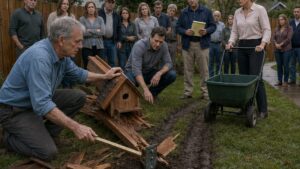
He Was Fined $350 For Repairing The Bridge His Mother Needed To Come Home
Chapter 1: The Crew Was Already Taking The Bridge Apart
The first thing Jonathan heard was metal screaming against stone.
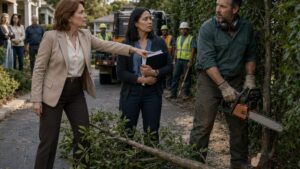
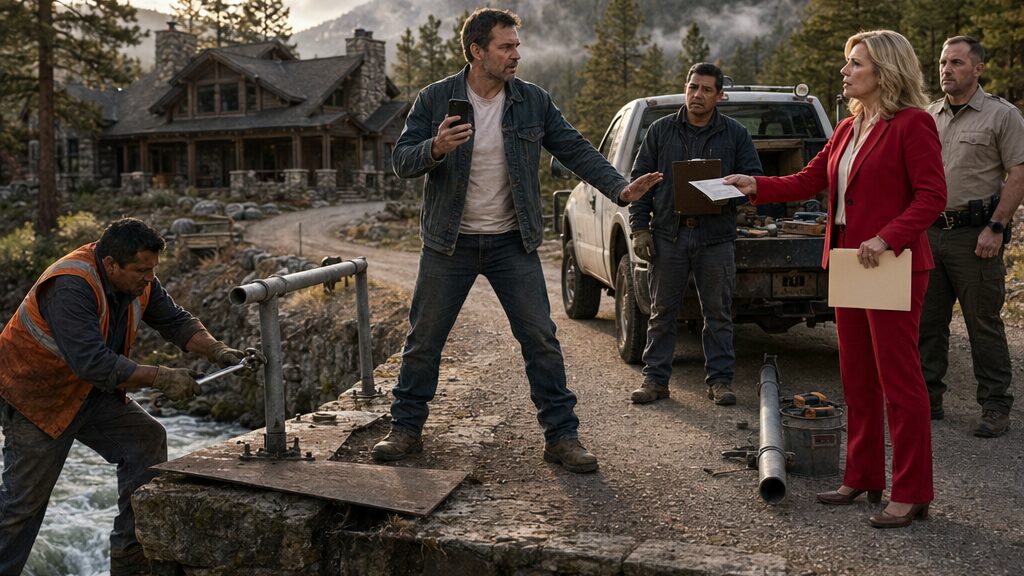
He stepped out of the kitchen with his coffee still untouched on the counter, crossed the narrow porch, and saw a white work truck parked sideways at the mouth of his driveway. Beyond it, down where the creek cut through the property, two men in orange vests were already on the old stone bridge. One had a socket wrench braced against the temporary rail Jonathan had bolted in place the night before. The other stood beside the steel plate, prying at the edge with a bar.
For half a second, Jonathan did not move.
Then the rail shifted.
“Hey!” he shouted.
The man with the wrench looked up, startled but not guilty. That was what struck Jonathan first. Not guilt. Not even surprise that someone had come out of the house. Just the look of a worker checking whether the person yelling at him was the person listed on the work order.
Jonathan went down the slope fast, boots slipping in the wet grass. The bridge sat twenty yards from the house, an old arch of gray stone over a cold mountain creek. His father had called it pretty. His mother had called it stubborn. Jonathan had spent the last two evenings making it safe enough for a wheelchair transport: steel support plate over the cracked edge, temporary rail along the right side, anti-slip strips where the moss always came back.
Now one end of the rail hung loose.
“Put that wrench down,” Jonathan said.
The worker lowered it but did not step away.
A man near the truck turned with a clipboard tucked under his arm. “You Jonathan Hall?”
“I’m the owner of this property.”
“That’s not what I asked.”
Jonathan looked at the rail, then at the man’s shirt. No company logo he recognized. No county seal. No HOA badge. Just a contractor who had come onto his property before breakfast and started taking apart the only safe way to his front door.
“Who authorized this?” Jonathan asked.
The man with the clipboard glanced up the driveway.
Jonathan turned.
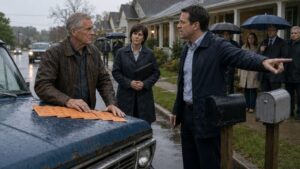
Elizabeth Moore was walking toward them in a red suit bright enough to look misplaced against the mountain grass. Behind her came a county deputy, slower, watchful, one hand resting near his belt but not on it. Elizabeth carried a cream-colored folder pressed neatly against her ribs, as if she had arrived for a board luncheon instead of a demolition.
“Mr. Hall,” she said. “Please step away from the bridge.”
Jonathan’s phone was in his hand before he remembered pulling it from his pocket. He opened the camera and hit record.
“Say that again,” he said.
Elizabeth stopped on the gravel apron before the bridge. Her eyes flicked to the phone, then away. “The association has issued an enforcement action regarding your unauthorized exterior modification.”
“One, this is my property. Two, that bridge was damaged in the storm. Three, you’re not removing anything until you show me a court order.”
The crew supervisor shifted his clipboard. “Ma’am?”
Elizabeth did not look at him. “Continue removing the noncompliant addition.”
Jonathan stepped onto the bridge.
The creek moved under him, white around the rocks, quick from last week’s rain. The steel plate under his boot gave a dull, steady sound. Without it, the cracked edge had flexed when he put weight near the right side. He knew because he had tested it at midnight with a flashlight clenched in his teeth and Mary’s discharge papers folded on the kitchen table.
The worker with the wrench looked from Jonathan to Elizabeth.
“Do not touch that rail,” Jonathan said, low enough that the creek almost swallowed it.
The deputy moved closer. “Sir, let’s keep everybody calm.”
“I am calm. I’m asking who gave them permission to dismantle a safety repair on my land.”
Elizabeth opened her folder and removed a paper. “You were notified that unapproved structural modifications visible from the community road violate section eight of the Mountain Laurel Homeowners Association standards.”
“I wasn’t notified of demolition.”
“A notice was left at your door.”
“When?”
“This morning.”
Jonathan laughed once, without humor. “This morning when the crew was already here?”
The deputy looked at Elizabeth. That tiny movement was the first crack in the scene. Elizabeth saw it too. Her jaw set, but her voice stayed smooth.
“The modification was performed without approval. It alters the exterior character of a shared scenic feature.”
“It’s a bridge,” Jonathan said. “Not a scenic feature.”
“It is visible from common access.”
“It is the access.”
A gust moved through the pines. One of the crew workers looked down at the creek and rubbed his thumb along the wrench handle. Jonathan knew the look. Men who worked with tools understood unsafe things faster than people who worked with forms.
Elizabeth extended the paper toward him. “You have been fined three hundred fifty dollars for unauthorized alteration and failure to obtain prior approval.”
Jonathan did not take it.
“My mother comes home in two days,” he said.
Elizabeth’s expression changed by almost nothing, but he saw the small tightening around her eyes.
He hated that he had said it. Hated that Mary had become part of this scene, standing there without standing there. He had promised her he would keep it simple. A repair. A discharge. No committees. No pity.
“She needs that rail,” he said.
Elizabeth adjusted the folder against her side. “Then you should have submitted the proper accommodation request.”
“I submitted repair paperwork weeks ago.”
“You submitted a general maintenance inquiry with no supporting documentation and no approval from the architectural committee.”
“The bridge cracked after the storm. I did what had to be done.”
“What you did,” Elizabeth said, “was install unapproved metal hardware onto a stone structure that falls under exterior standards.”
The deputy glanced toward the rail, then at the loose bolts. “Ma’am, is there a reason this can’t wait until the paperwork is sorted?”
Elizabeth looked at him as if he had asked the wrong question in a room full of people who knew the right one. “Deputy, the association has documented liability concerns. If the work remains and someone is injured, the HOA is exposed.”
“If you take it down,” Jonathan said, “someone will be injured.”
“Mr. Hall, please don’t dramatize this.”
That was when his hand tightened around the phone.
Not on the hammer he had left near the bridge wall. Not on the worker’s wrench. The phone. He kept it pointed at the rail, at Elizabeth, at the deputy, at the crew. His voice stayed level because if he raised it, the scene would become about his temper instead of the steel plate being lifted from the stone.
“My mother cannot walk across that bridge without support.”
Elizabeth looked briefly toward the house, then back at him. “I cannot evaluate a medical claim that has not been properly submitted.”
“She’s not a claim.”
“No,” Elizabeth said. “But the association operates through procedure.”
The supervisor cleared his throat. “We’re just here to remove the installed materials.”
“Name,” Jonathan said.
The supervisor blinked. “What?”
“Your name.”
The man hesitated. “Paul Perez.”
“Paul, do you have a court order?”
“No.”
“County permit?”
Paul looked at Elizabeth.
“Work order from the HOA,” she said.
“That’s not permission to come onto my land and take my materials.”
Elizabeth finally stepped closer. Her red jacket caught the light between the trees. “Mr. Hall, this bridge is subject to community standards whether you like that or not.”
Jonathan turned the phone toward the loosened rail. “And this is what community standards look like?”
Paul shifted his weight. “Ms. Moore, maybe we should pause until—”
“Continue,” Elizabeth said.
The worker at the rail did not move.
For a moment the only sound was the creek.
Jonathan stepped backward, putting himself between the crew and the remaining rail bracket. He did not touch anyone. He did not block the whole bridge. He simply stood where the next bolt would have to come out.
The deputy exhaled through his nose. “Sir.”
“I’ll move when I see the written removal order, the appeal deadline, and the authority that lets them remove safety hardware before notice is delivered.”
Elizabeth’s lips pressed into a line. She held the paper out again, and this time Jonathan took it with his free hand.
The top line read: NOTICE OF VIOLATION. Beneath it, in clean black type, was the amount: $350.
While Jonathan read, Paul’s second worker lifted the first detached rail section from the grass and carried it toward the truck. The metal scraped against the tailgate as he slid it in.
Jonathan looked from the fine to the empty bracket holes in the bridge.
Elizabeth said, “Removal will proceed.”
Chapter 2: The Deed Did Not End The Argument
Jonathan spread the survey across the hood of his truck with hands that wanted to shake and refused to.
The paper was old enough that the fold lines had gone soft, but the ink still showed the creek, the bridge, the parcel boundary, and his father’s careful pencil mark beside the stone arch: private crossing. Jonathan weighted one corner with his phone and the other with the $350 notice. The fine looked too clean beside the survey, too new to know what it had walked into.
Paul’s crew waited by the truck. The rail section they had already removed lay in the bed with its bolts in a plastic bucket. The steel plate remained on the bridge, half-pried, one corner raised like a loose tooth.
Elizabeth stood with her arms folded. The deputy stood a few feet away, reading the survey upside down from Jonathan’s side of the hood.
“There,” Jonathan said, tapping the line with two fingers. “Parcel line runs to the creek, crosses at the bridge, continues past the far bank. The bridge sits entirely inside my parcel.”
Elizabeth leaned forward, not enough to seem uncertain. “I am not disputing the parcel map.”
Jonathan looked up. “Then what are you doing?”
“I am enforcing the covenants.”
“It’s my bridge.”
“It may be your bridge,” Elizabeth said, “and still be subject to exterior standards.”
The deputy lifted his eyes from the paper. “Can both things be true?”
Jonathan turned toward him. “What?”
The deputy kept his voice careful. “I’m not taking sides. But ownership and association restrictions aren’t always the same question.”
Jonathan stared at him. The deputy did not flinch. That irritated Jonathan more than if he had. He wanted someone in a uniform to look at the line on the survey and say what Jonathan had been saying since the crew arrived: private property meant private property.
Elizabeth reached into her folder and took out another page, highlighted in yellow.
“Section twelve,” she said. “Scenic easement and exterior continuity. No owner shall alter, attach, remove, replace, paint, reinforce, clad, cover, or otherwise modify a structure visible from common roadways, trails, or shared viewsheds without written approval.”
Jonathan took the page. He read it once. Then again.
The words were there. Not bridge. Not safety rail. Not storm damage. But enough words to wrap around almost anything if the person holding the rule wanted it to.
“This was written for paint colors and decks,” he said.
“It was written for exterior structures.”
“This bridge existed before the HOA.”
“And the association maintains standards for everything visible within the community.”
Jonathan almost told her what his father used to say about the HOA when the first board had started sending letters about mailbox posts and roof stain colors. But that would not help. The phone was still recording from the hood, red dot bright in the corner of the screen.
“My father built this crossing before half these homes were here,” Jonathan said instead. “I’ve maintained it for twenty years.”
Elizabeth’s eyes moved to the bridge. “Then you understand why unapproved repair work could create liability.”
“I understand cracked stone better than you do.”
“That is precisely the problem, Mr. Hall. You are not a licensed structural engineer.”
The words landed harder than he expected because they were not entirely unfair. He had repaired barns, culverts, porch steps, and retaining walls since he was fourteen. He knew how weight moved through old stone. He also knew that knowing a thing in your hands was not the same as having a stamp on paper.
“I have a contractor coming for the permanent repair,” he said. “This is temporary.”
“Temporary modifications also require approval.”
“The edge flexed.”
“Then you should have blocked access until approved.”
Jonathan looked toward the house. The driveway on the far side of the bridge curved up to the porch where Mary’s room waited, bed lowered, rugs removed, bathroom door widened by an inch after he took the trim off. On this side of the bridge were the road, the mailbox, the world. On the other side was home. Elizabeth’s solution was to block the bridge and call that safe.
“My mother is being discharged day after tomorrow,” he said.
Elizabeth did not soften. “You keep mentioning your mother, but the board has received no medical accommodation request.”
“Because it was supposed to be a bridge repair.”
“You changed the use and safety profile of a visible structure.”
“I kept it from failing.”
“You installed unapproved hardware.”
The deputy stepped between the two lines of sight before either of them moved closer. “All right. Everybody take a breath.”
Nobody took one.
Paul came over, clipboard against his leg. “Ms. Moore, from a work standpoint, if there’s a dispute, I’d rather not remove anything else until it’s clear.”
Elizabeth turned to him. “Your company accepted the order.”
“I accepted removal of an unapproved installation. I didn’t know the owner was claiming medical access.”
Jonathan looked at him. Paul’s face was guarded, but not empty. He was not an ally. Not yet. Maybe not ever. But he had heard something.
Elizabeth heard it too. “The medical issue is unverified.”
Jonathan folded the survey once, sharply. “You want verification? Give me the appeal form.”
“You missed the standard review window by installing first.”
“The storm damage happened last week.”
“The alteration occurred without prior written approval.”
“Because stone doesn’t wait for committee minutes.”
A faint change crossed Ashley Lewis’s face as she arrived from the road, though Jonathan had not noticed her car pull in. She was not dressed like Elizabeth; jeans, gray sweater, hair pulled back, a travel mug in one hand. She paused beside the deputy, taking in the bridge, the truck, the rail in pieces.
“Elizabeth,” Ashley said, “is the whole board aware this is happening today?”
Elizabeth’s mouth tightened. “Emergency enforcement was authorized under the compliance chair’s authority.”
“By you?”
“Under the governing documents.”
Ashley looked at Jonathan, then at the survey in his hand. “Is that the parcel map?”
“Yes,” Jonathan said. He opened it again despite himself. “The bridge is mine.”
Ashley stepped closer and read the line. “Looks like it.”
Elizabeth said, “Again, ownership is not the only issue.”
Ashley did not argue. That bothered Jonathan. She simply looked toward the bridge, toward the missing rail, and then toward the raised steel plate.
“What exactly did he install?” she asked.
“A steel support plate and temporary safety rail,” Elizabeth said.
Jonathan added, “Because the right edge cracked and the old stone shifted.”
Ashley’s eyes moved to him. “Do you have photos from before?”
“Yes.”
“Engineer’s note?”
“Contractor’s coming this week.”
“That’s not what I asked,” Ashley said, not unkindly.
Jonathan closed his jaw.
The deputy handed the highlighted covenant page back to Elizabeth. “I can’t decide HOA authority here. I can keep the peace. That’s it.”
Elizabeth slid the page into her folder as if that settled more than it did. “The owner may file an emergency appeal. Until then, the violation stands.”
“Until then, you don’t remove anything else,” Jonathan said.
Elizabeth looked at her watch. “Because Mr. Perez has expressed concern, I will pause work until tomorrow morning. That is not a withdrawal. That is a courtesy.”
Jonathan did not thank her.
She removed a form from the folder and wrote on the top line with a pen Jonathan could hear clicking open over the creek. “Emergency appeal must be submitted by noon today. Supporting documentation required. If not received, removal resumes at eight tomorrow morning.”
Ashley looked at Elizabeth. “Noon? That’s barely three hours.”
“He says it is urgent,” Elizabeth replied. “Urgent matters require urgent documentation.”
Jonathan took the form. The paper was warm from her hand.
At the bottom, beneath the appeal instructions, was a box labeled Reason for accommodation request.
He stared at it too long.
Elizabeth noticed. “If your claim is what you say it is, Mr. Hall, prove it.”
Across the bridge, one corner of the steel plate lifted slightly in the wind and settled back against the stone with a dull metallic knock.
Chapter 3: The Approval Request Was Missing One Thing
“This was never complete,” the HOA clerk said.
Jonathan stood at the counter with the emergency appeal form in one hand and his phone in the other, staring at the screen she had turned toward him. The Mountain Laurel office smelled of printer toner and lemon cleaner. A framed photo of the community entrance hung behind the desk, all carved wood and flowers and rules made to look like welcome.
On the monitor was his old request.
Submitted: three weeks ago.
Subject: bridge maintenance and temporary stabilization.
Status: incomplete.
Jonathan leaned closer. “I uploaded the photos.”
“You did.”
“And the repair description.”
“Yes.”
“And I called twice.”
The clerk’s fingers hovered over the mouse. “The system requested additional documentation.”
“I never got that.”
“It shows an automated notice was sent.”
“To what address?”
She read the email aloud.
Jonathan shut his eyes for one second. It was the old address. The one he had used before Mary’s surgery, before the rehab center, before every part of his day had been divided into things to disinfect, things to sign, things to move out of the way before she came home.
“I updated my contact information with the HOA.”
“For billing,” the clerk said, softer now. “Not the architectural portal.”
He looked at her.
She seemed to know how ridiculous it sounded and also how little power she had to change it.
“What additional documentation?” he asked.
She clicked. A box opened.
“Licensed contractor estimate. Structural assessment if load-bearing. Material description. Color match. And if access or medical necessity is claimed, a medical accommodation request with supporting provider note.”
“I didn’t claim medical necessity.”
“I know.”
“Because it was maintenance.”
She glanced toward the glass door behind him. Outside, the red sleeve of Elizabeth’s suit passed across the window and disappeared toward the meeting room. “Mr. Hall, I can print the list.”
“I don’t need the list. I need the appeal filed.”
“The portal won’t accept it without attachments.”
He placed both palms flat on the counter. Not hard. Just enough to feel the surface under him. “The bridge is half apart.”
“I’m sorry.”
“Sorry doesn’t get my mother over it.”
The clerk did not answer.
Jonathan straightened before his voice could become something he would regret. He opened his phone and called the rehab center from the lobby, where two chairs sat beneath a bulletin board full of landscaping notices and bear-safe trash reminders.
The discharge coordinator answered on the fourth ring.
“This is Jonathan Hall,” he said. “Mary Hall’s son. I need documentation for her transport requirements and mobility restrictions.”
There was a pause full of keyboard clicking. “Her discharge packet includes general restrictions.”
“I need something specific. Exterior access. Wheelchair transport. Handrail. Bridge crossing. Anything saying she can’t safely cross without support.”
“Mr. Hall, we can prepare a medical necessity letter, but it may take twenty-four to forty-eight hours.”
His eyes went to the clock above the HOA counter.
“You don’t understand,” he said. “They’re removing the rail tomorrow morning.”
“I understand the timing is difficult.”
“No. Her discharge is tomorrow.”
Another pause. The coordinator’s voice changed slightly. “Her discharge is scheduled for nine thirty tomorrow morning.”
“Yes.”
“If the home access is unsafe, the transport team may refuse transfer.”
“What happens then?”
“It depends on bed availability.”
“What happens if there’s no bed?”
“We would need to discuss temporary placement options.”
Jonathan’s grip tightened around the phone. Temporary placement. Two clean words for putting Mary somewhere that was not home because a rail had become an appearance problem.
“She can’t stay there longer?” he asked.
“She can, if medically necessary, but insurance may not cover a nonmedical delay.”
Jonathan looked through the glass wall toward the inner office. Elizabeth stood with a folder open, speaking to someone he could not see.
“How much?” he asked.
“I can’t give exact billing figures. But extended private pay can be significant.”
Significant. Another word that did not have to look at the bridge.
“I need the letter today.”
“I’ll mark it urgent.”
“That’s not enough.”
“I know,” the coordinator said, and for the first time she sounded like she did know. “But I can’t sign for the provider.”
Jonathan ended the call without meaning to. The screen went dark in his hand, reflecting part of his face back at him. He looked tired enough to be older than he was.
The clerk came out from behind the counter with printed pages. “Here’s the emergency appeal checklist.”
He took it.
At the top, in bold, were the words supporting documentation required.
He thought of Mary in the rehab bed the night before, combing her hair with slow, irritated strokes because she hated when the nurses tried to help.
Don’t make me a project, Jonathan.
He had promised. Not in those words, but in the way he had nodded and taken the comb from her only when she handed it to him. He had promised she would come home to her own room, her own porch, her own creek outside the window. He had promised he would handle the rest without turning her into a file passed around by strangers with clipboards.
Now the file was the only door left.
He drove back to the house too fast and forced himself to slow down before the curve near the mailboxes. At home, the bridge waited in its half-finished, half-damaged state. The missing rail section left the right side open to the creek. The steel plate still sat crooked at one corner, as if even the bridge was holding its breath.
Jonathan carried the appeal checklist inside and laid it on the kitchen table beside Mary’s discharge folder.
He opened his laptop. The portal rejected the first upload because the contractor estimate was a photo, not a PDF. It rejected the second because the file name had a comma. It accepted the third and then asked for material specifications. He typed steel support plate, temporary galvanized rail, anti-slip surface strips, and felt stupid because none of those words explained the sound the stone had made under his boot.
At 11:26, the rehab center sent the general discharge restrictions. Walker assistance. Fall risk. No uneven surfaces without support.
He uploaded it.
The portal flashed: insufficient documentation for medical accommodation.
He called the rehab center again. The coordinator was away from her desk.
At 11:47, Mary called him.
He answered on speaker while scanning the contractor estimate.
“You sound busy,” she said.
“I’m handling it.”
“That means you’re not handling it.”
He almost smiled, but the timer on the portal session showed thirteen minutes before automatic logout.
“They want more paperwork,” he said.
“For the bridge?”
“Yes.”
She was quiet. In the background he heard a cart squeak, then a distant voice asking someone to sign a meal form.
“What kind of paperwork?”
“Medical accommodation.”
“No.”
“Mom.”
“No, Jonathan.”
“They’re taking the rail off.”
“I said no.”
He stopped typing.
Her voice came thinner through the speaker, but the steel was still there. “I am not having that board pass around my surgery notes so they can decide whether I deserve to enter my own house.”
“They don’t need surgery notes. Just a provider letter.”
“And then what? They vote on my legs?”
He put one hand over his eyes.
“I can get you home,” he said.
“Not by turning me into paperwork.”
The sentence hit exactly where she meant it to. He looked at the form. Reason for accommodation request. He saw the empty field, the cursor blinking as if impatient with him.
“I promised you,” he said quietly.
“You promised I’d come home as myself.”
The clock changed to 11:58.
Jonathan lowered his hand and began typing anyway. He kept it spare. No diagnosis. No drama. Resident requires safe supported access across private bridge due to temporary mobility limitation following hospitalization.
The upload wheel spun.
At noon, the page froze.
Then refreshed.
Submission window closed.
Jonathan stared at the screen until the phone slipped into silence.
Through the open kitchen window, from down by the creek, came the hollow knock of the loosened steel plate shifting against stone.
Chapter 4: The Board Called Safety An Appearance Problem
The first image on the screen was Jonathan’s bridge with the rail half gone, labeled in white letters: VIOLATION SITE.
He stopped just inside the lodge doorway, one hand still on the handle, and felt every person in the room turn to measure him against the picture. The community lodge had floor-to-ceiling windows facing the creek road, the kind of view that sold mountain lots to people who liked rules better when they were framed by pine trees. Tonight, the blinds were lowered. The bridge existed only as a projected photograph: stone arch, steel plate, missing rail, orange vest blurred at the edge.
Elizabeth stood beside the screen in the same red suit.
Jonathan walked to the folding table set aside for him and placed his folder down. The $350 notice sat on top because he had not known where else to put it. Its clean black letters seemed to watch him.
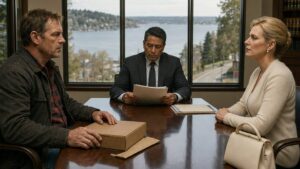
“Mr. Hall,” Elizabeth said, “we’ve convened this emergency session because an owner has installed unapproved structural material on a visible exterior feature, creating potential liability for the association.”
Jonathan remained standing. “You mean I repaired storm damage on the bridge to my house.”
A board member at the far end shifted in his chair. Ashley Lewis sat near the middle, arms folded, travel mug in front of her. She did not smile at him. She did not look away either.
Elizabeth clicked to the next photo. It showed the steel plate before the crew had pried it up, dark against the old stone.
“Temporary or not,” Elizabeth said, “this installation was made without written approval.”
“I filed a maintenance request.”
“You filed an incomplete inquiry.”
“It was incomplete because your portal sent the notice to an old address.”
Elizabeth looked down at her notes. “Contact information is the owner’s responsibility.”
Jonathan felt the room lean toward that simple sentence. It sounded reasonable. That was the thing about Elizabeth. She knew how to make a technicality sound like gravity.
He opened his folder. “The bridge cracked after last week’s storm. I have photos before and after. I have the contractor estimate. The permanent repair is scheduled.”
“After the unapproved installation.”
“After the bridge moved.”
A low murmur went through the table. Jonathan took out the photo he had printed from his phone: the old right edge, the hairline crack widened into a dark split, one stone shifted enough to catch shadow. He passed it to the closest board member, who looked at it and passed it along.
Elizabeth waited until the paper reached Ashley, then spoke again.
“No one is claiming maintenance is forbidden. The issue is process, materials, and liability. If every owner begins attaching steel hardware to visible structures and then calls it an emergency, the association loses all ability to maintain standards.”
Jonathan looked at the screen. The photo showed his bridge in a way that made it look decorative, almost ornamental. It did not show the slope from the road. It did not show how the creek cut off the house from the driveway. It did not show Mary’s bedroom with the bed lowered and the rugs rolled against the wall.
Ashley held the crack photo longer than the others. “Does the support plate change the load?”
Elizabeth turned toward her. “That is precisely why we needed review.”
Ashley looked at Jonathan. “Did you have anyone look at it before you installed it?”
“I called a contractor. He couldn’t get up here until this week. He told me to keep weight off the cracked edge if I could.”
“That’s verbal?”
“Yes.”
Elizabeth clicked again. A close-up of the rail bracket filled the screen. “This bracket was drilled into historic stonework.”
Jonathan’s jaw tightened. “Historic stonework that my father patched three times with mortar from the hardware store.”
“The visual character matters to the community.”
“My mother crossing it matters to me.”
The room quieted.
Elizabeth’s expression did not change, but Jonathan saw her fingers press lightly against the remote.
“Again,” she said, “no medical accommodation request has been approved or even properly submitted.”
Jonathan heard the word properly and felt the little failure in it find its target. He had almost made the deadline. Almost had the letter. Almost kept Mary out of it. Almost was the kind of son who could manage both dignity and paperwork without letting either one break.
Ashley set the crack photo down. “Elizabeth, did the association know there was a discharge date?”
“No verified documentation was provided.”
“That’s not what I asked.”
Elizabeth paused. “Mr. Hall mentioned his mother after enforcement began.”
Jonathan looked at Ashley then. Her question had not saved him, but it had changed the angle.
The HOA attorney, sitting near the end with a narrow laptop, cleared his throat. “The board should be careful not to treat unverified medical statements as determinative. The governing documents allow emergency removal where an unapproved alteration creates exposure.”
“Exposure to what?” Jonathan asked.
The attorney looked at him through thin-framed glasses. “Liability.”
“The rail was to prevent a fall.”
“Unapproved safety devices can also create liability.”
Jonathan let out a breath through his nose. “So if I do nothing and someone falls, that’s unsafe. If I fix it, that’s liability. If I ask permission, the portal sends the answer to the wrong address. And if I say my mother needs to cross it, she’s unverified.”
The attorney folded his hands. “I understand your frustration.”
“No,” Jonathan said. “You understand the paragraph.”
Elizabeth clicked to another slide.
This one was not his bridge. It showed a deck on another property, crooked posts, a hot tub half-covered by a tarp, caution tape tied to a railing. Jonathan had seen the place once, down near the lower road.
“Last year,” Elizabeth said, “the association was cited in an insurance review after unauthorized exterior work remained unresolved for months. We were warned that inconsistent enforcement could affect coverage.”
There it was. Not compassion, not cruelty. A premium. A prior failure. A warning passed down until it became a crew at his bridge before breakfast.
A board member muttered, “That deck was a mess.”
Elizabeth nodded. “And the board was accused of ignoring it until it became dangerous. We cannot repeat that mistake.”
Jonathan understood then why she had moved so fast. He did not forgive it. Understanding was not forgiveness. But the shape of her fear became visible: not the bridge itself, but the idea of being the person who let something slide.
Ashley leaned forward. “But this isn’t a hot tub deck. This is access to a residence.”
“Then Mr. Hall should have followed the medical accommodation process,” Elizabeth said.
Jonathan looked down at the folder. The discharge restrictions were inside. General enough to be dismissed, personal enough to feel like betrayal. He could take them out. He could put Mary’s fall risk on the table under fluorescent lodge lights for people who had never seen her force herself to stand between parallel bars with her mouth shut against pain.
His hand moved to the folder clip, then stopped.
Elizabeth noticed.
“Without documentation,” she said, softer but sharper, “the board has only what is before it: an unapproved exterior alteration, an incomplete application, and a structure whose safety has not been professionally certified.”
Jonathan lifted his eyes. “You also have a bridge your crew made less safe this morning.”
Paul Perez stood at the back wall, hat in hand. Jonathan had not realized he had come. Elizabeth turned toward him.
“Mr. Perez, the crew removed only part of the noncompliant rail.”
Paul rubbed his thumb along the bill of his hat. “We removed one rail section and loosened the plate corner.”
“Was the bridge safer before you removed it?” Ashley asked.
Paul did not answer quickly. “I’m not an engineer.”
“That’s not what I asked either,” Ashley said.
A few heads turned toward her.
Paul looked at Jonathan, then at Elizabeth. “It looked more supported before. But I was there to follow the order.”
Elizabeth’s face stayed still, but color rose high along her cheekbones.
The attorney typed something into his laptop.
Jonathan felt the room shift again, not enough to carry him, but enough to prove he was not imagining the ground under the rules.
Elizabeth closed the slide deck. The screen went blank, leaving a pale rectangle on the wall.
“The compliance chair recommends continuation of removal pending proper inspection and complete application,” she said. “The owner may submit supplemental documents for review. Until then, the fine stands.”
Ashley looked down the table. “Can we at least pause removal until the inspection?”
“The unapproved materials remain a liability,” the attorney said. “A pause may imply acceptance of the installation.”
Jonathan almost laughed. “You’re worried pausing might look like acceptance. I’m worried my mother can’t get home.”
Elizabeth’s eyes flicked toward him. For a second something moved there, not regret, not softness, but pressure. Then it was gone.
The vote happened too quickly. Two board members voted with Elizabeth. One abstained. Ashley voted no. The chair, after consulting the attorney, broke the tie in favor of continuing removal pending inspection.
Jonathan stood there while the words became official.
His phone buzzed in his pocket.
He looked down and saw a message from the rehab center.
Transport confirmed for Mary Hall tomorrow, 9:30 a.m. Please ensure safe exterior access before arrival.
He showed the screen to Ashley without thinking.
She read it, and her face changed.
Across the table, Elizabeth gathered her folder and said, “Removal may continue at eight.”
Chapter 5: The Morning His Mother Could Not Cross
The transport driver stopped at the bridge and said, “I can’t take her over that.”
Jonathan stood on the stone arch with one hand hovering near the open side where the rail had been. The empty bolt holes stared up from the stone, bright raw circles where the brackets had been. The steel plate still covered the cracked edge, but one corner sat raised, and without the rail the drop to the creek looked wider than it had the day before.
Behind the driver, in the transport van, Mary sat in her wheelchair with a blue blanket folded over her knees.
She was dressed to come home. That detail nearly undid him. Her gray sweater. Her hair pinned back. The small canvas bag on her lap with the book she had pretended to read at rehab. She looked past the driver, past Jonathan, straight to the bridge.
“Mr. Hall,” the driver said, not unkindly, “we’re not authorized to cross uneven exterior access without side support. Especially with that open edge.”
“It’s temporary,” Jonathan said.
The driver looked at the missing rail section in the truck ruts near the grass, where Paul’s crew had left marks the morning before. “That’s the problem.”
Jonathan turned toward the house, as if another path might have appeared overnight. There was none. The creek curved hard below the bridge, deep from rain. The old footstones downstream were slick and narrow, good for a teenager with fishing boots, useless for a wheelchair. The hill behind the house rose too steeply for vehicle access. His home sat twenty yards away and might as well have been across a county line.
Mary’s voice came from the van. “Jonathan.”
He went to her.
Up close, he saw what the ride had cost her. She had put on lipstick. Her hands were folded on the blanket, but the left one trembled faintly at the thumb. She saw him see it and moved that hand under the canvas bag.
“Don’t start,” she said.
He crouched beside the van lift. “I’m going to fix it.”
“You said that yesterday.”
“I’m still saying it.”
“That’s not the same thing.”
The driver pretended to check the straps on the wheelchair. Jonathan appreciated the mercy of that small lie.
From the road, tires crunched on gravel. Jonathan stood. Ashley Lewis got out of her car first, phone in hand, face tight with something that looked like worry she had not planned to show. A moment later, Elizabeth’s SUV pulled in behind her.
Jonathan felt his body go still.
Elizabeth stepped out in a pale coat over dark slacks this time, no red suit, though the red folder in her hand did the same work. She looked from the van to the bridge to Mary.
“I was told transport arrived,” Elizabeth said.
Jonathan walked toward her. “You told them removal could continue.”
“Removal was paused pending scheduling this morning.”
“The rail is gone.”
“Your unapproved rail was partially removed yesterday.”
“Enough to stop her from getting home.”
Elizabeth’s eyes moved to Mary again. Jonathan hated the calculation in that glance, the way Mary became evidence and complication at once.
Ashley came closer to the bridge. She did not speak at first. She stepped onto the stone carefully and looked at the open edge. Then she placed one hand near the missing rail, as if testing what the body reached for when balance became uncertain.
“This is the only way in?” she asked.
Jonathan nodded.
“No rear drive?”
“No.”
“Service access?”
“Not for a chair. Not for a van.”
Elizabeth said, “This demonstrates exactly why uncertified modifications are dangerous.”
Jonathan turned to her slowly. “No. This demonstrates what happens when you remove the thing that made it passable.”
“The transport driver cannot cross because the bridge is in an altered and uncertified state.”
“He can’t cross because your crew took off the rail.”
“The rail was unapproved.”
Mary spoke from the van, and everyone turned.
“You keep saying that word like it’s a handrail.”
The driver looked down. Ashley’s mouth tightened.
Elizabeth stepped toward the van. “Mrs. Hall, I’m sorry for the inconvenience. The association is trying to ensure—”
“Don’t,” Mary said.
The word was not loud. It did not need to be.
Elizabeth stopped.
Mary’s face had gone pale around the mouth, but her eyes were clear. “I spent three weeks learning how to stand up without apologizing for how long it took. I am not discussing my body in a driveway with strangers because you don’t like the look of metal.”
Jonathan looked away first.
That was his mother. Proud enough to cut herself on it.
Ashley moved beside the van. “Mrs. Hall, did you know Jonathan had filed a repair request?”
Mary glanced at Jonathan. “I knew he was fixing the bridge.”
“Did you ask him not to submit medical details?”
Mary’s hand tightened on the canvas bag. “I asked him not to make me a case.”
Elizabeth opened the folder. “And that is precisely why the board had no verified basis to consider accommodation.”
Jonathan stepped between Elizabeth and the van before he had fully decided to move. “Stop.”
The deputy was not there today. No uniform stood between them. The absence made the scene feel more dangerous, though no one raised a hand.
Elizabeth looked at him. “Mr. Hall.”
“You do not get to use my mother’s pride as your defense.”
“And you do not get to bypass a process because you chose not to submit necessary information.”
The sentence struck because part of it was true.
Jonathan felt it in the silence after. Mary had asked him not to. He had agreed because agreement felt like love. He had told himself the deed, the crack, the contractor estimate, the photographs would be enough. He had kept her out of the file because she had asked to remain a person.
And the result was the van idling at the wrong side of the bridge.
Ashley’s phone was in her hand, but she was not recording. She was looking at the empty bolt holes.
“Elizabeth,” she said, “did the board vote after seeing this exact access condition?”
“The board voted based on available documentation.”
“That’s also not what I asked.”
Elizabeth’s voice sharpened. “Ashley, we cannot run an association on emotional scenes in driveways.”
Mary laughed once, dry and small. “Honey, I wish this were emotional. It’s mostly humiliating.”
Jonathan turned back to the van. “Mom.”
“No.” Mary lifted her chin. “She should hear that too.”
The driver cleared his throat. “I have to call dispatch. If we can’t complete transfer, I need instructions.”
“Give me ten minutes,” Jonathan said.
“I can give you five.”
Jonathan went to the back of the van where the discharge folder sat in a plastic sleeve. He removed the papers with hands that did shake now. General restrictions. Fall risk. Assisted transfer. Avoid uneven surfaces without stable support. It was all there, plain enough for any person with sense, insufficient enough for any process built to reject what was not stamped in the right format.
He looked at Mary.
She looked back, and for the first time he saw fear on her face without anger covering it quickly enough.
Not fear of pain. Not even fear of falling. Fear of being sent away from a house she could see.
Jonathan took the pen from the driver’s clipboard.
“Where do I sign?” he asked.
Mary’s lips parted.
“Jonathan.”
“No,” he said gently. “You were right to not want it this way. I was wrong to think I could protect you by keeping everyone blind.”
He signed the medical release on the hood of the transport van. The driver gave him the number for the rehab coordinator. Ashley stepped away and made a call of her own, voice low, urgent. Elizabeth stood apart, folder held against her like a shield that had become too small.
Within ten minutes, the rehab center faxed the accommodation letter to Jonathan’s phone and Ashley’s email. Within twelve, Ashley had reached the county inspection office. Within fifteen, the driver received permission to return Mary to rehab temporarily rather than leave her in the driveway.
Mary did not argue when the lift began to rise.
That was worse.
Jonathan stood below her as the platform carried her back into the van.
“I’ll get you home,” he said.
Mary touched the edge of the canvas bag. “Then stop trying to do it alone.”
The van doors closed.
Jonathan watched it pull away, then turned to Elizabeth.
“I want an emergency county inspection today.”
Elizabeth looked at Ashley. “The association has not requested—”
“I have,” Jonathan said. “And this time, Mary Hall is in the paperwork.”
Chapter 6: The Inspection Changed The Meaning Of The Fine
The county inspector knelt beside the empty bolt holes and asked, “Who authorized removal before inspection?”
No one answered.
Jonathan stood on the road side of the bridge with his folder under one arm and his phone in his hand, recording again. Across from him, Elizabeth held the red folder lower than usual. Ashley stood near the inspector, watching his tape measure catch in one of the raw circles where the rail bracket had been. Paul Perez waited by his truck, the removed rail section still in the bed, its brackets attached like broken handles.
The inspector ran his fingers over the scrape mark where the steel plate had been pried upward. He did not look impressed. He did not look angry either. He looked like a man who preferred materials to opinions.
“This plate was installed after storm damage?” he asked.
“Yes,” Jonathan said.
“By you?”
“Yes.”
“Temporary?”
“Yes. Permanent contractor scheduled this week.”
The inspector glanced at the cracked stone edge. “And removal began yesterday morning?”
Jonathan looked at Paul.
Paul looked at Elizabeth.
The inspector noticed. “I’m asking whoever knows.”
Paul took his hat off. “My crew started at around seven forty-five yesterday.”
Elizabeth said, “Work commenced under emergency enforcement authority.”
The inspector kept his eyes on Paul. “Was the owner present when work began?”
“No,” Paul said.
“Had he signed receipt of the removal notice?”
“No.”
Elizabeth’s head turned sharply. “Mr. Perez, the notice was placed at the residence.”
Paul rubbed the back of his neck. “After we arrived.”
Jonathan heard Ashley inhale.
The inspector stood, knees popping slightly, and walked to the truck bed. “This the removed rail?”
Paul nodded.
“Was it loose before removal?”
“No.”
“Damaged?”
“No.”
“Obstructing passage?”
Paul looked at Jonathan, then down at the rail. “No.”
Elizabeth stepped closer. “The issue was not whether the rail was physically damaged. The issue was that it was unapproved, visually inconsistent, and potentially unsafe because it had not been reviewed.”
“Potentially,” the inspector said.
“Yes.”
He looked back at the bridge. “And now the open edge is actually unsafe.”
Elizabeth’s mouth closed.
Jonathan did not allow himself to react. Not with satisfaction. Not with anger. He had learned in the last two days that visible emotion became material other people used to build their own version of events. He kept the phone steady.
The inspector walked the bridge slowly. He tested the plate with his boot but did not put full weight near the raised corner. He leaned over the cracked edge, looked at the water below, and then stepped back to the road side.
“Mr. Hall, why did you install the plate where you did?”
Jonathan crouched and pointed, careful to keep his hand away from the edge. “The crack opened after the storm. Before the plate, that stone shifted under load here. The plate spreads weight back toward the center. The rail gave support on the open side.”
“You an engineer?”
“No.”
“Contractor?”
“No.”
Elizabeth’s eyes lifted slightly.
Jonathan felt the trap in the simple truth, but he stayed in it. “I’ve maintained this bridge since my father died. I know that doesn’t give me a license. It gave me enough sense not to leave it as it was.”
The inspector looked at him for a second longer than necessary. “Fair answer.”
Elizabeth said, “But still not approval.”
“No,” the inspector said. “Not approval.”
Jonathan felt the small rise of hope settle back down.
The inspector opened his tablet. “County is not here to settle HOA covenants. I’m here for safety access. Right now, this crossing is not acceptable for assisted wheelchair transport because the open side lacks stable support and the plate has been disturbed.”
“Disturbed by the removal crew,” Ashley said.
The inspector looked at her. “That is what the physical marks suggest.”
Elizabeth’s voice stayed controlled. “The association acted to remove an unapproved installation that itself had not been certified.”
“And created a condition that now requires correction before residential access can be considered safe.” He tapped something into the tablet. “Was there a medical access notice before removal?”
Elizabeth said, “No complete medical accommodation request was on file.”
Jonathan said, “A general discharge restriction was uploaded before noon yesterday.”
“After the removal began,” Elizabeth said.
The inspector raised a hand slightly, not to silence them like children, but to stop the overlap. “I want the timeline.”
Jonathan opened his folder. He had printed everything because paper could not lose signal at the creek. “Crew arrived around seven forty-five. I began recording at seven fifty-two. Notice handed to me after that. Emergency appeal deadline noon. I attempted upload before noon. Portal closed while the submission was processing. Medical release signed this morning after transport refusal. Provider letter received at ten sixteen.”
The inspector took the papers. “Recording shows notice handed after work began?”
“Yes.”
Elizabeth looked at the phone in Jonathan’s hand, then at the deputy’s absence, as if wishing yesterday had produced fewer witnesses.
Paul shifted near the truck. “That’s how it happened.”
Everyone looked at him.
Paul’s face reddened beneath his work tan. “I’m not trying to get in the middle. But we were unloading when Ms. Moore came up from the road. The paper wasn’t on the door when I got there. One of my guys put it there after.”
Elizabeth spoke carefully. “At my instruction, because the owner was not immediately present.”
“You began removal without him,” Ashley said.
“The governing documents allow emergency action.”
The inspector looked up from the papers. “What was the emergency?”
Elizabeth opened her folder. “Unapproved exterior structural modification creating liability exposure.”
“Was the bridge in imminent danger of collapse?”
“We had no certification either way.”
“Was there a complaint of injury?”
“No.”
“Was there a county order to remove?”
“No.”
The inspector made another note.
Jonathan watched Elizabeth’s grip tighten on the folder. For the first time, he could see the machinery behind her composure: all the warnings she must have received after the hot tub deck, all the emails about consistent enforcement, all the invisible fingers pointing at her if something went wrong. She was wrong. She had harmed them. But she was not improvising cruelty. She was clinging to a rule hard enough to turn it into a weapon.
The inspector handed the papers back to Jonathan. “Here’s where we are. The temporary support may have reduced risk before it was disturbed. I can’t certify the whole repair without engineering review, but I can say removal increased the immediate access hazard.”
Jonathan exhaled once.
Elizabeth said, “What does that mean practically?”
“It means practically,” the inspector said, “someone either restores stable side support before this bridge is used for assisted transport, or the bridge is blocked entirely until a safe alternative or permanent repair is approved.”
Jonathan looked toward the house.
Blocked entirely. The words landed like boards across the doorway.
Ashley stepped closer. “Can the rail be restored today?”
Paul looked at the truck bed. “Yes. If authorized.”
Elizabeth’s face turned toward him. “By whom?”
The inspector answered before Paul could. “By whoever has authority over access safety. I’m issuing a temporary safety order. Restore the rail to a stable condition by nightfall under temporary emergency access, or block the crossing from use.”
Elizabeth’s voice sharpened. “The HOA has not approved emergency access modification.”
“Then the HOA can explain why it prefers a blocked residence with a medically documented access need.”
Silence spread out from that sentence.
Jonathan did not mistake it for victory. The inspector had not approved his permanent repair. He had not erased the covenant. He had not declared the HOA powerless. He had handed everyone a narrower, harder question: restore the thing or make the house unreachable.
Ashley looked at Elizabeth. “We need another vote.”
“The board already voted.”
“Before the inspection.”
“The attorney will need to review the order.”
“The rail has to be restored by nightfall.”
Elizabeth looked at the bridge, at the rail in Paul’s truck, at Jonathan’s phone, still recording. For one moment, the red folder sagged in her hand.
Then she straightened. “The board will meet tonight.”
Jonathan lowered the phone just enough to meet her eyes. “My mother already lost one ride home.”
The inspector tore a printed notice from his portable machine and signed it against his clipboard. He handed one copy to Jonathan and one to Elizabeth.
“Nightfall,” he said.
Down in the creek, water struck stone with the steady patience of something that had seen every kind of human argument and kept moving anyway.
Chapter 7: The Vote Was Not About The Bridge Anymore
Jonathan placed Mary’s medical letter on the table beside the $350 violation notice, and for once no one reached for the fine first.
The lodge was colder at night. Someone had turned off half the overhead lights, leaving the board table bright and the corners dim. Outside the windows, the creek road was a black strip between trees. Down below, the bridge waited under temporary work lights, the rail still in Paul’s truck, the inspector’s order ticking toward nightfall with every minute the board spent deciding whether a woman could enter her own home.
Elizabeth sat across from Jonathan, red folder closed in front of her. The HOA attorney sat two chairs away, laptop open. Ashley stood instead of sitting, one hand on the back of her chair.
“Before we begin,” the attorney said, “the board should understand that emergency restoration does not equal approval of the owner’s installation.”
Jonathan looked at him. “The inspector didn’t ask you to approve my pride. He asked you to make the bridge safe enough to use.”
Elizabeth’s gaze moved to the medical letter. “No one is disputing that Mrs. Hall has a documented access concern.”
Jonathan almost answered. Then he stopped. Two days ago, he would have snapped that it was not a concern, it was his mother. Tonight, he knew the board would only write down the snap and ignore the reason.
Ashley picked up the provider letter. “It says stable side support is required for assisted wheelchair transport across exterior uneven access.”
“It also does not name the bridge,” the attorney said.
Jonathan gave him the transport refusal note. “That does.”
The attorney read it, then set it down carefully.
Elizabeth opened her folder at last. “The association’s position remains that Mr. Hall acted without approval. If the board allows owners to install first and justify later, we lose control of exterior safety.”
“You already lost control of safety,” Ashley said. “When the rail came off.”
A board member shifted. “Ashley.”
“No. We keep calling this exterior appearance because that’s the form we know how to use. But the county order is about access.”
Elizabeth’s voice sharpened, but not loudly. “And access structures can be unsafe if installed improperly.”
Jonathan said, “Then inspect it. Don’t tear it down before my mother gets home.”
Elizabeth looked at him then, and for the first time that evening her composure showed strain. Not collapse. Strain. “Mr. Hall, after last year’s incident on the lower road, our insurer made it clear that delayed enforcement of unapproved structures could affect the entire community. I was appointed compliance chair because the prior board let things slide until they became expensive.”
“The hot tub deck,” Ashley said.
“Yes. The hot tub deck. Unpermitted supports, exposed wiring, and six months of ignored notices.” Elizabeth touched the folder with two fingers. “Owners said it was temporary. They said it was safe. They said the HOA had no right to interfere. Then the insurance review came, and every homeowner in this room was at risk of higher premiums.”
Jonathan heard the effort in her voice. She was not asking to be liked. She was asking them to see the rule the way she saw it: a fence built after one animal had already escaped.
He could have attacked that. He wanted to. Instead he looked at the $350 notice.
“My bridge isn’t their deck,” he said. “And my mother isn’t your precedent.”
Elizabeth’s eyes dropped.
The attorney leaned forward. “A possible compromise would be to suspend additional fines while the owner submits a full architectural review package. The board can revisit emergency access modification within fourteen business days, with no admission of procedural error.”
Jonathan felt Ashley look at him before he fully understood what had been offered.
Fourteen business days.
No admission.
Mary in rehab or somewhere else while the board protected the shape of its own sentence.
“No,” he said.
The attorney blinked. “Mr. Hall, this would prevent further enforcement while preserving the association’s position.”
“It preserves your position. It doesn’t preserve access.”
“It is a reasonable procedural pause.”
“My mother lost her ride home this morning.”
“We are trying to avoid compounding liability.”
Jonathan put his hand on the medical letter. He did not lift it. He just pressed two fingers against the page to keep it flat.
“I need to say something clearly,” he said.
The room stilled.
He did not look at Mary’s letter while he spoke. “I did not submit this sooner because my mother asked me not to. She worked all her life. She paid off that house with my father. She knows every stone in that bridge because she carried groceries across it, hauled firewood across it, walked me across it when I was too small to be trusted near the creek. After surgery, after rehab, after learning how to get from a chair to a bed without falling, she wanted to come home as Mary Hall, not as an attachment in an HOA portal.”
No one interrupted.
Jonathan kept his voice even. “I thought I could honor that and still fix the problem. I thought the deed, the crack, the photos, the contractor estimate, and common sense would be enough. That was my mistake. But your mistake was taking the rail off before you knew who needed it.”
Ashley lowered her eyes.
Elizabeth did not.
Jonathan turned the fine notice so it faced the board. “This says unauthorized alteration. It should say you fined a man for trying to keep his mother from stopping at the edge of her own driveway.”
The attorney started to speak, but Ashley cut in.
“I assumed you were avoiding process,” she said.
Jonathan looked at her.
“At first,” she continued. “Yesterday, I thought this was another owner deciding the rules were optional because he had tools and confidence. I’ve seen that before.” She glanced at Elizabeth. “We all have. But this morning I stood on that bridge and reached for a rail that wasn’t there. I’m not in a wheelchair. I’m not recovering from surgery. I still reached for it.”
A board member at the end of the table rubbed his forehead. “What are you proposing?”
Ashley picked up the inspector’s order. “Withdraw the fine. Authorize immediate restoration of the temporary rail and support plate under emergency accommodation, subject to county inspection and permanent repair review. Require a stamped plan for the permanent fix. And revise the enforcement procedure so physical removal doesn’t begin before documented notice and appeal unless there is an actual county safety order.”
Elizabeth sat back slightly. “That is a significant policy change proposed under emotional pressure.”
Ashley’s face tightened. “No. It’s a narrow correction under factual pressure.”
The attorney murmured, “The board can authorize temporary emergency access without conceding improper enforcement, but withdrawing the fine may be seen as—”
“As what?” Jonathan asked. “Admitting the wrong sentence was written on the wrong day?”
Elizabeth looked at the attorney, then at the board.
For the first time, she did not answer immediately.
One of the unnamed board members, the one who had muttered about the deck the night before, leaned forward. “Elizabeth, did you know the crew started before he signed the notice?”
Elizabeth’s lips parted, then closed.
“That’s a yes or no,” Ashley said.
Elizabeth’s voice was lower now. “I knew the notice would be placed that morning. I understood the crew would begin once notice was posted.”
“Before he had a chance to respond,” Ashley said.
“Under emergency enforcement authority.”
“But there was no county emergency.”
Elizabeth’s hand moved to the folder, then stopped. “There was an insurance concern.”
“That is not the same thing,” Ashley said.
The words hung there, familiar in their shape. Jonathan thought of what he had told Elizabeth by the bridge: an HOA work order was not a court order. A concern was not an emergency. A rule was not a handrail.
The attorney removed his glasses. “The board needs to vote.”
Elizabeth stared at the closed red folder.
Jonathan waited.
Ashley made the motion.
One board member seconded it.
The first vote came from Ashley. “Yes.”
Then the board member beside her. “Yes.”
The one who had abstained the night before looked at Elizabeth, then at the medical letter, then at Jonathan. “Yes.”
Elizabeth’s face held steady, but something in the room had already moved past her.
The final board member hesitated. “Yes, with permanent review required.”
The attorney looked at Elizabeth. “As compliance chair?”
Elizabeth did not speak for several seconds.
Then she said, “I abstain.”
Ashley exhaled.
The attorney began typing the resolution. Paul, waiting near the back wall with his cap in both hands, straightened when he heard the words immediate restoration.
Jonathan looked down at the table. The $350 notice still lay beside Mary’s letter. One paper called him in violation. The other explained why the violation had never been the whole truth.
Ashley turned to the room. “Then I’m asking the board to authorize Paul Perez to restore the rail tonight.”
The attorney looked up. “We should document the vote separately.”
“Document it,” Ashley said. “Then call the vote.”
Chapter 8: The Bridge Was Repaired Under A Different Rule
Jonathan returned to the bridge and saw Paul unloading the same rail he had removed.
For a moment he stood at the edge of the work lights and did not step forward. The creek flashed silver in the dark below. The rail came out of the truck bed with a scrape he recognized from the wrong morning, but now Paul carried it toward the bridge instead of away from it. Two workers followed with the bucket of bolts.
Ashley stood near the road, phone to her ear, repeating the resolution language to someone from the county office. Elizabeth stood apart with the red folder tucked under one arm. The folder was thinner now, or maybe it only looked that way because it no longer decided everything.
Paul saw Jonathan and stopped. “We can set it back into the same holes.”
Jonathan nodded.
“I’ll need you to check the alignment before we tighten.”
Another nod.
Paul waited. “Mr. Hall, for what it’s worth, I should’ve stopped when you asked for the order.”
Jonathan looked at the rail in Paul’s hands. The apology was not big enough for what had happened. It was also not nothing.
“Put it back straight,” Jonathan said.
Paul accepted that.
They worked under the lights with the inspector’s temporary order clipped to Paul’s clipboard and the HOA resolution emailed to everyone twice. Jonathan did not stand aside. He held the rail level while Paul set the first bolts. He checked the plate corner and watched the washers bite down. He ran his thumb along the stone where the bracket had scraped it and felt the fresh scar beneath the metal.
Elizabeth came closer only after the first section was secure.
“The fine withdrawal has been drafted,” she said.
Jonathan did not look up from the bolt he was checking. “Drafted or signed?”
A pause.
“Signed.”
She held out a paper.
He took it, folded it once, and put it in his jacket pocket without reading it there in front of her. He had spent two days letting papers decide the visible shape of his anger. He would read this one at his kitchen table.
Elizabeth looked at the bridge. “The permanent repair still requires review. The board will require stamped specifications.”
“I know.”
“The material finish may need adjustment.”
“I know.”
She seemed almost unsettled by his refusal to fight that part.
Jonathan stood and faced her. “I’m not asking to decorate the bridge.”
“No,” Elizabeth said. “I understand that now.”
It was not an apology. Her voice did not offer one. But the sentence cost her something. He could hear it.
Ashley ended her call and came over. “County will recheck in the morning. If the rail is stable and the plate is secured, transport can attempt again.”
“Attempt,” Jonathan repeated.
“Official word,” Ashley said. “Not mine.”
By the time Paul finished, the bridge looked almost like it had before the first truck arrived, except Jonathan knew every place where removal had marked it. The rail was back. The plate lay flat. The anti-slip strips crossed the stone in dark bands. It was temporary, imperfect, documented, and standing under a different rule.
The next morning, Mary’s transport van arrived twenty minutes early.
Jonathan was already at the bridge. He had checked each bolt twice before sunrise. The county inspector arrived with coffee in a paper cup, stepped onto the bridge, tested the rail with both hands, and made notes without ceremony. Ashley arrived next. Elizabeth came last, wearing a dark coat and carrying no red folder, only a single envelope.
The inspector signed the temporary access clearance on the hood of Jonathan’s truck.
“Permanent repair inspection still required,” he said.
“Yes,” Jonathan said.
The inspector looked at him over the paper. “Don’t wait on that.”
“I won’t.”
The van doors opened.
Mary sat inside with the same blue blanket over her knees and the canvas bag on her lap. She looked at the bridge, then at Jonathan. Her eyes moved to the rail. She did not thank him. Not there, not in front of everyone.
“Looks crooked,” she said.
Jonathan almost smiled. “It’s level.”
“Your father also said things were level.”
Paul, standing near the truck, looked down quickly and hid a smile badly.
The driver lowered the lift. This time, when he looked at the bridge, he did not refuse. He checked the inspector’s clearance, checked the rail, and positioned himself behind Mary’s chair.
Jonathan walked beside them.
Halfway across, Mary reached for the rail.
Her hand closed around the metal, and the whole scene narrowed to that: her fingers, thin but firm, gripping something that had been called unauthorized, unapproved, noncompliant, a liability, an alteration, a violation. She did not know how many times it had been named by people who were not the ones who needed it. Or maybe she did, and she chose not to give those names any more space.
At the far side of the bridge, she paused.
Jonathan bent slightly. “You all right?”
Mary looked toward the house. The porch light was still on though the morning had come. Her room waited beyond the front window. The creek kept moving behind them.
“I’m home,” she said. “That’s different from all right.”
He nodded because he understood the distinction.
Ashley stayed back near the road. Elizabeth stood beside her, hands folded in front of her. When Mary’s chair reached the porch path, Elizabeth opened the envelope and removed a copy of the signed withdrawal.
“Mr. Hall,” she said.
Jonathan turned.
Elizabeth held it out. “For your records. The violation has been withdrawn. The emergency accommodation procedure will be reviewed at the next board meeting.”
Mary looked at the paper, then at Elizabeth. “Will reviewed mean changed?”
Elizabeth met her eyes. “It will mean written down more carefully.”
Mary considered that. “Careful is fine. Just don’t confuse it with kind.”
Elizabeth lowered the paper slightly.
Jonathan expected defensiveness. He had grown used to it, the quick return to procedure. But Elizabeth only nodded once.
“No,” she said. “I won’t.”
It was still not enough to undo the missed ride, the driveway humiliation, the rail in the truck. But it was something more useful than performance. It was a rule beginning to bend toward the person it had ignored.
The permanent repair took three weeks to approve.
There were compromises. The final rail had a darker finish to match the stone. The steel support was replaced by a reinforced under-plate the contractor could certify. The anti-slip strips stayed because the inspector refused to approve removal without an equivalent. Jonathan filled out every form. He attached every required page. He hated parts of it and did them anyway.
Mary kept the first clearance paper in the drawer beside her chair.
The withdrawn $350 notice, Jonathan kept somewhere else.
On the day the permanent repair passed inspection, he walked back to the kitchen after everyone left. Mary was by the window with tea cooling in her hand, watching the bridge the way people watch a road that has taken something from them and brought something back.
Jonathan opened the discharge folder. Behind the transport papers, the provider letter, and the county clearance, he slid the withdrawn violation notice into the back.
Mary noticed. “You keeping that?”
“Yes.”
“Why?”
He looked through the window. The bridge sat in the late light, patched stone and dark rail, not pretty in the old way but solid.
“So I remember what a form can do,” he said. “And what it can’t.”
Mary took a slow drink of tea. “That sounds like something I’d say.”
Jonathan smiled then, small and tired. “I probably learned it crossing that bridge.”
Outside, the creek moved under the repaired arch. The rail held steady in the wind. And when Mary stood later with her walker and crossed halfway to feel the sun on the stone, Jonathan walked beside her without touching her elbow until she asked.
The story has ended.