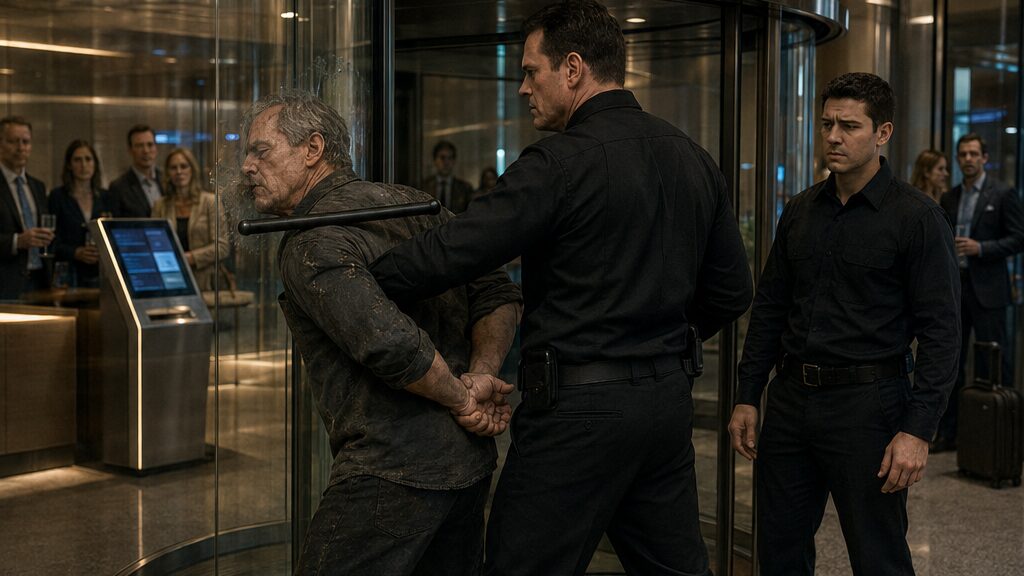
They Slammed the Old Worker Into Glass Before Learning Why He Entered First Class
Chapter 1: The Man Outside the Revolving Glass Door
The baton struck the stainless-steel doorframe with a hard metallic crack.
“That entrance is not for workers.”
Samuel Martin stopped beneath the sensor of the revolving glass door. It had already begun to turn, then halted with one curved panel between him and the carpeted reception area.
The man holding the baton wore a dark security uniform tailored too sharply for ordinary airport work. His badge identified him as Eric King, Head of Security. He stood with his feet wide, the baton loose in one hand, as though the polished entrance belonged to him personally.
Samuel lowered his eyes to his clothes. Oil darkened one sleeve of his gray work shirt. Dust marked the knees of his trousers. The leather of his boots had cracked years ago, though he had polished them that morning out of habit.
Beyond the glass, a server carried crystal tumblers beneath warm amber lights. Travelers rested in cream-colored chairs, their luggage aligned beside them like obedient animals. The lounge had been designed to make noise disappear.
Even the humiliation at its entrance seemed expected to remain quiet.
“I need to enter,” Samuel said.
Eric’s gaze traveled from Samuel’s gray hair to his boots.
“Maintenance uses the service corridor.”
“I’m not here for maintenance.”
That answer drew a glance from the young guard standing several feet behind Eric. His nameplate read Frank Gonzalez. He looked no older than thirty, and his hand hovered near his radio without touching it.
At the reception desk, an attendant in a navy uniform went very still.
Samuel recognized her from the employee roster he had reviewed before leaving his hotel. Nancy Roberts. Contract staff. Eleven months at the lounge. No disciplinary record. Three shift changes in six weeks.
She stepped from behind the desk before Eric could speak again.
“Sir,” she said softly to Samuel, “the public seating area is farther down the terminal. There are charging stations near Gate Forty.”
The words were polite. Her eyes were not dismissive. They were warning him.
Samuel studied her face. “I’m not looking for a charging station.”
Nancy’s fingers tightened around the tablet she carried.
“This area requires verified access.”
“I understand.”
“Then you should have your credential ready,” Eric said.
Samuel did have one. A black executive access card rested inside the lining of his work jacket. It could unlock every company-operated facility in the airport. Christopher Williams, the conglomerate’s National Security Chief, had argued that Samuel should wear a concealed emergency transmitter as well.
Samuel had refused it.
He had wanted an ordinary entrance, an ordinary complaint, and an ordinary response.
For three months, anonymous reports had reached a private address rarely used outside the executive office. They described passengers turned away despite valid access, contract workers searched without cause, and travelers followed through the terminal because their clothes did not match the lounge’s image.
The reports had no signatures. Internal reviews had found no misconduct.
Every review used nearly the same phrase: Necessary action taken to preserve the premium environment.
A man in a faded brown jacket approached the lounge while Samuel stood outside it. He held a First Class boarding pass and a worn canvas bag repaired with silver tape.
Eric looked at the boarding pass, then at the bag.
He did not ask a question. He simply lifted the baton and pointed toward the public concourse.
The traveler hesitated. “My airline told me—”
“Customer service is near Gate Thirty-Seven.”
“I have access.”
“You can confirm it with them.”
The traveler looked past Eric at the silent reception staff. No one moved. After a moment, he folded the boarding pass and walked away.
Samuel watched him disappear into the terminal crowd.
“Was his credential invalid?” Samuel asked.
Eric turned slowly. “That has nothing to do with you.”
“He showed you a boarding pass.”
“He was redirected.”
Nancy’s expression tightened.
Samuel faced her. “Is that what you call it?”
She swallowed. “People who create uncertainty at the entrance are redirected before they disturb the premium environment.”
The exact sentence from the second anonymous report.
Not similar. Exact.
Samuel felt the old, familiar pressure beneath his ribs. Decades earlier, before hotels and airport contracts and boardrooms with glass walls, he had entered buildings through loading docks. Men in suits had handed him tools without looking at his face. Once, after repairing a hotel boiler through the night, he had tried to drink coffee in the lobby and been ordered outside before the manager learned who had prevented the evacuation of three hundred guests.
He had remembered the insult.
He had trusted his company to remember it too.
Eric tapped the baton against his thigh. “You’ve been told where to go.”
Samuel looked through the revolving door. Its curved surface returned several versions of him at once: bent by the glass, divided by stainless-steel lines, trapped between the public terminal and the light inside.
“Open the door,” he said.
Frank shifted his weight. Nancy looked down at her tablet.
Eric smiled without warmth. “Show me a First Class boarding pass.”
“No.”
“A membership credential.”
“No.”
“Then leave.”
Samuel stepped fully into the sensor zone.
The door tried to rotate. Eric thrust the baton between the moving panel and the frame. The safety mechanism engaged with a low mechanical alarm, locking Samuel inside the shallow glass compartment.
Several guests turned toward the sound.
“What is your name?” Eric asked.
Samuel could have ended it there.
He could have removed the black card, watched Eric’s face change, and walked inside to apologies, bottled water, and carefully arranged explanations. The executive team would dismiss one man, write a report, and polish the glass before morning.
Instead, Samuel kept his hands at his sides.
“I asked to enter,” he said.
“And I refused.”
“On what grounds?”
“You have no credential.”
“You didn’t verify that.”
“You refused to present one.”
“You redirected the last man after he presented his.”
Frank looked toward the terminal where the traveler had vanished.
Eric’s jaw hardened. “Frank.”
The younger guard straightened.
“Search him.”
Nancy took one step forward. “Mr. King, he hasn’t—”
“Return to your station.”
“He hasn’t threatened anyone.”
Eric removed the baton from the door, but kept it held horizontally across Samuel’s path.
“No,” Eric said. “He has chosen not to cooperate in a protected area.”
The revolving door remained locked. Samuel stood inside the curved glass, surrounded by his own distorted reflections.
Frank approached him slowly.
“Sir,” he said, keeping his voice low, “place your hands where I can see them.”
Samuel looked at the young guard, then at Eric.
He could still reach the card inside his jacket.
He left it where it was.
Chapter 2: The Search Performed for Wealthy Eyes
“He looks like a thief,” Eric announced. “Frisk him.”
The words carried through the reception area with greater force than the alarm had. Conversation stopped behind the glass. A woman holding a champagne flute turned in her chair. Two businessmen near the buffet stared openly.
Frank’s face changed, but only for a second.
“Sir,” he said to Samuel, “turn toward the glass and keep your hands visible.”
“What action made me a theft suspect?” Samuel asked.
Eric glanced toward the watching guests. “Your refusal to follow lawful security instructions.”
“That began after you decided I didn’t belong here.”
“You entered a restricted area without credentials.”
“I stepped under a door sensor.”
“You attempted unauthorized access.”
Samuel looked at the security cameras fixed above the entrance. One faced the revolving door. Another covered the check-in kiosks. A third pointed toward the reception desk.
The complaints had said the cameras never showed enough.
He wondered who controlled what remained.
Frank came closer. “I don’t want this to become difficult.”
“It already is,” Samuel said.
Frank began with Samuel’s outer pockets. His movements were cautious, almost apologetic, but he did not stop.
Eric stood behind him with the baton displayed across both palms.
The curved glass threw Samuel’s image back in fragments. In one panel, he appeared broad and upright. In another, the angle shortened him into a stooped old laborer. Behind every reflection stood someone wealthier, cleaner, and safely separated from him.
Frank removed a stained work glove from Samuel’s right pocket.
Eric gave a short laugh. “Maintenance.”
Samuel said nothing.
From the left pocket came a small folding ruler, an airport access schematic, and a pencil worn flat along one side.
Frank opened the paper.
The diagram showed the lounge entrance, electrical isolation points, emergency access routes, and the service panel beneath the touchscreen kiosks.
Eric seized it from him.
“Well,” he said. “Now we know why he’s here.”
“It’s a facilities schematic,” Frank said.
“It maps every controlled entry point.”
“It also has equipment numbers.”
Eric held it up for the guests to see, though none could have read it from where they sat. “Possible theft preparation. Maybe sabotage.”
Samuel looked at him. “Which stolen object were you expecting to find in my pockets?”
Eric folded the paper once. “People planning theft don’t always arrive with stolen property.”
“So the absence of evidence supports your accusation.”
“You brought restricted technical information.”
“Is it marked restricted?”
Eric examined the page. It was not.
Frank’s hand paused at Samuel’s jacket.
“Continue,” Eric said.
Frank found nothing else in the outer pockets. His fingers moved toward the inside lining where the executive card rested.
Samuel caught his wrist.
He did not squeeze. He merely stopped the hand.
Frank’s eyes lifted to his.
“Remove your hand,” Eric said.
“State the basis for searching inside my clothing.”
“I already did.”
“You called me a thief because of how I look.”
“I called you a risk because of how you behaved.”
Samuel nodded toward the lounge. “Would you have searched me if I wore one of their suits?”
A few guests looked away.
Eric’s face reddened. “I protect everyone inside that room.”
“From old men in work shirts?”
“From anyone who refuses screening.”
Nancy moved from behind the desk again. “Mr. King, the entrance log shows no access breach.”
Eric did not turn. “Move the guests away from the disturbance.”
A new voice answered before Nancy could.
“That is exactly what we’re going to do.”
Susan Lee crossed the lounge in a dark tailored jacket, her employee badge clipped discreetly at the waist. Samuel knew her face from quarterly presentations. She directed lounge operations across the airport and had spoken at the previous board meeting about “frictionless premium service.”
She took in the locked door, the schematic in Eric’s hand, and Samuel restrained against the glass.
For one instant, Samuel expected recognition.
Susan’s eyes passed over his weathered face without stopping.
“Nancy,” she said, “guide our guests toward the private suites. Offer refreshments.”
“Shouldn’t we pause the search?” Nancy asked.
Susan’s expression remained composed. “Security is handling an unauthorized entry.”
“He didn’t enter.”
“He disrupted access.”
The distinction landed harder than Eric’s accusation.
Samuel had assumed Eric’s behavior survived because senior management had not seen it. Susan stood six feet away and saw everything. Her concern was not what was happening. It was who might be inconvenienced by witnessing it.
Nancy obeyed, but slowly. As she passed the desk, her thumb moved across the tablet screen.
Susan turned to Eric. “Resolve this quickly. Boarding for the Singapore flight begins soon.”
Eric’s shoulders settled. Permission had entered his posture.
He looked at Frank. “Finish the search.”
Samuel still held Frank’s wrist.
Frank whispered, “Please.”
Samuel released him.
The younger guard slid his hand inside the jacket and touched the edge of the concealed card. Before he could remove it, Samuel closed the jacket with his left hand.
“That stays where it is.”
Eric stepped forward. “Take it.”
Frank hesitated. “He hasn’t been placed under arrest.”
“This is a protected facility.”
“We have the schematic. There’s no weapon.”
“We don’t know that.”
Samuel saw the calculation on Frank’s face. A job, a supervisor, a procedure, a room full of witnesses who would remember only whether he followed orders.
Eric reached past him and grabbed Samuel’s jacket.
Samuel caught the fabric before it opened.
“Don’t,” he said.
Eric’s eyes narrowed. “You don’t dictate terms here.”
“I’m asking you to follow your own rules.”
“My rules keep this place secure.”
“No. Your uniform keeps people from challenging you.”
The watching guests had been moved deeper into the lounge, but several remained near the glass. Susan stood beside the reception desk, arms folded, her silence now an official decision.
Eric dropped the schematic and seized Samuel’s right wrist.
He turned it sharply behind Samuel’s back.
Pain drove through Samuel’s shoulder. His chest struck the curved glass, and the black executive card pressed unseen against his ribs.
Frank stepped back. “Mr. King—”
“Control his other arm.”
Samuel could feel Eric’s breath near his ear.
“You should have left,” Eric said.
Then he forced Samuel’s wrist higher, until the old joint began to shake.
Chapter 3: Blood on the First Class Glass
Samuel’s cheek struck the revolving door hard enough to stop it.
The glass shuddered in its steel frame. A warning tone sounded overhead, followed by the clipped mechanical voice of the entrance system.
“Obstruction detected. Access suspended.”
For one bright second, Samuel saw nothing but reflected light.
Then warmth spread beneath his left eye.
A line of blood touched the glass and began to slide downward.
Inside the lounge, someone gasped.
Eric tightened Samuel’s arm behind his back. “Stop resisting.”
Samuel’s palm was open against the glass. He had not moved.
Frank stood beside them, pale beneath the terminal lights.
“Sir, he isn’t resisting.”
“Take his legs out.”
Frank stared at Eric. “What?”
“Put him on his knees.”
The words seemed to cross a boundary even Eric did not hear.
Frank looked at the blood on the door. His hand lowered away from Samuel.
“No.”
Eric turned his head. “That was an order.”
“He’s contained.”
“He assaulted an officer.”
“He grabbed my wrist. He let go.”
Eric’s grip tightened. Samuel’s shoulder burned, but the sharper pain was not physical. Frank had known something was wrong before the first pocket was searched. Nancy had known before Samuel reached the sensor. Both had measured truth against the cost of speaking.
Samuel had come to observe that cost.
By remaining silent, he had increased it.
Eric forced him harder into the glass. “Knees.”
Samuel heard the baton leave Eric’s belt.
The metal-reinforced shaft pressed beneath his jaw, pinning his neck against the curved panel.
Through the glass, the lounge remained visible in perfect detail: amber lamps, white flowers, untouched drinks. A child stood beside a leather chair, watching until a parent pulled her away.
Susan approached the entrance. “Eric, conclude this before airport security arrives.”
“He had restricted plans.”
“They aren’t marked restricted,” Frank said.
Susan shot him a warning look. “You will submit your report after the scene is secure.”
“Like the others?” Frank asked.
Silence followed.
Eric’s eyes hardened. “What did you say?”
Frank swallowed. His refusal had cost him less when it was only physical. Now he had accused the system itself.
“I saw a complaint last year,” he said. “A contractor said you pushed him against the service elevator. It disappeared after internal review.”
Susan’s voice sharpened. “This is not the time.”
“There were others.”
“You were not assigned to review them.”
“No. I was assigned to write incident summaries.”
Eric shoved the baton higher against Samuel’s throat. “And you will write this one accurately.”
Nancy stood at the reception desk, both hands around her tablet. Susan noticed the screen.
“What are you doing?”
“Preserving the incident feed.”
“Release the recording to central control.”
“If I release it, local administration can overwrite the event classification.”
Susan crossed toward her. “Give me the tablet.”
Nancy backed away.
Samuel saw fear in her face, but something else had joined it. Not courage exactly. Courage was too clean a word for a person who had spent months calculating rent, contracts, and which truth might cost her the next shift.
This was exhaustion with being afraid.
“I activated the legal retention hold,” Nancy said.
Susan stopped. “You do not have authority to do that.”
“The system accepted it.”
“Cancel it.”
“No.”
Eric keyed his shoulder radio with one hand while maintaining pressure with the baton.
“Central, this is Lounge Security One. Armed intruder at premium entrance. Suspect violent, attempting to breach controlled access. Request immediate airport police response.”
Frank stared at him. “Armed with what?”
Eric released the transmission.
“The schematic indicates preparation.”
“You searched him. He has no weapon.”
“He attacked you.”
“He stopped me from taking something inside his jacket.”
Susan spoke quickly. “Frank, say nothing else until corporate counsel arrives.”
The terminal beyond the entrance had begun to change. Travelers slowed. Phones appeared. A distant airport announcement continued in a calm female voice, naming gates and boarding groups as though nothing at the lounge entrance had broken.
Samuel tasted blood at the corner of his mouth.
He had instructed Christopher not to intervene unless the inspection became unsafe. He had believed he could decide when that threshold arrived. He had imagined he would remain the only person at risk.
But Nancy now held a preserved recording that could cost her contract. Frank had disobeyed his superior in front of management. The falsely reported armed threat would bring airport officers expecting violence.
Samuel’s silence had stopped being evidence collection.
It had become permission for others to stand in front of consequences he had invited.
He shifted his feet.
Eric responded instantly, driving the baton against his throat. “Don’t move.”
Samuel looked at his reflection in the blood-marked glass. The face staring back at him was older than the one he remembered from loading docks and boiler rooms, but the eyes were the same.
Years ago, he had promised himself that if he ever held authority, no worker would have to become important before being treated as human.
Somewhere between expansion plans, quarterly summaries, and executive dashboards, he had begun receiving people as numbers.
He had come here hoping to find a bad report.
Instead, he had found the distance between what he owned and what he knew.
A radio crackled farther down the terminal. Airport officers were approaching.
Eric heard it and smiled faintly.
“You’re finished,” he whispered.
Samuel flexed the fingers of his left hand against the glass.
“No,” he said. “This is.”
Eric leaned closer. “What?”
Samuel shifted his weight backward, creating half an inch of space beneath the baton. His right shoulder screamed as the trapped arm moved, but he used the pain to measure Eric’s balance.
Eric was strong. He was also certain Samuel was weak.
That certainty held him closer than any restraint.
Samuel turned his chin just enough to breathe.
“Mr. King,” Susan said, hearing the approaching officers, “keep him controlled.”
Nancy still held the tablet.
Frank still stood with his hands at his sides.
Samuel could reveal the card. He could speak his name and let their fear perform the reversal for him.
But the lounge would continue operating. Susan would call the assault a misunderstanding. Eric would call it procedure. A report would be written before the blood dried.
Samuel reached across his chest with his free hand and closed his fingers around the baton.
Eric jerked it back.
Samuel did not release it.
His second hand came up despite the pain in his shoulder. Both palms locked around the shaft between them.
For the first time, Eric’s confidence broke.
“What are you doing?”
Samuel turned away from the glass.
The baton shifted in Eric’s grip.
The revolving door remained motionless behind them, Samuel’s blood bright against its polished curve.
He looked directly at Eric.
“The inspection is over.”
Chapter 4: The Baton Broke Before His Identity
Samuel pulled forward before Eric could brace.
The sudden movement dragged Eric off balance. His polished shoes slipped on the stone floor, and the pressure vanished from Samuel’s throat. Samuel turned under his trapped arm, ignoring the flare in his shoulder, and tore the baton from Eric’s hands.
Frank stepped back.
One of the other guards reached toward his belt, then stopped when Samuel raised the weapon between them.
He did not point it at Eric.
He set one end against his thigh, gripped the shaft with both hands, and bent.
The baton resisted for a fraction of a second. Then its reinforced core split with a dry crack that cut through the entrance alarm.
Silence followed.
Samuel let one broken half fall at Eric’s feet.
Eric stared down at it as though the object had betrayed him.
“You just assaulted a security officer,” he said.
Samuel’s breath scraped against the place where the baton had pressed his throat. Blood continued down his cheek, warm against his skin.
“No,” Frank said. “He disarmed you.”
Eric rounded on him. “You are finished here.”
Frank flinched, but he did not withdraw the words.
Samuel looked past them to the touchscreen kiosks. Their blue-white displays still glowed beneath the suspended-access warning. The system had locked the revolving door, but guests already inside could continue using the lounge. Staff could reset the entrance within minutes. Susan could move the disturbance behind an office wall and restore the polished quiet before the next boarding call.
The blood would be cleaned.
The recording would be reviewed.
The door would turn again.
Samuel crossed the reception area with the broken baton handle in his fist.
Susan stepped into his path.
“Put that down.”
He kept walking.
“You have made your point,” she said.
Samuel stopped close enough to see that she had finally begun to study his face. Not recognize it. Study it, as though searching for the category that would explain why an old worker no longer behaved like one.
“My point,” he said, “is that this place is closed.”
“You have no authority to close anything.”
Behind her, the nearest kiosk displayed its maintenance access icon in the lower corner. Samuel had argued for that position during the installation review because emergency controls needed to remain reachable when the upper display failed.
He had approved the drawings himself.
Susan followed his gaze. “Do not touch that equipment.”
Samuel drove the broken handle into the lower right edge of the screen.
The glass cracked beneath the first impact.
A guest cried out. The second strike split the display from corner to corner. On the third, sparks flashed inside the casing and the entire row of kiosks went black.
A low tone sounded from the ceiling.
“Critical check-in failure,” the system announced. “Premium access suspended. Manual authorization required.”
The locks inside the revolving door engaged with a heavy mechanical clunk.
Samuel lowered the baton handle.
No one moved toward him.
The guards had expected him to attack Eric. Instead, he had struck the machinery that gave their commands legitimacy. The broken screen reflected fractured pieces of every face around it.
Eric recovered first.
He grabbed his radio. “Airport police, expedite. Suspect is actively destroying property.”
Samuel turned toward him. “Property can be replaced.”
“You are going to prison.”
“For breaking my own equipment?”
Eric laughed once, too loudly. “Your equipment?”
Susan’s eyes moved from Samuel to the dark kiosks.
“What did you do?” she asked.
“I triggered the full access suspension.”
“That requires an executive maintenance sequence.”
“It requires knowing where the isolation point sits.”
Frank looked at the schematic lying near the revolving door.
Eric saw the look and stepped over it.
“He stole internal plans. That proves it.”
“No,” Samuel said. “It proves your first explanation was incomplete.”
Two airport officers appeared at the end of the concourse, moving quickly through the crowd. One had a hand near the restraint pouch on his belt. Their radios carried the false description Eric had transmitted: armed intruder, violent suspect, protected facility.
Eric lifted his voice.
“Officers! He attacked me and destroyed the security system. He may still be armed.”
Frank moved between Samuel and the approaching officers.
“He has no weapon.”
Eric shoved his shoulder. “Stand aside.”
Frank stayed where he was.
Nancy clutched the tablet against her chest. “The incident feed is preserved.”
Susan’s composure cracked. “Stop announcing that.”
“Why?” Nancy asked.
“Because you are compromising a live security response.”
“No. I’m preventing another report from changing after the fact.”
The officers reached the entrance.
“Drop the object,” one ordered.
Samuel looked at the broken handle in his hand. Then he placed it on the floor with deliberate care.
Eric extended his wrists toward them as if presenting evidence. “He twisted my arm, took my baton, snapped it, and smashed that kiosk.”
“You struck him first,” Frank said.
“He attempted a breach.”
“He was standing in a door.”
Susan stepped forward. “We need to contain this. The lounge is under my operational control.”
Samuel looked at her.
“That,” he said, “is part of the problem.”
The nearest officer approached him. “Sir, turn around and place your hands behind your back.”
Samuel’s shoulder throbbed at the command.
He could reach inside his jacket now. He could show the black card, say his name, and turn every accusation around before the restraints touched him.
He did not move.
Not yet.
The radio on Eric’s shoulder erupted with static.
Every security radio in the lounge answered at once.
Frank’s. The guards’. The unit mounted beneath Susan’s desk.
A voice cut across the channel, deep and controlled.
“Stand down. All lounge security personnel, stand down immediately.”
Eric gripped his radio. “Identify yourself.”
“This is Christopher Williams, National Security Chief.”
The color left Susan’s face.
Christopher continued before anyone could respond.
“The man in front of you is Samuel Martin. He owns fifty-one percent of this conglomerate.”
The words seemed to remove the air from the room.
Eric looked at Samuel’s torn jacket, his bleeding cheek, and the oil ground into his sleeves. His mouth opened, but nothing came.
One of the guards lowered his hands.
The airport officer nearest Samuel stopped reaching for his restraints.
Susan took a small step backward.
Samuel reached inside his jacket at last and removed the black executive card. He held it against the dead kiosk. Though the screen remained dark, the emergency reader flashed green.
The lock released with a single confirming tone.
Samuel looked at Eric.
His voice was quiet.
“Now we find out what else you called security.”
Chapter 5: The Reports That Rewarded the Wrong Man
Samuel refused the wheelchair before the medic finished unfolding it.
“I need to examine the complaint files.”
“You may have a concussion,” the medic said.
“I may also have eighteen months of falsified records.”
Blood had dried along Samuel’s jaw. A strip of medical tape closed the cut beneath his eye, and his right shoulder had begun to stiffen. The medic looked toward Christopher for support.
Christopher stood near the sealed office door, still holding the phone through which he had overridden the radios.
“Samuel,” he said, “you should be evaluated at the clinic.”
Samuel looked through the office glass.
The revolving door remained motionless. His blood marked its curved panel at eye level, a dark red streak against the immaculate terminal lights.
“After the files.”
An hour had passed since the radio announcement. Airport authorities had secured the reception area. Guests had been escorted out through a service exit. The broken kiosk remained untouched, and yellow barriers stood around the entrance.
Eric sat at the far end of the office table without his baton or radio. Two airport officers waited outside. Susan occupied the chair opposite Samuel, her hands folded over a closed laptop.
Frank and Nancy stood near the wall.
Samuel pointed to the laptop.
“Open every complaint involving denied entry, physical searches, worker access, or security contact during the last eighteen months.”
Susan did not move.
“Those records contain protected customer information.”
“So do the quarterly reports you sent my office.”
“This is not the appropriate review process.”
Samuel’s gaze settled on her. “The appropriate process brought me here in work clothes.”
Christopher placed a secure drive beside the laptop. “Central compliance has granted access.”
Susan looked at him. “Without legal counsel?”
“With preservation authority.”
Her hands separated.
She opened the computer.
The first screen showed twelve complaints. Samuel had received copies of nine anonymous allegations alone.
“Search archived incidents,” Nancy said.
Susan glanced at her.
Samuel nodded. “Do it.”
The number became forty-seven.
Many carried the same final classification: prevented access irregularity. Others were marked unfounded, passenger confusion, contractor noncompliance, or behavior inconsistent with premium standards.
Eric leaned forward.
“Those are security outcomes, not complaints.”
Samuel opened one.
A traveler with valid lounge access had reported being questioned about where he obtained his ticket. Eric’s summary described the man as agitated and potentially fraudulent. The attached airline verification confirmed the ticket was legitimate.
Another file involved a cleaner held against a service wall after entering with an active badge. The complaint had been closed because the contractor accepted reassignment.
Frank stared at the screen.
“That was the one I saw.”
Eric looked at him with open contempt. “You saw part of an incident.”
“I wrote the first summary.”
“You were a junior guard.”
“I still wrote what happened.”
Susan interrupted. “The final determinations were reviewed under the standards in effect.”
“By whom?” Samuel asked.
She said nothing.
Nancy stepped away from the wall.
“I sent the anonymous reports.”
The room turned toward her.
Her face flushed, but she kept speaking.
“The first one used my name. Two days later, my weekend shifts disappeared. I was told premium clients had complained about my manner.”
Susan shook her head. “Scheduling changes are not retaliation.”
“Two other contract workers complained openly. One was moved to overnight cleaning in another terminal. The other stopped receiving assignments.”
“You cannot prove those decisions were connected.”
“No,” Nancy said. “That was the point.”
Samuel looked at her. “Why keep sending reports?”
“Because people kept coming to the desk after security turned them away. They thought I could fix it.”
Her voice tightened.
“I gave them customer-service numbers. I apologized. Then I watched the files close.”
Samuel had read her words as data on a private screen. Here, with her contract badge clipped to a uniform she did not own, they carried weight he had never measured.
Frank moved to the table.
“I’ll give a statement.”
Eric laughed bitterly. “Now you find courage.”
Frank looked at him. “No. Now I’m admitting when I didn’t.”
He described the searches he had assisted with, the phrases Eric told guards to use, and the instruction to record uncertain encounters as prevented incidents. He did not excuse himself. When Samuel asked why he had complied, Frank answered without looking up.
“I needed the job more than I trusted the review process.”
Eric struck the table with his palm.
“We were rewarded for preventing disruptions. You all knew the numbers. Complaints went down. Theft reports went down. Premium satisfaction went up.”
Susan closed her eyes briefly.
Samuel noticed.
“Show me the performance framework.”
She did not answer.
“Susan.”
Slowly, she opened another folder.
The document was an executive scorecard. It linked management bonuses to reduced visible complaints, faster incident resolution, and premium-client satisfaction. No category measured wrongful exclusion. Contract-worker complaints counted only if formally substantiated before reassignment or termination.
At the bottom of the approval page appeared a chain of electronic signatures.
One belonged to Samuel Martin.
He remembered the presentation. Expansion pressures. Airport partnership negotiations. A crowded agenda. He had asked whether the metrics were measurable and scalable.
He had not asked who disappeared from them.
Eric pointed at the signature.
“You approved the system.”
The accusation held enough truth to quiet the room.
Susan spoke carefully. “I did not order anyone assaulted. But the targets were clear. Clients praised firm screening. Corporate praised fewer complaints. Every quarter, we were told this lounge was the model.”
Samuel looked again at his name.
The anger that had carried him through the broken baton and shattered kiosk lost its clean edge. Eric had chosen violence. Susan had chosen concealment. Frank had chosen obedience. Nancy had chosen silence until anonymity felt safe.
Samuel had chosen distance and called it management.
Christopher broke the silence. “We can suspend Eric, place Susan on administrative leave, and reopen with an external security team tomorrow.”
Samuel turned toward the bloodstained glass.
“No.”
Christopher lowered his voice. “The airlines will demand continuity.”
“They can demand it from a closed door.”
Susan stared at him. “You cannot permanently damage the flagship operation because of one incident.”
Samuel faced her.
“This was not one incident.”
He shut the laptop.
“The lounge will not reopen tomorrow.”
Eric’s face hardened. “When the board hears—”
Samuel looked at him once, and Eric stopped.
“It will not reopen under this management,” Samuel said, “under this security structure, or under the system carrying my signature.”
Beyond the office glass, the dark revolving door remained locked.
Chapter 6: What Ownership Could Not Excuse
The cleaners were waiting outside the locked lounge when Samuel arrived the next morning.
Six contract workers stood beside carts loaded with folded cloths, sealed bottles, and fresh linens. Their access badges flashed red each time one of them tried the service reader.
“We were told to report as usual,” one worker said.
The lounge beyond the glass was dark. Chairs remained out of place from the evacuation. The broken kiosk screen caught the terminal lights in jagged lines.
Samuel turned to Christopher. “Why are their badges disabled?”
“The emergency shutdown revoked all local credentials.”
“They didn’t assault anyone.”
“The system does not separate management access from contractor access during a full suspension.”
Samuel looked at the workers waiting beside the carts.
Even his attempt to stop the harm had fallen first on the people with the least control.
“Restore their access to collect personal property,” he said. “Pay every scheduled worker through the shutdown.”
Christopher made a call immediately.
Inside the lounge, an emergency executive meeting had already begun on the wall screens. Airline representatives, finance officers, legal advisers, and regional managers appeared in neat digital squares.
Samuel sat at the end of the reception table rather than in Susan’s former office. Medical tape still marked his cheek. His right arm rested close to his body.
A finance officer began before everyone had joined.
“This location supports four major airline partnerships. A closure beyond forty-eight hours triggers penalty provisions.”
“Then calculate them,” Samuel said.
“We have. Permanent closure could jeopardize airport renewal negotiations and several hundred associated positions.”
“Associated positions,” Samuel repeated.
No one answered.
A legal adviser recommended private settlements with the identified complainants. An operations executive proposed replacing the security contractor, renovating the entrance, and reopening under temporary oversight.
“Seven days,” he said. “Ten at most. Any longer suggests systemic failure.”
Nancy stood near the end of the table. She had been invited because Samuel requested the employee who sent the complaints, not because anyone else believed a contract attendant belonged in the meeting.
“It was systemic failure,” she said.
Several faces on the screens went still.
The legal adviser smiled tightly. “We are trying to create a remedy.”
“You’re trying to create a reopening date.”
Samuel looked at Nancy. “What remedy would you trust?”
She hesitated. “Not compensation by itself.”
“We will compensate every identified victim.”
“And what happens to the next worker who reports something after you leave?”
Her question entered the room without drama.
Samuel had planned to announce a fund, independent review, and new training requirements. Written down, the plan looked decisive.
Nancy continued.
“People with contracts can lose shifts without being fired. People with valid tickets can be called confused until they give up. Money after the damage does not protect the person who speaks before there is a camera.”
The operations executive interrupted. “We can strengthen anonymous reporting.”
“I reported anonymously,” Nancy said. “It took the owner being slammed into a door.”
No one spoke after that.
Samuel looked through the dark reception area toward the revolving glass. Travelers moved past it in the public terminal, redirected without ceremony to ordinary seating and airline desks. The airport continued. The luxury room did not.
Christopher placed a folder beside him.
“There is something else.”
Samuel opened it.
A timeline showed Christopher’s monitoring of the undercover inspection. He had received the first alert when Samuel entered the sensor zone. A second came when the search began. He had requested intervention authorization twice.
Samuel had denied it.
“I could have stopped Eric before he put you against the glass,” Christopher said.
“You followed my instruction.”
“I also trusted the local threat reports longer than I should have.”
Samuel studied the timestamps. Nancy had activated preservation. Frank had refused the order. Eric had transmitted the false armed-intruder call.
Between those moments were minutes Samuel had chosen to endure because he wanted proof no report could soften.
He had told himself the risk belonged to him.
It had not.
“Why are you showing me this?” Samuel asked.
“Because the investigation cannot describe you only as the victim.”
The honesty stung more cleanly than accusation.
Samuel closed the folder.
“No,” he said. “It cannot.”
He faced the screens.
“I allowed the inspection to continue after I could have ended it. That choice exposed employees to retaliation and brought armed airport officers toward a fabricated threat.”
The legal adviser leaned toward the camera. “Samuel, we should be careful about assigning personal liability before—”
“I am assigning responsibility.”
He turned to Christopher. “Include the timeline.”
Christopher nodded.
The finance officer returned to the projected losses. “We still need a decision. Temporary suspension or permanent closure.”
Samuel looked at the workers now entering through the service corridor after their badges were restored. One collected a coat from a locker. Another carefully removed family photographs taped inside a cabinet.
The lounge had called them essential when floors needed polishing and invisible when rules were written.
Samuel signed the closure order.
The digital pen left a dark line across the screen.
“Permanent,” he said.
Several voices began at once. He muted them.
“Contract workers are paid through the transition. No settlements require silence. All affected complaints go to independent review. Reopening, if there is ever a new lounge here, requires worker authority to halt abusive procedures.”
Nancy watched him without gratitude.
He was relieved by that.
Christopher gathered the signed documents. “What about the entrance?”
Samuel looked toward the bloodstained panel. Cleaning staff had left it untouched overnight.
“Preserve that section of glass until the investigation ends.”
“The airport may object.”
“Then show them the closure order.”
He stood, his shoulder protesting, and walked to the revolving door. The mechanism remained locked. Beyond it, passengers crossed the ordinary terminal without anyone separating them by appearance.
Samuel placed his palm against the cold glass beside the dried blood.
For years, the door had turned smoothly enough to hide what it kept outside.
Now it would not turn at all.
Chapter 7: The Door That Would Not Turn Again
Eric crossed the public terminal without his uniform.
For the first time, no baton tapped against his leg. No radio rested on his shoulder. He wore a plain gray jacket and carried a document envelope beneath one arm while an airport officer walked several steps behind him.
He did not look toward Samuel.
He looked toward the locked lounge.
A permanent closure notice covered the center panel of the revolving glass door. Behind it, the reception area remained dark, the broken touchscreen kiosk still sealed beneath evidence film. The faint stain on the curved glass had faded from red to brown, but it had not been removed.
Three weeks had passed.
Travelers flowed around the shuttered entrance with less interest now. Some paused to read the notice. Most continued toward their gates. Without its amber lights and silent attendants, the lounge looked smaller than Samuel remembered.
Eric slowed when he reached it.
His dismissal had become final that morning. The investigative findings cited assault, false threat reporting, evidence manipulation, and repeated misuse of security authority. His industry credentials had been revoked across the conglomerate’s international properties, and the independent review had distributed the findings to partner hospitality groups.
There was no public confrontation.
No one announced his name.
Eric stood outside the door where he had once decided who belonged, then continued toward the ordinary terminal exit.
Samuel watched from beside a temporary information counter. His shoulder still tightened when he lifted his arm too quickly. The cut beneath his eye had healed into a narrow line.
Christopher approached with a tablet.
“The partnership representatives are ready.”
“They have been ready for twenty minutes.”
“They want a reopening date.”
“They want a date they can put in a statement.”
Christopher glanced toward the dark lounge. “They may withdraw if they don’t receive one.”
Samuel nodded. “Then they should decide based on the truth.”
They entered a borrowed conference room overlooking the concourse. Nancy and Frank were already seated at the table. Susan appeared on a remote screen from administrative leave, accompanied by counsel. Her review was not complete, but she had agreed to answer questions about the reporting system.
Three airline representatives joined by video.
One began immediately.
“Our customers have lost access to a contracted premium service for twenty-one days. We support reform, but indefinite closure is not commercially workable.”
Samuel sat without opening the prepared briefing folder.
“What reopening date would satisfy you?”
“Within thirty days.”
“Regardless of whether the new protections function?”
“We believe safeguards can be implemented during operations.”
Nancy’s expression did not change.
A second representative leaned closer to his camera. “The incident involved one security chief and failures of local supervision. The response should remain proportional.”
Frank looked down at his hands.
Samuel turned to him. “How many reviewed incidents involved valid passengers or authorized workers?”
Frank opened the independent findings.
“Twenty-three confirmed so far. Nine involved valid lounge access. Seven involved active worker credentials. The others had lawful reasons to be near the entrance but were classified as suspicious before verification.”
The first representative said, “That does not establish that all twenty-three were discriminatory.”
“No,” Samuel replied. “It establishes that none reached independent review until the owner was treated the same way.”
Silence followed.
Susan spoke from the screen.
“The metrics did not instruct anyone to discriminate.”
Her voice was controlled, but the old certainty had thinned.
Samuel looked at her. “What did they instruct you to protect?”
“Customer satisfaction, incident reduction, and operational continuity.”
“And what happened when a complaint threatened those numbers?”
Susan’s jaw tightened. “It was resolved locally.”
“Hidden locally,” Nancy said.
Susan looked toward her image on the conference display. “I believed I was protecting this location. If the lounge lost premium ratings, contracts would have been reduced. Staff hours would have been cut.”
“That already happened,” Nancy said. “Just to the people who complained.”
Susan had no answer.
Samuel did not enjoy her silence. Three weeks earlier, he might have mistaken it for victory. Now he saw only the shape of the system they had all occupied differently: Susan protecting targets, Frank protecting employment, Nancy protecting shifts, Christopher protecting Samuel, and Samuel protecting his certainty that oversight from a distance was still oversight.
Christopher placed a proposal on the table.
“Independent complaint review. Protected reporting. External security licensing. Verified-access standards that prohibit appearance-based escalation. Quarterly audits sent directly to the board.”
The airline representatives began to relax.
Then Nancy closed the proposal.
“This still depends on someone above us deciding to care.”
Samuel studied her. “What is missing?”
“A worker council with stop authority.”
One representative frowned. “Stop authority over what?”
“Searches, removals, and entry procedures that violate the new rules. If two trained council members identify a breach, they can suspend the procedure until independent review.”
“That would allow contract employees to interrupt security operations.”
“Yes,” Nancy said.
“It could be abused.”
“So could a baton.”
The room went quiet.
Christopher looked at Samuel. The proposal on the table had taken days of legal work. Nancy’s demand introduced uncertainty no executive team could fully control.
Samuel felt the old instinct rise—the desire to refine the idea privately, convert it into policy language, test it through approved channels, and return later with something measurable.
That instinct had built the distance they were trying to close.
“How would council members be protected?” he asked.
“Paid time for reporting. No shift reduction without external review. No contractor substitution used as retaliation. Direct access to the independent investigator.”
“And who selects them?”
“The workers do.”
The first airline representative shook his head. “We cannot agree to an undefined governance body before service resumes.”
Samuel turned toward the glass wall of the conference room. Below, travelers passed the dark lounge and continued through the public terminal. Business had not stopped. Only the promise of separation had.
He looked back at Nancy.
“Put it into the reopening conditions.”
Christopher gave a slow nod and began making notes.
The representative’s expression hardened. “Then we need certainty on timing.”
“You do not have it.”
“Mr. Martin, our agreement permits withdrawal if premium facilities remain unavailable.”
“I have read the agreement.”
“Are you prepared to lose the partnerships?”
Samuel looked at the closure notice visible beyond the conference-room glass.
“Yes.”
The word carried no satisfaction. It was simply the cost of refusing to reopen a polished room before the people inside it could stop the next abuse.
The meeting ended without a date.
Afterward, Frank remained at the table while the others filed out.
“I submitted my statement through the new channel,” he said.
Samuel paused.
“About Eric?”
“About myself.”
Frank had documented the searches he assisted with, the reports he softened, and the moments he chose silence. The review would determine whether he remained employed.
“You understand that honesty does not erase participation,” Samuel said.
“I know.”
“Why submit it now?”
Frank glanced toward Nancy. “Because a protected channel means nothing if the first person who uses it only reports someone else.”
Samuel extended his hand.
Frank looked at it, then shook it once.
Nancy waited beside the lounge entrance after the conference room emptied. The permanent closure notice listed contact information for former guests, workers, and contractors whose complaints had been dismissed.
Samuel approached carrying the stained work glove recovered from his jacket.
“I was told you declined the operations position,” he said.
“It was a promotion for the person who complained.”
“You were qualified.”
“That wasn’t why it was offered.”
He could not deny it.
“The council has more power than the position would have,” she added. “Assuming you leave it alone.”
“I won’t leave it alone.”
Nancy’s expression cooled.
Samuel corrected himself. “I won’t control it. But I will answer to it.”
She considered him for a moment, then nodded toward the notice.
“There’s space beneath the frame.”
Samuel crouched carefully and placed the old glove on the narrow stainless-steel ledge below it. Oil still marked the fingertips. The fabric looked out of place against the polished entrance.
That was why he left it there.
Behind the glass, the bloodstain remained faintly visible. Beyond it stood the empty chairs, the dead kiosks, and the luxury room that had once made exclusion look like order.
Samuel straightened.
A group of contract workers waited nearby, their temporary meeting badges visible over ordinary clothes. Nancy joined them. Frank followed at a slight distance.
No private corridor had been arranged. No executive vehicle waited at the restricted exit.
Together, they walked through the public terminal, beneath the same fluorescent signs and boarding announcements as everyone else.
Samuel did not lead them.
He walked among them, listening as they discussed the first council election, the unresolved complaints, and the rules that still needed teeth.
Behind them, the revolving door remained still.
For once, Samuel did not mistake silence for proof that everything was working.
The story has ended.