They Said The Cabin Was Hers Until He Asked When The Will Was Signed
Chapter 1: The Orange Notice On Margaret’s Cabin Table
“Mom changed her mind. That was her right.”
Ashley Moore said it before Frank Campbell had even stood up from the deck table.
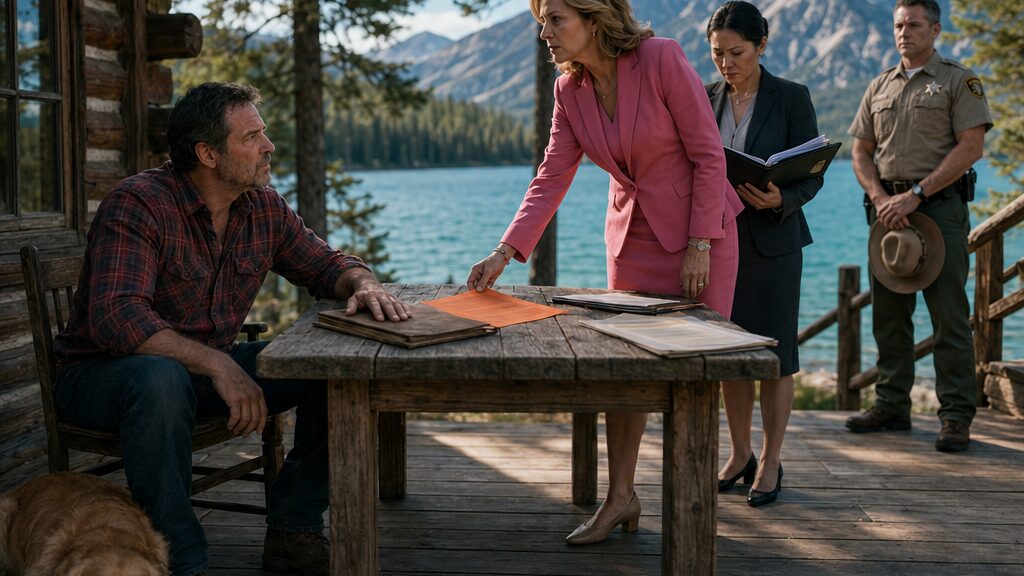
The orange paper in her hand snapped once in the lake wind, bright as a warning flag against her pink blazer. Behind her, a sheriff stood near the patrol vehicle at the edge of the gravel drive, hat in one hand, face carefully empty. Beside Ashley, Jessica Lee held a slim black folder against her ribs like she wished it were heavier.
Frank kept one hand on the old deed folder and the other flat on the weathered table his father had built before the railing was finished. At his boots, Margaret’s golden retriever lifted his head, looked at Ashley, then laid his chin back down with a tired sigh.
Two weeks since the funeral. Thirteen days since Frank had carried the last casserole dish out of the cabin kitchen. Ten days since Ashley had stopped answering his calls.
Now she was here with a sheriff.
“You brought him for this?” Frank asked.
Ashley looked at the sheriff, then back at Frank. “I brought him because I didn’t want a scene.”
Frank almost laughed, but it caught somewhere below his throat. “You came to Mom’s house with an eviction notice and didn’t want a scene?”
“It isn’t Mom’s house anymore.”
Jessica shifted her weight. The heel of her shoe caught in the gap between two deck boards. She pulled it free and looked down at her papers.
Ashley stepped forward and laid the orange notice across the table. It landed half over Frank’s deed folder, covering the corner where Margaret had written in blue ink years ago: Cabin papers. Keep safe.
Frank looked at that handwriting, the rounded C, the hard downward slash of the K. He remembered her doing it at the kitchen counter, wearing his father’s old flannel shirt because the furnace had gone out that morning. She had tapped the folder twice and said, “The cabin is handled, Frankie. Don’t let anyone make you feel like a guest here.”
Ashley’s red-painted nail pressed the orange paper flat.
“Seven days,” she said. “That’s more than fair.”
Frank read the top line once, then again. Notice to vacate. Property of Estate Beneficiary. Failure to surrender possession may result in enforcement.
He did not pick it up.
The sheriff cleared his throat. “Mr. Campbell, I’m just here to keep things civil and confirm service. This is not a removal today.”
“Today,” Frank said.
Ashley’s mouth tightened. “Don’t make this harder than it has to be.”
Frank looked past her at the lake. The water was too bright for what was happening. Sunlight scattered across the cove in small white cuts. The old dock bumped softly against its posts. On the far bank, Daniel Harris’s boathouse sat closed, its green door weathered almost gray.
Frank had changed Margaret’s sheets in the bedroom upstairs. He had crushed her pills into applesauce when she could no longer swallow them whole. He had learned which floorboards to avoid at night so the dog would not bark and wake her. He had stood in the driveway after the hospice van left and listened to Ashley tell a neighbor, “At least he had the cabin all this time.”
Jessica opened the black folder.
“Frank,” she said, softer than Ashley had spoken. “Your mother executed a revised will before her passing. The estate document names Ashley Moore as executor and primary beneficiary of the lake property.”
Frank did look at her then.
“Primary beneficiary,” he repeated.
Jessica nodded once. “The cabin, surrounding parcel, and associated maintenance account are assigned to Ashley under Article Four.”
The dog rose, uneasy now, and pressed his shoulder against Frank’s leg.
“My name is in it where?” Frank asked.
Jessica’s fingers paused on the page. “There are personal items designated to you.”
Ashley exhaled. “Don’t start.”
“What personal items?”
Jessica glanced at Ashley.
Frank saw it. That tiny sideways check. Not permission exactly, but habit. Ashley had already been in rooms with Jessica where Frank had not.
“Tools,” Jessica said. “Your father’s workbench contents. Some photographs. The truck, if it clears estate debt.”
“The truck doesn’t run.”
Ashley folded her arms. “You always said you could fix it.”
Frank looked down at the orange notice again. The paper had curled at one edge in the wind. Beneath it, only the bottom of the deed folder showed.
“Read the date,” he said.
Jessica blinked. “What?”
“The will. Read the date Mom signed it.”
Ashley’s voice sharpened. “This isn’t a deposition.”
“I’m asking the attorney.”
Jessica took a breath. “Margaret Campbell signed the revised will on March fifteenth.”
The deck seemed to tilt, though Frank had not moved.
March fifteenth.
He could see that day as clearly as the lake in front of him. Margaret in the recliner by the living room window, asking three times if the power had gone out though every lamp was on. Margaret crying because she thought Frank’s father was late from work, though he had been dead eleven years. Margaret unable to follow the hospice nurse’s question about pain from one sentence to the next.
He pressed his thumb into the deed folder until the old cardboard bent.
“Who was with her?” he asked.
Ashley stepped closer. “She knew what she was doing.”
“That wasn’t my question.”
The sheriff looked toward the road as if wishing another call would come over his radio.
Jessica lowered her eyes to the document. “The will was witnessed and notarized.”
“By whom?”
“The names are in the record.”
“Who drove her there?”
Ashley snapped, “She wanted privacy.”
Frank finally lifted the orange notice. Under it, the deed folder looked smaller than it had a minute ago. Old cardboard. Old ink. A promise that had never looked fragile until someone put newer paper on top of it.
He opened the folder and pulled out the copy Margaret had shown him years before. Warranty deed. Lake parcel. Margaret and his father’s names. Then Margaret’s alone after his father died. A handwritten sticky note still clung to the corner: Frank—do not lose.
Ashley looked at it and gave a short, humorless laugh.
“That doesn’t change the will.”
“No,” Frank said. “Maybe it doesn’t.”
For the first time, Ashley looked uncertain.
Frank turned the will copy toward Jessica. “March fifteenth. What time?”
Jessica did not answer immediately.
Ashley did.
“Ten in the morning,” she said.
Frank looked at her hand, still resting on the orange notice, holding it down as if the wind might save him if she let go.
He had not asked Ashley.
Chapter 2: The Date Nobody Wanted To Explain
“The documents are legal. The signatures are verified.”
Jessica Lee said it across a polished conference table where nothing smelled like Margaret’s house. Not cedar. Not dog fur. Not coffee reheated three times. The room smelled of toner, leather chairs, and lemon cleaner, and Frank hated it before he sat down.
He had put the orange notice inside the deed folder before leaving the cabin that morning. It was still there, folded once, its edge sticking out like a flame.
Jessica sat opposite him with the will copy, a notepad, and the professional patience of someone who had decided her first answer would also be her last.
Frank did not sit back.
“Verified by whom,” he asked, “and who drove her there?”
Jessica’s pen stopped moving.
He had slept maybe two hours. The rest of the night he had sat at Margaret’s kitchen table with the dog under his chair and the old cabin calendar spread open beside the deed folder. March fifteenth had been marked with one word in Margaret’s handwriting from months earlier: bulbs. She had wanted daffodils under the east window. By March, she could no longer remember why the seed packets were stacked by the sink.
“Frank,” Jessica said, “I understand this is difficult.”
“Don’t do that.”
Her face changed slightly.
He heard the roughness in his own voice and made himself lower it. “Please. Don’t make this sound like grief.”
Jessica folded her hands. “Your mother had the legal right to revise her estate plan.”
“If she understood it.”
“The signing was witnessed. The notary confirmed identity. The capacity standard for signing a will is not the same as—”
“Who made the appointment?”
Jessica glanced at the page.
Frank saw again what he had seen on the deck: the pause, the calculation, the instinct to protect process rather than answer.
“I can confirm that Ashley Moore was listed as the contact person for scheduling,” Jessica said.
Frank nodded once, though it did not feel like agreement. It felt like a door opening onto a darker room.
“And who brought Mom here?”
“I did not personally handle the intake.”
“But your office knows.”
“I can review the file.”
“She was here? In this building?”
Jessica hesitated. “The signing was completed in our satellite conference room.”
“Ten in the morning.”
Jessica looked at him.
“Ashley said it before you did,” Frank said. “Yesterday. I asked you what time, and Ashley answered. Why?”
Jessica closed the folder halfway. “Family members often assist elderly parents with appointments.”
“She wasn’t assisting. She was managing.”
“That is your interpretation.”
“No,” Frank said. “That is what happened yesterday on my deck.”
A flush rose faintly in Jessica’s cheeks. She looked down at her notepad. “I am not your attorney.”
“I know.”
“And I cannot advise you as if I am.”
“I’m not asking for advice. I’m asking for copies of every document my mother supposedly signed when I wasn’t in the room.”
“You may need to make a formal request through probate.”
“Then tell me where to start.”
For a moment, Jessica looked tired rather than guarded. She slid one sheet across the table: a copy request form, already marked at the top.
At the bottom, under Contact for Decedent, Ashley Moore’s name appeared again.
Frank stared at it.
Everywhere he had not been, Ashley had been.
The county building was twelve miles inland, past the bait shop, the closed feed store, and the church where Margaret’s funeral program still sat in a basket by the door. Frank parked under a maple that had not leafed out yet and carried the deed folder inside like something breakable.
The probate clerk had silver glasses on a chain and a voice flattened by years of bad family news.
“You’re not the executor?” she asked.
“No.”
“Beneficiary?”
“Apparently not.”
She looked over the counter at him. Not unkindly. Not helpfully either.
“Then access may be limited.”
“I’m her son.”
“I understand.”
He almost said, No, you don’t. Instead he opened the folder and pulled out the deed copy Margaret had saved.
“She told me the cabin was handled,” he said. “I need to know whether this was recorded.”
The clerk examined the copy. Her finger moved down the page slowly, stopping at the legal description, then the signature block, then the blank where a recording stamp should have been.
“This appears to be a prepared transfer deed,” she said.
“Prepared.”
“I don’t see a recording reference on this copy.”
Frank felt the first real fear of the day. Not anger. Fear. The clean kind that enters the chest before thought catches up.
“What does that mean?”
“It may mean it was never recorded. It may mean you have an incomplete copy. You’d need a title search to be certain.”
“She kept it in the folder.”
“That doesn’t make it controlling.”
He looked down at Margaret’s sticky note. Frank—do not lose.
He had not lost it. That was the worst part. He had done exactly what she asked, and somehow it still might not matter.
The clerk typed for a while. Keys clicked. A printer woke in the corner, hummed, then went quiet again.
“There’s probate opened under Margaret Campbell,” she said. “Recent filing. Executor: Ashley Moore.”
“I know that.”
“There is also a power of attorney document indexed before death.”
Frank looked up.
“What power of attorney?”
The clerk turned the monitor slightly away out of habit. “Durable financial power of attorney. Filed by the estate attorney’s office after death as supporting documentation. Agent listed as Ashley Moore.”
Frank gripped the counter edge. “When was it signed?”
The clerk scanned the entry.
“January twenty-sixth.”
January. Before the will. Before hospice had told him to stop leaving Margaret alone. Before Ashley’s weekly visits became “private time with Mom.”
Frank heard Margaret’s voice from that month, thin but still amused, telling him Ashley had brought fancy pastries too sweet for anyone with sense.
He had been glad then. Glad Ashley was visiting. Glad he was not the only one trying.
“Can I get a copy?” he asked.
The clerk’s expression softened a fraction. “You can request it. I can’t promise what will be released without executor consent.”
“Executor meaning Ashley.”
“Yes.”
Frank put the deed copy back in the folder. The orange notice rasped against the cardboard as he closed it.
Outside, in the parking lot, he stood beside his truck and called Jessica’s office. The receptionist put him on hold twice. When Jessica finally came on, her voice was careful.
“Frank?”
“You didn’t mention power of attorney.”
Silence.
“Was my mother signing things in January too?”
“I can’t discuss all estate matters over the phone.”
“Was Ashley using that power to move money before Mom died?”
“That is not a question I can answer casually.”
“Then answer it formally.”
Another pause.
“Frank,” Jessica said, “be careful about making accusations you cannot support.”
He looked at the county building doors, where people walked in carrying envelopes and walked out carrying consequences.
“I’m trying to find out what I can support,” he said.
Behind him, the clerk came out onto the steps with a paper in her hand.
“Mr. Campbell,” she called.
Frank lowered the phone.
The clerk approached slowly, as if the page itself had weight.
“I can’t give you the document yet,” she said. “But the index shows one more thing you should know before you leave.”
Frank waited.
“The power of attorney was used for a bank authorization in February. Cabin maintenance account.”
His fingers tightened around the phone.
Jessica was still on the line, saying his name.
Frank did not answer her.
Chapter 3: The Power Of Attorney Nobody Mentioned
“You were removed from account access in February,” the bank representative said, “under authorization from the listed agent.”
Frank sat in the small glass office and looked at the framed poster behind her head. A smiling couple in sweaters stood on a dock holding coffee mugs, advertising retirement planning. Their lake looked nothing like his lake. Their dock had never needed posts replaced in sleet.
“The listed agent,” Frank said.
The representative folded her hands. “Ashley Moore, acting under durable financial power of attorney for Margaret Campbell.”
“I paid the cabin bills from that account.”
“Until February twelfth.”
“I bought the propane. The roof patch. The wheelchair ramp boards.”
“I understand.”
People kept saying that. Frank wondered if they were trained to.
He reached into his folder and pulled out old receipts, the ones he had kept because Margaret used to worry about money in circles. He would show her the paid invoices, and she would calm for twenty minutes. Propane. Septic pump. Dog medication. Gutter repair. He slid them across the desk.
“My mother knew I used that account for the cabin.”
“I’m not disputing that.”
“Then why wasn’t I told I was removed?”
The representative looked toward the glass door. “Notice would have gone to the account holder and authorized agent.”
“My mother could not understand mail by then.”
“I can only tell you what the records show.”
There it was again. Records. Documents. Signatures. Records showed a world where Margaret knew what was happening, where Ashley assisted, where Frank lived in the cabin but somehow stood outside every room where decisions were made.
“What happened to the money?” he asked.
“I can provide statements only through the proper estate channels.”
“Which means Ashley.”
“Yes.”
Frank collected the receipts slowly. His hands wanted to shake, and he would not let them. He put each one back in the folder behind the orange notice, behind the will copy, behind the deed that might not be enough.
When he stepped outside the bank, he sat in his truck without starting it.
The dog’s leash lay coiled on the passenger seat. He had brought it out of habit, though the dog was back at the cabin sleeping beside Margaret’s chair. Frank touched the worn leather and tried to remember the last time he had believed habit could protect anything.
At the cabin, the kitchen still held Margaret’s systems. Pills had been removed. The hospital bed was gone. But the blue tape labels remained on cabinet doors: mugs, plates, tea, dog treats. Frank had written them large when Margaret began opening every cabinet and asking where ordinary things had gone.
He stood in front of the wall calendar.
The orange notice went up first. He pinned it beside March with one of Margaret’s old sewing pins. Below it he pinned the copy of the will signature page Jessica had given him. Then the bank note he had written in the truck: Removed from account access February 12.
January twenty-sixth: power of attorney.
February twelfth: bank access removed.
March fifteenth: will signed.
April twenty-ninth: Margaret died.
May thirteenth: eviction notice.
The line was too clean. That frightened him more than confusion would have.
He flipped the calendar back to March. On the fifteenth, in his own handwriting, was one word: clinic.
No. Not clinic.
He leaned closer.
Supplies.
He had driven inland that morning for hospice supplies because Ashley had called and said Lisa Martin was short on wound pads and rinse bottles. Frank remembered being irritated with himself because he should have checked the cabinet the night before. Ashley had told him not to worry. “I’ll sit with Mom. You go.”
He had thanked her.
He had thanked her.
Frank pulled the chair out and sat hard.
The cabin made small settling noises around him. Pipes. Wind. The dog’s nails clicking from the living room as he rose and wandered into the kitchen. He nudged Frank’s knee.
“I left her,” Frank said.
The dog pressed closer.
Frank closed his eyes only a second. That was all he allowed. Then he opened them and kept moving.
He found the older calendar in the drawer under the phone book, where Margaret kept rubber bands and dead batteries because she hated throwing away things that had once worked. The previous year’s pages were curled from kitchen steam.
He flipped backward, searching for the month the roof had leaked over the upstairs bedroom. October. Rain for six straight days. Frank had climbed the ladder in a storm because Margaret could not bear the dripping sound.
On October nineteenth, in Margaret’s handwriting, written across three squares, were the words: Frank roof / cabin stays.
He touched the ink.
It was not legal language. It was not witnessed. It did not carry a notary seal. It was just his mother’s hand making a note to herself while she still knew what the note meant.
His phone buzzed.
Ashley.
He let it ring until it stopped. Then a text appeared.
We need to settle this like adults.
Another came before he could answer.
I can offer you $15,000 from the estate if you’re out by the end of the week. Take it and don’t make this ugly.
Frank stared at the amount. Fifteen thousand dollars for the cabin porch where Margaret shelled peas in a blue bowl. Fifteen thousand for the bedroom where he slept in a chair the last three nights of her life because she panicked if she woke alone. Fifteen thousand for leaving quietly.
He typed, Who changed the bank account?
Three dots appeared. Vanished. Appeared again.
Mom wanted me handling things.
When?
You’re not listening. She did not want you controlling everything.
Frank stood and looked at the calendar wall. Controlling. That was the word Ashley had been saving. Not caregiver. Not son. Controlling.
He typed, You sent me out for supplies on March 15.
This time the three dots stayed longer.
Then: Because supplies were needed.
Frank looked at the list. January. February. March. He wrote beside March fifteenth: Ashley stayed.
His phone buzzed again.
You lived there rent-free for years. Don’t act like she left you nothing.
He did not answer.
Evening lowered over the lake, turning the windows black. Frank made coffee and forgot to drink it. He called the hospice agency and got a voicemail. He called Jessica’s office and was told she had left for the day. He called the county clerk and asked how to request every document tied to the power of attorney. The clerk sighed but told him.
Then he sat at the kitchen table and wrote down everything he remembered about the six weeks before Margaret died.
Not feelings. Facts.
What she could remember. What she could not. Who visited. Who called. When Ashley came. When Ashley asked him to leave the room. When Margaret became agitated after those visits. When she said, “Your sister thinks I’m unfair,” and then forgot she had said it five minutes later.
The list filled three pages.
Near midnight, his phone lit again.
Ashley.
He should have let it go dark. He should have waited until morning. Instead he picked it up.
The message was longer this time.
Take the money, Frank. You don’t want people hearing what Mom said about you.
Frank read it once.
The dog lifted his head beneath the table, sensing the change before Frank moved.
Frank set the phone beside the orange notice and stared at the words until they stopped looking like a threat and started looking like evidence.
Chapter 4: The Sister Who Said He Already Got Enough
“You lived in her house for years. Don’t act like you got nothing.”
Ashley said it before the waitress had finished setting down Frank’s coffee. Her voice cut across the empty lakeside diner, too bright against the quiet scrape of the waitress’s shoes and the low hum of the refrigerator case.
Frank did not touch the mug.
Ashley sat across from him in the same pink blazer she had worn on the deck, though today she had traded the heels for dark flats. A white envelope rested beside her hand. She had placed it there the moment he arrived, not pushed toward him yet, just made visible.
Frank kept the orange notice folded in his jacket pocket. He could feel its stiff edge every time he breathed.
“I didn’t live there as a guest,” he said.
Ashley’s eyes narrowed. “No. You lived there as the son who never left.”
The waitress stepped away without asking if they needed anything else.
Outside the diner windows, the lake road curved past closed bait sheds and winter-stained picnic tables. In summer, this place would be full of families ordering pancakes after sunrise fishing. Now there were only two men at the counter, one cook behind the pass, and Ashley sitting across from him as if this meeting were a business errand she wanted finished before lunch.
Frank slid his phone onto the table, screen down.
“You said Mom said something about me,” he said. “Say it.”
Ashley’s fingers moved to the envelope, tapping once on the flap. “I said you don’t want people hearing it.”
“That’s not the same thing.”
“She felt trapped.”
Frank waited.
Ashley looked toward the counter, then back at him. “There. Is that what you wanted? She felt trapped, Frank. By the cabin. By you. By the way every problem became yours to solve until nobody else could get near her without you hovering.”
The words entered cleanly and found the places he had already bruised himself. He saw Margaret in the recliner, annoyed when he asked if she wanted tea. Margaret telling him to stop fussing. Margaret snapping, “I am not furniture,” on a bad afternoon when he had tried to move her walker closer.
He had remembered those moments as illness. Ashley was laying claim to them as truth.
“I was caring for her,” Frank said.
Ashley’s laugh was small and tired. “You always say that like it ends the conversation.”
“It should answer part of it.”
“It doesn’t answer all of it.”
She opened her purse and took out a folded copy of something. Not the will. Not the orange notice. A handwritten note, or the copy of one. She did not give it to him. She kept it angled toward herself.
“She told me she hated feeling watched.”
Frank’s jaw tightened. “When?”
“In February.”
“When in February?”
Ashley’s mouth hardened. “You’re doing it again.”
“What?”
“Turning Mom into a schedule. Dates, times, records. You think if you stack enough paper high enough, it makes you the good child.”
Frank looked at the envelope.
“How much is in there?”
“Fifteen thousand. Like I said.”
“From the estate.”
“Yes.”
“The estate you’re telling me I’m not part of.”
Ashley’s hand flattened over the envelope. “I’m trying to be generous.”
“No. You’re trying to get me out by Friday.”
“Because the cabin needs to be listed before summer buyers disappear.”
There it was. Not hidden. Not dressed as grief. A listing window. A market season. Margaret’s porch measured against summer buyers.
Frank felt the old instinct to go quiet. It had protected family dinners for years. When Ashley criticized him for leaving his job to move closer, he had let Margaret change the subject. When Ashley visited once a month and called it exhausting, he had told himself everyone carried guilt differently. When Margaret avoided talking about money because Ashley cried, Frank had let it go.
Silence had felt kind then.
Now it looked like permission.
“Who arranged the signing?” he asked.
Ashley stared at him. “Mom asked to update things.”
“That’s not what I asked.”
“She asked for privacy.”
“She couldn’t remember the hospice aide’s name that week.”
“She had good hours.”
“Did she have a good hour at ten in the morning on March fifteenth?”
Ashley leaned in, voice low. “Be careful.”
Frank touched the coffee mug, not to drink, only to stop his hand from curling. “You sent me out for supplies.”
“Because supplies were needed.”
“And while I was gone, she signed away the cabin.”
Ashley’s face changed, but not in the way he expected. Not guilt first. Hurt. Then anger so quick it seemed to cover the hurt before anyone could see it.
“You think she owed it to you,” Ashley said.
“I think she told me something different.”
“She told everybody what they wanted to hear.”
Frank went still.
Ashley looked down at the note in her hand. “That’s what you never understood. She didn’t want a fight, so she promised things. To you. To me. Maybe to herself. And you believed the promise that put you in the best position.”
Frank’s voice dropped. “Read what you have.”
Ashley folded the paper back up.
“No.”
“Then don’t use it.”
“I’m not putting Mom on trial for you.”
“You already did when you brought a sheriff to her deck.”
The two men at the counter turned slightly. Ashley noticed. Her cheeks flushed.
“You want to talk about that deck?” she said. “Fine. I sat on that deck for years watching Mom look past me every time you walked outside. You knew which mug she wanted. Which blanket. Which pill. Which story calmed her down. You made yourself necessary.”
Frank took that in because part of it was true. Not the accusation, but the shape of it. He had become necessary. He had been proud of knowing what Margaret needed before she asked. He had also been tired, resentful, and sometimes relieved when Ashley cancelled a visit because one more person in the house meant one more performance of being fine.
“I didn’t make her sick,” he said.
“No,” Ashley said. “But you made sure the rest of us knew we were visitors.”
The envelope slid across the table.
“Take it. Leave the tools. Take the truck if you want it. Keep the dog if that makes you feel better. But don’t turn this into some public accusation that Mom was incompetent just because she finally did something you didn’t like.”
Frank looked at the envelope between them.
For one weak second, he imagined taking it. Not because it was fair. Because fighting would mean letting strangers read Margaret’s decline in typed lines. It would mean describing her confusion, her fear, the afternoons she mistook him for his father and then cried when corrected. It would mean reducing her final weeks to capacity, signatures, witnesses.
Ashley knew that. She was counting on it.
“I’m not doing this over money,” he said.
Ashley sat back. “That’s easy to say when you already got the house.”
“I’m doing it because I don’t think she signed that alone.”
Ashley’s eyes flashed. “You have no idea what she said when you weren’t around.”
“Then tell me.”
“No.”
“Because it helps you more as a threat.”
Ashley grabbed the envelope, then stopped herself from putting it away. “If you keep pushing, I will tell people she wanted distance from you. I will tell them she was afraid to upset you. I will tell them she asked me to step in because you had taken over her life.”
Frank’s coffee had gone cold. He looked at the dark surface and saw his own face broken in it.
“You’d say that about her?”
“I’d say what I have to say.”
The bell over the diner door rang.
Frank turned.
Daniel Harris stood just inside, one hand still on the handle, his cap pulled low, his expression caught between recognition and regret. He looked from Frank to Ashley, then to the envelope on the table.
Ashley went quiet.
“Daniel,” Frank said.
Daniel’s gaze dropped to Frank’s jacket pocket, where the corner of the orange notice had worked its way out.
For a second, it looked as if he might come over. He even lifted one hand, not quite a wave, not quite an apology.
Then Ashley said, “This is private.”
Daniel’s face closed. He gave a short nod to no one in particular, turned back through the door, and let the bell jangle behind him.
Frank stood so fast the chair scraped.
Ashley’s hand shot out and caught the envelope. “Frank.”
He looked down at her.
“What does Daniel know?”
Ashley’s answer came too quickly.
“Nothing that helps you.”
Chapter 5: The Neighbor Who Heard The Promise
“I’m not getting between family,” Daniel Harris said, and he would not look at the orange notice in Frank’s hand.
He stood at the end of his dock with a coil of rope over one shoulder, pretending to inspect a cleat that had held boats through twenty winters without needing this much attention. His boathouse door was open behind him. Inside, oars hung in pairs along the wall, and a red fuel can sat just where it had sat since Frank was a teenager.
Frank had found him there after two unanswered calls and one slow walk along the shoreline with the dog pulling ahead through the pine needles.
“You were already between family when you walked out of the diner,” Frank said.
Daniel’s hands stopped on the rope. “I walked out because it wasn’t my business.”
“Then why did you look like you knew what she was talking about?”
Daniel looked across the water toward Margaret’s cabin. From here, the deck was visible through the trees. The table looked small in the distance. The place where Ashley had laid the notice was just a pale rectangle in Frank’s mind now, but he could feel it as clearly as if the paper were still there.
“You’re grieving,” Daniel said. “Ashley’s grieving. People say things.”
“She’s evicting me.”
Daniel’s shoulders sagged, but he said nothing.
Frank unfolded the orange notice and held it out.
Daniel did not take it.
Frank waited.
The dog nosed at the dock edge, sniffing the cold water. A gull called once overhead. Somewhere across the cove, a hammer struck wood three times and stopped.
“You remember when Dad built our dock?” Frank asked.
Daniel gave a tired half smile despite himself. “He built half of it wrong first.”
“Mom said that too.”
“He wouldn’t listen.”
“No. He wouldn’t.”
Silence settled, but not gently. Frank could feel his own old habit trying to rise again, the one that said to let Daniel off because he was older, because he had been kind once, because not everyone had to stand where the fire was hottest.
He folded the notice again.
“Margaret told you something about the cabin,” he said.
Daniel’s jaw moved.
Frank stepped closer. “I need to know what.”
Daniel tossed the rope onto the dock. “Frankie—”
“Don’t call me that if you’re going to hide from me.”
The words hit harder than Frank intended. Daniel flinched as if Margaret herself had scolded him.
For years, Daniel had been the neighbor who checked the generator if Frank was at the pharmacy, who brought over perch when Margaret stopped cooking, who sat with her on the porch and talked about old storms. He had not been family, which had sometimes made him easier for Margaret. She could complain to Daniel without feeling she had failed either child.
Daniel removed his cap and rubbed his forehead.
“She said the cabin should stay with you,” he said.
Frank did not move.
“When?”
“More than once.”
“Daniel.”
“Last fall for certain. Maybe before. She was sitting on your deck with that brown folder in her lap. The deed folder. She said she’d made a mess of things between you and Ashley, but the cabin had to stay lived in. She said you knew how to keep it breathing.”
Frank looked toward the cabin. Keep it breathing. That sounded like Margaret. A house, to her, was never owned. It was tended.
“Was Ashley there?”
“No.”
“Did anyone else hear?”
“Maybe the hospice aide was inside. I don’t know.”
Frank let that small piece of relief come and go. It was not proof. Not enough. But it was Margaret’s voice coming through someone else, and for a moment the will’s clean typed lines seemed less final.
Daniel picked up the rope again, then put it down.
“There’s more,” Frank said.
Daniel looked away.
Frank felt it then. Not just reluctance. Shame.
“Ashley came every Thursday,” Frank said. “Didn’t she?”
Daniel’s silence answered before he did.
Frank waited.
“She started coming more after New Year’s,” Daniel said. “At first I thought that was good. You needed help. Margaret needed both of you.”
“She didn’t come to help.”
“That’s not fair.”
“Then make it fair. Tell me what you saw.”
Daniel’s face reddened. “I saw a daughter visiting her mother.”
“With documents?”
The dock boards creaked under Daniel’s shift of weight.
Frank’s pulse moved into his throat.
“You saw documents.”
“I saw folders.”
“What kind?”
“How would I know?”
“Daniel.”
“She carried a white folder sometimes. A blue one once. She came dressed like she was going to a meeting, not sitting with her dying mother.” He winced after saying it. “That was unkind.”
“Was she alone with Mom?”
“Yes.”
“Did she ask me to leave?”
“I wasn’t in your house.”
“But you saw me leave.”
Daniel looked at him then, and his eyes were wet in a way Frank had never seen. “You left plenty. Pharmacy. Clinic. Grocery. Hardware store. The dog’s medicine. You were always running somewhere.”
“Because things were needed.”
“I know.”
“Did Ashley come on March fifteenth?”
Daniel bent slowly and sat on the dock bench, as if standing had become too much. He looked at the water below his boots.
“Yes.”
Frank’s hand closed around the notice.
“What time?”
“Morning.”
“Before I left?”
“I saw her car after you drove out.”
The lake sound seemed to fall away.
Frank remembered the supplies list on the kitchen counter. Ashley’s voice on the phone. Don’t worry, I’ll sit with Mom. You go.
He sat beside Daniel, leaving space between them.
“Why didn’t you tell me?”
Daniel’s answer came so quietly Frank almost missed it.
“Because I thought Margaret had the right to make choices without all of us judging them.”
“All of us?”
“Me. You. Ashley. The whole cove. Everybody knew who did the work. Everybody knew Ashley resented it. Everybody had an opinion. I figured if Margaret wanted papers changed, maybe she was trying to stop the fight.”
Frank stared at him.
Daniel’s shame had another shape now. Not ignorance. Cowardice dressed as respect.
“She was confused that week,” Frank said.
“I know she had bad days.”
“She asked if Dad was coming home.”
Daniel closed his eyes.
“She thought the kettle was a telephone.”
“Frank.”
“No. If you saw Ashley bringing papers while Mom was like that, and you said nothing because it was family business, then you helped make it private enough to happen.”
Daniel looked as if Frank had struck him. For a second Frank regretted it. Then he remembered the orange paper on Margaret’s table and let the regret sit beside the truth without covering it.
Daniel reached into the pocket of his work jacket and pulled out a small notepad, the kind he used for fuel deliveries and dock repairs. He flipped through pages of numbers, names, weather notes.
“I write things down,” he said. “Not everything. Just what I need.”
He found a page and turned it toward Frank.
March 15. Ashley car 9:20. Frank truck gone 9:35. Lisa leaving early? Wind west.
Frank stared at the note.
“Lisa,” he said.
“Hospice aide. Lisa Martin. She came a few days a week by then, didn’t she?”
“Yes.”
“I saw her leave before noon that day. She looked upset.”
Frank’s throat tightened. “Why didn’t you give me this yesterday?”
Daniel took the notebook back but tore the page out carefully.
“Because yesterday I still wanted to believe staying out of it was decent.”
He handed Frank the page.
“It wasn’t,” Daniel said.
Frank folded the note into the same pocket as the orange notice. The two papers pressed against each other there, one a threat, one a crack in the threat’s foundation.
As Frank rose, Daniel spoke again.
“One more thing.”
Frank turned back.
Daniel looked toward the cabin, then down at his hands.
“A week before that, Margaret told me she was tired of being fought over. She said maybe paper was the only thing either of you would believe.”
Frank felt the relief twist into something harder.
“She said that?”
“Yes.”
“Did she mean the will?”
“I don’t know.”
Frank wanted to reject it because it did not help him cleanly. But Margaret had been complicated before she was ill. She had avoided hard conversations until they grew teeth. She had told Ashley she understood. She had told Frank the cabin was handled. She had wanted peace so badly she sometimes traded truth for it.
Daniel stood and looked suddenly older.
“Talk to Lisa,” he said. “If anyone knows what that day looked like inside the house, it’s her.”
Frank looked once more across the water at Margaret’s cabin, its deck bright under the afternoon sun.
“What’s her last name?”
“Martin,” Daniel said. “Lisa Martin.”
Chapter 6: The Hospice Note That Changed The Timeline
“I remember that day because your mother kept asking if your father was coming home.”
Lisa Martin said it in the clinic records office with both hands wrapped around a paper cup she had not drunk from. She was younger than Frank had expected, maybe late thirties, with tired eyes and a name badge turned backward on its clip. The room was barely larger than a pantry. File boxes lined one wall. A printer blinked red in the corner.
Frank had not even taken the orange notice out yet.
Lisa looked at the deed folder on his lap as if she already knew what was inside.
“March fifteenth?” Frank asked.
She nodded.
He had found her through three phone calls, one receptionist who told him records required authorization, and one quiet message Lisa returned before eight that morning. She had agreed to meet only during her break and only if Frank understood she could not “get in the middle of legal things.”
Everyone had a phrase for staying out of harm’s way.
“She asked for my father?” Frank said.
“Several times.”
“He’d been gone eleven years.”
“I know.”
Lisa looked down at the cup. “She had clearer days. You know that. She could still have moments where she knew exactly who was in the room. But that morning wasn’t one of the clearer ones.”
Frank felt the sentence enter the timeline and settle there.
Not enough to end it. Enough to change its weight.
“What time were you there?”
“I arrived a little before eight. You were making oatmeal.”
He remembered. Margaret had refused eggs that week. Oatmeal with brown sugar was the only breakfast she would finish.
“Ashley called me around nine,” Frank said. “She said supplies were low.”
Lisa’s mouth tightened.
“They were not low?”
“Some were. Not urgent.”
“Did you tell Ashley that?”
Lisa looked toward the closed door. “She asked me to leave early.”
Frank’s hand tightened around the folder.
“What reason did she give?”
“She said she wanted private time with her mother. She said family things were being discussed, and Margaret got embarrassed when aides were around.”
“Did Mom seem embarrassed?”
Lisa did not answer right away.
“She seemed tired.”
“Lisa.”
“She seemed confused. Agitated after Ashley arrived.”
Frank drew a slow breath through his nose.
The printer clicked suddenly, waking and stopping again. Lisa flinched at the sound, then seemed embarrassed by it.
“I wrote a note,” she said.
Frank looked up.
“In the care log. Not about legal documents. I didn’t know anything about a will. I wrote that Margaret was disoriented to time and repeatedly asking for her deceased husband. I wrote that family requested shortened visit.”
“Family meaning Ashley.”
“I didn’t name her in that line.”
Frank’s hope dimmed.
Lisa saw it. “But my visit schedule shows who signed me out.”
She set the cup down and opened a folder she had brought with her. Not the official record, he noticed. Copies. Pages printed at home or pulled from a portal. She had thought about this before he arrived.
“I’m not supposed to hand over medical records without authorization,” she said. “But I can tell you what exists. And if your attorney subpoenas it or requests it properly, it’s there.”
“I don’t have an attorney.”
“You may need one.”
The same fear from the county office returned, mixed with exhaustion. Attorneys meant retainers. Retainers meant money. Ashley knew that too. Fifteen thousand to leave. Thousands more to fight. Everything had a price except the truth, and the truth charged interest in other ways.
Lisa slid one page halfway across the table, keeping her fingertips on it.
“You can read this. Don’t take it.”
Frank leaned over.
March 15. Patient disoriented to time. Asked repeatedly for deceased spouse. Increased agitation after family arrival. Family requested aide depart at 10:15. Patient expressed fear of “signing wrong thing” though context unclear.
Frank read the last line three times.
Patient expressed fear of signing wrong thing.
His eyes burned, but he did not let them close.
“She said that?”
Lisa nodded. “Not exactly like that. She said, ‘What if I sign the wrong thing and they get mad?’ I wrote it as close as I could.”
“They.”
“I don’t know who she meant.”
Frank did. Or thought he did. Or feared he did, which was not the same thing.
“Why didn’t you tell me?”
Lisa pulled the page back. “Because I didn’t know what happened after I left. Because patients say things. Because families fight. Because if I reported every uncomfortable visit, I’d spend more time in statements than care.”
The answer was honest enough to hurt.
“And because Ashley scared you?” Frank asked.
Lisa’s eyes lifted.
“She was intense,” Lisa said carefully. “She asked questions like she already knew what answer she wanted. She wasn’t cruel to Margaret in front of me. But she made the room smaller.”
Frank thought of Ashley at the diner. Mom wanted privacy. She felt trapped. You made yourself necessary.
“She said I controlled Mom,” he said.
Lisa’s expression shifted, not into agreement but recognition.
“Your mother depended on you,” she said. “That is not the same thing. But sometimes dependence frightens people watching from the outside.”
“And from the inside?”
Lisa looked at him for a long moment. “Caregiving can become a room with only two people in it. Even when that isn’t what you mean.”
Frank accepted that because refusing it would be another kind of lying. There had been days when he had moved through the cabin like he alone knew how to keep disaster from entering. There had been moments when Ashley’s suggestions irritated him before he heard them. There had been nights when Margaret called his name and he felt love and burden rise together so tightly he could not separate them.
“I wasn’t trying to keep Ashley out,” he said.
“I believe you.”
“But maybe I did.”
“Maybe everyone was afraid of being left out,” Lisa said. “And someone turned that fear into paperwork.”
Frank sat back.
There it was. Not a villain’s mask pulled off. Something worse: a family weakness given legal form.
Lisa gathered the pages, then paused.
“I can speak to what I saw if properly asked,” she said. “I won’t guess. I won’t say she couldn’t sign anything ever. But I can say what that morning looked like.”
“That may not be enough.”
“No,” Lisa said. “But it’s not nothing.”
Frank left the clinic with no paper in his hand, only notes he had written from memory in the truck before starting the engine. March fifteenth. Disoriented. Deceased spouse. Signing wrong thing. Ashley signed aide out 10:15.
At the cabin, he laid the will page, the orange notice, Daniel’s torn notebook sheet, and his own notes on the deck table. The wind tried to lift the notice, so he placed the old deed folder over one corner.
For the first time, the notice looked less like an ending than a piece of a sequence.
His phone rang.
Jessica Lee.
Frank answered without greeting.
“I spoke with Ashley,” Jessica said. Her voice was lower than usual. “She says you’ve been contacting people and implying misconduct.”
“I’ve been asking what happened.”
“You need to understand something. Confusion noted during hospice care does not automatically invalidate a will.”
“I know.”
“Even a person with declining cognition can have lucid periods.”
“I know that too.”
“Then you need to be careful.”
Frank looked at the papers on the table. “Were you in the room when Mom signed?”
Silence.
“Jessica.”
“I was present for part of the appointment.”
“Part?”
“The notary handled the signing formalities.”
“Who spoke for Mom?”
“That’s not a simple question.”
“It is to me.”
The lake wind moved through the pines. The dog lay beside the table, eyes following Frank’s hand as he pressed the phone harder to his ear.
Jessica exhaled.
“Ashley did most of the talking,” she said.
Chapter 7: The Meeting Ashley Could Not Control
“You’re going to tear this family apart over a cabin.”
Ashley stood at the far side of Margaret’s deck table with the lake behind her and the sheriff beside the steps, and for a moment Frank saw exactly what she wanted everyone else to see: the grieving daughter, the reasonable executor, the sister forced to handle what her brother refused to accept.
The orange notice lay on the table between them, no longer alone.
Frank had placed it beneath the will page, Daniel’s torn notebook sheet, his own copy of the March calendar, and the notes he had taken from Lisa’s care record. The old deed folder sat at the top, its corners softened from years in Margaret’s kitchen drawer.
“You brought a sheriff to Mom’s table,” Frank said.
Ashley’s eyes flicked to the sheriff. “Because you wouldn’t leave.”
“Because I live here.”
“Because you convinced yourself that living here made it yours.”
Jessica Lee stood near the railing with her folder held tight against her chest. She had arrived ten minutes after Ashley, her face pale from the drive or from the reason Frank had asked her to come. Lisa Martin stood closer to the stairs, not quite on the deck, as if she needed a path to retreat. Daniel Harris had taken off his cap and held it in both hands.
No one looked comfortable.
That was the first honest thing about the morning.
Frank touched the orange notice with two fingers and slid it back into view.
“This is what you gave me,” he said to Ashley. “Seven days to leave. You said Mom changed her mind. Jessica said the documents were legal. I asked one question.”
Ashley folded her arms. “You asked a hundred questions.”
“One that mattered first. When did she sign?”
The sheriff shifted his weight. He had returned because Ashley had requested a follow-up visit before the deadline. Frank had called the station afterward and asked if the sheriff would be willing to hear why the matter was disputed before enforcement moved forward. The sheriff had not promised anything. But he had come.
Frank looked at him now. “I’m not asking you to decide ownership.”
“Good,” the sheriff said. “Because I can’t.”
“I’m asking you to understand why enforcing that notice today would be wrong.”
Ashley made a sharp sound. “This is exactly what I mean. He turns everything into a performance.”
Frank picked up the March calendar page. His hand was steady, though he had barely slept.
“March fifteenth. Ashley came at 9:20. Daniel saw her car. My truck was gone by 9:35 because Ashley asked me to get hospice supplies.”
Daniel swallowed. “That’s what I wrote down that day.”
Ashley turned on him. “You write down everyone’s car now?”
Daniel’s face reddened. “I write down what happens on this cove. Fuel, repairs, weather. I’ve done it for thirty years.”
“You didn’t know what was happening inside the house.”
“No,” Daniel said. “That’s why I should have asked.”
The admission moved across the deck quietly. Frank saw Lisa look at him then, as if courage could pass from one reluctant witness to another.
Frank set Daniel’s note down and picked up his own handwritten copy of Lisa’s record.
“Lisa was here that morning,” he said. “She arrived before eight. My mother was asking for my father. She was afraid of signing the wrong thing.”
Ashley’s face went flat. “That is not what happened.”
Lisa’s voice was small but clear. “She did ask that.”
“You’re misremembering.”
“I wrote it down that day.”
Ashley took one step toward her. “You wrote down your interpretation.”
Lisa did not move back. “I wrote down what I observed.”
Frank watched Ashley’s hands. They opened and closed once at her sides, the way Margaret’s used to when she wanted to say something unkind and was trying not to.
Jessica had not spoken yet.
Frank turned to her.
“Tell them what you told me.”
Jessica looked toward Ashley.
Ashley said, “Jessica.”
It was not a plea. It was a warning dressed as a name.
Jessica’s grip tightened on her folder. “I told Frank that confusion during hospice care does not automatically invalidate a will.”
Ashley lifted her chin slightly.
Frank waited.
Jessica looked down at the table. At the orange notice. At the will page. At the old deed folder with Margaret’s handwriting on it.
“And I told him,” Jessica continued, “that Ashley did most of the talking during the appointment.”
Ashley’s mouth opened, then closed.
The sheriff looked at Jessica. “Meaning?”
Jessica chose each word slowly. “Meaning Margaret was present. She answered some direct questions. But Ashley explained the changes, supplied the reasons, and corrected Margaret more than once when Margaret seemed uncertain about which document we were discussing.”
“That’s a lie,” Ashley said.
Jessica’s face tightened. “No. It is not.”
“You never said that before.”
“You never asked me to say it in front of a sheriff.”
For the first time, Ashley looked afraid. Not beaten. Not sorry. Afraid of losing the version of events she had been able to control.
Frank picked up the old deed folder.
“Last fall,” he said, “Mom had this on her lap when Daniel came over. She told him the cabin had to stay lived in. She said I knew how to keep it breathing.”
Daniel nodded, eyes fixed on the boards.
Ashley laughed once, but there was no force in it. “That’s sentimental nonsense. That doesn’t make a will.”
“No,” Frank said. “It doesn’t.”
He could feel the trap of wanting too much from each piece. Daniel’s memory did not transfer property. Lisa’s note did not automatically erase a signature. Jessica’s discomfort did not undo probate. The calendar did not speak for Margaret. The old deed folder might still be incomplete.
But together they no longer looked like grief.
They looked like a pattern.
“You got power of attorney in January,” Frank said. “You removed me from the maintenance account in February. You arranged the will appointment in March. You sent me out of the house the morning it was signed. Then after the funeral, you brought that notice here before I could ask for the full file.”
Ashley’s face flushed. “Because you would have dragged this out for months.”
“Because I would have asked when.”
“Because you never accept that Mom had any thoughts that didn’t come through you.”
Frank let that land.
There it was again, Ashley’s truest wound and her best weapon.
“You’re right,” he said.
The deck went still.
Ashley blinked.
Frank looked down at the table. “There were days I acted like I was the only one who knew what she needed. There were days I was tired and angry and didn’t want to explain her care to someone who came in for an hour and told me what I should be doing differently.”
Ashley’s eyes shone suddenly, but her jaw stayed hard.
“I’m not proud of that,” Frank said. “But that is not the same as Mom freely giving you the cabin while she was afraid of signing the wrong thing.”
Ashley pressed both hands against the table. “She wanted me taken care of too.”
“I believe that.”
“No, you don’t.”
“I do.”
“She said you had the cabin. She said you had all that time with her. She said I had bills and kids and a life that didn’t fit into your little saint story.”
Frank did not answer the accusation. He had not lived like a saint. He had lived like a tired son in a house that needed too much from everyone.
“What did you tell her the document did?” he asked.
Ashley looked away.
Jessica’s eyes dropped.
Frank’s chest tightened.
“Ashley.”
“I told her it would make things simpler.”
“For whom?”
“For everyone.”
“For you.”
Ashley snapped her gaze back. “For once, yes. For me too. Is that so terrible? I was her daughter too, Frank. Or did you forget that while you were busy being needed?”
Daniel shifted, as if the words had struck him personally. Lisa looked down at her hands.
Ashley’s voice broke at the edge but did not soften. “Every call was about you. Frank fixed this. Frank knows that. Ask Frank. Frank will stay. Frank will handle it. Do you know what it’s like to have your mother make you feel like a visitor in your own family?”
Frank looked at the orange notice.
“No,” he said. “I know what it’s like to have my sister make me feel like a trespasser in my own home.”
Ashley turned away sharply.
The sheriff removed his hat and looked at Jessica. “Counselor, is this notice currently uncontested?”
Jessica did not answer right away.
Ashley swung back toward her. “Don’t.”
Jessica’s face was pale but settled now.
“If you enforce that notice now,” she said, “I cannot represent this as uncontested.”
Ashley stared at her.
Jessica closed her folder. “And if Frank files a formal challenge with the care notes, witness statements, power of attorney timeline, and my record of the appointment, I will have to correct the estate file.”
“You work for the estate,” Ashley said.
“I do. Not for a version of it I can’t defend.”
The sheriff stepped back from the stairs. “Then I’m not treating this like a simple removal.”
Ashley looked from the sheriff to Daniel to Lisa, searching for the old shape of authority and finding none of it where she had left it.
Frank folded the orange notice once and placed it beneath the deed folder.
Ashley’s voice came low.
“You don’t know what you’re starting.”
Frank looked at his sister across Margaret’s table.
“I know what I’m finished accepting.”
Jessica turned to Ashley, and this time her voice had no softness left to hide behind.
“You need to decide whether you want this reviewed quietly, or whether you want every step of March fifteenth examined under oath.”
Chapter 8: The Cabin Margaret Tried To Leave Behind
The county clerk stamped the release hard enough to make Frank flinch, but the estate file stayed open on the counter between them.
The sound was final. The paper was not.
Ashley stood two spaces away, arms folded, sunglasses pushed up into her hair though they were indoors. She had signed where Jessica pointed. She had not looked at Frank once. The corrected property release transferred her claim in the cabin parcel back out of the disputed estate distribution, subject to final title review. The maintenance account funds would be partially restored. Other estate matters remained unresolved.
Partial. Pending. Subject to review.
The language had edges everywhere.
The clerk slid the stamped copy toward Jessica, who checked the page before handing it to Frank.
“There,” Ashley said. “You got what you wanted.”
Frank looked at the release. His name appeared in typed letters near the parcel description. Margaret’s cabin address sat beneath it, ordinary as a mailing label.
“I got the cabin corrected,” he said.
Ashley gave a short laugh. “Corrected.”
Jessica lowered her voice. “Ashley.”
“No, it’s fine. Let’s all keep pretending this was about truth.”
Frank placed the release inside the old deed folder. The orange notice was in there too, folded small now, no longer visible unless he opened the flap.
He had expected, foolishly, that this moment might feel larger. Not happy. He knew better than that. But maybe clean. Maybe like air after a long time underwater.
Instead it felt like standing in a room after furniture had been moved out. More space, more damage showing on the walls.
Ashley signed one more acknowledgment with a hard stroke of the pen.
Jessica had negotiated the release after two days of phone calls, one formal objection draft, and a letter naming the March fifteenth concerns without yet filing them publicly. Ashley’s own attorney, brought in after the deck meeting, had advised her not to risk a full challenge if the cabin was the weakest part of the estate plan. Frank had heard that secondhand. Ashley had called it extortion in an email copied to everyone.
She had still signed.
The clerk took the final page.
Ashley turned to Frank for the first time. “She made us choose.”
Frank looked at her.
“Mom?” he asked.
“She knew we couldn’t both have what we wanted. She knew you would never leave that place willingly. She knew I would look like the bad one if I tried to make anything equal.” Ashley’s mouth trembled, then tightened. “So yes, maybe I pushed. Maybe I made it simple. But don’t stand there acting like she didn’t put us in that room.”
Frank could have answered with Lisa’s note. With Daniel’s page. With Jessica’s careful statement. With dates and times and all the paper he had learned to stack.
Instead he said, “She avoided hard things.”
Ashley looked startled.
“She did,” Frank said. “She told me the cabin was handled. She told you she understood. She let both of us believe what kept us from fighting in front of her.”
Ashley’s eyes reddened, but no tears fell.
“That doesn’t mean you had the right to use her confusion,” Frank said.
The redness vanished behind something colder.
“I’m done apologizing for wanting my share.”
“You haven’t apologized.”
Ashley put on her sunglasses.
“Then I guess we’re both done waiting for something we’re not getting.”
She walked out before Jessica could stop her.
Frank watched through the glass as Ashley crossed the parking lot quickly, head high, shoulders rigid. At her car, she paused with one hand on the door. For a second he thought she might turn back. She did not.
Jessica stood beside him, holding her folder.
“This does not close every issue,” she said.
“I know.”
“You may still want independent counsel.”
“I know that too.”
Jessica nodded, then hesitated. “For what it’s worth, I should have asked more questions that day.”
Frank did not absolve her. He did not punish her either.
“Yes,” he said.
She accepted that with a small nod.
When Frank drove back to the lake, the dog was waiting by the kitchen door, tail thumping against the cabinet as if Frank had been gone for an hour instead of a piece of a lifetime. Frank let him out and followed him to the deck.
The table was clear except for a ring left by a coffee mug and a pale scratch where Ashley’s orange notice had first slid across the boards. Frank set the old deed folder down in that same place.
He opened it slowly.
The stamped release went on top.
Beneath it, the old deed copy. Beneath that, Margaret’s sticky note. Beneath that, folded into a square, the orange notice.
He considered throwing the notice away. The trash bin was ten steps from the kitchen. The woodstove could turn it black in seconds. The lake wind could take it if he let it go.
Instead he left it in the folder.
Not on top. Not visible. Not in charge.
But not erased.
The dog settled beside the table, chin on his paws, eyes half closed in the afternoon light. Across the cove, Daniel’s boathouse door stood open. Somewhere down the road, a truck passed and kept going.
Frank sat in Margaret’s chair.
For weeks he had wanted the world to say exactly what his mother meant. He had wanted paper strong enough to hold her voice without bending. He had wanted Ashley to admit what she had done in words clean enough to repair the damage.
None of that came.
What came was a stamped release. A partial account correction. A witness who stopped hiding. A hospice note that made the date tell the truth. An attorney who finally chose the record over convenience. A sister who walked away still believing her resentment was evidence.
It was not enough.
It was also what he had.
Frank ran his thumb over Margaret’s handwriting on the folder.
Cabin papers. Keep safe.
He got up, went inside, and placed the folder in the top drawer of the kitchen desk where Margaret had kept stamps, batteries, and things that still might be useful. Then he took out the blue tape labels from the cabinet doors one by one. Mugs. Plates. Tea. Dog treats.
The last label came off slowly, leaving a pale strip of clean wood beneath it.
The dog barked once from the deck.
Frank turned, expecting a car in the drive, a delivery, another piece of paper needing his name.
But there was only the lake, the table, and the old dog lying where he had always known to wait.
Frank stepped back outside and sat beside him until the light moved off the water.
The story has ended.