The HOA Put an Orange Notice on His Mailbox While the Crew Took Away His Wife’s Ramp
Chapter 1: The Orange Notice Went Up While the Ramp Came Down
The first board came loose with a crack Gary Miller felt in his teeth.
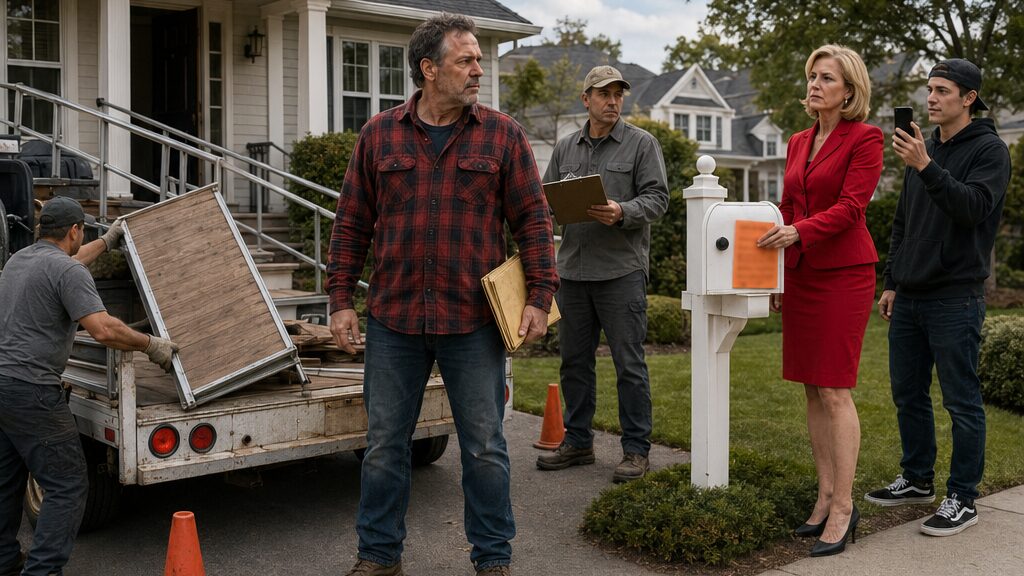
He was halfway down the front walk when the worker lifted the end of the ramp section and swung it toward the back of a white utility truck. The plywood scraped against the metal tailgate, leaving a pale line across the gray paint. Two orange cones stood crooked on his driveway, as if someone had decided his home was a construction zone before he had even opened the door.
“Put that down,” Gary said.
The worker froze, one gloved hand still under the board. He looked past Gary, not at him.
Rebecca Carter stood beside the white mailbox in a red blazer sharp enough to look intentional even at eight in the morning. She held a bright orange notice against the mailbox door and pressed tape across the top edge with the flat of her hand. A young man in a black hoodie stood two steps behind her with his phone raised, smiling like this was already the best part.
“Mr. Miller,” Rebecca said, not turning around. “Please remain clear of the work area.”
“That is my front entry.”
“It is an unauthorized exterior structure.”
“It is a ramp.”
“It is an unauthorized exterior structure,” she repeated, smoothing the orange notice so it faced the street.
Gary stepped off the walk and onto the driveway. The second worker had already removed the handrail from the lower section. The screws lay in a plastic cup on the ground. One of the posts leaned against the truck tire, the white paint scuffed where Donna’s hand had gripped it every morning.
Gary kept his voice level. “Who authorized you to remove it?”
Rebecca finally faced him. Her expression had the polished patience of someone who had practiced being interrupted. “The Glenhaven Ridge Homeowners Association issued notice of noncompliance. You were informed this addition violates section seven point four of the architectural standards.”
“I was informed five minutes ago when I saw your crew cutting bolts out of my steps.”
Joseph’s phone shifted closer. Gary saw himself on the screen for half a second: plaid shirt, work boots, hair uncombed, the yellow folder tucked under his arm. He looked more tired than angry. That bothered him more than the recording.
Rebecca glanced at the phone and then back at Gary. “A notice was posted.”
“You’re posting it now.”
“The association has authority to correct visible violations that affect neighborhood standards and liability.”
“The ramp is a medical accommodation.”
The worker at the truck lowered his eyes. The crew supervisor, a broad man with a clipboard, cleared his throat but did not speak.
Rebecca’s mouth tightened. “No accommodation was approved.”
Gary pulled the yellow folder from under his arm and opened it. He had arranged the papers the night before, though not for this. He had expected another email, maybe a fine, maybe a warning about paint color or setback distance. He had not expected the sound of tools outside his house before breakfast.
He turned the first page toward her. “Request submitted. Three weeks ago. Doctor’s note attached. Physical therapist’s recommendation attached. Photos attached. Temporary access plan attached.”
Rebecca did not take the paper. “Submission is not approval.”
“I asked for emergency review.”
“The committee did not grant emergency approval.”
“The committee never answered.”
“That does not give you permission to build first.”
Gary felt heat rise in his neck and forced it down. Behind him, the front door remained open. He had left it that way when he heard the drill. Donna was inside, waiting near the entry table, probably pretending she was not listening. He could picture her hand on the wall, the way she hated using the walker when anyone could see.
He turned to the crew supervisor. “Do you have a written removal order?”
The man looked at Rebecca.
Gary followed his eyes. “Not her opinion. An order.”
Rebecca lifted a packet from under her clipboard. “You may request a hearing after compliance is restored.”
“After you remove the only safe way my wife can get out of this house?”
Joseph’s smile faltered, but the phone stayed up.
Rebecca’s gaze flicked toward the front door. “Mr. Miller, I understand this is inconvenient.”
Gary closed the folder slowly. “No. You don’t.”
The second worker bent toward the remaining rail.
Gary stepped in front of him.
The movement was not dramatic. He did not shove anyone. He did not raise his arms. He simply put his boots on the narrow strip of concrete between the worker and the bolts, holding the yellow folder at his side.
The crew supervisor exhaled. “Sir, I can’t have you in the work zone.”
“This is my property.”
“We were told access was cleared.”
“Access to what?”
The supervisor looked uncomfortable. “Removal of noncompliant materials.”
Gary pointed to the white post leaning against the tire. “That post is the reason my wife did not fall last night.”
Rebecca said, “Mr. Miller, the association cannot verify private medical claims during active enforcement.”
“You didn’t try.”
“That is not accurate.”
“Then show me where you reviewed it.”
She lifted her chin. “This is not the forum.”
“It became the forum when you brought a crew, a camera, and tape for my mailbox.”
A curtain moved across the street. A neighbor stood at the edge of his driveway with a coffee mug. Another paused near the sidewalk with a dog pulling at the leash. Gary saw all of them, and then tried not to. Donna had asked him not to make their life a neighborhood story. She had said, I don’t want people lowering their voices when I come outside. He had promised. He had believed he could handle the board quietly.
Joseph angled the phone to catch the orange notice and Gary in the same shot.
Rebecca’s voice cooled. “Your refusal to leave the work area is being documented.”
“Good,” Gary said. “Document this too. I submitted the request on the third. Your office confirmed receipt on the fourth. I followed up on the tenth and the seventeenth. No one answered. My wife came home on the eighteenth. The ramp went in on the nineteenth because she could not climb three steps.”
Rebecca blinked once at the dates, just once, before recovering. “Again, receipt does not equal approval.”
“Silence does not equal permission to take it away.”
The supervisor shifted his clipboard. “Ma’am, do you want us to pause?”
Rebecca looked at the half-removed ramp, the growing audience, the phone, the notice she had just placed where every passing car could see it. For a moment Gary thought she might choose the practical thing, the decent thing, even if only to avoid looking cruel on camera.
Instead she said, “Proceed with the portion already detached.”
The worker reached for the lower board.
Gary did not move.
The supervisor stepped closer. “Sir.”
“No.”
Rebecca turned toward Joseph. “Make sure you get that he’s obstructing authorized work.”
Gary looked at the phone. “Make sure you get that she won’t show the order.”
Joseph’s jaw tightened. “You’re on HOA property from the sidewalk.”
Gary almost laughed, but it came out as a breath. “That sidewalk doesn’t lead to my wife’s bedroom.”
Rebecca opened her folder again. “Mr. Miller, if you continue obstructing, we will involve law enforcement.”
At that, one of the neighbors across the street lowered the coffee mug. The worker with the board set it down carefully, as if the word “law enforcement” had added weight to everything.
Gary tucked his papers back into the yellow folder. He could feel how thin the cardboard had become at the corners from being opened and closed, opened and closed, proof handled so many times it was beginning to look like begging.
“Call whoever you need to call,” he said. “But nobody touches another piece until I see something in writing that says you have the right to make my front door unsafe.”
Rebecca stared at him for a long second. Then she took out her phone.
Joseph’s camera stayed lifted. The orange notice fluttered at one corner where the tape had not caught. Behind Gary, inside the open doorway, Donna called his name once, quiet but strained.
Before he could turn, red and blue light washed across the white mailbox.
Chapter 2: The Officer Knew His Name Before the Complaint
“Dad?”
Gary closed his eyes for half a breath.
Of all the patrol cars in the county, of all the officers who could have turned into Glenhaven Ridge with lights reflecting off lawns and garage doors, Richard Miller stepped out of the driver’s side and looked first at the ramp boards on the truck, then at the orange notice, then at Gary.
Rebecca’s face changed before she could stop it. The smooth authority dropped out of her expression, leaving only surprise. Joseph lowered the phone a few inches.
Gary kept his hand on the yellow folder. “Richard.”
The word came out flatter than he intended. Not cold. Just careful.
Richard shut the patrol car door and walked toward the driveway, one hand resting near his belt, his eyes moving through the scene the way Gary had seen him do since he was young: first the people, then the exits, then the object everyone was pretending not to care about. The missing ramp section. The rail on the ground. Donna’s open door.
Rebecca recovered first. “Officer, thank you for coming. I’m Rebecca Carter with the Glenhaven Ridge HOA. We have an owner obstructing an authorized compliance action.”
Richard looked at her. “Who called?”
“I did.”
“For what emergency?”
Rebecca’s lips parted. “For obstruction and potential trespass in a designated work area.”
Gary almost spoke, but Richard’s eyes cut to him, not sharp, not warning, just asking him to wait.
Rebecca gestured toward the crew. “The association arranged removal of an unauthorized structure. Mr. Miller stepped into the work zone and refused to comply.”
Richard looked down at the concrete where Gary stood, then at the front door, then at the half-detached ramp. “This is his property.”
“The HOA has enforcement authority.”
“That may be.” Richard’s voice stayed even. “But I need to understand whether there’s a criminal issue here.”
Joseph lifted his phone again. Rebecca noticed and seemed to draw strength from it. “He is interfering with workers carrying out a lawful order.”
“Do you have that order?”
Rebecca held out her packet. Richard did not take it immediately.
Gary knew that hesitation. Richard was trying to be careful because the word Dad had already changed the air. Neighbors had heard it. Rebecca had heard it. Joseph’s phone had probably caught it. Gary felt a sting of shame he had no right to feel. He had wanted Richard kept out of this, kept out of Donna’s slow mornings and the walker by the couch and the way Gary had misjudged how fast a person could lose safe access to her own front step.
Richard accepted the packet and scanned the top page. “This is a violation notice.”
“It authorizes correction.”
“It says hearing may be requested within fourteen days.” Richard flipped the page. “I don’t see a court order. I don’t see a county removal order.”
Rebecca’s cheeks colored. “This is a civil association matter.”
“Then why did you request police?”
“Because he refused to leave the work zone.”
Gary said, “The work zone is the only route from my front door.”
Rebecca turned on him. “Because you installed it without approval.”
“Because my wife needed it.”
Richard’s jaw moved once. He looked toward the doorway. “Mom is home?”
Gary did not answer quickly enough.
Richard’s eyes changed, and that was worse than anger. Gary saw the questions arrive: Why didn’t you tell me? How long? How bad?
Rebecca stepped into the silence. “Officer, family relationships aside, the association cannot allow owners to install structures without review. We have standards for a reason. If every resident builds whatever they want and claims hardship afterward, the rules become meaningless.”
Gary looked at her then, really looked. Beneath the red blazer and clipped voice was not only cruelty. There was fear there too, the brittle kind. She had built a morning around certainty, and now certainty was slipping in front of neighbors.
Richard handed the packet back. “Ms. Carter, I can document that there is a dispute. I can keep the peace. I cannot enforce HOA architectural standards.”
“He is blocking the crew.”
“If the crew continues while he’s standing there, someone could get hurt. That would be an immediate safety issue.”
“So you’re telling him he can ignore the association?”
“No. I’m telling everyone to stop creating a bigger problem in front of a residence where medical access may be involved.”
Rebecca’s eyes narrowed at may. “He has not provided approved documentation.”
Gary lifted the yellow folder. “I provided it three times.”
“You submitted it,” she said. “You did not receive approval.”
Richard turned toward Gary. “Dad, do you have somewhere Mom can exit safely right now?”
Gary looked at the gap where the lower ramp section had been. Three front steps remained, ordinary and harmless to anyone who did not know how high they looked from a walker. The side door had two uneven pavers and a narrow turn. The garage step was worse.
“No,” Gary said.
The single word hit harder than he expected. It made Richard look away.
The crew supervisor cleared his throat. “Officer, should my guys pack up?”
Richard looked at Rebecca. “I’m advising everyone to pause until you clarify your authority to continue removal safely. If you choose not to, that’s your civil liability. But I’m not ordering Mr. Miller off his own entry path based on this paperwork.”
Rebecca drew herself taller. “I want it recorded that the HOA attempted lawful compliance and was prevented.”
Joseph’s phone rose.
Richard’s voice hardened slightly. “You may record from public space. Do not interfere with my report.”
Joseph took one step back.
For one foolish second, Gary felt relief. The kind that made a man want to lean on someone stronger, younger, uniformed. Then Richard looked at him again, and the relief turned into something heavier. His son could not be the answer. If Richard pushed too far, Rebecca would make the whole thing about favoritism. If Gary let that happen, Donna’s ramp would become a family privilege instead of a right.
Gary stepped away from the worker and faced Richard. “You should let another officer finish the report.”
Richard’s expression tightened. “Dad.”
“You said it yourself. Family relationship.”
Rebecca watched them, alert.
Gary hated giving her that opening, but he hated needing Richard more. “Document what you saw. Then call a supervisor, or whoever you need to call. I don’t want this fixed because you drove up.”
Richard looked at him for a long moment. When he spoke, his voice was lower. “This isn’t about pride.”
Gary almost said yes, it is. Instead he said, “It’s about doing it so it stays fixed.”
That landed. Richard gave one short nod and stepped back toward his car to use the radio.
Rebecca’s confidence returned in a different form, quieter and more dangerous. “Mr. Miller, the association will be scheduling an emergency hearing. Additional fines may apply for each day the violation remains.”
Gary looked at the ramp boards in the truck. “The violation is that my wife can’t leave the house?”
“The violation is unauthorized construction.”
Behind him, from inside the open doorway, Donna called again. This time her voice was not quiet enough to pretend away.
“Gary?”
He turned.
She stood just inside the threshold with one hand braced against the wall and the other on the walker, looking down at the gap where the ramp had been. Her face was pale from the effort of standing. Her eyes moved from the crew to the police car to the orange notice on the mailbox.
“I can’t get down,” she said.
Chapter 3: The Folder Proved Less Than Gary Needed
Donna stood at the open door and stared at the missing ramp as if someone had removed part of the house while she was still inside it.
Gary had put a dining chair near the entry so she could sit before her legs started shaking. She refused it at first, then gripped the back of it so hard her knuckles whitened. Outside, the crew had left with one section of ramp in the truck and another stacked against the shrubs after Richard’s supervisor arrived and turned the morning into paperwork. The orange notice remained on the mailbox, bright against the white metal, facing the street like a warning meant for everyone but them.
“Close the door,” Donna said.
Gary did.
The house went quiet except for the refrigerator and the faint click of her walker as she turned away from the entry. He moved toward her, but she lifted one hand.
“Don’t hover.”
He stopped.
She lowered herself into the chair with care that made him feel useless. The left side still tired faster. The physical therapist had said progress came in inches and bad days did not erase good ones. But the therapist had also stood in their front entry, measured the step height, and said, not unkindly, “She needs a rail and a ramp before she comes home.”
Gary had heard need and treated it like permission.
Now the yellow folder lay open on the kitchen table, its contents spread in uneven stacks. Request form. Doctor’s note. Therapist recommendation. Email receipt. Follow-up email. Second follow-up. Photos of the temporary ramp before paint. Photos of the handrail. A printed copy of section seven point four, underlined twice.
Donna looked at the papers. “You told me they were handling it.”
“They were supposed to.”
“That isn’t the same thing.”
He pulled out the chair across from her. “I know.”
“No,” she said, not sharply, but with enough edge to stop him. “You know now.”
Gary took the hit because it was fair.
Three weeks earlier, when he had submitted the request, Donna was still at the rehabilitation center arguing with a nurse about whether she could walk ten more feet than yesterday. Gary had filled out every box on the HOA form. Material type. Temporary duration. Color match. Expected removal date if no longer medically necessary. He had attached the doctor’s note because the form said supporting documentation may be included. May, not must. He had thought that was respectful.
He had not attached the photograph from the night she fell.
He had not written that he found her halfway between the porch and the front walk, one hand bleeding where she had grabbed the brick edge, her face turned away so he would not see she was crying. He had not written that the fall happened because he was still waiting for approval to install something he knew how to build in an afternoon.
Donna reached for the top sheet. “Show me what they actually confirmed.”
Gary slid the email receipt toward her. The sender line read Glenhaven Ridge Architectural Committee. Automated confirmation. Request received.
“That’s it?” she asked.
“There are my follow-ups.”
“But no human answer.”
“Not yet.”
“Gary.”
He looked down.
She softened then, which was worse. “You were trying to keep it quiet.”
“You asked me to.”
“I asked you not to make me a neighborhood tragedy.”
“I know.”
“I did not ask you to let them pretend I don’t exist.”
He had no defense for that.
His phone buzzed on the table. For a second he thought it might be Richard. It was not. The subject line made his stomach tighten before he opened it.
Emergency Compliance Hearing: Miller Residence Exterior Violation.
Donna watched his face. “What is it?”
He read silently first, because he had learned that reading bad news aloud too quickly gave it power. The association had scheduled a Tuesday evening hearing at the clubhouse. The language was neat and bloodless. Unsafe unauthorized construction. Failure to obtain approval. Interference with association correction efforts. Potential daily fines. Costs of removal may be assessed to owner account.
“They’re calling it unsafe,” he said.
“The ramp?”
“The construction.”
Donna laughed once, not because it was funny. “It was unsafe after they took it apart.”
Gary scrolled farther. Attached were photographs. One showed the ramp before removal, taken from the sidewalk at an angle that made it look larger than it was. Another showed Gary standing in front of the worker. A third showed the orange notice on the mailbox, centered perfectly.
Joseph’s work, probably. Or Rebecca’s.
Gary clicked into his sent folder and searched Nicole Davis. Nicole had been the board secretary who acknowledged homeowners at meetings and corrected people gently when they used the wrong form. He found the first email, the automatic receipt, then his follow-up to the committee address. He found another message where he had copied Nicole directly after no one answered.
He opened it.
Donna leaned forward. “What?”
Gary read the header twice. Delivered. Not bounced. The attachment icons were there. Doctor’s note. Therapist letter. Temporary plan. The timestamp was clear.
“It went through,” he said.
“Then why wasn’t it reviewed?”
He opened the board agenda from last week, the one posted on the HOA website. Landscaping variance. Pool equipment screen. Mailbox repainting schedule. Seasonal lighting reminder.
No Miller request.
He checked the architectural committee minutes. Nothing.
His eyes moved back to the orange notice visible through the narrow side window beside the front door. It had been posted as if there had been a process. As if a room of people had considered the facts and reached a decision. But the facts had never made it into the room.
Donna pushed herself up too quickly.
Gary stood. “Careful.”
“I need to see the door.”
“You just did.”
“I need to see what they left.”
He wanted to tell her no. He wanted to say he would handle it, which had become his favorite way of keeping her out of things that hurt. Instead he brought the walker around and stood beside her without touching her.
She moved slowly to the entry. At the threshold, she stopped. The top platform remained, but the lower section was gone, leaving the first drop too steep. The handrail ended in open air.
Donna stared at it for a long time.
“That’s not a violation,” she said. “That’s a trap.”
Gary swallowed.
His phone rang before he could answer. Unknown number. He almost ignored it, then pressed speaker.
“Mr. Miller?” The woman’s voice was low and rushed. “This is Nicole Davis from the board.”
Gary looked at Donna.
Nicole continued before he spoke. “I can’t talk long. I saw the hearing notice. There’s something wrong with how your request was logged.”
Gary gripped the phone tighter. “Wrong how?”
A pause. Papers shifted on her end.
“It should have gone into the emergency accommodation packet,” Nicole said. “It didn’t.”
Chapter 4: The Meeting Minutes Left Out the One Thing That Mattered
Rebecca Carter began the hearing by holding up the orange notice as if it were a piece of evidence from a crime scene.
Gary sat three rows back in the HOA clubhouse with the yellow folder flat across his knees. The fluorescent lights made the room look cheaper than the homes it governed. Folding chairs had been arranged in neat lines. A pitcher of water sweated on a side table. Several neighbors had come, not enough to fill the room, but enough that Gary could feel their eyes move from him to Rebecca’s red blazer and back again.
“This notice was posted after repeated failure to comply,” Rebecca said.
Gary looked at Nicole Davis at the end of the board table. She did not look at him. Her laptop was open, fingers resting over the keys without moving.
A board member near Rebecca adjusted his glasses. “Mr. Miller, you’ll be allowed to speak after the compliance summary.”
Gary nodded once.
Rebecca placed the orange notice upright against a small microphone base, facing the room. The sight of it there, away from his mailbox, irritated him more than he expected. On the mailbox it had been a threat. Here it had become theater.
“The structure in question,” Rebecca continued, “was installed without architectural approval. It altered the front elevation of the home, created potential liability, and did not meet community design standards. When an authorized crew arrived to remove the violation, Mr. Miller obstructed the work.”
Joseph stood near the wall with his phone in his hand. He was not recording now, at least not openly. His hoodie was gone, replaced by a dark jacket that made him look like he wanted to be taken seriously.
Rebecca clicked a remote.
A video appeared on the screen behind the board table. Gary saw himself standing in front of the worker, boots planted, yellow folder at his side. The ramp section was already missing in the video. The handrail was already on the ground. Joseph’s camera had started, or Rebecca had chosen to start it, after the crew had begun taking the ramp apart.
“Here,” Rebecca said, pausing the frame. “You can see the obstruction.”
Gary raised his hand.
The board member with glasses sighed. “Mr. Miller, you’ll have your turn.”
“My turn depends on when that video starts.”
Rebecca’s eyes moved toward him. “The video shows your refusal to allow authorized work.”
“It shows me refusing after they had already removed the lower section.”
“The timing does not change the violation.”
“It changes whether I was given notice before removal.”
A low murmur moved through the room.
Rebecca clicked off the video. “The notice was posted.”
Gary looked at the orange paper leaning under the microphone. “While the crew was already there.”
Nicole’s fingers finally moved, one short tap against the laptop.
The board member said, “Mr. Miller, do you have documentation you’d like entered?”
Gary stood. His knees felt stiff from sitting too still. He carried the yellow folder to the table and laid out the papers in the order he had memorized. Request form. Email receipt. Doctor’s note. Therapist recommendation. Follow-up messages. Photographs of the ramp before the crew touched it.
He did not include the photograph from Donna’s fall.
“I submitted the request on the third,” he said. “The automated receipt came on the fourth. I followed up on the tenth and the seventeenth. My wife came home on the eighteenth. The temporary ramp went in on the nineteenth. I did not build it to improve the house. I built it so she could enter it.”
Rebecca folded her hands. “No one disputes that you submitted something.”
Gary looked at Nicole. “Was my request on the agenda?”
Nicole’s face tightened.
The room went quiet enough for Gary to hear the water cooler hum.
The board member looked down the table. “Nicole?”
Nicole swallowed. “The request was received.”
“That wasn’t my question,” Gary said.
Rebecca cut in. “Mr. Miller, administrative processing does not create automatic approval.”
Gary kept his eyes on Nicole. “Was it included in the emergency accommodation packet?”
Nicole stared at her laptop. “No.”
A neighbor in the back whispered, “Emergency accommodation?”
Rebecca’s hand moved toward the microphone. “The terminology is internal.”
Gary opened the folder again and pulled out the email he had copied to Nicole directly. “This was sent to the committee address and to Ms. Davis. Attachments included.”
Nicole’s voice was barely above the microphone’s pickup. “Yes.”
“When?”
She looked at the screen. “The fourth.”
Rebecca’s chair creaked. “Received on the fourth does not mean reviewed on the fourth.”
Gary nodded. “Then when was it reviewed?”
No one answered.
The silence shifted the room more than any speech could have. Gary felt it move from curiosity to doubt.
Rebecca leaned forward. “The association cannot have residents self-certifying emergencies. There is a process for a reason. We have had past owners build unpermitted structures and then claim after the fact that removal would be inconvenient. Insurance has warned us about inconsistent enforcement. If we allow one unauthorized installation, we compromise the standards everyone agreed to when they purchased here.”
There it was, Gary thought. Not cruelty exactly. A wall made of prior arguments, insurance letters, and fear of losing control. Rebecca was wrong, but not random.
“My wife’s front door is not an insurance loophole,” he said.
Rebecca’s mouth tightened. “And community rules are not optional because a resident is frustrated by timing.”
Gary nearly answered too fast. He nearly said what Donna had made him promise not to say. He nearly described the fall, the blood on the porch edge, the sound she made when he tried to help her stand. Instead he put one finger on the therapist letter.
“The recommendation says exterior ramp access before discharge.”
Rebecca glanced at it. “Recommendation is not approval.”
“You keep saying approval like someone considered the request and denied it.”
“The installation occurred without approval.”
“Because no one answered.”
The board member with glasses rubbed his forehead. “Ms. Davis, why was the request not included?”
Nicole looked at Rebecca first. It was quick, but Gary saw it.
“I filed it under architectural modifications,” Nicole said.
“That’s what it was,” Rebecca said.
Nicole shook her head once. “It had medical attachments.”
Rebecca’s voice sharpened. “Medical attachments do not bypass board review.”
“No,” Nicole said. “But they change the packet.”
Gary watched her hands. They were trembling now.
The board member asked, “Was the medical information available before Monday’s enforcement?”
Nicole closed her laptop halfway, then opened it again, as if the answer might change if she gave the machine another chance.
“Yes,” she said.
Rebecca turned toward her. “A summary was available. Not an approved accommodation.”
Gary looked at Rebecca. “You saw the summary?”
Rebecca did not answer immediately. When she did, she spoke to the board, not to him. “I saw that Mr. Miller was attempting to justify an already-installed structure.”
The words hit the room wrong. Even Joseph looked down at his phone.
The hearing ended without a decision. The board continued the matter to Friday for a special review and left the temporary violation in place. Rebecca argued that daily fines should begin if Gary reconstructed anything before approval. The board member postponed that too, pending clarification.
Gary gathered his papers. The orange notice remained on the table until Rebecca picked it up and slid it back into her folder.
In the parking lot, Nicole approached him near his truck. She held her laptop bag tight against her side.
“I’m sorry,” she said.
Gary waited.
“I should have flagged it. I thought Rebecca had already moved it to emergency review.” Nicole looked back at the clubhouse doors. “She saw the medical summary before the crew went out. I know she did, because she asked me whether the doctor’s note used the word permanent.”
Gary felt the cold settle in a line down his back.
“Why would that matter?” he asked.
Nicole’s eyes shone with fear and shame. “Because if it wasn’t permanent, she said it could wait until after removal.”
Chapter 5: The Rule Rebecca Quoted Had an Exception
“Your ramp wasn’t the unsafe part,” the building inspector said. “The missing ramp is.”
Gary stood at the county counter with the yellow folder open between his hands. The inspector had a pencil tucked behind one ear and the tired patience of a person who spent most days explaining the difference between code and preference. He had studied Gary’s photos for less than a minute before pulling a plain form from a stack.
Gary stared at him. “The HOA called it unsafe unauthorized construction.”
“Unauthorized by them, maybe. I’m talking about county safety. Temporary residential access ramps are allowed when they meet slope, width, landing, and handrail requirements. Yours looks close. I’d need measurements for formal confirmation.”
“I have them.”
Gary pulled a page from the folder. The inspector’s eyebrows rose slightly.
“You built this yourself?”
“Yes.”
“You build for a living?”
“Used to. Small jobs. Decks. Repairs. Mostly before my knees started arguing with me.”
The inspector almost smiled. He checked the measurements, then the therapist letter, then the photo of the front entry before removal. Gary watched his pencil move down the page.
“I can’t speak to HOA aesthetics,” the inspector said. “But if a person with mobility limitations lives there, and this was temporary pending permanent design, removing it without providing safe alternative access creates a bigger safety concern than leaving it during review.”
Gary heard the sentence the way a drowning man heard wood hit water.
“Can you put that in writing?”
The inspector looked at him for a second, then reached for the form. “I can put what I can verify in writing. Don’t make it bigger than it is.”
“I won’t.”
“That means this doesn’t force your HOA to like the ramp.”
“I don’t need them to like it.”
“No,” the inspector said, signing the bottom. “You need them to stop taking it apart.”
Gary left the county building with the paper clipped inside the yellow folder and sat in his truck for a minute before starting the engine. He wanted to call Donna. He wanted to call Richard. He did neither. He had made too many choices by himself already, but he also knew the difference between sharing and reaching for rescue. This one he had to carry to the next place.
The Glenhaven Ridge HOA office occupied a converted model home near the community entrance. It had white shutters, seasonal flowers in identical pots, and a brass plaque by the door. Inside, a front desk clerk looked startled when Gary asked to review the governing documents.
“Most of them are online,” the clerk said.
“I need the current architectural guidelines and emergency accommodation procedure.”
The clerk’s fingers paused over the keyboard. “Emergency accommodation?”
Gary waited.
She printed more slowly after that.
At a small table near a window, Gary went through the pages with a pen from his truck. Section seven point four was exactly what Rebecca had quoted: exterior structures visible from the street required prior written approval and must conform to community materials, color, and scale. She had not invented it.
But three pages later, under a section titled Temporary Safety and Access Measures, Gary found the paragraph she had not quoted.
Temporary measures required for documented medical access, safety, or habitability may remain in place pending accelerated review, provided the owner submits written documentation and the installation does not create immediate danger to occupants, visitors, or adjoining properties.
Gary read it three times.
Then he read the next line.
Committee must review within ten business days of receipt.
He took a picture with his phone. Then he marked the page and made a copy.
The clerk watched him from the desk. “Do you need anything else?”
“Yes,” Gary said. “I need the enforcement request for my address.”
“I don’t know if I can provide internal enforcement forms.”
“Then I need the policy that says you can’t.”
That made her disappear into the back.
Five minutes later, Rebecca came out instead.
She had traded the red blazer for a cream cardigan, but she looked no less prepared. “Mr. Miller.”
“Ms. Carter.”
“I understand you’re requesting internal documents.”
“I’m requesting the enforcement basis for taking apart my ramp.”
“That was explained at the hearing.”
Gary opened the copied guideline and set it on the desk between them. “This says temporary medical access measures can remain pending accelerated review.”
Rebecca glanced down, not long enough to read. “Only if properly submitted and not hazardous.”
“I submitted it. The county says removal created the hazard.”
Her eyes moved to the paper clipped in the folder. “The county does not override our architectural authority.”
“I’m not asking them to choose paint color.”
“You keep reducing this to one sympathetic fact.”
Gary almost smiled at the phrase. Sympathetic fact. As if Donna’s ability to cross the threshold were a tactic he had chosen.
Rebecca lowered her voice. “You may not understand the position this puts the association in. Last year we had a resident build a front deck without approval and claim it was temporary. It took six months and legal fees to correct. Another owner threatened a discrimination complaint over a landscaping wall. If we don’t enforce consistently, we lose the ability to enforce at all.”
Gary studied her. For the first time he saw how much of this was not about his ramp alone. Rebecca was fighting every old case through his front door.
“That sounds exhausting,” he said.
She blinked.
“But my wife still needs to leave the house.”
Rebecca’s expression closed. “The board will review your materials Friday. Until then, do not reconstruct the ramp. If you do, daily fines will be assessed.”
“Under what category?”
“Continuing violation.”
“Even after you know your own rules allow temporary access pending review?”
“Our position is that your installation was not approved as safe.”
Gary tapped the county letter. “It was safer than the gap your crew left.”
Rebecca looked at him then, directly. “Mr. Miller, you are not the only resident with problems. If everyone bypasses process because their situation feels urgent, the community becomes unmanageable.”
“My situation didn’t feel urgent. It was urgent.”
“That will be for the board to determine.”
He placed the marked guideline into the yellow folder. “Then I want it in writing that you’re threatening fines if I restore temporary medical access before Friday.”
Rebecca hesitated.
Gary held her gaze. “Your name, the date, the rule, and the reason.”
The clerk had gone very still behind the desk.
Rebecca picked up a pen and wrote a short statement on HOA letterhead. Her handwriting was clean and narrow. Gary watched every word. She did not admit he was right. She did not withdraw the notice. She wrote that any reconstruction prior to board review may result in daily fines and further corrective action.
May. Not will.
He folded it into the yellow folder anyway.
That evening, after Donna had settled in the living room with her leg elevated and the walker within reach, Gary sat at the kitchen table and added labels to each document. County safety note. HOA temporary access rule. Rebecca fine threat. Nicole email timestamp.
His phone buzzed.
Unknown number. One file attached.
The message contained only six words.
Thought you should see the whole thing.
Gary opened the attachment. The video began before Joseph’s edited clip, before Gary stepped outside, before Rebecca posted the notice. The first frame showed the crew already lifting the lower ramp section away from the front step while the white mailbox stood bare at the curb.
Chapter 6: The Video Caught What the Notice Tried to Hide
The video started with the ramp already broken.
Gary stood in the living room with the phone in his hand, watching Joseph’s recording shake as someone laughed under his breath. The camera pointed at the front entry from near the mailbox. The lower ramp section was half off its supports. One worker had his drill pressed to the rail bracket. Another lifted loose boards toward the truck.
No orange notice was on the mailbox yet.
Donna sat in the armchair behind him, silent.
On-screen, Rebecca’s red blazer entered from the right.
“Get the removal first,” she said. “Then I’ll post.”
Joseph’s voice came from behind the camera. “Shouldn’t the notice be up already?”
Rebecca did not look at him. “It’s the same enforcement action.”
The video tilted as Joseph adjusted his grip. “Is he home?”
“He was notified.”
“When?”
“This morning.”
The clip caught a pause then, small but clean. Rebecca turned toward the mailbox with the orange paper in her hand while the drill whined behind her.
Gary stopped the video.
Donna said, “Play it again.”
He did.
The second time, the words sounded worse because he knew where they were going.
He rewound once more, then set the phone on the coffee table and sank into the chair across from her. The yellow folder sat open beside the phone, growing thicker by the day, as if paper could rebuild what wood had not been allowed to remain.
Donna looked at the frozen image: Rebecca beside the mailbox, crew already working behind her. “That boy sent it?”
“Joseph.”
“The one filming you like you were making a scene.”
“Yes.”
“Why?”
Gary tapped the message. “He didn’t say.”
Donna’s mouth tightened. “Maybe he wants to look decent after helping make us look foolish.”
“Maybe.”
“Are you going to use it?”
Gary did not answer.
Donna looked at him then, not at the video. “Gary.”
“It proves timing.”
“It also puts everything in front of people.”
“Not everything.”
“You know what I mean.”
He did. The video did not show Donna’s fall. It did not show the rehab center or the walker by the bed. But once the fight became public, people would fill in the missing parts. They would lower their voices at the mailbox. They would ask how she was feeling in that soft tone she hated. They would look at the ramp and see illness before they saw her.
“I don’t have to post it,” Gary said. “I can submit it to the board.”
“And if they bury it?”
He looked at the phone.
His pride had caused trouble once by staying quiet. Now anger tempted him toward the opposite mistake. He could send Joseph’s clip to every neighbor before dinner. He could let Rebecca feel what it was like to be framed by one angle and one line. The thought gave him a sharp, ugly satisfaction that passed quickly and left him ashamed.
“I’m not turning you into evidence for the neighborhood,” he said.
Donna leaned back, tired. “I am already evidence. I just don’t want to be entertainment.”
The doorbell rang.
Gary picked up the phone before he stood, as if someone might reach through the door and take it. On the porch, Joseph Harris stood with both hands in his jacket pockets, shoulders hunched, no phone visible.
Gary opened the door only halfway.
Joseph looked past him at the missing ramp marks, then down at the threshold. “I shouldn’t have come without asking.”
“No,” Gary said. “You shouldn’t have filmed without understanding.”
Joseph flinched. “I know.”
Gary waited.
Joseph pulled one hand from his pocket and held it empty, palm out, as though proving he was not recording. “My aunt told me you were one of those homeowners who does whatever he wants and dares the board to stop him. She said the ramp was a liability and you were using your wife as an excuse.”
Gary’s hand tightened on the door.
Joseph rushed on. “I didn’t know. Not really. I mean, I heard you say medical accommodation, but people say stuff. I thought…” He stopped and looked at the missing rail bracket. “I thought you were just another stubborn homeowner.”
Gary looked through the narrow opening at him. “And now?”
Joseph swallowed. “Now I watched the beginning again. I heard what she said. She knew the notice wasn’t up before they started.”
“Why send it to me?”
“Because she cut the clip for the meeting.”
There it was. Not nobility. Not full courage. Guilt, yes, but also self-protection. Joseph did not want to be the person whose video made a lie look official.
“Did she ask you to cut it?” Gary asked.
Joseph looked away.
“That’s an answer,” Gary said.
“She said the beginning was irrelevant.”
Gary almost closed the door. Instead he said, “It wasn’t.”
“I know.”
From inside, Donna’s walker clicked once against the floor. Joseph heard it. His face changed again, not dramatically, not in a way that forgave him, but enough to show he understood there was a person beyond the dispute.
Gary stepped onto the top platform and pulled the door mostly closed behind him. Without the ramp, even standing there felt like balancing on an edge.
“I’ll use the full video at the hearing,” he said. “Not online.”
Joseph nodded quickly. “Okay.”
“If anyone asks, you sent it because the record was incomplete.”
“That’s true.”
“Make sure you can live with it before Friday.”
Joseph looked toward the street. “My aunt won’t.”
“No,” Gary said. “Probably not.”
After Joseph left, Gary found Donna at the entry, one hand on the wall, the walker angled beside her.
“You should sit,” he said.
“You should stop saying that every time you’re scared.”
He shut his mouth.
She looked at the top step, the gap, the place where the lower section should have been. “I don’t want them discussing my body like a permit problem.”
“I know.”
“But I don’t want to be trapped in here because we’re both proud.”
The words landed softly and stayed.
Gary’s phone buzzed again before he could answer. This time the sender was Rebecca Carter.
The message was short, formal, and attached to a PDF. The association would waive pending fines and removal costs if Gary agreed not to reconstruct any exterior access structure before next month’s regular board meeting, accepted confidential review of his accommodation request, and refrained from distributing recordings or claims that could “misrepresent ongoing enforcement proceedings.”
Donna watched him read it.
“What do they want?” she asked.
Gary lowered the phone.
“They want us quiet,” he said. “And they want you to wait until next month for a ramp.”
Chapter 7: The Doorway Became the Whole Argument
Gary set the orange notice on the boardroom table first.
Then he placed the yellow folder beside it.
The two things looked wrong together under the clubhouse lights: one bright, thin, and public; the other worn at the corners from being carried through kitchens, county offices, driveways, and waiting rooms. Rebecca watched from her seat at the opposite end of the table. Nicole sat with both hands folded near her laptop, her face pale but steady. Joseph stood against the side wall, looking smaller without his phone raised.
The room had more people than Tuesday. Word had spread without Gary posting a thing. Neighbors filled the folding chairs. Two board members whispered over printed packets. The crew supervisor stood near the back, cap in his hands, as if he had been asked to attend a hearing about something he wished he had never touched.
Gary did not sit.
The board member with glasses cleared his throat. “Mr. Miller, this special review is to determine whether the violation remains active, whether fines are appropriate, and whether temporary access may be considered pending formal architectural approval.”
“Temporary access already should have been considered,” Gary said.
Rebecca leaned toward her microphone. “The association is willing to review the medical materials in executive session to protect privacy.”
Gary looked at her. “My wife’s privacy is not the same thing as your confidentiality agreement.”
A soft stir moved through the room.
Rebecca’s eyes hardened. “That is an unfair characterization.”
Gary opened the folder. “This is the timeline. Request submitted on the third. Receipt on the fourth. Follow-ups on the tenth and seventeenth. Medical recommendation attached from the beginning. Temporary access rule printed from your own guidelines. County safety note. Video showing removal began before the notice was posted.”
He took out each paper but did not scatter them. He lined them up, one by one, as if building the ramp again in thinner material.
Rebecca said, “The video is incomplete context.”
Joseph lifted his head.
Gary looked toward him, then back to the board. “The video was incomplete on Tuesday. Tonight you have the whole version.”
The board member nodded to Nicole.
Nicole connected the laptop to the screen. The video appeared, paused on the first frame: Gary’s front entry with the lower ramp section already loosened, the white mailbox bare in the foreground.
Rebecca’s jaw tightened.
Nicole pressed play.
The room listened to the drill whine. Then Rebecca’s voice came through the speakers: Get the removal first. Then I’ll post.
Nobody spoke until Joseph’s recorded voice asked, Shouldn’t the notice be up already?
Gary did not look at Rebecca when her answer came. It’s the same enforcement action.
He looked at the orange notice on the table.
When Nicole paused the recording, the room seemed to hold its breath around the frozen image of Rebecca by the mailbox.
The board member with glasses turned to Nicole. “Was this sequence known when the first hearing packet was prepared?”
Nicole looked down once, then raised her eyes. “The clip I was given for Tuesday began after removal had started. I did not ask for the full recording.”
Rebecca said, “Because the beginning did not change the underlying violation.”
Nicole’s voice trembled but did not break. “It changed the notice timing.”
“That is not the central issue,” Rebecca said.
Gary picked up the printed guideline and slid it forward. “This is.”
The board member read the highlighted paragraph aloud, slowly enough that the room understood each word: temporary measures required for documented medical access, safety, or habitability may remain in place pending accelerated review, provided documentation is submitted and the installation does not create immediate danger.
Rebecca sat very still.
Gary said, “My request included documentation. The county says the missing ramp created the danger. Your own rule says the committee had ten business days to review. Instead, on day fifteen, a crew arrived.”
Another board member turned to Nicole. “Why wasn’t it in the emergency packet?”
Nicole’s mouth tightened. “I filed it incorrectly at first. I put it with ordinary architectural modifications. When I realized it had medical attachments, I should have corrected it. I thought Rebecca had already flagged it.”
Rebecca stared at her. “Nicole.”
Nicole flinched at the name but kept going. “I’m responsible for that mistake. But Rebecca saw the summary before removal. She asked whether the doctor described the need as permanent.”
All eyes moved to Rebecca.
Rebecca’s hands folded around a pen. “The distinction matters. A permanent modification requires different review. A temporary structure that appears without approval creates enforcement confusion.”
Gary said, “You knew it might be temporary medical access.”
“I knew you were making that claim.”
“You knew enough to ask whether it was permanent.”
Rebecca’s expression shifted—not regret exactly, but a crack in certainty. “Mr. Miller, I have spent two years trying to keep this association from being sued because rules were enforced one way for one neighbor and another way for someone louder. People here expect consistency. They bought into standards. They expect the board not to be manipulated by emotional pressure.”
Gary let the words settle.
Then he said, “My wife is not emotional pressure.”
Rebecca looked away first.
He had planned to say less. He had promised Donna he would not turn her recovery into a spectacle. But the promise had changed shape since Monday. He could not protect her by letting the room discuss access as if no one needed it.
Gary lifted the therapist’s letter. “Donna came home because the discharge plan assumed safe entry. I built the ramp because I waited for approval until waiting became dangerous. I should have pushed sooner. I should have told my son how bad it was. I should have stopped pretending privacy meant silence. That part is mine.”
The room went quiet in a different way.
“But the rest is yours,” he said, looking at the board now, not only Rebecca. “You had the request. You had the rule. You had the medical summary. And someone decided the first official response should be a crew taking apart the thing that let her leave home.”
Rebecca leaned forward. “You are asking the board to allow any owner to install first and justify later.”
“No,” Gary said. “I’m asking the board to follow the rule it already wrote for the day someone’s home stops working like a home.”
A board member near the end of the table asked, “Would you accept modifications to make the temporary ramp less visible from the street?”
Gary almost answered too quickly. Anger wanted him to say no, to reject every condition because the first harm had been so plain. But Donna did not need victory shaped like pride. She needed a way through the door.
“What modifications?” he asked.
“Paint matched to trim. Side lattice. A review date for permanent design. No removal while review is pending.”
Rebecca said, “And professional inspection.”
Gary nodded. “If temporary access is restored immediately and protected in writing until permanent approval.”
The board member with glasses looked toward Rebecca. “That seems reasonable.”
Rebecca’s face tightened. “Reasonable also includes ensuring residents do not use private hardship to override community standards.”
The sentence landed badly before she finished it.
A chair scraped near the doorway.
Gary turned.
Donna stood at the entrance to the clubhouse with both hands on her walker. Richard stood half a step behind her, not touching her, wearing plain clothes instead of a uniform. Donna’s face was tired, but her chin was lifted. The room’s attention moved toward her, and Gary felt the old instinct rise—to cross the room, to shield her, to apologize.
Donna looked at him and gave the smallest shake of her head.
Then she faced the board.
“I am not a private hardship,” she said. “I am the person who lives behind that door.”
Chapter 8: The Notice Came Down Before the New Boards Went Up
Gary watched the same crew unload boards instead of taking them away.
They arrived Saturday morning in the same white utility truck, but this time the lower ramp section came out carefully, carried by two workers who avoided looking at the mailbox. The orange notice was gone. Only a faint square of tape residue remained on the white metal door, catching the light when Gary crossed the driveway with the yellow folder under his arm.
The crew supervisor met him near the front walk. “We’ll reinstall the temporary section, add the side rail, and paint to match once the primer sets. Inspector comes Monday. Permanent design review in two weeks.”
Gary looked at the paper on the supervisor’s clipboard before signing anything. Temporary access restored immediately. No removal pending permanent review except by county safety order or written agreement. Violation withdrawn without fine. Removal costs not assessed to homeowner.
He read it twice.
The supervisor waited without rushing him.
“Looks right,” Gary said, and signed.
The man nodded. “For what it’s worth, I didn’t know what it was for.”
Gary looked at the stacked boards, at the holes where posts had been pulled, at the front door where Donna sat just inside, watching without pretending not to.
“It was for the door,” Gary said.
The supervisor understood enough not to answer.
Richard arrived ten minutes later in jeans and an old sweatshirt, carrying coffee in a cardboard tray. He stopped at the curb as if unsure whether he had permission to step into the scene. Gary saw the hesitation and felt the weight of what he had hidden from him—not only Donna’s condition, but his own fear that needing help meant losing command of his own house.
“You planning to stand there all morning?” Gary asked.
Richard gave a cautious smile and came up the driveway.
Donna took her coffee from him through the doorway. “No uniform today?”
“Off duty,” Richard said. “And under strict instructions not to solve anything.”
Gary glanced at Donna.
She sipped her coffee. “Those were my instructions.”
The first board went back into place with a solid sound that made Gary’s shoulders loosen. A worker fitted the rail post into the old anchor, then paused while the supervisor checked the level. No one filmed. No neighbors stood with coffee mugs at the curb, though Gary caught one curtain move across the street and then fall back.
A dark car pulled up behind the crew truck.
Rebecca Carter stepped out with a folder in one hand. She wore a gray jacket instead of red. For a moment she stood beside the curb, looking at the mailbox without its orange notice. Then she walked up the driveway.
Richard shifted slightly, but Gary shook his head.
Rebecca stopped several feet away. “Mr. Miller.”
“Ms. Carter.”
She held out a letter. “Formal withdrawal of violation. Confirmation of temporary accommodation pending review. The board will be revising emergency procedures at the next regular meeting.”
Gary took the letter but did not open it yet. “And Nicole?”
Rebecca’s expression tightened, not with anger this time. With discomfort. “The filing error will be addressed internally.”
“And the removal order?”
Her eyes moved toward the crew. “Also under review.”
That was as close as she was going to come to saying her own name belonged in the sentence. Gary did not need more from her in the driveway.
Rebecca looked past him toward the doorway. Donna sat upright, one hand resting on the walker. The two women’s eyes met.
“I regret,” Rebecca began, then stopped.
Donna waited.
Rebecca tried again, quieter. “The process failed to account for your access need.”
Donna’s mouth curved, not into a smile. “Processes don’t fail by themselves.”
Rebecca absorbed that. She gave one small nod. “No. They don’t.”
Gary expected Donna to say more. She did not. She turned her attention back to the workers aligning the rail.
Rebecca left without a speech, without tears, without the dramatic collapse Joseph’s camera might once have wanted. Her car door closed softly. The truck engine and the drill filled the space she left behind.
By late morning the temporary ramp was whole again. Not beautiful. Not invisible. But steady. The side lattice softened the view from the street. The rail matched the trim well enough that no one could pretend the issue had ever been paint.
The supervisor tested the rail with both hands. “Solid.”
Gary tested it too. He put his weight into it until the post held. Only then did he turn to the doorway.
Donna stood slowly. Richard moved as if to help, then stopped when she glanced at him. Gary stayed at the bottom of the ramp, not at her elbow. The distance cost him, but it mattered.
She guided the walker onto the top platform.
The first few feet were careful. The wheels made a soft, steady sound against the boards. At the middle, her left foot dragged slightly, and Gary’s hand twitched at his side. Donna saw it and lifted her eyes.
“I’m all right,” she said.
“I know.”
He did not know, not completely. But he believed her enough to stay still.
She reached the bottom and stood on the driveway for the first time since Monday without gripping a wall, a chair, or Gary’s arm. No one clapped. No one recorded. The crew pretended to check their tools. Richard looked down at his coffee until he could manage his face.
Donna inhaled once, long and quiet.
“It smells like sawdust,” she said.
Gary laughed under his breath because it was not what he expected, and because it was exactly like her.
Richard carried one of the leftover boards to the garage after asking first. Gary let him. Not because the problem needed Richard to solve it, but because there was a difference between rescue and help. He was beginning to learn it late, but not too late.
Inside, Gary placed Rebecca’s withdrawal letter in the yellow folder. Then he went to the mailbox and rubbed away the last strip of tape residue with his thumb. It took longer than he expected. The adhesive clung in small gray rolls, stubborn after the paper was gone.
When the metal was clean, he opened the yellow folder one final time.
The orange notice lay inside, flattened between the county safety note and the temporary access approval. It looked smaller there. Not harmless, exactly. But contained.
Gary closed the folder and looked back toward the front door.
Donna stood on the ramp with Richard beside her and the new rail under her hand. The house looked the same from the street except for the one thing that made it possible to live in.
Gary tucked the folder under his arm and walked up the ramp, not around it.
The story has ended.