When the HOA Called His Water Line a Violation, He Turned the Red Valve Anyway
Chapter 1: The Red Valve Was Already in the Dirt
Jonathan Adams’s shovel hit something hollow under the brown grass, and the pressure gauge beside Frank Green’s porch trembled downward another notch.
Frank saw the needle move before Jonathan said anything. It shivered just below the line they had agreed was dangerous, then dipped lower, as if the house itself had taken a shallow breath and failed to finish it.
“Stop,” Frank said.
Jonathan froze with both hands on the shovel.
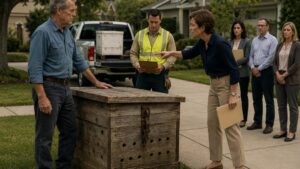
The trench cut across the strip of dry lawn between Frank’s driveway and the row of low shrubs the neighborhood called common landscaping. The grass there had not been green in weeks. A narrow section had already been peeled back, exposing packed clay, roots, and the top of a green water pipe that ran at an angle nobody had marked correctly on the association map.
Frank crouched with his gloves on and brushed dirt away from the pipe casing. It was damp underneath. Not wet enough to look dramatic from the sidewalk, but wet enough to make the dirt shine.
Jonathan leaned over his shoulder. “That’s the sleeve. The line’s under it.”
“Is it cracked?”
“Something is. That pressure didn’t drop because it felt shy.”
Frank did not smile. He turned toward the porch, where the temporary gauge was tied into the outside spigot with a brass fitting and a short coil of hose. The needle trembled again.
Inside the house, his mother was probably sitting at the kitchen table with her pill organizer open, waiting for the kettle to boil. Virginia Green had told him that morning not to fuss, which meant she had already noticed the water coughing through the faucet and had decided not to make it his problem.
Everything in Frank wanted to go inside and check. Everything practical in him knew he could not leave the line now.
“Cut clean,” Frank said. “Only enough to expose the joint.”
Jonathan gave him a look. “Frank, I’m going to ask again. Did the HOA answer your emergency notice?”
“I sent it.”
“That’s not what I asked.”
Frank reached into the trench and pulled away a clump of clay. “They can answer after we keep the water on.”
Jonathan exhaled through his nose. He was younger than Frank by a good fifteen years, but he had the careful face of a man who knew a license could be threatened by people who did not know the difference between a repair and an alteration. “I can expose. I can assess. But if somebody says stop, I have to think about my company.”
Frank looked up at him. “And if the line collapses?”
Jonathan’s eyes flicked to the gauge.
That was answer enough.
They worked faster after that. Jonathan loosened the clay around the pipe. Frank cleared roots with a hand trowel, slow enough not to nick anything. When the green sleeve came free, Jonathan tapped the casing lightly, then pointed to where the dampness gathered at a seam.
“There,” he said. “Old coupling. You see that?”
Frank saw the hairline split and the tiny pulse of water that appeared when pressure moved through the line. It was not spraying. It was worse than spraying. A spray looked like an emergency to everyone. This looked like something a board could debate until it failed.
Jonathan reached for the temporary valve assembly on the tarp: a red wheel valve, two clamps, a short length of pipe, and the small pressure gauge Frank had bought at the hardware store before dawn. He had gone before the store was fully open, standing in the aisle with mud on his boots from checking the yard in the dark.
“If we stabilize this side,” Jonathan said, “you might keep enough pressure for the house until we replace the cracked section.”
“Might?”
“I don’t lie around water.”
Frank nodded once. “Do it.”
Across the street, a curtain moved in Amanda Taylor’s front window. Frank noticed because he noticed things near his property now: a delivery truck slowing, a dog walker pausing, a car idling too long at the curb. Since the last HOA election, more neighbors watched before they asked.
Jonathan fitted the valve assembly over the exposed section. Frank held the pipe steady with both gloved hands. The red wheel looked too bright in the dirt, almost ridiculous, like a toy part attached to the thing keeping his house livable.
When Jonathan tightened the second clamp, the gauge at the porch fluttered. Frank stared until the needle rose a fraction.
“Come on,” he murmured.
The needle steadied.
Not high. Not fixed. But steadier.
Frank felt his shoulders loosen before he gave himself permission to feel relief. He stood, wiped the back of his wrist against his jaw, and looked toward the kitchen window. Through the glass he could see the pale square of Virginia’s dish towel hanging from the oven handle.
Then Amanda stepped out onto her lawn with her phone raised.
She did not call over. She did not ask what had happened. She stood behind her mailbox, aimed the phone toward the trench, and took a picture.
Frank looked away first. He told himself she was worried about flooding. That was reasonable. People worried about things that could cross property lines. But the phone stayed up long enough for him to know she was not taking one picture.
Jonathan saw it too. “You want me to put cones farther out?”
“I already put cones.”
“Put more.”
Frank dragged two orange cones from beside the driveway and set them wider around the trench. One rocked on the uneven grass, its base half on dry lawn, half on exposed dirt.
A dark SUV turned into the cul-de-sac before he straightened.
Frank knew the vehicle before he saw the driver. Brian Thompson liked to arrive slowly, as if every driveway were an extension of the boardroom and every resident had requested his presence by existing incorrectly. He parked at the curb, stepped out in a dark suit despite the heat, and adjusted his red tie while looking at the trench.
Jonathan muttered, “That was fast.”
Brian did not walk onto the lawn immediately. He stood at the edge of the common strip and took in the tarp, the exposed pipe, the red valve, the cones, the disturbed grass. His eyes paused on the pressure gauge.
“Mr. Green,” he said.
Frank removed his gloves one finger at a time. “Brian.”
“This work is not approved.”
“It’s an emergency repair.”
“Emergency repairs still require notification and association review when they affect common property.”
“I sent notification.”
Brian looked toward Jonathan. “Are you the contractor?”
“Licensed plumber,” Jonathan said.
“Then you understand you’re working on association-controlled land without authorization.”
Frank stepped between Brian and the trench before Jonathan could answer. “He’s working on my water line.”
Brian’s expression tightened, not with anger exactly, but with the satisfaction of finding the sentence he wanted. “Your line may run through this area. That does not make this area yours.”
Amanda had crossed halfway to the sidewalk now. Two other neighbors had appeared outside, pretending to adjust trash bins that had been empty since morning.
Frank lowered his voice. “The house is losing pressure. My mother is inside.”
Brian’s eyes moved briefly toward the house, then back to the trench. “I’m not disputing that you have a plumbing issue. I’m telling you this modification cannot remain here without approval.”
“It’s not a modification.”
“There is a new valve assembly in an open common strip.”
“There is a temporary valve stopping a failed line from getting worse.”
Brian removed a folded paper from inside his jacket. He had brought it with him. That bothered Frank more than the words. This had not begun when Brian saw the trench. This had begun when Amanda’s picture landed somewhere it should not have.
“You need to halt work,” Brian said. “Restore the area to its prior condition, and submit the proper exterior alteration request.”
Jonathan looked at Frank. His hands were still near the tools, but no longer touching them.
Frank felt the old, familiar heat rising in his neck. He had spent years learning to keep his face still while insurance forms asked whether Virginia could bathe without assistance, while discharge papers described his mother as a “home care burden,” while repair companies gave him windows of time like water and medication waited politely.
He picked up his gloves and put them back on.
Brian’s voice sharpened. “Mr. Green, I said the work has to stop.”
Frank crouched at the edge of the trench and turned the red wheel a quarter inch, watching the porch gauge respond.
The needle steadied again.
Only then did Frank look up.
Brian stepped closer, stopping just short of the cones. “Your water may run through it,” he said, loud enough for Amanda and the others to hear, “but this land belongs to the association.”
Chapter 2: The Crew Came Before the Notice Dried
A man Frank had never seen before was kneeling in the trench with a wrench on the red valve clamp when Frank opened the front door.
For one second, Frank did not understand what he was looking at. The sun had shifted. The orange cones had been moved. A white work truck idled beside the curb with its hazard lights blinking, and the tailgate was down, stacked with bags of soil and a steel plate. The man in the trench wore a gray shirt with no company logo Frank recognized.
Then the wrench turned.
“Stop,” Frank said.
The worker looked up but did not remove the wrench.
Frank came down the porch steps fast enough that his bad knee caught on the second one. Pain flashed up his leg. He ignored it. “Take your hand off that valve.”
The worker glanced over his shoulder.
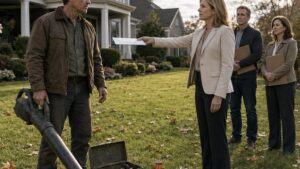
Brian Thompson stood near the driveway with a clipboard tucked under one arm. Beside him was a crew supervisor in a bright safety vest, holding a folded document in a plastic sleeve. Brian’s SUV was at the curb again. Amanda’s blinds were open across the street.
“Mr. Green,” Brian said. “You were notified.”
Frank crossed the lawn and stepped over the cone that had been dragged aside. “Notified when?”
Brian held out the paper.
Frank did not take it. “When?”
“This afternoon.”
“The crew is already here.”
“The notice was posted.”
Frank turned toward the door. A white paper was taped to the glass beside the handle. It had not been there when he took Virginia’s lunch tray in at noon. It was there now, trembling slightly each time the idling truck coughed.
He looked back at Brian. “You taped it to my door after they started.”
Brian’s jaw shifted. “The association has authority to remedy unapproved alterations on common property.”
“That valve is keeping water pressure in my house.”
“That claim is not documented in your application.”
Frank laughed once, without humor. “You mean the application you told me to submit after you tried to stop the repair?”
The worker in the trench moved again. Frank stepped down into the dirt and put one boot between the wrench and the pipe.
The crew supervisor lifted a hand. “Sir, don’t get in the work area.”
“This is my water line.”
“This is an authorized removal.”
“By who?”
The supervisor looked toward Brian.
Frank pulled his phone from his back pocket and started recording. The small red dot appeared on the screen. He held it at chest height, pointed at the trench, the worker, Brian, the truck.
“Say that again,” Frank said. “Who authorized you to dismantle a temporary repair on an active water line?”
Brian’s expression changed when he saw the phone, but not enough to look uncertain. “The Green Hollow HOA authorized removal of an unapproved alteration installed on association-maintained common property.”
“Association-maintained,” Frank repeated.
Brian paused.
Frank caught it. “This morning you said it was association land, not association responsibility.”
“I’m not here to debate wording.”
“No. You’re here to pull apart a valve before telling me what authority you have.”
The worker in the trench stood slowly, leaving the wrench hanging from the clamp. The red wheel was still attached, but one side of the assembly had loosened. A bead of water gathered along the coupling and dropped into the dirt.
Frank saw it. So did Jonathan Adams, who had just pulled up behind the white truck in his own van.
Jonathan got out with his tool bag in one hand and stopped dead. “What are they doing?”
“Removing the violation,” Brian said.
Jonathan looked at the open line. “That’s not a fence post. You loosen that wrong and you’ll drop pressure to the house.”
The crew supervisor said, “We were told it was inactive temporary hardware.”
“It’s attached to a live line.”
Brian’s face flushed slightly. “We were told it was unapproved.”
Jonathan looked at Frank, then at the valve. His voice lowered. “Frank, if they force this, I can’t touch it while there’s an enforcement dispute. My insurance won’t cover work under an active removal order.”
Frank knew that was true. He hated that it was true.
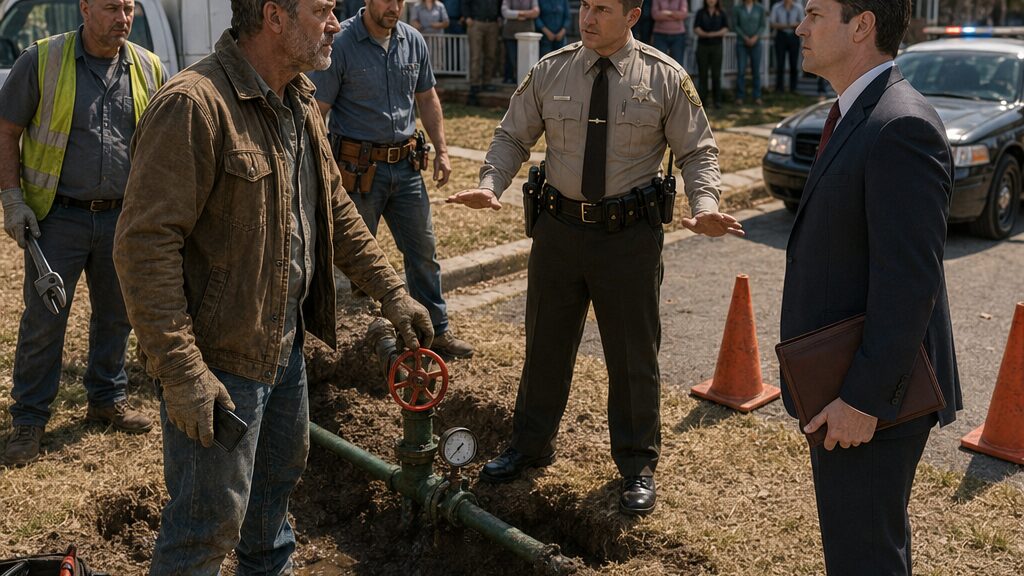
A sheriff’s cruiser rolled into the cul-de-sac before he could answer. It parked behind Brian’s SUV, and a deputy stepped out with one hand resting near his belt, the other raised slightly as if the air itself needed calming.
“Afternoon,” the deputy said. “Who called?”
Brian lifted his clipboard. “The association requested assistance with a resident obstructing authorized maintenance.”
Frank kept recording. “They’re dismantling a water valve without a court order.”
The deputy’s gaze moved from Frank to Brian to the man in the trench. “Anybody have a court order?”
Brian’s lips pressed together. “We have an HOA enforcement order.”
“That’s not what I asked.”
The cul-de-sac seemed to hold its breath.
Frank did not look at Amanda’s house, though he felt the shape of the neighborhood watching. He kept the phone steady. His hand wanted to shake; he would not let it.
Brian unfolded the document in the plastic sleeve. “The governing documents allow the board to cure unapproved modifications at the owner’s expense.”
The deputy took the paper, read enough to understand its category, and handed it back. “This is association paperwork. I’m asking whether a judge ordered entry or removal.”
“No,” Brian said. “But—”
“Then I’m not here to enforce it like one.”
Something loosened in Frank’s chest. Not victory. Space.
The crew supervisor stepped away from the trench. “I’m not getting in the middle of that.”
Brian turned on him. “You were hired to restore the common area.”
“I was hired to remove a non-compliant assembly. You didn’t say it was live.”
“It is non-compliant.”
Frank pointed at the pressure gauge near the porch. The needle twitched lower than it had that morning. “That valve is the only reason there’s still water pressure in my mother’s house.”
The words came out sharper than he intended.
They struck the air hard enough that Amanda lowered her phone across the street.
Brian looked toward the house again. This time his glance lasted longer. “Your file does not include any medical accommodation request.”
Frank felt the sentence like a hand closing around the most private part of the house.
“My mother’s condition is not for your sidewalk meeting.”
“Then I can only act on what is in the file.”
“In the file?” Frank looked down at the red valve, at the loosened clamp, at the water darkening the dirt. “You sent a crew onto my lawn before the tape on your notice warmed in the sun.”
Brian’s voice cooled. “And you installed unapproved hardware on property you do not own.”
Jonathan set his tool bag down but did not open it. That restraint told Frank more than words. Jonathan wanted to fix the clamp. Jonathan also wanted to keep his license.
“Can you tighten what they loosened?” Frank asked quietly.
Jonathan looked at the deputy, then at Brian, then at the worker still standing with the wrench. “Not while he’s claiming I’m altering association property. I’m sorry.”
The apology was worse because it was honest.
The deputy stepped closer to the trench. “Nobody touches anything for a minute.”
Brian checked his watch. “This cannot remain open overnight.”
“Then authorize the repair,” Frank said.
“I don’t have unilateral authority to approve an exterior alteration.”
“You had authority to send a crew.”
“To cure a violation.”
“To create one.”
For the first time, Brian’s confidence cracked into irritation. “Mr. Green, you keep using emergency language, but your paperwork is incomplete. You submitted a notice with no approved contractor schedule, no full diagram, no proof of utility easement, no medical accommodation documentation, and no board approval. I have a responsibility to the entire association, not only to your address.”
Frank took one step closer. The deputy shifted slightly, not touching him, just reminding him there was a line.
Frank stopped.
He could hear Virginia’s voice inside his head, dry and tired: Don’t make me the reason people whisper, Frankie.
He looked toward the kitchen window. The dish towel still hung from the oven handle. Behind that wall were pill bottles, a walker folded beside the pantry, a woman who had spent forty years paying bills on time and another ten insisting she was not a problem to be managed.
Frank turned back to Brian. “What do you want by morning?”
“The proper form. Complete documentation. Written acceptance that any damage resulting from this unauthorized work remains your responsibility. And the temporary assembly capped if approval is not granted.”
“You want me to ask permission for water.”
“I want you to follow the process.”
The deputy looked between them. “Is the line safe right now?”
Jonathan answered before anyone else could. “Less safe than it was before they loosened it.”
The crew supervisor rubbed the back of his neck. “We can retighten the clamp to where it was.”
Brian shot him a look.
Frank kept the phone on all of them. “Do it.”
The supervisor waited for Brian. Brian did not approve. He also did not stop him.
The worker climbed back in and tightened the clamp by a half turn. The water bead slowed. The pressure gauge did not rise much, but it stopped falling.
That tiny movement of the needle felt like an insult and a mercy at the same time.
Brian folded the plastic-covered order under his arm. “By nine tomorrow morning, Mr. Green. Complete paperwork, or the association will proceed with capping and restoration. Any further obstruction will be documented as refusal to comply.”
Frank lowered the phone only after Brian turned away.
Jonathan stood beside him in the torn grass, looking at the valve. “I’m sorry,” he said again.
Frank watched the red wheel sit crooked in the trench, bright against the wet clay. “Tomorrow morning,” he said, as if repeating the deadline could keep it from becoming real.
Chapter 3: The Form That Left Out the Person
The kitchen faucet coughed air into Virginia Green’s glass before it gave her a finger’s width of cloudy water.
Frank heard it from the hallway.
He stopped with one hand on the box of old appliance manuals he had pulled from the closet. The sound came again, a hollow spit from the pipes, followed by Virginia’s quiet, practical curse.
“Don’t come in here like I broke it,” she called.
Frank set the box on the table and went anyway.
Virginia stood at the sink with one hand braced on the counter, the other holding the glass under the faucet. She wore her blue cardigan though the house was warm, and her walker waited behind her like something she had parked there for someone else. The water cleared for two seconds, then thinned.
Frank reached past her and turned the handle off.
“I wasn’t finished,” she said.
“You shouldn’t be standing this long.”
“I have been standing longer than you have been alive.”
“Not tonight.”
She gave him the look she had used when he was ten and trying to hide a broken window. It had not lost strength with age. “How bad is it?”
Frank took the glass from her and held it up to the light. Tiny bubbles clung to the inside. “Bad enough.”
“That man in the tie?”
“Brian.”
“I know his name. I’m choosing not to use it.”
Despite himself, Frank almost smiled.
Virginia turned carefully and made her way back to the kitchen table. Each step had to be planned now. Not because she was helpless. Because the floor, the chair, the distance to the sink, the bathroom rail, the timing of medication, the height of the porch step—everything had become part of a map Frank carried in his head.
The water line was part of that map. Without steady water, the house stopped being a house that worked for her.
Frank opened his laptop on the table and woke the screen. The photo he had taken that afternoon was still open: red valve, green pipe, Brian’s shoes at the edge of the trench, the worker’s wrench hanging from the clamp. He closed it before Virginia could study it too long.
She saw anyway. She always saw.
“Did you tell them?” she asked.
“I told them the valve keeps pressure in the house.”
“That is not what I asked.”
Frank pulled up his email. “I submitted the emergency notice at 6:12 this morning. I have the timestamp.”
“Frank.”
“I’m finding the form.”
“Frankie.”
He stopped typing.
She rarely used that name now. It belonged to a house that had not needed grab bars, pill alarms, or laminated emergency lists. It belonged to a version of him who believed problems stayed fixed once he put enough work into them.
Virginia folded her hands on the table. Her fingers were thin, knuckles raised, nails clean and unpainted. “Did you tell them why water matters here?”
“Water matters everywhere.”
“Don’t dodge me in my own kitchen.”
Frank looked back at the screen. “I did not attach the medical accommodation form.”
The room held still around the sentence.
Virginia breathed in through her nose. “Why?”
Because you asked me not to make you a case number. Because every form turns you into diagnosis, limitation, risk. Because last time a clerk read your file and spoke louder to you like age had made you hard of hearing and simple. Because I promised you this house would stay yours, not become a project everyone got to review.
He said, “It wasn’t necessary for a pipe repair.”
Virginia’s eyes softened, and that was worse than anger. “Apparently it was.”
Frank opened the HOA portal and clicked through the submission history. The screen loaded slowly. The internet had been unreliable since the irrigation controller failed at the corner, another thing the association had postponed until the budget meeting.
There it was.
Emergency Exterior Repair Notification. Submitted 6:12 a.m. Attachments: contractor estimate, photo of pressure gauge, photo of exposed leak area, temporary repair description.
No medical accommodation attachment.
No easement map.
No board approval.
He clicked the confirmation email and printed it. The old printer on the sideboard woke with a grinding complaint. Paper slid out one page at a time, each sheet feeling less helpful than it should have.
Virginia watched him. “What does it prove?”
“That they received notice.”
“What does it not prove?”
Frank did not answer.
The printer spat out the last page.
His inbox chimed.
The subject line was from the HOA management address. RE: Emergency Exterior Repair Notification — Green Residence.
Frank opened it. Brian had not written it; the signature at the bottom belonged to the management office, but the language sounded polished by someone who expected it to be forwarded later.
Your emergency repair notification is incomplete and therefore cannot be approved at this time. Exterior alterations affecting common area property require full board review unless immediate danger to community property is verified by association-approved personnel. Any temporary structure or device installed without approval remains subject to removal. Please see attached compliance resolution and owner responsibility agreement.
Frank opened the attachment.
The first page was a formal denial. The second was worse.
Owner Responsibility and Indemnification Agreement.
His eyes moved down the paragraphs. He read phrases twice because they seemed too broad to be real.
Owner accepts sole responsibility for any present or future damage arising from private water-line work in or adjacent to common area.
Owner agrees association approval of temporary repair shall not constitute acknowledgement of association maintenance duty.
Owner agrees to reimburse association for enforcement, restoration, administrative, and legal costs related to unapproved work.
At the bottom was a signature line with his name typed beneath it.
Virginia reached for her glasses. “Read it to me.”
“No.”
“Read it.”
“It’s a waiver.”
“For what?”
“For everything they don’t want to own.”
She held out her hand.
Frank hesitated, then gave her the page. He watched her read slowly, lips tightening, one finger moving down the lines. At the third paragraph, she stopped.
“They want you to pay them for stopping you.”
“They want me to agree the line is mine forever.”
“Is it?”
“I don’t know yet.”
That admission cost him. He had acted all day as though certainty could be built from urgency. But the pipe had been underground for decades. The neighborhood had changed developers twice before he bought the house. The HOA map showed one thing. The county might show another. The water had never cared about the paperwork until the paperwork came for it.
Virginia set the page down. “If signing gets the water fixed—”
“No.”
“You didn’t let me finish.”
“I know where that sentence goes.”
“Then you also know who has to wash, drink, take medicine, and live here while you make a point.”
Frank pushed back from the table and stood. “This is not a point.”
“It becomes one if I’m the one waiting.”
The words landed clean. Not cruel. Clean.
Frank looked toward the hallway bathroom where he had installed the grab bar himself on a Saturday after Virginia nearly slipped. He had not asked permission for that. It was inside the house. No one had come with a clipboard. No one had asked whether the bar changed the character of the wall.
Outside, the red valve sat in the dark trench, loosened and threatened.
“I should have attached the form,” he said.
Virginia’s expression changed.
He had not meant to say it aloud, but there it was, the first honest thing under all his anger.
“I thought I was protecting you,” he said.
“From what?”
“From being discussed.”
Virginia looked down at the waiver, then toward the sink. “I am already being discussed. Just without the truth.”
Frank sat again slowly.
She slid the page back to him. “Use what you need. Not everything. Not the parts that aren’t theirs. But enough.”
“They’ll put it in minutes.”
“Then make them put only what matters.”
Frank folded the denial letter once, then opened it again because folding felt like surrender. He placed it beside the printed email timestamp and the photo of the valve on his phone. Three pieces of the same problem. Notice received. Need half-shown. Responsibility pushed back onto him.
His inbox chimed again.
This one came directly from Nicholas Scott, HOA treasurer. The message was short.
Mr. Green, if you wish to avoid additional enforcement action tomorrow, please sign and return the attached agreement by 8:30 a.m. The board may then consider temporary conditional permission for your contractor to proceed at your sole expense and risk.
Attached was the same waiver, now with one added line highlighted in yellow:
Owner acknowledges no present or future claim shall be made against the association regarding the water line, common strip, or related underground infrastructure.
Frank read it once.
Then again.
Virginia watched his face. “What did they send?”
Frank turned the laptop so she could see, but he kept his hand on the edge of the screen as if it might move on its own.
“They sent me permission,” he said, “to give up the line.”
Chapter 4: The Map Said More Than the Board Wanted
“The association map is missing a recorded page,” the county clerk said, and Frank felt the folder under his arm become heavier.
He stood at the counter with red dirt still worked into the seams of his boots, the unsigned waiver folded in his back pocket, and three printed photographs spread between him and the clerk: the trench, the pressure gauge, the red valve sitting crooked in the clay. Behind the counter, the clerk had a stack of oversized plat books open beneath a glass weight.
Frank leaned closer. “Missing how?”
“Not missing from here.” The clerk tapped the county index with one short fingernail. “Missing from whatever they gave you. See this notation? Utility reservation continued on Sheet C.”
Frank looked at the photocopy Brian had emailed with the violation notice. The association version ended at Sheet B. The common strip was shaded in pale gray, labeled landscape reserve, with no pipe, no easement line, nothing but a boundary that made Frank’s trench look like a trespass.
The clerk pulled another drawer open and lifted out a large sheet. “This is Sheet C.”
She unfolded it across the counter.
There, faint but legible, a dashed line cut through the common strip in front of Frank’s lot and three neighboring lots. It ran almost exactly where the green pipe had surfaced. The label beside it read utility access and maintenance easement.
Frank put one hand flat on the counter.
The clerk looked up. “That mean something?”
“It means they didn’t send me the whole map.”
“Could be old records. Could be oversight.” She had the careful voice of someone who had learned not to accuse anybody from behind a public counter. “I can certify a copy.”
“How long?”
“Ten minutes if the machine behaves.”
Frank looked toward the lobby windows. His truck sat outside with a cooler of water jugs in the passenger footwell because Virginia’s faucet had started coughing again before he left. He had filled them from Amanda’s hose at dawn, though he had done it when the street was empty and hated himself for the secrecy of it.
“Please,” he said.
The clerk carried the sheet toward the copier. Frank stood alone with the association’s incomplete map and Nicholas Scott’s waiver. The highlighted line from the night before seemed to glow through the folded paper in his pocket.
No present or future claim shall be made against the association.
It read differently now.
At the utility counter two blocks away, the answer became less helpful.
The city utility employee studied the certified map and shook his head. “This shows an easement. It doesn’t show ownership of the lateral.”
“It shows access.”
“It shows reserved utility access. That’s not the same thing as a work authorization.”
Frank held back the first response that came to him. He had promised Virginia before leaving that he would not let anger do the talking if paper could do it better.
“The line is losing pressure,” he said. “The HOA is threatening to cap the temporary repair. If that happens, the house may not have enough water.”
The employee looked at the pressure readings Frank had printed from the photos. His expression changed slightly at the handwritten times.
“You took these yourself?”
“Yes.”
“Same gauge?”
“Yes.”
“And a licensed plumber installed the temporary assembly?”
“Under emergency conditions.”
The employee turned to his computer and typed. “We can’t settle a property dispute at the counter.”
“I’m not asking you to settle it. I’m asking whether this looks like a safe delay.”
The employee did not answer immediately. That was the first useful thing he did.
He printed a number on a slip of paper. “Call inspections. Ask for a utility-related habitability check. Use those words. Tell them you have falling pressure readings after a temporary repair was disturbed.”
Frank took the slip. “Will they come today?”
“They’ll tell you the schedule.”
“That’s not what I asked.”
The employee met his eyes. “No. Probably not today. But if you send those photos, they may move.”
Frank called from the truck before he started the engine. He spoke to a recorded system, then a clerk, then someone who put him on hold long enough that he watched two people leave the building with their own easier problems. When a person finally returned, he gave his name, address, and the phrase exactly as instructed.
Utility-related habitability check.
The inspector’s office gave him an email address and told him to send the photographs, the pressure readings, and the certified map.
Frank sent everything from the parking lot. His thumb hovered over the medical accommodation letter Virginia had let him scan that morning.
Enough, she had said. Not all.
He attached only the one-page statement from her physician: continuous residential water access required for hygiene, medication preparation, and safe home care.
No diagnosis page. No history. No list of what had been taken from her slowly by age and illness.
He hit send.
On the drive home, the red valve stayed in his mind like a signal light underground.
Amanda Taylor was standing near his driveway when he pulled in.
Frank almost kept driving to the curb and ignoring her. Instead he parked, took the certified map from the passenger seat, and got out.
She held a plastic grocery bag with two gallons of water inside. “I left some on your porch,” she said. “These are extra.”
Frank looked at the bag. “We have water.”
“I know.” She tightened her grip on the handles. “I mean, I don’t know. I saw you filling jugs this morning.”
Heat rose in his face, quick and unwelcome.
Amanda looked toward the trench. The cones were back in place, though one had fallen sideways. The red valve sat below them, too exposed in the midday light.
“I shouldn’t have taken those pictures the way I did,” she said.
“You sent them to Brian.”
“I sent one to the association office.” She looked down. “I thought if that line burst, it could run down the street. My husband and I had a slab leak in our old place. It ruined half the floor before anyone believed us. When I saw the trench, I thought—”
“You thought I was making a mess.”
“I thought you might be trying to fix something before it became one.” She swallowed. “But I also thought the board should know. I didn’t know your mother was without steady water.”
Frank wanted to keep the apology out. It had arrived at a bad time, and he had no place to put it.
“She’s not without water,” he said.
Amanda’s eyes moved to the grocery bag.
Frank took the handles. Not because he wanted her charity. Because rejecting the water would make Virginia pay for his pride.
“Thank you,” he said, and it came out rough.
Amanda nodded toward the folder. “Did you find something?”
“Maybe.”
“Maybe good?”
“Maybe incomplete.”
Inside, Virginia sat at the kitchen table with the morning’s printed papers arranged in piles. She had labeled them with sticky notes in her neat old handwriting: HOA, COUNTY, MEDICAL, PHOTOS, DON’T SIGN.
Frank stopped at the doorway when he saw the last one.
Virginia did not look up. “I thought you might need reminding.”
He set Amanda’s water by the pantry and unfolded the certified map across the table. Virginia put on her glasses. Her finger found the dashed line before he pointed to it.
“That’s our yard?”
“Common strip.”
“Same dirt.”
“Not legally.”
She traced the words utility access and maintenance easement. “Does this fix it?”
“No. It helps.”
“Paper always helps less than it should.”
Frank’s phone rang before he could answer. The city inspection office.
He put it on speaker.
A woman’s voice came through. “Mr. Green? We reviewed the photographs and the pressure readings. We can send a utility inspector to your property tomorrow morning.”
Frank closed his eyes once. “Tomorrow?”
“First available. The note says possible habitability concern due to declining residential water pressure.”
Virginia mouthed, Good.
Frank opened his eyes. “The HOA says they may cap the temporary repair tomorrow morning.”
“What time?”
“Nine.”
A pause. Paper moved near the phone. “I’ll mark the visit urgent and request arrival before nine if possible. I can’t guarantee it.”
“Can you email confirmation?”
“Yes.”
When the call ended, Frank checked his inbox until the confirmation appeared. He printed it. Virginia placed it in the pile labeled COUNTY, then crossed out COUNTY and wrote RECORDS.
Frank took a photo of the certified easement map and texted it to Brian with one line:
This shows utility access and maintenance easement across the common strip. Do not touch the valve before inspection.
Brian’s reply came six minutes later.
An easement does not authorize an owner-installed alteration or establish association responsibility. Your application remains incomplete.
Frank stared at the sentence until the words blurred into their real shape: not enough.
Then another email arrived, this one from the city inspection office, marked urgent. The appointment window had been changed.
Utility inspector assigned. Field visit scheduled for 8:15 a.m.
Frank looked through the kitchen window toward the torn strip of lawn, the cones, the trench, and the red valve that everyone now seemed able to see except as what it was.
At 8:15, someone else would stand over it and decide whether the city saw a violation, a hazard, or a house trying to keep water moving.
Chapter 5: The Inspector Saw the Pressure Drop
The pressure gauge dipped while Brian Thompson was telling the city utility inspector there was no emergency.
Frank saw the needle move first. It dropped in one small, ugly motion, then quivered there as if deciding whether to fall farther. The inspector, who had been listening with a neutral face and a clipboard against his hip, stopped writing.
Jonathan Adams saw it too. His jaw tightened.
Brian did not. He was standing at the edge of the cones in a gray suit this time, speaking with controlled patience. Nicholas Scott stood beside him with a leather folder tucked under one arm, dressed for an office instead of a torn lawn.
“What we have,” Brian said, “is an owner who proceeded without approval on association-maintained landscape area, then attempted to reframe the violation as a utility emergency after the fact.”
The needle dipped again.
The inspector pointed. “Is that the same gauge from the submitted photos?”
Frank kept his hands open at his sides. “Yes.”
“Installed when?”
“Yesterday morning. Before the temporary valve.”
Jonathan stepped in only far enough to be useful. “It’s tied to the house-side pressure. It’s not perfect, but it’s consistent. The trend matters.”
Brian turned. “Mr. Adams is the contractor who performed the unapproved work.”
“Licensed plumber,” Jonathan said.
The inspector crouched near the porch spigot, looked at the gauge, then walked to the trench. He did not step inside it. He squatted at the edge and studied the red valve assembly. The clamp the crew had loosened showed a faint wet line in the dirt beneath it.
“Who disturbed this after installation?”
Frank looked at Brian.
Brian answered, “An association-approved crew began removal of unauthorized hardware.”
The inspector looked up slowly. “On a live residential water line?”
Nicholas shifted. “My understanding was that the assembly was temporary and outside the home’s plumbing system.”
Jonathan gave a short laugh he immediately swallowed. “It’s attached to the system. That’s what makes it a valve.”
The inspector made another note.
For the first time that morning, Frank felt the smallest opening in the wall. Not a doorway. A crack.
Brian seemed to feel it too. His tone sharpened. “We are not disputing that water runs through the line. The issue is whether Mr. Green had authority to excavate common property and install equipment without board approval.”
“The issue I’m here for,” the inspector said, “is whether the residence has a utility condition affecting habitability or safety.”
“And?”
“I’m still looking.”
Frank wanted the inspector to say it immediately. To point at the gauge and the wet dirt and make the whole thing obvious. But obvious had not been enough all week.
The inspector asked to see the inside fixtures. Frank hesitated for half a second before leading him through the front door. Brian took a step as if to follow.
Frank turned. “No.”
Brian looked offended. “This concerns association property.”
“My mother is inside.”
The inspector glanced at Brian. “I only need the owner and plumber.”
Inside, Virginia sat in the living room with her cardigan buttoned and her walker beside her chair. She had insisted on being dressed before the inspector arrived. Her hair was pinned back. On the table beside her were a glass of cloudy water and the physician’s one-page letter, folded in half.
“Ma’am,” the inspector said gently.
Virginia nodded. “I hear I’m part of the plumbing now.”
Frank closed his eyes briefly.
The inspector’s mouth softened, but he did not laugh. “I just need to check your fixtures.”
In the kitchen, Frank opened the faucet. It ran clear for three seconds, then coughed air and sputtered against the sink. The inspector watched without speaking. Jonathan tested the laundry hookup and the bathroom sink. Both showed the same weak pulse.
The inspector took a reading at the outside spigot again after they returned to the lawn. It had dropped two pounds since he arrived.
“That’s not stable,” he said.
Frank looked at Brian.
Brian’s face had settled into something harder than denial. It was calculation.
The inspector faced all of them. “I’m comfortable saying the repair is necessary to maintain reliable residential water service. Delaying it increases the risk of pressure loss and possible contamination if the damaged section worsens.”
There it was.
Not victory. But words from someone who did not live under the HOA.
Frank breathed through his nose, carefully.
Brian folded his arms. “Does that authorize work on association common area?”
“No,” the inspector said.
The opening narrowed again.
Frank stared at him. “You just said the repair is necessary.”
“I did.”
“But you won’t tell them to let us repair it.”
“I don’t have authority to override a property-control dispute unless there’s an immediate public utility hazard or a code order I can issue. Right now, I can document habitability concern and recommend prompt repair by a licensed professional.”
Nicholas spoke for the first time. “So the association is within its rights to require process.”
The inspector gave him a look. “I didn’t say that. I said I’m not the judge of your governing documents.”
Brian took that as enough. “Then we’ll proceed through the board.”
Jonathan had moved closer to the trench. He was looking not at the valve now, but at two old concrete spots near the edge of the dug section, half-covered by dead grass. He nudged one with his boot, then crouched and brushed dirt away.
Frank noticed. “What?”
Jonathan pointed. “Those are anchors.”
“For what?”
“Old access cover, maybe. Or a previous utility box.” He brushed around the second mark. “These weren’t poured yesterday.”
The inspector crouched beside him. “You see a lid?”
“No. Looks like it was removed or covered over when they landscaped.”
Frank stepped closer. In the dirt, the old concrete marks formed a rectangle wider than the trench. Something had been there before the grass and shrubs and common strip language. Something built around access.
Brian frowned. “That proves nothing.”
“Maybe,” Jonathan said. “But nobody pours anchors for invisible pipes they never plan to reach.”
The inspector took photographs.
Frank watched him do it, and for the first time all morning the red valve seemed less like an unauthorized object and more like something returned to a place that had always expected to be opened.
Small proof. Not enough. But real.
The inspector stood and addressed Frank. “I’ll file the habitability note today. It will say the repair is necessary and should not be delayed without an approved alternative to maintain service.”
“Approved alternative,” Brian repeated.
The inspector looked at him. “If the association blocks this repair, you should provide a safe, prompt alternative. Not just removal.”
Nicholas’s hand tightened on the leather folder. “That could imply association responsibility.”
“It implies water needs to keep running,” the inspector said.
There was no speech in it. No accusation. That made it harder to dismiss.
Brian stepped aside with Nicholas. They spoke low enough that Frank could not hear every word, but he caught fragments: exposure, assessment, precedent, special meeting. Nicholas shook his head once, then said something that made Brian look back toward the trench.
The inspector handed Frank a copy of the field note, not the final report, just a carbon sheet with boxes checked and two handwritten lines.
Necessary repair indicated to maintain residential water service. Jurisdictional/property authorization unresolved.
Frank read it twice. The first sentence helped him. The second sentence left him standing in the same dirt.
“Can my plumber tighten the temporary assembly?” he asked.
The inspector glanced at Brian. “From a utility safety standpoint, stabilizing what’s already attached would be preferable to leaving it compromised.”
Brian said, “The association does not consent to additional work.”
Frank felt the anger come up clean and hot.
The deputy from the day before was not there. No uniform stood between them. Only the inspector, Jonathan, Nicholas, and the neighbors who had begun to appear again at windows and driveways.
Frank turned to Jonathan. “If he refuses consent, what happens?”
Jonathan looked miserable. “I can’t risk it, Frank. Not with them objecting on property grounds.”
Brian did not look pleased by that. He looked relieved.
That was the moment Frank understood Brian was not trying to prove the line was safe. He was trying to keep anyone from creating a record that the association had allowed the repair.
Nicholas opened his folder and handed Brian a page. Brian read it, then looked at Frank.
“The board will hold an emergency meeting tomorrow evening,” Brian said. “Until then, the temporary assembly remains under violation. We will consider fines, restoration costs, and any conditional repair request you submit before noon.”
“You already have the request.”
“We have an incomplete request.”
The inspector packed his clipboard into his truck. Before getting in, he paused beside Frank. “Get every denial in writing,” he said quietly.
Frank nodded.
The inspector drove away, leaving behind the field note, the photographs of old anchors, and no permission.
Brian and Nicholas walked back toward the SUV. Amanda stood on her porch across the street, holding both hands around a coffee mug she had not drunk from.
Frank looked at the gauge.
The needle trembled.
By sunset, an email went out to every homeowner in Green Hollow. Frank knew because Amanda forwarded it to him without comment.
Emergency Board Meeting: Unauthorized Utility Alteration, Common Area Damage, Proposed Fine and Cost Recovery.
Attached beneath the notice was a photograph of Frank’s red valve, cropped tight so the house, the pressure gauge, and everything the valve protected could not be seen.
Chapter 6: The Meeting Turned Water Into a Fine
Frank walked into the HOA clubhouse and saw his red valve projected on the screen under the words Violation Item 4 before anyone said his name.
The photo filled the wall behind the folding table where the board sat. Cropped tight, it looked like evidence from a case already decided: red wheel, green pipe, wet dirt, orange cone edge. No kitchen faucet coughing air. No Virginia sitting with a folded physician’s note in her lap. No old concrete anchors. No pressure gauge trembling by the porch.
Just the part that made him look guilty.
Brian Thompson sat at the center of the table with a stack of papers squared in front of him. Nicholas Scott sat to his right, calculator and folder ready. Other board members flanked them, faces arranged into the careful blankness of people who hoped procedure would keep them from choosing too much.
Amanda Taylor sat in the second row.
Frank noticed her before he noticed the empty chair reserved for him near the front.
He sat without looking back.
Brian tapped the microphone though the room was small enough not to need one. The sound cracked once through the speakers. “This emergency meeting concerns unauthorized excavation and installation of plumbing hardware on association common area adjacent to the Green residence.”
Frank looked at the screen until his eyes stopped wanting to flinch.
Brian continued. “The board recognizes Mr. Green has reported a private water-pressure issue. However, the association must address the broader concerns: liability, common area damage, unapproved alteration, contractor activity without approval, and precedent.”
Precedent. Frank had heard that word from people who were afraid one act of mercy would become a bill.
Nicholas leaned toward his microphone. “Before discussion, I want to note potential cost exposure. If the association is deemed responsible for underground infrastructure in the common strip, similar claims may arise from multiple lots. We have no reserve line item for lateral water service repairs. Any acceptance of responsibility could require assessment.”
A murmur moved through the room.
There it was. Not just rules. Money.
Frank felt something settle. Brian had been the face at the trench, but Nicholas had just shown the board the thing behind the face: if the pipe belonged to them, the cost might not stop at Frank’s yard.
Brian clicked to the next slide. The association map appeared. Sheet B. The incomplete one.
Frank raised his hand.
Brian looked at him as though generosity cost him. “Mr. Green will have a chance to speak after the compliance summary.”
“That map is missing Sheet C.”
A board member at the far end looked up.
Brian’s smile was thin. “As I said, after the summary.”
Frank opened his folder and placed the certified county copy on his lap. He did not unfold it yet. He made himself wait. Anger wanted speed; documents needed timing.
Brian read from the governing rules. Exterior alterations. Common landscape area. Owner responsibility. Emergency work requiring immediate notice. He did not mention that Frank had sent notice before the first confrontation. He did not mention that the notice on Frank’s door had been posted after the crew arrived.
Then Amanda stood.
She did not raise her hand first. She just stood, and the room turned because small rule breaks were louder in that room than failing water.
Brian blinked. “Homeowner comments will come after—”
“I need to correct something,” Amanda said.
Frank turned slowly.
Her voice shook at first, then steadied. “I sent the first photograph to the association office.”
The room shifted again.
Brian’s fingers tightened around his pen.
Amanda kept going. “I saw the trench from my house. I was worried about a possible water main break because of damage I had in a previous home. I did not speak with Mr. Green first. I did not know his mother was inside with pressure dropping. I did not know the valve was temporary.”
Brian said, “Mrs. Taylor, no one is suggesting—”
“I am.” She looked at Frank, then away. “My complaint started the enforcement chain without the full facts.”
The room did not become friendly. But it became less certain.
Frank gave her the smallest nod he could manage. Not forgiveness. Acknowledgment.
Brian cleared his throat. “Thank you. The board appreciates residents reporting potential hazards.”
Frank stood then. “May I speak now?”
Brian could hardly say no without looking like exactly what he was trying not to be. “Three minutes.”
Frank unfolded the certified map and carried it to the front table. “The map in your packet is incomplete. This is the county-certified Sheet C. It shows a utility access and maintenance easement across the common strip.”
Nicholas reached for it first. His eyes moved quickly. Too quickly. Not confused; familiar with what he feared.
Brian looked over his shoulder. “An easement is not blanket permission for an owner to excavate.”
“I didn’t say it was.”
“You installed hardware.”
“To stabilize a failing line.”
“You omitted required documentation.”
Frank took one breath. He felt everyone waiting for him to defend his pride. He let the pride sit in his throat and did not feed it.
He removed the physician’s statement from his folder. One page. No diagnosis history. No private details beyond the necessary words.
“My mother lives in my home,” he said. “Her physician states continuous residential water access is required for hygiene, medication preparation, and safe home care. I did not attach this yesterday morning because I believed an emergency water repair should not require turning her condition into association business.”
His voice held. Barely, but it held.
He handed the page to the board secretary, who passed it to Brian.
Brian read it without expression. Nicholas leaned close enough to see.
Frank remained standing. “That is all of her medical information this board gets. The city inspector has already noted that the repair is necessary to maintain water service. My plumber can complete it. I am asking the board to withdraw the removal order and allow the repair under inspection.”
For a moment, no one spoke.
Then Nicholas adjusted his glasses and opened his folder.
“The association understands the sensitivity,” he said, in a voice polished smooth by numbers. “But we also have to protect all homeowners. The proposed solution is conditional permission. Mr. Green may proceed with repair at his sole expense if he signs the owner responsibility agreement, indemnifies the association, reimburses removal and administrative costs to date, and acknowledges that no current or future claim will be made against the association regarding the line or common strip.”
Frank looked at him. “You want me to sign away the easement.”
Nicholas did not blink. “No. We want to avoid an unresolved infrastructure dispute becoming an association-wide liability.”
“By making it mine.”
“By allowing your repair to proceed without prejudicing the association’s position.”
Frank heard a chair creak behind him. Someone whispered, “That seems fair,” and someone else whispered back, “Unless it’s their pipe.”
Brian leaned forward. “Mr. Green, this is the path to getting your water issue addressed quickly.”
There was the trap, dressed like help.
Frank thought of Virginia at the kitchen table, sorting papers into piles. DON’T SIGN.
He had nearly considered it in the hour before the meeting. He had sat in his truck outside the clubhouse with the waiver on the steering wheel, imagining steady water, a tightened valve, the relief of ending the fight before it took any more from his mother.
But the highlighted line had not changed. No present or future claim.
If he signed, the water might come back for now. The next failure would belong to him too. And the next owner. And perhaps the other homes along the dashed line no one was supposed to notice.
Frank put both hands on the back of the chair in front of him.
“No,” he said.
Brian’s expression hardened. “Then the violation remains active.”
“No,” Frank said again, quieter. “I will pay for my house-side repair. I will not sign a document saying the association has no responsibility for land and infrastructure it may have accepted before I ever lived here.”
Nicholas closed the folder. “Then the board has no assurance.”
“You have a certified easement map, a city habitability note, pressure readings, a plumber willing to finish the work, and a medical accommodation statement. What you don’t have is my signature taking your problem away.”
The room went completely still.
Brian looked down at the papers, then toward the board members. “The chair recommends that enforcement proceed unless the agreement is signed by 8 a.m. tomorrow. Removal crew will return to restore the common area. Costs will be assessed to the owner account pending further review.”
Amanda stood again. “You’re going to remove it after that?”
Brian did not look at her. “We are going to enforce the governing documents.”
Frank gathered his papers. He did not wait for the vote to be dressed up as discussion. He heard the board secretary call for hands as he slid the certified map into his folder.
On the screen, the red valve remained enlarged behind him, bright and isolated from everything it meant.
At the door, Brian’s voice reached him through the microphone.
“Removal crew is scheduled for 8 a.m. tomorrow unless the signed agreement is received before then.”
Frank stopped with one hand on the metal push bar, then opened the door and stepped out without turning around.
Chapter 7: He Refused to Sign Away the Line
The crew truck arrived at 7:42, eighteen minutes before the board member who had promised to “review the county record” had even opened the clubhouse office.
Frank watched it roll into the cul-de-sac from behind the porch post, one hand around his phone, the other holding the folder against his ribs. The red valve sat below the cones where it had been all night, bright in the gray morning light, the clamp damp but holding. The pressure gauge beside the porch trembled just above the line Jonathan had marked with a piece of blue tape.
Inside, Virginia had filled three glasses before dawn, not because she needed three glasses, but because the sound of water still coming from the faucet had become something neither of them trusted.
The truck backed toward the curb. The same crew supervisor got out first, followed by two workers who moved more slowly than they had on Monday, as if the trench had become less like a job and more like a place where someone might ask them to say what they were doing aloud.
Brian Thompson arrived one minute later in his SUV.
Frank started recording before Brian closed his door.
“Morning, Mr. Green,” Brian said.
“No signed waiver,” Frank said. “No removal.”
Brian carried a folder thinner than Nicholas’s but held it with more certainty. “The board voted last night. You were present.”
“The board voted on an incomplete map and ignored the city field note.”
“The board considered the material available.”
Frank stepped off the porch. His boots hit the walkway harder than he intended. “You were sent the certified Sheet C.”
“An easement does not give you permission to leave an open excavation and unapproved hardware in a common area.”
“The excavation is open because you keep stopping the repair.”
Brian looked at the crew supervisor. “Proceed with restoration.”
The supervisor did not move. “Do you have something from the court today?”
Brian’s face went still.
Frank turned the phone toward him. “Answer him.”
Brian’s eyes flicked to the screen. “The HOA has enforcement authority under the governing documents.”
“That’s still not a court order,” Frank said.
As if summoned by the words, the sheriff’s cruiser turned into the street.
The deputy stepped out, the same one from Monday. He took in the truck, the cones, the trench, Frank’s phone, Brian’s folder, and the workers standing away from their tools.
He sighed once. “I was hoping not to see this pipe again.”
Frank did not smile. Brian did not either.
The deputy approached the trench. “Same question as before. Does anybody have a court order authorizing removal over the owner’s objection?”
Brian lifted his folder. “We have a board resolution.”
The deputy’s expression did not change. “That wasn’t my question.”
“No court order,” Frank said.
Brian turned sharply. “This is not solely his property.”
The deputy looked at him. “Then it sounds like a civil property dispute. I’m here to keep people from putting hands on each other, not to decide your map.”
Frank felt the first solid thing of the morning under his feet.
The crew supervisor folded his arms. “I’m not touching the valve unless someone with authority tells me I won’t be liable for cutting off a residence.”
“You were hired by the association,” Brian said.
“I was hired to restore landscaping after an unapproved alteration. I wasn’t hired to become the test case.”
Frank looked at the supervisor for the first time as a person rather than another extension of Brian’s clipboard. The man avoided his eyes, but he did not step toward the trench.
A van door slammed down the street. Jonathan Adams came at a half jog with his tool bag, his hair still damp from a rushed shower.
“I can stabilize the clamp in ten minutes,” he said. “I can replace the cracked section in less than two hours if nobody stops me.”
Brian said, “You are not authorized.”
Jonathan looked at Frank, then at the deputy. “I’m not starting new work while he objects. But if that clamp slips because it was loosened Monday, everybody here is going to know why.”
The pressure gauge quivered.
Frank saw Brian see it.
For the first time, Brian’s face did not show control. It showed arithmetic. The truck. The witnesses. The field note. The recording. The old map. The waiver Frank had refused. Each piece did not solve the fight, but together they made the next wrong move heavier.
Amanda Taylor crossed the street carrying a manila envelope with both hands.
Frank almost told her not now. He had no room left for apologies or grocery bags or neighborly guilt. But her face stopped him. She looked as if she had found something she wished she had found two days earlier.
“My husband kept HOA papers,” she said, slightly out of breath. “From when he was on the landscaping committee. I didn’t remember until last night. I looked after the meeting.”
Brian’s posture changed. “Mrs. Taylor, this is not the time for unsorted private files.”
She ignored him and held the envelope out to Frank. “There are minutes from years ago. Before you moved in.”
Frank took the envelope. It was soft at the corners, old enough that the glue on the flap had yellowed. Inside were photocopied meeting minutes, budget notes, and a faded maintenance diagram with handwritten circles along the same dashed strip shown on Sheet C.
Amanda pointed to one page. “Here.”
Frank read the line once, then again.
Common utility access strip to remain HOA-maintained for landscaping and service access; prior utility box covers removed and area regraded after completion.
Below it was a vote approving removal of old covers and regrading, with a note that future access must be preserved.
Jonathan leaned over his shoulder. “That explains the anchors.”
The deputy looked at the old concrete marks near the trench. “Those?”
Frank nodded.
Brian came closer. “Let me see that.”
Frank held it out, but did not let go until Brian had to take it carefully. Brian read, his mouth tightening line by line. Nicholas Scott’s car pulled up at the curb while Brian was still reading.
Nicholas got out with his leather folder and moved fast. “What’s happening?”
Amanda answered before Frank could. “The association knew there was access there.”
Nicholas looked at her envelope. His eyes sharpened. “Those are not official board records.”
“They were copied from official board records,” Amanda said. “My husband kept everything because he didn’t trust anyone’s memory after budget season.”
Brian handed the page to Nicholas. Nicholas read less than Brian had. He understood faster.
“This doesn’t establish current line ownership,” Nicholas said.
“No,” Frank said. “It establishes you knew that strip was for utility access before you covered it and called it landscaping.”
Nicholas closed his lips.
The pressure gauge dipped again.
This time everyone saw it.
Virginia had come to the doorway. Frank had told her to stay inside. Of course she had not. She stood behind the glass storm door with one hand on her walker, watching the people gathered around the hole in the ground that had dragged her private life into the street.
Frank turned toward her. She did not wave him back. She nodded once.
Enough. Not everything. Enough.
Frank faced Brian, Nicholas, the deputy, the crew, Amanda, Jonathan, and the neighbors who had emerged onto porches with coffee cups and folded arms.
“My mother lives in that house,” he said. His voice stayed lower than he expected. “She needs reliable water to remain there safely. I sent emergency notice before work began. I hired a licensed plumber. I gave you pressure readings, a city field note, a physician’s statement, a certified easement map, and now your own old minutes showing access was supposed to stay available. I will not sign a waiver saying none of that matters.”
Brian looked toward Virginia, then away.
Frank stepped down beside the trench and put his gloved hand on the red valve wheel. He did not turn it. Not yet.
“This valve is not a decoration. It is not a landscaping choice. It is not me trying to take association land. It is the only thing keeping this line stable because the permanent repair keeps getting blocked by people who would rather remove the evidence than decide who is responsible for it.”
The crew supervisor looked down.
Nicholas said, “You’re making this sound simple.”
“No,” Frank said. “You did that when you cropped the photo.”
Amanda’s face tightened.
Brian recovered enough to lift his chin. “The board has not formally reviewed these alleged minutes. Until it does, the violation stands.”
Frank held the valve and looked at the deputy. “Can they remove it right now?”
The deputy looked at Brian. “Without a court order, I’m not forcing him off that spot. And if you start pulling on a live line after all this, you’re creating a bigger problem than a landscaping violation.”
Brian’s phone buzzed. He ignored it. Then it buzzed again.
Nicholas checked his own phone, read something, and went pale with irritation. “The inspector is coming.”
Frank looked down the street.
The city utility truck turned into the cul-de-sac at 8:19.
The inspector parked behind the cruiser and stepped out carrying the report folder from the day before. He looked at the crew truck, the open trench, and the faces around it.
“I was told removal might proceed,” he said.
Brian said, “We are enforcing association rules.”
The inspector walked to the gauge and watched the needle flicker. Then he looked at the old minutes in Frank’s hand, the certified map under Amanda’s envelope, and the red valve beneath Frank’s glove.
“Mr. Thompson,” he said, “do you want your denial and removal order recorded today as the reason a necessary habitability repair could not proceed?”
Brian did not answer.
The inspector opened his folder, clicked his pen, and waited.
Chapter 8: The Water Came Back Without an Apology Speech
“The repair can proceed today,” the inspector said, “if the association withdraws the removal order in writing.”
No one moved toward the trench.
The sentence hung above the red valve with the weight of something simple that had taken five days, a crew truck, a deputy, a medical letter, a certified map, old minutes, and Virginia standing behind a storm door to say aloud.
Brian looked at Nicholas. Nicholas looked at the crew supervisor, then at the neighbors, then at the inspector’s pen resting on the form.
“This is not an admission of ownership,” Nicholas said.
The inspector did not look impressed. “Then write that it’s not an admission of ownership. But if the work is necessary and the association has no court order to remove the temporary stabilization, you either provide a safe alternative or stop blocking the licensed repair.”
Brian’s mouth worked once before any words came. “We need board authorization.”
“You authorized a crew at eight in the morning,” Frank said. “Authorize a withdrawal.”
Nicholas pulled a phone from his pocket. He stepped away and spoke in a low, urgent voice. Brian remained near the cones, staring at the valve as if it had personally betrayed procedure.
Frank did not turn the red wheel. His hand stayed on it, still and deliberate.
Jonathan stood beside the trench with his tool bag closed. “Frank,” he said quietly, “once I start, I’m replacing the cracked section and installing a proper access assembly. Not just tightening what’s there.”
Frank nodded.
“There’ll need to be a cover. Visible. Not buried under sod again.”
“Good.”
“And inspection access later.”
“Good.”
Brian heard that and looked over. “Any permanent cover must meet association appearance standards.”
Frank almost laughed. Not because it was funny. Because even now, Brian could not help reaching for the smallest rule left.
The inspector capped his pen. “Appearance can be discussed after water service is protected.”
Nicholas returned with his phone still in hand. “The board will withdraw removal for today under protest, pending final written terms.”
“No,” Frank said.
Nicholas blinked. “Excuse me?”
“Not for today. Withdraw the removal order. Allow the repair. Put any final access-cover standards in writing by tomorrow, provided they don’t interfere with inspection or utility access.”
Brian stiffened. “You’re not in a position to dictate terms.”
Frank looked through the storm door at Virginia. She was still standing. Too long. Her chin was high, but her hand had tightened on the walker.
He turned back. “I am in a position to refuse another temporary permission that expires when it becomes inconvenient.”
The deputy shifted beside the cruiser. The crew supervisor looked at his boots. Amanda stood at the edge of the driveway with her late husband’s envelope pressed against her chest.
Nicholas began typing on his phone. “Removal order withdrawn pending completion of licensed repair and installation of approved access cover. Association reserves all rights regarding cost allocation, maintenance responsibility, and final landscape restoration.”
Frank looked to the inspector.
The inspector said, “Add that water service repair will not be obstructed while responsibility is under review.”
Nicholas’s jaw tightened, but he typed.
Brian said nothing.
When the email came through, Frank read it twice before handing his phone to Jonathan, then the inspector. It was not generous. It was not clean. It was enough to open the ground without someone calling it defiance.
Jonathan finally opened his tool bag.
The sound of work changed the cul-de-sac. Not louder than the argument had been, but more honest. Wrenches clicked. Water hissed once when Jonathan relieved pressure. The red wheel came off the temporary assembly and was set carefully on a towel beside the trench, not tossed aside like scrap.
Frank crouched nearby, close enough to hand over tools but far enough not to crowd. For the first time all week, the pipe looked like a problem being solved instead of evidence being argued over.
Brian stayed until the damaged coupling was cut out. When Jonathan lifted it free, the split showed along one side like a dark smile.
The inspector photographed it.
Nicholas did too.
Frank watched Brian’s face when he saw the crack. There was no apology there. But something in his expression altered, not into kindness, not even regret. Into the recognition that the pipe had not been waiting for approval. It had been failing the whole time.
Brian signed the formal withdrawal at the hood of the inspector’s truck just before noon.
He held the pen too tightly. “This does not resolve responsibility.”
Frank took the signed copy. “It resolves removal.”
Brian looked toward the house. Virginia had gone back inside. “The board will still require restoration standards.”
“Send them in writing.”
Brian seemed ready to object to the tone, then thought better of it. He walked back to his SUV without offering his hand.
No one applauded. The neighbors drifted away because practical things are often less satisfying to watch than conflict. Amanda remained.
“I should have knocked before I sent the picture,” she said.
Frank folded the signed withdrawal and put it in his folder. “Yes.”
She accepted that. After a moment, she held out the envelope of old minutes. “Keep the copies.”
“Your husband saved us some time.”
“He saved everything. Drove me crazy.” Her eyes moved to the trench. “Today I’m glad.”
By midafternoon, Jonathan installed the new section, fitted the proper valve, and set a temporary access cover over the opening until a permanent one could be ordered. The red wheel went back on, now seated cleanly instead of crooked. The pressure gauge waited by the porch.
“Ready?” Jonathan asked.
Frank looked at the inspector, who nodded. He looked at the signed withdrawal in the folder. He looked once toward the kitchen window.
Then he turned the red valve.
The wheel moved stiffly at first, then smoothly. Water rushed through the line with a low vibration Frank felt through his glove. At the porch, the gauge needle rose past the blue tape mark, paused, then climbed higher.
Inside the house, Virginia turned on the kitchen faucet.
Frank heard it through the open window: not coughing, not spitting, not gasping around air. A steady stream against stainless steel.
He stood very still until Virginia called, “Frankie.”
He went inside with dirt on his boots and stopped at the kitchen doorway.
Virginia held a clear glass under the faucet. Water ran hard enough to splash her fingers. She looked at it as if it were ordinary, which was what made Frank’s throat tighten.
“About time,” she said.
“Yes, ma’am.”
She set the glass down and looked at him over the top of her glasses. “You told them enough.”
He leaned against the doorframe. “Not everything.”
“Enough.”
One week later, the common strip still had orange cones around the repair, but they meant something different now. Not violation. Protection. The permanent access cover sat flush inside a small gravel border Jonathan had installed under the inspector’s approved notes. It was visible from the sidewalk, plain and practical, not hidden under sod where the next person would have to fight the same dirt.
The HOA sent its final notice in a carefully worded email. The violation was withdrawn. The repair was allowed. Maintenance responsibility would be reviewed for all lots along the utility access strip, and no owner would be asked to waive future claims while that review was pending. Frank would pay for the house-side repair work he had authorized. The association would cover restoration of the common access area and inspection access.
Brian did not apologize at the next meeting.
He read the notice into the minutes with a stiff voice and did not look at Frank when he reached the words habitability concern. Nicholas added a sentence about reserve planning and responsible governance. It sounded like an attempt to turn being forced to face a neglected problem into financial prudence.
Frank let him have the sentence.
When the meeting ended, Brian approached him near the door. For a moment, Frank thought he might finally say the thing people wanted said after harm was done.
Instead Brian said, “The access cover must remain locked.”
Frank nodded. “Jonathan gave the inspector a key. I have one. The association gets one after the maintenance review.”
Brian’s expression tightened at the boundary, then settled. “Fine.”
It was not warm. It was not healed. But it was written down.
That evening, Frank walked the edge of the lawn after dinner. The grass around the trench was still scarred. It would take time to fill in. The orange cones caught the porch light, and beyond them the access cover lay flat over the valve.
Virginia came to the doorway with her walker. “Admiring your hole?”
“Approved access point,” he said.
She smiled. “Fancy.”
Frank crossed the yard, unlocked the cover, and looked down at the red valve resting where it could be reached when needed. Not hidden. Not denied. Not left to fail quietly underground while people argued over the shape of a form.
He closed the cover and locked it again.
Behind him, in the kitchen, water ran steady into the kettle.
The story has ended.