She Called the Cops Because His Safety Gate Had No Key to Hand Over
Chapter 1: The Crew Was Already Cutting the Gate
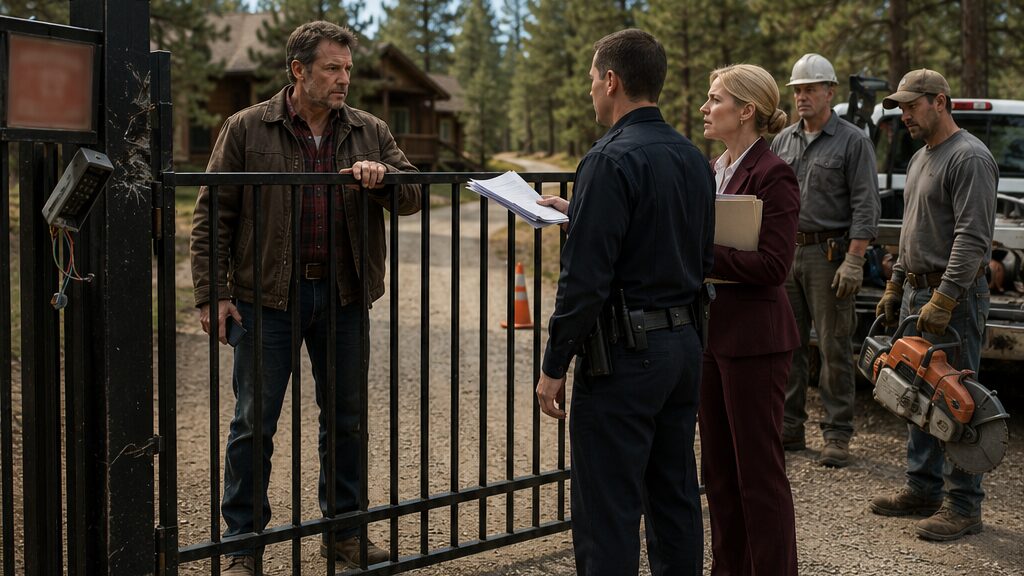
The saw was already whining against the black steel post when John Miller reached the bottom of his gravel drive.
For half a second, he did not understand what he was seeing. The gate he had paid Andrew Harris to install three weeks ago stood open at an awkward angle, one side trembling under the bite of a power tool. A work truck idled near the pines. Two orange cones sat in the gravel as if the entrance to his own property had become a public job site. A man in a hard hat braced one boot against the post while another worker held the biometric access panel away from the gate by its wires.
The panel hung like something injured.
John stopped ten feet from them.
“Turn that off.”
The man with the saw glanced over his shoulder but did not move.
John raised his voice only enough to be heard over the motor. “Turn it off now.”
The saw cut out. Its echo faded through the pines, leaving the work truck engine and the soft ticking of loosened metal. The worker looked toward the roadside, where Sharon Green stood in a burgundy suit with a folder tucked under her arm and a white notice pinched between two fingers.
She looked ready for a meeting, not a driveway.
“Mr. Miller,” she said, walking toward him in careful heels that sank slightly into the gravel. “You were notified.”
John looked from her to the gate. One bolt had already been stripped. The lower hinge plate was scratched bright silver where black paint used to be. On the tailgate of the work truck, he saw two pieces from the latch housing lying beside a pry bar.
“No,” he said. “I was not notified that strangers would be cutting into my gate.”
Sharon held out the paper. “The association issued a removal order for an unauthorized exterior modification. You received multiple emails.”
“I received a denial for review. Not permission to destroy property.”
“It is not destruction. It is enforcement.” She said it as if the distinction had weight enough to hold back the damage.
John took out his phone and started recording. He did not point it into her face. He held it chest high, steady enough to capture the gate, the workers, the truck, the paper in Sharon’s hand.
The crew supervisor shifted. “Ma’am, do you want us to keep going?”
“No one keeps going,” John said.
Sharon’s eyes flicked to the phone. “The crew is authorized by Pine Hollow Community Association. Your gate violates section 7.4, section 9.1, and emergency access standards. It has no physical emergency key. It also exceeds the approved exterior design guidelines.”
John looked at the sign Andrew had mounted beside the panel.
PRIVATE PROPERTY
NO KEYS
BIOMETRIC ACCESS ONLY
The sign had been meant to stop exactly this kind of conversation before it started. Seeing it beside the hanging wires made his jaw tighten.
“That sign is accurate,” he said.
Sharon gave a thin, practiced smile. “Then you understand the problem.”
“I understand you sent men onto my property to remove a gate without showing me a court order.”
“This is HOA common enforcement authority.”
“That is not a court order.”
The worker with the saw lowered his eyes to the gravel. The supervisor rubbed the back of his neck and stepped away from the post.
Sharon opened her folder. “You installed this after your application was rejected.”
“My application sat unanswered for twenty-six days.”
“It was incomplete.”
“You did not ask me for anything else.”
“We asked for a key.”
“There is no key.”
The phrase seemed to irritate her more than if he had cursed. She turned toward the access panel, the sleeve of her jacket brushing the loose wires. “Every gate has a manual release.”
“This one has an emergency responder override.”
“That is not the same as providing the association with access.”
“No,” John said. “It is not.”
For the first time, Sharon’s expression changed. Not much. A small tightening around the mouth, a flash of annoyance sharpened by something like worry.
Behind her, the crew supervisor said, “We were told there was a hidden release.”
John turned the phone slightly toward him. “Who told you that?”
The supervisor looked at Sharon, then back at John. “The work order said remove panel, locate manual release, secure open position if access denied.”
John felt the words settle in him, one by one. Locate manual release. Secure open position. They were not just removing a noncompliant piece of metal. They had come prepared to leave the entrance open.
His eyes moved uphill, beyond the gate, toward the cabin roof just visible through the trees. The porch was out of sight from here. So was the kitchen window where Ruth liked to stand in the mornings with one hand on the counter, watching birds as if they were neighbors arriving for coffee.
John stepped between the workers and the gate.
Sharon drew herself taller. “Mr. Miller, if you interfere with enforcement, we will add obstruction to the violation.”
“Add whatever word you need,” he said. “No one cuts another inch.”
“This is precisely why we require keys.”
“No,” John said, quieter now. “This is why I took them away.”
Sharon’s eyes narrowed. “Took what away?”
John did not answer. He kept the camera steady. He could feel the old habit rising in him, the one that told him to say less, to keep Ruth’s name out of other people’s mouths, to let them think he was stubborn rather than explain why the gate mattered. It had worked when the dispute lived in emails and forms. It did not work with the access panel hanging by wires.
A sound came from Sharon’s jacket pocket. She checked her phone and gave the briefest nod, as though confirming an appointment.
“The sheriff’s office has been contacted,” she said. “Since you are refusing lawful access.”
The crew supervisor took another step back.
John looked down the gravel road. No patrol car yet. Just the work truck, the cones, the sliced paint, the sign that said there were no keys.
“You called the cops because I won’t hand over something that doesn’t exist?”
“I called because you are preventing required access to a gated property within an association easement.”
“You called because you thought a uniform would make me step aside.”
She flushed, but her voice stayed even. “I called because emergency access is not optional.”
“No,” John said. “It isn’t.”
For a moment, they simply stood there, divided by the half-dismantled gate. The pines moved in a wind he could not feel. A loose wire tapped against the post with a faint plastic click. Click. Click. Click.
Then a patrol vehicle appeared at the bend.
Sharon closed her folder with relief so visible she seemed not to notice it. “Good.”
John turned his phone toward the arriving officers, then back to the damaged panel. He caught the stripped bolt, the pry bar, the work order clipped to the supervisor’s board, the sign beside the gate.
The first officer stepped out and scanned the scene. “Who called?”
“I did,” Sharon said immediately. “This homeowner is refusing to provide the required key and is obstructing removal of an illegal gate.”
John kept his place between the crew and the post. His heart was beating harder now, but his voice did not move.
The officer looked at him. “Sir, is there a key to this gate?”
Sharon answered before he could. “There has to be.”
John looked at her, then at the officer.
“Ask her,” he said, “why she needs one.”
Chapter 2: The Approval Form That Said Too Little
The denial email was still open on John’s kitchen table when his phone buzzed with a new notice from Pine Hollow.
He had printed the first one because paper made things harder to ignore. The pages lay beside a photograph of the old gate, the one with the rusted latch and scratched brass key box that had once seemed harmless. In the picture, the old post leaned toward the ditch. The lock hung open.
The subject line on the newest message was all capital letters.
FINAL NOTICE OF DAILY FINES AND CONTINUED REMOVAL AUTHORIZATION
John stood over the table without opening it.
From the living room, Ruth called, “Are the road men gone?”
He closed his eyes for a second.
“They’re gone for now,” he said.
“For now means they come back.”
She said it with the stubborn accuracy of a woman who had spent most of her life noticing what other people softened. Ruth Miller sat in her blue chair near the front window, a folded blanket over her knees though the room was warm. Her hair was pinned loosely at the back of her head. Her eyes moved from John to the driveway, then to the printed pages in his hand.
“They were taking apart the door at the road,” she said.
“I stopped them.”
“Doors are not supposed to come off in the morning.”
“No,” John said. “They’re not.”
He returned to the table and opened the new notice.
The language was clean and bloodless. Failure to comply. Unauthorized structure. Lack of physical emergency access. Exterior appearance deviation. Continuing violation. Daily fines beginning at 8:00 a.m. tomorrow unless removal resumed under association supervision.
He scrolled down. Sharon’s name sat at the bottom, typed neatly above her title.
Compliance Chair.
John looked at the older email beneath it, the one from four weeks earlier. He knew every sentence in it by now, but still he read it again.
Application denied pending resubmission. Proposed security gate upgrade lacks required association access method. Design not consistent with approved exterior standard. Applicant may resubmit with physical emergency key location, color-match plan, and access instructions.
Security gate upgrade.
His own words.
He had typed them late at night while Ruth slept and the house finally stopped making demands. He remembered deleting the phrase medical safety accommodation twice. He remembered telling himself he would add details later if they asked. He remembered thinking that once the gate was installed, once the road was secure, once Ruth stopped waking at every truck sound, he could fix the paperwork.
He had fixed the gate first.
He had left the truth vague.
On the table, the old gate photo showed the key box hanging open like a small metal mouth.
Ruth’s chair creaked. “John.”
He turned.
“Were they the same men?”
“No.”
“The ones who came before had yellow lights.”
“These had a white truck.”
She nodded, accepting this distinction with solemn care. Then her fingers moved over the blanket. “The yellow-light men left the gate wrong.”
John’s throat tightened.
The yellow-light men had not been men at all, not in any way he could prove. A utility crew maybe. A contractor maybe. Someone with a copied key, maybe. He had come home from fixing the back fence line and found the old gate standing open, Ruth gone from the porch, her cardigan caught on a blackberry cane near the road. He had found her fifteen minutes later by the drainage cut, confused and furious at him for looking frightened.
After that, no more keys.
No hidden box. No spare under the post. No list passed between board members and contractors and whoever else thought convenience was the same as permission.
He picked up the application again.
Reason for modification: security gate upgrade.
It looked cowardly now. Not false. Worse than false. Thin.
He heard gravel crunch outside and went rigid, but it was only a delivery truck turning around at the upper road. Ruth flinched anyway. Her hand went to the arm of the chair.
John folded the paper.
“I’m going to send them the rest,” he said.
Ruth looked away from the window. “The rest of what?”
“The reason.”
“No.”
“Mom.”
“No, John.” Her voice sharpened. “I will not have a room of people talking about whether I can be trusted with a porch.”
“That isn’t what it is.”
“That is always what it becomes.”
He said nothing.
She stared toward the trees. “First they ask what happened. Then they ask how often. Then they ask if I know where I am. Then they talk slower, as if I left my hearing in the same place I left my car keys.”
John sat across from her. The argument in him softened but did not disappear.
“They are going to keep trying to remove it.”
“Then tell them it is your gate.”
“I did.”
“Tell them it is your land.”
“I did.”
“Tell them to go bother somebody with a fountain shaped like a deer.”
He almost smiled. Then his phone rang.
Andrew Harris.
John stepped back to the kitchen before answering. “Andrew.”
There was wind on Andrew’s end, and traffic. “I heard they cut the panel.”
“They loosened it. Wires are intact. I think.”
“I can come by tomorrow morning.”
“They’re threatening fines if removal doesn’t continue.”
Andrew exhaled hard. “Yeah. About that.”
John looked toward Ruth, who was watching him now.
“What?”
“I got a call from the association office. Not Sharon directly. Some clerk. They want a statement from me.”
“What kind of statement?”
“That the gate has a concealed manual release or a hidden key cylinder.”
John gripped the phone tighter. “It doesn’t.”
“I know that.”
“You built it.”
“I know that too, John.”
The silence that followed had too much in it.
John lowered his voice. “Are you going to sign it?”
“No. But I need to be careful. If they claim I installed something that violates emergency access, they can make trouble with my license. I designed it around the responder override you asked for. I have the manual. I have the registration submission. But I don’t want to walk into a fight blind.”
John closed his eyes. Sharon was not just trying to prove a key existed. She was trying to make someone else say it.
“Send me everything,” John said. “The manual. The override paperwork. The installation notes.”
“I will. But John?”
“What?”
“If this was for your mother, you need to say that before they write the whole story for you.”
John looked at Ruth. She was still in the chair, chin lifted, proud and afraid and pretending not to be either.
“I know,” he said.
But after the call ended, he stood over the application for a long time, staring at the two words he had chosen because they were easier than the truth.
Security upgrade.
Outside, the damaged gate waited at the end of the drive with half its face loosened.
His phone buzzed again. This time it was a forwarded message from Andrew: statement requested by HOA.
The first line made John go still.
Please confirm whether the installed gate includes any hidden physical access method unavailable to the association.
Chapter 3: The Woman With Papers Called the Cops
“He’s refusing to unlock it,” Sharon Green told the officer, one hand pressed against the biometric panel as if she could shame it into opening.
John stood on the inside of the gate with his phone recording. The damaged panel had been pushed back into place but not secured; a thin black wire still showed along the edge where the crew had pulled too hard. Sharon’s papers fluttered in her other hand, the top page stamped with the red Pine Hollow letterhead.
The officer looked from Sharon to John. “Sir, can you open the gate?”
“Yes.”
“Then open it, please.”
“For whom?”
The officer paused. He was not irritated yet, only measuring the shape of the problem. His partner stood a few steps behind, near the work truck, speaking quietly with the crew supervisor.
“For us to understand what’s going on,” the first officer said.
John nodded toward the pedestrian side panel, which remained closed but undamaged. “I can let you through if you need to inspect the damage. I’m not opening the vehicle gate for the crew to continue removal.”
Sharon stepped forward. “That is obstruction.”
“That is private property,” John said.
The officer held up a hand before she could answer. “Ma’am, let me ask the questions.”
Sharon’s mouth shut, but her eyes stayed fixed on John with the bright, hard patience of someone waiting for procedure to return to her side.
The officer turned back. “Is there a key?”
“No.”
“A keypad code?”
“No general code.”
“A manual release?”
“Responder override only.”
Sharon gave a short laugh. “That is exactly the issue. He installed a gate that no one but him can access.”
John pointed his camera toward the sign on the post. “That issue was the design.”
“Sir,” the officer said, “explain that.”
Before John could answer, Sharon lifted the notice. “Pine Hollow requires all gated entries to maintain emergency access and association access for inspection, utility coordination, and compliance review. Mr. Miller installed this gate after his application was denied. He refuses to provide the physical key. Today, when an authorized crew arrived to correct the violation, he interfered.”
John watched the officer listen. Sharon was good at making one kind of order sound like the only kind there was.
“She skipped the part where the crew was already cutting before I came down the drive,” John said. “And the part where they were told to locate a hidden key that does not exist.”
The officer glanced at the crew supervisor. “Is that accurate?”
The supervisor looked deeply unhappy. “Work order said locate manual release. We hadn’t found one.”
“Because there isn’t one,” John said.
Sharon turned sharply. “Every compliant gate has one.”
“This isn’t that gate.”
“It has to be.”
“No,” he said. “It had to not be.”
The words came out before he could stop them. Too close to the truth. Sharon heard it. So did the officer.
“What does that mean?” the officer asked.
John felt the old wall rise in him again. Ruth’s voice from the living room. I will not have a room of people talking about whether I can be trusted with a porch.
“It means the system is registered for emergency responder access,” he said. “Not HOA convenience access. Not copied keys. Not a lockbox anyone can forget to close.”
Sharon’s expression hardened at copied keys.
The officer noticed.
“Do you have documentation for the responder access?”
“Yes.”
“Can you show it?”
John hesitated only a moment, then unlocked his phone with his thumb and pulled up the PDF Andrew had sent. He stepped close enough to the gate for the officer to see the screen but not close enough for Sharon to reach through.
The document showed the model, installation date, and emergency override registration submission. It was not final approval from the HOA. It was not the whole answer. But it was enough to make the officer read twice.
“This says county emergency services can access through an authorized responder credential,” the officer said.
“Correct.”
Sharon leaned in. “Submitted is not approved.”
“I didn’t say HOA approved it,” John said.
The officer looked at her. “Do you have a court order to remove the gate?”
“It is an association enforcement matter.”
“That’s not what I asked.”
Sharon’s fingers tightened around her folder. For the first time that day, she looked less angry than cornered.
“We have governing documents,” she said.
“Do the governing documents authorize your crew to cut into his gate today without a court order?”
“They authorize correction of violations after notice.”
The officer waited.
Sharon turned a page, then another. “The association’s counsel has advised—”
“Do you have the order with you?”
She did not answer.
John felt no victory in it. Only the temporary relief of a machine stopping before it reached bone.
The second officer returned from the work truck. “Crew says they’ll stand down unless you tell them otherwise.”
“I’m not telling them otherwise,” the first officer said.
Sharon’s face flushed. “So he can just ignore community rules?”
“No, ma’am. I’m saying this looks civil. We’re not forcing him to hand over a key he says doesn’t exist, and we’re not supervising removal without clear authority.”
“It does exist,” Sharon said. “He is hiding it.”
John looked at her through the bars of the gate. She had built the whole morning around that belief. If there was a hidden key, then he was stubborn. If there was a manual release, he was obstructing. If he had simply refused to share access, she was enforcing rules.
If there was truly no key, then she had sent a crew to tear apart the one thing he had built to keep the road from swallowing his mother.
He did not say that.
The officer handed John his phone back. “Sir, I suggest you keep all documentation. Photos of damage, emails, everything. Ma’am, I suggest the association speak with counsel before any further physical enforcement.”
Sharon’s smile returned, but it had lost its polish. “We already have an emergency hearing provision.”
John’s stomach tightened.
She slid one sheet from her folder and held it against the gate bars. “Mr. Miller, since you have confirmed the gate lacks required physical access, I am issuing notice of an emergency board hearing tonight. Continued refusal to provide access will be treated as an ongoing safety obstruction.”
The officer frowned. “Ma’am.”
“It is civil,” she said, not looking at him. “And we will handle it civilly.”
John did not take the paper. Sharon pushed it through the bars, and it fell at his boots.
The crew supervisor began gathering tools. The saw went into its case. The pry bar disappeared from the tailgate. The work truck engine coughed, then shut off.
Chapter 4: Ruth Could Not Be Another Notice
Ruth was standing at the kitchen window when John came in, one hand flat on the counter and the other gripping the curtain so tightly the fabric had twisted around her fingers.
“They were taking apart the door at the road,” she said without turning.
John closed the front door quietly behind him. Dust from the driveway still clung to his boots. In his hand, Sharon’s emergency hearing notice had already softened at the edges where he had folded it too many times walking back up the hill.
“They stopped.”
“They stopped because you stood there.”
He did not answer quickly enough.
Ruth turned then. Her face had the careful composure she used when she knew something was wrong and did not want anyone making it worse by being gentle. “Did they say they’re coming back?”
John placed the notice on the table, face down. “There’s a meeting tonight.”
“A meeting about my door?”
“The gate.”
“That’s what I said.”
He looked toward the living room, where her blue chair sat near the window, blanket folded over the arm. She had left her slippers halfway under it, one pointing toward the hallway, one toward the porch. Small signs of interrupted routine were everywhere: the crossword open on the side table, a mug of tea gone cold, the porch sweater still hanging from the back of a chair because the saw had started before she could step outside.
“They’re calling it an emergency obstruction,” he said.
Ruth laughed once, dry and disbelieving. “A closed gate is an obstruction. An open gate is a welcome mat. They should choose one.”
John almost smiled, but the notice on the table pulled him back.
He went to the kitchen drawer beneath the phone nook. The drawer stuck, as it always did, then gave with a wooden jerk. Inside were rubber bands, old batteries, a roll of tape, Ruth’s spare reading glasses, and a small metal dish where forgotten keys had collected for years.
He had meant to clean it out after Andrew installed the biometric panel. Instead, he had shoved the old keys under receipts and told himself there were larger things to fix.
Now he lifted them out.
The ring was heavier than it should have been. Old brass, two silver copies, one hardware-store key with a faded blue cap. A rectangular paper tag hung from one of them, yellowed and soft at the fold.
P.H.C.A. ACCESS — VOLUNTEER COPY
Beneath that, in handwriting he did not recognize, was a name that had been crossed out so many times only the first letter remained.
Ruth saw the key ring and went very still.
“Where did you find those?”
“In the drawer.”
“I told you to throw those away.”
“I know.”
“But you kept them.”
He looked down at the keys in his palm. “I thought I might need to prove what we replaced.”
“No,” she said. “You kept them because you keep everything that scares you.”
That landed harder than he expected.
He set the keys on the table beside the folded notice. Metal touched paper with a small, final sound.
Ruth stared at them. “That was the kind they used.”
“We don’t know who used it.”
“They had one.”
“We don’t know that.”
“They opened the gate.”
John’s patience broke at the edge, not loud, not sharp, but tired. “I know what happened.”
“No,” Ruth said. “You know where you found me.”
The room changed around the sentence.
He could still see it if he let himself: the old gate open against the post, the latch swinging, the driveway empty. He had called for her from the porch, then the shed, then the slope behind the house. He had found her near the drainage cut below the road, one shoe muddy, cardigan snagged on blackberry thorns, angry at him for running toward her as if she had done something shameful.
She had said she was going to check the mail.
The mailbox had been empty for two years. They had moved delivery to the porch after the first time she got confused by the fork in the road.
John sat down.
“I should have put the gate in sooner,” he said.
Ruth’s face tightened. “Do not do that.”
“I should have.”
“You were fixing the fence because the deer broke it.”
“I should have hired someone.”
“You hire someone and then you stand beside them telling them how to hold a hammer.”
He looked up. Her eyes had softened, but her chin remained lifted.
“You were not careless,” she said. “Somebody left that gate open.”
The words were meant to forgive him. Instead they pointed toward the thing he had refused to chase too far. Somebody. A copied key. A volunteer list. A contractor. A neighbor. A person who had treated access like convenience and then disappeared back into the trees.
His phone buzzed on the table.
He glanced at the screen.
Andrew had sent three files: the gate manual, the responder override submission, and a photo of the installation label inside the panel. Under them was a message.
Do not let them say there’s a hidden key. There isn’t. Never was.
John opened the manual. The phrase appeared in clean manufacturer language.
Biometric access system. No mechanical keyway. Emergency responder override available through registered credential module.
He slid the phone toward Ruth. She did not pick it up.
“If I show them this,” he said, “it helps.”
“Then show them that.”
“They’ll ask why I needed it this way.”
“Tell them you don’t like keys.”
“Mom.”
“No.”
Her voice cracked on the word, and both of them heard it.
She looked away first.
“I know what people do with a story like mine,” she said. “They make their faces sad. They call it concern. Then they decide every locked door is because I’m not safe to be near an unlocked one. I will not sit in that clubhouse and become the reason everyone whispers over cookies.”
John rubbed both hands over his face.
“I’m not trying to make you small.”
“I know.” She looked back at him. “That is why I am asking you not to.”
The porch light clicked on automatically, though evening had only begun to gather under the pines. Down the hill, the gate was out of sight. That made it worse. He could picture the loose panel hanging, the scratched post, the sign still insisting on something the day had already tried to undo.
His phone buzzed again.
Unknown number.
He let it go to voicemail.
Ruth noticed. “You used to answer phones.”
“I used to have less interesting people calling.”
That earned half a smile.
A moment later, the voicemail notification appeared. John tapped it and put the phone to his ear.
A woman’s voice came through low and rushed.
“John, it’s Susan Lopez. I know you don’t want to hear from me. I was the one who complained about the new gate. I thought you were trying to block the road from everyone. I didn’t know it was for your mother.” A pause. Static, then breath. “But you need to know who had those old keys.”
John’s eyes moved to the key ring on the table.
Ruth watched his face change.
The message continued.
“And Sharon knew the list was a mess. She knew before today.”
Chapter 5: The Neighbor Who Complained Knew More
“I was the one who complained,” Susan Lopez said before John had both boots through the wet grass at her fence line.
She stood on the other side of the split rail with a coffee mug in both hands, though there was no steam left in it. Her house sat lower than his, closer to the bend where the gravel road widened. From here, John could see the top of his black gate through the pines, one side still slightly crooked from the crew’s work.
“I figured that much out,” he said.
Susan winced. “Then I’ll save us both the part where I pretend I only called to ask a question.”
John stopped at the fence. He had come angry and tried not to show it. Anger made people simple, and he needed Susan complicated enough to be useful.
“You told Sharon I was blocking shared access.”
“I told her the old gate always had a keybox, and suddenly there was a new gate with a sign saying no keys.” Susan looked past him toward the road. “You have to admit, from this side it looked like you’d decided the rest of us could go around.”
“There is no around. This is my driveway.”
“It used to be the utility turnaround too.”
“For scheduled service.”
“And the fire department used it during the Ridge smoke.”
“With permission.”
She nodded, but reluctantly, as if each true thing cost her something. “I know that now.”
John rested one hand on the top rail. “You said Sharon knew about the old keys.”
Susan’s grip tightened around the mug.
“You need to understand something first,” she said. “I didn’t complain because I wanted them cutting your gate.”
“But you complained.”
“Yes.”
“And yesterday they cut my gate.”
Her face flushed. “I know.”
A truck passed on the upper road, slowing near the damaged entrance before continuing on. Both of them watched it go. The old fear moved in John before he could name it: any slowing vehicle became a question now.
Susan saw him watching.
“That,” she said quietly. “That is what I wanted to tell you.”
She set her mug on the fence post and reached into the pocket of her cardigan. When her hand came out, a ring of keys hung from one finger. Four of them were old gate keys, the same brass shape as the ones in John’s drawer. One had a cracked green cap. Another had a tag from a landscaping company that had not worked in Pine Hollow for years.
John did not reach for them.
“Why do you have those?”
“Because everyone had them.”
“That’s not an answer.”
“It’s the honest one.” Susan looked ashamed now, but not enough to hide. “My husband had one when we moved in. The old board gave him a copy because he helped clear snow. Then the utility guy had one. Then a painter borrowed one from the clubhouse office and never brought it back. People made copies because it was easier than coordinating. I didn’t think about it.”
“Until?”
“Until I saw people using them who had no reason to be up here.”
John’s hand closed around the rail.
“What people?”
“Contractors, mostly. Delivery drivers sometimes. A man in a white pickup who said he was looking at a roof job on the Anderson place, except the Anderson place had already sold.” She swallowed. “Once I saw a teenage boy open it for two cars behind him. Like he was holding a door at a store.”
John heard Ruth’s voice in the kitchen. The yellow-light men left the gate wrong.
“Did you tell Sharon?”
“Yes.”
“When?”
“Last winter.” Susan looked toward the trees again. “After the storm delay. The ambulance call.”
John frowned. “What ambulance call?”
“Not for you. For the Thompsons’ guest. The old gate was frozen open, then stuck closed, then somebody couldn’t find the keybox combination. It turned into a whole thing. Sharon was furious. She said if anything happened again, the board would be blamed.”
The pieces shifted. Sharon’s insistence on emergency access had not come from nowhere. It had grown around another failure, another driveway, another set of people standing helpless while a gate became a wall.
“That doesn’t excuse yesterday,” John said.
“No,” Susan said quickly. “It doesn’t.”
“But it explains why she wants a key.”
“She wants a key because she thinks keys make liability disappear.” Susan lifted the ring. “They don’t. They multiply.”
John looked at the keys now. He imagined them in pockets, glove boxes, kitchen drawers. He imagined people forgetting they had them until convenience needed a shortcut. He imagined the old gate standing open while Ruth walked toward the sound of a truck, toward a road that curved too close to the drainage cut.
“You knew my mother wandered through,” he said.
Susan’s eyes filled, but she did not look away. “I heard after. Not from you.”
“From who?”
“People talk.”
“That’s why I didn’t say anything.”
“I know.”
“No,” John said, sharper than he meant. “You don’t. You don’t know what it is to have one bad morning become the only thing anyone remembers about a person.”
Susan accepted the blow without defending herself. That made it harder to stay angry.
“I don’t,” she said. “But I know I helped Sharon turn your gate into a violation before I knew why it was there.”
“You can say that tonight.”
Her face changed.
There it was. The line where remorse met risk.
“At the hearing?”
“Yes.”
“John—”
“You left me a voicemail.”
“Because you needed to know. Not because I want to stand in front of the whole board and say I gave Sharon part of the complaint that started this.”
“You did start this.”
“I started a question. Sharon turned it into a crew with tools.”
John looked at her for a long moment. “That sounds like something you should tell them.”
Susan picked up the mug again, buying time with a drink that was no longer warm.
“If I speak, people will say I’m trying to cover myself.”
“You are.”
She nodded once. “Yes.”
The honesty took some of the force from him.
She held out the key ring over the fence. “Take these.”
John did not move.
“I don’t want them,” she said.
“You should give them to the board.”
“I will if you promise something.”
He laughed once, without humor. “You’re negotiating?”
“I’m asking.” Her voice shook now. “Do not stand up tonight and say I’m the reason Ruth got hurt.”
“She didn’t get hurt.”
“John.”
He looked down at the wet grass. Ruth had not broken a bone. She had not fallen into the drainage cut. She had not disappeared beyond the bend. But something had been hurt. Her trust in the road. His trust in himself. The ease of leaving a door open in a house that had always breathed freely.
Susan lowered her voice. “I was careless. I was not the person who left that gate open that day. And if you make me that person, I will shut down in there. I’m telling you the truth because it matters, not because I’m ready to be the villain.”
John wanted someone to blame cleanly. He wanted one name to attach to Ruth’s muddy shoe and the cut on her cardigan. But Susan stood across from him with old keys in her hand and a flawed, useful truth.
He took the ring.
“I won’t blame you for what I can’t prove,” he said.
Susan let out a breath.
“But I won’t protect anyone from what they did do.”
“I can live with that.”
His phone buzzed before he could answer. An email banner slid across the screen from Michael Thompson.
Emergency Hearing Packet — Miller Gate Obstruction
John opened it there by the fence.
The first page was a photo from yesterday: John standing between the crew and the gate, phone in hand, body blocking the loosened access panel. A red circle had been drawn around him. The caption below read:
UNAUTHORIZED OBSTRUCTION TO EMERGENCY RESPONSE AND ASSOCIATION ACCESS
Susan leaned close enough to read it.
“Oh,” she said softly.
John scrolled to the next page.
Sharon had attached his original application. The phrase security gate upgrade was highlighted in yellow.
Chapter 6: The Hearing Turned the Gate Into a Wall
Sharon opened the hearing with the photograph of John blocking the crew.
It filled the screen at the front of the Pine Hollow clubhouse, larger than life and stripped of everything outside the frame. Not Ruth’s porch up the hill. Not the old keys in John’s jacket pocket. Not the loose wire tapping the gate post. Just John, standing broad and stubborn in front of a black metal gate while workers waited behind him.
A red circle marked his body.
“This,” Sharon said, standing beside the screen, “is the situation we are being asked to tolerate.”
John sat in the second row with a folder on his knees. Susan sat two chairs behind him near the aisle, clutching her purse. Andrew Harris leaned against the back wall in a work jacket, arms crossed, face guarded. Michael Thompson sat at the long table with two other board members, reading through the packet as if he had only just realized some pages were missing.
The room smelled of coffee, floor polish, and photocopied paper.
Sharon clicked to the next slide. John’s application appeared, the words security gate upgrade highlighted.
“The homeowner installed an unapproved gate after denial,” she said. “The application did not claim medical necessity. It did not request accommodation status. It did not include a physical emergency key. When a removal crew arrived to correct the violation, Mr. Miller obstructed the work and refused access.”
John felt every face in the room turn toward him.
He kept both hands on the folder.
Michael looked up. “Mr. Miller, you’ll have time to respond.”
“I’d like to respond to that sentence now.”
Sharon’s jaw tightened. “There is a process.”
“There was a process yesterday too,” John said. “It involved a saw.”
A murmur moved through the room. Michael tapped his pen once on the table.
“Let him answer the point,” he said.
Sharon stepped back from the screen, but not far.
John stood. The folder felt too thin for what he needed it to carry.
“My application did say security gate upgrade,” he said. “That was incomplete.”
Sharon’s eyes sharpened.
He heard it before she said anything: the opening he had just handed her.
“I did not include everything I should have included,” John continued. “Not because the gate was cosmetic. Not because I was hiding a violation. Because the reason involves my mother’s privacy.”
A few people shifted. Susan lowered her eyes.
Sharon lifted a page. “The board cannot evaluate information an applicant chooses not to provide.”
“I understand that.”
“Then you admit the association acted based on the information available.”
John looked at her. “I admit I gave you too little. I don’t admit that gave you the right to send a crew before asking why.”
Sharon turned to the board. “This is exactly the problem. We have a homeowner who installed first, explained later, and now wants the association to absorb liability for a gate emergency responders cannot open.”
Andrew pushed off the back wall. “That’s not accurate.”
Michael looked toward him. “Name for the record?”
“Andrew Harris. I installed the gate.”
Sharon clicked her pen. “Mr. Harris is not on the agenda.”
“He’s in your packet,” John said. “You asked him for a statement.”
Michael glanced at Sharon. “What statement?”
For the first time that night, Sharon did not answer immediately.
Andrew walked forward just enough to be heard. “Someone from the association office asked me to confirm whether the gate had a hidden physical access method. It does not. It was designed without one.”
“That design is the violation,” Sharon said.
“No,” Andrew replied. “That design is how the responder override works. A physical keyway would defeat the security purpose.”
Michael flipped through the packet. “I don’t see the responder override documentation.”
John opened his folder. “Because it isn’t in her packet.”
Sharon’s face hardened. “Submitted after denial.”
“Submitted before your crew showed up,” John said.
Michael held out a hand. John walked the document to the table. As Michael read, the room quieted in a way that made the fluorescent lights seem louder.
“This is a registration submission,” Michael said.
“Yes.”
“To county emergency services?”
“Yes.”
“Was this sent to the association?”
John hesitated. “It was sent to the office with the revised note Andrew helped me prepare. Yesterday morning.”
Sharon seized on it. “Yesterday morning. After weeks of noncompliance.”
John looked down at the folder. There it was again, the part he could not polish away. He had waited. He had hoped hardware would solve what honesty might complicate. He had let the gate stand as explanation because explanation felt like exposure.
“I should have sent it sooner,” he said.
The admission changed the air. Sharon stepped closer to the board table.
“Then the board must ask whether this homeowner acted in good faith. He withheld relevant information, ignored denial, installed a nonconforming structure, and then physically blocked enforcement.”
John felt heat rise in his face. Not because she was wholly wrong. Because she had found the narrow strip of truth inside the larger falsehood and was using it like a blade.
Michael turned to him. “Mr. Miller, why didn’t you submit the medical or safety basis at the start?”
John looked toward Susan, then Andrew, then the small crowd of neighbors who knew Ruth by her porch wave and her Christmas jam jars and, lately, by whatever rumor had traveled faster than kindness.
He opened his folder and removed one page. Not the doctor’s note. Not yet. A photograph.
It showed the old keyed gate standing open.
“My mother lives with me,” he said. “She has good days and hard days. On one of the hard days, the old gate was left open by someone with access. I found her near the drainage cut below the road.”
No one moved.
He did not let the silence turn her into a spectacle.
“She was not the problem,” he said. “The access was.”
Sharon’s expression shifted, but only for a second. “I’m sorry that happened. But personal circumstances do not erase emergency access requirements.”
“No,” John said. “They explain why emergency access can’t mean handing out keys until no one knows who has them.”
Susan stood before she seemed ready to.
“I can speak to that.”
John turned. So did everyone else.
Susan’s face was pale. She held her purse strap so tightly her knuckles showed. “I had old keys. More than one. A lot of people did. I complained about John’s new gate because I thought he was blocking convenience. I was wrong about that. But I told Sharon last winter the old key list was out of control.”
Sharon’s voice cut in. “That is not a fair characterization.”
Susan looked at her. “You told me not to put it in email.”
The room went completely still.
Michael slowly turned his chair toward Sharon. “Is that true?”
Sharon’s face did not collapse. It reorganized. John saw the fear underneath then, not guilt alone. Fear of minutes lost at the Thompson guest’s ambulance call. Fear of blame. Fear of records that proved she knew the old system was broken before John ever installed the new one.
“We discussed concerns informally,” Sharon said. “No formal key audit was completed.”
“Before sending a crew,” Michael said, “did you verify the emergency responder override Mr. Miller submitted?”
Sharon looked at the packet. Then at the screen, where John’s circled body still blocked a gate without context.
She did not answer.
Chapter 7: There Was Never Supposed to Be a Key
“A physical key would defeat the entire safety plan,” Andrew Harris said.
He stood at the front of the clubhouse with his hands flat on the edge of the board table, not leaning exactly, but bracing himself as if he had walked into stronger weather than expected. The screen behind Sharon still showed John’s circled body at the gate. The red mark around him looked different now, less like proof of obstruction and more like an accusation that had started to come apart.
Sharon crossed her arms. “That is your opinion as the installer.”
“No,” Andrew said. “That is the manufacturer’s design.”
He opened the gate manual on the table and turned it toward Michael Thompson. John saw the page from where he stood: diagram, model number, access module, the printed line that had become the whole fight.
No mechanical keyway.
Andrew tapped the page once. “There was never supposed to be a key. Not hidden. Not spare. Not emergency. The emergency function is through a registered responder credential. If you cut into the panel looking for a key cylinder, you damage the system and still won’t find one.”
Michael read silently.
The room held its breath around him.
Sharon’s voice came cooler, more careful. “Then Mr. Miller installed a gate that does not comply with Pine Hollow’s written access requirements.”
John looked at her. “Your written access requirements were built around the old gate.”
“They apply to all gates.”
“They apply to keys,” he said. “That’s the problem.”
Michael looked up from the manual. “Mr. Miller, do you have the responder registration?”
John handed over the printed submission from Andrew’s file, then the email receipt from the county access portal. His fingers were steady until he saw the date on the receipt again: the morning before Sharon sent the crew. Late, but not nonexistent. Careful, but not careless enough to justify a saw.
Michael read it, then passed it to another board member. “This shows submission received.”
Sharon’s hand tightened around her pen. “Received does not mean approved.”
A voice came from the side of the room. “It means someone should have checked.”
Susan stood near the aisle. She looked as if she regretted rising before her knees were fully straight, but she did not sit back down. In one hand she held the old key ring.
John turned toward her. He had promised not to make her the villain. He had not known whether she would show up as a witness or a woman hoping the room would forget her voicemail.
Susan lifted the keys. They clicked softly against each other.
“I had these,” she said. “And I should not have. My husband had one from the old volunteer list. I kept it after he stopped helping with snow. Then I found two more in a drawer after a contractor left them at our place by mistake. That’s how it was. People passed them around.”
Sharon’s face flushed. “Susan, this is not the forum for—”
“It should have been the forum last winter,” Susan said, and the room went still again.
Michael leaned forward. “You told the compliance chair?”
“I told Sharon the old key list was out of control. I told her I saw people opening the old gate who didn’t live up the road and didn’t have scheduled work.”
“And you still complained about Mr. Miller’s new gate?”
Susan’s eyes flicked toward John. “Yes.”
The admission hung there, plain and ugly enough to be trusted.
“I thought he was cutting everyone off,” Susan said. “I was annoyed. I didn’t ask why he changed it. I went straight to the association because that’s what we do out here when we want to sound official instead of neighborly.” Her mouth trembled once. “I was wrong.”
John felt the anger in him shift shape. It did not vanish. It found edges.
Sharon set her folder down hard. “This does not change the fact that Mr. Miller installed after denial.”
“No,” John said.
He heard his own answer before he was certain he intended to give it.
Everyone looked at him.
“No,” he repeated. “It doesn’t change that. I should have filed it as a safety accommodation from the start. I didn’t because I didn’t want my mother’s hard days turned into clubhouse conversation.”
Across the room, Susan lowered the key ring.
John opened the folder and removed the doctor’s note, but he did not hand it around. He held it up just enough for the board to see the letterhead and folded it back.
“I have medical documentation. I’ll provide it to the board under privacy limits, not to the entire room. My mother is not evidence for people to stare at.”
Michael nodded slowly. “That is reasonable.”
Sharon’s expression tightened, but this time she did not interrupt.
John took one breath. “She wandered through the old gate after someone with access left it open. I found her below the road near the drainage cut. That is why I asked Andrew for no keyway. Not because I wanted to keep out fire trucks. Not because I wanted to make a point. Because too many keys meant no one was responsible for the gate anymore.”
Andrew pushed the manual closer to Michael. “The responder credential solves emergency access without creating more copies. It logs entry. It can be updated. If the county approves the registry, emergency services get in. Random old keys do not.”
Michael looked at Sharon. “Was this option reviewed before removal?”
Sharon’s mouth opened slightly, then closed.
John expected a denial. He expected her to reach for the packet, for a clause, for a phrase that turned omission into process.
Instead, she looked tired.
“The Thompson incident put the board under pressure,” she said. “We were told any private gate without physical access could expose the association. I asked for a key because that was the standard we had.”
“You asked for a key after being told keys were the problem,” Susan said.
Sharon’s eyes flashed. “You complained because you wanted access restored.”
Susan absorbed that without flinching. “I did. And I was wrong too.”
That, more than any document, changed the room. Not because Susan’s guilt solved anything, but because it removed the easy story. There was no single villain to carry every mistake out the door. There was convenience. Fear. Delay. Pride. A form that said too little. A rule that had not caught up to the harm it created.
Michael folded his hands on the table. “The board is going to separate two issues. First, whether Mr. Miller violated the application process. Second, whether the gate may qualify as a reasonable safety accommodation with an alternate emergency access method.”
Sharon turned toward him. “Michael—”
“No,” he said, not harshly. “We are not voting to continue removal tonight.”
John did not let himself breathe too visibly.
Michael looked down the table. “I propose we pause daily fines pending review of the medical accommodation packet and county responder approval. The crew does not return. Damage already done to the gate is documented.”
One board member nodded. The other hesitated, then nodded too.
Sharon sat very still.
“However,” Michael said, turning back to John, “final approval may require conditions. The board has to address exterior consistency and verify emergency access annually. There may also be screening or color-matching requirements.”
John felt the old resistance rise. One more condition. One more way to make safety conditional on taste.
But he looked at the screen, at his own circled body. He looked at Susan’s keys. He looked at Andrew’s manual. Then he thought of Ruth at the window, asking whether the road men would come back.
“What conditions?” he asked.
Sharon lifted her head.
“The final approval,” she said, voice controlled again, “still requires one condition you may not be willing to accept.”
Chapter 8: The Gate Opened Without Giving Them a Key
Andrew held the repaired access panel against the gate post exactly where the crew had cut it loose, and for a moment John could see both versions of the morning at once.
The damaged one: wires hanging, paint scarred, orange cones in the gravel, Sharon’s notice held like a verdict.
The restored one: Andrew’s drill seated cleanly against the mounting plate, new black screws aligned, the biometric glass wiped clear of dust.
“Try not to look like you’re waiting for it to fail,” Andrew said.
“I’m not.”
“You are.”
John stepped back and folded his arms, then realized what he had done and let them drop.
A week had passed since the hearing. The gate had spent those days half-working, secured with temporary hardware and a manual barricade Andrew hated looking at. Every vehicle that slowed near the bend made Ruth ask whether someone was coming to take “the road door.” Every email from Pine Hollow made John feel the old key ring in his desk drawer even when he was nowhere near it.
Now the final approval lay in his truck, signed that morning at the clubhouse.
Not a master key.
Not a hidden cylinder.
Not an association lockbox full of copied convenience.
The condition had been smaller and more irritating in the way reasonable things could be irritating after unreasonable damage: John had to plant two approved native shrubs along the exterior fence line to soften the view from the road, paint the post brackets a standard matte black, and submit to annual verification that the county responder override remained active.
He had wanted to refuse on principle.
Then Ruth had said, “If a shrub keeps them from wanting a key, buy three.”
So he had signed.
Andrew tightened the last screw and stepped away. “Panel’s live.”
John walked to it. The sign beside it had been cleaned but not replaced.
PRIVATE PROPERTY
NO KEYS
BIOMETRIC ACCESS ONLY
The lower left corner still bore a scratch from the crew’s pry bar. John had told Andrew not to buff it out.
His thumb hovered over the glass.
A car approached from the road before he touched it.
John turned.
Sharon Green’s sedan rolled slowly up the gravel and stopped outside the gate. She stepped out in a gray coat this time, not burgundy, with a folder tucked under one arm. No crew. No police. No orange cones. She closed the door carefully and stood on the public side of the entrance.
Andrew muttered, “Great timing.”
John walked toward the gate but did not open it. “Sharon.”
She looked at the repaired panel, then at the scratch on the sign. Her eyes lingered there long enough for John to know she saw it.
“I brought the withdrawn violation notice,” she said.
“You could have emailed it.”
“I did.”
“Then you brought the paper because?”
Her mouth tightened. For a second he thought she might retreat into the same polished voice she had used at the hearing. Instead, she slid the paper through the bars carefully so it would not fall.
“Because paper caused part of this,” she said. “It should undo its part in paper too.”
John took the notice.
Violation withdrawn pending ongoing accommodation compliance. Daily fines removed. Physical removal authorization rescinded. Gate approved subject to emergency responder verification and exterior screening.
No apology filled the empty spaces between the words.
Maybe that was better. An apology might have asked him to forgive the sound of the saw too quickly.
Sharon looked past him toward the house. “The board is reviewing the old access list.”
“Good.”
“And the contractor key policy.”
“Also good.”
She nodded once. “I should have verified the responder submission before sending the crew.”
John waited.
Her hands shifted on the folder. “I was trying to avoid another emergency access failure.”
“You created one.”
“I know.”
The words were quiet. Not enough to repair the post. Not enough to give Ruth back the mornings she had spent watching the road. But they were not nothing.
John looked at the notice, then folded it once. “I should have filed the request correctly the first time.”
Sharon’s eyes lifted to his.
“I know that too,” he said. “But if your process needs a person’s private fear spelled out before you stop cutting, the process is broken.”
She did not argue.
Behind John, the cabin door opened.
Ruth came down the porch steps wearing her blue sweater, moving carefully with one hand on the rail. John turned at once.
“Mom, stay on the porch.”
“I have been staying on the porch for a week,” she said. “It has lost its charm.”
Andrew hid a smile by looking into his toolbox.
Ruth walked down the drive slowly, her shoes crunching the gravel in small, deliberate steps. She saw Sharon outside the gate and lifted her chin.
“You’re the woman with papers.”
Sharon blinked. “Yes, ma’am.”
“You brought better papers this time?”
“Yes, ma’am.”
Ruth looked to John. “Is it done?”
He could have said yes and left the rest sealed away. He almost did. The habit was right there, ready and familiar.
Instead, he held out the withdrawn notice.
“They approved the gate,” he said. “No master key. The fire access gets checked once a year. I have to plant shrubs by the road.”
Ruth took that in. “Shrubs are nosy but harmless.”
John smiled faintly. “That’s what I thought.”
Her gaze moved to the gate post. She saw the fresh screws. Then the scratched sign. Then the place where paint still could not hide the crew’s first cut.
Her face changed.
“They did more than ask,” she said.
John did not answer fast enough.
Ruth turned to Sharon. “You sent men to take it apart while I was in the house?”
Sharon’s composure thinned. “The association made a mistake.”
“No,” Ruth said. “A mistake is putting salt in coffee. That was a decision.”
John stepped closer. “Mom.”
“I’m not confused about this.” Her voice stayed steady. “Do not make me smaller so everyone can feel kinder.”
The sentence struck him with the force of recognition. He had been doing that too, in another way. Keeping her private until privacy became isolation. Protecting her dignity by leaving her out of decisions built around her life.
“I know,” he said.
Ruth looked at him then, and whatever she saw made her expression soften.
Andrew cleared his throat. “Mrs. Miller, would you like to test it?”
She looked toward the panel. “Does it know me?”
“It will,” John said.
He had enrolled her print that morning at the kitchen table, her finger placed on the little scanner while she complained that modern machines demanded intimacy before breakfast.
Now he opened the pedestrian gate from the inside and stood beside her at the panel.
“Thumb flat,” he said.
“I remember.”
She pressed her thumb to the glass.
For one second, nothing happened.
John felt his chest tighten.
Then the panel gave a soft chime. The latch released. The black gate eased inward, smooth and quiet, not with the clatter of an old keybox, not with the grind of a copied lock, but with a simple mechanical certainty that belonged to the person who needed it.
Ruth looked pleased despite trying not to.
“Well,” she said. “It has manners.”
Andrew laughed.
Even Sharon’s mouth moved slightly, though she did not quite smile.
Ruth stepped through the gate, then back inside, testing the threshold as if it were a porch step she intended to judge fairly. John stayed near enough to catch her if she stumbled and far enough not to insult her for walking.
The gate closed behind her with a soft click.
That evening, after Andrew packed up and Sharon’s car disappeared down the road, John sat at the kitchen table with the hearing folder open. The withdrawn violation went on top. Beneath it, he placed the responder verification, Andrew’s manual page, Susan’s written statement, and the photo of the damaged panel.
Last, he took the old copied key from the drawer.
Ruth stood in the doorway watching him. “Throw it away.”
“I thought about it.”
“But you won’t.”
He slipped the key into a small envelope, sealed it, and wrote OLD ACCESS COPY across the front.
“No,” he said. “Some things you don’t keep because you’re scared. You keep them so nobody can pretend they never existed.”
Ruth came to the table and rested her hand briefly on his shoulder.
Outside, at the bottom of the pine-lined drive, the repaired gate waited in the dark. It had no key to hand over. It opened only for the people it was meant to protect.
The story has ended.