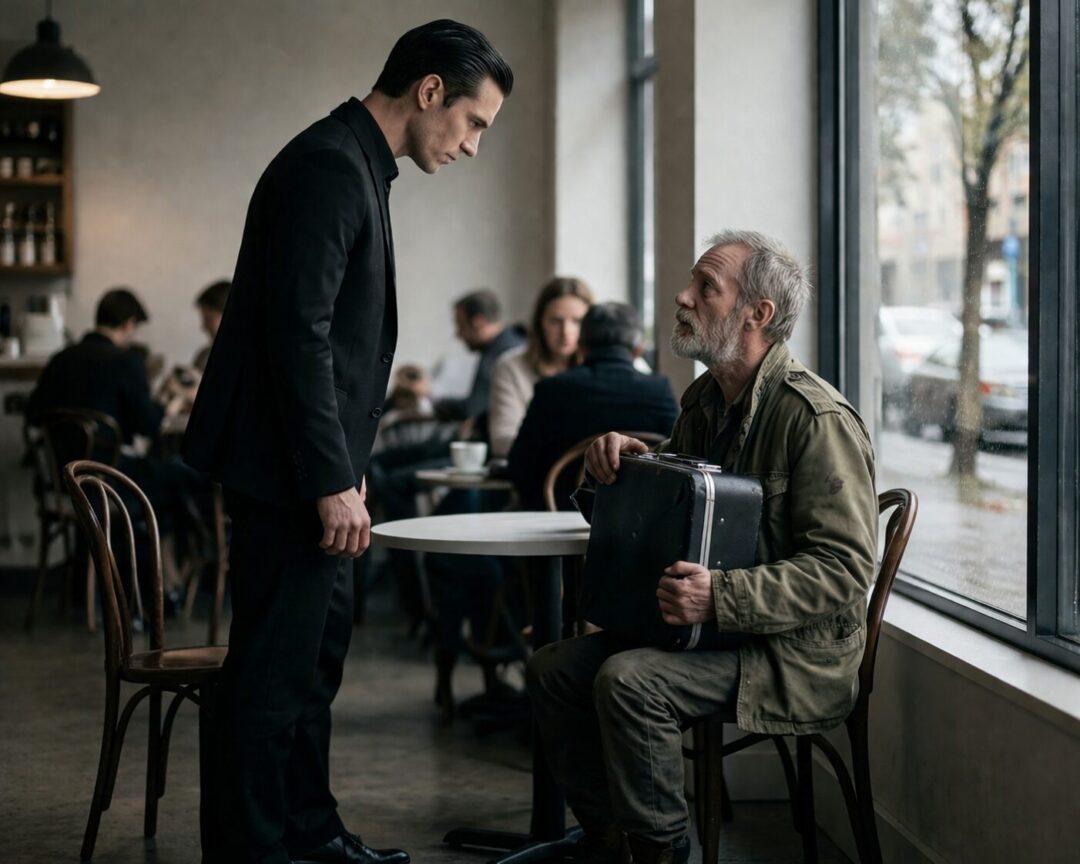
The Man by the Window
The Man by the Window
Part I — The Morning Rush
By the time anyone noticed the old man near the window, Nolan had already taken hold of his arm.
The café was full in the way expensive places often are at eight in the morning—quietly frantic, polished, and careful about appearances. Laptops glowed on walnut tables. Orders were called in low, practiced voices. Outside, the city was still shaking off dawn, but inside, everything had already arranged itself into a ritual of clean lines and upward ambition.
That was why the man looked so wrong.
He sat alone at a two-top near the front glass, wearing a stained olive jacket and worn boots still dusted with street grit. His beard was mostly gray, his face deeply lined, his shoulders narrow beneath the heavy fabric. A dented black case rested against his leg, one hand gripping the handle so tightly his knuckles looked carved from chalk.
Nolan had noticed him the second he walked in from the back office.
Nolan noticed everything that threatened the atmosphere.
At thirty-six, he wore management like a military rank. His black jacket was perfectly fitted, his shoes polished, his hair slicked into place so carefully it never seemed to move. The tiny earpiece in his right ear made him feel more important than his actual title suggested, and he carried himself with the brittle authority of a man who believed order and image were the same thing.
He didn’t ask whether the old man needed help. He didn’t ask if he intended to buy anything. He didn’t even ask if he was waiting for someone.
He crossed the floor, stopped beside the table, and said, flatly, “Sir, you need to leave.”
The old man looked up slowly.
His eyes were pale, not dull as Nolan had expected. Tired, yes. But steady.
“I’m fine here,” he said.
Nolan glanced around the room, making sure nearby customers could hear his disapproval without forcing them to witness a scene. “You’re upsetting people.”
That wasn’t true. Not yet. Most of the customers hadn’t fully registered the man. But Nolan had a gift for making discomfort contagious.
From behind the espresso machine, Tessa looked up.
She had only been working at the café for seven months, but that was long enough to know the shape of Nolan’s bad moods. He had a way of becoming more controlled when he was angry, as though rage sharpened him instead of loosening him. He never raised his voice unless it served him.
Tessa wiped her hands on her apron and kept watching.
The old man pulled the case closer. “Don’t touch that.”
Something in the line made the air change.
Not because it was loud. It was almost gentle. But the case clearly mattered, and that made the man feel suddenly less random. Less like clutter Nolan could sweep aside.
Nolan placed a hand on the man’s sleeve anyway.
“Up,” he said.
Tessa stepped away from the counter before she had fully decided to. “He didn’t do anything.”
Nolan didn’t even look at her. “Stay out of this.”
The old man rose carefully, his body stiff in a way that suggested old pain rather than weakness. He held the case against his side, not defensively exactly, but protectively, like someone holding the one thing in the room that still belonged to him.
Nolan steered him toward the front door.
Nobody stopped it.
That was the part Tessa would remember most later—not Nolan’s hand on the man’s arm, not the stunned silence, not even the way the door opened to the gray spring morning.
It was the fact that twenty people looked up and then looked away.
Outside, the patio chairs were still damp from overnight rain. Nolan guided the man past them and down toward the outer edge of the sidewalk seating.
“You can’t stay here,” Nolan said. “Take it somewhere else.”
The old man steadied himself against the back of a metal chair. For a second, he looked through the glass into the café rather than at Nolan, as if he were studying the place, memorizing it.
Then Nolan turned and went back inside.
Just like that.
As if a problem had been solved.
Tessa stood frozen behind the register long enough to ring up two cappuccinos wrong. Her hands were moving, but her mind was outside with the man in the damp jacket and the dented black case.
He hadn’t begged.
He hadn’t cursed.
He hadn’t even defended himself.
That somehow made it worse.
By the time the line shortened, she had already decided what she was going to do.
She poured a fresh coffee into a paper cup, grabbed one of the breakfast sandwiches that had just come off the warmer, and slipped outside before Nolan could notice.
The old man had lowered himself into one of the patio chairs. He was sitting very straight despite how tired he looked, the case upright beside his leg, his eyes on the traffic moving past the block. He turned when he heard the door.
Tessa set the coffee and sandwich on the table in front of him.
“It’s hot,” she said. “Both of them.”
He looked at the food, then at her.
Up close, he looked older than she had first thought—late fifties, maybe early sixties. But there was nothing vague about him. No confusion. No fog. Just exhaustion worn with discipline.
“You don’t have to do that,” he said.
“I know.”
His gaze dropped to the green apron, the rolled sleeves, the faint burn scar near her wrist. Tiny details people noticed when they were used to paying attention.
“What’s your name?” he asked.
“Tessa.”
He gave a small nod. “Thank you, Tessa.”
She took the chair across from him but didn’t sit. “You look freezing.”
He almost smiled at that.
The city wind moved down the street, carrying the smell of wet concrete and car exhaust. For one quiet moment, the morning seemed to pause around them.
Then the café door slammed open behind her.
Part II — What People Show
Nolan moved fast when he was embarrassed.
He had seen them through the glass—the barista outside with the man, the coffee on the table, the sandwich unwrapped between them—and what hit him first was not anger but panic. It looked bad. It looked like disobedience. It looked like his authority had cracked in full view of the room he worked so hard to control.
By the time he reached the patio, his face had gone hard.
“What are you doing?” he snapped.
Tessa turned. “Giving him breakfast.”
“You are not allowed to feed loiterers on café property.”
The word hit the air like something dirty.
The old man didn’t react.
Tessa did. “He’s a person.”
Nolan stepped closer to the table. “Inside. Now.”
She stood her ground.
That was when the whole thing became something larger than policy.
Customers had started to notice. Faces hovered just behind the front glass. A man with a phone in his hand paused halfway to the door. A woman at the corner table stopped typing and stared openly. The pressure Nolan usually relied on was now turning in both directions.
He reached for the table.
Maybe he meant to snatch the coffee away. Maybe he meant only to make a point.
But the table rocked. The cup tipped. Hot coffee spilled across the metal surface and splashed to the pavement. The sandwich, half unwrapped, slid after it and landed in the wet grit by the chair leg.
Nobody moved for a second.
Tessa stared at the ruined breakfast as if the sight had struck her physically.
The old man bent—not toward the food, but toward the black case.
He lifted it first.
That choice was so precise it seemed to hush the entire sidewalk.
He set the case on the table between himself and Nolan, brushed one hand slowly against the front of his jacket, and looked up.
Nolan mistook the calm for surrender.
“If you’re looking for sympathy,” he said, “you’re in the wrong place.”
The old man’s expression didn’t change.
“Maybe,” he said.
Then he placed the case flat on the table and opened it.
Tessa leaned in without meaning to.
Inside were no spare clothes, no loose papers, no collection of things salvaged from a hard life. Everything was neat. Ordered. Intentional. A stack of legal folders sat clipped together with color tabs. A sealed envelope rested on top of them. Beneath that lay a metal access card, embossed with the logo of the parent company that owned not just this café, but seven others across the city.
Nolan saw the logo and went still.
The old man picked up the top document and turned it so Nolan could read it.
The heading alone was enough.
Transfer of Ownership.
Nolan’s mouth opened, but no words came.
The old man lifted the envelope next. His fingers were rough, but the movement was measured, almost ceremonial. He slid out a letter printed on thick cream paper and placed it over the contract. At the bottom sat a signature line already executed. Above it, in formal language that left no room for confusion, was confirmation that the café group had changed hands at six that morning.
To him.
His name—Elias Mercer—was printed clearly across the page.
Tessa felt a strange, almost dizzying thrill pass through her, but it was not triumph exactly. It was the shock of seeing reality snap into a different shape.
Nolan read the page once. Then again, as if shame might disappear if examined closely enough.
“This—” he began, but his throat seemed to close around the word.
Elias shut the letter and rested both hands lightly on the case.
He was still wearing the same stained jacket. The same weathered boots. Nothing visible had changed. That made the reversal feel almost unbearable.
Nolan had not mistaken a disguise for poverty.
He had mistaken poverty for worthlessness.
And now the proof of that judgment sat open on the table between them.
Elias stood.
He wasn’t tall, but the motion changed the space around him. The lines in his face no longer suggested fragility. They suggested endurance. A long history of carrying things heavier than a black case and speaking only when it mattered.
He looked at Nolan with a kind of exhausted clarity.
“Is this how your staff are trained to treat guests who don’t look profitable?”
There was no accusation in his voice, which somehow made it worse.
Nolan swallowed. “Mr. Mercer, I didn’t realize—”
“No,” Elias said quietly. “You realized exactly what you wanted to.”
The words landed with surgical force.
Behind the glass, more faces had gathered. The room Nolan had used as an audience was still watching him. Only now, he was the one trapped inside its gaze.
Tessa looked from one man to the other.
Nolan’s hands, always so controlled, had begun to tremble.
Elias turned away from him.
That was the true punishment—not public yelling, not humiliation returned in equal measure, but the refusal to center him anymore.
Instead, Elias looked at Tessa.
She suddenly became aware of her own posture, her damp sneakers, the loose strands of hair falling near her face. She felt absurdly young.
“You brought me food,” Elias said.
Tessa nodded once.
“You sat with me when you thought I was nobody.”
Her throat tightened. “You weren’t nobody.”
For the first time, his face softened.
Then he glanced through the glass into the café—the room with its polished counter, expensive pastries, and careful branding—and something old and private moved behind his eyes.
“Tessa,” he said, “would you walk inside with me?”
Nolan made a small, desperate sound. “Sir, please, I can explain—”
Elias didn’t look at him.
“We’ll speak later,” he said.
There was no anger in it. Only conclusion.
He closed the case, picked it up, and moved toward the door. Tessa followed beside him.
For one strange heartbeat, Nolan remained outside alone, framed by the wet patio furniture and the ruined sandwich at his feet.
Then Elias stepped back into the café.
And the room changed around him.
Part III — Before the Door Opened
Two weeks earlier, Elias Mercer had signed the first set of acquisition papers in a hospital room that smelled faintly of antiseptic and lemon cleaner.
He had built most of his life in plain sight and learned, after enough years, that plain sight was where people became invisible.
His father had once cleaned office buildings at night. His mother had worked a breakfast counter for twenty-three years, smiling through swollen ankles and bad managers because rent didn’t care about dignity. Elias had known hunger that dressed itself up as “making do.” He had known what it was to watch people decide what kind of man you were before you had spoken a word.
Later, he made money. A great deal of it, eventually. Enough that newspapers had once called him disciplined, visionary, ruthless, self-made. They loved polished stories. They never understood that what drove him was not ambition by itself.
It was memory.
He had spent years buying and rebuilding neglected small businesses, not because they promised the largest returns, but because he understood what a place could mean to the people inside it. A diner. A laundromat. A café on a corner that survived because one woman behind the counter remembered your daughter’s name.
This café group had come to him through bad books and worse leadership. Profitable on paper. Hollow in culture. He had seen that before.
His advisers had wanted audits, projections, quiet restructuring.
Elias wanted to see the floor.
So on the first morning the transfer became official, he left the driver at home, dressed in old clothes from the storage room over his garage, and carried the black case himself.
He had not expected kindness.
But he had hoped for something smaller and harder to fake: baseline humanity.
What he found at the window table confirmed everything the numbers could not show.
He had been inside the café less than four minutes before Nolan reached him.
Later, Elias would replay the scene with painful accuracy. Not because he doubted what he had seen, but because he understood how quickly a culture revealed itself. Nolan had not acted like a man making a difficult call. He had acted like a man certain the room would reward him for protecting it from contamination.
That certainty never came from one morning.
It grew.
It was fed.
It became normal.
As Elias stood in the center of the café now, black case in one hand and every eye in the room on him, he felt not triumph but a tired kind of sadness.
He knew what places became when image outranked people.
He had spent half his life trying to build against exactly that.
“Tessa,” he said quietly, “would you bring me the staff schedule?”
She blinked. “Yes, sir.”
“Elias is fine.”
She nodded and hurried toward the back.
Nobody stopped her. Nobody seemed able to move at all.
When Nolan finally came in from the patio, the wet edge of one trouser leg had darkened nearly to the knee. He looked as though he had aged ten years in under a minute.
“Mr. Mercer—”
Elias raised a hand.
“Not here.”
The room exhaled all at once.
He could have fired Nolan in front of everyone. Part of him knew that some people in the café—customers and staff alike—would have found that satisfying. A clean moral ending. A swift collapse.
But that was not how rot worked, and not how repair worked either.
He asked the assistant baker to comp every drink in the room.
He apologized to the customers for the disturbance.
Then he waited in the office while Tessa brought the schedule and Nolan stood in the hallway outside, not yet called in, learning what it felt like when time turned heavy.
When Nolan finally entered, he looked smaller without the floor beneath him.
Elias did not shout. He asked questions.
How many complaints had there been about discriminatory treatment? How often were staff disciplined for acts of discretion or compassion? Why had turnover risen? Why had two talented baristas left in the last three months? Why, according to anonymous staff comments in the exit reports, was fear described more often than teamwork?
Nolan answered badly.
Not because he was stupid, but because he had spent too long mistaking control for leadership. Every answer exposed another hollow place. Every attempt at self-defense confirmed the deeper problem.
By noon, he was gone.
Not escorted. Not theatrically dismissed. Simply gone, carrying a leather portfolio and the stunned posture of someone who had finally discovered that status could evaporate faster than steam off hot coffee.
Tessa heard the news from the pastry station and felt a complicated jolt of relief. She had not wanted Nolan ruined. She had simply wanted him stopped.
That afternoon, Elias stayed.
He walked the café floor. He asked names and remembered them. He ate a bowl of soup in the corner booth instead of in the office. He spoke to the dishwashers, the prep cook, the delivery driver. He repaired nothing dramatic in those first hours. But he changed the weather.
And weather, in a workplace, mattered more than most people admitted.
Part IV — The Only Test
Three months later, the patio furniture had been repainted.
The café still served the same coffee. The same pastries. The same breakfast sandwiches, though Tessa now insisted they be wrapped more securely after one ridiculous morning the whole staff still referred to without naming directly.
But the place felt different.
Softer in some ways. Sharper in others.
The rules had not disappeared. Elias did not believe in chaos disguised as warmth. But he had rewritten them around a principle so simple the staff first laughed when they saw it posted in the break room.
Everyone gets treated like they belong until they prove otherwise.
That line changed more than any policy packet ever could.
Tessa had been promoted two weeks after Elias’s first visit. First to shift lead, then, by summer, to floor supervisor. The title still felt strange when vendors used it. She still woke some mornings expecting to find herself back behind the register, eighteen orders deep, hoping Nolan wouldn’t decide her smile looked insincere.
Now she ran the floor with a steadier hand than she knew she had.
She never wore an earpiece.
On a rainy Thursday in late August, she stood by the front window and watched a man in soaked work clothes hesitate at the door.
For a moment, memory flashed through her so vividly she almost felt the cold patio chair under her own hands.
She crossed the room before he could turn away.
“Come in,” she said, opening the door wider. “We’ve got space.”
The man looked startled. “I’m just trying to get dry.”
“That counts.”
He stepped inside, dripping onto the mat, and gave her the fragile smile of someone who had expected refusal and was still adjusting to its absence.
Across the room, Elias glanced up from a table in the corner where he was reviewing invoices. Their eyes met.
He didn’t smile broadly. He never did. But he nodded once.
It was enough.
Later that evening, after the rush eased, Tessa brought him a fresh coffee without asking how he took it. By then she knew.
He looked out through the glass at the dark street beyond the patio.
“Do you ever think about that morning?” she asked.
“Sometimes.”
“Me too.”
He took the cup from her, warming his hands around it. “That’s not always a bad thing.”
She leaned against the chair opposite him. “I still can’t believe you came in dressed like that on purpose.”
A small flicker of amusement crossed his face. “It saved time.”
She laughed, then grew quiet.
“What if I hadn’t gone outside?”
Elias looked at her for a long moment.
The café hummed softly around them—the clink of ceramic, the low murmur of a late conversation, the sound of someone wiping down the pastry case for closing.
“Then I would still have known something was wrong here,” he said. “But I wouldn’t have known who could help me fix it.”
Tessa felt that settle somewhere deep.
Not as praise exactly. Something steadier than praise.
Proof that a small decision, made in less than a minute, could reroute an entire life.
Outside, the rain began again, dotting the glass with silver.
Inside, warm light folded over wood tables and tired strangers and people finishing long days. A place, Elias had always believed, revealed itself by how it treated those who seemed least likely to matter.
That morning on the patio had shown him the truth of the café he’d bought.
What came after had shown him something better.
Not karma, exactly.
Something quieter.
The stubborn, life-altering power of being seen.