He Arrived At His Mother’s Estate Auction With The Bag They Told Him Was Worthless
Chapter 1: The Auction Had Already Started When Samuel Arrived
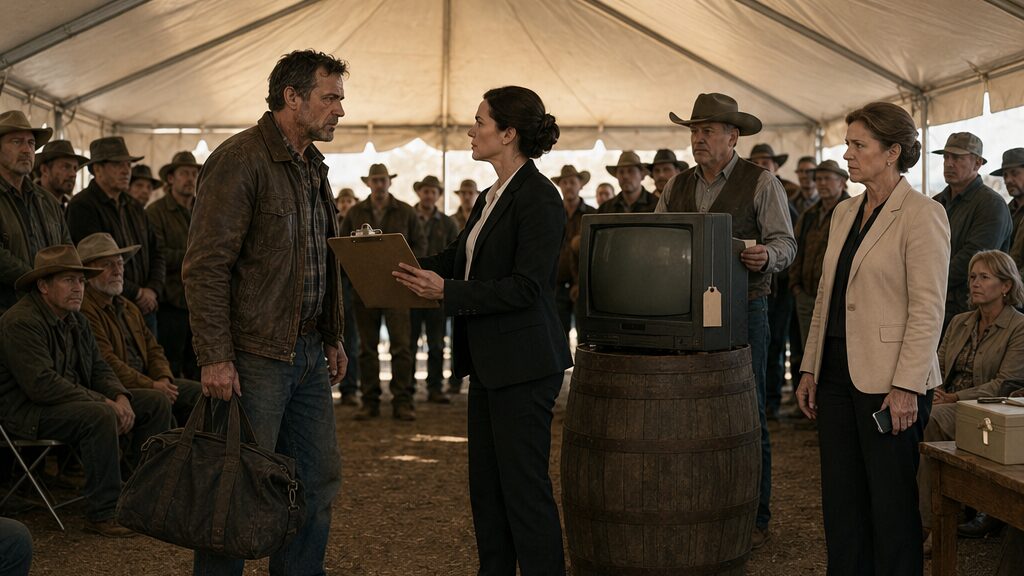
The auctioneer had the old television in his hand before Samuel reached the tent.
Not in his hand exactly—the thing was too heavy for that—but his fingers were already hooked around the lot card taped to its dusty gray side, lifting the number toward the crowd like it belonged to anyone who could raise a paddle fast enough.
Samuel stepped off the gravel and into the shade of the white canvas tent with his dark bag banging against his knee.
“Lot thirty-four,” the auctioneer called. “Vintage television set, nonworking, estate condition. We’ll start at ten.”
Samuel stopped so hard the man behind him bumped his shoulder.
The television sat on a wooden barrel near the front table, its curved glass screen filmed with dust, its boxy back turned slightly toward the aisle. There was a crack in the plastic trim near the channel dial. A strip of masking tape clung to the top where his mother had once written, in blue marker, DO NOT MOVE WITHOUT SAM.
Someone had peeled the tape off.
A bidder in a tan cowboy hat chuckled. “Ten.”
“Ten, thank you. Do I hear fifteen?”
Samuel pushed forward.
The tent was full of neighbors, ranch hands, antique pickers, men in clean hats who had never touched the Walker fence line but now stood shoulder to shoulder under his mother’s canvas, looking at her chairs, her dishes, her saddle rack, her sewing lamp, her coffee tins laid out in rows. Each item had a white tag tied to it. Each tag made the house feel less like a home and more like a body being taken apart in public.
“Fifteen.”
“Twenty.”
“Twenty, thank you.”
Samuel tightened his grip on the bag.
“Stop the lot,” he said.
Not loud enough. The auctioneer kept rolling.
“Twenty-five anywhere?”
Samuel moved faster. Boots scraped, heads turned, and the whispers began before he reached the center aisle.
“That’s Samuel.”
“Thought he wasn’t coming.”
“Katherine said he signed off.”
He had signed nothing.
“Stop the lot,” he said again, this time loud enough that the auctioneer’s rhythm broke.
A woman in a black blazer stepped from beside the cashier table and put herself between Samuel and the barrel. Stephanie Adams. Estate-sale coordinator. Clipboard to her chest, white blouse buttoned to the throat, face arranged into the hard politeness of someone who had been paid not to care.
“Mr. Walker,” she said, “you can’t interrupt active bidding.”
“That television shouldn’t be listed.”
Her eyes flicked to the bag in his hand. “If you intended to bid, registration closed at two.”
“I’m not bidding.”
That made the front row shift.
The auctioneer lowered the card but did not set it down. Behind him, the wooden sign hanging from the tent pole read AUCTION IN PROGRESS in block letters painted too bright, too cheerful, like a county-fair booth. Samuel’s mother had hated signs that told people what to do. She would have laughed at that one, then asked who gave permission to nail anything into her tent poles.
Stephanie raised one hand, palm outward.
“Too late,” she said. “Bids are in.”
The sentence hit the tent with more force than the gavel could have.
Samuel looked past her to the television. For a second he was ten years old again, lying on the braided rug in front of that same screen while Barbara Walker adjusted the antenna with one hand and balanced a bowl of popcorn against her hip. Later, when the picture went green and thin, she refused to throw it out. “That set remembers more of this family than either of you kids do,” she had said.
Now it had a lot tag.
Samuel lowered the bag to the ground beside his boot.
“Who authorized the sale of that item?”
Stephanie’s jaw tightened. “The executor provided the estate inventory.”
“Katherine?”
“Yes.”
“Show me where that television is listed.”
“That isn’t how this works.”
“Show me.”
Someone near the aisle muttered that he should let it go. Someone else said grief made people strange. Samuel heard all of it and answered none of it.
The flap at the far side of the tent moved. Katherine Clark stepped in from the yard with her sunglasses in one hand and her phone in the other. She wore black slacks and a cream jacket too clean for the dust rising under everyone’s boots. Her hair was pinned back in the smooth style she used for bank meetings, funerals, and anything else where appearing composed mattered more than being kind.
She saw Samuel, then the television, then the bag by his feet.
For one small moment, her expression changed.
Not surprise. Not sadness.
Fear.
Then it was gone.
“Samuel,” she said, crossing the front of the tent. “Don’t do this here.”
“You listed Mom’s television.”
“I listed obsolete electronics. It doesn’t work.”
“It wasn’t yours to list.”
A few bidders turned fully toward them now. The auctioneer kept his hand on the lot card, waiting for someone with authority to tell him whether to continue taking pieces from Barbara Walker’s life.
Katherine gave him a small apologetic smile, then turned back to Samuel. “The estate documents are clear.”
“You keep saying documents like that makes her less dead.”
Her face hardened.
Stephanie moved closer. “Mr. Walker, Mrs. Clark has legal authority as executor. If you have a dispute, you’ll need to take it up through probate. This sale was properly noticed.”
Samuel looked at her clipboard. “Then you have the inventory.”
Stephanie hesitated, just long enough.
Katherine noticed. “Stephanie.”
Samuel bent, unzipped the dark bag, and pulled out a folded page from the packet Donald Garcia had given him three days earlier. His hands were steady, which almost frightened him. He had expected anger to shake them. Instead, everything in him had narrowed to the size of that dusty television and the missing strip of tape.
“This inventory says household electronics, attic and back room,” he said. “That television was in the workshop.”
Katherine’s mouth thinned. “Because you moved it there years ago.”
“Mom moved it.”
“She couldn’t even lift it.”
“She told me where to put it.”
“Samuel.” Katherine glanced at the crowd as if they were guests at a dinner party he had ruined. “You’re embarrassing yourself.”
The old line landed. He had heard it when he dropped out of community college to help with the ranch. When he stayed unmarried because Barbara’s appointments kept multiplying. When he wore the same brown leather jacket to Donald’s office because he had come straight from repairing the south gate.
He looked at his sister and said nothing.
Stephanie exhaled through her nose, then flipped through the clipboard. “Lot thirty-four. Included under revised estate distribution and liquidation authority. Submitted by Katherine Clark.”
“Date,” Samuel said.
“Pardon?”
“What date did she submit it?”
Stephanie glanced at Katherine again.
“Yesterday evening,” she said.
The tent went quiet enough for Samuel to hear the canvas snap in the wind.
Katherine took one step toward him. “You had every chance to discuss this privately.”
“No,” Samuel said. “I had every chance to accept it quietly.”
The auctioneer cleared his throat. “Do we proceed?”
Stephanie squared her shoulders. “Yes.”
Samuel reached for the television, but Stephanie’s hand shot out, not touching him, just blocking him in front of everyone. “You cannot remove estate property from an active auction.”
“It’s not estate property.”
Katherine laughed once, soft and joyless. “According to what? Something Mom said in the kitchen fifteen years ago?”
Samuel looked down at the page in his hand. The packet from Donald Garcia was creased where he had folded it too many times. He had read the first page over and over because his mind kept refusing the words.
Katherine Clark, sole executor.
Primary beneficiary.
Personal property to be liquidated at executor’s discretion.
He turned the page.
There, near the bottom, beside a stamped copy line, sat the date he had tried not to stare at in Donald’s office.
Revised and executed: April 12.
Six weeks before Barbara Walker died.
Samuel read it once more under the auction tent while his mother’s television waited on a barrel like junk.
April 12.
The day after she had asked him why there were birds in the hallway when there had been no birds at all.
Chapter 2: The Reading Where His Name Disappeared
“The document names Katherine Clark as sole executor and primary beneficiary,” Donald Garcia said, and Samuel felt the room change shape around him.
The attorney did not look cruel when he said it. That somehow made it worse. He sat behind his polished desk with two neat stacks of paper in front of him, wearing a navy tie and a face trained by decades of delivering bad news as if it were weather.
Samuel sat in the chair closest to the door. He had chosen it without thinking.
Katherine sat beside him with her ankles crossed, a tissue folded in her left hand though she had not used it. Her eyes were lowered. Her purse rested against her knee like a shield.
Donald continued. “The ranch property itself remains subject to outstanding liens and expenses, which the executor is authorized to resolve through liquidation, sale, or transfer as needed.”
Samuel waited for the rest.
There had to be a rest.
His mother’s kitchen table. Her hand wrapped around a chipped mug. Her voice, thinner in the last year but still firm when she told him, “You keep the workshop, Sam. That’s where your father taught you everything. Katherine never wanted the mud, and you never wanted the office. We know what’s what.”
Donald turned a page.
“The personal property is to be catalogued and liquidated at the executor’s discretion, with proceeds applied first to estate obligations.”
Samuel’s ears rang.
He looked at Katherine. She did not look back.
Donald slid a summary page across the desk. “I know this is difficult.”
Samuel stared at the top line.
Estate of Barbara Walker.
Not Mom.
Not the woman who left grocery lists under magnets shaped like cattle. Not the woman who taped every receipt to the wall by the phone because “paper remembers better than people when money gets nervous.” Not the woman who called him at midnight because the pilot light sounded wrong.
Just Estate.
“Where am I?” Samuel asked.
Donald folded his hands. “You are mentioned.”
Katherine’s shoulders moved slightly.
“Where?”
Donald took a breath that was supposed to sound patient. “There is a provision acknowledging that you resided on the property and received support during Barbara’s lifetime.”
Samuel looked up. “Support?”
“Use of housing. Certain expenses.”
“I cared for her.”
“No one is disputing that.”
“You just called it support.”
Katherine finally turned. “Sam, please.”
He hated the sound of that shortened name in that room. She had not called him Sam at the funeral. She had said Samuel there, crisp and formal, like the name belonged on a program.
Donald adjusted the paper. “The will states that Barbara considered those arrangements to be part of her lifetime assistance to you.”
Samuel leaned back slowly. “That doesn’t sound like her.”
“It is her signed document.”
“When?”
Donald paused.
There it was, the first hesitation.
Samuel heard it the way he heard a bad bearing inside a tractor engine before anyone else noticed the smoke.
“When was it signed?” he asked.
Katherine’s tissue twisted in her fingers.
“April twelfth,” Donald said.
Samuel looked at him.
Outside the office window, a delivery truck backed into the pharmacy across the street, beeping steadily. Ordinary life kept moving with an indecency that almost made Samuel laugh.
“April twelfth,” he repeated.
Donald nodded. “Yes.”
Samuel saw his mother that week in fragments. Barbara sitting in the recliner with a blanket over her knees, asking whether the calves had been fed after he had just come in from feeding them. Barbara staring at the hallway and whispering about birds. Barbara putting salt in her tea and crying because she thought he had changed the sugar.
He had told himself it was the medication. The infection. The long tired slope of the body letting go.
“Who was there?” Samuel asked.
Donald’s hand moved toward the top stack, then stopped. “At signing?”
“Yes.”
“My office arranged execution according to statutory requirements.”
“That’s not what I asked.”
Katherine spoke before Donald could. “The signatures are verified.”
Samuel turned to her. “Were you there?”
“I helped Mom get things in order.”
“That wasn’t my question.”
Donald cleared his throat. “Barbara requested revisions.”
“Did she?”
“Yes.”
“From here?”
Donald’s face tightened almost invisibly. “There were discussions by phone and one visit to the ranch.”
Samuel’s throat went dry. “You came to the ranch?”
“In March.”
“I didn’t see you.”
Katherine said, “You weren’t always there.”
Samuel stared at her.
For three years his life had narrowed to that ranch: feed runs, pharmacy pickups, doctor appointments, night checks, the workshop cot for nights when Barbara’s breathing sounded wrong through the monitor. He had missed one county fair, two funerals, a dental cleaning, and every invitation that required leaving her alone longer than two hours.
“You told me to go to the parts store that day,” he said.
Katherine’s eyes sharpened. “What day?”
“I don’t know yet.”
Donald raised a hand slightly. “Samuel, grief can make timelines feel compressed. The document was properly executed. Two witnesses. Notarized. Barbara’s signature appears consistent with prior records.”
“Was she asked what year it was?”
Donald frowned. “That is not a standard requirement for signing a will.”
“Was she asked what she was giving away?”
“Mr. Walker—”
“Was she asked why I wasn’t in it?”
The room went still.
Katherine stood up. “I’m not going to sit here and be accused of something ugly because you don’t like Mom’s decision.”
Samuel remained seated. He looked at the summary page, at the cold sentence that turned years of care into free rent.
“I didn’t say what I thought yet.”
“You don’t have to,” Katherine said. “You’ve been saying it with your face since he started reading.”
Donald shifted forward. “There are procedures if you wish to contest. But I should be clear. Contesting a will is expensive, slow, and uncertain. The estate has carrying costs. There are debts.”
“What debts?”
Katherine looked away.
Donald’s answer was careful. “Medical balances. Property tax. Equipment loans. Some credit obligations.”
Samuel knew about some. Not all.
“How much?”
“That accounting is still being finalized.”
Katherine picked up her purse. “Which is why we have to move quickly. The auction house is already scheduled. We can’t keep paying storage and insurance because you need time to process.”
Samuel looked at her then, really looked.
His sister’s makeup was perfect, but the skin under her eyes looked gray. Her fingers gripped the purse strap too tightly. She was not only triumphant. She was tired. Cornered, maybe. Afraid of numbers Samuel had not yet seen.
That almost softened him.
Then Donald slid another paper forward.
“This is the preliminary estate-sale authorization.”
Samuel saw the words personal property, discretionary liquidation, executor approval.
His mother’s life had become categories.
Katherine moved toward the door. “Mom changed her mind. That was her right.”
Samuel stood then.
The chair legs scraped against Donald’s floor.
Katherine stopped with her hand on the knob.
Samuel held up the summary page. “She changed her mind six weeks before she died, when she couldn’t remember whether Dad was still alive.”
Katherine’s face went pale.
Donald said, “Mr. Walker.”
But Samuel was watching his sister.
For the first time since the funeral, Katherine looked less like someone defending their mother’s wishes and more like someone guarding a door.
Then she opened it.
“Believe what you need to believe,” she said. “The document is legal.”
And she left him in the office with the paper that had removed his name.
Chapter 3: The Bag Held More Than Auction Money
Samuel emptied the dark bag onto the workshop cot and found three years of proof that proved the wrong thing.
Receipts slid across the blanket in pale curls. Pharmacy slips. Feed invoices. A mileage notebook with bent corners. Appointment cards from the clinic. Repair notes written on torn cardboard. A calendar page with his mother’s shaky circles around days she feared she would forget.
None of it said, Samuel gets the workshop.
None of it said, Katherine must not sell the television.
None of it said, Barbara Walker understood what she signed on April twelfth.
He stood over the mess with both hands on his hips, still wearing the shirt he had worn to Donald Garcia’s office. The collar felt tight. The little room off the workshop smelled of dust, motor oil, and the lavender soap his mother had insisted he use on the sheets because “a man can smell decent even if he sleeps beside a toolbox.”
The cot had been temporary once.
Then Barbara’s falls became more frequent, and the baby monitor on the shelf became necessary, and temporary became three years.
Samuel picked up a receipt from the lumberyard. Ramp boards. Screws. Handrail brackets. He remembered Katherine saying the ramp made the porch look like a clinic. He remembered Barbara telling him not to listen.
He put the receipt aside.
The old television sat under a canvas tarp near the back wall, not yet tagged, its shape hunched in the corner like a patient animal. Samuel had moved it there two winters earlier when Barbara became convinced someone would throw it away if it stayed in the den. He had not asked why she cared so much. He had teased her about keeping a dead TV while refusing to keep a working microwave.
She had smiled, then looked toward the doorway.
“Some things get called broken because nobody wants to fix what’s inside,” she had said.
At the time, Samuel thought she was talking about the television.
Now he was not sure.
He opened the calendar notebook.
Barbara had written less as the months went on, so Samuel had taken over: medication times, blood pressure readings, meals she ate, visitors, confusion spells, pain days. He had never meant the notes as evidence. He had meant them as memory, because exhaustion made every day blur into the next.
March 3: K came after lunch. Mom tired.
March 9: K brought bank folder. Mom upset after.
March 15: Donald? Car in drive? I was in town for parts.
Samuel stopped.
The question mark beside Donald’s name had been written in pencil, pressed hard enough to dent the page.
He did not remember writing it.
He touched the line with his thumb. March fifteenth. He closed his eyes and forced himself back.
The south pump had failed. Katherine had called that morning and said Barbara wanted him to get the replacement before the store closed. He had argued because Barbara was having one of her bad days. Katherine had said she would sit with her. “I can handle two hours, Samuel. I’m her daughter too.”
He had wanted to believe that.
When he returned, Barbara was asleep in the recliner. Katherine was at the kitchen table with papers stacked in front of her. She had told him they were insurance forms.
Samuel turned the page.
March 22: K here again — papers?
The words were his. The uncertainty was his too.
He sat on the edge of the cot.
This was what he had done instead of asking hard questions. He had written question marks in a notebook and gone back to changing sheets, cooking oatmeal, checking pill bottles. He had let Katherine handle “paperwork” because the word made his stomach knot and because Barbara always looked ashamed when bills came.
Maybe Katherine was right about one thing. Maybe Samuel had accepted the easier kind of devotion—the kind with tools, meals, and night watches—and left the official burdens to someone else.
Then he saw the photograph.
It had slipped from between two pharmacy leaflets. Barbara stood in the workshop doorway wearing Samuel’s old denim jacket over her nightgown, one hand on the television, the other raised as if warning him not to take the picture. Her hair was thin and wild from sleep. Her smile was crooked.
On the back, in Barbara’s handwriting, were the words:
For Sam’s room when I’m gone. He’ll know why.
No date.
Samuel let out a breath that hurt.
He turned the photo under the lamp, searching for anything else. Nothing. No legal language. No witness. No proof that would make a lawyer sit forward.
Just his mother, a broken television, and a sentence that sounded exactly like her and meant almost nothing on paper.
A knock came at the workshop door.
Samuel gathered the papers quickly, as if grief were something shameful to be caught with. He crossed the room and opened the door.
The neighbor stood outside in a work coat, cap twisted in both hands. He looked past Samuel into the workshop, then down at the concrete.
“Didn’t mean to bother you.”
“You’re not.”
“I saw your truck come back from town. Figured you’d heard.”
Samuel waited.
The neighbor rubbed the edge of his cap. “Auction company put signs up by the highway. Starts Friday now.”
“Friday?”
“That’s what the sign says.”
Samuel felt the room tilt slightly. The sale had been scheduled for the following week.
Katherine had moved it up.
“Anything else?” Samuel asked.
The neighbor shifted his weight. “Maybe nothing.”
“Say it.”
“I was fixing the east fence back in March. Day your sister came over in that white SUV of hers. There was another car after. Dark sedan. Didn’t think much of it then.”
Samuel already knew.
Still, he asked, “Whose?”
“I couldn’t swear. But it had that gold plate on the front. Like the lawyers use downtown.”
Samuel looked back at the calendar lying open on the cot.
March 15: Donald? Car in drive?
The neighbor swallowed. “He wasn’t there long. But your mama was on the porch when I drove by after. She looked… bothered.”
Samuel folded the photograph once, carefully, and placed it in the dark bag.
Then he looked at the old television under the tarp.
For the first time since Donald Garcia read the will, Samuel knew the question was no longer whether his mother had signed something.
The question was who had been in the room when she did.
Chapter 4: The Sister Who Said It Was Never About Money
“You’re going to tear this family apart over money,” Katherine said before Samuel had both boots inside the kitchen.
She stood at Barbara’s sink with the auction company’s orange stickers in one hand and a coffee mug in the other. The mug had been their mother’s, the one with the faded bluebonnets, and Katherine held it like she had already decided what box it belonged in.
Samuel looked at the mug first. Then at the roll of stickers.
“You moved the auction up.”
Katherine set the mug down too carefully. “The estate has expenses.”
“Friday.”
“That is what the company had available.”
“The sign went up before you told me.”
“I don’t report to you.”
“No,” Samuel said. “Apparently you only report to papers Mom signed when she couldn’t name the month.”
Katherine’s face tightened. “Don’t start that.”
Samuel put the dark bag on the kitchen table. It landed with a heavy, dull sound, the same table where Barbara used to spread seed catalogs and property tax notices side by side, pretending one could soften the other.
Katherine glanced at it. “What is that supposed to be?”
“Questions.”
“I don’t have time for this.”
“You had time to bring Donald Garcia here in March.”
Her hand stopped on the sticker roll.
Samuel did not move. He had learned with skittish horses that sudden motion gave fear somewhere to run. Katherine was not a horse, but fear had the same look in people when it found their eyes before they could hide it.
“He came to discuss Mom’s affairs,” she said.
“While I was sent to town.”
“You weren’t sent anywhere. You chose to go.”
“You called and said the pump part had to be picked up that day.”
“It did.”
“And Donald happened to come while I was gone.”
Katherine turned from the sink. “Do you hear yourself? You sound paranoid.”
“I sound late.”
The word hung between them.
From the hallway came the hollow scrape of furniture being shifted in the front room. The auction workers had started with the smaller things: lamps, framed prints, side tables. Every scrape made Samuel’s jaw tighten.
Katherine picked up the roll of stickers and walked past him toward the dining room. “Mom knew exactly what she wanted.”
Samuel followed. “Then why didn’t she tell me?”
“She tried. You never listened when it involved anything outside fence wire and feed sacks.”
That landed harder than he expected.
In the dining room, Barbara’s cabinet doors stood open. Her serving bowls were lined along the floor with tags on them. The good table had a sticker on one leg. Katherine bent and pressed another orange circle to a box of linens.
Samuel watched her smooth the sticker with her thumb.
“You always hated this house,” he said.
“I hated being told I had to be grateful for it.”
He looked at her.
Katherine straightened, cheeks flushed now. “You want to talk about what Mom meant? Fine. Mom meant for you to stay here forever while everyone else cleaned up after the consequences. You got the land under your boots every day. You got the workshop. You got to be the loyal one because you never had to sit across from a bank representative and explain why there wasn’t enough money.”
“You think I didn’t pay?”
“You paid in labor. I paid in signatures.”
Samuel went quiet.
There it was: not guilt, not innocence, something more difficult. A belief she had built board by board until it looked to her like fairness.
“I was here every night she was scared,” he said.
“And I was on every call when the hospital wanted a card number.” Katherine’s voice broke on the last word, but she caught it fast. “You think that doesn’t count because it didn’t happen in front of you.”
Samuel looked toward the hallway where one of the workers carried out Barbara’s sewing chair.
“I never said it didn’t count.”
“No. You just act like I stole something because Mom finally admitted what everyone knew.”
“What did everyone know?”
“That you had already taken your share.”
Samuel turned back to her.
Katherine lifted her chin, eyes wet but hard. “You lived here rent-free for years.”
“I cared for her.”
“You also stayed because you had nowhere else that made you feel important.”
The room shrank around him.
For a moment, Samuel saw himself as Katherine must have: a man in the same worn jacket, sleeping off the workshop, fixing gates on land not legally his, telling himself it was sacrifice because the alternative was admitting he had never built another life.
He almost looked away.
Instead, he reached into the bag and pulled out the photograph of Barbara by the television.
Katherine’s eyes flicked to it.
“She wrote on the back,” Samuel said.
“I don’t want to see it.”
He set it on the table anyway. “For Sam’s room when I’m gone. He’ll know why.”
“That’s not a will.”
“I know.”
“It’s not proof.”
“I know that too.”
“Then what are you doing?”
Samuel rested his palm on the edge of the table. “I’m asking why the thing she marked for me is being sold before I can ask anyone what happened.”
Katherine stared at the photo but did not touch it.
Outside, the auction workers laughed at something near the truck. The sound felt wrong in the house.
“You think this is about the television,” she said.
“I think you’re afraid of it.”
Katherine looked up sharply.
Samuel saw it again, that flash from the tent before she smoothed it over. Fear, quick and bright.
“You don’t know what I’m afraid of,” she said.
“Then tell me.”
“For once in your life, Samuel, stop acting like quiet makes you noble.” She stepped closer. “You want to accuse me? Say it. Say you think I dragged our dying mother through legal papers so I could sell off a ranch that was already drowning.”
“I think she didn’t sign that alone.”
Katherine’s mouth opened, then closed.
It was not victory. It felt terrible. Samuel could see she had an answer prepared for greed, money, resentment, even insults. She did not have one ready for that.
Her phone rang on the table.
They both looked at it.
Stephanie Adams.
Katherine snatched it up. “Yes?”
Samuel watched her listen. The color in her face changed.
“When?” she asked. Then, lower, “No. Put it in the first block. I don’t care if it’s out of order.”
Samuel stepped closer.
Katherine turned her shoulder, but the room was too quiet.
Stephanie’s voice came through thin and sharp enough for him to hear only pieces. “Lot thirty-four… television… first auction block… Friday…”
Katherine ended the call without saying goodbye.
Samuel looked at the photograph still lying between them.
“Why,” he asked, “are you rushing that TV out of here?”
Katherine folded the edge of the auction sticker sheet until the paper buckled.
“Because,” she said, “junk is easier to sell before people start pretending it’s sacred.”
Chapter 5: The Nurse Remembered What The Paper Did Not
“I shouldn’t even be talking to you,” Christine Torres said, and kept both hands around her coffee cup like Samuel had brought cold into the diner with him.
They sat in the back booth near the kitchen door, where the clatter of plates covered pauses. Christine had chosen the seat facing the room. Samuel noticed that. She wore a pale cardigan over scrubs, and her name badge had been turned around so only the blank plastic back showed.
“You can leave,” Samuel said.
“I almost did.”
“Why didn’t you?”
Christine looked toward the front window. Across the street, the clinic’s brick wall caught the late morning sun. A nurse in blue shoes hurried toward the side entrance without looking over.
“Because your mother was kind to me,” Christine said. “Even when she didn’t remember I’d been there the day before.”
Samuel looked down at the care calendar he had placed on the table, closed between them. He had not opened it yet. He had promised himself he would not shove papers at her like Donald Garcia had shoved papers at him.
“I’m not asking you to say anything that isn’t true.”
“That’s what everyone says right before they ask you to step into a family fight.”
“It already is one.”
Christine gave him a tired look. “Then you know why I should stay out of it.”
The waitress poured more coffee and left without asking questions. Samuel waited until she was gone.
“Were you there around April twelfth?”
Christine’s fingers tightened. “Not the day of any signing.”
“I didn’t ask that.”
“No. But that’s where this goes.” She leaned back. “I heard Katherine’s version yesterday. She says you’re angry because Barbara left you less than you expected.”
Samuel opened the calendar then, not to the March entries, but to April. His handwriting filled most of the boxes: slept badly, confused at breakfast, asked for Dad, pain after lunch, no appetite.
Christine stared at the page.
“She left me nothing,” he said. “But that’s not why I called you.”
“Then why?”
“Because on April eleventh she asked me if there were birds in the hallway.” He touched the square on the calendar. “There weren’t any birds.”
Christine’s face changed, very slightly.
Samuel saw the professional caution come down over whatever she remembered.
“She had infection-related confusion at times,” Christine said.
“Was it only at times?”
“Samuel.”
“Was she clear enough to change a will?”
Christine looked away.
The kitchen door swung open, letting out the smell of fryer oil and onions. Samuel waited. He was learning, too late, that asking a question was not the same as demanding an answer.
Christine finally said, “Capacity isn’t all or nothing. People can have good hours.”
“Did she have them then?”
“Sometimes.”
“That wasn’t the question.”
Her cup clicked against the saucer when she set it down.
“You sound like your sister,” she said.
Samuel flinched.
Christine noticed. “I don’t mean cruel. I mean you both ask questions like the answer is already standing behind the person you’re asking.”
Samuel closed the calendar halfway.
“You’re right,” he said.
That surprised her.
He rubbed both hands over his face and forced himself to lower his voice. “I don’t know how to do this. I spent three years thinking if I kept the house running and kept her comfortable, the rest would stay decent. That was stupid. But I’m not trying to trap you.”
Christine watched him for a long moment.
Then she reached into her tote and pulled out a folded clinic note, coffee-stained at one corner. She did not hand it over. She kept it under her palm.
“This is not an official record,” she said. “It’s a copy of a note I made for myself after a home visit. I should have entered more, but the family situation was… uncomfortable.”
“What date?”
“April ninth.”
Three days before the signing.
Samuel’s breath slowed.
“What does it say?”
Christine looked at the paper as if it could still change its mind. “Barbara was distressed. She said she didn’t understand why you had stopped coming to see her.”
Samuel stared at her.
“I was there every day.”
“I know.”
“She knew that.”
Christine shook her head. “That morning, she didn’t. Katherine was in the kitchen. I remember because she answered before Barbara could. She said you were busy with your own plans and that they needed to make decisions without upsetting you.”
The diner noise thinned until Samuel could hear only the faint buzz of the light above them.
“I never stopped visiting.”
“I know,” Christine said again, softer.
“Did Mom believe her?”
“She was frightened. Not of you. Of being a burden. Of making the wrong choice. Of everyone fighting after she was gone.” Christine swallowed. “Katherine knew how to talk to that fear.”
Samuel looked toward the window. His truck sat outside with dust on the windshield. In the bed, under a tarp, were tools he had used to fix his mother’s porch rail the week before she died. He had thought work spoke for itself.
It did not. Not to lawyers. Not to estates. Not to people willing to use silence as proof.
“Will you sign something?” he asked.
Christine pulled the clinic note back toward herself.
“No.”
The answer was immediate.
Samuel nodded once, though disappointment moved through him like a slow bruise. “All right.”
“That’s it?”
“I said I wouldn’t trap you.”
Christine looked unsettled by that, almost annoyed. “You don’t understand. If I sign something, Katherine will say I influenced Barbara. Donald Garcia will say I’m trying to cover my own charting. The agency could get pulled into it. I have work I need.”
“I understand needing work.”
“No, you understand fixing things people can see.” Her voice sharpened, then softened. “I’m sorry.”
Samuel closed the calendar.
Christine touched the edge of it. “She did talk about you.”
He looked up.
“Not always clearly. But when she was herself, she asked whether you had eaten. Whether the workshop heater was fixed. Whether you still kept that old photograph of your father by the tool chest.”
Samuel’s throat tightened.
Christine’s fingers remained on the calendar. “And she asked about the television.”
His eyes lifted to hers.
“What about it?”
Christine hesitated.
A man at the counter laughed too loudly. A spoon dropped somewhere behind them. The ordinary sounds made the booth feel even smaller.
“She kept saying she needed the television with the tape still inside,” Christine said.
Samuel did not move.
Christine’s brow furrowed. “I thought she meant a VHS tape. Something stuck in an old player maybe. I told Katherine once, and she said Barbara got confused about old shows.”
“When did Mom say it?”
“More than once. Late March. Early April.” Christine’s voice lowered. “The last time, she grabbed my wrist hard enough to hurt. She said, ‘Don’t let them sell it before Sam looks.’”
Samuel opened the calendar again with hands that were no longer steady.
“What tape?” he asked.
Christine shook her head.
“I don’t know,” she said. “But whatever she meant, Katherine heard it too.”
Chapter 6: Too Late, Bids Are In
The auctioneer lifted the lot card for the television again, and Samuel knew that if the gavel fell, his mother’s last warning might leave the ranch in a stranger’s truck.
“Lot thirty-four,” the auctioneer said, voice recovering its rhythm. “Vintage television set, estate condition. Current bid twenty. Do I hear twenty-five?”
Samuel stepped around Stephanie.
She moved with him, blocking the aisle.
“Mr. Walker,” she said. “Do not make me call the sheriff’s deputy.”
“Call whoever you want. Just don’t sell that TV.”
Katherine stood near the cashier table with her arms crossed, face pale beneath the shade of the tent. Around them, the bidders had gone quiet in the hungry way people did when private pain became public enough to watch.
The old CRT sat on the barrel between two worlds: on one side, lot numbers and cash boxes; on the other, Samuel’s dark bag at his feet, holding a calendar, a photograph, and too many questions that should have been asked sooner.
The auctioneer looked at Stephanie. “Do we proceed?”
Stephanie’s lips pressed into a line. She was not enjoying this. Samuel could see that now. She was embarrassed, irritated, maybe even uncertain. But uncertainty was not authority, and Katherine had given her paperwork.
“Proceed,” Katherine said.
Samuel looked at her. “Why did you submit the television last night?”
A murmur moved through the crowd.
Katherine’s eyes cut to Stephanie.
Stephanie stiffened.
“I asked you,” Samuel said, turning to the coordinator. “Who signed the lot transfer?”
Stephanie glanced down at her clipboard, then back up. “Executor authorization covers all personal property included in the liquidation list.”
“That wasn’t my question.”
“You need to stop using that line like it makes you reasonable,” Katherine snapped.
Samuel ignored her. “Did Katherine submit that item last night?”
Stephanie’s throat moved. “A supplemental list was received yesterday evening.”
“What was on it?”
“Samuel,” Katherine warned.
“The television,” Stephanie said. “Some workshop items. Obsolete electronics. A few boxes from storage.”
Samuel’s skin prickled.
“Boxes from storage where?”
Stephanie looked at her papers.
Katherine stepped forward. “This is absurd. You don’t get to cross-examine people in the middle of an estate sale.”
“Then stop the sale and we can do it somewhere quiet.”
“No.”
The word was too fast.
Samuel turned to her. “Because of money?”
“Because I am done letting you turn Mom’s death into a performance.”
The old shame rose in him, familiar and hot. He could feel the crowd measuring his clothes, his bag, his place in the family story Katherine had told them before he arrived. The bitter son. The late son. The son who lived there and now wanted more.
He bent, opened the bag, and took out the photograph of Barbara with her hand on the television.
Katherine’s eyes locked on it.
Samuel held it up, not high, not theatrically, just enough for Stephanie to see.
“She wrote that this was for me.”
Stephanie’s expression flickered. “That may be something to discuss with probate.”
“No,” Katherine said. “It may be something he wrote on the back of a picture.”
Samuel looked at his sister.
“That’s where you want to go?”
“I don’t know what you want from me,” Katherine said, but her voice had changed. “You think every scrap in this house is a message. Mom was sick. She said things. She got confused. You know that better than anyone.”
“I do know it.”
“Then stop pretending every confused sentence was a legal instruction.”
Samuel stepped closer, lowering the photograph. “Christine heard her talk about the television.”
Katherine went still.
There it was. Not fear this time. Calculation.
The auctioneer shifted behind the barrel. “Twenty-five,” someone called from the right side.
Samuel turned.
A man in a dark hat stood near the edge of the tent, one hand raised, eyes not on the television but on Katherine.
“Twenty-five, thank you,” the auctioneer said quickly, relieved to have a number instead of a family. “Do I hear thirty?”
Samuel’s stomach dropped.
“Thirty,” Samuel said.
Stephanie turned sharply. “You’re not registered.”
“Then register me.”
“Registration closed.”
“Then don’t sell my mother’s property until you know whether it should be here.”
Katherine said, “It is estate property.”
“Thirty-five,” the man in the dark hat said.
The crowd stirred. Someone whispered that it was just an old broken set. Someone else whispered Samuel’s name.
Samuel reached for his wallet, though he knew it would not matter.
Stephanie stepped in front of him again. “Too late. Bids are in.”
The same sentence as before, but now it sounded less like a rule and more like a door being locked from the inside.
The auctioneer swallowed. “Thirty-five going once.”
Samuel looked at Katherine. “You heard Mom say not to sell it.”
Katherine’s jaw trembled. “I heard Mom say a lot of things that didn’t make sense.”
“Going twice.”
“She told Christine, ‘Don’t let them sell it before Sam looks.’”
Katherine looked away.
For the first time, Samuel wanted to shout. Not because shouting would help, but because the tent was too full of people standing still while a dead woman’s fear was being priced at thirty-five dollars.
Instead, he picked up his bag.
“Katherine,” he said quietly.
She turned back.
“If that TV leaves this ranch, I’ll file before noon tomorrow.”
“You don’t have the money for that.”
“No,” Samuel said. “But I have enough to make everyone answer questions.”
The auctioneer brought the gavel down.
“Sold. Thirty-five dollars.”
The sound cracked through the tent.
The man in the dark hat lowered his hand. He did not look pleased to have won. He looked inconvenienced.
Samuel walked straight toward him.
Stephanie said his name, but did not stop him this time.
The bidder took a half step back as Samuel approached. Up close, he smelled of chewing tobacco and truck upholstery. His paddle hung loose in his fingers.
“I’ll give you fifty,” Samuel said.
The man looked past him toward Katherine.
Samuel saw it.
The bidder’s eyes flicked only once, but it was enough.
“You buying for yourself?” Samuel asked.
The man shrugged. “Auction’s open to everybody registered.”
“That wasn’t what I asked.”
The man’s mouth tightened. He looked around, suddenly aware that being watched was different when the attention shifted onto him.
Samuel lowered his voice. “My mother asked me to look inside that television before it left. I’m not asking you for a favor. I’m asking what it costs.”
The bidder rubbed his jaw. “Already spoken for.”
“By you?”
No answer.
Samuel looked over his shoulder.
Katherine was no longer near the cashier table.
She was walking fast toward the house.
Samuel stepped into the bidder’s line of sight again. “Who is it spoken for?”
The man exhaled hard through his nose. “I don’t need trouble.”
“You already bought some.”
“I was just supposed to bid if nobody else did.”
Samuel’s hand tightened around the strap of the bag.
“Supposed to by who?”
The man looked toward the house, then at the television on the barrel, then back at Samuel.
“Your sister gave me forty dollars cash this morning,” he said. “Told me if that old TV came up, I was to make sure it didn’t leave with you.”
Chapter 7: The Tape Inside The Television
Something slid inside the television when the bidder lifted it, a dry little scrape behind the plastic casing, and Samuel heard it over the whole auction.
The bidder froze too.
For a second, neither of them spoke. The old set sat between them on the barrel, heavier than it looked, its glass eye reflecting the pale tent roof and the silhouettes of people pretending not to stare. The auctioneer had already moved on to a box of hand tools, but his rhythm faltered when he saw Samuel put one hand on the side of the television.
“Don’t,” the bidder said.
Samuel looked at him. “You heard that.”
“I heard an old piece of junk shifting.”
“You don’t believe that.”
The man’s mouth worked once. He looked toward the house again, but Katherine had disappeared through the porch door. The tent was full of witnesses now, but not the kind that helped. They watched because watching cost nothing.
Samuel took his wallet out and pulled every bill from it. Forty-eight dollars. He laid it on the barrel beside the television.
“You paid thirty-five,” he said. “There’s forty-eight. You keep the difference. Let me open the back.”
The bidder stared at the money.
Stephanie came up behind them, clipboard held tight. “The item has been sold. Any private arrangement after sale is between the buyer and—”
“Then it’s between us,” Samuel said.
Her lips pressed together. For the first time all day, she did not argue.
The bidder rubbed his thumb over his paddle. “Your sister told me not to let you have it.”
“My sister doesn’t own it anymore. You do.”
“That supposed to make me feel better?”
“No.” Samuel kept his voice even. “But it makes you the only person here who can decide not to be part of whatever she’s hiding.”
The bidder glanced at the crowd, then at the bills on the barrel. A man near the aisle muttered that it wasn’t worth the trouble. The bidder heard him and flushed.
“Fine,” he said. “But not here.”
Samuel did not breathe until the television was in the workshop.
They carried it together across the yard, past folding tables and cardboard boxes and the side of the house where auction stickers flashed orange on his mother’s belongings. Stephanie followed at a distance. Not supervising exactly. Witnessing. She stopped at the workshop door, as if crossing the threshold would make her responsible for whatever they found.
The bidder set the television on Samuel’s workbench with a grunt.
“Five minutes,” he said. “Then I take it.”
Samuel picked up a screwdriver from the pegboard.
His hands knew the rhythm before his mind caught up: loosen the back screws, cup them in the palm, set them in the magnetic tray, tilt the casing gently because brittle plastic snapped if rushed. His father had taught him on radios. His mother had watched from the doorway every time, pretending not to understand so he would explain.
The first screw came loose.
Then the second.
Stephanie stood by the open door. “Mr. Walker, if this becomes a probate issue—”
“It already is.”
The bidder shifted. “You better not break it.”
Samuel almost laughed. “It was sold as nonworking.”
“Still mine.”
Samuel nodded. “Still yours.”
That answer changed something. The bidder leaned against the bench instead of hovering over Samuel’s shoulder.
When the last screw came free, Samuel eased the back panel away.
Dust breathed out.
Something moved inside the hollow space near the bottom.
Not a tape.
An envelope.
It had been sealed in clear packing tape against the inside wall of the casing, behind a nest of old wires, where no one would see it unless they opened the television from the back. The tape had yellowed at the edges. On the envelope, in Barbara Walker’s handwriting, were three words.
Samuel’s fingers stopped.
For Sam only.
Stephanie stepped closer despite herself.
The bidder whispered, “Well, I’ll be.”
Samuel did not touch the envelope at first. He looked at the handwriting until it blurred, then forced himself to see the rest. A small white repair label was stuck to the inside plastic near the envelope.
Walker TV casing secured — March 28.
Samuel knew that label. He had printed it from the little label maker in the drawer because Barbara hated his messy tape notes. March 28 was two weeks before the revised will. The day he had opened the television to check whether mice had gotten into it after winter storage.
He had not seen the envelope then.
Which meant it had been placed after March 28.
Or he had been too hurried, too tired, too certain he knew what was in front of him.
He peeled the packing tape slowly. The adhesive resisted, making tiny tearing sounds that seemed too loud for the room.
Inside the envelope was a folded letter and a cassette tape.
Not a VHS. A small audio cassette, the kind Barbara had used years ago for grocery reminders before cell phones annoyed her into silence.
Samuel closed his eyes.
Christine had not misunderstood. Barbara had said tape because she meant tape.
The letter was dated April 5.
One week before the revised will.
Samuel unfolded it carefully.
Sam,
If you are reading this, it means I did not get to tell you plain enough, or someone decided not to hear me. I am tired of papers. I am tired of being asked questions when my head is bad and then being told what I answered after.
The workshop is yours because you kept it alive and because your father would haunt me if I let anyone sell it piece by piece.
Katherine is scared. I know that. She thinks money is the only way not to be left behind. I have not helped that fear. I let both of you believe different things because I wanted peace and made a mess instead.
Do not hate her if you can help it. But do not let her call my confusion my choice.
There was more, but Samuel had to set the page down.
He gripped the edge of the workbench. The room tilted toward grief, not the sharp grief of the funeral, but something older and quieter. His mother had known. Not everything, maybe not every consequence, but enough to be afraid of being interpreted after she could no longer correct anyone.
The bidder took off his hat.
Stephanie stared at the letter, pale.
Samuel picked it up again.
The last lines were shorter.
The old will is not where they think. I moved the copy after Katherine started asking about papers. The tape is only so you can hear my voice and know I was still myself when I wrote this.
Look behind what your father fixed badly. You always knew which thing that was.
Love,
Mom
Samuel looked around the workshop.
His father had fixed many things badly. A shelf bracket that leaned. A vise mounted crooked. A cabinet door with two different hinges because he refused to waste good hardware.
But Barbara had said he would know.
His gaze moved to the television, its back open like a chest.
The channel dial.
His father had replaced it with the wrong part after a storm burned out the tuner. It never lined up right after that. Channel four showed on five. Channel seven vanished unless you held the knob half a click between numbers.
Samuel reached inside the front casing and felt behind the dial plate.
There was nothing.
He swallowed the old panic of almost. Almost proof. Almost clarity. Almost a mother’s voice reaching through paper but not far enough.
Then the bidder said, “What about under the barrel?”
Samuel turned.
“What?”
“At the auction. It was sitting on that wooden barrel, right? You said your father fixed something badly. That barrel had a patch on one side. Looked like a drawer front nailed over a crack.”
Samuel stared at him.
The barrel.
The one from the workshop corner. The one his father had turned into a stand for the television after the old metal cart broke. The auction crew had carried both together because the TV was too awkward to move alone.
Samuel looked at Stephanie.
She already had her phone out. “The barrel was sold with the lot,” she said quietly. “Same buyer.”
The bidder raised both hands. “I didn’t know.”
Samuel looked at the letter again, then at the man who had taken forty dollars from Katherine and still told the truth when it mattered.
“I need the barrel,” Samuel said.
The bidder nodded once. “Then let’s go get it before your sister does.”
They found it by the loading truck, tipped on its side beside the tent. The television’s empty lot tag still hung from one metal band. Samuel knelt in the dust and ran his hand over the patched board near the bottom. The nail heads were old. One sat crooked, bent sideways, exactly the kind of repair his father would have declared “good enough to outlive us.”
Samuel pried the board loose with the claw end of a hammer.
Behind it, wrapped in oilcloth, was a flat packet.
Not a miracle. Not a court order. Not enough to erase the revised will by itself.
But when Samuel unfolded the first page and saw Barbara Walker’s signature from eight years earlier, naming both her children and leaving the workshop contents specifically to him, his knees pressed into the dirt.
His phone rang before he could stand.
Donald Garcia’s name lit the screen.
Samuel answered without speaking.
Donald’s voice was careful. “Samuel, I just received a call from Katherine. She wants to discuss a settlement before any formal filing is made.”
Samuel looked across the yard.
Katherine stood on the porch, one hand on the railing, watching him with the face of someone who had not expected the dead to leave instructions in broken things.
Chapter 8: The Paper Did Not Tell The Whole Story
“Take the money and stop making Mom look confused,” Katherine said, and the mediation room went so still Samuel could hear the fluorescent light buzzing above the table.
She sat across from him with Donald Garcia at one side and a bank representative at the other. Her cream jacket was gone; today she wore a dark blue blouse and no jewelry except their mother’s thin gold watch. It hung loose on her wrist, sliding toward her hand every time she reached for her folder.
Samuel looked at the watch, then at her.
“That’s what you think I’m doing?”
“That’s what it looks like.”
“No,” he said. “It looks like I found what you tried to sell.”
Katherine’s eyes flicked toward the old television letter lying in a plastic sleeve on the table. Beside it sat the prior will copy from the barrel, the care calendar, the photograph, Christine’s limited statement, and the estate-sale supplemental list Stephanie had emailed after the auction. The papers did not form a perfect bridge. There were gaps. Donald had made sure Samuel understood that before the meeting began.
The prior will was unsigned as a formal original copy, though it bore Barbara’s signature from a family planning packet. The letter was personal, not properly witnessed. Christine’s statement described confusion and isolation but did not declare incompetence. The auction list proved Katherine had rushed the television into sale, not why.
Still, all together, the papers changed the shape of the room.
Donald looked older than he had at the reading. “Katherine, I would advise keeping remarks focused on resolution.”
She laughed quietly. “Of course you would.”
Samuel leaned back. The dark bag sat against his chair leg, scuffed from being carried through the auction tent, the diner, the workshop, and now this narrow room where everyone wanted grief to become a number.
Donald turned to Samuel. “The proposal is as follows. Katherine agrees to remove the workshop tools, the television, the barrel, and certain personal effects from liquidation. She also agrees to a cash distribution equivalent to a portion of the disputed personal-property value.”
“A portion,” Samuel said.
The bank representative shifted. “Given estate debts, full redistribution would require more extensive proceedings.”
Samuel nodded. He had heard the numbers. Taxes. medical balances. Equipment loans Katherine had not invented, though she had hidden how close they had come to swallowing everything. The ranch had been more fragile than Barbara let him know and more burdened than Samuel wanted to admit.
Katherine’s pressure had been real.
So had her choices.
“I didn’t come for a portion,” Samuel said.
Katherine closed her eyes. “Here we go.”
“I came for the timeline.”
Donald’s hand stilled over his pen.
Samuel took the revised will copy from the folder and placed it beside the care calendar.
“April twelfth,” he said. “Who was in the room when she signed?”
Donald said nothing.
Samuel looked at him, not Katherine. “You told me the signatures were verified. I’m asking who answered questions.”
Donald removed his glasses and rubbed the bridge of his nose. “Barbara answered some.”
Katherine turned toward him sharply.
Donald did not look at her. “Katherine provided context when Barbara became tired.”
The words entered the room softly and landed hard.
Samuel heard Christine’s voice from an hour earlier in the hallway, before she signed her statement. I won’t say more than I saw. Don’t ask me to. But I saw enough to know she was scared of being corrected.
Christine had not come into the mediation room. She had signed in the reception area, hands trembling, then left for a shift at the clinic. Her statement was two pages, plain and limited. Barbara had experienced memory lapses. Barbara believed Samuel had stopped visiting, though Christine had seen evidence he had not. Katherine had been present during several conversations involving estate stress. Barbara had asked that Samuel inspect the television before anything was sold.
Not enough to win everything.
Enough to make silence impossible.
“Katherine answered what?” Samuel asked.
Donald’s face tightened. “When Barbara struggled to recall certain property categories, Katherine clarified what items were being discussed.”
“She clarified me out of the will.”
Katherine slammed her palm on the table. The gold watch jumped against her wrist.
“I clarified reality,” she said. “You want to know reality? Mom was drowning in bills. You were sleeping in the workshop acting like devotion paid taxes. Every time I tried to talk to her about selling equipment or refinancing, she cried because she thought you’d hate her. You think I wanted to sit there while she forgot words? You think I wanted to be the one making decisions because everyone else got to be sentimental?”
Samuel looked at his sister then, past the anger, past the polish, to the exhausted woman beneath it. Katherine had been cruel. She had also been frightened. Those things did not cancel each other.
“You should have told me,” he said.
“You would have said no.”
“Yes.”
“That’s why.”
Donald put his pen down. “Katherine.”
She pressed both hands over her face for one second, then lowered them. “I didn’t make her sign. I didn’t hold her hand. She knew there were debts. She knew something had to be sold.”
“But not everything,” Samuel said. “Not the workshop. Not the television.”
Katherine looked at the letter.
For the first time, her eyes filled in a way she did not control.
“She kept saying you would know what she meant,” Katherine whispered. “Do you know what that felt like? Sitting there with bills, with doctors, with her asking for you even when you were outside fixing something? You were always the one she trusted to understand without being told.”
Samuel swallowed.
That was the surprise that hurt most. Katherine had not only wanted money. She had wanted to be the child whose labor counted, whose fear counted, whose version of care had a place in Barbara’s last decisions. Instead of asking for one, she had written Samuel out of his.
“I didn’t understand,” Samuel said. “Not until the television.”
Katherine looked at him.
He tapped the plastic sleeve with Barbara’s letter. “And she didn’t protect me cleanly. She left scraps. Hiding places. Half instructions. That was Mom too.”
A tired sound escaped Katherine, almost a laugh, almost grief.
Samuel pushed Donald’s proposed settlement aside.
“I’ll agree not to file today,” he said. “Not because this is enough. Because dragging Mom through a competency fight won’t make her clearer. But I want three things.”
Donald picked up his pen.
“The workshop contents removed from sale permanently. The television and barrel stay with me. The prior will copy, Christine’s statement, Stephanie’s supplemental auction list, and your note about Katherine providing answers during signing become part of the estate file.”
Katherine stiffened. “That makes me look—”
“It makes the record honest.”
Her mouth closed.
“And the cash distribution?” Donald asked.
Samuel looked at the numbers on the proposal. It was less than he deserved if Barbara’s old plan had stood. More than Katherine wanted to give. Enough to pay the property tax portion tied to the workshop and keep the tools from being sold out from under him.
“Put it toward the estate debt tied to the workshop parcel,” he said. “If there’s anything left after that, split it the way Mom’s old document said personal items were supposed to be split.”
The bank representative raised his brows. Donald wrote.
Katherine stared at Samuel. “You’d rather have the record than the check.”
“I’d rather have both,” Samuel said. “But I’m learning late.”
For the first time that day, Katherine did not argue.
A week later, the auction tent was gone, leaving pale rectangles in the grass where tables had stood. The house looked smaller without people carrying pieces out of it. Some things were still missing. Some would not come back. Samuel did not pretend otherwise.
He moved the television himself, not into the house, but back to the workshop.
It took two trips with the handcart and one long pause by the door when the weight caught in his lower back. The barrel came after, patched board facing outward now, no longer hiding anything. He set the television on top of it beneath the pegboard where his father’s crooked shelf still leaned.
The screen reflected him dimly: older than he felt, dust on his sleeves, dark bag open at his feet.
Inside the bag were copies now. Calendar pages. Receipts. Christine’s statement. Stephanie’s email. Donald’s signed note. Barbara’s letter lay in a flat folder, not because paper could hold all of her, but because Samuel finally understood paper could keep someone else from claiming she had vanished completely into their version.
Katherine had not come by.
She had sent the watch through Donald in a padded envelope with no note. Samuel had left it on the kitchen table for three days before placing it in Barbara’s sewing box. He was not ready to forgive. He was no longer willing to pretend forgiveness and truth were the same task.
He ran his hand over the top of the television.
The plastic was warm from the workshop light.
“You made a mess of it, Mom,” he said quietly.
The room gave nothing back.
Then Samuel took the old strip of masking tape from the drawer, wrote in blue marker, DO NOT MOVE WITHOUT SAM, and pressed it across the top of the set where it had always belonged.
The paper had said one thing.
The room, at last, said another.
The story has ended.