The HOA Sent A Crew To Tear Down The Ramp My Son Was Protecting
Chapter 1: The Crew Was Already Pulling Out The Ramp
The first thing David Walker saw was not his son.
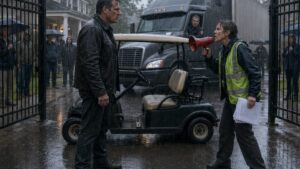
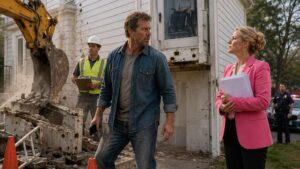
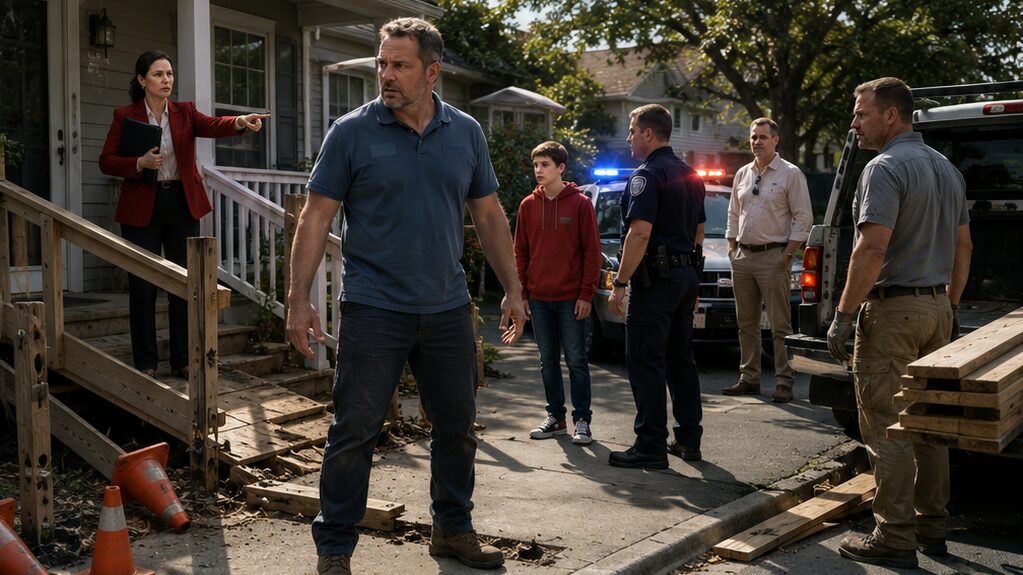
It was a pine board sliding off the front ramp, one end dragging across the concrete with a shriek that cut through the flashing blue light on the curb. A man in a gray work shirt carried the board toward a white truck while another worker knelt near the porch with a pry bar wedged under the handrail David had bolted in place three nights earlier.
Then David saw Tyler.
His son stood beside the police cruiser in a red hoodie, one shoulder turned away from the officer, his hands held low and stiff like he had been told not to move them. His face was pale in the wash of the lights. Across the driveway, Sarah Roberts held a black binder against her chest as if it were a shield.
David parked crooked at the curb and stepped out before the engine fully stopped.
“Dad,” Tyler said.
The officer lifted one hand. “Sir, stay where you are for a second.”
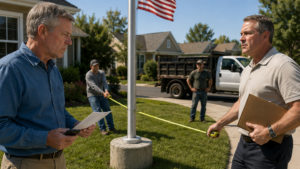
David stopped on the sidewalk. He worked for the city water department; he knew that tone. It was the voice people used when they wanted a scene to stay small. But nothing about the scene was small. The ramp to his front door was half gone. Two orange cones leaned sideways where Tyler must have moved them. A strip of yellow caution tape hung from the porch post and fluttered against the empty screw holes.
“That’s my son,” David said. “Why is he standing by your car?”
Sarah turned before the officer answered. Her red blazer looked too bright for the quiet street, and her white blouse was still crisp though everyone else seemed to have been pulled into the morning by force. The binder in her arms had a printed label slipped into the front cover: HOA RULES.
“Your son interfered with authorized removal,” she said. “He was warned twice.”
David looked past her at the crew. “Stop taking that apart.”
The man with the pry bar paused, not because David had authority, but because he looked toward someone who did. A heavier man near the truck lowered his clipboard. “We were instructed to remove all non-compliant exterior construction.”
“And you are?” David asked.
“Anthony King. Site supervisor.”
“Anthony, that ramp is on my property.”
Sarah opened the binder with a snap of plastic rings. “And your property is subject to the Fairlake Crossing exterior standards, section seven. No exterior modification may be installed without written approval. You know that, Mr. Walker. You submitted an incomplete request, then built it anyway.”
The officer shifted closer to Tyler. “Let’s keep voices down.”
David kept his palms open. He could feel his work shirt sticking to his back. He had come straight from a leak call, still in the blue uniform polo with the city patch on the sleeve, smelling faintly of pipe mud and chlorine. “Tyler,” he said without taking his eyes off Sarah, “tell me what happened.”
Tyler swallowed. “They were pulling the boards off. Grandma was inside. I told them she needed it.”
“You grabbed equipment,” Sarah said.
“I grabbed the board,” Tyler said. “It was falling.”
Sarah pointed at him so sharply David moved before he thought. The officer saw it and stepped forward.
David stopped himself with one foot on the edge of the driveway.
“No,” he said, quieter. “He did not damage anything.”
“Mr. Walker,” Sarah said, “your son ripped safety tape, moved cones, and obstructed a crew operating under board authorization. I had to call for assistance.”
“You called police on a sixteen-year-old for moving cones?”
“For interfering with enforcement.” She lifted a printed page from the binder. “And potentially damaging HOA-authorized removal equipment.”
Tyler’s eyes snapped to hers. “I didn’t damage anything.”
David turned to the officer. “He did nothing wrong, officer.”
The line came out clean, harder than David intended. It made the neighbor across the street, who had been pretending to collect mail, stop with her hand still inside the box.
The officer looked from David to Sarah. “We’re sorting out what happened.”
“Then start with why they’re tearing down a medical access ramp,” David said.
Sarah’s mouth tightened. “It has not been approved as a medical access ramp.”
“That doesn’t change what it is.”
“It changes what the association can allow to remain standing.” She tapped the binder. “This structure is non-compliant. It was installed without final approval, built with unapproved materials, and placed in a visible frontage zone.”
David almost laughed, but there was no humor in his chest. “Visible frontage zone. My mother can’t get down those steps without help.”
Sarah’s eyes flickered, but only for a second. “That information was not included in your submitted packet.”
“I told the office it was urgent.”
“You wrote ‘temporary front access repair.’ You did not include a physician’s letter, a formal accommodation request, or engineered specifications.”
Because Nancy had asked him not to. Because David had sat at the kitchen table with the form and chosen the least humiliating words he could find. Because he had promised his father years ago that his mother would never feel handled like a problem.
Now a worker was carrying away the board Tyler had tried to hold.
David lifted his phone and started recording.
Anthony saw it and raised his hand toward his crew. “Hold up.”
Sarah turned to him. “Mr. King, your work order is active.”
Anthony hesitated. He looked like a man who had removed a hundred fences and porch additions without knowing the stories behind them. “Ma’am, if there’s a dispute—”
“There is not a dispute,” Sarah said. “There is a violation.”
David stepped onto the driveway, slow enough that the officer would not mistake him. “I want the removal order in writing. I want the time it was issued. I want the person who authorized entry onto my property. And until I have that, nobody touches another board.”
“You don’t get to dictate enforcement,” Sarah said.
“No. But I get to document it.”
The officer looked at Sarah. “Do you have paperwork showing authority to remove it today?”
Sarah pulled out a sheet already clipped with a yellow tab. “Board enforcement notice. Exterior modification violation. Refusal to cure.”
David reached for it, but she held it back.
“I’ll show the officer,” she said.
David watched the page pass into the officer’s hands. It was strange how clean it looked. No mud, no torn edge, no urgency. Just lines and language, while the ramp lay open like a broken rib.
Behind the police car, Jason Nelson stood with his arms folded. David had not noticed him at first. Jason wore a pale golf shirt tucked too neatly into khakis, his sunglasses hanging from the collar. He was not on the board officially as president, but everyone knew he watched the budget like it was his personal fence line.
When David’s eyes met his, Jason looked away.
The officer read quietly. “This says notice of non-compliance was issued.”
“When?” David asked.
Sarah answered too quickly. “This morning.”
David looked at the half-empty ramp. “Before or after the crew started removing it?”
Sarah’s jaw shifted.
Anthony rubbed the back of his neck. One of his workers set a board down beside the truck instead of loading it.
“Mrs. Roberts,” the officer said, “I need to understand the timeline.”
“It is Ms. Roberts,” Sarah said, clipped. “And the association followed process.”
Tyler took one step forward. “They were already here when I opened the door.”
The officer pointed lightly toward him. “Stay there.”
David felt Tyler flinch at the command. Not much. Just enough to make David’s stomach turn.
Sarah closed the binder. “This family has ignored repeated communication. The board cannot permit residents to build first and explain later, especially with unsafe structures. We had an incident two years ago with a deck stair. A guest fell. The association was named. I will not expose this community to that again.”
For the first time, she sounded less angry than frightened. David heard it, and that made the situation worse. Fear in a person with authority could harden into anything.
“My mother isn’t a deck stair,” David said.
“No,” Sarah said. “But unapproved construction is unapproved construction.”
David looked at Anthony. “Did my son damage your equipment?”
Anthony glanced toward Sarah.
“Answer him,” the officer said.
Anthony’s voice lowered. “One cone got knocked over. Tape was pulled loose. I didn’t see him damage tools.”
Sarah opened her mouth.
“You said equipment,” David said.
“I said interference,” Sarah replied.
“You said damage.”
Jason moved then, coming around the back of the cruiser as if entering the scene by accident. “Maybe everyone should calm down before this becomes something bigger.”
David turned toward him. “It became bigger when police lights hit my mother’s window.”
Jason’s expression stayed smooth. “Nobody wanted that.”
“My son standing by a cruiser says otherwise.”
The officer held up the page. “I’m not making any decision about costs or HOA enforcement. Right now I’m determining whether there was criminal damage.”
“There was not,” David said.
Tyler stared at the ground.
Sarah pulled another page from the binder. “The board reserves all rights to recover expenses caused by homeowner interference.”
David stepped closer to the remaining ramp posts. “Then reserve them in writing. But your crew is done for today.”
Sarah’s voice thinned. “Removal continues today. The violation order is active.”
David lowered his phone just enough for her to see the screen was still recording. “Then say that again while I’m standing between your crew and the ramp my mother needs to leave this house.”
No one moved.
The police lights kept turning across the white truck, across Tyler’s red hoodie, across the black binder in Sarah’s hand. A saw buzzed somewhere down the street, ordinary yard work in a neighborhood trying very hard not to watch.
Then Jason leaned close to Sarah, half behind the open door of the cruiser, and spoke in a voice meant for only her.
David still heard it.
“Don’t mention the drainage report.”
Chapter 2: The Notice On The Door Was Still Wet
The violation notice had a bead of moisture trapped under the tape.
David noticed it only after the police car pulled away, after Anthony’s crew left the remaining ramp boards stacked beside the truck instead of taking them, after Sarah and Jason walked back toward the clubhouse without looking at the front door. The paper was slapped against the glass storm door at an angle, one corner already curling in the heat.
NOTICE OF EXTERIOR MODIFICATION VIOLATION.
The ink had not run, but the tape shone fresh. David touched the lower edge with one finger and felt the tackiness cling to his skin.
Tyler stood behind him on the porch, still in the red hoodie even though the day had warmed. “They put it there after they started.”
David took a photo before he peeled anything away. Then another with the phone held wider, showing the empty space where the ramp had been. The concrete still had pale lines where the side rails had shadowed it. Four screw holes marked the spot near the bottom landing, raw and bright against the older gray.
“Don’t touch those,” David said.
“I wasn’t going to.”
“I know.” David turned. “I’m not mad at you.”
Tyler’s shoulders moved like he almost believed him.
Inside, Nancy called from the hallway. “Is he all right?”
David opened the storm door carefully so the notice stayed intact. “He’s all right.”
“That is not what I asked.”
Tyler went in first. David followed with the violation paper held by its top corners. The house smelled of reheated coffee and the lemon oil Nancy used on the old table even when she could barely stand long enough to wipe it. Her walker waited near the hallway, two tennis balls on the back legs, one of them split from wear.
Nancy sat in the kitchen chair closest to the hall. She had dressed as if someone might come inside: cardigan buttoned, hair brushed, shoes on. That made David’s throat tighten more than if she had looked fragile.
“Grandma, I’m fine,” Tyler said.
Nancy studied his face. “You are pale.”
“I’m always pale.”
“No, you are a bad liar. Sit.”
Tyler sat.
David placed the notice on the counter and took more photos: timestamp visible on his phone, wet tape, torn caution strip outside, screw holes. He felt ridiculous and late, documenting after the damage had already begun.
Nancy watched him. “They said you were at work.”
“I was.”
“I told Tyler not to call you.”
David looked up.
Nancy folded her hands, then unfolded them. “The men came with the truck. I thought they were here to inspect. Sarah was on the porch with her binder. I told Tyler not to make a fuss.”
“You should have called me.”
“I have called you too many times this month.”
“No.”
“Yes.” Her voice stayed steady. “For the pharmacy. For the doctor. For the shower chair. For the step I could not manage. I was not going to call you because people with clipboards were being unpleasant.”
“They weren’t unpleasant. They were removing your way out.”
Her eyes went to the hallway, past him, toward the front door. “I thought if I stayed quiet, they would leave one side until you got home.”
Tyler leaned forward. “They weren’t going to, Grandma. They pulled the first rail off and said all of it was going.”
“So you moved the cones,” David said.
Tyler nodded. “I told them she needed it. They said it was already scheduled. One guy had the board loose and it dropped. I grabbed it so it wouldn’t hit the step. Then Sarah started saying I was interfering.”
David looked at his son’s hands. There was a red scrape across one knuckle.
“Why didn’t you tell the officer that?”
“I tried.” Tyler’s mouth tightened. “He kept telling me to wait.”
Nancy reached across the table and touched his sleeve. Red cotton under her thin fingers. “You should not have had to protect my ramp.”
“It wasn’t just your ramp,” Tyler said. “It’s our door.”
David turned away before either of them saw his face.
The front steps had been bad for months, worse after every rain. The lowest one had begun to tilt in winter. David had patched the edge, then repatched it. He had told himself he could do a proper repair once the city overtime eased and Nancy’s appointments slowed down. Then Nancy’s physical therapist had stood in the living room and said, gently but clearly, that one bad step could end her independence faster than any diagnosis.
So David had submitted the HOA form. Temporary front access repair. Natural wood. Low-profile rail. No change to landscaping. He had not written medical necessity because Nancy had looked across the table and said, “Please do not make me a paragraph in their files.”
He had built it over a weekend.
He had thought that was mercy.
Now he photographed the empty anchors where mercy had been pried loose.
His phone buzzed. An email preview slid onto the screen.
Fairlake Crossing HOA: Notice of Cost Recovery Review.
David opened it.
Sarah’s language filled the screen in clean lines: unauthorized modification, emergency removal, minor disruption by household member, possible recovery of costs related to damage caused during interference.
He read the last phrase twice.
Tyler saw his face. “What?”
David set the phone down, then picked it back up because he needed the record. “They’re saying the board may bill us for damage caused during interference.”
Tyler pushed back from the table. “Damage to what? I didn’t—”
“I know.”
“No, Dad, I didn’t break anything.”
“I know.”
Nancy’s hand tightened on the edge of the table. “How much?”
“It doesn’t say.”
“That means they want you frightened before they tell you.” Her voice was quiet, but the old sharpness in it made David look at her. Before the walker, before the careful shoes, Nancy had managed the front office of a machine shop for thirty-one years. She knew what paperwork sounded like when it was being used as a shove.
David opened his files on the laptop. He pulled up the original application and read it with new eyes.
Temporary access repair.
Estimated duration: ninety days.
Reason: front step instability.
There was no medical letter. No physical therapy note. No formal accommodation request. No photographs of Nancy standing at the threshold, deciding whether the risk was worth the sunlight.
He had made the request small so Nancy could remain private. Sarah had made the word small enough to dismiss.
“I need the letter from your therapist,” David said.
Nancy looked toward the hallway again.
“Mom.”
“I know.”
“I won’t send anything you don’t approve.”
“You should have asked me before building.”
That landed harder than he expected.
David closed the laptop halfway. “You could barely get to the car.”
“I know what I could barely do.” Her voice did not rise. “I also know what it feels like when people discuss your body as if you are not in the room.”
Tyler stared at the table.
David sat down across from her. “I thought I was keeping that from happening.”
“You were keeping me from choosing,” Nancy said.
The house went still except for the refrigerator hum and the faint scrape of a ramp board settling outside in the heat.
David looked at the notice again. The paper made everything sound simple. A violation. A cure. A cost. A household member. It had no room for Nancy standing at the door, no room for Tyler holding a board so it would not fall, no room for David choosing the wrong silence because it looked like love.
His phone buzzed again.
This time the message was shorter.
Pending board review, the household may be liable for expenses related to obstruction, crew delay, and damage caused during interference by minor resident Tyler Walker.
Tyler read his own name from across the table and went completely still.
Chapter 3: The Binder Had A Clause Sarah Would Not Read
Sarah Roberts slid the fine notice across the clubhouse table before David had both feet under his chair.
The paper stopped beside his hand, faceup, as if she had practiced the distance. Jason Nelson sat two seats to her right with a legal pad in front of him. The black HOA RULES binder rested open near Sarah’s elbow, thick with colored tabs. Exterior Standards was turned toward David. Emergency Access was three tabs behind it, visible only because David had spent half the night downloading every community document he could find.
“Good morning, Mr. Walker,” Sarah said.
David looked at the fine notice but did not touch it. “You invited me here to discuss emergency accommodation.”
“I invited you here to discuss your continuing violation and the events of yesterday.”
Jason clicked his pen. “Including obstruction by a minor resident.”
David set his phone on the table, screen down but recording audio. “Tyler did not obstruct anyone. He moved cones after your crew started removing the ramp before notice was properly served.”
Sarah’s eyes dropped briefly to the phone. “Recording is permitted, provided all parties are aware.”
“Good.”
The board secretary sat at the far end of the table with a laptop open, typing carefully, eyes fixed on the screen. No other board members had come. Not for this. Not yet.
Sarah folded her hands on top of the binder. “Let us be precise. Your exterior modification request was incomplete. You installed the structure anyway. The board issued notice. Removal was scheduled after failure to cure.”
“You issued notice the same morning your crew arrived.”
“Notice was posted.”
“After they started.”
Jason leaned back. “That is not our understanding.”
David looked at him. “Whose understanding is it?”
Jason’s expression did not change. “The property committee received confirmation that the notice process had begun.”
“That’s a careful sentence.”
Sarah cut in. “Mr. Walker, this is not a deposition. The ramp was not approved.”
“It was temporary.”
“It was visible.”
“It was necessary.”
“It was not documented as medically necessary.”
David felt his jaw tighten. He opened his folder and removed the printed page he had marked before dawn. “Fairlake Crossing Rules and Standards, section twelve. Emergency access and reasonable accommodation.”
Sarah did not look at it. “Section twelve requires complete supporting documentation.”
“It also says temporary accommodation may be considered pending full review where delay creates unsafe access.”
“It may be considered,” Sarah said. “Not self-installed.”
Jason underlined something on his pad. “Especially not with untreated lumber and unapproved rail height.”
David swallowed his first answer. The rail height was off by half an inch. He had known that after he measured it again. He had built it at eleven at night, under a porch light, after Nancy nearly fell trying to reach the car. But wrong was wrong, and if he pretended otherwise, they would use it.
“The rail needs adjustment,” he said. “I’ll correct it.”
Sarah blinked, as if she had expected an argument and received a tool instead.
David continued. “The boards were temporary. The anchors were removable. I submitted the request before I built.”
“You submitted an incomplete request.”
“Yes.” The word cost him. “I did.”
Jason’s pen stopped.
David looked at Sarah. “But incomplete paperwork doesn’t make it safe to remove the only usable front access while my mother is inside.”
Sarah’s mouth pressed into a line. “Your mother’s condition was not disclosed to the association.”
“Because she has a right to privacy.”
“She does. And the association has a responsibility not to approve unsafe construction based on verbal urgency.”
For a moment, David heard something underneath the procedure. Not sympathy exactly. Memory.
Sarah turned a page in the binder. “Two years ago, a homeowner installed temporary deck stairs after a storm. No approval, no inspection. A guest fell and broke a hip. The family sued the association for failure to enforce its own rules. We paid increased insurance premiums for everyone in this neighborhood. So when residents build first and explain later, I do not treat it as harmless.”
David held her gaze. “And when enforcement makes someone trapped in their house?”
She looked away first.
Jason cleared his throat. “We are not talking about anyone being trapped. We are talking about a non-compliant structure and a teenager who interfered with a contractor.”
David turned to him. “You keep saying that. Show me the damage report.”
Jason tapped his pen once. “The crew reported delay and disturbance.”
“Damage report,” David repeated.
Sarah took a page from her stack. “The incident statement says Tyler Walker ripped safety tape, moved cones, and physically handled materials under removal.”
David took the page. The words were neat. Too neat. Work began at 9:05 a.m. Notice had been posted prior to commencement. Minor resident entered restricted work area at approximately 9:20 a.m.
David read the time again.
9:05.
The first photo on his phone, the one Tyler had sent him before calling twice, showed the truck in the driveway at 8:47. Another showed no notice on the door.
He kept his face still.
“This says work began at 9:05,” he said.
Jason nodded. “That’s what the contractor reported.”
“Anthony King reported that?”
Jason’s pause was short, but David saw it. “The report came through the property committee.”
Sarah turned slightly toward Jason. “Jason, was that from the contractor or from committee observation?”
“From the compiled record,” Jason said.
David almost smiled. Another careful sentence.
Sarah returned to David. “Regardless, you cannot rebuild before the hearing.”
“What hearing?”
“The emergency board review. Tomorrow evening if we can secure quorum, otherwise Friday.”
“My mother needs to leave for a medical appointment tomorrow.”
“You may use the garage access.”
“She can’t manage the garage step either.”
“Then you may request assistance from medical transport.”
David stared at her. “You removed a ramp, then suggested I call transport to get my mother out of her own house?”
Sarah’s eyes hardened, but the hardness was thinner now. “I am suggesting you not reinstall an unsafe, unapproved structure before the board reviews complete documentation.”
David opened his folder and slid forward the physical therapist’s letter Nancy had allowed him to print that morning. Sarah did look at this page. Her fingers touched the edge but did not pull it close.
“She approved this?” Sarah asked.
“My mother read it before I came.”
“And she consents to association review?”
“She consents to what is necessary to stop this from becoming a claim against my son.”
Jason sat back. “No one wants a claim against your son.”
“You sent the email.”
“The association has to preserve rights.”
“There’s that word again,” David said. “Preserve.”
Sarah closed the binder partway, leaving one finger between the pages. “Here is what will happen. You will submit complete accommodation documentation by five today. The board will meet tomorrow if possible. Until then, the ramp remains removed. Any attempt to rebuild will be considered a separate violation.”
David looked at the tab marked Emergency Access, buried behind Exterior Standards. He reached over and turned to it himself.
Sarah’s hand tightened on the binder. “Mr. Walker.”
He stopped with the page open between them. There it was. Temporary measures may be granted where denial of access creates immediate hardship.
“Read that sentence out loud,” he said.
Sarah did not.
The board secretary stopped typing.
Jason’s chair creaked softly.
David stood, collected his folder, and took a photo of the open page before Sarah could close it. “I’ll submit everything by five.”
Sarah’s voice followed him to the door. “And the hearing will include the conduct of all household members.”
David turned back. “Then make sure the record starts before your crew arrived, not after.”
He was halfway to his truck when his phone rang from an unfamiliar number. He almost let it go. Then he saw the local area code and answered.
“This is David.”
A man’s voice came through low and uneasy. “Mr. Walker, it’s Anthony King. I don’t want trouble, but your HOA told us the notice went out yesterday.”
David stopped beside his truck.
Anthony exhaled. “That’s not what happened.”
Chapter 4: The Damage Under The Steps Was Not From Tyler
David pressed the heel of his work boot against the base of the lowest front step, and water seeped through the crack like the concrete had been holding its breath.
It was not raining. The sprinkler system along the common strip had shut off more than an hour ago. Still, a dark line spread from under the step and crawled toward the screw holes where the ramp anchors had been.
Tyler stood beside him with his hands shoved into the pocket of his red hoodie. “That’s not supposed to happen, right?”
“No,” David said.
He crouched and pressed again. More water beaded out, carrying grit. The step shifted under his weight, not much, but enough that his stomach tightened. He had patched the visible damage twice. He had blamed age, soil, bad luck, his own delay. But water under pressure left patterns. He had spent enough years kneeling beside broken service lines to know when a structure was being fed from somewhere else.
He took out his phone and filmed the seepage, then the slope of the lawn, then the narrow common strip between his house and the drainage bed the HOA maintained. A green utility cover sat half-hidden by mulch. Beyond it, the association’s decorative stone channel curved neatly toward the street drain.
Too neatly.
Tyler watched him trace the ground with his eyes. “Dad?”
“Get me the measuring tape from the garage.”
Tyler ran inside. David stayed low, ignoring the ache in his knees, and scraped mulch away from the edge of the stone channel. Damp soil clung to his fingers. The channel looked dry on top, but underneath the fabric liner was saturated.
By the time Tyler returned, a neighbor from two houses down had paused at the sidewalk with a small trash bag in one hand. The same neighbor who had stood at her mailbox during the police call.
David did not know her well. She was the kind of neighbor who waved without stopping, who kept her yard perfect and her opinions behind curtains.
“You found it too?” she asked.
David looked up.
She glanced toward the clubhouse end of the street before stepping closer. “The water.”
Tyler handed David the tape but stared at her.
David stood slowly. “You knew about this?”
“I knew Jason came out to look at it.” She shifted the trash bag to her other hand. “Three weeks ago. Maybe four.”
David kept his voice level. “Jason Nelson?”
She nodded. “I had water pooling near my side gate. Not as bad as yours. He said the landscaping contractor may have pitched the common strip wrong after the spring refresh.”
“Did he write a report?”
“I don’t know. He took pictures.” She glanced at the torn ramp marks. “He asked me not to start rumors before budget review.”
The words landed with the weight of a document David had not yet seen.
Tyler said, “Budget review?”
The neighbor’s face tightened. “I probably shouldn’t have said anything.”
David put the tape measure down. “You didn’t say anything wrong.”
She looked at the exposed screw holes and the muddy crack under the step. “I saw your son yesterday. He wasn’t breaking anything. He was scared.”
Tyler looked away fast.
David wanted to thank her, but thanks felt too small and too early. “Would you be willing to say Jason came out?”
“I can say he looked at the drainage,” she said carefully. “I can’t get in the middle of a lawsuit.”
“There isn’t a lawsuit.”
“Not yet.” Her eyes flicked toward the clubhouse again. “That place turns everything into one if money is involved.”
After she left, Tyler crouched where David had been and pressed the step with his palm. “So the water broke it?”
“Helped break it.”
“And they knew?”
“We don’t know what they knew.” David heard the old habit in his own voice, the caution he used at work when homeowners wanted blame before proof. “We know Jason inspected drainage near here. We know he told her not to talk before budget review. We know he told Sarah not to mention a drainage report.”
Tyler’s face changed. “You heard that too?”
David nodded.
“Why didn’t you say something?”
“Because hearing something isn’t the same as proving it.”
Tyler stood. “But they can say I damaged stuff without proving it.”
That was the center of it. That was the thing David had wanted not to look at directly.
He set the phone camera to video again and narrated the facts, not the anger: date, time, dry weather, sprinkler schedule, water seepage under the step, ramp anchors removed, common drainage channel saturated beneath surface rock. Then he called an emergency repair contractor and described only what he could show.
The contractor arrived in a truck that had seen more honest work than polish. He did not step onto the damaged stair until David warned him. He crouched, prodded the crack with a screwdriver, then walked the line of the drainage bed.
“You’ve got water traveling under the front approach,” the contractor said. “Could be irrigation overspray, could be a bad pitch from the common area, could be both. But that bottom step is not something I’d want an older person using.”
David felt Tyler look at him.
“Can it be repaired?”
“Yes. But not with somebody pretending it’s just cosmetic. You’d need to address water first, then rebuild the step or bypass it safely.”
“Bypass it safely,” Tyler repeated.
The contractor looked at the empty ramp marks. “That what this was?”
“Temporary ramp,” David said.
“Not the prettiest.”
“No.”
“But if someone couldn’t use the step, I understand why you put it there.” The contractor stood and wiped his hands on a rag. “Don’t let them tell you this crack came from a kid moving cones.”
David asked for a written assessment. The contractor said he could send preliminary notes by evening but not a full quote until he opened the area. Everything required permission, measurements, approvals, the exact machinery of delay that had already taken the ramp away.
After the contractor left, David found Tyler sitting on the porch beside one of the boards Anthony’s crew had not loaded. His son had dragged it out of the grass and laid it across his knees.
“You know,” Tyler said, “Grandma said Grandpa built the first porch rail here.”
David sat beside him. The board smelled of cut pine and dust. “He did.”
“Did the HOA approve it?”
David almost smiled. “There wasn’t an HOA then.”
“Sounds better.”
“It had other problems.”
Tyler ran his thumb over a saw mark. “If they knew the steps were bad because of their water, why tear down the thing that helped?”
David looked toward the clubhouse roof beyond the row of trimmed trees. “Because if the ramp stays, they have to ask why it was needed.”
He regretted the sentence as soon as it was out. Tyler heard more than he meant.
“So Jason is lying.”
“I said if.”
“But you think he is.”
David did not answer. He opened his email instead because his phone had vibrated twice.
The first message was from the contractor: preliminary notes, unsafe step condition, possible subsurface water migration, temporary bypass recommended pending full repair.
The second was from Fairlake Crossing HOA.
Sarah’s name appeared at the bottom, but the language had Jason’s careful edges.
Emergency hearing agenda has been amended to include review of unauthorized exterior construction, household interference with authorized enforcement, and potential homeowner responsibility for damage to association-regulated frontage elements.
David read the next line once, then again.
The board will also consider whether costs associated with unauthorized exterior damage may be assessed to the Walker household.
Tyler leaned closer. “What does that mean?”
David locked the phone.
“It means,” he said, “they’re going to try to make us pay for the damage they may have caused.”
Chapter 5: Nancy Asked To Speak For Herself
Nancy reached the front door and stopped before the first step as if there were glass there that only she could see.
Her walker stood behind her in the hall, angled wrong because she had refused to bring it the last few feet. One hand rested on the doorframe. The other hovered near the brass handle. Outside, the porch dropped into the gap where the ramp should have begun.
David came out of the kitchen too quickly. “Mom.”
“Do not grab me.”
He stopped with his hand half-raised.
Nancy did not turn. Her shoulders stayed straight, but the effort of standing showed in the tightness at the back of her neck. “I wanted to see if I could do it.”
“You can’t test that alone.”
“I am not alone. You are standing there looking terrified.”
Tyler was at the kitchen table with his school laptop open and no schoolwork on the screen. He looked up but did not move. None of them had moved easily since the ramp came down. The whole house had learned to pause near the front door.
Nancy lowered her hand from the handle. “I hate this,” she said.
David let the words stay in the hall without trying to soften them.
On the kitchen table behind him were three folders: medical letter, contractor’s preliminary notes, HOA notice. He had arranged them in order, then rearranged them twice, as if neatness could make the hearing less humiliating. At five that evening, he had submitted every document Sarah requested. At six, the board confirmed the hearing for the next night. At six-thirty, Jason’s amended agenda arrived.
Nancy had read it without speaking.
Now she turned from the door, slower than she should have had to, and reached for the walker. David held himself still until she took it.
“I am going tomorrow,” she said.
“No.”
Her eyes lifted.
David heard himself, heard the same mistake inside the word. Too fast. Too certain. “I mean—”
“You meant no.”
“Mom, they’re going to ask questions.”
“Yes.”
“About your condition.”
“Yes.”
“In front of Sarah. Jason. Whoever else shows up.”
“Then I will wear my good sweater.”
Tyler made a sound that was almost a laugh, then covered it.
David rubbed his forehead. “I’m trying to protect you.”
“I know. That is the problem.”
The sentence did not strike like anger. It settled like truth.
Nancy moved back toward the kitchen, each step measured. David wanted to take her elbow. He did not. She sat in her usual chair and looked at the folders.
“When your father got sick,” she said, “he made me promise not to let people turn him into paperwork. He hated the clipboard at every appointment. He hated being discussed in hallways. He hated the look people gave him when they thought he could not hear.”
David sat across from her.
“So when I began needing help,” Nancy continued, “I thought I could keep some of myself by not naming every weakness. By not letting a board put it in minutes. By not making my grandson hear adults talk about whether I can cross a doorway.”
Tyler closed the laptop.
Nancy looked at him. “But yesterday, you heard worse.”
Tyler’s jaw moved.
“You heard them call you a problem,” she said.
He looked down. “I grabbed the board because I pictured a fire.”
David went still.
Tyler kept his eyes on the table. “That’s why I moved the cones. They were pulling everything, and Grandma was inside, and I kept thinking if something happened, she’d be stuck. I know that sounds stupid.”
“It does not,” Nancy said.
“It happened so fast,” Tyler said. “One guy had the rail off. The board slipped. I grabbed it. Sarah yelled not to touch anything. I yelled back. Then she called someone, and the police came, and everyone was looking at me like I was some kind of criminal.”
David felt something in him fold inward.
He had been focused on the record, the timeline, the clause, the drainage. Necessary things. But Tyler had been carrying a picture David had not seen: Nancy behind a closed door, smoke or siren or panic, no ramp left, no time to file a form.
“I should’ve been here,” David said.
Tyler looked up. “You were at work.”
“I should’ve made it impossible for them to misunderstand.”
“You can’t control Sarah.”
“No. But I gave her blanks to fill in.”
Nancy reached for the medical letter. “Then stop leaving blanks.”
David watched her slide the page toward herself. Her fingers trembled slightly, but her voice did not.
“Use it,” she said.
“You’re sure?”
“No. But I am more sure than I was yesterday.”
He nodded.
“And I will speak tomorrow.”
“Mom—”
“David.”
He stopped.
“I am not a hallway conversation. I am not a paragraph in a file unless I choose to be. And I am choosing because Tyler will not pay for my pride or yours.”
The words went clean through him because they were not unfair.
He had thought his silence was tenderness. He had thought building fast was better than asking publicly. He had thought that if he carried enough—forms, lumber, appointments, bills—Nancy could remain untouched by the ugliness of needing. But Tyler had touched the board. Tyler had stood near the cruiser. Tyler’s name was now in an email under possible recovery.
David opened the folder and placed the medical letter on top of the stack.
“All right,” he said. “We go together.”
Nancy leaned back, tired now that the choice had been made. “Good.”
A car door closed outside.
Tyler stood first. David moved to the front window. Jason Nelson was on the walkway, not at the porch but near the torn place where the ramp had been. He held a thin folder at his side and looked toward the house with the patient expression of a man who wanted to be seen as reasonable.
David opened the door but stayed inside the threshold. The missing ramp made the space between them feel deliberate.
“It’s late,” David said.
Jason glanced past him, perhaps looking for Nancy. “I’m trying to avoid tomorrow becoming worse for everyone.”
“That depends on what you mean by everyone.”
Jason gave a small, tired smile. “You know how these meetings go. People get defensive. Things get said on record that can’t be walked back.”
“Like your timeline?”
Jason’s smile faded. “The board has discretion. Sarah listens to practical solutions when she isn’t being cornered.”
David stepped out onto the porch, careful around the damaged step. “Say what you came to say.”
Jason lowered his voice. “Drop the drainage issue. Submit the medical documents. Agree not to reinstall anything until approved. In return, I’ll recommend leniency on the incident with Tyler.”
David stared at him.
Jason continued quickly. “No cost recovery for the crew delay. No referral. No formal misconduct finding. Your son’s name stays out of the permanent minutes.”
From inside, David heard Tyler’s chair scrape.
David did not turn. “You want me to trade the truth about the drainage for my son’s name.”
“I want to keep this from becoming a larger association matter.”
“It already is.”
“It doesn’t have to be.” Jason looked toward the common strip. “If the drainage becomes part of this, insurance gets involved, reserves get touched, assessments go up. People who had nothing to do with your ramp will pay. Is that what you want?”
David thought of the neighbor looking over her shoulder before admitting Jason had been there. He thought of Sarah’s fear of liability hardening into procedure. He thought of Nancy at the threshold, refusing his hand.
“What I want,” David said, “is my mother able to leave her house and my son not blamed for protecting her.”
“Then be smart.”
The word sat between them like a dare.
Jason opened the folder and held out a single printed page. “This is a settlement framework. Not formal. Just a way to make tomorrow simpler.”
David did not take it.
Behind him, Nancy’s walker clicked once against the hall floor.
Jason glanced toward the sound. “Think about what public testimony does to families, David.”
David’s hand closed around the doorframe.
Nancy’s voice came from behind him, calm and near. “We have thought about what silence did.”
Jason’s face changed before he could cover it.
Chapter 6: The Hearing Started With The Wrong Time
Sarah began the hearing by reading Tyler’s name before she read Nancy’s.
David sat at the folding table with the folders aligned in front of him, Nancy to his left, Tyler to his right. The community clubhouse boardroom smelled faintly of coffee and floor polish. Three board members sat beyond Sarah, but only Sarah had the black HOA RULES binder open. Jason sat at the end with his legal pad, not quite beside her, not quite separate.
“The board is convened to review unauthorized exterior construction at the Walker property,” Sarah said, “associated removal enforcement, and reported interference by minor resident Tyler Walker.”
Tyler’s knee bounced under the table.
David put one hand flat on the folder closest to him, not on Tyler’s arm. His son did not need to be held in place. He needed to be believed.
Sarah continued. “We will also consider submitted documentation regarding claimed medical necessity.”
“Claimed?” Nancy said.
The room quieted.
Sarah looked up. For the first time since David had known her, she seemed uncertain whether the rule in front of her was the one she needed. “Mrs. Walker, the board has not yet made a finding.”
“Nancy,” Nancy said.
Sarah nodded once. “Nancy.”
David opened the first folder. “Before anything else, I want the record to reflect that Tyler did not damage crew equipment. Anthony King is here and can confirm what he saw.”
Anthony sat in the back row, hat in his hands. He looked uncomfortable enough to be honest.
Jason spoke before Sarah could. “The incident report says the minor resident entered the restricted area, moved safety equipment, and handled materials being removed under authorization.”
David looked at Sarah. “That report starts at the wrong time.”
Sarah’s fingers rested on the binder rings. “You’ll have a chance to present.”
“No,” David said. “This matters before the accusation. Because if the notice was posted after work began, then Tyler did not enter a properly restricted area. He walked out his own front door while a crew was already removing his grandmother’s access.”
Jason set his pen down. “That’s a characterization.”
“It’s a timeline.”
One of the board members leaned forward. “Let him present the timeline.”
Sarah’s mouth tightened, but she nodded.
David laid out the photos one by one. The first showed Anthony’s truck in the driveway at 8:47. No paper on the storm door. The second showed a worker loosening the rail while the glass door was still bare. The third showed the violation notice taped to the door at 9:18, moisture trapped beneath the tape.
He did not raise his voice. He did not call Jason a liar. He had wanted to, several times. Instead, he let the pictures sit under the fluorescent lights.
Then he placed his own application on the table.
“I submitted an incomplete request,” he said.
Tyler turned toward him. Nancy did not.
David kept going. “I called it a temporary access repair. I did not include the medical letter. I did not formally invoke the emergency accommodation clause. I built before written approval. That was my mistake.”
Across the table, Sarah looked at him carefully, as if the admission had taken one weapon out of her hand and left another she did not want to use.
Jason picked it up for her. “That mistake is exactly why enforcement was necessary. The association cannot allow unapproved structures, especially unsafe ones. Good intentions don’t change liability.”
David opened the second folder. “I agree unsafe work needs correction. That is why I asked for emergency review, not unlimited permission. But the ramp was bypassing steps that are also unsafe.”
He placed the contractor’s preliminary notes beside the photos. Then the images from the common drainage strip. Then the video still of water seeping from under the step.
Jason’s face stayed smooth, but his pen moved again.
“This is outside the scope,” he said.
“No,” David said. “This is the reason the ramp existed.”
Sarah turned a page in the binder, slower now. “The drainage issue can be referred to maintenance review.”
“It was already reviewed,” David said.
The neighbor from two houses down stood near the back wall, arms crossed tightly. She had come after all. David had not known until he saw her slip in behind Anthony.
She cleared her throat. “Jason looked at the common drainage last month.”
Jason’s pen stopped.
Sarah looked down the table. “Jason?”
Jason did not look at the neighbor. “I responded to a general concern. There was no formal finding.”
“You took pictures,” the neighbor said. “You told me not to start rumors before budget review.”
A board member shifted in his chair.
Sarah’s expression became controlled in a different way. Not defensive now. Assessing.
Jason leaned forward. “Even if drainage needs review, that does not retroactively authorize Mr. Walker’s construction or Tyler’s interference.”
David felt the old anger push at him. He kept it behind his teeth.
“No,” he said. “It doesn’t make my paperwork complete. It doesn’t make my rail height perfect. It doesn’t erase that I should have done this differently.”
He opened the last folder and took out Nancy’s medical letter.
“But it does explain why removal should not have happened before review. It explains why Tyler panicked. And it explains why this board needs to decide whether a rule is meant to keep people safe or just keep records clean.”
Sarah looked at the letter. “Nancy, do you consent to this being discussed?”
Nancy had worn her good sweater, dark blue with pearl buttons. Her walker stood beside her chair, visible to everyone. She placed one hand on it before answering.
“I do.”
David turned toward her. He had expected her to let him read. She had told him in the car that he could. But now she drew the paper closer and held it herself.
“My grandson did not run outside to cause trouble,” she said. “He ran outside because men were taking apart the only way I could leave through my front door without risking a fall.”
The room stayed still.
Nancy’s voice trembled once, then steadied. “I asked David not to describe my condition in the application. That was my pride. He respected it too much. That was his mistake. But Tyler’s mistake was loving me faster than the adults were listening.”
Tyler looked down hard.
Sarah’s face changed again, not softened exactly, but struck.
Nancy slid the letter toward Sarah. “I am not asking to keep an unsafe ramp. I am asking you to stop calling it a decoration. It was a way out.”
Anthony stood before anyone asked him. “I need to say something.”
Sarah nodded.
Anthony held his hat with both hands. “My crew arrived at 8:40. We were told notice had already been served and the homeowner had refused cure. We started staging at 8:47. The paper was posted after Ms. Roberts arrived. I didn’t see the boy damage equipment. He pulled tape and grabbed a board when it slipped. I should’ve stopped work sooner once I knew someone inside needed access.”
Jason’s chair scraped. “Anthony, your company accepted the work order based on association authorization.”
“Yes,” Anthony said. “And the work order I got came through the property committee at 7:56 that morning. It said prior notice complete.”
David did not look at Jason. He looked at Sarah.
She had gone very still.
Jason spoke carefully. “Administrative language. It may have referred to the violation process generally, not physical posting.”
David reached into his folder and removed the page Jason had offered on the porch. He had not signed it. He had photographed it after Jason left.
“This was offered to me last night,” David said. “Drop the drainage issue, and the association would recommend leniency for Tyler.”
Jason’s face flushed. “That was an informal settlement discussion.”
“It was a trade.”
“It was an attempt to spare your family public embarrassment.”
Nancy said, “You came to our door and warned us about what public testimony does to families.”
Sarah looked at Jason then. Something in her expression closed, but not against David.
One board member asked, “Sarah, did the board authorize any settlement framework?”
“No,” Sarah said.
Jason held up one hand. “I was trying to resolve a volatile situation.”
Sarah turned the binder toward herself. The tab marked Exterior Standards lay open. Behind it, Emergency Access waited in blue. She flipped to it at last.
David watched her read the sentence he had shown her the day before.
Temporary measures may be granted where denial of access creates immediate hardship.
The room waited.
Sarah closed her eyes for one second, then opened them.
“Jason,” she said, and her voice was no longer the voice from the driveway. “Why did your report list notice before removal?”
Chapter 7: The Ramp Went Back Up With Everyone Watching Quietly
Anthony returned with new lumber at eight on a Monday morning, but this time he did not unload a single board until David and Nancy had signed the work order on the hood of his truck.
The paper had three attachments clipped behind it: the emergency access approval, the revised ramp specifications, and the temporary drainage repair authorization for the common strip. Sarah Roberts stood beside the truck with the black HOA RULES binder tucked under one arm. She did not point it at anyone. She did not open with a warning.
Tyler stood near the porch in his red hoodie, holding a box of galvanized screws with both hands.
David noticed that first. Not the truck. Not Sarah. Not the neighbors pretending not to watch through blinds and half-open garage doors. He noticed Tyler standing where the police cruiser had been reflected in his face one week earlier, now waiting to help rebuild the same thing he had been accused of damaging.
Anthony looked at Nancy. “Ma’am, before we start, I want to confirm the landing height. The revised plan lowers the first approach by two inches and adds the side rail here.”
Nancy looked at the drawing, then at the torn marks in the concrete. “Will I be able to turn my walker at the top without catching the wheel?”
“Yes, ma’am. That’s why we widened the top platform.”
David almost answered for her, then stopped himself.
Nancy nodded. “Then build that one.”
Anthony gave David a brief glance, not quite a smile, and signaled his crew.
The first board came down gently over the old holes.
For a moment, David could not look away from the marks left by the removal. The concrete still showed where the earlier anchors had been pried up. One edge had chipped when the crew pulled too fast. He had wanted to patch everything before the rebuild, erase the evidence, make the walkway clean again.
Nancy had told him no.
“Let them see where it was taken from,” she had said that morning. “Then let them see it put back properly.”
So the old marks stayed visible beneath the new frame, not as a decoration, not as a grievance, but as a seam.
Sarah opened the binder on the hood of Anthony’s truck. David braced without meaning to. The sound of the rings still brought back the driveway, Tyler near the cruiser, her finger lifted as if the binder itself had found him guilty.
But this time she turned past Exterior Standards.
Her hand stopped at the blue tab.
“Emergency Access,” she said, more to the board secretary beside her than to David. “The board’s temporary accommodation approval is entered under section twelve, pending final inspection after the drainage repair.”
David signed where she pointed.
Then Nancy signed under him, her letters careful but firm.
Tyler watched her name go down. “Grandma, yours looks better than Dad’s.”
“Most things do,” Nancy said.
For the first time in a week, Tyler smiled without checking who might take it wrong.
Across the common strip, a different crew had already cut into the decorative stone channel. The clean curve had been lifted in sections, exposing the soaked liner beneath. The city access compliance clerk had come earlier, reviewed the photographs, and said only that temporary access could not be delayed while the drainage investigation continued. No speech. No victory. Just the words David had been trying to force into the room all along: could not be delayed.
Jason Nelson was not there.
The board’s notice had not made a spectacle of him. It said the property committee chair had stepped aside pending review of maintenance documentation and communication practices. It said the cost recovery claim against Tyler Walker was withdrawn. It said no criminal complaint had been filed and no damage charge would be pursued.
David had read that part twice at the kitchen table.
Tyler had read it once and shoved the paper away like it was too late to be a gift.
Now he carried screws to Anthony and asked where to set them. Anthony showed him without making him feel in the way. The sound of the drill began, low and steady. Sawdust collected on the driveway instead of blue police light.
Sarah came to stand near David while the crew aligned the next board.
“I owe Tyler a direct apology,” she said.
David watched his son kneel beside the lumber. “Then give him one when he isn’t holding something sharp.”
Sarah accepted that with a small nod. “Fair.”
He looked at her then. She seemed tired in a way she had not allowed herself to be at the hearing. The red blazer was gone; she wore a gray jacket and flat shoes. The binder still looked official, but less like a weapon under her arm.
“You had the clause,” David said. “It was there the whole time.”
“I know.”
“You just wouldn’t read it.”
Sarah looked toward the ramp frame. “I read rules in the order I’m afraid of them.”
David did not answer.
She continued, quieter. “That deck stair case two years ago made the board reactionary. I told myself consistency was fairness. Jason told me the notice was complete and the structure was unsafe, and that fit what I already feared.”
“That doesn’t explain calling police on Tyler.”
“No,” she said. “It doesn’t.”
The drill stopped. Anthony adjusted a board. Tyler leaned back to give him room, his red sleeve bright against the pale wood.
Sarah said, “I’ll apologize to him.”
David nodded once. It was not forgiveness. It was room for the next correct thing.
Nancy called from the doorway. “David.”
He turned quickly, then slowed before moving toward her. She stood with her walker at the threshold, not outside yet. Her lips were pressed together in concentration.
“The rail looks too far from the edge,” she said.
Anthony looked up. David almost said the plan had been reviewed, but Nancy was already pointing with two fingers.
“If my wheel catches here, I will turn too close to the drop.”
Anthony came over, studied the angle, and nodded. “You’re right. We can shift the rail in by an inch and still meet clearance.”
Sarah made a note in the binder.
David watched Nancy watch the men adjust the frame. It was her ramp now in a way the first one had not been. Not because she needed it more, but because she had been allowed to decide more.
The work took most of the morning. Neighbors passed with dogs, mail, excuses. No one clapped. No one filmed. The house did not become a stage, though David knew how easily it could have. A few people looked at Tyler and then looked away, embarrassed by what they had believed when the police lights were flashing. One neighbor stopped only long enough to tell Nancy the new rail looked sturdy.
Nancy said, “It had better be. I supervised.”
By noon, the main platform was secured. Anthony swept sawdust from the top board and tested the rail with both hands.
“All right,” he said. “Slow the first time.”
David stepped toward Nancy.
She looked at him.
He stopped.
Tyler stood at the bottom of the ramp, not blocking, just waiting. Sarah stood beside the truck with the binder open to the accommodation clause. Anthony moved aside. The board secretary held the inspection sheet on a clipboard.
Nancy rolled the walker forward.
The front wheels crossed the threshold and touched the new board with a soft wooden sound. She paused, adjusted her grip, and moved again. The ramp held. The rail sat close enough for her hand. The turn at the top gave her space.
David walked beside her but did not touch her.
Halfway down, Nancy stopped. Not from fear. Not because something had gone wrong. She stopped to look at the common strip where the drainage crew had exposed the wet earth under the stones.
“All that water,” she said.
David followed her eyes. “They’ll fix it.”
“Yes,” she said. “But remember this.”
“What?”
She looked at the new boards under her walker. “A thing can look neat on top and still be washing out underneath.”
David thought of the application he had softened, the condition Nancy had hidden, the timeline Jason had polished, the rule Sarah had chosen first because it felt safer than the one that asked her to see a person.
“I’ll remember,” he said.
At the bottom, Tyler stepped back to give her room. Nancy reached out and pinched the sleeve of his red hoodie.
“You,” she said, “will not grab boards from working men again.”
Tyler flushed. “I know.”
“And you will not let adults make you ashamed for being afraid for someone.”
He looked at her then. “Okay.”
Sarah waited until Tyler turned toward the screw box again. “Tyler.”
He stiffened.
She came no closer than the edge of the walkway. “I was wrong to say you damaged equipment without confirming it. I was wrong to let the situation become a police matter before I understood why you stepped in. I’m sorry.”
Tyler looked at David.
David gave him nothing but the truth of his own choice.
Tyler looked back at Sarah. “You scared my grandma.”
Sarah absorbed that. “I know.”
“And me.”
“Yes.”
He nodded once, not generous, not cruel. Just enough.
When the final inspection sheet was signed, Sarah handed David the binder so he could initial the revised emergency-access policy draft as the homeowner representative. The gesture surprised him. The binder was heavier than he expected. He opened it to the page she had marked, read the new line about temporary access not being removed while a medical accommodation review was pending, and signed at the bottom.
Then he closed the binder gently.
No snap of rings. No slap of paper. Just a cover meeting pages.
Nancy stood at the open front door with her walker turned toward the ramp, ready to go back inside under her own power. David stepped ahead and held the door, not because she could not manage it, but because she had asked him to hold it while she used the ramp herself.
She passed him slowly, chin lifted, wheels steady on the new boards.
Tyler followed with sawdust on his sleeves.
David stayed at the threshold until Nancy reached the hall. Behind him, the crew loaded tools into the truck. In front of him, the ramp remained, covering the old holes without pretending they had never been there.
The story has ended.