The Sold Signs Went Up Before She Learned Her Mother’s Will Had Changed
Chapter 1: The Sold Signs Were Already In The Field
Angela Carter hit the brakes so hard the red SUV lurched sideways on the gravel lane.
For one second she thought the orange flashes in the field were survey flags, the kind the county stuck in the ground before a road crew came through. Then the nearest sign caught the low sun and the black letters sharpened.
3500 ACRE SOLD.
Another one stood twenty yards beyond it.
Another by the first row of soybeans.
Another at the bend where the farm lane dipped toward the pond.
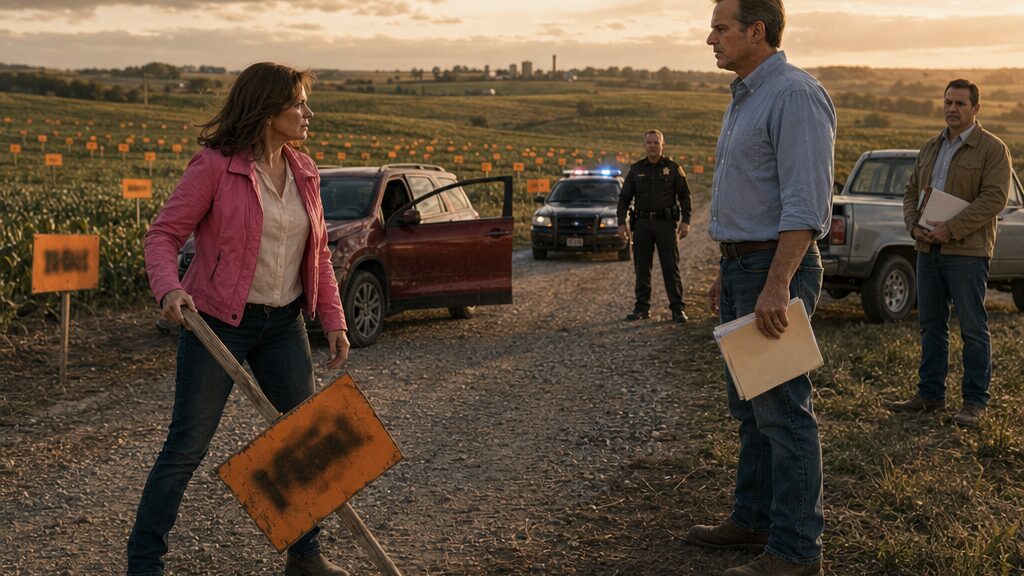
By the time Angela stepped out of the SUV, she could see them scattered all the way to the far pasture, orange rectangles staked into the land like warnings. Her mother’s land. Carol Carter’s land. The fields Angela had crossed barefoot as a child, the pond where Mark once broke his wrist falling through winter ice, the house road Carol had made Angela promise to keep open.
Angela left the driver’s door hanging open.
A man in a pale blue button-down stood near the middle of the front field with his hands on his hips. Even from a distance, she knew the set of his shoulders. Mark had always stood that way when he wanted to make a conversation feel finished before it began.
Near him was a white pickup with a magnetic door sign Angela couldn’t read from the lane. Behind it, a sheriff’s cruiser idled beside the drainage ditch. A deputy leaned against the hood, arms folded, not relaxed enough to be waiting and not tense enough to be surprised.
Angela walked past the first sign and pulled it from the ground.
“Ma’am,” the deputy called.
She kept walking, the wooden stake dragging a crooked line through the gravel dust.
Mark turned before she reached him. His face did not change much. That was the first thing that made the panic in her chest go cold. He did not look caught. He looked prepared.
“You sold my farm?” Angela said.
Mark’s jaw tightened. “It wasn’t your farm.”
The words landed flatter than a shout would have.
Angela held up the sign between them. “Then whose name did Mom put on every Christmas card for thirty years? Whose hands painted that porch with her? Whose name did she say when she told me to keep the house road open?”
The deputy stepped closer. “Ms. Carter, I need you to put the sign down.”
Angela turned to him slowly. “You know my name?”
“Yes, ma’am.”
“Then you know I’m Carol Carter’s daughter.”
“I know there’s a property transfer in process, and I know those signs are not yours to remove.”
Angela looked from the deputy to the orange field and back to Mark. The farm seemed suddenly staged against her. Someone had gone row by row and planted public proof before calling her. Before the estate meeting. Before she had even seen a copy of anything.
Mark took the sign from her hand, not roughly, but firmly enough to remind her the deputy was watching. He pushed the stake back into the dirt. “You need to calm down.”
Angela laughed once. It sounded wrong even to her. “You put sold signs in Mom’s field, and I need to calm down?”
“She made decisions before she died.”
“She was dying.”
“She was still allowed to make decisions.”
Angela looked toward the farmhouse. The kitchen windows caught the sun, bright and blank. For the last five months of Carol’s life, those windows had usually been shaded by noon because the light hurt her eyes. Angela remembered washing medicine cups in the sink while Carol asked twice in ten minutes whether the mail had come. She remembered Mark saying, “I’ll deal with the bills,” and Angela letting him, because bills felt like the ugly part of dying and she had wanted to be the daughter who brought soup, clean sheets, and quiet.
“What decisions?” Angela asked.
Mark’s eyes flicked toward the man by the pickup. Angela noticed him then: neatly dressed, holding a folder, watching with the careful patience of someone paid to stand near trouble and not become part of it.
“The estate gave me authority,” Mark said. “The trust was amended.”
Angela stared at him. “What trust?”
“The land trust.”
“There was no land trust with only your name on it.”
“There is now.”
The deputy looked away, as if the pond had become interesting.
Angela felt heat climb her neck. “Mom would not do that.”
Mark’s voice stayed low. “She did.”
“No. She wouldn’t.”
“Angela, the documents are legal.”
That word—legal—made something inside her go still. Mark said it the way people said locked, final, signed. As if a word printed in an office could reach backward through every promise Carol had made while sitting at the kitchen table in her robe.
The man from the pickup cleared his throat. “Mr. Carter, we should probably—”
“Not now, Jonathan,” Mark said.
Angela turned on him. “Who are you?”
The man hesitated. “Jonathan Perez. I’m handling the farm listing and sale process.”
“Sale process,” Angela repeated. “So this isn’t even just signs.”
Jonathan did not answer quickly enough.
Angela stepped closer to Mark. “When were you going to tell me?”
“At the reading.”
“The reading is in two days.”
“That’s when the attorney asked everyone to come.”
Angela looked out over the fields. Rows of green, orange signs, the pond throwing back the sky. Two days. They had left her two days between finding out and being expected to sit in a chair while someone read the paper version of her erasure.
“You had these signs printed before I heard the will,” she said.
Mark’s face moved then. A flash of irritation, or guilt, or simple exhaustion. “The buyers needed confirmation the property was moving forward.”
“The buyers.”
“The farm can’t sit in limbo.”
“Mom has been gone three weeks.”
“And the bills didn’t die with her.”
For the first time, she heard something under his control. Not sorrow. Not exactly. Fear, maybe. Anger shaped into usefulness. Mark had always known the land by acreage, yield, taxes, equipment repair. Angela knew it by rooms, tree lines, and where Carol’s voice carried from the porch.
“Mom promised me the house road,” Angela said. “She said no matter what happened to the acreage, the farmhouse, the cemetery path, and the lane stayed family.”
Mark’s face hardened again. “Mom said a lot of things before she got sick.”
“She said it after she got sick.”
“Then maybe you should have gotten it in writing.”
The deputy shifted his weight. Jonathan looked down at his folder.
Angela had the sudden clear urge to slap Mark. Instead she pressed her thumb hard against the seam of her jeans until the urge passed.
There it was. Her mistake, spoken in her brother’s voice. She had believed Carol’s hand squeezing hers mattered. She had believed a promise made beside a hospital bed counted because the person making it was her mother. She had let Mark carry the folders, call the accountant, speak to the attorney, because every time Carol asked, “Is the farm okay?” Angela had wanted to say yes.
“When did she sign it?” Angela asked.
Mark blinked. “What?”
“The amended trust. The will. Whatever paper you’re using to sell this land. When did she sign it?”
“Angela—”
“No. Give me the date.”
Jonathan closed his folder.
The deputy looked back at them.
Mark rubbed the bridge of his nose. “This is not the place.”
“It became the place when you planted signs in her field.”
“It was signed properly.”
“That isn’t what I asked.”
The wind moved through the soybean rows, rattling the orange signs on their stakes. Angela heard the plastic flutter, a cheap, hard sound where there used to be only insects and irrigation.
Mark finally looked at her, and for the first time his control looked like effort.
“Six weeks before she died,” he said.
Angela did not speak.
Six weeks before Carol died, her mother had called Angela by her sister’s name twice in one afternoon, though Carol had no sister. Six weeks before she died, she had asked whether her husband was bringing the tractor in, even though he had been buried twelve years. Six weeks before she died, Angela had fed her applesauce because Carol’s hands shook too hard to hold the spoon.
Mark bent, pressed the sold sign deeper into the soil, and stood back as if that settled something.
Angela looked at the orange field, then at her brother.
“Six weeks,” she said.
Mark’s mouth tightened.
And Angela knew the question was no longer whether he had sold the farm.
It was whether their mother had understood what he put in front of her.
Chapter 2: The Reading Where Her Name Was Missing
The estate attorney read Mark’s name three times before Angela heard her own.
Once as executor.
Once as primary beneficiary.
Once as successor trustee of the Carter Family Land Trust.
Angela sat with her hands folded around a paper cup of water she had not touched. The attorney’s conference room was too clean for grief: polished table, framed degrees, a watercolor of a courthouse, blinds lowered against the afternoon sun. On the wall behind the attorney hung a photograph of farmland that was not theirs, which somehow made the room feel colder.
Mark sat two chairs away, not beside her. He had shaved. His light blue shirt was replaced by a gray jacket, and he kept his eyes on the documents as if the paper deserved more courtesy than she did.
The attorney turned a page.
“To my daughter, Angela Carter, I leave the personal effects specifically designated in the attached household memorandum, if any such memorandum is located and determined valid.”
Angela waited.
The attorney continued.
“That is the relevant distribution language under the final will.”
The room went quiet enough for Angela to hear the tiny buzz inside the fluorescent lights.
“That’s it?” she asked.
The attorney adjusted his glasses. “Under the final will, yes.”
“Personal effects if a valid memorandum is located?”
“That is correct.”
“And the land?”
“The land is held by the amended trust.”
Angela looked at Mark. “Say it plainly.”
Mark did not answer.
The attorney rested both hands on the document. “The amended trust names Mark Carter as sole successor trustee with authority to manage, sell, or distribute the farm property at his discretion, subject to outstanding debts, taxes, and administrative obligations.”
Angela’s fingers tightened around the paper cup until the rim bent inward. “And my name?”
“In the trust amendment, your name does not appear as a beneficiary of the real property.”
She had expected pain. She had not expected the strange physical sensation of being removed from a room while still sitting in it.
Two days earlier, in the field, the sold signs had made the betrayal loud. Here it was quiet. Cream paper. Blue ink. Numbered paragraphs. Her mother’s life sorted into clauses and exceptions.
Mark spoke without looking at her. “Mom changed her mind. That was her right.”
Angela turned toward him. “She changed her mind six weeks before she died.”
The attorney’s pen stopped moving.
“When she couldn’t remember what year it was,” Angela said.
Mark’s eyes flashed. “Don’t do that.”
“Do what?”
“Make her sound gone before she was gone.”
Angela felt that strike deeper than she wanted it to. Because some days Carol had been there. Some mornings, she had looked at Angela and known exactly who she was. She had asked for coffee with too much cream. She had complained that Mark put canned tomatoes in the wrong cabinet. She had told Angela the wisteria needed cutting back before it pulled the porch rail loose.
But by afternoon, those mornings could collapse into fog.
“I’m not making her anything,” Angela said. “I’m asking when she signed away the farm.”
The attorney cleared his throat. “Ms. Carter, I understand this is upsetting. The documents were executed with witnesses and notarization. I am not here today to litigate capacity.”
“Who said anything about litigating?”
Mark gave a dry, humorless breath. “You did when you started accusing me in a field.”
“You had sold signs in the field before the will was read.”
“The sale is pending.”
“Because you made it pending.”
“Because the estate has obligations.”
Angela looked back at the attorney. “Was there an older will?”
The question seemed to make the attorney more uncomfortable than her anger had.
“There was a prior estate plan, yes.”
“What did it say?”
“Generally, the prior plan divided certain interests differently.”
“Plainly.”
The attorney glanced at Mark.
Angela saw it. A small glance, quick enough to deny, long enough to count.
“Plainly,” she repeated.
The attorney folded his hands. “The prior documents gave both children roles in relation to the farm. The final amendment changed that structure.”
Angela pressed the bent paper cup onto the table so it would not shake in her hand. “How old was the prior document?”
“Several years.”
“Before Mom got sick?”
“Yes.”
“And the new one was six weeks before she died.”
“That is the date of execution.”
Mark leaned forward. “You keep saying that like she didn’t have lucid days.”
Angela heard the defensiveness now. At the farm, his control had looked solid. In this room, under the attorney’s careful language, it had seams.
“Then why didn’t anyone call me?” she asked.
“Because it wasn’t your decision.”
“She was my mother.”
“And she was tired of everyone assuming the farm was a sentimental object instead of a failing business.”
The words brought color to his face. He believed some of it. That was worse than if he had simply lied. Angela could see the years in him too: broken irrigation pumps, late tax notices, evenings spent with farm accounts while she changed sheets and measured medicine. Mark had carried parts of Carol’s life Angela had not wanted to touch.
But carrying a burden did not give him the right to hide the door.
The attorney slid a folder toward Angela. “This is a summary copy. You may request full copies through proper channels, though as a non-beneficiary of the trust property, your access may be limited.”
“A non-beneficiary,” Angela repeated.
Her mother had stood in the farmhouse kitchen the year before the diagnosis, flour on her wrist from rolling biscuit dough, and said, “Your brother understands the acreage. You understand the house. Between you two, maybe this place will survive us.”
Angela had laughed then. She remembered laughing. As if survival were a family habit, not a legal arrangement.
“What happens if I question it?” she asked.
Mark sat back. “Angela.”
She did not look at him.
The attorney chose his words slowly. “You can consult independent counsel. You may have standing to contest certain aspects depending on prior documents, capacity questions, and timing. But there are deadlines. And I should be clear: disagreement with your mother’s decision is not the same as legal grounds.”
“What about being kept from knowing she was making it?”
“That depends on the facts.”
“What facts?”
The attorney closed the folder in front of him. “Who requested the change. Who was present. What medical condition she was in. Whether she understood the nature and consequences of what she signed.”
Angela looked at Mark again.
He met her eyes now, and for one brief second she saw not triumph, not even certainty, but something more guarded. A door shutting.
“Who requested the change?” she asked.
The attorney said, “My office was contacted by Mr. Carter.”
The room went still.
Mark said, “Because Mom asked me to.”
Angela waited for the attorney to continue. He did not.
“She asked you,” she said.
“Yes.”
“And nobody thought to ask me if I knew?”
Mark’s voice hardened. “You weren’t the one dealing with the bank.”
“No. I was dealing with Mom.”
“You came when it was emotional.”
Angela’s face heated, but she kept her voice level. “I came when she was scared.”
“You left when the bills were on the table.”
That one found its mark. Angela had no clean answer. She had left those papers to him. Not because she did not care, but because every column of debt felt like measuring Carol’s death in dollars.
The attorney pushed a business card toward her. “You should speak with counsel quickly if you intend to challenge anything.”
Angela took the card, not because she wanted his help, but because she needed something to do with her hand.
She stood. Mark stood too, as if worried she might lunge across the table.
She did not. She picked up the summary packet and held it against her chest.
“When did you meet with her?” she asked the attorney.
He looked down at his notes. “There was a house visit before execution.”
Angela froze.
“A house visit?”
“Yes.”
“At the farm?”
“At Mrs. Carter’s residence.”
Angela felt the old conference room disappear for a moment. In its place came Carol’s kitchen table with the worn edge near the sink, the pill organizer beside the sugar bowl, the calendar on the wall with Angela’s handwriting and Mark’s block letters fighting for space.
“I was there almost every day,” Angela said.
The attorney’s expression remained professional, but his eyes shifted.
“I don’t know your schedule,” he said.
“No,” Angela said, staring at Mark. “But he did.”
Mark looked away first.
Chapter 3: The Calendar Still Hanging In The Kitchen
The kitchen calendar was still open to the month Carol Carter had supposedly signed away the farm.
Angela stood in the doorway with the estate packet under one arm and the farmhouse key still in her hand. For a moment she did not step inside. The room looked too much like it had on Carol’s last clear morning: yellow curtains, white enamel sink, oak table with the scar near one leg where Mark had dropped a toolbox at sixteen. A small stack of unopened farm mail sat beside the fruit bowl, and above it hung the calendar Carol had used for everything she did not trust herself to remember.
Angela had bought it for her. Large squares. Thick paper. Photos of barns from different states. Carol had laughed when Angela hung it, saying, “I live on a farm. Why do I need to look at one on the wall?”
Now the calendar showed the final full month before Carol died.
Angela crossed the kitchen and touched the bottom corner of the page. It lifted slightly, stiff from humidity. The squares were crowded with handwriting.
Some entries were Angela’s. Laundry. Dr. call. Soup in fridge.
Some were Mark’s. Tax office. Bank. Feed delivery.
Some were Carol’s, shaky and slanted. Cut wisteria. Ask A about lane.
Angela swallowed.
Ask A about lane.
She took a photo with her phone.
The kitchen smelled faintly closed up, like dust and old wood. The pill organizer was gone. The hospital bed had already been removed from the front room. Mark had moved quickly through the house, clearing the obvious things, leaving only what looked ordinary enough not to matter.
Angela knew that trick because she had helped him do it in other rooms after their father died. Remove the medical equipment first. Leave the mug on the counter. Let the house pretend.
She set the estate packet on the table and began with the mail. Property tax notice. Crop insurance. A bank envelope. A seed catalog Carol would never open. None of it was hidden. That was what bothered Angela most. She had spent months walking around these papers, trusting that Mark knew which ones mattered.
Her phone buzzed.
Mark.
She let it ring.
It buzzed again.
She turned it face down.
The first calendar square that stopped her was six weeks before Carol’s death. A Tuesday. Mark’s block handwriting filled most of it.
Attorney 10:30.
Papers.
Below that, in Carol’s uncertain script, squeezed into the corner as if added later, were two words.
Papers again?
Angela stared until the letters blurred.
Again.
Not papers. Not attorney. Again.
She took another photo, then another closer one. The phone camera clicked too loudly in the empty kitchen.
A truck rolled up outside.
Angela looked through the curtain. Mark’s dark pickup stopped beside the porch. He got out fast, not running but close enough. Dust rose around his boots.
She slipped the calendar page from its top binding before she could talk herself out of it.
The back door opened.
“What are you doing?” Mark said.
Angela folded the calendar page once and held it at her side. “Looking for Mom’s household memorandum.”
His eyes went to the estate packet on the table, then the mail, then her hand.
“You don’t have permission to go through this house.”
“I have a key.”
“That doesn’t mean you can take documents.”
Angela almost laughed. “Documents. Now a calendar is a document?”
“If you’re planning to twist it into something, yes.”
He crossed the kitchen and reached toward her hand. Angela stepped back, bumping the sink cabinet.
“Don’t,” she said.
Mark stopped. His face flushed. “You’re making this worse.”
“Than sold signs?”
“Than dragging Mom through a fight she didn’t want.”
“You don’t know what she wanted.”
“I was here.”
“So was I.”
“Not for the parts you didn’t want to see.”
Angela looked at the unopened mail. The bank envelope. The tax notice. He was right enough to hurt, and wrong enough to make her furious.
“I should have asked more,” she said. “I should have made copies. I should have sat at this table every time you said you had it handled.”
Mark’s mouth tightened.
“But that doesn’t make what you did clean.”
He looked toward the calendar hook. The page was missing now, leaving the next month half-exposed beneath it.
“What did you take?”
Angela held up the folded page. “A month of Mom’s handwriting.”
“You can’t just take things from the estate.”
“Then call the deputy again.”
His eyes narrowed. “You think this is about making me look bad.”
“No. I think this is about finding out why Mom wrote ‘papers again’ on the same day your attorney came here.”
For the first time, Mark did not have an answer ready.
The kitchen clock ticked above the refrigerator. Carol had hated that clock because it ran five minutes fast, but she never replaced it.
Mark reached for the chair, pulled it back, then did not sit. “She was anxious. She wrote things down twice. You know that.”
“Yes,” Angela said. “She did. That’s why the date matters.”
“The date doesn’t change that she signed.”
“It changes whether she knew what signing meant.”
His voice dropped. “Be careful.”
Angela felt something inside her steady. “Or what?”
“Or you’ll spend money you don’t have proving nothing, and you’ll still lose the farm.”
There it was again. The assumption that she wanted acreage the way he wanted control of it. Acres, dollars, yield. She thought of Carol’s finger pressing into her palm, the night she whispered, “Promise me the house road stays open.” Not the whole farm. Not every field. The road. The way back.
“I’m not trying to own what you worked,” Angela said. “I’m trying to understand why Mom disappeared from her own decision.”
Mark’s face changed at that. Not softened. Changed. As if she had stepped too near a thought he kept covered.
“She didn’t disappear,” he said. “She was tired.”
“Tired people can be pressured.”
“Tired people can also tell the truth.”
“Then let me see all of it.”
“You’ll get what the attorney gives you.”
Angela looked at the calendar hook again. The empty metal prong where the month had been. “Who else was here that day?”
Mark picked up the stack of unopened mail and straightened it with unnecessary force. “The attorney. Me. The notary.”
“And Samantha?”
His hand stopped.
Angela watched him.
“Samantha was helping Mom then, wasn’t she?”
“She came in and out.”
“Was she here that day?”
“I don’t remember.”
“You remember enough to sell thirty-five hundred acres.”
Mark set the mail down. “You need to leave.”
Angela did not move.
He pointed toward the door. “Now.”
She could have argued. She wanted to. But the calendar page felt warm in her hand, and for the first time since seeing the signs, she had something Mark had not meant to give her.
She picked up the estate packet and walked toward the back door. At the threshold, she stopped and looked once more at the kitchen. The calendar hook. The table. The chair where Carol had sat wrapped in a blue sweater in August because the illness made her cold.
Beside the wall phone, tucked under an old refrigerator magnet shaped like a tomato, was a torn corner of notepaper Angela had missed before.
She stepped back before Mark could object and pulled it free.
A name. A phone number. Written in Carol’s shaking hand, then traced darker by someone else.
Samantha Lopez.
Next to it, in tiny letters, was the same date as the attorney visit.
Chapter 4: She Would Not Say It Over The Phone
Samantha Lopez chose the booth facing the diner door and kept one hand wrapped around her purse strap even after Angela sat down.
“I almost didn’t come,” Samantha said before the waitress could pour coffee.
Angela had rehearsed a softer beginning in the SUV. She had planned to ask about Carol’s care, to thank Samantha for the months she had helped, to ease toward the date on the calendar. But Samantha’s eyes kept moving to the parking lot, and the folded paper tucked under her purse looked too deliberate to ignore.
“Did Mark tell you not to talk to me?” Angela asked.
Samantha looked down at the table.
That was enough of an answer.
The waitress came by. Samantha asked for tea and did not touch the menu. Angela ordered coffee she did not want. Outside, trucks moved along the county road toward the grain elevator, their tires humming over the seams in the pavement. Everything about the diner was ordinary: sugar packets, vinyl seats, a bell above the door. That made Samantha’s fear feel sharper.
“I’m not trying to drag you into court,” Angela said.
“People say that before court.”
“I’m trying to understand what happened in my mother’s kitchen.”
Samantha’s mouth tightened at the word kitchen. She glanced toward the door again, as if Mark might walk through it with a stack of papers and a reason she should leave.
Angela took the folded calendar page from her purse and slid it across the table. She did not unfold it all the way. She only showed the square with the attorney’s appointment and Carol’s small, shaky words.
Papers again?
Samantha looked at it for less than a second, then away.
“You remember that,” Angela said.
“I remember a lot I don’t want to remember.”
The tea arrived. Samantha wrapped both hands around the cup and let the steam rise against her face. Angela waited. She had learned, in the last days with Carol, that silence could pull more truth from a room than pleading.
Samantha finally touched the edge of the calendar page.
“Your mother had good mornings,” she said. “People forget that when someone is declining. They think it’s one straight line down. It wasn’t like that with Carol.”
Angela nodded once.
“Some mornings she knew exactly where she was. She’d ask if the east fence had been checked. She’d ask whether you’d eaten. She’d tell me I folded towels wrong.” Samantha smiled faintly, then lost it. “By afternoon, she’d be asking me if her husband was out in the barn.”
Angela looked at the cup in front of her. The coffee had gone dark and still.
“Six weeks before she died,” Angela said. “The day she signed. What kind of day was it?”
Samantha leaned back, and for a moment Angela thought she would stand up and leave.
“I wasn’t there for the signing.”
“But you were there that day.”
“In the morning.”
“And?”
Samantha’s fingers pressed into the cup. “She was tired. She’d had a rough night. New medication, I think. Mark said the doctor had adjusted something because she wasn’t sleeping.”
Angela reached slowly into her purse and pulled out a small notebook. She did not open it yet.
Samantha noticed. “I don’t want my words twisted.”
“Then I’ll write them exactly.”
“That’s not what I mean.” Samantha’s voice dropped. “Your brother pays people in this county. Hires people. Knows people. I still take private care jobs.”
Angela closed her hand over the notebook. “He threatened you?”
“No. Mark doesn’t have to threaten. He says things like he’s disappointed. Like you’ve misunderstood. Like he’s doing the hard thing everyone else is too emotional to do.”
Angela knew that voice. She had heard it in the field, in the attorney’s office, in the kitchen.
“He told me the family agreed,” Samantha said.
Angela went still. “Agreed to what?”
“To keep you out of the paperwork conversations until after.” Samantha swallowed. “He said you couldn’t handle it. That you were fragile about the farm. That Carol got agitated when you asked about the house road.”
Angela felt the shame of that before the anger. Had she been fragile? Yes. Had Carol gotten agitated? Sometimes. Angela had thought she was protecting her mother by stopping the hard conversations when Carol’s face tightened. Mark had taken that softness and turned it into consent.
“I never agreed to that,” Angela said.
“I figured that out later.”
“When?”
Samantha reached into her purse and pulled out the folded paper. She kept it under her palm. “A week after the attorney came, Carol asked me if you knew about the farm papers.”
Angela did not move.
“What exactly did she say?”
Samantha closed her eyes briefly. “She said, ‘Does Angela know about the papers for the road?’ Not the farm. The road. I remember because I thought it was strange. She kept saying road.”
The sound in the diner changed. A chair scraped. The bell over the door rang. Someone laughed near the counter. Angela heard all of it from far away.
“The house road,” Angela said.
Samantha nodded.
“Did you tell Mark?”
“I told him she was asking for you.”
“And?”
“He said not to call. He said you’d already been told what you needed to know.”
Angela looked out at the parking lot. Her red SUV sat between two pickup trucks, dusty from the farm lane. In the rearview mirror, before she had come inside, she had seen one of the orange signs sticking up on the far side of the road, visible beyond the diner’s back lot where the farm boundary began.
“What is that?” Angela asked, nodding toward the paper under Samantha’s hand.
Samantha hesitated, then slid it forward.
It was not official. No letterhead, no notarized stamp. Just a photocopy of a weekly care log, lines filled in by hand. Medication times. Food. Mood. Visitors.
Angela found the date.
Morning: confused on waking. Asked if Angela had signed road papers. Needed reminders. Mark present.
Late morning: attorney visit expected. Carol anxious. Repeated “not all of it.”
Angela read the line three times.
Not all of it.
Her throat tightened. “She said that?”
“I wrote down what she said when it seemed important.”
“Why didn’t you call me?”
Samantha’s eyes filled, but she blinked the tears back with visible effort. “Because Mark said you knew. Because I needed the work. Because families fight at the end, and aides get blamed for taking sides. Because by the time I realized something was wrong, Carol was worse, and then she was gone.”
Angela wanted to be angry at her. It would have been easier. Instead she saw a woman at a diner booth clutching a purse strap like a railing, afraid of a family that had not protected even its own.
“Did Mom understand a sale?” Angela asked.
Samantha wiped one finger under her eye. “Some moments, maybe. The whole thing? I don’t know. That’s the truth. She knew she was worried about debt. She knew Mark was scared. But she kept saying you needed the road.”
Angela folded the care log carefully and put it beside the calendar page. A small payoff, but not clean proof. A human record, not a legal answer. Still, it changed the room inside her. Carol had not forgotten the promise. The question was whether anyone had let her finish it.
Samantha touched the edge of the paper. “That’s my only copy.”
“I’ll make a scan and give it back.”
“Don’t tell him I gave it to you.”
“I won’t unless I have to.”
Samantha looked at her then, really looked. “You may have to.”
The bell over the door rang again. Both women turned. It was only a delivery driver carrying a box of produce toward the counter. Samantha let out a breath.
Angela placed Carol’s calendar page back into her purse. “Was the attorney the only person who came that week?”
Samantha shook her head once.
Angela waited.
“There was another visitor before the signing,” Samantha said. “Not family. Not the attorney.”
“Who?”
“I didn’t know his name then.” Samantha’s eyes moved toward the diner window, toward the fields beyond the road. “But I saw him again yesterday. He was standing with Mark beside one of those orange signs.”
Chapter 5: The Offer Was Not An Apology
Mark slid the cashier’s check across the dusty farm desk like he was paying an invoice.
Angela did not pick it up.
The farm office had once been part of the equipment shed, boxed in with plywood walls and a low ceiling that trapped heat and the smell of oil. Their father had kept seed receipts in cigar boxes on the shelf. Carol had taped school pictures to the filing cabinet until the tape yellowed and the corners curled. Now most of that was gone. A laptop sat open on the desk. A sale map covered the wall. One orange “3500 ACRE SOLD” sign leaned against a metal cabinet, its stake snapped at the end, as if someone had pulled it from the ground and thought better of throwing it away.
“That is not hush money,” Mark said.
Angela looked at the check. The amount was large enough to insult her carefully.
“What is it, then?”
“A practical solution.”
“That’s your favorite kind.”
His jaw moved. He had not slept much. She could see it in the gray under his eyes and the way his shirt sleeves were rolled unevenly. For the first time since Carol’s funeral, Mark looked less like the man controlling the farm and more like someone being pulled behind it.
“You contest this,” he said, “and the estate bleeds money. Attorneys. Delays. Carrying costs. Penalties. You think the buyer waits forever? You think the bank cares about your feelings?”
Angela set Samantha’s copied care log on the desk, still folded. Mark’s eyes dropped to it.
“What is that?”
“A reason not to take your check.”
“You’ve been talking to people.”
“I’ve been talking to the people you told not to call me.”
Mark leaned back. “Samantha doesn’t understand estate planning.”
“She understood Mom asking about the road.”
His face tightened.
Angela tapped the folded paper once. “She also saw another visitor that week.”
Mark said nothing.
“Jonathan Perez,” Angela said.
A truck engine rumbled outside, then faded toward the far barn. Mark looked toward the small office window as if the work of the farm might interrupt and save him.
“He came to look at acreage,” Mark said.
“Before Mom died.”
“Yes.”
“Before probate.”
“Yes.”
“Before you had authority to sell.”
Mark pushed the check closer to her. “I had authority to prepare.”
“From whom?”
“From Mom.”
“On what day? One of her good mornings? One of the afternoons she thought Dad was still alive? Which version are we using when it helps you?”
Mark stood so quickly the chair struck the wall. “Don’t talk about her like that.”
Angela’s own anger flared, but she held it behind her teeth. She had come here wanting to make him flinch. Now she saw she already had. It did not feel as satisfying as she had imagined.
“Then stop using her illness only when it protects you,” she said.
He turned away, hands on his hips, facing the wall map. The farm was divided into colored blocks: tillable acreage, pasture, timber, water access, house parcel. Little yellow marks showed easements. A red circle had been drawn around the farmhouse, the lane, and the family cemetery, but a hard black line cut through the circle as if it were only another section to price.
Angela stepped closer. “Why is the house road circled?”
Mark did not answer.
“Mark.”
“Because it was complicated.”
“What was complicated?”
He let out a breath through his nose. “Access. Cemetery rights. Old easements. Buyer wanted it clean.”
“Clean,” Angela said.
He turned back. “Yes, clean. Because nothing about this place has been clean for fifteen years. You want to talk about promises? Fine. Mom promised Dad she wouldn’t let the bank take it. Dad promised us the land would pay for itself. It didn’t. It hasn’t in years. You know how many times I covered payroll out of my own account? How many tax notices I opened while you brought casseroles and told Mom not to worry?”
Angela absorbed it because some of it was true. Not the accusation, not the erasure, but the burden. She had seen envelopes and looked away. She had heard Mark mention refinancing and changed the subject to Carol’s appetite.
“You should have told me,” she said.
“I tried.”
“No. You complained. You hinted. You said you had it handled.”
“Because every time money came up, you looked like I was killing her faster.”
Angela had no answer for that. The office seemed smaller. Outside, metal clanged somewhere near the shed, and the orange sign against the cabinet rattled faintly.
Mark picked up the check and held it out. “Take it. Walk away from the land. Keep whatever household things the attorney approves. Don’t spend the next year chasing a version of Mom that doesn’t exist anymore.”
Angela looked at his hand, then at his face. “You still think this is about getting my share.”
“What else is it?”
“It’s about the fact that Mom asked for me, and you told people not to call.”
His expression shifted.
“It’s about the fact that she wrote ‘papers again’ on a day you brought an attorney to her kitchen. It’s about the fact that Jonathan was walking this land before she was buried. It’s about you deciding that because I didn’t want to read bank statements while Mom was dying, I didn’t deserve to know what you were putting in front of her.”
“You weren’t here for the hard parts.”
“I was here for the dying parts.”
The sentence stopped them both.
Mark lowered the check. For a moment, he looked past Angela, toward the filing cabinet where Carol’s old taped photos used to be. His voice, when it came, was quieter.
“She told me she didn’t want the farm to ruin us.”
Angela waited.
“She said if it had to go, it had to go before debt ate everything. She said you’d never agree.”
“She said all of it had to go?”
He did not answer quickly enough.
Angela’s chest tightened. “Did she say all of it?”
Mark put the cashier’s check back on the desk. “The buyer didn’t want a carved-up mess.”
“That isn’t what I asked.”
“It’s reality.”
“No, it’s what was easiest to sell.”
His eyes hardened again, the brief opening gone. “You are not going to stop this with a care log and some sentimental road promise.”
Angela picked up the check at last. Mark watched her, hope and suspicion flickering together.
She tore it once down the middle, then again, slowly enough that he understood before the pieces hit the desk.
Mark stared at them. “That was stupid.”
“Maybe.”
“I can have you removed from the farmhouse.”
“You already tried that in the field.”
“I’m executor.”
“And I’m Carol Carter’s daughter.”
He laughed without humor. “According to the final documents, that doesn’t give you rights to the land.”
Angela gathered Samantha’s folded log. “Then I’ll ask who had rights before the final documents.”
Mark reached for his phone as it began to ring. He glanced at the screen and turned slightly away, but the office was too small for privacy.
“Jonathan,” he said. “Not now.”
Angela stilled.
Mark listened, jaw tight.
“No, she hasn’t signed anything,” he said. “I said not now.”
He turned farther toward the window.
Angela heard only pieces after that. Closing. Buyer. Risk. Then one phrase, clipped and irritated, but clear enough to change the whole shape of the room.
“The pre-death option was never supposed to be discussed.”
Mark ended the call.
Angela looked at him.
He did not turn around right away.
Chapter 6: Tell Me The Date She Signed
The county clerk stamped the certified copy so hard the date bled through the paper.
Angela watched the ink settle.
The clerk slid the document under the glass partition. “That’s the recorded trust amendment index and the deed transfer preparation notice. Anything more detailed, you’ll need through the attorney or a formal request.”
Angela did not move her hand toward it at first. The date sat in the center of the page like a nail.
The same Tuesday as Carol’s kitchen calendar.
The same Tuesday as Samantha’s care log.
The same Tuesday Carol had been confused on waking, anxious about papers, and asking whether Angela knew about the road.
Angela took the copies and placed them in a folder with the calendar page, Samantha’s log, and a photocopy of a medication note Carol’s former doctor had released after Angela signed the proper authorization request as next of kin. The note was not dramatic. No bold declaration of incompetence. Just a medication change, confusion reported, family advised to monitor orientation.
It was not enough.
But it was no longer nothing.
By midafternoon she was back in the estate attorney’s conference room, sitting across from Mark, the attorney, Jonathan Perez, and a buyer’s representative who kept checking the time. Angela had not brought a lawyer. That was probably foolish. Mark’s eyes had said so the moment she walked in. But she had brought copies, and she had learned not to speak until the paper was on the table.
She laid the stamped county record down first.
“Tell me the date she signed.”
The attorney looked at the document, then at Angela. “The date is reflected there.”
“Say it.”
Mark shifted in his chair. “This is theater.”
Angela did not look at him. “Say it.”
The attorney exhaled. “The amendment was executed on September twelfth.”
Angela placed the calendar page beside it.
“Carol wrote ‘papers again?’ on September twelfth.”
Then Samantha’s care log.
“Her aide wrote that my mother was confused that morning, anxious about farm papers, and repeating ‘not all of it.’”
The buyer’s representative leaned forward slightly. Jonathan stopped checking his phone.
Mark’s face darkened. “A care aide is not a physician.”
Angela placed the medication note down last.
“No. This is the physician’s office note from the same week. Confusion reported. Medication adjusted. Family advised to monitor orientation.”
The attorney picked up the note. “Ms. Carter, this does not prove incapacity at the time of signing.”
“I know.”
That seemed to surprise him.
Angela kept her voice steady. “I am not saying one page proves everything. I’m saying the signing happened in my mother’s kitchen, during a documented period of confusion, after you were contacted by my brother, while he was arranging a sale option, and while I was not told.”
The buyer’s representative looked at Mark. “Sale option?”
Mark’s eyes cut toward Jonathan.
Jonathan lifted both hands slightly. “We had preliminary discussions.”
“Before Carol Carter passed?” the buyer’s representative asked.
Mark said, “Nothing binding without authority.”
Angela turned to him. “Then show the option letter.”
The attorney removed his glasses. “Let’s slow down.”
“No,” Angela said. “That’s what everyone counted on me doing. Slowing down. Waiting for the reading. Waiting for copies. Waiting until the signs were already in the ground.”
Mark leaned forward. “You are trying to make a mess because you can’t accept Mom trusted me.”
Angela looked at him then. “She may have trusted you. That’s what makes this worse.”
The room went quiet.
The attorney looked at the calendar page. “For clarity, the signing did occur at Mrs. Carter’s residence.”
Angela’s pulse beat once, hard.
“You told me there was a house visit,” she said. “You didn’t say the signing happened at the kitchen table.”
“That is not unusual for an ill client.”
“Who was present?”
The attorney hesitated. “Myself, the notary, Mrs. Carter, and Mr. Carter for portions of the visit.”
“For portions.”
“Yes.”
“Was he in the room when the substance of the document was explained?”
The attorney glanced at Mark. “He stepped in and out.”
Angela waited.
“Did she ask for me?”
The attorney’s face closed. “I don’t recall.”
Mark said, “Because she didn’t.”
Angela slid Samantha’s log closer to him. “She asked Samantha.”
“Samantha wasn’t in that room.”
“No. You made sure of that.”
Mark’s palm struck the table. Not hard enough to threaten, but hard enough to make the buyer’s representative sit back.
“You have no idea what it was like,” Mark said. “No idea. She was terrified every time a bill came. She asked me if the bank would put her out of the house. She asked me if you would hate her if the acreage had to go. You think I wanted this?”
Angela’s anger faltered, not because he deserved it to, but because grief had crossed his face too quickly to fake. She remembered Mark standing outside Carol’s bedroom the night the oxygen machine arrived, one hand over his mouth, unable to step in.
“What did you tell her?” Angela asked.
“I told her I would handle it.”
“That isn’t an answer.”
“It was the only answer she could stand.”
The attorney spoke carefully. “Mr. Carter, perhaps—”
“No,” Mark said. “She wants truth? Fine. Mom knew the farm was drowning. She knew Angela would fight selling every sentimental acre until there was nothing left to protect. Mom asked me not to let the farm destroy us.”
Angela felt the words like a door opening into a room she had avoided. Carol had feared the debt. Angela knew that. She had heard the fear under the questions and smoothed it away, bringing tea, adjusting pillows, saying, “Mark has it handled,” because she did not know what else to say.
“Did she ask you to erase me from the house road?” Angela said.
Mark’s face tightened again.
“Did she ask you to sell the cemetery parcel?”
“The buyer wanted continuity.”
“Did she ask you?”
Jonathan cleared his throat. “From a sale perspective, carve-outs can complicate financing—”
Angela turned to him. “I’m not asking from a sale perspective.”
The buyer’s representative set down his pen. “If there is a credible challenge involving capacity or undue influence, closing may need review.”
Mark snapped, “There isn’t.”
Angela slid the stamped date toward the buyer’s representative. “Then you should have no concern documenting when these negotiations began.”
Jonathan’s expression changed just enough.
The attorney saw it too.
“What negotiations?” the attorney asked.
Jonathan adjusted his cuff. “There were preliminary valuation discussions. Nothing improper.”
Angela said, “Before my mother died?”
Jonathan did not answer.
The buyer’s representative closed his folder halfway. “We’re scheduled to close unless a formal challenge is filed. But I need clean risk. This is no longer clean.”
Mark turned on Angela. “Do you understand what you’re doing? Delay means penalties. Penalties mean less estate value. You think you’re saving Mom’s wishes, but you’re burning what she left.”
Angela looked at the torn copies of the cashier’s check in her mind, then at the papers she had brought. None of them proved love. None proved intent by themselves. They only proved that the story Mark told had holes.
“I am done letting you make speed sound like honesty,” she said.
The attorney gathered the copies into a neat stack, though his face was no longer neutral. “Ms. Carter, if you intend to pursue this, you should file notice promptly. I will preserve my file materials pending proper request.”
Mark looked at him sharply. “Preserve?”
“That is prudent.”
Angela stood. Her legs felt unsteady, but her voice did not. “I’m filing.”
Mark rose too. “You don’t know what she asked me to do.”
Angela stopped with her hand on the back of the chair.
The room held still around them: Jonathan with his phone face down, the buyer’s representative watching, the attorney’s hand on Carol’s calendar page.
Mark’s voice dropped.
“You think the road was the whole promise,” he said. “You don’t know what she asked me to do when she realized the farm couldn’t survive.”
Chapter 7: The Signs Came Down From The House Road
Some of the orange signs were still standing when Angela returned to the farm, but the ones along the house road had been pulled and stacked against the fence.
At first she did not trust what she was seeing.
She stopped the SUV at the entrance and sat with both hands on the wheel, staring through the windshield at the bare stretch of gravel that ran toward the farmhouse. Two weeks earlier, the lane had been crowded by signs announcing the sale like a verdict. Now the first hundred yards stood open. Beyond the ditch and the front field, the orange markers still broke the rows, bright and stubborn under the pale morning sun.
Not gone.
Just moved back.
Angela stepped out slowly. The gravel shifted under her shoes. Near the first fence post, the pulled signs lay in a pile, their wooden stakes muddy, the black letters scuffed where they had scraped against one another.
3500 ACRE SOLD.
A truck door shut near the equipment shed.
Mark stood beside the farm office with his hands in his jacket pockets. He looked thinner than he had in the conference room. Not defeated. Not sorry enough for that. But worn down in a way that made him look, for one moment, like the brother who had once driven her to the hospital after she cut her hand on a broken jar and told jokes the whole way because he did not know what else to do.
Angela did not wave.
He walked toward her and stopped on the other side of the sign pile.
“The buyer’s agreed to pause the house parcel,” he said.
Angela looked past him toward the farmhouse. The porch rail sagged where Carol had always meant to fix it. The cemetery path disappeared behind the oaks, a narrow strip of shade leading toward the family stones.
“Pause,” Angela said.
“Pending review.”
“Not release.”
“No.”
She nodded once. She had learned, over the last two weeks, that almost every legal word came smaller than the thing it was supposed to hold.
After the conference room, Angela had filed notice. The attorney preserved his notes. Samantha signed a statement, careful and limited but clear: Carol had asked whether Angela knew about the road papers; Carol had repeated “not all of it”; Mark had told Samantha the family had agreed not to involve Angela. The doctor’s office produced no miracle sentence, no declaration that Carol could not sign anything. Only the same ordinary, devastating facts: confusion reported, medication adjusted, orientation inconsistent.
Enough to slow the sale.
Enough to force review.
Not enough to bring back the farm.
Mark looked toward the fields. “Jonathan’s not happy.”
“I’m not worried about Jonathan.”
“You should be. Delays cost money.”
Angela almost smiled, not because anything was funny, but because he still reached for the same tool.
“Everything costs money with you,” she said.
His eyes narrowed, then softened with something like exhaustion. “Because it does.”
The honesty in that stopped her from answering quickly.
Mark bent and lifted one of the orange signs from the pile. Mud clung to the stake. He held it without looking at the words. “You think I wanted them up?”
“Yes.”
He flinched.
Angela watched him. “Maybe not the signs. But what they did. You wanted everyone to see it as done before I could ask questions.”
He pushed the stake into the dirt beside the fence, not upright, just enough to lean the sign away from them. “I wanted it clean.”
“There it is again.”
“It had to be. The buyer didn’t want carve-outs. The bank didn’t want delay. The taxes were due. Equipment debt was past due. Mom’s medical bills were still coming. You think there was some gentle version of this? There wasn’t.”
“You chose the version where I disappeared.”
Mark turned on her then, the old heat rising. “Because every time Mom said your name, she changed the subject to the road. Not the debt. Not payroll. Not what we owed. The road. The cemetery path. The porch. She could not hold the whole farm in her head anymore.”
Angela felt the words hit, but this time she did not step back from them. “So you decided what parts of her thinking counted.”
“She asked me to stop the farm from swallowing us.”
“And did she ask you to sell the house road?”
Mark’s face closed.
Angela waited.
A breeze moved across the fields. One of the remaining signs fluttered with a hard plastic snap.
“No,” Mark said at last.
The word was so quiet Angela almost missed it.
He looked down at the sign pile. “She never said to erase you.”
Angela breathed in, and for a moment the farm blurred. Not from victory. The truth had come too small for victory. It was not a confession that fixed everything. It was one narrow door opened after weeks of pushing.
“She said,” Mark continued, “if the big fields had to go, they had to go. She said your father would hate it, but dead men don’t pay taxes.” His mouth twisted faintly, like he could hear Carol’s voice in the line. “Then she said you’d keep the road because you were the only one who remembered why it mattered.”
Angela looked toward the oaks.
“Why didn’t you tell me?”
“Because I knew what you’d say.”
“That isn’t an answer.”
“It’s the only one I’ve got.” He rubbed his face with both hands, then dropped them. “I thought if I cut around the house, the sale would fall apart. I thought if the sale fell apart, the debt would eat everything anyway. I thought making one clean decision was better than letting the whole thing rot while we fought over memories.”
“And now?”
He looked at the fields with the signs still standing. “Now it’s not clean.”
“No,” Angela said. “It never was.”
A white pickup turned off the county road and stopped near the gate. Jonathan stepped out, spoke briefly to the buyer’s representative, then looked toward Angela and Mark without approaching. The buyer’s representative carried a folder but did not open it. Even from a distance, Angela could feel the changed shape of the day. Two weeks ago, everyone had acted as if the sale had already spoken. Now they were waiting because Angela had made the unanswered questions expensive.
Mark saw them too. “They’ll still take most of it.”
“I know.”
He seemed surprised by that.
Angela bent and picked up one of the pulled signs. It was heavier than it looked. The orange board was scratched across the word SOLD, leaving a pale scar through the black letters.
“I wanted all of them down,” she said.
“I know.”
“I wanted Mom to have written something that made this simple.”
“She didn’t.”
“No.” Angela ran her thumb along the edge of the sign. “She trusted us not to make it ugly.”
Mark looked away.
The buyer’s representative walked closer then, stopping several yards from them. “The revised proposal preserves the farmhouse parcel, the lane access, and the cemetery easement while review continues. Final acreage subject to survey.”
Angela nodded. “And the estate file?”
“The attorney has agreed to produce records through the proper process.”
Mark said nothing.
The representative shifted his folder under one arm. “This does not resolve any claims of influence or capacity.”
“I understand,” Angela said.
And she did. That was the strange mercy and cruelty of it. The law had not declared Carol fully wronged. It had not declared Angela right. It had only slowed down long enough to admit the document had not explained everything.
When the representative returned to the pickup, Mark stayed beside the fence. Angela lifted the sign she was holding.
“I’m taking this one.”
Mark glanced at it. “Why?”
“Because I want to remember what it looked like when everyone told me it was already over.”
He nodded once, barely.
She carried the sign up the house road herself.
The farmhouse was quiet when she reached it. Inside, the kitchen still held the empty calendar hook, but Angela had brought the removed page back in a folder. She set the orange sign in the barn instead of the house, turning it backward so the blank side faced out. Behind it, she tucked Carol’s calendar page into the gap between the board and the wooden stake.
Papers again?
Ask A about lane.
The words were small. They had not saved the farm whole. They had not made Mark innocent or guilty in any clean way. They had not brought Carol back to explain what she meant on the mornings when she was clear and the afternoons when she was not.
But they had opened the road.
Angela stood in the barn doorway and looked out toward the lane, the farmhouse, the oaks, and beyond them the fields still marked in orange. Some of the land would go. Some of the fight would continue. The family would not return to what it had been.
She understood that now.
The document had said one thing.
Her mother’s life had said another.
And at last, Angela had made both of them visible.
The story has ended.