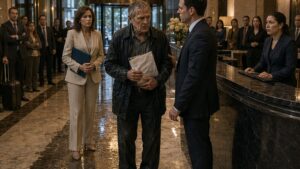
He Fixed the Only Bridge So His Wife Could Get Home, But the HOA Sent a Crew to Tear It Out
Chapter 1: The Crew Was Already Cutting the Bridge Apart
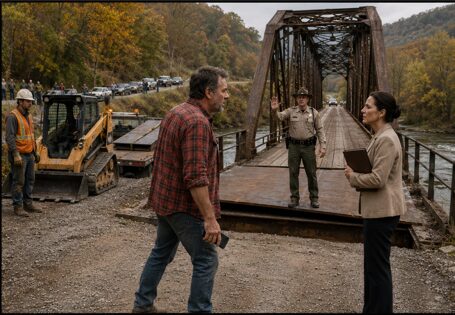
The saw was already in the bridge when Michael Walker reached the gravel bend.
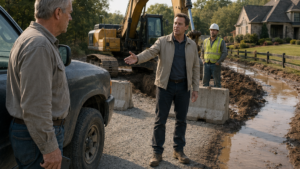
Its scream carried over the river before he saw the crew. One man in orange gloves leaned over the steel deck, sparks snapping from the blade as it bit into the edge of the last temporary plate. Another stood beside a flatbed truck where two plates had already been loaded, their bolt holes dark with mud and rust. A chain hung from a small loader, swinging lazily above the bridge like it was waiting for the next piece.
Michael slammed his truck into park crooked across the shoulder.
“Stop!” he shouted.
The worker did not stop. He looked once toward the woman in the beige blazer standing near the first truss, then lowered his head and kept cutting.
Michael came down the road fast enough that gravel shot from under his boots. His red plaid shirt was half-buttoned wrong, and his hands were already closing into fists before he forced them open.
“I said stop.”
The blade rose. The sudden quiet made the river sound louder.
Laura Perez turned from the bridge with a clipboard pressed against her ribs. Her hair was pinned back, her face composed in the way people looked when they had practiced staying calm before arriving.
“Michael,” she said, “you need to step away from the work area.”
“That’s my bridge access.”
“It is common association property.”
“That plate is the only reason anything heavier than a pickup can cross without dropping into that seam.”
Behind him, the first horn sounded.
Michael looked back. A white SUV had stopped near his truck, then a work van behind it, then another car easing around the bend and stopping short. Farther down Cedar Ridge Road, more vehicles were beginning to gather, engines idling in the narrow gravel lane between the trees.
Laura glanced at the line, then back to him.
“This is exactly why unapproved alterations create problems,” she said.
Michael stared at her. “You brought a demolition crew to the only bridge in.”
“We brought a removal crew to correct an unauthorized modification.”
The supervisor stepped down from the flatbed, wiping his gloves together. He kept his eyes on Laura, not Michael. “Ma’am, we need the last one off before the deck shifts again.”
Michael moved before he thought better of it. He stepped onto the bridge and planted himself in front of the last plate, his boots landing on the steel with a hollow sound.
The worker with the saw lifted both hands and backed away.
Laura’s jaw tightened. “Michael, do not interfere.”
He pulled his phone from his pocket, thumbed the camera open, and held it low at his side. The red recording dot appeared. He kept his voice flat because if he raised it, his hands would start shaking.
“I want the order in writing before that machine touches anything else.”
Laura lifted the clipboard. “You received notice.”
“I received a violation letter. I didn’t receive permission for strangers to come onto this bridge at seven in the morning and cut out the repair that keeps it usable.”
A sheriff’s vehicle rolled up behind the stopped SUV, lights flashing without siren. The blue pulses slid across the trees and the old steel truss. The deputy stepped out slowly, taking in the flatbed, the raised chain, Michael on the bridge, and Laura with her folder.
“What’s going on here?” the deputy asked.
Laura answered first. “The Cedar Ridge Road Association is enforcing a removal order for an unapproved structure installed on common access property. Mr. Walker is obstructing the crew.”
Michael did not step off the plate.
“That plate is not a structure,” he said. “It’s a temporary safety repair.”
“Do you have written approval?” the deputy asked him.
The question landed harder than Michael expected. The horns behind him stopped. Engines idled. Doors opened. People began getting out, not close enough to help, close enough to watch.
Michael looked from the deputy to Laura.
“I submitted the request.”
“That’s not what I asked,” the deputy said, not unkindly. “Do you have approval?”
Laura’s expression changed almost imperceptibly. Not a smile. Something smaller and colder: confidence returning to a person who had found the right rule.
Michael swallowed.
“I have the request,” he said. “I have the repair estimate. I have pictures. I have—”
“Approval,” Laura cut in. “He does not have approval.”
The deputy looked toward the cut plate hanging from the loader chain. “And removing those is safe?”
The crew supervisor shifted. “We were told to remove all unauthorized material. The original deck remains.”
Michael let out one breath through his nose. “The original deck has a split running across the east seam. Ask him why he needed the loader to lift the first plate. Ask him why the bolts pulled clean through rotten plank under the steel.”
The deputy’s gaze moved to the bridge deck.
Laura’s hand tightened on the clipboard. “This is precisely the problem. Mr. Walker is not an engineer. He made alterations to association infrastructure without approval, and now he is using those alterations to create alarm.”
Michael felt the heat climb up his neck.
He wanted to say Katherine’s name. He wanted to say hospital bed, discharge schedule, transport van, the way she had looked at the ceiling when she asked if the house was ready. He wanted to say he had promised her she would come home before the leaves were gone.
Instead he said, “A medical transport has to cross this bridge.”
Laura blinked.
The deputy looked at him again.
Michael kept the phone recording, low and steady. “Not for convenience. Not for a project. Not because I wanted to improve property values. A medical transport has to cross this bridge, and without that plate, I don’t know if it can.”
A white van at the back of the line gave two short horn taps. Someone shouted, “Can we get through or not?”
Laura looked toward the road. The line had grown while they argued. Vehicles now stretched around the bend, white roofs visible between the trees, a delivery truck boxed in behind a pickup, a neighbor standing with both hands on his hips.
Laura opened her folder and pulled out a printed packet.
“The association issued an enforcement order,” she said, handing it to the deputy. “Removal was scheduled pursuant to the bylaws after Mr. Walker failed to cure the violation.”
Michael stepped down off the plate only far enough to face the deputy. “Read the date.”
The deputy looked at the first page.
Laura said, “The order is valid.”
“Read the time,” Michael said.
The deputy’s eyes moved.
Laura’s mouth flattened.
“What time did the crew start?” the deputy asked.
The crew supervisor looked at his boots. “We were here about seven.”
The deputy looked back at the order. “This says notice posted this morning.”
Laura lifted her chin. “Notice was posted before work proceeded.”
“This morning when the crew was already here?” Michael asked.
No one answered.
The river moved under the bridge with a slow, brown pull. A crow called from somewhere beyond the truss. The loader engine coughed and settled into idle.
The deputy folded the order once and handed it back to Laura. Then he walked to the edge of the deck and crouched near the place where the first plate had been removed. Michael watched his hand hover above the exposed seam without touching it.
“How many plates came off?” the deputy asked.
“Two,” the supervisor said.
“And this is the last one?”
“Yes, sir.”
The deputy stood. “Nobody cuts anything else until we know whether this bridge can carry traffic.”
Laura’s head snapped toward him. “Deputy, the association has a right to enforce its rules.”
“And I have a road blocked with residents who need to move through it.” He looked at Michael. “You cannot stand in the work zone.”
Michael stepped off the steel plate onto the gravel approach, but he did not put away the phone.
The deputy pointed to the bridge. “Can a car cross right now?”
The supervisor hesitated.
Laura said, “It could before Mr. Walker interfered.”
“That’s not what I asked.”
The supervisor rubbed the back of his neck. “With two plates off and that last one half-cut, I wouldn’t send vehicles over it. Not until somebody checks the deck.”
The line of cars went quiet in a way that felt heavier than the horns.
Michael looked at Laura then. For the first time, her face was not composed. She looked past him toward the bend, toward the stopped vehicles, toward the road that ended at the bridge because there was no other way in.
The deputy reached for his radio.
“I’m closing the crossing until we get an inspector out here,” he said.
Michael felt his stomach drop.
Laura turned sharply. “Closing it?”
The deputy looked at the exposed bolt holes, the half-cut plate, the idling loader, and the line of vehicles trapped on the gravel road.
“Right now,” he said, “I don’t know if Mr. Walker made this bridge unsafe or if removing his repair did. But until someone qualified tells me which one it is, nobody crosses.”
Chapter 2: The Request That No One Claimed to Receive
The medical transport driver refused to cross the bridge four weeks before the saw ever touched it.
He stopped with the front wheels of the van just short of the steel deck and leaned forward over the steering wheel, staring through the windshield as if the bridge had moved while he was looking at it. Michael stood on the passenger side, one hand on the door, the other holding Katherine’s discharge folder against his hip.
“You crossed it last month,” Michael said.
“Last month it didn’t jump under me.”
“It settles.”
“That wasn’t settling.”
The driver opened his door and stepped down. He was not dramatic about it. That made it worse. He walked to the first seam, crouched, and pressed one palm against the deck where the old steel met the planked understructure. A dark gap showed where the edge had begun to pull away. When a breeze moved through the truss, the loose edge gave a faint tick.
The driver stood. “I’m not taking a patient over that.”
Michael looked beyond the bridge toward his house road, half-hidden in the trees. He could see the roofline from there if he knew where to look. Katherine had counted on that roofline. She had asked him twice whether the porch rail was done and once, very quietly, whether the bridge felt worse after the rain.
“She’s not in the van today,” Michael said. “This is just the assessment.”
“That’s why I’m telling you now.” The driver softened his voice. “When she’s in the chair, with equipment, with me and another attendant, we’re heavier than we look. If that seam drops under the back wheels, I can’t guarantee anything.”
Michael nodded once, because arguing with the wrong man would not fix the bridge.
That evening, he carried the discharge folder into the kitchen and set it beside a repair estimate from Frank Johnson. The house was too clean. He had scrubbed it the way a person scrubbed before bringing someone home from a place that smelled like antiseptic and warmed-over coffee. The hallway rug was rolled against the wall. The downstairs bedroom had a new lamp, new sheets, and a small bell Katherine had laughed at over the phone because she hated the idea of ringing for him.
He opened his laptop and began the request.
To the Cedar Ridge Road Association Board,
Temporary safety stabilization requested for bridge deck access at east seam.
He wrote too much, deleted half, and wrote again. He attached Frank’s estimate, three photographs of the split seam, and a note from the transport company stating that patient transport across the bridge could not be completed until the deck was stabilized. He did not attach Katherine’s full paperwork. She had asked him not to.
“I don’t want to become neighborhood business,” she had said from the rehab bed, her hand resting over the blanket where the IV bruises had faded yellow. “Tell them what they need to know. Not everything.”
He had promised.
So he wrote “medical access” and “scheduled discharge” and “temporary plate stabilization,” but he did not write her diagnosis, her setbacks, the mornings she could stand and the afternoons she could not. He did not write that she had cried only once, after the doctor left, because she thought Michael had been asleep in the chair.
The auto-reply came back at 9:48 p.m.
Your request has been received and is pending review.
Michael printed it. He printed everything. He put the pages into a folder and slid the folder under the old radio on the kitchen counter, where he kept bills he could not forget.
Three days passed.
He called the association number and got voicemail. He emailed again and received the same reply. The bridge seam widened after another rain. One neighbor drove across slowly and later told him the back of her SUV “dipped funny.” A delivery driver stopped leaving packages at the house and began dropping them at the mailbox cluster before the bridge.
On the fifth day, Frank Johnson came out with a flashlight, a pry bar, and the expression of a man who had already decided he disliked what he was seeing.
“I can plate it,” Frank said. “Steel sheets across the weak span, bolted into the beams, side rail braced where it’s pulling. Temporary. It’ll distribute weight until they approve a proper repair.”
“Will it hold the transport van?”
“It’ll hold better than this.”
“That’s not the same answer.”
Frank looked up at him. “Michael, the real answer is the association needs a bridge engineer and a proper repair plan. But if you’re asking whether I’d rather cross with plates or without them, I’d rather cross with plates.”
Michael stared down through the gap where the river moved below, flashing brown between dark boards.
“I submitted the request.”
Frank gave him a sideways look. “You got approval?”
“I got received and pending review.”
“That is not approval.”
“It’s my wife’s way home.”
Frank wiped rainwater from his forehead though the rain had already stopped. “I’ll do the job if you sign that you asked me to do temporary stabilization and that you’re still seeking association approval. But I’m telling you now, they may make noise.”
“They make noise about mailbox paint.”
“This is a bridge.”
Michael looked toward the house. The downstairs lamp was visible through the window even in daylight because he had left it on after testing the room the night before. Katherine had chosen that lamp years ago from a roadside antique store. She said it made the room look less borrowed.
“How long?” he asked.
“One day if I can get the plates from the yard.”
“Do it.”
Frank did not move. “You sure?”
No. Michael was not sure. He was tired, angry, and ashamed of how good it felt to make a decision no one else could delay. He thought of the auto-reply, the unanswered voicemails, the transport driver’s hand hovering over the seam.
“I’m sure enough,” he said.
The plates arrived on a flatbed before sunrise two mornings later. Frank’s crew worked quietly, not like men hiding something, but like men who knew sound traveled in the valley. The steel plates looked oversized at first, dull and industrial against the old bridge deck. By noon, they looked like exactly what had been missing. Each bolt settled tight. The weakened seam disappeared beneath the weight distribution. Frank braced the side rail with a short steel support and painted the exposed edges with rust primer.
Michael walked across after the last bolt went in. The bridge did not jump. It held.
For the first time in weeks, he let himself breathe all the way in.
He photographed the finished work from six angles and emailed the association again.
Temporary stabilization completed due to urgent medical access need. Original request attached again. Please advise next inspection step and formal approval process.
The auto-reply arrived.
Pending review.
He called Laura Perez directly the next morning. She did not answer. He left a message, then another two days later. On the third, he saw her SUV slow at the far side of the bridge. She stepped out, photographed the plates, photographed the rail support, and drove away without coming to the house.
That afternoon, Michael found the envelope taped to his front door.
It was white, clean, and sealed in a plastic sleeve as if protected from weather mattered more than the words inside. The heading read: Notice of Violation and Demand to Cure.
He read the first paragraph standing on the porch.
Unauthorized exterior alteration to common access property.
He read it twice, then looked toward the bridge where the new steel plates lay flat and steady in the muted afternoon light.
At the bottom of the page, beneath Laura Perez’s signature, one sentence had been underlined.
Failure to remove the noncompliant materials may result in association-directed removal at owner expense.
Chapter 3: Laura Perez Called Safety an Exterior Change
The first thing Michael saw at the board meeting was a photograph of his bridge repair blown up on a screen, the steel plates circled in red.
He stopped in the doorway of the Cedar Ridge lodge with his cap in one hand and the folder in the other. The room smelled faintly of coffee and floor polish. Folding chairs had been arranged in rows, but most people stood along the back wall, murmuring under the low buzz of the projector. On the screen, someone had taken the photograph from an angle that made the plates look like an intrusion, a hard gray patch on the old bridge deck, the red circles turning each bolt into an accusation.
Laura Perez stood beside the screen in a beige blazer, the same violation letter clipped to the top of her packet.
“Mr. Walker,” she said. “We were just about to begin.”
“You began with my property on the wall before I got here.”
“Common access property,” she corrected.
Michael walked to the front row and sat down because standing would make him look like he had come to fight. His folder rested on his knees. The top page was the auto-reply printed in black and white, already creased from being handled too much.
Laura called the meeting to order. A board treasurer read the agenda. Someone coughed. Someone whispered, “Is that the bridge?” as if everyone in the room did not already know.
When Laura reached his item, she did not look at him first. She looked at the room.
“The board has received multiple concerns regarding unauthorized modifications to the Cedar Ridge bridge. These modifications include steel deck plates, bolted fasteners, and an exterior rail support installed without prior written approval, engineering review, or association authorization.”
Michael opened the folder.
Laura continued, “The issue before us is not whether Mr. Walker had personal reasons for wanting improved access. The issue is whether one homeowner may alter shared infrastructure without approval.”
Michael stood. “I submitted a request.”
Laura turned slightly. “You submitted incomplete correspondence.”
“I submitted the estimate, photos, transport note, and a request for temporary stabilization.”
“We do not have a complete application on file.”
He held up the auto-reply. “Your system received it.”
“Our system receives emails. That does not convert an email into an approved application.”
The sentence was clean. Too clean. It had the feel of something written before the meeting.
Michael felt the room tilt toward her. Not because everyone agreed, but because procedure had a way of sounding like truth when spoken through a microphone.
He placed the printed pages on the table in front of the board. “The bridge deck shifted under a medical transport assessment. The company said they would not cross until it was stabilized. Frank Johnson inspected the seam and installed temporary plates so the bridge could carry necessary traffic until the board approved a permanent repair.”
Laura took the pages but did not read them. “Mr. Walker, no one is dismissing your concern.”
“You are calling it an exterior alteration.”
“Because that is the category under the bylaws.”
“It’s a bridge deck.”
“It is a modification to common property.”
“It is a safety repair.”
“It may be, if reviewed and approved by qualified parties. But right now, it is unapproved work performed at your direction.”
A murmur moved across the back of the room.
Michael looked over his shoulder. Angela Hill stood near the coffee urn, arms folded, eyes fixed on the screen. He knew her mostly from mailbox conversations and the year she had collected signatures for road grading. She looked older than he remembered, not fragile, just tired of listening to people pretend new problems were new.
He turned back. “Then inspect it.”
Laura’s lips pressed together. “That is not how emergency authorization works.”
“It was an emergency.”
“An emergency does not eliminate process.”
“Neither does process eliminate an emergency.”
For the first time, something like irritation broke through Laura’s calm. She lowered her voice, but the microphone caught it anyway.
“You installed steel across a shared bridge without engineering approval. If it fails, if someone is injured, if our carrier determines the association allowed unpermitted work on common infrastructure, every homeowner here is exposed. You are asking us to treat your judgment as enough.”
Michael gripped the back of the chair in front of him. He thought of Katherine’s hand on the blanket, her request not to become neighborhood business. He could feel the folder under his palm, full of almost enough proof. The medical transport note. The photographs. The estimate. Not the pages that would make everyone stop whispering. Not the pages with her name beside the words she did not want read in a room like this.
“My judgment is not the only thing in that folder,” he said.
“But you are asking us to approve after the fact.”
“I am asking you not to remove the only safe crossing before you provide another one.”
Laura looked down at the board packet. “You were asked to cure the violation voluntarily.”
“By tearing out the repair.”
“By removing unapproved materials.”
“And leaving the split seam exposed.”
“The bridge existed before your plates.”
“That doesn’t mean it was safe.”
A neighbor in the back said, “My truck crossed fine last week.”
Another muttered, “Mine didn’t.”
Laura lifted one hand. “This is exactly why we cannot govern by anecdote.”
Michael almost laughed. It came out as a breath. “You have photographs. You have a contractor estimate. You have a transport refusal.”
“We have no complete application,” Laura said.
He looked at the board treasurer. “Did anyone ask me for another form?”
The treasurer glanced at Laura before answering. “I don’t handle intake.”
Michael looked at the other board members. No one met his eyes for long.
Laura slid a page from the packet. “The proposed action is to uphold the violation and require removal within ten days. If Mr. Walker does not remove the materials, the association may contract removal and assess costs to his lot.”
Michael felt the words land in the room like bolts being dropped into a tin bucket.
He forced himself not to speak while the board discussed liability, precedent, contractor qualifications, and property values. Property values came up twice. Katherine’s name did not come up at all because he did not put it there.
When they allowed him one final comment, he stood slowly.
“If you remove those plates,” he said, “you are not restoring the bridge. You are restoring the problem.”
Laura looked at him for a moment longer than she needed to. Something uncertain moved in her expression and vanished.
“The motion has been made,” she said.
The vote passed four to one.
People began collecting coats and coffee cups. The projector went dark, leaving the screen blank and gray. Michael gathered his papers carefully, aligning their edges because if he did not do something small with his hands, he might do something larger he would regret.
Near the coffee urn, Angela Hill stepped into his path.
“You’re not wrong about that bridge,” she said quietly.
He looked at her. “Then why didn’t anyone say that ten minutes ago?”
Her mouth tightened. “Because people around here hate assessments more than they hate danger.”
“What does that mean?”
Angela glanced toward Laura, who was speaking with the treasurer near the folding table. Then she pulled a small yellow sticky note from her purse and pressed it against the front of Michael’s folder.
“Ask for the March minutes,” she whispered.
Michael looked down.
In neat blue handwriting, she had written only five words.
Ask for the March minutes.
Chapter 4: The Warning Buried in the March Minutes
Angela Hill handed Michael the March minutes with one paragraph nearly swallowed by a gray copier shadow.
“Don’t ask me why it copied like that,” she said, but her eyes told him not to believe the machine had done it by accident.
They stood in her kitchen three days after the board vote. A kettle clicked behind her. On the table between them lay six stapled pages, a ceramic mug with a chipped rim, and Michael’s yellow sticky note, now soft at the edges from being folded and unfolded in his pocket.
He bent over the page.
Cedar Ridge Road Association Regular Meeting — March 14.
Most of the minutes were dull enough to be honest: gravel bids, mailbox posts, a complaint about short-term rentals, discussion of late dues. Then came the paragraph Angela had marked with a faint pencil line.
Bridge deck condition discussed. County correspondence reviewed. Further action tabled pending budget impact and insurance consultation.
Below that, a block of text faded into dark gray.
Michael looked up. “What’s under this?”
Angela folded her arms. “That’s what I wondered when I first printed it.”
“You were secretary then.”
“I was secretary until that meeting.” Her mouth tightened. “After that, Laura said the minutes needed to be ‘cleaned up’ before posting. I told her minutes weren’t supposed to be cleaned up. She said I was making the board look careless.”
Michael touched the shadowed paragraph with one finger. “County correspondence.”
Angela nodded. “There was a letter.”
“You saw it?”
“I saw the envelope. I saw Laura put it in the board folder. I heard the treasurer say the word ‘assessment’ like it was poison.” She looked toward the kitchen window, where the road beyond her yard fell toward the bridge. “Then everyone decided the bridge could wait because the road still worked.”
Michael felt the old anger rise, but this time it had nowhere simple to go. A board room could dismiss him as emotional. A violation notice could call him noncompliant. But the March minutes sat on the table, quiet and ugly.
“Do you have the letter?”
Angela shook her head. “No. I kept the minutes because I wrote them. I didn’t keep board correspondence after I resigned.”
“Why didn’t you say something at the meeting?”
Her answer did not come quickly.
“Because I spent two years being the person who said something,” she said. “About drainage. About the bridge. About dues that were too low to maintain what we own. People smiled and told me I was worrying too much. Then they got angry when worry turned into cost.” She pushed the pages toward him. “I’m not proud of staying quiet. But quiet was easier until I saw those red circles around your repair.”
Michael gathered the minutes, then stopped. “If I use this, Laura will know it came from you.”
“She already knows I can read.”
The county office was forty minutes away if the bridge was clear and almost two hours if he had to take the logging-road detour. Michael drove the long way because he did not want to cross the bridge until he understood what had been hidden about it. Every mile felt like time stolen from Katherine.
At the clerk’s counter, a sign told him requests might take ten business days. He set the minutes down anyway.
“I need any county correspondence sent to the Cedar Ridge Road Association about the bridge on Cedar Ridge Road, around March,” he said.
The clerk glanced at the line behind him. “You’ll need a records form.”
“I’ll fill out whatever you want.”
“It may not be available today.”
Michael looked at the thin plastic nameplate on the counter, then at the clock, then back at the clerk. He made himself soften his voice.
“Ma’am, the association voted to remove temporary safety plates from that bridge. My wife is supposed to come home across it. If there’s a county warning, I need to know before they take those plates out.”
The clerk’s expression changed just enough. Not pity. Recognition of a practical problem.
“Fill this out,” she said, sliding him a form. “Wait over there.”
He filled the form with block letters because his hand wanted to rush. Cedar Ridge Road bridge. March correspondence. Deck condition. Weight restriction. Association notice. He wrote his email, phone number, address, then sat under a bulletin board covered in public meeting notices until his knee started bouncing.
His phone buzzed.
Katherine.
He answered before the second ring. “Hey.”
“You sound like you’re in trouble.”
“I’m in a county chair.”
“That is usually trouble.”
He looked at the records window. “I’m checking something.”
“About the bridge?”
“About paperwork.”
A pause.
“Michael.”
He closed his eyes for half a second. “I’m not telling people your business.”
“That isn’t what I asked.”
“I know.”
“You do that when you don’t want to answer.”
The clerk called his last name before he could respond. He stood too fast, the chair legs scraping the floor.
“I’ll call you back,” he said.
“Don’t make me the secret that hurts you,” Katherine said.
The line stayed open a moment after she said it. Then she hung up.
Michael stood with the phone in his hand, the words heavier than the folder under his arm.
At the counter, the clerk handed him two copied pages.
“There was an inspection letter sent to the association in March,” she said. “This is what we can release today.”
The first page was stamped with the county seal. The second was a short inspection summary.
Observed deck movement at east seam. Recommend immediate engineering evaluation. Recommend temporary weight restriction until evaluation complete. Continued deterioration may affect emergency and medical access.
Michael read the last line twice.
“Was this sent to Laura Perez?”
“It was sent to the association’s registered contact.” The clerk checked the page. “Laura Perez.”
He placed the March minutes beside the letter. County correspondence reviewed. Further action tabled.
The clerk lowered her voice. “That bridge should have had signage.”
“It didn’t.”
“I can’t speak to enforcement.”
“Who can?”
She wrote a number on a slip of paper. “County bridge inspector. He’s in the field most days. You may not get him.”
Michael got him on the second call, from the county office parking lot, with trucks passing behind him and Katherine’s sentence still burning in his ear.
The inspector listened without interrupting. Michael told him about the seam, the plates, Frank’s temporary work, the violation notice, the scheduled removal. He did not mention Katherine by diagnosis. He said medical transport because he still could not make his mouth say more to a stranger.
“Were the plates engineered?” the inspector asked.
“No. Installed by a contractor. Temporary.”
“Then I can’t approve them over the phone.”
“I’m not asking you to approve them over the phone. I’m asking if tearing them out makes sense before inspection.”
A long silence followed.
“I’ll say this carefully,” the inspector said. “If the deck is moving the way it was in March, and if the plates are distributing load across that seam, removing them could make the crossing less stable until a qualified person evaluates it.”
“Can you put that in writing?”
“Not without seeing the bridge again.”
“Can you come today?”
“I’m booked in another county.”
“Tomorrow?”
Another silence. Papers shifted on the other end.
“I can try late morning.”
Michael looked at the county letter in his hand. “They have ten days to remove them.”
“Then tell them to wait for inspection.”
“They won’t listen to me.”
“Then send the March letter to every board member and copy the county office. That usually makes people more careful.”
Usually.
Michael drove back by the long route. When he reached the bridge approach near dusk, he parked and walked the deck alone. The steel plates were damp with mist, dull and solid under his boots. He crouched near the edge where Frank had painted the primer around the bolts. Beneath the bridge, the river moved steadily, indifferent to minutes, notices, votes, and men who thought waiting was safer because waiting cost less today.
He took photographs of every plate. Every bolt. Every seam. He photographed the bridge from the road and the road from the bridge. He photographed the place where a weight-limit sign should have been.
Then he opened a new email.
To: Laura Perez and Cedar Ridge Road Association Board
Cc: County bridge office
Attached are March county inspection materials recommending immediate evaluation of the Cedar Ridge bridge and temporary weight restriction. These documents appear to predate my repair request and the violation notice. Do not remove temporary stabilization before county inspection.
His thumb hovered before sending.
He thought of Katherine telling him not to make her neighborhood business. He thought of her later sentence, the one that had cut cleaner than Laura’s letter.
Don’t make me the secret that hurts you.
He added one line.
This bridge is required for scheduled medical transport to my home.
He sent it.
The reply came from Laura at 8:13 p.m.
The association’s enforcement position remains unchanged. Unauthorized materials must be removed.
Michael was still staring at the screen when Frank Johnson called.
“They moved it up,” Frank said without greeting.
Michael stood in the kitchen so fast the chair struck the wall.
“What?”
“The removal. I got a call from the crew supervisor asking where I sourced the plates because they need to know what equipment to bring. They’re not waiting ten days.”
Michael looked through the dark window toward the bridge he could not see.
“When?” he asked.
Frank exhaled.
“Tomorrow morning.”
Chapter 5: The Line of Cars Became the Evidence
The medical transport van was trapped three vehicles back from the bridge by the time Michael saw its blue side stripe between the stopped cars.
For one second, he thought it had come for Katherine. His chest locked before his mind caught up with the date, the schedule, the impossible timing. Then he saw the driver standing outside the van, phone pressed to one ear, looking toward the bridge with the same refusal in his posture Michael had seen four weeks before.
The deputy had moved everyone back from the steel deck. The loader idled beside the flatbed. Two removed plates lay chained down in the truck bed. The last plate, half-cut and useless, still sat across the seam like a door someone had tried to tear off its hinges.
Laura was on her phone near the bridge rail, one hand over her other ear.
Michael walked toward the medical transport driver.
“You carrying a patient?” he asked.
“Not yet,” the driver said. “Pickup on the ridge. They told us this was the only road.”
“It is.”
The driver looked at the bridge. “Not today.”
The words moved down the line faster than any official announcement. A neighbor repeated them to someone behind a pickup. A delivery driver climbed onto his running board to see. Farther back, a white SUV tried to reverse, found no room, and stopped with its backup lights glowing uselessly.
Laura ended her call and came toward Michael with the enforcement folder clutched to her side.
“You need to tell them you blocked the crew,” she said.
Michael turned slowly. “Tell who?”
“The residents. The deputy. Anyone asking why the road is closed.”
“The road is closed because your crew removed two plates and half-cut the third.”
“The road is closed because you interfered before the removal could be completed safely.”
He stared at her, trying to understand whether she believed it or needed to.
“Laura, there is no version where taking out all three plates makes that seam stronger.”
“That is not your determination to make.”
“Then why didn’t you wait for the county inspector?”
Her mouth tightened.
The deputy stepped between them before either could say more. “I need both of you away from the bridge approach.”
Michael pointed to the flatbed. “Deputy, those plates need to stay here. Don’t let them haul them off.”
The crew supervisor raised both hands. “I’m not hauling anything until somebody tells me to.”
Laura said, “Those are association-directed removals.”
The deputy looked at her. “Right now those are potential evidence of what changed this morning.”
The word evidence landed. Laura’s eyes flicked once toward the truck bed.
A neighbor shouted from near the bend, “Some of us have jobs!”
Another voice answered, “Some of us have kids at school!”
The deputy turned and raised his voice. “Nobody crosses until the bridge is checked. If you can safely turn around, do it one vehicle at a time. If you cannot, stay with your vehicle.”
Nobody could turn around. That became clear within minutes. Cedar Ridge Road narrowed too much between the trees and the ditch. The line had grown into a trapped metal spine: vans, pickups, SUVs, one county maintenance truck, the medical transport van, and an old sedan with its hood dented pale gray.
Michael walked to the exposed section of bridge where the deputy allowed him only near enough to point. Empty bolt marks scarred the deck where Frank’s plates had been. Without the steel spread across it, the seam looked worse, not better. The old decking bowed subtly around the gap, the kind of movement a person might miss until weight found it.
The deputy crouched, just as he had earlier, and studied the holes.
“These bolts were in solid?” he asked.
“Yes,” Michael said. “Frank installed them into the beams.”
“And they removed the plates this morning?”
Michael nodded.
The deputy looked to the supervisor. “Did the deck look like this before removal?”
The supervisor rubbed one gloved thumb against the side of his hand. “I didn’t inspect it before we started. We were told the material was unauthorized and had to come out.”
“Did anyone tell you there was a county inspection letter?”
“No.”
Michael looked at Laura.
Her face had gone still.
The deputy stood. “I’m calling the county.”
Laura stepped closer. “I already spoke with association counsel. The county does not maintain this bridge. It’s private.”
“I’m not asking them to maintain it. I’m asking someone who knows bridges whether this one is safe enough for traffic after your crew cut into it.”
The medical transport driver approached with his phone still in hand. “My dispatch needs an estimated delay.”
The deputy gave a short laugh without humor. “Tell them unknown.”
The driver looked past him to Michael. Recognition moved across his face. “This is the same bridge.”
Michael nodded once.
“The one I reported?”
Laura’s head turned. “Reported to whom?”
“The family. My company. We sent a note for their access file.” The driver glanced at Michael. “I said we wouldn’t transport across unless it was stabilized.”
Michael did not enjoy the look on Laura’s face. He had wanted her to understand, not to be cornered by a stranger in front of idling cars. But the line behind them was no longer a backdrop. It was the thing she had tried not to see.
Laura said, “No one disputes that Mr. Walker had concerns.”
The driver gestured to the bridge. “Looks like more than concerns now.”
The deputy’s radio crackled. He answered, listened, then looked down the road as though help might appear faster if he stared hard enough.
“County inspector can be here this afternoon,” he said. “Until then, crossing is closed.”
The noise that rose from the stopped vehicles was not a shout. It was worse: doors shutting, people calling family members, engines turning off one by one. The whole road settling into the knowledge that it had become a parking lot.
Laura turned away and began another call.
Michael walked to his truck and opened the passenger door. His folder lay on the seat, thick with copies now: request, auto-reply, repair estimate, March letter, photographs. He pulled it out and nearly dropped it because his hand had started shaking.
Angela Hill appeared beside the truck.
“I was in the line,” she said.
He looked past her. “You saw?”
“I saw enough.”
“I sent the March letter last night.”
“I know.” Angela’s eyes moved toward Laura. “Half the board called each other before breakfast.”
“Then why did they still come?”
Angela did not answer. That was answer enough.
Michael’s phone rang.
The screen showed Katherine’s facility.
For a moment he could not touch it. He knew before he answered that the call was not casual. Facilities did not call in the middle of a road closure because they wanted to chat.
He pressed the phone to his ear.
“Michael Walker?” the nurse asked.
“Yes.”
“We’re reviewing Katherine Walker’s discharge plan for tomorrow. The transport company notified us that your access road is currently closed.”
Michael turned his back to the bridge. “It’s temporary.”
“We need safe confirmed access before discharge. If the road remains closed or uncertain, we’ll have to delay release or discuss alternate placement until transport can be completed.”
The words did not come as a shock. They came as something worse: a rule spoken kindly.
Michael looked at the bridge plates strapped to the flatbed, the empty bolt marks, the long line of cars, and Laura standing by the rail with her phone pressed to her cheek.
“How long?” he asked.
“That depends on access confirmation.”
He closed his eyes.
Across the road, the loader engine finally shut off. The silence after it died was so complete that Michael could hear the river under the bridge.
Chapter 6: The Meeting Moved From the Lodge to the Bridge
Laura Perez called the emergency board meeting to order beside the bridge because no one could reach the lodge.
A folding table had been set up on the gravel approach, its legs uneven on the packed dirt. The old steel truss rose behind it, blocked by orange cones and the sheriff’s temporary barrier. Frank Johnson’s flatbed sat off to the side with the removed plates stacked on it, their scraped undersides exposed. The plates looked less like unauthorized material now and more like something taken from a wound.
Neighbors stood in a rough half-circle around the table, some holding coffee, some holding phones, all of them watching the bridge as if it might speak before anyone else did.
Michael stood near the front with his folder under one arm.
Laura placed her enforcement packet on the table, squared it with both hands, and said, “This emergency meeting concerns the temporary closure of Cedar Ridge bridge and the unauthorized materials installed by Mr. Walker.”
A low murmur moved through the crowd.
Michael heard someone say, “Still calling it that?”
Laura paused but did not look toward the voice. Her blazer was darker than the one she had worn at the first meeting, and her face looked as if she had slept badly and decided to hide it with posture.
“The association must consider liability, access, insurance requirements, and compliance obligations,” she said.
Angela Hill stepped forward before Laura could continue.
“Then read the March minutes first.”
Laura’s eyes moved to her. “Public comment will follow board discussion.”
“No,” Angela said. “Discussion followed silence last time.”
The board treasurer shifted behind the table. The deputy, standing near his vehicle, did not intervene.
Laura’s hand rested on the enforcement folder. “Angela, this is not productive.”
“It would have been productive in March.”
The crowd stilled.
Michael did not speak. His instinct was to take over, to push, to demand. Instead he looked at the stacked steel plates and held his place.
Angela unfolded her copy of the minutes. Her hand trembled once, then steadied.
“Cedar Ridge Road Association Regular Meeting, March fourteenth,” she read. “Bridge deck condition discussed. County correspondence reviewed. Further action tabled pending budget impact and insurance consultation.”
Laura’s face did not change.
Angela raised the county letter. “The correspondence recommended immediate engineering evaluation and temporary weight restriction. It warned continued deterioration could affect emergency and medical access.”
People began talking all at once.
The deputy lifted one hand. “Let her finish.”
Angela looked at Michael then, briefly. Not asking permission. Telling him she had stepped in and would not step back.
“The posted minutes did not include the full discussion,” she said. “I know because I wrote the original draft. The board discussed whether acknowledging emergency status would require a special assessment. That discussion was removed before posting.”
A neighbor near the back said, “Is that true?”
Laura lifted her chin. “The posted minutes reflect the approved record.”
“That isn’t an answer,” Michael said.
Laura turned to him. “You are not innocent in this, Michael. You installed material without authorization.”
“I did.”
The admission quieted people more effectively than denial would have.
Michael opened his folder and laid the pages on the folding table one by one.
“Here is my request. Here is the auto-reply. Here is Frank’s estimate. Here is the transport company’s refusal to cross until the bridge was stabilized. Here is the email I sent after the plates went in, asking for inspection and formal approval. Here is last night’s email with the county warning attached.”
Laura looked at the pages but did not touch them.
Michael kept going because if he stopped, pride would tell him to protect what no longer could be protected.
“I should have pushed harder before installing them. I should have called every board member, gone to the county sooner, made this public sooner.” His throat tightened, and he forced the next words through cleanly. “But my wife is scheduled to come home. She cannot come home if transport cannot cross this bridge. I did not install those plates to win an argument. I installed them because waiting had become its own danger.”
The crowd did not murmur this time. The quiet had weight.
Laura’s eyes dropped to the transport note.
Michael did not say Katherine’s diagnosis. He did not say the private parts of her recovery. He had promised not to make her a display, and now he understood the difference between privacy and silence.
“She asked me not to make her condition neighborhood business,” he said. “I tried to honor that. I left too much unsaid. But the bridge is not private. The danger is not private. And if access fails, she is not the only person who pays for it.”
The board treasurer rubbed both hands over his face. “Laura, did we receive his request?”
Laura did not answer immediately.
“It came through the intake email,” she said.
“That is not what you told us.”
“I said we had no complete application.”
“Did anyone ask him to complete one?”
Laura looked out toward the bridge, where the half-cut plate still sat under cones. “The process requires formal submission.”
Angela said, “The process also requires the board to act on known hazards.”
Laura’s control cracked then, not into anger, but into exhaustion.
“You all want the bridge fixed,” she said, turning toward the residents. “No one wants the assessment. No one wants the insurance review. No one wants to hear that if we declare it unsafe, our carrier may ask why we ignored the March letter. You think I’m protecting paperwork. I’m trying to keep this association from collapsing under a repair bill half this road will refuse to pay.”
For the first time, Michael saw the fear beneath her precision. It did not excuse what she had done. It explained why she had done it with such force.
A neighbor said, “So you removed the plates to make the problem smaller?”
Laura’s mouth opened, then closed.
The county bridge inspector arrived in a white truck before she answered. He walked the deck with the deputy and Frank, crouching at the exposed seam, measuring the cut edge, asking for the removed bolts. Everyone watched from the gravel while the inspection happened in small gestures: a flashlight beam, a tape measure, the inspector’s boot testing the deck and then stopping quickly.
When he returned, his words were brief.
“I would not reopen this crossing as it sits,” he said. “The temporary plates should not have been removed before evaluation. Reinstallation under contractor supervision may allow limited temporary access, but this bridge needs formal engineering review and likely permanent repair.”
Laura gripped the edge of the table.
The board treasurer looked at her enforcement folder. “Then we need a vote.”
Laura said, “If we vote emergency authorization, we acknowledge the condition.”
Michael said, “The condition is already standing behind you.”
Everyone looked at the bridge.
The stacked plates on Frank’s trailer caught the late light. Scratched, heavy, ugly, necessary.
Laura drew a breath. “Emergency authorization will affect dues.”
“Then say that,” Michael said. “Say the bridge needs repair and it will cost us. Don’t say my wife’s way home is an exterior change.”
Something in Laura’s face shifted at that. Not surrender. Not apology. The first honest recognition that the words she had used had done harm beyond the order itself.
She gathered the enforcement folder, held it for a moment, then looked at the board.
“We’ll recess for ten minutes,” she said.
People began speaking in tight clusters. Michael stayed where he was. Frank came beside him, hands in his pockets.
“You did what you had to do,” Frank said.
“I did some of it late.”
“Most people do.”
Michael looked toward the blocked bridge. “Katherine told me not to make her the secret that hurts me.”
Frank said nothing, which was the kindest thing available.
Ten minutes stretched to nearly twenty. Laura stood apart from the board, speaking low with the treasurer, then with the inspector, then alone for a moment beside the sheriff’s barrier. When she finally came back to the folding table, the crowd quieted without being asked.
Michael noticed it before anyone else did.
The enforcement folder was no longer in her hand.
Chapter 7: The Bridge Reopened Without Anyone Pretending It Was Fine
Frank lowered the same steel plate back onto the bridge under county supervision, and no one spoke while it settled into place.
The loader chain tightened, then eased. The plate swung once over the exposed seam, dull gray against the old deck, its scraped underside showing where it had been dragged, cut loose, and stacked like scrap. Michael stood behind the sheriff’s barrier with his hands in his jacket pockets, watching the bolt holes line up over the scars they had left behind.
“Down two inches,” Frank called.
The plate touched steel with a heavy sound that moved through the truss and into Michael’s chest.
The county bridge inspector crouched beside it before anyone bolted anything. He ran a gloved hand along the edge, checked Frank’s temporary bracing plan, and pointed to the places where new inspection tags would go. This time, nothing was being done fast or quietly. Every step had a witness. Every measurement was written down. Every bolt had a reason beyond somebody’s claim.
Laura Perez stood near the folding table with the withdrawal form in front of her.
She had not come alone. The board treasurer stood to one side, pale and quiet, holding the emergency authorization packet. Angela Hill stood farther back, arms folded, watching the bridge instead of the people. Several neighbors remained along the road, not cheering, not jeering, just waiting to see whether the crossing they all depended on would become a road again.
Frank looked toward the inspector. “Ready for bolts?”
“Proceed.”
The drill started. Its sound was sharper than the saw had been, less violent, more certain. Michael watched the first bolt sink through the plate and into the beam. He thought of the morning the crew had cut the repair apart, Laura calling it unauthorized material, the medical van trapped in the line, Katherine’s discharge disappearing behind one more condition.
His phone buzzed in his pocket.
Katherine.
He stepped away from the group before answering. “They’re putting it back.”
“Legally?” she asked.
He looked over at the inspector, who was signing the first temporary access tag. “Legally.”
“That sounded like an important word.”
“It is today.”
There was a small silence.
“Did you have to tell them everything?” she asked.
“No.”
“Did you tell them enough?”
He watched Laura pick up the pen, hesitate, and bend over the form. “Yes.”
Katherine exhaled softly. “Good.”
He wanted to apologize again. He had already done it on the phone the night after the emergency meeting, standing in the kitchen beside the folder that had become too thick to close. He had told her he was sorry for making privacy do the work of pride. She had told him he was not the only one who had been scared. Then she had asked whether there would be railings at the front steps when she got home, because she was not coming back to be carried like furniture.
“They’re going to allow limited crossing by appointment first,” Michael said. “Medical transport, residents who were stuck out, essential vehicles. Then light local traffic until the engineer finishes the full report.”
“Listen to you,” Katherine said. “You sound like a meeting.”
“I hate that.”
“You needed some of it.”
He almost smiled. “Don’t get used to it.”
“Too late.”
The drill stopped. Frank set a bolt head with a final metallic knock.
Michael turned back in time to see Laura sign the violation withdrawal. She did not make a speech. She did not ask everyone to gather around. She pressed the paper flat with one hand, signed her name, then slid it to the treasurer for the second signature.
When she approached Michael, she held the paper out without ceremony.
“The violation is withdrawn,” she said. “Emergency temporary stabilization is approved pending engineering review. The association will issue a formal notice this afternoon.”
Michael took the paper. He read the first line, then the second, then Laura’s signature. Not because he distrusted his eyes. Because paper had been used against him, and now paper had to be made to say the right thing clearly.
“Does this include the medical transport crossing?” he asked.
“Yes. Under the inspector’s conditions.”
“And the permanent repair?”
Laura looked toward the bridge. “The board approved an engineering evaluation and emergency funding proposal. There will be an assessment discussion.”
A neighbor groaned from behind them.
Laura turned her head. “There will be a public discussion,” she said, louder. “Not a hidden one.”
That quieted the road more than an apology would have.
Michael folded the withdrawal once and put it in his folder.
Laura looked at him then, not past him, not at the folder, not at the crowd.
“I should have asked what the transport note meant,” she said.
Michael did not answer quickly. He could have made her stand there longer. A week ago, he might have wanted to. But the bridge behind her was not fixed because she felt bad. It was fixed because people finally stopped pretending rules were the same as responsibility.
“Yes,” he said. “You should have.”
She nodded once, accepting the size of that without decoration.
“And I should have said more before it got here,” he added.
Laura seemed surprised by that. So did Angela, who glanced over from the side of the road.
Michael looked at the steel plate. “But saying less didn’t give you the right to remove it.”
“No,” Laura said. “It didn’t.”
The inspector opened the crossing for the first medical transport test at 2:40 that afternoon. The van approached slowly, the same driver at the wheel. Frank stood on one side of the bridge, the inspector on the other. Michael watched the van’s front tires roll onto the plate, then the rear tires. The bridge made its old sounds, but it did not jump.
The driver crossed, turned around at the far approach, and crossed back.
He stepped out and gave one short nod. “That’ll do under restriction.”
Michael looked away before relief showed too plainly.
Katherine came home the next morning.
There was no crowd at the bridge. Michael had made sure of that. The transport van arrived from the far side with only the driver, an attendant, and Katherine inside. Laura had asked whether the board should have someone present for documentation. Michael had told her the inspector’s tag was documentation enough.
He stood at the near approach as the van moved onto the bridge. A new temporary inspection tag hung from the side rail support, white against the old steel, dated and signed. The plate beneath the van’s tires looked both ugly and beautiful to him, scratched and bolted and honest.
The van crossed slowly.
When the door opened in front of the house, Katherine looked smaller than she had in memory and more herself than she had in months. She wore a blue sweater he had packed badly, one sleeve slightly twisted beneath her jacket. The attendant lowered the ramp. Michael stepped forward, then stopped himself from reaching too soon.
Katherine noticed.
“Learning,” she said.
“Trying.”
She looked past him toward the road. “Is everyone watching?”
“No.”
“Good.”
He helped only when she nodded. Together, with the attendant close by and the new porch rail waiting, they moved toward the house at Katherine’s pace. Halfway up, she stopped and looked back toward the trees where the bridge sat out of sight.
“That much trouble for a piece of metal,” she said.
Michael shook his head. “For the way home.”
Her hand tightened on the rail.
Over the next week, Cedar Ridge Road changed in small, visible ways. A temporary weight-limit sign appeared at both ends of the bridge. The association sent a letter that did not hide the cost or soften the warning. The engineering evaluation was scheduled. The emergency assessment meeting notice went out with the county letter attached, the full one this time, not a cleaned-up summary.
People complained. They asked why dues had not been raised sooner, why the March warning had not been posted, why Michael had installed first and fought later, why Laura had enforced first and asked later. None of the answers were easy enough to satisfy everyone. That, Michael thought, was probably how they knew the answers were finally closer to true.
On Friday evening, he drove Katherine to the bridge and parked before the approach. She wanted to see it without being inside a transport van. The sun was low behind the trees, laying gold through the truss. Vehicles crossed one at a time now, slow and careful, tires thumping softly over the steel plate.
Laura had posted the permanent repair notice on a wooden stake near the barrier.
Michael helped Katherine stand beside the truck. They read it together.
Bridge engineering review pending. Temporary access approved under restriction. Permanent repair plan to follow.
Katherine leaned lightly against him, not because she had to, but because she chose to.
Angela’s car crossed from the far side. She slowed near them, lifted one hand, and kept going.
Michael lifted his hand back.
No one clapped. No one gathered. No one pretended the bridge was fine.
The plate held as Angela’s car rolled over it, the inspection tag flickering in the evening light. Beyon