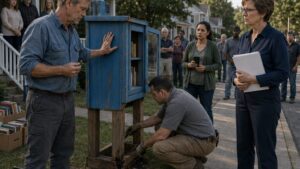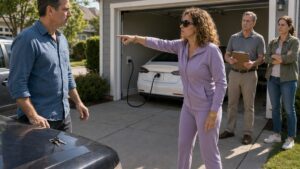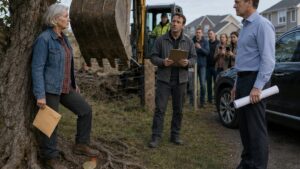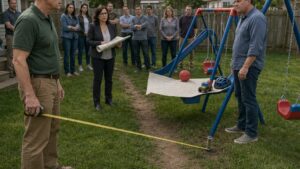
The HOA Tore Out John Walker’s Fence Before Asking Why The White Horse Kept Running
Chapter 1: The Crew Pulled The First Fence Post
The first fence post came out of the ground with a wet crack just as John Walker reached the pasture lane.
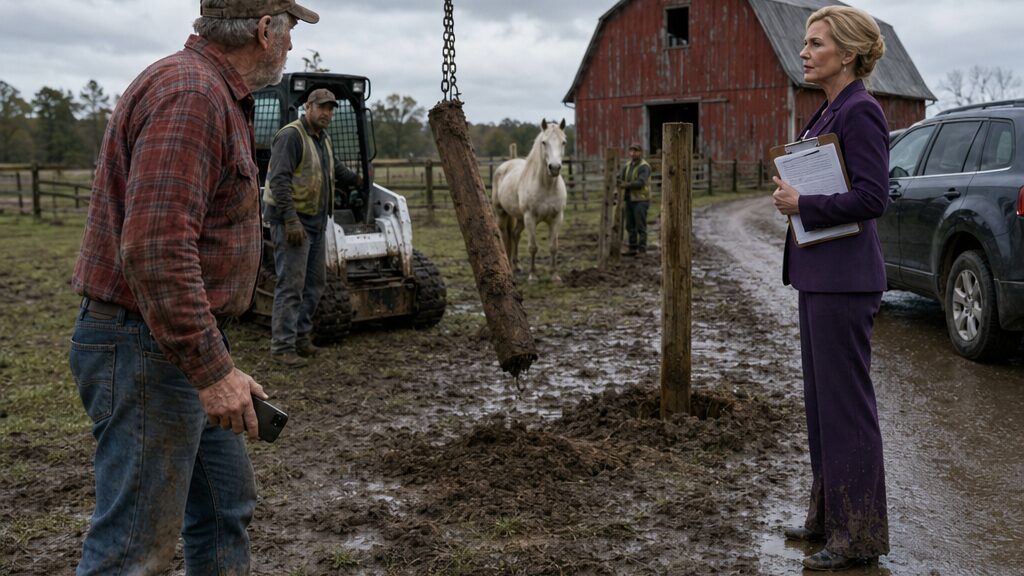
It swung from a chain hooked to the arm of a compact loader, the fresh cedar dark with mud at the base, concrete still clinging to it in broken gray chunks. The machine idled low and rough beside the red barn, rattling the loose windowpanes in the tack room. Two workers in orange vests stood near the gap they had opened. Behind them, the white horse lifted her head from the far side of the pasture and watched the empty space where the post had been.
John stopped at the edge of the gravel drive.
For one full breath, he said nothing.
He had set that post himself two days earlier, guiding it while Kevin Lee leveled it and tamped gravel around the footing. It had been the first post after the storm had peeled back the old rail fence like a zipper. It marked the line between the pasture and the narrow road that curved past the barn toward the HOA entrance.
Now it hung like evidence.
John walked toward the machine.
The crew supervisor saw him and raised one hand, not in greeting, but to hold him back. “Sir, you need to stay clear of the work area.”
“That post is on my fence line,” John said.
“It’s scheduled for removal.”
“By who?”
The supervisor looked toward the black SUV parked near the barn gate.
Melissa Young stepped out from behind it wearing a purple suit jacket too clean for a pasture and shoes that had already collected mud around the heels. She carried a clipboard against her chest and had the careful expression of someone arriving with an answer already prepared.
“Mr. Walker,” she said. “I was hoping we could avoid a scene.”
John looked past her at the crew. One worker had already looped the chain around the next post.
“Then tell them to stop.”
Melissa’s mouth tightened. “The Willow Creek Homeowners Association has issued an enforcement order for unauthorized exterior modification.”
John wiped one palm on the thigh of his jeans, not because it was dirty, but because his fingers had begun to curl. “It’s a fence.”
“It is a non-compliant agricultural-style barrier visible from a community road.”
“It’s the pasture fence.”
“It was changed without final approval.”
“The old fence blew down.”
“You still needed approval before changing materials.”
The loader arm whined as the worker adjusted the chain. The white horse took two slow steps toward the widening gap, ears pricked forward. John saw the movement, and something inside him narrowed to that one pale body against the brown grass.
“Don’t pull another post,” he said.
The supervisor glanced at Melissa.
Melissa opened the clipboard and slid a paper free. “The board authorized removal after failure to cure.”
John did not take the paper. “Failure to cure what?”
“The unauthorized posts, the black hardware on the gate, and the height variance along the roadside section.”
“The roadside section is where the tree came down.”
“That may be true,” Melissa said, “but emergency repairs are temporary. Permanent repairs require submission, review, and approval.”
“I submitted.”
“Your submission did not include compliant materials.”
“It included what would hold.”
Melissa gave him the paper then, extending it as if the act itself should settle the matter. John took it without looking down. His eyes stayed on the chain around the next post.
The supervisor cleared his throat. “Ma’am, we’re paid through noon. If we’re stopping, I need to know.”
“We are not stopping,” Melissa said.
John folded the notice once and put it in his shirt pocket. “You’re on my land.”
“The association maintains enforcement authority over exterior improvements visible from the common roadway.”
“This is not an improvement. It’s a repair.”
Melissa’s gaze shifted briefly to the horse, then back to him. “The board has heard that argument.”
“Not from me.”
“You declined to attend the compliance hearing.”
John felt that one land. He had stood in his kitchen that night with the hearing notice in his hand, boots still muddy from setting brace posts, and decided he was too old to sit in a clubhouse while people who had never mended a rail told him what a pasture needed. He had mailed the repair request. He had kept the receipts. He had done enough.
Or he had thought he had.
The worker bent toward the chain again.
John stepped forward and placed himself between the loader and the post.
The supervisor cursed under his breath. “Sir, you can’t stand there.”
“I’m standing here until somebody shows me a court order.”
Melissa’s eyes sharpened. “This is an HOA enforcement action, not a court proceeding.”
“Then it’s not enough to tear out a fence that keeps a horse off the road.”
For the first time, Melissa’s confidence flickered into irritation. “Mr. Walker, no one is discussing the horse right now.”
“I am.”
The white horse reached the first empty hole and lowered her nose to it, breathing into the disturbed earth. John heard the soft huff over the loader’s engine. The sound pulled at him harder than Melissa’s voice, harder than the paper in his pocket. That horse had learned the old gate by habit. She knew where the line had always been. A line half-removed was not a line at all.
Melissa took a slow step closer. “If you interfere with authorized work, I will have to involve law enforcement.”
“Do that.”
The crew supervisor looked from one to the other. “I’m not touching him with the machine.”
“No one asked you to touch him,” Melissa said. “Proceed with the remaining posts once he moves.”
“I’m not moving,” John said.
A worker near the truck muttered, “This is above my pay grade.”
Melissa’s cheeks colored, not with embarrassment but with the strain of keeping her voice level while losing control of the picture she had arranged. She removed her phone from her pocket.
John pulled his own phone from the chest pocket of his faded plaid shirt and started recording. He angled it at the idling machine, the lifted post, the open gap, Melissa’s clipboard, the white horse standing too close to the road side of the pasture.
Melissa watched him. “You are making this unnecessarily difficult.”
“No,” John said. “You did that when you sent a machine before you knocked on my door.”
“We left notice.”
“When?”
Melissa did not answer immediately.
The loader engine coughed. Somewhere in the barn, a latch knocked in the wind.
“When?” John asked again.
Melissa looked down at her clipboard. “This morning.”
“This morning,” John repeated, “when the crew was already here?”
Her lips pressed thin. “You had prior written warnings.”
“I had a storm. I had a broken fence. I had a horse I was required to contain.”
“Required by whom?”
John’s hand went halfway toward the old folder tucked under the passenger seat of his truck. He could see it from where he stood, a brown legal folder with softened corners. County notice. Receipts. Photos. And beneath those, older papers he had not opened in years.
He stopped himself.
Not here. Not with a machine running and Melissa standing in the mud like she owned the ground under his boots.
Melissa noticed the movement. “If you have documentation, you should have brought it to the hearing.”
John’s jaw tightened. “Tell them to put the post back.”
“I cannot do that.”
“You can. You won’t.”
The words landed quietly, but the crew heard them. The supervisor looked away.
Melissa tapped her phone screen and lifted it to her ear. “Yes, this is Melissa Young, Willow Creek HOA president. We have a homeowner physically interfering with an authorized enforcement removal at the Walker property on Pasture Lane.” She paused, eyes still on John. “Yes. He is refusing to clear the work area.”
The white horse took another step toward the gap.
John lowered his phone, turned his body sideways, and stood between the machine and the post while Melissa gave the sheriff’s office his address.
Chapter 2: Melissa Young Brought Rules To A Barn
The police SUVs came over the rise with their lights flashing, red and blue washing over the barn boards before the tires even reached the gravel.
John stayed where he was.
The loader had gone quiet after the supervisor finally cut the engine, but the silence it left behind felt worse. The pulled post lay on the grass beside its empty hole. The next post still wore the chain around its middle like a noose. Near the gap, the white horse flicked her tail and watched the approaching vehicles with nervous attention.
Melissa walked toward the first SUV before it fully stopped.
That told John plenty.
She wanted the first words. The first version. The frame around the whole morning.
A sheriff’s deputy stepped out, one hand resting near his belt, eyes moving from Melissa to John to the crew to the fence line. He did not rush. That helped a little.
“Deputy,” Melissa said, “thank you for coming. This homeowner is obstructing an authorized HOA enforcement action and creating a safety issue for the workers.”
John almost laughed at the shape of that sentence.
The deputy looked at the machine, then at John. “Sir, are you refusing to leave the work area?”
“I’m refusing to let them remove more of a working fence without proper authority.”
Melissa held up her clipboard. “The HOA has authority under the community covenants.”
“May I see what you have?” the deputy asked.
She handed him papers with tabs already marked.
John watched him read. The deputy’s face gave away little. He turned one page, then another. The crew waited by their truck. One worker rubbed mud from his gloves. Another kept glancing at the horse.
“Mr. Walker,” the deputy said, “do you have paperwork on your side of this?”
John walked to his truck and opened the passenger door. The old brown folder sat under a feed-store receipt and a pair of fencing pliers. He hesitated over it, then pulled out only the top stack: his HOA repair request, dated three weeks earlier; the material invoice; photos of the fallen tree across the old fence; a copy of the email confirmation showing the submission had been received.
He left the older deed packet inside.
Back at the fence line, he handed the stack to the deputy. “I submitted the repair request. Nobody answered before the old section failed completely.”
Melissa spoke before the deputy could read. “Submission is not approval.”
“I didn’t say it was.”
“Our covenants are clear,” Melissa said. “If the architectural review committee does not issue approval, the homeowner may not proceed with permanent visible changes.”
John looked at her. “That fence was there before most of these houses were built.”
“The old fence was split rail and natural finish. This replacement uses taller posts, wire backing, and black gate hardware.”
“It uses materials that keep a horse in.”
“It changes the exterior appearance along a community roadway.”
The deputy lifted one hand slightly, and Melissa stopped. He looked through John’s papers. “You submitted on the fifth?”
“Yes.”
“Any response?”
“An automatic receipt.”
“No denial?”
“No approval either,” Melissa said. “The board’s position is that no response means no authorization.”
John turned to her. “That’s not written anywhere in the letter you sent me.”
“It is in the guidelines.”
“You sent me a warning, not the guidelines.”
“They’re available online.”
“I don’t live online, Melissa. I live here.”
Her expression hardened at the use of her first name. “And living here means following the same rules as everyone else.”
John looked toward the pasture. “Everyone else doesn’t have a twelve-hundred-pound animal and a road ten yards from the fence.”
“That is exactly why the association cannot allow improvised fencing.”
The deputy glanced toward the white horse. “Has the animal been loose?”
John’s answer caught in his throat.
Not loose on the road. Not yet. But after the storm, she had pushed through the sagging corner near the maple and stood in the lane before dawn, white as fog in his headlights when he came back from checking the lower gate. He had gotten her in before any car passed. He had not told the board because telling them felt like handing them a weapon.
Melissa answered instead. “There was an incident last month involving livestock near the road. Residents were concerned.”
John looked at her sharply. “After the storm.”
“Concerned,” she repeated.
The deputy turned back to John. “Sir, I understand your position. But if this is an HOA civil enforcement action and they have documented authority, I can’t settle the covenant dispute here.”
“They don’t have authority to make the place unsafe.”
“I’m not saying they do.”
“You’re letting them continue?”
“I’m saying I need to know whether there’s a legal reason they can’t.”
John felt the old folder in his mind like a weight under the truck seat. There was a legal reason, or there had been once. His wife had known the language better than he did. Agricultural use reserved. Existing pasture and livestock fencing exempt from later aesthetic restrictions. He could hear her voice across the kitchen table years ago: Don’t lose that folder, John. One day somebody will forget this place was here first.
He had not lost it.
He had just refused to use it.
Melissa seemed to sense the gap. “Mr. Walker had an opportunity to present any special circumstances. He chose not to attend the hearing.”
“I was fixing the fence.”
“The meeting was at seven in the evening.”
“I was still fixing the fence.”
“That was your choice.”
The deputy handed back John’s repair request. “For now, nobody is going to use equipment while you’re standing in front of it. That’s dangerous for everyone. But if the HOA has removal authority, they may be able to reschedule with proper notice or seek further remedy.”
Melissa’s shoulders eased as if she had won enough.
John heard what the deputy had not said. He had not said the fence could stay. He had not said the HOA was wrong. He had not said the horse mattered more than the process.
Melissa turned to the crew supervisor. “Pack up for now. We’ll coordinate the remaining removal.”
“Remaining removal,” John repeated.
She faced him. “You still have a chance to cure voluntarily.”
“The cure is the fence.”
“The violation is the fence.”
The deputy looked between them and sighed. “I suggest both parties keep things documented.”
John almost reached for the truck again.
Almost.
Instead he folded his papers and slid them back into the folder he had brought out, leaving the older one hidden where it was. Pride had a strange taste at that moment, dry and metallic. He had spent too many years proving things by doing them. Good hinges. Straight posts. Clean stalls. A gate that latched. He hated the idea that the truth had to be performed in front of people who arrived late and called themselves official.
A sharp clatter broke across the lane.
The white horse had nudged the loose chain with her nose. It slid against the half-pulled post, and the post shifted. She tossed her head, startled, and stepped sideways through the space where the first post had been removed.
John moved fast.
“Easy,” he called, already walking toward her.
The horse paused with one front hoof outside the fence line, her body angled toward the road where the police lights still flashed against the gravel.
Melissa turned and saw it.
The deputy saw it too.
John lifted both hands low, gentle and steady, but his eyes were on the empty hole in the fence.
Chapter 3: The Notice Arrived After The Damage
The notice on John’s front door was dated 8:15 that morning.
He stood on the porch with the paper flat against his palm, reading the timestamp twice while mud from his boots dried in flakes on the boards. The crew had been at the pasture by 8:10. The first post had come out before he had even seen the envelope taped below the brass knocker.
Same-day notice.
Not warning. Not delivery. Cover.
He looked toward the barn lane. The white horse was back inside the pasture, tied temporarily to the inner rail near the loafing shed while he patched the gap with two cattle panels and a length of rope. It was ugly. It sagged. It would not hold if she leaned hard into it.
But it was something.
John carried the notice inside and laid it on the kitchen table beside his repair request, the printed email receipt, and a row of material invoices. The kitchen still had the old wallpaper his wife had chosen, small blue flowers fading near the window where sunlight struck every morning. He did not look at it long.
The notice used phrases Melissa liked.
Non-compliant exterior modification.
Failure to cure.
Association-authorized removal.
Owner responsible for costs.
He read until the words stopped meaning anything and became only a wall with official language painted on it.
His phone buzzed.
Kevin Lee’s name lit the screen.
John answered. “Yeah.”
“I heard they came back on you,” Kevin said.
“They took one post.”
A pause. “Only one?”
“One and a half.”
Kevin exhaled. “I’m sorry. Crew came by my yard yesterday asking where I bought the posts. I should’ve called you.”
“They asked you?”
“Not Melissa. Some guy from the removal company. Said the HOA wanted matching info so they could identify what had been installed.”
John looked at the invoices on the table. “They were planning this before the notice.”
“Sounds like.”
The anger that moved through John was quiet enough to be dangerous. He pressed his thumb against the edge of the table until the nail went pale.
Kevin continued, “John, that old gate wasn’t going to last. I told you that.”
“I know.”
“I’m saying if anyone asks, I’ll say it again. The bottom hinge was tearing out, the posts were rotted below grade, and after that maple came down, the whole road section was compromised. You didn’t replace it because you wanted it pretty.”
“No one’s asking you yet.”
“They will.”
John looked at the paper dated 8:15. “Maybe.”
Kevin’s voice lowered. “You ever show them the county letter?”
John said nothing.
“John.”
“I submitted the repair request.”
“That’s not what I asked.”
John walked to the counter where the county notice lay folded under a feed-store magnet. He had touched it so many times the crease had softened. The notice was not a punishment, not exactly. It was a warning after the storm: livestock containment must be restored along the public road within ten days to prevent hazard. The county seal sat at the top. Sandra Wilson’s printed name sat near the bottom.
“I didn’t attach it,” John said.
Kevin was quiet for a moment. “Why not?”
“Because I shouldn’t need a county warning to fix my own fence.”
“No,” Kevin said carefully. “But with an HOA, sometimes you need to show them the fire before they admit there’s smoke.”
John closed his eyes.
He knew that tone. People used it with old men when they were right but did not want to sound like they were correcting them.
“I had the posts ordered,” John said. “You had the crew ready. The horse was pushing the sagging rail. I wasn’t waiting for Melissa Young to decide whether cedar offended the neighborhood.”
“I get that.”
“But?”
“But now she’s got a story. You ignored process. You skipped the hearing. You installed anyway.”
John opened his eyes and looked toward the hallway where his boots had left mud on the floorboards. “I fixed what was broken.”
“I know. You need to prove why.”
After the call, John went to the barn office, a narrow room behind the tack hooks with a desk made from an old door laid over file cabinets. He kept property papers there, warranties, vet records, receipts for hay, and one brown legal folder he had not opened in years.
He opened the drawer but did not take it out.
Instead he pulled the county notice from the kitchen and added it to the top of the repair stack. Mud marked one corner from his thumb. That should have embarrassed him. It didn’t. Mud belonged on that paper more than Melissa’s tabs belonged on hers.
He sat at the desk and saw, without wanting to, his wife across from him in the barn years earlier, hair tucked under a cap, telling him the pasture fence was not decoration. It was promise work. You keep the line safe, she had said, you keep everything inside it safe too.
He pushed the memory away before it could ask anything of him.
By late afternoon, John drove to the HOA mailbox kiosk near the clubhouse. It was a stone-faced structure with a bulletin board behind glass and a neat planter of ornamental grass at the base. His farm had been there before the kiosk, before the clubhouse, before Willow Creek decided country views improved property values as long as nobody had to smell hay.
A new notice had been posted under “Compliance Updates.”
Walker property exterior modification remains unresolved. Further enforcement pending.
No mention of the storm.
No mention of the county warning.
No mention of the horse stepping toward the road because of the gap they had opened.
John stood there long enough for two neighbors to slow their walking pace and pretend not to read over his shoulder. One of them gave him a quick, uncomfortable nod. The other looked away.
When he returned home, an envelope waited in the mailbox at the end of his drive.
This one had been sent by certified mail.
He opened it beside the pasture gate, with the white horse breathing softly over the temporary cattle panel. The paper inside was thicker than the notice on his door.
Daily fines would begin the next morning unless all newly installed posts, hardware, and non-compliant roadside materials were removed at the owner’s expense.
At the bottom, in Melissa Young’s precise signature, one sentence had been underlined.
Failure to comply may result in full removal by association contractor with costs assessed to the homeowner.
John folded the notice once, then again.
Across the pasture, the empty post hole had filled with brown water.
Chapter 4: The Board Learned The Fence Wasn’t Cosmetic
Melissa Young projected the photograph of John’s fence onto the clubhouse wall as if it were evidence from a crime scene.
The image showed the pulled post lying beside the muddy hole, the chain marks dark around the cedar, the white horse half visible beyond the gap. Someone in the second row murmured when the horse appeared. Melissa clicked to the next photo before the room could settle on it.
“This is the unauthorized roadside section,” she said. “The post height exceeds community guidelines. The wire backing is visible from Pasture Lane. The gate hardware does not match approved exterior finishes.”
John sat in the front row with his hat in his hands.
He had not wanted to come. He had nearly turned around twice on the drive to the clubhouse, once at the mailbox kiosk and again where the paved community road began, smooth and curved and lined with ornamental pear trees. But the certified fine notice sat folded in his jacket pocket, and the temporary cattle panels back home were tied with rope that would not hold another hard push from the white horse.
So he came.
The clubhouse smelled like carpet cleaner and coffee. A half circle of board tables faced the rows of folding chairs. Melissa sat in the center, a stack of papers arranged squarely before her. Thomas Moore sat two seats down, arms crossed, his face turned toward the projected images.
John had known Thomas by sight for years. He lived in the newer house beyond the bend, the one with the long driveway and the stone mailbox. They had waved over fences, no more than that. Thomas was younger than John by maybe fifteen years, tidy in the way men became when they paid someone else to mow. Tonight he did not wave.
Melissa clicked again.
A close-up of the black gate latch filled the wall.
“This is exactly why the architectural process exists,” she continued. “If one homeowner makes unilateral changes, enforcement becomes impossible for everyone.”
John raised his hand.
Melissa looked at him the way a person looked at a loose thread on formal clothing. “You’ll have your allotted time, Mr. Walker.”
“My horse doesn’t work by allotted time.”
Several faces turned toward him. A few people looked uncomfortable. Melissa did not.
“Your animal is not the issue before the board.”
“It’s the reason the fence exists.”
“The issue before the board is an exterior modification made without approval.”
John stood slowly. The chair legs scraped behind him. “I submitted the request.”
“And proceeded before approval.”
“Because the old fence failed.”
Melissa lifted a sheet from her table. “The committee received a request for fence repair, not a request for replacement with altered post height and non-standard backing.”
Kevin had told him to explain that part simply. John tried.
“The old split rail looked nice,” he said, “but it wouldn’t hold after the storm. The posts were rotted under the ground. The rails had gaps. The wire backing keeps the horse from leaning through. The taller posts keep the gate square.”
A board member at the end of the table frowned. “Couldn’t you have replaced it with the same style?”
“Not and keep her in.”
Melissa cut in. “That is an opinion.”
“No,” John said. “That is a fence contractor’s assessment.”
“Then the assessment should have been submitted.”
“It would have been if anyone had answered the first request.”
Melissa’s jaw flexed. “Mr. Walker, the guidelines clearly state that work may not proceed without written approval.”
John looked at the faces behind her. “And what do the guidelines say about a broken fence along a road?”
No one answered.
Thomas Moore leaned forward then. “They say residents are responsible for maintaining safe properties.”
John turned to him. “That’s what I’m trying to do.”
Thomas’s voice was controlled, but something under it was not. “With respect, Mr. Walker, that horse was near the road last month.”
The room changed. It leaned toward Thomas.
John held still.
“She was not in the road,” he said.
“She was close enough that my daughter swerved.”
John looked at him carefully. “I never heard that.”
“No,” Thomas said. “You didn’t. Because by the time I got out there, you had her back inside the pasture, and you drove away like nothing happened.”
John felt heat rise into his neck. “It happened after the storm. Before I had materials.”
“My daughter was shaking.”
That landed differently than Melissa’s rules. John looked down at his hat. He had seen headlights that morning, yes. He had seen a car slow near the bend. He had not known who was inside. He had been too busy slipping a halter over the horse’s head, too busy cursing himself for trusting the old rail another night.
“I didn’t know it was your daughter,” he said.
Thomas’s mouth tightened. “The board heard from more than one resident. We cannot have livestock drifting toward the community road.”
John looked back at the projected photograph. The pulled post lay in the mud, accused of being unsafe by the people who had removed it.
“Then why take down the fence?” he asked.
Thomas said nothing.
Melissa stepped into the silence. “Because an unsafe, unauthorized repair is not the solution to another unsafe condition.”
“You keep saying unauthorized like that makes it useless.”
“It makes it non-compliant.”
“It kept her behind the line.”
“For two days,” Melissa said. “Without review, without inspection, without standards.”
John almost reached into his folder for the county warning. He had placed it there before leaving home, on top of the receipts. It would have helped. It would have proved this was not just him being stubborn. But the room already felt like it had decided he was a man who acted first and explained later.
Because he was.
He pulled the county paper halfway free, saw the muddy fingerprint on its corner, and stopped. Beneath it lay the brown deed folder he had brought from the barn but still had not opened. His wife’s handwriting marked the tab: Pasture covenant.
Melissa saw the paper in his hand. “Do you have additional documentation?”
John’s thumb pressed over the handwriting on the folder.
He thought of his wife saying, They’ll forget what the land was. Don’t you forget with them.
He slid the county notice back inside.
“I have a broken fence,” he said. “I have receipts. I have a contractor who’ll tell you the repair was necessary.”
Melissa’s expression cooled. “What you do not have is approval.”
A resident in the back whispered, “Rules are rules.” Another whispered something about property values.
John looked at Thomas. “You want the horse off the road?”
“Yes.”
“So do I.”
Thomas looked away first.
For a moment, John thought the room might see it: the nonsense of it, the hard bright absurdity of punishing a fence for doing what everyone claimed they wanted done. But Melissa clicked back to the first photograph, and the machinery chain mark filled the screen.
“The board has allowed time to cure,” she said. “The violation remains. Fines begin tomorrow. I am recommending an emergency authorization for full removal of the non-compliant section, with costs assessed to the owner.”
John stood with his hat in both hands. “You’ll make the road less safe.”
Melissa met his eyes. “The board will make the property compliant.”
Thomas shifted in his seat, but he did not speak.
Melissa looked down the table. “All in favor of scheduling full removal?”
Hands began to rise.
Chapter 5: The White Horse Reached The Road
The white horse stepped through the missing fence line just as headlights came around the bend.
John saw her from the barn door and ran.
The temporary cattle panel had folded outward where the rope slipped from the old brace. One end dragged in the mud behind her, clattering softly against a stone. Rain blurred the road beyond the pasture, turning the oncoming car’s lights into two white smears.
“Easy,” John called, but the word tore in his throat.
The horse lifted her head, startled by the headlights and the sound of John’s boots hitting gravel. One hoof landed outside the pasture. Then another. Her pale body moved into the lane where the fence should have stopped her.
The car braked hard.
Tires hissed on wet pavement. The horn did not sound. That was mercy. A horn might have sent her sideways into the ditch or forward into the bumper.
John slowed before he reached her. Running at a frightened horse was a fool’s move, and he had done enough fool things already. He lowered his shoulders, held one hand out, and spoke the old barn nonsense his wife used to laugh at.
“Come on now. You know better. Back to me.”
The horse trembled, ears flicking between him and the car. The driver’s side door opened.
Thomas Moore stepped out into the rain.
For a second, neither man moved.
Thomas had no umbrella. Water darkened his jacket almost immediately. His face, caught in the headlights, was pale with the look of a man seeing his own argument turn against him.
“Don’t come closer,” John said.
Thomas froze.
John reached the dangling lead rope still looped around the horse’s halter. He moved slowly, fingers closing over wet nylon. The horse blew hard through her nostrils and bumped his shoulder with her nose, as if blaming him for the whole world shifting under her.
“I know,” John murmured. “I know.”
He turned her gently, step by step, away from the car and back through the gap. The empty post holes had filled with rainwater, dark circles in the earth. The cattle panel lay bent. Beyond it, the old barn glowed dimly from the single bulb over the side door.
Thomas followed at a distance.
When the horse was tied inside the barn aisle, John latched the half door and stood with one hand pressed flat against the wood. His breathing came hard now that the danger had passed.
Thomas stopped just outside the doorway. Rain ran from his hairline. “Was that the same section?”
John turned. “The one your board tore open?”
Thomas flinched at your board. “I didn’t vote to tear it open like that.”
“You raised your hand.”
“I voted for removal of the non-compliant section.”
John gave him a tired look. “What did you think removal meant?”
Thomas looked toward the pasture. The loader tracks were still there from the first crew visit, filling with water. “I thought they’d replace it with temporary approved panels.”
“They didn’t bring panels.”
“I didn’t know that.”
“You didn’t ask.”
Thomas swallowed. “My daughter was in the car last time. She came home crying. She just got her license. I pictured that horse coming through the windshield.”
John’s anger had a clean edge until that moment. Then it hit something human and dulled.
“I didn’t know about your daughter,” he said.
“You didn’t tell anyone the fence failed because of the storm.”
“I told the HOA.”
“You told them you were repairing it.”
“It was a repair.”
“You didn’t tell them the county warned you.”
John’s head turned sharply.
Thomas looked almost ashamed. “Melissa mentioned there might be some outside notice. She said you never submitted it.”
John stared at him through the dim barn light. “She knew there was a notice?”
“She said you were implying there was one.”
“I asked her at the fence if she wanted the horse on the road. That’s not implying. That’s pointing.”
Thomas rubbed rain from his face. “Mr. Walker—”
“John.”
“All right. John. If there’s a county document, you need to bring it in.”
“I should have brought it already.”
The admission came out rougher than he expected. It sat between them beside the smell of wet horse and old hay.
Thomas nodded once, not victorious, just troubled. “Yes.”
A set of tires crunched outside the barn.
John looked past Thomas and saw Melissa’s black SUV pulling up near the gate.
“For heaven’s sake,” Thomas said under his breath.
Melissa stepped out with her phone in one hand and a raincoat thrown over her shoulders. She had the strained look of someone called from dinner into a problem she did not want witnessed by the wrong person.
“Thomas,” she said first, then saw John. “I received a message about livestock in the roadway.”
“Because the fence is open,” John said.
“The temporary barrier you installed failed?”
“The barrier I used because your crew pulled a post.”
Melissa looked toward the dark pasture, then at the bent cattle panel. “That is exactly why temporary unapproved structures are not reliable.”
Thomas turned to her. “Melissa.”
She glanced at him, surprised by his tone.
“The original repair was more secure than this,” he said.
“The original repair had not been approved.”
“The horse was just in the road.”
“Then the animal needs to be secured in the barn until compliance is resolved.”
John’s hands curled at his sides. “You want me to keep a pasture horse shut in a stall because you don’t like black hardware.”
“I want the association to avoid liability.”
“You created it.”
Melissa’s face tightened. “I did not create the storm damage. I did not install an unauthorized fence. I did not refuse to attend a hearing.”
“No,” John said. “You just sent a crew to tear out the part that was working.”
Thomas looked from one to the other. “We need to allow temporary safety repairs tonight.”
Melissa turned on him. “Without board approval?”
“With a horse loose at the road, yes.”
“The board already voted.”
“The board did not vote to make the road more dangerous.”
Melissa’s voice lowered. “Be careful, Thomas. We have procedures for a reason.”
“And we have eyes for a reason too.”
John watched the words strike her. Not hard enough to change her mind, but hard enough to make her realize the room she had controlled two nights ago had followed her into the rain and no longer sounded as certain.
She looked back at John. “No additional materials are to be installed without written approval. If you put those posts back tonight, the fines remain and removal continues.”
John stepped closer, stopping just outside the barn light. “Then put that in writing.”
“I already have.”
“No. Put this in writing. That after your crew opened the fence and after the horse reached the road, you are still ordering me not to secure the gap.”
Melissa did not move.
Thomas looked at her.
Rain tapped the metal roof. The white horse shifted in the stall behind John, restless and confused by confinement.
Melissa slid her phone into her pocket. “I will send a clarification.”
“Tonight,” John said.
Her eyes narrowed. “Tomorrow morning.”
“Tonight.”
For a moment, Melissa looked as if she might refuse simply because he had asked plainly enough to make refusal visible. Then she turned and walked back toward her SUV.
Thomas remained by the barn, watching the taillights swing across the wet fence line as she backed out.
“I’ll tell them what I saw,” he said.
John did not answer at first. He was looking at the empty post holes, each one holding rain like a small dark eye.
Then he walked to the barn office, opened the lower drawer, and took out the old brown deed folder for the first time in years.
His wife’s handwriting waited on the tab.
Pasture covenant.
Chapter 6: The Old Deed Changed The Jurisdiction
Sandra Wilson read the first page of the deed folder and said, “This changes who had authority.”
John stood on the other side of her county office desk with his hat in his hands, too tired to feel relief all at once. He watched her finger move down the old recorded language, past legal descriptions and boundary references, to the paragraph his wife had circled years ago in blue ink.
The office was small and practical, with soil maps pinned to one wall and a shelf of binders marked livestock, drainage, fencing, and road access. Sandra had mud on the side of one boot, which made John trust her more than the polished table at the clubhouse.
She read the paragraph again silently.
“Existing pasture use,” she said, “including livestock containment fencing, gate access, and repair or replacement necessary for safe agricultural operation, shall not be prohibited by later residential architectural restrictions.”
John knew the sentence. He had heard it in his wife’s voice before he heard it in Sandra’s.
“I should have brought it sooner,” he said.
Sandra looked up. “Yes.”
He appreciated that she did not soften it.
“I thought submitting the repair request was enough.”
“For ordinary repair, maybe. But once the association disputed materials, this needed to be attached. And this”—she tapped the county warning she had issued after the storm—“definitely needed to be attached.”
John looked toward the window. Outside, county trucks sat in a row under a flat gray sky. “I didn’t want to ask permission for a thing I already had the right to do.”
Sandra leaned back. “Mr. Walker, having the right and proving it before damage happens are two different chores.”
He let out a humorless breath. “My wife would have said that better.”
“Was this her file?”
He nodded.
Sandra did not ask more. She turned to her computer and began typing. “The HOA may have authority over exterior appearance on residential lots, but if this pasture covenant is still valid, they cannot require you to remove a safety repair that is necessary for livestock containment along a public road. Especially not after the county issued notice to restore containment.”
“Can you put that in writing?”
“I can issue a clarification letter. I’ll reference the storm damage inspection, the containment notice, and the recorded covenant language. I’m not your attorney, and I can’t adjudicate HOA covenants, but I can state the county’s position clearly.”
“That’s more than I had yesterday.”
Sandra paused typing. “What happened yesterday?”
John told her about the horse stepping into the road. He kept it brief, but his voice changed despite him. He saw again the headlights, the wet lane, the horse’s white shoulder beyond the fence line.
Sandra stopped typing. “Did anyone get hurt?”
“No.”
“Was there a report?”
“Not official.”
“There should have been.”
“Thomas Moore saw it. He’s on the board.”
“That helps and complicates things.” She resumed typing. “If the removal created or worsened the hazard, the association needs to know that in writing immediately.”
“They know.”
“No,” Sandra said. “They’ve heard it. That is not the same.”
John almost smiled. Kevin had said nearly the same thing.
Sandra printed the letter on county letterhead. The printer hummed while John stood beside the desk, looking at the old deed folder open under the fluorescent light. His wife’s blue circle had faded, but not enough to disappear. On the inside flap she had written one line in a slanting hand.
Keep the line safe.
He ran his thumb near the words but did not touch them.
Sandra stamped the letter, signed it, scanned it, and handed him the original with the deed copy and county notice clipped behind it.
“I’m emailing this to the HOA office address listed on your notices,” she said. “You should also hand-deliver a copy.”
“I will.”
“And Mr. Walker?”
He looked back.
“Do not install anything new until this is in their hands unless there is immediate danger. If there is immediate danger, document it. Photos. Time. Who was present. What you did and why.”
John gave a short nod. “I’m learning.”
“Late lessons still count.”
By noon, he was back in the barn office making copies on the old printer that jammed every third page. The white horse stood outside in the small paddock he had made from panels borrowed from Kevin, her head over the rail, watching him through the open window as if she understood paperwork had become part of fence work.
Kevin arrived with coffee and a roll of temporary tape.
“You get it?” he asked.
John held up the county letter.
Kevin read the first page standing beside the desk. His eyebrows rose. “This is strong.”
“Strong enough?”
“Strong enough to make them slow down if they’re smart.”
John looked at him. “Are they?”
Kevin did not answer.
John drove to the HOA office and found the door locked for lunch. He slid a copy through the mail slot, then photographed it half in, half out, with the address visible. At the clubhouse bulletin board, he taped another copy under the compliance notices. A neighbor walking a small dog stopped to read the top line before hurrying on.
By the time John returned home, Sandra’s email had already gone out. He knew because Melissa called within ten minutes.
He let it ring twice before answering.
“Mr. Walker,” she said, “posting county correspondence on the clubhouse board without authorization is inappropriate.”
“Removing a fence before checking the deed was inappropriate.”
A pause.
“The county letter does not resolve all architectural issues.”
“No. It resolves the safety one.”
“It is not a court order.”
“Neither was your removal notice.”
Her silence sharpened.
John stood in the barn doorway with the phone pressed to his ear. Across the lane, the empty holes marked the fence line like missing teeth.
Melissa said, “The board will review the letter.”
“When?”
“At the emergency session.”
“You mean the one authorizing removal?”
“The agenda can be amended.”
“Amend it before your crew comes back.”
“They are not scheduled today.”
John looked toward the road as a truck slowed near the pasture entrance, then continued on. “Good.”
After the call, he spread the documents across the barn desk in order: repair request, receipt confirmation, county warning, deed covenant, Sandra’s letter, photographs of the pulled post, photographs of the empty holes filling with rain, photographs of the horse at the broken panel. For the first time since the loader chain had tightened around the cedar, the mess looked like a story someone else could understand.
Not feel. Maybe not yet.
But understand.
He was clipping the packet together when his phone buzzed again.
Kevin.
John answered. “You forget something?”
Kevin’s voice came low and fast. “John, I’m at the feed turnoff. There’s a removal truck headed your way.”
John went still.
Kevin continued, “Same company. Loader on the trailer. Two workers in orange vests.”
John looked at the county letter lying beside his wife’s old folder, the fresh stamp still dark on the page.
Then he grabbed the packet, his hat, and his keys.
By the time he stepped out of the barn, the truck was already turning in at the pasture gate.
Chapter 7: The Document Made The Deputy Stop
The crew lowered the chain around the last gate post as John’s truck bounced into the pasture lane.
For a moment, all he saw was the metal hook sliding against cedar, the same careless motion as before, the machine idling with its bucket low and its wheels sunk in the soft ground. The red barn stood behind it. The white horse paced the small temporary paddock near the loafing shed, throwing her head each time the chain clinked.
John stopped his truck sideways across the lane.
The packet of papers lay on the passenger seat, clipped together so tightly the top page had bent at one corner. County letter. Deed covenant. Repair request. Photos. He took them in one hand and stepped out before the engine had fully settled.
The crew supervisor turned from the machine. “Sir, we were told to resume.”
“By who?”
Melissa Young answered from beside her SUV. “By the board’s standing enforcement authorization.”
John looked past her. “After receiving the county letter?”
Her face was composed, but the folder tucked under her arm was thicker than usual. “The board has not completed review.”
“Then the work stops until it does.”
“The violation remains active.”
“The county says the fence is required.”
“The county does not control architectural standards.”
“The county controls livestock safety on a public road.”
The supervisor lifted both hands. “I need someone to tell me whether I’m working or not.”
“You are working,” Melissa said.
“You are stopping,” John said.
The supervisor looked miserable.
The chain tightened.
John walked straight to the gate post and stood with one boot beside the hole they had begun to widen. He held the packet against his chest. He did not raise his voice. He did not touch the machine. He simply stood where the post would fall if they pulled it free.
Melissa’s eyes flashed. “Mr. Walker, step away from the equipment.”
“Tell them to unhook the chain.”
“We have been through this.”
“No,” John said. “This time I brought what you said I should’ve brought.”
She glanced at the papers. “Documents can be submitted to the board for review.”
“They were submitted to your office and posted at the clubhouse.”
“Posting them publicly did not make them valid.”
The white horse struck the ground with one front hoof. The sound cut across the engine noise like a knock on a door.
John turned his phone camera on and held it low. “State your name and authority for the removal.”
Melissa took a step back. “I’m not participating in that.”
“You sent a crew to my fence twice. Say why.”
Her voice lowered. “You are escalating this unnecessarily.”
“No. I’m documenting it correctly this time.”
Those words changed something in him as he said them. Not enough to wash away the anger. Not enough to make the scene clean. But enough to make him feel, for the first time since the first post came out of the ground, that he had stopped arguing from hurt and started standing on facts.
A sheriff’s SUV turned in from the road.
Melissa looked toward it with visible relief.
John did not.
The same deputy stepped out, rain jacket open, expression already tired. He scanned the scene: John at the gate post, the idling loader, Melissa with her clipboard, the restless horse, the packet in John’s hand.
“Everyone stay clear of the machine,” the deputy said.
“I am clear,” John said. “The machine is too close to me.”
The supervisor immediately cut the engine. Silence fell hard.
Melissa moved first. “Deputy, Mr. Walker is again interfering with HOA enforcement. This is a scheduled continuation of the removal you observed earlier.”
The deputy looked at John. “Sir?”
John held out the packet. “County agricultural extension issued clarification this morning. The fence is required for livestock containment. The deed says existing pasture fencing can be repaired or replaced for safe agricultural operation without later architectural restrictions prohibiting it.”
Melissa cut in. “That is his interpretation.”
“It’s the county’s letter,” John said.
The deputy took the packet.
Melissa stepped closer. “Deputy, with respect, this remains a civil covenant matter. He is trespassing against an authorized enforcement action.”
John stared at her. “Trespassing?”
“Interfering,” she corrected quickly.
“On my own fence line.”
The deputy looked up from the first page. “Ms. Young, did the HOA receive this letter before resuming work?”
Melissa’s pause was small, but everyone heard it.
“The board received correspondence,” she said. “It has not been reviewed.”
“That wasn’t my question.”
Her mouth tightened. “Yes. It was received.”
The deputy turned the page.
John watched his eyes move over Sandra Wilson’s signature, the county stamp, the copied paragraph from the deed. The deputy’s expression shifted—not dramatically, not like something from a courtroom story, but enough. His forehead creased. He went back to the first page, then checked the attached warning notice.
“Ms. Young,” he said, “this letter states the county considers the roadside containment repair necessary for livestock safety.”
“The association does not object to safety,” Melissa said. “We object to unauthorized materials.”
“The letter also says removal may increase hazard exposure along the public road.”
Melissa’s fingers tightened around her clipboard.
The deputy held up the deed copy. “And this recorded language appears to create an agricultural-use exception.”
“Appears,” Melissa said. “That is exactly why the board needs time for review.”
“Then why is the crew here?”
No one spoke.
The white horse blew hard through her nostrils. One worker looked down at his boots.
Melissa recovered first. “Because the violation order predates this morning’s correspondence.”
The deputy looked at the idling machine, now quiet but still chained to the gate post. “You cannot ask me to keep the peace while you proceed with a disputed removal after receiving notice that the removal may create a road hazard.”
“The HOA has enforcement rights.”
“Maybe. Maybe not. That’s not getting decided in this pasture.” He handed the packet back to John, then looked at the supervisor. “Unhook the chain.”
The supervisor did not wait for Melissa.
He walked to the post, released the hook, and let the chain fall into the mud.
John felt the sound in his knees.
Melissa turned sharply. “Deputy, are you ordering the association to stop?”
“I’m telling everybody here that no more physical removal happens today. If the association wants to pursue this, do it through the proper civil channel after reviewing the county letter. But no machine is pulling that post while there’s a documented livestock hazard and unclear authority.”
Melissa’s face went pale with controlled anger. “This creates a dangerous precedent.”
John looked at the open holes along the fence line. “No. This stops one.”
The deputy turned to him. “Mr. Walker, this does not erase the fines or settle the dispute. You understand that?”
“I do.”
“And don’t install permanent work beyond what the county letter supports until the board and county sort this out.”
John nodded. “I’ll install what keeps her in.”
“Document it.”
“I will.”
That answer carried more weight than it would have a week ago.
A truck slowed on the road. Then another. Neighbors had begun to notice the police lights again, the machine at the pasture, Melissa standing with her folder, John holding papers in front of the red barn. Thomas Moore’s car pulled in last, stopping near the gate but not blocking anyone.
He got out slowly.
Melissa saw him and said, “Thomas, this is being handled.”
He looked at the unhooked chain, the deputy, then the horse. “Is it?”
John said nothing.
The deputy gave Thomas a brief nod and returned to his SUV to make notes. The crew began loading equipment with the embarrassed efficiency of men who wanted no part of the next argument.
Melissa walked toward John, stopping just far enough away to keep mud off her shoes. “You should have submitted that covenant before.”
“Yes,” John said.
The admission appeared to surprise her.
He looked down at the packet in his hand. “My wife kept this folder. She knew people would forget what this place was before it had a clubhouse.”
Melissa’s expression shifted, but not into softness. More like discomfort at being handed something that did not fit a form.
John continued, quieter. “That fence wasn’t just boards. It was how we kept the road safe, kept the pasture working, kept the home from turning into a decoration for everybody else’s view.”
Thomas stood near the gate, listening.
John swallowed once. “I promised her I’d keep the line safe. I thought doing the work was enough. I was wrong about that. But you were wrong to tear it out before asking why it was there.”
For once, Melissa had no immediate answer.
The deputy closed his notebook. The machine trailer rattled as the crew secured the loader.
Thomas stepped closer, eyes still on the gap. “Melissa, I need time at the emergency session.”
She turned to him. “For what?”
“To speak against the removal order.”
Her face hardened. “Thomas.”
He looked at John, then at the white horse, who stood behind temporary panels where a real fence should have been. “I saw what happened on the road. The board needs to hear it from someone who voted with you.”
Chapter 8: The Gate Closed Before Sunset
Thomas Moore stood at the front of the clubhouse and admitted the board had made the road less safe.
No one interrupted him.
That alone told John the room had changed.
Two nights earlier, the same tables had faced him like a bench of judges. Now the board members avoided looking too long at the projected photographs behind Thomas: the empty post holes, the bent cattle panel, the white horse halfway through the gap, the county letter stamped and enlarged on the screen.
Melissa sat at the center of the table with her hands folded, her face composed in a way that no longer looked like control. It looked like effort.
Thomas kept his voice even. “I supported enforcement because I believed the repair was unapproved and possibly unsafe. I was concerned about livestock near the road. My daughter had a close call after the storm.”
A murmur passed through the room. Thomas waited until it ended.
“But after the association removed part of the fence, the horse reached the road again. I saw it. The temporary barrier failed because the permanent repair had been interrupted. Whatever our concerns were about appearance, the removal increased the risk we claimed we were trying to prevent.”
John sat in the same front-row chair as before. His hat rested on his knee. The old brown deed folder lay closed beside him.
Melissa looked down at her papers. “The association acted under the information available at the time.”
Thomas turned toward her. “We had enough information to pause.”
A board member at the end of the table cleared his throat. “The county letter changes the analysis.”
“It confirms the analysis we should have done,” Thomas said.
John looked at him then.
Thomas did not sound proud. He sounded like a man carrying a thing he did not want but had decided not to put down.
Melissa lifted her head. “For clarity, the board is not conceding that all portions of Mr. Walker’s installation were compliant.”
John stood.
A few chairs creaked behind him.
“I’m not asking you to like the fence,” he said. “I’m asking you to stop making it weaker.”
Melissa met his eyes. “The board is prepared to waive accumulated fines while the matter is reviewed.”
“No.”
The word came out plain and hard.
Melissa blinked. “Excuse me?”
“No. Waiving fines doesn’t put back the post your crew pulled. It doesn’t pay Kevin for the extra work. It doesn’t cover the panels I had to borrow or the gate hardware you told me to remove after the county said containment was required.”
A board member shifted. “Mr. Walker, reimbursement is a separate question.”
“It wasn’t separate when you billed removal costs to me.”
The room went still.
John placed the county packet on the table nearest him. He did not slide it dramatically. He just set it down where everyone could see the stamp.
“I should have given you all of this sooner,” he said. “That part is mine. I was angry that I had to ask permission to fix a fence that existed before these rules did. I let pride do paperwork’s job. But once the county letter arrived, once the horse reached the road, once you knew removal made the hazard worse, the choice was yours.”
Melissa’s gaze dropped to the packet.
John’s hand moved to the brown folder. For a moment, he only touched the edge.
“My wife kept this deed because she knew this day might come. She used to say people like a farm view until the farm needs something. Then they call it messy.”
No one laughed.
“She was better at explaining things than I am. I thought keeping my head down and doing the work was dignity. Maybe sometimes it is. This time it gave you room to pretend the fence was decoration.”
Melissa’s voice softened by a fraction. “Mr. Walker, the association had residents concerned about safety and liability.”
“I know. Thomas told me.”
Thomas looked down.
John continued, “That concern was real. But the answer to a loose horse was not a weaker fence.”
The board member at the end leaned toward Melissa. The two exchanged low words. Another board member asked to see the county letter again. Papers moved. The room waited.
Melissa finally straightened. “The board can approve the roadside repair under county safety specifications, subject to one visual condition.”
John’s shoulders tightened. “What condition?”
“The black gate hardware must be treated or shielded so it is not reflective from the roadway. No change to structural strength. No reduction in post height. No removal of wire backing where needed for containment.”
Kevin, standing along the back wall, gave John the smallest nod.
John considered it. The old version of him wanted to reject the condition simply because it came from Melissa. But the condition did not weaken the fence. It did not endanger the horse. It did not turn safety into permission.
“I can accept that,” he said.
Melissa looked down at the paper before her. “The board will withdraw the violation, suspend enforcement, approve the repair as modified, and reimburse documented costs related to the removed post and emergency temporary containment.”
“Not suspend,” John said. “Withdraw.”
Her jaw tightened.
Thomas said quietly, “Withdraw is right.”
One by one, enough board members nodded.
Melissa picked up her pen. “Withdraw,” she said.
The word did not sound like victory. It sounded like a gate unlocking.
By late afternoon, Kevin’s truck was back beside the pasture, this time with no police lights, no clipboard, no crew waiting to undo the work. The pulled post could not be reused; the base was split where the chain had bitten too deep. Kevin set a new one in the same hole after John cleaned out the rainwater with a post-hole scoop.
Thomas came by near sunset carrying two bags of gravel from his trunk.
John looked at them, then at him.
“My daughter asked if the horse was okay,” Thomas said.
“She is.”
Thomas set the bags down. “Good.”
They worked mostly without talking. Kevin leveled the post. John tamped. Thomas held the brace rail steady when asked, awkward but willing. At the gate, Kevin fitted the hardware shield Melissa had requested, a dull finish that caught no light from the road.
When the final latch clicked, the sound was small.
The white horse stood inside the pasture, ears forward, calm behind the restored line. She came to the gate and breathed against John’s sleeve.
He rested one hand on her neck. With the other, he reached into his jacket pocket and felt the folded HOA notice still there, creased from the day the first post came out. He did not throw it away. Not yet. Some papers were warnings. Some were proof. Some reminded a man that silence could cost more than pride admitted.
Melissa’s SUV passed slowly on the road but did not stop.
John watched it go, then closed the gate fully. The latch settled cleanly into place before the sun