The HOA Sent A Crew To Tear Down Grandpa’s Dock Ramp Before Reading The Permit
Chapter 1: The Crew Was Already Pulling Out The Ramp Posts
The first thing Robert Walker heard was not the lake.
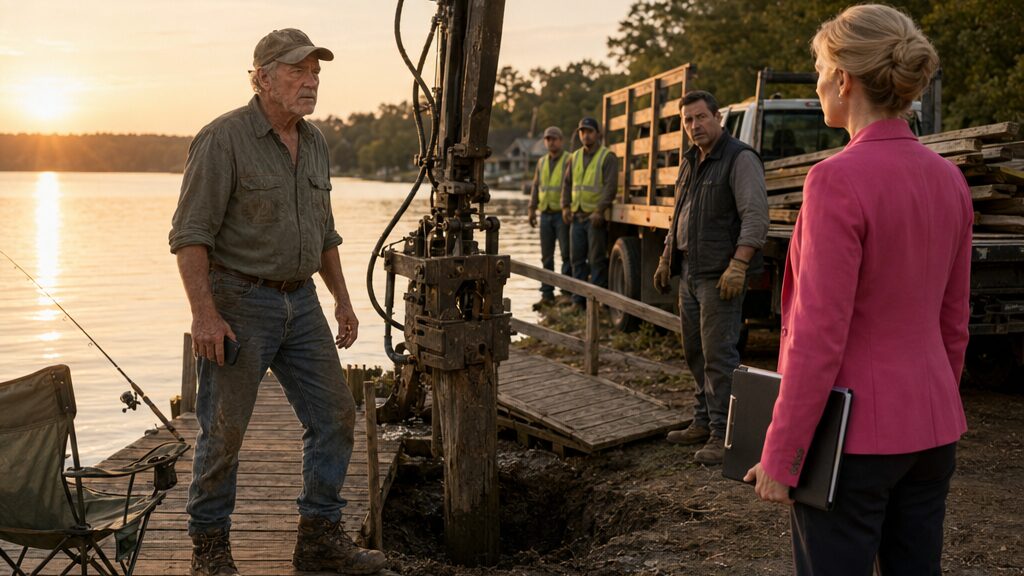
It was the hard metallic cough of a hydraulic post puller biting into the timber beside his dock.
He had been sitting in his folding fishing chair with his rod balanced across his knees, watching the bobber drift in the gold line where evening touched the water. Then the machine clamped down, shuddered, and the nearest ramp post jerked upward with a wet crack from the mud.
Robert set the rod carefully against the arm of the chair.
“Stop,” he said.
The worker nearest the machine glanced back but did not release the lever. The post rose another inch. A second worker stood beside the truck with two boards already stacked in the bed, their screw holes bright and raw where they had been pulled loose.
Robert stood. His knees complained, but he kept his face still.
“I said stop.”
This time the machine went quiet.
The man at the lever looked toward the bank, where a woman in a pink blazer stood on the path with a clipboard tucked against her ribs. Angela Carter had not dressed for the dock. Her shoes were wrong for mud, her hair was too neat for wind, and her expression had the polished hardness of someone who had decided the conversation before arriving.
“Mr. Walker,” she called, walking down the planks as if she owned them. “Please move away from the work area.”
“This is my dock.”
“It is a non-compliant lakefront structure attached to common shoreline access.”
Robert looked at the ramp, then at the half-lifted post. The ramp was nothing fancy: pressure-treated boards, low slope, handrail on the water side, wide enough for careful feet and small wheels. He had built it with his own hands over three weekends, measuring twice, sanding the rail smooth until no splinter could catch a palm.
“It’s a ramp,” he said.
“It was not approved.”
“I submitted the request.”
“And you began construction before approval was granted.”
Robert reached into the front pocket of his work shirt and brought out his phone. His thumb found the camera without hurry. “Say that again.”
Angela’s mouth tightened. “You can record if you want. The board has authorized removal under section 8.2, exterior modifications, and section 11.4, unauthorized structures affecting common view standards.”
The worker at the machine shifted. The supervisor, a broad-shouldered man with a yellow vest and a folded work order, came down from the truck.
“Ma’am,” he said to Angela, lower than before, “we’re not trying to get in the middle of anything.”
“You’re not in the middle,” Angela said. “You’re performing contracted enforcement.”
Robert kept the phone up. “Your name?”
The supervisor hesitated. “Paul Clark.”
“Paul,” Robert said, “you have a court order?”
Paul looked at Angela.
Angela lifted her clipboard. “The association has issued notice.”
“That is not what I asked.”
“Mr. Walker, you were notified.”
“When?”
“This morning.”
Robert turned his phone slightly toward the truck, the boards, the machine, the post hanging crooked in its grip. “This morning when your crew was already here?”
A flicker passed across Paul’s face.
Angela opened her clipboard and removed a paper. “A violation notice was placed on your front door at 8:15 a.m.”
“I was on the dock at 8:15.”
“That is not the board’s responsibility.”
Robert looked past her toward the house. The back porch sat above the slope, its screen door still swinging faintly in the breeze. No one had knocked. No one had called. No one had sent the message through the online portal where his request had sat, unanswered, for weeks.
He took one step onto the ramp.
Paul raised a hand. “Sir, I need you clear of the work.”
“No.”
Angela’s eyebrows lifted. “Excuse me?”
Robert put himself between the machine and the next post. He was not a large man anymore, not the way he had been when he could lift wet boards alone and carry two bags of concrete without thinking. But he stood square, boots planted on the planks he had leveled by hand.
“You’re done until I see written legal authority.”
“You’re looking at it.” Angela extended the paper.
Robert did not take it. “That’s an HOA notice.”
“It is binding under the covenants you agreed to when you purchased this property.”
“I purchased this property before that ramp was necessary.”
“That does not exempt you from process.”
“What does non-compliant mean,” Robert asked, his voice low, “when someone can’t reach the water without it?”
For the first time, Angela’s eyes moved from his face to the ramp itself. Not with understanding. With calculation.
“If there is a medical issue,” she said, “you should have applied for accommodation.”
“I did.”
“You applied for exterior modification review.”
“With the attachment.”
Angela’s grip shifted on the clipboard. “The board has no completed accommodation file from you.”
Robert felt something cold and old move behind his ribs. He had filled out what they asked. He had attached what Lisa sent him. He had chosen the least revealing words possible because he had promised not to make his family into neighborhood business. Safety access. Handrail. Temporary ramp. Medical need documented. He had thought that was enough.
He had been wrong.
Paul cleared his throat. “Mr. Walker, maybe we can pause until—”
“No,” Angela said. “The removal order is active.”
The machine rumbled again as the worker tested the lever.
Robert did not move.
Paul’s face hardened, not cruelly, but with the look of a man calculating liability. “Sir, don’t make me call this in as obstruction.”
“I’m not obstructing,” Robert said. “I’m standing on my property asking who gave you permission to tear it apart.”
Angela pulled out her phone. “Then I’ll call someone who can explain it.”
Robert watched her turn away, one hand pressed to her other ear as she spoke toward the lake. He heard pieces: unauthorized structure, refusing removal, common shoreline, older resident agitated. That last word made his jaw tighten.
Agitated.
He looked down at his folding chair. The rod still leaned against it, the line loose now, bobber drifting toward the reeds. On ordinary evenings, his grandson would point to the same place and ask whether fish knew when people were watching. Robert would tell him fish knew more than people gave them credit for.
Behind him, the half-loosened post creaked in the clamp.
Angela ended the call. “Officers are on their way.”
Paul stepped back from the machine. The workers waited by the truck. No one met Robert’s eyes.
Minutes stretched. A neighbor appeared on a porch two houses down, phone raised. Angela saw and straightened her shoulders, as if the camera confirmed the importance of her role. Robert kept his own phone recording at his side.
When the police cruiser finally rolled down the community access road, its tires crunching gravel, Angela walked up the slope to meet it before the officer could reach the dock.
Robert could not hear everything she said, but he saw her point: first at the ramp, then at him, then at the truck. The officer listened, nodded once, and came down the dock path with another officer behind him.
“Mr. Walker?” the first officer said.
“That’s me.”
“Officer Ryan Garcia. We got a call about a dispute over removal of an unauthorized structure.”
“Did she mention the machine was already pulling it out before I was notified?”
Ryan glanced at the half-raised post. His expression changed only slightly. “That’s what I’m trying to sort out.”
Angela stepped onto the dock behind him. “Officer, the HOA has clear enforcement rights here.”
Ryan held out a hand. “I’ll need to see the order.”
Angela handed him the notice, pleased to be asked.
Ryan read the first page. Then the second. His eyes moved from the paper to the mudline where the post had come out. He looked at the orange cones, the machine tracks pressed into the damp buffer, and the loosened boards stacked in Paul’s truck.
“Ms. Carter,” he said, “who authorized equipment inside the protected shoreline buffer?”
Angela’s confidence held for half a second too long.
Then she looked down at the paper as if it had changed in his hands.
Chapter 2: The Letter No One Wanted Read Aloud
Lisa Walker arrived while the post was still hanging from the machine like a pulled tooth.
Her car stopped crooked in the gravel, driver’s door left open, and she came down the slope too fast for the loose stones. Robert saw her look first at him, then at Angela, then at the gap in the ramp where two boards had been removed. Her hand went to her mouth before she could stop it.
“No,” she said.
Robert lowered his phone.
Lisa stepped onto the dock and froze at the place where the ramp used to begin its gentler slope. Without the first boards, the entrance dropped awkwardly from the higher walkway to the old dock planks. It was not much of a drop for a healthy adult. It was enough to matter.
“Dad,” she said quietly, “where’s the rail?”
“In the truck.”
Her eyes moved to the stacked boards. One still had the handrail bracket attached, screws bent where someone had forced them loose.
Angela approached with Officer Ryan Garcia beside her, but Lisa did not look away from the ramp.
“You can’t leave it like this,” Lisa said.
Angela’s voice sharpened into meeting-room politeness. “Ms. Walker, no one wanted this to become difficult. Your father chose to proceed without approval.”
Lisa turned. “We submitted the accommodation letter.”
“Not to the proper committee.”
“We submitted it through the portal you told us to use.”
Angela pressed the clipboard to her chest. “The portal receives exterior modification requests. Medical accommodation review requires additional documentation.”
Robert felt Lisa glance at him. He had not told her that. He had not known it, or maybe he had seen the extra link and told himself the attachment would be enough. He remembered sitting at the kitchen table with the laptop open, not wanting to click anything that asked for diagnosis details, mobility notes, provider names. He had uploaded the letter Lisa sent and written, Access ramp required for safe family use.
Lisa opened her bag and pulled out a folder, blue and worn at the corners. “This is the letter.”
“Lisa,” Robert said.
She did not stop.
Angela saw the folder and took half a step back. “This is not the place to discuss private medical information.”
“No,” Lisa said. “The place was your committee four weeks ago.”
Robert’s fingers tightened around the phone. He could feel Ryan watching all of them, weighing not just the words but the way they were being avoided.
Lisa held the folder against her body instead of opening it. “The ramp is for safe access. That is all anyone here needs to know.”
Angela’s eyes flicked toward the neighbor’s porch, where the phone was still raised. “Then you understand why proper confidential process matters.”
Robert looked at her. “You sent a crew before process finished.”
“The process could not finish because the structure was already installed.”
“You didn’t answer.”
“That is not the same as approval.”
Ryan lifted a hand between them. “Let’s slow down. Mr. Walker, can you show me the request?”
Robert nodded and opened the HOA portal on his phone. His fingers were not as steady as he wanted. He hated that Lisa saw it. He hated more that Angela might.
The screen loaded slowly. When the request appeared, Ryan leaned close. Angela leaned closer.
Status: Pending Review.
Submitted: May 14.
Attachments: 2.
Lisa let out a breath. “There.”
Angela’s face did not soften. “Pending is not approval.”
“No,” Robert said. “But it’s not denied.”
“It also does not authorize construction.”
“It authorizes you to answer.”
Paul Clark, who had been standing near the truck, shifted his cap from one hand to the other. “Ma’am, do you want us to secure the area and come back?”
Angela turned on him. “The board’s order was to remove the non-compliant structure.”
Ryan looked toward Paul. “Did your crew arrive before the notice was placed?”
Paul’s jaw moved once. “We were told to be here at eight.”
Angela cut in. “The notice was posted at 8:15.”
Ryan looked at her. “That wasn’t my question.”
A flush rose under Angela’s makeup. For a moment she seemed less angry than cornered. Then she opened the large map clipped beneath her notice and spread it over the hood of Paul’s truck.
“The larger issue,” she said, “is that Mr. Walker’s ramp extends into a common lakefront easement. The association has an obligation to keep that area uniform and unobstructed.”
Robert stepped closer. The map showed the lake lots in clean black lines, old parcel numbers, setbacks, buffer marks. Angela tapped a strip shaded pale gray along the water.
“This is common access.”
Robert shook his head. “That dock has been part of this lot since before the association existed.”
“The dock, perhaps. Not the added ramp.”
Lisa said, “You’re moving the argument because the portal says pending.”
Angela’s smile was thin. “I’m clarifying the full violation.”
Robert studied the map. Something about the gray strip made his stomach tighten. He knew his deed. He knew the dock history. But he also knew the shoreline had changed since the flood three years ago, and he had measured from the old cedar marker because that was where he had always measured from.
Angela saw his hesitation. “This is why owners are required to wait for approval.”
The words landed harder because part of them might be true.
Robert looked back at the ramp. The loose post had left a dark, water-glossed hole near the edge. He could hear Lisa breathing beside him, controlled and furious.
“Even if there’s an easement question,” Lisa said, “you don’t get to make it unsafe.”
Angela folded the map with crisp movements. “The board is prepared to hold an emergency hearing tonight. Until then, the structure remains in violation.”
“Tonight?” Robert asked.
“The sooner we resolve this, the better for everyone.”
Ryan glanced at the broken ramp entrance. “You can’t leave this as a hazard.”
Angela turned to Paul. “Secure it.”
Paul looked at the removed boards. “With what?”
“Cones. Tape. Whatever is standard.”
Robert laughed once, without humor. “You tore out a handrail and want caution tape to replace it.”
Angela did not answer him. She was already typing into her phone.
Lisa opened the blue folder enough for Robert to see the top page. The letterhead. The carefully phrased recommendation. The words safe access and mobility limitation. He had promised Lisa he would not make her son’s needs a neighborhood exhibit. He had promised because she was tired of explaining him to schools, clinics, strangers in grocery aisles, relatives who thought advice was kindness.
But now the boards that made the lake reachable were in a truck.
“Dad,” Lisa said softly, “they’re counting on you not wanting to say it.”
Robert kept his eyes on the folder.
Angela finished typing. “Emergency hearing at seven. Clubhouse. The crew will leave the site secured overnight.”
“No,” Robert said. “They’ll put the boards back until the hearing.”
Angela’s gaze hardened. “The board will not reinstall an unapproved structure.”
Ryan looked at the exposed drop and then at Angela. “Ms. Carter, if someone gets hurt—”
“The area will be taped off,” she said.
Paul’s workers stretched orange tape across the gap where Robert’s handrail had been. It fluttered weakly in the lake wind, bright and useless.
Robert watched the tape move.
For the first time that evening, he understood that being right quietly had not protected anything.
Angela gathered her papers and looked at him as if the matter had been organized back into its proper folder. “Seven o’clock, Mr. Walker. Bring whatever documentation you believe is relevant.”
Then she turned to Paul.
“Leave the removed materials loaded. The remaining structure stays unusable until the board decides.”
Chapter 3: The Map Made Grandpa Look Wrong
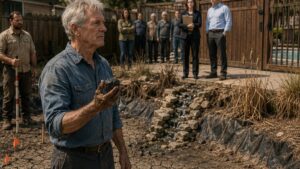
The old survey looked like salvation until Robert carried it down to the shoreline and saw the cedar marker was no longer where the paper said it should be.
He stood with the yellowed plat in one hand and a tape measure in the other, boots sinking into soft ground left torn by the machine tracks. The survey was dated two decades before the HOA put up its first clubhouse sign. It showed his dock tied neatly to Lot 12, with a narrow note in small print: existing lake access retained.
Robert had underlined that note in pencil years ago.
But the shoreline did not care about pencil. Floodwater had eaten the bank and laid silt where grass used to grow. The cedar marker he had measured from sat crooked near the reeds, and when he stretched the tape back toward the house, the numbers made Angela’s gray easement strip seem less ridiculous than he wanted it to be.
Lisa stood behind him, arms folded. “Does it prove anything?”
“It proves what used to be here.”
“That’s not the same.”
“No.”
He hated the answer for being honest.
The ramp, half gone, looked worse in morning light. The orange tape sagged from one cone to another. The removed post hole had filled with dark water. Rusted bolts from the original dock showed along the old frame, and beside them the new concrete anchors he had set looked too fresh, too obvious, too easy for Angela to point at.
Lisa followed his gaze. “You built it well.”
“I built it before I made them answer.”
“You built it because we needed it.”
“I know why I built it.”
“Do you?” she asked.
He looked at her then.
Lisa’s face softened, but she did not take the question back. “Because sometimes I think you built it like if the boards were perfect, nobody could ask why they were there.”
Robert folded the survey along its old creases. “I didn’t want your son discussed at a board table.”
“I didn’t either. But he’s already being discussed. Just without the truth.”
A truck door shut behind them. Paul Clark came down the slope alone, no crew, no machine. He held his work order folded small in one hand.
Robert slipped the survey under his arm. “You here to finish?”
“No.” Paul stopped a few feet from the ramp. “I told them I wasn’t putting the machine back on this bank until somebody above me signs something clearer.”
Lisa’s eyes narrowed. “Angela?”
“Her office called twice.” Paul looked at Robert. “I’m not proud of yesterday.”
“You pulled the post.”
“I did.”
“Why?”
Paul looked at the hole filling with water. “Because the work order said HOA enforcement removal. It had a lot number, a board signature, and a note that owner had been notified. That usually means someone argued for three months and lost.”
“Usually,” Robert said.
Paul nodded. “This one didn’t feel usual.”
“Did Angela tell you to remove first and let me object later?”
Paul rubbed the back of his neck. “Not in those words.”
Robert waited.
“She said the owner was known to delay compliance by asking procedural questions. Said if we knocked first, we’d be there all day. Said to start with the outer posts so the structure couldn’t be used while the paperwork got sorted.”
Lisa’s mouth tightened. “She made sure it would be unusable.”
Paul looked at the ramp. “That’s what it looks like.”
Robert turned the phone recorder on again and held it low. Not hidden. Not dramatic. Just present.
Paul saw it and nodded once. “I’ll say that if someone official asks.”
“Someone official might.”
“I figured.”
After Paul left, Robert returned to the kitchen table with the survey, the HOA covenants, the printed portal page, and the copy of the accommodation letter Lisa finally laid flat in front of him. The house felt too quiet without the lake sounds. Through the back window, the orange tape moved in jerks.
He read the covenants until the words blurred. Exterior structures. Common views. Unapproved changes. Owner responsibility. Committee discretion.
Then he found section 9.7.
Emergency Life-Safety Repairs.
His finger stopped under the heading.
An owner may undertake temporary emergency repair or modification necessary to prevent immediate hazard to persons or property, provided the owner submits notice and supporting documentation within five business days.
Robert read it twice. Then a third time.
Lisa leaned over his shoulder. “That’s it.”
“Maybe.”
“Dad.”
He tapped the page. “Temporary. Necessary. Supporting documentation. They’ll say the ramp wasn’t temporary. They’ll say I used the wrong materials. They’ll say I should have waited.”
“But you notified them.”
“Yes.”
“And they did nothing.”
He looked at the neat stack of papers. “I should have sent certified mail. I should have gone to the office. I should have made them stamp it.”
“You shouldn’t have to build a legal case to keep a child from falling off a dock.”
Robert closed his eyes briefly.
There it was, the thing neither of them had wanted said fully. Not diagnosis. Not details. Just the truth shaped like a person.
A child.
His grandson, who loved the lake but froze at uneven steps. Who gripped rails with both hands. Who trusted Robert’s instructions more than anyone else’s because Robert never hurried him.
Robert opened his eyes. “I thought if I kept it simple, I was protecting him.”
Lisa sat across from him. “You were protecting us from embarrassment.”
He looked down.
She did not say it cruelly. That made it worse.
Before he could answer, his phone rang.
Unknown number.
He almost let it go. Then he saw Lisa watching him, and he answered.
“Robert Walker?”
“Yes.”
“This is Michelle Flores. I’m on the HOA board.”
Robert sat straighter.
“I don’t have long,” she said. Her voice was low, quick, and strained. “Tonight, when Angela brings up the easement map, don’t argue the map first.”
“What should I argue?”
There was a pause.
“Ask her about the county notice.”
Robert looked at Lisa.
“What county notice?”
Michelle exhaled shakily. “The one about the shoreline access hazard. The one the board received before your ramp request.”
Robert’s hand tightened around the phone.
“Michelle,” he said, “what did that notice say?”
Her voice dropped almost to a whisper.
“Ask Angela before the board votes. Make her answer on record.”
Chapter 4: The Board Called Safety A Property Value Problem
Angela Carter opened the meeting with Robert’s face frozen on the clubhouse screen.
In the photo, he stood on the dock with one hand at his side and the other holding his phone, his shoulders squared between the hydraulic machine and the half-torn ramp. The image had been taken from the neighbor’s porch, zoomed tight enough that the fishing chair behind him looked like a prop and the orange tape looked like proof.
Angela stood beside the screen in the same pink blazer, now dry-cleaned back into authority.
“This,” she said, “is not how a community functions.”
A murmur moved through the folding chairs.
Robert sat in the second row with Lisa beside him and the blue folder on his knees. He kept his hands flat over it, not to hide it, but to keep himself from opening it too soon. At the front table, Michelle Flores sat with the other board members, her face carefully blank. She had not looked at him since he entered.
Angela clicked to the next slide. A photo of the ramp appeared, taken before the crew arrived. The handrail looked clean, sturdy, and out of place only because a red circle had been drawn around it.
“Unapproved exterior modification,” Angela said. “Constructed within lakefront view lines. Potential encroachment into common easement. Installed before the committee completed review.”
Robert heard the order in her words. Not what the ramp did. Not who needed it. Only what box it failed to fit.
A board member leaned into a microphone. “Mr. Walker, you’ll have a chance to speak.”
“I’m listening,” Robert said.
Angela clicked again. The HOA map appeared, the gray strip along the shoreline enlarged. “We have rules for a reason. If every homeowner builds first and asks later, our insurance carrier will treat the lakefront as unmanaged risk. Property values suffer. Shared access suffers. The board loses the ability to enforce any standard fairly.”
A man near the back crossed his arms. “So he built on common land?”
Robert felt Lisa stiffen.
Angela did not answer directly. “That is one of the concerns under review.”
The man looked at Robert. “Do you expect special rules because you’ve been here longer than everyone?”
Lisa’s hand moved toward the folder.
Robert touched her wrist once, lightly.
He stood.
The room quieted, not out of respect exactly, but curiosity. He knew how he looked to them: old man, work shirt, lake mud still on one boot, not polished enough for a meeting that smelled of coffee and copier toner.
“I don’t want special rules,” he said. “I want the rules followed all the way through.”
Angela’s expression remained fixed.
Robert held up a printed page. “I submitted the modification request on May 14. The status was pending when the crew arrived.”
Angela said, “Pending is not approval.”
“No,” Robert said. “But pending is also not permission to tear something apart before answering.”
A few heads turned toward the board table.
Robert opened the blue folder but did not remove the medical letter yet. He took out only the portal printout and the section of the covenants he had marked.
“Section 9.7 allows temporary emergency life-safety repair when there is an immediate hazard to persons or property and supporting documentation is submitted within five business days.”
Angela stepped forward. “That section was designed for storm damage, gas leaks, electrical hazards—”
“Where does it say only those?”
“It is not intended as a bypass for exterior aesthetics.”
“The handrail wasn’t built for aesthetics.”
“Then you should have completed the accommodation process.”
Lisa stood so quickly her chair scraped the floor. “We tried.”
Robert looked at her. For a moment he wanted to ask her to sit down. The old instinct rose in him: keep it small, keep it private, don’t let strangers turn family pain into public language.
Lisa opened the folder. Her voice stayed steady, but he could hear the edge under it.
“Request submitted May 14. Supporting letter uploaded May 14. Follow-up message sent May 22. No response. Follow-up message sent May 29. No response. Yesterday, June 11, an HOA crew removed half the ramp before notice was handed to the homeowner.”
The room had changed. Not fully. Not in Robert’s favor. But the first clean line of certainty had cracked.
Angela clasped her hands. “No one is disputing that communication could have been better.”
Michelle’s eyes dropped to the table.
Angela continued, “But an incomplete accommodation request cannot authorize construction that impacts common property and shoreline compliance.”
Robert looked at Michelle.
Ask Angela about the county notice before the board votes.
He waited until Angela turned back toward the screen.
“Was the county involved before my request?” Robert asked.
Angela stopped.
It was small. A hesitation most people might have missed. Robert did not.
“The county?” she asked.
“Shoreline office. Access hazard notice.”
Michelle’s fingers tightened around her pen.
Angela’s tone cooled. “There are ongoing lakefront maintenance discussions unrelated to your violation.”
“Were they before my request?”
A board member looked at Angela. “What notice?”
Angela did not look at him. “Routine correspondence.”
Robert set the covenant page on the chair beside him. “Then put it on the record.”
A silence spread across the room, different from the earlier quiet. This one had weight.
Angela clicked off the screen. “We are not here to litigate broad maintenance matters. We are here to decide whether Mr. Walker’s unapproved structure may remain.”
Lisa said, “You mean whether my son can safely use his grandfather’s dock.”
The words landed before Robert could stop them.
Several residents turned. Someone in the back lowered a phone.
Angela looked at Lisa, then at Robert. For one brief moment, something almost like discomfort crossed her face. Then the board-chair version of her returned.
“No one wants anyone unsafe,” Angela said. “That is precisely why unauthorized structures are dangerous.”
Robert felt tired in a way that had nothing to do with age. “You made it dangerous when you took it apart.”
The board whispered among themselves. Michelle said nothing. Angela took the microphone again.
“The compliance committee is prepared to offer a reasonable path. Mr. Walker removes the remaining ramp and handrail within forty-eight hours. He submits a complete accommodation package through the proper channel. The board will expedite review within ninety days.”
“Ninety days?” Lisa said.
“That is expedited.”
Robert looked at the projected photo still faintly glowing on the dark screen: himself standing between machine and ramp. In the picture he looked stubborn. Maybe he had been. He had thought good work would speak for itself. He had thought privacy was protection. He had thought if he did not force people to see the need, they would at least leave the solution alone.
He stood again.
“No.”
Angela’s brows drew together. “No?”
“I won’t remove the rest of the ramp so you can take ninety days to decide whether the missing half mattered.”
“You are rejecting compromise.”
“I’m rejecting an unsafe one.”
The board chair called for a vote. It happened with raised hands, murmurs, and a speed that made Robert understand the decision had been waiting before he entered.
Michelle’s hand hesitated.
Then, pale and tight-lipped, she raised it with the majority.
Angela looked at Robert without triumph, but with something worse: relief.
“The violation is upheld,” she said. “The remaining structure must be removed within forty-eight hours. Failure to comply will result in further enforcement and cost recovery.”
Robert looked at Michelle.
She did not look back.
Chapter 5: The Missing County Notice Changed The Whole Dock
“Your ramp may be the only thing holding that section stable,” the county clerk said, and then immediately looked as if she wished someone else had said it.
Robert stood at the public counter with a folder under one arm and lake mud on the soles of his boots. Behind the clerk, file cabinets lined the wall beneath a faded map of the county shoreline. Outside the glass door, Lisa waited near the parking lot with her phone pressed to her ear, speaking softly to someone Robert did not interrupt.
“What do you mean?” he asked.
The clerk glanced toward a closed office door. “I’m not the inspector.”
“But you saw the file.”
“I saw the notice.”
“What notice?”
She hesitated, then turned to a stack of scanned documents on her monitor. “There was a shoreline access hazard notice issued to the association. Drainage undermining. Unstable edge. Required corrective plan. The property references include the common buffer behind Lots 10 through 13.”
Robert put both hands on the counter. “Lot 12.”
She nodded.
“When?”
“April 28.”
Before his request. Before the portal. Before Angela’s crew.
Robert felt the room narrow to the small rectangle of light on the clerk’s screen. “Can I get a copy?”
“You can request one.”
“I’m requesting one.”
She printed it, each page sliding out with a soft mechanical scrape. When she placed the notice on the counter, Robert did not pick it up right away. The county seal sat at the top. Beneath it, typed lines described erosion, unsafe transition points, and prohibited disturbance without county clearance.
One sentence held him.
Temporary stabilization measures should remain undisturbed pending inspection.
He read it again.
His ramp had not been official stabilization. He knew that. But the posts had been set exactly where the old transition had begun to sag. He had braced the edge because it moved under his boot. He had told himself it was part of building the ramp safely, not a separate fight.
He heard Lisa enter behind him.
“What is it?” she asked.
Robert handed her the page.
She read the line and closed her eyes for one second. “They knew.”
“We don’t know who knew.”
But he did know enough. Angela had flinched at the words county notice.
The clerk lowered her voice. “The inspector can come tomorrow morning.”
“Tomorrow?”
“That’s the earliest.”
Robert looked at the clouds gathering beyond the parking lot, darkening over the lake road. “There’s a storm coming.”
“I know.”
“If the dock shifts tonight—”
“I can flag the file.” She looked genuinely sorry. “But I can’t send someone who isn’t available.”
Robert folded the notice carefully, not because it was fragile, but because he needed something in his hands to obey him.
Back at the lake, he walked the edge with the county notice, the old survey, and the photo of the ramp before removal. The empty post holes looked larger now. He crouched beside one and pressed two fingers into the wet soil. It gave too easily. The machine tracks had cut through the soft buffer, leaving grooves that would carry rain straight toward the dock frame.
He had built the ramp for access. But he had also braced what his body had felt before his mind named it: the shoreline was failing.
A car door closed near the clubhouse path.
Michelle Flores stood by the records office, arms wrapped around a binder. She looked smaller outside the board table.
“I shouldn’t be here,” she said.
Robert stood. “Then why are you?”
She glanced toward the clubhouse windows. “Because last night I voted like a coward.”
He did not answer.
Michelle walked closer and opened the binder. Inside were meeting notes, bid summaries, and a copy of the same county notice. Yellow highlighting marked estimated corrective costs.
“The reserve fund can’t absorb the full shoreline repair,” she said. “Not without a special assessment.”
“So you delayed it.”
“The board delayed it.”
“You’re on the board.”
The words struck. She accepted them.
“Angela thought if we kept the lakefront visually compliant through the insurance review, we could negotiate more time.”
Robert looked toward his dock, at the orange tape shaking in the wind. “So my ramp was ugly at the wrong time.”
Michelle’s mouth tightened. “It was visible. And it raised questions about that section of the shoreline.”
“Because it was unsafe.”
“Because if one owner started making emergency fixes, others would ask why the association hadn’t.”
There it was. Not cruelty. Not ignorance. Fear shaped into procedure.
Robert looked at the notice in her binder. “Did Angela read this before sending the crew?”
Michelle’s silence answered first.
“Say it,” Robert said.
“She had it.”
The lake wind pushed at the papers. Michelle held them down.
“Will you say that to the county?”
Her eyes lifted. “I don’t know.”
Robert almost laughed. “You called me.”
“I know.”
“You told me to ask.”
“I know.”
“But saying it where it counts is different.”
Michelle shut the binder. “I have neighbors who can’t afford a huge assessment. Fixed incomes. Families already stretched. If this becomes a penalty issue—”
“It became a penalty issue when you tore out the ramp.”
She flinched.
Before she could respond, Angela’s voice cut across the slope.
“Mr. Walker.”
Angela came down from the clubhouse path with her phone in one hand and two board members behind her. She stopped when she saw Michelle.
The air between the two women changed.
Angela’s eyes moved to the binder. “Michelle.”
Michelle straightened. “Robert requested county records.”
“Of course he did.”
Robert held up the notice. “Why didn’t you mention this last night?”
Angela’s face remained composed, but her color had risen. “Because you are misrepresenting a broad maintenance notice as approval for your structure.”
“It says temporary stabilization measures should remain undisturbed.”
“Your ramp was not a county-approved stabilization measure.”
“No. It was safer before your crew pulled the posts.”
Angela stepped closer. “Be careful, Mr. Walker. If you claim your unauthorized construction was structural support, you may be admitting you altered the shoreline without permit.”
Lisa, who had been standing near the truck, snapped, “You can’t use the ramp as proof he broke rules and then pretend removing it didn’t matter.”
Angela turned on her. “Your father created this exposure by building first.”
Robert felt heat rise behind his eyes, but he kept his voice quiet. “No. I created a safe way down to the dock because you ignored the request. You created exposure when you sent machinery into the buffer.”
For the first time, Angela looked past him at the holes, the tracks, the stacked boards, the darkening water.
A phone alert sounded from Lisa’s hand.
Then another from Michelle’s.
Storm Warning: Lakefront Flood Advisory. Heavy Rain And Wind Expected Overnight.
Robert looked at the exposed ramp entrance. At the tape. At the holes filling slowly from below.
The county inspector would not come until morning.
Angela saw the alert too. “No one goes near that dock tonight.”
Robert folded the county notice and put it in his folder. “Then you’d better hope what you removed wasn’t holding more than your argument.”
Chapter 6: The Rain Showed What The Ramp Was Holding
Robert woke to the sound of boards slapping loose against the dock.
Not thunder. Not wind. Wood hitting wood in an uneven rhythm, hard enough to pull him upright before he knew where he was. The house was dark except for the kitchen clock and the pale flash of rain against the windows. Another slap came from outside, then a grinding sound that made the muscles in his back go tight.
He was in his boots before the next gust hit.
The flashlight beam shook only once in his hand as he opened the back door. Rain came sideways across the porch. The lake had climbed up the bank, brown water rolling into the shallow grooves the machine had left. Every track pointed toward the dock like a channel.
Robert pulled his rain jacket on and went down the slope.
The orange caution tape had torn loose from one cone and wrapped itself around the remaining handrail, snapping in the wind. One of the boards Paul’s crew had loosened but not fully removed had lifted at the edge. It slapped down again as water pushed beneath it.
Robert stepped onto the old dock frame, then stopped.
The hole where the first post had been pulled was no longer a hole. It was a small, churning mouth, water pumping up through loosened soil. The second hole beside it had widened. The ground around both had slumped toward the lake.
He aimed the flashlight at the exposed edge.
“Angela,” he said to the empty rain, not as a curse, but like a fact.
He did not go farther. That was the first clear decision. The old Robert, the one who trusted his hands more than anyone’s process, would have grabbed a board and tried to brace it himself. The old Robert would have worked in the dark because waiting felt like surrender.
Instead, he took out his phone.
He filmed the holes. The loose board. The torn tape. The water cutting through machine tracks. Then he called Lisa.
She answered on the second ring, voice already awake. “Dad?”
“Don’t come down the dock.”
“What happened?”
“The edge is moving.”
“I’m coming over.”
“Bring the folder. Stay off the ramp.”
By the time headlights swept across the wet gravel, Robert had set two sawhorses across the path from his shed and tied rope between them. Not strong enough to stop a fool, but visible. Lisa came running from the car with her hood up and the blue folder under her coat.
She stopped at the barrier.
“Dad?”
“I’m here.”
She saw the water and went still.
Behind her, another set of headlights turned into the access road. Then a police cruiser. Then Angela’s car.
Robert watched them arrive through the rain with a strange calm. Some part of him had expected her. Control did not sleep easily when weather was taking over the story.
Angela stepped out beneath a black umbrella. Officer Ryan Garcia came from the cruiser, rain already darkening his uniform. Another officer followed.
Angela pointed toward the dock. “He’s been warned not to use this area.”
Robert lifted his flashlight. “I’m not using it. I’m keeping people off it.”
Ryan came to the barrier and looked down the slope. “Show me.”
Robert handed him the phone with the video already open. Ryan watched the clip without speaking, then looked past him at the empty post holes filling and collapsing.
Angela’s umbrella tilted in the wind. “This is exactly why unauthorized alterations are dangerous.”
Lisa turned so sharply the folder slapped against her coat. “Your crew made those holes.”
“Those posts were part of an unapproved installation.”
Robert said, “And your notice says temporary stabilization shouldn’t be disturbed.”
Angela’s eyes flashed. “That notice does not apply to his ramp.”
Ryan looked at her. “What notice?”
No one answered quickly enough.
Robert took the county copy from Lisa and handed it across the rope. Rain spotted the page instantly. Ryan shielded it under his arm and read by flashlight.
Angela stepped closer. “Officer, that is being taken out of context.”
Ryan looked up. “Did the HOA have county clearance to bring removal equipment into this buffer?”
Angela’s jaw set. “The association has maintenance authority over common shoreline.”
“That wasn’t my question.”
The same words he had used with her the day before. This time they landed harder.
A shout came from behind them.
One of Paul’s workers had arrived with a truck, apparently called by someone in the board office. He was walking down the side path, hood up, carrying a roll of heavier caution fencing. A neighbor followed behind with a phone raised, trying to see what the commotion was.
“Stop there,” Robert called.
The worker didn’t hear over the rain. He stepped around the first cone, aiming for the dock entrance.
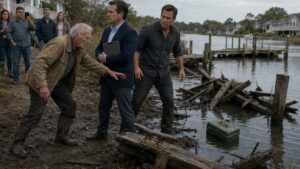
Robert moved faster than anyone expected. He crossed the grass, caught the worker by the sleeve—not hard, but firm—and pulled him back two steps just as the edge board dropped under a wash of water.
The worker stared at the place where his boot would have landed.
Robert let go immediately. “No one goes past the rope.”
The neighbor stopped filming.
Ryan saw the board shift. His face changed from procedural to alarmed. “Everybody back up.”
Angela looked at the worker, then at the board, then at Robert’s hand falling away from the man’s sleeve. For the first time since the first post came out, she had no sentence ready.
Paul Clark arrived ten minutes later, soaked through, carrying his own copy of the work order in a plastic sleeve. He took one look at the slumped holes and swore under his breath.
Ryan asked, “Were you instructed to remove those posts without county clearance?”
Paul looked at Angela.
She said, “Paul.”
He closed his eyes briefly, then opened them. “I was instructed to remove the ramp under HOA enforcement order. I was not given county clearance paperwork.”
“Were you told the owner had already been notified?”
“Yes.”
“Before you arrived?”
Paul looked at Robert. “Yes.”
Ryan wrote that down.
Angela’s umbrella snapped backward in the wind, and she fought it down with both hands. The motion made her look suddenly less polished, less certain, a person trying to hold shape against weather.
“This is becoming unnecessarily adversarial,” she said.
Robert almost answered. Lisa touched his arm.
He let the silence answer for him.
A county truck arrived just after dawn, its amber light cutting through the rain’s gray edge. The shoreline inspector stepped out in rubber boots and a rain shell, carrying a waterproof folder. The inspector did not ask who was upset. The inspector looked first at the water, then the tracks, then the holes.
“Who ordered removal?” the inspector asked.
Angela lifted her chin. “The association issued an enforcement action.”
“After receiving our April notice?”
Michelle appeared at the top of the slope then, hair wet, binder clutched to her chest. She had come after all.
Angela turned toward her. “Michelle, not now.”
Michelle walked down to the rope. “Yes. After receiving it.”
The rain seemed to quiet for one suspended second.
Robert looked at Michelle. She did not look away this time.
The inspector opened the waterproof folder and removed a multi-page notice. Ryan stepped closer. Angela did too, though slowly now, as if each step cost her.
The inspector unfolded the top page, clipped a photograph of the disturbed buffer to it, and read the line without raising their voice.
“Potential civil penalties and restoration liability up to two million dollars may apply for unauthorized disturbance of protected shoreline buffer and failure to maintain safe shared access pending inspection.”
Angela stared at the page.
Robert looked past it to the dock, to the torn tape and the empty post holes filling with rainwater, and understood the document had finally said what he had been trying to say since the machine first started.
The ramp had never been the danger they claimed.
The danger was what they were willing to remove before asking why it had been built.
Chapter 7: Grandpa Went Back To The Lake After The Vote
Angela Carter’s voice shook on the word “million.”
Not much. Not enough for everyone in the clubhouse to hear, maybe. But Robert heard it from the second row, where he sat with Lisa on one side and the blue folder resting open across his knees.
The same screen that had shown his body blocking the demolition crew now showed the county notice. No cropped porch photo. No red circle around his ramp. Just the county seal, the inspection date, the photographs of machine tracks cutting through the shoreline buffer, and the sentence the board could no longer keep off the record.
“Potential civil penalties and restoration liability up to two million dollars,” Angela read, “may apply for unauthorized disturbance of protected shoreline buffer and failure to maintain safe shared access pending inspection.”
A woman near the back whispered, “Two million?”
Angela did not look up.
Robert watched her hands instead of her face. They held the paper carefully, but the bottom edge trembled. For the first time since she had stepped onto his dock in that pink blazer, she looked less like the rules and more like a person trapped inside the consequences of how she had used them.
At the board table, Michelle Flores sat with a binder open in front of her. The county inspector’s report lay beside it, marked with yellow tabs. Officer Ryan Garcia stood near the wall, not part of the meeting, not speaking unless asked, but present because the county had requested a record of the removal order and the site disturbance.
Angela set the notice down. “To be clear, the county has not assessed a final penalty.”
A board member leaned toward the microphone. “But they can.”
“They can,” Michelle said.
The room turned toward her.
Michelle’s voice was quiet but firm. “And the report identifies the association’s removal action as the triggering disturbance.”
Angela’s mouth tightened. “It identifies several contributing factors.”
“Including our failure to respond to the April notice,” Michelle said. “And our failure to respond to Mr. Walker’s May 14 request before enforcement.”
Robert felt Lisa’s hand close around his wrist under the folder.
Angela looked at Michelle as if betrayal could be corrected by eye contact. Michelle did not lower her gaze.
The board chair cleared his throat. “We have a proposed resolution.”
Robert looked down at the papers in his lap. He already knew what the first version said. The association’s attorney had emailed it the night before: temporary permission to reinstall a modified ramp, no admission of fault, confidentiality between parties, future review at the board’s discretion. A settlement shaped like a door that opened only if Robert agreed not to tell anyone how he had been locked out.
The chair continued, “The association will allow Mr. Walker to submit a revised application for a compliant access structure. Enforcement fines will be suspended during review. The parties will work cooperatively toward—”
“No,” Robert said.
The microphone picked up his voice from the room and made it sound larger than he felt.
Angela stared at him. “Mr. Walker, this is a generous path forward.”
Robert stood slowly. His knee ached from the week of climbing around barriers and temporary plywood. He took the county notice in one hand and Lisa’s accommodation letter in the other.
“It is not a path forward if the next person has to fight the same locked door.”
The room stayed quiet.
Robert faced the board, not the residents. “I am not asking this community to read my family’s private medical details. I never wanted that. I still don’t. But I am asking you to write a rule that says when someone submits a safety or access request, the board answers before sending a crew.”
Angela’s lips parted, but he kept going.
“I am asking you to stop treating silence as permission to punish. I am asking you to withdraw the violation. I am asking you to restore the ramp at association cost because your crew made the dock unsafe. And I am asking you to create an emergency repair process that protects people first and argues about stain color later.”
A few residents shifted. Someone near the aisle gave a small nod.
Angela said, “The association cannot simply accept every owner’s definition of emergency.”
“No,” Robert said. “But it can stop tearing things down before reading the file.”
That landed.
Not loudly. There was no applause. No gasp. Just a settling, as if the room had finally understood the difference between a rule and the way it had been used.
Michelle lifted a printed motion from her binder.
“I move that the board withdraw the violation against Robert Walker, authorize immediate restoration of the dock ramp and handrail under county-approved stabilization conditions, pay for restoration from the association’s liability reserve, and adopt an interim emergency safety and accommodation procedure requiring written review before physical enforcement.”
Angela turned toward her. “Michelle.”
Michelle looked pained, but she did not stop. “I also move that all shoreline buffer work be paused unless cleared by the county.”
The chair asked for a second.
For one awful moment, no one spoke.
Then another board member raised a hand. “Second.”
Angela sat down.
The vote was not unanimous. Robert noticed that. He wanted to notice it. Easy endings were for people who did not have to repair what was left after the meeting. But the motion passed.
When the chair announced it, Lisa pressed her fingers to her eyes. Robert looked at the blue folder, at the pages he had tried so hard not to make public, and closed it gently.
Angela approached him after the meeting while residents gathered in murmuring clusters around the coffee table and exit doors. Without the microphone and screen, she looked smaller, but not softer.
“Mr. Walker,” she said.
Lisa stiffened.
Robert waited.
Angela glanced toward the room, then back at him. “I believed I was protecting the association.”
“I know.”
That answer seemed to unsettle her more than anger would have.
“I should have read the accommodation file before enforcement,” she said.
“Yes.”
“And the county notice should have been disclosed.”
“Yes.”
Her face tightened, but she nodded once. “The restoration crew will coordinate with the county inspector.”
Robert looked at her hands. No clipboard this time. “Send it in writing.”
She gave a short, tired breath. “I will.”
A week later, the rebuilt ramp felt different under Robert’s boots.
Not because the boards were better, though they were. The county had required deeper bracing, a wider drainage gap, and a rail bracket that looked less elegant but held stronger under pressure. Paul Clark had returned with his crew, quieter than before, and worked under the county inspector’s watch. The association paid. The removed boards were not reused; Robert asked for one piece back, the section with the bent handrail bracket, and set it in his shed where he could see it from the workbench.
Not a trophy. A reminder.
The fishing chair returned to its place at the lower dock near sunset.
Robert carried it down himself, one hand on the new rail. Lisa watched from the top of the slope, but she did not offer to help. That was her apology and her trust at the same time.
The child came after, moving carefully, one hand sliding along the smooth rail. Robert pretended to fuss with the tackle box so no one had to make the crossing into a ceremony.
Step.
Pause.
Hand forward.
Another step.
The ramp did what it was built to do. It did not ask for explanation. It did not announce itself as kindness. It simply held.
When the child reached the dock, Robert lifted the fishing rod and offered it handle first.
“Think they know we’re watching?” the child asked.
Robert looked at the water, where the evening light had turned gold again over the reeds.
“Fish know plenty,” he said.
Lisa laughed softly from the slope.
Robert sat in his folding chair. Behind him, the new ramp rested firm against the shore. Somewhere in the clubhouse, new rules sat in a binder with signatures and dates. Somewhere in the county office, the penalty file remained open until restoration was complete. None of that made the lake louder.
The bobber drifted once, then steadied.
Robert smiled, not because the board had lost, and not because Angela had been made to read the number aloud.
He smiled because the way home was open.
The story has ended.