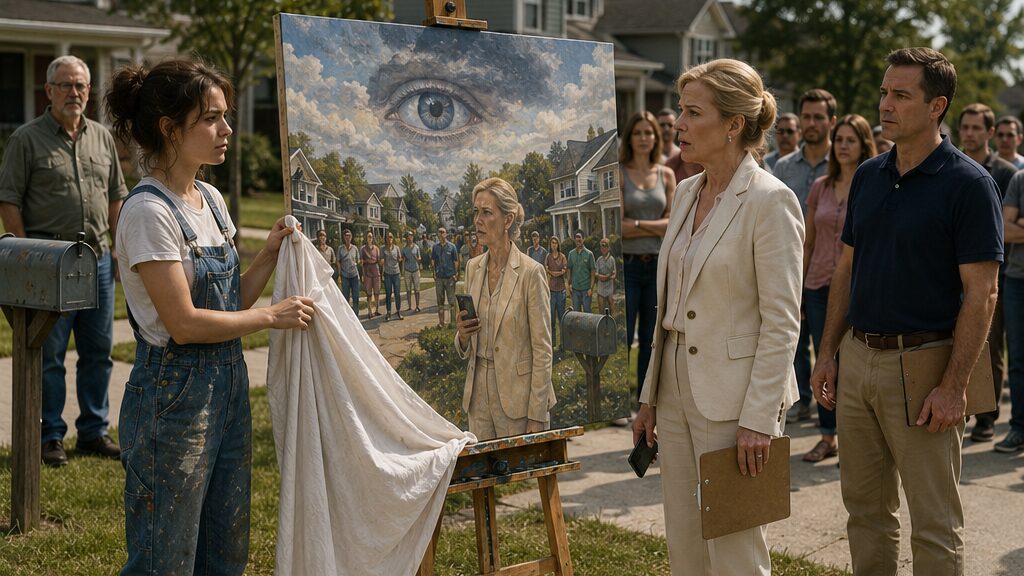
The Woman Who Tried to Ban Saturday Painting Never Expected Her Own Street to Stare Back
Chapter 1: The Easel That Made the Street Stop Talking
Patricia Roberts’s shadow fell across the wet blue of Samantha Lee’s canvas before Samantha heard her clear her throat.
The shadow sliced through the painted street like a dark ruler. It cut across the half-finished curb, the white mailbox with the chipped red flag, the bend of the sidewalk, and the pale outline of something Samantha had not meant anyone to notice yet: an eye, sketched high above the rooftops in thin gray strokes.
Samantha stopped with her brush in the air.
“Are you planning to leave all this out here?” Patricia asked.
Her voice had the polite tightness of someone who had practiced sounding reasonable. She stood on the sidewalk in a bright pink athletic jacket, black leggings, and expensive walking shoes that had never touched mud. One hand rested on her hip. The other held her phone loosely, as if it had simply appeared there and was not waiting to become evidence.
Samantha looked at the easel, the folding stool, the plastic jar of cloudy rinse water, and the beige drop cloth spread over the grass just inside the property line.
“No,” Samantha said. “I bring it in when I’m done.”
“You do this every Saturday.”
It was not a question.
Samantha glanced down the street. The dog walker had slowed near the corner. The young couple across the street had paused with two grocery bags between them. A sprinkler clicked in Richard Hall’s yard, the only sound pretending nothing was happening.
“I paint on Saturdays,” Samantha said.
Patricia’s smile moved, but did not soften. “Samantha, I’m sure this feels harmless to you. But a front yard is not an art studio.”
The words settled over the lawn with more weight than they deserved.
Samantha had heard versions of them before. A driveway was not for chalk. A porch was not for drying canvases. A window was not for taped sketches. A neighborhood, according to people like Patricia, was a place to be maintained, not interpreted.
“I’m not blocking the sidewalk,” Samantha said. “And nothing is permanent.”
Patricia stepped closer, though still carefully avoiding the grass. “The issue is appearance. Community standards. Temporary displays can still create visual clutter.”
Samantha almost laughed, not because it was funny, but because the street behind Patricia was full of visual clutter no one seemed to mind: recycling bins left out too late, campaign signs tucked behind hedges, seasonal wreaths three months out of season, delivery boxes leaning against doors like small accusations.
But Samantha only wiped her brush on a rag.
Patricia tilted her head toward the canvas. “What exactly are you painting?”
Samantha’s fingers tightened around the brush.
The painting was not ready to explain itself. It never was at this stage. At first it looked like an ordinary neighborhood scene: ranch-style houses, narrow lawns, a row of Bradford pears, the gentle curve of Meadowbrook Lane where everyone’s windows faced everyone else’s lives. But beneath the first layer of color, Samantha had already marked the things people missed because they were too busy judging the things they noticed.
The neighbor with the mailbox, lifting the blinds just enough to see who parked where.
The dog walker turning her face away while still watching.
Patricia’s square-shouldered stance reflected faintly in the dark glass of a front door.
And above it all, not fully painted yet, the outline of an eye—not accusing, not kind, simply open.
“It’s the street,” Samantha said.
Patricia looked at the canvas again. For the first time, her expression changed. It was quick, almost invisible, but Samantha saw it: a tiny withdrawal around the mouth, a pause in the eyes.
“The street,” Patricia repeated.
“Yes.”
“That looks like Mrs. Campbell’s mailbox.”
“It’s a mailbox.”
“And that house looks like the Roberts house.”
Samantha did not answer quickly enough.
Patricia’s smile vanished. “Are you painting people’s homes without permission?”
“They’re visible from the sidewalk.”
“That is not the point.”
Samantha lowered the brush. She could feel her heartbeat now, a small pressure behind her ears. She hated that her body responded before her voice did. She hated that she could paint a human face from a ten-second glance but could not make one clean sentence when someone cornered her in public.
“It’s not meant to hurt anyone,” she said.
Patricia gave a short breath through her nose. “Intent doesn’t always matter when impact is negative.”
The dog walker had stopped completely now. The young couple crossed more slowly than necessary. A car rolled past and braked just enough for the driver to look.
Samantha felt the street doing what the painting had already known it did. Watching, measuring, storing.
Patricia glanced toward the observers, then back at Samantha. Her voice became quieter, which somehow made it worse. “As compliance chair, I have to tell you this may be considered an unauthorized display under the Meadowbrook Residential Standards.”
“It’s a canvas.”
“It’s a display when it is visible from common view.”
“It’s visible because I’m painting it.”
“And residents are entitled not to have the neighborhood turned into a spectacle.”
Samantha looked at the canvas. The blue she had just laid down was beginning to bead near the edge of the painted curb. She wanted to fix it before it dried wrong. That simple desire felt childish beside Patricia’s words, but it was also the only thing in the moment that made sense.
From across the street, Richard Hall stood by his garage with a watering wand in his hand. He was in his late sixties, tall but slightly bent at the shoulders, watching with the worried stillness of a man who had seen neighborhood arguments turn official before. His eyes met Samantha’s for half a second, then dropped to the canvas.
Patricia noticed him too.
“Good morning, Richard,” she called.
“Morning,” he said.
His voice held no opinion, which was almost worse than taking a side.
Patricia turned back to Samantha. “I’m asking you politely to pack this up.”
Samantha heard her mother’s voice in her head before she answered. Don’t make this bigger than it is. We live here. They know how to make things difficult.
But she also heard her father’s voice, older and softer, from the last summer he had sat beside her on this same lawn: Ordinary places disappear first, Sammy. Paint them before people forget they had souls.
“I’m not finished,” Samantha said.
Patricia blinked once.
The street seemed to inhale.
“I’ll bring it inside when I’m done,” Samantha added, keeping her voice even. “Like I always do.”
Patricia’s hand tightened around her phone. “Then I’ll have to document it.”
That word—document—made the canvas feel less like an object and more like a crime scene.
Samantha put the brush down and reached for the cloth hanging over the back of the easel. She did not want Patricia photographing the unfinished eye. She did not want that half-made gaze trapped in the HOA portal, stripped of paint and purpose, discussed by people who used phrases like concern and standards when they meant discomfort.
But Patricia was faster.
Her phone came up.
“Please don’t,” Samantha said.
Patricia did not look at her. The camera made a small artificial click.
Samantha froze with the cloth in her hand.
On the screen, she saw the captured image reflected for one brief second: herself standing beside the easel, the street half-painted, the gray outline of the eye hovering above the rooftops, and Patricia’s shadow across it all like a mark someone else had made.
Chapter 2: The Notice Taped Beside the Wet Paint
The violation notice was taped to the front door while the paint on Samantha’s canvas was still tacky enough to take a fingerprint.
She saw it through the narrow window beside the door: a white sheet folded into thirds, sealed in a plastic sleeve, attached with blue painter’s tape someone must have considered polite. The Meadowbrook HOA logo sat in the upper corner, a green oak tree with roots too perfect to be real.
Samantha had been washing brushes at the kitchen sink. A line of diluted blue ran around the drain and disappeared.
Her mother came in from the garage carrying a laundry basket against her hip. Debra Moore saw Samantha’s face first, then the notice.
“Oh, no,” Debra said.
Samantha dried her hands on her jeans. “It might just be a warning.”
Debra set the basket down too carefully. “Warnings are what they send before they decide you ignored them.”
The plastic sleeve crackled when Samantha pulled it from the door. The notice was only one page, but it seemed to have been written by someone determined to make a small thing sound large.
Unauthorized exterior display visible from common area. Potential violation of Section 6.3: Aesthetic Continuity and Temporary Structures. Corrective action requested within seven days. Continued noncompliance may result in hearing, fine assessment, and additional enforcement remedies.
At the bottom, under Compliance Review, Patricia Roberts had signed her name in sharp blue ink.
Debra read over Samantha’s shoulder and pressed her lips together.
“It says potential,” Samantha said.
“It says fine assessment.”
“It says may.”
“Samantha.”
The way Debra said her name made Samantha fold the paper. Not because she agreed, but because she knew that tone. It belonged to utility bills opened at midnight, to the furnace repair that had gone on a credit card, to the year after her father died when every envelope had seemed to arrive holding its breath.
Debra crossed to the kitchen table and sat down. The table was still marked with pale rings from Samantha’s rinse jars, even though she tried to use coasters. A stack of mail sat near the salt shaker, sorted into piles: pay now, pay soon, pretend not to see until Friday.
“I bring everything in,” Samantha said. “Every time.”
“I know.”
“I’m not selling anything. I’m not putting up signs.”
“I know.”
“Then why are you looking at me like I built a billboard?”
Debra rubbed her forehead. “Because they don’t need to be right to make this expensive.”
Samantha looked toward the living room, where the covered canvas stood against the wall. She had moved it inside after Patricia took the photo, but the painting did not feel safe there. The sheet over it made it look like furniture in a house someone had abandoned.
“They can’t fine us for painting,” Samantha said.
“They can fine us for arguing about what painting counts as.”
That landed.
Debra softened when she saw it had. “I’m not saying she’s right. I’m saying we don’t have room for a fight with the HOA.”
Samantha wanted to say that was exactly why people like Patricia kept winning. Because they counted on everyone being too tired, too polite, too broke, too careful. But the words would have been unfair to Debra, who had spent years being careful so Samantha could keep taking art classes and working part-time at the community college instead of grabbing any full-time job with benefits and fluorescent lights.
So Samantha said nothing.
Debra looked toward the covered canvas. “What’s under there that bothered her so much?”
“Nothing.”
“Samantha.”
“It’s just the street.”
“Then why cover it?”
Samantha picked at a dry fleck of blue on her thumb. “Because people don’t understand unfinished things.”
Debra gave a sad little laugh. “People don’t understand finished things either.”
For a moment, Samantha almost told her. Not everything. Not the full shape of the painting, which she barely understood herself. But about the eye. About the way she had started sketching it after noticing how many windows shifted when delivery trucks came, how many curtains moved when Richard forgot to edge his lawn, how many neighbors pretended not to watch Patricia write down trash-bin times on her phone.
About her father, who used to sit beside her on Saturdays with coffee cooling in his hand, naming colors in ordinary things.
That porch isn’t beige, Sammy. It’s oatmeal in shade and warm bone in sun.
The last Saturday before he went back to the hospital, he had pointed down Meadowbrook Lane and said, Paint it while it still looks like people live here.
Samantha swallowed. “Dad liked when I painted outside.”
Debra looked away.
The kitchen changed when he entered it as a memory. It always did. The refrigerator hum became louder. The empty chair beside the window became more visible.
“I know he did,” Debra said.
“He said the light was better.”
“He said a lot of things to keep you painting.”
Samantha looked at her mother then. “You say that like it was a problem.”
“No.” Debra’s voice caught, and she steadied it. “I say it because he didn’t have to stay here and deal with the letters after.”
The words were not cruel, but they had edges.
Samantha folded the notice again, tighter this time. “So what do you want me to do?”
Debra did not answer right away. Outside, a car door closed. Somewhere down the street, a leaf blower started up with an angry whine.
“I want you to bring the easel in,” Debra said. “For now.”
“For now.”
“Just until we know what they can do.”
“That’s what she wants.”
“I know.”
Samantha turned toward the covered canvas. The cloth hung over the top, but one lower corner showed part of the painted curb. A small figure stood there, barely blocked in: a woman with one hand on her hip, facing a house that was not hers.
Debra followed her gaze and stood. “I’m not asking you to stop painting. Just don’t give Patricia Roberts a reason.”
“She already found one.”
“Then don’t give her a better one.”
Samantha wanted to refuse. Instead, she nodded once.
That afternoon, she folded the drop cloth, carried the stool to the garage, and collapsed the easel with more force than necessary. Richard Hall watched from across the street, but this time he did not call out.
By evening, the lawn looked exactly the way Meadowbrook wanted lawns to look: trimmed, empty, harmless.
Samantha waited until Debra went upstairs before opening her laptop. She logged into the Meadowbrook resident portal, intending to read Section 6.3 herself.
A red notification blinked beside Community Updates.
When she clicked it, Patricia’s post filled the screen.
Reminder: Residents are encouraged to report unauthorized displays, sidewalk obstructions, and activities that may affect neighborhood appearance. Thank you to those helping maintain Meadowbrook standards.
Below the message was Patricia’s photo from Saturday.
Samantha stared at it.
The image had been cropped. The easel showed. The jars showed. Samantha’s hand, reaching too late with the cloth, showed.
But the unfinished painted eye had been left perfectly centered.
Chapter 3: What the Compliance Chair Saw in the Canvas
The next Saturday, Samantha painted with the front blinds open and the easel six feet inside the living room.
From the sidewalk, anyone passing could see only her shoulder, the back of the canvas, and the white cloth draped over the lower edge of the window. It was not a violation. It was also not freedom.
Every few minutes, Samantha looked past the glass to the empty patch of lawn where her easel should have been. The grass there was slightly flattened from weeks of Saturday mornings. Without the stool and jars, the space looked like someone had erased a person but left the outline.
Her brush moved anyway.
She painted from memory: the dog walker’s pause at the corner, the young couple pretending not to read the notice still taped inside the Lee-Moore kitchen drawer, Richard’s garage door lifted halfway like a mouth unsure whether to speak.
Then she painted Patricia.
Not as a monster. That was the problem.
Samantha could have exaggerated the sharpness of her chin, the bright jacket, the phone raised like a weapon. It would have been easier. It would have made the painting safer because everyone would know what side it was on.
Instead, the figure on the canvas stood with her shoulders squared and her weight slightly back, as if bracing against something no one else could see. One hand held a phone. The other pressed against her own ribs, half hidden, almost protective.
Samantha leaned in, irritated by the tenderness of it.
“You don’t deserve nuance,” she muttered.
The brush still gave it to her.
Across the street, Patricia Roberts stood behind her own front window and watched the Lee house.
She had not meant to stop there. She had been sorting packets for the upcoming HOA annual meeting: budget summary, landscaping renewal, compliance report, candidate statement. The packets were stacked in perfect corners on her dining table. She had printed them on heavier paper than necessary because presentation mattered. People said substance mattered more, but people trusted substance more when it had clean margins.
She had walked to the window only because she saw movement.
There was Samantha, still painting.
Indoors, yes. Behind glass, yes. But still visible enough to feel deliberate.
Patricia held her coffee without drinking it.
Her husband had once said she could spot a crooked trash bin from a moving car. He had meant it as a joke. She had not laughed. Crooked bins became stained driveways. Stained driveways became rentals no one maintained. Rentals became cars on lawns and mattresses at curbs and people saying, It’s not my problem, until the whole street sagged under everyone’s lowered expectations.
She knew how fast a neighborhood could become a place people apologized for.
She had grown up on one.
Meadowbrook was not that street. She had worked too hard to become the kind of woman who lived in a neighborhood with entry signs, oak trees, and rules people actually read.
Still, the photo in the portal had not landed the way she expected.
A few residents had liked it. One had commented, Thank you for staying on top of this. Another had written, Is that really a problem? Looks like art.
Art. As if the word excused visibility.
Patricia had deleted the second comment because it invited argument in a community forum. She had marked it as off-topic, though she knew that was not entirely true.
Now, through the Lee window, she could see only the edge of Samantha’s canvas. A sliver of color. A pale shape. Something like a roofline.
Then Samantha shifted.
For one brief second, the canvas angled toward the glass.
Patricia saw herself.
Not clearly. Not fully. Just enough: pink jacket, one hand on hip, phone lifted. Her posture was unmistakable. Worse, it was accurate. Not ugly. Not flattering. Accurate in a way that felt like being caught speaking in her sleep.
Her face warmed.
She stepped back from the window, then hated herself for stepping back.
At noon, Brandon Scott called.
“Patricia,” he said, “I’m looking at the compliance log.”
“Good,” Patricia said. “The Lee matter needs to be addressed before the annual meeting.”
“That’s why I’m calling.”
His voice had the careful smoothness of a man who preferred numbers because numbers did not cry at meetings. Brandon was HOA treasurer, but lately he had been acting like a mediator because the board president was traveling and no one wanted to chair a room full of homeowners angry about mulch costs.
“We need to be consistent,” Patricia said before he could continue. “The rule covers displays visible from common areas.”
“It covers temporary structures and signage.”
“An easel is a temporary structure.”
“That might be a stretch.”
“It obstructed the appearance of the front lawn.”
“Was the sidewalk blocked?”
“No.”
“Was anything left overnight?”
“No, but—”
“Then we should be cautious.”
Patricia looked at the packets on her table. Her candidate statement sat on top: Preserve Standards, Preserve Value. She had worked on that phrase for two evenings.
“Cautious is how standards become optional,” she said.
Brandon sighed. “And overreach is how meetings become lawsuits.”
“It is not overreach to ask a resident not to stage personal activity in the front yard every weekend.”
“Personal activity includes gardening.”
“Gardening improves appearance.”
“Kids’ lemonade stands?”
“Brandon.”
“I’m not disagreeing with you completely. I’m saying we need a process.”
Patricia pressed her palm flat against the table. “Then schedule one.”
“A process?”
“A walk-through. Saturday morning. Board members present. We observe, document, and make a determination before the annual meeting.”
Silence traveled through the phone.
“That may escalate things,” Brandon said.
“She escalated it by turning residents’ homes into subject matter.”
“Did she?”
Patricia’s eyes moved to the window again. She could no longer see Samantha, only the Lee house with its plain shutters and slightly uneven porch rail.
“I saw enough,” she said.
By late afternoon, Samantha had finished the section with Patricia’s figure. She had also painted the neighbor with the mailbox, his hand lifting the red flag though he had no outgoing mail. She painted the dog walker’s leash curled around her wrist, her small backward glance. She painted Richard standing in his garage, not entering the scene and not leaving it.
She saved the eye for last.
The first version had been too sharp. It looked accusatory, almost cruel. She softened the lid, warmed the brown near the iris, added the faintest reflection of rooftops in the pupil. The eye did not glare. It watched because everyone watched. It asked because no one asked themselves why.
A chime sounded from her laptop.
Samantha wiped her hands and opened the Meadowbrook portal.
New Official Notice: Scheduled Compliance Walk-Through.
She clicked.
The message was from Brandon Scott, written in formal, bloodless sentences. The HOA board would conduct a review of exterior standards concerns on the following Saturday at 9:00 a.m. The first listed address was hers.
Debra came in behind her and read the screen without a word.
Samantha waited for her mother to tell her to stop, to cover the canvas, to let Patricia have this one.
Instead, Debra looked through the living room window at the empty lawn.
“What are you going to do?” she asked.
Samantha looked at the painting, at the softened eye above the street, at Patricia’s figure standing inside the world she wanted to control.
“I don’t know yet,” she said.
But that was not true.
She knew the easel would be back outside.
Chapter 4: The Street Inside the Painting Looked Too Familiar
Patricia arrived eight minutes before nine with three board members, Brandon Scott, and enough residents trailing behind her to make Samantha’s front lawn feel smaller than it was.
Samantha had not uncovered the canvas yet.
That was the first thing Patricia noticed. The easel stood exactly where it used to stand, just inside the property line, but the painting was draped in a clean white sheet tied at the back with a piece of blue ribbon. The drop cloth was square to the sidewalk. The jars were capped. The folding stool was tucked under the easel, as if Samantha had prepared not a mess but an exhibit.
Debra stood in the doorway with one hand on the frame.
Richard Hall stood near his mailbox, not crossing the street, not staying entirely away.
“Good morning,” Patricia said.
Samantha looked at the cluster of faces behind her: the neighbor with the mailbox, the dog walker with no dog, the young couple across the street standing side by side like they had only meant to check the mail and somehow joined a hearing. Others lingered at the edge of driveways, pretending not to be part of it.
“Good morning,” Samantha said.
Brandon cleared his throat. He wore a navy polo with the Meadowbrook HOA logo embroidered over the pocket, though Samantha had never seen anyone wear one outside a board event. He held a clipboard but kept it low, almost apologetic.
“This is an informal exterior standards review,” he said. “We’re here to observe and clarify the issue.”
“The issue is already clear,” Patricia said. “The resident has resumed the unauthorized exterior display after written notice.”
Samantha’s hands rested at her sides. Her fingers wanted the ribbon. She made them wait.
“It’s not a display,” she said. “It’s my painting.”
“It is visible from common view,” Patricia replied.
“So are porch chairs.”
“That is not comparable.”
“So are garden flags.”
“Those are allowed seasonal items within size limitations.”
“So are people.”
The words slipped out before Samantha could soften them.
A hush moved through the group. Not dramatic. Just enough that the sprinkler ticking somewhere down the block became suddenly loud.
Patricia’s face tightened. “No one is objecting to people, Samantha.”
Samantha looked past her at the faces watching. “I know.”
Brandon shifted his clipboard. “Maybe it would help if we understood what the painting is.”
Patricia turned slightly. “The content isn’t the primary question. The presence of the item is.”
“But the complaint includes potential targeted depiction of residents,” Brandon said.
Samantha looked at him. That was new. “Targeted depiction?”
Patricia’s chin lifted. “You were seen painting recognizable homes and individuals without consent.”
The neighbor with the mailbox blinked and looked at his own mailbox, as if it had betrayed him.
Samantha’s mouth went dry. She had known Patricia might say clutter, standards, obstruction. But targeted made the canvas sound like a threat.
Debra stepped down one porch step. “She paints what she sees from our yard.”
Patricia looked at her with controlled sympathy. “Debra, I understand this is uncomfortable. That’s why we’re trying to handle it through proper channels.”
Samantha hated the way proper channels made her mother look smaller.
She reached for the ribbon.
A few people leaned in before they realized they were doing it.
Samantha untied the blue ribbon slowly, not for effect, but because her fingers had gone clumsy. The cloth loosened. For one second, she almost stopped. She could still choose a smaller life. She could carry the canvas inside, apologize, let the street go back to pretending it did not stare.
Then Richard’s voice came from across the road, quiet but clear.
“Let her show it.”
Patricia looked back at him.
Richard did not move. “You all came to see.”
Samantha pulled the cloth away.
The street stared back.
At first no one spoke.
The painting was larger than it had looked under the sheet. The canvas held Meadowbrook Lane in late morning light, but not as a row of property lots. It curved with life. Houses leaned toward one another through porch shadows. Cars shone in driveways. Hedges shaped little walls. Windows held reflections. The sidewalk wound through everything like a pale ribbon.
Above the rooftops, worked into the sky but not separate from it, was the eye.
It was not enormous in the way Samantha had feared. It did not glare down like a judge. It hovered where the light gathered, its iris built from browns, greens, and grays borrowed from shutters, lawns, tree bark, roof shingles. In the pupil, tiny distorted shapes suggested houses and human figures, the street reflected back into itself.
Beneath it, residents appeared in small, careful moments.
The neighbor with the mailbox stood at his curb, one hand on the little red flag, his face turned toward the Lee house. The dog walker held a leash looped around her wrist, her dog’s nose pointed forward while her own head tilted back. The young couple across the street stood behind their half-open door, grocery bags still in hand. Richard was there too, framed by his garage, one hand on the watering wand, the other resting on the door track.
And Patricia stood in the foreground, phone raised, shadow falling across the grass.
No one was mocked. No one was beautified. Everyone was caught in the act of looking.
“Oh,” the dog walker said.
The young woman across the street touched her own throat. “That’s our porch.”
Her husband leaned closer. “That is our porch.”
The neighbor with the mailbox let out a small laugh that sounded embarrassed before it became real. “You got the dent in the box.”
“I fixed that dent twice,” someone muttered from the back.
A few people smiled. Not broadly. Not yet. But recognition loosened the air.
Samantha stood beside the canvas, feeling exposed in a way she had not expected. She had thought unveiling the painting would protect her, because then they would finally see what she meant. Instead, she realized seeing was not simple. Their faces changed one by one, each person meeting some private version of themselves in color.
Patricia did not soften.
Her eyes had gone straight to the figure in the foreground. Samantha watched her take it in: the phone, the angle of the wrist, the controlled posture, the shadow. There was no name painted beside it. No accusation. But there was no mistaking her.
“This is exactly what I was concerned about,” Patricia said.
The small smiles faded.
Brandon looked from Patricia to the canvas. “Let’s be careful.”
“No,” Patricia said, her voice steady but thinner now. “This crosses a line. This is not landscape art. This is a targeted representation of residents engaged in private activity.”
“Private?” Samantha said before she could stop herself. “Everyone is standing outside or at windows facing the street.”
“People have a reasonable expectation not to become subjects in a resident’s public commentary.”
“It’s not commentary.”
Patricia turned on her. “Then what is it?”
The question opened at Samantha’s feet like a hole.
She could feel the whole street waiting for the answer. Debra on the porch. Richard by the mailbox. Brandon with his clipboard. Patricia in front of the painting and inside it at the same time.
Say it, Samantha thought. Say what Dad said. Say what you mean.
But the words tangled behind her ribs.
“It’s observation,” she said.
Patricia seized on the weakness. “Observation of residents without consent.”
“That’s not—”
“Do you deny that this painting depicts me?”
Samantha looked at the figure on the canvas. Patricia’s shadow crossed the painted lawn. Above it, the eye reflected the street.
“No,” Samantha said.
“Do you deny that you painted other residents watching your home?”
“No.”
A murmur moved through the group.
Samantha felt the scene tipping away from her. She had let the painting speak, but Patricia was translating it faster.
The neighbor with the mailbox cleared his throat. “I don’t feel attacked.”
Patricia did not look at him. “That is your individual reaction.”
The dog walker said, “It’s a little uncomfortable, but maybe that’s the point.”
“The HOA is not here to critique art,” Patricia said. “We are here to determine whether this display creates a nuisance or harassment concern.”
Harassment.
The word struck harder than targeted.
Debra came off the porch. “Patricia, that’s too much.”
“I’m being precise,” Patricia said.
“No,” Debra said. “You’re being frightening.”
That changed the air more than the painting had.
Debra seemed surprised by her own voice. Samantha stared at her mother, seeing the tremor in her hand and the fact that she had stepped onto the lawn anyway.
Brandon raised his clipboard slightly. “Let’s pause. No one is making a final determination on the sidewalk.”
“Then I request,” Patricia said, turning toward him, “that the board require this canvas to be removed from exterior view until the annual meeting.”
Brandon hesitated.
Samantha saw the hesitation and knew what it meant. He knew Patricia was pushing too far, but he also knew the meeting was close, the board was divided, and no one wanted angry residents lining up at open comment.
“The resident can voluntarily remove it,” Brandon said.
“And if she doesn’t?” Patricia asked.
He looked at Samantha, not unkindly. “Then the matter will be added to the annual meeting agenda for formal review.”
Patricia faced Samantha again. “You have until then. Remove the painting from public view. Do not display it in the yard, driveway, or window. If you insist on making residents part of your art, be prepared to explain why.”
Samantha folded the white cloth in her hands. The easy answer was yes. Bring it inside. Hide it again. Let the meeting happen without her.
But behind Patricia, the neighbor with the mailbox was still looking at his painted self. The dog walker’s expression had shifted from embarrassment to thoughtfulness. Richard had crossed the street at last and stood at the edge of the lawn.
Samantha lifted the cloth, but she did not cover the canvas.
“I’ll bring it to the meeting,” she said.
Patricia’s eyes narrowed.
Samantha heard Debra inhale sharply beside her.
Brandon wrote something down.
And for the first time all morning, the painted Patricia and the real one seemed to share the same expression: both of them staring at Samantha as if she had stepped outside the lines they had drawn for her.
Chapter 5: The Rule Was Never Written for This
Richard Hall brought the folder over that afternoon as if it might burn his hands if he held it too long.
Samantha found him on the porch, standing just outside the doorbell’s reach. He wore a faded work shirt and carried a manila folder under one arm, its corners soft and darkened from years in a garage cabinet. When she opened the door, he glanced past her toward the living room, where the canvas leaned against the wall uncovered.
“I should have given this to you before,” he said.
Samantha stepped aside. “What is it?”
“Something your father left with me. Or maybe something I kept because I didn’t want to decide what to do with it.”
Debra appeared at the end of the hall. At the sight of Richard, her face tightened in the polite way people had when history entered without calling first.
“Richard,” she said.
“Debra.”
No one moved for a second.
Then Debra looked at the folder. “Is that about the HOA?”
“Partly.”
Samantha took it to the kitchen table. The same table where the notice had been folded, where bills were sorted, where her father used to sharpen pencils with a pocketknife over an old mug. Richard sat only after Debra did, and even then on the edge of the chair.
Inside the folder were old Meadowbrook newsletters, photocopied rule pages, a few yellow sticky notes gone nearly transparent, and three sketches wrapped in tracing paper.
Samantha touched the sketches last.
The first showed Meadowbrook Lane fifteen years earlier. The trees were smaller. The mailboxes looked newer. The Lee house still had the porch swing her father had built before the brackets rusted out. The second sketch showed Richard’s garage from across the street, the door half-open even then. The third was unfinished.
It was the same bend of sidewalk Samantha had painted.
Her father’s lines were looser than hers. Faster. He had drawn the street as if he trusted it to hold still only for a minute. But there, lightly marked above the roofline, was an oval shape that might have become an eye or might have become a cloud if he had lived long enough to choose.
Samantha stared until the paper blurred.
“He painted this?” she asked.
Richard nodded. “He sketched constantly. Said the street had more faces than people gave it credit for.”
Debra pressed her fingers to her mouth.
Samantha looked up. “Why didn’t I know?”
“Because after he got sick, he stopped showing people unfinished things,” Debra said quietly.
The words landed too close.
Richard slid one of the photocopied pages forward. “This is Section 6.3 before they revised the formatting.”
Samantha blinked herself back to the table.
The old rule was shorter than the current version. No unauthorized signs, banners, storage structures, abandoned construction materials, or temporary displays shall remain visible from common areas in a manner that diminishes aesthetic continuity.
Beside temporary displays, someone had handwritten: campaign signs? yard sale? broken patio set left 3+ weeks?
“That’s it?” Samantha asked.
“That’s what it used to be.”
Debra leaned in. “It doesn’t say painting.”
“No,” Richard said. “It wasn’t written for someone actively using an easel. It was written after a homeowner left a torn party tent frame in his driveway for a month and called it temporary.”
Despite herself, Samantha almost smiled. “A party tent?”
“Blue tarp, bent poles, two lawn chairs, and a grill with no lid,” Richard said. “It was a sight.”
Debra gave the smallest laugh, then covered it.
Samantha looked at the current notice on the counter. “Then Patricia stretched it.”
“Boards do that,” Richard said. “Sometimes because they have to. Sometimes because it’s easier than admitting they don’t like something.”
His tone had changed.
Samantha looked at him. “You said you should have given this to me before.”
Richard rubbed his thumb along the folder’s edge. “There was another dispute. Years back. Before Patricia chaired compliance, but she was involved.”
Debra’s shoulders stiffened. “Richard.”
Samantha turned to her mother. “You know about this?”
Debra did not answer.
Richard continued carefully. “A neighbor on the next block kept a bench by the curb for her husband. He had trouble walking from the mailbox. It wasn’t fancy, but it was neat. Patricia pushed the board to classify it as an unauthorized fixture.”
Samantha felt something cold move through her. “What happened?”
“The bench went away. The neighbor stopped coming outside much. They moved the next spring.”
“Because of a bench?”
“Because of what the bench came to mean,” Richard said.
Debra stood and went to the sink though there were no dishes there. “It was not that simple.”
“No,” Richard agreed. “It rarely is.”
Samantha looked from one adult to the other. “Did Dad know?”
Richard’s eyes lowered. “Your father spoke at that meeting.”
Debra turned. “He was already sick.”
“He spoke anyway.”
“What did he say?” Samantha asked.
Debra’s face had gone pale, not with anger exactly, but with an old exhaustion. “He said a neighborhood that can’t tolerate a bench for a tired man has confused neatness with goodness.”
Samantha sat back.
The sentence sounded so much like him that she could hear the shape of his voice around it. Gentle. Almost amused. More devastating for not being loud.
“And then?” she asked.
Richard did not look at Debra this time. “The board tabled the issue. Patricia kept pressing. The family removed the bench before the next vote.”
“So nothing changed.”
Richard folded his hands. “No.”
“And you kept all this?”
“Your father asked me to look over the rule. I was still doing consulting then. Architecture, code review, that sort of thing. I told him the HOA had broad discretion but weak language. He said weak language was where unfair people liked to hide.”
Samantha touched the old sketch again. The almost-eye above the roofline seemed less like an invention now and more like an inheritance.
Debra spoke from the sink. “I didn’t want you carrying his fights.”
Samantha looked at her mother’s back. “So you let me think I was starting one.”
Debra flinched.
The words were unfair. Samantha knew that as soon as they left her mouth. But she did not take them back.
Debra turned slowly. “I let you keep painting because he asked me to. I asked you to be careful because he wasn’t here to see what careful costs now.”
The room went quiet.
Samantha looked at the folder, the notice, the covered history of benches and easels and people made to feel like the things that helped them live were unattractive.
“What happened to Patricia?” she asked.
Richard frowned slightly. “What do you mean?”
“Why is she like this?”
Debra and Richard exchanged a look.
Richard answered first. “She grew up over by East Marlow. Before the redevelopment. Her mother’s house was on a street that went downhill fast after the plant closed. She told me once that if someone had enforced standards early, maybe people wouldn’t have given up on it.”
“That doesn’t give her the right to do this,” Samantha said.
“No,” Richard said. “It explains the shape of her fear. Not the damage she does with it.”
Samantha sat with that.
It would have been easier if Patricia were only mean. A pure villain could be painted with hard lines. But fear required a steadier hand. Fear could still hurt people. Fear could still become a clipboard, a notice, a public post, a demand.
Richard pulled one more paper from the folder. “There’s a records room at the clubhouse. Owners can request access to meeting minutes. If you’re going to speak, don’t just bring a painting. Bring the rule.”
Samantha looked at Debra.
Her mother held her gaze for a long moment, then nodded once.
At the clubhouse, the records room smelled like old paper and carpet glue. Brandon Scott met them there with a key ring and an uneasy expression. He did not ask why Richard came. He did not ask why Debra stood so close to Samantha.
“I can give you thirty minutes,” Brandon said. “Copies have to be requested formally.”
“Can we take notes?” Samantha asked.
“Of course.”
The minutes confirmed what Richard remembered. The temporary display rule had been discussed after abandoned items, signage, and long-term storage complaints. Nothing about active painting. Nothing about residents sketching from their own property.
Then Samantha found the handwritten note in the margin of a photocopied draft: avoid subjective enforcement.
The words were underlined twice.
She stared at them until Brandon shifted beside her.
“That was before my time,” he said.
“But not before the rule.”
“No.”
“Then why did nobody say that?”
Brandon rubbed the bridge of his nose. “Because sometimes the board handles the person in front of them instead of the rule underneath.”
It was the closest thing to an admission she had heard.
That night, Samantha set her father’s sketch beside her own painting. The two streets looked at each other across the living room floor. Debra sat on the couch, silent, holding one of the old newsletters.
Samantha picked up the white cloth.
“You don’t have to do this,” Debra said.
“Yes,” Samantha said. “I do.”
She folded the cloth, not around the canvas, but into a neat square.
At the annual meeting, the painting would not be hidden.
Chapter 6: Before the Board Could Vote, Samantha Turned the Canvas Around
The covered canvas stood beside the HOA voting table like a witness no one had sworn in.
The clubhouse smelled of coffee, printer toner, and the lemon cleaner the association used before meetings. Folding chairs filled the room in uneven rows. Residents murmured over paper agendas while board members arranged name placards at the front table. The canvas, taller than the table and draped in white, drew every glance people tried not to give it.
Samantha stood beside it with both hands around the wooden frame.
Debra sat in the front row. Not by the aisle where she could escape easily, but directly in front of Samantha, purse in her lap, shoulders squared. Richard stood along the side wall with his arms folded. Brandon sat at the board table, shuffling papers he had already straightened twice.
Patricia entered last.
She wore a cream blazer and carried a slim folder instead of a clipboard. Her hair was smooth, her face composed, her smile ready for a room that might still choose her. When she saw the covered canvas, her steps slowed only slightly.
Then she walked to the table and took her seat.
Brandon called the meeting to order because the board president was absent. He moved through budget approval, landscaping costs, and pool maintenance with the clipped pace of a man trying to outrun the item everyone had come to see.
Samantha heard almost none of it.
Her palms had begun to sweat against the stretcher bars. She had not slept much. Each time she closed her eyes, she saw Patricia’s face at the walk-through, the quick flash of hurt buried under accusation. She saw Debra turning away at the kitchen sink. She saw her father’s almost-eye, unfinished above a street that had already been learning to watch itself.
“Next agenda item,” Brandon said at last. “Exterior standards review regarding the Lee-Moore property.”
Chairs creaked. Someone coughed. A phone screen dimmed.
Patricia opened her folder. “I’ll begin with the compliance summary.”
Samantha forced herself not to interrupt.
Patricia’s voice was calm, professional, and effective. She did not call Samantha disrespectful. She did not mention embarrassment. She said “resident concern,” “visibility from common areas,” “recognizable depictions,” and “potential precedent.” She described the easel as a temporary display. She described the painting as a possible nuisance. She described the HOA’s responsibility to uphold standards evenly.
Evenly, Samantha thought, looking at the rows of faces. As if all standards fell on all people the same way.
Patricia finished with a page placed neatly on the table. “This board cannot make decisions based on whether an object is meaningful to one resident. Feelings cannot override standards.”
The sentence settled cleanly because it sounded true enough to be dangerous.
Brandon looked toward Samantha. “You asked to speak.”
Samantha’s throat tightened.
She could have started with the rule. Richard had helped her organize the pages. The old minutes were in a folder under her chair. Brandon knew what they said. So did Patricia, probably. Samantha could argue definitions, active use, temporary structures, common-view interpretation.
Instead, she turned the canvas around.
The cloth slipped off in one motion.
A small sound moved through the room.
The painting looked different under fluorescent lights. Less gentle, maybe. More exact. The eye above the street held the room in it now, or seemed to. Meadowbrook Lane curved below, full of small figures caught watching, pausing, measuring. Patricia’s painted figure stood in the foreground with the phone raised, her shadow touching the grass but not swallowing it.
Samantha did not look at Patricia first.
She looked at the residents.
“This is what I painted,” she said.
Her voice shook on the first word and steadied by the last.
A hand rose halfway in the second row, then dropped. The neighbor with the mailbox leaned forward. The dog walker pressed her lips together. The young couple across the street sat very still.
Patricia’s face had gone unreadable.
Samantha picked up her father’s sketch from the small stand beside the easel and held it where the front row could see. “This is what my father sketched before I did.”
Debra’s eyes closed.
“He used to say ordinary places disappear first,” Samantha said. “Not because the houses fall down. Because people stop seeing the people inside them.”
She glanced at Patricia then, but only briefly. If she stared too long, the room would turn it into a duel.
“I didn’t paint this to shame anyone. I painted what Saturdays look like from my yard. The mailboxes. The porches. The people walking dogs. The windows opening. The way we all know when someone’s grass is too long or whose trash bin stayed out overnight. The way we notice everything except what it feels like to be noticed.”
No one moved.
Samantha reached for the folder of records. “I also looked up the rule.”
Brandon lowered his eyes.
“Section 6.3 was written for abandoned items, signs, and temporary structures left out long enough to affect the neighborhood. The draft notes say to avoid subjective enforcement.”
She set the photocopy on the board table. Not dramatically. Just close enough for Brandon to see the underlined words.
“This easel is not stored outside. It does not block the sidewalk. It comes in when I’m done. If the board wants a rule that says no one can paint in a front yard, then vote on that honestly. But don’t call my painting a nuisance because it made people uncomfortable to recognize themselves.”
A few heads turned toward Patricia.
Patricia’s hands were folded on the table. Her knuckles were pale.
“That is a mischaracterization,” she said.
Samantha nodded once. “Maybe.”
The room shifted again, surprised by the concession.
Samantha took a breath. “Maybe you really did think you were protecting the neighborhood.”
Patricia looked up sharply.
“But I live here too,” Samantha said. “My mother lives here. My father lived here. The neighbor who needed a bench lived here. People should not have to disappear from their own street to keep it looking acceptable.”
Debra stood.
Samantha’s voice caught, because that was not planned.
Her mother held her purse in both hands like she needed something to anchor her. “I told Samantha to take the easel inside,” Debra said.
The room turned toward her.
Debra looked at no one but Patricia. “Not because I thought she was wrong. Because I was afraid you would make being right too expensive.”
Patricia’s face changed. The change was small, but Samantha saw it. So did Brandon.
Debra continued, softer now. “I have been afraid of letters on the door for years. I have been afraid of comments in the portal. I have been afraid that one wrong thing in the yard would become a bill I couldn’t pay or a meeting where people discussed my house like I wasn’t sitting there. That isn’t community standards. That’s fear with stationery.”
No one laughed. No one clapped.
It was better that way.
Samantha felt something loosen in her chest, something she had thought the painting would loosen but had not.
Patricia looked down at her folder. For a moment, Samantha thought she might apologize. Or defend herself. Or leave.
Instead, Patricia said, “My concern remains precedent.”
Brandon exhaled slowly.
Patricia lifted her eyes to the room. “If every resident decides their personal expression belongs in the front yard, then standards become unenforceable. I understand that this painting has emotional meaning. I am not dismissing that. But the board’s responsibility is not to individual expression. It is to the collective appearance and value of the community.”
There it was again, polished until it almost shone.
Samantha could feel anger rising, bright and tempting. She could tell them about East Marlow. Richard had said enough. She could paint Patricia’s fear for everyone, make the room see the crumbling street she was still running from. It would be easy now. Patricia had given her the opening.
Samantha looked at the painted figure in the foreground. The hand on hip. The phone. The shadow.
Then she looked at the real woman behind the table, holding herself together with rules.
“No,” Samantha said quietly.
Patricia frowned. “No?”
“I’m not going to make you smaller so I can win.”
The room went utterly still.
Samantha turned back to the board. “I’m asking you to withdraw the violation because the rule doesn’t fit. I’m asking you to stop using the portal to turn residents into examples. And I’m asking to keep painting on Saturdays, as long as I’m not blocking the sidewalk or leaving materials out overnight.”
Brandon looked at the other board members. A silent exchange passed between them, full of calculation, embarrassment, and relief that someone had finally put the matter into terms they could vote on.
He picked up the photocopied rule page. His eyes stopped on the underlined note.
Avoid subjective enforcement.
Patricia sat very straight.
Brandon set the page down. “The motion before the board is whether the violation notice regarding the Lee-Moore property should stand and proceed to fine assessment.”
A hand rose from one board member. Another adjusted glasses and nodded.
Brandon looked at Samantha, then at Patricia, then out at the residents who had come to watch and found themselves watched back.
“A
Chapter 7: The Neighborhood Standards Changed on a Saturday Morning
Samantha carried the easel back to the lawn one week later without knowing whether anyone would stop her before she unfolded the legs.
The vote had ended with two hands raised to uphold the violation, three against, and Brandon Scott staring at the table for a long second before saying, “The notice is withdrawn.” He had not sounded triumphant. No one had. Even the people who agreed looked careful, as if the room itself had become something fragile.
Patricia had left through the side door before the chairs were stacked.
Now, on Saturday morning, the official withdrawal letter sat inside the house on the kitchen table. Samantha had read it four times. Debra had read it once, then placed a coffee mug on the corner to keep it from curling.
No fine would be assessed. No further action would be taken regarding the easel, provided materials were not left overnight and access to the sidewalk remained clear.
The words were practical, narrow, almost boring.
They were also the first HOA letter Samantha had ever seen that made her mother cry.
The street was quiet when Samantha set the easel down. She placed the legs carefully on the grass, then checked the distance from the sidewalk even though she already knew it was clear. The habit annoyed her. Patricia had gotten inside her hands. She shook them once and reached for the canvas.
Not the finished painting. That one was inside, leaning against the dining room wall, still too charged to bring out casually.
Today she had a fresh canvas.
Blank.
That was somehow worse.
The neighbor with the mailbox stepped out first. He carried two envelopes and no obvious reason to linger, but he stopped at the curb.
“Morning,” he called.
“Morning,” Samantha said.
His eyes went to the canvas. “Starting a new one?”
“Trying to.”
He nodded as if this were a serious weather report. “The dent’s still there, if you need accuracy.”
Samantha smiled before she could stop herself. “I’ll keep that in mind.”
He put the envelopes in the mailbox and lifted the red flag with exaggerated care. It was the first time she had seen him do it without pretending he wasn’t aware of her.
The dog walker came next, this time with the dog. The little brown animal pulled toward Samantha’s lawn, nose twitching at the jars.
“Not today,” the dog walker murmured, then looked at Samantha. “I told my sister about the painting.”
Samantha’s grip tightened on a tube of paint. “Oh.”
“She said it sounded creepy.” The dog walker winced. “I told her it wasn’t. I told her it made me realize I always look back at your house because I’m worried you’ll think I’m judging you, which is ridiculous because looking back probably makes it worse.”
Samantha blinked, then laughed softly. The dog walker laughed too, relieved.
“I’m not sure I painted that much,” Samantha said.
“You painted enough.”
The young couple across the street came out with travel mugs and stood on their porch. The woman lifted her hand in a shy wave. Samantha waved back.
One by one, Saturday resumed, but it did not return to what it had been. The street still watched. People still paused. Windows still shifted. But the watching had changed shape. It had less hiding in it.
Samantha squeezed a line of pale yellow onto her palette.
The front door opened behind her, and Debra came down the steps with a second cup of coffee.
“You forgot this,” Debra said.
“I left it there.”
“I know.”
Debra handed it to her anyway.
The two of them stood beside the easel, shoulder to shoulder. For years, Debra had stayed near the doorway when Samantha painted, close enough to call her in if necessary, far enough to pretend she was not waiting for trouble. Today she stepped onto the lawn.
“Your father would have put too much sugar in that,” Debra said.
Samantha looked into the coffee. “He said bitter coffee was a failure of imagination.”
“He said a lot of things while ruining perfectly good coffee.”
Samantha smiled, then glanced at her mother. “Are you okay?”
Debra looked at the blank canvas instead of answering quickly. “I’m less afraid than last week.”
“That’s not the same.”
“No.” Debra took a breath. “But it’s more than I had.”
A car slowed near the curb. Samantha braced without meaning to.
It was Brandon Scott.
He parked two houses down, got out, and walked toward them with both hands visible and no clipboard. The absence was so obvious that Samantha almost looked for where he might have hidden it.
“Good morning,” he said.
Debra’s expression guarded itself. “Brandon.”
He nodded to her, then to Samantha. “I wanted to make sure you received the withdrawal.”
“We did,” Samantha said.
“Good.” He looked at the easel. “And I wanted to say the board will be reviewing the language in Section 6.3.”
Debra raised an eyebrow. “Reviewing it how?”
“With counsel, hopefully. And with resident comment before any changes.” Brandon’s mouth tightened. “We should have done that before applying it this way.”
It was not quite an apology, but it did not dodge responsibility either.
Samantha accepted it with a nod. “Thank you.”
He seemed relieved by the simplicity of that. Then he glanced back toward the street, where a few residents were pretending not to watch the conversation. “There’s also been a request.”
Samantha waited.
“Several residents asked whether your painting could be displayed at the clubhouse.”
Debra’s cup paused halfway to her mouth.
Brandon hurried on. “Not as an HOA branding thing. Or not necessarily. Just—people have been talking about it. Some thought it might be good for the fall open house.”
There it was, Samantha thought. The neighborhood’s talent for turning discomfort into décor.
She imagined the painting hung between notices about pool hours and recycling rules. She imagined Patricia walking past her own painted figure every board meeting. She imagined residents pointing with paper cups in their hands, saying, That’s me, as if being recognized once meant the work was finished.
“I’m not sure,” Samantha said.
Brandon nodded too quickly. “Of course. No pressure.”
But pressure did not always need force. Sometimes it arrived dressed as appreciation.
“I’d need conditions,” Samantha said.
Debra looked at her, surprised.
Brandon straightened. “What kind?”
“If it’s displayed, my statement goes with it. Not a caption from the board. Mine. And no using it in campaign materials, newsletters, property-value flyers, or anything that makes it look like the HOA sponsored it.”
Brandon’s ears reddened slightly. “That’s fair.”
“And residents can opt into future paintings. Not as subjects being watched. As participants.”
The word felt strange and right.
Brandon looked toward the young couple, the dog walker, the neighbor with the mailbox. “I think people might like that.”
“Some will,” Samantha said. “Some won’t.”
“That’s also fair.”
He left soon after, walking carefully around the edge of the lawn as if the grass had become a boundary he was newly aware of.
Samantha dipped her brush into the yellow, but before she touched the canvas, a familiar figure appeared at the bend of the sidewalk.
Patricia Roberts was walking without her phone in her hand.
She wore a pale blue sweater, jeans, and simple flats. No blazer. No folder. No sunglasses pushed into her hair. Her arms hung stiffly at her sides, as if she did not know what to do with them without something official to hold.
The street noticed immediately.
The neighbor with the mailbox shut his mailbox too hard. The dog walker slowed. The young couple became very interested in their coffee lids. Debra’s whole body went still beside Samantha.
Patricia stopped at the edge of the sidewalk.
“Good morning,” she said.
Samantha set the brush down. “Good morning.”
Patricia looked at the easel. Then at the blank canvas. Then at the grass beneath it, where the legs stood neatly inside the property line.
“I’m not here in any official capacity,” she said.
No one asked what capacity she had come in.
Debra’s voice was cool. “Is there something you need?”
Patricia’s gaze flicked to her and back to Samantha. “I wanted to say that the board made its decision.”
“Yes,” Samantha said.
“And I will respect it.”
The words were stiff, but they cost her something. Samantha could see that. Not enough, maybe. Not everything. But something.
Patricia’s fingers curled once, empty. “I also wanted to say I did not intend to frighten your mother.”
Debra did not soften. “But you did.”
Patricia took that without looking away. “Yes.”
A breeze moved the corner of Samantha’s drop cloth. She put her shoe on it to keep it from lifting.
Patricia looked down the street, at the houses she had spent years trying to hold in place with rules. “Where I grew up, people stopped caring by inches. One couch on a porch. One car that didn’t run. One yard no one mowed because the owner got sick and then the neighbors stopped mowing too. By the time anyone noticed, everyone had already decided it was normal.”
Samantha said nothing.
Patricia’s mouth tightened. “That is not an excuse.”
“No,” Debra said.
Patricia nodded once, accepting the correction. “It is the reason I notice things too fast.”
The dog walker moved on quietly, giving them privacy only after hearing enough to know privacy was needed.
Patricia looked at the blank canvas. “In your painting, I looked exactly the way I must have looked.”
Samantha waited.
“I hated it,” Patricia said.
This time, Samantha did not mistake honesty for apology. She let the words stand as what they were.
Patricia drew a breath. “I don’t know that I liked being painted. But I understand now that not liking a mirror is not the same as being harmed by it.”
Debra’s eyes shifted to Samantha.
Samantha picked up her brush, not to paint, but to have something in her hand. “I wasn’t trying to make you smaller.”
“I know.”
Then Patricia added, almost too quietly, “That may have been why it worked.”
The street gave them a little silence.
Patricia did not ask to be forgiven. Samantha was grateful for that. Forgiveness asked too quickly could become another kind of enforcement, another form to sign before anyone had read the damage.
Instead, Patricia stepped back from the curb. “Have a good Saturday.”
“You too,” Samantha said.
Patricia walked away, slower than usual.
Debra watched her until she turned the corner. “That was not an apology.”
“No,” Samantha said. “But it wasn’t a notice.”
Her mother laughed once, unexpectedly, and wiped under one eye with her thumb.
By midmorning, the blank canvas had become less blank. Samantha did not paint the street exactly as it stood. Not this time. She started with the sidewalk, then the bend in the curb, then the mailbox with its stubborn dent. The neighbor with the mailbox came over and asked if he should stand somewhere specific.
“No,” Samantha said. “Just don’t pretend you’re not looking.”
He laughed and stayed.
The young couple asked if she would paint their porch swing when they finally fixed the chain. The dog walker asked if the dog could be included “from a flattering angle,” which made Debra laugh hard enough to spill coffee on the porch step.
Richard arrived last, carrying the old folder under one arm.
“Thought you might want this nearby,” he said.
Samantha saw the edge of her father’s sketch inside and shook her head gently. “Keep it safe a little longer.”
Richard studied her face. “You’re sure?”
“I know where it is now.”
He nodded, understanding more than she had said.
Around noon, Brandon’s email arrived on Debra’s phone. The subject line made Debra read it aloud from the porch: Community Artwork Display Request.
Samantha wiped paint from her wrist and listened.
The email was careful, almost overly so. It confirmed that the HOA would not reproduce, display, photograph for promotional use, or relocate Samantha’s original painting without written permission. It invited her to propose terms if she wished to share the work at a resident-led gathering rather than an official board event.
Debra looked up. “Resident-led.”
Samantha glanced at Brandon’s house down the street. “He learns fast.”
“Do you want to do it?”
Samantha looked at the canvas in progress. The new painting had no large eye in the sky. Not yet. Instead, she had left a blank space above the rooftops, a pale open place where something might go or might not.
Residents had begun to drift closer, not as a crowd, not as witnesses called by a complaint, but as people with ordinary excuses. A question about color. A joke about mailboxes. A quiet request to see the old painting someday, if Samantha was willing.
She thought of the first painted eye, sharp with the need to prove what everyone was doing. She thought of her father’s unfinished oval, hovering between cloud and witness. She thought of Patricia walking away without a clipboard.
“I might share it,” Samantha said. “But not so they can say Meadowbrook supports art.”
Debra leaned against the porch rail. “Then why?”
Samantha touched the brush to the canvas and painted the first warm line of Richard’s garage door.
“So people remember they live next to each other,” she said.
The words sounded like her father and like herself at the same time.
Later, when the light shifted and the shadows shortened under the mailboxes, Samantha climbed onto the porch and looked at the canvas from a distance. The street was there again, but changed. Less watched. More awake. The figures did not hide behind windows. Some stood on lawns. Some waved. Some remained uncertain at the edges, which felt honest.
Above the rooftops, she had still not painted the eye.
She stood with the brush in hand, studying the blank space.
Debra came beside her. “Leaving it?”
“For now.”
The blank space did not feel empty. It felt like a place the street had not earned yet, or maybe a place Samantha no longer needed to fill for it. The watching had not vanished. Meadowbrook would still argue about lawns and bins and porch furniture. Patricia would still notice too much. Brandon would still write careful emails. Debra would still worry when envelopes came with logos in the corner.
But the easel stood on the lawn.
The sidewalk remained clear.
No one had asked Samantha to cover the canvas.
She stepped back down into the grass and added one final detail: not an eye, but a small unpainted oval of light above the rooftops, open enough to become a cloud, a window, or a question.
Then Samantha rinsed her brush, looked down Meadowbrook Lane, and began painting the people who had stayed.
The story has ended.