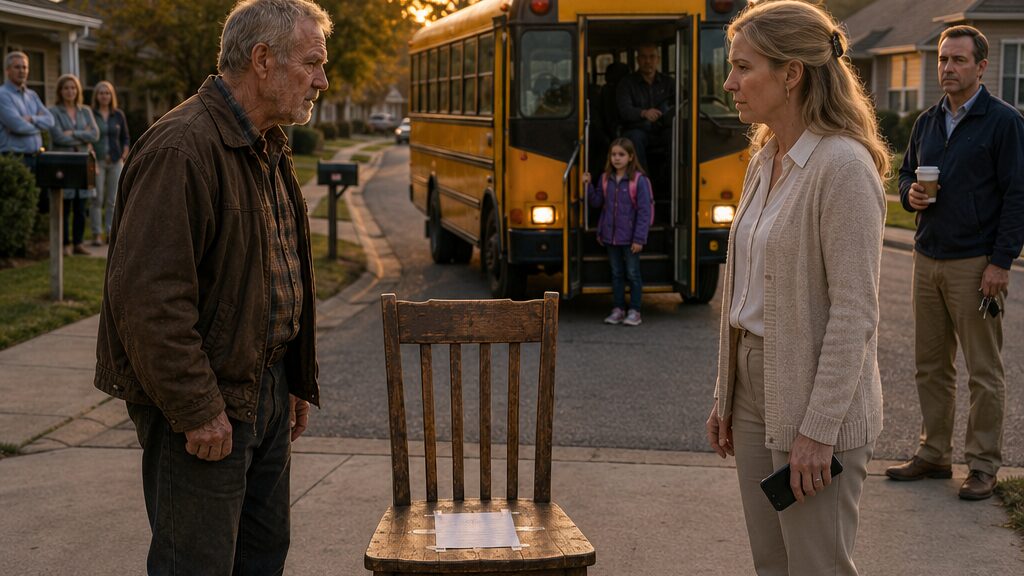
The Empty Chair at Six O’Clock Made the Whole Neighborhood Choose a Side
Chapter 1: The Chair Appeared at the Curb Before the Bus Did
Richard Moore had the chair halfway down the driveway before he realized Brenda Walker was watching him again.
Not openly. Not from the sidewalk like a person with a question. From behind the white slats of her front window blinds across the street, where one narrow strip had been lifted by two fingers. Richard saw the movement in the glass because he had spent thirty-two years repairing building lights, security mirrors, elevator panels, and anything else that taught a man how to notice reflections.
He kept walking.
The chair was heavier than it looked, not because of the wood, but because of the way he carried it. One hand around the top rail, the other under the seat, careful not to let the legs scrape the concrete. It was a plain wooden kitchen chair with a faded honey finish, worn smooth where hands had gripped it over the years. One rear leg had a rubber cap that did not match the other three. The seat had a shallow crescent mark near the front edge from a dropped coffee mug long before Richard had stopped setting two mugs out in the morning.
He set it at the end of the driveway, just before the sidewalk line, turned it toward the bend in Willow Creek Drive, and checked his watch.
5:43.
Too early by most people’s standards. Exactly right by his.
A lawn mower buzzed somewhere beyond the cul-de-sac. A delivery van rolled past without stopping. Two houses down, a child’s bike lay on its side near a flower bed, one wheel spinning slowly in the mild spring air. Richard stood behind the chair and pressed two fingers against the back rail to test its balance. The left front leg rocked once. He shifted it a half inch until it settled.
Across the street, the white blinds snapped shut.
Richard took off his cap, wiped the inside band with his thumb, and sat down.
He did not bring a book. He did not bring his phone. He did not wave at cars unless they waved first. He simply sat, shoulders square, feet planted, watching the curve where the school bus would appear.
The first time he had done this, no one had noticed. Or if they had, they had been decent enough to say nothing. By the fourth afternoon, a neighbor had slowed her walk and glanced from Richard to the empty street as if expecting a parade. By the second week, someone had asked if he was selling the chair. By the third, Brenda Walker had begun watching through the blinds.
Now it was Monday again, and Richard could feel a question moving through the neighborhood before anyone said it.
At 5:49, Brenda opened her front door.
She came out in pale slacks and a neat blue cardigan, carrying the kind of small notebook people used when they wanted a conversation to feel casual and official at the same time. Her hair was clipped at the back of her head. She paused on her porch, looked both ways, then crossed the street with her chin raised slightly, as if the asphalt itself belonged to a committee.
“Good evening, Richard.”
“Brenda.”
She stopped beside the strip of grass between the sidewalk and the curb. Her eyes moved to the chair, then to him, then back to the chair.
“You’re out early today.”
“Bus is sometimes early on Mondays.”
“Bus?”
He looked down the street. “School bus.”
Brenda gave a small smile that did not reach her eyes. “I see.”
She waited for him to add something. Richard let the silence sit there. He had learned long ago that people who wanted information often filled silence with their own guesses. Most of the time, that was easier than handing them something delicate.
Brenda tapped the notebook against her palm. “A few residents have asked about this.”
“The bus?”
“The chair.”
Richard rested one hand on the worn seat edge. “It’s just a chair.”
“That may be part of the issue.” Brenda’s voice stayed soft, but she looked toward the houses on either side as if the siding had ears. “The association has guidelines about items left in front-facing driveways. Furniture, equipment, storage containers, things of that nature.”
“I don’t leave it.”
“You put it here every day.”
“And I take it back every day.”
“But while it’s here, it’s visible from the street.”
“So am I.”
Her mouth tightened, then loosened. “Richard, I’m not trying to be difficult.”
He looked at her then. Not hard. Just enough to let her know he had heard that sentence too many times in too many forms.
Brenda shifted her weight. “It’s unusual. That’s all.”
A robin landed near the mailbox, pecked once at the grass, and flew away. Richard watched it go. He had no talent for explaining things to people who had already decided that explanation was a form of permission.
“It’s temporary,” he said.
“Temporary every day can become permanent in effect.”
He almost smiled, but stopped himself.
Brenda opened the notebook. “Why do you sit out here at six o’clock every evening?”
Richard looked toward the bend in the road. “You’ll see.”
The words came out quieter than he meant them to. He felt their weight after he said them, the small danger in them. They gave Brenda nothing, but they told her there was something to give.
Her expression changed, just slightly. Curiosity sharpened into suspicion.
“You’ll see what?”
Before Richard could answer, the low diesel rumble reached them from beyond the curve.
Brenda turned her head.
The yellow school bus appeared between the maples, sunlight flashing across its windshield. Richard stood before it reached the stop sign. He did this every day too, not fast enough to look eager, not slow enough to seem uncertain. His hand stayed on the chair back.
The bus hissed to a stop near the corner. Its red sign swung out. Children shifted behind the windows like bright, restless shapes.
Brenda watched, notebook lowered.
The doors folded open.
A small girl in a purple jacket and pink backpack came down the steps. Emma Moore looked first toward the driveway, not the sidewalk, not the other children, not the waiting parents farther down the block. Her eyes found Richard’s hand on the chair back. Only then did her shoulders drop.
She walked quickly, not quite running. Her hair had come loose from one side of its braid. The backpack bounced against her spine.
“Grandpa.”
Richard’s face moved before he could stop it. Not a smile exactly, but the careful warmth he saved for her, the one that did not ask anything and did not make a fuss.
“Hey, Button.”
Emma came straight to him and pressed herself against his side. He put one arm around her shoulders. She smelled like pencil shavings, school paper, and the strawberry soap Sarah bought in bulk.
“Rough day?” he asked.
Emma shook her head against him, which meant yes but not out here.
Brenda stood very still.
Richard lifted Emma’s backpack strap where it had twisted. “Your mom working late?”
“Till seven.”
“Then we’ll get you a snack.”
Emma glanced at Brenda, then looked away. “Who’s that?”
“Mrs. Walker. Neighbor.”
Brenda’s smile came back too quickly. “Hello, Emma.”
Emma nodded once, polite and guarded.
The bus doors folded shut. The engine groaned, the red sign pulled in, and the bus moved on. The street became ordinary again, except Brenda was still staring at the chair as if it had changed shape while she watched.
Richard picked it up with one hand and kept his other arm around Emma.
“Have a good evening,” he said.
Brenda did not answer right away. Her eyes followed the chair up the driveway, into Richard’s garage, where he leaned it against the wall in its usual place beside a folded step ladder and a bucket of sidewalk salt.
By the time Richard and Emma went inside, Brenda was back across the street on her porch. She had her phone out now, not the notebook. Her thumb moved quickly.
Inside, Emma set her backpack by the kitchen table but did not unzip it. Richard poured apple juice into a glass and put peanut butter crackers on a plate. She sat with one knee tucked under her, facing the window that looked toward the street.
“Is she mad?” Emma asked.
“Mrs. Walker?”
Emma nodded.
“She likes rules.”
“Mom likes rules.”
“Your mom likes bedtime. That’s different.”
Emma touched one cracker but did not eat it. Richard could still feel Brenda’s stare through the walls. He could also feel the old warning inside himself: don’t explain what people have not earned the right to carry.
At 6:17, across the street, Brenda Walker sat at her dining table with the blinds open just enough to see Richard’s driveway. She attached three photos to an email: the chair at the curb, Richard sitting in it, Richard carrying it back with Emma pressed close at his side.
Her subject line read: Repeated driveway furniture violation — immediate review requested.
She paused over the send button, looked once more across the street, and clicked before the bus had fully disappeared from the neighborhood.
Chapter 2: The Notice Made the Empty Chair Look Guilty
The white envelope was tucked between the chair slats like someone had tried to make the wood confess.
Richard saw it Tuesday at 5:38, before he had even lifted the chair from the garage wall. The envelope sat upright against the seat back, clean and square, with the Willow Creek Homeowners Association logo printed in blue at the corner. His name was centered in a window he did not need to read.
He stood in the garage doorway with one hand still on the light switch chain.
For a moment, he did nothing.
The chair waited where it always waited, its back legs touching the cinder block wall, the front legs angled toward the driveway. Beside it, a broom leaned crookedly. A coffee can full of screws sat on the workbench. There were plenty of places for an envelope to be left. Mailbox. Front door. Porch mat.
Someone had placed this one in the chair.
Richard reached for it, then stopped. He could see Brenda’s house through the garage opening. Her car was in the driveway. The blinds were closed.
He pulled the envelope free.
Inside was a single page, folded twice. The language was polite and flat.
Dear Mr. Moore,
The Association has received notice of repeated placement of indoor furniture in a front-facing driveway area near the public sidewalk. Please be advised that all visible items must comply with Community Appearance Standards, Section 4.2, including but not limited to prohibitions on storage, obstruction, and nuisance placement.
The chair must be removed from public view immediately unless actively in use for ordinary outdoor recreation.
Failure to comply may result in further enforcement action.
Richard read it once, then again, though he had understood it the first time. He was not angry yet. Anger, in him, usually came late. First came the careful sorting: what mattered, what did not, what could be ignored, what had to be handled before it harmed someone else.
He folded the notice along its original creases and put it in his shirt pocket.
At 5:43, he carried the chair down the driveway.
A woman walking a small dog slowed near the mailbox. The dog sniffed the grass, but the woman watched Richard. He could feel her trying to decide whether friendliness was safe.
“Evening,” Richard said.
“Evening.” Her eyes flicked to the chair. “Nice day for sitting.”
“Good enough.”
She moved on.
Richard set the chair down exactly where he had set it Monday. One rear leg found the same shallow dip in the concrete edge. He adjusted it, then sat.
The notice in his pocket felt stiff against his chest.
At 5:51, Brenda appeared from the direction of the clubhouse, though Richard suspected she had timed the walk to look accidental. She carried no notebook today. Instead, she held a slim folder against her ribs.
“Richard,” she said.
“Brenda.”
“I assume you received the notice.”
“It was in my chair.”
“That seemed the most direct place.”
He looked at her. “Direct isn’t always appropriate.”
A faint color rose in her face, but her voice stayed controlled. “I’m glad you read it.”
“I read it.”
“And yet here we are.”
“Yes.”
She inhaled through her nose. “The board is not trying to interfere with anyone’s personal habits. But when a resident repeatedly places furniture near the street, it raises questions of appearance, safety, and precedent.”
“Precedent.”
“If everyone decided to bring kitchen chairs, couches, folding tables, whatever they liked to the curb every evening, the neighborhood would look—”
“Like people lived here?”
“That isn’t fair.”
Richard held the chair seat at both sides, feeling the worn edge under his fingers. “Neither is pretending one chair is a couch.”
Brenda’s folder tightened slightly under her arm. For the first time, he saw the pressure behind her expression. Not just irritation. Something closer to fear of being made small. She looked toward the houses and lowered her voice.
“I have had complaints, Richard. Not one. Several. People don’t understand what you’re doing.”
“They don’t have to.”
“That is exactly the attitude that makes this difficult.”
The rumble of the school bus reached them earlier than usual.
Richard stood.
Brenda turned, almost annoyed by the interruption. The bus rounded the corner and slowed near the stop. Richard put his left hand on the chair back.
Emma appeared in the second window from the front. He saw her before the doors opened. She was looking for him already.
The bus hissed. The red sign swung out.
Emma came down two steps, stopped on the last one, and scanned the driveway. Her eyes did not settle until Richard moved his hand along the top rail of the chair, a small motion, almost nothing. Her grip loosened on the backpack straps.
Only then did she step down.
Brenda saw it.
Richard knew because Brenda stopped speaking. Her folder lowered an inch. Her eyes went from Emma to Richard’s hand, then to the chair.
Emma crossed the sidewalk, slower today. She watched Brenda the way children watch closed doors in houses where adults have been arguing.
“Hey, Button,” Richard said.
Emma did not hug him immediately. She stood close enough that her sleeve brushed his.
“Is the bus early?” he asked.
“A little.”
“How was science?”
“We had mealworms.”
“That sounds like a lawsuit.”
Her mouth tried to smile. It almost got there.
Brenda cleared her throat. “Hello again, Emma.”
Emma gave the same careful nod as Monday.
Richard picked up the chair. “We’re going inside.”
Brenda moved half a step closer. “Richard, I don’t want to discuss association business in front of a child, but this can’t continue as it is.”
Emma’s fingers caught Richard’s shirt at the side.
He felt it through the fabric. A pinch, small but urgent.
He turned to Brenda. “Then don’t discuss it in front of her.”
Brenda blinked. She looked wounded by the boundary, which irritated him more than the notice had.
“I’m simply saying,” she said, quieter now, “that using a child to make a point will not help your case.”
The words entered Richard slowly.
Emma’s fingers tightened.
He set the chair down again, not at the curb this time, but beside him. The wooden legs made a hard sound against the driveway.
“I’m not using her for anything.”
Brenda looked at Emma, then away. “I didn’t mean—”
“Yes, you did.”
The street seemed to pause around them. A car turned in at the far end, tires soft against asphalt. Somewhere a garage door opened.
Richard picked the chair up again. He did not trust himself with another sentence. He walked Emma up the driveway, slower than usual because she was not moving well.
Inside the garage, he put the chair against the wall. Emma waited until the garage door lowered halfway before she spoke.
“Am I in trouble?”
“No.”
“Is the chair in trouble?”
He looked at her then. Her eyes were too serious for nine years old. Too practiced at measuring adult faces.
“No,” he said, though the notice in his pocket said otherwise.
At the kitchen table, she ate two crackers and drank half her juice. She did not tell him about the mealworms. When Sarah’s car was not in the driveway by 6:45, Richard packed Emma’s homework folder, drove her three blocks to Sarah’s townhouse, and waited until mother and daughter were inside.
He was backing out when his phone rang.
Sarah’s name lit the screen.
He answered through the truck speaker. “You forget something?”
“What happened at the bus stop?” Sarah’s voice was tight, low, controlled in a way that told Richard Emma was nearby.
“Nothing happened.”
“Dad.”
He looked through the windshield at Sarah’s porch light. Emma’s pink backpack was visible through the front window, still on her shoulders.
“The HOA put a notice in the chair,” he said.
Sarah was silent for a breath. “Did Emma see it?”
“Not the notice. She heard enough.”
“Oh, God.”
“She was all right after.”
“No, she wasn’t.” Sarah’s voice cracked, then steadied. “She came in and asked if she had made the chair bad.”
Richard closed his eyes.
“I’ll handle it,” he said.
“That’s what worries me.”
He opened his eyes again. “What does that mean?”
“It means please don’t stand out there and make this into some fight where everyone knows our business.”
“I didn’t make it a fight.”
“But it can become one.” Sarah lowered her voice even more. “Please don’t tell them about her. Please. Not about the panic. Not about Mom. Not about any of it.”
Richard looked across the street through his windshield, though Brenda’s house was out of sight from here.
“Sarah—”
“No. Promise me.”
He heard the fear under the command. It was not pride. It was a mother trying to keep her child from becoming a neighborhood story.
Richard gripped the steering wheel.
“All right,” he said.
But as he pulled away from the curb, the folded notice in his pocket scraped against the seat belt, and for the first time, the chair felt less like something he was protecting than something he had left exposed.
Chapter 3: At Six O’Clock, Everyone Watched the Wrong Thing
Brenda Walker was standing beside the chair when Richard reached the end of his driveway, and the notice was already taped across the seat.
Not tucked. Not folded. Taped.
A strip of clear packing tape ran from one side of the wooden seat to the other, pressing the white paper flat over the worn crescent mark. The blue HOA logo sat in the center like a seal on a locked door.
Richard stopped halfway down the driveway with both hands empty.
The chair had been in his garage fifteen minutes earlier. He had carried it out at 5:42, set it down, gone back inside for the sweater Emma liked because she said it made him look “less like he was going to fix a sink,” and returned to find Brenda at the curb.
There were three neighbors outside who had not been outside two minutes before. One was pulling weeds that did not exist. Another stood at a mailbox with no mail in his hand. Across the street, a curtain shifted.
Brenda held a phone against her palm. Her face had the composed brightness of someone who had rehearsed how reasonable she was going to be.
“Richard,” she said. “Before this goes any further, I need you to remove the chair from this location.”
Richard looked at the notice. “You went into my garage?”
“No. It was already here.”
“You taped paper to my chair.”
“It’s a copy of the formal warning.”
“I know what it is.”
“Then you understand the issue.”
He came the rest of the way down the driveway. His knees hurt more when people watched him, or maybe he only noticed then. He stood on the house side of the chair, Brenda on the street side, the notice between them.
It was 5:55.
“You need to take that off,” he said.
Brenda’s voice lowered. “I need you to take the chair back inside. The Association cannot allow residents to create personal fixtures in common view.”
“It’s not a fixture.”
“It has been placed here three consecutive school days this week, and multiple days before that.”
“It’s a chair.”
“It is also a visible violation.”
A car slowed, then continued.
Richard looked down the street. No bus yet. He could move the chair. He could pick it up and carry it six feet back. He could sit on the driveway instead. He could tell himself Emma would understand.
But Emma would not see the same thing.
She would see the chair gone.
He reached for the tape.
Brenda put one hand out, not touching him, but blocking the motion. “Please don’t remove official Association documentation.”
That almost did it. Not the words. The way she said official, as if the paper had more right to the chair than Emma’s small hands on his sleeve.
Richard kept his voice level. “Take your hand back.”
Brenda’s eyes widened. One of the neighbors looked up fully now.
“I’m not threatening you,” Richard said. “I’m telling you I need that seat clear.”
“For what?”
He did not answer.
The bus engine sounded faintly beyond the curve.
Brenda heard it too. She turned her head and then looked back at him with something like realization, though not yet understanding.
“This is about your granddaughter,” she said.
Richard moved the corner of the tape with his thumbnail.
“Richard, if this is about pickup arrangements, there are designated bus stops. Parents and guardians stand on sidewalks every day without placing furniture in driveways.”
He peeled the tape slowly. It pulled at the finish. A thin line of old varnish lifted with it.
“Stop,” Brenda said.
The bus came into view.
The neighbors turned toward it as if the street itself had called them.
Richard got one side of the tape free. The paper bent but did not tear. He folded the notice once, carefully, because his hands needed something precise to do. Then he set it under the front leg of the chair, pinning it against the concrete.
Brenda stared down at it. “That is not compliance.”
“No,” Richard said. “It’s paper.”
The school bus slowed near the corner. Its brakes sighed. The red sign swung open.
Emma was in the front third of the bus, sitting by the window. Richard saw her face brighten when she spotted him. Then her eyes moved to Brenda. To the neighbors. To the paper under the chair leg.
The brightness vanished.
The doors folded open.
Children came down first in a burst of backpacks and noise. One boy jumped the last step. A girl called to someone about a permission slip. The school bus driver looked in the mirror, waiting.
Emma stood at the top of the steps.
Richard placed one hand on the chair back, exactly where he always did.
Emma did not move.
“Come on, sweetheart,” the driver said gently from inside.
Emma looked at Brenda.
Brenda’s folder was gone today, but her phone was still in her hand. The neighbors were still watching. The chair was where it belonged, but the air around it was wrong, crowded, sharpened by adult attention.
Richard’s chest tightened.
He stepped away from Brenda and toward the bus, but stopped before he reached the sidewalk. He knew better than to rush her. Rushing made it worse. Explaining in front of strangers made it worse. Too many eyes made everything worse.
“Button,” he said, steady and low.
Emma’s hand tightened around the bus rail.
Brenda’s expression changed again. This time the shift was visible. Annoyance loosened into discomfort.
The driver glanced from Emma to Richard. “You need a minute?”
Richard nodded once. “Please.”
The last child had already crossed toward the far sidewalk. The engine idled louder in the silence that followed.
Richard lifted the chair by the back rail and moved it two inches, just enough to show Emma he was choosing it, setting it, making it safe again. Then he sat.
He had not planned to sit. Not with Brenda standing there. Not with the notice under the leg. But the moment he lowered himself into the chair, Emma’s eyes locked on him.
He placed both feet flat on the driveway and rested his palms on his knees.
“I’m right here,” he said.
Emma took one step down.
Then another.
At the bottom, she froze again. Her mouth pressed tight, the way it did when tears were trying to climb up and she was trying to hold them down because crying in public would make too many people kind.
Richard did not move toward her.
“You see me?” he asked.
She nodded.
“You see the chair?”
Another nod.
“All right.”
Emma crossed the sidewalk in short, stiff steps. When she reached him, she did not hug him the way she usually did. She turned and stood behind the chair, both hands gripping the top rail near his shoulders, as if she were holding it in place for him.
Richard put one hand over hers.
Only then did the bus doors close.
No one spoke until the bus pulled away.
Brenda looked at the paper trapped under the chair leg, then at Emma’s hands. Her face had gone pale in patches.
“I didn’t realize,” she said.
Richard looked straight ahead. “No.”
“I thought—”
“I know what you thought.”
Emma’s fingers dug into the chair.
One of the neighbors drifted back toward his yard. Another suddenly found mail in the box. The curtain across the street fell shut.
Brenda swallowed. “Richard, if there is a special circumstance, you need to submit it properly. The board can’t be expected to—”
He turned then, and whatever she saw in his face stopped the sentence.
“I’m taking my granddaughter inside.”
He stood slowly. Emma did not let go of the chair until he lifted it. She stayed close enough that the chair leg brushed her shoe as they walked up the driveway.
At the garage, Richard paused and looked back.
A man had come from the sidewalk near the clubhouse path. Joshua Baker, the HOA treasurer, stood with his keys in one hand and a takeout coffee in the other. He must have arrived while the bus was stopped, because he had the stillness of someone who had seen enough to wish he had seen more.
Brenda was bending to pick up the folded notice from the driveway.
Joshua’s voice carried, quiet but clear.
“Brenda,” he said, “why wasn’t the board told there was a child involved?”
Richard did not wait for the answer. Emma was still beside him, breathing too carefully, and the chair between his hands felt, for the first time in months, like it might not be heavy enough to hold back what was coming.
Chapter 4: Sarah Asked for Silence Before She Asked for Help
Emma still had her backpack on at the dinner table.
Sarah noticed it before she noticed the untouched pasta, before she noticed the fork lying beside the plate instead of in Emma’s hand. The pink straps were pulled tight over her daughter’s shoulders, both of Emma’s fists curled around them as if someone might lift the bag away and take the rest of the day with it.
“Em,” Sarah said softly. “You can take that off.”
Emma looked down at herself, surprised by the weight she had been carrying.
“I know.”
But she did not move.
Sarah stood at the counter with the colander still steaming in the sink. Her work blouse clung at the wrists where she had washed her hands too quickly. She had come home late again, walked into a quiet house, and found Emma sitting exactly where Richard had left her: at the kitchen table, shoes on, backpack on, eyes fixed on a knot in the wood.
“Did something happen at school?”
Emma shook her head.
“On the bus?”
Another shake.
Sarah turned off the burner even though nothing was on it. The click sounded too loud.
“Was it Grandpa?”
Emma’s face changed then, not into blame, but into the kind of fear children showed when they thought an adult might get in trouble for loving them wrong.
“No.”
Sarah came around the table and knelt beside her. “Then what happened?”
Emma pressed her mouth closed.
The backpack straps creaked under her grip.
Sarah did not touch her yet. She had learned that lesson the hard way in grocery aisles, in the school office, in the back seat after dentist appointments. First give space. Then ask once. Then wait.
After a long moment, Emma whispered, “Did I make the chair bad?”
Sarah’s chest went cold.
“No, sweetheart. Why would you think that?”
“The lady put paper on it.” Emma stared at the table. “And everyone looked. Grandpa sat down, but everyone looked like he wasn’t supposed to.”
Sarah sat back on her heels.
The chair.
Again.
She closed her eyes only for a second, but in that second she saw her father standing in the driveway with both hands on the back rail of that old chair, refusing to explain himself to anyone because silence was the last wall he knew how to build.
“Who was there?” Sarah asked.
“The lady. Some neighbors. A man with coffee.” Emma’s voice shrank. “The bus driver waited.”
Sarah’s jaw tightened. “Did anyone say anything to you?”
Emma shook her head, then nodded, then looked confused by her own answer. “Not really.”
Not really was worse than no.
Sarah stood, pulled out the chair next to Emma, and sat close without touching. “Grandpa didn’t do anything wrong.”
“Then why did the lady put paper there?”
“Because grown-ups sometimes think rules are more important than people.”
Emma looked up quickly, as if that answer was both comforting and frightening.
Sarah regretted it at once. “That doesn’t mean all rules are bad.”
“Mom.”
“What?”
“Can I take my backpack off after dinner?”
Sarah swallowed. “Sure.”
Emma picked up her fork, but her hands were trembling so slightly that only a mother would have seen it.
Richard’s truck pulled back into the driveway at 7:12.
Sarah saw the headlights sweep across the front window, pause, and go dark. He did not come to the door right away. That was how she knew he was waiting to be invited or dismissed, letting her decide whether she wanted a father or only a completed favor.
She opened the front door before he could leave.
He stood beside the truck in his brown jacket, cap in one hand, shoulders set as if he had been expecting a storm and found something worse: quiet.
“She all right?” he asked.
“She asked if she made the chair bad.”
His face moved. Barely. Enough.
Sarah stepped onto the porch and pulled the door nearly closed behind her. Through the narrow gap, Emma remained at the table, backpack still on, fork in hand.
“What happened?” Sarah asked.
Richard looked toward the street. “Brenda taped a notice to the chair before the bus came.”
“Taped?”
“Yes.”
“Dad.”
“I took it off.”
“That’s not the part I’m worried about.”
He looked at her then.
Sarah folded her arms, not because she was cold, but because she needed something between her and the memory of Emma frozen in doorways, Emma refusing to leave the school counselor’s office, Emma asking whether people could disappear on regular days.
“You promised me,” Sarah said.
“I didn’t tell them.”
“You don’t have to tell them if you stand there making it obvious there’s something to tell.”
Richard’s eyes narrowed, not in anger, but in hurt. “She needed the chair.”
“I know she needs the chair.”
“Then what was I supposed to do?”
“Not turn it into a scene.”
“I didn’t.”
“Everyone watching my daughter unable to get off a bus is a scene.”
The porch light hummed above them. Across the little front yard, a sprinkler clicked from some neighbor’s lawn, three houses down, steady and indifferent.
Richard put his cap on, then took it off again. “Sarah, that woman put an HOA notice on your mother’s chair.”
Sarah flinched at your mother’s chair. She hated herself for it, but she did.
“Don’t,” she said.
“Don’t what?”
“Don’t use Mom to make this simple.”
“It is not simple.”
“No, it isn’t. That’s why I asked you not to talk about it.”
He looked past her through the door gap. “You asked me to let people think whatever they want.”
“I asked you to protect Emma.”
“So did I.”
“By letting the whole street study her?”
His mouth closed.
Sarah wished he would argue. It would be easier if he got loud, if he became the stubborn old man Brenda probably thought he was. But Richard had never been loud when pain was close. He just went still, and his stillness made other people feel cruel.
Sarah rubbed one hand over her forehead. “She’s finally going to school without calling me from the nurse’s office. She’s finally getting on the bus without the counselor walking her out. If this neighborhood starts whispering that she has problems—”
“She does not have problems.”
“I know that.” Sarah’s voice broke, and she lowered it fast. “I know. But people don’t say it kindly. They say it like a label. Like a warning. Like something they have a right to know.”
Richard leaned against the truck, suddenly older under the porch light.
“She misses her grandmother,” he said.
Sarah looked away.
Inside, Emma set her fork down with a small click.
“She does more than miss her,” Sarah whispered. “She thinks if someone isn’t waiting, people don’t come back.”
Richard shut his eyes.
There it was. The thing both of them had been walking around for months, as if grief were furniture in a dark room and they were trying not to bruise themselves on it.
After the funeral, Emma had refused to enter the school building for nine straight mornings. Then she had gone in but refused the bus home. Then, one afternoon, Richard had set the old chair at the driveway edge because he could not stand by the mailbox that long with his bad knee. Emma had stepped off the bus without crying for the first time in weeks.
The next day, he had done it again.
Then again.
No one had called it therapy. No one had called it an accommodation. It had simply worked.
Sarah hugged herself tighter. “I should have thanked you more.”
Richard’s face hardened against the kindness. “You don’t have to thank me for being her grandfather.”
“I’m not thanking you. I’m asking you not to make her story public.”
“I’m not trying to.”
“But you will if Brenda pushes you. Because you think silence is dignity until someone corners you, and then you say the one sentence that cuts the whole room open.”
He looked at her sharply.
Sarah regretted that too, but she did not take it back. They both knew she was not only talking about HOA notices. She was talking about hospital hallways, about the funeral home, about the way Richard had told a distant cousin, “You didn’t visit her when she was alive,” and left the room silent for twenty minutes.
“I can handle Brenda,” he said.
“No. You can handle boilers and broken locks and people who know when to stop. Brenda doesn’t know when to stop.”
He breathed through his nose. “There’s a board meeting tomorrow.”
Sarah stiffened. “No.”
“I received an email.”
“You’re not going.”
“She’s asking for fines.”
“Then pay them.”
That landed badly. She saw it before he spoke.
“With what?” he asked quietly. “Pride?”
“Dad—”
“No. You’re scared. I understand scared. But I will not pay a fine for sitting where your daughter can see me.”
Sarah pressed her lips together. The porch blurred once, then cleared.
“Then go,” she said. “But don’t say panic attacks. Don’t say counseling. Don’t say Mom died and Emma broke in half. Don’t say anything that turns her into something for them to discuss over coffee.”
Richard looked toward the window again. Emma had finally slipped one arm out of a backpack strap. Not both. One.
“What am I allowed to say?” he asked.
Sarah did not answer right away.
“That the chair helps,” she said at last. “That it’s temporary. That it’s for pickup. That’s all.”
“And if that isn’t enough?”
Sarah’s hand found the porch railing. “Then it still has to be enough.”
A phone buzzed inside Richard’s jacket pocket. He took it out, read the screen, and his face changed.
“What?” Sarah asked.
He turned the phone so she could see.
The email subject line was bold and official: Notice of Hearing and Daily Fine Assessment.
Below it, in smaller text, was the line that made Sarah’s stomach drop.
Noncompliance after final warning may result in daily fines beginning immediately upon board review.
Richard put the phone away.
Inside the house, Emma slipped her second arm out of the backpack at last, but neither adult moved. The thing Sarah had tried to keep private had become official before either of them had found the courage to name it.
Chapter 5: The Board Heard Rules Before It Heard the Promise
Richard sat in the back row while Brenda Walker showed the room a picture of his chair.
It filled half the portable screen at the front of the HOA clubhouse meeting room, enlarged until the worn wooden seat looked like evidence from a trial. The photo had been taken from across the street. Richard could tell by the angle. His garage door appeared in the background, half open. One corner of his sleeve was visible beside the chair, cropped in a way that made him look like he was sneaking out of the frame.
Brenda held a remote in one hand and stood beside the screen with the calm posture of someone presenting facts.
“This is not about one resident sitting outdoors,” she said. “This is about repeated noncompliance after polite notice.”
The room smelled faintly of carpet cleaner and burnt coffee. Six folding chairs were occupied. Two board members sat at the long table in front, along with Joshua Baker, who had a binder open and a pen resting unused in his hand. The property manager sat near the end, laptop ready.
Richard had brought the folded notice from Wednesday. Nothing else. It sat in his shirt pocket, creased now from being opened and closed too many times.
Brenda clicked the remote. Another photo appeared: the chair with the notice taped across the seat.
Richard heard one of the board members shift.
“This escalation became necessary,” Brenda said, “because informal conversation and written warning did not produce cooperation.”
Joshua looked up. “Was that before or after the bus stop incident?”
Brenda’s hand tightened around the remote. “I wouldn’t characterize it that way.”
“How would you characterize a child being unable to exit a bus because adults were gathered around the object in dispute?”
The room changed temperature.
Richard kept his eyes on the screen. He had not expected Joshua to speak first. He had expected to sit, be misunderstood, say as little as possible, and leave with a fine he would figure out how to fight later.
Brenda’s smile became careful. “I think we should avoid emotional phrasing. A child hesitated. That is not the Association’s responsibility.”
Richard’s hand closed over the folded paper in his pocket.
The property manager glanced at him, then quickly back at the laptop.
Joshua turned a page in his binder. “It may become our responsibility if enforcement interferes with safe pickup or creates an access issue.”
“Access?” Brenda said. “The chair is the obstruction.”
“It may be. Or it may be part of the pickup arrangement.”
“It is a kitchen chair placed at a curb.”
“At a driveway,” Richard said.
Every face turned to him.
His own voice sounded rough in the small room. He had meant to stay quiet until asked. He had promised Sarah careful words. Already, he had stepped over his own line.
Brenda lowered the remote. “Mr. Moore, you’ll have an opportunity to speak after the presentation.”
“I’m correcting the location.”
Joshua’s mouth twitched, not quite a smile.
Brenda clicked again. The next slide showed a cropped copy of the community standards, Section 4.2 highlighted in yellow.
“No resident may store, display, or maintain indoor furniture, household goods, or personal property in front-facing exterior areas visible from the street,” Brenda read. “Temporary exceptions apply to active loading, unloading, maintenance, and ordinary outdoor use as defined by the board.”
She looked at Richard. “The chair is not patio furniture. It is not part of approved landscaping. It is not a bench, fixture, or permitted accommodation.”
Richard noticed the word before anyone else seemed to.
Accommodation.
Joshua noticed too. He flipped backward in the binder.
Brenda continued. “If we allow this, we set a precedent. The board has already been criticized this year for inconsistent enforcement. Residents want clarity. They want the neighborhood kept to the standard they pay for.”
For the first time, Richard saw the room from Brenda’s side. Not kindly, but plainly. The clubhouse with its cheap blinds and donated coffee machine. The board members who did not want to be there. The emails from people who expected rules to make life tidy. Brenda had built herself a small place of authority, and that place depended on never looking uncertain.
Then she looked at him like his chair was a crack in the wall.
The board president, a role-only man in a quarter-zip, cleared his throat. “Mr. Moore, would you like to explain why the chair needs to be placed there daily?”
Richard stood.
The folded notice in his pocket scratched his fingers as he took it out. He looked at it instead of at the room.
“My granddaughter’s bus arrives at six,” he said.
“We understand that,” Brenda replied. “Many families manage bus pickup without leaving furniture visible from the street.”
Richard did not look at her. “She needs to see me.”
“Children often like to see family waiting.”
He unfolded the notice once. “She needs to see me in that chair.”
A pause.
Joshua’s pen moved slightly.
The board president leaned forward. “Is there a reason it must be that specific chair?”
Richard heard Sarah’s voice from the night before: Don’t say Mom. Don’t say counseling. Don’t say any of it.
He refolded the notice.
“Yes.”
The room waited.
Richard did not give them more.
Brenda exhaled, and in that exhale he heard her relief. His silence had given her back the floor.
“With respect,” she said, “a personal preference cannot override the governing documents.”
Joshua flipped another page. “Maybe not. But a temporary safety accommodation might.”
Brenda turned. “What?”
He slid the binder toward the center of the table. “Section 7.1. Resident requests involving temporary mobility, medical, disability, safety, or child welfare concerns may be reviewed by the board for reasonable accommodation, provided the accommodation does not create a traffic hazard or permanent exterior alteration.”
Brenda stared at him.
The property manager leaned toward the binder. “That language is in the amended rules from 2019.”
“I know,” Joshua said. “It was added after the ramp dispute on Cedar Lane.”
“That was different,” Brenda said quickly. “That involved a resident’s physical access to the home.”
“It says child welfare concerns.”
“It says may be reviewed. Not automatically granted.”
“No one said automatic.”
Richard felt the first small shift in the floor beneath the argument. Not victory. Not even safety. But a door where a wall had been.
The board president looked at Richard. “Mr. Moore, have you submitted an accommodation request?”
“No.”
“Would you be willing to?”
Richard hesitated.
Brenda stepped in. “Before we even discuss that, we would need documentation. Otherwise, anyone could claim emotional need for any visible object.”
The phrase emotional need landed like something wrapped in plastic.
Richard put the folded notice on the empty chair beside him. He had not meant to bring the chair, but now the empty folding chair next to him looked too neat, too temporary, too unlike the one waiting in his garage.
“What documentation?” he asked.
Brenda turned back to him. “If this relates to your granddaughter, we would need a statement. Medical, school, or other professional support. And since she is not the homeowner, there may be additional questions about standing.”
“Standing,” Richard said.
“Yes.”
“She is nine.”
“I’m not questioning her age.”
“No. Just whether she counts.”
Joshua looked down at his binder.
Brenda’s face flushed. “That is not what I meant, and I think you know that.”
Richard did know. That was the trouble. Brenda did not mean to be cruel in the way cruel people meant it. She meant to be correct, and she believed correctness washed the cruelty clean.
The board president lifted one hand. “Let’s keep this procedural. Mr. Moore, if you can provide a written request by Monday, the board can review whether temporary placement of the chair within your driveway can be permitted.”
“Monday,” Richard said.
“Until then,” Brenda said, “the chair should be removed from the front driveway area.”
“No.”
The word came out before he softened it.
The room stilled.
Richard picked up the folded notice and placed it on the chair beside him again. “I will move it if it blocks the sidewalk. I will move it if it blocks the street. I will not remove it before her bus comes.”
Brenda’s lips parted.
Richard kept going, because stopping now would let them turn him back into a problem to be managed.
“I can measure the setback. I can put it inside any line you show me. I can send a request. But at six o’clock, she will see me.”
The board president rubbed his forehead.
Brenda’s voice cooled. “Then the fine stands pending review.”
Joshua looked at her. “We haven’t voted on that.”
“We issued notice.”
“Notice isn’t a fine.”
“It becomes one upon board review.”
“And this is board review.”
The two stared at each other across the cheap table, and Richard understood then that the conflict had moved. It was no longer only Brenda against him. It was rule against rule, appearance against accommodation, procedure against judgment.
The property manager typed something. The sound filled the pause.
The board president finally said, “No fine tonight. Mr. Moore has until Monday at noon to submit a written request. Chair must not obstruct sidewalk or street. Final determination at next meeting.”
Brenda’s face went still.
Richard should have said thank you. He could feel the shape of the polite words waiting in the room. But gratitude felt wrong when the thing being granted was permission not to frighten a child.
He nodded once instead.
As the board began gathering papers, Brenda stepped close enough that only he could hear.
“You’re making this harder than it needs to be.”
Richard looked at her, then at the enlarged photograph still glowing on the screen behind her.
“No,” he said. “I think I made it too easy for too long.”
On his way out, Joshua caught him near the clubhouse door.
“Mr. Moore.”
Richard stopped.
“If you need the accommodation form, I can email it.”
“I don’t use much email.”
“I can print one.”
Richard studied him. Joshua looked uncomfortable, but he stayed put. That counted for something.
“Print two,” Richard said.
Joshua nodded.
Richard had his hand on the door when Brenda’s voice carried from the front of the room, sharp with forced professionalism.
“If the physical chair is truly necessary,” she said to the property manager, “then perhaps he should bring it as evidence next time.”
Richard turned back.
Everyone looked at him again.
He thought of Sarah’s warning. He thought of Emma on the bus steps. He thought of the chair in the garage, old and scarred and accused.
“All right,” he said. “If you need evidence, I’ll bring the chair.”
Chapter 6: The Chair Was Never Empty to Him
Richard turned the chair over on Friday afternoon and found his wife’s initials under the seat.
He had not been looking for them. He had been checking the front left leg, the one that rocked if it found the wrong part of the driveway. The chair lay upside down across his workbench, its four legs pointing toward the garage ceiling, its underside exposed in the dusty light from the open door.
A spider had made a fine web between two stretchers. Richard brushed it away with the side of his hand. Then he saw the letters, scratched into the underside near one corner.
L.M.
Not neat. Not centered. Cut with a knife point or a nail, the way a person might mark something quickly and then laugh about it later.
Linda Moore had marked everything she claimed as useful. Garden trowels. Storage bins. The good scissors no one was allowed to use on cardboard. Richard had forgotten the chair bore her initials, or maybe he had made himself forget because remembering every small thing would have left him unable to move through the house.
He touched the letters with one finger.
The garage shifted around him.
For a second, he was not in the present week with an HOA form waiting on the counter and a compliance chair across the street. He was watching Linda sit at the driveway edge with a glass of iced tea balanced on her knee, waving at Emma’s bus like the child was returning from overseas instead of third grade.
“You wave too big,” he had told her once.
Linda had smiled without looking back. “Then she’ll know which house is hers.”
Now Richard stood in the garage with the chair upside down, his thumb resting on the carved L, and the memory struck hard enough that he had to lean one hand on the workbench.
He had promised Linda many things in the last months, some spoken, some only understood. Keep Sarah from carrying everything alone. Fix the loose porch rail. Don’t let the house turn into a museum. Be there when Emma comes home.
That last one had seemed simple. Almost too simple to count as a promise.
The accommodation form lay on the workbench beside a tape measure and pencil. Joshua had dropped off two copies that morning in a plain folder, no HOA logo on the outside, as if even he understood that some papers should not arrive dressed like threats.
Richard turned the chair upright and sat on the low stool across from it.
Reason for request, the form asked.
He had written: Temporary placement of chair in driveway during school bus drop-off for child safety and support.
Then he had stopped.
Supporting documentation, if any.
He had nothing that did not feel like betrayal.
At 5:10, he drove to Sarah’s townhouse with the form folded in his jacket pocket and the chair left in the garage, facing the open door as if it too were waiting.
Emma answered before Sarah could.
“Grandpa, you’re early.”
“I know.”
Her face tightened. “Is the bus coming?”
“No. Bus already came. I’m just here to talk to your mom.”
Emma studied him with more suspicion than a child should have needed. “About the chair?”
“Some.”
She stepped aside.
Sarah was in the kitchen, still in work clothes, chopping carrots with more force than carrots deserved. She saw him, saw his jacket pocket, and set the knife down.
“Emma,” she said, “can you take your homework to the living room?”
Emma did not move. “I know when people are talking about me.”
Sarah’s eyes closed briefly.
Richard crouched, slowly because his knee did not like sudden humility. “You’re right.”
Emma looked surprised.
“We are talking about something that affects you,” he said. “Not because you did anything wrong.”
“Because of the lady?”
“Because adults are trying to decide where a chair belongs.”
“That’s dumb.”
“It is getting there.”
Her mouth twitched.
Sarah leaned against the counter, arms folded. “Dad.”
Richard did not look away from Emma. “Can I ask you something?”
Emma nodded.
“When you get off the bus and see me in the chair, what does it help?”
Sarah drew in a breath as if to stop him, but Emma answered before she could.
“It means you didn’t forget.”
Richard felt Sarah’s silence behind him.
“I wouldn’t forget,” he said.
“I know.” Emma looked down at her socks. One had a hole at the toe. “But my brain doesn’t know until it sees.”
Richard nodded once, because that made more sense to him than anything any adult had said all week.
Emma’s fingers twisted the hem of her shirt. “When Grandma waited, she always waved before the doors opened.”
Richard’s throat closed.
Sarah turned toward the sink.
“And after she died,” Emma continued, quieter now, “the bus sounded wrong. Like it was going somewhere else. But then you sat in her chair, and it sounded regular again.”
No one spoke.
A car passed outside the townhouse. Somewhere in the living room, the homework folder slipped off the couch and slapped the floor, but Emma did not turn.
“Does Grandma know when I get home?” she asked.
Sarah made a sound so small it barely reached the room.
Richard stayed crouched, though his knee burned.
“I don’t know how all that works,” he said. “I won’t pretend I do.”
Emma’s eyes filled.
“But I know she wanted you safe,” he said. “And I know I’m there because she loved you and I love you. So when you see that chair, you can remember both things.”
Emma wiped her nose with the back of her wrist. Sarah reached for a napkin automatically, then stopped herself from making the moment smaller.
“So,” Emma said, “the chair isn’t empty.”
Richard’s hand tightened on his knee.
“No,” he said. “Not to me.”
Sarah turned fully away then, one hand pressed over her mouth.
Emma stepped forward and put her arms around Richard’s neck. He almost lost his balance, then caught himself on the cabinet and held her with one arm. Over her shoulder, he saw Sarah watching him with grief and apology and fear tangled together.
After Emma went to the living room, leaving the homework folder still on the floor, Sarah took the form from Richard’s hand.
She read the first line. Then the second. When she reached Supporting documentation, if any, she stopped.
“They’ll ask for proof,” she said.
“I know.”
“I don’t want a doctor’s note in an HOA file.”
“Neither do I.”
“I don’t want Brenda saying words like anxiety and welfare in a room full of people who still call me Linda’s girl even though I’m forty.”
Richard looked toward the living room. Emma was humming under her breath, not a song exactly, just a little line of sound she used when she was making herself steady.
Sarah lowered the paper. “I asked you to stay quiet because I thought quiet meant safe.”
“I know.”
“But it didn’t, did it?”
He did not answer.
She sat at the table and picked up a pen. “I’ll write a statement.”
Richard stiffened. “Sarah—”
“Limited,” she said, looking up sharply. “Not everything. Not Mom’s last day. Not the counselor. Not all of it.”
“What then?”
“That Emma has experienced difficulty with school bus transitions after a family loss. That seeing you seated in a consistent, familiar place helps her exit safely. That the chair is present only during drop-off and removed immediately after.”
Richard let the words settle. They were clean. Protective. True without being naked.
“That enough?” he asked.
“It has to be.”
She began writing on the back of the second form, because neither of them wanted to make it look too polished. Richard sat across from her and said nothing. For once, his silence did not feel like a wall. It felt like a hand held flat beneath something fragile.
When Sarah finished, she slid the paper to him.
At the bottom, she had written: Please do not discuss my daughter’s private history beyond what is necessary to decide the accommodation.
Richard read that line twice.
“Good,” he said.
Sarah’s eyes were red, but her voice was steady. “If Brenda pushes past that, I want you to leave.”
“I may not.”
“Dad.”
“I’m telling you the truth.”
“She can bait you.”
“I know.”
“You like to act like you don’t care what people think, but you do. You care when they make love look foolish.”
Richard folded the statement carefully with the form. “Yes.”
That admission seemed to take more from him than any argument.
Sarah looked toward the living room. “Then don’t let her make you prove love in a way that hurts Emma.”
He nodded.
By the time he returned home, the street was dim and quiet. Brenda’s house had porch lights on. Richard carried the chair from the garage to the kitchen, set it near the table, and turned it upside down once more to look at Linda’s initials.
At 8:42, his phone buzzed.
Another email from Willow Creek Homeowners Association.
He opened it standing beside the chair.
Final Notice of Removal Deadline.
The message was brief. Temporary pause pending review did not authorize continued visible violation. All noncompliant furniture must be removed from front-facing areas by Monday at 5:00 PM. Failure to comply may result in immediate fine assessment and further board action.
Richard read it once, then set the phone on the table.
The chair stood between him and the dark kitchen window, its four legs planted on the linoleum, Linda’s initials hidden underneath. Monday at five meant one hour before the bus.
For the first time all week, Richard did not wonder what he would say.
He wondered exactly where the property line began.
Chapter 7: Before the Bus Came, Richard Moved the Line
Richard put painter’s tape across his driveway at 4:47 Monday afternoon while Brenda Walker watched from the sidewalk with her arms folded.
The blue strip ran crooked the first time. Richard pulled it up, measured again from the expansion joint near the garage apron, and pressed it down slower, smoothing it with the side of his thumb. The tape made a bright, temporary border across the concrete, six feet back from the sidewalk edge.
Brenda looked at the tape, then at the wooden chair waiting in the garage.
“That doesn’t change the removal deadline,” she said.
“No,” Richard replied. “It clarifies it.”
He set the tape roll on the driveway and checked the printed email beside it. He had brought the message outside, weighted at the corner with a flat-head screwdriver so the wind would not flip it over. Final Notice of Removal Deadline. Monday, 5:00 PM.
It was 4:48.
A neighbor slowed near the mailbox, pretending to sort flyers. Richard did not look over. If the neighborhood needed a show, he would give them measurement, not anger.
Brenda stepped closer but stayed off his driveway. “The notice requires removal of noncompliant furniture from front-facing areas.”
Richard picked up the tape measure. “Show me where front-facing ends.”
“That is not how the rule is applied.”
“It is today.”
Her mouth tightened. “Richard, you are not helping yourself.”
He finally looked at her. “I submitted the accommodation request at noon.”
“I’m aware.”
“With Sarah’s statement.”
“I’m aware of that too.”
“Then until the board reviews it, I’m keeping the chair inside my property line, outside the sidewalk, outside the street, and inside the measured setback Joshua printed from your own guidelines.”
Brenda’s eyes flicked toward the sheet under the screwdriver. Beside her final notice lay a second page: a property diagram from the HOA handbook, one Joshua had left in Richard’s mailbox that morning with a handwritten note in the margin.
Measure from sidewalk edge. Keep path clear. Document everything.
Richard had documented everything. He had taken pictures at noon, at two, at four-thirty. Not because he wanted a fight, but because he had spent too many years in maintenance departments where the person with the clipboard often won unless the person with the wrench kept records.
Brenda saw the phone in his shirt pocket. “Are you recording me?”
“No.”
“Taking pictures?”
“Of tape.”
“That sounds sarcastic.”
“It’s accurate.”
A faint flush crept up her neck. Richard had no pleasure in it. Brenda looked tired in the daylight, not defeated, just stretched thin by the effort of being certain all the time. Her cardigan was buttoned wrong at the bottom. He noticed and looked away before she saw him notice.
At 4:55, Joshua Baker arrived from the clubhouse path, binder under one arm.
Brenda turned on him. “This is becoming unnecessary.”
Joshua stopped at the sidewalk. “Looks necessary to me.”
“You gave him documents without board authorization?”
“I gave him the section you cited.”
“That is not your role.”
“My role is treasurer. My other role is homeowner who doesn’t want us fining a man for avoiding the sidewalk.”
Brenda’s face hardened. “You saw one emotional moment and decided procedure doesn’t matter.”
“I saw a child unable to leave a bus because our procedure showed up taped to her grandfather’s chair.”
Richard pulled the chair from the garage.
Both of them stopped speaking.
The chair looked smaller in the open driveway than it had in the meeting photo, smaller than Brenda’s complaints, smaller than the fear Sarah had carried in her voice. Richard held it by the back rail, walked it to the blue tape, and set it with its front legs just behind the line.
He faced it toward the bend where the bus would come.
Then he took a photograph.
Brenda looked from the chair to the tape. “You think this is clever.”
“No,” Richard said. “I think it’s where she can see me.”
“It is still visible from the street.”
“So is every porch chair in Willow Creek.”
“Porch furniture is approved exterior furniture.”
“This chair is approved by a nine-year-old trying to get home.”
Joshua looked down.
Brenda’s jaw worked once. “That is precisely the kind of statement that makes it difficult to address this neutrally.”
“Neutral for who?”
She did not answer.
At 5:00, Richard’s phone alarm buzzed once. He had set it for the deadline, though he had not told anyone. Brenda heard it and looked at his pocket.
“The deadline has passed,” she said.
Richard nodded. “The chair is not where the notice said it couldn’t be.”
“The notice said front-facing areas.”
“The accommodation request says drop-off support. The handbook says sidewalk clear. The county accessibility clerk said temporary child-safety placement should be reviewed before penalty if it doesn’t block a path.”
Brenda’s eyes sharpened. “You called the county?”
“I called a public number.”
Joshua looked at him with open surprise.
Richard took the folded form from his back pocket, not Sarah’s statement, only the page with the clerk’s general guidance written in Richard’s blocky hand. He had not asked for a ruling. He had asked what words meant when a rule met a child. The clerk had not given legal advice. She had said, carefully, that associations were expected to review reasonable safety-related requests before imposing penalties when no obstruction existed.
Brenda read the notes without touching the paper.
“You’re escalating this outside the neighborhood,” she said.
“You brought the neighborhood to my driveway.”
A car door closed two houses down. The neighbor at the mailbox had disappeared, but another stood on a porch, phone down at his side. Richard saw it and felt the old anger rise. Not hot, not wild. The cold kind, the kind that could make him say too much.
He breathed once and looked at the chair.
Linda’s initials were hidden underneath. Emma’s hands had gripped the top rail. Sarah’s statement sat inside the house, copied once, folded cleanly, holding back more than it revealed.
Brenda followed his gaze. “We still have community image to consider.”
Joshua’s head lifted. “That’s not in the final notice.”
“It is in the standards.”
“It isn’t the violation cited.”
“This is bigger than technical obstruction,” Brenda said, and now there was strain in her voice. “If we let visible exceptions multiply, residents stop respecting the process.”
Richard looked at her. “Then write a better process.”
“That is not fair.”
“No. What wasn’t fair was taping a notice to the place my granddaughter looks for before she can step off a bus.”
Brenda went quiet.
The words had gone farther than Sarah wanted. He knew it as soon as they were out. Not panic. Not death. Not the private center of it. But enough for the air to change.
Joshua closed his binder slowly.
Brenda looked toward the bend in the road. The bus was not visible yet, but the time had shifted around all of them. Five forty-six. Then five fifty. The daily pull began, the one Richard felt in his knees and chest and hands before any engine could be heard.
He sat.
Not at the curb now. Behind the blue line. On his own driveway, facing the same direction.
The chair rocked once, then settled.
Brenda stared at the tape. “You can’t solve this with a strip of blue tape.”
“No,” Richard said. “But I can show you exactly what you’re trying to take.”
The bus appeared at 5:59.
By then, three neighbors had found reasons to be outside. Joshua stood near the sidewalk but not in the way. Brenda remained beside the grass, her phone in her purse now, both hands empty.
Richard kept his palms on his knees.
The bus slowed. Its brakes sighed. The red sign swung out.
Emma was at the window.
For one second, her eyes searched the old spot near the sidewalk and found nothing.
Richard lifted one hand.
Her gaze jumped to the blue tape, then to the chair, then to him. He saw the question cross her face. Different place. Same chair. Same grandfather.
The doors opened.
She came down the steps carefully. At the bottom, she paused, but not the way she had Wednesday. This time she was studying the line.
Richard did not call out.
Emma crossed the sidewalk. Her shoes stopped just on the far side of the blue tape. She looked at Brenda, then Joshua, then the chair.
“Is this where it’s allowed?” she asked.
Richard’s throat tightened. “It’s where I put it today.”
“Can I cross it?”
“It’s not that kind of line.”
Emma stepped over the tape.
The smallest sound came from Brenda, barely a breath.
Emma did not hide behind the chair. She came around to the side, slipped off her pink backpack, and set it on the driveway beside Richard’s foot. Then, with the solemn care of a child doing something brave in front of adults who had not earned it, she sat on the edge of the chair beside him, half on his knee, half on the wooden seat.
Richard put an arm lightly behind her back.
The bus driver waited until Emma looked up and gave a tiny nod. Then the doors closed and the bus moved on.
No neighbor spoke.
Brenda’s face had lost its official shape. For a moment, she simply looked like a woman who had arrived with a rule and found herself standing in front of a reason.
Joshua looked at the chair, then at the blue tape, then at Brenda.
“I’m going to recommend the board accept the temporary accommodation,” he said.
Brenda did not answer.
Emma leaned close to Richard, her voice low enough that only he could hear. “Grandpa?”
“Yes.”
“If they say no, can we make another line?”
Richard looked over her head at the people watching from porches, windows, and sidewalks. He had spent all week trying not to make Emma’s fear public. Now the neighborhood had seen her courage instead.
“We’ll make whatever we need,” he said.
Across the street, Brenda turned away first, but she did not leave. She stood with her back to them, facing the quiet road, while Emma rested one hand on the chair rail as if claiming it for both of them.
Chapter 8: At Six O’Clock, the Street Finally Understood
Brenda arrived at the next HOA meeting carrying the old violation photo printed so large it did not fit neatly in her folder.
One corner bent against the clubhouse door as she walked in. Richard saw it from the back row: his chair enlarged again, flattened into evidence, the driveway cropped, the story missing. Brenda held it with both hands for a moment, adjusting the crease, and he noticed she would not look at him.
Sarah sat beside him.
That was new.
She had almost changed her mind twice in the parking lot. Once with her hand on the car door handle. Again when they reached the clubhouse walkway and she saw two neighbors standing near the entrance, lowering their voices too late. Richard had not told her she had to come. He had only waited.
Now Sarah sat straight-backed, a folded statement in her lap, her thumb moving across the paper’s edge until it softened.
“You don’t have to read it,” Richard said.
“I know.”
“You can hand it to Joshua.”
“I know.”
She did not sound angry. She sounded like a woman holding a door closed with her shoulder.
At the front, the board president called the meeting to order. Joshua had a stack of papers in front of him, neatly clipped. Brenda placed the enlarged photograph against the table leg where everyone could see it without her having to lift it.
The picture did what it had done before. It made the chair look like an object. A thing misplaced. A problem without a child, without a promise, without Linda’s initials hidden underneath the seat.
Brenda spoke first.
“The Association needs to be careful,” she said. “I want that understood before we vote. We can be compassionate and still maintain standards. If we create exceptions based solely on emotional claims, we weaken enforcement for everyone.”
Her voice was controlled, but Richard heard the fatigue beneath it. The past week had not given her what she expected. The chair had not disappeared. The neighborhood had not lined up cleanly behind her. Joshua had stopped nodding through procedure. Even the board president looked less eager to be finished than to be fair.
Joshua waited until Brenda sat.
Then he stood with one page in hand.
“I’m not recommending an exception based solely on emotion,” he said. “I’m recommending a temporary, narrow accommodation based on child welfare, lack of obstruction, written family request, and the Association’s own rule language.”
Brenda’s eyes stayed on the table.
Joshua continued. “The chair is placed inside the homeowner’s driveway, behind a measured setback, during a limited daily window. It is removed after bus drop-off. It does not block the sidewalk, street, mailbox, or any common area. The requested use is consistent and tied to safe transition from the school bus.”
One of the board members asked, “Do we have documentation?”
Sarah’s hand tightened around the statement.
Richard felt it more than saw it. He leaned back slightly, giving her space to move or not move.
Sarah stood.
The room turned toward her, and Richard hated every pair of eyes for one breath before he made himself stop. Sarah had chosen to stand. That mattered.
“My daughter’s private history is not up for neighborhood discussion,” she said.
No one spoke.
Sarah looked at the board president, not at Brenda. “I’m providing a limited statement. It confirms that after a family loss, my daughter has had difficulty with school bus transitions. Seeing her grandfather seated in a consistent, familiar place helps her leave the bus safely. That is all the Association needs to know.”
She walked the paper to Joshua, not Brenda.
That too mattered.
Joshua accepted it with both hands, read the first lines, and passed it to the board president. Brenda looked at the paper as it moved past her, but did not reach for it.
The board president read silently, then set it face down. “Thank you, Sarah.”
Sarah returned to her seat. Her face was pale, but she did not shake. Richard wanted to cover her hand with his. He did not. Not here, not while she was holding herself upright by will alone.
Brenda cleared her throat. “I respect the family’s privacy. I do. But we need to consider whether a chair with sentimental value is the least intrusive option. Could Mr. Moore stand at the same location?”
Richard stood before Joshua could answer.
“My knee won’t hold that long every day,” he said.
The board president nodded. “Could an approved outdoor chair be used instead?”
Richard looked at the enlarged photo near Brenda’s chair. There it was, the old wooden seat, accused again.
“No.”
Brenda lifted her eyes.
Richard kept his voice even. “Not because I’m stubborn. Because the child looks for that chair. Not any chair. That one.”
A quiet moved through the room.
He could have said more. He could have said Linda’s name. He could have told them about the initials under the seat, about the iced tea, about the wave before the bus doors opened. He could have cut the room open the way Sarah feared.
Instead, he looked at the board president and said, “I’m asking for the smallest thing that works.”
Sarah lowered her head.
Joshua moved the clipped papers forward. “I propose we approve a temporary accommodation for the remainder of the school year, subject to renewal if needed. Chair must remain behind the measured driveway line, be present only within fifteen minutes before and after bus arrival, and be removed afterward. I also propose we amend the policy to clarify temporary child-safety and accessibility requests so this doesn’t happen again as an enforcement dispute.”
The property manager typed quickly.
Brenda looked at Joshua. “You’re rewriting policy over one chair.”
“No,” Joshua said. “I’m rewriting procedure because one chair showed us where it failed.”
The board president looked from Joshua to Brenda. “Any objection to putting it to a vote?”
Brenda’s fingers rested on the large photo. For a moment, Richard thought she would lift it, make the old argument one last time, tell the room what people would see from the street.
But she did not.
She slid the photo back into her folder. The bent corner caught, then disappeared.
“I still believe consistency matters,” she said quietly. “But I won’t object to a limited accommodation.”
It was not an apology. Richard did not expect one. He was surprised to find he did not need it as much as he had thought.
The vote passed.
No one clapped. No one gave speeches. The property manager read back the conditions in a practical voice, and Joshua corrected the phrase “furniture exception” to “temporary safety accommodation.” Sarah exhaled beside Richard like she had been holding her breath for a week.
After the meeting, Brenda approached them near the door.
Sarah went still.
Brenda looked first at her, then at Richard. “I should not have taped the notice to the chair.”
Richard watched her face. It cost her something to say it. Not enough to erase what had happened. Enough to be real.
“No,” he said. “You shouldn’t have.”
Brenda nodded once. “I hope the arrangement helps Emma.”
Sarah answere