The Night Samuel Broke the Gavel and Exposed the HOA That No Longer Existed
Chapter 1: The Notice Nailed Beneath the Basketball Hoop
Samuel saw his name before he saw the amount.
SAMUEL WILSON appeared in black capital letters beneath the basketball hoop, large enough to read from halfway down the block. Below it, in smaller type, the notice listed his address, his alleged balance, and the words EMERGENCY FORECLOSURE HEARING.
Someone had fastened the page to the wooden backboard support with four silver roofing nails.
Samuel stopped at the edge of the court with his interview folder tucked under one arm. The folder still held three copies of a résumé no one had asked to keep.
Children usually played there until the streetlights came on. Now folding chairs covered the painted free-throw lines. Two portable floodlights leaned against the chain-link fence. A narrow platform had been built beneath the opposite hoop, with three tables arranged across it like a judge’s bench.
At the center of the middle table sat Charles Hill’s wooden gavel.
Charles stood behind it in a dark overcoat, directing two workers as they taped electrical cables to the asphalt. He had once run for county office, lost badly, and spent the following years speaking as if the election had been stolen by people too foolish to understand him.
He looked up and saw Samuel reading the notice.
“Good,” Charles called. “You’ve been properly informed.”
Several neighbors turned. Samuel felt their attention move over his jacket, his interview folder, the polished shoes he had worn to a warehouse office twenty miles away.
The hiring manager had glanced at his application and said the company wanted someone with “more adaptable experience.” Samuel had supervised industrial maintenance crews for nineteen years. He had rebuilt hydraulic systems older than the manager.
Now his foreclosure balance hung beneath a hoop.
Samuel crossed the court and pulled once at the paper. The nails held.
“You posted my account publicly.”
Charles picked up the gavel and tapped it against his palm. “The board voted for transparency.”
“You posted my address and balance.”
“Residents deserve to understand what unpaid obligations cost the community.”
Samuel looked toward the folding chairs. A few neighbors lowered their eyes. Others pretended to inspect the meeting agenda taped to the fence.
Charles smiled without warmth. “Seven o’clock. Don’t be late.”
Samuel’s hardship-extension request was folded inside his coat pocket. He touched the edge of it through the fabric.
“You received my application.”
“We received many excuses.”
“It was filed under the hardship policy.”
Charles gave the gavel a light strike against the table.
The crack carried farther than it should have across the empty court.
“Procedural questions will be addressed during the meeting.”
Samuel looked at the head of the gavel. Its varnish had worn away around the striking face, leaving pale wood beneath the brown finish.
Charles turned from him and told one of the workers to raise the platform another inch.
Samuel walked home without removing the notice. Pulling it down in front of everyone would have looked like shame, and leaving it there felt worse.
Amanda Garcia caught up with him near the mailboxes.
“Samuel.”
He kept moving.
She stepped in front of him. She wore a grocery-store jacket over sweatpants, and the wind kept lifting loose strands of hair across her face. In one hand she held three envelopes.
“He sent these today.”
Samuel recognized the HOA letterhead.
Amanda opened the first envelope and showed him a lien notice addressed to her mother. “Roof drainage violation. Nine hundred dollars.”
“Your mother’s gutters were replaced last year.”
“I know.”
The second notice belonged to the family across the cul-de-sac. The third named an older resident who had stopped attending meetings after Charles fined him for leaving a wheelchair ramp visible from the street.
Amanda tapped the account numbers printed near the top. “Look at them.”
Samuel did.
The first began with 1187. The second with 4521. The third with 1187 again, though the dates and properties were different.
“They’re reusing numbers,” she said. “Or inventing them.”
“They’ve always been careless.”
“This isn’t careless.”
Across the court, Charles tested the microphone.
A burst of static scraped through the speakers. Then his voice rolled over the houses.
“Residents are reminded that tonight’s emergency assembly concerns delinquent assessments, community solvency, and enforcement discipline.”
Amanda glanced back.
Samuel felt the folded state envelope inside his interview folder. It had arrived that morning, but he had not opened it. He had spent the day trying to prove he was still employable before he allowed himself to read another piece of bad news.
Amanda lowered her voice. “Let me stand with you tonight.”
“No.”
“You shouldn’t be alone up there.”
“I won’t be up there.”
“That platform is exactly where he wants you.”
Samuel shifted the folder under his arm. “This is my account.”
“That is what he wants everyone to believe.”
He stepped around her.
Amanda followed. “You missed two neighborhood calls. You don’t answer the door. You told people you were on temporary leave when you were already laid off.”
Samuel stopped.
A curtain moved in a nearby window.
Amanda saw it too and softened her voice. “Nobody is judging you for losing your job.”
“They don’t need the details.”
“Charles already nailed the details to a basketball hoop.”
Samuel’s jaw tightened.
His father had bought the house when the subdivision was still surrounded by open fields. Samuel had helped replace the porch rails, lay the back patio, and repair the roof after a summer storm. On the night before his father died, Samuel had promised the house would stay in the family.
At the time, it had seemed like an easy promise.
Charles’s voice boomed again from the speakers.
“For the benefit of public confidence, Mr. Wilson’s hearing will be conducted in full view of the membership. The neighborhood deserves transparency.”
A few doors opened along the street.
Amanda looked at Samuel. “He is making an example out of you.”
Samuel removed the state envelope from his folder. A circular seal showed through the paper.
“I know.”
“What is that?”
“Nothing yet.”
“Samuel.”
He slid it back into the folder.
Amanda’s expression changed. “You have something.”
“I have an unopened envelope.”
“And you still won’t let anyone help.”
“I didn’t ask.”
“That has never stopped Charles.”
She walked away before he could answer.
Samuel entered his house through the side door. The kitchen was cold. He had stopped running the heat during the day two weeks earlier. His lunch from the interview—a wrapped sandwich he had not eaten—went onto the counter beside a row of past-due notices.
He removed his tie, folded it carefully, and placed it over the back of a chair.
The hardship request lay in his coat pocket. Three pages. Employment history. Bank balance. Mortgage information. A paragraph he had rewritten six times before admitting he had no current income.
He set it on the table.
Then he opened the state envelope.
The document inside carried the seal of the State Supreme Court and a case number he recognized from the complaint he had filed after finding duplicate fines in his account.
He read the first paragraph standing up.
By the second, he had lowered himself into a chair.
By the third, the sounds from the basketball court seemed to move very far away.
The order declared that the neighborhood homeowners’ association had failed to produce legitimate financial records, had collected unauthorized assessments, and had obstructed a state audit.
Its corporate authority had been revoked.
Its governing powers had been dissolved.
The effective date appeared at the bottom of the page.
Samuel checked it twice.
Thirty-one days earlier.
Outside, Charles struck the wooden gavel against the table, and the sound passed through Samuel’s kitchen wall like a challenge.
Chapter 2: The Order That Proved Too Little
“The filing has already been transmitted to outside counsel.”
Samuel pressed the phone harder against his ear. “The organization filing it no longer exists.”
The state clerk paused. He could hear keys clicking on her end.
“I understand what you’re saying, sir.”
“No, I don’t think you do. I have the order in front of me. Their authority was revoked last month.”
“The order invalidates the association’s governing status. It does not automatically remove every private filing from every outside system.”
“They’re holding a foreclosure hearing tonight.”
“An actual court hearing?”
“A board hearing.”
“Then it is not a foreclosure hearing in the legal sense.”
“It becomes legal when they send whatever they sign to the collection attorney.”
Another pause.
Samuel stood at the kitchen table with the Supreme Court order spread beside his layoff notice. The torn edge of the layoff notice matched the place where he had ripped it from the employee bulletin board before anyone else could see.
Outside, the gavel struck twice during sound testing.
The clerk said, “You should send the order to the attorney handling the claim.”
“I don’t know who that is.”
“The notice should identify them.”
“The board has not given me a copy.”
“Then request one in writing.”
“They plan to sign tonight.”
Her voice became more cautious. “Mr. Wilson, the dissolution order establishes that the association lost authority on the effective date. If individuals knowingly continued collecting funds or issuing liens afterward, that may create separate civil or criminal exposure. But I cannot tell you who had knowledge of the order.”
“Charles Hill had knowledge.”
“Can you prove receipt?”
Samuel looked at the last page.
The certificate showed the order had been served on the association’s registered office. No signature. No recipient name.
“I can prove it was sent.”
“That is not the same thing.”
The words landed harder than he expected.
“What am I supposed to do while they take my house?”
“I cannot provide legal advice. Preserve every notice. Record dates. If they make representations about their authority after receiving the order, document them.”
Samuel looked through the window.
Charles stood on the platform rehearsing at the microphone. Brenda Allen sat at the treasurer’s table, arranging folders into exact stacks.
“Representations,” Samuel said.
“Yes.”
“Public statements count?”
“They can.”
He thanked the clerk and ended the call.
For a moment he remained still.
Then Charles struck the gavel again.
Samuel folded the court order once, placed it inside his coat, and crossed the street.
Amanda was on her porch sorting papers into a grocery bag. When she saw him, she closed the bag.
“You opened it.”
Samuel stopped at the bottom step. “What makes you think that?”
“You look less frightened.”
“I wasn’t frightened.”
“You were wearing interview shoes at four in the afternoon and staring at your own foreclosure notice.”
He ignored that. “I need to see the receipts.”
Amanda did not move.
“The three accounts you showed me,” he said. “I need the payment dates.”
“Why?”
“To compare them.”
“With what?”
Samuel glanced toward the court. The wind lifted the corner of the meeting agenda from the fence.
“With the dates on the fines.”
Amanda studied him. “You found something in that envelope.”
“I found a reason to ask questions.”
“That is not enough.”
“It has to be.”
“No.” She picked up the grocery bag. “Not this time.”
Samuel climbed one step. “Amanda.”
“My mother paid them twelve hundred dollars after they threatened a lien. I told her not to, but she was afraid they would put her out. The family across the street borrowed money. Another neighbor used part of his medical savings. You do not get to take their receipts into that meeting unless you tell me what you are doing.”
“I’m not taking anything.”
“Then why do you need them?”
He looked away.
Amanda gave a humorless laugh. “You want Charles to say something.”
Samuel’s eyes returned to her.
“You have proof of part of it,” she continued, “but not enough. So you want him angry. You want him talking.”
“I need him to confirm the board still claims authority.”
“What happens after that?”
“I use what I have.”
“What do you have?”
He said nothing.
Amanda set the bag down. “You think silence makes you careful. It doesn’t. It makes everyone else guess.”
“I’m trying to protect this.”
“Your house?”
“The evidence.”
“From me?”
“From anyone who might react before the meeting.”
Her face hardened. “You mean anyone who might stop you.”
Samuel climbed back down.
“I don’t need the receipts,” he said.
“Yes, you do.”
“I can get the admission without them.”
“And then Charles will say he misunderstood the dates. Brenda will say she followed the books. The others will say they trusted the president. You will have one paper and one angry statement, and they will bury you in procedure.”
Samuel felt heat rise behind his collar.
“You don’t know what the paper says.”
“No. Because you refuse to show me.”
He turned toward the court.
Amanda spoke behind him. “I will not watch you walk in there, lose control, and give Charles exactly the picture he wants.”
Samuel stopped.
“He wants the unemployed man to look desperate,” she said. “He wants everyone to think your anger proves your debt is your fault.”
“I know what he wants.”
“Then stop helping him.”
Samuel faced her. “I need Charles to speak on the record.”
It was the most he had intended to say.
Amanda looked at him for a long moment. “Recorded by whom?”
Samuel had no answer.
The portable speakers hissed as Charles adjusted the volume. Folding chairs scraped across the asphalt. Residents had begun to arrive early, bundled in jackets, speaking in low voices.
Amanda picked up the grocery bag again. “When you are ready to trust someone, knock.”
She went inside and closed the door.
Samuel walked toward the court alone.
At its edge, he tested the recording function on his phone. The microphone captured the wind, the speakers, and the distant bounce of a basketball from another block. He slipped the phone into his breast pocket with the lens facing outward.
It might be enough.
Charles stood on the dais, explaining to two board members that the meeting had to look orderly because “disorder invites defiance.” He did not notice Samuel.
Brenda did.
Her hand stopped above a folder. She looked at Samuel, then at Charles, then toward the equipment shed beside the court.
A minute later, she left the table carrying a coil of microphone cable.
Samuel waited.
The shed door opened three inches.
Brenda’s face appeared in the gap.
“Now,” she mouthed.
Samuel crossed behind the folding chairs and entered.
Brenda pulled him inside and locked the door.
The shed smelled of damp plywood, rubber basketballs, and machine oil. Gavel cases, extension cords, nets, and old maintenance tools crowded the shelves.
Brenda placed the cable on a hook and faced him.
Her lipstick had been applied too carefully. A faint tremor moved through one hand.
“Your house,” she said, “is not the reason they called this meeting.”
Samuel did not reach for the court order inside his coat.
“What is?”
Brenda glanced at the narrow window.
Then she lowered her voice.
“Charles ordered the original dissolution notice removed from the board files.”
Chapter 3: The Treasurer Who Kept One Copy
Brenda pushed a metal bolt through the shed door and turned on a single hanging bulb.
“If anyone asks,” she said, “you followed me in here.”
Samuel looked at the locked door. “That makes me sound better?”
“It makes me sound less guilty.”
“You are the treasurer.”
“I process what the board approves.”
“You signed every notice.”
“I signed what Charles put in front of me.”
Samuel held her gaze. “That is still signing.”
Her mouth tightened.
Outside, the microphone squealed. Someone cursed. A gust rattled the shed’s thin walls.
Brenda moved to a black carrying case on the highest shelf. She took it down with both hands and set it on a crate. The case was shaped for a ceremonial gavel, with a recessed space in the foam for the handle and head.
The gavel itself was already on the dais.
Inside the empty recess lay a folded document.
Brenda did not hand it over.
“This is a copy,” she said. “The original came by certified delivery.”
“Who signed for it?”
She looked toward the door.
“Charles?”
“He was in the office when it arrived.”
“Did he sign?”
“I don’t remember.”
“You brought me in here to say you don’t remember?”
“I brought you in here because he opened it in front of me.”
Samuel’s breathing slowed.
“What did he say?”
“That the state had exceeded its authority. That an appeal would restore everything. That until then, the board had a duty to maintain continuity.”
“Was there an appeal?”
“He said there would be.”
“That isn’t an answer.”
“No. There wasn’t.”
She lifted the folded copy from the case.
Samuel reached for it.
Brenda pulled it back.
“What do I get?”
“The chance to tell the truth before someone proves you hid it.”
Her eyes flashed. “You think I don’t understand what this is?”
“I think you understand exactly what it is.”
“I have a mortgage too.”
“So do the people you fined.”
“My husband left debts I didn’t know about. The board stipend covers groceries.”
Samuel stared at her. “You kept collecting illegal money because the stipend bought groceries?”
“I kept the books because if I resigned, Charles would have blamed everything on me.”
“He still will.”
“That is why I need protection.”
“I can’t give you protection.”
“You can tell the state I cooperated.”
“If you cooperate.”
She paced once through the narrow space. “I copied the order. I kept account summaries. I questioned the transfers.”
“What transfers?”
Brenda stopped.
Samuel saw the answer before she spoke.
She opened a second case beneath the first and removed a thin ledger. Several pages had been marked with yellow tabs.
She laid it on the crate.
The reserve account had once held enough money to repair the neighborhood’s drainage system, replace damaged fencing, and cover emergency roof work on shared buildings. The balance declined in irregular jumps over six months.
Samuel followed the entries with one finger.
CONSULTING SERVICES.
COMMUNITY OUTREACH.
PUBLIC COMMUNICATIONS.
The payments went to an account identified only by initials.
“Whose account?”
Brenda rubbed her thumb over the edge of the page. “A consulting company Charles used during his county campaign.”
“How much?”
“Enough that the reserve fund cannot cover scheduled repairs.”
“And the new fines?”
“Keep cash moving.”
“My foreclosure?”
Brenda looked down.
Samuel closed the ledger. “Say it.”
“Your account was large enough.”
“My real balance was twelve hundred dollars.”
“After fees, penalties, legal preparation, inspection costs—”
“Costs created by the board.”
She said nothing.
“How much are they claiming now?”
“Seventeen thousand four hundred.”
Samuel almost laughed. The number was too large to absorb.
Brenda continued quickly. “Charles said if the payment came through before anyone challenged the authority issue, it could bridge the reserve deficit.”
“You were going to take my house to cover his missing money.”
“The board cannot take a house directly.”
“You were preparing the filing.”
“I prepared the account.”
“You prepared the weapon.”
Brenda flinched.
Outside, Charles’s voice came through the speaker.
“Brenda? We need the authorization packet.”
She closed the ledger.
Samuel placed his hand on it. “Those pages go with me.”
“No.”
“They prove motive.”
“They prove I kept the books.”
“They prove money was moved.”
“They also prove my signature is on transfers Charles approved.”
“Then explain why.”
“To whom?”
“The residents. The investigators. Anyone who asks.”
Her face changed at the word investigators.
“You contacted someone.”
Samuel did not answer.
Brenda grabbed the ledger and held it against her chest. “You tell them I came to you first.”
“I will tell them what happened.”
“You tell them I tried to stop it.”
“Did you?”
“I kept the copy.”
“That is not stopping it.”
“I questioned the transfer.”
“Did you refuse it?”
Her silence filled the shed.
Samuel looked at the copied court order still in her hand. “Give me that.”
“You promise you’ll say I cooperated.”
“I won’t promise something you haven’t done.”
Brenda’s fear hardened into anger. “Then you get nothing.”
She shoved the court order back into the hollow gavel case and snapped it shut.
“You called me in here.”
“I made a mistake.”
“No. You wanted me to carry the risk for you.”
“And you want me to confess while you keep your own plan hidden.”
That struck closer than he wanted.
Brenda saw it.
“You think you are different because you waited until they came for your house,” she said. “The rest of us were supposed to guess you had a strategy.”
Samuel heard Amanda’s voice in the accusation.
He stepped back from the crate.
“Charles is going to make me an example tonight.”
“Yes.”
“Why?”
“So everyone pays the next assessment before the state notice becomes public.”
“What assessment?”
Brenda looked at the door again.
“A special emergency reserve assessment. Five thousand per property.”
Samuel understood then. His foreclosure was not only a source of money. It was a demonstration.
Charles intended to crush one resident in public, then demand payment from all the others while fear was fresh.
“Does the board know?”
“Some of them know pieces. Charles tells each person only what he needs them to approve.”
“Do they know the HOA is dissolved?”
“They know there is a legal dispute.”
“That is not what I asked.”
Brenda’s shoulders sagged. “They know enough to have asked questions.”
“And they voted anyway.”
“Yes.”
The answer gave Samuel no satisfaction.
Documents would not be enough. Brenda could retreat. The board could claim confusion. Charles could call the order temporary, the transfers authorized, the foreclosure a clerical process already underway.
He needed people to choose truth while they still had something to lose.
Charles’s voice sounded again, sharper now.
“Brenda Allen, report to the dais.”
She opened the case, removed the folded copy, and slid it into the inside pocket of her coat.
Samuel moved between her and the door.
“You leave with that, you are choosing him again.”
“I am choosing not to be destroyed by you.”
“I cannot destroy you.”
“You can give my name to the state.”
“Your name is already in the ledger.”
Brenda’s face went pale.
Samuel stepped aside.
She unbolted the door, then paused with her hand on the latch.
“The original notice was in the clubhouse archive box,” she said. “Charles ordered the old records cleared before tonight.”
“Cleared where?”
“I don’t know.”
“You expect me to believe that?”
“I expect you to look.”
She opened the door and slipped out.
Samuel remained in the shed for three seconds, listening to the wind and the growing murmur of residents taking their seats.
Then movement beyond the narrow window caught his eye.
A pickup truck idled behind the court.
Jacob Miller stood at the open tailgate, lifting sealed archive boxes from a maintenance cart. Each box bore the HOA’s old account labels and a range of dates ending the week the dissolution order had arrived.
Charles stood beside the truck, pointing toward the road.
Jacob loaded the last box and closed the tailgate.
Samuel reached for the bolt.
The records were leaving.
Chapter 4: The Friend Samuel Accused Too Soon
Samuel stepped into the truck’s path before Jacob could close the driver’s door.
The pickup rolled forward six inches and stopped.
Jacob leaned out the window. “Move.”
“Open the tailgate.”
Around them, residents were filing toward the basketball court in winter coats, carrying folding blankets and paper cups. Several slowed when they recognized Samuel standing in front of the truck.
Jacob killed the engine.
“You want Charles to call the police before the meeting even starts?”
“He’s moving records.”
“I’m moving boxes.”
“From the clubhouse archive.”
Jacob glanced toward the platform.
Charles stood beneath the hoop, speaking to a board member with one hand resting on the gavel. He had not yet noticed them.
Samuel planted both hands on the hood.
“Open it.”
Jacob climbed out.
He was shorter than Samuel remembered and looked older than he had six months earlier, when they had argued beside a broken drainage grate. Samuel had accused him of inflating repair bills for Charles. Jacob had said the board had approved every invoice. Neither had spoken since.
“You don’t know what you’re doing,” Jacob said.
“Then explain it.”
“Not here.”
“You loaded the boxes in front of half the neighborhood.”
“Because he told me to.”
“That excuse is getting crowded tonight.”
Jacob’s eyes narrowed. “You think I wanted this job?”
“You kept taking it.”
“You think contractors can refuse the only association controlling access to forty-seven properties?”
“The association doesn’t exist.”
For the first time, Jacob’s expression slipped.
Samuel saw it.
“You know.”
“I know Charles has been acting strange.”
“That isn’t what I asked.”
Jacob looked past him at the residents taking seats. “Get away from the truck.”
“Where are the boxes going?”
“To the storage cabinet behind the utility wall.”
“Why?”
“Because Charles ordered the clubhouse cleared.”
“Before tonight?”
“Yes.”
Samuel moved around the truck and grabbed the tailgate handle.
Jacob caught his wrist.
The contact pulled both men still.
Months earlier, Samuel would have pushed back immediately. Instead he looked at Jacob’s hand, then at his face.
“Let go.”
Jacob did.
Samuel opened the tailgate. The archive boxes were stacked two deep. Each had been sealed with fresh tape, but dust marked the sides where old labels had been removed.
One label remained.
BOARD CORRESPONDENCE — LEGAL.
Samuel reached for it.
Jacob stepped between them. “Don’t.”
“You’re protecting him.”
“I’m protecting my business.”
“From what?”
Jacob took out his phone and opened a message thread.
The latest message came from Charles.
CLEAR ALL RECORDS DATED BEFORE LAST MONTH. LOCK THEM IN CABINET C. DO NOT LEAVE KEYS WITH BOARD STAFF.
Samuel read it twice.
“That sounds like concealment.”
“It sounds like storage.”
“You believe that?”
“No.”
The answer came quietly.
Jacob put the phone away. “He owes me eight thousand dollars. He threatened to challenge my contractor registration if I stopped work. Said he’d report unsafe installations.”
“Were they unsafe?”
“No.”
“Then why were you afraid?”
“Because an accusation costs money even when it’s false.”
The words cut close to Samuel’s own silence.
Jacob looked toward the court. “He told me I’d be finished in this county if I embarrassed him.”
“And you believed him.”
“I believed he would try.”
Samuel looked at the boxes.
“Is the original court notice in there?”
“I don’t know.”
“Brenda says it is.”
Jacob’s jaw tightened. “Brenda told you?”
“She kept a copy.”
“That woman has spent a year signing whatever Charles handed her.”
“And you spent a year building his platforms.”
Jacob flinched.
Samuel regretted it before the words fully left him.
Wind pushed a torn corner of one of the public notices against the chain-link fence. It stuck there, trembling.
Jacob looked down. “You still think I helped him invent those repair fines.”
“I saw your name on the invoice.”
“My name was on the labor. Charles added the compliance surcharge afterward.”
“You never told me.”
“You didn’t ask. You accused me in front of two workers.”
Samuel remembered the moment. He had already been laid off, though he had told no one. Charles’s first late fee had arrived that morning. Jacob had been standing near the drainage grate with a clipboard, and Samuel had needed someone to blame who was not himself.
“I was wrong,” Samuel said.
Jacob stared at him.
Samuel forced himself not to look away. “I decided what you were before you answered.”
“That apology is about six months late.”
“I know.”
Jacob rubbed both hands over his face.
On the dais, Charles struck the gavel once.
The handle gave a faint creak under the impact.
Jacob glanced toward it. “That thing’s splitting.”
Samuel followed his gaze.
“I repaired it twice,” Jacob continued. “He hits too hard when people talk over him.”
The court speakers crackled.
“Mr. Wilson,” Charles announced, “step away from association property immediately.”
Every head turned toward the truck.
Charles stood at the microphone, watching them.
Samuel did not move.
Jacob lowered his voice. “The cabinet is beside the equipment shed. I’ll lock the boxes there. One key stays with me.”
“Will you open it for investigators?”
“If investigators actually come.”
“They need proof the records are present.”
Jacob looked at the phone in Samuel’s pocket, then toward Amanda, who stood near the back row with her grocery bag of receipts.
“You have a plan?”
“Part of one.”
“That usually means no.”
“It means Charles needs to say what he believes he controls.”
“And if he doesn’t?”
Samuel looked at the platform. “He will.”
Charles struck the gavel again.
“Mr. Wilson is attempting to interfere with official HOA records,” he said. “Let the minutes reflect that.”
Murmurs spread through the chairs.
Jacob closed the tailgate and handed Samuel a small brass key.
“If the police come, the cabinet opens.”
Samuel closed his fingers around it.
“If they don’t,” Jacob added, “you give that back.”
Charles turned away from the microphone and spoke sharply to Brenda. She had returned to the treasurer’s table but had not opened the authorization folder.
Samuel could not hear the first sentence. The second came through the speaker.
“Move Wilson’s matter to the top of the agenda.”
Brenda’s face went pale.
Charles pointed at the folder in front of her.
“And bring the foreclosure authorization. It will be signed tonight.”
Chapter 5: The Meeting Built Like a Trial
Charles opened the meeting by striking the gavel hard enough to make Brenda’s water cup jump.
“Tonight,” he said, “this board will make the first necessary correction.”
His eyes settled on Samuel.
The folding chairs filled the painted key beneath the basketball hoop. Wind pushed through the chain-link fence and snapped the corner of the meeting agenda against a post. Portable floodlights threw long shadows behind the raised platform, making the board members appear taller than they were.
Samuel stood at the back beside Amanda.
She looked at the brass key in his hand. “What is that?”
“Cabinet C.”
Her gaze moved to Jacob, who stood near the utility wall.
“You talked to him.”
“I accused him before I listened.”
Amanda studied Samuel’s face, perhaps waiting for more.
He gave her the key.
“If officers come, Jacob can open the cabinet. If he freezes, use this.”
Amanda closed her hand around it. “What is inside?”
“Board records. Maybe the original order.”
“Maybe?”
“That is what we have.”
She reached into the grocery bag and removed a stack of receipts held together with a binder clip.
Samuel looked at them.
“You still don’t get these,” she said.
“I know.”
“Not until you tell me what the court order says.”
Charles struck the gavel again.
“Mr. Wilson,” he called. “Present yourself.”
Residents turned.
Samuel took the folded hardship request from his coat. Its top corner shook in the wind, though his hand did not.
He walked between the chairs toward the platform.
Charles watched him approach with the satisfied patience of a man expecting obedience. To his right, Brenda sat with the foreclosure authorization open in front of her. A pen lay across the signature line.
Samuel stopped below the dais.
Charles leaned toward the microphone.
“Mr. Wilson, your account has accumulated seventeen thousand four hundred dollars in unpaid assessments, penalties, enforcement fees, inspection charges, and legal preparation costs.”
A murmur moved through the crowd.
Samuel said, “My unpaid assessment was twelve hundred dollars.”
“Those who refuse timely compliance create additional costs for everyone.”
“I filed for hardship protection.”
Charles lifted one hand. “You will be permitted to speak when recognized.”
“I am standing here because you called my name.”
A few residents shifted in their chairs.
Charles raised the gavel.
The sound silenced them.
“Order is not optional,” he said. “This neighborhood has suffered because residents increasingly treat rules as suggestions. Property values decline. Shared obligations go unpaid. Personal hardship becomes a shield against responsibility.”
Samuel watched him perform the words. Charles did not look at the residents as people. He looked across them as if searching for cameras.
“You lost a county election,” Samuel said. “This is not the council chamber.”
The crowd made a low sound, almost laughter, but fear stopped it before it formed.
Charles’s face tightened.
“This board has no interest in political resentment.”
“Then answer a financial question.”
“You are here to answer questions.”
Samuel looked at Brenda. Her fingers rested on the authorization packet.
“Under what current authority did this board issue fines last week?”
Charles leaned back. “The recorded covenants.”
“And the corporate charter?”
“In full standing.”
Amanda moved along the back row, taking out her phone.
Charles continued. “A frivolous state review raised procedural concerns. Those concerns were addressed.”
One board member handed him a letter.
Charles held it up.
“Our legal counsel confirmed that the association retains full enforcement power.”
Samuel could not read the text from below, but he saw the date near the top.
So did Amanda.
She stepped closer to the light, opened the camera on her phone, and zoomed in.
The letter was dated six weeks before the dissolution order.
She immediately bent over the grocery bag, photographing the receipts. Then she opened a message thread Samuel could not see and began sending the images.
Charles lowered the letter.
“Does that answer your question?”
“No.”
The word carried without a microphone.
Charles looked irritated. “Then ask a better one.”
“Are you stating, on the record, that every fine issued this month was valid?”
“Yes.”
“Every lien?”
“Yes.”
“Every foreclosure action?”
Charles glanced at Brenda.
She looked down.
Samuel saw the hesitation.
Charles saw it too.
He placed one hand on the authorization packet and slid it toward her.
“Every action approved by this board,” he said, “is lawful and binding.”
Samuel turned slightly toward the residents.
“You heard him.”
Charles struck the gavel.
“You will face the board.”
Samuel did.
“Who received the state notice?” he asked.
Charles’s fingers tightened around the handle.
“What notice?”
“The order delivered to the registered office thirty-one days ago.”
Brenda’s pen rolled off the table.
It hit the dais, bounced once, and fell to the court.
Charles turned toward her.
“Pick it up.”
Brenda remained seated.
Charles bent close enough that the microphone caught only fragments.
“Missing funds.”
“Your signature.”
“Do as instructed.”
Brenda’s face went gray.
She climbed down one step, retrieved the pen, and returned to her chair.
Samuel watched Charles force it back into her hand.
There it was—not confusion, not confidence, but pressure.
Charles faced the audience again.
“Mr. Wilson is attempting to distract from his debt with internet rumors and misunderstood paperwork.”
Samuel raised his voice.
“Did this board receive an order from the State Supreme Court?”
Charles smiled.
“The state reviewed the association and found no basis to suspend our obligations to residents.”
“That is not what I asked.”
“You are not conducting this meeting.”
Samuel looked at the outdated attorney letter.
“What date is that opinion?”
Charles lowered it.
“Counsel’s advice is privileged.”
“You just displayed it as proof.”
“It confirms our position.”
“It predates the court order.”
Amanda stood.
“The letter is six weeks old,” she said.
Several residents turned toward her.
Charles’s expression changed.
Amanda held up her phone. “The date is visible. The payments in this bag were collected after the order Samuel is asking about.”
“Sit down,” Charles said.
“No.”
The word surprised even her.
Charles lifted the gavel.
“Mrs. Garcia, your mother has an active compliance matter. I suggest you consider whether public disruption serves her interests.”
Amanda’s courage faltered, but she remained standing.
Samuel felt his own mistake with sudden clarity. She had feared exactly this. Not embarrassment. Retaliation against someone she loved.
He looked toward her phone.
“Are you recording?”
Amanda met his eyes.
“Yes.”
Charles turned toward a board member at the audio controls.
“Cut Mr. Wilson’s microphone.”
Samuel glanced at the small standing microphone positioned at the edge of the dais. Its green light went dark.
“I wasn’t using it,” he said.
Charles leaned into his own.
“This hearing will proceed without further interference.”
Samuel raised his voice over the wind.
“Who signed for the state order?”
Charles slammed the gavel down.
The handle creaked.
Then he pointed toward the audio table.
“Cut every floor microphone. Now.”
The speakers fell silent except for the hum of the amplifier.
Charles looked down at Samuel with renewed control.
“Let us discuss why you cannot pay.”
Chapter 6: The Hardship Request Torn in Half
Charles opened Samuel’s hardship request to the paragraph marked PRIVATE FINANCIAL STATEMENT.
Samuel recognized the indentation of his own handwriting beneath the typed words. He had pressed too hard when signing it at the kitchen table.
Charles began reading.
“My employment was terminated without severance. I currently have no income beyond remaining savings, which are insufficient to cover both mortgage payments and the disputed assessments.”
The speakers carried each word across the court.
Samuel heard a chair creak behind him.
Charles looked over the paper. “You wrote this?”
“Yes.”
“And submitted bank information showing less than two months of mortgage reserves?”
“That information was required by the hardship policy.”
“Which policy?”
“The one in effect when I filed.”
Charles turned a page with deliberate care. “The board revised that policy.”
“After the association was dissolved.”
A gust lifted the top sheet. Charles trapped it beneath the gavel.
“You keep repeating that word as if it changes your obligations.”
“It changes yours.”
Charles smiled toward the residents.
“This is the danger of selective legal interpretation. A man loses his job, stops paying, and suddenly discovers constitutional principles.”
Samuel felt the humiliation move through the crowd in waves—not laughter, but avoidance. People looked at their shoes, their phones, the chain-link fence. They were not enjoying it. That almost made it worse.
Charles continued reading.
“I have applied for twelve positions and have not received an offer.”
Samuel’s hands closed at his sides.
His father’s house stood beyond the court, its porch light visible between two roofs. He remembered replacing the railing beside his father, both of them arguing over whether the posts were level. His father had laughed and said a house could survive crooked wood if the people inside stood straight.
Charles held up the page.
“Twelve applications. No offers. Yet Mr. Wilson asks this community to absorb his failure.”
Amanda stepped into the aisle.
“Stop reading that.”
Charles ignored her.
“He remained current before the layoff,” she said. “Every receipt proves it.”
A board member reached for the microphone controls, but they were already muted.
Amanda lifted her phone.
“You cut the speakers. You did not stop the recording.”
Other phones appeared.
One resident raised a device from beneath a blanket. Another held one at chest height. A third turned on a flashlight while recording, the white beam fixed on the dais.
Charles looked across the crowd.
For the first time that evening, the platform seemed small.
“You are recording confidential financial proceedings,” he said.
“You made them public,” Amanda answered.
Samuel turned toward the residents.
He could still let them defend him. He could stand quietly and allow their anger to cover the part of him that felt exposed.
That would be another kind of hiding.
“I lied to some of you,” he said.
The court settled.
Charles lowered the paper slightly.
Samuel faced the chairs.
“When I lost my job, I said I was on leave. I stopped answering the door. I ignored calls because I did not want anyone to know I couldn’t fix this.”
No microphone carried the words, but the wind had dropped enough for them to reach the back rows.
Amanda watched him.
Samuel continued. “I thought if I accepted help before I solved it myself, then I had already lost more than the job.”
Charles gave a dismissive laugh. “This meeting is not a support group.”
Samuel did not look at him.
“I accused Jacob of helping the board because his name was on a repair invoice. I was wrong. I refused Amanda’s receipts because I did not want to explain what I knew. That was wrong too.”
Near the utility wall, Jacob lowered his head once.
Amanda’s phone remained raised, but her expression softened.
Samuel looked across the residents. “I should have told you sooner.”
No one applauded.
An older resident in the second row simply said, “Then tell us now.”
Charles struck the gavel.
The sharp sound made several people jump.
“This performance is concluded.”
Samuel turned back to him.
Charles pulled the final page of the hardship request free.
“You ask for a six-month extension under a policy that no longer exists.”
“It existed when I applied.”
“The board has discretion.”
“The board has no authority.”
Charles laughed again, louder this time.
“Being unemployed does not excuse your debt.”
He tore the request down the middle.
The amplified rip came through his microphone, louder than his voice.
One half fell onto the table. The other caught the wind and sailed over the edge of the dais.
It landed near Samuel’s feet.
Charles tore the remaining pages again. White pieces scattered across the painted court. One slid beneath a folding chair. Another struck the fence and clung there beside the foreclosure notice.
The residents watched the fragments move.
Charles lifted the foreclosure authorization.
“Proceedings begin tomorrow morning.”
Brenda’s hand shook around the pen.
“Sign,” Charles said.
She stared at the line.
“Brenda.”
The board members beside her shifted away, leaving her alone with the document.
Samuel bent and picked up the largest piece of his request. It contained half of the sentence admitting he had no income.
For weeks, those words had felt like proof of failure.
Now they looked like what they were: facts Charles had tried to turn into shame.
Samuel folded the fragment once and placed it in his pocket.
Then he stepped onto the dais.
A board member rose quickly. “You are not permitted up here.”
Samuel kept walking.
Charles grabbed the gavel.
“Return to the floor.”
Samuel stopped across the table from him.
The varnished head lay against the foreclosure authorization. A thin split ran along the handle where Jacob had repaired it.
Charles’s knuckles whitened around the wood.
“You think breaking procedure changes the debt?” he asked.
“No.”
Samuel placed one hand over the gavel.
A silence spread outward from the table.
Charles looked down at Samuel’s hand.
“Remove it.”
Samuel did not.
Behind him, phones remained raised. Amanda stood in the aisle. Jacob waited near Cabinet C. Brenda held the pen but had not signed.
Samuel looked directly at Charles.
“One final answer,” he said.
Charles tried to pull the gavel free.
Samuel held it against the table.
“Did you receive the court’s dissolution order?”
Chapter 7: The Sound of False Power Breaking
Charles tightened both hands around the gavel.
“Touching board property is grounds for removal,” he said. “Possibly arrest.”
Samuel kept his palm against the handle.
“Then answer the question.”
Charles pulled once. The gavel did not move.
A board member rose from his chair but stopped when Jacob stepped away from the utility wall. Amanda remained in the aisle with her phone raised. Behind her, more screens glowed in the cold air.
Charles looked from one face to another and seemed to decide that volume could restore what hesitation had taken.
“The association received correspondence,” he said. “That correspondence was under review.”
“Did you receive the dissolution order?”
“I received an improper ruling from a state body that failed to understand the operational needs of this community.”
The residents began murmuring.
Samuel did not release the gavel.
“You opened it.”
Charles’s nostrils flared. “I reviewed it in my capacity as president.”
“Before or after this month’s fines?”
Charles hesitated.
It lasted less than a second, but every phone recorded it.
“The board had ongoing obligations.”
“Before or after?”
“Authority does not disappear because a clerk stamps a document.”
“That was the State Supreme Court.”
“And courts make errors.”
Samuel felt the split beneath his palm. Jacob had repaired the handle, but Charles’s repeated blows had opened the grain again.
“Did you tell the residents the HOA had been dissolved?”
Charles yanked the gavel toward himself.
“No.”
The word came out sharp and unguarded.
The court went silent.
Charles realized what he had said and immediately leaned toward the microphone.
“Because disclosure of an unresolved legal dispute would have created panic and widespread nonpayment.”
Samuel looked at Amanda.
She nodded once. The recording was still transmitting.
“Did you tell the board?” Samuel asked.
Charles glanced at Brenda.
“I informed the officers of the association that continuity was necessary.”
Brenda pushed back from the table.
“No,” she said.
Charles turned.
Her chair scraped loudly across the platform.
“You told us the order would never be enforced,” Brenda continued. “You said we had thirty days to replace the reserve money before anyone found out.”
“Sit down.”
“You said Samuel’s foreclosure would cover the shortfall.”
Charles raised the gavel, forgetting Samuel’s hand still pinned it.
“Brenda.”
Her fear was visible, but so was the moment when fear stopped being useful to her.
She reached inside her coat and removed the copied order.
“I kept this.”
Charles went still.
Brenda unfolded it and held it toward the residents.
“He opened the original in the board office. I was there.”
One of the board members beside her stood abruptly. “You never showed me that.”
“You asked why the state seal was on the envelope,” Brenda said.
“You said it was an audit request.”
“That is what Charles told me to say.”
The board member turned toward Charles. “You told us the review was closed.”
“It was being challenged.”
“You said no governing authority had been affected.”
“I said what was necessary to prevent collapse.”
Charles’s voice rose with each sentence. “Do you understand what would have happened if everyone stopped paying at once? The drainage repairs would have failed. Contractors would have walked away. Property values would have fallen. Somebody had to hold the structure together.”
“With money from the reserve account?” Samuel asked.
Charles looked at him.
“Money transferred to your campaign consultant?”
The crowd erupted.
Charles released the gavel and reached for the microphone switch.
Amanda called out, “The state investigator has the ledger photographs.”
Charles’s hand froze.
Samuel looked back at her.
She held the phone toward him. A message filled the screen.
TRANSMISSION RECEIVED. OFFICERS APPROACHING COURT ENTRANCE. PRESERVE ALL RECORDS.
Charles saw enough to understand.
“Those records are privileged,” he said.
Jacob moved to Cabinet C.
Charles pointed at him. “Do not open that.”
Jacob took out his key.
“You ordered me to clear every file dated before last month.”
“That was routine retention.”
“You wrote it in a text.”
Jacob unlocked the cabinet.
The metal doors opened to reveal the stacked archive boxes.
Charles left the center table and started down the dais steps.
“Close it.”
Jacob stepped aside but did not obey.
Samuel removed the brass key from Amanda’s outstretched hand and unlocked the second latch. Together, they opened the cabinet fully.
Brenda pointed toward the upper box. “The certified receipt should be in legal correspondence.”
A board member rushed toward the cabinet.
Charles shouted, “Destroy nothing.”
Then, almost in the same breath, he said, “Remove the old files before these people contaminate them.”
The contradiction hung in the air.
Amanda’s phone captured it.
Samuel opened the top box. Inside were folders labeled by month, payment notices, lien drafts, and a thick certified-mail envelope bearing the court’s return address.
Brenda reached past him and pulled out the delivery receipt.
Charles’s signature crossed the bottom.
The date was thirty-two days earlier.
Samuel held it up.
“You signed for it.”
Charles lunged.
His hand closed around the edge of the Supreme Court order protruding from Samuel’s coat.
Samuel caught his wrist and stopped him.
For one dangerous second, they stood chest to chest.
Charles’s face had lost its practiced calm. He looked smaller without the microphone between them, but his eyes burned with panic.
“You have no idea what you’re destroying,” he said.
Samuel looked at the hand gripping the order.
“No,” he said. “I know exactly what I’m stopping.”
He released Charles’s wrist and stepped back.
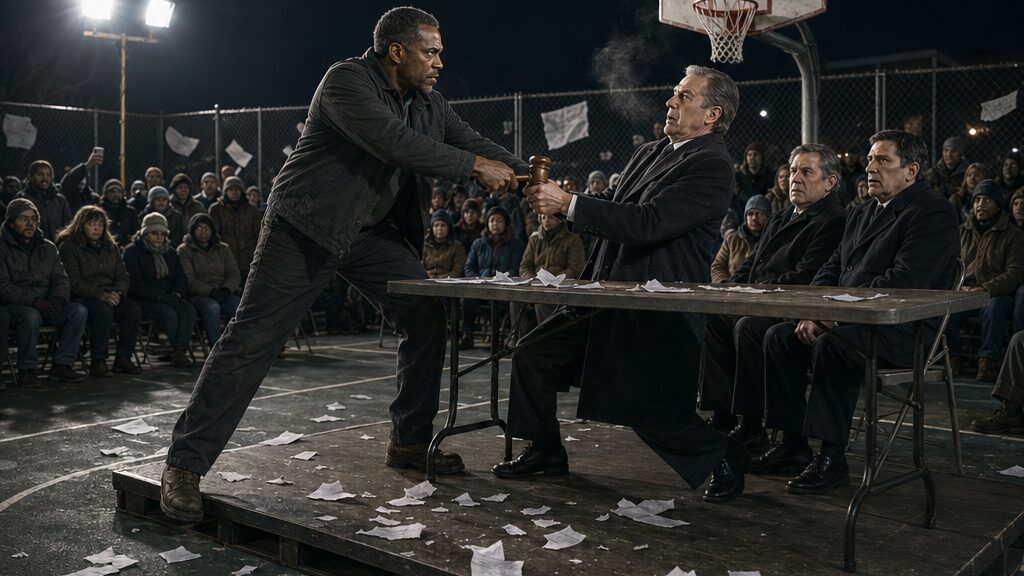
Then he took the gavel from the table.
Charles stared at him.
“That belongs to the association.”
“The association no longer exists.”
Samuel gripped the handle with both hands.
He did not swing it at Charles. He did not strike the table or the microphone or any person standing near him.
He bent the weakened wood across his knee.
The handle resisted, creaked, and snapped.
The sound cracked across the court harder than any blow Charles had delivered all evening.
One half remained in Samuel’s right hand. The head and broken length of handle hung from his left.
He dropped both pieces at Charles’s feet.
No one spoke.
Samuel removed the Supreme Court order from his coat and slapped it flat across the foreclosure authorization.
The state seal covered the signature line.
“This board was dissolved thirty-one days ago,” he said. “Every fine collected after that date, every lien threatened, and every foreclosure prepared under authority you knew you did not have is evidence.”
Charles looked at the order, then at the phones, then at the cabinet full of records.
“You think this makes you a hero?” he said.
“No.”
Samuel met his eyes.
“It makes you answerable.”
Beyond the chain-link fence, vehicle doors slammed.
Charles turned toward the sound.
Two officers entered through the gate, followed by others moving along the outside perimeter. Their radios crackled beneath the sudden shouting.
The board broke before the first officer reached the dais.
“He controlled the accounts!” one member yelled.
Brenda raised both hands. “I retained documents. I can show you where the transfers are.”
Another board member shoved a folder toward the approaching officers. “I voted based on what he told us.”
Charles pointed at Brenda. “She signed every check.”
“You threatened me,” Brenda shouted.
“You approved the transfers.”
“You wrote them.”
“You all benefited.”
The officers ordered everyone to remain where they were.
No one listened.
Board members crowded away from Charles, accusing one another, pulling documents from folders, offering passwords and private conversations. One tried to hand an officer a phone before being told to place it on the table. Another demanded separate counsel.
Charles stepped backward until his heel touched one half of the broken gavel.
He looked down.
The head rolled beneath the table.
An officer climbed onto the dais.
“Charles Hill?”
Charles straightened his coat.
“I am the elected president of this association.”
Samuel looked at the order beneath his hand.
“No,” he said.
The officer took Charles by the arm.
Around them, the board continued turning on itself.
Chapter 8: What Remained After the Gavel
“Brenda, do not say another word.”
Charles stood beneath the basketball hoop with his hands secured behind him.
Brenda looked at the officer beside her, then at Charles.
“I want a separate lawyer,” she said.
Charles closed his eyes.
It was the last instruction he gave that evening, and the first one no one even pretended to follow.
Officers moved across the court collecting phones, sealing archive boxes, and photographing the scattered documents. The floodlights still burned, but the dais no longer resembled a tribunal. Its tables had been pushed apart. Chairs stood crooked. The microphone lay on its side with the cable trailing toward the asphalt.
The residents remained.
No one seemed ready to go home.
Samuel stepped down from the platform and picked up a piece of his hardship request near the free-throw line. The wind had folded it against the painted boundary.
He found another piece beneath a chair.
Amanda approached with her grocery bag tucked beneath one arm.
“You missed one,” she said.
She pointed toward the fence.
A strip of paper clung to the chain links. Samuel pulled it free. It contained the paragraph Charles had read aloud, though only the final line remained intact.
I am requesting time, not forgiveness of the debt.
Samuel folded it with the other pieces.
“You sent everything?” he asked.
Amanda nodded. “The receipts, the recording, the photo of the attorney letter, Jacob’s message.”
“And my case?”
“With the others.”
Samuel looked at her.
She understood the question beneath the question.
“I did not send them a story about one unemployed man,” she said. “I sent them forty-seven properties and a month of illegal collections.”
Across the court, residents gathered around the opened boxes under an officer’s supervision.
One woman found a lien notice bearing an amount she had never received. An older resident held up two account statements with different balances for the same date. Another pointed to a folder containing photographs of harmless property conditions labeled as violations.
The discoveries did not produce cheers.
They produced anger spoken in low, exact sentences.
“This signature isn’t mine.”
“They charged this twice.”
“I paid that.”
“My mother never received this.”
A state investigator arrived and spoke briefly with the supervising officer. Then she addressed the residents from court level, without using the dais.
“All foreclosure-related actions associated with this board are being frozen pending review,” she said. “No one should make additional payments tonight. These records will be secured, and affected homeowners will receive individual instructions.”
A resident asked whether the money would be returned.
The investigator did not promise it.
“If funds can be traced and recovered, restitution may be possible.”
“May be?” someone repeated.
“Yes.”
The answer settled over the crowd with the weight of unfinished work.
Samuel respected it more than a promise.
Near the police vehicles, board members continued competing to become the most useful witness.
Brenda spoke rapidly to an officer while pointing toward the ledger. Another member insisted he had opposed the special assessment in private. A third claimed Charles had forged meeting summaries.
Charles heard them and twisted around.
“They approved every action,” he said. “Check the votes.”
One officer guided him toward a vehicle.
Charles looked across the court at Samuel.
For a moment, the old performance returned.
“You think they will thank you when the roads need repair?” he called. “When the drains fail? When nobody wants responsibility?”
Samuel looked at the broken gavel pieces beneath the table.
“The work still exists,” he said. “Your authority doesn’t.”
Charles opened his mouth, but the officer placed him into the vehicle.
The door closed.
Jacob stood beside Cabinet C with his hands in his jacket pockets. Samuel walked over.
“You kept the records here,” Samuel said.
“I nearly didn’t.”
“But you did.”
Jacob looked toward Charles’s vehicle. “After you blocked the truck.”
“After you showed me the message.”
Neither of them tried to make the exchange cleaner than it was.
Samuel held out the brass key.
Jacob shook his head. “Give it to the investigator.”
Samuel did.
Amanda’s mother joined them, wrapped in a heavy coat. She touched Amanda’s arm, then looked at Samuel.
“You should lead the recovery committee,” she said.
Several residents nearby heard her.
One of them nodded. “You knew what to do.”
Another said, “You stood up to him.”
The suggestions spread too quickly.
“President would have to be temporary,” someone said.
“We need one person coordinating records.”
“Samuel already has the state contact.”
Samuel felt the shape of the old structure trying to rebuild itself around the nearest person who had appeared strong.
He stepped onto the painted sideline, not the dais.
“No president,” he said.
The residents quieted.
“We need a committee because no single person should hold every record, every decision, or every key.”
A man near the boxes frowned. “Someone has to be responsible.”
“We all do.”
The words surprised Samuel with how little they hurt.
He looked at Amanda. “You have the payment records.”
Then at Jacob. “You know the contracts and repairs.”
Jacob shifted uncomfortably but did not refuse.
Samuel gestured toward the residents around the boxes. “Anyone affected should be able to see the process. We choose people for specific work. We replace them if they stop showing the work.”
“You’re refusing?” Amanda asked.
“I’m refusing the chair.”
A faint smile touched her mouth.
“I’ll serve,” Samuel said. “Not above anyone.”
The residents began discussing practical things: copying files, contacting mortgage companies, checking elderly neighbors, listing emergency repairs that could not wait for the legal review.
Their voices overlapped, but no gavel silenced them.
An officer removed the two broken halves from beneath the table and placed them in an evidence bag. Before sealing it, she photographed them beside the Supreme Court order.
Samuel watched the cloudy plastic close over the wood.
The symbol looked ordinary inside the bag.
Just a cracked tool with too much meaning forced into it.
He returned to the center of the court. The foreclosure notice with his name still hung beneath the hoop. One corner had torn loose from its nail and slapped softly against the support.
Samuel pulled it down.
This time no one mistook the act for shame.
He folded the notice around the pieces of his hardship request. He did not try to align the torn edges or make the pages whole.
Amanda stood beside him as the police vehicles began leaving.
“You still have the interview folder?” she asked.
“At home.”
“How did it go?”
“They wanted someone more adaptable.”
“That sounds like their loss.”
Samuel almost dismissed the comfort.
Then he stopped himself.
“Maybe,” he said.
The court was emptying slowly now. Residents carried copies, phone numbers, and lists rather than orders. Jacob helped lower one of the floodlights. The raised platform remained, but without the board behind it, it was only plywood and screws.
Samuel looked toward his house.
The porch light still burned.
“I thought losing the job meant I had failed to keep my place,” he said.
Amanda followed his gaze. “In the house?”
“In all of it.”
He held the folded papers at his side.
“It didn’t.”
The wind moved through the fence and across the painted court.
Nothing struck a table.
No one called for order.
Samuel walked home beside his neighbors.
The story has ended.