The HOA Sent a Crew to Tear Down His Dock Before the Lake Police Arrived
Chapter 1: The Saw Was Already Running on the Dock
The saw was already biting into the brace before John Baker reached the bottom of his own yard.
At first, he thought the sound had come from a boat engine coughing to life across the cove. Then the blade screamed again, sharper this time, and a splinter of treated pine snapped off the side of his dock and dropped into the water.
John stopped halfway down the stone path.
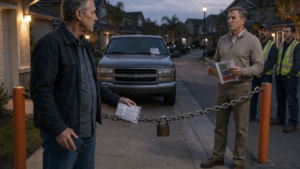
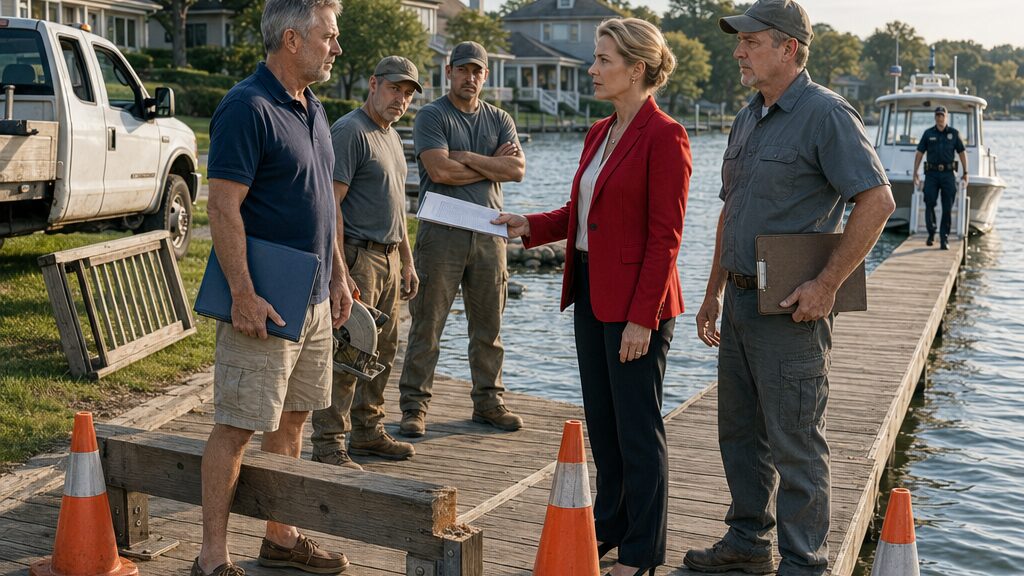
Two men in work shirts stood on the dock he had rebuilt with his own hands twelve summers ago. One held a circular saw against the temporary cross-brace beneath the new handrail. Another had orange cones lined along the first twenty feet of planking as if the dock had become a construction site overnight. A white pickup idled near the grass, tailgate down, with one of John’s rail sections already lying in the bed.
For a second, he did not move. He only watched the board sag where the brace had been cut halfway through.
Then the memory came through him so fast his fingers closed hard around the coffee mug still in his hand: Susan’s shoe slipping, her hand missing the old slick rail, her body turning toward the water before he caught her by the back of her sweater.
He set the mug in the wet grass and walked faster.
“Stop that saw.”
The man holding the tool lifted his finger from the trigger. The blade whined down. He looked toward an older man near the truck, broad-shouldered, gray hair under a cap, clipboard tucked under one arm.
John stepped onto the dock. The boards flexed beneath him, but not the way they had before the brace. Not yet.
“This is private property,” John said. “Who told you to cut into it?”
The older man approached without hurry. “Gary Thompson. Crew supervisor.”
“I asked who told you.”
Gary glanced toward the shoreline path leading to the street. “Lakeview Shores HOA. We’re removing unauthorized lakefront framing.”
John stared at him.
“Unauthorized lakefront framing,” he repeated.
“That’s what the work order says.”
“That framing is a temporary stabilization brace.”
Gary’s eyes flicked down to the board his worker had been cutting. “I’m not here to debate terms.”
“No, you’re here to take apart a dock without giving the homeowner notice.”
Gary adjusted his grip on the clipboard. He did not look pleased, but he did not look ashamed either. He looked like a man who had started a job expecting a quiet morning and found the property owner standing in front of him before seven.
“There was supposed to be notice on the door,” he said.
“There wasn’t.”
“I can only go by what I’m given.”
John stepped between the worker and the next brace. He kept his hands low, palms open, because there were three of them and one of him, and because anger was the easiest thing for other people to misunderstand. “Then what you’ve been given is wrong.”
Behind him, the lake slapped softly under the dock. The first cut brace creaked.
One of the workers shifted his weight. “Boss?”
Gary did not answer him. He watched John’s face instead. “Sir, I don’t want trouble. We were hired to remove the non-compliant additions and restore the dock to its prior condition.”
“If you restore it to its prior condition, somebody is going to get hurt.”
“That isn’t in my paperwork.”
John almost laughed, but it would have come out wrong. He looked back toward the house. The bedroom curtains were still drawn. Susan had not heard yet, or she had heard and was pretending she had not, waiting to see whether he would handle it without making her the center of another fight.
He turned back. “Wait here.”
“Mr. Baker—”
“Wait,” John said.
He went up the path quickly, past the mug in the grass, through the side door, and into the kitchen. The blue folder lay exactly where he had left it the night before, beside a bottle of pain medication and the small flashlight Susan used when she came downstairs before sunrise. He slid the folder under his arm and paused at the doorway to the hall.
“John?” Susan called from the bedroom.
He closed his eyes for half a beat.
“It’s the HOA crew,” he said. “They’re at the dock.”
Silence.
Then the bed frame shifted.
“Are they taking it down?”
“Not if I can stop them.”
“Show them the letter.”
He looked at the blue folder. The medical letter was not inside it. It was still in the drawer where he had put it, separate from permits, emails, photographs, and repair notes. He had told himself it did not belong in an HOA file. He had told himself Susan should not have to become evidence.
“I’ve got the lake safety notice,” he said.
“That’s not what I said.”
The words followed him back outside.
By the time John returned to the dock, Gary was standing near the cut brace with his phone to his ear. The workers had stopped, but one had already loosened two bolts from the handrail post.
John opened the folder on top of a dock box and pulled out the first sheet.
“Emergency repair notice,” he said. “Submitted to the HOA office three weeks ago. Copy to Lakeview Shores property committee. Photos attached. Temporary stabilization required pending permanent repair.”
Gary lowered his phone. “I’m not with the HOA.”
“I know that. But you’re cutting the board.”
Gary’s jaw tightened.
John turned to another page. “Email from county lake safety office confirming they received the dock condition report. They asked that temporary stabilization remain in place until inspection. That inspection is scheduled this week.”
Gary looked at the paper but did not reach for it. “My work order says remove everything added after May fifteenth.”
“The brace was added May eighteenth because my wife nearly went into the water on May seventeenth.”
The words came out before John could soften them. He hated how Gary’s face changed: not enough to stop the job, but enough to know there was a person behind the wood.
Gary looked toward the house, then back at the half-cut brace.
“I can call the HOA contact,” he said.
“You do that.”
“I already did.”
“And?”
“She’s on her way.”
John nodded once. “Good. Until she gets here, no more cutting.”
Gary exhaled through his nose. “I can pause for a few minutes. But if she confirms the order, I have to continue.”
“You don’t have to do anything that makes this dock unsafe.”
“With respect, Mr. Baker, I don’t know what makes your dock safe. I know what I was contracted to remove.”
John closed the folder. The blue cover had a dented corner from the morning Susan slipped, when he had carried it outside with the repair estimate and dropped it running toward her. He pressed his thumb over that dent and forced his voice level.
“Then you’re going to stand here until the person who signed that order explains why she scheduled a removal before the safety inspection.”
Gary glanced again at the shoreline path.
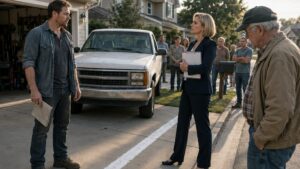
This time John heard the car before he saw it. A clean white SUV pulled up near the curb above the slope. The driver’s door opened. Sarah Wilson stepped out in a vivid red suit, her blond hair pinned back, a thick violation packet tucked against her side.
She did not look surprised to see the cut brace, the idling truck, or John standing in front of the workers.
She looked prepared.
Chapter 2: The Red Suit Said It Violated the Rules
“This violates HOA rules,” Sarah Wilson said before her shoes touched the dock.
She came down the slope with the violation packet held like a shield, red jacket bright against the pale morning water. Gary stepped aside as she reached the first orange cone. The crew watched her the way workers watched the person who controlled payment.
John did not move away from the brace.
“Section nine,” Sarah said, tapping the packet with one finger. “Exterior lakefront structures must retain approved appearance, approved materials, and approved sightline profile. You installed unapproved framing, non-matching rail support, and visible bracing.”
“It’s temporary,” John said.
“It is visible from three neighboring lots.”
“It’s holding the rail steady.”
“It was not approved.”
“I submitted the emergency repair notice three weeks ago.”
Sarah’s mouth tightened, not with surprise, but with impatience. “Submitting a request is not approval.”
“No one answered it.”
“The board is not required to approve incomplete exterior modifications because a homeowner decides his timeline is urgent.”
John opened the blue folder again. He took out the printed email from the lake safety office and held it up without stepping toward her. “County lake safety has an active review. They asked that temporary stabilization remain in place until inspection.”
Sarah glanced at the paper from a distance. “County review does not override HOA design authority.”
“It overrides you cutting into a brace before the inspector sees it.”
Gary shifted behind her. “Ms. Wilson, just so we’re clear, he’s saying there’s a safety inspection scheduled.”
“I heard him,” Sarah said.
The worker with the saw rested it against his thigh, blade down. The half-cut brace gave another small groan as the wake from a passing boat moved under the dock.
John felt it through his shoes.
“Everyone off the cut section,” he said.
No one moved.
He looked at Gary. “Now.”
Gary hesitated, then waved his worker back. The man stepped away from the brace.
Sarah’s eyes sharpened. “Mr. Baker, you do not direct the HOA’s contractor.”
“I direct who stands on a half-cut support on my dock.”
For the first time, Sarah looked down at the brace closely enough to see the cut. Something flickered across her face, too quick to call concern. She turned to Gary. “Why is that only partially removed?”
“Because he came down and stopped us.”
“We are authorized to remove it.”
“We were cutting the load-bearing brace first,” John said. “If that was your instruction, you don’t know what you ordered.”
Sarah faced him again. “Don’t mischaracterize this. The HOA ordered removal of unapproved additions.”
“You ordered men onto my property before I was notified.”
“A notice was prepared.”
“Prepared isn’t delivered.”
“It was posted.”
“Not when I came outside.”
Sarah opened the packet and pulled out a page with a red mark across the top. “This is the notice. You are in violation. The board has authority to cure exterior violations and assess removal costs to the homeowner after failure to comply.”
“Failure to comply with what? A request you never answered?”
“With the governing documents you agreed to when you bought in Lakeview Shores.”
A sound came from the right. Not loud. Just a dock gate clicking on the neighboring property.
John looked over.
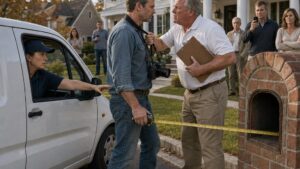
Angela White stood on her own dock in a pale sweater, arms folded, watching. She was far enough away to pretend she was not listening and close enough to hear every word. Behind her, two more neighbors had stopped on the shoreline path with coffee cups in hand.
Sarah saw them too. Her posture changed. Straighter. Cleaner. More official.
“This is exactly why we have standards,” she said, voice raised just enough to travel. “One homeowner cannot alter a shared lakefront view and create liability for the entire association.”
John felt heat climb his neck. He thought of Susan inside, trying to make it from bed to bathroom without turning too quickly. He thought of the medical letter in the drawer. He thought of Angela’s eyes on the dock brace as if it were ugly wood and not the thing that kept his wife’s hand steady.
He made himself speak to Sarah, not the watchers.
“You want liability?” he said. “Leave that brace cut halfway through and tell the county inspector why.”
“The county inspector is not here.”
John looked out across the water.
A white patrol boat was moving along the cove, still distant, its blue stripe flashing when it caught the sun. He had called the lake safety office the night before after the HOA’s last email refused to confirm a hearing date. He had not known whether anyone would come. He had only left a message: active removal threatened before inspection.
Now the boat slowed near the row of private docks.
Sarah followed his eyes but not far enough.
She turned back with a thin smile. “You seem to believe calling outside agencies will intimidate the board. It won’t. This community has rules for a reason.”
“So do docks,” John said. “Weight, movement, load, waterline stress. You don’t get to call those things ugly and make them disappear.”
Gary’s phone buzzed. He checked it, then looked at Sarah. “Do you want us to continue?”
Sarah did not answer immediately. She looked from the folder to the brace to Angela’s dock. The neighbors were listening openly now. Her face carried the strain of someone who needed a clean decision because messy ones looked weak.
“Yes,” she said. “Proceed with the removal. Carefully.”
Gary did not move. “The brace is partially cut.”
“Then finish removing it.”
John stepped directly in front of the next worker before the man could pick up the saw. He kept his hands visible, one holding his phone, the other flat against the blue folder.
“Before that saw touches another board,” he said, “I want the order in writing and the authority that overrides an active lake safety review.”
Sarah held up the packet. “You have the order.”
“That’s an HOA enforcement notice.”
“That is the authority.”
“No,” John said. “That’s not the same thing.”
Gary looked between them. “Ms. Wilson?”
Sarah’s voice dropped. “Mr. Thompson, your company was retained to perform a job.”
“And I’m asking whether we’re clear to cut a support he says is under safety review.”
“The HOA will indemnify—”
“Will you put that in writing right now?” John asked.
Sarah’s eyes snapped to him.
He did not raise his voice. That seemed to bother her more. “Write that you personally instructed this crew to remove a temporary stabilization brace after being shown the county safety email.”
Angela shifted on the neighboring dock. One of the workers took his hand off the saw completely.
Sarah’s face hardened. “You are obstructing authorized enforcement.”
“I’m preventing damage.”
“You will be assessed for the delay, the crew time, and the full cost of removal.”
“Put that in writing too.”
The patrol boat’s engine grew louder.
This time Sarah noticed Gary looking past her. Then one of the workers looked. Then Angela. The boat had reached the end of John’s dock, and two uniformed lake police officers were stepping onto the lower platform.
Sarah turned halfway, still holding the violation packet.
John watched her register the boat, the uniforms, the timing. Her expression did not fall apart. It tightened, control rushing to cover surprise.
One officer started up the dock.
Sarah looked back at John. “Did you call law enforcement on an HOA compliance matter?”
John closed the blue folder and pointed past her.
“Look behind you, Sarah.”
Chapter 3: The Folder Proved Less Than He Needed
“The removal stops for today,” the lake police officer said, “but that does not mean the repair is approved.”
The sentence landed harder than John expected.
Gary’s crew had backed off the dock. Sarah stood near the orange cones with her violation packet tucked under one arm, saying nothing now, which was not the same as yielding. The officer had taken photographs of the half-cut brace, the loosened bolts, the handrail, and the open blue folder. He had listened to John. He had listened to Sarah. He had called the county lake safety office from the dock.
Then he gave John the part that did not feel like a win.
“We can pause activity that may leave a dock unsafe before inspection,” the officer said. “We cannot decide your HOA variance.”
Sarah’s shoulders settled slightly, as if the ground had returned under her feet.
John heard that before he saw it.
“So the association’s authority remains intact,” she said.
“The association can follow its process,” the officer replied. “It cannot continue cutting into this structure today. Not with an active safety review and a partially removed support.”
Gary rubbed a hand over his mouth. “What do you want us to do with the cut brace?”
“Secure the area,” the officer said. “No further removal. No one uses that section until the inspector reviews it.”
John looked toward the house. That section was the path from the yard to the boat lift, but more than that, it was where Susan held the rail when she wanted to sit near the water. He had installed the brace because the old rail shuddered under her hand. Now the officer was telling him the dock had become unsafe in a new way.
Because someone had cut into the thing that fixed it.
Sarah signed the officer’s acknowledgment with controlled strokes. “The HOA will schedule an emergency board review.”
“Good,” John said.
She turned to him. “Don’t mistake a temporary pause for permission.”
“I’m not the one who mistook a violation notice for a demolition order.”
Her lips pressed together, but the officer was between them, and the neighbors were still watching.
By noon, the dock was taped off, the crew was gone, and the first brace hung in an awkward splinted state under the rail. John stood in the kitchen with the blue folder spread open across the table. Every document had seemed solid when he gathered it: photographs of warped boards, the contractor’s estimate, the email to the HOA, the emergency notice, the county reply. Now they looked thinner.
Susan sat at the far end of the table, one hand wrapped around a glass of water she had not touched.
“You didn’t include it,” she said.
John did not ask what she meant.
He slid a stack of photos into date order. “I included the safety report.”
“The medical letter.”
“They don’t need your diagnosis to know a cut brace is dangerous.”
“They need to know why you built it before the permanent approval.”
“I told them you slipped.”
“You told a crew supervisor in the middle of a fight.” Her voice was calm, which made it worse. “That’s not the same as telling the board.”
John pushed the folder shut, then opened it again because closing it felt childish. “I’m not giving Sarah Wilson a piece of paper with your private medical information so she can wave it around a meeting room.”
“You don’t get to protect me by making the reason disappear.”
He looked at her then.
Susan had dressed carefully, more carefully than the day required, in a blue sweater and soft shoes with grips on the soles. Her hair was combed back. Her face was pale from the effort of moving around after the morning’s noise, but her eyes were steady.
“That’s not what I’m doing,” he said.
“It is.”
“I don’t want them talking about you like an exception.”
“They already are,” she said. “They’re just doing it without using my name.”
The kitchen clock clicked once. Outside, a strip of yellow caution tape fluttered at the dock entrance.
John looked down at the folder. He remembered Susan on the old rail, laughing once because the lake breeze had taken her hat and dropped it into the shallows. He remembered the later day, the bad one, her shoulder hitting his chest when he caught her and the way she said, almost angry, “Don’t make a face.” He had not made a face since. Not where she could see.
His phone rang.
The HOA office number lit the screen.
He answered without sitting. “John Baker.”
A woman from the office read from a prepared tone. “Mr. Baker, I’m calling to notify you that an emergency board meeting has been scheduled for tomorrow evening at six. The matter of unauthorized dock modifications, violation assessment, removal cost, and temporary safety claim will be reviewed.”
“Temporary safety claim,” John repeated.
“That is the language on the agenda.”
“Who wrote the agenda?”
A pause. “The board president.”
“Sarah.”
Another pause. “The board president.”
“Send it to me in writing.”
“It has already been emailed.”
The line clicked dead.
John lowered the phone.
Susan watched him. “What did they call it?”
He almost lied. Not fully. Just enough to make it gentler.
Then he saw the caution tape again through the window, bright and ridiculous against the water, and understood that gentler was how they had gotten here.
“Unauthorized dock modifications,” he said. “Violation assessment. Removal cost. Temporary safety claim.”
Susan’s face did not change, but her fingers tightened around the glass.
John sat down and pulled the drawer beside the table open. Inside lay the sealed envelope from her doctor, addressed generally to “Housing or Property Authority.” He had put it there because he could not bring himself to file her body beside bolts and boards.
Susan reached across the table before he could touch it.
She took the envelope, opened the blue folder, and laid the letter on top of the first page.
“Then stop making me invisible,” she said.
Chapter 4: The Board Called Safety an Appearance Problem
Sarah Wilson had enlarged the photograph of John’s dock brace until it filled the entire screen behind the board table.
The brace looked worse that way. Crooked in the projector light, raw-edged where Gary’s crew had cut it, brighter than the weathered dock around it. A red circle had been drawn around the support post. Under the photo, someone had typed: UNAPPROVED EXTERIOR MODIFICATION — VISIBLE FROM LAKEFRONT COMMON VIEW.
John stood at the back of the meeting room with the blue folder under his arm and felt every chair between him and the board turn into a witness stand.
Susan had not come. The medical letter had.
It sat inside the folder, still in its envelope, heavy as a stone.
Sarah stood beside the screen in the same red suit jacket she had worn on the dock, though now there was no saw behind her and no lake police officer walking up behind her shoulder. Here, under ceiling lights and framed community bylaws, she looked fully at home.
“We are not here to debate whether Mr. Baker believes he had a reason,” she said. “We are here to determine whether the association’s process was bypassed and whether the structure now presents liability to the community.”
John looked at the photograph again. The missing context made the brace seem guilty.
Benjamin Lee, the treasurer, sat at the end of the board table with a stack of printed financial reports. He wore reading glasses low on his nose and did not look at John when he spoke.
“Our insurer has already requested updated documentation after the Williams dock incident last year,” Benjamin said. “Any non-standard dock modification may affect coverage. If one homeowner installs unapproved structural elements, others will claim the same right. Then assessments rise for everyone.”
A low murmur moved through the room.
John heard the word assessments land harder than safety ever had.
Sarah let it settle before turning to him. “Mr. Baker, you may speak.”
He walked to the small microphone at the front. The blue folder felt too bright against his hand. He opened it on the lectern and pulled out the emergency repair notice first.
“This was submitted to the HOA office three weeks ago,” he said. “Temporary stabilization pending permanent repair. Photos attached. Contractor estimate attached. County lake safety copied.”
Sarah folded her hands. “Received does not mean approved.”
“I understand that. But no denial was sent. No request for additional information. No hearing date. Nothing.”
“Our office receives many requests.”
“You received one marked emergency.”
Benjamin looked up. “Emergency according to you.”
John slid the next page forward. “According to the contractor who inspected the rail. He wrote that the support had lateral movement and should be stabilized before regular use.”
Sarah leaned toward the microphone. “And yet the contractor did not submit an architectural variance request on the proper form.”
“He’s a dock contractor. I submitted what your office told me to submit.”
“What you submitted,” Sarah said, “was a repair notice. Not a complete exterior modification application.”
John stared at her.
For a moment, the meeting room went too quiet.
“You’re saying,” he said slowly, “that if I had called the same brace a repair, it was incomplete, but if I called it a modification, it was unauthorized.”
Sarah did not blink. “I am saying the association cannot approve work without the correct process.”
A neighbor in the second row whispered something John could not hear. Angela White sat three chairs from the aisle, arms folded, eyes fixed on the projected photo. She looked uncomfortable, but not yet on his side.
John pulled the lake safety email from the folder. “County safety acknowledged the condition and asked that temporary stabilization stay in place until inspection.”
Sarah’s expression tightened. “County safety has jurisdiction over lake hazards. The association governs community appearance standards.”
“It’s the same dock.”
“It is not the same authority.”
Benjamin removed his glasses. “Mr. Baker, nobody wants your property unsafe. But if we allow emergency claims without documentation, we undermine every standard this community relies on.”
John almost reached for Susan’s letter.
His fingers touched the envelope.
He thought of her voice in the kitchen: Stop making me invisible.
Then he saw Sarah watching his hand. Not cruelly. Carefully. Like someone waiting for a form to become either useful or disqualifying.
He pulled out the contractor estimate instead.
“The permanent repair uses approved brown composite rail, matching the dock profile,” John said. “I already ordered it. The temporary brace is only there until the inspector clears the replacement.”
“Then why wasn’t the permanent repair application included?” Benjamin asked.
“It was attached to the second email.”
Sarah turned to the office clerk at the side table. “Was there a completed permanent repair application?”
The clerk looked down at the screen in front of her. “There is an email with attachments. I see photos, estimate, county correspondence.”
“And the application?”
The clerk hesitated. “I don’t see the association’s form.”
John felt the room move away from him by inches.
“I filled out the emergency repair notice your office sent me,” he said.
Sarah’s voice softened, which somehow made it worse. “Mr. Baker, that is the point. You are asking this board to treat an emergency notice as a full architectural approval. We cannot do that, especially when the modification may be tied to a medical accommodation that was never properly submitted.”
The word medical struck the room like dropped glass.
John’s hand closed over the folder.
Angela looked at him then. Really looked.
Sarah continued, “If there is a medical accommodation issue, the association has a process for that as well. It requires appropriate documentation.”
John kept his mouth shut one second too long.
He could feel Susan’s letter in the folder, but now the room had become exactly what he feared: curious, formal, hungry for the private reason behind the boards.
“I’m not discussing my wife’s medical history in front of the neighborhood,” he said.
“No one has asked you to,” Sarah replied. “But the board cannot evaluate a claim it has not received.”
“You had a safety report.”
“We had an incomplete file.”
Benjamin tapped his reports into a neat stack. “The board needs to protect both the Bakers and the community. Leaving unapproved structural work in place exposes everyone. Removing it before inspection may have been premature, but keeping it indefinitely is not an option.”
Premature.
John turned the word over once. A crew with a saw before sunrise had become premature.
The board moved into discussion. Sarah spoke about sightlines and precedent. Benjamin spoke about insurance. Another board member, unnamed at the far end, asked whether the brace could be painted. Someone else asked whether the dock could be closed entirely until the permanent repair. Each suggestion treated the dock as an object first, a route second, and only somewhere far down the list as the place where Susan used to stand to watch the herons cross the cove.
At last Sarah read the motion.
“The association will allow forty-eight hours for Mr. Baker to submit acceptable documentation for emergency accommodation and proper exterior repair review. If acceptable proof is not received, removal of non-compliant elements may resume, and costs may be assessed to the homeowner.”
John stood still as the votes came in.
Yes.
Yes.
Yes.
Benjamin paused, looked once at John, and said, “Yes, with the note that the association should expedite review if complete documents are provided.”
Sarah marked the vote.
John closed the blue folder.
“Who decides what acceptable means?” he asked.
Sarah looked up from the paper.
“The board does.”
Chapter 5: The Notice on the Door Came Too Late
The removal notice was stapled to John’s front door at 8:10 in the morning, but the ink on the timestamp said 7:35.
He stood on the porch with the blue folder tucked under one arm, staring at the black numbers printed across the top of the page. The paper was damp at the corners from the lake air, fresh enough that it had not curled yet. Four staples pinned it flat to the wood.
Behind him, inside the house, Susan’s chair scraped against the kitchen floor.
“John?”
He pulled the notice free carefully so the staples stayed in the door. “They posted it.”
“After you sent the documents?”
“After.”
He had emailed the full packet at 6:42 that morning: the emergency notice, the contractor estimate, the county safety email, the permanent repair plan, and one page from Susan’s medical letter. Not the diagnosis. Not the full history. Just the sentence her doctor had written plainly enough that even a board could understand it: safe, stable rail-assisted access is medically necessary to reduce fall risk at primary residence.
At 7:18, the HOA office had confirmed receipt.
At 8:10, the notice appeared.
The timestamp said it had been posted before the office confirmed anything.
John looked at the staple holes. Not the torn paper. The holes.
There were four new ones, shining pale in the painted doorframe. No older punctures. No mark from a notice left before sunrise. No curled tape. No shadow where paper had hung for hours.
He took a photo with his phone.
Then he photographed the timestamp, the empty porch, the doorframe, and the path down toward the dock.
At the bottom of the hill, Gary Thompson’s white pickup rolled slowly into view.
John folded the notice once and walked down to meet him.
Gary climbed out without the crew. He wore the same cap, but not the same expression. Today he looked like he had come to give bad news and did not want to be seen doing it.
“I’m not here to work,” Gary said before John could speak. “Just checking the site.”
“Checking it for whom?”
Gary looked toward the taped-off dock. “HOA.”
“They sent the notice after receiving my documents.”
“I don’t handle notices.”
“No. You handle the saw.”
Gary’s jaw flexed. “Fair.”
John held out the paper. “What time were you scheduled the first morning?”
Gary did not take it. “Mr. Baker—”
“What time?”
Gary looked past him toward the water, then back to the house. “Six-thirty arrival. Seven start.”
“The board meeting was last night.”
“This was scheduled before that.”
John felt something cold move through him. “Before the board voted?”
“I received the work order the afternoon before the meeting,” Gary said. “My office confirmed crew availability before close of business.”
John stared at him.
Gary lowered his voice. “I was told it was an unused decorative add-on.”
“It’s attached to the handrail.”
“I know that now.”
“You didn’t see that before cutting?”
“We see a lot of bad homeowner builds. People attach things everywhere. Planters, benches, shade frames.” Gary looked at the dock again. “They said it was abandoned framing and that the homeowner had ignored removal notice.”
John lifted the notice. “They hadn’t posted one.”
“I’m telling you what I was told.”
“Will you put that in writing?”
Gary gave a tired laugh without humor. “I like being employed.”
“You like being lied to?”
That landed. Gary looked at him sharply, then away.
“I’ll say this,” he muttered. “I’m not restarting work without a written clearance from the county inspector. Not after seeing that cut brace move.”
It was not enough. It was the first honest thing from the other side, but it was not enough.
A screen door opened across the property line.
Angela White stepped out from her side porch holding pruning shears she was not using. She looked toward Gary’s truck, then toward John, then down at the paper in his hand.
“Was that just posted?” she asked.
John turned. “You saw it?”
“I saw the HOA car pull away about ten minutes ago.”
Gary shut his eyes briefly.
John walked to the low hedge separating their yards. “Angela, did you see a notice on my door before this morning?”
She hesitated. Her gaze shifted toward the dock, toward the taped brace, toward the place where she had watched Sarah declare the violation in front of everyone.
“No,” she said. “I can’t swear nobody came before I was up, but I walked down for the paper at seven. Your door was clear.”
John nodded once. “Would you be willing to say that at the meeting?”
Angela’s mouth tightened. “I don’t want to be in the middle of this.”
“You already were.”
Color rose in her face.
He regretted it as soon as he said it, but did not take it back. He remembered her watching from her dock while Sarah found a bigger voice.
Angela looked toward the water. “I thought you were just being stubborn.”
John said nothing.
“We all did,” she added, quieter. “The brace looked… I don’t know. Like something half-built.”
“It was half-temporary.”
She almost smiled, then didn’t. “I saw Susan on the path last week.”
John went still.
“She stopped at the bend by the hydrangeas,” Angela said. “Had one hand on the fence. I thought she was just resting.”
“She was deciding whether she could make it back up without falling.”
Angela’s eyes moved to the folded notice. “I didn’t know.”
“No one asked.”
The words were sharper than he meant them to be. Angela flinched, but this time he let the silence stand.
Gary cleared his throat. “I should go.”
John looked at him. “If they send you back before inspection?”
Gary opened the truck door. “I’ll ask for written clearance.”
“From Sarah?”
“From someone higher than Sarah.”
After he left, John took the notice, the photos, and his phone inside. Susan sat at the table with the laptop open, reading the HOA email chain. The blue folder had grown thicker since morning, as if paper could become a wall if stacked high enough.
“They’re still calling the documents incomplete,” she said.
He stood behind her and read the message.
The board acknowledged receipt of supplemental materials. However, procedural deficiencies remain. Removal authority is not waived by disputed timing.
John took the laptop and typed one sentence before he could overthink it.
Please identify the specific deficiency in writing and confirm whether removal was scheduled before last night’s vote.
He sent it.
The reply came eleven minutes later from Sarah herself.
Timing irregularities, if any, do not alter the underlying violation.
Susan read it twice.
“That means yes,” she said.
That evening, John walked the property line to photograph the dock from Angela’s angle. He expected her to avoid him. Instead, she came out holding her phone.
“I wasn’t sure if I should show you this,” she said.
On the screen was a photo taken through her kitchen window the night before the crew arrived. The image was slightly blurred, but clear enough: Sarah Wilson stood on John’s dock in a dark coat, red suit visible beneath it, measuring tape extended from the rail to the brace.
The timestamp was 7:52 p.m.
John looked from the phone to Angela.
Angela swallowed. “She knew exactly what it was attached to before she sent the crew.”
Chapter 6: The Lake Police Heard the Part She Left Out
“Why is one brace missing from a stabilization plan that calls for three?” the county lake safety inspector asked.
No one answered at first.
They stood in a hard line along the dock: John near the blue folder, Sarah at the rail with her violation packet, Benjamin a few steps behind her, Gary near the orange cones, and the lake police officer by the lower platform. The inspector crouched beside the half-cut section and touched the empty bolt marks where Gary’s crew had loosened the first support. The wood showed pale scars in the morning light.
John felt those marks like an accusation against everyone, including himself.
“It was partially removed before the pause order,” he said.
The inspector looked over his shoulder. “By whom?”
Gary raised his hand slightly. “My crew. Under HOA work order.”
“After reviewing the stabilization plan?”
Gary’s eyes moved to Sarah.
Sarah stepped forward. “The association had not been provided a complete stabilization plan at that time. What we had was an unapproved exterior alteration.”
The inspector stood. “That doesn’t answer my question.”
Sarah held her packet closer. “The HOA was enforcing design rules.”
“On a structure under active safety review.”
“The review was not final.”
“No,” the inspector said. “That is why removing part of the support is a problem.”
The lake police officer said nothing, but his notebook was open.
John opened the blue folder on the dock box. The wind lifted the corner of the medical letter, and he put his hand over it.
Sarah saw the movement.
“Mr. Baker has repeatedly introduced new information after deadlines,” she said. “The board cannot make decisions based on shifting claims.”
John looked at her. “The dock didn’t shift. Your explanation did.”
Benjamin frowned. “John, we’re here to find a workable solution. But Sarah is correct that the board received incomplete materials.”
John almost snapped back that the board had received enough to stop a saw. Instead he saw Susan at the top of the shoreline path.
She stood with one hand on the temporary fence rail John had added beside the slope. She wore her blue sweater again, the one from the kitchen, and her soft shoes. The distance from the house to the dock was not far for most people. For her, it had become a series of negotiations with ground, balance, pride, and pain.
“Susan,” he said before he could stop himself.
Everyone turned.
Her face tightened at the attention, but she kept coming. Angela walked several steps behind her, not touching her, close enough to help if asked and far enough to let her decide.
John moved toward the path.
Susan shook her head once.
He stopped.
It was the hardest thing he had done all morning.
She reached the dock entrance and held the post until her hand steadied. Then she looked at Sarah, not at the inspector.
“I asked him not to make me part of this,” Susan said.
The lake moved under the dock. No one spoke.
John felt the sentence go through him, clean and painful.
Susan looked at the cut brace. “That was a mistake.”
Sarah’s posture changed. Not softening. Preparing. “Mrs. Baker, no one wants to invade your privacy.”
“You already did,” Susan said. “You just did it by pretending privacy meant there was no person involved.”
Benjamin lowered his eyes.
John picked up the letter. His hands were not steady, so he laid it flat on the folder before reading.
“I’m not reading her history,” he said. “I’m reading one line.”
Sarah opened her mouth.
The inspector looked at her. “Let him read.”
John read from the page.
“Stable rail-assisted access to exterior home pathways is medically necessary to reduce fall risk during recovery and daily mobility.”
He stopped there.
Not because there was nothing more. Because there was plenty more, and all of it belonged to Susan before it belonged to a board.
The inspector took the letter only after Susan nodded.
Sarah’s face had lost some of its color, but her voice stayed controlled. “The association has a medical accommodation process. It exists so requests can be evaluated properly. It was not completed before the alteration was installed.”
John looked at the brace. “She slipped before it was installed.”
The words came out quietly enough that the lake almost took them.
Angela inhaled behind Susan.
John kept going because stopping now would be another kind of hiding. “The old rail moved under her hand. I caught her before she went over the side. The contractor came the next morning. He said the permanent repair needed review but the temporary brace should go on immediately. So I put it on. I filed the notice that afternoon.”
The inspector looked through the folder. “I see the contractor note.”
Sarah said, “A contractor note is not an HOA approval.”
“No,” John said. “It’s the reason you shouldn’t have sent a crew to take it apart before anyone inspected it.”
Benjamin shifted. “Sarah, did we receive the county emergency exception memo before the board meeting?”
The question changed the air.
Sarah turned slowly toward him. “We received correspondence.”
Benjamin’s mouth tightened. “The memo?”
John looked at Benjamin, then at Sarah.
The inspector paused with a page in his hand. “I sent an advisory to the HOA office after Mr. Baker’s first report. It stated that temporary stabilization may remain pending inspection if removal would increase hazard.”
John had never seen that memo.
He looked down at his folder. It was not there.
Sarah said, “The advisory was preliminary.”
“It was relevant,” Benjamin said.
“It did not grant approval.”
“But did the board see it?”
Sarah’s silence lasted one beat too long.
Gary looked at the cut brace. Angela looked at Susan. The officer wrote something down.
Sarah’s face hardened with the strain of someone holding a weakening line. “The board had enough information to know the work was unapproved. We also had an insurance review pending. If we allow every owner to claim emergency exception after the fact, we expose the association to uncontrolled liability.”
The inspector’s voice stayed flat. “Uncontrolled liability includes ordering removal of safety supports before inspection.”
Sarah turned to him. “How long is the association expected to tolerate non-compliant materials?”
“Long enough not to make the dock less safe.”
“It cannot stay like this indefinitely.”
“No one asked for indefinitely,” John said. “I asked for until today.”
Susan’s hand found the post again. John saw the tremor before she closed her fingers around it.
He wanted to go to her. He stayed where he was.
The inspector walked the length of the rail, pressed at the remaining braces, then returned to the cut section. He took more photographs: the missing bolts, the saw mark, the empty space where wood should have met wood.
“This dock cannot remain in a half-removed condition,” he said.
Sarah seized on it. “Then the unapproved structure should be fully removed and the dock closed until proper approval.”
The inspector turned to her. “That is not what I said.”
John felt his pulse in his throat.
The inspector pointed to the cut brace. “The temporary stabilization plan required three supports. One has been compromised by removal activity. Until a permanent repair is approved, the immediate safety concern is restoration of stabilization, not further removal.”
Sarah stared at him.
Benjamin spoke carefully. “Are you saying the HOA has to allow the brace to be restored?”
“I’m saying if the association interferes with restoration of temporary stabilization after this inspection, it may be creating the hazard it claims to be managing.”
The lake police officer closed his notebook.
Susan exhaled once, small enough that only John seemed to hear it.
But the inspector was not finished.
He looked at the blue folder, then at Sarah’s packet, then at the dock beneath them. “I will issue a written finding today. Until then, no further removal. And someone needs to explain why an emergency advisory sent before the board meeting did not make it into the discussion.”
Sarah’s hand tightened around the violation packet.
John looked at the empty bolt marks where the first brace had been.
For the first time since the saw began, the question was no longer whether he had broken the rules. It was whether the HOA had broken the thing it claimed to protect.
Chapter 7: The Space Where the Brace Had Been
Sarah opened the meeting by withdrawing one part of the violation and leaving the bill on the table.
“The board acknowledges,” she said, reading from a prepared page, “that removal activity should not have proceeded once an active lake safety review was identified. The association is therefore withdrawing the daily non-compliance fine assessed after the pause order.”
John sat beside Susan in the front row, the blue folder closed on his lap.
He waited.
Sarah turned the page.
“However, the original exterior alteration remained unapproved at the time of installation. The association reserves the right to recover reasonable costs incurred during enforcement and to require any permanent repair to conform fully to Lakeview Shores design standards.”
There it was.
Not the saw. Not the cut brace. Not the week Susan had avoided the dock because half the support had been loosened. Just reasonable costs.
John felt Susan’s hand move once against the armrest of her chair. She had insisted on coming, then insisted he not help her out of the car unless she asked. She looked tired, but she was upright, her cane resting against her knee, her eyes on the board table.
The room was fuller than the first meeting. Angela White sat across the aisle. Gary Thompson stood near the back wall, cap in both hands, as if he had not decided whether he belonged there. Benjamin Lee had two folders open in front of him and looked like he had slept poorly.
Sarah continued, “The proposed resolution is as follows: Mr. Baker may submit a revised permanent repair plan using approved composite materials and standard rail profile. The temporary supports must be removed once permanent work begins. Removal costs from the prior enforcement action remain under review.”
John opened the blue folder.
The sound was small, but Sarah stopped reading for half a breath.
He took out three pages and walked them to the board table. Not the whole folder. Not everything. Just the inspector’s written finding, the contractor’s revised plan, and a photograph of the empty bolt marks where Gary’s crew had removed the first brace.
He laid the photo on top.
“I’m not here to argue about the color of the rail,” he said.
Sarah’s eyes moved to the photograph.
John kept his voice low enough that everyone had to listen. “The permanent material can match. The profile can match. I already agreed to that. What I won’t agree to is paying for a crew that was sent before proper notice, before inspection, and after the association had an emergency advisory it did not show the board.”
Benjamin leaned back slightly.
Sarah said, “The advisory did not approve the structure.”
“No,” John said. “It warned against removing stabilization before inspection.”
The room shifted. A few people already knew that. Others did not.
Benjamin picked up the inspector’s finding and read the highlighted line. His mouth tightened at the exact place John had expected: removal of temporary stabilization prior to safety inspection increased risk of structural instability and should not have proceeded without written safety clearance.
Sarah folded her hands. “The association acted under its governing documents.”
Gary spoke from the back before John could answer.
“No, ma’am.”
Every head turned.
Gary looked uncomfortable, but he did not step back. “Not the way it was explained to us.”
Sarah’s face went still. “Mr. Thompson, this is a board discussion.”
“I know.” He lifted his cap, then lowered it again. “But my company is being named in the enforcement costs, and I’m not certifying that job as properly noticed.”
Benjamin looked at him sharply. “What do you mean?”
Gary cleared his throat. “We received the work order before the first emergency meeting. We were told the structure was an unused decorative frame and that notice had already been posted. When we arrived, there was no homeowner acknowledgment, no county clearance, and the brace was attached to the rail system. Once Mr. Baker showed the safety email, we should have stopped until the HOA clarified.”
Sarah’s voice thinned. “You did stop.”
“After we cut into it.”
No one spoke for several seconds.
John looked down at Susan’s hands. They were folded neatly now. He could not tell whether she was relieved or bracing for the next blow.
Benjamin removed his glasses and rubbed the bridge of his nose. “Sarah, did the insurer require removal of temporary safety bracing?”
Sarah turned toward him. “The insurer required updated compliance documentation for all lakefront structures.”
“That is not the same question.”
“No,” she said after a moment. “They did not specifically require removal.”
Benjamin opened his second folder. “I spoke with the carrier this morning.”
Sarah’s head snapped toward him.
He did not look pleased to be saying any of it. “Their concern was undocumented hazards and inconsistent enforcement. But the representative stated that documented emergency stabilization pending inspection is less concerning than disabling a safety support without clearance.”
A murmur moved through the room, softer than outrage, heavier than gossip.
Sarah’s jaw tightened. “You contacted the carrier without notifying me?”
“I’m the treasurer. The costs were being discussed under my committee.”
John watched the two of them and saw, for the first time, the shape of Sarah’s fear. Not cruelty. Not simple pride. She had been holding a wall together with rules because she believed one loose board would bring the whole structure down: insurance, assessments, blame, the board’s authority, her own name at the top of every angry email.
But fear had not stopped the saw.
Angela stood before the board asked her to speak.
“I complained about the brace,” she said.
John turned.
Angela held her phone with both hands, but she did not look at it. “I told Sarah it looked unfinished from my dock. I said if the board let one person build whatever they wanted, the whole cove would start looking like a storage yard.” She swallowed. “I thought it was about appearance because that’s all I asked about. I didn’t ask why it was there.”
Sarah looked down at her papers.
Angela faced John and Susan. “I saw Susan on the path before all this. I saw her stop. I told myself it wasn’t my business.” Her voice wavered once, then steadied. “The brace looked ugly to me because no one had asked who needed it.”
Susan’s face softened, but she did not smile.
John felt the old instinct rise in him, the need to say it was fine, to close the door before their private life spilled farther into the room. He let the silence do the work instead.
Benjamin turned a page. “I propose an amended resolution.”
Sarah looked at him, warning in her eyes.
Benjamin continued anyway. “The violation related to emergency temporary stabilization is withdrawn. Removal costs are not assessed to the Bakers. The permanent repair plan is approved with matching composite materials as submitted, subject to county safety signoff. Temporary stabilization remains until permanent work begins. The board will draft an emergency repair procedure so safety-related temporary work is reviewed within forty-eight hours and cannot be removed before inspection.”
Sarah said nothing.
The unnamed board member at the far end asked, “And medical accommodation documentation?”
John stood.
Susan touched his sleeve, not to stop him, but to steady him.
“The board can require enough to understand the need,” John said. “Not enough to make someone’s medical file community property. One sentence from a qualified provider should be enough to trigger the process. After that, talk about boards and bolts and rail height. Not my wife like she’s an exhibit.”
Susan looked straight ahead. “I needed the rail,” she said. “That should have mattered before anyone cut it.”
No one interrupted her.
Benjamin wrote something on the resolution. Sarah read it, face controlled, then looked at John.
“I should have brought the advisory to the board,” she said.
It was not a full apology. It was not warm. It did not undo the cut in the brace or the yellow tape across the dock. But it was the first sentence she had spoken that did not hide behind a section number.
John nodded once. “Yes.”
The vote passed.
Not with applause. Not with cheers. Just raised hands, paper sliding across the table, and the uncomfortable quiet of people realizing a rule had failed because everyone had treated it as complete.
One week later, the new rail matched the dock so well that from Angela’s property line it almost disappeared. Brown composite, approved profile, clean fasteners, three supports beneath the section where the old brace had been. The empty bolt marks were gone, covered by stronger wood.
John stood at the dock entrance with the blue folder under his arm out of habit.
Susan looked at it.
“You bringing that to the water now?”
He followed her gaze and almost laughed.
For weeks, he had carried the folder like a tool, then like a shield, then like proof that he was not asking for anything unreasonable. Now it looked out of place in the sunlight.
He walked back to the dock box, opened the lid, and set the folder inside. Not hidden. Not thrown away. Filed where it belonged.
When he returned, Susan had already stepped onto the dock.
He moved beside her but did not touch her elbow. The new rail was smooth under her hand. The dock did not shudder. Halfway down, where the brace had once been cut, she stopped and looked over the water.
A heron lifted from the far reeds, slow and gray against the cove.
Susan took three more steps, then another.
At the end of the dock, she turned back to him.
John waited until she nodded before he came closer.
Behind them, the dock box sat closed, the blue folder inside, no longer something he had to carry to be believed.
The story has ended.