They Chained the Old Man’s RV Before Learning Who Owned Their Entire Access Road
Chapter 1: The Night They Turned Darkness Into a Weapon
The inside of Richard Hill’s RV turned white at twelve seventeen in the morning.
Not bright. White.
Every faded cabinet, every scratch in the narrow floor, every wrinkle in the blanket over his knees appeared at once beneath a hard, unnatural glare. The light forced itself through the curtains as if the walls had been peeled away.
A generator coughed to life outside.
Then a man shouted across the gravel.
“Keep them aimed at the windows. He won’t sleep here tonight.”
Richard did not move immediately. His coffee had gone cold beside an open book, and one finger still marked the page. Across the table sat a small green drafting lamp with a brass switch and a hairline crack along its ceramic base.
He reached for that first.
He draped a folded cloth over it, protecting it from the glare, then stood and pulled the front curtain aside by less than an inch.
Three construction floodlights had been erected along the edge of the lot, their tripods planted in the gravel. Each lamp faced the RV. Electrical cables ran to a generator parked near the clubhouse curb, where six residents stood with crossed arms and glowing phones.
Scott Martin occupied the center of them.
He wore a clean work jacket despite the hour and held one hand against his hip as though he were supervising a legitimate job. Two members of his crew adjusted the lamps while he watched the RV windows.
“Little higher,” Scott called. “Make sure he understands.”
Richard studied the equipment, not the man.
Fourteen-thousand-lumen halogen heads. Portable contractor units, older but powerful, set too close together. One aimed toward the sleeping compartment, one toward the table, one toward the driver’s side mirror. The angle was not careless. Someone had walked the length of the vehicle and chosen the positions.
Richard picked up a spiral notebook from beneath the table.
July 14. 12:17 a.m. Three halogen floodlights installed on eastern boundary. Generator positioned partly on clubhouse curb. Scott Martin directing.
He added the names printed on the crew truck, the plate number, and the distance between the nearest tripod and the RV.
Outside, someone laughed.
Richard closed the curtain.
For eleven minutes, he sat beneath the glare and listened to the generator’s uneven pulse. The vibration traveled through the gravel into the RV’s frame. A spoon trembled against the rim of the sink.
He could have walked outside with the deed folder. He could have pointed to the iron survey markers half-buried around the lot. He could have told them who had laid the drainage line beneath their clubhouse lawn, who had argued for the old oak trees to remain, who had drawn the first access route before most of their houses existed.
Instead, he turned the page in his notebook.
The knock came at twelve thirty-one.
Three hard strikes.
Richard opened the door only after switching on the exterior camera mounted beneath the awning.
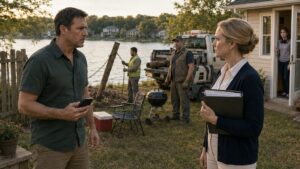
Ashley Green stood on the bottom step, holding a plastic document sleeve. She was dressed in slacks and a cardigan, as though she had come from an evening board meeting rather than a midnight harassment.
The light behind her was so strong it erased the edges of her face.
“This is from the clubhouse board,” she said.
Richard looked at the sleeve but did not take it.
“At midnight?”
“We voted late.”
“On floodlights?”
Ashley glanced over her shoulder. Scott was watching.
“The board voted to notify you that the lot is being treated as a safety concern. There have been complaints about waste disposal, unauthorized occupation, fire risk, and reduced visibility near the access lane.”
“Which complaint did you verify?”
Her mouth tightened. “I’m delivering the notice.”
“Who owns the lot?”
Ashley looked down at the paper.
The silence lasted long enough for Scott to call from across the gravel, “Tell him he has forty-eight hours.”
Richard kept his eyes on Ashley.
She lowered her voice. “The records aren’t clear.”
“They are clear.”
“Then you should attend the emergency meeting tomorrow.”
“I attended enough meetings when this place was dirt.”
Something moved in her expression. Not recognition exactly. More like a memory disturbed before it could surface.
She extended the sleeve again.
Richard accepted it and read the first line beneath the clubhouse seal.
NOTICE OF UNSAFE OCCUPANCY AND REQUEST FOR VOLUNTARY REMOVAL.
No parcel number appeared. No owner was named. The final paragraph referred to the gravel lot as “unassigned common-adjacent land.”
Richard looked beyond Ashley.
Near the curb, beside the trimmed hedge, a rust-colored iron rod lay on the concrete. One end had been painted yellow years ago, though most of the color had worn away.
His survey stake.
It had stood at the northeastern corner of the lot since before the clubhouse foundation had cured.
Richard stepped down from the RV.
Ashley moved aside. “Mr. Hill?”
He crossed the gravel slowly, the notice in one hand. Several residents raised their phones higher. Scott smiled as though Richard had finally been drawn into the performance.
Richard stopped at the curb and picked up the stake.
The soil clinging to its lower end was still damp.
“You pulled this,” he said.
Scott glanced at it. “That scrap?”
“Boundary marker.”
“It was a tripping hazard.”
“It was fourteen inches inside the gravel shoulder.”
Scott spread his hands toward the floodlights. “This is exactly the problem. You’ve got junk sticking out of the ground, an unregistered vehicle sitting here for weeks, electrical hazards—”
“The RV is registered.”
“You’re missing the point.”
“No. I know exactly where the point was driven.”
The crewman nearest the generator looked away. Ashley stared at the stake.
Scott took two steps closer. “You can make this easy. Move the vehicle, and we all go home.”
Richard measured the distance from the curb with his eyes. He knew the grade, the drainage fall, the buried conduit. He had once stood here with Betty in summer rain while she held the survey map beneath her coat and laughed because the paper had already dissolved at the edges.
He pressed the stake back into the hole.
It slid down six inches before stopping against packed earth.
Scott’s smile faded.
Richard returned to the RV without another word.
Inside, he photographed the board notice beside the clock and added the displaced marker to his log. Then he knelt at the driver’s seat and reached beneath the metal base.
A shallow locking drawer was bolted to the floor.
He removed a key from the chain around his neck, turned it twice, and pulled the drawer open.
Inside lay tax records, survey maps, a title policy, photographs of the original development, and a thick envelope from the county clerk. The papers were arranged exactly as he had left them.
Except for one.
Richard lifted each document, then checked beneath the folder and behind the drawer.
The certified application for emergency injunctive relief was gone.
He sat back on his heels while the floodlights burned through the windshield.
Outside, Scott called for one of the lamps to be moved closer.
Chapter 2: The Contractor Who Promised an Empty Lot
By nine the next morning, Richard’s gravel lot had disappeared from the neighborhood.
Scott Martin stood before a glossy rendering on the clubhouse terrace, pointing at a glass-walled events pavilion where the RV should have been.
Sunlight flashed across the mounted image. In the artist’s version, flowering shrubs bordered a stone walkway, tables sat beneath white umbrellas, and smiling couples faced an open lawn that did not exist.
No gravel. No survey markers. No access lane crossing the retained parcel.
No Richard.
“This gives the community what it’s been missing,” Scott said. “A modern event space, upgraded drainage, better lighting, higher resale value for every home on this street.”
Residents crowded around the rendering with coffee cups and sunglasses. Some nodded. Others photographed the proposed pavilion.
Ashley stood near the back with the board files pressed against her ribs.
“What about the man in the RV?” a resident asked.
Scott did not hesitate. “Temporary obstruction.”
“Police said they couldn’t remove him.”
“Police said it was a civil question. Civil questions get resolved when the responsible parties stop waiting for someone else to act.”
A few people laughed.
Scott smiled, but his hand tightened around the presentation remote.
His company’s name was printed in the corner of the rendering. Beneath it, in smaller type, appeared the proposed construction schedule. He had already ordered materials. He had already told six men the clubhouse job would carry them through winter. Yesterday, a lender had called about two overdue equipment payments.
None of that appeared on his face.
“What I need from the board,” he continued, “is confirmation today. Investors are visiting in forty-eight hours. They need to see a clear site and a community willing to move forward.”
Ashley raised a hand.
Scott’s eyes shifted toward her. “Yes?”
“We still don’t have a verified parcel record.”
“The county map labels it separately from the residential lots.”
“That isn’t the same as ownership.”
“It also isn’t a reason to let one man hold the entire development hostage.”
“He hasn’t demanded anything.”
“That’s because he thinks silence works in his favor.”
Across the road, Richard emerged from the RV carrying a sledgehammer no larger than necessary and the rusted survey stake.
Conversation on the terrace slowed.
He walked to the northeastern corner, measured from the old curb seam with a steel tape, and drove the stake back into the ground with three controlled strikes.
Scott watched from behind the rendering.
Richard checked the distance again, adjusted the marker by half an inch, then tamped gravel around it with the heel of his boot.
“That looks maintained to me,” Ashley said quietly.
Scott turned. “You want to defend him now?”
“I want to know what we’re standing on.”
He lowered his voice. “We’re standing on a contract that keeps people employed. My people. Some of them live nearby. You think delaying this is harmless?”
Ashley looked toward the staging area beside the clubhouse. Two work trucks sat there with trailers already loaded. The crew moved equipment that had not yet been authorized for use.
“You spent money before the board approved the project,” she said.
“I prepared.”
“You committed.”
“I believed the board meant what it said.”
“What did it say?”
“That the lot would be cleared.”
Ashley remembered no such motion. Only complaints. Requests. A loosely worded discussion about beautification.
Scott stepped closer. “Do you know what happens if this contract falls through? I don’t lose a drawing. Men lose paychecks.”
“That doesn’t make the land yours.”
“No. It makes waiting irresponsible.”
He turned away before she could answer and resumed his presentation.
Ashley entered the clubhouse through the side door.
The archive room smelled of dust and carpet glue. Metal cabinets lined one wall, their labels spanning three decades of board decisions. She unlocked the oldest cabinet and pulled out a binder marked ACCESS, DRAINAGE, EASEMENTS.
The first pages concerned utility trenches. The next recorded snow removal agreements. Near the back, she found minutes from a meeting held twenty-eight years earlier.
A single sentence had been underlined in blue ink:
Use of the northern gravel corridor shall continue by revocable access permission from the retaining owners until formal transfer or withdrawal.
Ashley read it twice.
Retaining owners.
Not association land. Not common land.
Footsteps sounded behind her.
Scott filled the doorway.
“Find anything useful?”
Ashley closed the binder.
“Old drainage notes.”
“Any obstacle?”
The correct answer pressed against the back of her teeth.
She pictured the terrace full of residents, the promised pavilion, the board president’s warnings about delay, and Scott’s crew carrying equipment they might soon be unable to pay for.
“No,” she said. “Nothing clear.”
Scott studied her for a moment, then nodded.
Outside, Richard had finished resetting the stake. He stood with both hands resting on the sledgehammer handle, looking not at the clubhouse but at the slope beyond it, where roofs descended toward a stand of trees.
Ashley wondered what he saw there.
Scott returned to the terrace and tapped the rendering.
“Forty-eight hours,” he announced. “By the time the investors arrive, that lot will be empty.”
Applause came from only part of the crowd, but it was enough.
Later that afternoon, a flatbed truck backed into the construction staging area. Samuel Brown guided it with one hand raised, his face turned toward the driver.
The load consisted of tripod lights, wheel blocks, steel cable, and a heavy rusted chain coiled like something dredged from water.
Scott signed the delivery sheet.
Samuel lifted one end of the chain and let it fall onto the gravel. The impact drew Richard’s attention from across the road.
“Where’s the removal order?” Samuel asked.
Scott kept writing.
“Which order?”
“The one that lets us touch the RV.”
Scott tore off the receipt and handed the clipboard back to the driver.
“We’re not towing tonight.”
“That wasn’t my question.”
Scott looked toward the clubhouse windows, where board members still examined the rendering.
Then he looked at Richard.
“By tomorrow,” he said, “nobody will care.”
Chapter 3: A Permission Everyone Mistook for Ownership
The delivery truck blocked the access road before noon, and within four minutes the line of trapped vehicles reached the clubhouse entrance.
The driver leaned from his window, waving at residents who shouted contradictory instructions.
“I can’t clear the turn,” he called. “There’s no room.”
“There is,” Richard said.
He had stepped from the RV carrying a measuring rod.
The driver looked down at him. “Not with that drainage ditch.”
“You’re not near the ditch.”
Richard pointed beneath the truck. “Your rear axle is six feet past the old conduit line. Straighten the wheel, reverse eighteen inches, then cut left when your mirror reaches the third fence post.”
A resident shook his head. “That’ll put him in the culvert.”
“The culvert begins beyond the cottonwood.”
“There is no cottonwood.”
“There was when the line was laid. The root channel is still there.”
The driver hesitated, then followed Richard’s directions.
The truck cleared the turn with less than a foot to spare and rolled onto the clubhouse service lane. Traffic began moving again.
Several people stared at Richard as they passed.
He folded the measuring rod and returned to the RV before anyone could ask how he knew.
Inside, he shut the curtains and switched off every light, though it was midday. The darkness narrowed the room to familiar shapes.
He called the county records office.
After two transfers, a clerk confirmed that his emergency application had been forwarded to the courthouse for judicial stamping.
“When?” Richard asked.
“Yesterday afternoon.”
“The certified copy was stored in my file.”
“You mailed the original certified packet, Mr. Hill.”
Richard closed his eyes.
He remembered preparing the envelope at the narrow table, separating the ownership records from the application, then walking it to the roadside mailbox. He had searched the drawer all night for a document that had not been stolen.
His own memory had supplied the threat.
“Has it been approved?”
“It’s pending.”
“There’s a removal attempt scheduled tomorrow evening.”
“I can add urgency to the note.”
“Urgency was already in the heading.”
“I understand.”
“No,” Richard said, more sharply than he intended. “You process it. You don’t understand it.”
The clerk went silent.
Richard looked toward the cloth-covered drafting lamp.
“I apologize,” he said. “Please add the note.”
When the call ended, someone knocked.
Ashley stood outside with the old binder held against her chest.
“There’s an emergency board meeting at four,” she said. “You should come.”
“No.”
“They’re going to discuss authorizing Scott to clear the lot.”
“They can authorize him to repaint the moon. It won’t give him title.”
“They think it’s association property.”
“You know better now.”
Ashley’s grip tightened.
Richard saw the answer before she spoke.
“I found language about revocable access,” she said. “But it doesn’t identify the retaining owners by name.”
“It did in the original plat.”
“Then bring it.”
“No.”
“Why not?”
Richard looked past her toward the clubhouse terrace. Scott was directing workers as they positioned barriers around the staging area.
“Because I don’t conduct title hearings for people who begin with floodlights.”
Ashley lowered her voice. “Your silence is making this worse.”
“My silence didn’t move the marker.”
“No, but it gave Scott a story everyone could use.”
Richard’s jaw tightened.
She had been a child when the first houses went up. He remembered a girl with scraped knees following survey flags while her mother called from an unfinished porch. Whether that girl had been Ashley, he could not be certain.
“I remember you,” she said.
Richard’s eyes returned to her.
“Not well. You used to stand near the drainage trench with a woman who carried rolled maps. Betty, wasn’t it?”
He said nothing.
Ashley opened the binder to a folded sheet tucked behind the minutes. It was an old drainage map, copied so many times that some lines had faded.
Two signatures remained clear at the bottom.
Betty Hill.
Richard Hill.
Ashley touched the second name.
“This is your handwriting.”
He took the map from her before the wind could catch it.
For a moment, the gravel lot was gone. He saw stakes strung with red twine, wet clay on Betty’s boots, and the two of them arguing over whether the access route should become a permanent easement.
Not permanent, she had insisted. Open because we choose it, not because someone takes it.
Richard refolded the map.
“The lane crosses my parcel,” he said. “The association was permitted to use it.”
“For nearly thirty years.”
“Permission does not become ownership because nobody remembers saying thank you.”
“Then tell them.”
“I just told you.”
“That isn’t the same.”
He handed back the map.
Ashley looked at him with open frustration. “If Scott moves that RV, the board will treat the empty lot as consent.”
“An empty lot doesn’t transfer title.”
“It changes what people believe happened.”
Richard glanced toward the staging area.
Belief had never impressed him. Grades, measurements, boundaries, stamped records—those held. People changed stories whenever convenience required it.
Betty had understood people better.
Perhaps that was why she had insisted the road remain open.
Families should not have to circle two miles because we own the shorter path, she had said. A community shouldn’t feel trapped behind its legal lines.
At the time, generosity had seemed simple. They owned the ground. They could share it.
He had not imagined people one day standing on that same ground and calling him an intruder.
“The injunction may not arrive before tomorrow,” he said.
Ashley’s face changed. “You filed one?”
“Yes.”
“Then why didn’t you say so?”
“Because it was not your concern until you decided it was.”
She shut the binder. “Come to the meeting.”
“No.”
“You’d rather let this reach the tow truck?”
“I’d rather people obey the law without needing to know whether the old man in front of them can punish them.”
Ashley had no answer to that.
She walked back toward the clubhouse.
At four, Richard watched through the windshield as residents entered the meeting. At five fifteen, Scott emerged carrying a sheet of white paper and a roll of tape.
He crossed the gravel alone.
Richard opened the door before Scott could knock.
Scott held up the notice. It bore the clubhouse emblem, a block of legal-sounding language, and a bold heading:
FINAL REMOVAL AUTHORIZATION.
“There is no such authority,” Richard said.
“There is now.”
“Signed by whom?”
“The board.”
“The board does not own this parcel.”
Scott taped the notice beside the RV door.
“You’ve had every chance to handle this quietly.”
Richard looked at the bottom of the page.
TOW SCHEDULED: TOMORROW, 6:00 P.M.
Scott pressed the last corner flat.
“When the truck comes,” he said, “stay out of the way.”
Richard stared at the paper until Scott had crossed back to the clubhouse.
Then he reached up and touched the notice, not to remove it, but to make sure the camera above the door had captured every word.
Chapter 4: The Chain Around the Home He Chose
Richard woke to metal scraping beneath the floor.
The sound came slowly at first—a rough drag under the rear axle, then a hard knock against the frame. The RV shifted on its suspension.
He opened his eyes in darkness.
Outside, men spoke in low voices. A chain clinked over gravel. The generator had not started yet, but someone was working close enough that Richard could hear breath between the words.
He reached beneath the table and pressed the switch for the exterior cameras.
Four small screens flickered to life.
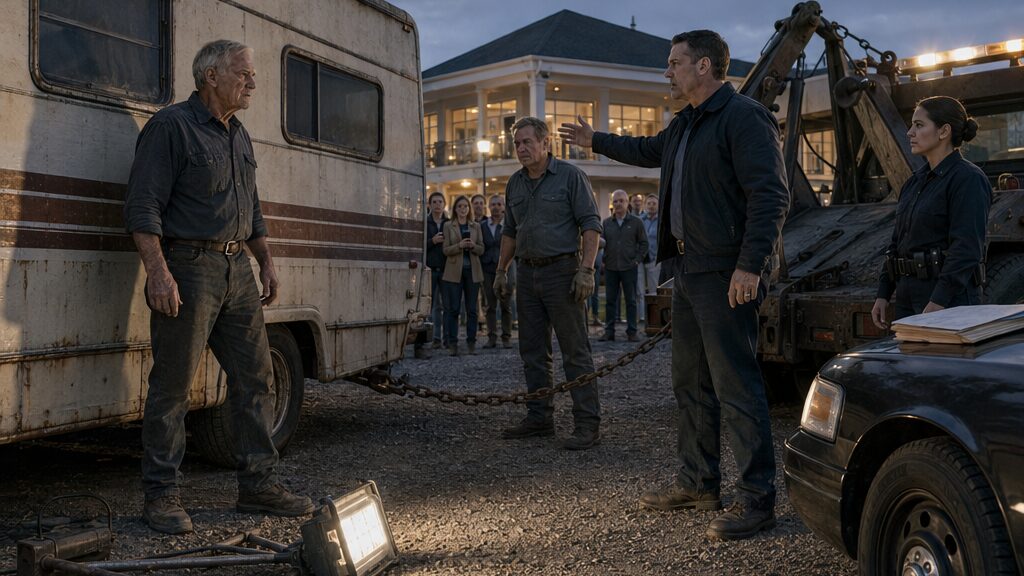
Scott’s crew surrounded the RV. One worker crouched near the rear wheel, feeding the rusted steel chain beneath the chassis. Another held a massive iron padlock. Samuel Brown stood apart, studying the connection point with a flashlight.
Across the road, residents gathered along the clubhouse frontage. Some wore coats over sleep clothes. Several held phones ready before anything had happened.
Richard checked the clock.
9:42 p.m.
The removal notice had promised six the following evening.
Scott had moved the schedule forward.
Richard opened his notebook and wrote the time.
On the monitor, Samuel rose and walked toward Scott.
“That rail isn’t designed for this,” Samuel said. The camera caught the words clearly. “You pull from there, you can twist the floor.”
Scott glanced toward the RV windows. “It’s an old camper.”
“It’s occupied.”
“He’s been told to leave.”
“That doesn’t change the frame.”
Scott lowered his voice, but Richard increased the monitor volume.
“We are securing it. The tow happens at dawn.”
“You said tomorrow evening.”
“The investors moved their visit.”
Samuel looked at the crew. “Then get a proper lift.”
“I don’t have time for another rental.”
“You don’t have authority either.”
Scott’s face hardened.
“You want these men paid next month?”
Samuel did not answer.
“Then do the job.”
The first floodlight came on.
White glare burst through the rear curtain. A second lamp ignited near the windshield, then a third. The chain crossing beneath the RV flashed silver-orange where the rust had worn away.
Richard put on his boots.
He slipped the ownership folder into a canvas case, checked the empty space where the stamped application should have been, and left the case beneath the driver’s seat. Then he took his camera and opened the door.
The crowd reacted before he stepped down. Phones rose. A woman near the clubhouse whispered something that made two people laugh.
Scott walked forward.
“You were given notice.”
“For six tomorrow.”
“Schedule changed.”
“By what authority?”
“The board authorized removal.”
“The board owns neither the vehicle nor the land beneath it.”
Scott pointed toward the road. “You’ve had days to prove that.”
Richard looked past him at the chain. It had been looped around a structural rail but passed dangerously close to the waste line and the lower floor supports.
He photographed the connection.
Scott stepped into the frame. “Put that away.”
Richard took another picture.
Samuel approached from the rear of the RV. “Mr. Hill, you should stay clear when we tension this.”
“You should not tension it.”
“I’ve told him the mount isn’t safe.”
Scott turned sharply. “Samuel.”
Richard crouched beside the wheel and photographed the padlock. Its iron body was nearly the size of his fist. Fresh tool marks showed where the chain had been forced through too narrow a gap.
He stood.
“One pull from that angle,” Richard said, “and the rail rotates inward. It will shear the water line first. Then the floor fasteners.”
Samuel stared at him.
Scott gave a short laugh. “Now you’re a towing expert?”
“No.”
Richard pointed to the rail. “I designed the support spacing.”
The nearest crewman looked toward Samuel.
Scott stepped closer until the floodlight threw his shadow across Richard’s chest.
“You keep saying things like that. You know the drains. You know the road. You know the frame. But you never produce anything.”
Richard met his gaze.
“You were warned not to touch this vehicle.”
Scott spread his arms toward the residents. “Everyone heard that. A threat.”
“No. A record.”
Richard lifted the camera so the red light was visible.
Scott’s expression changed.
For the first time, he looked at the underside of the awning, then at the small black dome mounted near the door.
Richard followed his eyes.
“There are three more,” he said.
The residents behind Scott became quieter.
Ashley stood near the clubhouse steps with the archive binder under one arm. She had not joined the others filming. Her eyes moved from the camera to the chain.
“Scott,” she called. “Stop until the board reviews this.”
“The board already voted.”
“Not on chaining an occupied vehicle.”
“It’s secured, not moving.”
“You changed the schedule without telling us.”
Scott turned toward her. “Because the investors are coming tomorrow morning, not tomorrow night. You want to explain why we lost the project over an abandoned lot?”
Richard said, “It is not abandoned.”
Scott faced him again.
“Then why do you live like no one owns anything here?”
The words struck harder than Richard expected.
Not because they were true, but because some part of them touched the shape of his own withdrawal. Curtains closed. Letters unanswered. Meetings ignored. The lot maintained only enough to preserve its boundaries, never enough to invite questions.
He had mistaken being left alone for being understood.
Still, Scott had chosen the chain.
Richard stepped closer, stopping just beyond the reach of the nearest light.
“You have documented notice that the property is disputed,” he said. “You have no removal order from a court, county, or police department. Your foreman has told you the connection is unsafe. Unlock the chain.”
Scott’s jaw tightened.
“And if I don’t?”
“Then everything after this moment is deliberate.”
No one laughed.
Richard turned and climbed back into the RV.
Behind him, Scott said loudly, “He’s retreating.”
The word carried toward the clubhouse.
“He knows he doesn’t have a case.”
Richard closed the door.
The floodlights burned through the curtains again, harsher now because he knew people were watching for movement inside.
He sat at the table and reviewed the camera feeds. Scott paced. Samuel spoke privately to two crewmen. Ashley remained on the steps, arguing with a board member who would not meet her eyes.
Richard’s phone rang at 10:16.
The caller identified himself as a courthouse courier.
“Mr. Hill, your emergency injunction has been approved and stamped.”
Richard gripped the phone tighter.
“When will it arrive?”
“It left the courthouse forty minutes ago, but there’s a road closure near the east junction. Delivery may be delayed until morning.”
“How late?”
“I can’t say.”
Outside, Scott climbed onto the tow truck’s side step.
“Bring it back at dawn,” he told the driver. “Five thirty. We pull before anyone can stall us again.”
Richard looked at the chain on the monitor.
The padlock hung directly beneath his sleeping compartment.
Chapter 5: What Betty Meant by Leaving the Road Open
At three twelve in the morning, Betty’s voice returned to the RV.
Richard sat in darkness with an old cassette player on the table. The plastic case beside it bore his own handwriting:
ACCESS ROAD MEETING.
He had found the tape behind a stack of survey photographs while searching again for anything that might support the injunction if the stamped order arrived too late.
For several seconds, the recording held only chair legs scraping and distant coughing.
Then Betty spoke.
“The road should remain open while people remember it is a gift.”
Richard stopped breathing.
Her voice was younger than the one he carried in memory. Clearer. Impatient in the way it became when she believed men in a meeting were complicating something simple.
A man on the tape asked whether the permission should be converted into a permanent easement.
“No,” Betty said. “Not permanent. Open because we choose it. If someday people start treating kindness like ownership, then they need reminding.”
Paper rustled near the microphone.
Richard stared at the small drafting lamp beneath its folded cloth.
For years, he had remembered only the first half of the promise.
Keep it open.
He had built his silence around those words. Every unauthorized shortcut, every widened tire track, every clubhouse delivery that crossed his parcel without acknowledgment—he had tolerated them because closing the lane felt like closing something Betty had opened with both hands.
The tape clicked softly.
Her voice continued.
“Generosity without choice isn’t generosity. It’s surrender.”
Richard reached for the lamp.
The brass switch resisted before clicking on.
Warm yellow light spread across the table, touching the edges of the old maps and the cracked ceramic base. It did not expose the room. It gathered it.
Outside, Scott’s floodlights still burned against the curtains.
A knock came at the door.
Richard stopped the tape.
Ashley stood on the step holding the archive binder and a sealed plastic folder. Her hair was loose, and one sleeve of her coat had been pulled halfway through.
“You’re awake,” she said.
“So is everyone you helped wake.”
She accepted the rebuke.
“I brought the minutes.”
Richard looked toward the clubhouse. Most of the windows were dark now, though the construction lights made the building seem awake.
“Why?”
“Because I should have brought them yesterday.”
He opened the door wider.
Ashley entered and stopped when she saw the lamp.
“I remember that,” she said.
Richard said nothing.
“She used to carry it into the temporary office when the power failed.”
“You remember more than you admitted.”
“So do you.”
He closed the door.
Ashley placed the binder on the table and removed several copied pages. One contained the language about revocable access. Another listed the retained parcels by survey number. A third carried Betty’s signature beside a handwritten note.
Permission dependent upon continued respectful community use.
Richard touched the line.
Ashley watched him. “I found that after the meeting.”
“And hid it before.”
“Yes.”
“Why?”
She sat opposite him but did not remove her coat.
“Because Scott said the project would collapse if we delayed. The board president said residents would blame whoever raised another obstacle. I thought if the lot really belonged to someone, that person would have come forward years ago.”
“I was here.”
“You never said who you were.”
“That did not make the land ownerless.”
“No.”
The answer came without defense.
Ashley glanced at the cassette player. “I knew your name when I saw the map. I should have said so in front of everyone.”
“You wanted them to approve the pavilion.”
“I wanted the arguing to end.”
“You wanted it to end in the direction that cost you least.”
She looked down.
“Yes.”
The admission altered the room more than an apology would have.
Richard gathered the copied pages.
“Scott knows you took these?”
“He saw me leave.”
As if summoned by the name, a shout came from outside.
“Ashley!”
Scott crossed the gravel toward the RV, floodlight glare cutting around him.
She stood.
He struck the door with the flat of his hand.
“Open it.”
Richard remained seated.
Scott hit it again.
“You take board records out of the clubhouse at three in the morning and carry them to him? What exactly are you doing?”
Ashley moved toward the door, but Richard raised one hand.
“He wants you outside because the cameras cover the step,” he said.
She stopped.
Scott’s shadow crossed the curtain.
“You’re conspiring against the association,” he shouted. “Against the project. Against men whose jobs depend on this.”
Ashley’s face tightened.
Richard said, “Do their jobs require stealing land?”
Scott heard him.
“This isn’t about land. It’s about one old man refusing every reasonable solution because he enjoys controlling everyone around him.”
The accusation entered through the thin wall and stayed there.
Richard looked at Betty’s note.
For a moment, he saw his own behavior as Scott might: a man possessing information but withholding it, watching confusion grow, refusing rooms where facts could be tested. Scott’s conclusion was wrong. His harm was chosen. But Richard’s silence had still created space for the lie.
Ashley stepped toward the door again.
“This time,” she said, “I need to answer.”
Richard opened it.
Scott stood at the foot of the steps. Two residents had emerged from the clubhouse behind him.
Ashley held up the copied minutes.
“The access lane is revocable private permission. The board never owned it.”
Scott stared at the pages.
“Give me those.”
“No.”
“You remove association records—”
“They’re copies.”
“You think this changes tomorrow?”
“It changes tonight.”
Scott looked past her at Richard.
“You planned this.”
Richard rose and came to the doorway.
“No. You planned the tow.”
“The contract saves this community money.”
“The contract saves your company.”
Scott’s face went still.
“That crew has families.”
“Then you should not have tied their wages to property you never verified.”
The words landed. Richard saw exhaustion beneath Scott’s anger, and fear beneath that. The contractor’s boots were dusted white from the gravel. His jacket was still clean, but the cuffs had begun to fray.
For one brief second, Scott seemed close to saying the thing he had avoided: that he had already spent money he did not have.
Instead, he pointed at Richard.
“At dawn, that vehicle moves.”
He turned and crossed back toward the clubhouse.
Ashley watched him go.
“He won’t stop.”
“No.”
“What will you do if the injunction doesn’t arrive?”
Richard looked at the drafting lamp.
The answer was no longer the one he had carried for years.
“I will close the road.”
Ashley faced him.
“Betty wanted it open.”
Richard touched the handwritten note.
“Only while they remembered it was a gift.”
At five twenty-three, the growl of a diesel engine rolled across the lot.
Richard stepped outside.
The tow truck reversed toward the RV, its warning alarm sounding with each movement. Scott walked beside it, guiding the driver toward the chained frame.
Samuel stood near the rear axle, arms folded, his expression grim.
At the far end of the access road, red and blue lights appeared.
Mary Torres’s patrol car turned onto the gravel with a courier envelope visible on the passenger seat.
Scott slapped the tow truck’s side panel.
“Keep coming.”
The truck continued backward.
Chapter 6: The Glass Broke Before the Chain Pulled Tight
The tow cable tightened before Mary’s patrol car stopped moving.
A low metallic groan passed through the RV. One rear corner lifted, no more than two inches, but enough to twist the steps and send a cupboard door swinging open inside.
Richard stood beside the vehicle.
“Release it,” he said.
Scott raised one hand toward the tow truck driver.
“Hold.”
The truck idled under tension.
Mary stepped from the patrol car with the courier envelope in one hand.
“No one moves anything,” she called. “Disconnect the cable.”
Scott walked toward her before she reached the RV.
“Officer, this man just threatened my crew. We have board authorization to remove an abandoned vehicle from association property.”
Mary looked past him at Richard.
“Is anyone inside?”
“No,” Richard said.
“Was anyone inside when the chain was attached?”
“I was.”
Mary’s eyes shifted to Scott.
He answered quickly. “He was notified. Multiple times.”
“That wasn’t my question.”
Samuel came forward.
“He was inside.”
Scott turned. “Stay out of this.”
“I attached the rear loop,” Samuel said. “I told you it could twist the support rail.”
Mary looked at the raised corner of the RV.
“Lower it now.”
Scott stepped between her and the tow controls.
“We are seconds from resolving this. If you stop us again, the investors walk, the board loses the project, and my crew loses months of work.”
Mary’s voice stayed level. “Lower the vehicle.”
Scott looked toward the clubhouse.
Residents filled the terrace and front steps. Phones pointed across the road. The glass pavilion rendering still stood on an easel behind them, bright beneath the construction lights.
Scott’s entire promise was watching.
He turned toward the driver.
“Ease it forward.”
Samuel moved first.
He crossed to the tow truck and struck the emergency release. The cable slackened. The RV dropped hard enough to rock on its suspension.
Scott shoved Samuel’s hand away.
“What are you doing?”
“Stopping before someone gets hurt.”
“You work for me.”
“Not for this.”
The crew stood motionless.
Scott looked from one face to another and saw that none would take the controls.
His fear sharpened into something colder.
He climbed into the tow truck himself.
Mary stepped toward the cab. “Do not start that pull.”
Scott shut the door.
Richard heard the engine rev.
He looked at the chain beneath his home, then at the nearest floodlight.
Its glare filled his vision. For three nights, it had turned his windows into public glass. It had followed him from table to bed, flattened every shadow, and told the people across the road that they were entitled to see whether he broke.
The cable began to draw tight again.
Richard moved.
He crossed the gravel with a speed that made several residents lower their phones. Scott saw him through the windshield and pressed the accelerator harder.
The tripod stood between Richard and the tow line.
He planted one steel-toed boot against its lower brace and kicked.
The heavy frame toppled sideways. The halogen head struck the gravel but remained lit, blazing upward.
Richard stepped over the fallen stand.
Then he drove his boot through the thick glass lens.
The sound cracked across the lot.
Glass burst inward. The bulb flashed blue-white, spat sparks, and died.
For a second, the darkness around the RV returned.
Scott killed the engine.
No one spoke.
Richard withdrew his boot from the broken housing. Glass fragments slid across the leather without penetrating it.
Scott climbed down from the truck.
“You all saw that,” he shouted. “Destruction of equipment. Threatening behavior. Arrest him.”
Mary did not look at Richard’s boot. She looked at the cable, the chain, the lifted frame, and the cameras beneath the awning.
“Whose light?” she asked.
“Mine.”
“On whose land?”
“The association’s.”
Ashley stepped down from the clubhouse terrace carrying the copied minutes.
“No,” she said.
Scott turned on her. “You do not speak for the board.”
“I kept quiet once. I won’t do it again.”
She handed Mary the records.
Mary scanned the first page, then the parcel reference.
Richard walked to the patrol car. The courier envelope remained on the passenger seat.
Mary opened the door and passed it to him.
The seal was unbroken.
Scott pointed toward the RV. “Whatever paper he has does not excuse what he just did.”
Richard tore open the envelope.
Inside lay the stamped injunction, the court seal raised beneath his thumb. Attached were certified parcel descriptions and a temporary restraining order prohibiting interference with the RV, gravel lot, access corridor, and retained boundary markers.
Richard carried the packet to the cruiser hood.
He did not hand it to Mary.
He dropped it flat against the metal.
The sound was not loud, but every phone caught it.
Mary read the first page.
Her expression changed before she reached the second.
Scott saw it.
“What?”
Mary looked at Richard. “You own parcel fourteen, the gravel lot, and the northern access corridor?”
“Yes.”
Scott stepped closer. “That corridor is association property.”
Ashley held up the old minutes. “It never was.”
Mary continued reading.
“The association has permissive use only. Revocable by the retaining owners.”
The silence across the road deepened.
A resident near the clubhouse said, “That can’t be right.”
Richard opened the canvas case he had carried from the RV. He removed the original plat, the title policy, and the tax records.
“It is right,” he said.
Scott stared at the documents as if the ink might rearrange itself.
“You let everyone use the road.”
“Yes.”
“For decades.”
“Yes.”
“Then it’s an easement.”
“No.”
Mary placed one finger on the certified description. “The court has already addressed that issue for the temporary order. Continued permissive use did not create ownership.”
Scott’s face reddened.
“He concealed this.”
Richard looked at him.
“I lived on my land. You never asked before deciding I had none.”
Scott turned toward the residents.
“Tell her. Tell her what this lot has done to property values. Tell her why the board acted.”
No one answered immediately.
The glass pavilion rendering shone behind them, displaying a future built across Richard’s property.
Samuel approached Mary and held out his phone.
“These are work messages,” he said. “From Scott. Yesterday and tonight.”
Scott moved toward him. “You hand that over, you’re done.”
Samuel did not pull the phone back.
“I was done when you told us to pull with him inside.”
Mary read the messages.
Her jaw tightened.
One line instructed the crew to move before police or county officials could interfere. Another said that once the RV was damaged or displaced, the board could call the site cleared and argue later.
Scott saw the screen and stopped denying.
“I had a deadline,” he said. “I had workers depending on me. The whole street wanted him gone.”
“Your deadline did not authorize trespass,” Mary said.
Richard turned toward the access road.
At its entrance stood an old barrier arm, weathered and raised, nearly hidden among shrubs. He and Betty had installed it before the first residents moved in. It had not been lowered in twenty-seven years.
The control box remained active.
Ashley followed his gaze.
“Richard,” she said softly.
He took a document from the injunction packet. A prepared revocation notice. The signature line waited at the bottom.
Betty’s voice returned to him.
While people remember it is a gift.
Scott stepped closer.
“You close that road, emergency vehicles will lose access.”
“Emergency access can be preserved by written agreement.”
“You’ll trap half the neighborhood outside.”
“No. They can use the south entrance.”
“That adds two miles.”
Richard looked at the chain around his home.
“For thirty years, I saved them two miles.”
He placed the notice on the cruiser hood and signed.
Mary watched but did not interfere.
“What are you doing?” Scott demanded.
“Ending permission.”
Richard walked to the control box beside the road and entered the old code.
The motor coughed once, then engaged.
Across the entrance, the barrier arm began to descend.
Several residents’ vehicles remained parked outside the neighborhood. Their owners hurried toward the road, calling for Richard to wait.
He did not.
The barrier lowered until its red-striped beam settled across the lane with a final mechanical click.
Behind him, the shattered floodlight lay dark in the gr
Chapter 7: The Gifts Left Beneath the Shattered Light
By the third morning, a line had formed beside Richard’s RV.
The first resident carried a pie beneath a clear plastic lid. Behind her stood a man with a paper bag of bread, then a couple holding flowers, then three more people with apology cards pressed between their fingers.
A locksmith worked twenty feet away, replacing the old barrier control with a new keyed panel and emergency override box.
No one in line spoke above a murmur.
The shattered floodlight still lay where Richard had broken it. Its thick glass lens was caved inward, and the rusted chain had been removed from beneath the RV and coiled beside it under a police evidence tag.
Richard watched through the windshield with a cup of coffee in his hand.
The residents shifted when they noticed him.
The woman with the pie stepped forward.
“Mr. Hill?”
Richard lowered the driver’s window three inches.
“I made this myself,” she said. “I wanted to apologize for what happened.”
“What part?”
Her grip tightened on the container.
“For believing things without checking.”
“You filmed the tow.”
She looked down. “Yes.”
“Did you stop filming when the cable lifted the RV?”
“No.”
Richard closed the window.
The woman stood there for several seconds, then placed the pie on the gravel beneath the broken light and walked away.
The others followed in uneven turns.
Some apologized directly. Some blamed Scott. One man insisted he had never supported the floodlights, though Richard remembered his face among those illuminated by them. Another said the road closure was creating serious inconvenience for school traffic, then seemed surprised when Richard did not treat inconvenience as remorse.
The gifts accumulated.
Bread. Cookies. A jar of preserves. Flowers wrapped in paper. Cards bearing careful handwriting and phrases about misunderstanding, community, and moving forward.
Richard left them untouched.
Ashley arrived shortly before noon with a folder instead of food.
She stopped beside the locksmith and examined the new control box.
“Emergency services?” she asked.
“They will receive a separate access code.”
“Deliveries?”
“South entrance.”
“Residents?”
“South entrance.”
She nodded.
The new route added eleven minutes in light traffic and more during the morning rush. The complaints had already begun at the clubhouse, though no one now described the gravel corridor as common property.
Ashley approached the RV.
Richard opened the door before she knocked.
“I brought a draft agreement,” she said. “Emergency vehicles, utility repairs, and temporary access during road closures. Nothing else without written permission.”
He took the folder.
“You wrote it?”
“With an attorney.”
“That is an improvement.”
She almost smiled.
Across the lot, the locksmith tested the barrier. The arm lowered, stopped, and rose again.
Ashley looked at the gifts.
“You’re not taking any of them?”
“No.”
“Some people mean it.”
“Meaning it after losing the road is not the same as meaning it before.”
“They may not know how to prove the difference.”
Richard opened the folder and read the first page.
“That is their problem.”
Ashley studied him.
“Is it?”
He looked up.
She did not retreat.
“You were right about the land. About Scott. About the board. But you also let people keep guessing because you preferred their wrong story to being known.”
Richard closed the folder.
“They had no right to harass me.”
“No.”
“They had no right to touch my vehicle.”
“No.”
“They had no right to take my silence as permission.”
“No,” Ashley said again. “But silence is still a choice.”
Before Richard could answer, a truck stopped at the barrier.
Scott climbed out alone.
He looked smaller without his crew, though nothing about his build had changed. His work jacket was gone. He wore a plain shirt with the sleeves rolled above his forearms and carried a white envelope.
The locksmith stepped away from the control box.
Scott walked across the gravel.
Ashley remained beside the RV.
“I need to speak with him privately,” Scott said.
“No,” Richard replied.
Scott glanced at Ashley, then accepted the refusal.
He held out the envelope.
“Payment for the light.”
“You destroyed my property while using it.”
“I’m still responsible for the damage.”
Richard did not take the envelope.
Scott lowered his hand.
“The police released the equipment yesterday. The board terminated the bid. My lender froze the operating line.”
His voice remained controlled, but each sentence seemed to cost him.
“I came to ask whether you’ll withdraw the complaint.”
“No.”
Scott looked toward the coiled chain.
“I made a bad call.”
“You made several.”
“I had six people expecting months of work.”
“You used them to do something illegal.”
“I thought if the site was cleared, the argument would become administrative.”
“You meant damage first, argue later.”
Scott’s mouth tightened.
Samuel’s messages had left little room for another version.
“I can’t undo it,” he said.
“No.”
“What would satisfy you?”
Richard looked at him for a long moment.
“Satisfaction is not the purpose.”
“Then what is?”
“Consequence.”
Scott stared at the envelope.
Richard continued.
“You will communicate through the attorneys. You will pay for the RV inspection, the frame repair, the cameras you damaged, and the legal costs caused by the tow attempt.”
Scott nodded once.
“And Samuel’s lost wages.”
His head lifted.
“He quit.”
“He refused an unlawful order. Pay what he was promised through the end of the month.”
“That has nothing to do with your claim.”
“It has everything to do with the choice you made.”
Scott looked toward the clubhouse, where residents stood behind the glass doors watching without coming outside.
After a moment, he put the envelope back into his pocket.
“I’ll speak to my attorney.”
“Do that.”
Scott walked to the barrier and waited for the locksmith to raise it.
He did not look back.
Ashley exhaled slowly.
“You could have ruined him.”
“He is doing enough of that himself.”
“And the residents?”
Richard looked at the gifts again.
“What do you intend to do?” she asked. “Close the road and close the curtains forever?”
The question irritated him because it sounded too close to Betty’s voice when she challenged one of his silences.
He stepped down from the RV.
The locksmith handed him two new keys and explained the emergency override. Richard listened, tested both keys, then signed the installation sheet.
When the locksmith left, evening had begun settling over the gravel lot.
No floodlights came on.
The clubhouse windows reflected the lowering sky. Natural shadows gathered beneath the RV, soft and unthreatening.
Richard picked up Ashley’s folder.
“I’ll attend one meeting,” he said.
She blinked. “At the clubhouse?”
“Here.”
“On the lot?”
“My land. My terms.”
Ashley nodded.
“We can arrange that.”
“The access rules will be written. Emergency passage stays. General use does not.”
“Understood.”
“And the board minutes will record that the previous arrangement was permission, not ownership.”
“They will.”
Richard looked toward the line of gifts.
Ashley followed his gaze.
“What should I tell them?”
“The truth.”
“That may not be enough.”
“It would have been a useful beginning.”
She accepted that and crossed back toward the clubhouse.
Richard carried none of the food inside.
He left the cards unopened beneath the shattered floodlight, where the residents would see them when they passed by the south entrance.
Inside the RV, he sat at the narrow table.
For years, darkness had meant hiding. Then Scott had tried to strip it from him and turn light into punishment.
Richard reached for the small green drafting lamp.
He clicked the brass switch.
Warm light spread across Betty’s maps, the signed access agreement, and the empty chair opposite him.
Outside, the barrier remained lowe