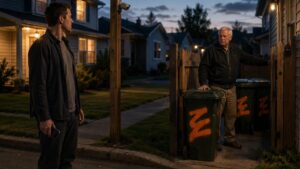
She Called My Emergency Generator a Violation While My Wife’s ICU Went Dark
Chapter 1: The Cable Was Already Coming Loose
Daniel Carter opened his front door to the sound of a wrench turning against metal.
Not a knock. Not a doorbell. Not Cynthia Rivera’s sharp voice calling from the walkway like she usually did when the HOA wanted him to trim back the brittle desert sage by the mailbox.
A wrench.
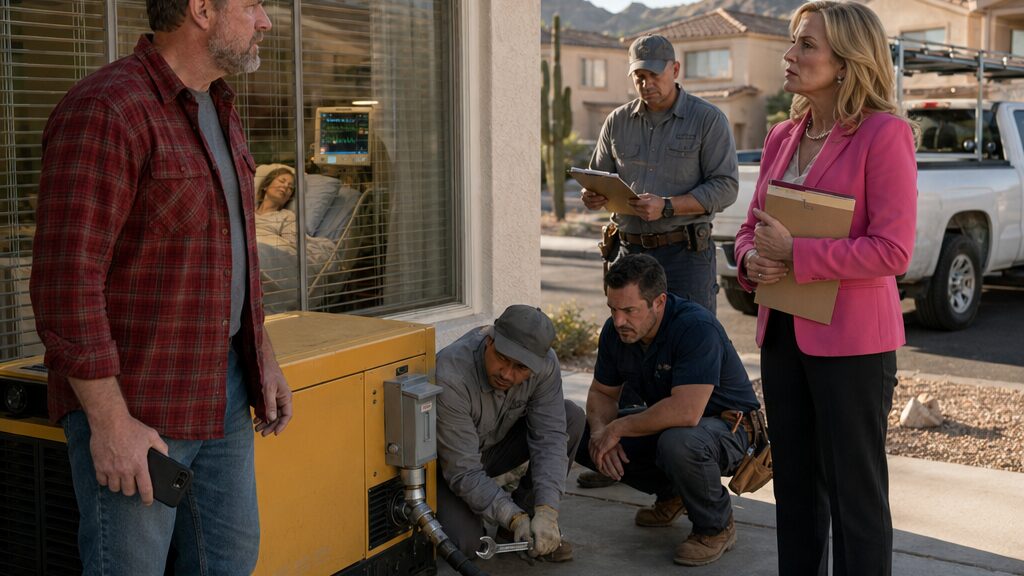
It came from the side of the driveway, where the yellow CAT generator sat on its temporary steel skid under the shade cloth Daniel had rigged two weeks earlier. A man in a gray work shirt was crouched beside the transfer box, one knee in the gravel, his gloved hand braced against the thick black cable that ran from the generator toward the house.
The cable was already moving.
Daniel stepped onto the porch barefoot, the cool stucco under his heels forgotten. “Stop.”
The worker looked up, startled, then glanced past Daniel toward the street.
That was when Daniel saw the rest of them.
A white pickup with no company logo idled at the curb. Two orange cones had been set near the generator. A second worker stood beside the tailgate with a cordless saw in his hand. And on the sidewalk, bright against the pale morning, Cynthia Rivera stood in a pink blazer with a folder tucked beneath one arm.
She was not alone. The crew supervisor, a broad man with a clipboard, stood beside her as if they had been discussing a landscaping job.
Cynthia lifted her chin. “Mr. Carter, please don’t interfere with authorized work.”
Daniel took one step off the porch. “Authorized by who?”
“The association.”
“That’s not an answer.”
The worker at the transfer box lowered the wrench, but his hand stayed on the cable.
Daniel pointed at him without raising his voice. “Take your hand off that line.”
The worker looked again to the supervisor. The supervisor gave no instruction.
Cynthia walked up the driveway with the careful confidence of someone approaching a dog she expected to obey. Behind her, a few garage doors were open. A neighbor stood half-hidden behind a trash bin. Farther down the street, the mountains were still purple in the early light, and the neat tan houses of Silver Vista Estates looked exactly the way the HOA newsletter liked them to look: quiet, clean, identical.
Except for Daniel’s driveway.
Except for the generator.
Except for the black cable Cynthia’s crew was trying to remove.
“You were notified,” Cynthia said.
Daniel held out his hand. “Show me.”
She opened the folder and produced a single sheet. It was printed on HOA letterhead. The paper looked too clean to have spent any time on his door.
Daniel read the first line.
NOTICE OF IMMEDIATE COMPLIANCE ACTION.
He looked at the date.
Today.
The paper had been signed at 6:42 a.m.
It was not yet 7:15.
Daniel lifted his eyes to her. “You dated this this morning.”
“We attempted delivery.”
“When?”
Cynthia’s mouth tightened. “It was placed at your front entry.”
“My front entry is twelve feet behind me. I opened the door because your man was already taking a wrench to my power line.”
The crew supervisor cleared his throat. “Sir, we’re only disconnecting exterior equipment deemed non-compliant. Removal’s scheduled after disconnect.”
Daniel turned to him. “Do you know what that cable feeds?”
The supervisor glanced at the generator, then the transfer box. “Residence power, I assume.”
Daniel stared at him long enough for the man to shift his weight.
“Not residence power,” Daniel said. “Medical equipment.”
Cynthia exhaled as if she had expected this. “Mr. Carter, we have discussed the language you use around this installation. The association has not received complete documentation supporting a permanent exterior machine of this size.”
“It’s not permanent.”
“It has been present for fifteen days.”
“Temporary emergency equipment can last more than a week when the emergency lasts more than a week.”
“The approval period for temporary external units is thirty days only after written approval. You do not have that approval.”
Daniel felt the familiar pull in his chest, the one that came whenever he had to decide how much of Amy belonged to strangers. He had spent months learning how to keep his face ordinary at pharmacies, hospitals, insurance offices. Not because he was ashamed of her. Never that. Because Amy hated being turned into a case file before anyone remembered she was a woman who used to argue over paint colors and hum old songs while folding laundry.
He looked at the generator instead of the window.
“Put the order in my hand,” he said, “before that cable comes loose.”
Cynthia’s gaze flickered toward his phone, which was still in his hand. Daniel had not realized he had started recording until he saw her notice it.
“You’re welcome to document this,” she said. “The association is acting under section nine, exterior equipment and emergency nuisance correction.”
“Read me the part that gives you permission to cut power to medical equipment.”
“That has not been established.”
“I just established it.”
“By statement, not by approved documentation.”
The worker at the transfer box began to rise. Daniel moved then, not fast enough to threaten, just enough to place himself between the man and the cable. His shoulder brushed the warm metal housing of the generator.
The supervisor raised both palms. “Sir, I don’t want a confrontation.”
“Then don’t create one.”
Cynthia’s voice sharpened. “Mr. Carter, stepping into the work area creates liability.”
“So does disconnecting a medical power supply.”
“You keep saying medical,” she said.
Daniel turned fully toward her. “Because it is.”
Her eyes went to the front window.
For one second, Daniel hated that window. He had left the blinds half open because Amy liked the morning light. She said the desert sun made the machines feel less like machines. From the driveway, you could see only part of the room: the edge of the adjustable bed, the IV pole, the monitor stand, the curtain he had hung to soften the medical glare.
Not enough to explain.
Too much to ignore.
Cynthia looked away first.
“The board requested supplemental information,” she said. “You did not provide it.”
“I provided the equipment list, the physician’s note, and the temporary generator plan.”
“You provided a note that said backup power was recommended.”
“Required,” Daniel said.
“Recommended,” Cynthia repeated. “That distinction matters.”
A small sound came from inside the house. Not the alarm. Not yet. A soft mechanical chime from the power conditioner in Amy’s room.
Daniel heard it because he heard everything in that room now. He heard the difference between a pump cycling normally and a pump complaining. He heard the faint pitch change of the oxygen concentrator when the load shifted. He heard the house the way a mechanic heard an engine.
The worker did not hear it.
Cynthia did not hear it.
The neighbor behind the trash bin certainly did not hear it.
Daniel turned toward the house, then back toward the cable.
“How far did you loosen it?” he asked.
The worker swallowed. “I just cracked the coupling.”
Matthew Lopez’s van turned the corner then, tires crunching over the gravel shoulder as it pulled up behind the white pickup. Matthew stepped out before the engine fully died, hair still wet, tool belt half-buckled. He looked from Daniel to the crew to the open transfer box.
“What the hell are you doing?” Matthew said.
Cynthia stiffened. “You are?”
“The electrician who installed that temporary transfer. Who touched it?”
The crew supervisor lifted his clipboard slightly. “We were authorized to disconnect.”
Matthew walked closer, saw the angle of the coupling, and stopped. “Not like that, you weren’t.”
Daniel watched Cynthia’s face. She did not look frightened. That almost made it worse. She looked annoyed that the scene had become less clean than the paper in her folder.
“Mr. Lopez,” she said, reading his name off the side of his van, “this equipment is subject to removal.”
Matthew crouched beside the box but did not touch it. “This equipment is carrying a medical load through a manual transfer. You don’t break that connection cold while the circuit is live.”
“It was supposed to be shut down first,” the supervisor muttered.
Daniel turned slowly toward him. “Who told you it was shut down?”
The supervisor looked at Cynthia.
Cynthia said, “The notice required the resident to make the equipment safe for removal.”
“The notice I got after your man had his wrench on it?”
She pressed the folder against her ribs. “This has gone beyond a conversation. If you refuse to clear the work area, I will call for assistance.”
Daniel almost laughed. Not because anything was funny, but because the wrongness of it was so complete that his body did not know what else to do.
He lifted the phone higher. “Say it clearly for the recording. You are ordering a crew to disconnect the generator after being told it powers medical equipment inside my house.”
Cynthia’s eyes narrowed. “I am ordering removal of non-compliant exterior equipment that has not been approved by the association.”
“That’s not what I asked.”
“That is the answer.”
Matthew looked over his shoulder at Daniel. “Dan, I need to check the load inside.”
Daniel did not move.
Because if he moved, the crew might move.
Because if the crew moved, the cable might come loose.
Because if the cable came loose wrong, the quiet room behind the window would become a room full of alarms.
Cynthia took out her own phone. “I’m contacting the non-emergency line.”
Daniel nodded once. “Good. Tell them to send someone who understands the difference between an HOA notice and a court order.”
The worker with the saw set it down. The supervisor looked like he wished he had never accepted the morning call. Across the street, a garage door lifted another foot, and another face appeared in the shadow.
Daniel backed one step toward the window without clearing the transfer box.
Inside, through the glass, Amy’s bed was angled toward the light. Her head was turned slightly, her hair tucked under the soft blue scarf she wore when she was tired of looking like a patient. He could not see her eyes from here, but he knew she was awake.
Then the alarm came.
Three short beeps.
A pause.
Three more.
Not loud to anyone else. Not dramatic. Nothing like television.
But Daniel’s whole body went cold.
Matthew heard it too. He stood.
From inside the house, Amy’s monitor began beeping through the open window.
Chapter 2: The Room Behind the Front Window
The battery indicator on Amy’s monitor had dropped from green to amber by the time Daniel reached her bedside.
He still had Cynthia’s notice crushed in his left hand.
Amy looked at it before she looked at him. Even with the nasal cannula resting across her face and the blanket tucked up under her arms, she noticed paper. She always noticed what people carried into a room.
“What did they do?” she asked.
“Nothing yet.”
“Daniel.”
He crossed to the power conditioner mounted beneath the small shelf Matthew had installed last week. The display blinked between line power and backup, undecided, as if the house itself was trying to interpret Cynthia’s paperwork.
Outside, voices rose and fell in the driveway. Cynthia’s was clipped. Matthew’s was lower, angrier. The crew supervisor answered in fragments. Somewhere beyond them, a truck door slammed.
Daniel set the notice on the counter beside a tray of syringes and sterile caps. It looked obscene there. White paper. Black print. HOA letterhead beside medical tape.
Amy turned her head toward the window. “Close the blinds.”
He did not move.
“Please,” she said.
That moved him. He crossed the room and pulled the blinds halfway, leaving enough light for her but cutting off the view from the street. The slats clicked together with small, brittle sounds.
The monitor beeped again.
Daniel checked the battery estimate. “We have backup.”
“How much?”
“Enough.”
“That’s not a number.”
He hated that she knew him so well.
“Forty-three minutes on the monitor if nothing else draws. Less if the pump cycles hard. The concentrator has its own battery.”
Amy closed her eyes. Not in panic. She had become too disciplined for panic. That was one of the cruel things illness had taught her: how to receive danger without spending breath on surprise.
“Matthew’s here?”
“Yes.”
“Then let him handle the machine.”
“They’re not listening to him.”
“Then make them.”
Daniel picked up the small handheld radio Matthew had left near the equipment cart. It connected to the temporary electrical monitor outside, a simple system Matthew had mocked together after the second outage. Daniel pressed the side button.
“Matt.”
Static, then Matthew’s voice. “I’m here.”
“What did they loosen?”
“Coupling at the transfer box. Not fully separated. But they broke tension on the seal, and the load flickered. I need five minutes with nobody touching anything.”
Daniel looked at Amy.
She was watching the amber light.
“Take five,” Daniel said.
“I’m trying. HOA president says I can’t work on equipment pending removal.”
Daniel turned back toward the door.
Amy caught his wrist before he could leave. Her grip was thin, but not weak.
“Don’t tell the whole street.”
He looked down at her hand.
“They don’t need the whole story,” she said. “They need enough to stop.”
“Enough hasn’t stopped them.”
Her eyes moved to the window. Behind the blinds, shadows shifted across the driveway.
“I don’t want Shirley from across the street counting my machines,” Amy said. “I don’t want those people whispering ICU like it’s a ghost story. I fought to come home, Daniel. Not to become the house everybody slows down to stare at.”
He had no answer that did not sound like betrayal.
Months earlier, when the hospital discharge coordinator had said home care was possible if they met equipment conditions, Amy had cried in the parking lot, not because she was afraid of dying at home, but because she was afraid of living as a spectacle. Daniel had promised her that the house would stay theirs. The front room could become a medical room, yes, but not a display. Not a neighborhood exhibit. Not a pity stop.
So he had submitted the HOA packet carefully. Too carefully. Equipment list. Placement sketch. Temporary generator plan. Physician note with only what was necessary. No diagnosis details. No photographs of Amy. No description of the night the grid failed and he had counted seconds between pump alarms while the utility company’s automated line told him service would be restored soon.
He had thought dignity and documentation could coexist.
Now a crew outside was proving how much blank space bureaucracy could use.
Daniel bent and kissed Amy’s forehead. “I’ll keep it small.”
“You don’t know how to keep anything small when you’re scared.”
That almost broke him.
Instead, he smiled once, badly. “Then I’ll keep it useful.”
When he returned to the driveway, Matthew was standing with both hands in the air while Cynthia blocked the transfer box.
“Move,” Daniel said.
Cynthia turned. “The contractor is not authorized to continue work.”
“He’s not continuing work. He’s preventing damage.”
“The equipment is under enforcement action.”
“The equipment is under medical load.”
Cynthia glanced toward the half-closed blinds. “Again, that has not been verified by the association.”
Daniel held up the notice. “Your paper doesn’t change the physics.”
Matthew pointed at the transfer box. “If I re-torque the coupling and stabilize the line, nobody has to touch anything else until a real authority sorts it out.”
“The HOA is the authority over exterior modifications,” Cynthia said.
“Not over electricity feeding a patient,” Matthew snapped.
The word landed too hard. Patient.
A woman across the street stepped out from behind her open garage. Shirley Johnson wore a pale robe over jeans, her gray hair pinned up unevenly, a coffee mug in one hand. She looked from Matthew to Daniel to the blinds.
Daniel saw the question form on her face.
He hated Cynthia for that too.
The crew supervisor checked his clipboard again, though nothing useful could have appeared there since the last time he looked. “Ma’am, we were told the resident would have the system shut down.”
Daniel stared at Cynthia. “You told them that?”
“I told them the equipment had been noticed for removal.”
“That’s not the same thing.”
“You were given opportunities to comply.”
“When?”
Cynthia opened her folder and removed another paper. “Initial courtesy reminder. Second notice. Architectural control inquiry. Final compliance warning.”
Daniel recognized the dates. Each one matched an email he had answered. Each one had avoided the one thing he had kept writing back: temporary medically necessary backup power.
“You never approved or denied the medical accommodation,” he said.
“Because the request was incomplete.”
“It was complete enough for you to know what it was.”
Cynthia’s expression tightened.
Matthew lowered himself beside the box slowly, watching Cynthia as if she might physically stop him. “I’m tightening the coupling. That’s it.”
The crew supervisor looked at Cynthia. “I’m not comfortable stopping him from making it safe.”
Cynthia did not answer.
Matthew worked quickly. The wrench moved in controlled quarter turns. Daniel watched the black cable settle back into alignment, its thick curve lying across the gravel like something alive that had been injured but not severed.
The amber light inside Amy’s room stopped blinking.
A small green light appeared on the power conditioner through the slats.
Daniel let out a breath so quietly no one heard.
There had been other mornings like this, though none with Cynthia in the driveway. The first outage had come during a heat advisory, the kind that made the stucco walls radiate warmth long after sunset. The grid had failed at 2:08 a.m. Daniel remembered the time because he had written it on the back of an envelope while waiting for the utility company to answer. Amy’s monitor had switched to battery. The oxygen concentrator had followed. Then the infusion pump had chirped once, an offended little sound, as if it could not believe the house had failed its duty.
The portable battery system had carried them forty-nine minutes.
The grid had returned at fifty-six.
Daniel had not slept afterward. By sunrise, he had called Matthew. By noon, he had ordered the generator.
By the following week, Cynthia had sent an email with the subject line: UNAPPROVED EXTERIOR EQUIPMENT.
Now she looked at that same machine as though its continued existence was Daniel’s stubbornness made metal.
Matthew stood. “Stable for now.”
“For now?” Cynthia repeated.
“For now because someone partially loosened a live medical backup connection.”
The crew supervisor rubbed the side of his face. “We didn’t know.”
“I told your president,” Daniel said.
Cynthia said, “You stated a medical concern. You did not provide complete approval materials for a permanent installation.”
“It isn’t permanent,” Daniel said again.
“It is connected to the residence.”
“So is a garden hose.”
“A garden hose does not affect noise levels, insurance coverage, or exterior appearance.”
Daniel looked at the generator. Dust clung to its yellow panels. The shade cloth above it was tied to two temporary posts and the side fence. It was not beautiful. It was not hidden. It hummed when it ran, a low industrial sound no one would mistake for birdsong.
It was also the reason Amy was in their house instead of a long-term acute care facility forty miles away.
“Tell me what approval you needed,” he said. “Right now. Name the missing document.”
Cynthia did not hesitate. “A completed medical justification form, a permanent installation plan, an acoustic mitigation plan, proof of county electrical inspection, and written board approval.”
“I submitted the first two.”
“You submitted partial materials.”
“Because Amy’s diagnosis is not your neighborhood gossip.”
Shirley flinched across the street.
Daniel regretted the line as soon as it left his mouth. Not because it was untrue. Because Amy had asked him to keep it small, and he had already failed.
Cynthia’s face cooled. “This is exactly why process matters. The board cannot be expected to make decisions based on emotional accusations in a driveway.”
The distant sound of sirens rose somewhere beyond the subdivision wall. Not ambulance sirens. Police. Cynthia had made her call.
Daniel folded the notice once, carefully, along its center crease. He needed his hands to do something precise.
“I’ll get the folder,” he said.
He went inside through the front door, past Amy’s room. She turned her head toward him. The green light reflected faintly against the wall beside her bed.
“Is it holding?” she asked.
“For now.”
She studied his face. “You told them too much.”
“I know.”
“Did it work?”
He looked toward the driveway, where Cynthia’s silhouette crossed behind the blinds.
“No.”
Daniel went to the kitchen desk and pulled open the bottom drawer. The folder was blue, worn at the corners from being opened too many times. He had labeled each tab with block letters: PHYSICIAN, EQUIPMENT, INSTALLATION, HOA, UTILITY.
He opened the HOA tab first.
There was his copy of the medical accommodation request. There was the equipment list. There was Matthew’s sketch. There was the physician note.
Daniel turned the first page over, looking for the HOA receipt stamp that should have been in the lower right corner.
The box was blank.
He checked the second copy. Blank.
His jaw tightened.
Behind him, through the wall and window and morning noise, the police siren grew louder.
Daniel stared at the unstamped page and felt the ground shift under every careful thing he thought he had done.
Chapter 3: The Notice Said Temporary Meant Thirty Days
“Temporary still has to look temporary,” Cynthia had told him two weeks earlier, smiling as if the sentence solved something.
Daniel remembered the way she had stood in the HOA office beneath a framed photograph of Silver Vista Estates at sunset. The same mountains. The same stucco roofs. The same planned desert plants arranged in approved curves along approved gravel.
He had come in with the blue folder under his arm and a sleep headache behind his eyes. Amy had been home six days. The generator had been in the driveway for three.
Cynthia had not invited him to sit.
“It is temporary,” Daniel had said.
“It is large.”
“It has to carry a medical load.”
Her expression had changed at medical, but not enough. Not toward concern. Toward caution.
“Then you’ll need to submit the appropriate materials.”
“That’s why I’m here.”
He had placed the packet on the front edge of her desk. She had not touched it right away. Instead, she had looked through the glass office wall toward Charles King, who was standing near the copier with a stack of envelopes tucked beneath one arm.
Charles had come in without being asked. “Is this the generator issue?”
“It’s not an issue,” Daniel had said.
Charles gave a quick, uneasy smile. “Everything becomes an issue if it sets precedent.”
Daniel remembered that phrase because Charles had said it like an apology and a warning at the same time.
Now, standing in his kitchen with the blank receipt box staring back at him, Daniel could hear Matthew arguing outside and the first police car rolling to the curb. The past did not feel past. It felt like a line running straight from Cynthia’s clean desk to the loosened cable in his driveway.
He flipped through the packet again.
Physician note. Equipment list. Installation plan. Temporary placement sketch. Email printouts. Utility outage report.
No stamp.
He checked the folder pocket. Nothing.
A knock hit the open front door frame.
“Mr. Carter?” a police officer called. “Can you step outside?”
Daniel slid the unstamped packet under his arm and went back through the hall. Amy’s eyes followed him from her bed.
“Police?” she asked.
“Yes.”
“Daniel.”
“I know.”
“No, listen.” Her voice was thin but steady. “Don’t let them make you the angry man in the driveway.”
That stopped him.
She knew that too. Knew the beard, the plaid shirt, the size of his shoulders, the way neighbors who barely knew him saw his silence as temper. Knew Cynthia could stand in a blazer with a folder and look official even while standing beside a cable she had no business touching.
Daniel nodded once. “I won’t.”
Outside, the police car’s lights flashed without siren, blue and red sliding over the pale garage doors and the yellow generator panels. Two officers stood near the curb. The crew had stepped back. Matthew stood close to the transfer box, jaw set. Cynthia was already speaking to one officer, folder open, posture composed.
Daniel walked down the driveway with the blue folder visible at his side.
Cynthia glanced at it.
For the first time that morning, she looked uncertain.
Only for a second.
Then Charles King’s words returned from the HOA office.
“If we approve a large exterior generator without full documentation,” Charles had said two weeks earlier, “the insurance carrier can ask why our architectural controls exist at all.”
Daniel had looked from Charles to Cynthia. “My wife’s equipment doesn’t care about your carrier.”
Charles had winced. “I’m not saying the need isn’t real.”
“You don’t know the need.”
“No,” Charles said. “Because you haven’t fully documented it.”
Daniel had opened the folder then, tapping the physician note. “That says backup power is medically required.”
Cynthia had finally picked up the page. “It says recommended for safe home care.”
“Read the next line.”
She had read it silently. Her face had not changed.
Daniel had wanted to tell her everything then. The alarms. The battery countdown. Amy trying to joke while he knelt on the floor checking plugs with hands that would not stop shaking. But he could hear Amy’s voice in his head: I am not asking permission to be sick in my own house.
So he had said only, “This is enough.”
Cynthia had placed the page back on the stack. “For emergency temporary review, perhaps. Not for an exterior installation of this duration.”
“How long does review take?”
“Architectural control meets twice monthly.”
“I don’t have twice monthly.”
“Then submit complete materials today.”
“I am.”
“Complete materials,” Charles repeated gently. “The board may need more than a general note.”
Daniel had closed the folder. “You are not getting her diagnosis.”
Cynthia’s mouth had tightened. “Then you understand you may be limiting what the board can consider.”
He had understood.
He had understood the wrong thing.
In the driveway now, the police officer turned toward Daniel. “Sir, the HOA president says this is a compliance matter and that you prevented a removal crew from completing work.”
Daniel handed him the notice. “They started before giving me this.”
The officer read the date and time. His eyebrows moved slightly.
Cynthia said, “Delivery was attempted.”
Daniel handed over the blue folder next. “This generator powers medical equipment inside the house. I submitted a temporary accommodation request two weeks ago.”
Cynthia said, “Incomplete request.”
Daniel looked at her. “Where’s the receipt stamp?”
She hesitated. “Excuse me?”
“My copy doesn’t have one. You took the packet in your office. You said it would be scanned.”
“That does not mean it was accepted as complete.”
“Accepted and received aren’t the same thing.”
The officer looked between them. “Was the packet received?”
Cynthia closed the folder in her hands. “The office received materials. They were insufficient for approval.”
Matthew let out a short breath. “But enough to know what the generator was for.”
Cynthia turned on him. “You are not party to the HOA process.”
“I’m party to the electrical system your crew almost damaged.”
The crew supervisor stared down at his clipboard.
Across the street, Shirley Johnson had moved closer, robe belted tight now, coffee mug gone. She stood at the end of her driveway with the expression of someone who had stepped into a conversation too late and recognized one sentence too many.
Daniel saw her and remembered the first complaint.
It had arrived by email five days after the generator installation.
A neighbor has reported excessive mechanical noise during evening hours.
No name. No direct conversation. Just the HOA’s polite language standing in for a person.
Daniel had read the email at 1:17 a.m. while sitting beside Amy’s bed during a medication change. He had typed three different replies and deleted each one. Finally he wrote: The generator operates only during outages and scheduled test cycles. It supports medically necessary equipment. Please advise what sound mitigation is required for temporary approval.
Cynthia’s answer had come the next afternoon.
Submit acoustic mitigation plan with architectural packet.
As if he were adding a pool pump.
Now Shirley crossed the street slowly, not to Daniel, but to the edge of the gathering.
“I signed the noise form,” she said.
Everyone turned.
Cynthia’s eyes sharpened. “Shirley, this isn’t necessary.”
Shirley looked at Daniel, then at the generator. “I didn’t know.”
Daniel said nothing.
“I thought it was for a remodel,” Shirley continued. “Or one of those backup systems people put in and never ask about. Cynthia said several of us should document impact before the next board meeting.”
Cynthia’s voice lowered. “That is not an accurate characterization.”
Shirley’s face flushed. “You told me it would help establish pattern.”
Charles had said pattern too, in the office. Pattern of noncompliance. Pattern of exterior changes. Pattern of residents thinking emergency meant exemption.
Daniel looked at the unstamped receipt box on the top page of his folder.
Blank space. That was all Cynthia needed.
The officer handed the notice back. “At this point, nobody touches the equipment until we understand whether there’s an immediate safety issue.”
Cynthia opened her mouth.
The officer raised one hand. “Ma’am. Nobody touches it.”
For one brief second, Daniel felt the day loosen.
Then the crew supervisor glanced at the generator housing. “Uh,” he said. “Is it supposed to do that?”
A thin gray thread of smoke curled from the side vent of the yellow machine, rising into the clean desert morning before anyone said stop.
Chapter 4: Smoke Rose Before Anyone Said Stop
A gray burst of smoke coughed from the generator housing, thin at first, then thick enough to make the crew supervisor step backward into one of his own orange cones.
“Everyone away from it,” Matthew said.
Daniel moved toward the generator.
The nearest police officer raised a hand. “Sir, step back.”
“That machine is powering medical equipment inside my house.”
“And it may be on fire.”
“It isn’t on fire.” Matthew was already crouching near the side panel, not touching it yet, eyes moving over the vents, the coupling, the transfer box. “It’s heat stress from load interruption. Maybe a seal burn. Maybe worse if someone keeps yelling instead of letting me shut it down properly.”
Cynthia seized on the smoke like it had arrived on her side.
“This is exactly the hazard the association warned about,” she said. “Unapproved industrial equipment operating beside a residence.”
Daniel turned to her so sharply the officer shifted his stance.
“You had your crew put a wrench on it.”
“The machine is smoking, Mr. Carter.”
“After your crew touched the line.”
The officer looked at Matthew. “Can this thing explode?”
Matthew did not look up. “Not if people stop making it worse.”
That did not seem to comfort anyone.
Across the street, neighbors had emerged in pieces: a man in running clothes at the curb, a woman holding a small dog, Shirley Johnson near her mailbox with one hand pressed to her mouth. The smoke rose between Daniel’s garage and the pale morning sky, impossible to hide, impossible to explain in one sentence. The very thing keeping Amy safe now looked like a danger to everyone who did not know what had been done to it.
Daniel felt the shape of Cynthia’s argument forming before she made it.
Unsafe installation. Resident refused compliance. Emergency correction justified.
He went still.
Amy had warned him not to become the angry man in the driveway. But Cynthia had found another way to frame him: not angry, reckless. A man who had dragged a dangerous machine into a quiet neighborhood and then cried medical when caught.
“Matthew,” Daniel said, “tell me what you need.”
“Access to the panel and two minutes without anyone touching the cable.”
The officer frowned. “Can you do that safely?”
“Yes, if the coupling holds.”
The crew supervisor swallowed. “We barely loosened it.”
Matthew looked up then. “You broke the seated connection under load. Barely isn’t a safety category.”
The supervisor’s face reddened. “We were told the resident had been instructed to shut it down.”
Daniel looked at Cynthia.
She looked at the officer.
“I informed the resident through proper notice that the equipment was subject to immediate compliance action,” she said.
“That is not what he asked you,” Daniel said.
The officer glanced toward the front window, where the blinds were half-closed. “Is there someone inside who needs assistance?”
“My wife,” Daniel said.
“Does she need EMS?”
“Not if the power holds.”
The officer’s face changed. Not dramatically. Just enough that Daniel knew the word wife had reached where equipment had not.
A second police car rolled up. Its lights washed over the generator, over the white pickup, over Cynthia’s blazer. Daniel hated the lights too. They made everything look like a scene already decided by someone else.
Inside the house, a monitor beeped twice.
Daniel turned.
The sound did not carry to the street the way it carried inside his body, but Shirley heard something. Her head lifted.
Matthew held out a hand. “Dan, go check her. I’ll stabilize this.”
“No one touches that cable.”
“Nobody will,” the officer said.
Daniel looked at him. “You’ll make sure?”
The officer nodded once. “Go.”
Daniel went inside at a fast walk and found Amy watching the door, her eyes too clear.
“Smoke?” she asked.
He stopped beside the bed. “You can see it?”
“Smell it.”
He checked the monitor. Still green at the line input, battery ready, numbers steady. He checked the pump. He checked the concentrator. He did all of it twice because fear made him distrust the first pass.
“It’s outside,” he said. “Matthew’s on it.”
“Is Cynthia still there?”
“Yes.”
Amy closed her eyes for a moment. “Of course she is.”
Daniel looked toward the blinds. “The police asked if you need EMS.”
“Do I?”
“Not yet.”
“Then don’t let them take me out of here because she made a mess in our driveway.”
Our driveway. Our house. The words settled him more than any steady reading on the monitor could have.
He squeezed her hand. “I’m going back.”
“Daniel.”
He paused.
“Don’t just defend the generator,” she said. “Defend the reason.”
That was harder. The generator was metal, cables, amperage, noise levels. The reason was her. Her body. Her privacy. Her fear. His promise. Their life rearranged around machines neither of them had wanted but both had learned to respect.
He nodded and went back outside.
The smoke had thinned. Matthew had the side access open and was using a thermal scanner near the coupling.
“Heat spike at the connector,” Matthew said without looking away. “No active fire. But I’m shutting the load to bypass for a controlled reset.”
Cynthia stepped forward. “You cannot perform additional work on equipment under violation.”
The officer turned to her. “Ma’am, he is making it safe.”
“He is modifying a non-compliant installation.”
“He is preventing a possible emergency.”
“There is already a possible emergency because the resident installed an unapproved machine.”
Daniel heard the trap close.
He walked to the generator and stood beside Matthew, close enough to see the scorched smell’s source: not flames, not dramatic destruction, just a darkened ring near the coupling where stress had done what stress did. It left a mark people could point to afterward.
Matthew lowered his voice. “It was stable when I installed it. I tested the load. I gave you the readings.”
“I know.”
“They’ll say this proves it wasn’t safe.”
“I know.”
Matthew finally looked at him. “No, I mean they’ll say it officially.”
The crew supervisor had backed near his truck. His clipboard hung uselessly at his side.
Daniel took out his phone again. He photographed the coupling. He photographed the wrench lying on the gravel where the worker had set it down. He photographed the notice with the morning timestamp. Then he photographed the cable, still attached, black and thick and suddenly fragile.
Cynthia watched every shot.
“You’re building a narrative,” she said.
Daniel did not lower the phone. “You brought a crew before breakfast.”
“We followed enforcement policy.”
“You followed a policy straight to my wife’s power supply.”
“The board had not approved a permanent generator.”
“And you had not denied a medical accommodation.”
“That request was incomplete.”
“Then you pause,” Daniel said. “You ask. You verify. You don’t send men with tools.”
A murmur moved through the neighbors. Cynthia heard it and straightened.
“This community cannot function if every resident declares a private exception,” she said, now speaking not only to Daniel but to everyone within earshot. “We have architectural standards for safety and fairness. We have processes because selective enforcement creates liability for all homeowners.”
Charles King’s words again, dressed in Cynthia’s voice.
Daniel looked around. At the neighbors. At Shirley. At the officers. At the crew that had come to remove a thing before understanding what it held.
Then he looked at the front window.
Behind the blinds was the reason.
“She is not an exception,” Daniel said. “She is a person.”
For a moment, no one answered.
Then the radio on the officer’s shoulder crackled. He listened, then turned slightly away and spoke into it. Daniel caught fragments: medical equipment, HOA dispute, generator issue, no active fire.
Matthew finished the controlled reset. The generator’s hum steadied, lower than before but even. He closed the access panel and stood.
“Here’s the plain version,” he said to the officer. “The generator was operating within tested load. The crew loosened the transfer coupling without verifying shutdown. That caused a flicker and heat stress. If they continue removal without proper transfer, they risk interrupting equipment inside.”
The officer wrote something down. “You’ll put that in writing?”
“Yes.”
Cynthia’s face hardened. “He is Daniel’s contractor.”
“And you hired the crew,” Matthew said.
The officer looked at the crew supervisor. “Who instructed you to begin disconnecting?”
The supervisor glanced at Cynthia, then at his clipboard. “The work order came through the association office. It said resident had been noticed and equipment was to be made ready for removal.”
“Did it say medical equipment?”
“No.”
Daniel’s hand tightened around his phone.
The officer turned to Cynthia. “Before the crew began removal, were you warned this generator powered medical equipment?”
Cynthia’s folder shifted slightly in her hands.
The street went quiet enough that Daniel could hear the generator holding its wounded hum.
Chapter 5: The Packet Was Never Missing
Matthew’s photo arrived at 1:08 p.m., while Daniel was standing at Amy’s kitchen counter trying to make himself eat a sandwich he could not taste.
The image showed Cynthia beside the transfer box before Daniel had opened the front door. The morning light was flat and pale. The worker was already crouched. The wrench was already in his hand. Cynthia’s pink blazer was reflected faintly in the yellow side panel of the generator.
Under the photo, Matthew had written: Timestamp is 7:07. Notice says 6:42. Crew was on the cable before you came out.
Daniel stared at the numbers until they blurred.
Across the hall, Amy’s room was quiet except for the soft cycle of equipment. The generator had stayed stable after Matthew’s reset, but Matthew had warned him not to let anyone touch it again until the coupling was inspected and replaced. The police had left after instructing everyone to keep distance and treat the matter as disputed. Cynthia had left with the crew, not defeated, only delayed.
Delayed was not safe.
Daniel saved the photo in three places, then opened his email.
There were already two new messages from the HOA.
The first was from the association office: Emergency board review scheduled for 6:30 p.m. regarding non-compliant exterior generator and related safety incident.
The second was from Cynthia.
Mr. Carter, in light of this morning’s smoke event, the association reserves all rights to proceed with emergency hazard abatement pending board ratification.
Hazard abatement.
Daniel read the phrase twice.
Then he walked to the sink and put the untouched sandwich in the trash.
Amy called from the other room, “Bad?”
He leaned against the counter, closed his eyes for one second, then went to her doorway. “They scheduled a meeting.”
“Good.”
“Not that kind.”
She watched him. The afternoon light made the machines look softer than they were.
“They’re going to call the generator the hazard,” he said.
“Not the people who touched it?”
“That’s why I need the file.”
She understood immediately. “The HOA file?”
“I need to prove they received the packet.”
“And if the packet says you didn’t give enough?”
Daniel looked toward the blue folder on the kitchen table.
“That’s the problem.”
Amy’s mouth curved a little, not quite a smile. “There it is.”
“What?”
“The face you make when you’re mad at yourself but looking for someone else to blame.”
He almost answered too fast. Stopped. Let the sting do its work.
“I should have made them stamp it.”
“Yes.”
“I should have sent the diagnosis.”
“No.”
Daniel looked at her.
Amy’s eyes were tired but firm. “You should have made them acknowledge what you did send. That’s different.”
The distinction lodged in him.
He had been treating privacy and proof like enemies. Maybe they were not. Maybe he had simply trusted the wrong people to respect a boundary they could exploit.
His phone rang before he could answer. Shirley Johnson’s name was not in his contacts, so the number showed only as local. He nearly ignored it. Then he saw her standing outside earlier, saying I didn’t know.
He answered.
“Mr. Carter?” Shirley’s voice sounded smaller through the phone. “It’s Shirley. Across the street.”
“Yes.”
“I’m sorry to call. I got your number from the neighborhood directory.”
“What is it?”
A pause. “I wanted to tell you something before the meeting.”
Daniel stepped into the kitchen. “I’m listening.”
“When Cynthia asked me to sign the noise complaint, she said the board needed documentation before everyone started bringing in machinery. Her words. ‘If we let this stand, everyone will bring in machinery.’ I thought she meant outdoor generators for convenience. RV hookups. Workshop equipment. I didn’t know your wife was in that room.”
Daniel gripped the edge of the counter. “Did you tell Cynthia you didn’t know?”
“This morning, yes.”
“And?”
“She told me not to let guilt rewrite what I experienced.”
That sounded like Cynthia. Controlled. Plausible. Cold only after you understood what it did.
Shirley continued, “I was a nurse for thirty-one years.”
Daniel went still.
“I knew that alarm,” she said. “The one through your window. Not the exact machine, maybe, but the rhythm. I’ve heard rooms change because of that sound. I should have asked before signing anything.”
Daniel looked toward Amy’s room. “Why are you telling me?”
“Because Cynthia is going to use my complaint tonight. I want it noted that I did not know the generator powered medical equipment when I signed it.”
That was not forgiveness. Not yet. But it was a crack in the wall.
“Will you put that in writing?” Daniel asked.
“Yes.”
He closed his eyes. “Thank you.”
“Mr. Carter?”
“Yes.”
“If you need someone to sit with your wife during the meeting, I can. I know she doesn’t know me. I know that’s an awkward offer. But if you need to go, and if she’ll allow it, I can sit quietly and touch nothing unless she asks.”
Daniel could not speak for a moment.
A surprise from kindness was harder to handle than hostility.
“I’ll ask her,” he said.
After the call, he opened the HOA portal. His hands moved with the hard efficiency of his old construction days: records, emails, attachments, dates, labels. He found the architectural control thread. Found Cynthia’s replies. Found his own message with the subject line Temporary Emergency Generator Medical Backup Request.
Attachment: Carter_Medical_Backup_Packet.pdf.
Sent two weeks ago.
He clicked.
The portal spun, failed, then opened a preview.
At the top of the preview, in small gray text not included on his printed copy, was a system line:
Received by Association Office. Routed to Architectural Review. Status: Incomplete – insufficient detail.
Daniel stared at it.
Not missing.
Never missing.
Received.
Routed.
Marked.
He downloaded the page. Took a screenshot. Printed it.
The printer in the corner whined slowly, as if even the machine understood that nothing in the house could be allowed to fail today.
When the pages came out, Daniel saw what Cynthia had seen: his physician note, cautious and spare. Backup power recommended for safe home-based care. Interruption may require urgent transfer.
He had thought that was enough. To any decent person, it should have been enough to pause a crew.
To a board looking for reasons to avoid precedent, it had become a loophole.
Daniel called Amy’s physician’s office. The nurse on the line remembered him. That helped until it did not.
“The doctor is with patients until late afternoon,” she said. “I can send a message.”
“I need a letter before six.”
“I understand, but—”
“No,” Daniel said, then caught himself. He lowered his voice. “I’m sorry. I know you’re not the problem. The HOA is voting tonight to remove the generator that powers her home equipment.”
Silence.
Then the nurse said, “Send me the wording they’re challenging.”
Daniel emailed everything: Cynthia’s notice, the portal status, the equipment list, the photo, Matthew’s summary. He removed nothing this time except Amy’s most private test details. Not because he was hiding. Because proof did not require surrendering every piece of her.
When he went back to Amy, she had already guessed.
“You need a stronger letter,” she said.
“Yes.”
“With diagnosis?”
“Only what they need.”
“That sentence has carried us a long way today.”
He sat beside her bed. “Too far.”
Amy looked toward the covered window. “I don’t want that board discussing my body like landscaping.”
“I know.”
“I don’t want Cynthia saying my name.”
“She won’t.”
“You can’t promise that.”
“No,” he said. “But I can promise she won’t get to pretend you’re paperwork.”
Amy turned her face away for a moment. When she looked back, her eyes were wet but steady.
“Then say enough,” she said. “Not everything. Enough.”
At 4:51 p.m., the physician’s letter arrived.
At 4:54, the HOA office sent another message.
Emergency agenda updated: Board to vote on ratification of immediate hazard abatement and completion of generator removal pending later accommodation review.
Daniel read it aloud once.
Amy’s expression changed at pending later.
“That means they remove it first,” she said.
“Yes.”
“And review after.”
He folded the paper slowly, precisely, until the crease cut through the words hazard abatement.
Outside, the generator held its hum.
For now.
Chapter 6: Put the Order in My Hand
Daniel walked into the HOA meeting room carrying the damaged cable end in a clear plastic evidence bag.
Every conversation stopped.
Not because the room was full. It wasn’t. Emergency board meetings never drew the casual neighbors who came for landscaping votes and pool hours. Only the board sat at the folding tables in front, with Cynthia at the center and Charles King beside her, tapping a pen against a printed agenda. Shirley Johnson sat in the second row, hands folded tightly in her lap. Two other neighbors stood near the back wall, pretending not to stare at the bag in Daniel’s hand.
The cable end was not large, but it looked heavier than anything else in the room.
Daniel placed it on the table in front of him and remained standing.
Cynthia’s gaze dropped to the bag, then rose. “Mr. Carter, this is not a courtroom.”
“No,” Daniel said. “If it were, you would have had to answer the officer’s question this morning.”
Charles shifted. “Let’s keep this orderly.”
“Orderly is why I’m here.”
Cynthia folded her hands. Her blazer was no longer pink but pale cream, softer and more official under the fluorescent lights. “The board has convened to address an immediate safety concern caused by an unapproved exterior generator installation at your property.”
Daniel opened his folder.
“No,” he said. “The board has convened to decide whether to finish removing medical backup power from my house after being warned what it supports.”
A board member looked down.
Cynthia’s voice stayed level. “Emotional framing cannot override safety rules.”
Daniel almost smiled at that, but there was no humor in him.
He took out the first page. “Portal record. My packet was received and routed two weeks ago.”
He slid it across the table.
Charles picked it up before Cynthia could. His eyes moved over the system line.
Received by Association Office. Routed to Architectural Review. Status: Incomplete – insufficient detail.
Daniel set down the second page. “Physician note submitted with the packet.”
Cynthia said, “Which did not provide sufficient detail for permanent approval.”
“Temporary emergency approval,” Daniel said. “I did not request permanent approval.”
“You connected equipment to the residence.”
“For a temporary medical load.”
“You installed exterior machinery.”
“After two power outages.”
Charles raised a hand, not quite interrupting, not quite surrendering. “Mr. Carter, no one is saying your wife’s situation lacks seriousness. The issue before us is whether the association can allow an unreviewed generator after a smoke incident.”
Matthew stood along the side wall, still in his work clothes. He had come straight from another job, dust on his boots, face tired. “The smoke incident happened after the removal crew loosened the transfer coupling.”
Cynthia looked at him. “Your statement is noted.”
“It needs to be more than noted.”
“It will be evaluated.”
Daniel took out Matthew’s written summary and placed it beside the cable. “Evaluate it now.”
Charles read that too. His pen stopped tapping.
Cynthia leaned toward him. “Charles.”
He did not look up immediately.
Daniel saw the pressure in Cynthia’s face then, the narrow calculation. She was not a villain from a story Amy would roll her eyes at. She was worse because she made sense to herself. She saw a neighborhood full of rules held together by enforcement. She saw one generator, then ten. One exception, then every resident with a reason. One lawsuit if she acted, another if she didn’t. And somewhere along the way, she had decided the safest thing for the association was to make Daniel’s need look incomplete.
Charles set down Matthew’s summary. “The contractor states the unit was stable prior to attempted removal.”
“The contractor is paid by Mr. Carter,” Cynthia said.
“The crew was hired by the association,” Daniel said. “Should we ignore them too?”
The room went quiet.
Daniel took out his phone and played the first clip from the driveway. His own voice sounded calmer than he remembered.
Put the order in my hand before that cable comes loose.
Cynthia’s recorded voice answered: The association is acting under section nine, exterior equipment and emergency nuisance correction.
Then Daniel’s voice: You are ordering a crew to disconnect the generator after being told it powers medical equipment inside my house.
Cynthia’s answer filled the room: I am ordering removal of non-compliant exterior equipment that has not been approved by the association.
Daniel stopped the recording.
No one moved.
He did not feel triumph. He felt sick. Amy’s room had become sound in a meeting room. Her life reduced to the pauses between people choosing words carefully.
Cynthia recovered first. “That recording confirms that I identified the correct basis for enforcement. It does not establish that approved medical documentation existed at the time.”
Daniel took out the physician’s letter.
His hand hesitated.
Amy had said enough. Not everything. Enough.
He unfolded the page and read only the lines that mattered.
“Patient requires uninterrupted electrical support for prescribed home medical equipment. Interruption of backup power may create urgent risk and may require emergency transport. Temporary generator support is medically necessary until stable alternative backup is installed.”
His voice did not break. He made sure of it.
He placed the letter on the table.
“This is not a request to park a machine in the driveway because I like the sound,” he said. “This is not a remodel. Not a workshop. Not a convenience. My wife is in our front room because her care team allowed her to come home if I could keep that equipment powered. I submitted the request. I kept her details narrow because she asked me not to turn her illness into neighborhood property. That was my mistake.”
Shirley lowered her eyes.
Daniel continued. “But my mistake did not authorize anyone to put tools on that cable after I said medical equipment. Your incomplete file did not authorize it. Your noise complaint did not authorize it. Your fear of precedent did not authorize it.”
Charles leaned back slowly.
Cynthia said, “Mr. Carter, nobody wanted harm to come to your wife.”
“But you were willing to act before finding out whether harm would come.”
Her face flushed.
For the first time, she looked less official than cornered.
Charles cleared his throat. “There may be a middle path. We could ratify the emergency abatement as a safety measure but delay physical removal pending later accommodation review.”
Daniel looked at him.
For a second, he could not make the words fit together.
“You would still classify it as a hazard.”
“Pending review.”
“And leave the removal order active.”
“Paused.”
“Paused means someone can unpause it.”
Charles spread his hands. “The board has to protect the association while we sort out the medical claim.”
Daniel picked up the bagged cable end.
“No,” he said.
Cynthia’s eyes sharpened.
Daniel held the cable where everyone could see the blackened ring near the coupling.
“You don’t get to damage the lifeline, call the burn mark proof, and then keep the knife on the table while you decide whether the person bleeding filed the right form.”
No one spoke.
It was more than he had meant to say. More dramatic than Amy would have liked. But it was true, and the room knew it.
A board member whispered to Charles. Charles did not answer.
Cynthia’s voice came quieter now. “What exactly are you asking for?”
“Withdraw the immediate removal order. Withdraw the hazard abatement classification unless a county inspector determines the generator itself is unsafe. Approve temporary medical operation for seven days while a safe placement plan is reviewed. Put in writing that no crew touches my equipment without notice, medical review, and proper electrical shutdown.”
“That is a lot to demand.”
“It is less than what you demanded from my wife without asking her name.”
Cynthia looked away.
Then Shirley stood.
Her chair scraped against the floor, loud enough to make everyone turn.
“I signed the complaint,” she said. Her voice shook, but she did not sit back down. “Cynthia used my complaint without telling me the generator powered a medical room.”
Chapter 7: The Generator Stayed, But Not the Same Way
The crew came back the next morning, and Daniel was halfway down the driveway before he realized they were unloading a concrete pad instead of removal tools.
No cordless saw. No orange cones blocking the generator. No white pickup angled like a threat across his curb.
A flatbed truck sat at the street with a small precast slab strapped to its bed, a pallet of sound-baffle panels beside it, and a county inspector standing near the mailbox with a tablet in one hand. Matthew Lopez was already there, talking low with the inspector, his hands moving in the careful shapes electricians used when explaining danger to people who might actually listen.
Daniel stopped beside the yellow generator.
The same black cable curved across the gravel toward the transfer box. Temporary clamps held the repaired coupling in place, and a bright tag Matthew had taped above it read: DO NOT DISCONNECT UNDER LOAD.
Daniel had written the same thing in his head all night.
Do not disconnect under load.
Do not remove first and review later.
Do not call a lifeline a violation because it makes the paperwork cleaner.
Cynthia Rivera stood near the sidewalk, not in a bright blazer this time, but in a gray suit jacket that made her look smaller. Charles King stood a few feet away from her, reading something on his phone. He did not look proud. He looked as if the night had removed a layer of certainty from his face.
Daniel walked to Matthew. “What is this?”
Matthew nodded toward the slab. “Temporary medical accommodation installation. Seven-day emergency approval, pending final review. County inspector signs the placement, I reconnect clean, sound panels go up by noon if everything checks out.”
Daniel looked at the inspector. “The HOA approved that?”
Charles answered before Cynthia could. “The board voted to withdraw immediate removal pending medical accommodation review.”
“Pending?”
“For the final placement,” Charles said. “Not for operation. Operation is approved under emergency medical accommodation.”
Daniel waited.
Charles understood the silence. He took a folded letter from his folder and handed it over.
Daniel read the first page slowly.
The violation fine was withdrawn. The hazard abatement classification was withdrawn pending county inspection. No association crew was authorized to touch the generator, transfer box, or related medical backup equipment without written notice, electrical safety procedure, and confirmation that medical load had been safely transferred.
At the bottom, in a separate paragraph, the board ordered a review of emergency accommodation procedures.
Daniel read it again because the first time felt too fragile to trust.
Cynthia watched him from the sidewalk. She had not come closer.
The county inspector cleared his throat. “Mr. Carter, I need your authorization to inspect the transfer setup and confirm load management with Mr. Lopez. I’m not here for HOA aesthetics. I’m here to make sure nobody gets hurt.”
Daniel folded the letter once and put it in his back pocket.
“That’s all I asked for yesterday,” he said.
The inspector looked at the generator, then at the cable, then at the temporary scorch mark near the old coupling. “Yesterday seems to have involved people doing work out of order.”
Matthew gave a humorless laugh. “That’s one way to write it.”
Inside the house, Amy was awake. Daniel had left her with the room camera angled only toward the monitor shelf, not her bed. On his phone, the green indicators held steady. He checked anyway. Then checked again.
Shirley Johnson came across the street carrying a thermos she did not offer him right away. She looked at the crew unloading the concrete slab, then at the generator.
“I gave the board my written statement,” she said.
“I heard.”
“I should have given it before there was a crew in your driveway.”
Daniel looked at her. The easy answer would have been yes. The useful answer was harder.
“You didn’t know what they were using it for.”
“I knew I hadn’t asked you.” Her fingers tightened around the thermos handle. “That part is mine.”
The crew lowered the pad onto a dolly. The sound of it settling onto metal made Daniel’s shoulders tighten before he could stop them. Yesterday, every work sound had meant removal. Today, the same sounds meant repair. His body had not caught up.
Shirley followed his gaze. “Does she need anything?”
Daniel almost said no. It was his practiced answer. His wall. His promise turned into a reflex.
Instead, he said, “Quiet.”
Shirley nodded. “Then I’ll make sure people give her that.”
She walked back toward the curb and spoke to two neighbors who had slowed too obviously near the street. Daniel could not hear the words, but he saw them move on.
The inspector approved the pad location after checking clearances. Matthew supervised the generator shutdown, transfer, and reconnection as if each step were being performed in a room full of glass. The county inspector watched the load indicators. Daniel watched the cable.
When the new coupling seated, Matthew tightened it with both hands and then stopped.
“Your turn,” he said.
Daniel frowned. “My turn for what?”
“Look at it before I close the box.”
Daniel crouched beside him. The cable entered clean now, supported properly, no twist in its weight, no stress pulling at the connection. The black sheath was scuffed from the day before, but intact. The old damaged end sat in Daniel’s garage, still sealed in its clear bag.
“It’s not pretty,” Matthew said.
Daniel touched the edge of the transfer box, not the cable. “It doesn’t have to be.”
Behind them, Cynthia said, “Mr. Carter.”
Daniel stood.
She had walked halfway up the driveway. Not far enough to seem familiar. Far enough that everyone could see she was trying.
“I wanted to speak privately,” she said.
“No.”
The word came out before anger could decorate it.
Cynthia glanced toward the inspector, then Charles, then the crew. “The association is prepared to withdraw all fines and close the violation file. Quietly. If you agree not to pursue a written complaint against the board.”
Daniel heard Amy’s voice in his head: Don’t turn the victory into revenge.
He also heard the monitor alarm through the window. The wrench. The smoke. Cynthia saying emotional framing as if emotion had been the danger.
He stepped closer, lowering his voice enough that the neighbors could not feed on it.
“You still think quiet means solved.”
Cynthia’s mouth tightened. “I am trying to avoid further harm.”
“To who?”
Her answer did not come.
Daniel looked toward Amy’s window. The blinds were open now, but only halfway. Enough for light. Not enough for display.
“I’m not asking for your resignation in the street,” Daniel said. “I’m not asking for a public apology. I’m not asking the neighborhood to pick a side on my wife’s medical history.”
Cynthia’s face eased slightly.
“But the complaint stays written,” he said. “The board changes the emergency accommodation process in writing. Medical power requests get a safety pause before enforcement. No removal crew touches anything tied to medical equipment until a qualified inspector reviews it. And no neighbor complaint gets used without checking whether there’s a protected need behind the thing they’re complaining about.”
“That is a policy matter.”
“Yes.”
“It cannot be drafted in a driveway.”
“Then draft it at a table. But draft it.”
Charles came closer, phone lowered. “The board can put a temporary emergency procedure in place this week and formalize it next month.”
Cynthia looked at him.
Charles did not look away from Daniel. “We should have had one already.”
That was not an apology either. But it was something sturdier than an apology. It was a door that had been locked yesterday opening an inch.
Daniel nodded once. “Send it in writing.”
Cynthia’s shoulders lowered. Not surrender. Fatigue.
“I did believe it was unsafe,” she said.
Daniel looked at the newly seated cable. “It became unsafe when you treated not knowing as permission.”
The words stayed between them.
A few hours later, the sound-baffle panels stood around the generator in a clean, low enclosure that matched the desert tan of the house better than Daniel expected. The generator itself still looked industrial, still yellow, still impossible to mistake for landscaping. But now it sat level on the concrete pad, tagged by the county inspector, connected cleanly by Matthew, and documented in three separate folders Daniel had already scanned twice.
Inside, Amy watched him tape the new approval letter inside the kitchen cabinet where emergency numbers were posted.
“You laminated it?” she asked.
“Not yet.”
“That means yes.”
He leaned in the doorway of her room. “It means I’ve learned paper has to survive weather.”
“And people.”
“And people.”
She studied him with tired amusement. “Did you enjoy telling Cynthia no?”
“No.”
“Daniel.”
He looked down.
“A little,” he admitted.
Amy smiled, but it faded quickly. “Don’t feed on it.”
“I’m not.”
“I mean it.” Her hand shifted on the blanket. “I don’t want our life to become a case against her.”
He came to the side of the bed.
“She almost cost you—”
“I know what she almost cost me.” Amy’s voice stayed soft, but it cut through him. “And I know what anger almost costs you when you let it live too long.”
He sat.
The machines worked around them, steady and indifferent. Outside, the generator gave a low test hum behind its new panels. Quieter now. Not silent. Never silent. But no longer exposed in the driveway like an accusation.
“I thought keeping people out was protecting you,” Daniel said.
“Sometimes it was.”
“Not yesterday.”
“No.” Amy looked toward the window. “Yesterday you had to let them know I was real.”
He swallowed.
She reached for his hand. “You did.”
A week later, the HOA sent the revised emergency accommodation procedure to every homeowner in Silver Vista Estates. It was plain, practical, and probably argued over for hours before it reached its final form. Daniel read every line at the kitchen table while Amy slept in the next room.
Medical or safety-related equipment could not be removed under ordinary violation procedures until reviewed by a qualified professional. Emergency requests required written acknowledgment within twenty-four hours. Neighbor complaints could trigger review, but not physical enforcement, where health-related need was claimed. Temporary approval could be granted while documentation was completed.
At the bottom, Charles had added a line about residents’ privacy being respected during medical verification.
Daniel read that one twice.
Cynthia’s name was not on the email. Charles had sent it on behalf of the board. Later, Shirley told him Cynthia had stepped aside from emergency enforcement duties pending review. Not removed. Not shamed at the mailbox. Just no longer the person who could send a crew before sunrise with a half-told story and a full set of tools.
That was enough.
That evening, Matthew stopped by to check the load readings one more time. Shirley left a covered dish at the door without ringing the bell. Daniel saw her walking away and did not call her back. Quiet, she had promised. She kept it.
After midnight, the desert neighborhood finally settled into itself. No police lights. No idling trucks. No crew voices. No clipboard authority at the curb.
Daniel stood in the front room and watched Amy sleep.
The machines beside her bed glowed softly. The monitor line moved in its steady rhythm. Outside the window, beyond the half-open blinds, the generator’s small green indicator held constant behind the sound-baffle panel.
Not a violation.
Not a nuisance.
Not an exception.
A lifeline, allowed to remain.
Daniel sat in the chair beside Amy’s bed and listened to the house stay powered through the night.
The story has ended.