The Distance Left
Part I — The Empty Tube
Jack Mercer woke with his face pressed into snow so cold it felt hot.
For one blind second he thought the shelling had started again. His heart was beating that hard—violent, arrhythmic, like something trapped in his chest trying to kick its way out. He sucked in air and got ice, powder, blood. The world came back in broken pieces: white ground, gray sky, one spruce tree bent under frost, silence so complete it felt wrong.
The battlefield was gone.
He tried to push himself up and a white burst went across his vision. One ski was twisted under his leg. The other was missing. His left hand was clenched so tightly he couldn’t feel his fingers, only the shape of what was in them.
A cardboard tube.
He stared at it as if it had been placed there by someone else. The cap was gone. The inside was empty.
The stimulant tablets had been for the patrol. Shared ration. Days of movement compressed into one ugly little promise.
Jack had swallowed them all.
He rolled onto his back and lay there, panting. The sky above him was the dead color of old tin. His pulse hammered in his throat, in his ears, in the roof of his mouth. He tried to count breaths the way Sergeant Pierce had taught them to count shots when panic wanted the body for itself.
Couldn’t do it.
Something was wrong with his right side. He pressed down and found torn cloth, stiffness, a wetness already freezing. Not as much blood as there should have been. That meant the cold was doing part of the work. He didn’t know if that was mercy or bookkeeping.
“Move,” he whispered, but the voice that came out didn’t sound like his.
He looked around again. No tracks he could trust. Wind had worried the surface into one smooth lie. No men. No poles. No shouted names. No machine guns in the distance. Just a wide, terrible quiet, and the bent black teeth of the forest.
Then memory struck in flashes too bright to hold.
Dark. Trees rushing past. Pierce shouting over incoming fire. Jack fumbling with the ration tube because his gloves were thick and his hands were stupid with cold. Someone behind him yelling, “Mercer, hurry the hell up.”
The first pill would not come loose.
He had pulled the cap with his teeth. Snow hit his face. The patrol lurched left. Something exploded too near. He tipped the tube against his tongue and the whole bitter spill went down at once.
After that, speed.
Not strength. Not courage. Just speed.
He had skied like a man being burned alive from the inside. The trees had leaned toward him. The snow had flashed blue. He remembered laughter that might have been his own, or might have been fear scraping metal. He remembered voices—his patrol, surely his patrol—always just beyond the next rise. He remembered following them.
Then light.
Then the ground coming up under him.
Jack sat upright so fast the world lurched sideways. Nausea hit him. He bent over and gagged nothing. The tube was still in his hand.
He almost threw it away, then stopped.
No. He had done this. The thing should stay with him.
He yanked the trapped ski free, got a boot under himself, and stood. One step. Then another. His body felt wrong in every direction at once—too fast, too weak, trembling and numb. The stimulant was still in him, maybe. Or the aftershock of it. Or the fear of what came after. He could not tell where chemistry ended and terror began.
He checked his coat. Rifle still slung. Pack half torn open. Canteen. Knife. Two strips of jerky hard as wood. No compass. He searched once, twice, and understood that if he did not find it by then, he was not going to.
He turned slowly, hunting for anything that looked like direction and finding only winter.
Then Pierce’s voice came back to him with hateful clarity.
Never stop in open cold. Rest is how it gets you.
Jack picked a line through the trees and began to move.
He used one ski and one broken pole, dragging his bad side through powder up to his knees. His heart would not settle. It kept beating too hard, too fast, as if it hadn’t heard that the shelling was over. Every few minutes he had to stop and brace a hand against a trunk until the shaking passed.
That was when he began hearing them.
At first it was just one call: “Mercer.”
He turned so quickly he almost fell. No one.
A while later, two men laughing somewhere ahead.
Then Pierce again, clipped and furious: “Keep interval.”
Jack went after the voice.
He knew better. He knew how snow carried sound and returned it changed. He knew the tablets had scorched through him and left his head unreliable. But the alternative was worse. The alternative was believing the patrol was gone and he had traded all their wakefulness for a mouthful of bitterness and a grave in the woods.
So he followed.
The voice led him downhill into a stand of younger pines, then vanished.
He stood there with his lungs tearing themselves open, listening to nothing. The stimulant tube dug into his palm. He had gripped it so long the cardboard had gone soft with sweat.
“I know,” he said aloud, though he did not know to whom.
The first time his legs truly gave, he did not decide to stop. The body made the choice before the mind could argue. He dropped to one knee, then both. Snow soaked through immediately. He looked up and saw the shallow dip of a shell scar or drainage cut a little ahead—a low wound in the land, half sheltered from the wind.
It might keep him alive.
It might bury him.
He crawled into it anyway.
Part II — What He Took
The ditch was barely a ditch. More a depression in the frozen earth, lined with roots and drifted in. But the wind passed over it instead of through it, and that alone made it feel like a room.
Jack lay curled inside it, breath smoking in small hard bursts.
When the shaking eased enough for thought, shame arrived.
It came cleaner than pain. Cleaner than fear. It sat where the tablets had sat in his throat and would not go down.
He saw the patrol as it had been before everything broke.
Five men in winter whites moving through timber so quiet their breathing felt loud. Pierce in front, compact and tireless, checking the line with quick glances. Snow on everyone’s brows. A retreat order passed down like an insult. The kind of order that meant the map had failed somewhere higher than any man freezing in the trees.
Jack had been carrying the stimulant ration because he was nearest the med pouch when Pierce split it up.
“Half a tablet each if we stall,” Pierce had said. “Not before.”
“Can’t wait to chew government speed in the woods,” someone muttered.
Pierce didn’t smile. “Can’t wait to get you idiots home either. Save the jokes.”
Jack had nodded and stuffed the tube inside his coat.
That should have been the whole story.
Then the firing had started from their flank. Nothing dramatic. Just enough to turn the dark into confusion. They shifted line. Someone went down, maybe from slipping, maybe from panic. Jack got a hand inside his coat, found the tube, and tried to shake one tablet into his glove.
His fingers wouldn’t work.
The cap jammed.
Pierce was shouting for movement. Snow burst off a trunk inches from Jack’s face. He bit the cap and pulled. The tube tipped.
Bitter chalk hit his tongue.
All of it.
He remembered choking. Remembered trying to spit and swallowing instead. Remembered the first look Pierce gave him when Jack shouted, “Sergeant—”
Not understanding yet. Then understanding.
“Jesus Christ, Mercer.”
That was the last moment before the world accelerated.
He had expected sickness. Collapse. Instead he got a terrible, blazing competence for maybe ten minutes or maybe an hour. The body became a machine that did not ask permission. He could feel every branch before it hit him, every dip before the ski found it. He stopped being cold. Stopped being tired. Stopped being exactly human.
He had skied too fast. Faster than the line. Faster than sense.
The voices in the trees became impossible to ignore because they sounded so certain. Men ahead. Friendly men. Men calling him back into order.
Then the blast.
He still couldn’t remember whether he’d hit a mine or an old buried shell or some charge set and forgotten by people already dead. He remembered only the white light under him and the feeling of being lifted, absurdly gentle for one second, before the ground struck him like a verdict.
In the ditch, Jack opened his eyes and found he had bitten the inside of his cheek. He could taste blood.
“Good work,” he said to the roots over his face.
His voice had gone flatter now. The pulse was still raging, but his limbs had become lead. This was the crash, then. The bill after the borrowed speed.
He forced himself to inventory what he had. Jerky. Canteen with a crust of ice around the mouth. Knife. Rifle. A few rounds. One blanket strip torn from his roll. Anna’s last letter, folded twice and sealed in oilcloth. He had forgotten it was there until his fingers touched it.
For a second he almost laughed.
He had lost his compass and one ski and maybe his patrol, but he had kept the letter.
He did not take it out. Not yet. Home felt obscene in that hole.
He chewed one strip of jerky until his jaw hurt too much to continue. It might as well have been leather. He swallowed snow because the canteen lid refused to turn. Above him the sky dimmed toward late afternoon, though he could not trust the hour.
He told himself he would rest five minutes.
Instead he woke to darkness.
He came up choking, sure for one sick instant that he had been buried alive. Snow had drifted over part of the ditch and crusted his sleeve. His heartbeat returned at once, that same deranged pounding, and with it came panic so huge it felt almost external.
Never stop in open cold.
“I know,” he snapped to no one.
He clawed himself upright. The stars were out. That meant clear weather, which meant colder before dawn. He tried to stand and his right leg buckled. Pain arrived late, hot and specific. Something in the knee, maybe sprained, maybe worse.
Fine. A man could limp.
He climbed from the ditch and started again.
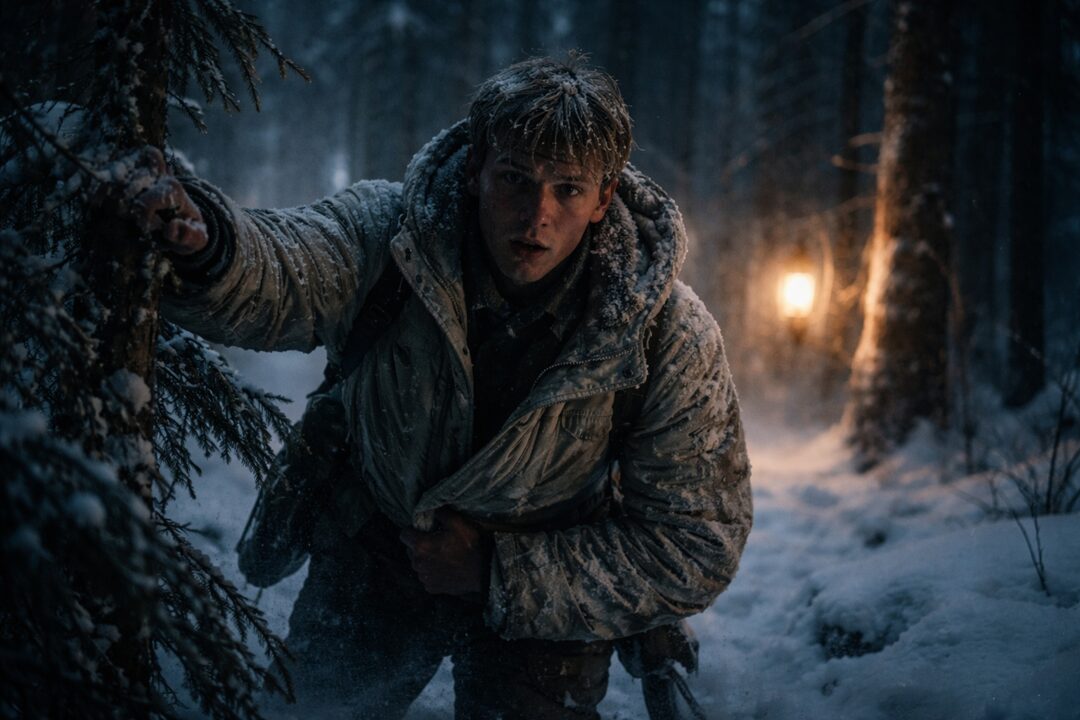
The forest at night had its own laws. Distance lied. Shadows moved first and became trees later. More than once Jack saw what looked exactly like lamp glow ahead, low and golden between the trunks, only to reach it and find moonlight caught in ice.
At one point he heard engines.
Not imagined voices this time. Engines. A convoy or a half-track somewhere beyond the ridge. He dropped at once, chest in snow, rifle up. His hands shook too badly to aim. The sound swelled, then thinned, then became wind moving through bare branches.
He lay there for a long time after it was gone.
“I’m not chasing ghosts anymore,” he said.
Then, because the night did not care what men promised, he lifted his head at the next voice.
It was Elias this time.
Not a command. Not a shout. Just his brother saying Jack’s name the way he used to when he found him under a truck in the garage back home.
Calm. Amused. Certain.
“You’re making a hell of a mess,” the voice said.
Jack squeezed his eyes shut. Elias had grease under his nails year-round, even in church. He could fix a hinge, split wood, coax life back into an engine everybody else had cursed and abandoned. Real strength had always looked like that to Jack—quiet hands, not speeches.
When Jack opened his eyes, there was only the forest.
He kept moving until dawn cut a gray seam across the sky. Then his body gave up argument and folded again.
This time he found another depression, deeper, with roots overhead and old blast marks on the earth. He scraped out a space with both hands and lay down in it like an animal.
The hunger had sharpened.
He ate bark first because it felt less degrading than what came next. It tasted like bitterness and dirt. It sat in his stomach like splinters. Later, after an hour or a day—time was failing now—he pulled a pine cone apart and chewed the soft pale base of the scales, spitting the hardest pieces.
He could not have said which humiliated him more: that he was doing it, or that he was grateful for anything that could be called eating.
“Don’t be proud now,” he muttered, and for the first time he understood the sentence was not an insult.
It was instruction.
Part III — The Things That Stayed
By the third day—or what he thought was the third day—Jack stopped trying to number time.
The body had its own calendar now. Wake shivering. Move. Stop before collapse became death. Force something into the mouth. Listen. Start again. The sun, when he saw it, only told him which direction the world had failed in.
The pine cones got easier.
Not because they were food. Because his shame had run short of energy.
He found a stand of younger trees and stripped what he could. He scraped inner bark and held it in his mouth until the fibers softened enough to swallow. He melted handfuls of snow under his tongue. Once he caught sight of tracks—hare, maybe fox—and followed them far too long before he realized he had started believing a small animal might lead him somewhere human.
That was when he took Anna’s letter out.
The paper was dry under the oilcloth. He stared at her handwriting as if it belonged to another species.
Rent went up again, which feels unpatriotic somehow.
A train got stuck by the river last week and the whole town turned out to complain as if that were a civic duty.
Your brother says the porch needs paint in the spring, and I told him spring is a rumor at this point.
There was more. A line about coffee. A line about the cracked blue bowl she kept meaning to replace and never did. Nothing dramatic. Nothing fit for the grand machinery of war.
That was why it hurt.
He folded it before he got to the end.
The ordinary future in her letter felt impossible in the woods. Not precious at first. Offensive. A train delayed. Rent. Paint. Bowls. Those belonged to a world where men worried about seasons arriving on time.
But later, when he started moving again, it was that exact pettiness that held him. Not glory. Not medals. Not even love in the way songs used the word.
Just the idea of somebody still caring whether the porch got painted.
Near noon he crested a low rise and saw smoke.
It was thin and far, maybe half a mile, maybe two. In winter distance was another lie, but smoke was different from voices. Smoke had weight. Cause. It meant fire, and fire meant hands.
Jack stood swaying on his remaining ski and looked at it until tears stung his eyes from the cold.
Then he started toward it.
He moved faster than he should have. Hope made him stupid in ways the tablets had only introduced. He forgot the bad knee. Forgot to ration strength. Several times he had to catch himself against trees when the black came in at the edges of his vision.
The smoke vanished once, reappeared, vanished again. He nearly cursed aloud. But there—a structure now. Dark angle against white. A roofline. A cabin or hunting shelter tucked near the edge of a frozen clearing.
He laughed once. Just one cracked sound.
By the time he reached it he was shaking badly enough his rifle tapped against his leg. The place leaned to one side. One shutter hung broken. The door stood partly open as if someone had left in haste or had never come back to close it.
Jack did not trust miracles anymore. He circled once, slow, listening.
No voices. No dogs. No movement.
He stepped inside.
The air smelled of old ash and damp wood. The stove was cold. A cot frame sat bare in one corner. Shelves along the wall held a rusted tin, a cracked mug, a length of wire, and nothing else. No food. No blankets. No men. A previous life stripped down to its bones.
He stood in the middle of the room and let the silence tell him the truth.
This was not rescue.
It was shelter, briefly. A pause. A place where somebody else had once believed in staying alive.
That was all.
Jack lowered himself to the floor with more care than dignity. He wanted to sleep there for a year. Instead he searched the room, because hope was still making demands. The rusted tin held mouse droppings and two nails. Under the cot frame he found a rag stiff with age. In the stove he found blackened scraps of something that might once have been paper.
He sat back against the wall and closed his eyes.
That was when Elias spoke again.
Not from outside. Not as an apparition. Just in Jack’s head with such clarity it felt intimate.
“You always thought strength had to look impressive.”
Jack laughed without humor. “You got a better definition?”
A pause, as if memory itself were considering him.
Then: “Keep doing the next thing.”
That was all Elias had ever done, really. Fix the hinge. Cut the wood. Get the truck started. Nothing dramatic. Just the next necessary act with no appetite for witnesses.
Jack looked around the empty cabin.
He had wanted this place to mean he was nearly saved. Instead it gave him something meaner and more useful: proof that no one was coming in time.
The patrol was gone beyond his reach. The war was still out there, but it was no longer asking anything noble of him. No objective. No line to hold. No man to impress. Just this: if he stopped choosing life, winter would do the rest without even noticing.
That knowledge hurt.
It also clarified.
He fed splinters and broken scraps into the stove and coaxed enough fire to warm his hands, not the room. He thawed the canteen cap at the edge of the flame and got a mouthful of water. He ate the second strip of jerky slowly, with one eye on the door, and then from the shelf he took the cracked mug and held it because it was a human object and his hands needed reminding.
By evening the little fire died.
He could stay the night. He knew that. But if he stayed longer, the cabin would become another ditch: shelter turning into burial by comfort.
On the wall beside the door hung a small rectangle of darkened glass in a frame. A mirror, clouded with age. He looked up by accident and saw a stranger.
His cheeks had hollowed in days. Powder burns blackened one side of his jaw. His eyes looked feverishly pale, too alive and too far away at once.
“No one owes you this,” he told the face in the mirror.
Then he stood.
Part IV — What He Could Carry
After the cabin, the world narrowed fast.
He left at dawn with less than he came in with. The rifle first. He kept it for another mile out of habit, then leaned it carefully against a birch and walked away. No enemy had shown itself up close in days. The weapon was weight now, nothing more.
A little later he dropped spare rounds into the snow and did not look back.
By afternoon the remaining pack strap had eaten a raw groove across his shoulder. He emptied the pack, kept the canteen, letter, knife, blanket strip. Left the rest. Every object argued as he abandoned it. Every object claimed it might matter later. But later had become too expensive.
He kept the empty stimulant tube the longest.
It rode in his pocket like a judgment. Once, reaching for the letter, he touched it and nearly threw it into the drifts on reflex. Instead he pulled it out and stared.
A cheap cardboard thing. A ridiculous thing to have survived when men might not have.
Shared ration. One man took all.
That thought had followed him like a second heartbeat. He had stolen wakefulness from the others. Stolen their chance, maybe. Stolen more life than belonged to him. It had made survival feel indecent, as if continuing required an accounting he could never settle.
Now, on a frozen ridge with the wind slicing across him, he understood the ugliness of that belief.
The tablets had not made him chosen. They had made him reckless.
The blast had not judged him. The woods had not condemned him. Winter was not interested in fairness. He had not been handed extra life from somebody else’s portion. He was simply not dead yet.
It was a smaller truth than redemption. Harder, too.
Jack opened his hand and let the empty tube fall.
The wind rolled it once across the crusted snow and lodged it in a drift.
He stood over it another second, then kept going.
That afternoon he saw tracks again—broad this time, not animal. Sled runners or a cart, frozen into the surface and half filled. Real. Human. He followed them because there was nothing wiser to do. They took him through a stand of firs, across a wide open stretch of glare ice, and up toward a road cut.
By the time he reached the road, his feet no longer felt attached to him. His right hand was a blunt object at the end of his sleeve. He flexed his fingers and got almost nothing back.
He also got the truth.
The road was abandoned.
No fresh wheels. No recent boots. One old truck carcass sat nosed into a snowbank, stripped of anything useful. The road itself ran east and west through white emptiness.
Jack stood in the middle of it and laughed again, because there was nothing else to call the cruelty of seeing exactly the thing you need after it has stopped mattering.
He chose west. Not from logic he trusted, but because the sun had moved and the wind had habits and somewhere inside his failing body an old map still whispered.
Near dusk he fell for real.
Not a stumble. Not a knee in the snow. A full collapse.
He was walking, then he wasn’t. He came back with his cheek on ice and the taste of metal in his mouth. He had bitten his lip through. The first thought he had was simple and shameful in its relief:
Good. Stay here.
No more choosing. No more calculation. Just stop. Let the road hold the body until weather turned it into something nobody had to explain.
He lay there long enough for the temptation to become almost tender.
Then Anna’s letter pressed against his chest.
He did not take it out. He just felt it there, a paper square between skin and cold.
A train got stuck by the river.
Such a stupid sentence. Such an ordinary sentence. A sentence written by someone who still believed delays were the kind of trouble life offered.
Jack rolled onto his back and looked at the paling sky.
“If I come home,” he said to no one, “I won’t come back clean.”
The answer, when it came, was Anna’s voice assembled from memory rather than exact words.
Then come back alive.
He got to his elbows. Then his knees. Then his feet.
The next miles ceased to be miles. They became acts.
Lift.
Set down.
Breathe.
Again.
His heart no longer felt fast so much as enormous, a hammer somewhere outside him striking through the air. He could hear it over the wind. Over his breath. Over everything.
At some point he lost the remaining ski and did not waste time retrieving it. After that he half walked, half dragged himself. His blanket strip trailed. He tore it free and kept moving.
The sky darkened. He thought of Pierce saying, Never stop in open cold, and for the first time the command no longer felt like rank. It felt like his own voice, chosen.
Ahead, far off, something rang.
A bell.
No. Not a bell. Metal striking metal. Then barking. Or engines. Or maybe just another trick of a damaged mind building a village out of wind.
Jack stopped.
This was the last cruelty, he thought. A final mercy-killing hallucination to draw him into more waste.
The sound came again.
He could not tell if it was real.
But this time the choice was different. He did not need certainty anymore. Refusing to move would also be a choice. A clear one. A final one.
He bent forward and started toward the sound.
Part V — The Last Necessary Thing
The dark was complete by the time he saw light.
Not moon on ice. Not a fantasy between trees. A lantern swinging, distant and yellow, crossing once behind a stand of trunks.
Jack stopped so abruptly his knees nearly folded.
“Hey,” he tried to shout.
What came out was air.
He stumbled forward. Branches slapped his face. Snow caught his boots and kept trying to keep them. The light vanished. He kept going anyway, because now vanishing meant nothing. Every hope in this story had vanished before returning in another shape.
“Hey!”
This time there was sound. Thin, broken, but enough.
The barking became definite. Dog, then. Good. Dogs belonged to people. He moved toward it and nearly pitched headfirst into a ditch hidden under crusted snow. He caught himself on both hands, and pain went white through his fingers. He crawled out and rose again.
The light reappeared, closer.
A voice called something he could not make out.
Jack lifted one arm.
It felt like lifting a dead man’s arm.
“American,” he said, though he did not know if anyone could hear.
The next minutes would never make proportional sense afterward. He would remember pieces: a lantern held high; two men in heavy coats, faces blurred by the dark; a dog circling and barking; someone catching him under the shoulder and swearing at the weight, because there was hardly any of it.
“Christ.”
“Get him down.”
“Look at him.”
Jack tried to explain. He wanted to say there had been a patrol. A ration tube. An explosion. He wanted to say he had not meant to take it all. That he had followed voices. That he had eaten pine cones. That he had not stayed in the cabin because staying would have killed him. That he was sorry for surviving in such an ugly way.
Instead he said only, “Don’t let me sleep.”
One of the men answered, close to his ear, “Not tonight.”
They half carried, half dragged him toward a shed or hut with a stove burning somewhere inside. The warmth hit first as pain. It clawed into his face, his hands, his feet. He made a sound he had never made before and hoped never to again.
Someone forced him to drink slowly. Broth, maybe. Or hot water with something in it. It tasted like the world returning.
He tried to hold the cup and could not. The man holding it was patient.
His pulse frightened them. He knew that even through the blur. One touched his throat, then his wrist, then looked up sharply at the other.
“How long’s he been out?”
Jack laughed once, or cried once—it was impossible to know the difference then.
“Since Tuesday,” he said, though he had no idea if it was true.
Later there was a sled. Then a room with harder light. Then another room. He drifted in and out of strangers’ hands, bandages, muttered assessments. Someone cut away his clothes. Someone held him down while they cleaned what could be cleaned. Someone said his weight as if it were a piece of scandal. Someone else counted his pulse twice because they did not believe it.
Jack came back properly in a hospital bed with a spoon at his mouth.
For a panicked second he did not understand the indignity of it. Then he did, and it nearly made him turn away.
The nurse—a stern woman with tired eyes—waited until he swallowed.
Then she said, not unkindly, “You can live through the woods and still let somebody feed you.”
He closed his eyes.
The broth was thin and salty and so overwhelming he could not speak.
For days, maybe weeks, life reduced itself to small permissions. Water. Broth. Sleep under a roof. The absence of wind. A blanket that did not have to be earned each hour. The body returning piece by piece and not all of it.
Pierce’s name was on his tongue more than once, but each time he stopped. He would ask when he could bear the answer. Not before.
Anna’s letter survived. The corners were ruined, the fold lines nearly gone, but it survived. He read it through at last in a room that smelled of antiseptic and boiled linens, and when he reached the line about the porch paint, he put a hand over his eyes and let himself shake.
No one came to watch.
That helped.
Part VI — The Years After
He did not become the man people wanted from the story.
There was no clean version. No polished legend. When others told it later, they liked the shape of it better than the feel: the tablets, the blast, the snow, the impossible distance, the pulse that should have killed him and somehow announced he was still alive.
What they could not tell was how often survival had looked petty.
A man chewing bark.
A man lying to himself about voices.
A man wanting to stop on a road because stopping was easier than being judged by daylight.
Jack lived anyway.
That was the fact at the center of everything. Not the incident. Not the absurdity. The continuation.
He saw Elias again before the war was fully finished. His brother stood in the station with a coat too light for the season and his hands shoved deep in the pockets as if he were trying not to reach too soon. Jack had imagined that moment a hundred times in the woods and in none of those versions had he known what to do with his own face.
Elias looked at him once, hard and steady, taking in the weight still missing from him, the changed way he stood.
Then he said, “You look terrible.”
Jack laughed. A real laugh this time, brief and cracked at the edges.
“Yeah,” he said. “I know.”
Elias stepped forward and put a hand behind his neck, not dramatic, just certain. Witness, not judge.
Anna came later. The porch did get painted in the spring. Not because it meant anything grand. Because it needed doing. She handed him coffee one morning while the boards dried and asked if the color looked wrong to him in the sun.
He looked at the porch. At the brush in the bucket. At the blue bowl still sitting cracked on the kitchen shelf because she had never replaced it.
“No,” he said. “It looks right.”
There were years after that. Not heroic years. Real ones.
Rent.
Repairs.
Coffee.
Bad weather.
Arguments too tired to become tragedies.
Winters he respected too much.
Summers he never wasted.
Sometimes he woke in the dark with his heart running wild and had to remind himself that silence could be harmless. Sometimes food in a bowl still undid him for reasons he could not explain to anyone who had not once held pine scales in a numb hand and called it enough.
He told the story only when pressed, and even then badly. No telling ever matched the true proportions. The woods had been too large. The shame too private. The continuation too strange.
What remained, in the end, was not glory.
It was this: the body once reduced to snow, bark, pine cones, panic, and one last blind act of hope went on living in rooms with curtains, at tables with chipped bowls, on porches that needed paint. It crossed not only a frozen wilderness but years.
A long time later, when his hair had thinned and his hands had become his brother’s hands, practical and marked by work, Jack stood one winter evening at the kitchen window and watched the yard disappear under falling snow.
Anna set a bowl of soup beside him without asking whether he wanted it.
He took it in both hands.
Outside, the world was whitening into distance again. Inside, the spoon touched ceramic. The radiator clicked. Somewhere in the house a floorboard answered with its small familiar complaint.
Ordinary sounds. Ordinary heat. Ordinary time.
For a moment the years behind him felt impossible.
Then he raised the spoon, and ate, and stayed.