The Boulder Everyone Wanted Gone Was Holding Together More Than One Family’s Property Line
Chapter 1: The Violation Notice Beside My Grandfather’s Boulder
The orange paint had not been there when Brian Thomas left for work.
It cut across the front lawn in a bright, ugly stroke, beginning near the sidewalk and ending beside the boulder his grandfather had once called the only honest thing on the property.
Brian stood at the curb with his lunch cooler still in one hand.
The mark was not a utility line. He knew the color conventions well enough to recognize that. It was a rough arrow made with landscaping paint, its point aimed directly at the moss-covered stone.
Someone had written REMOVE in the grass.
The boulder rose nearly four feet above the lawn and spread wider than the hood of Brian’s truck. One side was dark with old moss. The other had a pale scar where his grandfather used to scrape winter ice from it with the edge of a shovel. Children had climbed on it for years. Delivery drivers used it as a landmark. Brian had never considered it attractive.
He had also never considered the possibility that anyone might touch it.
A white envelope had been wedged beneath the brass clip of his mailbox.
FINAL COMPLIANCE NOTICE.
He read the first paragraph twice.
The architectural committee had determined that the “oversized natural stone feature” created a visual obstruction inconsistent with current neighborhood standards and potentially interfered with safe sight lines near the curve of the street. He was required to submit a removal plan.
Brian looked from the letter to the boulder.
The street curved almost sixty feet beyond it.
“You’re home.”
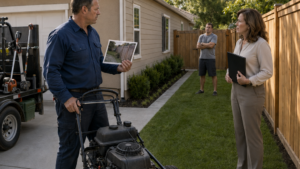
Karen White crossed from the sidewalk two houses down, carrying a slim blue folder against her chest. She wore running shoes and a gray cardigan, as though she had happened to be outside rather than waiting for his truck.
Brian lifted the notice.
“You painted my yard?”
“The contractor marked the access route.”
“There is no contractor.”
“There will be, unless you submit your own plan.”
Her tone was even. That made him angrier than if she had sounded pleased.
Brian set his cooler on the driveway. “You don’t get to schedule work on my property.”
“The board gets to enforce recorded restrictions.”
“By excavating my front lawn?”
“By requiring correction of a violation.”
He looked again at the arrow. “You called a rock a violation.”
Karen’s jaw tightened.
“It isn’t a rock in a flower bed, Brian. It’s a massive obstruction in the most visible yard on the curve. We’ve had three complaints this year.”
“From you?”
“From residents.”
“How many residents?”
“I’m not discussing complaint identities.”
“Then I’ll guess one.”
A curtain shifted across the street.
Karen noticed it too. She lowered her voice.
“This is exactly why nothing gets resolved with you. Every question becomes a challenge to whether anyone has the right to ask.”
Brian folded the notice once.
“You asked months ago. I answered.”
“You said your grandfather put it there.”
“He did.”
“That doesn’t make it exempt.”
“No.”
The word came out more sharply than he intended.
Karen waited.
Brian could have stopped there. Instead he heard himself say, “It means it stays.”
Her expression changed—not anger yet, but recognition. She had found the irrational part of his argument and knew it.
“Because your grandfather liked it?”
Brian looked at the stone.
He remembered a hospital room with blinds half closed against afternoon glare. His grandfather’s hand had been dry and unexpectedly light in his own.
Don’t let them move it.
At twenty-seven, Brian had assumed the old man meant developers, neighbors, anyone with a clean-lawn obsession. He had not asked why. His grandfather had been failing quickly, and Brian had wanted to sound certain.
I won’t.
That had been fifteen years ago.
“It predates my ownership,” Brian said.
Karen gave a short breath. “So does the cracked retaining wall on Hawthorne Court. We still made them repair it.”
“It may predate the subdivision.”
That stopped her for half a second.
“May?”
Brian hated the word as soon as it left him.
Karen opened the blue folder.
“If you have documentation that changes the board’s authority, submit it.”
“I didn’t say I had documentation.”
“Then what are we doing?”
Brian looked toward the neighboring roofs, all built in variations of the same late-seventies style. Trim lawns. Mature maples. New garage doors attached to old brick. The boulder sat among them like something the houses had been arranged around and later forgotten.
Karen removed a paper from the folder.
“The board has already scheduled a contractor access review for Thursday.”
Brian stared at her.
“You said unless I submit a plan.”
“A review isn’t removal.”
“You marked a route.”
“To determine equipment access.”
“What equipment?”
“That depends on the contractor.”
For the first time since seeing the paint, Brian felt something colder than irritation.
He stepped closer, not threateningly, but enough that Karen lowered the paper.
“You bring machinery into this yard without my permission, we have a different problem.”
“The association’s attorney has reviewed the enforcement provisions.”
“Has the association’s attorney reviewed the actual property?”
Karen’s face hardened.
“Submit evidence by Wednesday.”
She turned away.
Brian called after her. “Karen.”
She stopped.
“You don’t know how deep that thing goes.”
Neither did he.
That was the problem.
By evening the orange paint had faded only slightly under the sprinkler. Brian turned the water off before it reached the mark.
Inside, he spread the notice across the kitchen table beside his laptop. He searched county parcel records, old subdivision scans, archived plats available through public portals. The current survey showed ordinary bearings and distances. The boulder appeared nowhere.
At nine fifteen he closed the laptop.
He told himself that was the end of it.
Then he went to the garage.
His grandfather’s tools still occupied the lower drawers of a dented steel cabinet Brian had moved from the old house after Kathleen sold it. Most were ordinary: chalk boxes, plumb bobs, folding rules, two rusted levels too inaccurate to use.
In the third drawer, beneath a canvas pouch of masonry bits, he found a sheet of paper folded into quarters.
The paper had yellowed along the creases.
Brian carried it under the workbench light.
It was not a formal survey. No seal. No certification block. No scale he trusted. Just pencil lines, bearings, several lot numbers, and a rough oval drawn where his house now stood.
Inside the oval, his grandfather had written a notation.
CP?
A faint line extended from it toward two other marks beyond the original property.
Brian sat on the work stool.
Control point.
Maybe.
Or maybe not.
He knew better than to force meaning onto incomplete field notes. He had spent years correcting younger technicians who treated every old mark as sacred simply because someone had once drawn it.
He photographed the sheet.
Then he opened an email to the HOA.
Karen,
I have located an old family sketch suggesting the boulder may be associated with pre-development survey work. I request suspension of any access or removal activity pending verification.
He read it twice.
Then deleted the second sentence.
The sketch was not evidence. Sending it would invite exactly the kind of conclusion he would reject at work. Worse, it would reveal how little he actually knew.
He closed the draft without sending anything.
At ten forty, he unfolded the compliance notice again.
A paragraph near the bottom had escaped him the first time.
If no acceptable removal plan or supporting documentation was received, association-authorized equipment access could begin seven calendar days from the date of notice.
Brian looked through the dark kitchen window toward the boulder.
For the first time in fifteen years, his promise had a deadline.
Chapter 2: The Promise Brian Could Never Properly Explain
“You should have let that thing go years ago.”
Kathleen Adams said it before Brian had finished closing her front door.
He stood in the entryway holding a clear plastic sleeve with the old sketch inside. His mother had not asked how he was. She had looked at the paper, then at him, and moved directly to the subject both of them had avoided since his grandfather’s funeral.
Brian followed her into the dining room.
“That’s your answer?”
“My answer to what?”
“Why he made me promise.”
Kathleen began gathering unopened mail from the table. “Your grandfather made people promise things because he didn’t trust ordinary conversations.”
“He was dying.”
“He had the habit before that.”
Brian placed the sketch down.
Kathleen did not touch it.
Two days had passed since the notice appeared. By noon tomorrow, the HOA wanted documentation. The contractor access review was already scheduled.
Brian tapped the plastic sleeve.
“Did you know about this?”
She glanced at the pencil lines.
“No.”
The answer came too fast.
Brian sat.
“Mom.”
“I said no.”
“You didn’t look at it.”
“I saw enough.”
“It has lot references.”
“So?”
“And a possible control-point notation.”
Kathleen turned toward the kitchen.
Brian caught a small movement in her face—not confusion. Recognition followed by refusal.
He looked past her at the built-in shelves along the dining room wall.
For most of his childhood, those shelves had held his grandfather’s old binders. Green covers. Black spines. Field books jammed sideways where they did not fit. Kathleen used to complain that the room looked like an office.
The shelves now held framed photographs and ceramic bowls.
One section was conspicuously empty.
Brian stood.
“Where are the binders?”
Kathleen stopped.
“What binders?”
He stared at the bare shelf.
“Granddad’s survey records.”
“I got rid of a lot after he died.”
“You told me everything from his work was junk.”
“A lot of it was.”
“That isn’t what I asked.”
She set the mail down harder than necessary.
“Don’t come into my house and question me like I’m one of your field crews.”
“I’m not.”
“You are.”
Brian looked at the sketch again.
“What happened during the grading dispute?”
Kathleen’s expression went still.
There it was.
He had not known the phrase until the previous night, when he remembered something she once said at a family dinner about “that mess when they regraded the back lots.” He had assumed she meant drainage.
Now he watched her sit.
“Who told you about that?”
“No one.”
“Then why are you asking?”
“Because Granddad drew lines from the boulder across three original parcels.”
Kathleen rubbed her thumb against the edge of an envelope.
“It was a long time ago.”
“So it happened.”
“Something happened.”
“What?”
She looked at him with the tired impatience she had used when he was seventeen and certain every adult hesitation proved dishonesty.
“They brought equipment in after several houses were already occupied. Drainage corrections. New swales. Shoulder work near the unfinished lots. Your grandfather argued with people for months.”
“About markers?”
“About everything.”
“That’s not an answer.”
“No, Brian. It’s the answer I have.”
He slid the sketch toward her.
“Why did he tell me never to move the boulder?”
Kathleen’s gaze dropped at last.
For a few seconds she studied the pencil oval. Her mouth tightened.
Then she pushed the page away.
“Because he was stubborn.”
Brian felt anger rise with embarrassing speed.
“That’s it?”
“That may be all there is.”
“You knew he made me promise.”
“I knew.”
“And you never once thought I deserved context?”
“I thought you deserved a life that wasn’t organized around one of his unfinished arguments.”
Brian stood so quickly the chair legs scraped.
Kathleen flinched.
He regretted it immediately, but not enough to sit back down.
“I have an HOA preparing to bring equipment onto the property tomorrow.”
Her face changed.
“Tomorrow?”
“Access review first.”
“You said they wanted paperwork.”
“They want both.”
Kathleen looked toward the window.
“Then let them inspect it.”
“You just told me to let it go.”
“An inspection isn’t removal.”
“That’s Karen’s line too.”
He picked up the sketch.
At the door, Kathleen said, “Brian.”
He waited.
She seemed ready to say something.
Instead she folded the unopened mail into a neater stack.
“Don’t make your grandfather into something he wasn’t.”
Brian left with the answer lodged under his ribs.
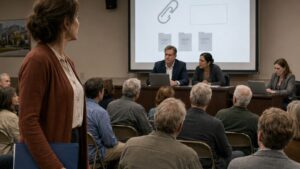
That evening the HOA meeting room smelled of coffee and dry-erase marker. Twelve folding chairs faced a table where Karen sat beside the HOA president and two board members.
Brian placed the sketch in front of him but did not hand it over.
Karen noticed.
“Is that your documentation?”
“It’s a historical sketch.”
“Certified?”
“No.”
“Recorded?”
“No.”
“Prepared by whom?”
“My grandfather.”
Karen leaned back.
Brian heard how it sounded.
The HOA president cleared his throat. “Mr. Thomas, the issue before us is narrow. Do you have verifiable evidence that the feature is protected, recorded, or otherwise outside architectural enforcement?”
“Not yet.”
Karen spoke before anyone else could.
“Then we’ve delayed as much as we reasonably can.”
Brian turned to her. “You’ve delayed nothing.”
“We sent three prior notices.”
“About landscaping appearance. Not excavation.”
“One violation led to the other.”
“No. Your impatience led to the other.”
A board member shifted in his chair.
Karen’s face colored, but her voice stayed controlled.
“Residents are required to maintain compliant frontage. We cannot tell one homeowner to remove an unapproved retaining wall while telling another that a four-foot boulder is exempt because he has a family story.”
Brian almost corrected her.
It wasn’t a story.
But what did he actually have?
A dying man’s request. An unsigned sketch. His mother hiding behind half-answers.
The HOA president asked, “Can you provide official evidence before scheduled access?”
Brian looked down at the pencil notation.
CP?
Under the fluorescent lights, another abbreviation became visible near the edge of the old fold. Three cramped letters beside a line extending southwest.
REF.
Brian knew that one.
Reference.
Not proof. Still not proof.
But not random either.
“I can request archival review,” he said.
“How long?”
“I don’t know.”
Karen shook her head.
“That could be months.”
“It could be days.”
“Could be.”
Brian looked at her.
For the first time, he noticed the fine strain around her eyes. She was not enjoying the meeting. She was gripping her pen hard enough that her knuckles had gone pale.
It did not make her right.
The vote was three to one.
Proceed with contractor access unless official evidence arrived before work began.
Outside, Brian stood beneath the parking-lot light and stared at the sketch.
He had spent his career telling people that marks meant nothing without context.
Now two faded abbreviations were all he had.
When he reached home, a pickup truck was parked at the curb.
A broad-shouldered man in work boots stood beside the boulder with a tape measure.
Brian walked faster.
“Can I help you?”
The man turned.
“James Martinez. Contractor.”
“You’re early.”
“Just checking access.”
Brian looked at the measuring tape stretched along the lawn.
“Tomorrow was the review.”
James shrugged. “I had another job nearby.”
“You have permission to be here?”
“I stayed off the property line as best I could.”
“You’re standing in my yard.”
James reeled in the tape.
“Fair enough.”
Brian expected defensiveness. Instead James stepped back toward the sidewalk.
Then he looked over his shoulder at the boulder.
“That thing natural?”
“Yes.”
“Ever been moved?”
“Not in my lifetime.”
James crouched near the moss-darkened base without touching it.
“Ground’s raised around this side.”
Brian said nothing.
James stood again.
“You know what bothers me?”
“I’m sure you’ll tell me.”
“The shape.”
“What about it?”
“People see four feet of rock and think they’ve got four feet of rock.”
He pointed toward the lower slope of the lawn.
“That isn’t how stone always works.”
Brian followed the gesture.
James gave the boulder one last look.
“I wouldn’t be surprised if most of it’s underground.”
Chapter 3: The Excavator Stopped When Metal Appeared Under Stone
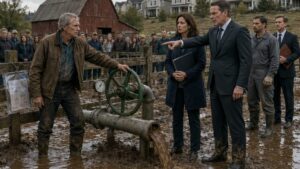
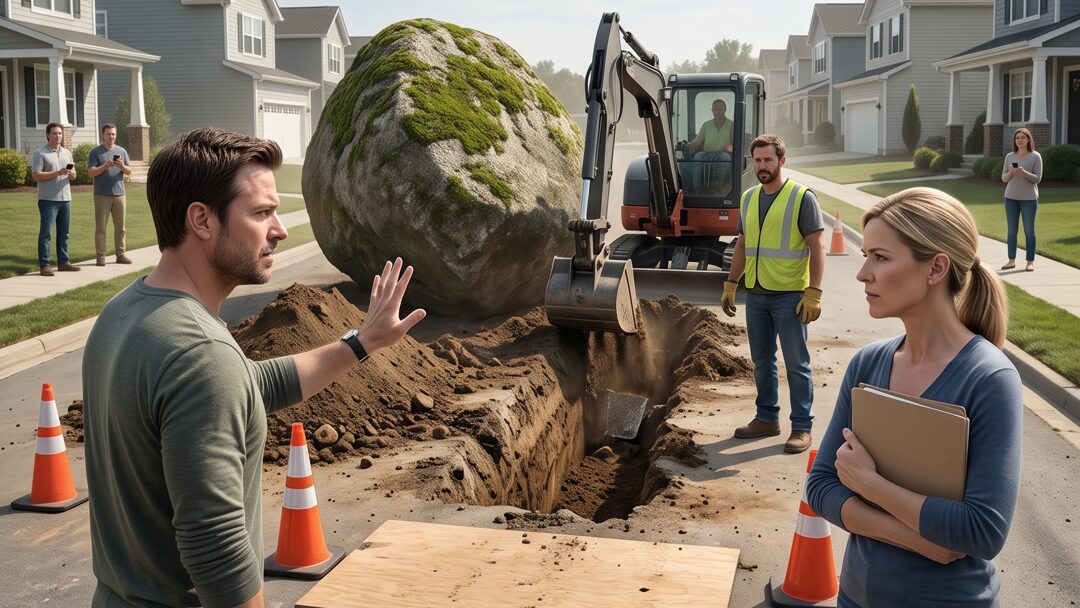
The bucket scraped away six inches of soil and exposed more rock.
James Martinez immediately raised one hand.
The compact excavator went still.
For three seconds nobody spoke.
Then the operator tilted the bucket away, and a slab of gray stone appeared beneath the grass where everyone—including Brian—had expected ordinary dirt.
Karen stood near the driveway holding the blue violation folder.
“What does that mean?”
James climbed down into the shallow cut.
“It means we haven’t found the bottom.”
The work had begun at eight that morning under an arrangement Brian still considered a distortion of the HOA’s authority. The association called it enforcement access. Brian called it a mistake with paperwork.
He had objected in writing.
He had contacted county records.
He had submitted a request for archival review.
None of it had produced a formal stop order.
So now orange cones lined his lawn, plywood protected part of the driveway, and half the neighborhood had discovered reasons to walk slowly past his house.
Brian stood just outside the marked work zone.
“Stop digging.”
Karen turned.
“We agreed to exploratory access.”
“I didn’t agree to anything.”
“The board authorized—”
“You found a continuous stone face.”
James brushed loose soil with his boot.
“Could still be a shelf.”
Brian looked at him.
“You believe that?”
James did not answer.
The boulder’s visible portion rose above them, moss along the north face, pale granite exposed on the side nearest the driveway. Now the excavation revealed another broad surface descending beneath the lawn.
James called to one of his crew members.
“Bring the probe.”
Karen stepped closer to Brian.
“This is exactly why we hired professionals.”
Brian looked at her. “Professionals pause when conditions change.”
“Conditions have changed by six inches.”
“No. Our understanding changed.”
She exhaled through her nose.
“Brian, you have had a week.”
“And the county has my request.”
“You still have no recorded exemption.”
“Neither do you have proof this can be removed without affecting anything else.”
“It’s a rock.”
The words carried farther than she intended.
Across the street, someone stopped pretending to check a mailbox.
Brian saw Karen notice.
She lowered her voice.
“You’re using uncertainty as a shield.”
“And you’re treating certainty like something the board can vote into existence.”
James returned with a steel probe.
He pushed it into the soil near the exposed stone.
It stopped almost immediately.
He moved two feet left.
Again.
Then farther downslope.
Again.
His expression changed.
Brian felt the old sketch in his back pocket as though the paper had weight.
James stood.
“I need more room.”
Karen nodded before Brian could speak.
“Do it.”
Brian turned sharply.
“No.”
James looked between them.
Karen opened the folder. “The approved scope includes access necessary to assess removal.”
“Assess. Not widen excavation because the first assumption failed.”
James wiped his gloves on his jeans.
“I’m not taking sides.”
“Then don’t.”
James studied the ground.
“I do need to know what I’m dealing with.”
Brian wanted to refuse outright.
He should have requested a formal survey review the first day. He knew that now. He had wasted time protecting an unsigned sketch because he did not want Karen seeing how uncertain he was.
His own silence had helped put the machine here.
“Hand excavation first,” Brian said. “No deeper pull.”
James nodded.
Karen did not.
“This has already cost the association for mobilization.”
Brian looked at her. “Then losing more money should make you cautious.”
Her face tightened.
For the next hour the crew removed soil from two sides. The exposed stone kept growing.
By ten, the front yard no longer looked like a landscaping site. It looked like the edge of a foundation excavation.
The neighborhood audience grew.
A man from farther down the block filmed briefly from the sidewalk until James told him not to interfere with the work zone. Two children on bicycles stopped near the corner. Someone asked whether the rock was part of bedrock.
No one knew.
Brian stayed close enough to watch every bucket movement.
The first attempt to test the boulder’s mobility came before noon.
James looped a heavy strap around the exposed upper section and attached it to the excavator.
“This is not removal,” he said to Brian. “Low load. I want to see whether it gives.”
Brian hated agreeing.
But he needed to know too.
The engine deepened.
The strap tightened.
Nothing happened.
The operator increased pressure.
A tremor passed through the soil near Brian’s shoes.
“Stop,” he said.
At the same moment James shouted, “Hold!”
The machine idled.
A thin crack had opened in the disturbed earth several feet downslope.
Karen stared at it.
“What is that?”
“Movement,” Brian said.
“Of the rock?”
“Maybe surrounding fill.”
James crouched.
The contractor’s earlier impatience was gone.
He pressed two fingers into the crack, then stood.
“We’re not pulling harder with this setup.”
Karen looked toward the excavator.
“Can you bring in something larger?”
James laughed once, without humor.
“That’s not my first question.”
“What is?”
“What exactly are we attached to?”
Karen folded her arms.
“You said you could remove it.”
“I said I remove landscape boulders.”
“And this is?”
James looked toward the widening excavation.
“I don’t know yet.”
That answer should have ended the work.
Brian believed it did.
Then Karen stepped aside with the HOA president, who had arrived ten minutes earlier. They spoke quietly. Brian could not hear every word, only fragments.
Mobilization.
Schedule.
Additional cost.
Need resolution.
When Karen returned, she said, “Widen the trench enough to determine the footprint.”
James stared at her.
“You heard what I said.”
“You said no harder pull.”
“I also said I don’t know what we’re attached to.”
“Then find out.”
Brian stepped between them.
“No more machine work.”
Karen opened the folder.
Brian almost laughed.
“You think paper changes the ground?”
“I think recorded enforcement authority matters.”
James looked at Brian.
Then at Karen.
Finally he said, “I’ll widen on the driveway side only. Shallow passes. If I see anything I don’t like, I stop.”
Karen nodded.
Brian did not.
But the machine started.
The next bucket removed loose soil.
The one after that struck stone.
The operator changed angle.
A harsh metallic scrape cut across the yard.
Everyone froze.
Not the dull grind of steel on granite.
Metal on metal.
James raised both hands.
“Stop.”
The engine dropped to idle.
Brian was already moving.
“Stay out of the cut,” James warned.
Brian stopped at the edge.
At first he saw only dirt and stone.
Then James climbed down with a hand shovel and cleared a narrow section beneath the boulder’s visible face. Soil came away in clumps.
Something dark appeared.
Rectangular.
Flat.
Bolted directly into the stone below the old grade line.
Karen came closer.
“What is that?”
James used a soft brush from the truck.
A corroded metal plate emerged beneath decades of compacted soil.
The first line was unreadable.
The second contained numbers.
Brian’s heart began to pound.
“Give me the brush.”
James looked up.
“You recognize it?”
“Give me the brush.”
James handed it over.
Brian stepped carefully into the cut.
For one brief, shameful second, he felt vindicated.
He imagined turning around and looking directly at Karen. Imagined the board meeting. The violation notice. The orange word painted in his yard.
He had been right.
Then more of the plate became visible.
A stamped abbreviation appeared beside a sequence of figures.
REF CP.
Brian stopped brushing.
James leaned closer.
“What does that mean?”
Karen asked from above, “Brian?”
He did not answer.
He knew the notation.
Not enough to claim legal significance. Not enough to settle a boundary. But enough to understand that this was not a decorative plaque and not a family memorial.
Reference control point.
Or a local predecessor notation serving the same function.
His eyes moved across the plate.
A bearing.
A date older than the subdivision’s final recorded plat.
And one partial identifier he recognized from the faded sketch in his back pocket.
The boulder had not merely been drawn on his grandfather’s paper.
The paper had been drawn from the boulder.
Brian climbed out of the excavation.
Karen’s face had lost its certainty.
“So you were right?”
The question came softly.
Around them, phones were raised on the sidewalk.
Brian looked at the exposed plate, then at the crack downslope from the failed pull.
His brief satisfaction vanished.
“No.”
Karen blinked.
“What?”
“We don’t know that.”
“You just recognized it.”
“I recognized a notation.”
“Then what is it?”
Brian turned toward James.
“How much did the stone move?”
James’s expression sharpened.
“I don’t know that it did.”
“You felt the ground.”
“So did you.”
“How much load?”
James named an estimate.
Brian looked toward the street, mentally reconstructing bearings from the sketch. One faint line had extended beyond his lot. Another toward parcels now occupied by houses with fences, driveways, additions.
The plate had survived underground because the boulder had stayed fixed.
Maybe.
Unless it had shifted.
Unless the subdivision work had already changed the relationship decades ago.
Unless his grandfather had known.
Karen said, “Brian, explain what’s happening.”
He looked at her.
For days he had wanted exactly this moment—the thing beneath the rock that would prove she had been too quick, too certain, too willing to reduce his grandfather to a story.
Now he understood that proof was the smallest thing they had uncovered.
“If that plate is what I think it is,” he said, “this may have been a reference point for older survey work.”
The HOA president stepped closer.
“For this lot?”
“I don’t know.”
“For the subdivision?”
“I said I don’t know.”
Karen stared at the plate.
“But it means the rock matters.”
Brian glanced at the cracked soil.
“It means moving it may matter.”
James swore quietly.
The operator shut off the excavator.
Without the engine, the yard became strangely silent.
Brian pulled out his phone.
“Who are you calling?” Karen asked.
“County records first. Survey supervisor second.”
She looked toward the neighbors.
“Can we cover the excavation until we know?”
“No.”
Her head snapped toward him.
Brian pointed at the plate.
“No one touches it. No one covers it in a way that disturbs its position. No straps. No bucket. No backfill until it’s documented.”
Karen’s face tightened again, but now uncertainty had entered it.
“You don’t have authority to order the association’s contractor.”
James removed his gloves.
“He doesn’t need it.”
Karen turned.
James looked at the boulder.
“I’m not pulling on that again.”
The statement moved through the spectators in murmurs.
Brian dialed the county number.
Before anyone answered, he faced the crew, the board members, Karen, and the machine sitting above the torn lawn.
“Nobody moves anything until the county sees this.”
Chapter 4: The Old Marker Did Not Prove What Anyone Wanted
Virginia Lopez placed three plats side by side and said, “They don’t agree.”
Brian stared at the sheets beneath the county records office lights.
The first was an older subdivision plat copied from microfilm, its lines softened by generations of reproduction. The second was a later revision. The third was a modern digital printout with clean bearings, parcel numbers, and the kind of precision that made people trust it at a glance.
None of the rear lot lines landed in exactly the same place.
“That much variation?” Brian asked.
Virginia folded her arms.
“You’re asking the wrong question.”
“What’s the right one?”
“Whether the variation comes from drafting, monument recovery, field conditions, later correction, or somebody carrying forward a bad assumption.”
Brian looked at the oldest sheet again.
The boulder’s plate had been photographed before the excavation was temporarily stabilized. County staff had measured what they could without disturbing it further. The stamped reference notation was real. The date was real. The connection to pre-subdivision survey work was real.
For twenty-four hours, Brian had allowed himself to imagine that those facts would end the argument.
Now Virginia tapped the middle plat with one fingernail.
“This line references a recovered point.”
Then the modern one.
“This one relies on a coordinate reconstruction.”
Then the oldest.
“And this one appears to reference a physical control chain that may include your stone.”
“May.”
“Yes.”
He disliked the word more each time he heard it.
Virginia looked at him over her glasses.
“You know how this works.”
“I know.”
“Do you?”
Brian leaned back.
The records room was quiet except for a scanner feeding paper somewhere behind the counter.
Virginia had known him professionally for years. Not closely, but enough to remember which crews he had worked with and enough to distrust the fact that he was personally involved.
“You want me to say the boulder settles everything,” she said.
“I want you to say what it is.”
“I can say it appears historically significant to an older survey reference network.”
“Which means?”
“It means exactly what I said.”
Brian looked at the plates.
“Could modern boundaries depend on it?”
“Possibly.”
“Could they be wrong without it?”
“Possibly.”
“Could the excavation have disturbed it?”
Virginia paused.
“That is the part I’m most interested in.”
Brian’s jaw tightened.
“James stopped.”
“After a pull test.”
“A low-load test.”
“So you told me.”
“He said he couldn’t confirm movement.”
“That is not the same as confirming no movement.”
Brian looked down at the oldest plat.
One line extended across what would later become his property. Another continued toward two parcels downslope. A tiny discrepancy on paper could become several inches on the ground. Sometimes more.
Virginia slid a yellow legal pad toward him.
“I need every private sketch, field note, photograph, and family record you have.”
Brian did not touch the pad.
“I have one sketch.”
“Then I need it.”
“It isn’t certified.”
“I did not ask whether it was certified.”
He met her eyes.
Virginia’s expression did not change.
“Brian.”
“I’ll send a copy.”
“Today.”
He nodded.
The lie was small enough to sound like agreement.
He did send the sketch that afternoon.
He did not tell Virginia that Kathleen had reacted as though she knew more.
By the next morning, the problem had escaped the records office.
Brian saw the first title-company email because a neighbor walked across his lawn carrying a printed copy.
The man had refinanced his house six months earlier. Brian knew him only well enough to wave.
“What exactly did you find?” the neighbor asked.
Brian was standing near the temporary barrier around the excavation.
“I’m still trying to determine that.”
“My lender got a notice.”
Brian looked at the paper.
It was not a cancellation. Not even a formal title defect. Just a request for clarification after preliminary information about a possible legacy boundary-reference issue reached a title representative through the HOA’s insurer.
But the neighbor’s face had gone pale.
“They’re asking whether there could be a survey exception.”
“Could be.”
“That means what?”
“It means they want more information.”
“That’s not an answer.”
Brian heard his own words from days earlier and almost smiled.
He didn’t.
The neighbor shook the paper.
“I just refinanced.”
“I know.”
“No, you don’t. I had to do that refinance.”
Brian said nothing.
The man looked toward the exposed boulder.
“So this thing of yours—”
“It isn’t mine in the way you mean.”
“It’s in your yard.”
“That doesn’t make the history underneath it mine.”
The neighbor’s anger faltered.
Brian lowered his voice.
“No one has said your boundary is wrong.”
“But they might.”
“Yes.”
The honesty landed badly.
The man folded the paper once and walked away.
By noon, Karen had sent a neighborhood email asking residents not to speculate publicly. By one, a private neighborhood message thread had produced exactly the opposite effect.
Someone claimed three fences might be misplaced.
Someone else said Brian had discovered an “original master property marker.”
Another resident insisted the HOA had known for years.
Brian read that one twice.
Then deleted the thread from his phone.
At three, Virginia called.
“I have something.”
Brian was at his kitchen table when the email arrived.
The attachment contained a county scan of an old survey-control index. The image was poor, but one identifier matched the partial sequence on the metal plate.
Brian leaned closer.
“So it is a control point.”
“A reference point in an older network,” Virginia corrected. “Do not improve my language.”
“Fine.”
“It was used.”
“For the subdivision?”
“For work associated with the original tract and at least part of the early development period.”
Brian closed his eyes.
There it was.
Not a family story.
Not an ornamental rock.
Not his grandfather’s eccentricity.
Something real.
Virginia continued before he could speak.
“And now the bad news.”
Brian opened his eyes.
“Of course.”
“The later records do not consistently reference the same recovery chain.”
“How inconsistent?”
“Enough that I want field work.”
Brian looked toward the front window.
The boulder stood behind orange fencing and plywood barriers. Its buried plate had been covered without backfilling the excavation.
“Which parcels?”
“Potentially yours and several adjoining ones.”
“Potentially.”
“Yes.”
“Worst case?”
Virginia was silent for a beat.
“That depends on reconstruction.”
“Virginia.”
“Under one plausible reading, your east line shifts.”
“How far?”
“A few feet in one segment.”
Brian stood.
The chair moved backward.
“You’re telling me I could lose part of my side yard.”
“I am telling you one reconstruction suggests that.”
“My fence?”
“Possibly.”
“My driveway edge?”
“Possibly.”
He walked to the window.
For a week he had defended the boulder as though keeping it protected what belonged to him.
Now the same stone might prove that some of what he considered his had never been his at all.
Virginia said, “This is why old monuments do not produce simple victories.”
Brian watched a strip of afternoon light fall across the lawn.
“Is the boulder historically significant?”
“Yes.”
The answer came without qualification.
A small, bitter satisfaction moved through him anyway.
Then Virginia added, “That does not mean it proves what you want.”
His phone buzzed before he could respond.
Kathleen.
He almost let it go to voicemail.
Then he answered.
“What?”
Silence.
His mother said, “You were right about one thing.”
Brian’s grip tightened around the phone.
“Which thing?”
“I didn’t get rid of all his records.”
The satisfaction vanished.
Kathleen continued, very quietly.
“I still have the notebooks.”
Chapter 5: Kathleen Had Kept the Notebook Because Truth Had a Price
Kathleen set a locked metal document box on the dining table and kept the key in her hand.
Brian stood across from her.
Neither sat.
The box was gray, dented at one corner, with a strip of old masking tape across the lid. His grandfather’s handwriting had faded into a brown shadow.
FIELD.
Brian looked at his mother.
“How long?”
Kathleen closed her fingers around the key.
“Since he died.”
“You told me they were gone.”
“I told you a lot of his work was gone.”
“You knew what I meant.”
“Yes.”
The word struck harder than denial.
Brian pulled out a chair but remained standing behind it.
“Open it.”
Kathleen looked toward the curtained window.
“No.”
He laughed once.
Not because anything was funny.
“You called me.”
“I called because this has gotten bigger.”
“It was always bigger. You just knew before I did.”
“That is not the same thing.”
“What exactly is the difference?”
Her face tightened.
“The difference is I knew enough to be afraid and not enough to fix it.”
Brian pushed the chair in.
“Open the box.”
Kathleen sat at last.
“You are doing it again.”
“Doing what?”
“Turning him into the only person who matters.”
Brian stared at her.
“This is about a survey problem.”
“No. It’s about your grandfather. It has been about him since you found that notice.”
“He made me promise.”
“I know.”
“You keep saying that like it excuses you.”
Kathleen placed the key on the table but covered it with her palm.
“Do you know what he was like after the grading work?”
Brian said nothing.
“He checked the boulder every week. Sometimes every day. He’d go out with that old tape and stand there measuring to things that weren’t there anymore.”
“What things?”
“Pins. Stakes. Marks. I don’t know.”
“You do know more than that.”
Kathleen looked at him with sudden anger.
“I was twenty-six. I had a child. Your father was working nights. I did not sit down and ask for a lesson in boundary law.”
Brian flinched at the sharpness.
She saw it and looked away.
“He said the grading crews had disturbed markers,” she continued. “Then later he said some had been lost entirely. He kept telling people the stone had to remain because it was the one thing nobody could accidentally pull with a fence post or bury under a new driveway.”
Brian looked at the box.
“That matches the plate.”
“I assumed it would.”
“You assumed?”
Kathleen’s fingers tightened.
Brian understood.
“You knew.”
“I knew he believed it.”
“That isn’t what I asked.”
She lifted her hand from the key.
“Open it yourself.”
Brian took the key.
The lock resisted once.
Then turned.
Inside were six field notebooks, two folded maps, loose photographs, and a cloth pouch containing old brass tags.
Brian sat down.
The smell that rose from the box was paper, dust, and faint machine oil.
He picked up the first notebook.
His grandfather’s handwriting filled the pages in hard block letters. Dates. Distances. Bearing checks. Crossed-out numbers. Notes in margins.
Brian turned pages quickly.
Kathleen said, “Slow down.”
He ignored her.
The third notebook contained the subdivision name.
His breath stopped.
There were entries from the period Kathleen had described. References to drainage correction. Regrading. Lost irons. A note about “contractor cut beyond staked limit.”
Then a line underlined twice.
RECHECK FROM STONE CP.
Brian looked up.
“He knew.”
“Yes.”
“He absolutely knew.”
Kathleen’s face did not brighten.
“Keep reading.”
Brian did.
At first the notes appeared to support everything he wanted.
Markers displaced after grading.
Secondary references unreliable.
Stone point retained.
Repeated checks from the boulder.
He could see the structure now: his grandfather had preserved a stable reference while everything around it changed.
Brian felt vindication build again despite himself.
“He tried to tell them.”
Kathleen said nothing.
“He kept records.”
Still nothing.
Brian looked up.
“What?”
Kathleen’s expression was tired.
“You’re making him a hero.”
“He preserved the one point that survived.”
“Keep reading.”
Brian turned another page.
A field note had been clipped into the binding.
The writing was different—not the later block letters, but an earlier hand, faster and less controlled.
Brian scanned the figures.
Then again.
One observation had been corrected.
A bearing crossed out.
A replacement written above it.
Beside the correction were his grandfather’s initials.
Brian felt a small pressure behind his ribs.
“What is this?”
Kathleen did not answer.
Brian followed the numbers to a later note.
REFERENCE CARRIED FROM PRIOR FIELD ENTRY.
He looked back.
The corrected bearing had propagated into a later calculation.
His grandfather had signed the page.
Brian sat very still.
“No.”
Kathleen’s eyes filled but did not spill.
“He made a mistake.”
“One field note.”
“Yes.”
“That doesn’t mean—”
“I know what it means and what it doesn’t.”
Brian stood.
“You said you weren’t trained.”
“I was trained in living with him.”
“That is not the same thing.”
“No. It isn’t.”
She leaned forward.
“But I know the night he came home and sat in his truck for two hours because he realized one of the disputed references went back to a note he had signed.”
Brian looked down at the page.
The paper seemed suddenly fragile.
“Did he cause the boundary problem?”
“I don’t know.”
“Did he?”
“I don’t know.”
Kathleen struck the table with the flat of her hand.
The sound shocked both of them.
“I have spent thirty years not knowing exactly how much was his fault.”
Silence followed.
Brian sat again.
Kathleen wiped one eye with the heel of her hand, impatient with herself.
“The grading crews did move things,” she said. “That part was real. Other people made decisions. Other records were bad. But he had made an error before that. Maybe small. Maybe corrected later. He never trusted that it was harmless.”
Brian looked at the notebooks.
“Why hide them?”
Kathleen’s mouth tightened.
“Because by the time he understood the larger problem, people had homes.”
“So?”
“So some of them were old. Some had no money. One family had just finished paying off their mortgage. Another had a garage built near a line nobody questioned. Your grandfather thought if he forced the issue open, people could lose sales, loans, peace of mind.”
“That wasn’t his decision.”
“I told him that.”
“But you helped him.”
Kathleen looked at the box.
“After he died, yes.”
Brian stood again.
The betrayal came slowly now, colder than anger.
“You removed these from the house.”
“Yes.”
“You let me inherit the property without them.”
“Yes.”
“You let me promise him—”
“I tried to tell you not to build your life around that promise.”
“You never told me why.”
“Because I was ashamed.”
The answer stopped him.
Kathleen looked directly at him.
“Not just of him.”
Brian said nothing.
“I helped keep the records private. At first because I thought we needed time. Then because years passed. Then because every year made the next year harder.”
She pushed one notebook toward him.
“I kept telling myself silence protected people.”
Brian saw his grandfather in that sentence.
Worse, he saw himself.
The unsent email.
The withheld sketch.
His refusal to ask for formal review because he wanted evidence before exposing uncertainty.
He picked up the field note again.
“So the boulder—”
“Was not about protecting his reputation.”
Kathleen shook her head.
“He could have destroyed the notebooks if that was all he wanted.”
“Then why make me promise?”
“Because he believed that stone was the last stable physical reference left from before the grading changes. He was terrified someone would move it before the records could ever be sorted out.”
Brian looked through the dining room toward the darkened window.
For fifteen years he had imagined a simple line between loyalty and disrespect.
The boulder stays.
That was all.
Now the stone carried a different weight.
His grandfather had preserved something important.
His grandfather had also hidden from what it might reveal.
Brian closed the notebook.
“I have to give this to the county.”
Kathleen’s face changed.
“You have to decide what that means first.”
“No. That is exactly the mistake.”
“You don’t know what full disclosure does.”
“Neither did he.”
“It could affect innocent people.”
“It already affects them.”
Kathleen looked at him.
“And your own property.”
Brian hesitated.
There it was.
A strip of side yard.
A fence.
Maybe part of the driveway edge.
His own certainty suddenly had a price.
Kathleen saw the hesitation.
She did not accuse him.
That made it worse.
Brian gathered the notebooks.
“Are these all of them?”
Kathleen glanced toward the box.
“Yes.”
He knew she was lying.
Not from the word.
From the same tiny movement in her face he had seen when he first showed her the sketch.
Brian searched the box more carefully.
Beneath the folded maps lay a thinner notebook with no label.
He opened it.
Several pages had been removed.
Near the back was a dated entry.
Brian read it once.
Then again.
The date matched the year of the grading dispute.
The note beneath it was brief.
EAST AND SOUTH SECONDARY MARKERS LOST DURING FINAL CUT. STONE CP REMAINS. PRIOR FIELD ERROR MAY AFFECT RECONSTRUCTION. DO NOT MOVE STONE.
Brian’s hands went cold.
Below that, his grandfather had listed the exact day the other markers disappeared.
He looked at Kathleen.
She did not speak.
The date was not a rumor now.
Not a family memory.
It was a record of the moment the neighborhood lost the references everyone later assumed still existed.
Chapter 6: Karen Was Wrong, But Brian Was Not Innocent Either
Karen White waited until the HOA president left the room, then closed the door and asked, “Can this be limited to your lot?”
Brian stopped gathering his papers.
The emergency meeting had ended twelve minutes earlier. The two board members had gone. Folding chairs sat crooked beneath fluorescent lights. Through the window, Brian could see the dark outline of the community mailbox shelter.
He looked at Karen.
“What?”
“You heard me.”
“I want to know why you asked.”
Karen pressed both palms against the conference table.
“If the marker is on your property and the excavation occurred on your property, can the review stay there?”
“No.”
“You answered quickly.”
“Because boundaries do not respect HOA meeting rooms.”
Her face tightened.
Brian slid the county printouts into his folder.
Karen said, “I am asking whether there is a technically defensible way to avoid creating unnecessary panic.”
“Is that what you call it?”
“What would you call it?”
“Containment.”
She looked away.
Brian had arrived prepared to dislike her.
More than dislike her.
He had spent the previous night reading his grandfather’s notebooks until two in the morning. By sunrise, anger had settled into something simpler. Karen had pushed the excavation. Karen had ignored uncertainty. Karen had stood in his yard with a blue folder while a machine pulled against the one object his grandfather had tried to preserve.
He wanted her to be the clear part of the story.
Now she pulled out a chair and sat.
“My refinance is under review.”
Brian said nothing.
Karen laughed softly without humor.
“There. You look surprised.”
“I didn’t know.”
“No. You assumed.”
The word landed cleanly.
She folded her hands.
“My divorce was expensive. I kept the house because moving would have meant changing schools for reasons I didn’t want to explain to anyone. I have equity, but not much cash. The refinance was supposed to clear the remaining settlement obligation and lower the monthly pressure.”
Brian remained standing.
Karen looked at the closed door.
“If this becomes a broad title issue, the lender may pause.”
“That does not change the survey facts.”
“I know.”
“Does it?”
Her head turned sharply.
“Yes, Brian. I know.”
For the first time since the orange paint appeared, her anger did not seem aimed at him.
She looked frightened.
Not dramatically. Karen did nothing dramatically.
Her fear lived in the way she kept aligning the edge of one paper with another.
Brian sat across from her.
“You authorized wider excavation.”
“Yes.”
“After James said he didn’t know what he was dealing with.”
Karen’s fingers stopped.
“Yes.”
“Why?”
She looked at him.
“Because mobilization had already cost money. Because the board had spent months being accused of selective enforcement. Because three residents had complained that we forced them to correct visible violations while you got an exception.”
“I didn’t get an exception.”
“I know that now.”
“You knew it then.”
“I knew you had no approved exemption.”
“That’s not the same thing.”
“No.”
The admission was quiet.
Brian waited.
Karen swallowed.
“And because I wanted it finished.”
There it was.
Not a rule.
A choice.
She continued, “James warned me that the scope had changed. I treated that as a cost problem instead of a risk problem.”
Brian felt the satisfaction he had expected.
It lasted less than a second.
Then he thought of the missing pages in his grandfather’s notebook.
Of the field error.
Of the page now folded inside his own work folder, separate from the copies he had shown the board.
Karen looked at him.
“What aren’t you telling us?”
Brian’s body went still.
“Why would you ask that?”
“Because you came in tonight saying there may be historical records relevant to a broader review. Then you gave us summaries instead of copies.”
“They’re family records.”
“That did not answer me.”
He disliked how accurately she had learned his habits.
Brian opened the folder.
Inside were photocopies of selected notebook entries.
Lost markers.
Stone reference.
Grading dates.
He had omitted the page mentioning his grandfather’s earlier field error.
He had told himself the omission was temporary.
The page required interpretation.
The county should review it privately first.
Residents should not panic over an unverified note.
Every reason had sounded responsible until Karen asked what he was hiding.
Brian closed the folder again.
“There are records I’m still evaluating.”
Karen leaned back.
“So yes.”
“It isn’t that simple.”
A tired expression crossed her face.
“That is what you have said about me for a week.”
Brian looked away.
The meeting room suddenly felt smaller.
Karen stood.
“I’m not asking you to protect me.”
“Good.”
“I’m asking you not to expand a problem beyond what the evidence requires.”
“That is reasonable.”
“And?”
“And the evidence may require more than you want.”
She nodded once.
Then picked up her bag.
At the door, she stopped.
“For what it’s worth, I should have stopped the work when James warned me.”
Brian looked at her.
She did not ask forgiveness.
“I didn’t,” she said. “That part is mine.”
Then she left.
The next morning Brian drove to work with the missing page in his jacket pocket.
He could feel it whenever he moved.
At ten, he met the county survey supervisor in a municipal parking area between two field trucks. Brian had offered to bring preliminary copies over before lunch.
He handed across the folder.
The supervisor skimmed the contents.
“These all the records?”
Brian’s hand went to his jacket without touching the pocket.
“All the relevant ones I’ve copied so far.”
The sentence came easily.
Too easily.
The supervisor nodded.
“We’ll need originals eventually.”
“I know.”
“We may need chain-of-custody notes, especially if anyone challenges dates.”
“I know.”
Brian watched the folder disappear under the supervisor’s arm.
A memory came without invitation.
Kathleen at the dining table.
I kept telling myself silence protected people.
Brian had judged her for it less than twelve hours earlier.
Now a page rested against his chest.
He walked back toward his truck.
Halfway there, his phone rang.
Virginia.
He answered.
“Tell me you did not just send partial records.”
Brian stopped.
“How do you know what I sent?”
“The supervisor called me because your copy sequence jumps.”
Brian closed his eyes.
The missing notebook pages.
The copied numbers.
Of course.
Virginia’s voice hardened.
“Do you have additional material?”
“Yes.”
Silence.
Then, “Why don’t we?”
“I’m verifying context.”
“You are personally affected.”
“I’m aware.”
“That means you do not get to decide alone which context matters.”
Brian looked across the parking lot.
A field crew loaded tripods into a truck. One technician checked a level bubble, adjusted the instrument, checked again.
Precision built from repeated doubt.
Brian said, “The omitted page references a possible earlier error by my grandfather.”
Virginia did not speak.
“It may affect how the later records are interpreted.”
Still silence.
“And it may affect my parcel.”
Virginia exhaled.
“There it is.”
Brian’s jaw tightened.
“That isn’t why I held it.”
“Maybe not entirely.”
The words hurt because they were fair.
His email chimed.
A new message appeared while Virginia was still on the line.
County Survey Review.
Priority.
Brian opened it.
The message was brief.
Given the potential relevance of private historical field records to an active multi-parcel review, please provide all originals, copies, photographs, removed-page evidence, private sketches, and related material in your possession or control no later than 12:00 p.m. tomorrow.
Brian read it twice.
Virginia said, “You saw it?”
“Yes.”
“No summaries this time.”
Brian looked down at his jacket pocket.
Across the parking lot, a technician drove a metal survey pin into the ground, then marked the location with bright chalk.
A clean point.
A confident mark.
Something people could build assumptions around.
Brian put one hand over the hidden page.
By noon tomorrow, he would have to decide whether he was protecting the neighborhood from uncertainty—or simply repeating the oldest mistake in his family.
Edit
Chapter 7: Brian Put the Missing Page on the Table Himself
Brian removed the page from his jacket before anyone asked for it.
The county review room was small enough that the movement drew every eye.
Virginia Lopez sat at one end of the table with the survey supervisor beside her. Across from them were Karen White, the HOA president, an insurance adjuster, and one of the board members. Photographs of the excavation lay between them: the torn lawn, the exposed stone, the corroded plate beneath the old grade line.
Brian placed the folded page beside the clearest photograph.
For a moment, no one spoke.
Virginia looked at the paper, then at him.
“This is the omitted record?”
“Yes.”
“The one you had yesterday?”
“Yes.”
Karen turned her head.
Brian did not look at her.
The supervisor unfolded the page carefully. His eyes moved across the notation about the prior field error, then down to the later reconstruction references.
“You understand,” he said, “that this could change how we evaluate the private notebooks.”
“I do.”
“And potentially weaken the argument that the old control chain was consistently reliable.”
“Yes.”
The insurance adjuster leaned forward.
“Could it also expand the number of affected parcels?”
Brian’s mouth went dry.
“Yes.”
Karen’s hand tightened around her pen.
The supervisor looked up.
“Why did you withhold it?”
There was no answer Brian could give that would preserve the version of himself he preferred.
So he stopped trying.
“Because I told myself I needed context.”
Virginia said nothing.
Brian continued.
“The page mentions my grandfather’s error. It may affect my own line. It may affect other properties. I thought partial disclosure would keep people from reacting before the technical review was complete.”
Karen gave a quiet, bitter breath.
Brian finally looked at her.
“I know.”
Her expression changed slightly.
Not forgiveness.
Recognition.
The supervisor slid the page toward Virginia.
She read it once, then turned to another notebook copy already on the table.
“This date predates the final grading cut.”
“Yes,” Brian said.
“And the later entry says the secondary markers were lost after that cut.”
“Yes.”
Virginia traced the sequence with one finger.
“So the grandfather’s mistake is real.”
Brian felt the words physically.
“Yes.”
“But it is not necessarily the same as the later loss.”
“No.”
“And the stone reference appears repeatedly after he became concerned about both.”
Brian nodded.
The insurance adjuster asked, “Can someone say that in ordinary English?”
Virginia leaned back.
“It means the grandfather was not simply preserving a perfect system everyone else ruined.”
Brian stared at the photograph of the boulder.
Virginia continued.
“He appears to have made or carried forward at least one questionable field entry. Later, separate grading work may have destroyed other physical references. After that, he repeatedly checked from the stone point because it may have been the last stable surviving reference in that local chain.”
“So he caused this?” Karen asked.
“We cannot say that.”
“He saved the neighborhood?”
“We cannot say that either.”
Brian almost smiled.
There would be no clean sentence.
No plaque-sized truth.
The supervisor placed both hands on the table.
“What we can say is that the notebooks, the recovered plate, and the inconsistencies in later plats justify formal coordinated review.”
The room changed.
The HOA president sat forward.
“Coordinated meaning?”
“Not just Mr. Thomas’s parcel.”
Karen closed her eyes briefly.
The supervisor continued.
“We would recommend an independent resurvey covering the affected area, recovery of remaining monuments where possible, comparison against recorded plats, and a structured correction process if discrepancies are confirmed.”
“How long?” the board member asked.
“Months.”
The word landed heavily.
“And cost?”
The insurance adjuster answered before the supervisor could.
“That depends on scope, title involvement, and whether the carrier accepts part of the claim under the association’s coverage.”
The HOA president rubbed his forehead.
Brian looked around the table.
This was the point where he could still retreat slightly.
He could argue that the HOA had caused the immediate disturbance and therefore should bear the first burden. He could insist his own parcel be treated separately. He could protect the side yard Virginia had warned him might not belong entirely to him.
Instead he opened his folder.
“I want my parcel included under the same reconstruction method as everyone else’s.”
Karen looked at him.
The supervisor said, “It would be.”
“I mean no preferential treatment because the marker is on my property.”
Virginia’s eyes stayed on him.
Brian continued.
“If one defensible reconstruction shifts my east line, record it. If my fence has to move, it moves.”
The HOA president said, “Brian, nobody is asking you to waive—”
“I am.”
The room went still again.
Brian looked at the photograph of the exposed plate.
“For two weeks I’ve been saying no one else gets to decide what the evidence means before the work is done. That has to apply to me too.”
Virginia lowered her gaze to the missing page.
The supervisor tapped the notebook copies together.
“There is enough here to establish a formal review path.”
It was the first thing anyone had said that sounded like progress.
Not victory.
Progress.
The insurance adjuster began outlining what the HOA would need to preserve: contractor records, authorization emails, photographs, invoices, the sequence of warnings before excavation.
At that, Karen stopped writing.
“Include my email.”
The adjuster looked up.
“Which one?”
“The morning of the excavation.”
Karen’s voice was steady, though her face had gone pale.
“I approved widening the work area.”
The HOA president shifted.
“Karen, we should probably let counsel—”
“No.”
She looked at the adjuster.
“James Martinez warned that the scope had changed. I authorized continued shallow machine work anyway.”
The board member stared at her.
Karen placed her pen down.
“I want that in the record.”
No one applauded.
No one thanked her.
Brian was glad.
Some admissions deserved to remain uncomfortable.
By late afternoon, the review had become a plan: temporary stabilization at the excavation, independent survey proposals, notice to potentially affected owners, coordination with title representatives, and a request that the HOA’s insurer evaluate both the excavation decision and broader corrective costs.
The process would be slow.
Some residents might lose inches.
Possibly feet in isolated segments.
Two fences could be affected under the most plausible preliminary reconstruction. Brian’s own side line remained one of them.
Outside the county building, Karen caught up with him.
“Brian.”
He stopped near the steps.
She held her bag against her side.
“For what it’s worth, I didn’t expect you to turn over that page.”
“Neither did I.”
She almost smiled.
Then didn’t.
“My refinance is probably delayed.”
“I’m sorry.”
“I know.”
A car passed through the parking lot.
Karen looked toward the building.
“You understand this doesn’t make what you did yesterday disappear.”
“No.”
“And what I did in your yard doesn’t disappear because I admitted it.”
“No.”
She nodded.
That seemed to satisfy her more than reassurance would have.
That evening the HOA community room filled beyond its folding-chair capacity. Residents stood along the back wall. No one raised a phone for applause. No one needed a villain explained to them.
The HOA president read the motion slowly.
Independent coordinated survey.
Insurance review.
Reserve funding authority if coverage proved incomplete.
Title-support coordination for affected owners.
The vote reached Karen last.
She sat with the blue folder closed in front of her.
“For the motion,” she said.
Then she leaned toward the microphone.
“And I want the minutes to reflect that I authorized continued excavation after the contractor advised that conditions had changed.”
The room went silent.
Brian watched her sit back.
The boulder had begun as the thing everyone wanted removed because it interrupted the clean appearance of the street.
Now the whole neighborhood would have to decide whether it could live with something less comfortable than appearance.
A record.
Chapter 8: The Boulder Stayed, But the Old Silence Did Not
The workers returned to Brian’s yard several months later carrying no excavator bucket.
One had a level.
Another carried a small case containing a bronze marker plate no larger than a paperback book.
Brian stood near the driveway while they crossed the grass.
The lawn had recovered unevenly from the excavation. A faint crescent of newer sod showed where the trench had been stabilized and closed. The moss line on the boulder remained untouched.
For months, the neighborhood had lived by appointments and envelopes.
Survey crews recovered two old monuments and rejected three supposed ones. Title representatives reviewed corrections. The HOA’s insurer accepted part of the excavation-related costs. Reserve funds covered part of the coordinated work after a meeting so tense no one pretended the decision was painless.
Most parcel discrepancies were resolved through recorded corrections that changed paperwork more than daily life.
Two owners accepted negotiated boundary adjustments.
Brian moved one section of fence.
He lost twenty-two inches at the narrowest part of his east side yard.
The world did not end.
Karen’s refinance was delayed, then completed under revised documentation. She remained on the board but stepped down as architectural committee chair. She and Brian did not become friends.
They learned to speak without pretending the other person was simple.
Kathleen arrived as the worker opened the marker case.
She stood beside Brian on the sidewalk.
“That’s it?”
“That’s it.”
The proposed wording had gone through six revisions.
One early version, suggested by a local preservation commission clerk, had called Brian’s grandfather “the man who saved the neighborhood’s original boundaries.”
Brian rejected it immediately.
“He didn’t,” he had said.
Another version described the stone as the subdivision’s definitive original boundary monument.
Virginia rejected that one.
“It wasn’t,” she said.
The final text was smaller in every sense.
Historic survey reference point associated with early tract and subdivision work. Preserved through later grading changes. Reexamined during coordinated boundary review and correction.
No hero.
No villain.
No claim that the stone had solved everything.
The worker placed the marker beside the boulder rather than on it.
Brian had insisted on that too.
Kathleen read the text.
“He would have hated this.”
Brian looked at her.
“The wording?”
“The modesty.”
A laugh escaped him before he could stop it.
Kathleen smiled faintly.
Across the street, Karen stood talking with a neighbor whose fence line had been corrected. She glanced toward Brian’s yard.
For a second, Brian expected her to come over.
She only nodded.
He nodded back.
The worker checked the marker with a level.
A small adjustment.
Another check.
Brian watched the bubble settle between two lines.
For years, he had trusted marks because his work required him to. Pins. coordinates. bearings. Chalk lines snapped cleanly across uncertain ground.
The last months had not taught him that such things were useless.
Only that every mark carried a history of human judgment.
Kathleen touched the edge of the old moss with two fingers.
“Do you regret it?”
Brian knew what she meant.
The promise.
The years of keeping the boulder because a dying man had asked him to.
The excavation.
The notebooks.
The strip of side yard.
The neighbors who had spent months opening letters they did not want.
He looked at the stone.
Once, it had been an ugly object people argued about.
Then a burden.
Then evidence.
Then a temptation to turn one complicated man into a hero.
Now it was only what it had always been: a piece of ground made meaningful by what people chose to build around it, hide beneath it, and finally admit.
“I regret not asking him why,” Brian said.
Kathleen looked down.
“So do I.”
The worker packed the level away.
The new marker caught a small reflection of afternoon light, then dulled again beside the older stone.
Kathleen asked, “Did you keep the promise?”
Brian looked at the untouched boulder, at the factual marker, at the faint line where his fence now stood twenty-two inches closer to the house.
“Yes,” he said.
Then he shook his head.
“Not all of it.”
Kathleen waited.
Brian put his hands in his pockets.
“I kept the part that could survive the truth.”
The story has ended.