The Woman Who Used My Empty Garage Thought Silence Meant Permission Until the Whole Neighborhood Learned Why I Had Waited
Chapter 1: The Car Behind My Garage Door
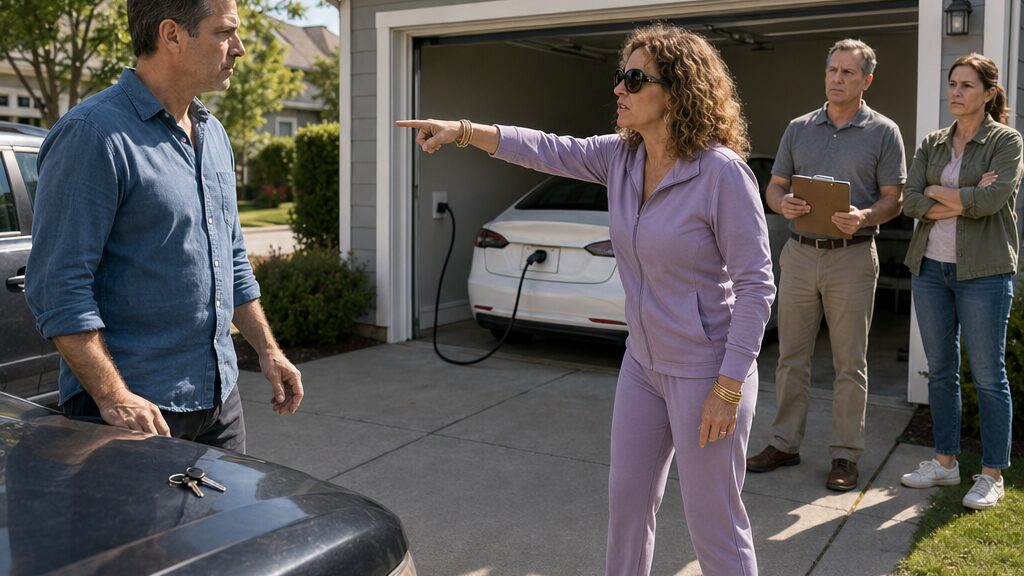
“Move your truck, Jason, or I’ll have it towed.”
Michelle Clark said it loudly enough for the two HOA board members on the sidewalk to stop pretending they were studying the hydrangeas.
I stood beside my pickup with one hand on the driver’s door. Behind Michelle, inside my detached garage, her white electric sedan sat plugged into my wall outlet.
The charging cable crossed the concrete threshold in a bright black curve.
For a second, nobody spoke.
Then Michelle pushed her sunglasses higher on her nose and pointed toward my truck.
“You’re obstructing access.”
“To my garage.”
“To my vehicle.”
One of the neighbors shifted his weight. The other looked down at the clipboard he had been carrying for the Saturday landscaping walk-through.
Michelle wore lavender athletic pants and a matching zip jacket despite the heat. She had dragged her folding chair onto the strip of shade beside my garage as if she were supervising a job site. A stainless tumbler sat in the cup holder.
“You can’t trap someone’s car,” she said.
“I didn’t trap it.”
“You parked across the apron.”
“I parked in my driveway.”
Her mouth tightened.
The old version of me—the version I had spent years trying not to become again—would have stepped closer. He would have raised his voice because he could feel people watching. He would have needed the watching people to know he was right.
I could almost feel that man moving under my skin.
Instead, I took my keys from my pocket and set them on the hood of the truck.
The small metal clink seemed louder than it should have.
“I’ll move the truck,” I said, “when you say, in front of them, that you do not have permission to use my garage.”
Michelle gave a short laugh.
“Oh, please.”
“That’s all.”
“You let me use it.”
“No.”
“You did.”
“I did not.”
One board member finally looked up.
Michelle turned toward him immediately.
“He’s changing the story because he’s angry.”
I watched the sentence land.
That was Michelle’s real skill. Not yelling. Not intimidation. Framing.
She had served as HOA board secretary long enough to know that the first clean explanation often became the accepted one.
She pointed at me again.
“He knows I’ve parked there.”
“That isn’t the same as permission.”
“You never use it anyway.”
There it was.
The sentence that had been underneath everything.
You never use it anyway.
Three weeks earlier, I had woken before dawn because light was spilling through the kitchen window from the detached garage.
My father had installed that fixture himself, a cheap motion light that came on whenever something moved near the side door. After he died, I kept meaning to replace it. I kept meaning to rent the garage, too.
There were a lot of things I kept meaning to do.
At 5:18 that morning, I pulled on jeans and walked barefoot through the damp grass.
The garage door was open.
Michelle’s sedan was inside.
I remember stopping before I reached it because the scene did not fit together at first. The white car. My workbench. My father’s dented metal shelving. A charging cable running from the rear quarter panel to the outlet beside the pegboard.
Michelle was standing near the open side door with her phone in one hand.
She looked more tired than I had ever seen her.
“Oh,” she said. “You’re up.”
“What are you doing?”
“My charger at home isn’t working.”
I looked at the cable.
She spoke quickly.
“I have to leave early. It’s an emergency.”
That word mattered.
Emergency.
I should have asked what kind. I should have said no. I should have told her to unplug immediately.
Instead, I rubbed my face and said, “You can’t make a habit of this.”
Michelle had already turned back toward the car.
“I won’t.”
That was my first mistake.
Not kindness.
Ambiguity.
At six-thirty the sedan was gone.
I told myself the matter was finished.
Four nights later, I found the car inside again.
The next time, I saw the cable before I saw Michelle.
It had been laid neatly against the wall, almost as if neatness changed ownership.
“Michelle.”
She looked over from her folding chair.
“What?”
“I told you not to make a habit of this.”
“You said it was fine.”
“I said one time.”
“No, you didn’t.”
I remember the irritation rising hot and fast.
I also remember another driveway years earlier. Another neighbor. My former wife standing at the porch with both arms folded while I shouted over a property-line dispute that now seemed too stupid to have survived in memory.
But it had survived.
People remembered the shouting, not the survey stakes.
My wife had told me later, “You always think being right will make people forget how you act.”
We were already failing by then, but that sentence stayed.
So when Michelle smiled as if daring me to become unreasonable, I backed away.
“Please move it,” I said.
She glanced toward the garage.
“You never use it anyway.”
The first time, I had no answer ready.
Back in the present, on Saturday morning, that sentence hung between us again.
One of the board members cleared his throat.
“Maybe everybody just needs to cool down.”
Michelle seized on it.
“Exactly. Jason has decided to create a crisis.”
I looked at the cable crossing my threshold.
“How long has your car been in there today?”
“That’s not relevant.”
“It is to me.”
She turned toward the board members.
“See? This is what I mean.”
My face felt hot.
I stared at the keys on my hood until the urge to pick them up and throw them disappeared.
Then I said, “I’m not touching your car. I’m not touching the charger. I’m not blocking the street. I’m asking one question.”
Michelle folded her arms.
I looked directly at her.
“Do you have my permission to use the garage?”
Silence.
The neighbor with the clipboard looked at Michelle.
Her jaw moved once.
Then she said, “You allowed it.”
“That wasn’t my question.”
“You knew.”
“That wasn’t my question either.”
For the first time that morning, something changed in her expression.
Not fear.
Calculation.
She took out her phone.
“Fine,” she said. “I’ll document that you’re refusing access.”
“To my garage.”
“To my vehicle.”
She walked away before anyone could force the distinction.
I waited until she reached the sidewalk, then picked up my keys and moved the truck.
Her sedan backed out ten minutes later.
The charging cable stayed on my concrete.
That afternoon I carried it into the garage and placed it beside the wall outlet. I did not unplug anything because the car was gone. I did not call the police. I did not email the HOA.
I told myself I had made the boundary clear.
At 7:42 that evening, my phone buzzed.
The message was from Alexander Scott, a local tradesman who had answered the FOR RENT sign I had finally hung on the garage.
Hi Jason. Monday still work to see the space? If it’s as available as you said, I’m ready to move fast.
I read the message twice.
Then I looked through my kitchen window toward the detached garage.
Michelle’s folding chair was gone.
The cable was still inside.
For the first time, the garage did not look empty.
It looked occupied by a problem I had spent three weeks refusing to name.
Chapter 2: Three Weeks of Borrowed Electricity
Alexander arrived Monday at nine in a work van with a dent over the rear wheel and a cashier’s check already tucked inside his shirt pocket.
Michelle’s white sedan was in my garage.
For several seconds, neither of us said anything.
The FOR RENT sign stood on two wire stakes beside the driveway. Behind it, visible through the open garage door, the sedan’s charging light pulsed green.
Alexander looked from the sign to the car.
“You renting the whole garage?”
“Yes.”
He nodded toward the sedan.
“Comes furnished?”
I might have laughed under different circumstances.
Instead, I walked toward the garage.
“Michelle!”
Her folding chair was beside the hedge.
Empty.
The charging cable ran from the outlet behind my father’s workbench to the car. This time she had tucked it against the wall, then curved it neatly around the tire.
Alexander followed me halfway.
“I’ve got a job in the county starting next month,” he said. “Need somewhere dry for tools and two compressors. I can pay three months up front.”
“I know.”
“You said access anytime.”
“You’ll have it.”
He looked at the car again.
“When?”
The question was simple.
That made it worse.
I pulled out my phone and called Michelle. No answer. I texted.
Your car is in my garage. I have a prospective renter here. Please move it now.
Three dots appeared.
Disappeared.
Appeared again.
Finally:
In a meeting. Will get it later.
I showed Alexander nothing.
“I can come back,” he said.
“No. Give me ten minutes.”
I walked across the lane and knocked on Michelle’s front door.
No answer.
Her home charger was mounted beside her garage. The indicator was dark.
I returned to my own garage and stood beside the sedan, looking at the plug.
It would have taken one movement to disconnect it.
One.
I did not touch it.
Alexander watched me decide not to.
“That her car?”
“Yes.”
“Neighbor?”
“Yes.”
He put his hands into his pockets.
“You got some kind of arrangement?”
“No.”
The word sounded weak even to me.
His expression changed slightly.
Not disbelief exactly.
Caution.
I heard myself add, “I told her to stop.”
“How long has she been doing it?”
I looked at the cable.
“Three weeks.”
Alexander gave a slow nod.
That was the moment I understood what my patience looked like from outside.
Not restraint.
Permission.
We walked around the rest of the space anyway. I showed him the shelves I would remove, the side entrance, the deadbolt I planned to replace. He asked practical questions about insurance and electricity.
But the conversation had already changed.
At the door of his van, he said, “Call me when it’s actually available.”
“It is available.”
He looked past me.
“No offense, Jason. It isn’t.”
Then he drove away.
I stood in the lane until his van disappeared.
At noon, Michelle finally arrived.
She came walking from the direction of the clubhouse with a folder under one arm.
“I need the car moved,” I said.
“You sent me a message.”
“I had a renter here.”
“That sign’s been up forever.”
“Eleven days.”
She shrugged.
“What’s your point?”
“My point is the garage is not yours.”
“I never said it was.”
“You keep putting your car in it.”
“Because it’s empty.”
I stared at her.
She stared back.
There was no theatrical rage in her face. That would have been easier. She looked genuinely irritated that I was forcing her to discuss something she considered obvious.
“I pay for that electricity,” I said.
Michelle shifted the folder to her other arm.
“How much do you think charging costs, Jason?”
“That’s not the issue.”
“So you don’t know.”
“The amount doesn’t decide whether you can take it.”
“Take it.”
She repeated the words as if I had accused her of stealing jewelry.
“You always said it was fine.”
“I did not.”
“You knew I was using it.”
“I told you not to make a habit of it.”
“That’s not the same as telling me I couldn’t.”
The sentence hit harder than I wanted it to.
Because it was wrong.
And because it was not entirely false.
That evening, I pulled my electric bills from the utility account.
I worked as a commercial photographer, which meant I was used to timelines. Image numbers. Metadata. Before and after.
The bills showed a rise, but not enough to prove anything by themselves.
So I photographed the meter at ten that night.
At 1:15 a.m., the motion light came on.
I looked through the window.
The white sedan was back.
The cable crossed the threshold again.
I photographed the meter at 1:22.
At 5:40, I photographed it a third time.
The next night, the same.
The night after that, the cable had been routed behind a trash can.
Wednesday, looped over a hook.
Thursday, stretched straight across the concrete as if nobody could possibly question its right to be there.
Each night I took pictures.
Each morning I hated myself a little more for not having done something sooner.
On Thursday afternoon, Alexander texted.
Found another option. Costs more but I need certainty. Thanks anyway.
I sat at my kitchen table with the message open.
My father’s old garage key lay beside my coffee mug.
He had built half the shelving in that garage after retiring, measuring every bracket twice. When he died, I had left his workbench untouched for almost a year. Renting the space had felt like admitting he was not coming back to use it.
Michelle had seen emptiness.
I had been hiding grief in plain sight.
Neither fact gave her permission.
But my own delay had created room for this.
At six, I wrote a note.
Michelle—
You do not have permission to park, charge, store property, or otherwise use my garage or electrical outlet. Please remove your vehicle and charger no later than Friday at 9:00 a.m. Future use is not authorized.
Jason Hill
I read it twice.
Then three times.
No insults.
No threats.
No mention of the HOA.
I walked to the garage.
Her sedan was inside.
The charging light blinked.
I slid the note under the driver-side wiper.
The next morning, at 7:10, Michelle was waiting beside my mailbox.
She held the note in one hand.
“I’m asking politely,” I said before she could start. “Move it by nine.”
Michelle tore the paper once down the middle.
Then again.
The pieces fell at my feet.
Her voice stayed almost conversational.
“Write whatever you want to make yourself feel important.”
I looked at the paper on the pavement.
“Friday at nine.”
She smiled.
“Fine.”
Then she walked away.
I watched her cross the lane.
At the time, I thought the deadline was the first clear thing I had done.
By sunrise the next morning, I understood that Michelle had heard it as a challenge.
Chapter 3: Friday Was the Wrong Deadline
The first thing I saw Friday morning was a crushed cereal box in the grass.
Then an empty detergent jug.
Then two weeks of recycling spread across my front lawn.
I stood on the porch in socks, looking at cans, cardboard, plastic bottles, and torn paper scattered from the curb to the hedge.
My blue recycling bins lay on their sides.
Across the lane, Michelle sat in her folding chair.
She was drinking coffee.
I checked the time.
6:47 a.m.
Her white sedan was inside my garage.
The charging cable stretched across the threshold in a straight, deliberate line.
I put on shoes and walked outside.
Michelle watched me pick up the first bottle.
“Morning,” she said.
I kept moving.
“You lose something?”
I carried the bottle to the bin.
“Did you do this?”
She lifted one shoulder.
“Wind.”
“There wasn’t any wind.”
“You should secure your bins.”
I looked at her.
She smiled over the rim of her cup.
My hands began to shake.
That frightened me more than anger itself.
Years earlier, during the dispute I still hated remembering, I had mistaken that shaking for proof I needed to act. I had shouted until three neighbors came outside. My wife had stood on the porch and watched me become a story people told about me.
I bent down and picked up another can.
Michelle said, “Nine o’clock, right?”
I stopped.
She glanced at her watch.
“Still time.”
I forced myself to finish gathering the recycling.
At 8:12, I rolled both bins behind my fence.
At 8:30, I photographed the garage.
At 8:45, Michelle crossed the lane.
She walked directly toward the sedan.
“I need my car.”
“Take it.”
“Move your ladder.”
A six-foot aluminum ladder rested against the side wall near the garage apron. It was mine. It was not blocking the vehicle.
“It’s not in your way.”
“It is from my angle.”
“Then wait. I’ll move it.”
I stepped toward it.
Michelle got there first.
She grabbed the side rail.
“Don’t.”
“I can handle a ladder.”
“Michelle, leave it.”
She pulled.
One rubber foot caught on the concrete lip.
The ladder twisted.
I saw what was about to happen a fraction too late.
“Stop—”
The top rail swung down and struck the rear passenger door of her sedan with a hollow metallic bang.
Both of us froze.
A pale scrape marked the white paint.
Michelle stared at it.
Then at me.
“You did that.”
“No.”
“You made me move it.”
“I told you not to touch it.”
“You blocked my car.”
“The ladder wasn’t blocking anything.”
Her face changed.
Not grief over the damage.
Opportunity.
She took out her phone.
I felt the old anger rise so hard that for one dangerous second I saw only fragments: the torn note, the cereal box in my lawn, the cable across my threshold, Alexander’s van driving away.
Michelle raised her phone.
“Say it again.”
I looked directly into the lens.
“I did not damage your car.”
“You caused it.”
“No.”
“You refused access.”
“No.”
The simplicity of the word steadied me.
Michelle lowered the phone slightly.
“You think you can bully me because you own an extra garage?”
I nearly laughed.
Instead I said, “Move your car.”
Her eyes narrowed.
“You’ll hear from the association.”
“I’m sure I will.”
By 9:05 the sedan was still inside.
By 9:20, two neighbors had appeared near the lane.
At 9:27, one of the HOA board members from the previous Saturday walked up with his phone in his hand.
Michelle had already called him.
She stood beside the garage telling the story before I reached them.
“He gave me access, then suddenly blocked me in. Now he’s created a safety hazard and damaged my vehicle.”
I stopped several feet away.
The board member looked uncomfortable.
“Jason, Michelle says there’s been an escalation.”
“There has.”
Michelle pointed at me.
“See?”
I ignored her.
“My garage. My outlet. Written notice expired at nine. Her car is still inside.”
“You let me use it.”
“I told you repeatedly to stop.”
“After weeks.”
There it was again.
After weeks.
The board member looked at me.
“Is that true?”
I could have lied.
I could have said I objected from the first second.
For one breath, I wanted to.
Then I said, “I told her the first morning not to make a habit of it.”
Michelle gave a sharp laugh.
“Exactly.”
“That is not permission.”
“You didn’t say no.”
The two neighbors were watching now.
The garage suddenly felt like a courtroom built out of concrete and lawn chairs.
I walked to my truck.
Michelle called after me.
“What are you doing?”
I took my keys from my pocket and placed them on the hood.
The same small metallic sound as Saturday.
Then I turned.
“You want my truck moved?”
“Yes.”
“I’ll move it.”
She looked almost triumphant.
“When you say, in front of everyone here, that you do not have permission to use my garage.”
Michelle’s face went still.
The board member exhaled.
“Jason, maybe this isn’t—”
“It’s exactly the issue.”
Michelle stepped closer.
“You’re threatening me.”
“No.”
“You’re holding my car.”
“No. I’m asking you to state whether you have permission.”
“You let me.”
“That wasn’t the question.”
Her cheeks flushed.
“You’ve become completely unreasonable.”
I looked at the board member.
“Ask her.”
He did not.
That told me something.
Not that he believed Michelle.
That he was afraid of becoming part of it.
Michelle picked up her phone again.
“Fine. I’m filing a formal safety complaint. Obstruction, harassment, and interference with access.”
“To my garage.”
She turned away.
“Keep talking.”
I did not.
Ten minutes later, I moved the truck.
Michelle backed the sedan out, the damaged door catching sunlight as she turned.
The charging cable remained plugged into my wall.
She had left it behind.
At 10:16, an email arrived from Kathleen Baker, the community association manager.
Subject: Urgent Resident Safety Concern.
Michelle had filed first.
The complaint described me as “increasingly confrontational.” It said I had created a vehicle-access obstruction during an active neighborhood walk-through. It referenced the ladder as a “hazardous item positioned near resident property.”
Resident property.
Her car, inside my garage, had become resident property.
My garage had become a location where I had allegedly created hazards.
I read the email twice.
Then I opened the attachment.
There was a statement from Michelle.
She wrote that I had “historically permitted” her use of the structure.
Historically.
Three weeks had become history.
I went into the garage and stared at the outlet.
The cable was still connected to the wall, its loose end lying on the floor.
I wanted to rip it out.
Instead I photographed it.
Then the meter.
Then the scrape on the concrete where the ladder foot had caught.
Then the recycling still trapped under the hedge.
My phone showed 11:03.
A calendar alert appeared at the top of the screen.
Flight check-in available.
For several seconds I did not understand what I was looking at.
Then I remembered.
Barcelona.
A commercial architecture assignment I had booked months earlier. Nonrefundable flight. Three days of preliminary location work before the client meeting. I had promised myself I would go because for two years I had turned down anything that required leaving home for long.
My flight departed that night.
I stood alone in the garage with Michelle’s charging cable at my feet, an official complaint in my inbox, and a plane ticket that would put me thousands of miles away before the weekend was over.
Leaving suddenly looked reckless.
Staying suddenly looked like exactly what Michelle expected.
And for the first time since this began, I stopped asking how to keep the peace.
I started asking what I could prove.
Chapter 4: The Evidence I Almost Hated Collecting
At 11:14 Friday morning, I was crouched beside the electric meter with my phone held inches from the glass when Michelle dragged her folding chair into view and sat down to watch me.
She did not ask what I was doing.
That bothered me more than if she had.
I photographed the reading, stepped back, and took a wider shot that included the meter number, the side of my house, and the timestamp on my phone screen. Then I photographed the garage from the driveway.
Michelle crossed one ankle over the other.
“Building a case?”
“Building a timeline.”
“For what?”
“I don’t know yet.”
That was true.
I had already learned enough in one morning to stop pretending I understood the rules. I knew the garage was mine. I knew the outlet was mine. I knew Michelle had ignored a written deadline.
I did not know whether locking a garage with someone else’s vehicle inside would be treated as securing my property or creating a new problem.
I called the association office.
Kathleen Baker answered on the fourth ring.
“Jason, I saw the complaint.”
“I need you to tell me what authority the HOA has over my detached garage.”
A pause.
“That depends on what you mean by authority.”
“I mean can Michelle use her board position to claim access?”
“No board member has personal access rights because of office.”
“Good.”
“But this is now a resident dispute involving alleged obstruction and property damage.”
“I didn’t damage her car.”
“I’m not deciding that over the phone.”
“I’m leaving the country tonight.”
Another pause.
“That complicates things.”
“Everything seems to.”
Kathleen exhaled quietly.
“Send me your documentation.”
“I’m doing that now.”
“And Jason?”
“Yes?”
“Do not improvise a remedy because you’re angry.”
The words hit too close.
“I’m not angry.”
Kathleen let the silence answer for her.
After the call, I went inside and opened every message between Michelle and me.
There were fewer than I expected.
That was the first problem.
The second was worse.
The earliest exchange was from the first morning.
Michelle: Charger failed. Needed a little power. Hope that’s okay.
Me: Saw the car. One time is fine but don’t make a habit of it.
I stared at my own sentence.
One time is fine.
I remembered saying something different in my head.
I remembered meaning something different.
But the words were there.
I kept scrolling.
Four days later:
Me: Your car is in there again.
Michelle: Home charger still acting up.
Me: I need the garage clear.
Michelle: I’ll move it after work.
No explicit no.
Two nights later:
Me: Please don’t park there overnight.
Michelle: You’re not using it.
Me: That isn’t the point.
Again, no explicit statement that permission was withdrawn.
Not until the note.
I sat back.
The evidence did not make me look blameless.
It made me look inconsistent.
For several minutes I considered leaving those first messages out of the packet.
The thought came so naturally that I hated it.
I had spent all morning furious that Michelle was shaping the story, and here I was deciding which parts of mine were convenient.
I attached the messages.
All of them.
Then I added the meter photographs, the utility bills, the image of the FOR RENT sign, Alexander’s text withdrawing from the rental, photographs of the torn note pieces, the recycling, the ladder scrape, and Michelle’s car inside the garage at different dates and times.
At 1:38, I photographed the charging cable again.
Then I unplugged it from my outlet.
The connector came free with a small plastic click.
I stood holding the cable.
For one ugly second, I imagined cutting it.
Not because it would help.
Because it would feel final.
Instead, I coiled it carefully.
Loop over loop.
My father had taught me to coil extension cords that way so they would not twist.
When I finished, I placed Michelle’s charger against the inside wall near the side door.
Boundary, I told myself.
Not revenge.
At three, I posted a fresh written notice on the garage door and emailed a copy to Kathleen.
Unauthorized use is withdrawn and prohibited. Vehicle access must be arranged immediately. Garage will be secured after 6:00 p.m.
I called Michelle.
She rejected the call.
I texted.
Your car must be removed by 6. I am leaving tonight. Contact me now to arrange access.
No reply.
At 4:20, I sent it again.
At 5:11, she responded.
Stop harassing me. My complaint is pending.
I read that sentence three times.
Then I called a local attorney’s office and got no farther than a receptionist telling me nobody could advise me before Monday.
At 5:45, I stood in the garage beside the white sedan.
My suitcase was already in the truck.
The car was silent.
The loose charging cable rested in its neat coil against the wall.
I could leave the garage open.
I could miss the flight.
I could keep waiting for Michelle to decide when my property became mine again.
At 6:03, I pulled the overhead door down.
The panels rattled into place.
I locked the side door.
Then I locked the gate.
As I drove toward the airport, I kept checking the rearview mirror as though the garage might follow me.
At the terminal, the gate agent scanned my boarding pass and waved me through.
My phone buzzed before I reached security.
Michelle.
You cannot hold my vehicle. Open the garage now.
I stopped walking.
Another message followed.
I am documenting this.
I typed three different replies and deleted all of them.
Finally:
You were given written notice and multiple opportunities to remove the car. Contact the association manager. I will respond in writing.
I sent it.
Then I boarded the flight.
For two days, nothing happened.
Barcelona almost convinced me I had ended it.
I photographed stone facades for the client. I drank bad coffee near a plaza full of tourists. I walked twelve miles on Saturday and checked my phone too often.
Sunday afternoon, I was sitting outside a café reviewing location notes when a message appeared from one of the neighbors.
Jason. Call me when you see this.
A second message arrived before I could answer.
Police are at the garage.
I stared at the words until the sounds of the street seemed to move farther away.
Chapter 5: The Complaint She Filed Before I Landed
The police officer’s voicemail was calm, which somehow made it worse.
“Mr. Hill, this is regarding a vehicle-access complaint at your property. No emergency at this time. Please return my call.”
No emergency.
I listened twice.
Then I called.
The officer asked me to confirm my name, address, and whether I owned the detached garage.
“Yes.”
“Is there a vehicle inside belonging to another resident?”
“Yes.”
“Did you knowingly secure the structure with the vehicle inside?”
“Yes.”
The word sounded terrible without context.
I leaned forward over the café table.
“She had written notice. Repeated requests. She had been using the garage without permission.”
The officer did not react.
“Did she ever have permission?”
“For one emergency use.”
“That’s not what I asked.”
I closed my eyes.
“Yes. Once.”
“And after that?”
“I told her not to make a habit of it.”
“Was permission formally withdrawn?”
“Eventually.”
“Eventually when?”
“Friday in writing.”
The officer was silent long enough for me to hear dishes clattering inside the café.
“I’m not making a legal determination over the phone,” he said. “This appears to involve a property dispute. The vehicle owner says she had ongoing permission and that access was cut off after a disagreement.”
“That is not what happened.”
“She also alleges you damaged the vehicle.”
“I did not.”
“Do you have documentation?”
“Yes.”
“Keep it.”
I almost laughed.
“I’ve been doing that.”
When the call ended, I contacted Kathleen.
She answered immediately.
“Jason, I was about to call you.”
“Did Michelle send police to my house?”
“She requested assistance.”
“That isn’t an answer.”
“No,” Kathleen said. “It’s not.”
I stood and walked away from the café tables.
“What exactly has she filed?”
“A formal resident complaint, a board incident report, and a request for emergency association intervention.”
“On my private garage?”
“She is claiming the dispute affects community safety.”
“Of course she is.”
“Jason.”
I stopped.
Kathleen’s voice had changed.
“I need you to hear something you’re not going to like.”
“I’m listening.”
“Michelle has two residents willing to say you allowed her to use the garage.”
The street in front of me seemed to tilt slightly.
“Who?”
“I’m not giving names before the process requires it.”
“What did they actually see?”
“One says you told Michelle the garage was empty and she could use it.”
“I never said that.”
“The other says the arrangement had been going on for weeks without objection.”
“That one is closer.”
Kathleen went quiet.
I pressed my thumb against the edge of the phone.
“I objected.”
“When?”
I thought of my own messages.
Your car is in there again.
I need the garage clear.
Please don’t park there overnight.
Words that felt obvious when I wrote them.
Words that did not look nearly as strong now.
“I sent you everything,” I said.
“I received it.”
“Including the first message.”
“Yes.”
“One time is fine.”
“Yes.”
The humiliation of hearing my own sentence read back to me was immediate.
Kathleen continued carefully.
“That message helps Michelle’s argument that the initial use was permitted.”
“Initial.”
“Yes.”
“Not three weeks.”
“No.”
That single word gave me something solid.
Kathleen said, “Your dated notice helps. So do the meter photographs. So does the message telling her to remove the vehicle before six.”
“Then why are we talking like I’m the one under investigation?”
“Because she filed first, because her vehicle is currently inaccessible, and because this association has a liability problem whether you like that or not.”
I stopped beside a stone wall.
“You knew there was a problem before Friday.”
Silence.
“Kathleen?”
“I received an informal message last week.”
“From who?”
“I’m not discussing other residents.”
“About this garage?”
“Yes.”
My anger sharpened.
“And you did nothing.”
“It did not include a formal request for action.”
“You’re the manager.”
“I manage procedures, Jason. I do not police every neighbor disagreement.”
“Until Michelle files one.”
“That’s not fair.”
“No. It isn’t.”
The sentence came out harder than I intended.
I waited for the old rush, the need to keep going.
It did not come.
Only exhaustion.
Kathleen spoke first.
“I should have contacted you.”
I said nothing.
“I thought both of you were escalating a small dispute.”
“You decided that without asking me.”
“Yes.”
The admission was quiet.
It mattered.
Not enough.
But it mattered.
By Monday morning, the association had scheduled an emergency hearing for Thursday evening.
My flight home was Tuesday.
The timing felt deliberate even though Kathleen insisted it was the earliest date all required people could attend.
The police took no immediate action. Michelle’s car remained inside the garage. Kathleen arranged for no one to enter while ownership and access were disputed. The result was a kind of frozen absurdity: my garage locked, Michelle’s car inside, her charging cable visible on my security camera where I had left it coiled against the wall.
Then the camera feed changed.
At 3:16 Monday afternoon, Michelle appeared at my gate with a locksmith.
I watched from my hotel room.
There was no sound, only images.
Michelle pointed.
The locksmith examined the gate, then the posted notice.
He made a phone call.
Michelle folded her arms.
After several minutes, he shook his head.
She stepped closer.
He shook it again.
Then he left.
I saved the clip.
The evidence pile was growing.
So was my unease.
Tuesday morning, while I was packing to leave Barcelona, Kathleen emailed a preliminary hearing packet.
Michelle’s statement described me as volatile.
That word stopped me.
Volatile.
Years earlier, another neighbor had used the same word after the property-line argument that ended with me shouting in front of half the block.
I had changed neighborhoods since then.
Michelle could not know.
Still, the word found the exact place I kept hidden.
I closed the laptop.
My phone buzzed.
The message came from a number I recognized only after reading the name.
Jennifer Wilson.
Michelle’s daughter.
We had spoken maybe four times in six years.
Her message was short.
Jason, I need to ask you something before the hearing.
A second message appeared.
Please don’t tell them why Mom needed that charger.
I read it twice.
Then a third message came.
I thought you already knew.
Chapter 6: The Reason She Never Asked
“The first time was supposed to be one night.”
Jennifer said it before I had even sat down.
I had landed Wednesday morning, gone home long enough to drop my suitcase, and met her at a café ten minutes from the neighborhood because she did not want Michelle seeing us together.
Jennifer looked exhausted.
There were shadows under her eyes. She kept turning a paper cup between both hands without drinking from it.
“One night,” I repeated.
“Yes.”
“Why?”
She looked toward the window.
“My schedule changed.”
“That doesn’t answer the question.”
“I know.”
For several seconds she said nothing.
Then she told me.
Jennifer worked irregular hospital shifts across the county. When her evening coverage ran late, Michelle handled transportation for Jennifer’s son—school pickup, after-school care, sometimes the drive to Jennifer’s apartment near midnight. Michelle’s home charging unit had begun failing intermittently. A replacement estimate had arrived during the same month as an insurance increase and a major plumbing repair.
“She should have asked me.”
“I know.”
“She did ask me. Sort of. The first time.”
Jennifer nodded.
“That was the emergency.”
“And after that?”
Her fingers tightened around the cup.
“She kept using it.”
“Why?”
“Because it worked.”
I leaned back.
“That’s your explanation?”
“No.”
Jennifer finally looked at me.
“That’s hers.”
The distinction changed the room.
“She told me you didn’t care,” Jennifer said. “She said the garage had been empty forever and you’d told her one time was fine.”
“One time.”
“I know.”
“She knows that.”
Jennifer did not answer.
I looked down at the table.
For weeks I had imagined Michelle’s motive as simple entitlement. Maybe because simple entitlement was easier to fight.
Jennifer spoke quietly.
“Mom’s been having money problems.”
I looked up.
“She would hate me telling you that.”
“Then why are you?”
“Because she filed complaints saying you trapped her. Because she told people you were unstable. Because this has gone past protecting her.”
The words sat between us.
Jennifer continued.
“Her HOA position matters to her more than it should. People call her when the pool gate sticks. They ask her about trash pickup. She knows which vendor is late. She knows who forgot a form. She likes being the person who has answers.”
“I noticed.”
A tired smile almost appeared.
Then disappeared.
“When the charger broke, she couldn’t afford the repair right away. Not without moving money around. She didn’t want anyone knowing.”
“So she used mine.”
“She said it was temporary.”
“For three weeks.”
“I know.”
“And when I objected?”
Jennifer looked at the table.
“She said you were making her beg.”
I stared at her.
“I never asked her to beg.”
“No.”
“I asked her to move the car.”
“I know.”
The anger came back, but it was different now.
Less clean.
Jennifer said, “You saw her that first morning, right?”
“Yes.”
“She was upset.”
“She looked tired.”
“She’d been driving my son because I got stuck on a double shift. Her car was nearly dead. She thought you saw all of that.”
“I saw a car in my garage.”
Jennifer closed her eyes briefly.
“That’s what I told her.”
I said nothing.
“She thought asking properly after that would mean admitting she couldn’t manage things.”
“So she decided I owed her.”
Jennifer’s voice dropped.
“Yes.”
There it was.
Not a legal trick.
Not a secret conspiracy.
Shame.
Ordinary, stubborn shame that had put on an HOA badge and started calling itself common sense.
I hated how much easier it would have been if Michelle had no reason at all.
After the café, Jennifer followed me back to my property.
Kathleen had arranged access so I could inspect the garage while Michelle’s car remained inside pending the hearing.
The side door opened with resistance.
The air smelled faintly of rubber and dust.
The sedan sat exactly where I had left it.
Against the wall, the charging cable remained coiled.
Jennifer saw it and stopped.
“That’s hers.”
“I know.”
She picked it up.
For a moment she held the coil against her jacket.
“She bought this after the home charger started failing.”
I looked at the cable.
The same object that had crossed my threshold night after night now seemed smaller in her hands.
Still not mine.
Still used without permission.
But no longer meaningless.
Jennifer placed it back.
“She could have charged elsewhere,” I said.
“Yes.”
“Public station. Dealership. Your place.”
“My building doesn’t have charging.”
“Then public.”
“She said the rates were ridiculous.”
“So she took my electricity because mine was cheaper.”
Jennifer flinched.
I regretted the sharpness but not the fact.
“She was wrong,” Jennifer said.
I waited.
Then she added, “But that isn’t the worst thing she did.”
I looked at her.
Jennifer stepped away from the cable.
“After your Friday deadline, she called me. She was furious. She said you were trying to humiliate her.”
“I was trying to get my garage back.”
“I know.”
“What did she do?”
Jennifer took a breath.
“She used the board contact list.”
The words took a moment to settle.
“What do you mean?”
“She called people from the landscaping walk-through before she filed the complaint. Asked what they remembered. Told them you had trapped her car. Told them you’d been getting aggressive.”
My jaw tightened.
“She was building witnesses.”
“Yes.”
“Before the complaint.”
“Yes.”
I looked toward the white sedan.
“And the ladder?”
Jennifer shook her head.
“I wasn’t there.”
“Did she tell you?”
“She said you caused it.”
“That isn’t what I asked.”
Jennifer’s eyes filled, but her voice stayed steady.
“She told me she was going to make sure the association understood what kind of person you were.”
The garage felt colder.
For the first time since the conflict began, my anger did not make me want to shout.
It made everything precise.
Michelle had needed help.
She had been ashamed.
She had turned temporary permission into entitlement because asking again felt beneath the version of herself she needed people to see.
I could understand all of that.
Then she had chosen to use institutional access to make me look dangerous.
Understanding stopped there.
My phone buzzed.
Kathleen.
Hearing packet updated. Please review immediately.
I opened the email while Jennifer stood beside me.
The new attachment contained six photographs.
The first five were familiar.
The sixth was not.
It showed my driveway Friday morning from an angle near the sidewalk.
Michelle’s white sedan was inside the garage.
The charging cable was connected.
My FOR RENT sign stood beside the apron.
And the ladder was visible against the wall.
The timestamp in the lower corner was 8:37 a.m.
Before Michelle claimed I had positioned it as a hazard.
Before the damage.
I zoomed in.
At the edge of the frame, partly cut off, was the clipboard carried by one of the HOA board members.
I had never seen the photograph.
Jennifer leaned closer.
“Who took that?”
I looked at the timestamp again.
Then at the ladder.
Then at the cable crossing my threshold.
The hearing was the next evening.
And somewhere between Michelle’s story, the board’s memory, and that photograph was the firs
Chapter 7: The Empty Chair at the Hearing
The association attorney was waiting outside the clubhouse with a folder under one arm and an offer I had not asked for.
“If you withdraw your complaint tonight,” he said, “we may be able to resolve the vehicle access issue privately.”
I stopped with my hand on the glass door.
“Privately how?”
“Immediate release of the vehicle. Mutual non-disparagement. No finding against either party.”
“And the electricity?”
He glanced down at the folder.
“Could be handled informally.”
“The lost rental?”
“That becomes more complicated.”
“Of course it does.”
His expression tightened.
“Mr. Hill, nobody benefits from turning a neighbor dispute into a public proceeding.”
Through the glass, I could see the hearing room.
Kathleen sat at the front table arranging documents into stacks. The HOA board president was speaking quietly with two board members. Michelle was already inside.
Her folding chair was outside.
I noticed it only because I had never seen it empty before.
It sat against the clubhouse wall, collapsed halfway, one metal leg crooked on the concrete. Without Michelle in it, it looked cheap.
Ordinary.
I looked back at the attorney.
“What happens if I withdraw?”
“No formal findings tonight.”
“Against her?”
“Against either of you.”
“And she keeps saying I trapped her car?”
He spread one hand.
“I’m offering a practical exit.”
I thought about how badly I had wanted an exit three weeks earlier.
I had mistaken exits for peace before.
“No.”
The attorney lowered his voice.
“You understand your own messages are not clean.”
“I do.”
“You gave initial permission.”
“For one use.”
“You were ambiguous afterward.”
“I know.”
“Then you should appreciate the risk.”
“I do.”
That seemed to unsettle him more than denial would have.
I opened the door.
The room smelled faintly of coffee and copier paper.
Michelle sat at the far end of the long table in a navy blouse instead of her lavender tracksuit. She had no sunglasses. For the first time since this began, she looked smaller than the role she had built around herself.
She did not look at me.
Kathleen did.
Her face gave nothing away.
The board president called the meeting to order.
The first twenty minutes were procedural.
Dates.
Property boundaries.
Complaint numbers.
Whether the detached garage was included within my deeded parcel.
Whether the HOA had any direct authority to grant individual access.
It did not.
That fact landed quietly.
No one applauded.
Michelle’s attorney did not object.
The association attorney asked me to describe the first morning.
I did.
I said Michelle had told me her charger had failed. I said she described the situation as an emergency. I said I had responded that one time was fine but she should not make a habit of it.
Michelle looked up then.
The board president asked, “So you did permit the first use?”
“Yes.”
The room went very still.
I could feel the attorney outside becoming a better offer in my memory.
I continued.
“And I was unclear after that.”
Kathleen looked at me.
Michelle’s expression changed.
Not triumph exactly.
Surprise.
I placed copies of the messages on the table.
“I told her the garage needed to be clear. I told her not to park overnight. I told her it wasn’t the point that I wasn’t using it. I thought that was enough.”
“Was it?” the board president asked.
“No.”
The answer came easier than I expected.
“No. It wasn’t.”
Michelle leaned back.
I went on.
“I should have said, in writing, after the first use: you do not have permission to use this garage again. I didn’t. I avoided a direct conflict because I told myself I was being patient.”
The board member with the clipboard shifted in his seat.
I looked at him.
“That delay mattered.”
I slid Alexander’s text forward.
“I had a renter come to inspect the garage. Michelle’s car was inside. He walked away.”
The board president read the message.
Michelle spoke for the first time.
“That isn’t my responsibility.”
I turned toward her.
“No. My delay is my responsibility.”
The words stopped her.
I continued.
“Your car being there is yours.”
The room stayed quiet.
That was the first moment I understood what telling the whole truth could do.
For weeks, I had been afraid that admitting my mistakes would destroy my credibility.
Instead, the room seemed to sharpen around them.
The association attorney moved to the photographs.
Meter readings.
The FOR RENT sign.
The sedan in the garage on multiple dates.
The charging cable crossing the threshold.
Then the new image appeared on the screen.
8:37 a.m.
Friday.
White sedan inside.
Cable connected.
Ladder against the wall.
FOR RENT sign visible.
Clipboard at the edge.
The board president turned.
“Who took this photograph?”
The board member with the clipboard cleared his throat.
“I did.”
Michelle stared at him.
“Why?”
“Landscaping walk-through documentation.”
“You photographed my car?”
“I photographed the planting strip and apron.”
The attorney enlarged the image.
The ladder stood flush against the side wall.
Not in front of the vehicle.
Not across the access path.
The board president asked, “At what time did the alleged damage occur?”
“After eight forty-five,” I said.
Michelle said, “That doesn’t prove he didn’t cause it.”
“No,” I said. “It doesn’t.”
She looked at me sharply.
The attorney asked, “What does it prove, Mr. Hill?”
“That the ladder was not positioned as a hazardous obstruction at 8:37.”
The board member nodded reluctantly.
The photograph did not solve everything.
That was exactly why it mattered.
It contradicted one part of the story without pretending to explain the rest.
Then Kathleen produced the complaint timeline.
Michelle had contacted two residents before filing.
The calls themselves proved nothing.
The board access log proved she had downloaded the current neighborhood contact sheet from the board portal forty-three minutes before the first calls.
Michelle’s face hardened.
“I was gathering information.”
“Using board resources?” the president asked.
“I was responding to a resident safety matter.”
“You were the resident.”
“I am also the secretary.”
The distinction she had avoided for weeks finally reached the table.
The board president leaned forward.
“Those are not the same role.”
Michelle’s voice sharpened.
“I was trying to resolve this before Jason escalated.”
I almost answered.
Instead, I waited.
She turned toward me.
“You want everyone to act like this began with some scheme. It didn’t. My charger failed. I needed to drive my grandson. Jason knew I was using the garage. He saw me. He let it happen.”
The room changed.
Not because the facts were new to me.
Because Michelle had finally said need out loud.
Her face flushed as she continued.
“You have an empty garage. You weren’t using it. I needed temporary accommodation.”
The board president said, “Did you request accommodation?”
Michelle hesitated.
“I believed there was an understanding.”
“Did you ask?”
“I shouldn’t have had to explain my family circumstances to a neighbor.”
“No,” I said quietly.
Everyone looked at me.
“You shouldn’t have had to explain them.”
Michelle’s eyes narrowed, suspicious of agreement.
I continued.
“You had to ask for access.”
Her mouth tightened.
“You knew enough.”
“No.”
“You saw me struggling.”
“I saw your car.”
That landed differently than I expected.
Michelle looked down.
For one second, Jennifer’s explanation was there between us without her name being spoken.
Shame.
Pride.
A woman who could tell everyone else which form to submit but could not say she needed help.
I understood it.
And still—
“You used your board access after I gave written notice,” I said. “You called people before filing. You described me as unstable. You tried to make the complaint about my behavior instead of your continued use.”
Michelle looked up.
“You were unstable.”
The old word.
The old fear.
I felt the room waiting.
Years ago, I would have fought the word itself.
I would have tried to erase the possibility that anyone could ever see me that way.
Instead I said, “I have been.”
Nobody moved.
“Not in this dispute,” I added. “But years ago, in another property argument, I lost my temper publicly. I’ve spent a long time being afraid of becoming that person again.”
Michelle stared at me.
“So I waited too long. I softened things I should have said clearly. I let resentment build. That is mine.”
My hands were steady.
“But fear of being angry does not create permission for someone else.”
The board president closed the folder in front of him.
The silence afterward was not dramatic.
It was administrative.
That made it feel more serious.
The association attorney summarized possible findings: misuse of board resources, procedural conflict of interest, failure of management to respond early, a private property dispute outside direct HOA authority, potential reimbursement issues suitable for mediation.
Michelle’s temporary board suspension was discussed.
Not permanent removal.
Not humiliation.
A review.
Michelle’s face went pale anyway.
Kathleen said, “I also need to state for the record that I received informal notice of the dispute before the formal complaint and did not contact both parties.”
The board president turned toward her.
Kathleen continued.
“I assumed the matter was mutual escalation. I should not have.”
For the first time, responsibility spread across the room in accurate portions.
Mine.
Michelle’s.
Kathleen’s.
Not equal.
But real.
The board president looked at me.
“Mr. Hill, the association cannot determine all private damages tonight. Mediation is available. The vehicle can be released under a documented access arrangement.”
He paused.
“You have requested reimbursement in your written submission. You have also referenced storage, electricity, lost rental income, and removal costs.”
I knew what was coming.
The question I had imagined answering with anger.
The one that had kept me awake on the flight home.
The board president folded his hands.
“Given the record before us, what exactly do you want?”
Chapter 8: What I Asked For Instead of Revenge
The tow-yard dispatcher quoted a number high enough to make Jennifer go silent on the phone.
The car had not yet been moved, but after the hearing Michelle’s attorney had asked for estimates in case off-site storage became necessary during mediation.
The dispatcher listed transport, intake, daily storage, administrative release, after-hours access.
By the time the total reached four figures, I stopped writing.
Jennifer said, “She can’t do that.”
I looked through my kitchen window toward the garage.
Michelle’s sedan was still inside.
The hearing had ended without a dramatic order. Her board access was suspended pending review. The HOA would not defend her private use of my garage. Kathleen had arranged mediation. The car could be removed as soon as we agreed on documented access.
Two weeks earlier, I would have wanted the tow-yard number to hurt.
Now it sounded like collateral damage.
“What can she do?” I asked.
Jennifer hesitated.
“She can pay something. Not all at once.”
“That isn’t what I asked.”
A long pause.
“She can reimburse the electricity.”
“And?”
“Probably part of the rental loss.”
“Probably.”
“I’m trying to be honest.”
“So am I.”
The mediation room was smaller than the hearing room.
No audience.
No board members.
Just a rectangular table, the association attorney acting in a limited facilitation role, Kathleen with a file, Michelle, and me.
Michelle looked tired.
Not defeated.
I was glad.
Defeated people can agree to anything and resent all of it later.
The attorney began with numbers.
Measured electricity based on utility records and charging estimates.
The documented period of repeated use.
Alexander’s proposed rent.
The dates of the failed inspection and withdrawal.
Potential vehicle removal costs.
Potential storage claims.
Possible dispute over the ladder damage.
Michelle interrupted.
“I’m not paying for a full month of rent.”
“I didn’t ask for a full month,” I said.
She looked at me.
The attorney checked the page.
“That is correct.”
Michelle’s eyes narrowed.
“What are you asking for?”
I had been asked the same thing at the hearing.
I had not answered immediately then.
I had asked for time.
Now I slid one sheet across the table.
“Actual electricity based on the agreed estimate.”
Michelle glanced at it.
“Partial rental loss from the date Alexander inspected until the written deadline.”
She looked up.
“Partial?”
“Yes.”
“Why?”
“Because I helped create the uncertainty before the deadline.”
Kathleen’s pen stopped.
I continued.
“No punitive storage fees. No attempt to charge you some imaginary market rate for keeping the car there before formal notice.”
Michelle said nothing.
“The tow yard?” the attorney asked.
“Not if the car can be removed normally.”
Jennifer’s words stayed in my head.
She can’t do that.
I looked at Michelle.
“I’m not paying for the damage to your car.”
Her face tightened.
“I knew you’d—”
“I’m also not asking you to admit you damaged it deliberately.”
That stopped her.
“The photograph proves where the ladder was at 8:37. It does not prove every second afterward. I know what I saw. You know what you did. I’m not turning an uncertain damage claim into leverage.”
The attorney leaned back.
Michelle stared at the sheet.
“What’s the condition?”
“Written access rules.”
“For your garage?”
“For my property.”
Her expression sharpened at the wording.
I kept my voice even.
“No parking. No charging. No storage. No entry without explicit written permission. Same rules for everyone.”
“Everyone.”
“Yes.”
“So this is about making an example.”
“No.”
“Then why put it in writing?”
I almost smiled.
“Because that is how I should have handled it the first time.”
Nobody spoke.
Kathleen looked down at her file.
Michelle read the sheet again.
“What about the board?”
“Not my decision.”
“You asked for my suspension.”
“I asked for review of the contact-list use.”
“You knew what that would do.”
“Yes.”
The answer hurt both of us.
She leaned back.
For the first time in the entire dispute, Michelle did not immediately respond.
When she finally did, her voice was lower.
“I wasn’t trying to steal your garage.”
“I know.”
Her eyes lifted.
“I thought you didn’t care.”
“I know.”
“You act like that makes it worse.”
“Sometimes it does.”
She looked away.
The attorney cleared his throat.
“Can we discuss a payment structure?”
That was how it ended.
Not with applause.
Not with a confession.
Numbers.
Dates.
Installments.
Michelle agreed to reimburse the measured electricity. She agreed to a portion of the lost rental income based on the period after Alexander’s failed inspection and before the written deadline. The remaining claimed rental loss was withdrawn.
Her car would be released that afternoon.
No tow yard.
No accumulating storage fees.
The ladder damage remained unresolved and was removed from both sides’ settlement demands.
The HOA adopted a temporary rule requiring board members to recuse themselves from resident complaints in which they were personally involved. Kathleen documented her failure to respond to the early notice.
Michelle remained suspended from board duties during the review.
She signed last.
Her pen hovered over the paper.
Then she wrote her name.
When we returned to the garage, Jennifer was waiting near the lane.
Alexander was there too.
That surprised me.
He stood beside his work van with both hands in his pockets.
“I heard the space might actually be available,” he said.
I looked at Michelle.
She looked at him.
For one awkward second, the whole story seemed compressed into that driveway: the FOR RENT sign, the white sedan, the open garage, the people who had been inconvenienced by what two neighbors refused to say clearly.
Michelle went to her car.
I unlocked the side door and raised the overhead door.
The sedan sat where it had sat for two weeks.
Against the wall was the charging cable.
Still coiled.
I picked it up.
Michelle watched me.
For a second, I wondered whether handing it to her would feel theatrical.
It did not.
It felt practical.
I held it out.
“This is yours.”
She took it.
The coil sagged slightly between us.
“I could have asked,” she said.
The words were so quiet I almost missed them.
“Yes.”
She looked at the cable.
“You could have said no.”
I thought about all the ways I might defend myself.
Then I said, “Yes.”
That was the closest we came to apology.
It was enough.
Michelle placed the cable in her trunk and drove away.
No one clapped.
Jennifer followed her car with her eyes until it turned the corner.
Then she looked at me.
“Thank you for not towing it.”
I nodded.
“I didn’t do it for her.”
“I know.”
That was also enough.
Alexander walked through the garage slowly.
He examined the lock, the outlet, the shelves, the side access.
“Still want three months up front?” I asked.
He shook his head.
“One month.”
“Fair.”
“And I want the access terms written.”
I looked at him.
He raised both hands.
“No offense.”
I laughed then.
The first real laugh I had managed in weeks.
“None taken.”
We wrote the lease at my kitchen table.
Access hours.
Storage limits.
No subleasing.
No charging vehicles without separate written agreement.
Emergency contact procedure.
I read every line.
Alexander read them too.
When we finished, he tapped the page.
“This is clear.”
The sentence stayed with me.
Clear.
Not kind.
Not harsh.
Clear.
A week later, I replaced the old deadbolt.
I cleared the last of my father’s tools from the workbench, keeping the dented level and one coffee can full of screws I had no reason to save except that he had touched them.
Alexander moved in two compressors, stacked tool cases, and a rolling cabinet.
The garage no longer looked empty.
That mattered less than I expected.
One afternoon, I found Michelle standing at the edge of my driveway.
No folding chair.
No sunglasses.
She held a small envelope.
I stopped beside the truck.
“What is it?”
“First reimbursement installment.”
“You could mail it.”
“I know.”
I took the envelope.
She glanced toward the garage.
“New tenant?”
“Yes.”
“He knows the rules?”
“Yes.”
A faint expression crossed her face.
Maybe embarrassment.
Maybe recognition.
She started to leave.
Then she stopped.
“My home charger is fixed.”
I nodded.
“Good.”
“That’s all.”
“Okay.”
She walked away.
I did not invite her to explain more.
I did not need her shame to become my reward.
That evening, I hung Alexander’s spare key on a hook inside the garage.
My father’s old key had occupied that hook for years.
I turned it once between my fingers before putting it in a drawer.
Then I heard footsteps outside.
A neighbor I barely knew stood at the open door.
He pointed toward the outlet.
“Hey, Jason. Any chance I could plug in for twenty minutes? Just this once.”
The old reflex appeared instantly.
Avoid the awkwardness.
Make it easy.
Say yes now and resent it later.
I looked at the outlet.
Then at the neighbor.
“No.”
The word came out calm.
He blinked.
“Oh. Sure.”
Nothing broke.
Nobody shouted.
No marriage ended.
No neighborhood gathered.
He walked away.
I closed the garage door halfway, then stopped and looked at the hook where Alexander’s key hung.
For years, I had thought boundaries were what angry people used when patience failed.
I had been wrong.
Sometimes a boundary was the thing that kept anger from becoming necessary.
I lowered the door.
This time, when it closed, I did not feel trapped behind it.
The story has ended.