The Morning a Brick Crossed My Kitchen, I Learned Why the HOA Wanted Our Creek
Chapter 1: The Brick Landed Beside Anna’s Breakfast
The brick came through the kitchen glass before I heard anyone outside.
One second Anna was dragging her spoon through a bowl of cereal, pushing the last blue marshmallow away from the milk. The next, the window beside her burst inward with a crack so violent I felt it in my chest.
Glass sprayed across the table.
Anna screamed.
I reached her before the brick stopped moving.
It struck the tile, bounced once, and rolled beneath a chair while I pulled Anna against me and turned my back to the window. She was barefoot. That was the first thing my mind understood clearly.
Bare feet.
Glass everywhere.
“Don’t move,” I said.
She was shaking too hard to answer.
I lifted her onto the counter, swept the nearest shards away with the side of my shoe, and checked her face, arms, neck. A thin red line marked her left forearm. Nothing deeper. No glass in her eyes.
“Mom?”
“I’m here.”
“Was that a gun?”
“No.”
I said it too quickly.
She looked past me toward the broken window.
Morning light came through the jagged opening. Beyond it, our backyard sloped toward the creek, where the water usually caught the sunrise in strips between the sycamores.
That morning I saw only the hole in the glass.
I called 911, then carried Anna into the hallway and made her put on sneakers without removing them again. I told her to stay in my bedroom.
“Lock the door.”
Her face changed.
That was when I understood what I was asking my eight-year-old to do inside her own home.
“Just until I know what happened.”
She nodded anyway.
I took the fireplace poker from beside the living room hearth and stepped through the front door.
Carol Wright was standing beside my mailbox.
I stopped.
She wore a charcoal pantsuit and low black shoes, dressed as if she were about to chair a meeting rather than stand in dew-dark grass before seven in the morning. Her silver hair was smooth. Her HOA badge hung from a blue lanyard.
She looked toward the side of my house, where the broken kitchen window faced the yard.
Then she looked at me.
“You need to get control of yourself, Maria.”
For several seconds, I could not speak.
“Did you see who threw it?”
Carol’s mouth tightened.
“Thrown what?”
I stared at her.
A small sound came from the neighboring porch. A door closing.
Carol folded her arms.
“You’ve turned this into something it never needed to be.”
“My daughter was sitting at that window.”
“I have no idea what you’re talking about.”
The police dispatcher was still connected through the phone in my pocket. I remembered that suddenly and took my hand away from the poker.
Carol glanced down at it.
“There,” she said. “That’s exactly the problem.”
I almost laughed.
Instead I said, “Why are you here?”
Her eyes shifted past me toward the creek.
That movement told me more than her answer.
“We need to settle access.”
“At six forty in the morning?”
“The project cannot keep waiting because you’ve decided an old fence gives you rights you don’t have.”
The creek ran behind four houses before bending toward a drainage culvert near the subdivision road. My lot had the longest stretch of bank. When I bought the house, I had received the plat, the title documents, and a survey attachment showing the rear boundary.
For months Carol had insisted the HOA controlled a corridor along the water.
I had asked her to produce the easement.
She had produced warnings.
“You’re standing outside my house after a brick came through my kitchen,” I said, “and you want to discuss the creek?”
“I want you to understand what happens Monday.”
A patrol car turned onto our street.
Carol did not look surprised.
“Formal enforcement begins,” she said. “Fence violation. Obstruction of common access. Vehicle compliance. Anything else the board has been patient about.”
“Patient?”
“You could make this easier.”
The patrol car slowed.
Carol stepped backward.
“I am trying to keep this neighborhood from flooding again.”
Then she walked away.
The responding officer found the brick beneath the kitchen chair. Red clay, chipped at one corner, damp with grass. No note. No obvious markings.
I watched him place it into an evidence bag while Anna sat on the stairs with both hands wrapped around a mug of cocoa she was not drinking.
“Do you know anyone who might be angry with you?” he asked.
I looked through the broken window toward the creek.
“Yes.”
Anna heard me.
I wished immediately that I had lied.
By noon, plywood covered the glass. I made calls to the insurance company, the window contractor, the police department. I photographed every shard before sweeping. I saved screenshots of my previous emails with Carol. I printed the HOA notices already in my inbox and started a folder.
That was how I handled fear.
I made columns.
Dates.
Attachments.
Names.
Facts were cleaner than anger.
Late that afternoon, Anna stood at the back door watching the creek.
She used to run down there after dinner, especially in summer when fireflies gathered over the weeds. We had hung little solar lights along the inside of the fence, not enough to make the bank bright, only enough to show the path.
“You want me to come with you?” I asked.
She shook her head.
I thought she meant she wanted to go alone.
Then she stepped away from the door.
That evening, I walked the fence line by myself.
Near the bend in the creek, where our grass gave way to wet ground and exposed roots, I found a bright orange paint mark on a wooden stake.
I had never seen it before.
Ten feet beyond my fence, a second mark had been sprayed directly onto the soil.
I pulled out my phone and opened the survey image.
The line on my screen did not match the line someone had painted across my yard.
Chapter 2: The Notices Arrived Faster Than Answers
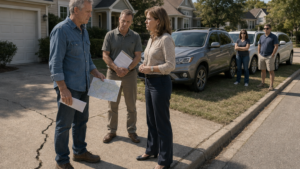
The tow truck hooked my work vehicle at 5:52 on a Thursday morning.
I woke to the metallic clank outside my bedroom and ran barefoot to the front window.
My SUV was already lifted at the rear.
The driver was tightening a chain.
I threw on shoes and went outside.
“What are you doing?”
He held up a printed authorization.
“Private tow.”
“This is my driveway.”
He looked at the paper again.
“HOA says the rear wheel crosses common pavement.”
I stared at him.
My driveway ended at the sidewalk. The SUV sat where it had sat for two years.
Across the street, a curtain moved.
“Put it down.”
“Ma’am, I’m just doing the call.”
“Then call whoever sent you.”
He sighed, but he did.
The truck lowered my vehicle after I showed him my deed packet and photographed his authorization. He left without charging me, though the incident still cost me forty minutes and one client call I had to take from the curb.
The authorization bore Carol’s signature.
By then, the citations had been arriving for three weeks.
Fence height.
Mailbox finish.
Trash container visibility.
Temporary plywood over a broken window.
A claim that my side gate blocked emergency landscaping access.
Each one came in the same cream envelope with the HOA logo in the corner.
I appealed every notice.
I told no one.
That was my mistake, though I did not understand it then.
I believed the cleanest response to a false claim was a correct document. I believed neighbors would lose interest if I refused to perform outrage for them. I believed Carol would eventually run out of rules before I ran out of evidence.
Instead, my silence left her an empty room to fill.
At the subdivision mailbox station, I began noticing conversations stop when I approached.
One Saturday, Elizabeth Green stood beside the recycling bins with her arms folded.
“You know people are scared, right?”
I kept sorting cardboard.
“About what?”
“The creek.”
I looked at her.
Elizabeth lived two lots downhill. I knew her well enough to wave and once had accepted a package for her, but not well enough to know why her voice shook when she said the word.
“You mean Carol’s project?”
“I mean water in people’s houses.”
“I’m not blocking drainage.”
“That’s not what we’ve been told.”
“Then you were told wrong.”
Elizabeth gave a short, tired laugh.
“Convenient.”
I set the cardboard down.
“What exactly did she tell you?”
“That the association has a long-standing access strip and you fenced it off. That contractors can’t clear the bank. That you’re threatening legal action if anyone crosses your property.”
The last part was almost true. I had written that no one should enter the disputed strip until ownership was established.
Almost true was more useful than a lie.
“When did this project start?” I asked.
Elizabeth stared at me.
“You really don’t know?”
She pulled out her phone.
An HOA newsletter from four months earlier showed a rendering of a widened creek corridor with a maintenance path, native plantings, and drainage work near the culvert.
The headline read: COMMUNITY CREEK RESILIENCE PLAN.
My property appeared in the diagram.
So did an access line.
It ran directly through the part of the bank Anna loved.
“Carol promised this before spring storms,” Elizabeth said. “Some of us thought work had already been approved.”
“Approved by whom?”
“The board.”
I zoomed in.
The drawing was too small to show parcel boundaries clearly.
“When did residents vote?”
Elizabeth’s expression hardened again.
“Maria, my basement took fourteen inches of water last year. I threw away my father’s tools because they sat in it overnight. I’m not interested in board-process games.”
Neither was I.
But that night, I opened every attachment I had.
The citations looked repetitive until I laid them side by side.
Then I saw the creek line.
On one notice, the supposed common corridor followed the water.
On another, it cut behind my fence.
On a third, it widened near the exact place where I had found the orange stake.
Three documents.
Three versions.
I printed them.
At midnight, Anna appeared in the doorway wearing pajamas.
“You said you were going to bed.”
“I am.”
“You always say that.”
I closed the laptop.
She looked at the stack of cream envelopes.
“Is the brick because of the creek?”
My answer took too long.
“I don’t know.”
“Is that lady going to take our backyard?”
“No.”
It came out firm.
Too firm.
Anna nodded the way children do when they realize adults are answering a different question.
The next morning, I drove to the HOA office.
Carol was not there. Robert Adams, the treasurer, sat behind a desk with a calculator and three bank statements spread before him.
“I need my complete appeals file.”
He adjusted his glasses.
“You should submit a records request.”
“I did.”
“Then it’s processing.”
“It has been eleven business days.”
Robert glanced toward the closed interior office.
Then he opened a cabinet.
“I can give you the materials attached to the active enforcement file.”
He handed me a thin folder.
I sat in my car and went through it page by page.
The fourth attachment stopped me.
A survey sketch.
My survey sketch.
I knew the coffee stain in the lower corner. I had submitted the copy eighteen months earlier when I replaced part of the rear fence after a storm.
The fence contractor had moved one section inward to avoid a large root system. I had meant to send the updated as-built attachment afterward.
I never did.
The old sketch showed the previous fence position.
Not the property boundary.
The fence.
My stomach dropped.
Carol had been calling it proof that I changed my claim.
Worse, I had given it to the HOA myself.
I sat in the car for ten minutes without moving.
Then my phone vibrated.
An email from the association.
EMERGENCY COMMUNITY MEETING.
The body of the message named me.
“Documentation recently obtained,” it said, “raises serious concerns regarding a homeowner’s inconsistent representations of creek-corridor boundaries.”
Attached was the old sketch.
At the bottom, in bold:
THE BOARD WILL PRESENT THE RECORD TO MEMBERS TUESDAY AT 7:00 P.M.
Chapter 3: I Admitted My Mistake Before She Could Use It
My own flawed survey attachment was already on the clubhouse wall when I walked in.
Projected twelve feet wide.
The coffee stain in the corner looked like a dark island.
Every folding chair was occupied.
Carol stood beside the screen with a remote in one hand. Robert sat at the board table without looking at me. Elizabeth was in the second row.
Someone near the back whispered, “That’s her.”
I carried a cardboard document tube beneath one arm and a grocery bag in the other.
Carol smiled.
“Maria. Thank you for coming.”
I had imagined several versions of that moment.
In all of them, I said something cutting.
Instead I chose a seat near the aisle.
Carol called the meeting to order.
She began with flood risk.
That was smart.
Photographs appeared: muddy water over patios, standing water near foundations, a collapsed section of bank. No exaggeration was necessary. The damage was real.
“Our community has delayed action too long,” she said. “The proposed corridor allows maintenance access, debris removal, stabilization, and future emergency response.”
People nodded.
Then she changed the slide.
My old sketch.
“Unfortunately, implementation has been obstructed by inconsistent private claims.”
She did not say my name immediately.
She did not have to.
“This document was submitted by the homeowner herself.”
A murmur moved through the room.
Carol advanced to another slide showing a newer line I had used in an appeal.
“The same homeowner later asserted a materially different position.”
Elizabeth turned to look at me.
Carol’s voice remained calm.
“No one wants conflict. But when individual representations interfere with infrastructure serving dozens of homes, the board has a duty to respond.”
There it was.
Not a villain’s speech.
A reasonable sentence wrapped around a false conclusion.
Carol looked at me.
“Would you like to explain?”
I stood.
My legs felt unsteady, which irritated me more than the whispers.
“Yes.”
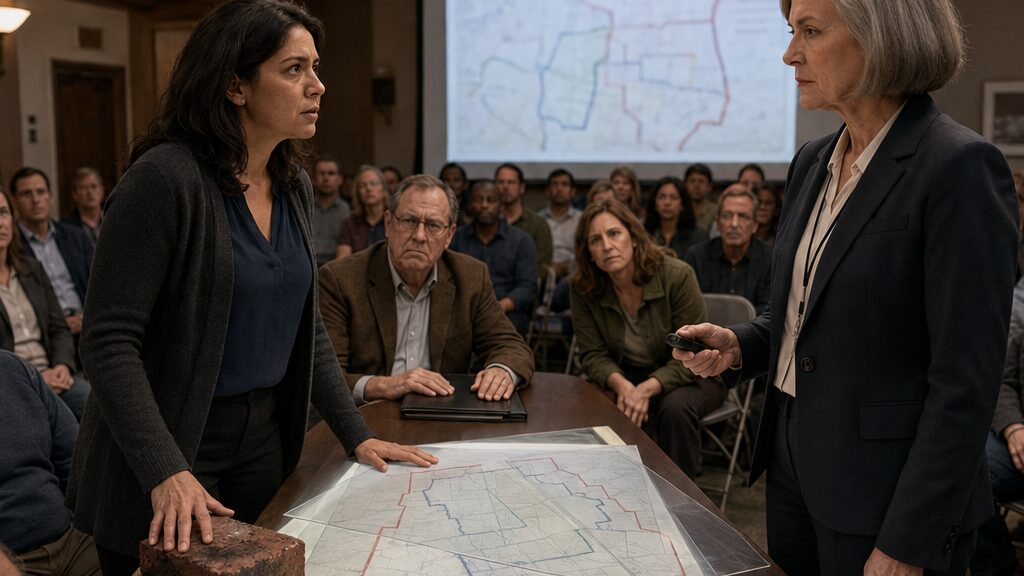
I carried the grocery bag to the front table and removed the brick.
The room changed.
Even Carol stepped back.
It had been released from police evidence after photographs and prints produced nothing useful. I had kept it in a box in the garage.
I set it on the table.
A dull red weight.
“This came through my kitchen window while my daughter was eating breakfast.”
Carol’s face hardened.
“That incident is not on tonight’s agenda.”
“I know.”
“Then I would ask you not to imply—”
“I’m not implying anything.”
I heard my own voice and realized how tired it sounded.
“I don’t know who threw it.”
That quieted the room more effectively than accusation would have.
“I brought it because since that morning, every disagreement about this creek has felt like something I needed to survive instead of explain.”
I looked at the projected sketch.
“And that has made me worse at explaining.”
Carol’s expression shifted.
She had expected denial.
I pulled the first transparent sheet from the document tube.
“The attachment on the wall is outdated.”
A sharper murmur.
Someone said, “There.”
I kept going.
“I submitted it eighteen months ago during a fence repair. It shows the old fence position. I was supposed to provide the updated as-built attachment afterward.”
I looked toward Elizabeth.
“I didn’t.”
Carol folded her arms.
“Thank you.”
“I’m not finished.”
I placed the transparent sheet on the overhead document surface I had asked the board secretary to provide. The projector changed to the original recorded plat.
“This is the parcel plat.”
Second sheet.
“This is the fence attachment I failed to update.”
Third sheet.
“And this is the project drawing circulated by the HOA.”
I aligned the corners.
Three creek lines appeared.
For a moment, the room was silent simply because people were trying to understand what they saw.
I pointed to the first line.
“Recorded parcel boundary.”
Then the second.
“Old fence position. My mistake.”
Then the third.
“Project access line.”
Carol said, “These are not comparable documents.”
“No. They aren’t.”
I slid the project overlay half an inch.
The line crossed farther into my property than either of the others.
“That’s the problem.”
People leaned forward.
The project corridor did not merely follow my old fence mistake. It extended beyond it.
Near the creek bend, the difference was almost twelve feet.
Elizabeth stood.
“Can you zoom in?”
The board secretary adjusted the projector.
The shifted line filled the wall.
Carol moved toward the screen.
“The project map is conceptual.”
“Then why is code enforcement using the same line?”
I placed three citations beside the brick.
One by one.
Each referenced obstruction within the proposed corridor.
Carol’s mouth tightened.
“The board has relied on historical common access.”
“Show me the easement.”
“We are not conducting a title hearing.”
“You are fining me as though you already did.”
A man in the back said, “She’s got a point.”
Carol turned.
“This is precisely why infrastructure planning becomes impossible. We have residents demanding immediate flood protection and others insisting every procedural question be litigated before a shovel moves.”
Elizabeth spoke from the second row.
“Was this exact line approved?”
Carol did not answer immediately.
That was the first visible crack.
Robert looked down at the table.
I noticed.
“Robert?”
His head came up.
Carol said, “The treasurer is not responsible for engineering design.”
“I’m asking whether the board approved this line.”
Robert rubbed one thumb along the edge of his folder.
“The board approved funding for preliminary work.”
“That wasn’t my question.”
Carol stepped between us.
“This meeting is becoming adversarial.”
I almost laughed.
Instead I picked up the old fence attachment.
“This is what you brought everyone here to see. My mistake. So let’s see all of it.”
I held it up.
“I submitted an outdated attachment. I should have corrected it. I didn’t. If the board wants that entered in the minutes, enter it.”
The room went still.
Carol’s easiest weapon disappeared in my own hand.
I continued.
“But this map does not prove your corridor. It proves my fence moved. Those are not the same thing.”
Elizabeth looked from one overlay to another.
Then she said, “Where did the project line come from?”
Carol’s answer was smooth but too fast.
“From planning materials developed through the drainage initiative.”
“Who authorized it?”
“A combination of consultants and board review.”
“Which vote?” I asked.
Carol’s face changed.
Not panic.
Calculation.
She reached for the remote.
“We have spent enough time on one homeowner’s interpretation.”
“Then put the authorization packet on the screen.”
“I said enough.”
That was when Robert moved.
Only a little.
He closed the folder in front of him.
Carol noticed.
So did I.
The rest of the meeting broke into argument. Residents demanded to know whether construction was delayed. One board member complained that no one had received the overlays before that night. Another insisted the project was necessary regardless of boundary disputes.
Carol adjourned early.
People gathered in knots instead of leaving.
Elizabeth approached me but stopped before speaking.
“I still need my basement protected,” she said.
“I know.”
“You didn’t before.”
That landed harder than accusation.
“No,” I said. “I didn’t.”
She nodded once and walked away.
I rolled the overlays carefully.
The brick remained on the table.
When I reached for it, Robert appeared beside me.
He looked older than he had that morning in the HOA office.
“Maria.”
I waited.
He checked whether Carol was still in the room.
She was near the exit, speaking sharply to one of the board members.
Robert lowered his voice.
“That project map.”
“What about it?”
He glanced at the transparent sheet in my hand.
Then he said, “That map was never in the budget packet I signed.”
Chapter 4: The Project Was Spending Money Before It Owned Access
The county records clerk searched the parcel index twice before looking up at me.
“There’s no recorded easement matching that description.”
I kept both hands flat on the counter.
“Try the association name.”
“I did.”
“The developer?”
“I did.”
“Historical access?”
She turned the monitor slightly, not enough for me to read everything, only enough to show a list of entries.
“Utility easement. Drainage easement near the road. Temporary construction easement from when the subdivision was built. Nothing giving the HOA a maintenance corridor across the rear of your parcel.”
I had spent thirteen days preparing to hear that answer.
It still frightened me.
“Could something exist and not be recorded?”
“Anything is possible.” She leaned back. “But if someone is claiming a permanent property right, I’d want to know what instrument creates it.”
I wrote down the search references.
“Can I get certified copies?”
“Of what exists, yes.”
“What about what doesn’t?”
That earned the first hint of a smile.
“We don’t certify absence. We certify records.”
Facts again.
Never as complete as I wanted them to be.
I left the county building with a folder under my arm and Carol’s project map folded inside my bag. On the courthouse steps, I called the property surveyor who had prepared my original plat review.
He could not inspect the site for another week, but he studied the documents I emailed.
His response arrived that afternoon.
The project line, he wrote, did not correspond cleanly to the recorded parcel boundary, the old fence position, or any easement shown on the title materials I had supplied.
Not proof.
But no longer just my suspicion.
I started a timeline.
As a bookkeeper, I trusted dates more than motives.
First public newsletter announcing the creek project.
First contractor mention.
First board minutes referencing preliminary drainage work.
My first objection.
My first citation.
The emergency meeting.
Then I requested invoices.
The HOA delayed.
I requested them again.
Robert sent a partial packet three days later with a note that read: These are the records currently available to me.
Currently available.
I printed every page.
One invoice carried a date six weeks before the board vote Carol had cited during the meeting. Another showed a deposit to a contractor for “mobilization and corridor preparation.”
I circled the date.
Then I found a project drawing attached to the payment request.
The creek line was already there.
The shifted version.
Money had moved before the supposed approval.
I was still staring at it when someone knocked on my front door.
Elizabeth stood outside with a plastic storage bin.
“I’m not here to argue.”
“That’s reassuring.”
She almost smiled.
Then she lifted the bin.
“You need to see something.”
We sat at my kitchen table beneath the new window.
I noticed she looked at it before sitting down.
From the bin she removed photographs sealed in sandwich bags.
A basement wall stained brown three feet above the floor.
A child’s bicycle half-submerged.
Boxes collapsed into pulp.
A workbench under muddy water.
“My house,” she said.
I turned over one photograph.
The date was from the previous spring.
“This was after the big storm?”
“After the second one.”
She placed another photograph beside it.
“My father died five years ago. Those were his tools.”
The picture showed rust spreading across a row of wrenches.
“I’m sorry.”
“I don’t need you to be sorry.”
Her voice was sharp, then softened.
“I need you to understand why I believed Carol.”
I looked at her.
“She came door to door after this. Said the creek corridor was the only realistic way to get equipment behind the lower lots. Said one homeowner was holding everything up.”
“Me.”
“Yes.”
“Did she say the access was disputed?”
“No.”
“Did she say there was no recorded easement?”
Elizabeth’s face tightened.
“No.”
I slid the contractor invoice across the table.
“She was spending before the approval she showed us.”
Elizabeth read the date.
“That doesn’t mean the project was fake.”
“I didn’t say it was.”
“Then what are you saying?”
“That people needed drainage work. And somebody decided needing it badly enough made the property question optional.”
She looked toward the backyard.
For the first time, I wondered how many conversations like this I could have had earlier.
How many I had avoided because I preferred records to people.
Elizabeth touched the invoice.
“If this project dies, the water doesn’t care whose paperwork was right.”
“I know.”
“You didn’t before.”
The same words she had used after the meeting.
This time I did not defend myself.
That evening Anna ate dinner at the kitchen island.
I told her I might need to meet with more neighbors.
She kept pulling cheese from her sandwich.
“Are they mad at us?”
“Some are.”
“Because of the creek?”
“Yes.”
“Are they going to come in the backyard?”
“No one is allowed to do that without permission.”
She looked up.
“That’s not what I asked.”
I put down my fork.
“What did you ask?”
She hesitated.
Then, very quietly, “Are they going to come anyway?”
The room seemed to contract around us.
I had promised her this house would be stable.
After months of disruption before we moved here, after boxes and temporary rooms and adults telling her not to worry, I had chosen this place because of the creek.
Because she had stood at the fence during the showing and watched fireflies rise from the bank.
“No,” I said.
Again, too firm.
Anna pushed back from the island.
“I don’t go down there anymore.”
I stared at her.
“What?”
“To the creek.”
“Since when?”
She shrugged.
“Since the window.”
I had seen her avoid the path.
I had called it caution.
I had not asked.
That failure sat between us longer than any accusation Carol had made.
Two days later, the surveyor confirmed there was no visible marker supporting the HOA’s project line. He cautioned that a full boundary opinion would require more work, but the immediate issue was clear enough: the line being enforced had no obvious relationship to the recorded materials.
I added his note to the timeline.
Then I added the contractor deposit.
The project drawing.
The newsletter promise.
The board vote.
The sequence looked wrong.
Not dramatic.
Worse.
Ordinary enough to have happened one shortcut at a time.
I stayed late at a client’s office that Friday, finishing payroll corrections I had postponed during the records fight.
When I turned onto our street, I smelled smoke before I reached my driveway.
At first I thought someone had a fire pit going.
Then I saw Anna standing on Elizabeth’s front lawn.
Barefoot.
Crying.
I braked so hard my bag fell from the passenger seat.
Behind my house, above the fence line, a dark ribbon of smoke climbed through the trees.
Chapter 5: The Burned Fence Made Every Earlier Threat Look Different
One side of the rear fence was still smoking when I ran into the backyard.
“Mom!”
Anna’s voice came from behind me, but I did not turn until Elizabeth caught my arm.
“She’s safe.”
I looked at her.
“I got her out.”
Only then did I understand that Anna was not in the house.
The fire had eaten through the dry weeds along the creek bank and blackened six fence panels. Two posts leaned inward. The little solar lights Anna and I had hung along the path had melted into warped black shapes.
A thin flame moved through grass near the water.
I grabbed the garden hose.
“Maria, the fire department is coming.”
I sprayed anyway.
The water struck a smoking post and threw ash back across my shirt.
By the time firefighters finished soaking the bank, the sky had gone dark.
The fire investigator walked the edge with a flashlight.
“Any fuel stored back here?”
“No.”
“Gasoline? Lawn equipment?”
“In the garage. Front side of the house.”
He crouched near the fence.
“Anyone have authorized access?”
“No.”
The word came out before I thought about contractors, surveyors, HOA claims.
He looked up.
“No one?”
“Not without asking me.”
That answer was truer.
A responding police officer took photographs. Elizabeth kept Anna inside her house while I answered questions.
“Any ongoing disputes?”
“Yes.”
The officer paused with his pen above the page.
I gave him Carol’s name.
This time I did not pretend uncertainty about the conflict.
But when he asked whether I had evidence connecting her to the fire, I had none.
Not then.
The damage estimate came later.
Fence replacement. Landscaping. Cleanup. Electrical work for a small outdoor outlet damaged near the path.
More than I could comfortably absorb.
Insurance would cover some of it.
Not all.
At midnight, after Anna finally slept in my bed, I remembered the camera.
It was mounted beneath the back eave, installed after the brick.
I had checked it every day for a week.
Then less often.
I opened the app.
The first clip showed darkness.
The second, a cat.
The third made me stop breathing.
11:43 p.m.
A figure entered from the far side of the creek bend.
Gray hair caught the infrared light.
Dark jacket.
Careful steps.
Carol.
I replayed it.
She moved along the disputed line carrying a red container.
My hands went cold.
In the clip she stopped near the orange stake, looked toward my house, then continued beyond the camera’s clearest angle.
The recording ended.
The next clip began seven minutes later.
Empty bank.
No flame.
I watched all night.
At 12:18, the camera caught a faint glow beyond the fence.
At 12:22, smoke.
No ignition.
No hand pouring fuel.
No match.
But Carol had been there.
With a red container.
The next morning I drove straight to the police station.
I handed over copies of the clips.
For the first time since the brick, I felt something close to certainty.
That feeling lasted four hours.
The fire investigator called me into a small interview room.
He had printed still frames.
“This is Ms. Wright?”
“Yes.”
“You’re certain?”
“Yes.”
“And this container?”
“It looks like a gas can.”
“It could be.”
“It is.”
He studied me.
“Ms. Torres, I understand why you believe that.”
“She was on my property.”
“Near your property.”
“My camera shows her crossing the line.”
“The exact boundary is disputed.”
I almost stood.
He raised a hand.
“I’m not taking her side.”
“Then whose side are you taking?”
“The evidence.”
The word hurt because it was mine.
He pushed one still toward me.
“We can establish she was present. We may establish the container type. We do not have footage of ignition.”
“The fire starts right after.”
“More than half an hour later.”
“She threatened me.”
“That matters.”
“She lied about being there.”
“Did she?”
I froze.
“What?”
“Has anyone formally asked her yet?”
I hated him for the question.
Because I knew what he was doing.
Separating what I knew from what I had assumed.
The same discipline I had demanded at the HOA meeting.
I left angry enough to shake.
At home, Anna was drawing at the kitchen table.
The repaired window reflected the afternoon behind her.
She looked up.
“Did they catch her?”
I set down my keys.
“No.”
“But you saw her.”
“I saw her by the creek.”
“With the gas thing.”
“Yes.”
“Then why?”
I sat across from her.
“Because seeing part of something isn’t the same as seeing all of it.”
Anna stared at me.
“That’s stupid.”
“Yes,” I said. “Sometimes it feels that way.”
Later, Carol came to the curb while I was photographing the damage.
She did not cross into the yard.
Smart.
“I heard you gave the police video.”
I kept my phone aimed at the fence.
“Were you here that night?”
She looked toward the creek.
“I inspect common areas.”
“With a fuel can?”
Her jaw tightened.
“You have no idea what was in that container.”
“So you were here.”
“I did not say that.”
“You just did.”
Carol stepped closer to the edge of the driveway.
“You are taking a complicated community problem and turning it into a personal campaign.”
“My fence burned.”
“And lower homes flood.”
“My daughter was here.”
“So were dozens of families the last time the creek came over its banks.”
For one dangerous second, I understood her.
Not forgave.
Understood.
She saw every question as delay.
Every boundary as obstruction.
Every person between her and completion as the reason someone else would suffer.
Then she made her choice.
“You should be very careful,” Carol said, “about accusing people of crimes you cannot prove.”
She walked away.
I wanted to send the footage to every resident in the subdivision.
I drafted the email.
Attached the clip.
Wrote the subject line.
CAUGHT ON CAMERA.
My finger hovered over Send.
Then I saw the black screen between clips.
Thirty-five missing minutes between her presence and visible smoke.
I deleted the draft.
The restraint tasted like defeat.
Three days later, the fire investigator called.
The cause remained undetermined.
He could not rule out intentional ignition.
He could not establish it.
The red container in the footage was relevant, he said, but not conclusive.
I thanked him because I did not trust myself to say more.
That afternoon I found Anna’s melted creek lights in a contractor’s debris pile.
I saved one.
Not because it proved anything.
Because I had finally understood what my silence was costing her.
At 7:16 that evening, my phone vibrated.
A message from Robert.
We need to meet privately.
I did not answer.
A second message appeared.
I have the original payment ledger.
Then a third.
Carol does not know I kept it.
Chapter 6: Robert’s Silence Was Bought by Fear, Not Loyalty
Robert opened the ledger to a payment made twenty-three days before the board vote.
He did not greet me first.
We sat in a closed diner after hours because, he said, the owner owed him a favor. Only the lights above our booth were on. The rest of the room disappeared into dark rows of tables.
Robert turned the book toward me.
“There.”
The entry listed a contractor deposit.
I read the date twice.
“Mobilization?”
“Yes.”
“For a project that wasn’t approved yet.”
“Preliminary work.”
“That’s what you called it?”
“That’s what Carol called it.”
I looked up.
Robert’s eyes were red from lack of sleep.
“How much?”
He tapped the figure.
My stomach tightened.
“Why would you release that?”
“I didn’t.”
“You’re the treasurer.”
“I prepared the checks. Carol had authority under the emergency maintenance threshold for certain expenditures.”
“This was above that.”
“Split across two invoices, it wasn’t.”
I sat back.
The diner refrigerator hummed behind the counter.
“You knew.”
“I knew the payment timing was aggressive.”
“Don’t do that.”
His face stiffened.
“Do what?”
“Use accounting words to make fear sound procedural.”
He looked down.
For a moment, neither of us spoke.
Then he said, “My basement flooded twice.”
I waited.
“The second time, my wife was out of town. I carried boxes upstairs until three in the morning. Family photographs. Tax records. Everything from my father’s house after he died.”
His thumb rested on the ledger margin.
“I had six inches of water around the furnace.”
I thought of Elizabeth’s photographs.
Robert continued.
“Carol found a contractor willing to move fast. Residents were already threatening to sue the association for failed maintenance. Our reserve account was thin. A special assessment would have been ugly.”
“How ugly?”
“For some people? Annoying. For others? Enough to make them sell.”
“So you paid first.”
“I told myself the access issue would be cleaned up.”
“By taking my land?”
“I told myself the historical corridor was probably real.”
“Probably.”
“Yes.”
The word barely reached me.
“And when you saw the project map?”
“I asked where the line came from.”
“What did Carol say?”
“Consultant review.”
“You believed her?”
Robert closed his eyes.
“No.”
There it was.
Not corruption in the form I had wanted.
No secret loyalty.
No dramatic payoff.
A tired man who suspected something was wrong and preferred the version of events that protected his basement and his balance sheet.
“You let her use that line against me.”
“Yes.”
“You sat there while she called me dishonest.”
“Yes.”
Anger rose in me clean and hot.
“You could have stopped it.”
“Maybe.”
“Don’t say maybe.”
He met my eyes.
“I could have spoken.”
That was worse because it was honest.
I stood and walked to the dark front windows.
Outside, the parking lot was empty.
“You want forgiveness?”
“No.”
“Good.”
“I want the record corrected.”
I turned.
“Now?”
He flinched.
Just slightly.
“Now that there’s a fire?”
“Yes.”
“Now that Carol might pull you down with her?”
“Yes.”
I almost left.
Then I looked at the ledger.
Useful truth did not become useless because the person carrying it had failed me.
That lesson felt unfair.
I sat again.
“What else?”
Robert exhaled.
He showed me contractor dates.
Emails referenced in payment notes.
A budget packet with no shifted map attached.
Then a later project file where the corridor suddenly appeared as if it had always existed.
“I kept asking for the approval chain,” he said.
“And?”
“Carol said delay would kill the contract.”
“Did anyone backdate anything?”
“I don’t know.”
“Did you sign records you shouldn’t have?”
“No.”
The answer was immediate.
Then he added, “But I approved minutes I hadn’t read carefully.”
Mixed motives.
Small failures.
The machinery of damage rarely looked dramatic when spread across enough people.
We moved to the HOA records room after midnight.
Robert unlocked the cabinet.
Inside were binders I had been requesting for weeks.
“You denied these existed?”
“I said they weren’t available to me.”
“That was a lie.”
“Yes.”
He removed a folder.
“I thought I was protecting the association.”
I took it from him.
“No. You were protecting a decision.”
He did not argue.
Near two in the morning, we found the sequence.
Contractor discussion.
Preliminary deposit.
Resident newsletter promising the project.
Internal concern about access.
Then the later line drawing.
The project had not followed the property right.
The property claim had followed the project.
I photographed everything.
At home, an envelope waited beneath my front door.
No HOA logo.
A law office return address.
Inside was a proposed settlement.
The terms were almost generous.
The HOA would withdraw outstanding citations.
Pay part of my fire-related deductible without admitting responsibility.
Cover replacement landscaping.
Suspend enforcement while a revised drainage plan was prepared.
In exchange, I would withdraw complaints against the association and its officers.
I read it twice.
Then I saw the easement clause.
Permanent access.
Twelve feet wide along the creek bank.
The exact corridor shown on Carol’s altered project map.
I sat at the kitchen table until sunrise.
Anna came in wearing socks and carrying her blanket.
“What’s that?”
“A choice.”
She climbed onto the chair beside me.
“Good choice or bad choice?”
“I don’t know yet.”
She leaned against my arm.
For months I had wanted safety.
Here it was, at least on paper.
The citations gone.
Some money back.
The fighting reduced.
No more public meetings if I chose silence.
Then I imagined the permanent access line crossing the place where Anna used to watch fireflies.
Not because drainage work could never happen.
Because Carol wanted the disputed outcome legalized after the pressure had already been applied.
Anna touched the final page.
“Is this about the creek?”
“Yes.”
“Are they taking it?”
I looked at the signature line waiting for my name.
For the first time, I did not tell her no.
I said, “They’re asking
Chapter 7: I Refused the Deal and Put My Own Error on the Record
The first thing I did at the special board hearing was correct myself.
Carol had not yet opened her folder.
The room was full, though quieter than the emergency meeting had been. No one whispered when I walked in this time. The soot-stained brick sat in my bag beside the corrected overlays, Robert’s ledger copies, contractor invoices, and a timeline I had spent two nights checking until every date matched a source.
I stood before the board.
“I want the minutes to reflect something before I make any accusation.”
Carol looked at me sharply.
I placed my outdated fence attachment on the table.
“This document was mine. I submitted it. It was no longer accurate after the fence repair, and I failed to replace it.”
A board member leaned toward the microphone.
“Ms. Torres, that issue has already been discussed.”
“Not completely.”
I looked at the residents.
“I let people think facts would explain themselves. They didn’t. I let my silence become room for other people to guess.”
Anna was not there. I had asked Elizabeth to stay with her.
For once, I did not pretend that keeping the hard part away from my daughter meant it disappeared.
“I made the record less clear,” I said. “That matters.”
Carol folded her hands.
“Thank you. Then perhaps we can finally acknowledge why the board had concerns about your shifting claims.”
I removed the first transparent overlay.
“No.”
The word came out calm.
“I’m acknowledging my error so we can stop using it to hide yours.”
The room tightened.
I placed the recorded plat on the projector surface.
Then the outdated fence attachment.
Then the HOA project map.
The three lines appeared again.
This time I added dates.
“The original parcel record predates all of us.”
I pointed to the second sheet.
“My fence attachment came later. Wrong for the current fence position. My responsibility.”
Then the third.
“This project line appeared after the first contractor deposit.”
Carol interrupted.
“Preliminary expenditures are normal.”
“Yes.”
I placed the ledger copy beside the overlays.
“So let’s look at them.”
The projector changed.
A payment date.
Then another.
Then the board vote Carol had repeatedly described as the project authorization.
The first deposit came before it.
The second payment came before it.
A resident near the aisle said, “How?”
Robert sat rigidly at the board table.
Carol turned toward him.
He did not look away this time.
I continued.
“The project was spending money before the approval date given to residents.”
Carol rose.
“That is a grossly misleading characterization. The association faced an urgent drainage problem. Contractors require deposits. Engineering requires preliminary work.”
“Then why wasn’t the access problem disclosed?”
“It was being resolved.”
“By whom?”
“Through board process.”
“Show the vote.”
Carol’s expression hardened.
I placed another document on the projector.
An internal payment reference.
Then the budget packet Robert had signed.
No corridor map.
Then the later project file.
Shifted line.
“There is no approved map in the packet tied to the first payments,” I said. “The access line appears later.”
A board member turned to Robert.
“Is that accurate?”
Robert swallowed.
“Yes.”
The room changed.
Not loudly.
That was the worst part for Carol.
People stopped reacting to her and started reading.
She pushed back from the table.
“You are all pretending this happened in a vacuum.”
No one spoke.
Carol looked toward Elizabeth, who had entered late and stood against the back wall.
“Ask the lower-lot owners what another season of flooding costs. Ask them whether they wanted six more months of title review while water came into their homes.”
Elizabeth’s face tightened.
Carol continued.
“We had reserve problems. Litigation threats. Contractors threatening to walk. Residents demanding action from the same board they now accuse of moving too quickly.”
For a moment, I saw the version of herself Carol had been protecting.
The woman who had promised a solution.
The president who believed finishing the project would justify every shortcut taken to get there.
She looked at me.
“You had a fence discrepancy. We had historical use. We had community need. You turned every attempt at access into a fight.”
“That isn’t permission.”
“No. It was reality.”
I thought of the settlement in my kitchen.
The citations withdrawn.
The damage money.
The permanent easement hidden inside relief.
I took it from my folder.
Carol’s face changed.
“This arrived after the fire,” I said.
One board member reached for it.
I did not hand it over yet.
“I was offered peace.”
The room stayed silent.
“Withdraw complaints. End the enforcement dispute. Get some money back.”
I turned to the easement clause.
“And sign permanent access over the same line that appeared after the spending began.”
Carol said, “Settlement communications are confidential.”
“I haven’t signed anything.”
“Your attorney—”
“I don’t have one.”
That caused a murmur.
Carol stopped.
I placed the proposal on the table.
“This is what finally made the sequence clear to me. The project needed access. The access wasn’t established. Money was already committed. Then enforcement began.”
I laid out the dates.
First deposit.
Newsletter promise.
Internal access concern.
My first citation.
Second payment.
Altered corridor map.
Emergency enforcement.
The pattern did not prove every motive.
It did not solve the fire.
It did not identify who threw the brick.
It did something harder.
It showed what decisions had been made before the story residents were given.
Carol looked at Robert.
“You knew the financial exposure.”
“Yes,” he said.
“And you said nothing.”
“Yes.”
“Because you agreed the project was necessary.”
Robert’s mouth tightened.
“Yes.”
There was no triumph in the answer.
Carol turned back to the room.
“You see?”
“I do,” Elizabeth said.
Everyone looked at her.
She stepped away from the wall.
“My basement flooded too.”
Carol’s face softened slightly.
“Exactly.”
Elizabeth shook her head.
“No. That’s why I believed you.”
She walked toward the front.
“I needed the project to be real so badly I stopped asking whether Maria’s property claim was real too.”
Carol’s shoulders stiffened.
Elizabeth looked at me.
“I still think the drainage work has to happen.”
“So do I,” I said.
That surprised several people.
Carol laughed once.
“Now you say that.”
“Yes. Now I say it publicly.”
I looked around the room.
“I was wrong to act as if everyone supporting the project was supporting what happened to me. Some people were scared. Some people had water in their homes. Some people stayed quiet because they thought the alternative was worse.”
Robert lowered his eyes.
“But fear does not create an easement.”
I placed my hand on the brick.
“And damage does not become acceptable because the project goal was useful.”
The hearing lasted another hour.
The board went into a closed procedural consultation, then returned.
Carol sat with her hands flat on the table.
The vote to remove her as president was not unanimous.
That mattered to me.
It meant this was not theater.
One member voted no.
One abstained.
The rest voted yes.
Carol did not collapse.
She gathered her papers.
For one brief second, she looked at the creek map on the projector.
Then at me.
“You still have a drainage problem,” she said.
“I know.”
That was the last thing she said before leaving.
The board froze new project spending pending independent review.
The citations against me were suspended.
Not erased yet.
Suspended.
The settlement proposal was withdrawn from consideration.
Then one of the board members looked toward me.
“We need a lawful access solution before next storm season.”
I nodded.
He glanced at Elizabeth, then Robert.
“We’re forming a temporary easement working group with an independent surveyor and outside records review.”
I waited.
Then he said, “Ms. Torres, will you serve?”
My first instinct was no.
Protect my land.
Protect Anna.
Keep my distance.
That instinct had carried me through shattered glass, citations, smoke, and a room full of accusations.
It had also left my daughter believing danger was larger than anything I could explain.
I looked at the three creek lines on the wall.
Then at the one place where none of us had yet drawn a fourth.
“Yes,” I said.
“But every map goes to every resident.”
Chapter 8: When the Creek Turned Green Again, Anna Still Hesitated
The new fence was finished by spring, but Anna stopped six feet from the creek.
I had imagined that moment differently.
For months, I pictured her running down the restored path as soon as the workers left. I pictured relief arriving all at once, as visible as green grass replacing ash.
Instead she stood beside me with both hands in her jacket pockets.
The bank had been replanted with native grasses.
The blackened soil was gone.
A narrower maintenance path ran along a negotiated route that avoided the center of our yard and connected only where the independent survey showed legal access could be created by agreement.
Not assumption.
Not pressure.
Agreement.
Elizabeth had signed a limited drainage easement on part of her lot. I had signed one on a smaller section near the culvert approach, with hours, purposes, notice requirements, and restoration obligations written into the document.
The HOA paid for independent surveying.
Project invoices were reviewed.
The reserve fund took a hit.
Legal fees did not disappear because Carol lost a vote.
Some neighbors still blamed me for the delay.
Others blamed the board for everything.
Robert resigned as treasurer after the review.
He stayed in the neighborhood.
Carol did too.
Justice, I learned, did not remove people from the grocery store.
Anna stared at the water.
“You can go down,” I said.
“I know.”
“We don’t have to.”
“I know.”
A dragonfly crossed the path.
She did not move.
The old solar lights had been replaced, but I had not turned them on.
I had been waiting for her.
That, too, was a kind of pressure.
I sat on the lowest step.
“Can I tell you something?”
Anna looked at me suspiciously.
“I thought not talking made things safer.”
She kicked at the edge of the path.
“You talked a lot.”
“At meetings.”
“Not to me.”
There was no defense.
So I did not make one.
“You’re right.”
She looked toward the fence.
“When the fire happened, I thought you knew who did it.”
“I thought I did.”
“Was it Carol?”
The question had lived between us for months.
“The investigators never proved who started it.”
Anna frowned.
“But she was there.”
“Yes.”
“With the red can.”
“Yes.”
“Then why isn’t that enough?”
I watched the creek move around a branch caught near the bank.
“Because part of the truth isn’t always the whole truth.”
She made a face.
“You said that before.”
“I know.”
“It’s still annoying.”
I smiled.
“A lot of true things are.”
She sat beside me.
For a while, we listened to water.
Then she said, “Did Carol lie?”
“Yes.”
“Did Robert?”
“Yes.”
“Did you?”
The question caught me.
I could have answered no.
I had not fabricated maps.
I had not invented an easement.
I had not denied the fire footage.
But Anna was not asking about documents.
“Yes,” I said.
Her eyes lifted.
“When?”
“When I kept telling you everything was fine because I wanted you to feel safe.”
She considered that.
“That was a bad lie.”
“Yes.”
“Did it work?”
“No.”
She nodded, satisfied by the accuracy.
The independent drainage work took three months.
The contractor stabilized the lower bank, cleared debris near the culvert, and installed access protections that did not require treating my yard as association property.
Elizabeth’s basement had stayed dry through two heavy storms.
Not proof of permanent success.
But enough to let people breathe.
The HOA adopted a records rule requiring project maps, votes, and payment authorizations to be available to members before major work began.
Boring changes.
The kind that never went viral.
The kind that mattered.
Anna stood.
I expected her to head back toward the house.
Instead she walked to the first solar light.
She crouched beside it.
“Can I?”
“Yes.”
She flipped the switch.
One small amber bulb came alive.
Then the next.
She moved slowly down the path, turning them on one by one.
I stayed where I was.
When she reached the creek, she did not kneel beside the water as she once had.
She stood two steps back.
That was enough.
Later, we carried a folding table outside to review the final restoration map before the working group’s last meeting.
A breeze kept lifting one corner.
Anna disappeared into the garage.
She returned carrying the brick.
I froze.
For months, it had sat on a shelf inside a clear box.
Evidence that had proved almost nothing.
Memory that had proved too much.
“Anna.”
“It’s heavy.”
“I know.”
She set it carefully on the map.
The paper flattened beneath it.
The old red brick held down the corner showing the creek line.
Not Carol’s line.
Not my old fence line.
The surveyed boundary, the limited easements, the maintenance route, all marked separately.
Clear enough that no one had to pretend they were the same thing.
Anna leaned over the map.
“Is this ours?”
She pointed to the grass beside the creek.
“Yes.”
“And this?”
“The maintenance path.”
“Can they just come whenever?”
“No.”
“They have to ask?”
“Unless there’s a real emergency.”
She nodded.
Then she pointed to Elizabeth’s lot.
“That part helps her basement?”
“Yes.”
Anna traced the route with one finger.
“So everybody got something.”
I looked at the brick holding the page open.
“Not everything.”
She seemed to think about that.
Then the first fireflies appeared above the bank.
Only two at first.
A small pulse near the reeds.
Then another beneath the sycamore branches.
Anna saw them before I did.
She stepped away from the table.
Not running.
Not yet.
But she walked toward the creek.
At the first solar light, she turned back.
“Mom?”
“Yes?”
“Are you coming?”
I left the map where it was.
The old brick stayed on the table, holding the line in place while the two of us went down to the water.
The story has ended.