The Day They Paved Daniel’s Driveway and Forced Him to Defend More Than His Property
Chapter 1: The Asphalt Crew Arrived Before Daniel Finished His Coffee
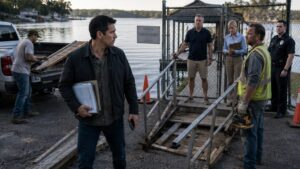
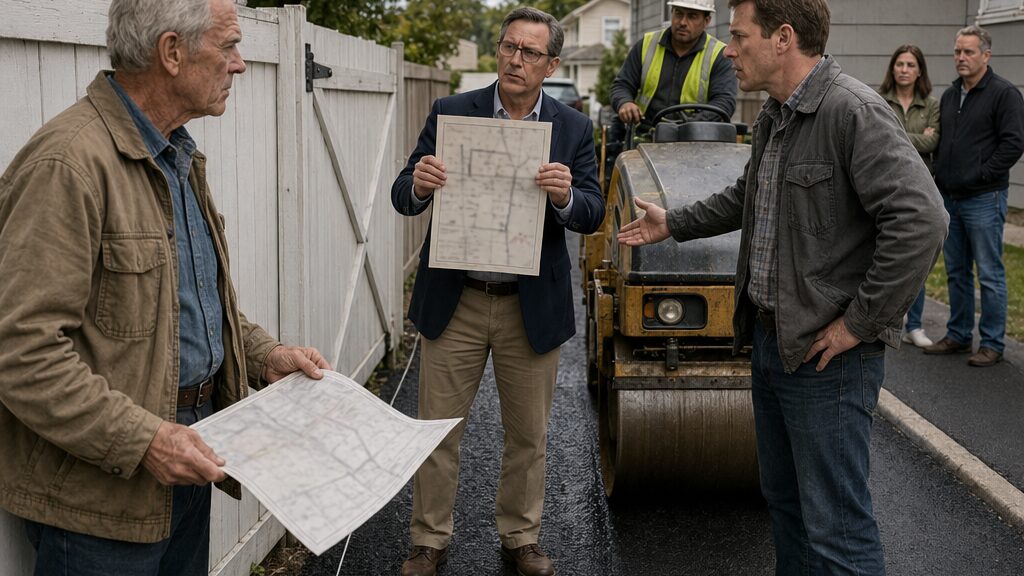
The roller crossed Daniel Hall’s property line before he had taken the second sip of coffee.
He saw it through the kitchen window: a low orange machine shuddering beside the white fence, its steel drum pressing a ribbon of black asphalt over the narrow strip between his house and the Walkers’ new place. The operator leaned forward against the vibration. Behind him, two workers raked steaming pavement toward Daniel’s backyard gate.
Beneath the roller, disappearing inch by inch, was the white survey string Daniel had stretched before sunrise.
He set down his mug.
By the time he reached the side door, Kevin Walker was standing near the detached garage with one hand raised to guide the crew. Kevin wore work boots too clean for the job and held a folded sheet of paper against his thigh.
“Stop the roller,” Daniel called.
The foreman looked toward Kevin instead.
Kevin walked over, his expression already tightened for an argument. “Morning, Daniel.”
“Stop the equipment.”
“We’re almost through the first pass.”
“You’re paving my property.”
Kevin glanced down at the white string emerging from beneath the fresh asphalt. “We’ve been over this. It’s shared rear access.”
“No, you’ve said that. You haven’t shown it.”
One of the workers rested his rake against his shoulder. The roller idled, engine knocking heavily enough to shake the loose pane in Daniel’s gate.
Kevin unfolded the sheet. “The HOA confirmed the access. The previous owner used it. The seller confirmed it. It runs to our garage.”
None of those statements answered the same question, and Daniel knew Kevin understood that.
Daniel took out his phone and began photographing the roller, the truck, the asphalt edge, the string, and the wooden stake beside the fence. His hands remained steady. Thirty-four years of municipal survey work had taught him that anger blurred details, and blurred details became other people’s facts.
Kevin stepped into the frame. “Are you seriously documenting my contractor?”
“I’m documenting trespass after written notice.”
“You sent me a letter two nights ago.”
“I handed you a copy three weeks ago.”
“That wasn’t a legal notice. That was you telling us not to use the driveway.”
“It was me telling you where the parcel line is.”
The front door of the Walker house opened. Amanda stood there with one child behind her legs and another watching through the screen. She did not come closer.
Across the street, a garage door had risen halfway. A neighbor pretended to sort recycling while staring openly.
The foreman approached Daniel. “Sir, I’ve got a signed authorization from the property owner.”
“Which property owner?”
The man looked at Kevin.
Daniel pointed toward the white fence. “That fence sits four inches inside my parcel. The gatepost, the drainage channel, and the strip you’ve paved are on the same deed.”
Kevin exhaled. “You keep acting like six feet of driveway is a national border.”
“It doesn’t become yours because you need it.”
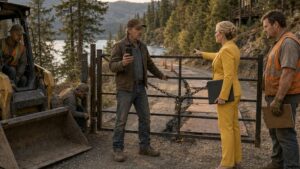
Before Kevin could answer, a silver SUV stopped at the curb. Timothy Roberts climbed out carrying a leather folder embossed with the association’s name. He wore a pale blue shirt with the sleeves rolled precisely twice, as if he had arrived prepared to appear informal.
“Daniel,” Timothy said, “we need to keep this from becoming a scene.”
Daniel looked at the asphalt machine idling on his land. “You brought an inspection folder to active construction. I believe the scene began without me.”
Timothy gave the foreman a reassuring nod. “The board recognizes this as established rear access. The work can continue.”
“Based on what recorded instrument?”
“This community has functioned with that passage for years.”
“A habit is not an easement.”
“This isn’t the county survey department. You don’t get to interrogate every neighbor like they’re standing at a permit counter.”
Daniel felt several eyes settle on him. Timothy knew exactly how to shift the dispute. Not ownership versus assumption, but an old man’s rules versus a young family’s ordinary needs.
Kevin folded his arms. “We’re not taking your garage. We’re making usable access to ours.”
Daniel walked to the roller and placed a plastic-sleeved copy of his written objection on the metal housing beside the controls.
The foreman stared at it. “Don’t put things on the equipment.”
“You now have notice that the work crosses a disputed boundary.”
Timothy stepped forward. “Daniel, move away from the machinery.”
Daniel looked at Kevin, not Timothy.
“You are building permanence on an assumption,” he said.
For a moment, the only sound was the roller’s engine and the faint hiss of cooling asphalt.
Then Timothy opened his folder.
“All right,” he said. “Since you insist.”
He removed a laminated neighborhood diagram and held it out where Kevin, the foreman, and the watching neighbors could see. The drawing showed the two houses, the detached garage, the side strip, and Daniel’s gate. A faded green band ran along the disputed path.
At its edge, in slanted handwriting, were the words REAR ACCESS.
Daniel did not take the page.
The handwriting was not Timothy’s.
It was his.
The foreman glanced between the diagram and the white string. “This says access.”
“It is not a recorded plat,” Daniel said.
Timothy’s mouth tightened with satisfaction. “It came from the association archives. It predates the Walkers’ purchase by almost twenty years.”
Kevin tapped the green strip. “And it matches how the property was used.”
Daniel forced himself to look beyond the handwritten words. There were no recording numbers. No surveyor’s seal. No grant language. Just an old landscaping diagram copied onto association letterhead.
But his initials sat in the lower corner.
D.H.
The roller operator called from the machine. “We continuing or not?”
Timothy answered first. “Continue.”
Daniel stepped onto the unpaved portion of the strip.
The foreman’s face changed. “Sir, you need to move.”
“No machine crosses another inch while I’m standing here.”
Kevin’s composure cracked. “You’d risk getting hurt over this?”
“No. I’m making sure you decide whether your driveway matters enough to order a man run down for it.”
Amanda came halfway across the yard. “Kevin.”
Her voice was quiet, but the children had followed her to the porch.
Kevin looked from them to the workers, then to Daniel.
“Shut it down,” he said.
The foreman raised both hands, frustrated, and signaled the operator. The engine died. The sudden silence made the scene feel larger.
Timothy slid the diagram back into the folder. “The board will issue a compliance notice if you obstruct recognized access.”
“Send it.”
“You may also be responsible for delay charges.”
“Send those too.”
Timothy studied him. “You know what this document means.”
“I know what it is.”
“That is not the same answer.”
“No,” Daniel said. “It isn’t.”
He photographed the diagram before Timothy could close the folder. Then he photographed his own initials.
By noon, the crew had left a twenty-foot section of blacktop cooling beside the white fence. Its straight edge covered most of the survey string, but a few clean inches remained visible near the gate, bright against the dark pavement.
Inside, Daniel opened the locked metal file box beneath his desk. The deed was where it had always been. So was the certified survey, folded along lines softened by years of handling.
He set both beside the photograph of Timothy’s diagram.
His phone rang at one thirty.
“Elizabeth Garcia,” the voice said. “You left a message about active construction.”
Daniel explained the paving, the notice, the parcel line, and the HOA president’s instruction to continue. He did not mention the handwriting until Elizabeth asked him to send every document used against him.
There was a pause after she opened the photograph.
“Daniel,” she said, “are those your initials?”
“Yes.”
“Did you draw this?”
“Part of it.”
“What part?”
“The route.”
Another pause.
“Then before I file anything,” Elizabeth said, “I need to know why.”
Daniel looked through the window at the black asphalt lying over the white line.
“That diagram should never have survived,” he said.
Chapter 2: The Map in the HOA Office Did Not Match the Deed
The county records clerk searched the parcel number twice before turning the monitor toward Daniel.
“There’s no easement,” she said.
Elizabeth stood beside him at the counter, one hand resting on her legal pad. “No access agreement, maintenance covenant, reciprocal driveway instrument, or license memorandum?”
The clerk clicked through the index. “Nothing recorded against Mr. Hall’s parcel that benefits the neighboring lot.”
On the screen, Daniel’s property appeared as a pale rectangle outlined in white. The line ran from the street, beside his house, along the fence, and around the backyard gate. The disputed strip sat entirely inside it.
Daniel had known what the records would show. Still, the clean line on the screen gave him a momentary sense of order.
Elizabeth requested certified copies.
As the clerk printed them, she said, “This helps with emergency relief. It does not make the HOA diagram disappear.”
“It has no legal force.”
“That isn’t the only question.”
Daniel looked at her.
“The other question,” Elizabeth continued, “is whether someone reasonably relied on it, and why your initials are on it.”
The printer fed out the first page.
Daniel watched the white boundary line emerge beneath a gray heading.
“No recorded easement,” he said.
Elizabeth did not let him redirect her. “What did you authorize?”
“Nothing permanent.”
“That’s not an answer I can put in a verified complaint.”
He folded the certified copy once, then stopped when he saw her expression and laid it flat again.
“The prior owner used the strip occasionally.”
“How occasionally?”
“When necessary.”
“For what?”
“He needed access to the rear.”
“Vehicle access?”
“Sometimes.”
“For how long?”
Daniel looked toward the clerk, who had moved to another terminal but was close enough to hear.
“This is not the place.”
Elizabeth gathered the copies. “Then my office is.”
An hour later, Daniel sat across from her while she arranged three images side by side: the certified deed survey, the HOA neighborhood diagram, and a recent photograph of the fresh asphalt.
On the deed, the white line meant ownership.
On the HOA diagram, a green band labeled REAR ACCESS crossed that ownership.
In the photograph, the line had vanished beneath black pavement.
Elizabeth tapped the old diagram. “The board will say this shows a longstanding arrangement.”
“It shows landscaping and traffic flow.”
“It shows your initials beside the route.”
“They are initials, not a conveyance.”
“I agree. A judge may agree. But Kevin will ask why you drew it.”
Daniel’s gaze settled on the handwriting. The letters had been made with a fine drafting pen. He remembered the pressure required to keep the line uniform.
Elizabeth leaned back. “I can file for a temporary restraining order today. The active construction and lack of a recorded easement are enough to ask. But if there is relevant history, I need it before the other side gives it to me.”
“The land is mine.”
“I am not disputing that.”
“Then stop the work.”
She held his gaze a moment longer, then turned to her keyboard.
By late afternoon, the complaint included the deed, parcel map, photographs, written objection, contractor information, and an affidavit in which Daniel stated that he had granted no permanent easement.
Elizabeth read that sentence aloud.
“Is it true?”
“Yes.”
“That is narrower than saying you never permitted use.”
“I know what it says.”
“So do I.”
The judge signed the temporary order shortly before the clerk’s office closed. It prohibited further paving, vehicle passage, alteration, or claimed use of the disputed strip until a preliminary hearing.
Daniel carried the stamped copy to his car without smiling.
At home, the asphalt remained unfinished. The edge ended in a rough ridge twenty feet from the gate. Kevin was outside measuring the distance between his driveway and the rear garage.
Daniel walked over and handed him the order.
Kevin read the first page, then the second.
“You filed this in one day?”
“You paved after notice.”
Kevin’s face reddened. “The HOA approved it.”
“The HOA does not transfer land.”
“This is going to cost us thousands.”
“You should have confirmed ownership first.”
“We did confirm it.”
“No. You confirmed that people agreed with you.”
Amanda stood in the side yard holding a grocery bag. She looked at the court stamp, then at Kevin.
“Does this mean we can’t use the gate?” she asked.
“It means you cannot cross the strip,” Daniel said.
“For how long?”
“Until the court decides.”
Her expression closed. “The children’s bikes are in the garage.”
Kevin handed the order back. “You could have talked to us.”
“I did.”
“You handed me a survey and told me to stay off your land. That isn’t talking.”
Daniel almost answered, then saw Elizabeth’s face in his mind when she had asked how long the prior use lasted.
He turned away.
The HOA meeting took place the next evening in a converted clubhouse room that smelled of coffee and carpet cleaner. Timothy sat at the head of a folding table with an association management representative beside him.
Elizabeth placed the certified county search in front of them.
“There is no recorded access right,” she said. “The court has restrained further use. The association should withdraw any statement suggesting otherwise.”
Timothy opened the archive folder.
“The absence of a recorded easement does not erase established community practice.”
“It does limit what you may represent as a legal right.”
Timothy removed the diagram. “This was prepared with Mr. Hall’s participation.”
Elizabeth slid it closer.
Under the fluorescent lights, the old paper showed more detail than the photograph had. Near the green access band, beneath Daniel’s initials, was a date from eighteen years earlier.
Elizabeth looked at him. “You didn’t mention the date.”
“It doesn’t change the deed.”
“No,” she said quietly. “It changes the questions.”
Timothy heard her.
He turned the diagram toward Daniel. “Would you like to explain why you personally marked this route?”
Daniel’s throat tightened. “It was not a permanent grant.”
“That wasn’t my question.”
The management representative shifted uncomfortably. Kevin sat against the back wall, watching.
Daniel said, “The document was an internal site sketch.”
“Created for what purpose?”
“Temporary convenience.”
Kevin stood. “Temporary for eighteen years?”
The room went still.
“I bought that house because the seller said the garage had rear access,” Kevin continued. “The worn track was there. The gate was there. The association map was there. And now the man who drew the route says none of it counts.”
“You ordered construction after I objected,” Daniel said.
“Because I thought you were changing your mind after the sale.”
Daniel’s fingers pressed against the tabletop.
Timothy gathered the papers. “The board will schedule a formal compliance hearing. Until then, we will obey the court order. But the association does not concede that Mr. Hall’s interpretation is complete.”
Outside, Elizabeth stopped Daniel beside his truck.
“You need to tell me everything.”
“I told you there was no permanent right.”
“That is not everything.”
Before he could answer, Kevin emerged from the clubhouse carrying a large envelope.
“My attorney will send these formally,” he said, “but you should see them now.”
He handed the envelope to Elizabeth.
Inside were photographs printed from different years. In one, an older vehicle crossed the disputed strip. In another, trash bins stood beside Daniel’s gate. A third showed a wheelchair ramp aligned with the passage. The final image showed Daniel himself holding the gate open while the former owner drove through.
On the back, in faded ink, someone had written: Dan said use anytime needed.
Elizabeth read the words twice.
Daniel stared at the photograph of his younger hand on the gate.
The white line was nowhere visible.
Chapter 3: Everyone Saw a Shared Driveway Except the Man Who Owned It
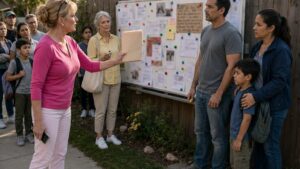
By the time Daniel entered the HOA hearing room, every chair facing the projector was occupied.
Two residents stood along the wall. Kevin and Amanda sat together near the front. Timothy had placed the old diagram on an easel beside the board table, enlarged until the green access band looked wider than the actual strip.
Daniel understood the arrangement immediately. This was not a fact-finding session. It was a correction ceremony, and the community had come expecting him to be corrected.
Elizabeth set her briefcase on the table. “Do not answer beyond the question asked.”
“I know how hearings work.”
“This one is not court.”
“No,” Daniel said, looking at the residents. “Court has rules.”
Timothy called the meeting to order.
He summarized the dispute in a patient voice, describing “a historically used rear-access route” and “a sudden withdrawal of cooperation by a longtime homeowner.” He did not say unauthorized paving until Elizabeth interrupted.
“The construction occurred after written objection.”
Timothy nodded as if granting a minor point. “Which is why the board is reviewing all parties’ conduct.”
The projector displayed the county parcel survey first. A thin white line traced Daniel’s ownership.
Then Timothy overlaid the HOA diagram. The green band blurred the line until it was difficult to tell whether the route ran on one parcel or between both.
A resident near the wall whispered, “Looks shared to me.”
Daniel heard it.
Timothy displayed the photographs Kevin had provided. The older vehicle. The bins. The ramp. Daniel holding the gate.
“For nearly two decades,” Timothy said, “the neighboring property used this route openly and with Mr. Hall’s knowledge.”
“Permission is not ownership,” Elizabeth said.
“Nor is it nothing.”
Timothy turned to Daniel. “How often did the former owner use the strip?”
“When necessary.”
“Once a year?”
Daniel said nothing.
“Once a month?”
“It varied.”
Kevin leaned toward Amanda, then sat back.
Timothy advanced to another photograph. Tire marks cut through damp soil beside the fence.
“Would you call this rare?”
“It was not a public road.”
“No one has called it one.”
“You called it shared access.”
“Because that is how it functioned.”
Daniel felt the familiar urge to narrow the room to measurements. Fence offset: four inches. Parcel width: sixty-eight feet. Strip width: six feet, three inches at the street, narrowing behind the gatepost. Numbers could not pity him, accuse him, or ask why he had let anything remain unclear.
Elizabeth placed the certified title search on the table.
“The county found no easement, no reciprocal driveway agreement, and no recorded license. Whatever personal permission once existed did not run with the land.”
That gave Daniel a brief, clean satisfaction. Several residents looked toward Timothy rather than him.
Then Timothy said, “Mr. Hall, did you ever tell the former owner he could use the route?”
Daniel answered carefully. “Under certain circumstances.”
Kevin rose halfway from his chair. “You told me you’d never granted access.”
“I said there was no permanent right.”
“You knew what I meant.”
“I knew what the words meant.”
A murmur moved through the room.
Amanda touched Kevin’s arm, but he pulled away.
“You let someone use it for years,” Kevin said. “Then we bought the house, and suddenly the gate becomes sacred.”
Daniel’s chair scraped as he stood.
Elizabeth said his name quietly.
He remained standing. “You paved my land after I gave you a survey.”
“And you gave us half the story.”
The words struck harder because they were true in a way Kevin did not yet understand.
Timothy raised his hand. “We will maintain order.”
The door at the back opened.
Sarah Hall stepped inside carrying a canvas tote and wearing the expression she used when she had already decided Daniel would dislike what she came to say.
He had not told her about the hearing.
She took the last place along the wall.
Timothy continued. “Mr. Hall characterizes the prior use as occasional. Does anyone have direct knowledge otherwise?”
Sarah said, “I do.”
Daniel turned.
She walked forward slowly. “The former owner used that path every week for a long time.”
“Sarah,” Daniel said.
“You knew they had photographs.”
“That does not make this your concern.”
Her mouth tightened. “That sentence is why I’m here.”
Timothy invited her to sit at the witness table. Elizabeth objected to the hearing taking testimony without notice, but Sarah shook her head.
“I’m not here for the board,” she said. “I’m here because my father will let strangers tell the wrong story before he tells a painful one.”
The room became silent enough for Daniel to hear the projector fan.
Timothy asked, “Did your father allow regular access?”
“Yes.”
“For how many years?”
Sarah looked at Daniel. “More than he wants to admit.”
Kevin spread his hands. “There. That’s the whole issue.”
“No,” Sarah said. “It isn’t.”
Daniel stared at her. She had inherited her mother’s refusal to soften a truth once she believed it necessary.
Amanda spoke for the first time. “At closing, we were not shown a deeded easement.”
Kevin turned sharply. “Amanda.”
“We weren’t,” she said. “The seller said the rear access had always been used. The HOA packet had the diagram. We assumed the paperwork would be somewhere in the records.”
Timothy adjusted the folder before him. “The association provided historical materials, not title assurance.”
“You called it established access,” Amanda said.
“The association described existing community practice.”
Kevin’s face hardened. “So now everyone is choosing words.”
Daniel almost laughed, but there was nothing amusing in the room. Each person had built safety out of a different phrase. Existing practice. Shared access. Temporary convenience. No permanent right.
Elizabeth addressed Amanda. “Did Daniel object before paving began?”
Amanda looked down. “Yes.”
“How long before?”
“About three weeks.”
Kevin said, “Because we thought he was denying something already attached to the house.”
“But you had no recorded instrument,” Elizabeth said.
Kevin’s voice rose. “We had a garage we couldn’t reach, a map from the association, tire marks that had been there for years, and a seller telling us the access came with the property. What exactly was I supposed to think?”
“That you should confirm before pouring asphalt,” Daniel said.
Kevin looked at him. “And what were you supposed to do? Tell the truth?”
The question stayed in the room after Timothy called for a five-minute recess.
Residents gathered near the coffee urn. No one approached Daniel. He stood beside the projected survey, where the white boundary line was still visible beneath the green overlay.
Sarah joined him.
“You made me look dishonest,” he said.
“You did that before I arrived.”
“The land is mine.”
“I know.”
“Then why are you helping them?”
“I’m not helping them take it.”
“You told the entire board the use was regular.”
“It was.”
His jaw tightened.
Sarah lowered her voice. “You keep talking as if admitting why it happened will erase the parcel line.”
“You do not know what a court will do with an admission.”
“And you don’t know what silence is doing to everyone else.”
Across the room, Amanda stood alone while Kevin spoke sharply to Timothy. The children were not present, but Daniel remembered them behind the screen door, watching adults decide whether a gate belonged to law, memory, or whoever acted first.
The hearing resumed.
Timothy proposed an interim resolution: Daniel would permit pedestrian passage but no vehicle use until the civil hearing. Elizabeth refused on the ground that any ordered use could prejudice the property case.
Daniel expected relief.
Instead, he felt the room close further around him.
Timothy announced that the HOA would suspend enforcement while seeking counsel, but he added that the board considered Daniel’s prior participation in the access arrangement “material and unresolved.”
The meeting ended without a fine.
It did not feel like a victory.
Outside, the projected map’s pale afterimage still seemed fixed in Daniel’s eyes. Kevin and Amanda left separately, he toward the driveway and she toward the sidewalk.
Sarah waited beside Daniel’s truck.
“You should have called me,” he said.
“You would have told me it was handled.”
“It is being handled.”
“No. It is being measured.”
He unlocked the truck.
Sarah caught the door before he could open it.
“The access didn’t start because the old neighbor wanted a shorter drive to the garage,” she said.
Daniel did not move.
“It started during Mom’s final winter.”
The parking lot sounds receded—the closing clubhouse door, Kevin’s engine, the rattle of someone returning chairs.
Sarah released the truck door.
“You can keep letting them use her memory without knowing it,” she said. “Or you can
Chapter 4: The Favor Daniel Never Recorded Became the Claim He Could Not Escape
Sarah placed the old brass gate key in the center of Daniel’s kitchen table.
It landed beside the certified survey with a small metallic sound that pulled him backward eighteen years more effectively than any photograph had.
“You kept it,” he said.
“You gave it to me after Mom died.”
“I gave you her key ring.”
“And this was on it.”
The key had once opened the side gate from both directions. Its teeth were worn smooth at the peaks, the round head darkened by years of fingers. Daniel had changed the lock after the former neighbor moved into assisted living, but he had never thrown the old cylinder away.
Sarah sat across from him. “Tell Elizabeth before Timothy tells his version.”
“There is no version that changes the deed.”
“You’re still doing it.”
“Doing what?”
“Answering the safest question.”
Daniel picked up the key. It was colder than he expected.
In the winter his wife became too weak to climb the back steps, the house had filled with practical objects: pill organizers, folded blankets, a shower chair, disposable gloves, oxygen tubing coiled like clear rope beside the bedroom wall. The side gate had become the shortest route from the driveway to the kitchen.
The former owner next door had understood without being asked. He had driven Daniel’s wife to appointments when Daniel was trapped at work, carried groceries through the gate, and later pushed her wheelchair along the narrow strip when the front walk iced over.
The first time the chair caught in mud, Daniel had gone outside with white marking chalk and drawn a smooth route from the neighboring drive to his gate.
“Stay inside the line,” he had told the man. “The ground is firmer there.”
The old neighbor had nodded. He never treated the permission as ownership. He knocked before entering. He closed the gate. When Daniel’s wife slept, he left groceries beside the steps without speaking.
Months later, the HOA had proposed new landscaping around both rear garages. Daniel had marked the same route on the site sketch so the maintenance crew would not block it with shrubs.
REAR ACCESS, he had written.
He had meant access to his sick wife.
Not access attached to a parcel. Not a driveway right surviving every sale. Not a permanent promise to people he had never met.
Sarah watched his face. “You drew it for Mom.”
“For emergencies.”
“It became more than emergencies.”
“Because she got worse.”
“And after she died?”
Daniel set down the key.
The former neighbor had continued using the path. At first, Daniel had allowed it because the man had earned more than convenience. Then because he had developed trouble walking. Then because ending the arrangement would have required a conversation Daniel did not want to have.
The gate had remained useful. The tracks had deepened. The HOA diagram had stayed in a file.
“I should have corrected the map,” Daniel said.
Sarah’s expression softened, but not enough to let him escape. “Yes.”
“I should have written a license with an end date.”
“Yes.”
“He knew it was personal.”
“Kevin didn’t.”
“Kevin paved after notice.”
“I’m not defending that.”
“You keep sounding as though you are.”
“I’m defending the part where he believed something before he chose to ignore you.”
Daniel looked toward the side window. Through the glass, the unfinished asphalt ended in a jagged black lip. Beyond it, the gate stood closed.
His wife had once told him the gate made the house feel less like a sickroom. People could come and go without crossing the living room, without forcing her to perform health for visitors.
He had promised her he would keep the side garden and gate the way they were.
He had treated that promise as if changing a hinge, moving a rose, or explaining an old favor would betray her.
At Elizabeth’s office that afternoon, he told the story without looking at either woman.
Elizabeth listened with her pen still.
When he finished, she asked, “Did the former owner ever pay for access?”
“No.”
“Maintain the strip?”
“He spread gravel twice. I reimbursed him once.”
“Did you ever put the permission in writing?”
“No.”
“Did you tell the HOA it was personal and revocable?”
“No.”
“Did you correct the archive diagram after your wife died?”
“No.”
Each answer felt like a small stake driven into the table.
Elizabeth closed her legal pad. “This does not necessarily create an easement. Permission can remain permission, even for years. But the duration, the map, the visible use, and your silence give Kevin an argument that he reasonably believed the access belonged with the house.”
“He had a duty to check title.”
“He did. Poorly. He relied on a seller, the association, and what he saw.”
“The county record was available.”
“So was your objection, which is why paving after notice remains his worst fact.”
Sarah asked, “What happens if Dad discloses all of this?”
Elizabeth looked at Daniel. “The temporary order should remain because ownership and current construction are separate from the history. At the full hearing, Kevin may argue reliance, estoppel, or some form of implied right. I do not think the evidence is enough for a permanent vehicle easement, but it makes the case less clean.”
“Less clean,” Daniel repeated.
“You wanted a line. Courts look at everything around it.”
Her phone rang. She glanced at the screen and answered on speaker after identifying Timothy’s attorney.
The voice informed them that the association intended to submit the old diagram, maintenance records, photographs, and statements from residents who had observed continuous use. The HOA would argue that Daniel’s own notation established a recognized access route upon which later owners could rely.
Elizabeth asked, “Does the association possess any title opinion verifying that conclusion?”
A pause followed.
“The association is not a title company.”
“Did the board disclose that limitation when it approved Kevin Walker’s paving request?”
Another pause.
“The board approved aesthetic compliance, not property rights.”
Daniel leaned forward.
Elizabeth said, “Your president stood on-site and instructed the contractor to continue after being shown a survey.”
“That characterization is disputed.”
The call ended with no resolution.
Elizabeth removed her glasses. “Timothy is trying to separate the HOA’s approval from the legal access claim.”
“He told everyone it was established,” Sarah said.
“He is protecting the association.”
Daniel looked at the old key in Sarah’s palm.
For three weeks he had divided the dispute into those who respected facts and those who ignored them. Now the facts had begun to include his own omissions.
Elizabeth opened a new page. “We have two choices. We can disclose the history narrowly and argue it was a personal, revocable license. Or we can wait for Kevin to prove it and challenge every detail.”
Sarah looked at him.
Daniel understood what Elizabeth was not saying. Waiting might be strategically safer. It would also allow Kevin to present the former neighbor as a man Daniel had betrayed, and Daniel’s wife as a missing piece to be guessed at by strangers.
He stood and walked to the window.
Below, cars moved along the county street, each kept in its lane by painted white lines. The paint did not stop a vehicle. It worked because people agreed what crossing it meant.
He had demanded that everyone honor his boundary while refusing to explain the line he had once drawn across it himself.
“Disclose everything,” he said.
Elizabeth watched him carefully. “Everything relevant?”
“Everything.”
“The wheelchair. The care. The map. The continued use.”
“Yes.”
Sarah closed her hand around the key.
Elizabeth said, “Timothy will use it to argue permanence.”
“Then let him use the truth instead of an empty shape.”
“And if it weakens your case?”
Daniel looked toward Sarah.
“Then at least it will be my case,” he said, “not a story built from what I was afraid to say.”
Chapter 5: Kevin Was Wrong About the Land but Not About Daniel’s Silence
Kevin arrived at mediation carrying a contractor’s estimate large enough to cover half the table.
The first page showed a drawing of his property. The detached garage sat behind the house like a trapped box. Without passage along Daniel’s strip, vehicle access would require removing part of the porch, relocating utility equipment, and cutting a new drive along the opposite side.
At the bottom, the estimated cost was printed in bold.
Amanda sat beside him with both hands around a paper cup she had not touched.
Daniel and Elizabeth took the other side. Timothy sat near the end with the HOA management representative. A mediator placed a blank sheet between them and drew one straight vertical line.
“Ownership on one side,” she said. “Practical need on the other. Today we determine whether there is a lawful place between them.”
Kevin pushed the estimate forward. “There isn’t, unless Mr. Hall lets us use what everyone said came with the house.”
Daniel studied the number. It was more than Kevin had likely saved for emergencies and less than the value the garage added to the property. Enough to wound a family without destroying one.
“You should take that up with the seller,” Daniel said.
“We are.”
“Then why are we here?”
“Because the garage is still behind my house.”
The mediator asked Kevin to explain what he believed before closing.
He described the worn tire path, the double-width opening at the street, the backyard gate, and the HOA diagram in the disclosure packet. The seller had said the prior owner used the route for years. Timothy had later called it recognized rear access.
Kevin looked at Daniel. “Nothing about that looked temporary.”
“Did you receive a recorded easement?” Elizabeth asked.
“No.”
“A title commitment listing an access right?”
“No.”
“A survey showing any part of Daniel’s parcel belonged to you?”
Kevin’s jaw worked before he answered. “No.”
“Yet you ordered paving.”
“Because by then I believed Daniel was trying to revoke something after we bought the house.”
The mediator turned to Daniel. “And you?”
He had rehearsed the legal answer with Elizabeth. Instead, he looked at Amanda.
“I allowed the former owner to use the strip,” he said. “At first because he helped my wife during her illness. Later because his mobility declined. I marked the route on an HOA landscaping sketch. I did not record a license or correct the diagram when the circumstances ended.”
Kevin’s expression changed, not into sympathy but into confusion.
“You drew it,” he said.
“Yes.”
“And you never told me.”
“No.”
“You stood in the driveway and acted like I invented everything.”
“I told you the land was mine.”
“That was not the whole truth.”
Daniel felt Elizabeth shift beside him, ready to intervene.
He said, “No. It wasn’t.”
The room quieted.
The admission did not erase Kevin’s paving, but it removed the clean distance Daniel had kept between his own conduct and everyone else’s.
“I should have corrected the association record,” he continued. “I should have told you the use was personal and ended with the former owner. I did neither.”
Kevin leaned back.
For one moment, Daniel thought the honesty had reached him.
Then Kevin tapped the estimate. “So because you failed to fix your records, I’m supposed to lose the garage?”
“The records were not title records.”
“They were the records people gave us.”
Timothy cleared his throat. “The association packet clearly states buyers must conduct independent due diligence.”
Amanda looked at him. “That statement was on page forty-seven under general disclaimers.”
“The association cannot guarantee title.”
“But you guaranteed it to Kevin in the driveway,” Daniel said.
Timothy’s face tightened. “I confirmed the historical use.”
“You told the contractor to continue.”
“I approved the paving material under architectural guidelines.”
“You called the route established shared access.”
The mediator held up a hand. “We will deal with the association’s representations separately.”
Amanda set down her cup.
“Kevin received Daniel’s letter before the paving deposit became nonrefundable,” she said.
Kevin turned toward her. “Amanda.”
“You told me the contractor needed to start before the weather changed.”
“That was true.”
“You also said if the asphalt was already down, no one would make us tear it out.”
The words settled heavily.
Kevin stared at her. “You knew what we were risking.”
“I knew what you told me.”
“You agreed we couldn’t lose the garage.”
“I agreed we needed access. I didn’t agree that pouring pavement would make the argument disappear.”
The mediator wrote something on her pad.
Daniel saw Kevin’s shame harden into anger. It was the same transformation he had watched on the driveway when questions became public.
Kevin said, “Do you know what it feels like to tell your children this is the house where they’ll grow up, then find out you may have bought a garage no car can reach?”
Daniel did not answer immediately.
“Yes,” he said at last. “I know what it feels like to promise a house will remain one thing and learn that promises do not control what happens.”
Kevin looked away.
The mediator offered several options: a paid permanent easement, a temporary license, pedestrian-only access, cost sharing for a new drive, or removal followed by separate negotiations.
Daniel rejected a permanent vehicle easement. The strip ran too close to his kitchen wall and crossed the drainage channel he maintained. More than that, granting permanence under pressure would turn Kevin’s decision to pave into leverage.
Kevin rejected removal.
“What if Mr. Hall offered pedestrian access for a limited period?” the mediator asked.
“For what purpose?” Kevin said. “So we can carry groceries past the garage we can’t use?”
Amanda said, “The children’s bikes are back there.”
Kevin looked at her. “That’s not the issue.”
“It is one issue.”
Daniel listened to them and understood that the access meant different things inside their own house. To Kevin, it represented the purchase he needed to justify. To Amanda, it was a route through daily life. To Timothy, it was an archive mistake that could become an association liability.
To Daniel, it had become proof that grief could be paved over if he failed to guard it.
The mediator drew a second line beside the first.
“Sometimes,” she said, “the legal boundary and the workable arrangement do not have to occupy the same place.”
Elizabeth proposed that the asphalt be removed, title confirmed, and a six-month pedestrian license negotiated while the Walkers designed lawful access elsewhere.
Kevin shook his head. “No. If it comes out, it only goes back by court order.”
Amanda closed her eyes briefly.
The mediator asked whether he understood the risk of removal costs, attorney fees, and possible damage restoration.
“I understand.”
“Do you understand that the absence of a recorded easement is a substantial problem for your claim?”
“I understand that Daniel let this go on for years and now wants everyone to pretend it never happened.”
Daniel said, “I am not pretending.”
“You did until today.”
“That was wrong.”
Kevin looked at him, almost startled by the plainness of the answer.
Daniel continued, “But my silence did not give you the right to pour asphalt after notice.”
The mediator gave them an hour apart.
In the private conference room, Elizabeth said, “You did well.”
“I admitted negligence.”
“You admitted ambiguity. That matters.”
“He still thinks removal is punishment.”
“Because accepting removal means accepting he made the final bad choice.”
Daniel looked through the glass panel toward the hall. Amanda stood alone by a vending machine. Kevin was speaking with Timothy several feet away, both men gesturing toward documents neither appeared to trust anymore.
When the parties returned, the mediator asked one last time whether anyone would move.
Daniel repeated the temporary pedestrian offer.
Amanda said she would accept it.
Kevin did not.
Timothy offered to commission a review of the association archives but refused to concede that the board had misrepresented the access.
The mediator closed her file.
“Then this matter proceeds to the full hearing.”
Chairs moved back. Papers were gathered. The estimate remained on the table until Kevin folded it along the garage drawing, dividing the house from the route he believed should reach it.
As he left, he stopped beside Daniel.
“You were right about the deed,” Kevin said. “But if you had told me the truth the first day, none of this would have happened.”
Daniel looked at the folded estimate under Kevin’s arm.
“Not none of it,” he said. “But not this much.”
Chapter 6: The Court Asked Who Owned the Strip and Who Created the Confusion
Kevin’s attorney displayed Daniel’s initials before the deed.
The enlarged HOA diagram filled the courtroom monitor, its green access band running across the narrow strip in a way that made the route look settled and intentional. Daniel’s handwritten REAR ACCESS appeared above the date. His initials sat below it.
Only after the judge had studied that image did Elizabeth place the certified survey beside it.
A white boundary line appeared beneath the green band.
“This case involves two different questions,” Elizabeth said. “Who owns the land, and what limited permission once existed upon it.”
Kevin’s attorney rose. “The questions cannot be separated when Mr. Hall created the very record on which later owners relied.”
The judge looked toward Daniel. “We will hear the evidence.”
Timothy testified first.
He described the diagram as part of the association’s historical property file and said the access had been visible for years. Under Elizabeth’s questioning, however, he admitted the association had never obtained a title opinion, never recorded an easement, and never confirmed that Daniel intended the route to benefit future owners.
“Did you tell the asphalt foreman the route was recognized access?” Elizabeth asked.
“I said the association recognized its historical use.”
“Did you instruct the crew to continue?”
“I approved the material.”
“After seeing Daniel’s certified survey?”
“It was a copy, not a certified survey at the time.”
“Did you investigate its accuracy before directing the work to proceed?”
Timothy paused. “No.”
“Why not?”
“The diagram had been in the file for eighteen years.”
“Was the board concerned that admitting uncertainty would require review of other archived site diagrams?”
Kevin’s attorney objected.
The judge allowed the question.
Timothy adjusted his tie. “A broad records review would have been costly and potentially disruptive.”
There it was—not conspiracy, only institutional fear dressed as consistency.
Amanda testified that the seller had described rear access but had not produced a recorded right. She confirmed the HOA packet included the diagram. She also confirmed Daniel objected before construction and that Kevin proceeded believing completed work would strengthen their position.
Kevin testified next.
He spoke without the anger he had carried at mediation. The courtroom required him to reduce his life to answers.
Yes, he had seen the worn path.
Yes, the detached garage appeared designed for vehicle entry from Daniel’s side.
Yes, he relied on the seller and HOA materials.
No, his title report did not list an easement.
Yes, Daniel gave him a survey.
Yes, he paved anyway.
“Why?” his attorney asked.
Kevin looked toward the judge. “Because I thought Mr. Hall was trying to take back something that came with the house. And because I had already told my family I had not made a mistake buying it.”
The admission shifted something in the room. Daniel heard no excuse in it, only the pressure Kevin had converted into certainty.
Then Daniel was called.
Elizabeth began with the deed, the county search, and his career in municipal surveying. She established that he understood recorded property interests and had never signed a permanent easement.
Then she placed the old diagram before him.
“Did you draw the green route?”
“Yes.”
“Did you write ‘rear access’?”
“Yes.”
“Why?”
Daniel looked at the screen, but he no longer saw an archival exhibit. He saw white chalk around wheelchair wheels, his wife wrapped in a blanket while the former neighbor steadied the chair at the gate.
“My wife was ill,” he said. “The neighbor helped her. The route gave him access to our kitchen and allowed him to move her without using the front steps. Later, when he had difficulty walking, I allowed him to keep using it.”
“Was the permission granted to his property?”
“No.”
“To him personally?”
“Yes.”
“Did you intend it to continue after he left?”
“No.”
“Did you say so in writing?”
“No.”
“Did you correct the HOA diagram?”
“No.”
“Why not?”
Daniel could have said grief. He could have said there had been no immediate need. Both were true and incomplete.
“Because correcting it required admitting the circumstances were over,” he said. “I left the paper as it was because I did not want to revisit why it had been made.”
Kevin’s attorney approached.
“You were a survey professional.”
“Yes.”
“You understood that records guide later decisions.”
“Yes.”
“You allowed visible use for years.”
“Yes.”
“You placed the words ‘rear access’ on an association document.”
“Yes.”
“And when the Walkers arrived, you told them only that the land was yours.”
“Yes.”
“Would you agree that your conduct created confusion?”
Daniel looked at Kevin and Amanda.
“Yes.”
“Then why should they bear the cost?”
“Because confusion did not authorize construction after notice.”
The attorney stopped.
Daniel continued before he could be told to.
“I bear responsibility for leaving the record unclear. The HOA bears responsibility for presenting a site sketch as authority. The seller bears responsibility for making assurances without proof. Kevin bears responsibility for paving after he received the survey and objection.”
The judge watched him closely. “What remedy are you asking for?”
“Removal of the asphalt and confirmation of title.”
“Nothing else?”
Daniel glanced at Elizabeth. This was the point they had discussed, and the point at which he could choose a clean victory.
“I do not want a permanent access right created by pressure,” he said. “But I am willing to grant Amanda and the children a six-month pedestrian license through the gate while the Walkers design lawful access on their own parcel.”
Kevin turned toward his attorney.
The judge asked, “Vehicle use?”
“No.”
“Transferable?”
“No.”
“Revocable for breach of conditions?”
“Yes.”
“And recorded?”
“Yes. So no one has to guess again.”
The hearing recessed.
When the judge returned, the ruling came in parts.
The certified survey controlled the boundary. No recorded easement burdened Daniel’s land. The evidence showed a personal, permissive use, not a permanent right attached to the neighboring parcel. The HOA diagram was insufficient to convey property and had been treated with more authority than it possessed.
Kevin’s reliance was understandable, the judge said, but it became unreasonable once Daniel provided direct notice and a survey before paving.
The asphalt had to be removed.
The Walkers would bear the primary removal cost. The HOA would contribute to survey and restoration expenses because its representative had encouraged continuation without verifying title. Claims involving the seller could proceed separately.
Daniel heard the legal distinctions, but the sentence that stayed with him came near the end.
“A boundary may be clear even when the conduct around it is not.”
The judge approved negotiation of the temporary pedestrian license but did not order Daniel to grant it.
Outside the courtroom, Kevin stood with the removal order in his hand.
“Ten days,” he said.
Daniel nodded.
“You got what you wanted.”
“No.”
Kevin gave a short, tired laugh. “The asphalt comes out. The garage is still trapped. What part did you not get?”
Daniel looked at the order.
“I wanted the line to prove I had done nothing wrong.”
Kevin’s expression shifted.
“It proved the land is mine,” Daniel said. “That is not the same thing.”
Amanda joined them, holding the children’s bike helmets by their straps. “Is the temporary offer real?”
“Yes.”
Kevin looked at Daniel. “After all this?”
“Because of all this.”
The court clerk opened the door behind them and called another case.
Kevin folded the order once, sharply.
“I’ll believe it when I see it recorded,” he said.
Daniel met his eyes. “That is reasonable.”
Ten days from that morning, the order said, the black asphalt had to be broken, lifted, and carried away from the white line beneath it.