They Threatened the Old Rancher Until the Entire HOA Learned Whose Valve Fed Their Homes
Chapter 1: The Trench Cut Through His Father’s Pasture
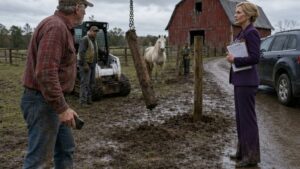
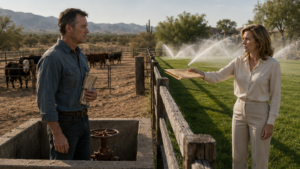
The calf stood behind orange construction mesh where Timothy Moore’s fence had been the night before.
It bawled once, high and confused, then pushed its wet nose through the plastic squares. Beyond it, three cows paced along a raw trench that cut across the north pasture in a straight brown wound. Fresh soil lay heaped over grass Timothy’s father had seeded by hand decades earlier. A yellow excavator idled near the cottonwoods, its bucket dripping clay.
Timothy stopped his truck in the open gate and left the engine running.
For several seconds, he did not move. His black funeral jacket still hung behind the driver’s seat. The paper card from the church lay on the dashboard, his father’s name printed beneath a small gray cross. Timothy had returned from the cemetery after dark, checked the cattle by headlights, and gone inside without eating.
There had been a fence then.
He stepped down from the cab.
A section of barbed wire had been cut cleanly in four places, rolled into loose coils, and tossed beside a post. One cedar brace had been dragged twenty feet and split lengthwise. Tire tracks crossed the pasture from the county road.
A ranch hand came hurrying from the barn.
“I heard machinery before seven,” he said. “Thought you’d approved it.”
Timothy crouched beside the cut wire. The ends were bright silver where the cutters had bitten through.
“Get the cattle into the south lot.”
“The trench blocks the lane.”
“Use the creek gate.”
The ranch hand looked toward the excavator. “Should I call the sheriff?”
“Not yet.”
Timothy straightened and walked toward the trench.
A contractor in a fluorescent vest climbed down from the excavator and lifted both hands as if calming a horse.
“Sir, you need to stay outside the work zone.”
Timothy kept walking.
The trench was nearly five feet deep in places. Gray pipe rested along the bottom, joined in long sections that pointed downhill toward the new roofs of Ridgeview Estates. Orange survey stakes marked a corridor across the pasture. One stake had been hammered through the edge of an old irrigation channel.
“You’re on Moore land,” Timothy said.
The contractor glanced at a clipboard. “We have authorization.”
“From whom?”
“Ridgeview Community Association. Utility extension.”
“That isn’t a person.”
The contractor’s expression tightened. He had the look of a man paid to follow plans, not defend them. He turned the clipboard around.
The top sheet carried the HOA’s name, a project number, and a printed route map. A heavy black line crossed Timothy’s parcel. At the bottom were two signatures from the developer’s office and one from Brian Adams, president of the association.
There was no signature from Timothy.
“No easement attached,” Timothy said.
“It’s referenced on page three.”
He flipped through the packet. Page three contained a typed notation: EXISTING HISTORICAL WATER AND UTILITY ACCESS. No recording number. No deed book. No parcel authorization.
“That’s not an easement.”
“I don’t handle title.”
“You handled my fence.”
The contractor looked toward his crew. Two workers had stopped pretending not to listen.
“We were told access had been cleared.”
“By the same people who told you this was their land?”
The man’s jaw moved, but no answer came.
Timothy walked the trench line toward the barn. He counted pipe couplings, valve boxes, and the width of the excavation. The work was too large for a temporary household connection. The main line was sized for dozens of homes, maybe more. A second, narrower pipe ran beside it, likely sewer force main or pressure return.
At the concrete service pad near the barn, Timothy stopped.
His old well cap was still visible, but someone had installed a new steel junction box beside it. Fresh bolts had been driven into the concrete. A conduit disappeared beneath the soil toward the trench. Blue paint marked the pipe route around the pad.
Timothy placed one palm on the box.
It was warm.
The contractor had followed him. “That’s the control connection.”
“To my well.”
“To the community supply system.”
Timothy looked at him.
The contractor corrected himself. “The connected supply system.”
The distinction was small, but it told Timothy the man had heard the argument before.
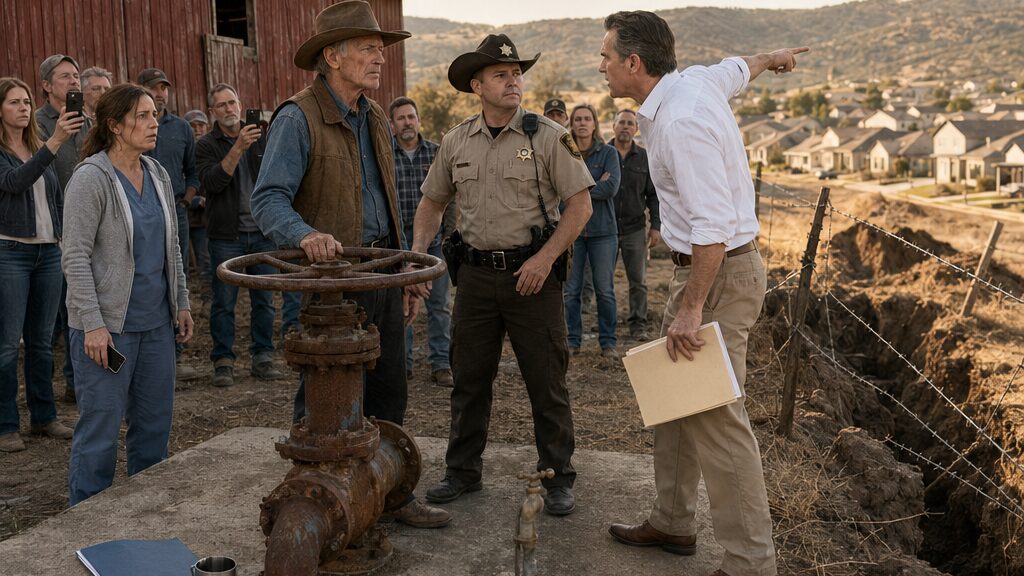
Near the rear edge of the pad, weeds had grown around the old master valve. The wheel was rusted dark red, large enough to require both hands. Timothy’s father had kept it greased when Timothy was a boy. In later years, dust and grass had gathered around it until it looked like part of the concrete itself.
Timothy knelt and brushed dirt from the valve stem.
The ranch hand called from the pasture. One cow had begun kicking at the orange mesh. Timothy looked back at the contractor.
“Shut your equipment down.”
“I can’t do that without authorization.”
“You’re standing on the authorization.”
The contractor exhaled. “Mr. Moore, we’re behind schedule. The road crossing is booked for Wednesday. If we stop now, the association starts charging delay costs.”
“To whom?”
The man hesitated.
Timothy took the clipboard from his hand and read more carefully. Beneath the work order was an access date issued the previous Thursday—the day Timothy had driven his father to the hospital for the last time.
The final excavation approval was dated Saturday morning.
While Timothy had sat beside a hospital bed listening to his father’s breathing slow, crews had been cleared to cross the ranch.
He handed back the papers.
“You knew nobody was here.”
“I didn’t know anything about that.”
“But somebody did.”
The contractor looked away.
Timothy walked to the north fence and photographed every cut wire, every broken post, every tire track. He took close pictures of the junction box, the pipe markings, and the orange stakes. Then he stood at the highest point of the pasture and followed the trench with his eyes.
It dropped through his land, crossed the old drainage swale, passed beneath the county road, and continued toward Ridgeview Estates. Rows of pale houses sat on former grazing land below, each with fresh sod, decorative stone, and identical black mailboxes.
A sprinkler turned in one yard, throwing water in a silver arc.
Timothy watched it complete three slow passes.
The contractor approached again, quieter now.
“I’ll call the project manager.”
“You do that.”
“What should I tell him?”
“That the owner is standing here.”
Timothy returned to the valve pad. On the concrete beside the rusted wheel sat his father’s metal coffee cup, where Timothy had left it before the funeral. The handle was dented. A dark ring of dried coffee marked the bottom.
He picked it up, then noticed a vibration beneath his boot.
At first he thought it came from the excavator. But the engine had gone silent.
He crouched and pressed his fingers against the new pipe where it entered the junction box.
A steady pulse traveled through the metal.
Water was already moving beneath his hand.
Chapter 2: The President Who Called Trespass Progress
Brian Adams arrived before Timothy’s certified complaint had reached the county clerk’s outgoing mail tray.
His white SUV came through the ranch gate at noon, followed by a black pickup carrying two HOA board members. Brian parked on the gravel as if he owned the turn circle, stepped out in a pressed polo shirt and polished boots, and checked his phone before looking at Timothy.
“You shut down my crew.”
Timothy stood beside the well pad with the work order folded in his back pocket.
“They shut themselves down when they ran out of legal ground.”
Brian smiled without humor. “That line serves a hundred and forty-two homes.”
“It crosses one ranch.”
“It crosses an established utility corridor.”
“Show me the recording number.”
One of the board members opened a leather folder. Brian stopped him with a small movement of his hand.
“We don’t need to conduct a title seminar in the dirt.”
“Then get off my dirt.”
The board members shifted. The contractor and his crew had gathered near the excavator, waiting for someone else to become responsible.
Brian walked past Timothy toward the trench. He looked at the cut fence and the cattle in the south lot but did not apologize.
“This development increased values across the whole valley,” he said. “New roads. Fire access. Better tax base. Your land benefits from that whether you like the houses or not.”
“My fence didn’t benefit.”
“We’ll replace it.”
“You already replaced permission with a work order.”
Brian turned. His face remained composed, but a muscle moved near his temple.
“There’s historical access.”
“Where?”
“Your family granted water use years ago.”
Timothy looked toward the old valve.
Dust had settled over the manufacturer’s plate. He knelt, wiped it clean with his thumb, and revealed the stamped serial number. The valve was older than every house in Ridgeview by at least thirty years.
Brian watched him.
“You know what that number means?” Timothy asked.
“It means you own an old piece of hardware.”
“It means somebody connected your new line to an old piece of hardware without asking.”
Brian folded his arms. “We are not stealing water.”
“What do you call taking it without permission?”
“A continuation of service.”
Timothy rose slowly.
“Continuation from when?”
Brian glanced at the board member with the folder. The man opened it and produced a photocopy. At the top was a county letterhead from twelve years earlier. The body referred to emergency drought supply and temporary interconnection for “affected households east of the Moore parcel.”
Brian held it out.
“There. Your father signed.”
Timothy did not take it immediately.
The signature looked like his father’s—broad first stroke, compressed surname, a slight upward hook at the end. But the paper was not an easement. It was a county emergency memo. The date fell during the worst drought the valley had seen in forty years.
“This says temporary,” Timothy said.
“It established use.”
“It established emergency use for affected households.”
“Those households became a community.”
“And temporary became permanent because you typed it that way?”
Brian’s voice hardened. “The county recognized the connection.”
“Then the county can show me where it authorized a sewer trench, a control box, and permanent access across my pasture.”
One of the board members spoke. “The development inherited existing service expectations.”
Timothy looked at him. “Expectations aren’t recorded against land.”
Brian took the paper back.
“You’re making this harder than it needs to be.”
“No. I came home and found a trench. Somebody else made it hard.”
Brian stepped closer. He lowered his voice, perhaps thinking quietness would make the words less threatening.
“If you force a legal fight, it will take years. Surveys, injunctions, expert reports, appeals. You’ll spend money every month while that line sits unfinished.”
Timothy said nothing.
Brian looked toward the funeral jacket visible through the truck window.
“You’ve got enough to handle right now.”
The board members went still.
Timothy felt the old instinct rise—the one that had carried him through utility emergencies and hospital corridors. Say less. Let the other man reveal himself.
Brian mistook the silence for weakness.
“Our association has counsel on retainer,” he continued. “The developer has deeper resources than either of us. You may be right about a technical filing. You may even get a judge to listen. But you could be dead before the case reaches the end.”
The pasture seemed to narrow around them.
The contractor looked down.
Timothy removed his work gloves one finger at a time.
“My father died Sunday,” he said.
Brian’s expression changed, but only briefly. “I’m sorry to hear that.”
“You approved this Saturday.”
“I approved a schedule.”
“Across land you knew I wasn’t here to defend.”
“That’s not what happened.”
“Then tell me what happened.”
Brian spread his hands. “We had closings pending. Families waiting to move in. Loan commitments. Contractors booked. Every delay affects people who did nothing wrong.”
For the first time, Timothy heard something beneath the confidence. Not guilt. Pressure.
It did not make the trench lawful.
Brian nodded toward the valley. “Those people bought homes with the understanding that water service existed. If you interfere, the HOA will have to act.”
“Act how?”
“We can assess costs related to obstruction. We can seek emergency access. We can document every day you delay public-serving infrastructure.”
“Public-serving?”
“The system serves the public.”
“It serves dues-paying homeowners in your association.”
Brian’s mouth tightened. “You want to argue definitions while families wait?”
Timothy stepped to the edge of the concrete pad.
“Bring me a recorded easement. Bring me a permit carrying my parcel number. Bring me one paper where I signed away access. Until then, your crew stays out.”
Brian stared at him for a long moment. Then he motioned to the board members.
As they turned toward the vehicles, Timothy called after him.
“The memo date is twelve years old.”
Brian stopped.
“The first Ridgeview plat wasn’t recorded until nine years ago,” Timothy said. “So your paper cannot authorize service to a development that did not exist.”
One board member looked at Brian.
Brian turned back slowly. “The agreement attached to the source, not the subdivision.”
“That is not what the memo says.”
“You’re reading it narrowly.”
“I’m reading the words.”
Brian walked toward his SUV.
At the door, he paused and looked past Timothy toward the barn, the well pad, and the rusted valve.
“Ask your father who gave us permission,” he said.
Then he got in and drove away.
Timothy remained beside the valve after the dust settled. The old emergency memo lay in his mind like a stone he could not turn over.
His father had signed something.
The question was what else he had promised without telling him.
Chapter 3: County Records Held Two Different Truths
The county clerk found the valve serial number under Timothy’s parcel before she found any easement attached to Ridgeview Estates.
She leaned toward the monitor, adjusted her glasses, and read it again.
“MV-41-773. Installed under rural supply improvement, nineteen eighty-eight. Owner of record: Moore parcel, section fourteen.”
Timothy placed both hands on the counter.
“And transfers?”
“None listed.”
The records office smelled of old paper, dust, and copier heat. Fluorescent lights hummed above rows of flat files. Timothy’s father’s metal coffee cup sat beside his elbow, empty except for a few grains of dried soil.
The clerk opened another index.
“I have maintenance access retained by the county for inspection during declared emergencies. That does not convey ownership.”
“What about Ridgeview?”
“I’m checking.”
Behind Timothy, the door opened.
Angela Perez entered carrying a laptop bag and wearing the dark slacks and county identification badge she used for engineering meetings. She stopped when she saw the cup.
“You brought Grandpa’s mug.”
“It was in the truck.”
“That wasn’t an answer.”
“I didn’t call you for a discussion about a cup.”
“You didn’t call me at all. The clerk did.”
The clerk gave Timothy an apologetic look. “You asked for someone who could read the infrastructure annotations.”
“I can read them.”
“You can read pipe plans,” Angela said. “You cannot access the county engineering archive without staff authorization.”
Timothy turned back to the monitor.
Angela set her bag down. “You shut a construction crew off a live line yesterday.”
“They were trespassing.”
“I know. I saw the incident report.”
“You sound disappointed.”
“I sound like someone who doesn’t want you arrested for tampering with a system before we know how it’s classified.”
“It’s classified under my parcel.”
“Ownership and service obligation are not always the same thing.”
Timothy heard Brian’s voice in the phrasing and looked at her sharply.
Angela did not retreat. “That is why we check.”
The clerk returned with a thick plat book and laid it open across the counter. Ridgeview’s development phases appeared in colored lines: streets, lots, drainage corridors, utility corridors. The western boundary stopped at the county road.
Nothing crossed Timothy’s land.
“No recorded permanent utility easement,” the clerk said. “No sewer easement either.”
Timothy felt his shoulders loosen by a fraction.
Angela traced the proposed line on the construction map he had brought.
“This route doesn’t match the approved utility plan. The permitted water main was supposed to enter from the south pumping station.”
“Why didn’t it?”
“Cost, probably. Elevation too. The southern route needs a booster station.”
The clerk searched another database. “The booster station permit was never finalized.”
Angela looked at Timothy. “Connecting to your well would save them months.”
“And a lot of money.”
“Yes.”
The small payoff should have satisfied him. No easement. No approved route. A clear reason for the developer to cut through his pasture.
Instead, his eyes returned to the drought memo.
“What did my father sign?”
The clerk pulled the historical emergency file.
The memo was only two pages. During the drought, several domestic wells east of the Moore property had failed. Timothy’s father had allowed a temporary interconnection to a roadside tank and three neighboring homes. The county supplied pipe and inspections. The agreement expired when the drought declaration ended.
At the bottom, in faded blue ink, was his father’s signature.
Angela read silently.
“This helps you,” she said. “It defines the use as temporary.”
“Brian says it established continuing service.”
“Brian can say the moon is a pressure tank. It doesn’t make it one.”
Timothy almost smiled, but the clerk turned a page.
“There’s a handwritten notation.”
The line appeared in the margin beside the expiration clause:
Owner continued seasonal access by private agreement. Verify before disconnection.
No name. No recording reference. Only initials.
Timothy leaned closer.
A voice behind him said, “Those are mine.”
Ronald Williams stood near the file cabinets, one hand resting on a cane he did not seem to need so much as prefer. He had retired from the recorder’s office eight years earlier. His hair had gone white, but Timothy recognized the careful tone—the voice of a man who had spent a career explaining why unofficial things still mattered.
“You wrote that?” Timothy asked.
Ronald came to the counter.
“I wrote it after your father came in during the second dry summer.”
“What private agreement?”
“Nothing recorded against the land.”
“That wasn’t my question.”
Ronald glanced at Angela. “A few households were still having trouble. Your father kept the line available for emergency draw. Seasonal only.”
“For how long?”
“Several years.”
Timothy’s jaw tightened. “And nobody thought to tell me?”
“Your father assumed you knew.”
“My father assumed silence counted as notice.”
Angela looked at him, but he refused to meet her eyes.
Ronald studied the drought memo. “He did not grant the development permanent access.”
“Then why write ‘verify before disconnection’?”
“Because shutting water without checking who relied on it could hurt someone.”
“That sounds like a service obligation.”
“It was a warning, not a deed.”
Angela opened her laptop and pulled up the current system map.
“If Ridgeview incorporated the old emergency branch into its main network, a sudden shutdown could affect every connected home. Fire suppression too, depending on how they designed it.”
“It’s my valve.”
“I know.”
“My well.”
“I know that too.”
“Then stop talking like Brian.”
Angela closed the laptop halfway.
“I’m talking like an engineer. If you close it before we know the system layout, Brian may be wrong about the easement and still convince a judge you created an emergency.”
Timothy picked up the coffee cup.
“You left this place and learned how to make every wrong sound balanced.”
Angela’s face changed.
“I left because you and Grandpa turned every choice into a loyalty test.”
The clerk lowered her eyes to the papers.
Timothy regretted the words as soon as he saw their effect, but apology had never come easily in that family. His father had waited for anger to cool, then resumed speaking as if nothing had happened. Timothy had inherited the habit and called it restraint.
Angela reopened the laptop.
“The current line is eight inches,” she said. “The old drought connection was two. That alone proves expansion beyond the original use. But I need the design submissions and pressure calculations.”
“Can you get them?”
“If they were filed.”
Ronald tapped the handwritten notation.
“There may be more.”
Timothy looked at him.
Ronald’s fingers remained on the paper.
“Your father kept maintenance notes,” he said. “Flow dates. Households served. Conditions he imposed.”
“Where?”
Ronald hesitated long enough to answer the question before speaking.
“In a ledger he gave me for safekeeping.”
Timothy stared at him.
“You had it all this time?”
“I thought releasing it would complicate the title.”
“It already complicated the title.”
“I was trying to protect what he meant.”
“No. You were deciding what I was allowed to know.”
Ronald absorbed that without defense.
Angela asked, “Was the ledger ever filed?”
“No.”
“Did the developer see it?”
“I don’t know.”
Timothy set the metal cup down. It struck the counter harder than he intended.
“Bring it to me.”
Ronald looked at the drought memo, then at the current subdivision map.
“There’s something in it you may not like.”
Timothy held his gaze.
“That stopped being your decision when they cut my fence.”
Ronald nodded once.
“I’ll bring it tonight.”
As he turned away, Timothy looked again at the handwritten warning.
Verify before disconnection.
The county records had given him the truth he wanted: no permanent easement, no lawful route, no transfer of the valve.
Ronald’s hidden ledger might prove a second truth.
And that one could decide whether closing the valve would defend his father’s land—or betray the reason his fath
Chapter 4: When the Neighborhood Watched Him Close the Valve
Dozens of phones were pointed at Timothy before he reached his own barn.
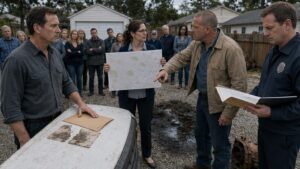
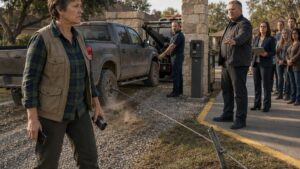
Cars lined both sides of the ranch drive, their tires pressed into the dry grass. Residents from Ridgeview stood behind the open gate in work clothes, pajamas, and exercise gear, some holding empty pitchers as if they had come to display evidence. A sheriff’s deputy waited beside the concrete valve pad. Brian Adams stood near him with two board members and a folder tucked beneath one arm.
Timothy stopped his truck twenty yards away.
Someone called, “That’s him.”
Another voice answered, “He shut us off.”
He had not shut anything off yet.
Pressure had dropped overnight because the contractor had halted work with the new branch partly isolated. Angela had explained that twice by phone. Timothy had said nothing in response except that he would inspect the system himself.
Now Brian had turned uncertainty into an audience.
Timothy stepped out carrying the blue records folder. His father’s metal cup sat in the truck’s console. He considered leaving it there, then took it with him.
Brian moved forward.
“Mr. Moore, these residents need service restored immediately.”
“Restored from what?”
“You interfered with an active community water system.”
“I stopped a construction crew from trespassing.”
A woman near the gate raised her phone higher. “My faucets are barely running.”
Several residents murmured agreement.
Brian gestured toward them. “This is what your obstruction has done.”
Timothy looked at the deputy. “You here to arrest me?”
“No, sir. I’m here to keep the peace and determine whether anyone intends to damage infrastructure.”
“Good.”
Timothy walked past Brian to the valve pad. The rusted wheel stood above the concrete, its stem dark with age. Beside it, the new junction box gleamed against the older well equipment.
He placed the metal cup on the pad.
Brian noticed it and frowned, as though the ordinary object offended the formality of the confrontation.
“We have county documentation,” Brian said.
“Then show it.”
A board member opened the folder and produced the old drought memo. Brian held it toward the crowd rather than Timothy.
“The Moore family granted water access years ago. Ridgeview purchased homes based on continued service. Mr. Moore is trying to revoke that service because he dislikes development.”
That version moved through the residents faster than the truth could. Timothy saw it in their faces: the old rancher, angry at new houses, punishing families for living nearby.
Susan Baker stood near the front. Her gray sweatshirt was zipped over hospital scrubs, and her hair looked hastily tied. She held no phone.
“My mother’s pressure machine uses a humidifier reservoir,” she said. “I need to know whether the water is going off completely.”
Timothy looked at her. “Not yet.”
“Not yet?”
Brian stepped between them. “It will not go off. The association will not allow one landowner to threaten public safety.”
Timothy opened the blue folder.
“Deputy, can you read numbers?”
The deputy’s expression remained neutral. “Usually.”
Timothy crouched and wiped dust from the manufacturer’s plate on the old valve. The stamped figures appeared beneath his thumb.
“Read that serial number aloud.”
Brian said, “This is irrelevant.”
The deputy leaned down.
“MV-41-773.”
Timothy handed him the county inventory sheet.
“And the owner listed beside that number?”
The deputy read silently first. The phones moved closer.
“Moore parcel, section fourteen. Timothy Moore, current owner of record.”
A hush spread unevenly through the group.
Brian recovered quickly. “Ownership of hardware does not eliminate a service obligation.”
“Show him the obligation,” Timothy said.
Brian held out the drought memo.
The deputy read it. “This says emergency temporary interconnection.”
“It established historical use,” Brian replied.
“Where is the permanent easement?” Timothy asked.
Brian turned toward the board member. “The legal packet—”
“The packet has been requested from counsel.”
“So you don’t have it.”
“We have ample evidence of continued service.”
Timothy removed another page from the folder: the Ridgeview utility plat.
“The approved main enters from the south. It never crosses my land.”
The deputy compared the drawing to the trench visible beyond the barn.
One resident lowered his phone. Another asked Brian, “Why are they digging here if that isn’t the approved route?”
Brian’s tone sharpened. “Because field conditions required an adjustment.”
“An adjustment through my pasture,” Timothy said, “with no permit carrying my parcel number.”
A board member leaned toward Brian and spoke under his breath. Timothy caught only two words: engineering objection.
Angela had sent him the document before dawn. A county review comment, dated four months earlier, warned that the proposed ranch connection lacked a permanent easement and could not support build-out demand without independent source verification.
Timothy held up the page.
“Your engineer warned you.”
Brian’s face changed.
It was small, but the crowd saw it.
“That comment was preliminary,” he said.
“It says, ‘Do not construct.’”
“It was resolved administratively.”
“By whom?”
Brian did not answer.
Susan stepped closer to the concrete pad.
“Did you know there was no easement?”
Brian looked at her. “Susan, this is a technical dispute. We are working to protect residents.”
“That isn’t what I asked.”
Other voices followed.
“Did you know?”
“Why weren’t we told?”
“Is our water even permitted?”
Brian raised both hands. “Please. Everyone needs to remain calm. Mr. Moore is creating an artificial emergency to gain leverage.”
Timothy looked at the valve.
The new branch had been feeding Ridgeview from his well, but not lawfully and not safely. Angela had warned him not to make a sudden move. Ronald’s ledger had not yet arrived. The careful choice was to wait.
Then Brian said, “You have no right to touch that system while families depend on it.”
The words struck exactly where Brian intended.
Timothy wrapped both hands around the wheel.
The rust resisted. He shifted his feet and pulled. Metal groaned through the stem.
The crowd erupted.
“Stop him!”
“Call somebody!”
The deputy moved one step forward but did not touch Timothy.
Brian grabbed Timothy’s shoulder. “Take your hands off that valve.”
Timothy turned his head.
“Take yours off me.”
Brian released him.
Timothy continued turning. The old mechanism fought each quarter rotation, then began to move more smoothly. Somewhere inside the line, pressure changed with a low shudder.
At the edge of the pad, a hose bib connected to the new branch sputtered. Water ran in a thin stream, coughed air, and stopped.
Timothy held the wheel closed.
For one suspended second, satisfaction moved through him. Not joy. Something harder. The certainty that a boundary, ignored in paper and dirt, had finally become physical.
Then Susan’s phone rang.
She answered, listened, and went pale.
“My mother’s alarm is sounding.”
Brian seized the moment.
“You see?” he said loudly. “This is what he wanted.”
Susan ignored him. “The humidifier chamber’s empty. The caregiver says the backup bottles are almost gone.”
Timothy’s hands remained on the valve.
He could hear his daughter’s warning: You may be right about the easement and still create an emergency.
Susan looked at him across the concrete.
She no longer looked angry. She looked afraid.
From the open phone in her hand came a faint, repetitive alarm from a house below the ridge.
Chapter 5: His Father’s Favor Was Never a Surrender
Timothy carried two five-gallon water containers into the home of the woman who had accused him of holding a neighborhood hostage.
Susan opened the door before he knocked. She stepped aside without thanking him, but she took one container immediately and led him down a narrow hallway.
Her mother sat in a reclining chair beside a humming oxygen concentrator. Clear tubing ran beneath her nose. A caregiver poured bottled water into a humidifier chamber attached to the machine.
“The alarm stopped,” Susan said. “We had enough for another hour.”
Timothy set the second container by the kitchen doorway.
“I didn’t know the medical equipment depended on household supply.”
“You didn’t ask.”
“No.”
The word remained between them.
Susan folded her arms. “Brian told us the ranch line was a legal backup source. He said the southern pump station had been delayed by county bureaucracy.”
“It was delayed because the design wasn’t complete.”
“I know that now.”
She gestured toward the front windows. Beyond them, residents moved between houses carrying cases of bottled water. “Most of us bought after inspections. We paid connection fees. We were told the system was approved.”
Timothy looked back toward her mother.
“I’ll bring enough emergency water for tonight.”
“We don’t need charity.”
“It isn’t charity.”
“What is it?”
He had no clean answer.
Susan’s voice softened, though not by much. “I was wrong about why you closed it. But you were wrong to assume everyone below that hill was part of what Brian did.”
Timothy picked up the empty plastic cap from the counter and screwed it onto the container.
“You should ask your board where the connection fees went.”
“I plan to.”
She held his gaze.
“I’m not asking you to give Brian what he wants. I’m asking you to help us prove what he did.”
That surprised him more than anger would have.
When Timothy returned to the ranch, Ronald Williams’s truck was parked near the kitchen door. Angela sat at the table with her laptop open. Between them lay a narrow ledger bound in cracked brown cloth.
His father’s metal cup stood beside it.
Timothy stopped in the doorway.
“You moved the cup.”
Angela looked at him. “I washed it.”
“I didn’t ask you to.”
“It had dirt in it.”
“It always had dirt in it.”
Ronald shifted in his chair. “The ledger is why we’re here.”
Timothy removed his coat and sat across from them.
The first pages contained dates from the drought years. Handwritten columns recorded households, gallons, valve positions, and pressure readings. His father’s writing was blunt and compressed.
Three homes. Emergency draw only.
County tanker delayed.
No irrigation.
Close at sunset.
Beside several entries, a line appeared again and again:
Emergency only—no transfer of land rights.
Timothy read it twice.
Angela turned the ledger toward him and pointed to faded marks along the page margin. “These numbers correspond to wheel position.”
“The old valve doesn’t have a gauge,” Timothy said.
“So he rationed by rotation.”
Timothy looked at the metal cup. A pale line circled its inside, worn into the enamel.
Ronald tapped it gently.
“He used that to check flow at the hose bib. Filled to the line in a set number of seconds.”
Timothy remembered his father standing at the valve in summer heat, cup in one hand, pocket watch in the other. Timothy had been young enough to think the ritual was only another stubborn habit.
“He never told me what he was doing.”
Ronald’s eyes remained on the ledger. “You weren’t speaking much then.”
“We spoke.”
“You argued.”
Timothy shut the book.
Ronald did not retreat. “You wanted him to sell the north acreage after your wife died. He thought you were trying to leave.”
“I was trying to pay hospital debt.”
“He knew that later.”
“Later wasn’t useful.”
Angela closed her laptop partway. “Neither is pretending Grandpa’s silence was only his fault.”
Timothy looked at her.
She did not look away.
“You do the same thing,” she said. “You decide what people should understand, then punish them when they don’t.”
The kitchen refrigerator clicked on. From outside came the distant clank of cattle moving through the south gate.
Timothy opened the ledger again.
Near the final entries, his father had written:
Development inquiry denied. Temporary drought use cannot support permanent subdivision.
Below it:
Any future connection requires separate source, recorded agreement, and Moore approval.
The words steadied something inside him.
His father had not surrendered the ranch. He had opened the valve because neighboring wells had failed, then closed it when the emergency ended. The favor had been measured, conditional, and specific.
What followed had not been generosity misunderstood by accident. Someone had taken the memory of that generosity and stretched it until it covered a subdivision.
Angela turned her laptop back toward him.
“I found the engineering objection.”
He had seen the first page at the valve pad. Now she showed him the complete email chain.
The consulting engineer had warned Brian and the developer’s project manager that the ranch connection lacked a recorded easement, that the old well had not been tested for full development demand, and that construction should not proceed.
Brian’s reply was brief:
Continue preliminary work. Documentation is being resolved.
A later message showed him approving field installation two days before Timothy’s father died.
“Why take that risk?” Timothy asked.
Angela opened a financial attachment.
“Because the next phase had twelve closings scheduled. If permanent water certification failed, lenders could suspend them.”
Ronald leaned back. “That would put the development in trouble.”
“More than the development,” Angela said. “Brian is listed as a member in the company that owns two unfinished homes. His personal guarantee appears in the financing disclosure.”
Timothy studied the screen.
Brian had not merely protected an abstract community. He had tied his own savings and status to the project, then treated Timothy’s land as the least expensive solution.
It explained the pressure.
It did not excuse the choice.
A vehicle stopped outside. A door slammed.
The ranch hand entered holding a large envelope.
“Deputy delivered this. Said it came from the courthouse.”
Timothy opened it at the table.
Brian and the HOA had petitioned for an emergency order compelling access to the valve and prohibiting Timothy from interfering with community water service. The filing described him as an unstable landowner who had deliberately endangered medically vulnerable residents.
A hearing was set for Monday morning.
Angela read over his shoulder.
“They used Susan’s mother.”
“They used what I did.”
“You can explain it.”
Timothy looked at the ledger, the repeated warning, and his father’s careful ration marks.
For years he had resented the old man for leaving promises half-spoken.
Now Timothy had given Brian a silence of his own to weaponize.
Chapter 6: The Hearing Exposed What Every Signature Hid
Brian’s attorney placed the hidden ledger into evidence before Timothy had explained why it existed.
The brown book lay beneath the courtroom lights, its cracked cover visible to the judge. Copies had already been distributed. Timothy sat beside Angela at the respondent’s table, listening as the attorney described “decades of continuous community reliance authorized by the Moore family.”
Ronald shifted uneasily in the witness seats.
Brian sat behind his attorney wearing a dark suit. He looked tired rather than triumphant. A stack of folders rested beside him, each marked with Ridgeview lot numbers.
The attorney opened the ledger.
“Your Honor, the petitioner does not deny that formal documentation should have been updated. But equity recognizes conduct. The prior owner supplied water beyond his boundary for years. The current owner knew infrastructure existed and nevertheless closed the master valve without notice.”
Timothy leaned toward Angela.
“I didn’t know the current infrastructure existed.”
“I know,” she whispered. “Let him finish.”
The attorney displayed a photograph. Timothy’s father stood beside the rusted valve during the drought, one hand on the wheel and the metal cup in the other. Three neighbors waited with containers behind him.
The image struck harder than the ledger.
His father looked younger than Timothy remembered him at the end, but older than Timothy was when they had stopped speaking honestly.
The attorney continued. “Mr. Moore now claims absolute control while refusing to acknowledge the humanitarian arrangement his own father maintained.”
The judge looked toward Timothy’s side.
“Counsel?”
Timothy’s attorney began to rise, but Timothy touched his sleeve.
“I need to say it.”
The attorney hesitated, then asked permission for Timothy to testify.
Under oath, Timothy gave his name, occupation, and history maintaining municipal water systems. His attorney led him through the cut fence, unauthorized trench, missing easement, and new junction box.
Then came the ledger.
“Did your father provide water to neighboring homes?” the attorney asked.
Timothy could have narrowed the answer. He could have said he had not witnessed every entry or that the arrangement had expired.
Instead he looked at the photograph.
“Yes.”
Brian glanced up.
“Was it permanent?”
“No.”
“How do you know?”
“My father wrote the conditions beside every draw. Emergency only. No irrigation. Close at sunset. No transfer of land rights.”
The HOA attorney stood. “Yet the line remained physically present.”
“A two-inch emergency branch remained. Ridgeview installed an eight-inch main and a sewer line.”
“Did you notify every resident before closing the valve?”
“No.”
“Did you confirm whether medical equipment depended on the supply?”
“No.”
The attorney let the silence lengthen.
“So despite your technical experience, you shut down a line without determining the consequences.”
Timothy felt Angela’s stillness behind him.
“Yes.”
The answer created a murmur in the gallery.
The attorney appeared surprised by its simplicity.
“Why?”
“Because I was angry. Because they cut my fence while I buried my father. Because Mr. Adams told me I’d die before I could stop them.”
Brian’s attorney looked toward his client, then back at Timothy.
“Is that statement documented?”
“No.”
“So this court has only your account.”
“Yes.”
The attorney returned to his table.
Timothy’s own attorney introduced the approved Ridgeview utility plat, the valve inventory, and the emergency memo. Angela testified that the southern pump station—not Timothy’s well—was the permitted permanent source. She explained the difference between the old two-inch branch and the new eight-inch connection.
Then she produced the engineering objection.
Brian’s attorney challenged its status as preliminary. Angela read the central sentence aloud:
“Construction across the Moore parcel shall not proceed without recorded permanent easement, independent source-capacity certification, and owner authorization.”
The judge looked at Brian.
“Did you receive this?”
Brian took the stand after a conference with his attorney.
“Yes.”
“Why did construction proceed?”
“We believed the historical arrangement would be formalized. The developer’s counsel advised that continued use created a defensible access claim.”
“Did counsel advise you to begin construction before resolving it?”
Brian paused.
“Not in those words.”
The judge’s voice cooled. “What words did counsel use?”
Brian looked at the residents seated behind him. Susan was among them.
“They said delay could jeopardize closings.”
“Your closings?”
“Community closings.”
Angela passed a financial disclosure to Timothy’s attorney. After objections and argument, the judge admitted it for the limited purpose of motive.
Brian acknowledged that he held an interest in two unfinished Ridgeview properties. If the water certification failed, both could fall into default.
His composure weakened.
“I was trying to prevent a collapse,” he said. “People had deposits at risk. Contractors had payroll. Families had sold other homes. Every official kept telling us one more document was needed. One more review. One more delay.”
The judge asked, “So you used Mr. Moore’s land because the lawful route cost more?”
Brian’s face tightened.
“We used a source that had served the area before.”
“After your engineer told you not to.”
Brian did not answer.
The hearing paused while the judge reviewed the documents.
In the corridor, Susan approached Timothy.
“I gave a statement about my mother,” she said.
“I expected you would.”
“I said the shutdown frightened us. I also said Brian never disclosed that the source crossed private land.”
Timothy nodded.
She looked through the courtroom doors at Brian.
“I thought he was protecting our homes.”
“He may have thought so too.”
“That doesn’t make him right.”
“No.”
When court resumed, the judge declined to grant the HOA permanent access. The old drought arrangement, she said, demonstrated humanitarian permission, not a property transfer. The current construction exceeded both its physical scale and stated purpose.
But she did not leave Timothy untouched.
“The court cannot ignore the respondent’s decision to close a known residential supply without adequate assessment,” she said. “Nor can it allow the petitioners to benefit from unauthorized construction.”
She ordered temporary bottled-water distribution, immediate independent testing, and no further work on Timothy’s land.
Then she turned to him.
“Mr. Moore, you understand this system better than anyone presently before the court.”
“Yes, Your Honor.”
“You will submit, within twenty-four hours, a proposed interim operating plan that protects medically vulnerable residents and fire safety without creating a permanent easement or prejudicing your ownership claim.”
Timothy’s attorney whispered, “We can draft narrow terms.”
Angela already had her laptop open.
Outside the courthouse, she showed Timothy a preliminary plan: monitored limited flow, emergency shutoff protocols, county supervision.
He read the first page and handed it back.
“What’s wrong with it?” she asked.
“It sounds like the county owns the decision.”
“The court asked for a safe plan.”
“And I’ll give one.”
“You have twenty-four hours.”
“I know.”
Angela studied him. “Don’t turn this into another refusal.”
Timothy looked through the courthouse windows at the photograph still displayed inside—the old valve, his father’s hand, the metal cup measuring what could be given without giving everything away.
“I’m not refusing,” he said. “But I’m writing the terms myself.”