They Threatened to Remove Him From His Mountain Cabin—Then the Old County Map Changed Everyone’s Story
Chapter 1: The Men at the Bottom of the Cedar Steps
“Step away from the access road, sir.”
Charles Walker did not move.
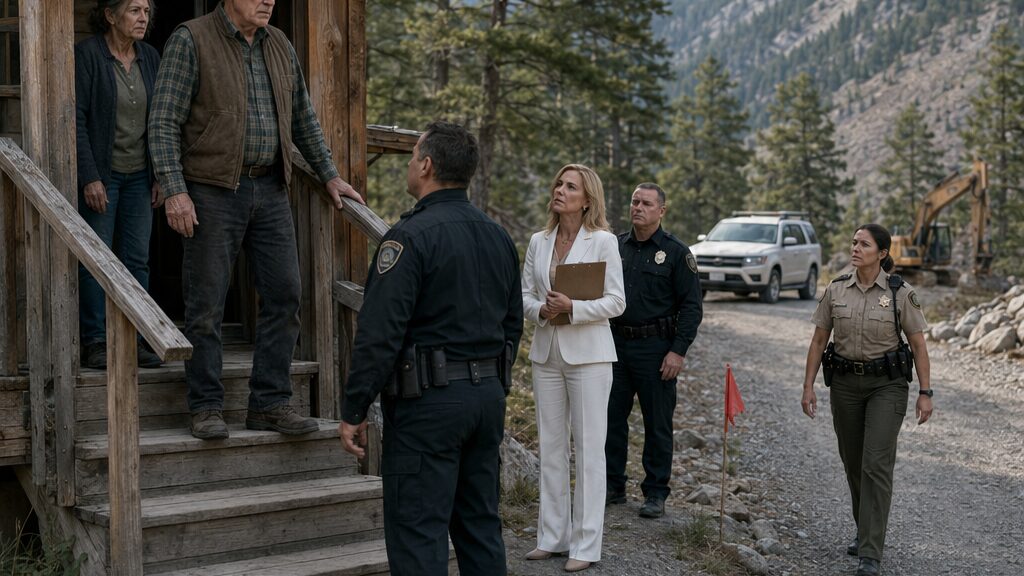
The man who had spoken stood at the bottom of the cedar steps in a dark uniform, one hand resting near his belt. A shield-shaped patch was sewn over his left pocket. From twenty feet away, it looked official enough to make a person obey before asking questions.
Charles looked at the patch.
Then at the second man beside him.
Then at Katherine Moore.
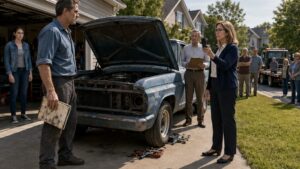
She stood between them in a white pantsuit too clean for the gravel road, holding a clipboard against her ribs. Her white SUV blocked half the turn near the gate. Behind it, a red survey flag trembled beside the ditch.
“Mr. Walker,” Katherine said, “we’re done discussing this.”
Charles’s right hand closed around the cedar handrail.
The wood was sun-faded where palms had passed over it for decades. His father had shaped the upper curve with a drawknife because he had disliked the square factory rails Charles wanted to buy. The old man had said a hand ought to know when it was home, even in the dark.
Charles felt the shallow groove beneath his thumb.
Katherine lifted her clipboard.
“You are obstructing authorized access to an association infrastructure project. You have been notified repeatedly. These officers are here to ensure compliance.”
The nearest uniformed man shifted his feet.
Charles noticed that.
Not the threat. The shift.
A man comfortable in his authority usually did not look sideways when someone called him an officer.
Behind Charles, the screen door creaked.
Elizabeth stepped onto the porch. “What’s going on?”
“Go back inside,” Charles said.
Her eyes hardened. “No.”
The second uniformed man glanced toward the cabin. “Ma’am, for everyone’s safety, you need to remain clear of the work area.”
Elizabeth looked past him at the gravel road they had paid to grade every spring for thirty-one years.
“What work area?”
Katherine exhaled sharply. “This is exactly the behavior we’ve been dealing with.”
Charles kept his hand on the rail.
The morning had already gone wrong before the three vehicles came up the mountain. He had heard engines below the bend, then doors, then Katherine’s voice carrying through the trees. But the sight of the uniforms had changed the weight of things. It had made the cabin seem smaller.
That was what bothered him most.
Not fear itself.
The fact that someone had brought fear here deliberately.
Katherine stepped closer. “You were given a final opportunity to cooperate. You refused.”
“I refused your claim.”
“The county map recognizes the route.”
“No,” Charles said. “Your map recognizes the route.”
Her expression barely changed, but the clipboard tightened against her side.
“The association has documentation.”
“Then show it.”
“We have shown it.”
“You showed me a colored line.”
The nearest uniformed man raised his voice. “Sir, I’m going to ask you one more time to step away from the access.”
Charles looked directly at him.
“Are you a sworn law-enforcement officer?”
The man paused.
Katherine answered for him. “They are enforcement personnel retained for this situation.”
“That wasn’t my question.”
“Charles,” Elizabeth said quietly.
He heard the warning in her voice. Not that he should surrender. That he was beginning to sound like his father.
Charles descended one step.
The first uniformed man straightened.
Charles stopped.
“Are you a sworn officer?”
The man said, “We are authorized to enforce compliance on behalf of the association.”
“Badge number?”
Another pause.
A bird called from the timber above the roofline. Somewhere down the slope, an engine idled.
Charles looked at the second man. “You?”
“We’re not here to debate credentials.”
“Court order?”
Katherine’s jaw tightened. “This is not a courtroom.”
“No. It’s my front steps.”
She flipped open the clipboard and removed a sheet in a clear plastic sleeve.
“This notice authorizes immediate access under the recorded utility corridor shown on the county planning map.”
Charles did not take the paper.
“Recorded where?”
“County records.”
“Book and page?”
The silence that followed was small, but it was the first thing all morning that belonged to him.
Elizabeth came to stand beside the doorframe.
Katherine lowered the sheet. “You have spent three weeks trying to manufacture ambiguity where none exists.”
Charles felt something cold move through him.
Three weeks.
Three weeks of red flags appearing where no one had asked permission to stand. Three weeks of notices that smelled like warm toner. Three weeks of Katherine speaking as if confidence could substitute for chain of title.
And now this.
“You brought men dressed like officers to my house,” he said.
Katherine’s face sharpened. “I brought professionals because you have repeatedly obstructed an authorized project.”
“Professionals from where?”
The first man stepped forward. “Sir, that is enough.”
Charles’s hand tightened on the cedar rail.
The old instinct rose fast: shut the gate, say nothing, give them no piece of you they could use. It was the instinct his father had lived by. The instinct Charles had inherited so thoroughly that sometimes Elizabeth accused him of mistaking silence for strength.
Maybe she was right.
But not this morning.
Charles looked at Katherine.
“You said the county map gives you access.”
“It does.”
“You’re sure?”
“Yes.”
“Then you won’t mind waiting for the county.”
For the first time, something moved behind her confidence.
Not doubt.
Anger.
“You do not get to delay emergency work because you dislike the answer.”
Charles heard the word.
Emergency.
It was new.
“You never called it emergency work before.”
Katherine looked toward the men. “Remove the obstruction from the access lane.”
Elizabeth stepped forward. “What obstruction?”
Katherine pointed.
At Charles.
The nearest uniformed man moved one foot onto the bottom cedar step.
Charles did not release the rail.
He looked down at the man’s polished black boot, then at the red survey flag beside the road.
For one impossible second, the two objects seemed connected by a line only Charles could see.
A flag.
A map.
A claim.
Three weeks earlier, before the uniforms and the clipboard and the word emergency, he had found the first red flag twenty-seven paces beyond his gate.
On his side of the fence.
And when he pulled it from the ground, a second one was waiting farther up the slope.
Chapter 2: The Fresh Toner Notice on the Woodpile
The notice was stapled to the post beside Charles’s firewood.
He found it at six forty in the morning, ten days before Katherine arrived with the uniformed men.
The paper was bright white. Too bright against the gray cedar post and split pine logs. A plastic sleeve protected it from dew.
Charles read the heading twice.
NOTICE OF VIOLATION AND REQUIRED CORRECTIVE ACTION
Below that was his property address.
Below that, a demand.
The western deck and associated rail structure were identified as noncompliant improvements affecting community visual standards and a planned utility-access corridor. Corrective action was required within ten days.
Charles removed the staple with the tip of his pocketknife.
The paper still held warmth from a printer.
Fresh toner.
Bad intentions, his father would have said.
Charles folded the notice once and carried it inside.
Elizabeth was pouring coffee.
“What now?”
He laid the paper on the kitchen table.
She read the first paragraph, then looked toward the windows facing the deck.
“They want the rail removed?”
“They want enough language on paper that nobody knows what they want.”
“It says deck structure.”
“It says associated rail structure.”
“That’s the rail.”
“I can read.”
Elizabeth put down the page. “Then don’t start with me.”
Charles turned toward the coffee maker.
That was how the first argument began.
Not with the HOA.
With his wife.
By eight, he was at the gate studying the red flags again.
There were five now.
One near the drainage ditch. Two climbing the lower slope. Another beside the gravel turnout. The fifth stood beyond an old ponderosa, close enough to the cabin road that Charles could see it from the deck.
He followed them downhill until the trees opened toward the planned community below.
The HOA development occupied the gentler part of the mountain: clustered homes, trimmed roadside grass, stone entrance signs, matching mailbox structures. Charles’s four acres sat above it, older than the development and awkwardly positioned beside the narrow corridor that connected the upper lots to the county road.
A white SUV approached.
Katherine Moore lowered the passenger window.
“Mr. Walker.”
Charles stayed where he was.
She parked and stepped out holding a clipboard.
“You received the notice.”
“Somebody came onto my property to post it.”
“It was served at the affected site.”
“Who?”
“Our property-management representative.”
“Name?”
Katherine ignored the question. “I was hoping we could avoid making this adversarial.”
Charles looked at the red flags.
“You put those there?”
“The survey team did.”
“On whose authorization?”
“The expansion plan has already moved beyond preliminary review.”
“That isn’t what I asked.”
Her smile disappeared.
Katherine was younger than Charles by at least fifteen years, maybe more. She spoke with the clipped patience of someone accustomed to meetings where time itself became leverage.
“The association has spent eighteen months coordinating the infrastructure route.”
“Not with me.”
“The relevant corridor is recognized on the updated map.”
“What corridor?”
She opened the clipboard and showed him a color printout.
A thick blue line ran from the development boundary up the slope. Near his gravel road it bent west, crossed a shaded area, then continued toward the planned expansion.
Charles stared at it.
The line passed near his deck.
Closer than near.
It seemed to pass beneath the western corner.
“Where’d you get this?”
“County planning data.”
“That isn’t a deed.”
“It reflects the recognized access.”
“Recognized by who?”
“The county.”
Charles looked more closely. The map had parcel lines, contour marks, road labels. His property boundary was shown in black.
The blue route crossed it.
No easement reference appeared beside the line.
No recording number.
No book.
No page.
“You updated this,” Charles said.
“The association submitted corrected mapping based on available records.”
“Corrected.”
“Yes.”
“Before asking me.”
Katherine shut the clipboard.
“Your refusal to acknowledge an existing corridor does not erase it.”
Charles felt the familiar pressure behind his ribs.
His father had hated that kind of sentence. Words designed to leave no place for another person to stand.
Charles handed the map back.
“Get your flags off my land.”
Katherine’s expression changed, not much.
“You should speak with counsel before making decisions that expose you to fines.”
“Fines from an HOA I don’t belong to?”
“Your property affects association infrastructure.”
“That doesn’t make my house yours.”
“No one said it did.”
He held up the notice.
“This says my deck violates your standards.”
“It says the structure interferes with an identified corridor.”
“It also says community visual standards.”
“The document uses standardized compliance language.”
Charles almost laughed.
Instead he folded the notice again.
“Then standardize somebody else.”
He walked away.
That afternoon, he wrote the letter.
Elizabeth read it over his shoulder.
To the Board and Management:
I reject in full any claim by your association of jurisdiction, easement, access, enforcement authority, design control, utility rights, or other interest affecting my property. No employee, contractor, surveyor, board member, manager, agent, or representative is authorized to enter.
Elizabeth stopped reading.
“In full?”
“Yes.”
“You haven’t checked the records yet.”
“I know my deed.”
“You know the copy in the safe.”
“My father bought this land before that development existed.”
“That doesn’t answer every possible easement.”
Charles turned from the desk.
“Whose side are you on?”
The words landed before he could pull them back.
Elizabeth’s face went still.
“That,” she said, “is exactly the wrong question.”
She left the room.
Charles sat alone with the letter.
For several minutes he did nothing.
Then pride did what pride often did when given time to cool: it disguised itself as principle.
He signed the refusal.
He sent it certified the next morning.
Two days later, Charles walked into the county records office carrying the HOA notice, the color map, and his deed copy.
The building smelled of carpet dust and old paper.
A senior records technician named Debra Hill listened without interruption. Then she asked him for the parcel number.
Charles gave it.
She typed, frowned, and disappeared through a door behind the counter.
When she returned, she carried a wide archival folder.
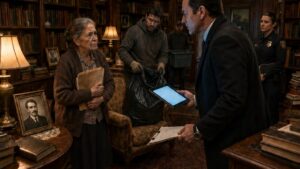
“Mr. Walker,” she said, “I’m going to tell you what I can verify and what I can’t.”
“That’s all I want.”
Debra opened the folder.
The first document was a plat map older than the one Katherine had shown him.
Then another.
Then a narrow strip of microfilm printout.
Charles leaned closer.
Debra placed Katherine’s color map beside the older record.
“These aren’t the same thing,” she said.
“I know.”
“No,” Debra replied. “I mean they are not showing the same legal history.”
She tapped the date in the lower corner of Katherine’s map.
Then she tapped a notation on the older plat.
“This map is newer than the right it claims to show.”
Chapter 3: The Map Beneath Forty Years of Dust
Debra Hill pulled a second plat from the archival folder, and Charles knew immediately that Katherine had never shown it to him.
The paper was yellowed at the edges and soft along the folds. A county recording stamp sat near the lower right corner. Across the center ran a hand-drawn road line that looked nothing like the clean blue corridor on the HOA map.
“What is that?” Charles asked.
Debra adjusted her glasses.
“Depends which year you’re asking about.”
“I’m asking now.”
“That’s not how land records work.”
Charles looked at her.
She did not smile.
“I’m not trying to be difficult, Mr. Walker. I’m telling you the problem.”
She spread three documents across the counter.
The oldest showed Charles’s parcel before the planned community existed. The next showed the first development phase below the slope. The third contained utility annotations added years later.
Charles pointed to his gravel road.
“That’s mine.”
“The parcel is yours.”
“The road?”
“There’s no separate road parcel here.”
“So mine.”
Debra shook her head slightly. “Ownership and use rights are not always the same question.”
Charles felt irritation rise.
He had come for a clean answer. Katherine was wrong. The HOA had no authority. The flags came out. The project stopped.
He had imagined leaving with that certainty folded under his arm.
Instead Debra kept introducing verbs like appears, indicates, may, and requires further review.
She tapped the oldest plat.
“Your deed chain predates the association by decades. That part is straightforward.”
Charles exhaled.
“Forty years?”
“More, depending on which development filing you use.”
“So they can’t enforce design standards on my deck.”
“I don’t see anything here showing your parcel was annexed into the association.”
The first true relief entered him.
Small, hard, satisfying.
He pictured Katherine’s notice on the woodpile.
Community visual standards.
Standardized compliance language.
“Can I get a certified copy?”
“Yes.”
“And something stating I’m outside the HOA?”
“No.”
“Why not?”
“Because I certify records, not legal conclusions.”
Charles stared at her.
Debra looked back without apology.
“But,” she said, “I would ask whoever sent this notice to identify the recorded instrument they believe gives them design authority over your parcel.”
Charles nodded.
That was enough for now.
Then Debra moved the middle plat.
A thin dashed line appeared beneath her hand.
“What’s that?”
“Utility notation.”
Charles leaned closer.
The line entered from the lower development, crossed toward his western boundary, disappeared under a block of later annotations, then emerged above the road.
“Wastewater?”
“Looks like it.”
“Looks like?”
“The index references a sewer service route. I need the utility book.”
She disappeared again.
Charles waited beside the counter.
On the wall behind him hung aerial photographs of the county from different decades. In one, the entire upper slope was timber and rock. No development. No curved subdivision roads. No stone entrance sign.
Just the mountain.
His father had liked maps but distrusted anyone who brought one to a kitchen table.
A map, he used to say, was a man telling dirt what it had agreed to.
Charles had laughed the first time.
He did not laugh now.
Debra returned carrying a long ledger and a rolled reproduction.
“This is where it gets less clean.”
She unrolled the sheet.
A utility line crossed the slope.
Charles followed it with one finger.
From the lower homes, up toward his boundary.
Across.
Then back.
He frowned.
“It crosses my parcel.”
Debra said nothing.
“Twice.”
“It appears to.”
“Why?”
“The topography may have forced the route.”
Charles traced the line again. The old sewer path curved along the slope, crossed a narrow section of his land, returned toward the development, then cut across a second corner near what was now his gravel turnout.
He looked at Katherine’s blue corridor.
Her new line did not merely follow the old route.
It widened it.
Straightened it.
Extended it toward the expansion area.
“Jesus.”
Debra’s voice stayed neutral. “The association may have infrastructure concerns that are real even if their map does not establish the rights they’re claiming.”
Charles barely heard her.
A feeling of vindication moved through him so strongly that for a moment it became almost physical.
They needed his land.
That was why the flags had appeared.
That was why the deck had suddenly become noncompliant.
That was why Katherine kept saying corridor.
She had not been enforcing standards.
She had been applying pressure.
Charles took out his phone.
“I need copies of all of this.”
“You can request them.”
“Certified.”
“Some can be certified. Some are reference reproductions.”
“Everything you can.”
Debra watched him.
“You’re going to confront them.”
“I’m going to stop them.”
“That is not the same thing as understanding the record.”
Charles lowered the phone.
“Do you see a permanent easement?”
“I see references.”
“Recorded easement?”
“I haven’t found the instrument.”
“Then they don’t have one.”
“I did not say that.”
“You haven’t found it.”
“That is different.”
Charles felt his jaw tighten.
Debra turned the ledger around.
Beside one utility entry was a typed notation.
TEMPORARY ACCESS—SEE CORRESPONDENCE INDEX
No book number.
No page number.
No permanent easement instrument attached.
Charles read it twice.
“Temporary.”
“That’s what this says.”
“So not permanent.”
“That’s what that word usually means.”
He almost smiled.
Debra did not.
“But there’s another problem.”
She pointed to a faded handwritten mark beside the notation.
“What is that?”
“Cross-reference.”
“To what?”
“I don’t know yet.”
Charles looked at his watch. He had been there nearly two hours.
“Can somebody just erase an easement?”
“No.”
“Lose one?”
“Records can be misindexed. Instruments can be referenced under grantor names instead of parcel numbers. Older utility arrangements can be ugly.”
“Ugly isn’t legal.”
“No. But it isn’t imaginary either.”
Charles looked again at the route crossing his property twice.
The first revelation had been simple.
The HOA had no visible basis to control his deck.
The second was better.
Their expansion might depend on ground he owned.
The third had just arrived and spoiled the taste of both.
There had been some kind of access.
Temporary, perhaps.
Informal, perhaps.
But something.
Debra pulled an old county index drawer from beneath the counter. Unlike the computer system, it contained narrow cards with typed and handwritten entries.
She searched under the utility district first.
Nothing.
Then the original development company.
Two references.
Neither matched.
She tried the road name.
Then Charles’s parcel predecessor.
Her finger stopped.
Charles saw the change in her face.
“What?”
Debra drew out a card.
The handwriting was faded blue ink.
She placed it on the counter.
Charles read the first line.
ACCESS CORRESPONDENCE—UPPER SLOPE SEWER EMERGENCY
Then the date.
Thirty-eight years earlier.
Then a name.
Not the association.
Not the developer.
His father’s.
Charles Walker Sr.
For several seconds Charles said nothing.
Debra looked at him.
“You recognize that name?”
Charles kept his eyes on the card.
“Yes.”
“Then there may be another file.”
He felt the certainty he had carried into the building shift beneath him.
Not disappear.
Shift.
His father had never mentioned an easement.
Never mentioned sewer access.
Never mentioned giving the development below them anything.
But the county index said otherwise.
Debra reached for the request slip.
Charles stared at his father’s name and wondered, for the first time, whether Katherine Moore was the only person in this dispute who had been telling an incomplete story.
Chapter 4: The Letter Charles Never Showed His Wife
Elizabeth recognized the handwriting before Charles had taken off his coat.
She was standing at the kitchen table with the photocopy from the county index in one hand. The original certified pages lay beside it. Charles had left them there when he came home, meaning to explain after coffee, after dinner, after he had decided how much explanation was necessary.
Elizabeth tapped the blue-ink notation.
“That’s your father’s.”
Charles stopped.
Outside, a gust pushed against the western windows. The cedar deck gave its familiar low creak.
“You can’t know that from a copy.”
“I wrote Christmas cards to him for twenty-eight years.”
She looked at Charles.
“Don’t do that.”
“Do what?”
“Make me prove I remember your family.”
He set his keys on the counter.
The room suddenly seemed arranged against him: the county papers, the HOA notice, Katherine’s colored map, the certified-mail receipt from the refusal he had already sent.
Elizabeth lowered the photocopy.
“What did he agree to?”
“I don’t know.”
The answer came too quickly.
Her face changed.
Not anger yet.
Recognition.
Charles turned toward the sink.
“I’m going back tomorrow. Debra said there may be another file.”
“Charles.”
“There are gaps in the index.”
“Charles.”
He opened the faucet though there was nothing in his hands to wash.
Elizabeth crossed the kitchen and shut it off.
“You know something.”
“I know my father.”
“That isn’t an answer.”
“He never gave that development permanent rights.”
“You said you didn’t know what he agreed to.”
“I said I don’t know what that card refers to.”
Elizabeth watched him for several seconds.
Then she walked out of the kitchen.
Charles heard the hallway closet open.
His stomach tightened.
“Elizabeth.”
No answer.
A door farther back in the cabin scraped across old flooring. The storage room.
Charles went after her.
She had already pulled the cedar chest away from the wall.
The chest had belonged to his mother. After she died, it became the place for papers no one wanted to throw away and no one wanted to read. Tax receipts. Funeral cards. Warranty booklets for machines long gone. His father’s final hospital folder.
Elizabeth knelt and lifted the lid.
“Don’t,” Charles said.
She looked up.
There it was.
The anger.
“You brought county employees into this. You sent certified letters. You told me there was no possible access right.”
“I said there was no permanent easement.”
“No. You said they had nothing.”
She began removing folders.
Charles stood in the doorway.
He could have stopped her only by admitting where the letter was.
That was the absurdity of it.
Silence had protected the secret until silence itself pointed directly at it.
Elizabeth found the brown envelope beneath a stack of property-tax statements.
She froze.
Charles closed his eyes for half a second.
On the front, in his father’s handwriting, were the words:
UPPER LINE—TEMPORARY ONLY
Elizabeth did not open it immediately.
“When were you going to tell me?”
“It isn’t what you think.”
“You have no idea what I think.”
“My father didn’t sign away the land.”
“That is not what I asked.”
Charles felt himself harden.
It happened automatically. A door closing somewhere inside.
“I found it after he died.”
“How long ago?”
He said nothing.
Her mouth parted slightly.
“Charles.”
“Seventeen years.”
She stared at him.
He wished she had shouted.
Instead she sat back on her heels.
“Seventeen.”
“I read it once.”
“And hid it.”
“I put it with his papers.”
“You wrote the HOA yesterday saying no access had ever been authorized.”
“I wrote that they have no current right.”
“You wrote ‘any claim.’ I read it.”
Charles looked away.
Through the storage-room window he could see the outer end of the cedar rail. One upright had darkened at the base where snow sat too long each spring.
His father had cut a small V-shaped notch into the underside of the top rail during construction. A carpenter’s mark. Nothing decorative.
Charles had once asked why.
So you know which side I worked from, his father said.
At the time Charles thought it was a joke.
Elizabeth opened the envelope.
The paper inside was thin, yellowed, folded twice.
She read silently.
Then again.
Charles knew the words without needing to see them.
He had not memorized them intentionally.
Some sentences simply stayed because a person spent years trying not to think about them.
The letter was addressed to the original development company.
It acknowledged a failed section of sewer line after a winter slide. It granted crews temporary permission to cross the upper slope for emergency repair equipment. Access was limited to a described route. Restoration was required. Permission ended when the work was complete.
Near the bottom, his father had written one additional paragraph by hand.
This permission is not a permanent road right or utility easement. Any future crossing requires separate agreement in writing.
Elizabeth set the page down.
“So you were right.”
Charles said nothing.
“Partly,” she added.
“They have no permanent easement.”
“This letter says he let them in.”
“Once.”
“For an emergency.”
“Thirty-eight years ago.”
“You knew.”
Charles felt heat rise behind his neck.
“My father spent the last years of his life watching that development creep uphill. Every time they wanted something, they called what they wanted necessary.”
Elizabeth stood.
“And now you hear the same thing.”
“Yes.”
“So you decided the past only counted where it helped you.”
“That’s not fair.”
“No?”
“He was explicit. Separate agreement in writing.”
“I can read, Charles.”
“Then read that sentence again.”
“I did.”
She folded the letter carefully.
“What you don’t want to read is the rest.”
He looked at her.
“Your father let them cross because something had failed.”
“That doesn’t give Katherine Moore my road.”
“I didn’t say it did.”
“You’re doing exactly what she does. Mixing one thing into another until I’m supposed to surrender.”
Elizabeth’s expression tightened.
“No. I’m asking whether you can tell the truth without treating it as surrender.”
The words hit harder than he expected.
He turned away.
That evening, neither of them mentioned dinner.
Charles sat on the western deck with the county maps spread across a small worktable. The old utility route crossed his parcel twice. The new route on Katherine’s map was wider, straighter, more convenient for the expansion.
Not the same.
That mattered.
But the letter mattered too.
He ran his thumb beneath the cedar handrail until he found the old V-shaped notch.
His father’s mark.
For seventeen years, Charles had treated that letter as another kind of mark: proof that the old man had seen the danger and drawn a boundary.
Temporary only.
Charles had ignored the first half.
Permission granted.
An engine sounded below.
Not a pickup.
Diesel.
He stood.
Headlights moved between the trees at the lower bend. Then another set.
Elizabeth came onto the deck.
“What is that?”
Charles was already walking toward the steps.
By the time he reached the gate, a flatbed truck had stopped on the shoulder. Behind it waited a tracked excavator on a trailer.
A man in a reflective vest climbed down from the cab.
Charles stood in the middle of the gravel road.
“Where are you going?”
The excavator operator looked at a tablet, then toward the slope.
“Upper access.”
“No.”
The man frowned.
“We’re scheduled.”
“By who?”
“Association project.”
“This road is private.”
The operator looked uncomfortable rather than confrontational.
“I was told it was cleared.”
Charles stepped closer.
“Who told you?”
The man glanced at the white markings painted near the trailer hitch, then back at Charles.
“HOA contact. Katherine Moore’s office.”
Charles looked at the excavator.
At the red flags.
At the road his father had once allowed emergency crews to cross.
Then at the operator.
“Did she tell you the access is disputed?”
The man’s silence answered before his words did.
“No,” he said. “She told us it was already cleared.”
Chapter 5: The Day Private Authority Came Wearing Badges
At seven twelve the next morning, one of the uniformed men told Elizabeth Walker that they had authority to remove obstructions.
She was standing halfway down the cedar steps.
Charles heard the sentence from inside the cabin.
“What obstructions?” she asked.
The man looked past her.
At Charles.
He came through the screen door slowly.
Two dark-uniformed contractors stood below the steps. Katherine Moore was near the gravel turnout with her clipboard. Her white SUV sat behind them, angled in a way that narrowed the road.
The excavator was farther down the slope now, unloaded but silent.
Charles recognized the scene before it fully formed.
This was where the three weeks had been heading.
Not to court.
Not to a records office.
Here.
One side trying to make the other move first.
Katherine looked up at him.
“Mr. Walker, we’re proceeding today.”
“No.”
“The contractor has mobilized. You were notified.”
“You sent equipment onto disputed access after your operator was told it wasn’t cleared.”
Her eyes narrowed slightly.
“The association’s position has not changed.”
“Mine has evidence now.”
That caught her.
Only for an instant.
“What evidence?”
Charles came down one step and rested his hand on the cedar rail.
“The kind with recording dates.”
The nearest uniformed contractor shifted.
Katherine recovered.
“If you believe you have a legal objection, you can pursue it through appropriate channels. You cannot physically obstruct authorized work.”
Charles looked at the men.
Their uniforms were close enough to law enforcement to be understood before they were examined. Dark shirts. Dark trousers. Metal belt hardware. Shield-shaped company emblems. One wore a badge-shaped piece above his pocket.
No visible company name from where Charles stood.
“Who are they?”
“Compliance enforcement.”
“That isn’t a company.”
Katherine’s tone sharpened. “They are retained professionals.”
The contractor nearest Elizabeth said, “Sir, we need you to clear the designated access zone.”
Elizabeth looked at him.
“You told me you could remove obstructions.”
“We can take appropriate steps to secure the work area.”
“Are you police?”
The man did not answer directly.
“We’re authorized to enforce site compliance.”
Charles felt something settle inside him.
Not calm.
A narrower thing.
Precision.
He looked at Katherine.
“Yesterday you called this an infrastructure project. Today you brought enforcement.”
“You have escalated at every stage.”
“I pulled flags off my land.”
“You interfered with survey work.”
“I asked for an easement.”
“You were provided documentation.”
“A color map.”
“A county-recognized map.”
Charles descended another step.
The contractor lifted one hand.
“Stay there, sir.”
Charles stopped.
The words hung between them.
Elizabeth turned toward the man.
“Did you just order him to stay on his own steps?”
Katherine said, “Please don’t make this theatrical.”
Charles almost laughed at that.
Instead he looked at the contractor’s chest.
“Badge number?”
The man’s hand lowered.
“What?”
“Your badge number.”
“This is not relevant.”
“Agency?”
“We are contracted enforcement personnel.”
“Contracted by who?”
“The association.”
“So private.”
The second contractor stepped forward.
“Sir, you need to comply with lawful site instructions.”
Charles looked at him.
“Are you a sworn law-enforcement officer?”
No answer.
He asked again.
“Are you sworn?”
Katherine cut in. “They are not claiming to be sheriff’s deputies.”
“That wasn’t my question.”
The first contractor said, “We have authority to enforce the association’s access rights.”
“Court order?”
“We do not need to litigate this on the roadside.”
“That means no.”
Katherine opened her clipboard and removed a document.
“This notice authorizes access.”
Charles did not take it.
“Signed by a judge?”
“No.”
“County sheriff?”
“This is a civil property matter.”
“Then why’d you bring men dressed like cops?”
The air changed.
The second contractor looked at Katherine.
Elizabeth’s hand moved toward the screen door behind her.
Charles saw it.
“Did you call?”
She nodded once.
Katherine saw that too.
“Calling law enforcement will not change the property record.”
“No,” Charles said. “But it might clarify who gets to order people off land.”
A low engine sounded below the bend.
Katherine exhaled through her nose.
“You are wasting everyone’s time.”
Charles looked toward the excavator.
“No. I’m making you spend yours.”
The first contractor stepped onto the bottom cedar step.
The old fear came back immediately.
Stronger because it was physical now.
A boot on the step.
A man close enough to touch the rail.
Charles’s grip tightened around the cedar.
His father’s notch pressed into the side of his thumb.
For an instant he saw himself doing what he had imagined through years of arguments that never became real: pushing someone back, slamming the gate, proving that a boundary was a thing a body defended.
Then Elizabeth said his name.
Just once.
“Charles.”
He stayed still.
The contractor looked up.
“Sir, move away from the access.”
Charles’s voice came out quieter than before.
“No.”
“We are directing you—”
“You have my answer.”
“Charles,” Katherine said, “this is your last opportunity to avoid consequences.”
He turned his head toward her.
“What consequences?”
“Removal from the immediate work zone. Additional costs. Legal action.”
“By them?”
“The association will use every lawful measure available.”
“Then use one.”
A tan county vehicle appeared around the bend.
The contractors looked back.
Katherine did not.
Deputy Rebecca Taylor parked behind the white SUV and got out with the controlled impatience of someone expecting nonsense.
She was in a tan uniform. Her badge was fixed over her shirt pocket. Radio on shoulder. Duty belt. No ambiguity.
She looked first at the vehicles, then the excavator, then Charles on the steps.
“Who called?”
“I did,” Elizabeth said.
Rebecca walked up the gravel road.
“What’s the immediate threat?”
Katherine spoke before anyone else.
“There is no threat. We have a civil access dispute and a homeowner obstructing authorized infrastructure work.”
Rebecca looked at her.
“You are?”
“Katherine Moore. HOA president.”
Rebecca turned to the two men.
“And you?”
The first contractor gave the company name.
It meant nothing to Charles.
Rebecca’s gaze dropped briefly to the shield-shaped emblem.
“What’s your role here?”
“Compliance enforcement.”
“With what statutory authority?”
The man hesitated.
“We’re contracted by the association to secure the work area.”
Rebecca looked at the bottom step.
Then at Charles.
“Did anyone touch anyone?”
“No,” Charles said.
“Threaten anyone?”
Elizabeth answered.
“He told me they could remove obstructions.”
Rebecca looked at the contractor.
“What did you mean?”
“Physical obstructions from the designated work zone.”
“People?”
“No.”
Elizabeth said, “He was looking at my husband.”
The contractor’s face tightened.
“That is her interpretation.”
Rebecca turned to Charles.
“What did they tell you?”
“To step away from the access. Then to stay on my steps.”
“Did they identify themselves as law enforcement?”
Charles considered the exact words.
“No.”
Katherine’s shoulders eased a fraction.
Charles continued.
“They let us work pretty hard to discover they weren’t.”
Rebecca looked at the contractors again.
“Did either of you use the word officer?”
Neither answered.
Katherine said, “I may have referred to them as enforcement officers in a general sense.”
Rebecca’s eyes moved to her.
“A general sense.”
“They are enforcement personnel.”
“Private personnel.”
“Yes.”
“With no arrest authority.”
Katherine’s mouth tightened.
“This is becoming semantic.”
“No,” Rebecca said. “It’s becoming specific.”
The first contractor tried to interrupt.
“We have not impersonated anyone.”
Rebecca turned.
“I didn’t say you had.”
Silence.
“But now that you raised it, I’m going to ask some questions.”
The man’s face changed.
Charles saw it.
So did Katherine.
Rebecca pointed toward the road.
“Everyone stays where they are. No work starts. No one removes anyone. I’m contacting dispatch and checking the civil status of this access claim.”
Katherine stepped forward.
“Deputy, the county planning map—”
“Ma’am, a planning map is not a court order.”
The sentence landed with none of the drama Charles had imagined over the last three weeks.
That made it stronger.
Katherine looked toward him.
For a moment, Charles expected satisfaction to come.
It did.
But not cleanly.
Because beneath it was the letter in the cedar chest.
Temporary emergency access.
His father’s handwriting.
A truth he had not given Rebecca.
A truth Katherine might or might not know.
Rebecca finished speaking into her radio and walked toward the contractors.
“Take out your identification.”
The first man reached for his wallet.
The second did not move.
Rebecca looked at him.
“Now.”
He complied.
Charles felt Elizabeth come beside him.
“You okay?” she whispered.
“No.”
“Good.”
He glanced at her.
She kept looking ahead.
“Means you understand what this is.”
Down the slope, the excavator operator shut off the engine.
The sudden quiet made every voice carry.
Rebecca examined the contractors’ identification, then looked at Katherine.
“The property dispute is civil,” she said. “I am not deciding ownership or easement rights on this road.”
Katherine nodded as if that settled the matter.
Rebecca continued.
“But the way private personnel represented their authority here may not be.”
Katherine’s face lost color.
And for the first time since the red flags appeared, Charles wondered not whether she had gone too far, but what had made her desperate enough to go there.
Chapter 6: The Stop-Work Order Was Not a Victory
The county planning inspector taped the stop-work notice directly to the excavator.
Charles stood ten feet away and watched the orange sheet flatten beneath the inspector’s palm.
STOP WORK PENDING ACCESS AND PERMIT REVIEW
The same red survey flags still climbed the slope behind it.
For three weeks, those flags had looked like an invasion.
Now, with the machine silent and Katherine nowhere in sight, they looked almost pathetic.
Charles expected triumph.
What he felt was relief with an edge on it.
The inspector turned.
“No equipment movement beyond removal from the disputed area. No excavation until access authority is established.”
Charles nodded.
The HOA property manager stood near the white utility pickup, arms crossed.
“How long?”
“That depends on what gets submitted.”
“We have a schedule.”
The inspector looked at him.
“Not anymore.”
Charles should have enjoyed that more than he did.
By Monday morning, Eric Martin was sitting at the Walker kitchen table with the old letter in front of him.
He had read it three times without speaking.
Elizabeth sat opposite Charles.
The silence felt familiar in the worst way.
Eric finally removed his glasses.
“You told me there was no prior permission.”
Charles looked at the table.
“I said no permanent easement.”
Eric’s expression barely changed.
“That distinction is doing a lot of work for you.”
Elizabeth said nothing.
Charles felt the sting anyway.
Eric tapped the letter.
“Your father was explicit that the permission was temporary. That helps.”
Charles looked up.
“But.”
“But this also establishes that an upper-slope access route existed, that the sewer line required emergency work, and that your father knowingly permitted crossing under defined conditions.”
“Once.”
“Yes.”
“Thirty-eight years ago.”
“Yes.”
“No permanent transfer.”
“Yes.”
Charles leaned back.
“Then what’s the problem?”
Eric put his glasses down.
“The problem is you already sent an absolute denial. If this turns into litigation, opposing counsel will ask whether you knew about prior access when you wrote it.”
Charles looked toward Elizabeth.
She did not rescue him.
Eric continued.
“That does not create an easement by magic. It does not put you in the HOA. It does not give them design authority over your deck. It does not excuse Katherine’s notices or what happened with those contractors.”
“Good.”
“But it makes your position less clean than you want it to be.”
Charles’s jaw tightened.
“I didn’t hire people in costumes.”
“No.”
“I didn’t put flags on somebody else’s land.”
“No.”
“I didn’t send violation notices from an association they don’t belong to.”
Eric’s voice stayed calm.
“No.”
“Then stop talking like we’re equal.”
Elizabeth finally spoke.
“He didn’t say equal.”
Charles turned toward her.
She held his gaze.
Eric folded his hands.
“This is not a morality scoreboard. I’m telling you where the risk is.”
A truck passed on the county road far below, the sound faint through the windows.
Eric opened another folder.
“There’s something else.”
He slid a packet across the table.
Charles recognized HOA letterhead.
“Where’d you get that?”
“Public planning submission.”
The packet included engineering summaries, capacity estimates, and a timeline.
Charles read the first page.
Then the second.
His eyes stopped on a paragraph marked in yellow.
Projected wastewater capacity threshold.
Seasonal peak usage.
Required improvement window.
“What is this?”
Eric said, “The infrastructure issue appears to be real.”
Charles looked up.
“Real how?”
“The existing system is close to capacity during peak periods. The expansion made it worse as a planning problem, but even without every proposed unit, they have a deadline to address part of the line.”
Elizabeth leaned forward.
“What happens if they don’t?”
Eric turned another page.
“Potential emergency work. Possible restrictions. Possibly a special assessment if costs rise.”
“How much?”
“It depends.”
Charles hated that phrase now.
Eric gave a range.
Elizabeth’s face changed.
Charles read the number again.
“That’s per house?”
“Potentially.”
“And Katherine knew?”
“She should have.”
Charles stared at the packet.
He pictured the development below: retired couples, working families, people he barely knew and had sometimes resented simply because they belonged to the association pushing uphill.
A long-term resident had once waved when Charles drove past.
Another had helped pull a delivery truck from snow.
They were not Katherine.
Eric tapped the engineering summary.
“This does not justify coercion.”
Charles said nothing.
“It does explain pressure.”
“Pressure doesn’t make a fake badge real.”
“No.”
“Doesn’t make my road theirs.”
“No.”
“Doesn’t excuse the notices.”
“No.”
Eric waited.
Charles looked at him.
“What?”
“You keep answering charges I’m not making.”
The words irritated him because they were true.
Elizabeth stood and poured coffee no one had asked for.
Eric picked up the old letter and placed it beside a faded photograph Charles had brought from the county file.
In the photograph, Charles was perhaps twenty-eight. His father stood at the western edge of the unfinished deck, one boot on a brace, one hand resting on the raw cedar rail.
Charles had forgotten the picture existed.
The old man looked younger than Charles remembered him.
Almost young enough to be mistaken.
Eric said, “Your father wrote two things in that letter.”
“I know.”
“He said temporary only.”
“Yes.”
“And he let them cross.”
Charles looked at the photograph.
The handrail in the picture was not finished.
No V-shaped notch yet.
No years of weather.
No promise made at a hospital bed.
Elizabeth placed a mug beside him.
“What do you want?” she asked.
“To keep them off the land.”
“That’s what you wanted three weeks ago.”
“It’s still what I want.”
She sat.
“Is it?”
Charles looked at her.
“Because right now you can hurt Katherine. That’s not the same thing.”
He stood so quickly the chair legs scraped.
Eric did not move.
Elizabeth flinched, then steadied.
Charles walked to the window.
Below the deck, the red flags marked a path between trees.
An old utility path.
A proposed expansion path.
A problem layered over a claim layered over somebody else’s fear.
He thought of Katherine at the steps, calling the contractors enforcement.
He thought of the stop-work notice.
He thought of homeowners receiving assessment letters because a project stalled for years.
Then he thought of his own certified refusal.
No access had ever been authorized.
He had demanded written truth from Katherine while keeping a handwritten truth in a cedar chest.
Behind him, Eric said, “There’s an HOA meeting tonight.”
Charles turned.
“I’m not a member.”
“No.”
“Then why would I go?”
“Because they’re discussing the project.”
Elizabeth looked at him.
Eric slid a blank legal pad across the table.
“If you want to shut it down completely, we can start preparing for that fight.”
Charles said nothing.
“If you want something else, decide what it is before someone else decides for you.”
For the next two hours, Charles worked at the kitchen table.
Not on a complaint.
Not on a speech.
Terms.
A surveyed corridor narrower than Katherine’s map.
No construction staging on the cabin road.
No HOA jurisdiction over his residence, deck, rail, gate, or four-acre parcel.
Written restoration standards.
Insurance.
Compensation.
Emergency access defined rather than implied.
No future expansion without separate agreement.
And one more condition.
The association would withdraw every violation notice claiming design or enforcement authority over his property.
At six forty that evening, Charles parked outside the HOA meeting room.
The old letter was in one folder.
His proposed terms were in another.
Through the glass doors he could see Katherine at the front table, speaking to residents who had not yet noticed him.
Charles stood there long enough to understand that he could still leave.
Then he opened the door and walked in carrying evidence that could protect his position, evidence that could weaken it, and a boundary he had finally chosen to put into words.
Chapter 7: The Boundary Charles Chose to Put in Writing
Charles began by handing the room the one document that made his own position less comfortable.
He placed copies of his father’s letter on the front table.
Katherine stopped speaking.
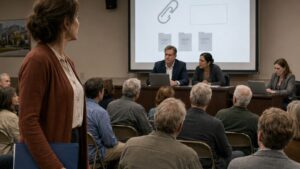
The HOA meeting room held maybe thirty people, most seated in folding chairs. A few had turned when Charles entered. Now nearly everyone was looking at the yellowed page beneath Katherine’s hand.
The HOA treasurer leaned closer.
“What is this?”
“Read it,” Charles said.
Katherine did not touch the copy.
“I’m in the middle of a board presentation.”
“I know.”
“This meeting is for association business.”
“So is the sewer line crossing my land.”
A murmur moved through the chairs.
Charles felt the old instinct rise: say less, let them wonder, keep every useful fact behind his teeth.
He looked at Elizabeth instead.
She stood near the back wall.
Not beside him.
Not against him.
Waiting.
Charles faced the room.
“My father gave temporary access thirty-eight years ago after a line failure. Emergency repair only. That letter says so.”
The treasurer picked up the page.
Katherine’s voice sharpened. “Then you’ve known there was an established access route.”
“No.”
“You just admitted—”
“I admitted what the paper says.”
Charles placed a second document beside it.
“It also says the permission ended when the repair ended. Any future crossing required a separate written agreement.”
One of the board members took the copy from the treasurer.
A long-term resident in the second row said, “Why weren’t we told any of this?”
Katherine looked toward him.
“The historical access question has been under review.”
Charles opened his second folder.
“No. The historical access question was treated as settled.”
He placed the violation notice on the table.
Then the deck-compliance demand.
Then the colored planning map.
The property manager shifted near the wall.
Charles continued.
“My parcel was never annexed into your association. County records show no HOA design authority over my cabin, deck, rail, or gate. Yet I got this.”
He tapped the notice.
Katherine folded her arms.
“Standard compliance language was used in connection with a disputed corridor.”
“Standard language that gave me ten days to alter a structure your association does not control.”
A resident near the aisle raised her hand, then seemed to realize she did not need permission.
“Is that true?”
Katherine answered carefully.
“The notice should have been more precisely drafted.”
Charles almost smiled.
Three weeks earlier, that sentence would have enraged him.
Now it sounded small.
The HOA treasurer turned to Katherine.
“You told the board counsel had confirmed enforcement options.”
“Counsel confirmed multiple options depending on access status.”
“That isn’t what you told us.”
Katherine’s expression tightened.
Charles saw, for the first time, how tired she looked.
Not defeated.
Tired.
There were faint shadows beneath her eyes. Her white jacket was gone; she wore a dark blouse with the sleeves pushed back.
She looked toward the residents.
“The board has been trying to prevent an infrastructure crisis.”
The room quieted.
Charles said nothing.
Katherine continued.
“Our wastewater capacity projections are not theoretical. We are approaching seasonal limits. If the upper correction is delayed indefinitely, emergency work could cost substantially more.”
A man in the third row said, “How much more?”
Katherine looked at the treasurer.
The treasurer did not answer for her.
So she gave the range.
The room changed.
Not loudly.
That was worse.
A woman near the back whispered, “Per household?”
Katherine nodded.
Someone swore under his breath.
The long-term resident leaned forward.
“You knew this?”
“Yes.”
“For how long?”
Katherine hesitated.
There it was.
Not a missing deed.
Not a surprise witness.
A choice.
“Several months,” she said.
The room broke into overlapping voices.
Charles watched her grip the edge of the table.
He understood something then that did not excuse her.
She had been afraid.
Not of him.
Of this room.
Of thirty people hearing a number and deciding she had failed before she could show them a solution.
So she had tried to make the solution inevitable.
Charles knew that impulse better than he wanted to.
The treasurer stood.
“You told us the expansion route was secured.”
Katherine said, “I believed the historical corridor supported access.”
“You believed?”
“The planning submissions—”
“Did you know Mr. Walker disputed it before the equipment was mobilized?”
Silence.
Charles felt Elizabeth’s eyes on him.
Katherine looked down.
“Yes.”
The answer landed harder than any accusation Charles could have made.
The treasurer sat slowly.
One board member said, “And the contractors?”
Katherine’s face hardened again.
“They were retained for site compliance.”
“They looked like police,” someone said.
“They were not instructed to impersonate law enforcement.”
Charles spoke.
“You called them officers at my house.”
Katherine looked directly at him.
For once, neither of them had a paper to hide behind.
“I used the wrong word.”
“No,” Charles said. “You used the useful word.”
The room went quiet.
He could have kept going.
He could have described the boot on his cedar step, Elizabeth being told to clear the work area, the way Katherine’s confidence had depended on everyone else hesitating.
He could have humiliated her.
Part of him wanted to.
Instead he opened the last folder.
“I didn’t come here to shut your system down.”
That surprised the room more than the letter had.
Katherine stared at him.
Charles set several pages on the table.
Eric had drafted them, but every condition had begun in Charles’s handwriting on the kitchen legal pad.
“I’m willing to grant a limited recorded utility easement.”
No one spoke.
Katherine looked at the pages but did not reach for them.
Charles continued.
“Not the blue corridor on your map. A surveyed route following the narrowest workable path. No construction staging on my cabin road. No claim of HOA jurisdiction over my four acres. No design authority. No enforcement authority.”
The property manager stepped forward.
“You’re proposing access?”
“I’m proposing terms.”
He turned a page.
“Restoration of disturbed ground. Insurance. Compensation. Defined emergency access. Separate written approval for any future expansion outside the recorded corridor.”
The treasurer took the document.
Charles placed one final condition on top.
“And every violation notice against my property gets withdrawn in writing.”
Katherine finally spoke.
“You expect the association to admit it had no jurisdiction.”
“Yes.”
“That language exposes the board.”
“It tells the truth.”
Her eyes narrowed.
“You also withheld this letter.”
The room went still again.
Elizabeth did not move.
Charles felt the old door inside him begin to close.
He stopped it.
“Yes.”
The word came out rough.
Katherine looked almost startled.
Charles faced the residents.
“I knew my father had allowed temporary emergency access. I told myself it didn’t matter because no permanent easement was granted.”
He glanced at Elizabeth.
“That was not the whole truth.”
No one applauded.
He was grateful.
“I sent an absolute refusal before I checked every record. That made this worse.”
Katherine said, “Then you share responsibility.”
Charles looked at her.
“For my part.”
He let the words settle.
“Not yours.”
The distinction mattered.
So did the admission.
The treasurer read the proposed terms while the room remained uneasy and quiet.
Finally he said, “This avoids the broad route?”
Charles nodded.
“If engineering confirms it.”
“And no expansion staging?”
“Correct.”
A board member asked, “What happens if we reject it?”
Eric had prepared an answer for that.
Charles did not use it.
“You fight me.”
He looked around the room.
“I fight you. The stop-work order stays until somebody proves access or a court decides it. Lawyers get paid. The line gets older.”
He paused.
“I can do that.”
The room believed him.
Then he added, “I don’t think I should.”
Katherine lowered her eyes.
The meeting did not end with a vote to praise Charles or condemn her.
It became messier than that.
The board moved negotiations out of Katherine’s sole control. The treasurer and two board members were authorized to work with counsel. Katherine remained on the board temporarily but was removed from direct project negotiations pending review of the notices and contractor incident.
Some residents were angry at her.
Others were angry at Charles.
A few were angry at everyone.
That felt more honest than applause.
The following week, surveyors marked a narrower route.
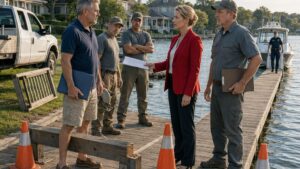
Charles walked it with Eric, the county planning inspector, and the association’s engineer. Twice he rejected turns that came too close to the deck. Once he accepted a bend that cost him three young trees because it kept heavy equipment off the cabin road.
Elizabeth watched from the porch.
When Charles came back, she asked, “You all right?”
“No.”
She smiled faintly.
“Still good, then.”
At the county recorder’s office, Debra Hill reviewed the final filing packet before it went across the counter.
She compared the new survey with the old utility reproduction.
“This one is considerably more specific.”
“That’s the idea,” Charles said.
Debra looked at the clauses.
“No HOA jurisdiction. Defined route. Restoration.”
“Separate writing for future access.”
She nodded.
“Your father would have appreciated that sentence.”
Charles was not sure.
For once, he did not pretend he was.
“Maybe.”
Debra stamped the intake copy.
The sound was ordinary.
A mechanical thump.
Yet Charles felt something loosen in his chest.
Not because he had won.
Because the boundary now existed where everyone could read it.
Weeks later, the split section of cedar handrail finally gave way beneath his palm.
Charles had known it was failing since spring.
He carried a replacement length onto the deck and set it across two sawhorses. Elizabeth brought him coffee and leaned against the doorway.
“You’re actually fixing that?”
“I fix things.”
“You’ve spent a month proving otherwise.”
He looked at her.
She lifted the mug.
“Too soon?”
“Probably.”
She stayed while he worked.
Charles removed the damaged cedar carefully. The old top rail had been repaired twice before. Beneath it, still visible on the surviving section, was his father’s V-shaped notch.
He ran his thumb over it.
For years he had believed the mark meant ownership.
My father built this.
I finished it.
Mine.
Now he remembered the actual words.
So you know which side I worked from.
Charles fitted the new cedar beside the old.
He could have cut away the weathered section completely. Made the rail smooth. Clean. Uniform.
Instead he joined the replacement just beyond the notch.
Elizabeth watched him drive the final screw.
“You left it.”
“Yes.”
“On purpose?”
Charles rested both hands on the rail.
Below them, farther down the slope, the new survey markers followed a narrow line through the trees. Not the HOA’s original blue corridor. Not his father’s temporary path.
Something written now.
Limited.
Recorded.
Real.
“Yes,” he said.
The old notch remained beneath his thumb, worn by decades and no longer hidden.
The story has ended.