He Accused the Quiet Neighbor of Lying Until His Yellow Boots Appeared on Camera
Chapter 1: The Woodpile Was Shorter Than Yesterday
The gap in the third row was too clean to be an accident.
Raymond Scott stood with one gloved hand resting on the top course of oak and counted again. He started at the left post of the rack, touching each vertical stack with two fingers as he moved. Eight columns. Then seven. Then the broken rhythm where a column should have risen nearly to his shoulder.
He had built the pile himself over six weekends.
Each log had been cut from storm-damaged oak, hauled from the back acreage, split on the steel wedge beside the outbuilding, and stacked bark-side up so rain would slide away. Raymond did not remember every piece. He did not need to. He remembered dimensions, levels, and straight lines. Thirty-eight years supervising municipal maintenance had trained him to notice when something no longer matched the work that had been done.
He stepped back and looked at the gravel.
No logs had rolled loose. No bark lay where the missing column had stood. The rack had not shifted. Someone had lifted the wood away.
Across the narrow utility strip, Justin Mitchell was watering a lawn that did not need water.
The late-autumn grass was still green in careful bands, and Justin moved the hose in smooth half circles while wearing a gray work shirt, dark jeans, and spotless yellow rubber boots. His corner lot looked prepared for inspection even when no inspection was coming. The flag on his polished metal pole snapped above the driveway. Every shrub had the same rounded shape.
Justin glanced over.
Raymond lowered his hand from the woodpile.
“Morning,” Justin called.
“Morning.”
Justin looked toward the rack, then back at Raymond. “Getting ready for a hard winter?”
“Always do.”
“Supposed to be mild.”
Raymond said nothing. Justin smiled as though silence were an answer he had expected, then returned to the hose.
The woodpile stood near the rear edge of Raymond’s property, between the weathered outbuilding and the gravel lane that utility crews used when they needed access to the power boxes. A faded orange survey cap marked one corner. The legal easement ran beside the fence, though Raymond had always understood that the rack remained inside his line.
He had placed it there twelve years earlier because the roof overhang kept off the worst rain and the gravel made hauling easier. No one had objected. Not the power company. Not the HOA. Not even Justin, though Justin had objected to almost everything else eventually.
Raymond spent the next hour checking places where missing logs might have been moved. He looked behind the splitter, beneath the tarp near the shed, and along the wall where he sometimes set aside pieces too knotted for the stove. Nothing.
On the second morning, another armload was gone.
This time the loss came from the back of the rack. Whoever had taken it knew enough not to leave the front visibly uneven. Raymond noticed because the upper row had settled into the hollow.
He took a yellow carpenter’s pencil from his shirt pocket and marked the inside edge of the rack post at the height of the remaining wood. Then he counted the rows and wrote the number on a scrap of feed sack.
He did not call anyone.
By the third morning, the pencil mark showed a drop of nearly four inches.
Raymond crouched beside the gravel lane and studied two shallow tracks pressed into the damp surface. They were narrow, parallel, and separated by the width of a garden wheelbarrow. One track wobbled slightly, as if its tire needed air.
The marks led away from his rack, crossed the utility strip, and ended at the gate in Justin’s side fence.
Raymond stayed crouched for a long moment.
A truck slowed on the road. One of the neighboring homeowners lifted a hand through the window. Raymond returned the gesture and stood.
Justin’s gate was painted white. The latch shone. Beyond it, Raymond could see the edge of a red wheelbarrow leaning against the garage.
He walked to the boundary but did not cross it.
Justin appeared from behind the house carrying hedge clippers. The yellow boots looked newly rinsed.
“You lose something?” Justin asked.
Raymond pointed toward the tracks. “You been using that gate?”
Justin looked down. “It’s my gate.”
“I know whose gate it is.”
“Then what are you asking?”
Raymond’s jaw tightened. “Someone’s been taking wood.”
Justin shifted the clippers from one hand to the other. His face registered surprise slowly, almost carefully.
“From your pile?”
“Yes.”
“How much?”
“Enough.”
Justin gave a short laugh. “Raymond, you have half a forest stacked back there. You sure you’re not just forgetting what you burned?”
“I haven’t started the stove.”
A landscaping contractor working two lots down paused near his trailer. Justin noticed him and raised his voice slightly.
“Well, I’d hate to think you were accusing people because you can’t keep track of your own inventory.”
Raymond felt the heat rise beneath his collar.
“I didn’t accuse anybody.”
“Good.” Justin smiled toward the contractor. “Because that would be an ugly thing to do without proof.”
The contractor looked away and resumed winding a strap.
Raymond had known Justin for eleven years. He knew the man’s habits: the Sunday flagpole polishing, the Wednesday trash-bin washing, the way he photographed grass clippings left too long at the curb and sent them to the HOA secretary with timestamps. Justin liked rules best when he could stand beside them.
Still, a wheelbarrow track was not proof.
Raymond turned back toward his property.
Justin called after him. “Maybe write the number down next time.”
The laugh came again, lighter now because someone else had heard it.
Raymond returned to the rack and finished splitting the last round of oak beside the outbuilding. He worked harder than necessary. The maul struck cleanly, the grain opening under each blow. By noon, his shoulders ached.
He stacked the fresh pieces in a separate row and measured the top with a level.
That evening, he locked the shed and walked the boundary once more. The tracks had begun to fade under passing tires, but the gate still held one detail the gravel had not.
A strip of fresh oak bark was caught beneath the bottom rail.
Raymond bent and pulled it free.
The inner surface was pale and damp, newly torn from a split log. He carried it back to his rack and held it against the raw edge of one remaining piece.
The contours matched.
Across the utility strip, Justin switched on his porch light. For a second, the yellow boots stood beside the door before disappearing inside.
Raymond closed his hand around the bark.
Chapter 2: The Threat Made in Front of Mailboxes
The photograph had been tucked beneath Raymond’s mailbox flag where every passing car could see it.
He pulled it free before opening the box.
The image showed his woodpile from the gravel lane, shot at an angle that made the rack appear to extend far beyond the orange survey cap. A white sheet was stapled to the bottom. At the top, in bold letters, it read: NOTICE OF POTENTIAL EASEMENT OBSTRUCTION.
Below that was Justin Mitchell’s name and title.
HOA Board Vice President.
Raymond read the notice twice.
The document claimed his firewood created a hazard for utility access, reduced neighborhood appearance standards, and had generated “multiple informal concerns.” It gave him until Friday to provide a written response.
It was Friday.
“Convenient, isn’t it?”
Justin’s voice came from behind him.
Raymond turned. Justin stood beside the mailbox cluster with a folded paper in one hand. Mud flecked the lower half of his yellow boots. Two neighbors were walking up the road carrying grocery bags, close enough to hear without pretending they were listening.
“You took that picture?” Raymond asked.
“As part of my board duty.”
“You put it under my flag.”
“I wanted to make sure you got it.”
“The mail ran yesterday.”
Justin shrugged. “Then maybe you should check your box more often.”
Raymond held up the notice. “You’re filing this now?”
“I’m documenting a long-standing concern.”
“Long-standing since when?”
“Since you started stacking wood over the easement.”
Raymond glanced toward the two neighbors. They had slowed near their driveway.
“You told me yesterday you thought I couldn’t keep track of my own wood,” he said.
Justin’s expression hardened. “What does that have to do with the easement?”
“It has to do with you knowing wood was missing.”
“I know because you announced it.”
“I said someone was taking it. I didn’t say how much.”
Justin looked past him toward the rack. “You said an armload. Maybe two rows.”
Raymond went still.
He had never said either thing.
Justin realized it a fraction too late. His eyes shifted, then narrowed as if anger could erase the mistake.
“Are you accusing me now?” he asked.
“I’m asking how you knew.”
“You’re getting confused again.”
Raymond folded the notice once, keeping his hands steady. “There are wheelbarrow tracks from my rack to your gate.”
“There are wheelbarrow tracks all over gravel.”
“There’s bark under your fence.”
Justin stepped closer.
The two neighbors had stopped completely now. One held a paper grocery bag against her hip.
“You need to be careful,” Justin said quietly.
“About what?”
“About saying things that damage a person’s name.”
Raymond could smell coffee on his breath.
Justin unfolded the paper in his hand. It was another copy of the violation photograph. He held it between them.
“You have until the end of today to retract this accusation,” he said.
“I haven’t made one in writing.”
“You made it to me.”
“I asked a question.”
“You implied I’m a thief.”
Raymond looked at the yellow boots. Mud clung along the sides and around the heels. The night before had been dry. The only wet ground near either property lay beside the wood rack, where runoff from the outbuilding roof had softened the gravel edge.
Justin followed his gaze and shifted his feet.
“What happens if I don’t retract it?” Raymond asked.
Justin smiled without warmth. “Then I make sure every homeowner here understands who they’re dealing with.”
The neighbor with the grocery bag looked down at the pavement.
“You planning to put that in every mailbox?” Raymond asked.
“If necessary.”
“And what will you tell them?”
“That you’re unstable. That you make accusations because you don’t like being told the rules apply to you.”
Raymond felt something break loose inside him—not rage exactly, but the restraint he had been gripping too tightly.
“You think a board title lets you steal from me and call me crazy afterward?”
The words carried farther than he intended.
A garage door across the road stopped halfway open. The landscaping contractor turned from his trailer.
Justin’s eyes widened, then settled into satisfaction.
“There,” he said. “That’s the man people need to see.”
Raymond heard how it had sounded: loud, direct, unsupported.
Justin raised the photograph. “You’re standing here threatening an HOA officer because your illegal woodpile is short a few pieces.”
“How many pieces?”
Justin’s hand tightened on the paper.
Raymond stepped closer. “You said ‘a few.’ Yesterday you said two rows. I never told you either.”
“That doesn’t prove anything.”
“No. It doesn’t.”
The admission seemed to please Justin.
He leaned in. “Then withdraw it by five.”
“Or you’ll ruin my name?”
“I’ll correct the story.”
“Do you want to say that with everybody listening?”
Justin glanced at the watching neighbors. “Are you threatening me?”
“I’m asking whether you want witnesses for what you just said.”
For a moment, neither moved.
Then Justin laughed directly into Raymond’s face.
It was not a nervous laugh. It was the sound of a man certain he had already won the version of events that mattered.
He tucked the photograph beneath his arm and walked toward his house, yellow boots leaving damp marks on the gravel.
Raymond remained beside the mailboxes.
One neighbor offered a strained smile. “Maybe this can all be handled at the meeting.”
“What meeting?” Raymond asked.
She looked embarrassed. “Kathleen mentioned a review.”
His phone vibrated before she finished.
The email came from Kathleen Garcia, the HOA president. Its tone was polite and formal. A complaint had been received concerning obstruction of the utility easement and aggressive conduct toward a board representative. A preliminary review would be held the following Tuesday at seven in the neighborhood clubhouse.
Attached were three photographs.
One showed the rack.
One showed Raymond standing beside Justin near the mailboxes, his hand lifted mid-argument.
The third had been taken from farther away. Justin appeared calm. Raymond appeared to be advancing toward him.
There was no sound attached. No context.
Only the shape of anger.
Raymond looked up the road. Justin had stopped at his gate and was watching him.
The yellow boots were no longer muddy. He had turned the hose on them and was washing away the marks.
Chapter 3: Two Eleven in the Morning
The camera alert sounded at 2:11 a.m.
Raymond was already awake.
He sat up in the dark, reached for the phone on the chair beside his bed, and opened the security application. For half a second the screen showed only grainy black-and-white gravel, the lower edge of the outbuilding roof, and the pale geometry of stacked wood.
Then a figure moved along the fence.
Raymond stopped breathing.
The person entered from the right, pushing a wheelbarrow with one hand while holding the gate open with the other. The face was hidden beneath a cap and turned collar, but the body moved without hesitation. Whoever it was knew where the latch stuck. Knew which strip of gravel stayed quiet. Knew how far the camera reached.
Raymond watched the figure cross onto his property.
Three nights earlier, after the mailbox confrontation, he had cleaned the old camera under the outbuilding eave and adjusted its angle downward. The camera had been installed years ago after tools disappeared from an unlocked trailer. Justin had once mocked it for pointing at “nothing but firewood and weeds.”
Raymond had not corrected him.
The following morning, he had called Emma.
She answered on the fourth ring.
“Dad?”
“I need help with a camera.”
There had been a pause long enough for him to hear traffic through her hands-free connection.
“What happened?”
“Nothing yet.”
“That means something already happened.”
He had nearly told her he would handle it. The sentence rose automatically, polished by years of use. Instead, he said, “Wood’s been going missing.”
Emma arrived that evening with a laptop, two charging cables, and the expression she wore when trying not to accuse him of waiting too long.
She found the HOA notice on the kitchen table.
“You didn’t call me when this started?”
“I’m calling now.”
“You called because you need software.”
“I called because I need help.”
That answer changed her face slightly, though she did not let him see satisfaction.
They tested the camera, widened the motion zone, and removed branches that triggered false alerts. Emma created a separate folder on the laptop and set the files to copy automatically.
“If you catch someone,” she said, “don’t go outside.”
“I know.”
“I mean it.”
“I said I know.”
“You also said nothing was happening.”
Raymond looked toward the dark window over the sink. “I was wrong.”
Now, at 2:11 in the morning, the wheelbarrow stopped beside the rack.
The figure lifted one log, then another.
Not hurriedly. Not clumsily.
The person selected seasoned pieces from the center row, the driest oak, and laid them lengthwise in the barrow so they would not knock together. It was the work of someone who had done it before.
Raymond’s bare feet touched the cold floor.
He reached for his jeans, then remembered Emma’s warning.
On the phone screen, the figure turned.
The yellow rubber boots shone almost white in infrared.
Raymond sat back down.
Proof did not feel the way he expected. There was no satisfaction in it. Only a pressure behind his ribs and a strange quiet, as though the room itself had understood something final.
Justin loaded six more pieces.
At one point he paused beneath the camera. His head lifted.
Raymond’s hand tightened around the phone.
The face remained indistinct, but the mustache caught a pale line of light. Justin looked directly toward the lens for one second, then turned away. Either he had not seen it or believed it was still aimed past the rack.
He pushed the wheelbarrow toward the fence.
The front tire wobbled.
Raymond watched him open the white gate, maneuver the load through, and disappear toward his garage.
The clip ended.
He played it again.
At 2:18, he called Emma.
She answered with a frightened whisper. “Are you all right?”
“I got him.”
“Did you go outside?”
“No.”
“Send me the file.”
He transferred it from the phone, then sat at the kitchen table while she joined him by video. Her face appeared small and washed blue by her screen.
“Don’t trim anything,” she said.
“I’m not.”
“We need the original timestamp and metadata.”
“I know how evidence works.”
“You know how maintenance records work.”
“Close enough.”
She did not smile. “Dad.”
He opened the clip on the laptop.
On the larger screen, details sharpened: Justin’s gray coat, the red wheelbarrow, the white fence gate, the bright boots. The theft was unmistakable.
Emma leaned toward her camera. “Pause when he turns.”
Raymond stopped the video at 2:14:37.
Justin stood beside the loaded wheelbarrow. Behind him, the orange survey marker rose from the gravel near the lower corner of the frame.
“Go back two seconds,” Emma said.
Raymond did.
“Now freeze it.”
He froze the image.
The marker was partly visible. The bottom row of Raymond’s woodpile extended beyond it.
“That angle’s distorted,” he said.
“Maybe.”
“It’s under the roofline. The lens bends the edge.”
“Maybe.”
He zoomed in.
The orange cap disappeared beneath the outermost logs. Even allowing for perspective, the stack crossed the line.
Raymond opened another camera still from daytime. The same relationship appeared from a slightly different angle.
Emma was silent.
“The easement isn’t the property line,” he said.
“No. But the HOA complaint is about access.”
“The utility company has never objected.”
“That doesn’t mean Justin’s photo is false.”
Raymond leaned back.
For three nights he had imagined the camera producing one clean fact: Justin stole the wood. The truth on the screen was less obedient. It showed Justin trespassing and stealing. It also showed Raymond’s rack pressing into the very easement Justin had used to attack him.
“We can crop the frame,” Raymond said.
Emma’s eyes lifted.
“To show the boots and wheelbarrow,” he continued. “The survey marker isn’t relevant to the theft.”
“It’s relevant to the complaint.”
“They’re separate issues.”
“Then submit them separately.”
Raymond closed his mouth.
Emma watched him through the screen. “You called me because you wanted help.”
“I did.”
“Not because you wanted me to help you hide the part that hurts.”
“I’m not hiding anything.”
“You just said to crop it.”
“For clarity.”
“For advantage.”
The words sat between them.
Raymond looked again at the frozen frame. Justin’s yellow boots stood beside stolen oak. Behind them, the orange marker vanished beneath Raymond’s carefully stacked row.
Evidence had arrived.
It had simply refused to belong entirely to him.
Chapter 4: Evidence That Did Not Fully Exonerate Him
The county map placed the easement line eight inches farther into Raymond’s yard than he remembered.
He stood at the records counter with one hand flat on the enlarged survey sheet while the clerk traced the narrow shaded strip with a capped pen.
“Utility access,” she said. “Twelve feet from the recorded center line.”
Raymond looked at the measurements again.
“The orange cap is here?”
“That cap marks the survey point. It doesn’t mark the full easement width.”
“My rack is behind the cap.”
“The corner of it is. According to this, the outer edge extends into the access strip.”
“How far?”
The clerk measured against the printed scale.
“Roughly eight inches. Maybe nine, depending on the rack’s current position.”
Raymond folded his arms.
The records office smelled of toner, dust, and wet coats. Behind him, someone fed coins into a copy machine. Each mechanical click seemed louder than it should have been.
“The wood is still on my property,” he said.
“Yes.”
“And entering my property to remove it is still theft.”
The clerk looked up. “I can tell you what the record says. I can’t tell you what a deputy or the association will do with it.”
Raymond paid for three certified copies.
By noon, the survey sheets covered his kitchen table beneath loose strips of oak bark and two printed frames from the night recording. He had placed the clearest image in the center: Justin beside the wheelbarrow, gray coat open at the throat, yellow boots bright under the infrared light.
To the left lay a second print showing the timestamp.
To the right was the frame Raymond had not yet decided to include.
The orange cap disappeared beneath the bottom row of logs.
Emma stood across from him, still wearing her work jacket. She had driven over during her lunch break after he sent her a photograph of the county map.
“Eight inches,” she said.
“Approximately.”
“That means Justin’s complaint wasn’t invented.”
“It means part of the rack is in an access strip nobody has needed in twelve years.”
“That’s not the same as saying it isn’t there.”
Raymond slid the theft photograph toward her. “And that doesn’t give him the right to take my wood.”
“I didn’t say it did.”
“You keep talking like the two things cancel each other.”
“I’m trying to keep you from talking like one of them erases the other.”
He picked up the unedited still.
The outer edge contained the survey marker. If he cropped a narrow band from the right side, the image would show Justin, the wheelbarrow, the boots, and the stolen logs. Nothing essential to the theft would be lost.
He placed a ruler over the paper.
Emma watched him.
“What are you doing?”
“Improving the composition.”
“That is not what you’re doing.”
“The camera lens stretches the edge. The marker isn’t relevant to identifying him.”
“It’s relevant to the hearing.”
“The hearing should be about theft.”
“The hearing is about the complaint Justin filed.”
Raymond pressed the ruler down. “He filed the complaint to protect himself.”
“Probably.”
“So I’m supposed to help him?”
“You’re supposed to tell the truth.”
“I am telling the truth.”
“Not all of it.”
The kitchen went still.
Raymond lifted the ruler and set it beside the prints. “You think I’m lying?”
“I think you’re trying to decide which truth deserves to be visible.”
He turned away from her and went to the sink. Outside, the woodpile stood beneath the outbuilding roof. From this angle, the rack looked perfectly aligned.
His wife had once accused him of doing the same thing with arguments: choosing the angle from which he appeared most reasonable, then refusing to move.
He had not liked hearing it then either.
Emma gathered the survey copies into a straight stack.
“You could submit the full video,” she said. “Then tell them you’ll move the rack.”
“And let Justin stand there acting as though theft was enforcement?”
“No.”
“That is exactly what he’ll do.”
“Then say the two things are separate.”
“He’s vice president. Kathleen already thinks I threatened him.”
Emma’s expression changed at the name.
“Have you told Kathleen about the recording?”
“Not yet.”
“Have you filed the theft report?”
“I called the sheriff’s office.”
“That wasn’t my question.”
Raymond had spoken to a deputy that morning. The deputy said the video appeared useful, but the office would need the original file, a value estimate, and a formal statement. Raymond had promised to bring them after the HOA review.
He had wanted to control the order.
First clear his name. Then report the theft.
“I haven’t signed anything,” he said.
Emma let out a breath through her nose. “You keep waiting until every fact is lined up exactly the way you want.”
“That’s called being careful.”
“That’s what you called it when Mom was sick.”
Raymond turned.
Emma’s eyes dropped, but she did not take the words back.
He had delayed telling her how quickly her mother’s condition was changing because there had been another appointment scheduled. Another scan. Another possible treatment. He had wanted certainty before he said something that could not be unsaid.
By the time he called, certainty was all that remained.
“This is not the same,” he said.
“No. It’s smaller.” Emma touched the unedited print. “Which means you still have time to do it differently.”
She picked up her keys.
“Where are you going?”
“Back to work.”
“I asked you to help preserve the file.”
“I did. There are three copies, and the original metadata is intact.”
“You said you’d help prepare the evidence.”
“I will, if you submit all of it.”
Raymond looked at the ruler on the table.
Emma paused at the door. “I won’t help you crop out the part that makes you uncomfortable.”
After she left, Raymond sat alone among the papers.
The theft image was strong. The survey image was inconvenient. Together they told a less satisfying story than either man wanted.
He opened the HOA email and read Kathleen’s instructions again. Evidence could be submitted electronically until five o’clock. Materials received later might not be reviewed before the hearing.
It was 4:17.
Raymond attached the clear still, the timestamped clip, and the county map.
His cursor hovered over the full recording.
He imagined Justin watching it in the clubhouse. He imagined the pause when the orange marker appeared. He imagined the room deciding that two wrongs were easier to dismiss than one clear injustice.
At 4:42, Emma sent a single message.
I meant what I said.
Raymond stared at it.
Then he attached the unedited file.
In the message body, he wrote:
The recording documents removal of my property. It also appears to show that the outer edge of my rack extends into the utility easement. I will correct the placement regardless of the board’s decision concerning the theft.
He read the sentence three times.
At 4:56, he pressed send.
The confirmation appeared almost immediately.
Kathleen Garcia has received your files.
A second message followed two minutes later.
Mr. Scott, because of the seriousness of the material, Tuesday’s preliminary review will be converted to a formal evidence hearing. Mr. Mitchell and the full board have been notified.
Raymond closed the laptop.
For the first time since the wood began disappearing, he had no control over who would see the truth or what they would do with it.
Chapter 5: The Man in the Yellow Boots Took the Floor
Justin asked the board to fine Raymond before Raymond was allowed to speak.
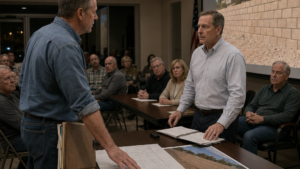
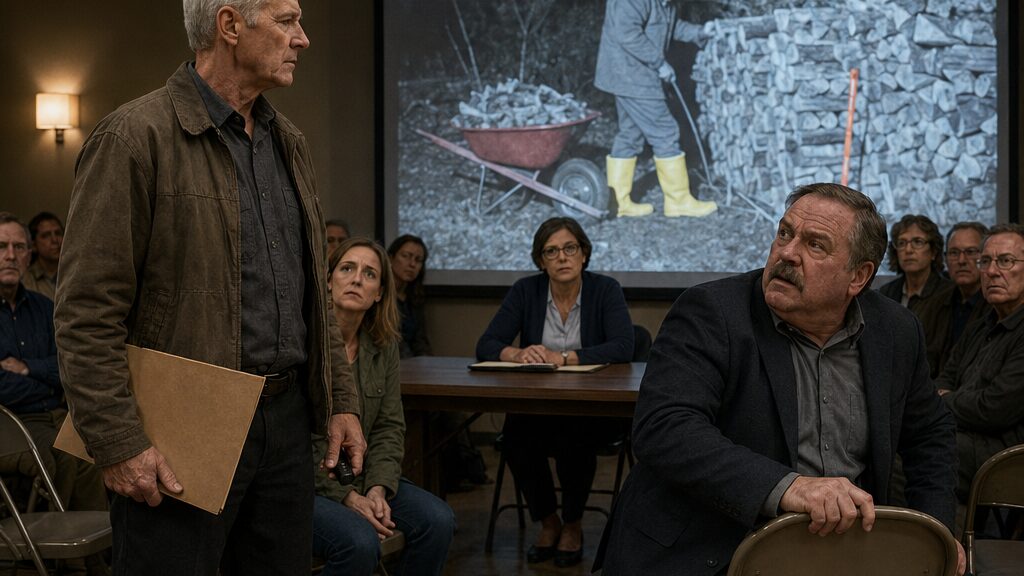
He stood at the front of the neighborhood clubhouse in polished brown shoes, one hand resting on the back of a folding chair. Behind him, a portable projector displayed the photograph of Raymond’s woodpile. The angle exaggerated the rack’s reach into the gravel access strip.
“This is not complicated,” Justin said. “The governing documents require that utility easements remain unobstructed. Mr. Scott has ignored that rule and responded aggressively when the violation was brought to his attention.”
Raymond sat in the second row beside Emma.
Nearly thirty homeowners had filled the room. Some held printed agendas. Others had come without papers, drawn by the rumor that someone had been caught stealing firewood or that Raymond had threatened an HOA officer, depending on which mailbox the story had reached first.
Kathleen sat at the center of a long folding table with the HOA secretary and two board members. She looked tired rather than dramatic. A legal pad lay open in front of her.
“Mr. Mitchell,” she said, “you were asked to limit your opening remarks to the easement complaint.”
“I am.”
“You just characterized Mr. Scott’s conduct.”
“Because his conduct is part of the complaint.”
Kathleen’s mouth tightened. “You will have an opportunity to address that after the submitted evidence is reviewed.”
Justin turned slightly, letting the room see his patience.
“Of course.”
He returned to his seat on the opposite side.
The brown shoes caught Raymond’s attention. Justin almost always wore the yellow boots when he worked outside, even when the ground was dry. Tonight, he had chosen leather polished to a hard shine.
Kathleen called the hearing to order.
She confirmed that the board would consider two separate matters: the physical obstruction of the recorded utility easement and Raymond’s allegation that Justin had removed firewood without permission.
A murmur traveled through the room at the word allegation.
Justin leaned back and crossed his arms.
Kathleen began with the survey.
The county map appeared on the screen, followed by the measurements Raymond had submitted. She traced the boundary with a red digital pointer.
“The outermost portion of the rack appears to extend approximately eight inches into the utility access area,” she said. “Mr. Scott, do you dispute that?”
Raymond stood.
“No.”
The room went quieter.
Justin looked toward him sharply.
Kathleen asked, “Are you willing to correct it?”
“Yes. I’ll move the rack inside the line.”
“When?”
“Within ten days, weather permitting. Sooner if the board requires it.”
One of the homeowners whispered something to the person beside him.
Raymond sat down.
Emma did not look at him, but her hand relaxed around the edge of her notebook.
Justin rose again. “Then the violation is admitted.”
Kathleen lifted one hand. “Sit down, Mr. Mitchell.”
“It matters that—”
“It has been entered into the record. Sit down.”
For the first time, Justin obeyed without performing his agreement.
Kathleen turned to the secretary. “Play the submitted video from the beginning.”
The projector screen went black.
A timestamp appeared in the upper corner.
2:11:08 A.M.
The grainy view showed Raymond’s outbuilding, the gravel lane, the wood rack, and the white gate in Justin’s fence.
No one spoke.
At 2:11:31, the gate opened.
A figure entered, pushing a red wheelbarrow.
The first reaction was not a gasp but a subtle movement through the room—backs straightening, heads tilting toward the screen. The figure crossed the gravel and stopped beside the rack.
Justin’s chair creaked.
The person began loading wood.
One log. Then another. Then another.
The video had no useful sound, only the faint electronic hiss of the camera’s microphone. That silence made the movements look more deliberate. There was no confusion, no attempt to clear an obstruction. The figure selected pieces from the center of the seasoned stack and arranged them in the wheelbarrow.
Kathleen paused the video.
The yellow boots filled the lower portion of the screen.
Mud marked the soles. The loose top of the left boot folded outward in the same way Raymond had seen a hundred times while Justin watered his lawn.
Beside the boots stood the red wheelbarrow with its uneven front tire.
A voice near the back said, “Those are Justin’s.”
Kathleen looked up. “Please hold comments.”
Justin rose anyway.
“That could be anyone.”
The sentence hung in the room.
Raymond saw two homeowners exchange glances.
Kathleen did not respond immediately. “The video will continue.”
The figure turned beneath the camera. The face remained blurred, but the line of the mustache showed pale against the skin. The person looked upward for one second before wheeling the oak through Justin’s gate.
The video ended.
Kathleen opened a file on her laptop. “Mr. Scott also submitted the original recording, device metadata, and a daytime image of the same area. The secretary confirmed the file creation time and that no edits were detected.”
Justin remained standing.
“You cannot identify a person from boots and a wheelbarrow.”
Raymond rose.
Kathleen looked at him. “You may respond.”
Raymond faced the board rather than Justin.
“The wheelbarrow belongs to Mr. Mitchell. The gate leads to his yard. The boots match the pair he wears regularly. The person knew where the gate latch sticks and which pieces of oak were seasoned.”
Justin laughed once, but the sound failed to carry.
Raymond continued. “The video also shows my rack crossing the easement. I submitted that portion without alteration.”
Kathleen looked down at her notes. “Yes. You did.”
Justin turned toward the audience. “So he admits the wood was obstructing shared access.”
“It was eight inches into an access strip,” Raymond said. “That required me to move it. It did not make it yours.”
“You don’t get to decide what interferes with the community.”
“And you don’t get to remove property at two in the morning.”
Justin’s face flushed.
Kathleen struck the table lightly with her pen. “Both of you will address the board.”
Raymond turned back.
The secretary advanced to a daytime comparison image. It showed Justin’s wheelbarrow beside his garage, its front tire angled slightly left. Another frame showed the tread of the yellow boots near the gate.
The proof did not arrive as one dramatic blow. It accumulated: gate, wheelbarrow, boots, timing, repeated access. Each piece narrowed the room around Justin.
One board member asked, “Mr. Mitchell, did you remove the wood?”
Justin stared at the screen.
“I had an emergency.”
The answer changed the air more completely than a confession.
Kathleen leaned forward. “Is that a yes?”
“I said there was an emergency.”
“What kind?”
“That is private.”
“Did you have Mr. Scott’s permission?”
Justin’s jaw shifted. “The wood was blocking common access.”
“That was not the question.”
Justin looked toward Raymond, and for a moment the anger disappeared. What replaced it was not remorse. It was fear.
“I was going to replace it.”
Raymond felt Emma turn toward him.
Kathleen asked, “How many times did you enter Mr. Scott’s property?”
Justin did not answer.
The secretary replayed the final portion of the file list. Three motion events appeared on separate nights. Justin looked at the screen as though he had not known the camera retained more than one clip.
“You submitted all three?” he asked Raymond.
Raymond heard what the question revealed.
Justin had known there were blind intervals. He had likely watched the camera light or learned its previous detection range. He had not taken one desperate load. He had returned.
“Yes,” Raymond said.
Justin’s eyes hardened again. “You’ve been recording my property.”
“The camera points at my rack and the gate.”
“My gate.”
“From my land.”
Kathleen intervened before the argument widened. “The board will review camera placement separately if a written complaint is made. Tonight’s issue is unauthorized removal.”
Justin gripped the chair back.
“I already told you. There was an emergency.”
“Then explain it,” one board member said.
“No.”
Kathleen’s patience thinned. “You used your board position to initiate a complaint against the same homeowner whose property you appear to have removed. You threatened reputational consequences in front of witnesses. If there is context the board should consider, now is the time.”
Justin’s eyes moved through the room.
The people he had reminded about trash cans, paint colors, and grass height now watched him without deference. Raymond could almost see the calculation: what could be admitted without collapsing the rest?
Justin sat down.
“I have nothing else to say.”
Kathleen called a brief recess.
Chairs scraped. Conversations started in low bursts. Emma touched Raymond’s sleeve.
“You did the right thing submitting the whole file,” she said.
He looked toward Justin, alone near the wall.
“It doesn’t feel finished.”
“It isn’t.”
Across the room, Kathleen was speaking quietly with the secretary. The secretary handed her a sealed envelope from the association’s maintenance files.
Kathleen opened it, read the top page, then looked directly at Justin.
When the meeting resumed, she did not begin with the vote.
“Mr. Mitchell,” she said, holding up the document, “before we continue, I need you to explain why an emergency furnace-repair invoice for your home was submitted to the HOA maintenance account six weeks ago.”
Justin’s face emptied.
The room fell silent again.
This time, even Raymond had not known what was coming.
Chapter 6: The Furnace Bill Behind the Perfect Lawn
Justin was waiting beside Raymond’s truck before sunrise.
He wore the gray coat from the recording and no hat. His hands were buried in the pockets. The yellow boots sat several yards away inside his open garage, lined up beside an empty metal wood rack.
Raymond stopped on the porch.
“You’re on my driveway.”
“I know.”
“What do you want?”
Justin glanced toward the road. No lights moved between the houses.
“I want to settle this before Kathleen turns it into something bigger.”
Raymond walked down the steps but stayed near the porch rail.
“You turned it into something bigger.”
“I’m offering to pay.”
“For the wood?”
“For all of it.”
“How much is all of it?”
Justin looked irritated by the question. “Whatever you say it’s worth.”
“That’s not how restitution works.”
“Four hundred, then. Five.”
“And the complaint?”
“I’ll withdraw it.”
“The rack still crosses the easement.”
“You move it, and the issue disappears.”
Raymond studied him.
The offer was practical on its surface. Money, withdrawal, silence. A clean exchange between two men before the neighborhood woke. It was the kind of arrangement Raymond might once have preferred.
“What did Kathleen find?” he asked.
Justin looked toward his house.
“The furnace went out in September.”
“That invoice was dated October.”
“The first repair failed.”
“And you submitted it to the HOA?”
“I submitted part of it.”
“Why?”
Justin’s mouth tightened. “Because the technician serviced the clubhouse system the same week. The office mixed the invoices.”
“Kathleen didn’t sound like she thought it was an accident.”
“She likes procedures until procedures make her look foolish.”
Raymond waited.
Justin pulled his hands from his pockets. The knuckles were red from the cold.
“The bank turned down the equity line,” he said. “The furnace company wanted half up front. The credit card was already near the limit.”
He spoke in clipped pieces, as if each detail cost him more than the last.
“My wife thought the furnace was being repaired under a service plan. The board thought the invoice was a duplicate clubhouse charge. I was going to reimburse it after the refinance.”
“The refinance that was denied.”
Justin looked at him sharply. “You don’t know anything about it.”
“I know you took wood from me.”
“The house was cold.”
“You could have asked.”
Justin gave a bitter laugh. “Asked you?”
“Yes.”
“You barely speak to anyone.”
“That doesn’t mean I’d let your house freeze.”
“You would have looked at me exactly the way you’re looking now.”
Raymond had no answer ready.
Justin walked toward the garage and stopped beside the empty rack. The yellow boots stood beneath the workbench, cleaned so thoroughly that the rubber shone.
“The first time,” Justin said, “I needed enough to get through the night. The furnace had cut out again, and the repair company couldn’t come until morning.”
“You took nearly a full wheelbarrow.”
“Yes.”
“You came back two more times.”
Justin stared at the boots.
“The second time, I told myself the wood was in the easement. That you’d ignored the rules for years. That somebody would eventually make you move it.”
“So you decided it belonged to you.”
“I decided you had more than you needed.”
Raymond felt anger return, but it had changed shape. It was no longer the hot humiliation from the mailbox cluster. It was colder and more exact.
“You counted my wood.”
“I could see the pile.”
“You watched me split it.”
Justin’s face tightened.
Raymond continued. “You knew how many weekends it took. You knew I heated the outbuilding and part of the house with it.”
“You always have more.”
“That was your reason?”
“No.” Justin looked up. “That was the reason I used.”
The honesty in the sentence stopped Raymond.
Justin rubbed one hand across his mouth.
“After you confronted me, I should have returned it,” he said. “Instead, you stood there looking at the tracks, and I knew you suspected me. I thought if I admitted it, that would be the only thing anyone saw.”
“So you filed the complaint.”
“You were over the easement.”
“Eight inches.”
“You were still over.”
“And that made the rest easier.”
Justin did not deny it.
He looked across his lawn. Even in the weak light, the stripes were visible. The shrubs were trimmed. The flagpole reflected the gray sky.
“My name was the one thing I still had under control,” he said. “The house loan, the furnace, the cards—none of that. But people listened to me at meetings. They believed I knew what I was doing.”
“You used that to call me unstable.”
“I needed them to believe you before they looked at me.”
The words were plain now, stripped of argument.
Raymond looked at the empty wood rack. He could understand a cold house. He could understand debt, embarrassment, even the fear of telling family that the life they thought was stable had begun to crack.
He could not accept what Justin had done with those fears.
“You didn’t just take wood,” Raymond said. “You tried to make me doubt what I saw. Then you tried to make everyone else doubt me too.”
Justin lowered his head.
“I said I’d pay.”
“That doesn’t settle the rest.”
“What do you want? An apology in front of the whole neighborhood?”
“No.”
“Then what?”
“The truth at the decision meeting.”
Justin looked up quickly. “No.”
“Kathleen will ask whether you took it.”
“She already did.”
“And you hid behind an emergency.”
“There was an emergency.”
“There was also a second trip. And a third.”
Justin stepped toward him. “If I stand up there and say everything, I lose the board position.”
“You used the position against me.”
“My wife will hear about the invoice.”
“She deserves to hear it from you.”
“You don’t get to decide what she deserves.”
“No. But you don’t get to buy my silence so she won’t.”
Justin’s face hardened. For one moment, Raymond saw the man from the mailboxes again—the one who believed pressure could reshape reality.
“You think this makes you better than me?” Justin asked.
“No.”
“You’re enjoying it.”
Raymond considered the question before answering.
“A week ago, maybe I would have.”
Justin seemed unprepared for that.
Raymond looked back toward his house. Emma had been right about the recording. A partial truth used for advantage was still a way of hiding.
“I won’t ask the board for more than restitution and a fair decision,” he said. “I won’t show the footage outside the hearing. I won’t put it online. But I won’t lie for you.”
Justin glanced toward the yellow boots in the garage.
“If I refuse?”
“Then the board decides from the evidence, and Kathleen decides what to do with the invoice.”
“You filed with the sheriff?”
“Not yet.”
Justin’s gaze returned to him.
Raymond saw the calculation and disliked that it still existed between them.
“That is not leverage,” he said. “I’m giving the HOA process time to separate the property issue from the theft. What happens after that depends on what you do.”
Justin’s shoulders lowered slightly.
“You always talk like a work order,” he said.
“It keeps things clear.”
“No. It keeps you from saying what you feel.”
The remark struck close enough that Raymond did not dismiss it.
Justin pushed his hands back into his coat pockets.
“I hated that you had the wood,” he said. “Not because I needed all of it. Because you had prepared. You had your stove serviced, your rack full, your bills paid. You stood over there acting like none of this neighborhood nonsense mattered.”
“It mattered when you used it against me.”
“Yes.”
The admission was nearly a whisper.
A light came on inside Justin’s house.
He turned toward it.
Raymond said, “The meeting is next Thursday.”
“I know.”
“You speak for yourself.”
Justin nodded once, but it was not agreement.
He walked into the garage and stopped beside the boots. For a second, Raymond thought he might put them on. Instead, he nudged them beneath the workbench with the toe of his shoe.
“I’ll pay for the wood,” Justin said without turning. “Don’t expect anything else.”
Raymond opened the truck door.
“Payment is the easy part.”
Justin looked back.
Raymond held his gaze. “Thursday, you tell them why you filed the complaint after you took from me. Not the furnace story alone. The rest of it.”
“And if I don’t?”
“Then I will.”
Justin’s face closed.
Raymond got into the truck and started the engine. In the mirror, he saw Justin standing between the perfect lawn and the dark garage, with the yellow boots hidden beneath the bench but still visible from the road.
Chapter 7: Restitution Without Reconciliation
Justin arrived with the first wheelbarrow before the board vote.
Raymond saw him from the kitchen window, crossing the utility strip in the yellow boots he had hidden beneath the garage bench a week earlier. The red wheelbarrow was loaded with oak. Each piece had been brushed clean of ash and basement dust, but several still carried the darkened ends of wood stored too close to a stove.
Justin stopped at the orange survey cap.
He did not cross.
Raymond put down his coffee and went outside.
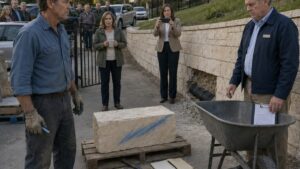
A new line of fluorescent marking paint ran along the gravel, placed by the utility contractor that morning. Raymond had already removed the outer row of the rack. The old timber base lay dismantled beside the outbuilding, and the remaining wood had been shifted back from the easement.
Justin kept both hands on the wheelbarrow handles.
“Where do you want it?”
“Behind the painted line.”
“I can see the line.”
“Then why ask?”
Justin looked at him. “Because it’s your wood.”
Raymond stepped aside.
Justin pushed the wheelbarrow forward until its tire nearly touched the boundary, then began passing the logs across one at a time. Raymond stacked them inside the corrected edge. Neither man crossed to the other’s side.
The yellow boots stopped at the line every time.
After the third load, Emma’s car turned into Raymond’s drive. She parked near the outbuilding and got out wearing work gloves tucked into her back pocket.
She looked from Justin to the growing stack.
“He started early,” Raymond said.
“I can see that.”
Justin set another log down. “There are two loads left after this.”
Emma studied him for a moment. “Are you going to the meeting?”
“Yes.”
The answer came without defensiveness, but not without effort.
At six thirty that evening, the clubhouse held fewer people than the evidence hearing but more than a routine board vote. Kathleen sat behind the same folding table. A thin file rested in front of her, divided by colored tabs.
Justin took a chair in the first row instead of his usual place beside the board.
Raymond sat with Emma near the aisle.
Kathleen opened the meeting by reading the findings into the record. The rack had extended into the utility easement. Raymond had acknowledged the violation, moved the wood, and scheduled replacement of the base inside the corrected boundary.
She turned a page.
“Separately, Mr. Mitchell removed firewood belonging to Mr. Scott on three documented occasions without permission.”
No one whispered this time.
“The board finds that the easement violation did not transfer ownership of the material and did not authorize private removal.”
Justin stared at the floor.
Kathleen continued. “The two matters will remain separate in the association record.”
Raymond felt something in his chest ease. Not triumph. Something steadier.
Justin had spent two weeks trying to make one wrong cancel the other. The board had refused him.
Kathleen looked toward Raymond. “Before the restitution decision, do you wish to make a statement?”
Raymond stood.
He had prepared four sentences on an index card. He left the card in his pocket.
“My rack crossed the access strip,” he said. “I believed the survey cap marked enough of the boundary. I was wrong. I should have checked the recorded width before building there, and I should have corrected it when the concern was first raised instead of treating every complaint as part of the theft.”
Justin looked up.
Raymond continued. “The wood was still mine. Mr. Mitchell had no permission to take it. Both things are true.”
He sat down.
Emma’s shoulder touched his briefly.
Kathleen turned to Justin. “You requested an opportunity to address the board.”
Justin rose slowly.
The yellow boots looked out of place against the clubhouse carpet. Dried mud remained in the tread despite the careful cleaning.
“I removed the wood,” he said.
His voice was quieter than it had been at the mailbox cluster.
“The first night, my furnace had failed. I had not told my family how far behind I was on repairs or other bills. I told myself I would replace what I took.”
He paused.
“The second and third times were not emergencies.”
A chair shifted behind Raymond.
Justin looked toward the board but not toward the room.
“Mr. Scott confronted me. I was embarrassed and angry that he had seen through me. I decided his easement violation made what I had done less serious. Then I used my board position to file a complaint and make him look unreliable before he could prove it.”
Kathleen did not soften.
“Do you understand that this was an abuse of your role?”
“Yes.”
“And the maintenance invoice?”
Justin swallowed. “I allowed a furnace charge from my property to remain in the association account after I realized it had been misclassified. I intended to repay it. I did not disclose it because I was afraid of losing my position.”
Kathleen folded her hands.
“The association has received reimbursement for that charge this afternoon. The board will issue a separate written finding regarding financial controls.”
She looked down the table. “The proposed resolution requires Mr. Mitchell to return the remaining firewood or reimburse Mr. Scott for its replacement value, resign from the architectural and violation review committee, and have no role in decisions concerning Mr. Scott’s property for two years.”
One board member added, “The easement correction will be closed without a fine because Mr. Scott complied before the deadline.”
Kathleen called the vote.
It passed unanimously.
There was no applause.
The lack of it suited Raymond. Applause would have turned the room into a stage, and he had spent too long being treated as a character in Justin’s version of events.
After the meeting, Kathleen asked Raymond and Emma to wait.
Justin stood near the exit.
Kathleen closed the file. “There is something else I need to say.”
Raymond remained standing.
“I received informal concerns about Justin’s use of his board role before this,” she said. “Nothing as serious as this, but enough that I should have paid closer attention.”
“Why didn’t you?” Emma asked.
Kathleen accepted the question without bristling.
“He handled jobs no one else wanted. Inspections. Vendor calls. Violation letters. I told myself his efficiency mattered more than his manner.”
“You believed him because he sounded official,” Raymond said.
Kathleen looked at him. “Yes.”
“And because I didn’t.”
“Yes.”
The answer cost her something.
“I treated civility as evidence,” she continued. “That was a failure of judgment. The minutes will reflect that the initial aggression complaint against you was unsupported.”
Raymond nodded.
It was not an apology crafted to make everyone feel repaired. It was an admission with a record attached. He trusted that more.
Justin had reached the door.
“Mr. Mitchell,” Kathleen called.
He stopped.
“Your resignation letter is due tomorrow.”
“You’ll have it.”
He looked toward Raymond. “The rest of the wood will be back by Saturday.”
Raymond said, “All right.”
Justin waited, perhaps expecting forgiveness or another condition.
Raymond offered neither.
Outside, he and Emma walked toward their cars beneath the clubhouse lights.
“You could have buried him in there,” Emma said.
“I told the truth.”
“You also left some things unsaid.”
“Not everything unsaid is hidden.”
She smiled faintly. “That almost sounds healthy.”
The following afternoon, Justin returned the final load. He wore the yellow boots, and once again they stopped at the new line.
He set the wheelbarrow handles down.
“That’s all of it.”
Raymond counted the pieces. The amount did not perfectly match what was missing, but the restitution check would cover the difference.
Justin looked toward the dismantled rack.
“I’m not asking us to be friends.”
“I know.”
“I don’t expect you to forget it.”
“I won’t.”
Justin nodded once.
Then he turned the wheelbarrow around and went home.
Emma arrived ten minutes later carrying a drill, a box of exterior screws, and two lengths of treated lumber strapped through the open trunk of her car.
She looked at the old rack scattered beside the outbuilding.
“Are you rebuilding this alone?”
Raymond glanced at the lumber, then at her work gloves.
“No,” he said. “Not if you’ve got the afternoon.”
Chapter 8: The Line They Could Both See
The footprints ended exactly at the survey line.
Raymond found them before breakfast, pressed into the first thin snow of winter. They came from Justin’s gate, crossed the utility strip, and stopped beside the new fluorescent marker stake. The tread pattern belonged to the yellow boots.
No prints crossed onto Raymond’s side.
A small white envelope had been wedged beneath the new gate latch.
Raymond picked it up.
Inside was a receipt for the final restitution payment and a folded invoice from a hardware store. Someone had purchased a stainless-steel latch, two hinge bolts, and a weatherproof cable stop. The old gate hardware, which had dragged against the gravel for years, had been replaced.
There was no note.
Raymond opened and closed the gate once. It moved without sticking.
Behind him, Emma set two mugs of coffee on the rebuilt wood rack.
“You found it,” she said.
Raymond held up the receipt.
“He could have mailed that.”
“He could have.”
“He fixed the latch.”
“I noticed.”
The new rack stood three feet inside the easement, square to the outbuilding wall. Emma had insisted on measuring every corner twice. Raymond had pretended this irritated him, though he had checked her figures a third time after she left.
The returned logs occupied the center rows. Freshly split oak filled the ends. From the kitchen window, the structure looked smaller than the old rack, but it was stronger and fully inside the marked line.
Emma handed him a mug.
“Are you going to return the receipt?”
“Why would I?”
“So he knows you saw it.”
“He knows where he left it.”
“That isn’t the same as answering.”
Raymond drank his coffee.
Snow collected along the top edges of the stacked wood. Across the strip, Justin’s lawn had disappeared beneath a clean white sheet. Without its stripes, it looked like everyone else’s.
“I don’t know what answer he wants,” Raymond said.
“Maybe he isn’t asking for one.”
“Then we agree.”
Emma leaned against the rack. “You’re very good at turning silence into agreement.”
He looked at her.
She smiled into her mug, but the remark remained.
During the week since the meeting, she had come by twice. Once to help attach the roof braces, once with dinner she claimed she had accidentally ordered too much of. Raymond had almost told her not to make a habit of checking on him.
Instead, he had given her a key to the outbuilding.
The gesture had required fewer words than an apology, but unlike silence, it had opened something.
He folded the receipt and put it in his coat pocket.
“I’ll keep it with the HOA papers,” he said.
“That’s very sentimental.”
“It’s documentation.”
“Of course.”
They worked until noon, adding the final side brace and clearing the old timbers from the gravel. Emma handled the drill while Raymond held the boards square. They argued once about the spacing and settled it with a tape measure instead of stubbornness.
When they finished, Emma stood back.
“Mom would have said the old rack was crooked.”
“It was not crooked.”
“She would have said that because she knew you’d bring out a level.”
Raymond brushed sawdust from his gloves.
“She usually did.”
The memory did not close his throat the way it once had. It remained painful, but pain was no longer the only thing inside it.
A wheelbarrow rattled on the other side of the fence.
Justin appeared near his garage carrying a bag of furnace filters. He had repaired the empty metal wood rack and stacked a small amount of purchased firewood against the wall. The yellow boots were muddy from the melting snow.
He saw Raymond and Emma.
For a moment, all three stood within sight of the line.
Justin lifted one hand.
Emma waited.
Raymond returned the gesture.
Justin continued toward his house.
“That was almost neighborly,” Emma said.
“It was a hand.”
“Attached to a neighbor.”
Raymond gathered the scrap lumber.
He did not tell her that two days earlier he had seen a furnace-company truck in Justin’s driveway. He did not tell her that Justin’s flag had remained lowered during the service call, as though the man no longer needed every ordinary problem disguised as order.
Some observations did not require action. That was different from pretending not to see.
By late afternoon, Emma packed her tools.
“Dinner next Sunday?” she asked.
Raymond nearly answered with the list of work he needed to finish.
Instead, he said, “Here?”
“If you cook.”
“I can cook.”
“You can heat things.”
“Sunday at five.”
She closed the trunk. “I’ll bring something that needs more than heat.”
After she drove away, Raymond walked the boundary.
The new line was easy to see now. Orange caps marked the corners. Fluorescent stakes showed the full easement width. The wood rack stood well behind it, leaving enough room for a utility truck.
Justin’s repaired gate closed cleanly.
The argument had not made the line real. The survey had always existed. What had changed was that neither man could pretend not to know where it was.
Raymond removed the restitution receipt from his pocket. He considered placing it beneath Justin’s mailbox flag with a written acknowledgment.
He decided against it.
A formal response would have turned the repaired latch into another transaction. He did not owe Justin reassurance, and Justin did not need praise for stopping at a boundary he should never have crossed.
Still, the house across the strip would face winter with a repaired furnace and little stored fuel.
Raymond returned to the outbuilding and selected one split log from the fresh oak. It was dense, dry, and straight-grained. He carried it to the easement edge.
He set it on a low concrete block beside the gate, exactly outside both private yards.
Then he went to the workshop and found a scrap of weatherproof card. In block letters, he wrote:
EMERGENCY WOOD. ASK FIRST. FREELY GIVEN.
He tied the card to the log with twine.
The distinction mattered.
Taken wood carried humiliation in both directions. Given wood did not.
As evening settled, the porch light came on across the strip. Justin stepped outside in the yellow boots and saw the log.
He approached slowly.
At the marked line, he stopped.
He read the card without touching it. Then he looked toward Raymond’s house.
Raymond stood inside the outbuilding doorway, one hand resting on the new rack.
Justin did not smile. He did not apologize. He placed his palm briefly against the top of the gate post and gave a single nod.
Raymond nodded back.
Justin left the log where it was and returned home.
The offer remained between them—not reconciliation, not absolution, but a clear choice placed on neutral ground.
Raymond switched off the workshop light.
In the darkness, the new survey stakes were still visible beneath the snow, and the wood stood secure behind the line they could both see.
The story has ended.