They Built a Gate Across His Road, but the Second Lock Exposed What the HOA Had Hidden
Chapter 1: The Gate They Locked Across Jerry’s Gravel Road
The gate had not been there when Jerry Thomas went to bed.
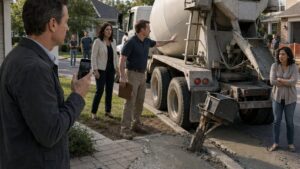
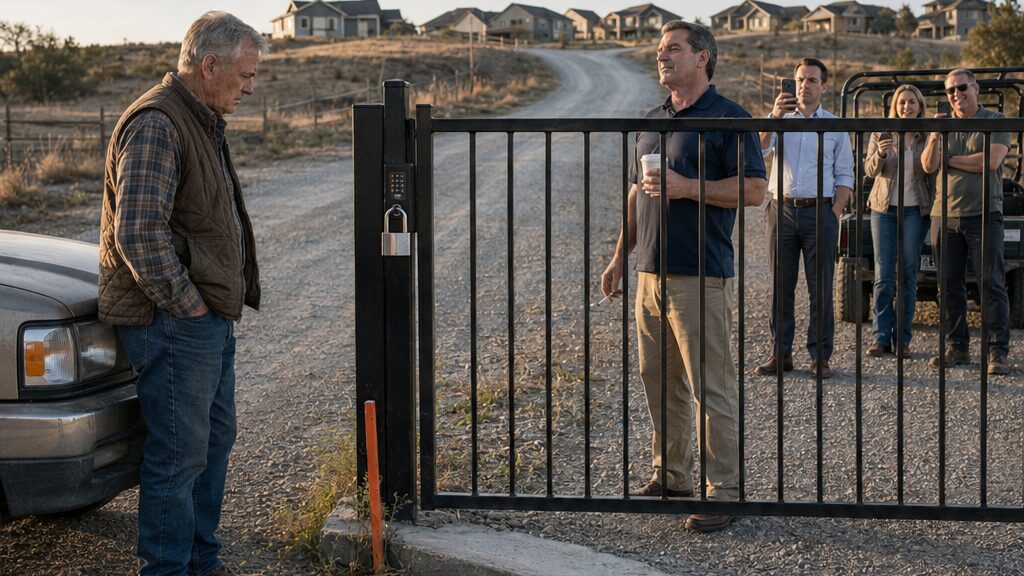
At six fifteen the next morning, it stretched across his gravel road like a steel accusation. Two black posts had been sunk into fresh concrete. A chain looped through the center bars, and a polished silver padlock caught the early light.
Jerry stopped his pickup twenty feet from it.
Beyond the gate, the road climbed between two stands of oak toward twelve houses built on what had once been pasture. Sprinklers ticked across trimmed lawns. A delivery van waited on the far side, its driver leaning over the wheel with both hands raised in confusion.
Mark Nelson stood beside the new keypad.
He wore a navy polo embroidered with the development’s name and held a paper coffee cup in one hand. Behind him, Nicholas Martin and two other board members watched from a golf cart. Nicholas already had his phone pointed at Jerry.
Mark smiled as if Jerry had arrived for a ribbon cutting.
“Morning,” he called. “You’ll need to request a resident code.”
Jerry switched off the engine. The sudden silence made the idling delivery van sound loud.
“For my road?”
Mark’s smile widened. “For the community entrance.”
Jerry climbed out slowly. He wore the same brown work vest he had used through twenty-eight winters on county road crews. The knees of his jeans carried pale stains from old concrete dust. He walked toward the gate without looking at the men recording him.
Fresh tire marks crossed the gravel. Near the right post, a mound of wet clay had been tamped over the shoulder of the road. Whoever had installed it had moved the shallow drainage cut he had maintained since before the first house was framed.
Jerry crouched near the post.
“You pour this yesterday?”
“The contractor finished before dark.”
“You have a permit number?”
Mark took a drink. “The board approved it.”
“That wasn’t my question.”
One of the men behind him laughed. Nicholas lowered his phone for half a second, then raised it again.
Mark stepped closer to the bars. “Jerry, this road serves our development. We maintain it. We insure it. We’ve had two vehicle break-ins since spring, and residents have been demanding controlled access.”
“You spread gravel twice.”
“We’ve invested more in this road than you have in years.”
Jerry looked through the gate at the delivery van. The driver had begun backing toward the houses, searching for somewhere to turn.
“The easement gives those homes passage,” Jerry said. “It doesn’t give your board the ground under it.”
Mark glanced toward Nicholas’s phone, making sure the camera still had them both.
“Technically, the dirt may be attached to your parcel,” he said. “Practically, this is our road.”
He flicked ash from a cigarette Jerry had not noticed between his fingers. The gray flecks landed near Jerry’s boot.
The gesture produced a small, clean heat behind Jerry’s ribs.
For two summers he had watched orange survey stakes disappear from the roadside. Mulch had been dumped against his fence. Landscapers had cut a wider turn at the entrance without asking. Each time, Jerry had made a call, then accepted an apology that came without repair.
He had told himself neighbors needed room to make mistakes.
Mark mistook his silence for consent.
“Remove the gate,” Jerry said.
The golf cart went quiet.
Mark rested one hand on the bars. “Or what?”
Jerry could have answered with the deed book and page number. He had known them since his father made him memorize the property description at seventeen. He could have said that the strip beneath Mark’s shoes was forty-two feet wide, measured from an iron pin buried beside the ditch. He could have recited the easement language word for word.
Instead, he looked down.
A faded wooden stake protruded from the weeds behind the right gatepost. Its top had once been painted orange, though only a thin stripe remained. Jerry had driven it beside the iron marker eight years earlier when the county widened the public shoulder.
The new concrete footing sat almost three feet beyond it, toward Jerry’s field.
Mark’s gate was not merely across the easement.
Part of it stood outside the access corridor altogether.
Jerry rose.
“Say it again,” he said.
Mark frowned. “Say what?”
“That the road belongs to you.”
Nicholas shifted his phone closer.
Mark gave a short laugh. “The development controls the road now. You can cry about the paperwork, but the gate stays.”
Jerry looked directly into the phone. “And I need your permission to enter my own parcel?”
“You need a code like everyone else.”
“I’m not everyone else.”
“That attitude is the reason this had to be handled by the board.”
Jerry felt the old temptation to end the exchange with the kind of sentence his road foreman used to call a bridge burner. He could see Mark waiting for it. A raised voice would become the only part of the recording residents ever saw.
So Jerry nodded once.
Then he turned and walked back toward his truck.
Mark called after him. “We’ll email the code request form.”
Jerry did not answer.
He reversed down the public shoulder and took the long way around through his hay field, using a rutted equipment lane that ended behind his barn. The route was not suitable for winter, deliveries, or emergency vehicles. It barely suited his pickup.
From the ridge, he could see the twelve houses clustered above the road. Their roofs rose where cattle had once stood beneath hickory shade. He did not resent the houses. He resented the ease with which people inside them had begun treating his memory as vacant land.
By eight, a clipped video appeared on the development’s resident page.
Nicholas had started recording after Jerry asked whether the road belonged to the board. The post showed Jerry refusing the access code and saying, “I’m not everyone else.” It did not show the misplaced post or Mark’s cigarette ash.
The caption read: LOCAL LANDOWNER THREATENS NEW SECURITY IMPROVEMENT.
Comments gathered beneath it.
Some residents asked what Jerry had threatened. Others thanked the board for keeping the neighborhood safe. One wrote that the old man had been angry about the development since construction began.
Jerry read the comments once, then closed the page.
He carried a wooden box from the bedroom closet to the kitchen table. His father had built it from cedar scraps and fitted it with a small brass latch. Inside were tax receipts, hand-drawn drainage maps, and deeds wrapped in brittle paper.
At the bottom lay the original easement.
Jerry unfolded it carefully. The county stamp was faint but legible. The language was plain: a nonexclusive right of ingress and egress over the described strip, granted for the benefit of parcels beyond the Thomas property.
No transfer of title.
No authority to construct a gate.
A folded square of lined paper had been clipped behind the final page. Jerry had seen it years earlier but remembered only his father’s handwriting across the top.
He removed the rusted clip.
The note began with a date from thirty-six years before.
Below it, his father had written one sentence in dark block letters:
The road must stay ours, but it must never leave a family trapped behind us.
Chapter 2: The Clause Nobody Read and the Warning They Threw Away
“There is no transfer.”
The county clerk said it twice, the second time more slowly, as though Jerry might distrust an answer that simple.
She turned the monitor toward him. A chain of recorded instruments filled the screen: the Thomas deed, the original easement, three subdivision plats, mortgage releases, and later amendments affecting drainage and utilities.
None conveyed ownership of the gravel strip.
Jerry rested both hands on the counter.
“What about the association?”
“It appears as beneficiary through the individual lots. Not as titleholder.”
“And authority to build structures?”
The clerk shook her head. “Nothing recorded here grants it.”
She printed the index and stamped the copy. Jerry folded it into the same canvas document case that held his father’s deed. For six days, Mark’s gate had opened and closed on a keypad Jerry refused to use. Each time he crossed his own road, he drove through the field.
The refusal had become less practical every day and more important in his mind.
Outside the records office, Pamela Adams waited beside a white survey truck. She was in her forties, with a sun-faded cap and a field notebook tucked under one arm. Jerry had known her father from the county department, but Pamela did not trade on familiarity.
“You brought everything?” she asked.
Jerry lifted the case.
“Then let’s find out where the steel actually sits.”
They spent the afternoon along the road.
Pamela located the original iron pins with a magnetic detector. Her assistant set up a total station beside the ditch while she checked angles against the recorded plat. One pin had been buried under mulch. Another lay beneath the edge of fresh concrete.
When Pamela finished her calculations, she stood facing the gate with one hand on her hip.
“The southern post is inside the easement corridor,” she said. “The northern footing crosses your boundary by thirty-four inches. The keypad pedestal is farther out.”
“So it trespasses.”
“Yes.”
Jerry waited for more.
Pamela closed the notebook. “That doesn’t mean you can obstruct passage.”
“I didn’t say I would.”
“You have the look of someone considering it.”
He glanced toward the development. Mark’s gate contractor was adjusting the closer while two residents waited in their cars.
“I own the land.”
“You do.”
“They built on it without asking.”
“They did.”
“So they remove it.”
“That is a reasonable demand.” Pamela’s tone remained even. “But the easement is still active. You cannot use ownership to make access unreasonably difficult, especially if this is the only route.”
Jerry heard the warning and stored it where he stored all advice that interfered with a decision already taking shape.
“Mark says they control it.”
“Mark is wrong.”
“That should settle it.”
Pamela looked at the gate. “Being wrong first does not make every response to him right.”
She drove two new stakes beside the recovered pins and sprayed their tops bright orange. Before leaving, she handed Jerry a preliminary sketch.
The line ran through the new concrete exactly as he had expected.
For one hour, proof felt like relief.
Then Mark arrived.
He parked his SUV against the shoulder and walked toward the stakes. Nicholas followed, holding a folder.
“What is this?” Mark asked.
“A survey.”
“We already have a development plat.”
“You have a plat showing your access. This shows my boundary.”
Mark bent over the nearest stake but did not touch it. “You’re spending money to prove you own gravel everyone knows you own.”
“You told me the board owned it.”
“I said we control the entrance.”
“Your post is three feet onto my property.”
Mark looked at Pamela’s sketch. Something tightened around his mouth, then disappeared.
“We’ll have counsel review it.”
Jerry handed him a certified envelope.
“This is notice to remove the gate and restore the shoulder. Ten business days.”
Nicholas opened the folder he carried but said nothing.
Mark weighed the envelope in his palm. “You hired a surveyor and sent legal notice before attending a single board meeting.”
“I attended the meeting where you announced the gate after the contract was signed.”
“We had urgent security concerns.”
“You could have called.”
“We sent notices.”
“To association members. I’m not one.”
“That was your choice.”
Jerry looked at the polished padlock hanging at the center of the gate. At home, in his father’s tool chest, an older lock lay wrapped in an oily rag. Its body was scarred and brown with age. His father had used it on the pasture gate, though he rarely closed it.
“I’m asking once more,” Jerry said. “Take your structure off my land.”
Mark tore open the envelope.
He skimmed the first page while two cars rolled to a stop behind him. Their drivers lowered their windows. Nicholas stared at the ground.
When Mark finished, he folded the paper badly and shoved it back into the envelope.
“You want us to spend thousands because one footing crosses an invisible line?”
“The line was there before your house.”
“The gate protects twelve families.”
“The easement already protected their access.”
Mark stepped nearer. “You are not going to hold an entire neighborhood hostage over thirty-four inches.”
Jerry’s grip tightened around the canvas case. “Your gate is the only thing holding anyone.”
Mark looked toward the waiting residents. His voice rose enough for them to hear.
“This is what we’re dealing with. He would rather jeopardize security than cooperate.”
The first drops of rain struck the dust.
Jerry said, “Ten business days.”
Mark let the envelope fall.
It landed faceup in the gravel between them. Rain darkened the paper around the certified-mail label.
Nicholas flinched but did not bend to retrieve it.
Mark returned to his SUV. The other board members followed. Tires passed close enough to the envelope to splash it with mud.
Jerry stood beside the gate until the vehicles disappeared uphill.
Pamela’s warning returned to him: Being wrong first does not make every response right.
He picked up the soaked notice, but the act did not soften him. It sharpened something.
Ten days later, the gate remained.
The orange stake beside the keypad had vanished.
Jerry found it in the ditch, snapped near the base.
That afternoon, he called the same contractor whose name appeared on the county’s approved vendor list. The man met him behind the barn, away from the entrance.
Jerry spread Pamela’s sketch across the hood of his pickup and pointed to a line forty feet beyond the HOA gate, still within his parcel.
“I want a farm gate here,” he said. “Steel frame. Manual lock. Nothing touching their structure.”
The contractor studied the drawing. “This is inside an access easement.”
“I know.”
“You have written approval?”
“For construction on my land, yes. The county said no building permit is required for an agricultural gate.”
“That is not the same as saying you can keep it locked.”
Jerry slid the survey closer.
“I asked where you can build it.”
The contractor looked from the map to Jerry’s face.
Then he tapped the marked line with one finger.
“I can put it exactly there.”
Chapter 3: Two Gates, Twelve Houses, and One Dangerous Victory
Mark entered the access code at seven twelve on Monday morning, and his gate swung inward to reveal another gate waiting forty feet beyond it.
For several seconds, he did not move.
Jerry watched from beside his barn.
The second barrier was plain galvanized steel, the kind used across cattle lanes. No decorative arch. No development emblem. A heavy chain wrapped around its center, secured by the old brown padlock from Jerry’s father’s tool chest.
Mark drove forward until his bumper nearly touched it.
Behind him, three residents’ cars lined up inside the development. A school bus waited on the public road, unable to enter because Mark’s SUV blocked the space between the gates.
Mark got out and stared through the bars at Jerry.
“What did you do?”
Jerry crossed the grass at an unhurried pace.
“I put a gate on my land.”
“You cannot block this road.”
“That’s what I told you.”
“This is an easement.”
“Yes.”
Mark pointed toward the HOA gate, still standing open behind his SUV. “Then unlock it.”
Jerry stopped on his side of the second barrier. “Remove yours.”
A woman in blue hospital scrubs stepped out of the second car in line. Jerry recognized Barbara Clark from the resident page. Her expression was not amused.
“I have to get to work,” she said.
Mark turned toward her. “This will be handled.”
“Handle it with the gate open.”
More doors opened. Nicholas appeared in the fourth vehicle, phone already in his hand. This time he did not seem certain whom to record.
Mark lowered his voice. “Jerry, this stunt is illegal.”
“The footing of your gate is on my property. You received notice. You ignored it.”
“That does not authorize you to deny access.”
“I am not denying access to anyone who has the right to cross.”
Barbara stared at the chain. “It looks denied from here.”
The words struck more cleanly than Mark’s anger.
Jerry had imagined this moment for ten days. In his mind, Mark saw the second gate and finally understood that title mattered. He called a contractor. The illegal structure came down. The road became his again without argument.
He had not pictured Barbara in scrubs, checking the time while a school bus idled between them.
Mark seized the opening.
“You see?” he called to the waiting residents. “He is punishing all of you because he lost a property dispute.”
“I didn’t lose anything,” Jerry said.
Mark walked up to the second gate. “You built this out of spite.”
Jerry looked past him toward the polished black bars of the HOA entrance. “I built it because you said a gate proved control.”
The school bus driver sounded the horn.
The sharp blast scattered birds from the roadside trees.
Nicholas approached Mark. “Maybe we should open ours and back everyone out.”
“Ours is open.”
“We could remove the chain temporarily.”
Mark’s face reddened. “This is not our obstruction.”
Barbara stepped closer to Jerry’s gate. “Do you have a key?”
“Yes.”
“Then use it.”
Jerry felt every eye on him. He also felt the weight of the old key in his pocket.
“If I open it now,” he said, “he leaves his gate on my land.”
Barbara’s mouth tightened. “And if you don’t, my shift starts without me.”
She was not defending Mark. That made the accusation harder to resist.
Jerry took out the key.
For one instant, satisfaction rose anyway. Mark’s claim had collapsed in front of the same people who had watched him dismiss the deed. The board president stood between two barriers, unable to command either one.
Jerry inserted the key, opened the brown padlock, and pulled the chain free.
The road filled with engines.
Barbara returned to her car without thanking him. The school bus entered, then the outbound residents passed one at a time. Mark stayed beside his SUV until the line cleared.
“You do that again,” he told Jerry, “and I’ll have a court order before sunset.”
“Take your gate down.”
“You’ve just demonstrated that you are the threat we built it for.”
Jerry closed his gate after the last vehicle passed but did not relock it. He looped the loose chain around the post.
Mark photographed it from several angles.
By noon, the story had changed online.
The HOA posted a notice accusing Jerry of creating an unauthorized obstruction and endangering residents. The photograph showed only his galvanized gate and brown lock. Mark’s black gate had been cropped from the frame.
Jerry read the notice from his kitchen table, then turned the phone facedown.
He told himself the morning had worked. Mark had been forced to confront the boundary. Residents had seen two gates and understood that the board’s control was not absolute.
Yet the old padlock lay beside his coffee mug, and it no longer looked like proof.
It looked like a question.
At three thirty, Jerry heard a horn at the road.
A white medical transport van sat between the gates. Its driver had entered the HOA code but found Jerry’s gate closed after a gust of wind swung it across the lane. The chain was not locked, but it had slipped through the latch and tightened under the van driver’s pulling.
Jerry walked quickly from the barn.
Inside the van, an elderly resident sat in a wheelchair with an oxygen tube beneath her nose. Her daughter stood outside, trying to lift the chain.
“We’ve been here six minutes,” the driver said. “Dispatch is calling me.”
“It isn’t locked.”
“It doesn’t have to be locked to block a vehicle.”
Jerry freed the chain. The driver opened the gate and returned to the van without another word.
Six minutes was not an hour. It was not an ambulance. No one had been harmed.
Jerry repeated those facts while the van disappeared down the public road.
They did not settle him.
At sunset, Mark pounded on Jerry’s porch screen.
“You locked families in,” he shouted.
Jerry remained inside the entryway, one hand on the wooden frame.
“My gate was unlocked.”
“A medical vehicle was delayed.”
“Because the chain caught.”
“Because you put a gate in an access road.”
“So did you.”
“Ours has a keypad.”
“Does the fire department have the code?”
Mark paused.
It lasted less than a second, but Jerry saw it.
“The system is compliant,” Mark said.
“That wasn’t my question.”
Mark leaned toward the screen. “Our attorney is filing for an emergency injunction. We’ll seek fees, damages, and removal of your gate. If your little stunt affects a sale, we will add that too.”
Jerry’s anger returned, grateful for a target.
“Your post is on my land.”
“And your gate interferes with twelve deeds. Congratulations. You found a way to be wrong while holding the survey.”
Mark stepped back.
Barbara stood at the edge of the porch.
Jerry had not heard her approach. She had changed out of her scrubs, but her hospital badge still hung from her belt. Her face was tired.
“Mark,” she said, “go home.”
“This concerns the board.”
“It concerns everyone who could not leave this morning.”
Mark looked between them. “Then tell him.”
“I intend to.”
After Mark walked away, Barbara faced Jerry through the screen.
“My mother lives with us,” she said. “She has heart failure. Some days she needs transport. Some days she needs more than that.”
Jerry’s hand dropped from the frame.
“I opened the gate.”
“After people begged you.”
“He had no right to put his there.”
“I believe you.”
The answer disarmed him.
Barbara glanced toward the road, where the two gates stood in the fading light.
“But an ambulance will not stop to decide which old document makes which man right,” she said. “It will stop at the first locked thing in its way.”
She left before Jerry could answer.
On the kitchen table, the old brown padlock remained beside his father’s handwritten note.
For the first time, Jerry understood that he might have defended the boundary exactly as drawn and still crossed a line his father had never meant him to approach.
Chapter 4: The Emergency Key Mark Never Told the Residents About
The fire engine stopped at the black gate for eleven seconds before anyone inside the development understood what was wrong.
Barbara stood at her kitchen window, watching the red lights pulse against the houses. No siren sounded. The truck had not come for an emergency; the fire marshal had arranged a routine access test after Barbara called that morning.
Eleven seconds was still too long.
A firefighter leaned from the passenger window and entered a code on the keypad. A red light flashed. He tried again. Behind the truck, Mark approached at a brisk walk, phone pressed to his ear.
Barbara crossed her yard toward the entrance.
Mark reached the keypad first. “They changed the system yesterday,” he said. “There’s a temporary code.”
The firefighter looked down at him. “Our dispatch has no code for this address.”
“There should be a Knox key.”
The firefighter pointed to a small metal box mounted on the left post.
Its door stood open.
The box was empty.
The fire marshal stepped from a county vehicle parked behind the engine. She examined the box, then looked at Mark.
“Where is the emergency key?”
Mark glanced at the board members gathering near the clubhouse. “The contractor must not have installed it yet.”
Barbara stopped beside him. “You told us the gate passed inspection.”
“It did.”
The fire marshal opened a clipboard. “Not through my office.”
Mark’s expression changed, not into fear but concentration. Barbara had seen the same look on physicians preparing to explain a mistake without naming it.
“This is a private access control system,” he said. “The board’s understanding was that the contractor coordinated with the county.”
“Then your contractor misunderstood the process.”
The marshal entered the temporary code Mark gave her. The gate opened. Beyond it, Jerry’s galvanized gate stood tied back against its post, the chain hanging loose.
The fire engine drove through without slowing.
Barbara watched it pass the second gate and felt her anger divide itself.
Jerry had created the obstruction the day before. He had known what the brown padlock would do. Yet his gate now stood open, while Mark’s more expensive gate had no verified emergency override.
The difference did not excuse Jerry.
It did make Mark’s story incomplete.
At noon, the clubhouse filled with residents demanding answers. Mark stood behind a folding table with the HOA attorney beside him and the two other board members lined along the wall. Nicholas sat near the end of the table, twisting a pen between his fingers.
Barbara remained standing.
“Was emergency access approved before installation?” she asked.
“The system is being brought into full compliance,” Mark said.
“That is not what I asked.”
Several residents murmured.
Mark set both palms on the table. “The gate was necessary. We had two break-ins, packages stolen from porches, and an insurance carrier asking what measures we had taken. We were facing either controlled access or increased premiums.”
Barbara understood the pressure. Her own renewal notice had risen enough to force changes in the household budget. She had supported a security gate when the board first proposed one.
She had not supported building it on another man’s land.
“Did Jerry give permission?” she asked.
“The association has an easement.”
“Permission for the gate.”
The attorney leaned toward his microphone. “Property rights within an easement can involve competing interpretations. That matter is now being handled through counsel.”
Nicholas stopped turning the pen.
Barbara looked at him. “You voted for the contract.”
His eyes remained on the tabletop.
Mark said, “All required board approvals were obtained.”
Nicholas inhaled. “The approval came before the consent letter.”
Silence moved across the room.
Mark turned toward him. “What consent letter?”
“The one the contractor asked for. From the landowner.”
The attorney’s head lifted.
Nicholas’s voice grew quieter. “We approved the deposit because the insurance deadline was approaching. Mark said the letter could be obtained before the posts were set.”
“Did you obtain it?” Barbara asked.
Nicholas looked at Mark.
Mark answered for him. “Jerry had refused to participate in association business for years. We acted under the easement authority available to us.”
“That sounds like no.”
“We acted for twelve homes.”
Barbara thought of her mother’s oxygen tubing, of the medical van caught behind Jerry’s chain, and of the empty emergency box bolted beside Mark’s padlock.
“Both gates endangered those homes,” she said. “Only one of you keeps pretending his gate did not.”
Across the room, Mark’s mouth hardened.
The meeting ended without a vote. The attorney advised residents not to discuss pending litigation online. Mark announced that an emergency injunction had been filed against Jerry, seeking immediate removal of the galvanized gate and reimbursement of the association’s legal costs.
Barbara left through the side door before Mark could stop her.
Jerry was standing at the gravel entrance when she arrived. His gate remained secured open with wire. He held the brown padlock in one hand and a coil of chain in the other.
“You heard about the fire test?” she asked.
“I watched it.”
“Mark is asking a judge to remove your gate.”
“I expected that.”
“He says you are unstable.”
Jerry’s jaw shifted. “That part new?”
Barbara ignored the bitterness. “Did you know his emergency box was empty?”
“No.”
“Would it have changed what you did?”
Jerry looked toward the houses.
The honest answer took too long.
Barbara nodded. “That is what I thought.”
He put the chain in the bed of his pickup. “My gate stays open until the court says otherwise.”
“No conditions?”
“I said it stays open.”
The concession should have satisfied her. Instead, she noticed how carefully he avoided saying he had been wrong.
“Mark did not get landowner consent,” she said. “Nicholas admitted it.”
Jerry turned back.
“He also approved payment before the contractor asked for consent.”
“Will Nicholas say that in court?”
“I don’t know. He looked like he regretted saying it in the clubhouse.”
Jerry slid the brown padlock into his pocket. “Regret makes people quiet.”
“So does pride.”
His eyes narrowed, but he did not respond.
That evening, Barbara returned to the clubhouse to copy the meeting packet for a group of residents. The building was empty except for the hum of the vending machine and the faint chemical smell of the recently cleaned floor.
A binder labeled BOARD MINUTES sat in the unlocked cabinet behind the meeting table.
She found the gate vote in the June section. The official page said the board had approved installation “subject to confirmation of all necessary permissions.”
Barbara remembered the meeting differently.
She remembered Mark saying the board would proceed immediately and resolve paperwork afterward. Nicholas had objected. A resident had asked whether Jerry owned the entrance. The exchange had lasted nearly ten minutes.
None of it appeared on the signed page.
Barbara opened the electronic packet on the clubhouse computer. The saved PDF matched the binder.
Then she checked the printer tray beneath the desk.
A loose draft lay facedown under unused sign-in sheets. It contained handwritten corrections and an earlier version of the paragraph.
The earlier line read: President Nelson directed installation to proceed before written landowner consent, stating that documentation could be corrected after construction.
Barbara placed the draft beside the signed minutes.
At the bottom of the official version, the modification date was three days after the board secretary had approved it.
She photographed both pages, then stood alone in the clubhouse with the evidence glowing on her phone.
Someone had not merely summarized the meeting.
Someone had changed what the board had decided after everyone went home.
Chapter 5: The Board Minutes Changed After Everyone Went Home
The sentence appeared in black ink halfway down the unedited page:
President Nelson directed installation to proceed before written landowner consent, stating that documentation could be corrected after construction.
Jerry read it twice.
Barbara had spread both versions of the minutes across his kitchen table. The official copy sat on the left, neat and harmless. The discarded draft sat on the right, carrying the words that had been removed.
“They knew,” Jerry said.
“Nicholas knew. Mark knew. I don’t know about the others.”
“The official minutes say permission was pending.”
“The draft says Mark told them to build anyway.”
Jerry touched the page with one finger but did not move it. “This gets his gate removed.”
“It may.”
“It proves bad faith.”
“It proves somebody changed a record.”
Jerry looked at her. “You still sound unconvinced.”
“I am convinced Mark hid something. I am not convinced that makes your gate safe.”
The old irritation rose, though less cleanly than before.
“My gate is open.”
“Now.”
Jerry leaned back. Barbara had come before her hospital shift, still wearing the dark slacks and plain jacket she used when meeting families. A travel mug sat untouched near her elbow.
“What do you want from me?” he asked.
“I want you not to turn this into a contest where the last man holding a key wins.”
Before Jerry could answer, a car rolled into the drive.
Mark stepped out carrying a slim leather folder. The HOA attorney followed him.
Barbara gathered the minutes, but Mark had already seen them through the window.
“I was hoping we could speak privately,” he said when Jerry opened the door.
“You brought counsel.”
“He is here to document terms.”
Barbara stood behind Jerry. “Then it is not private.”
Mark’s gaze moved to the papers on the table. For one moment, the confidence left his face.
It returned quickly.
“I have a settlement proposal,” he said.
Jerry let them inside.
The attorney placed the folder on the table. Mark set a new brass padlock on top of it. The lock was smaller than the one on the HOA gate, polished enough to reflect the overhead light.
Jerry looked at it. “What is that supposed to mean?”
“A replacement access system,” Mark said. “One gate, not two. The association maintains it. You receive a permanent key and code. Emergency services receive override access.”
“On whose land?”
“The gate remains where it is.”
“Then no.”
“Read the terms.”
The offer reimbursed Jerry for Pamela’s survey, the contractor’s work, and part of his legal expenses. It also paid him an annual maintenance fee. In exchange, he would acknowledge the association’s authority to manage entry, remove his own gate, and keep the settlement confidential.
The money was not enormous.
It was enough to replace the barn roof, repair the field lane, and end the argument without a hearing.
Mark watched him read.
“This gives you more than you had before,” he said. “Guaranteed compensation. Guaranteed access. No special assessment to the residents.”
Barbara folded her arms. “And no discussion of the altered minutes.”
The attorney replied, “The agreement resolves all disputed claims without admission.”
Jerry looked at the brass lock.
For years he had paid taxes on the strip while other people used it, widened it, and complained when potholes formed. Now the association offered to pay for the control it had already taken.
There was a practical dignity in accepting money instead of anger.
There was also silence.
“What happens if I refuse?” Jerry asked.
Mark’s shoulders lowered slightly. This was the conversation he had expected.
“The court may order your gate removed. The association will seek costs. If title insurers flag the dispute, pending sales could collapse. Legal expenses will be passed to homeowners.”
“A special assessment,” Barbara said.
The attorney nodded. “Possibly.”
Mark turned to her. “Some residents cannot absorb that. Nicholas has already told us another assessment may force him to sell.”
Jerry studied Mark’s face. The concern there was not entirely false. Mark needed authority, but he also understood what rising costs could do to families whose wealth existed mostly on paper.
That did not explain the altered minutes.
“Who changed the record?” Jerry asked.
Mark did not blink. “Draft minutes are revised before approval all the time.”
“After approval?”
“You are relying on a discarded working copy.”
Barbara placed her phone on the table and displayed the modification date.
The attorney stopped touching his pen.
Mark’s expression tightened. “This is exactly why settlement is responsible. Every document becomes a weapon. Every procedural mistake becomes a scandal. Meanwhile, twelve families pay.”
Jerry closed the folder.
“I need time.”
Barbara looked at him sharply.
Mark stood. “The offer expires tomorrow at five.”
He left the brass padlock behind.
After the car disappeared, Barbara said, “You are considering it.”
“I said I need time.”
“You said no before you saw the check.”
“It protects my title.”
“It lets him keep the gate.”
“It records my permission instead of pretending he never needed it.”
“And it buries what he did.”
Jerry picked up the brass padlock. It was solid, well made, and without a scratch.
“People behind that road could be billed thousands if this goes farther.”
“They could also keep electing a man who changes records whenever the truth costs him something.”
She gathered the minutes.
“You wanted residents to understand the difference between access and ownership,” she said. “Maybe you should understand the difference between settlement and truth.”
She left the house.
The following afternoon, Jerry found Nicholas waiting beside the barn. His shirt was untucked, and his eyes carried the swollen look of someone who had not slept.
“I did not know Mark changed the minutes,” Nicholas said.
“You knew he lacked permission.”
“I knew we did not have the letter yet.”
“You voted anyway.”
Nicholas looked toward the development roofs. “My mortgage payment increased when the rate adjusted. Then insurance went up. Mark said the gate would keep the carrier from dropping us. A special assessment would finish us.”
“So you recorded me instead.”
Nicholas’s face reddened. “Mark said if residents saw you as the obstacle, they would approve the emergency spending.”
Jerry remembered the phone held steadily beyond the gate, the laughter from the golf cart, the cropped video online.
“Was any of that funny to you?”
“No.”
“You laughed.”
Nicholas looked down. “That was easier than telling him no.”
It was not an excuse. It was, Jerry understood, the first honest thing Nicholas had given him.
“What do you want now?” Jerry asked.
Nicholas handed him a small flash drive.
“Unedited financial exports. Contractor invoices. Email attachments. I copied them before access was restricted.”
“Why?”
“Because Mark says the residents will lose everything if he loses control.” Nicholas swallowed. “I am starting to think he means he will.”
Jerry accepted the drive.
That night he sat at the kitchen table with the settlement folder open before him. The reimbursement figure rested beside the brass padlock. On the other side lay his father’s easement and the stained certified envelope Mark had thrown into the rain.
The private settlement offered certainty.
The hearing offered cost, delay, and the possibility that a judge would condemn both gates.
Jerry reached for the easement. His father’s folded note slipped free and landed beneath the polished brass lock.
He opened it again.
The first sentence was the one he already knew: The road must stay ours, but it must never leave a family trapped behind us.
Below it, in smaller handwriting, was a line Jerry had overlooked because the fold ran through the words.
Never let a gate make families beg to reach the road.
Jerry looked at Mark’s confidentiality clause.
For thirty-six years, he had treated his father’s promise as an instruction to guard title.
Now he understood that the promise had also been a warning about men who believed ownership gave them the right to control passage.
The warning did not name Mark.
It did not spare Jerry.
Chapter 6: The Promise Beneath the Survey Line
The hospital receipt was folded inside the easement like a bookmark.
Jerry found it two mornings before the hearing while searching the deed box for the original survey description. The paper had yellowed almost to brown. Across the top, a county ambulance service had typed his father’s name and a transport date from thirty-six years earlier.
The destination was the regional hospital.
The pickup location was not the Thomas house.
It was the neighboring farm beyond their property.
Jerry sat on the barn floor with the receipt in one hand and his father’s note in the other.
Memory returned in fragments: his father collapsing beside a tractor; rain making the lower field impassable; two neighbors carrying him through their yard to reach the road; an ambulance waiting where the gravel remained firm. Jerry had been in his early thirties, angry at everyone and useful to no one.
His father survived.
Months later, he granted the recorded easement that eventually served the development’s twelve houses.
Jerry had remembered the legal work but not the reason.
He had thought his father acted because the county required access before parcels could be sold. The receipt showed something else. A man who had once depended on an open route had refused to leave future families landlocked.
Outside the barn, Jerry’s galvanized gate stood open. The brown padlock hung from his belt.
He carried a bolt cutter to the entrance.
The chain was already loose, but he cut it anyway. The jaws closed with a hard metallic snap. One half dropped into the gravel. Jerry removed the gate from its latch and wired it permanently against the fence until the court decided what should happen.
He placed the brown padlock in his pocket.
That evening, eight residents gathered near the road. No one had called it an HOA meeting. Barbara had invited people who wanted information without Mark directing the room.
Pamela stood beside an enlarged survey exhibit attached to an easel. Nicholas remained near the back, away from the other board members. Mark had not been invited, though his black gate framed the meeting like a reminder of his absence.
Pamela pointed to the marked corridor.
“Jerry owns the underlying land,” she said. “The easement grants passage to the benefited parcels. The association’s northern footing crosses outside that corridor. Jerry’s gate was within his parcel but created an additional burden inside the passage route.”
A resident asked, “So who is right?”
Pamela lowered her hand. “That is not a surveying question.”
They looked at Jerry.
He had prepared three sentences in the barn. Standing before the residents, they sounded like the beginning of another defense.
He abandoned them.
“My gate should not have been locked,” he said.
The group went still.
Mark had told them Jerry would never admit fault. Jerry had almost proved him right.
“I had the right to object to what the board built,” he continued. “I had the right to demand removal. I did not have the right to make your families carry the cost while I forced that point.”
Barbara watched him without relief.
Jerry faced her. “The medical transport delay was my responsibility.”
“Partly,” she said.
He nodded. “Partly is enough for me to answer for.”
A man near the easel asked whether Jerry was surrendering the road.
“No. The gate remains a trespass. The title remains mine. I am opening access because those facts do not give me permission to endanger you.”
The words cost him less than he expected and more than he wanted.
Nicholas stepped forward.
“The board knew written consent was missing,” he said. “I voted to proceed anyway.”
Several residents turned on him at once.
“Why?”
“Because we were told insurance would not renew without visible security measures. Because I was afraid of another assessment. Because Mark said Jerry would delay until the deadline passed.”
“You laughed at him,” one resident said.
Nicholas’s face tightened. “Yes.”
There was no applause for either confession.
The absence felt appropriate.
Barbara moved closer to Jerry. “I will give the altered minutes and the original emails to the attorney handling the hearing.”
“You have my permission to use the survey,” Pamela said.
Jerry looked at Barbara. “Will you support my claim?”
“I will support the truth.”
“That was not my question.”
“It is my answer.” Her voice remained steady. “I will not help you protect your land by pretending the delay did not happen. I will not help Mark protect the board by pretending he had permission.”
Jerry glanced at the black gate.
“That may be enough.”
“It has to be.”
A vehicle approached from the public road. Mark’s SUV stopped outside the entrance. He emerged with the HOA attorney and a sheriff’s deputy.
Conversation ceased.
Mark carried a packet of papers.
“The court issued temporary relief,” he announced. “Jerry’s gate must remain unsecured pending the hearing. Any interference with resident access may result in sanctions.”
Jerry looked toward his galvanized gate, wired open against the fence.
“It has been unsecured since yesterday.”
Mark saw the cut chain on the ground. His eyes moved to the residents.
“So you concede the obstruction.”
“No.”
“You removed the lock.”
“I corrected my mistake.”
Mark smiled without warmth. “That is a distinction your attorney can attempt to explain.”
“I do not need an attorney to explain that your gate is on my land.”
The deputy shifted his weight but said nothing.
Mark handed Jerry the court order. “The association’s settlement offer remains open until five.”
Jerry folded the packet once.
Barbara stepped beside him. Nicholas remained behind her, holding the flash drive.
Mark noticed the arrangement.
“What is this?” he asked.
“A conversation you did not schedule,” Barbara said.
“I am still the elected president.”
“For now.”
The words traveled through the group without anyone repeating them.
Mark’s attention returned to Jerry. “You can end this tonight. Expenses reimbursed. Access guaranteed. No assessments. Or you can turn a boundary error into a financial disaster for every person standing here.”
Jerry knew some of that might be true. Hearings cost money. Lawyers multiplied harm by the hour. Even a victory could arrive as invoices.
He removed the brass settlement lock from his coat pocket and held it out.
Mark reached for it, mistaking the gesture.
Jerry placed the lock on top of the settlement folder in Mark’s hands.
“No confidentiality,” he said. “No private authority over the road. The gate comes down, emergency access is recorded, and every invoice and vote goes to the residents.”
Mark’s expression hardened. “Then there is no agreement.”
“Not tonight.”
“You think an old receipt and a survey make you righteous?”
Jerry felt the brown padlock in his pocket, scarred by his father’s hands and then his own.
“No,” he said. “I already learned they do not.”
He turned toward the residents.
“At the hearing, I will submit the deed, both surveys, the certified notice, the medical delay, and the fact that I locked my gate. All of it.”
Mark stared at him. The strategy had depended on Jerry hiding his own mistake as fiercely as the board hid theirs.
“You are volunteering evidence against yourself,” the attorney said.
“I am volunteering the whole road.”
No one cheered. Barbara simply nodded. Pamela began rolling the survey exhibit. Nicholas held the flash drive tighter, as though he had finally understood that handing over evidence was not the same as telling the truth aloud.
Mark walked back toward his SUV.
At the driver’s door, he turned. “Once this begins, you cannot control where it ends.”
Jerry looked at the black gate, the empty emergency key box, and the survey stake bright against the dimming grass.
“That is why it belongs in the open.”
Mark drove away.
Jerry remained at the entrance until the residents dispersed. Then he picked up the severed chain and carried it to the barn.
On his workbench, he placed the old brown padlock beside the hospital receipt.
The lock had once represented his father’s land. Then it had represented Jerry’s answer to humiliation. At the hearing, it would represent both.
For the first time since Mark built the gate, Jerry was not preparing to prove that he alone was right.
He was preparing to tell enough truth that neither man could own the ending.
Chapter 7: The Road Stayed Open, but the Board Lost Its Lock
Mark entered the county hearing room expecting Jerry to be alone.
He stopped just inside the door when he saw the evidence table.
The altered meeting minutes lay beneath a clear cover, already marked with an exhibit sticker. Beside them sat Pamela’s survey, the certified letter stained by rain, the hospital transport receipt, and two padlocks.
The polished silver lock from the HOA gate rested next to Jerry’s scarred brown one.
Barbara sat behind Jerry with a folder on her lap. Nicholas occupied the end of the same row, separated from Mark’s other board members by three empty chairs.
Mark’s attorney leaned close to him and spoke quietly.
Whatever he said made Mark look again at the altered minutes.
Jerry had slept badly, but the exhaustion had burned away as soon as he entered the room. He wore a clean work shirt beneath his brown vest. The old padlock had pulled one side of the evidence bag lower while he carried it inside.
Now it lay where everyone could see it.
The hearing officer entered, and the room rose.
The matter began with the HOA’s request for a permanent injunction against Jerry’s gate. Mark’s attorney described an elderly landowner who had reacted to a minor boundary disagreement by deliberately obstructing the only access road serving twelve homes.
The description was clean, orderly, and not entirely false.
Photographs appeared on a screen: Jerry’s galvanized gate closed behind the HOA entrance; cars lined along the road; the medical transport van waiting beside the chain.
“The respondent’s conduct created an immediate threat to public safety,” the attorney said. “Whatever title dispute may exist, self-help cannot replace lawful process.”
Jerry felt Barbara watching him.
His own attorney was not there because he had chosen not to hire one. The decision had seemed sensible when he believed records would speak for themselves. Now, listening to the HOA attorney arrange the truth into a shape that favored Mark, Jerry understood how easily facts could become walls.
The hearing officer turned to him.
“Mr. Thomas, do you dispute that you installed and locked the second gate?”
“No.”
The attorney looked almost disappointed that he had not resisted.
“Did you notify the residents beforehand?”
“No.”
“Did you provide emergency services with a key?”
“No.”
“Did a medical transport vehicle experience delay at that gate?”
“Yes.”
Mark shifted in his chair.
Jerry placed both hands flat on the table.
“My gate was a mistake,” he said.
A faint rustle passed through the room.
Mark’s attorney paused.
Jerry continued before anyone could interrupt him.
“The HOA gate was built on my land without permission. I believed that putting another gate entirely inside my boundary would force the board to remove theirs. I was thinking about ownership. I was not thinking enough about the people whose only route crossed that strip.”
The hearing officer studied him. “You concede the second gate unreasonably burdened the easement?”
“I concede that locking it did.”
Mark leaned toward his attorney, but the advantage they had expected did not arrive.
Jerry’s admission changed the room. The photographs no longer looked like evidence dragged from him. They looked like evidence he had brought himself.
The hearing officer asked, “Is your gate currently locked?”
“No. It is wired open.”
“Will you agree not to obstruct passage while this dispute is resolved?”
“Yes.”
The officer made a note.
Mark’s attorney stood. “The association appreciates that concession. Given Mr. Thomas’s acknowledgment, we ask that removal be ordered immediately.”
Jerry looked at the black gate visible through the hearing-room windows only in his mind: its concrete footing over the old line, its empty emergency key box, its polished lock above the faded stake.
“Then remove both,” he said.
The attorney turned. “The association’s gate is not before the court on this motion.”
“It is the reason mine existed.”
“That does not establish unlawfulness.”
Pamela was called next.
She unfolded the survey exhibit and explained the original pins, the easement corridor, and the location of both barriers. Her testimony was precise enough to strip emotion from the dispute.
“The northern footing of the HOA structure extends thirty-four inches beyond the recorded access corridor and onto the Thomas parcel,” she said. “The keypad pedestal extends farther.”
“Does the easement grant the association title to that area?” the hearing officer asked.
“No.”
“Does it expressly authorize a gate?”
“No.”
“Does it prohibit one?”
“No. But any structure must not unreasonably interfere with the servient owner’s use, and it must comply with applicable safety requirements.”
The HOA attorney asked whether Jerry’s gate also sat within the access route.
“Yes.”
“So both structures burden the easement.”
“In different ways,” Pamela said.
“Yet both burden it.”
“Yes.”
The small victory showed in Mark’s face.
Then the fire marshal testified.
The emergency key box had been empty during inspection. No approved override code had been registered with dispatch. No final access certification had been issued. The gate could delay emergency vehicles if the keypad failed, if power was interrupted, or if the current code was unavailable.
Mark’s attorney called it an administrative oversight.
The fire marshal answered, “An oversight becomes a hazard when a board represents it as completed.”
Barbara opened her folder.
She presented the two versions of the meeting minutes, the printer copy, the modification date, and emails recovered from the HOA system. One message from Mark to the contractor read: Install before the insurance visit. We can fix the paperwork after the structure demonstrates controlled access.
Another directed Nicholas to describe Jerry as uncooperative in resident communications.
Mark’s attorney objected to the emails’ context.
Nicholas stood before being called.
“I can provide the context,” he said.
Mark turned toward him. “Sit down.”
The hearing officer looked over her glasses. “Mr. Martin, are you prepared to testify under oath?”
Nicholas swallowed. “Yes.”
He admitted approving the deposit without landowner consent. He admitted recording Jerry at the gate so the board could portray him as hostile. He admitted laughing because opposing Mark in front of the others had frightened him more than humiliating a neighbor.
“The association faced an insurance deadline,” Nicholas said. “That pressure was real. The break-ins were real. But we used them to pretend there was no other choice.”
“Were the official minutes changed after approval?” the hearing officer asked.
Nicholas looked at Mark.
“Yes.”
“By whom?”
“I saw Mark editing the file. I did not stop him.”
Mark rose. “That is a lie.”
His attorney pulled him back down.
For the first time since the gate appeared, Mark looked less like a president than a man trapped inside the argument he had built.
When his turn came, he did not deny the break-ins, the insurer’s warning, or the financial pressure. He explained that residents expected action and that every delay risked higher premiums, failed home sales, and accusations that the board had ignored safety.
“I made decisions under time pressure,” he said. “Maybe the process was imperfect. But my purpose was to protect the development.”
Jerry believed him.
That was the difficult part.
Mark had not begun with a desire to steal land. He had begun with fear—of crime, of costs, of appearing weak. Then each shortcut required another. By the time Jerry stood before the gate, Mark needed the old man to be unreasonable because admitting otherwise would expose everything behind the lock.
The hearing officer recessed for forty minutes.
No one spoke much in the corridor.
Mark stood near the far wall with his attorney. Barbara sat beside Jerry on a wooden bench.
“You admitted more than they expected,” she said.
“I did more than I expected.”
“Do you regret it?”
Jerry looked at the evidence bag in his lap.
“I regret waiting until a hearing to say it.”
Nicholas approached but remained standing.
“If there is a special assessment,” he said, “some people will blame both of you.”
“They may be right,” Jerry said.
Nicholas seemed surprised by the answer.
When the hearing resumed, the officer read the ruling slowly.
Jerry was permanently restrained from locking or obstructing the access corridor except under a future recorded agreement that preserved emergency entry and resident passage.
His galvanized gate was to be removed from the traveled portion of the easement within thirty days.
The HOA’s gate was also found to create an unauthorized and unsafe burden. Its northern footing trespassed outside the corridor, and the association had failed to obtain landowner consent or final emergency-access approval. It was to be removed within the same thirty days.
Neither side received the complete victory it had requested.
The HOA was ordered to reimburse Jerry’s documented survey and restoration costs. The parties were directed to record an access-management agreement identifying the easement width, maintenance duties, emergency requirements, and a prohibition against future structures without written consent from both the landowner and benefited parcel holders.
The hearing officer referred the altered minutes and spending records for independent HOA review.
Mark remained still as the ruling ended.
Jerry gathered the two locks from the evidence table.
Outside, Barbara asked, “Was that enough?”
He looked toward the road beyond the parking lot.
“It is what the facts allowed.”
The black gate came down three weeks later.
There were no cameras from local news and no crowd gathered to celebrate. A contractor loosened the bolts, lifted the bars with a small loader, and broke away the concrete around the misplaced footing. Jerry watched from the ditch while Pamela marked the restored boundary.
The association paid to reset every missing survey stake.
Its residents later voted for an independent financial review and a new board election. Mark did not seek another term. Nicholas did, but only after standing at the clubhouse and reading aloud the full unedited minutes.
He did not win.
Barbara helped prepare the recorded access agreement. It required the road to remain open, established a shared maintenance schedule, and gave Jerry written authority over any future construction on his land. Emergency vehicles received unrestricted passage. No board could install another gate without his consent and resident approval.
Jerry removed his galvanized barrier himself.
He kept the posts beside the barn for use in a cattle lane. The old brown padlock returned to his father’s tool chest, though not wrapped in the oily rag.
By early autumn, the entrance looked almost as it had before the dispute. Gravel ran uninterrupted from the public shoulder toward the houses. A fresh orange stake stood beside the ditch, bright enough that no one could claim not to see it.
One evening, Barbara stopped her car near Jerry as he filled a shallow rut.
“My mother asked whether the road is finally yours again,” she said.
Jerry rested both hands on the rake.
“What did you tell her?”
“That it never stopped being yours.”
He looked up the hill at the homes beyond his field.
“And?”
Barbara smiled faintly. “That owning it is not the same as owning everyone who needs it.”
Jerry nodded.
A school bus approached from the development. He stepped off the gravel and let it pass without slowing. Children’s faces appeared briefly in the windows, then disappeared toward the public road.
No gate opened for them.
No one needed a code.
Jerry returned to the rut and pulled the gravel level with three steady strokes. Near the ditch, the new survey stake marked exactly where his land began.
The road crossed the line without apology.
That was what it had always been meant to do.
The story has ended.