She Cut the Lock on His Lake Road Before Learning Who Needed the Repair
Chapter 1: The Pink Blazer at the Locked Lake Gate
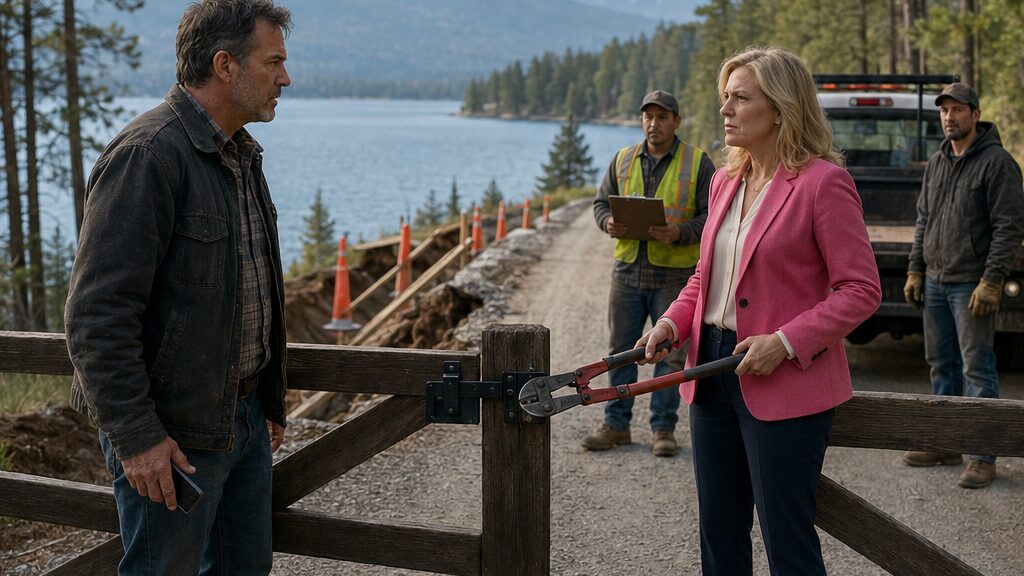
The bolt cutters were already around Timothy Martinez’s lock when he came down the gravel road with coffee cooling in one hand and his phone in the other.
For half a second, he did not move.
The lake was flat behind the gate, pale blue between the pines, the kind of morning that usually made the road feel farther from the rest of the community than it really was. The wooden gate stood at the bend where the private lane narrowed toward his house. Two orange repair markers leaned along the washed-out shoulder beyond it. A temporary board kept loose gravel from sliding toward the ditch.
And Lisa Roberts, in a bright pink blazer that looked made for an office and not a mountain road, had the jaws of the bolt cutters set against the black steel shackle.
“Take those off,” Timothy said.
Lisa looked up as if he had interrupted a meeting, not stopped her from cutting into his property. A folded notice was tucked under one arm. Another had been taped to the post beside the gate, its white paper lifting at the corners in the lake breeze.
“Mr. Martinez,” she said. “You were notified.”
“Notified of what?”
“The unauthorized road alteration. The temporary barrier. The gate modification. The markers.” She adjusted her grip on the bolt cutters. “We’re here to restore compliance.”
Timothy set his coffee on the nearest fence post. Carefully. Too carefully. His hand wanted to snatch the tool away, but he knew how that would look on a phone, in a report, in a sentence written by someone who had already decided he was unreasonable.
“Restore compliance by cutting a lock?”
“The lock prevents association access.”
“This is not association road.”
Lisa’s mouth tightened. “The easement language gives the association reasonable inspection access.”
“Inspection isn’t removal.”
Behind her, a white work truck idled at the curve. Timothy had not noticed it at first because the pines screened the lower road, but now the reverse lights blinked on. The truck began backing toward the gate with a slow crunch of tires over gravel. A crew supervisor leaned out the passenger window, watching Lisa for instructions.
Timothy’s eyes moved past the gate to the repaired section. Scott Lee’s crew had laid new stone along the shoulder yesterday and braced the soft edge near the culvert. It wasn’t pretty yet. It was not supposed to be. It was temporary stabilization, the first step before the permanent gravel could be compacted. If they pulled the markers or removed the boards, a heavy vehicle would not see where the edge fell away.
“Tell that truck to stop,” Timothy said.
Lisa did not turn around. “The crew has been instructed to remove all unapproved materials from the common-view corridor.”
“Common-view corridor,” Timothy repeated.
“It’s in the design standards.”
He looked at the locked gate, then at the orange markers beyond it. “That road is how we get to my house.”
“And you were welcome to submit an exterior modification request.”
“I did.”
Lisa’s expression did not change, but something in her eyes sharpened, as if he had made the wrong move in a process she understood better than he did.
“There is no approved request on file.”
“I didn’t say approved. I said submitted.”
“That’s not the same thing.”
The truck continued backing. Its warning beep cut into the morning, small and mechanical and absurd against the lake. Timothy stepped closer to the gate, between Lisa and the latch.
“Do not bring a crew onto my property without written authorization.”
Lisa lifted the notice from under her arm and held it out. “This is the written authorization.”
He did not take it. The top line read Notice of Violation. Beneath it, in bold: Unapproved Exterior Alteration / Restricted Access Obstruction.
Timothy pulled his phone up and started recording.
Lisa noticed. Her shoulders squared. “You’re welcome to document. I’m documenting too.”
“Good,” he said. “Say your name and what you’re doing.”
“I’m Lisa Roberts, compliance chair for the Lakeview Ridge Homeowners Association. We are enforcing a written violation after failure to obtain approval.”
“Say what you’re about to cut.”
She looked at the phone, then the gate, then back at him. “An unauthorized lock obstructing association access.”
“It’s my lock on my gate.”
“That is disputed.”
“No, it isn’t.”
The crew truck stopped behind her. Two workers got out. One carried gloves and a pry bar. The other opened the truck bed and pulled loose a strap. They looked like men who had been told this was a simple removal job and were beginning to realize it was not.
Timothy raised his voice just enough for them to hear. “Nobody touches the markers past this gate.”
The supervisor approached, clipboard in hand. “Sir, we’re just here to remove the flagged items.”
“They’re not flagged items. They’re safety markers.”
Lisa gave the supervisor a quick glance. “Proceed only when I say.”
Timothy turned back to her. “That shoulder dropped eight inches after the storm. The markers are there so a vehicle doesn’t put a tire into the washout.”
“You should have waited for approval before beginning work.”
“The culvert was undermining the road.”
“Emergency stabilization still has to be reported.”
“It was.”
“Not in the correct category.”
He stared at her. “The road is falling apart. This isn’t landscaping.”
Lisa’s face flushed, not with embarrassment, but with the heat of someone holding a line because backing away would make all the earlier words look dangerous.
“Mr. Martinez, the association has a responsibility to all residents. If every owner decides his project is an emergency, we lose standards entirely. We have erosion rules, contractor requirements, liability procedures, and visual restrictions for lake-facing access roads.”
“Visual restrictions?”
“The gate and markers are visible from the north overlook.”
“The road is visible because it exists.”
“The board has received complaints.”
“From who?”
“I’m not required to identify residents during enforcement.”
A pinecone rolled under the truck tire. The supervisor shifted his weight. One worker looked toward the washed-out shoulder, then at the bolt cutters, then at Timothy’s phone.
Timothy lowered his voice. “Lisa, listen to me. I’m not refusing inspection. I’m refusing removal. That road needs to stay marked.”
“You can make that argument at the hearing.”
“The hearing is tomorrow.”
“The violation stands until then.”
“And you’re cutting the lock today?”
“We left notice.”
“When?”
She hesitated.
Timothy caught it. “When?”
“This morning.”
He looked at the paper taped to the post. The tape was clean. Not dusted, not damp, not curled from night air. Fresh.
“This morning,” he said, “while you were standing here with bolt cutters.”
Lisa’s jaw tightened. “You were not available to receive notice.”
“I was inside the house.”
“You did not answer the first knock.”
“There was no knock.”
Her eyes flicked toward the house hidden beyond the pines. “We are not debating this in the road.”
“No,” Timothy said, stepping fully in front of the gate. “We’re not.”
For a moment, nobody moved. The lake lapped softly below the slope. The truck engine idled. Far up the community road, a dog barked once and went silent.
Lisa drew a breath through her nose. “Mr. Martinez, step aside.”
“No.”
“You are interfering with enforcement.”
“I am asking for a lawful order before you cut my lock and send a crew past my gate.”
“You have the notice.”
“That notice says violation. It doesn’t say you can destroy property before appeal.”
Lisa’s fingers tightened on the handles. “The lock itself is the obstruction.”
“The lock protects the road.”
Her voice sharpened. “The lock protects your unauthorized work.”
Timothy felt the words hit harder than he wanted them to. Unauthorized work. As if the gravel, the boards, the markers, the contractor invoice on his kitchen counter, the medical transport schedule pinned beside his mother’s medication chart, all of it were some vanity project he had hidden from the neighbors.
He almost said Margaret’s name.
He did not.
Instead, he held the phone steady. “State for the recording that I have objected to removal before appeal.”
Lisa looked at the lens. “You have objected.”
“And state that the crew is here before the appeal hearing.”
“The crew is here to preserve association standards.”
“That’s not what I asked.”
The supervisor cleared his throat. “Ms. Roberts, you want us to wait?”
Lisa did not answer him. She looked at Timothy, and for the first time, uncertainty moved across her face. Not compassion. Calculation.
Then it vanished.
“Cut the lock,” she said.
Timothy stepped forward. “Lisa—”
The bolt cutters snapped shut before he finished her name.
Chapter 2: The Crew Came Before the Notice
The first thing the worker removed was not a board, not a post, not anything that could be called a structure. It was one orange repair marker, light enough to lift with two fingers, bright enough to keep a tire from sliding over the broken edge of the road.
“Put that back,” Timothy said.
The worker froze with the marker halfway to the truck bed. He looked to the crew supervisor. The supervisor looked to Lisa.
The lock lay open in the gravel at Timothy’s feet, its shackle split clean through. The sound it had made when it fell still seemed to hang in the morning air, sharper than the truck’s engine, sharper than Lisa’s voice.
“Continue,” Lisa said.
Timothy bent, picked up the lock, and held it in his left hand while his right kept recording. It was heavier than he expected, or maybe his hand had tightened too hard around it.
“Those markers are there because the shoulder is unstable,” he said. “If you remove them, you’re creating a hazard.”
Lisa held the violation notice against her clipboard. “The hazard is unapproved work performed without association review.”
The worker lowered the orange marker, but not onto the ground. Into the truck bed.
Timothy walked through the opened gate.
“Sir,” the supervisor said, stepping after him. “Don’t get in the work area.”
“This is my road.”
“We were told this section is under association control.”
“You were told wrong.”
Lisa followed, her shoes slipping slightly on the gravel. The pink blazer made her look even more unreal beyond the gate, a strip of office color against pine bark, mud, and stone.
Past the bend, the damage was obvious to anyone willing to look. The rain had eaten a crescent out of the downhill shoulder, leaving a ragged drop where the road narrowed. Scott’s temporary support boards ran along the edge, staked low and rough, with new gravel packed beside them. The culvert mouth below was still exposed. A single tire too far right would not have to fall far to trap a vehicle; it would only need to tilt at the wrong angle.
Timothy pointed. “There.”
Lisa glanced once. “I see unapproved stabilization materials.”
“You see a road trying not to slide.”
The crew supervisor crouched near the board. He touched the gravel, pressed it with two fingers, and looked back at his men. “This is fresh work.”
“Yes,” Timothy said. “Because it washed out.”
Lisa said, “Which is why all work needed review.”
“Review doesn’t keep a van on the road.”
The words came out before he stopped them.
Lisa turned. “What van?”
Timothy looked at the phone screen instead of her face. “Medical transport.”
The supervisor’s head lifted.
Lisa’s expression changed only slightly, but the change was there: not sympathy, exactly. Annoyance at new information arriving outside her preferred order.
“There is no medical accommodation approval in the file,” she said.
“I submitted one.”
“Again, Mr. Martinez, you submitted something. That does not mean you were approved.”
“You keep saying that like the road waits for the board calendar.”
A worker reached for one of the wooden stakes. Timothy moved between him and the board, not touching him, not raising his voice.
“No.”
The worker stopped.
The supervisor said, “Ms. Roberts?”
Lisa’s mouth compressed. “Remove the visible markers and loose materials only.”
“The boards are not loose,” Timothy said.
“They’re temporary.”
“Yes. Temporary until permanent repair.”
“Which was not approved.”
Timothy stepped closer to the broken edge. Gravel shifted under his boots and dropped into the ditch. The small sound made every worker glance down.
“Look at that,” he said. “You hear it?”
Lisa looked at the phone again. “Please move back from the edge.”
“Now you see the danger.”
“I see you creating a scene.”
“I am standing where my mother’s transport van has to pass.”
There. He had said more than he meant to, though not all of it. Not her condition. Not the morning the van had fishtailed. Not the way Margaret’s hand had gripped the seat belt and then told him, with the pride he had inherited from her, that it was “nothing worth making public.”
Lisa’s eyes narrowed. “If there is a medical transport issue, there are procedures.”
“There were forms.”
“Not in the file I reviewed.”
“Then you reviewed the wrong file.”
A new vehicle came down the road before Lisa could answer. A sheriff’s cruiser, moving carefully over the gravel, lights off. Someone from the crew must have called, or one of the neighbors watching from the upper road. The cruiser stopped outside the gate. A deputy stepped out and took in the scene: cut lock, open gate, truck, crew, orange marker in the bed, Timothy recording.
“Morning,” the deputy said, in the cautious tone of someone who had already seen three versions of the same dispute before breakfast. “Who called?”
The crew supervisor lifted one hand. “I asked dispatch to send someone before this got worse.”
Timothy held up the lock. “They cut my lock and came onto my road.”
Lisa lifted her clipboard. “The association is enforcing a violation under its governing documents.”
The deputy looked at the lock. “You cut that today?”
Lisa paused. “The lock obstructed access for inspection and removal.”
“That’s not what I asked.”
“Yes,” she said.
The deputy turned to Timothy. “Anybody threaten anybody?”
“No.”
“Anybody put hands on anybody?”
“No.”
The deputy glanced at the phone in Timothy’s hand. “You recording?”
“Yes.”
“Keep doing that if you want. But I’m going to be clear. Property line and HOA authority questions are civil unless there’s immediate criminal damage I can verify. I can tell everyone to slow down. I can document. I can’t decide your bylaws on the side of a road.”
Timothy felt the false relief land and crumble at the same time.
“So they can cut a lock?”
“I didn’t say that. I’m saying I can’t sort the whole dispute here.”
Lisa stepped in quickly. “Deputy, the board has documented violations. The owner has refused access. We have a hearing scheduled.”
“Tomorrow,” Timothy said. “They sent a crew today.”
The deputy looked at Lisa. “Why not wait for the hearing?”
“Because the obstruction is ongoing and visible from common areas.”
Timothy almost laughed, but the sound caught in his throat. “Visible from common areas.”
Lisa’s face hardened. “This road runs above the north lake path. The association has received complaints, and our insurer has warned against unapproved structural work near drainage areas.”
The deputy looked toward the washed-out shoulder. “That edge is soft.”
“Yes,” Timothy said. “That’s the point.”
Scott Lee’s pickup arrived then, faster than usual, bouncing lightly over the ruts. Scott got out with a tape measure clipped to his belt and a folded plan in his hand. He looked at the cut lock first, then at Timothy, and his face told Timothy he understood enough.
“What happened?”
“They cut it,” Timothy said.
Scott looked at Lisa. “You told me yesterday all work had to pause until review. You didn’t say you were sending a removal crew.”
Lisa looked at his truck logo. “Mr. Lee, if you continue work after written notice, the association may file a contractor compliance complaint and notify county permitting.”
Scott’s expression closed. He was a careful man with a small business and no appetite for being dragged into a neighborhood war. He looked at the deputy, then at the road.
“I can’t restart under threat like that,” he said quietly.
Timothy stared at him.
Scott did not look away. “I’m sorry. I’ll provide what records I can. Measurements. Photos. But if they file on my license, I’ve got employees.”
Lisa’s grip on the clipboard loosened slightly, as if the word license had given her back the room.
Timothy turned the phone toward her. “Say when the notice was posted.”
Lisa’s eyes flicked to the deputy.
“Ms. Roberts,” the deputy said, “answer him.”
“This morning,” she said.
“Before or after the crew arrived?”
She said nothing.
Timothy waited.
The deputy waited.
Lisa’s lips pressed flat. “The notice was posted when we arrived.”
“With the crew,” Timothy said.
“With the crew,” she said.
The phone captured it. So did the quiet. Even the workers seemed to feel the shape of it.
For one second, Timothy thought that would stop everything.
Then Lisa pulled a second paper from her folder.
“This is the formal removal deadline,” she said. “Forty-eight hours to restore the area to pre-alteration condition or the association will proceed with corrective action and assess costs to your account.”
She held it toward him.
Timothy did not take it.
The deputy finally did, glanced at it, then handed it to Timothy like it weighed more than paper.
Timothy read the deadline twice. Forty-eight hours. Remove temporary supports. Remove markers. Restore association access. Submit proper application for future work.
Behind the words, the road crumbled grain by grain into the ditch.
Lisa looked past him at the house hidden beyond the trees. “You have two days, Mr. Martinez.”
Timothy folded the paper once, carefully, and put the broken lock in his pocket.
Chapter 3: A Road Too Narrow for the Van
The transport van stopped before the curve and did not move again.
Timothy stood at the edge of the gravel with one hand raised, trying to guide the driver through the safest line, but the front tire had already drifted toward the place where the orange marker used to be. Without the marker, the shoulder looked wider than it was. The new gravel blended into the old until the road lied to anyone who did not know where the ground had dropped.
The driver lowered the window. “I’m not comfortable taking it in.”
“It’ll hold if you stay left.”
“I don’t have enough left.”
Timothy looked at the uphill bank, then at the tire, then at the empty space where the marker had been. The van’s side mirror nearly brushed a pine branch. The downhill edge waited, quiet and loose.
Inside the van, Margaret Martinez sat in her wheelchair with a blanket over her knees, watching through the windshield.
She had dressed for the appointment herself, refusing help with the buttons on her blue sweater until the third try, when her fingers tired and she let Timothy finish the last one without comment. She had asked if the road was ready. He had said it was “close.”
He hated that word now.
The driver leaned out farther. “Last time we came through here, we slid.”
Timothy’s stomach tightened. “You made it.”
“Barely. I reported it to dispatch.”
“You reported it?”
“I have to. If we get stuck out here with a patient, that’s on me.” The driver looked apologetic but firm. “I can back up and load at the top road if you can get her there another way.”
Timothy looked at the slope between the house lane and the upper road. Too steep. Too uneven. Too far for Margaret to pretend it was nothing.
“No,” he said.
The driver’s voice softened. “I’m sorry.”
Margaret’s window lowered with a mechanical hum. Her face appeared in the opening, pale with effort and annoyance.
“Timothy,” she called. “Are you arguing with the man who’s trying not to tip me into a ditch?”
“I’m discussing options.”
“That means arguing.”
The driver looked away, pretending not to hear.
Timothy walked to her window. “We may need to reschedule.”
Margaret’s eyes moved past him to the road edge. She saw the missing marker. She saw the loose gravel. She saw more than he wanted her to.
“What happened to the orange post?”
“It was removed.”
“By who?”
“The association.”
She stared at him. “The neighbors?”
“The HOA.”
“Why would they remove a safety marker?”
“Because they called it unapproved.”
Margaret leaned back against the headrest. Her left hand rested on the blanket, curled slightly from the stroke. Her right hand gripped the armrest, the knuckles still strong.
“I told you not to make my business into a meeting.”
“I didn’t.”
“That’s not what I asked.”
He looked down at the gravel.
The driver cleared his throat. “I can wait five minutes, but dispatch will need an answer.”
Timothy nodded, though he had no answer to give. He walked behind the van and watched the driver reverse slowly, inch by inch, until the vehicle reached the wider turnout near the gate. Every backup beep felt like a public announcement of failure.
Margaret did not speak until he had wheeled her back into the kitchen.
The house smelled faintly of toast and the lemon cleaner she insisted he use because “pine scent belongs outside.” Morning light moved across the table where his folders had spread during the night: contractor estimate, culvert photos, HOA forms, medical transport schedule, repair invoice, printed screenshots from his phone.
Margaret looked at the papers. “You said it was a road issue.”
“It is.”
“You said the board needed a form.”
“They do.”
“You didn’t say someone came down here and removed markers.”
“I didn’t want you worrying.”
That made her laugh once, dry and tired. “I had a stroke, Timothy. I didn’t become decorative.”
He flinched. She saw it and softened, but only a little.
“Don’t make that face. I’m not glass.”
“I know.”
“You act like if nobody says the hard part out loud, it doesn’t count.”
He gathered the papers too quickly, aligning edges that did not need aligning.
She watched him. “Are you fighting the neighbors again?”
“It’s not the neighbors.”
“It’s always the neighbors when people use rules instead of names.”
He stopped moving.
Margaret had lived in the lakeside house before the HOA had a compliance chair, before the north overlook had benches, before half the cabins became polished second homes with matching shutters. She knew every bend of the road because she had walked it after Timothy’s father died, slow and furious, refusing pity. She had taught Timothy which ditches flooded first, which pine roots lifted the gravel, which part of the road froze before the rest.
Now she needed the road to hold her in a van.
That was the part he could not stand.
“The repair is temporary,” he said. “Scott can finish it once this is sorted.”
“And what did you tell them it was for?”
He opened his mouth.
Her eyes narrowed. “Timothy.”
“I submitted the medical transport letter.”
“Submitted is not told.”
“It was in the packet.”
“Did you go to the meeting?”
He looked toward the window.
Margaret exhaled. “You didn’t.”
“I had you here.”
“You had a phone.”
“I thought the documents would be enough.”
“No. You hoped the documents would speak so you wouldn’t have to.”
He wanted to argue. He wanted to say privacy mattered, that the board had no right to discuss her appointments and mobility and whether she could safely get from her own kitchen to a van. He wanted to say Lisa Roberts would turn her into a category, an exception, a burden on community standards.
But Margaret was looking at the folder, not him.
“What exactly did you send?”
He sat across from her and opened the packet. The top page was his cover letter: Emergency Road Stabilization and Medical Access Accommodation Request. Beneath it were the contractor estimate and drainage photos. Then the transport schedule. Then the doctor’s letter in a sealed copy sleeve, because he had hated even including it.
He flipped to the back for the receipt.
It was not there.
He checked again, faster.
“What?” Margaret asked.
“I had a stamped copy.”
“From the office?”
“Yes.”
“Where is it?”
He pulled loose every page. A paper clip snapped off and skittered under the table. The contractor estimate slid onto the floor. He checked the folder pocket, the envelope, the back of the medical letter.
Nothing.
Margaret’s face became very still. “Did they give you one?”
“Yes.”
“Are you sure?”
The question landed harder than he expected because she was not doubting him. She was measuring the weakness in the only proof he had let stand in for his voice.
Timothy looked at the stack on the table: all the reasons, all the evidence, all the things he had trusted to travel through a system without him.
Outside, the widened turnout sat empty beyond the trees. Farther down, the gate hung closed without its lock.
He picked up the folder again and found only the blank inside flap where the receipt should have been.
The space was clean. No staple mark. No stamp. No proof that anyone had accepted the request at all.
Chapter 4: The Board Called It a View Problem
Lisa Roberts put Timothy’s own recorded image on the meeting room screen before he had taken his seat.
There he was, larger than life against the washed-out road, standing in front of the crew with one hand raised and the broken gate behind him. The angle made him look wider, harder, almost threatening. The orange markers looked less like safety warnings and more like construction debris scattered along a private lane.
A few neighbors turned to look at him.
Timothy kept walking.
The Lakeview Ridge meeting room sat above the marina office, all glass on one side, with the lake darkening behind it and the north overlook visible through the windows. From that height, the gate and road below appeared small and tidy, a thin gravel line cut through pines. You could not see the dropped shoulder from here. You could not see how the edge gave way under a tire. From here, Lisa’s argument already had better lighting.
“Mr. Martinez,” she said, without looking away from the screen. “You’re just in time.”
Samantha King sat near the end of the board table with a folder open, pen balanced across the pages. She glanced at Timothy once, not warmly, not coldly. Measuring.
Timothy took the chair closest to the aisle instead of the one set aside for homeowners. He placed his folder on his lap and kept one hand over the empty inside flap where the stamped receipt should have been.
Lisa clicked to the next slide.
A photo of the gate filled the screen. The notice she had taped to the post was visible. So were the bolt cutters, though only partly, angled near her feet.
“This is the current condition of the Martinez access road,” Lisa said. “Unapproved gate obstruction. Temporary road materials visible from the north overlook. Unpermitted stabilization work near a drainage area. Failure to maintain association access for inspection.”
Timothy’s jaw tightened.
The board chair, an unnamed man with reading glasses low on his nose, looked over the agenda. “Mr. Martinez will have time to respond after compliance presents.”
“I’d like the first photo to include the part where she cut the lock,” Timothy said.
Lisa’s face stayed composed. “This is not a criminal proceeding.”
“No. It’s the meeting you said I should wait for while your crew was already on my road.”
Murmurs moved through the room.
The chair tapped his pen. “Mr. Martinez.”
Timothy stopped. He could feel the heat rising in his neck, could hear Margaret’s voice from the kitchen: Submitted is not told.
Lisa moved on. The next slide showed the orange markers from above. “The issue is not whether Mr. Martinez believes work is needed. The issue is that no owner may alter road-facing exterior areas without review. The gate and repair materials affect sight lines, emergency access, and community appearance.”
A neighbor two rows back raised a hand before the chair invited comment. “That gate makes the whole lower road look restricted. Like we’re not welcome down there anymore.”
“It is restricted,” Timothy said, turning in his chair. “It’s private.”
The neighbor frowned. “It’s still part of the community view.”
“The view doesn’t drive on it.”
Someone whispered. Someone else made a quiet sound of disapproval.
Lisa took the opening. “This is exactly why we have standards. When owners make unilateral changes, disputes become personal. The association’s job is to keep them procedural.”
Procedural. Timothy stared at the word as if it had appeared in the air between them. Procedural was a clean word. It had no mud on its boots. It never sat in a van that could not get around a bend.
Samantha leaned toward the screen. “Can we clarify what was filed? The agenda packet says decorative gate and roadside alteration.”
Timothy looked at her.
Lisa clicked to a document image. “The exterior modification log lists Mr. Martinez’s submission under gate variance and roadside materials. It was deemed incomplete.”
“By who?” Timothy asked.
Lisa turned a page on her clipboard. “Compliance intake.”
“Was there a medical-access attachment?”
Lisa paused just long enough for Samantha to notice.
“There is no medical documentation in the file before us,” Lisa said.
Timothy opened his folder. The pages felt suddenly thin. He pulled out the copy of his cover letter and stood.
“I submitted this.”
The chair held out a hand. “You can bring it forward.”
Timothy walked to the table and laid down the letter. Lisa did not touch it. Samantha reached first.
Her eyes moved across the first line. “Emergency Road Stabilization and Medical Access Accommodation Request.”
The room shifted.
Lisa said, “A title on a homeowner’s copy does not establish that the association received a complete submission.”
Timothy looked at her. “You cut my lock without knowing what I submitted.”
“I acted on the file available to me.”
“You acted before the hearing.”
“I acted because the obstruction continued.”
Samantha turned the page. “Mr. Martinez, where is your stamped receipt?”
The question was quiet. It embarrassed him more than Lisa’s sharpness had.
“I had one.”
“Do you have it tonight?”
“No.”
Lisa folded her hands. “Then the board has to rely on the official record.”
Timothy wanted to say the official record had arrived at his gate with bolt cutters. Instead, he looked at Samantha.
“I brought photos. Contractor measurements. Transport schedule.”
“Transport for whom?” Lisa asked.
The room waited.
Timothy felt the trap under the question. If he answered, Margaret became the subject of neighborhood debate. If he refused, Lisa got to say the file lacked proof.
“For a resident of my household,” he said.
Lisa’s expression softened into something almost sympathetic, which was worse. “Mr. Martinez, nobody is questioning that private medical concerns can be serious. But the association can’t approve construction based on vague references. We need proper documentation in proper channels.”
“It was in the packet.”
“Again, there is no evidence of that.”
Samantha kept looking at the page in front of her. “The file title bothers me.”
Lisa turned to her. “It was categorized according to visible exterior impact.”
“But if he submitted it as medical access, it should have been routed differently.”
“If,” Lisa said.
The chair leaned back. “We can’t resolve intake questions from the table tonight. The current violation remains active unless the board votes otherwise.”
Timothy looked from one face to another. Not hostile faces. That almost made it harder. They were cautious, inconvenienced, worried about setting precedent. They were people who could see the lake road from a window and think the view had told them enough.
He placed the transport schedule on the table but kept the doctor’s letter inside the folder.
Lisa noticed. “If you’re withholding documentation, Mr. Martinez, you can’t blame the board for not considering it.”
His hand tightened around the folder. “I’m not handing my mother’s medical history around a room full of neighbors.”
There it was. More than he had meant to say.
Samantha’s pen stopped.
Lisa’s gaze flickered. “Your mother?”
Timothy picked the schedule back up, then put it down again. His pride and his fear collided in a way that left him with no graceful sentence.
“The road needs to be passable,” he said. “That’s all I’m asking.”
Lisa shook her head slightly. “No. You’re asking the association to excuse unapproved work after the fact while refusing to provide reviewable proof in the required manner.”
The words had weight because they were partly true. Timothy hated that most.
Samantha closed the folder in front of her and looked at the tab on the board’s copy. “Lisa, can I see the intake scan?”
“It’s in the packet.”
“The original scan.”
Lisa’s mouth tightened. “I don’t have access from here.”
“Then I want it before we vote on removal.”
The chair frowned. “We can request it tomorrow.”
“The removal deadline is already running,” Timothy said.
Samantha looked at him then. Really looked. Not at the man in the projected photo. At him.
“When you submitted it,” she asked, “did you submit it as medical access or as road work?”
The room went quiet around the question.
Timothy looked down at his folder, at the careful copies, at the place where the receipt was missing.
“As both,” he said. “Because it was both.”
Chapter 5: The Missing Request in the Wrong Folder
Samantha King found Timothy Martinez’s name in the wrong folder at 8:17 the next morning.
The folder was labeled Decorative Gate Variance — Denied / Incomplete, and the first scanned page showed the lower half of Timothy’s cover letter cut off just above the words medical access accommodation. Whoever had fed it through the office scanner had captured the letterhead, the property address, and the phrase gate and roadside stabilization, then let the rest vanish into the machine’s white glare.
Samantha stared at the screen until the office printer beside her clicked awake and startled her.
The HOA office was barely more than two rooms behind the marina lobby, with a copier, a file cabinet, a coffee machine, and a wall of framed lake photographs from years when nobody had cared if roads matched anything. Lisa’s blazer hung neatly on the back of a chair. The woman herself stood at the counter, reviewing a stack of enforcement letters as if the morning were ordinary.
“Is this the only scan?” Samantha asked.
Lisa did not look up. “Of what?”
“Timothy Martinez’s submission.”
“You mean the gate variance.”
“I mean the document he says was a medical-access request.”
Lisa set down her pen. “Samantha.”
The tone was not angry. It was tired, and that made Samantha turn.
“We cannot let every owner rename a violation after enforcement begins,” Lisa said. “If he had a medical accommodation, he needed to submit it properly.”
Samantha rotated the monitor. “The top of the letter says emergency road stabilization. The bottom is cut off. There’s an attachment list on page two, but no attachments scanned.”
Lisa came closer. Her eyes moved across the screen. Something crossed her face too quickly to name.
“The intake clerk may have separated confidential attachments.”
“Where are they?”
“If they existed, they should be in the restricted file.”
“Should be.”
Lisa straightened. “You’re implying mishandling.”
“I’m asking where they are.”
The copier spat out a page from another job. Lisa picked it up, checked it, and placed it in a tray with more care than the page needed.
“You weren’t here for the dock claim,” she said.
Samantha had heard about it, of course. Everyone had. A homeowner on the west shore had extended a dock without approval. A storm loosened the supports, a guest slipped, and the insurer spent months threatening the association over inspection failures. After that, Lisa became compliance chair and the rules turned hard-edged. People complained about her, but they also let her do the work nobody else wanted.
“This isn’t a dock,” Samantha said.
“It is unreviewed work near drainage that may affect access and liability.”
“It’s also possibly medical access.”
“Possibly,” Lisa said. “Not proven.”
Samantha looked back at the scan. The missing lower half bothered her. The clean file title bothered her more. Decorative gate variance. It was the sort of label that decided the outcome before anyone read the facts.
A knock came at the open office door. Scott Lee stood there, cap in hand, looking like he would rather be anywhere else.
“I was told I could drop measurements.”
Lisa’s posture cooled. “Mr. Lee, any communication regarding ongoing violation work should go through the board.”
Samantha stepped in before he could retreat. “You can leave them with me.”
Scott hesitated, then entered. He carried a folded site sketch, printed photos, and a small stack of invoices clipped together. His hands were rough and scraped at the knuckles. He placed everything on the counter, not too close to Lisa.
“I’m not taking sides,” he said.
“Nobody asked you to,” Lisa replied.
His jaw worked. “You kind of did when you mentioned my license yesterday.”
Samantha looked at Lisa.
Lisa’s expression did not change. “I informed him of possible consequences if unapproved work continued.”
Scott opened the sketch. “The work we did was temporary stabilization. No widening. No grade change beyond packing the failed shoulder. These measurements show the original road edge and the washout line. If the supports come out before permanent fill, the edge will keep unraveling.”
Samantha studied the sketch. “How much of the road is affected?”
“Enough that a van has to swing uphill to avoid the soft edge. If it’s a standard pickup, maybe it passes. Longer wheelbase, heavier load, medical lift equipment—different story.”
Lisa crossed her arms. “That’s an engineering opinion?”
“That’s a contractor telling you where tires go.”
“It’s not certified.”
“No. It’s also not decorative.”
The words sat in the small office.
Samantha made a copy of Scott’s sketch, then placed it beside the scanned letter. On the screen: a cut-off request. On the counter: measurements showing the road had become narrower than it looked. Neither solved everything. Together, they made Lisa’s neat file feel less neat.
A phone rang in the outer lobby. The office clerk answered it in a low voice.
Lisa reached into another folder and withdrew a letter with the HOA insurer’s logo. “This is what you keep ignoring. The insurer warned us after the dock incident that failure to enforce unapproved exterior work could jeopardize coverage. Especially near slopes, water, drainage, or shared access routes. If we allow Mr. Martinez to continue work without review and something happens, every owner pays.”
Samantha read enough of the letter to understand why Lisa had been sleeping with rules under her pillow.
“You should have brought this to the board last night,” Samantha said.
“I have brought it up for months.”
“But you used it to justify cutting a lock before appeal.”
Lisa’s face tightened. “I used it to prevent another unmanaged liability.”
Scott gathered his cap in both hands. “If that road fails, liability won’t be theoretical.”
The office clerk appeared at the door. “Ms. Roberts? The code inspector returned your call. He can come by this afternoon, but he said he won’t sign off on anything unless the HOA clarifies whether it wants removal or emergency stabilization.”
Lisa closed her eyes briefly.
Samantha looked at her. “You called code?”
“I requested guidance.”
“Before the board vote?”
Lisa opened her eyes. “We have forty-eight hours. If removal proceeds, I want the county aware.”
“If removal proceeds,” Samantha repeated.
The clerk glanced between them and disappeared back to the lobby.
Samantha picked up Timothy’s scanned cover letter. The missing bottom half looked almost accusatory now.
“I want the restricted file.”
Lisa said nothing.
“Lisa.”
“There may not be one.”
“Why?”
“Because if the intake clerk classified it as decorative exterior work, confidential attachments may have been returned or never uploaded.”
“Returned to who?”
“To the homeowner.”
Samantha thought of Timothy’s face when she asked for the receipt. Not innocent, exactly. Cornered. Angry at himself as much as at them.
“Or lost,” she said.
Lisa’s voice dropped. “Be careful.”
“No. That’s the problem. Everyone is being careful with the association. Nobody is being careful with the road.”
Scott looked toward the window, where the lake glittered through the office blinds. “He needs an answer before tonight. His mother has transport scheduled tomorrow morning. He didn’t want me saying that, but it’s true.”
Lisa’s head turned.
Samantha saw the reaction this time. Not disbelief. Not even irritation. A flash of fear, because the facts were becoming human at the worst possible moment for her enforcement case.
Lisa recovered quickly. “Then tonight’s vote matters.”
“On what?” Samantha asked. “Immediate removal?”
Lisa gathered the papers into a straight stack. “On whether unauthorized materials remain in place.”
Samantha held up Scott’s sketch. “And whether removing them creates the hazard we claim to be preventing.”
Lisa took her blazer from the chair. “Bring your questions. I’ll bring the insurer letter.”
Scott picked up his empty folder. “And I’ll bring photos from before your crew touched anything.”
Lisa looked at him. “You are not a party to the hearing.”
“No,” he said. “But my work is.”
After he left, Samantha stayed in the copy room and printed the cropped scan three times. On each copy, she circled the missing lower half of Timothy’s first page. Then she printed the file index. Decorative Gate Variance. No medical attachments. No stamped receipt logged. No appeal hold entered.
At the bottom of the enforcement schedule, one line had been added that morning.
Emergency board vote — 7:00 p.m. — authorize immediate removal if violation remains uncured.
Samantha folded the page once and texted Timothy only six words.
They are voting on removal tonight.
Chapter 6: What the Broken Lock Actually Protected
Margaret found the broken lock wrapped in a dish towel beside the sink.
Timothy had meant to move it before she came into the kitchen. He had meant to put it in the folder with the photos and violation notices, where it could become evidence instead of an object his mother could hold. But the call from Samantha had come in, then Scott’s message, then the transport company’s reminder for tomorrow, and the lock had stayed there under the towel like something waiting to be discovered.
Margaret lifted it with both hands.
The cut shackle opened uselessly.
She did not ask what it was. She looked at it for a long time, then set it on the kitchen table between them.
“They cut this?”
Timothy stood by the counter with his phone still in his hand. “Yes.”
“Yesterday?”
“Yes.”
“And you were going to let me hear about it from someone else?”
“No.”
“You were going to let me not hear about it at all.”
He had no answer that would not insult them both.
Margaret touched the cut metal with one finger. Her left hand was slower, less obedient, but she used it anyway. Since the stroke, she had refused to let that hand disappear from her life. She made it hold napkins, press envelopes flat, steady cups she no longer trusted it to lift. Now she pressed it against the lock as if testing whether broken things could still be useful.
“What did you tell them?” she asked.
“Enough.”
“That means no.”
He pulled out the chair across from her and sat. “I told them the road was for medical transport.”
“For who?”
He looked away.
“Timothy.”
“I didn’t use your name.”
Margaret leaned back. The effort of the morning had left shadows beneath her eyes, but her voice remained steady. “So the whole room got to imagine whatever they wanted.”
“I was protecting your privacy.”
“You were protecting your pride.”
The words hit clean because they were clean. No anger wrapped around them. No cruelty. Just the thing itself.
Timothy picked up the broken lock and turned it over. “I promised you I wouldn’t let this house become something you had to leave.”
“You promised me after the stroke, when I was angry enough to throw a water cup at the nurse.”
“You missed.”
“I did not miss. I spared her shoes.”
He almost smiled. It disappeared quickly.
Margaret looked toward the window over the sink. Through it, the pines hid most of the road, but she knew exactly where it bent, where the ditch opened, where the gate stood with no lock on it.
“Your father put that gate up because strangers kept driving down here to fish,” she said. “Not because he hated people. Because the road was narrow and fools don’t read signs.”
“I know.”
“And now you think if the neighbors know I need the road, I become the sign.”
“No.”
“Yes.”
He did not deny it again.
The house settled around them, wood ticking faintly in the afternoon heat. The appointment card for Margaret’s missed visit lay on the counter. Timothy had turned it face down. She had turned it face up again.
“Samantha says they’re voting tonight,” he said.
Margaret nodded as if she had expected it. “Then we’re going.”
“No.”
She looked at him.
“No,” he repeated, already hearing how useless it sounded. “The road isn’t safe. The van wouldn’t take the curve this morning.”
“Then we go another way.”
“There isn’t another way that works.”
“Then you’ll find one.”
“This is exactly why I’m trying to handle it.”
“No. You’re trying to handle me.”
He stood too fast, the chair scraping. “You think I want to talk about your medical letters in front of Lisa Roberts and people who care about lake views?”
“I think you want to win without letting anyone see what losing costs.”
That stopped him.
Margaret’s expression softened, but her eyes did not. “I don’t want to be pitied. I don’t want my medication schedule read aloud. I don’t want some neighbor deciding whether my life is sad enough to deserve gravel.”
“Then what do you want me to say?”
“The truth. The useful part. Not all of it.”
He sat down again.
She pushed the broken lock toward him. “Tell them I live here. Tell them the transport van has to reach the house. Tell them I had a stroke if you must, but don’t perform it. Don’t make me smaller so they feel bigger, and don’t hide me so they can pretend this is about scenery.”
Timothy looked at the lock, then at his mother’s hand resting beside it.
“I should have gone to the first hearing.”
“Yes.”
“I should have kept the receipt.”
“Yes.”
“I should have told them earlier.”
“Yes.”
He let out a breath that was almost a laugh and almost not. “You enjoying this?”
“A little.”
The phone buzzed on the table. Scott had sent photos: the road before the repair, the washout after the storm, tire tracks near the collapsed edge, the temporary boards before Lisa’s crew removed the first marker. In one photo, Timothy saw the faint marks from the morning the van had slid. Two dark arcs curved too close to the ditch.
Margaret saw him looking. “That was worse than you said.”
“It held.”
“Barely.”
He closed the photo. “I didn’t want you afraid of your own driveway.”
“I already was. I was pretending for you.”
The admission moved through him slowly. He had believed he was carrying the fear alone because that was how he understood love: keep the worst part outside the room. But she had been in the room the whole time, pretending not to see him pretending.
A horn sounded outside.
Timothy went to the window. A transport van had pulled into the upper turnout. Not the same driver as that morning, but the same company logo. The driver stepped out, walked to the bend, and stopped where the gravel narrowed. He looked down at the damaged edge, then back toward the house.
Margaret straightened. “That’s our ride.”
“That’s tomorrow’s confirmation.”
“I called.”
He turned. “You called transport?”
“I called and asked if they had an evening cancellation.”
“Mom.”
“Don’t ‘Mom’ me. The board is deciding whether I can leave my house. I can be present for that.”
“The driver won’t take the curve.”
“Then we’ll hear him say it.”
Timothy went outside before she could try to wheel herself toward the door. The driver met him halfway up the road, shaking his head.
“I’m sorry,” the driver said. “Dispatch said there was a safe access question. I have to assess. I can’t bring the van down that curve in the dark.”
“It’s not dark yet.”
“It will be before I get back out.”
Timothy looked at the road, at the missing orange marker, at the place where the board line had been disturbed by the crew. Even in daylight, the curve looked uncertain. In evening shadow, it would look whole until it wasn’t.
Margaret appeared in the doorway behind him, one hand on the frame, refusing to stay back.
“Can you load me from here?” she called.
The driver looked up the slope between the house and turnout. His face answered before he did.
“Not safely, ma’am.”
Timothy closed his eyes for one second.
When he opened them, Margaret was still in the doorway, chin raised, broken lock visible on the kitchen table behind her through the open door.
The meeting would decide her access. The road would not let her reach it.
Chapter 7: The Vote Held Beside the Gravel Marks
Timothy placed the broken lock on the meeting table before anyone could ask him to sit down.
It landed with a dull metal sound that made the board chair’s pen stop moving. Beside it, Timothy set one orange repair marker, scratched where the crew had tossed it into the truck bed, and a folder thick with photographs, contractor notes, and the copy of the medical-access request that had somehow become a decorative gate variance.
Lisa Roberts looked at the lock first, then at Timothy.
“Mr. Martinez,” the chair said carefully, “we have an agenda.”
“So did the crew,” Timothy said. “They came before the notice.”
The meeting room was fuller than it had been the night before. Word had moved fast through Lakeview Ridge, faster than any formal notice. Neighbors lined the back wall. Scott Lee stood near the door with a rolled site plan under one arm. Samantha King sat at the board table with three copied pages in front of her, each marked with a dark circle around the missing lower half of Timothy’s scanned letter.
Margaret was not there.
That absence sat beside Timothy more heavily than any folder. He had left her at the kitchen table with the phone within reach, the missed appointment card turned face up, and the broken lock gone from where she had placed it. Before he left, she had held his wrist and said, “Don’t make them feel sorry for me. Make them tell the truth about the road.”
So he had come with the road.
Lisa folded her hands. “The association is prepared to consider a temporary extension of the removal deadline while Mr. Martinez submits a complete request.”
“No,” Timothy said.
The room quieted.
Lisa’s eyebrows rose. “No?”
“No extension for a violation that should not have been issued this way.”
The chair leaned forward. “Mr. Martinez, an extension is often the practical first step.”
“It’s practical for the association. It keeps the violation alive, keeps the road half-marked, keeps my contractor threatened, and gives everyone another week to decide whether my mother can safely leave her house.”
There. Her name did not need to be spoken yet. Her place in the sentence was enough.
Lisa’s face tightened. “This is exactly the problem. You are asking us to act on emotional pressure instead of process.”
Timothy opened the folder and removed a photograph Scott had taken after the storm. The washed-out shoulder filled the page, raw and open, the gravel cracked into a crescent above the culvert.
“I’m asking you to look at the process you used.”
Samantha slid her copies toward the chair. “Before we continue, the board needs to acknowledge an intake issue.”
Lisa turned sharply. “Samantha.”
“No,” Samantha said, not loudly. “This has to be in the record.”
The chair picked up the first copy. “What am I looking at?”
“The scanned file used for enforcement,” Samantha said. “Mr. Martinez’s submission was categorized as a decorative gate variance. The first page was cropped before the phrase medical access accommodation. The attachment list references documents that are not in the visible file.”
A low murmur moved through the room.
Lisa said, “There is no proof those attachments were included.”
Samantha nodded once. “That’s correct. There is also no proof they were returned, rejected, or reviewed. There is no receipt logged. No appeal hold entered. And the crew was sent before tonight’s removal vote.”
The chair looked at Lisa. “You sent the crew to remove materials before board authorization?”
Lisa’s mouth opened, then closed.
Timothy watched her choose words. He had done the same thing all week. He recognized the small pause before self-protection.
“I authorized preliminary corrective action to prevent further unauthorized work,” she said. “The lock obstructed inspection access. The markers and temporary boards were visible and had not been approved.”
“Before the appeal ended,” Samantha said.
Lisa looked at her. “Before the road condition worsened under unreviewed construction.”
Scott stepped forward. “The road condition worsened because your crew removed the marker line.”
Lisa did not look at him. “Mr. Lee is not a party to this proceeding.”
“My measurements are,” Scott said.
The chair held up a hand. “Let him speak briefly.”
Scott unrolled the site plan across the side table. “No widening. No grade change beyond temporary fill. No permanent structure. The boards are there to hold loose gravel until proper stabilization. If you remove them now, that edge gets worse.”
Lisa drew the insurer’s warning letter from her folder. “And if unapproved work fails, the association is exposed. We received written warning after the prior dock incident. This is not personal.”
For the first time that night, Timothy saw the room understand part of her fear. A few heads nodded. Liability was a language communities trusted because it sounded adult and measurable.
Lisa continued, steadier now. “If we allow one owner to decide what is emergency work, we invite every owner to bypass review. We lose enforceability. Insurance questions affect every household here.”
Timothy waited until she finished.
Then he placed the medical transport schedule beside the lock.
“My mother missed an appointment today because the van would not take the curve after your crew removed the marker. The driver came again tonight. He would not bring her to the meeting deciding whether the road can be made safe.”
No one spoke.
He did not take out the doctor’s letter. Not yet.
“She had a stroke,” he said. “She uses a wheelchair outside the house. Medical transport needs to reach the front entrance. That is the useful part. Not her medication. Not her whole history. Not something for neighbors to vote on as gossip.”
Lisa’s eyes lowered for a second, then lifted again. “I am sorry about your mother’s condition. But sympathy does not answer whether your work meets safety and drainage requirements.”
“You’re right.”
The answer surprised her.
Timothy touched the broken lock with one finger. “That’s why I hired Scott. That’s why I submitted the drainage photos. That’s why the temporary markers were there. I am not asking to do whatever I want. I am asking you to stop calling safety markers a view problem.”
Samantha opened another page. “There is a path. Emergency stabilization can be approved under conditional access accommodation, limited to the existing road footprint, subject to county review and contractor documentation. The violation can be withdrawn without approving any future expansion.”
Lisa looked at the chair. “That exposes us if the county disagrees.”
The chair rubbed his forehead. “It also exposes us if we force removal after being told the road is unsafe.”
Timothy watched the balance shift, not dramatically, not like a movie where everyone suddenly understood. It moved by inches. A copied file. A contractor measurement. A missed appointment. A lock that should not have been cut.
Lisa gathered herself. “Then table the removal. Give Mr. Martinez seven days to submit a complete medical accommodation packet.”
“No,” Timothy said again.
The chair looked tired. “Mr. Martinez—”
“She wants a delay that keeps me in violation. My contractor won’t work under threat. The transport company won’t drive the road. Seven days is not neutral.”
Lisa’s voice sharpened. “You are not the only resident whose safety matters.”
“I know that,” Timothy said. “That’s why the repair needs conditions. Put them in writing. Existing footprint. Temporary stabilization only. County inspection. Contractor measurements. No gate expansion. No road widening. But withdraw the violation tonight.”
The room went still around the shape of an actual solution.
Samantha looked from Timothy to the chair. “I move that the board withdraw the current violation, approve emergency stabilization under conditional medical-access accommodation, require contractor documentation and county review, and suspend any removal action pending completion of those conditions.”
Lisa stared at her. “You’re rewarding noncompliance.”
Samantha’s voice stayed quiet. “No. I’m correcting a file before it becomes harm.”
The chair asked for a second. Another board member gave it.
Timothy stood with his hands at his sides while they discussed wording. He did not look back at the neighbors. He did not look for approval. He looked at the broken lock and remembered Margaret’s hand on it, testing whether a broken thing could still be useful.
When the chair finally called for the vote, Samantha raised her hand first.
Then another.
Then the chair.
Lisa kept both hands folded on the table.
The motion passed without applause, without anyone looking especially victorious. It passed like a door unlocking from the inside.
Timothy gathered the papers, but Samantha touched the orange marker before he could pick it up.
“Leave that,” she said. “We need it in the record until the written approval is issued.”
Timothy looked at the bright plastic marker lying beside the broken lock.
“How long?” he asked.
The chair glanced toward the office clerk. “We’ll draft tonight. Formal notice tomorrow morning.”
Tomorrow morning.
Timothy thought of the road in darkness, of Margaret waiting at the kitchen table, of a van driver shaking his head at the curve.
“Tomorrow morning,” he repeated, and for once the words sounded less like a promise than another deadline he would have to survive.
Chapter 8: A New Lock on the Same Gate
Scott Lee tightened the last hinge bolt where the old lock had been cut, then stepped back and tested the gate with one firm pull.
The gate held.
A new lock hung from the latch, black steel like the first one, but heavier. Timothy had bought it at the hardware store two towns over because he did not want the same brand, the same shape, the same easy memory of metal snapping in Lisa Roberts’s hands. The old lock sat in a clear evidence sleeve inside the HOA office now, photographed, logged, and filed under a new heading Samantha had insisted on: Access Accommodation Review — Martinez Road Stabilization.
The orange repair markers were gone. In their place, Scott had installed short permanent reflectors along the curve, low enough not to catch the eye from the overlook, bright enough for a driver to trust the edge at dusk. The temporary boards had been replaced with compacted stone and a reinforced shoulder that followed the original road line exactly. No widening. No show. Just a road that could do its job.
Timothy stood near the gate with his arms loose at his sides, watching Scott pack the last wrench into his toolbox.
“Try it,” Scott said.
Timothy swung the gate open, then closed. The hinge moved cleanly, no drag, no complaint.
“That’ll do,” he said.
Scott smiled a little. “High praise.”
“You want poetry, fix a porch.”
A vehicle came down from the upper road before Scott could answer. For one sharp second, Timothy’s body remembered the work truck, the warning beep, the bolt cutters. Then he saw Lisa’s sedan slow at the turnout.
She parked outside the gate and got out holding a folder.
No pink blazer today. Gray coat, low shoes, hair pulled back. She looked less like an announcement and more like someone who had read every line of something she wished had not been written.
Scott glanced at Timothy. “You want me to stay?”
Timothy looked at Lisa walking toward them. “Finish loading.”
Lisa stopped on the other side of the gate. She did not touch it.
“Mr. Martinez.”
“Ms. Roberts.”
She held out the folder through the bars. “Formal withdrawal of the violation. Conditional approval for emergency stabilization. Copy of the revised accommodation intake procedure. Samantha asked me to deliver it directly.”
Timothy took the folder but did not open it right away.
Lisa’s gaze moved to the new reflectors, the repaired shoulder, the lock. “The county inspector signed off?”
“This morning.”
“And the contractor documentation?”
“Attached.”
She nodded. For a moment, the only sound was Scott sliding a shovel into the truck bed.
Lisa looked at the gate latch. “The board also voted to reimburse the lock.”
Timothy almost said he did not need their money. Pride rose out of habit, quick and useless.
Then he thought of Margaret telling him not to make himself smaller and not to make her into evidence. He thought there might be another version of the same lesson: do not refuse correction just because it arrives late.
“Send the reimbursement to the repair invoice,” he said.
Lisa accepted that with a small nod.
“I should not have cut it,” she said.
He looked at her then.
The sentence was not large. It did not repair the missed appointment. It did not erase the image of the crew carrying away the first orange marker. It did not make Lisa soft or him forgiving. But it stood there in the road, plain and measurable.
“No,” Timothy said. “You shouldn’t have.”
Lisa’s face tightened, but she did not defend herself. “The insurer letter made us cautious.”
“It made you careless in a different direction.”
She looked toward the lake. “After the dock incident, everyone said the board should have acted sooner. When something goes wrong, people don’t remember nuance. They remember who failed to enforce.”
“And when enforcement goes wrong?”
She looked back at him. “They remember that too.”
Scott closed his tailgate. “Road’s ready.”
As if answering him, the sound of a van engine rose from the upper lane.
Timothy turned before he saw it.
The home-health transport van came slowly into view, white sides flashing between pine trunks. It stopped at the gate while Timothy opened it. The driver lowered the window, looked at the repaired curve, and then at Timothy.
“Want me to walk it first?”
“Please.”
The driver did. He stepped along the edge, checked the reflectors, looked down at the reinforced shoulder, and nodded once. Not enthusiastic. Professional. The best kind of approval.
“I can take it,” he said.
Timothy realized he had been holding his breath only when it left him.
He walked back toward the house, but Margaret was already at the door in her wheelchair, blue sweater buttoned, blanket folded across her lap, chin lifted as if she had been waiting not for transport but for a verdict. The driver brought the lift down. Timothy kept one hand near the chair without touching it unless she asked.
“I can manage the threshold,” she said.
“I know.”
“You’re hovering.”
“I know.”
She gave him a look, but there was warmth under it.
The lift rose. The chair locked into place. The driver secured the straps, checked them twice, and closed the side door. Timothy went to the front passenger side, then stopped.
Margaret’s window lowered.
“Timothy.”
He came back.
She looked past him to the gate, the new lock, the low reflectors catching light along the curve. “That looks better.”
“It is better.”
“No speeches?”
“No speeches.”
“Good.”
The van rolled forward.
Everyone watched it take the bend. Scott stood beside his truck. Lisa stood outside the gate, folder tucked against her side. Timothy stood in the gravel with one hand resting on the open gatepost.
The front tire passed the first reflector. Then the second. The van stayed level. The rear wheels followed cleanly over the repaired shoulder, no slide, no correction, no driver’s pause. It continued down toward the house as if the road had always been that simple.
Timothy looked away before anyone could read too much on his face.
But Lisa had seen enough. She stepped back from the gate.
“I’ll let the board know transport accessed safely.”
“Tell them the road worked,” Timothy said. “That’s all.”
She nodded and returned to her car.
A week earlier, he would have watched until she left, guarding the road with his eyes. Now he let Scott ask about the final invoice, let the driver finish loading Margaret’s appointment bag, let the gate stand open while people who had a reason came through.
Later, after the van had taken Margaret to the appointment she had rescheduled, after Scott had left, after the lake went silver under the afternoon light, Timothy closed the gate.
He threaded the new lock through the latch.
For a moment, he held it before snapping it shut. The old instinct rose again: lock it, protect it, keep the world from seeing what it might use against you.
Then he looked down the repaired road, at the reflectors marking the edge, at the curve that no longer lied to drivers, at the safe line leading home.
He clicked the lock closed.
This time, it did not feel like he was keeping people out.
It felt like he was keeping the road safe for the person who still needed to come bac