He Said the Bridge Was Mine, Then the Locked Gate Cost Us Both
Chapter 1: The Papers Landed Face-Down in the Mud
Jason Carter knocked the folder from the porch rail before he had read a single page.
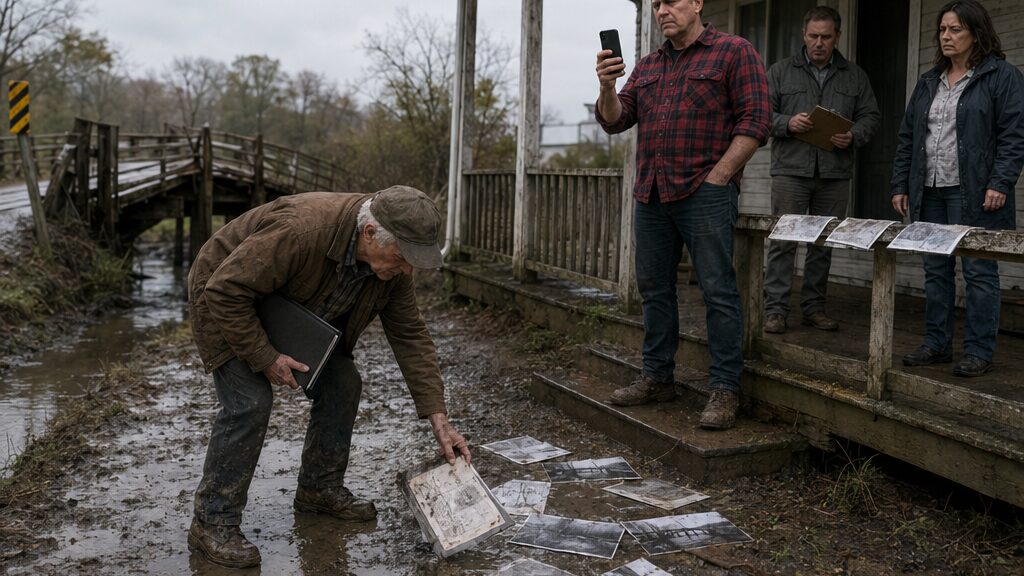
The engineer’s report opened in the air like a white bird with a broken wing. Photographs, estimates, and inspection sheets slid down the porch steps and landed face-down in the brown water collected beside Edward Walker’s boots.
One of the road-association members flinched. The other stared at the bridge as though the ruined papers had nothing to do with him.
Jason remained on the porch, one hand planted on his hip.
“I told you already,” he said. “It’s your bridge.”
Edward looked down at the top sheet. The county’s red inspection stamp was bleeding into the mud.
Beyond the yard, the wooden bridge crossed the creek in a single narrow span. Its rails leaned outward, and the decking had gone silver with age. A strip of bright survey paint marked the beam the structural engineer had condemned. From where Edward stood, the paint looked almost clean enough to touch. The wood around it was not.
“The south beam has lost nearly half its bearing surface,” Edward said. “You saw the photographs.”
“I saw an estimate for eighteen thousand five hundred dollars.”
“It is the lowest of three.”
“That does not make it mine.”
Jason spoke loudly enough for the association members to hear every word. They had come for what the association called a maintenance walkthrough, although the association did not own the bridge, the creek, or either parcel. It maintained the gravel lane serving six homes farther uphill and had spent years pretending that gave it authority over every ditch, culvert, and fence post connected to the road.
Edward bent and lifted the first page from the puddle.
Jason gave a short laugh. “There. You’re holding your problem.”
The younger of the two association members shifted his clipboard under his arm. “Maybe we should all calm down.”
“We are calm,” Jason said.
Edward set the wet page on the porch rail. Mud ran from its bottom edge in a thin line.
He retrieved the engineer’s photographs next. One showed the cracked beam from beneath, where the rot had opened a dark cavity large enough to push a hand into. Another showed the deck sagging under a loaded pickup. The engineer had taken that photograph two weeks earlier, before placing a temporary weight restriction on the crossing.
Jason’s livestock trucks were several times heavier.
Edward laid each photograph beside the first page, smoothing the corners with his palm.
“You use it more than anyone,” Edward said.
“I use the access I have always used.”
“And the structure carrying that access needs repair.”
Jason stepped down one porch stair. “My family paid dues on the approach road for twenty-seven years. We graded the east side. We cleared snow. We replaced gravel after the flood. Your family collected every benefit of owning the land under that bridge, and now you want me to buy you a new one.”
“A bridge is not a benefit when it costs more than my truck.”
“Then sell something.”
The words settled more heavily than the papers had.
Edward’s gaze moved to the association members. Neither looked at him now. They studied the creek, their boots, the cloudy sky. The humiliation did not come from Jason alone. It came from the fact that everyone present had already decided which man was more likely to yield.
Edward crouched again.
The estimate had landed beneath a porch step. He reached into the mud and drew it out slowly. The black ink had held, though the lower margin was gone.
Jason took out his phone.
Edward heard the faint electronic sound as the camera began recording.
“You getting this?” Jason asked the association members. “This is what happens when somebody inherits property they cannot maintain.”
Edward straightened with the estimate in his hand.
For a moment he wanted to cross the distance between them and knock the phone into the same puddle. The thought came cleanly, without heat. That was what made it dangerous.
Instead, he placed the estimate on the rail.
“Say it again,” Edward said.
Jason lowered the phone slightly. “What?”
“That the bridge is mine.”
Jason smiled. “The bridge is yours.”
“And the repair is my responsibility alone.”
“That is exactly what I am saying.”
Edward aligned the muddy pages by tapping their bottom edges against the rail. The neatness of the movement made Jason’s smile fade.
“Put it in writing.”
The older association member finally looked at him. “Edward, what good is that going to do?”
Edward did not answer.
Jason raised the phone again. “You want me to write down that you own your own bridge?”
“I want your position stated clearly.”
“You think a piece of paper is going to scare me?”
“No.”
The single word stopped the argument more effectively than shouting would have.
The creek moved under the bridge with a low, steady sound. A loose board knocked once against a joist.
Jason glanced toward it, then back at Edward. “Fine. I’ll send you something tonight.”
“Include the repair deadline you mentioned.”
“I will.”
“And sign it.”
Jason laughed again, but there was less certainty in it now. “Anything else?”
“No.”
Edward gathered the last sheet from the mud. It was the county inspection notice, the one stating that the bridge could remain open only under a temporary weight restriction while the owner arranged repair or closure. The red stamp had blurred, but the inspector’s signature remained legible.
He folded nothing. He carried the pages inside flat against his forearm.
From the kitchen window, he watched Jason show the video to the association members. One of them smiled uneasily. The other said something Edward could not hear. Jason enlarged the image with two fingers, replaying the moment Edward knelt in the mud.
Edward spread the papers across the kitchen table.
He placed clean towels under them, weighted the corners with salt shakers and coffee mugs, and copied every damaged page before the moisture could distort it further. The old printer protested, feeding each sheet through with a dry mechanical rasp.
By late afternoon, the video had reached three people on the lane. Nancy called from the city after someone forwarded it to her.
“Dad, what happened?”
“Nothing that cannot be documented.”
“That is not what I asked.”
Edward watched a muddy drop slide from the engineer’s report onto the towel.
“I made Jason an offer,” he said. “He declined.”
“He threw papers at you.”
“He knocked them off the rail.”
“That is worse, not better.”
Edward said nothing.
Nancy exhaled into the phone. “Please do not do whatever it is you are planning without talking to me.”
“I am not planning anything.”
“You only sound that calm when you already have.”
The line went quiet between them.
Edward looked toward the window. Across the creek, Jason’s barn lights came on one by one.
At 9:17 that night, an email arrived.
The subject line read: FINAL NOTICE—BRIDGE REPAIR.
Jason’s message was six paragraphs long. It called the bridge Edward’s sole property, rejected any obligation to contribute to repairs, demanded that the work begin within seven days, and warned that Edward would be held responsible for all losses caused by delay.
At the bottom, beneath his full name, Jason had typed:
Owner of the Carter property and lawful user of the Walker bridge access.
Edward printed the email.
Then he placed Jason’s clean signature beside the mud-stained inspection report and read the wording a second time.
Chapter 2: The Old Plat Drew a Narrower Truth
The clerk was about to close the oversized record book when Edward saw the broken triangle in the corner of the plat.
“Leave that open,” he said.
The clerk stopped with both hands on the cover.
“What did you find?”
Edward leaned closer. The county records office had replaced most of its public terminals, but the oldest subdivision plats still lived in thick bound volumes that smelled of paper dust and binding glue. The drawing before him had been recorded in 1981, when the Carter parcel had been divided from a larger farm.
A faded line crossed the creek. Beside it, in lettering small enough to miss, the surveyor had drawn a triangle broken on its east side.
“Private structure marker,” Edward said.
The clerk frowned. “I thought that was an old drainage symbol.”
“Not in this surveyor’s work.”
He knew the drafting habits because he had spent twelve years cataloging deeds, plats, releases, and road dedications in this same building. Long before digital indexing, he had learned which surveyors abbreviated bearings, which lawyers buried restrictions in addenda, and which ink turned pale under the copying lamps.
The clerk brought him a magnifying glass.
Under the lens, the triangle sharpened. A notation ran from the bridge footprint to the western parcel:
STRUCTURE WITHIN GRANTOR RETAINED LAND.
Edward followed the boundary line with one finger. The bridge lay entirely within what was now his property. The Carter parcel possessed an easement over it, not ownership of it.
The distinction was narrower than Jason understood and more dangerous than Edward had allowed himself to hope.
The clerk retrieved the easement instrument from microfilm. It granted the Carter parcel “continuous right of ingress and egress by ordinary residential and agricultural vehicles” across the existing bridge and approach.
Edward read the paragraph twice.
There was no maintenance clause.
No cost-sharing formula.
No duty to rebuild.
No language describing what happened if the structure became unsafe.
The clerk watched him. “Is that good or bad?”
“It is incomplete.”
“That sounds bad.”
“It usually is.”
Edward requested certified copies of the plat, easement, and deed history. While the clerk stamped them, he opened Jason’s email on his phone and compared the wording.
The bridge is your property.
You alone are responsible for its condition.
Edward felt the first clean edge of leverage. If Jason insisted Edward alone owned the structure, then Jason could not easily claim an equal right to decide whether it remained open after the county declared it dangerous.
But the leverage stopped where the easement began. Jason still possessed a recorded right of passage. Ownership might support closure for safety; it did not erase access forever. Any judge would ask what alternative Edward had offered, how long he had known about the damage, and whether he had acted in good faith.
Those questions followed him down the hall to Amanda Mitchell’s office.
Amanda had been twenty-three when Edward trained her to index legal descriptions without mistaking a tax parcel line for a deed boundary. Now she sat behind a county desk with two computer screens, a framed certification, and a stack of code files marked with colored tabs.
She read the engineer’s report first.
Then the plat.
Then Jason’s email.
“You asked him to send this?” she said.
“Yes.”
“Why?”
“So there would be no argument about his position.”
Amanda looked over the paper at him. “There is always an argument about position.”
She turned to the photographs. “The engineer recommends immediate closure to heavy vehicles and full closure if the beam deteriorates further.”
“It rained all weekend.”
“I know.”
“The lower pocket is holding water.”
“I know that too.”
Edward waited.
Amanda placed both palms on the desk. “You can request a condemnation inspection. If the county inspector agrees the bridge presents an immediate hazard, we can post it closed.”
“And the easement?”
“Does not authorize unsafe passage.”
“So the gate can be locked.”
“For safety, not punishment.”
“I did not say punishment.”
“No. You rarely say the part that matters most.”
The remark landed more precisely because she did not raise her voice.
Amanda leaned back. “If you close his only practical vehicle access, we have other problems. Fire response. Ambulance access. Delivery of heating fuel. Livestock care. A court may require temporary accommodation even if the structure itself remains closed.”
“He has an old farm track on the north boundary.”
“Can a fire engine use it?”
Edward did not answer.
“Can an ambulance?”
“Not in wet weather.”
“Then do not mistake permission to close the bridge for permission to ignore what closure causes.”
Edward folded the certified plat along its existing crease. “Will you schedule the inspection?”
“Yes.”
“When?”
“Tomorrow morning.”
He stood to leave.
Amanda tapped Jason’s email. “This helps you establish what he claimed. It does not make him correct.”
“I understand.”
“Do you?”
Edward met her eyes.
She had known him too long to be impressed by silence.
At home, he spread the plat across the kitchen table. The certified copy lay beside Jason’s email, and for the first time the mud-stained report looked less like evidence of humiliation than a first step in a sequence.
Nancy called again.
“You went to the courthouse,” she said without greeting.
“How do you know?”
“Amanda called me.”
Edward stared at the phone. “She had no reason to do that.”
“She said I am listed as successor trustee on Mom’s property file and that I should understand the access issue.”
“That file is not active.”
“She said the bridge might be closed tomorrow.”
“It might.”
“Dad.”
“The structure is unsafe.”
“That is not what I am asking.”
Edward looked at the 1981 plat. “Jason has an access easement. He does not own the bridge.”
“And?”
“And he put in writing that I do.”
Nancy was silent for a beat. “You sound pleased.”
“I sound accurate.”
“That is not the same thing.”
After the call ended, Edward returned the certified documents to their folder. The damp pages from Monday had dried stiff and uneven. Mud had formed thin brown scales along the margins. When he flexed the inspection report, one of the scales cracked and fell onto the table.
He brushed it aside and opened the property file he kept in the bottom drawer of the china cabinet.
The folder contained old tax maps, insurance letters, invoices for gravel, and copies of deeds going back three generations. Edward searched for the original easement release, thinking there might be an attachment omitted from the recorded copy.
Halfway through the file, he found a yellow county form dated six years earlier.
BRIDGE CONDITION OBSERVATION—NON-EMERGENCY.
The description mentioned surface checking, moisture retention, and early decay at the south bearing. It recommended a professional inspection within twelve months.
At the bottom, in the acknowledgment box, were Edward’s initials.
E.W.
He remembered the day immediately.
His wife had been in treatment then. The hospital bills had arrived in thick white envelopes. Nancy had asked whether they should sell the lower pasture. Edward had placed the bridge form in the file and told himself the timber would hold another season.
Then another.
He sat at the table with the old warning in one hand and Jason’s new demand in the other.
The papers did not contradict each other.
That was what made them dangerous.
Chapter 3: The Red Notice Closed More Than a Road
The county inspector drove the first red fastener into the bridge post at 8:12 Wednesday morning.
The impact rang through the timber.
Jason stood on the far side of the creek with his arms folded while the inspector fixed the condemnation notice beneath the weight-limit sign. Amanda watched from the gravel approach, holding a clipboard against her coat.
Edward carried the folder under one arm. The mud-stained report was inside it, along with the plat, Jason’s email, and the older warning bearing his initials.
The inspector tested the beam with a steel probe. The tip disappeared into the rotted pocket almost to the handle.
“That changed since the engineer’s visit,” he said.
“How much?” Amanda asked.
“Enough.”
Jason stepped closer to the bridge entrance. “My pickup crossed yesterday.”
“That does not make it safe today,” the inspector said.
“I have animals to feed.”
“You can walk feed across in small loads if the deck remains restricted to foot traffic, but no vehicles until temporary support or repair is approved.”
Jason looked at Edward. “You did this fast.”
“The beam did it faster.”
“You knew exactly which office to call.”
“Yes.”
The inspector finished fastening the notice. CONDEMNED—NO VEHICULAR CROSSING UNTIL CERTIFIED SAFE.
Amanda read it once and turned to Edward. “If you secure the gate, emergency personnel must have a way to reach you.”
“I will give the county a key.”
“One to Jason as well.”
Jason laughed without humor. “A key to a gate I am forbidden to open.”
“For emergency use only,” Amanda said.
Edward removed a new chain from the bed of his truck. Its links were bright zinc, untouched by rain or dirt.
He looped it around the gateposts. Before closing it, he passed the chain over the folder under his arm, holding the papers against his ribs while he worked.
Jason watched the movement.
“You planned this before the inspection.”
“I bought a chain before the inspection.”
“Same thing.”
“No.”
Edward threaded the padlock through two links and snapped it shut.
The sound was smaller than he expected.
By noon, the association had sent a group email stating that it had no legal authority over the private bridge and would not assume repair costs. The wording was careful enough to show that someone had spoken to counsel.
By afternoon, Jason had parked his pickup on his side of the bridge and begun carrying feed sacks across by hand. He made six trips before stopping. Edward saw him rest one sack against the condemned rail and stare down at the creek.
Edward almost went outside.
Instead, he stood behind the kitchen curtain until Jason lifted the sack again.
At 11:43 that night, headlights washed across Edward’s ceiling.
A feed truck idled at the gate, its engine deep enough to rattle a glass in the sink. The driver stepped down and examined the red notice with a flashlight.
Jason came across the bridge on foot, moving fast.
Edward pulled on his jacket and went outside.
Rain had begun as a fine mist. In the truck’s headlights, the chain shone white.
“What is this?” Jason demanded.
“The bridge is closed.”
“I can read.”
“Then you know.”
“The driver has six tons of feed.”
“The bridge cannot carry it.”
“He can cross empty and unload on my side.”
“No vehicle can cross.”
Jason walked to the gate and seized the chain with both hands. “You cannot lock me out of my own property.”
Edward stopped a few feet away.
The feed-truck driver looked from one man to the other and then down at his paperwork.
Edward spoke quietly. “Your email said the bridge was mine.”
Jason’s grip tightened.
“You said the repair was mine alone,” Edward continued. “The county says the unsafe structure must be closed. Your paperwork did not give me the bridge. It only confirmed the position you chose.”
“You think this is clever?”
“No.”
“You are enjoying it.”
Edward wanted to deny that immediately.
The answer did not come.
For one sharp second, watching Jason stand helpless behind the chain, Edward did feel something close to satisfaction. It was not joy. It was the relief of seeing a man forced to inhabit his own words.
But the feed truck idled behind him. Somewhere across the creek, cattle bawled in Jason’s dark pasture.
Edward looked away first.
The driver cleared his throat. “I can drop the load here, but somebody needs equipment to move it. And I cannot block the lane overnight.”
Jason released the chain. “Put it on the shoulder.”
“That is going to cost extra.”
“I know.”
Edward returned to the house while the truck tipped the feed beside the road. Through the window, he watched Jason cover the load with tarps and tie them down in the rain.
The next morning, a bridge contractor arrived with a compact excavator on a trailer. He parked beside the same gate, inspected the condemnation notice, and refused to cross.
Jason argued for fifteen minutes.
The contractor finally pointed at the rotted beam and said, “Your insurance will not cover me if that deck drops.”
The machine left.
By Thursday afternoon, Jason had accumulated a delivery surcharge, a contractor cancellation fee, and a warning from the county about storing feed too close to the drainage ditch. None of those costs equaled half the bridge repair, but each one tightened the dispute.
Edward kept the gate locked.
At four, Amanda called.
“The fire chief wants to inspect the alternate route.”
“The north track?”
“Yes.”
“It is not passable after rain.”
“That is what I told him.”
Edward watched Jason drag a pallet of bagged feed with a small tractor on his side of the creek. “The bridge is unsafe.”
“I am not disputing that.”
“Then what do you want me to do?”
“I want you to understand that a lawful closure can still create a public-safety problem.”
“The county posted it.”
“The county did not design the access arrangement.”
“Neither did I.”
Amanda paused.
Edward looked toward the bottom drawer where the old warning form lay beneath the plat.
“No,” she said. “But you may have lived with it longer than you are saying.”
Before Edward could answer, a red county utility vehicle turned into his drive. The rural fire chief stepped out, followed by Amanda.
They walked to the creek together.
The chief studied the bridge, the chain, and the steep farm track visible beyond Jason’s pasture. Then he looked at Edward.
“If Mr. Carter has a heart attack tonight,” he said, “how do you expect us to reach his house?”
Chapter 4: Nancy Found the Promise Between Two Deeds
Nancy found her mother’s handwriting because the deed sleeve would not lie flat.
She had come straight from the city, still wearing office shoes unsuited to Edward’s gravel drive. The fire chief’s question had reached her through Amanda before Edward could call, and by the time she entered the house she was carrying three accusations she had not yet decided how to arrange.
Edward was outside with the fire chief, walking the edge of the north track. Nancy went to the storage room looking for the insurance binder.
The deed sleeve sat in a gray metal box beneath old tax files. When she pulled it free, one corner caught. Something had been tucked behind the folded document.
She slid out a yellowed sheet from a grocery-store notepad.
The handwriting belonged to her mother.
Jason’s mother came over again. Told her the bridge stays open as long as either family lives here. We will not strand them over a line on a map. Edward agreed. Need to put maintenance terms in writing when things settle down.
There was no date, but Nancy knew when her mother had used that notepad. It had sat beside the telephone during the winter the Carter family’s old farmhouse burned and was rebuilt farther back from the creek.
Nancy read the note twice.
Then she heard the back door open.
Edward entered with mud on his boots and the fire chief’s business card in his hand. He stopped when he saw the metal box open on the table.
“What are you looking for?”
“The insurance binder.”
“It is in the cabinet by the furnace.”
Nancy held up the note. “This was not.”
Edward closed the door behind him.
For several seconds, he looked only at the handwriting.
“Mom promised them access,” Nancy said.
“She said we would not use the ownership line to cut them off.”
“And you agreed.”
“Yes.”
“Did Jason know?”
“His mother did.”
“That is not what I asked.”
Edward set the business card on the counter. “Jason was young. He was not handling the property then.”
Nancy laid the note beside the deed. “So the bridge was never just some easement you discovered this week.”
“I did not say I discovered the easement this week.”
“You let everyone think you did.”
“I found the recorded language that controls the closure.”
She stared at him. “That sentence is exactly the problem.”
Edward’s jaw tightened.
Outside, a vehicle moved slowly along the road and stopped at the locked gate. A door opened, then shut. Neither of them went to the window.
Nancy returned to the metal box. “Amanda said you trained her in records.”
“I did.”
“She also said the county found an old condition notice.”
Edward did not answer.
Nancy searched through the files until she found the yellow form from six years earlier. His initials sat in the acknowledgment box.
The room seemed to narrow around the paper.
“You knew,” she said.
“I knew there was surface checking and moisture.”
“It says early decay at the south bearing.”
“It recommended inspection. It did not condemn the bridge.”
“It recommended inspection within twelve months.”
Edward looked past her toward the window. “Your mother had started treatment.”
Nancy held the form at chest height. “Do not use her illness to make the date disappear.”
“I am not.”
“You signed this, put it in a drawer, and waited six years.”
“I watched the bridge.”
“You watched it rot.”
The words struck harder than she intended. Edward’s face changed, not with anger but with the controlled stillness she had seen after her mother’s funeral, when every decision had become something to be completed without discussion.
Nancy lowered the form.
Edward moved to the kitchen table. The mud-stained engineer’s report lay there beneath the certified plat. He placed his hand on the brittle edge.
“The first estimate I got was nine thousand,” he said. “That was four years ago.”
Nancy sat down slowly.
“You got an estimate?”
“Informal. The contractor said the beam could be sistered if we moved quickly.”
“And you did not tell me.”
“You were trying to refinance your house.”
“That was my decision to manage.”
“The hospital had taken most of what we had set aside. The lower pasture was the only clean asset left. If I borrowed against it, there would be very little left when this place became yours.”
“I never asked you to preserve every dollar.”
“You did not have to.”
Nancy looked at the papers. “So you decided for me.”
“Yes.”
The directness left her with nowhere easy to place her anger.
Edward continued, his voice quieter. “Then material prices rose. Jason increased his herd. He started bringing heavier trucks across. Every time I considered raising the issue, I knew what he would say—that the bridge stood on my land and his family already maintained the approach.”
“He was not entirely wrong.”
“No.”
It was the first time Nancy had heard him say it.
The admission changed the shape of the room more than any legal document had.
Edward pulled out a chair but did not sit. “I thought I could hold the structure another year. Then another. I told myself formalizing the agreement would create a debt you would inherit.”
“So instead I inherit a condemned bridge, a hostile neighbor, and an old promise nobody recorded.”
“Yes.”
Nancy rubbed her thumb over her mother’s handwriting.
Her anger remained, but it had lost its clean edge. Edward had not hidden the problem because he did not trust her judgment alone. He had hidden it because protecting her had become indistinguishable from controlling what she was allowed to know.
“You made Jason responsible for humiliating you,” she said. “He is. But you also waited until the only safe answer was to close his road.”
Edward looked toward the gate.
“He chose not to read the report.”
“And you chose not to show anyone the earlier one.”
The rain began against the storage-room window, sudden and hard.
Nancy placed the handwritten promise beside the mud-stained inspection pages. Her mother’s ink was faded but clean. Edward’s report carried brown marks across every margin.
“One family protected a promise by never writing it down,” Nancy said. “The other protected itself by pretending the promise meant free access forever. And now both of you are using paper to prove the other one is wrong.”
Edward sat at last.
“What do you want me to do?” he asked.
“Tell Jason the truth.”
“He will use it against me.”
“Probably.”
“The association will say I caused the emergency.”
“You helped cause it.”
Edward’s eyes lifted.
Nancy did not look away. “I will not help you refinance, sign an easement release, or defend the closure as though you had no part in this. Not unless you tell him about the warning and Mom’s promise.”
A knock sounded from the front porch.
Not the sharp knock of an official. Three slow blows, heavy enough to carry through the house.
Edward rose.
Nancy reached the hallway first and opened the door.
Jason stood in the rain with water running from his hair and jacket. He held a neatly stapled agreement above his head to keep it dry.
“My attorney says this gets the gate open,” he said.
Chapter 5: The Agreement Offered Access but Assigned All Blame
Jason kept the agreement raised above the mud as though the ground itself might reject it.
Edward stood inside the doorway. Nancy remained a few steps behind him, holding her mother’s note and the old warning form against her side.
“You can come in,” Edward said.
Jason looked at Nancy, then at the papers in her hand. “This is between property owners.”
“She is successor trustee.”
“That does not make her part of what happened Monday.”
“It makes her part of what happens next.”
Jason wiped his boots on the mat and entered.
In the kitchen, he placed the agreement on the driest part of the table. The pages were crisp, square, and bound with a single silver staple. Beside them lay Edward’s report, stiff with dried mud.
Jason noticed the comparison.
“I did not come to apologize about the folder.”
“Then do not,” Edward said.
“I came to restore access.”
He turned the agreement toward Edward. A yellow tab marked the signature line.
The first page authorized Jason to pay half the immediate bridge repair estimate. The number had been typed in bold: $9,250. In exchange, Edward would reopen the gate within twenty-four hours and guarantee uninterrupted access during construction.
At first glance, it was the offer Edward had requested on Monday.
Then he read the second page.
The owner of the burdened parcel accepted sole responsibility for inspection, maintenance, repair, replacement, injury, environmental damage, interruption of access, business losses, and all future claims connected to the bridge.
Edward continued to the third page.
Jason’s payment would be described as a one-time accommodation without admission of duty.
Nancy read over his shoulder. “This makes Dad responsible forever.”
“It makes ownership clear,” Jason said.
“You already made ownership clear in your email.”
“My attorney says ownership and liability are different.”
“Your attorney is right,” Edward said.
Jason’s shoulders loosened slightly.
Edward placed the agreement flat. “That is why I will not sign this.”
The looseness vanished.
“You asked me to pay half.”
“I asked you to share responsibility.”
“I am offering more than nine thousand dollars.”
“You are buying permanent immunity for the price of half one repair.”
Jason leaned forward. “I cannot operate another week like this.”
“That does not make the language fair.”
“Fair?” Jason pointed toward the locked bridge. “My feed is sitting beside the county road under tarps. The contractor billed me for bringing equipment he could not unload. My lender called this afternoon because someone sent them the condemnation notice.”
Nancy glanced at Edward.
Jason saw it. “Yes. The lender. You think I threw those papers because I had nineteen thousand dollars sitting in a checking account?”
“You did not read them,” Edward said.
“I knew what they said. Expensive problem. Your land.”
“You filmed him picking them out of the mud,” Nancy said.
Jason looked at her. “I was angry.”
“That explains it. It does not excuse it.”
“No,” he said after a moment. “It does not.”
The answer was so quiet that Edward looked up.
Jason rubbed rainwater from the table with his sleeve. “The herd is collateral on the operating loan. If I cannot document reliable truck access, the bank can freeze the credit line. No credit line means no feed account. No feed account means I start selling animals at whatever price somebody offers.”
“You could have said that Monday,” Edward said.
“And you could have said you planned to lock the gate.”
“I did not know the inspector would condemn it.”
“But you knew how to make the request.”
Edward felt Nancy’s attention on him.
The old warning form seemed to gain weight in her hand.
Jason noticed it. “What is that?”
Edward could have told Nancy to put it away. He could have said it was unrelated. He could have protected the narrow advantage he had built from Jason’s email and the clean recorded lines of the plat.
Instead, he held out his hand.
Nancy gave him the form.
Edward placed it beside Jason’s proposed agreement.
“Six years ago, the county noted early decay in the south bearing.”
Jason read the date. His face hardened. “You knew.”
“I knew it required inspection.”
“You let my trucks cross for six years.”
“I monitored the deck.”
“That is not an inspection.”
“No.”
Jason turned toward Nancy. “Did you know?”
“No.”
Edward added the handwritten note.
“This is from my wife,” he said. “After your family rebuilt the house, she promised your mother we would not use ownership of the bridge to strand you. I agreed. We intended to record maintenance terms later.”
Jason read the note without touching it.
“My mother never told me.”
“She may have believed the promise was enough.”
Jason stared at the faded handwriting. “So you knew my family relied on more than the easement.”
“Yes.”
“And you still chained the gate.”
“The bridge could fail.”
“You waited until it gave you leverage.”
The accusation was true enough to sting and false enough to resist.
Edward folded his hands on the table. “I waited too long because repair costs would have consumed most of what remained after my wife’s treatment. I told myself I was protecting Nancy’s inheritance.”
Nancy stood beside him, but she did not rescue him from the silence.
Edward continued. “That delay was mine. The warning was mine. But your heavier use, your refusal to review the new report, and your attempt to assign every cost to me were yours.”
Rain struck the window over the sink.
Jason looked from the old note to the muddy report and finally to his attorney’s agreement.
“The association members know about the earlier warning?” he asked.
“Not yet.”
“So you are telling me this privately.”
“For the moment.”
Jason’s expression shifted. Edward saw calculation first, then something closer to exhaustion.
“You expect me to sign a different paper and keep quiet about this?”
“No.”
The answer surprised all three of them.
Edward moved Jason’s agreement aside. “Tomorrow, I will send the earlier warning, the engineer’s report, and a statement of my delay to Amanda and the association. Any new agreement will include it.”
Nancy’s breath eased behind him.
Jason stared. “Why would you do that?”
“Because otherwise I would be asking you to accept responsibility I refused to name in myself.”
“That does not open the bridge.”
“No.”
Jason pushed back from the table. “Then we have wasted an hour.”
He reached for the agreement.
Edward stopped him with two fingers on the top page. “I will consider temporary access if a contractor designs safe shoring and both of us sign the emergency conditions.”
“My contractor cannot start without equipment on my side.”
“There may be a creek-bank installation from this side.”
“That costs more.”
“Yes.”
“Who pays?”
“We do not know yet.”
Jason gave a tired, bitter laugh. “You always have an answer that ends with another document.”
“And you always want a document that ends the argument before it reaches you.”
For a moment, neither moved.
Then Jason pulled the agreement free.
At the front door, he turned back. “The lender gave me until Monday.”
“I heard you.”
“That is not the same as helping.”
“No.”
After Jason left, Edward took the county key from the hook.
Nancy followed him through the rain to the gate.
He fitted the key into the padlock and opened it. The chain loosened between the posts.
“Are you opening the bridge?” she asked.
“Not to vehicles.”
Edward removed the padlock and put it in his coat pocket. He left the chain looped through the gate, unsecured but clearly barring the road.
“What does that accomplish?” Nancy asked.
“It means the next decision is not locked.”
Across the creek, Jason stood beneath his porch light watching them.
Edward laid one hand on the loose chain.
Before he could decide the terms for removing it, his phone began to ring.
Chapter 6: One Emergency Crossing Changed the Terms
Jason’s voice contained no anger when Edward answered.
“The calf is down.”
Edward looked across the creek. Jason was already running toward the barn.
“How long?”
“Found her ten minutes ago. She is straining, but nothing is moving.”
“Call the veterinarian.”
“I did. She is twenty minutes out and cannot get her truck across.”
Edward lifted the loose chain from the gate and opened it wide enough for a person to pass.
“Bring clean ropes, two blankets, and the small sled you use for mineral blocks.”
“What about the truck?”
“No vehicles.”
“Edward—”
“The bridge is still condemned.”
A pause.
Then Jason said, “All right.”
It was the first instruction he had accepted without argument.
Edward called Amanda while Nancy gathered work gloves from the mudroom. The county official answered on the second ring.
“This is not emergency medical access for a person,” she said after he explained. “The county cannot authorize a vehicle crossing.”
“I am not asking it to.”
“What are you proposing?”
“Foot access for the veterinarian. Equipment moved by hand. If the calf must be transported, we use the north bank and a light utility trailer after the ground is checked.”
Amanda was silent for a moment. “Document every step.”
Edward almost laughed.
“I will.”
The veterinarian arrived in a pickup and parked beside Edward’s barn. She carried a hard case, medication bag, and obstetric chains. Edward and Nancy helped move the equipment across the bridge one load at a time, keeping to the centerline where the engineer had marked the strongest decking.
The bridge shifted faintly beneath them.
Nancy stopped.
“Do not look at the creek,” Edward said. “Look at my boots.”
They crossed.
Inside Jason’s barn, the calf’s front legs were visible but turned badly. The cow lay against the straw, breathing in short, violent bursts.
The veterinarian worked from her knees.
“I need room and steady tension,” she said. “Not force.”
Jason attached the chains as directed. Edward braced one boot against a stall post and held the rope. Nancy kept the cow’s head from striking the boards.
For twenty minutes, there was no argument about property lines, ownership, or blame. There was only the veterinarian’s voice counting, Jason’s breath, the scrape of boots, and the weight at the other end of the rope.
The calf came free in a rush and lay still.
Jason dropped beside it.
The veterinarian cleared its airway and rubbed its ribs with a towel. Nothing happened.
Edward handed her the second blanket.
She worked again.
The calf coughed once, then drew a thin, ragged breath.
Jason bowed his head until his forehead nearly touched the straw.
Edward looked away.
By the time the animal could lift its head, the rain had softened. The veterinarian said the calf should survive but needed monitoring. The cow would require medication and no transport unless her condition worsened.
At the barn door, Jason washed his hands under an outdoor tap.
“Thank you,” he said.
Edward nodded.
Jason stared toward the bridge. “I still need access.”
“I know.”
“And the lender does not care about a calf.”
“I know that too.”
They crossed back on foot. At the gate, a bridge contractor waited beside a utility truck. Amanda had called him after speaking with Edward.
The contractor walked the creek bank, measured the distance beneath the damaged beam, and studied the engineer’s photographs.
“I can install temporary steel shoring from below,” he said. “No heavy equipment on the deck. I would need a small excavator on this bank and two workers in the creek.”
“How soon?” Jason asked.
“Today, if materials are available.”
“And after that?”
“Light vehicles only. Passenger pickup, veterinarian, emergency response. No feed trucks, no loaded trailers, no construction equipment.”
Jason looked at Edward. “It is something.”
The contractor named the cost.
It was more than either man expected.
“That comes out of the permanent repair money,” Jason said.
“Yes,” Edward replied.
“So we spend thousands to use the bridge for a few weeks, then spend again to rebuild it.”
“Or we leave it closed.”
Jason’s mouth tightened, but he did not argue.
Amanda arrived with a two-page temporary-access form. It assigned joint responsibility for following the contractor’s restrictions, required both men to indemnify the county, and terminated access immediately if the shoring shifted.
Edward carried the kitchen folder outside.
He removed the mud-stained engineer’s report and placed it on the hood of Amanda’s vehicle. Then he laid the clean temporary-access form over it.
The brown margins remained visible beneath the new pages.
Jason signed first.
Edward read every line.
Amanda watched him. “There is no hidden answer in the margins.”
“There usually is.”
“Not this time.”
Edward signed.
The contractor began work before noon. Steel posts were lowered from the bank and seated on concrete pads beneath the bridge. Each strike of the wrench traveled through the old wood.
Jason stayed nearby, following instructions and moving materials without complaint. When the contractor ordered him away from the creek edge, he stepped back. When Amanda limited his pickup to an empty crossing at walking speed, he agreed.
By late afternoon, the contractor certified temporary light access.
Jason drove his pickup across first.
Edward stood beside the gate and listened to the deck creak under the tires. The steel supports held.
On the far side, Jason stopped and lowered his window.
“My feed supplier can bring smaller loads to the road,” he said. “I can move them across in the pickup.”
“That will cost more.”
“Less than selling the herd.”
Edward nodded.
Jason rested one arm on the window. “What happens Monday?”
“We file a permanent agreement.”
“Whose agreement?”
“Ours. Not your attorney’s. Not mine alone.”
Jason waited.
Edward took a folded sheet from his coat.
He had spent the hours during the contractor’s work writing figures on the back of an old road-association notice. The first repair estimate had been divided according to three factors: ownership of the structure, actual frequency and weight of use, and responsibility for delayed action.
Edward’s share included the land ownership and his failure to act on the earlier warning.
Jason’s share included heavier agricultural use and immediate business benefit.
Future inspections would be scheduled, recorded, and funded annually by both properties under a fixed percentage. Emergency restrictions would no longer depend on one man deciding when to speak.
Jason read the figures from the driver’s seat.
“You put yourself at forty percent.”
“Yes.”
“Your first proposal was fifty-fifty.”
“That was before I admitted the earlier warning.”
Jason looked at the paper again. “And you put me at sixty.”
“Your vehicles create most of the load.”
“My family maintained the approach.”
“The formula gives you credit for that.”
Jason tapped the page. “This line makes the old promise part of the recorded agreement.”
“It should have been recorded years ago.”
“And the statement about your delay?”
“Attached.”
Jason looked toward Nancy, who stood near the contractor’s truck.
“You are really going to file that publicly?”
“Yes.”
Jason folded the paper along its center. “The association will tear you apart.”
“Possibly.”
“And you still expect me to admit what I did Monday.”
“Yes.”
A long silence passed between them.
Then Jason put the pickup in gear.
“I will read it tonight,” he said.
Edward watched him drive toward his barn.
The chain lay on the grass beside the open gate, wet and dull now, no longer securing anything. Edward picked it up but did not return it to the posts.
On the hood of Amanda’s vehicle, the temporary agreement remained over the stained report, both signatures drying in the late light.
That evening, Edward sat at the kitchen table and rewrote the cost formula in clean language.
At the bottom, beneath the percentages, he added two signature lines and one sentence neither man would be able to avoid:
Each owner acknowledges the harm caused by treating access, maintenance, and silence as someone else’s responsibility.
Chapter 7: The New Bridge Carried a Different Kind of Weight
The old chain lay cut across the contractor’s tailgate beside a row of new bridge bolts.
Its links were dark from six weeks of rain and handling. The fresh bolts, thick as Edward’s thumb, caught the morning light each time the crew moved around them.
Jason stood at the edge of the approach road with a paper cup in one hand. He no longer crossed the work zone without asking. When the foreman waved him back from the crane’s swing radius, he stepped behind the safety line without complaint.
Edward noticed that more than he wanted to.
The new span was not elegant. It used pressure-treated beams, steel reinforcement, and a wider deck designed for the loads Jason’s farm required. The rails were plain and square. Nothing about it resembled the silvered bridge that had crossed the creek for most of Edward’s life.
That bridge had been dismantled in sections.
The rotted south beam had broken under its own weight when the crew lifted it. The sound was soft, almost disappointing.
The final cost was twenty-three thousand eight hundred dollars.
Material delays, temporary shoring, revised engineering, and creek-bank stabilization had consumed every margin in the original estimate. Edward’s forty-percent share was larger than the figure he had once been unwilling to discuss with Nancy.
She arrived before the county inspection, carrying a folder against her chest.
“You brought it?” Edward asked.
She held up the signed trust authorization. “I brought my consent to preserve the easement.”
He reached for it, but she did not release the folder immediately.
“After the full maintenance agreement is recorded,” she said.
“That is the plan.”
“And after your statement is attached.”
“Yes.”
Nancy let go.
The statement was three paragraphs long. Edward had revised it until there was no technical phrasing left to hide behind. It said he had received notice of early decay six years before the condemnation. It said he had failed to obtain the recommended inspection. It said financial fear and concern for his daughter’s inheritance influenced that delay.
It did not say he alone caused the bridge to fail.
It did not say Jason’s conduct was excused.
It said only what Edward could prove about himself.
Amanda arrived with the county inspector shortly before noon. She examined the rail height, approach grading, load placard, and emergency key box. The inspector walked beneath the span and struck each support with a rubber mallet.
Jason watched from the bank.
“Still think the paperwork did this?” he asked Edward.
Edward looked at the new beams. “The paperwork stopped us from pretending it had not happened.”
Jason nodded once, as though that answer cost less to accept than the old one.
The inspector returned to the road. “Bridge passes for the posted agricultural load. Final certification depends on the maintenance agreement being recorded today.”
Amanda opened her case on the hood of the county vehicle.
The agreement had been rewritten twice by Jason’s attorney and once by the county. Its terms were plain.
Edward retained ownership of the land and structure. Jason retained permanent access for residential and agricultural use. Jason would pay sixty percent of scheduled maintenance and repair because his vehicles created most of the structural load. Edward would pay forty percent because he owned the bridge and had delayed action after the earlier warning.
Annual inspections would be shared under the same formula.
Either man could order emergency closure if a licensed professional identified an immediate hazard, but written notice had to be provided at once. Neither could use closure, delay, or access as bargaining pressure unrelated to safety.
The old promise from Edward’s wife had been translated into recordable language: access would not be withheld while either property remained occupied, except under certified safety restrictions.
Amanda set the signature pages on the hood.
Jason read his section again. “My attorney still says sixty percent is high.”
“Your loaded vehicles account for more than sixty percent of the traffic weight,” Edward said.
“I know.”
“Then why mention it?”
Jason turned the pen between his fingers. “Because agreeing to something and liking it are not the same.”
Edward understood that better than he wished.
Jason signed.
The pen made a faint scratching sound against the paper.
Amanda moved the agreement toward Edward.
Before he signed, he removed the mud-stained engineer’s report from his folder. Nancy had flattened the pages between boards and covered the torn edges with transparent repair tissue. The county stamp remained blurred, and brown watermarks spread across the lower margins.
Edward placed the damaged report beneath the clean agreement.
Jason looked at it.
“Why keep that?” he asked.
Edward aligned the corners. “Because clean copies make it too easy to forget how we got here.”
The association members had come for the inspection, though they stood several yards away and said little. The older one shifted when Edward took out his statement.
Amanda held out her hand. “Once this is filed, it becomes part of the public maintenance record.”
“I know.”
“You can still submit the technical history without the personal explanation.”
Edward glanced at Nancy.
Her expression did not ask him to proceed. It left the choice where it belonged.
He signed the agreement first.
Then he signed the statement.
“I received the warning,” Edward said, loud enough for Jason and the association members to hear. “I delayed the inspection. I believed I was protecting family money, but the delay increased the danger and narrowed everyone’s choices.”
No one applauded.
The younger association member stared at the road. The older one cleared his throat.
Jason looked down at the mud-stained report. “I threw that folder because I thought if I refused the problem hard enough, it would stay on your side of the creek.”
Edward said nothing.
Jason continued. “I recorded you picking it up. I sent the video around. That was not about the cost. It was about making sure nobody saw me lose an argument.”
Amanda placed Jason’s statement of responsibility beside Edward’s.
“You understand this does not erase either liability issue,” she said.
“It is not supposed to,” Jason replied.
At the records office, the clerk scanned the agreement, inspection schedule, statements, plat, and trust authorization. The mud-stained report had to be fed through a protective sleeve.
Edward watched its distorted county stamp appear on the monitor.
Nancy stood beside him.
“The reserve account will be smaller,” he said quietly.
“I saw the invoice.”
“I should have asked before deciding what your inheritance was supposed to protect.”
“Yes.”
He waited for something more.
Nancy rested one hand on the counter. “You can stop apologizing by making decisions differently.”
“That sounds harder.”
“It is.”
The clerk returned the originals with a recording receipt.
By late afternoon, the county inspector removed the condemnation notice. Jason stood on his side of the bridge while Edward opened the gate.
There was no ceremony. The feed supplier’s smaller truck crossed first, moving slowly over the new deck. The beams gave no sound beyond the ordinary hum of tires on timber.
Jason followed in his pickup. At the center of the span, he stopped.
Edward felt his shoulders tighten.
Jason lowered the window. “You want me to back off?”
“No. Keep moving.”
Jason drove the rest of the way.
The gate remained open after sunset.
Edward carried the old chain to the barn. He considered throwing it into the scrap bin with the removed bolts, but instead hung it from a nail inside the door. The cut ends rested against the wall, no longer capable of closing anything.
From the barn entrance, he could see the bridge lights reflected in the creek.
A pickup crossed toward Jason’s property, then another returned empty. The structure carried both without complaint.
Edward touched one of the chain’s worn links.
Ownership had once felt like a line he could defend.
Now it felt more like the bridge itself: weight accepted from both directions, inspected before failure, and held safely only when no one pretended the burden belonged entirely to the other side.
The story has ended.