She Found a Dark Stain Beneath Her New Carpet—and an HOA Record Meant to Bury It
Chapter 1: The Carpet Edge That Should Not Have Lifted
The carpet came up so easily that Catherine nearly fell backward.
She had only pinched the loose edge beside the living-room vent, intending to tuck it beneath the metal lip. Instead, a whole pale-gray corner lifted in her hand. The padding beneath it peeled away without resistance, exposing a dark stain spread across the plywood subfloor.
Behind her, Mark Johnson was still smiling.
“Installation crews rush the edges sometimes,” he said.
His voice carried the same pleasant steadiness he had used at closing, when he had slid the keys across the table and congratulated her on getting into the neighborhood before prices rose again.
Catherine stayed kneeling. Moving boxes surrounded her in uneven towers. Her coffee maker was still wrapped in newspaper. The brass floor lamp she had assembled twenty minutes earlier cast a warm circle over the new carpet and the brown-black shape beneath it.
The stain was wider than her hand.
“It isn’t an edge problem,” she said.
Mark stepped closer but did not kneel. His polished shoe stopped short of the exposed padding.
“Old houses collect old marks.”
“The listing said the floors were replaced last month.”
“They were.”
Catherine looked up. “Then why didn’t they replace this section of subfloor?”
For the first time, his smile seemed to require effort.
“That would be a seller question.”
“You represented the seller.”
“I represented the transaction.”
The distinction landed with the neatness of a practiced line.
Mark checked his watch. He had come by because one of the garage remotes had not been programmed. He had fixed it in less than a minute and then accepted Catherine’s offer to walk through the house, commenting on the afternoon light and the mature trees as if she had not already purchased both.
Now he moved toward the front door.
“Send me a photograph,” he said. “I’ll contact the flooring company.”
Catherine lowered the carpet carefully. “You’re leaving?”
“I have another appointment.”
His hand was already on the knob.
“Mark.”
He turned.
“What kind of mark do you think that is?”
He glanced toward the living room but not at the floor itself.
“Something a qualified contractor should assess.”
Then he smiled again, smaller this time, and walked out.
The latch clicked behind him.
For several seconds Catherine remained on her knees, one hand resting on the carpet. She told herself there were ordinary explanations. A burst pipe. Pet damage. Spilled varnish. Something from construction. The house was twenty-two years old. A dark patch beneath flooring was not a verdict.
She lifted the carpet again.
The padding was clean and bright, its factory grid still visible. The stain beneath it had sunk into the wood in irregular rings, darker at the center. Someone had covered an old problem with new material.
Catherine pressed one finger to the edge. Dry.
She took photographs from four angles, then opened the closing folder on the kitchen island. The purchase price—three hundred forty thousand dollars—sat in black type near the top of the settlement statement.
Most of her divorce settlement had become the down payment.
For fourteen months, she had answered questions about whether she was sure she wanted to buy alone. Her sister had suggested a condo. Her supervisor had suggested renting another year. Her former husband had said nothing, which had been worse than advice.
The house had been Catherine’s proof that the end of one life did not make her incapable of beginning another.
Now, less than four hours after receiving the keys, she was photographing a stain beneath the living-room carpet.
She needed air.
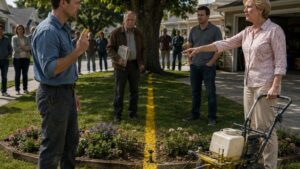
Outside, the subdivision looked exactly as it had in the brochure: clipped lawns, brick mailboxes, young maples planted at regular intervals. Catherine stood near the front walk while her small dog sniffed the base of the porch.
Across the street, an older woman approached with a tan dog on a red leash.
The dog saw Catherine’s house and stopped.
Its front legs stiffened. The leash drew taut.
“Come on,” the woman said.
The dog would not move.
The woman followed its stare toward Catherine’s living-room windows. Her expression changed so quickly that Catherine almost missed it—recognition, then alarm.
“Is something wrong?” Catherine asked.
The woman looked at the moving boxes visible through the window.
“You moved in.”
It was not a question.
“Today.”
The woman tightened her hand around the leash. “I didn’t know they’d sold it.”
Catherine crossed the grass to the sidewalk. “You live nearby?”
“Next door. Barbara Jones.”
“I’m Catherine.”
Barbara nodded without offering her hand.
Catherine studied her face. “Did something happen in my house?”
Barbara’s gaze shifted toward the windows again.
“You should ask the association.”
“I’m asking you.”
The tan dog gave a low whine.
Barbara pulled it closer. “People talked too much when it happened. Then they stopped talking at all.”
“When what happened?”
Barbara looked down the street. Two residents were unloading groceries from an SUV.
“Not here.”
“Then where?”
“I shouldn’t have said anything.”
Catherine felt the first cold pressure beneath her ribs. “Barbara, I found a stain under brand-new carpet.”
Barbara’s eyes came back to hers.
For one second, Catherine saw confirmation.
“Don’t tear up more than you have to,” Barbara said quietly.
“What does that mean?”
“It means get your records before you start making accusations.”
“Records of what?”
Barbara stepped away.
“Please don’t tell Donald I spoke to you.”
“Who is Donald?”
But Barbara was already pulling the dog along. This time it followed, though it looked back twice before they reached the next driveway.
Catherine stood at the curb until they disappeared behind a hedge.
Inside, the house seemed altered without anything having moved. The open boxes no longer suggested possibility. They looked temporary, as if she might need to pack them again.
She returned to the living room with a utility knife, work gloves, and a flashlight.
The carpet lifted in a broad sheet. The tack strips were new. So was the padding. The stain spread nearly three feet across the subfloor, concentrated beside the wall where Catherine had planned to place her sofa.
She mixed warm water with floor cleaner and scrubbed a small corner. The water turned gray, but the mark did not lighten.
She tried again.
Nothing.
At last she sat back on her heels. The cloth in her hand was damp and clean except for ordinary dust. Whatever had darkened the wood had been there long enough to become part of it.
Her phone rang.
Mark’s name appeared on the screen.
Catherine answered immediately. “Did you reach the flooring company?”
“I left a message.”
“Who paid them?”
“The seller, presumably.”
“I need the invoice.”
There was a pause.
“I can request it.”
“Tonight.”
“Catherine, contractors don’t always respond after business hours.”
“Send me the name.”
Another pause, shorter but more revealing.
“I’ll see what I can find.”
The call ended.
Catherine opened the kitchen drawer where Mark had placed appliance manuals and spare keys. Beneath the warranty packet lay several folded receipts left by the previous owner: pest control, gutter cleaning, air-filter service.
At the bottom was a white invoice from a flooring contractor.
She unfolded it beneath the pendant light.
The work description read: remove existing carpet, install new pad and carpet in living room and hall. Rush completion requested.
The invoice date was three days before the house had been listed for sale.
In the customer field, the previous owner’s name had been crossed out.
Above it, written by hand, were two words:
Authorized by HOA.
Chapter 2: The Box Marked No Beside a Dead Woman
The county record listed the location of death as Catherine’s living room.
She read the line twice at a public terminal while the county records clerk waited on the other side of the counter.
Residence. Natural causes. Living room.
Eight months earlier.
Catherine’s fingers remained on the edges of the printed page. She had slept on an air mattress in that room because her bed frame was still boxed upstairs. At two in the morning, she had woken facing the rolled carpet and told herself she would deal with it after sunrise.
Now the page told her a woman had died within feet of where she had slept.
“Is there anything else attached?” Catherine asked.
The clerk glanced at the request number. “That is the public record. Medical details aren’t available.”
“I’m not asking for medical details. Emergency response, property reports, anything tied to the address.”
The clerk searched again. “There was no police investigation.”
“So it wasn’t violent.”
“Nothing here indicates that.”
The answer should have relieved her. Instead, it sharpened the problem. A natural death was not a crime scene, and not every state required every death in a home to be disclosed. Catherine knew that better than most buyers.
But someone had rushed new carpet into the room, removed an invoice from the sale packet, and crossed out the customer’s name in favor of the HOA.
Catherine slid the death record into a folder.
“Can I get a certified copy?”
“There’s a fee.”
“I know.”
At home, she placed the record beside the seller’s disclosure. The relevant section asked about material defects, insurance claims, remediation, and conditions affecting the property. A separate supplemental question asked whether the seller knew of any event likely to influence a buyer’s decision.
Every answer was marked No.
The boxes formed a column down the page.
No water intrusion.
No hazardous-material remediation.
No structural repair.
No material event requiring additional explanation.
The stain lay exposed six feet away.
Catherine carried the disclosure into the living room and crouched beside the floor. She placed the page on the clean padding, aligning the checked box with the darkest part of the wood.
One small mark against a dead woman’s entire history.
Her phone camera focused on the contrast.
At work that afternoon, Catherine kept her office door partly closed. The title company occupied the second floor of a low glass building near the interstate, far enough from her new subdivision that no one there had yet asked to see photographs of the house.
She logged into the claims database and stopped before entering the address.
Company policy was plain: employees could not use internal systems to research personal transactions without disclosure and assignment to another examiner.
She knew the rule because she had helped revise it.
Instead, she used public contractor databases and county permit records. The carpet company had a current license. No permit was required for flooring. A separate sanitation contractor had billed the property six days before the carpet installation.
The public filing listed only an invoice number and amount.
Catherine called the company from her personal phone.
“I’m the current owner,” she said. “I’m trying to obtain prior service records for insurance purposes.”
The employee asked for the address, then placed her on hold.
When she returned, her voice had become careful.
“We would need authorization from the party who ordered the work.”
“Who ordered it?”
“I can’t release customer information.”
“Can you describe the service category?”
Another pause.
“Organic material removal and surface treatment.”
Catherine looked through the glass wall of her office. Her supervisor was speaking with a claims assistant near the copier.
“Was the living-room subfloor treated?”
“I can’t discuss the work order.”
“You just described it.”
“I described the billing category.”
“Was replacement recommended?”
“I’m sorry. You’ll need authorization.”
The line disconnected.
Catherine wrote down the invoice number. It began with the same four digits as the flooring invoice found in the drawer, suggesting the jobs had been arranged within the same service chain.
She opened the electronic seller packet she had received before closing and searched the number.
No result.
She checked the indexed document list. Inspection report, roof certification, HVAC service, pest clearance, appliance warranty, HOA resale certificate.
No sanitation invoice.
She searched the scanned attachments manually.
Still nothing.
A knock sounded against her partly open door.
Her supervisor stood there holding a coffee mug.
“How is the new place?”
“Full of boxes.”
“That’s the traditional first stage of ownership.”
Catherine minimized the public-record window.
Her supervisor did not move. “Are you researching your address?”
The question was mild, which made lying harder.
“Only public records.”
“Good.”
Catherine said nothing.
Her supervisor lowered her voice. “Do not put it into our systems. Even for a harmless comparison.”
“I haven’t.”
“If there’s a claim, disclose it and let someone else handle it.”
“I know the policy.”
“I know you know it.” Her supervisor looked at the folder beside Catherine’s keyboard. “That’s why I’m reminding you.”
After she left, Catherine stared at the blank claim-search bar.
She could have found the original submission history in minutes. Every packet version, every upload timestamp, every removed attachment might be traceable through the title chain.
She closed the browser instead.
At five thirty, Mark finally returned her call.
“I spoke with the flooring company,” he said. “They were hired before I received the listing.”
“By the HOA?”
“I don’t know.”
“The invoice says they authorized it.”
“Then ask them.”
“I intend to. Why wasn’t the sanitation invoice in my packet?”
Silence.
“What sanitation invoice?”
“Organic material removal. Six days before the carpet.”
“I never saw that.”
“You transmitted the seller packet.”
“I transmitted what I received.”
“From whom?”
“The estate representative and association management.”
Catherine wrote both down.
“Did you know the owner died in the house?”
Mark exhaled. “I knew she passed away.”
“In the living room?”
“I wasn’t given that level of detail.”
“Did you ask why the living-room flooring had been replaced?”
“The house needed cosmetic work.”
“Three days before listing?”
“That’s not unusual.”
“Was there a prior version of the disclosure packet?”
“I sent you the final version.”
“That wasn’t my question.”
Mark’s tone hardened. “You work in this field, Catherine. You know a death is not automatically a reportable property defect.”
“I also know an omitted remediation invoice can be material.”
“Then file through the proper channels.”
“You sound very certain that I won’t like what I find.”
“I sound certain that accusing people before you understand the law is a bad idea.”
He ended the call before she could answer.
Catherine remained at her desk until the cleaning crew began emptying trash cans in the hallway. Then she drove home through early evening traffic with the certified death record on the passenger seat.
Barbara’s curtains moved when Catherine pulled into the driveway.
By the time Catherine reached her porch, they were still.
Inside, she cut a small square from the stained edge of the old carpet backing and sealed it in an evidence sleeve. She labeled it with the date, location, and time, then photographed the larger exposed area with a measuring tape in frame.
Her habits steadied her.
Dates did not flinch. Invoices did not become embarrassed. Documents either aligned or they did not.
She drafted a formal email to the HOA president requesting the resale certificate file, board minutes related to the property, maintenance authorizations, and any communication concerning remediation before listing.
She did not mention the death record.
She did not mention Barbara.
She wrote only that she had identified discrepancies between the condition of the property and the transaction documents.
Ten minutes later, her phone rang from a local number.
“This is Catherine Mitchell.”
A man’s voice answered, warm and almost amused.
“Ms. Mitchell, Donald Harris. HOA president.”
“Thank you for returning my message.”
“So you found the little accident.”
Catherine looked at the sealed carpet sample on the counter.
She had never used the word accident.
Chapter 3: Three Papers Aligned Across Donald’s Desk
“The new owner with the imagination is here.”
Donald Harris said it through the open office door before Catherine had given her name to the management-company representative.
Two residents seated in the waiting area looked up.
Catherine kept her face still.
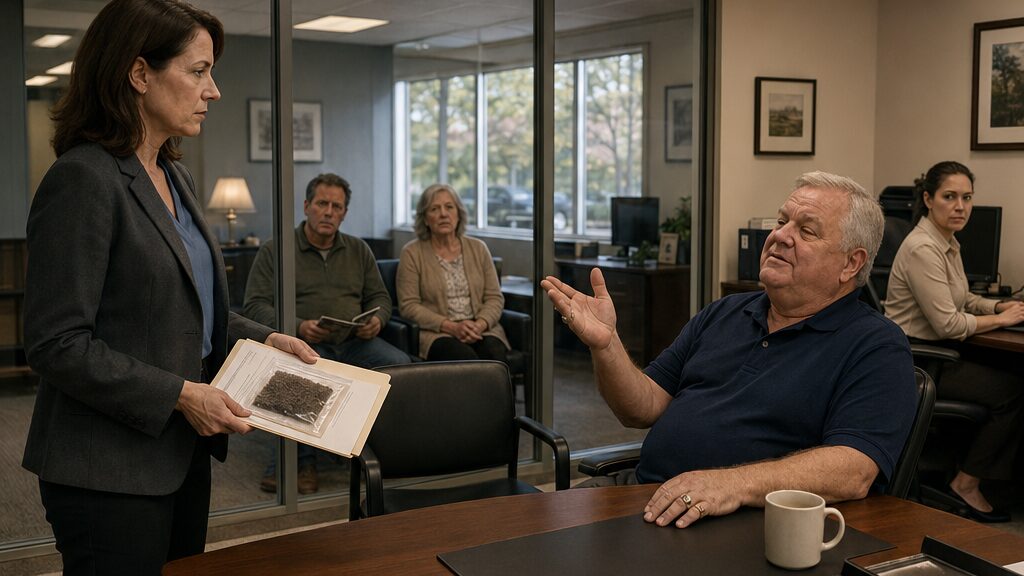
Donald leaned back behind a broad walnut desk. He was heavy through the shoulders, silver-haired, and dressed in a navy polo embroidered with the subdivision’s tree emblem. Several rings flashed when he waved her inside.
“Come on, then,” he said. “Let’s hear the theory.”
The office walls held framed photographs of holiday decorating contests, summer cookouts, and Donald shaking hands beside newly planted entrance signs. A ceramic mug near his elbow read WORLD’S BEST BOSS, though no one in the office appeared to work for him.
Catherine closed the door halfway.
Donald pointed to a chair. “Leave it open. Posted homeowner hours.”
The residents beyond the glass partition could hear every raised word.
Catherine sat and placed her folder on her lap.
“I requested records.”
“And I requested patience.”
“You called the condition in my living room an accident before I described it.”
Donald smiled. “Barbara has never been good at minding her business.”
“I didn’t say I spoke to Barbara.”
His smile held, but something behind it shifted.
“You just did.”
“No. You did.”
One of the residents outside turned a magazine page without looking down.
Donald folded his hands over his stomach. “A woman died. It was sad. It was also a private family matter, not a neighborhood attraction.”
“I agree it should not become an attraction.”
“Good. Then we understand each other.”
“We don’t.”
Catherine opened the folder.
First she placed the signed disclosure on his desk.
Then the certified death record.
Finally, the sealed square of carpet backing.
She aligned their lower edges with the edge of the desk.
Donald stared at the carpet sample.
“What is that supposed to prove?”
“By itself, very little. I’d like you to explain the dates in order.”
“I don’t take examinations from homeowners.”
“The sanitation contractor treated the living-room subfloor six days before new carpet was installed. The carpet was installed three days before listing. Neither invoice appeared in the seller packet. The disclosure marked No beside material remediation and No beside events requiring explanation.”
Donald glanced toward the open doorway.
Catherine lowered her voice rather than raising it.
“The death record establishes why remediation occurred. The invoice number establishes that an authorized service took place. Your flooring invoice identifies the HOA as the authorizing party.”
“Natural death isn’t a defect.”
“I didn’t say it was.”
“You’re implying fraud.”
“I’m identifying a contradiction.”
Donald leaned forward. “You bought a used house. Used houses have histories.”
“Then why clean this one from the paperwork?”
His jaw tightened.
“The board helped a grieving family. That’s the entire scandal.”
“By ordering carpet?”
“By preventing ghouls from turning somebody’s worst day into a sales spectacle.”
Catherine studied him. For the first time, his anger did not look entirely performed.
“Who decided the sanitation invoice should be removed?”
“No one removed anything.”
“There was an earlier packet.”
“You don’t know that.”
“Mark transmitted a final version but won’t identify the prior version. The invoice sequence shows two linked services. The resale certificate lists no association-authorized work at the property.”
Donald tapped one finger against the death record.
“You people in title offices think a missing piece of paper means someone built a conspiracy around you.”
Catherine felt heat rise into her neck. She had not told him where she worked.
“My employment wasn’t in my email.”
Donald’s finger stopped.
Neither of them spoke.
Beyond the partition, the management representative began typing, loudly and without rhythm.
Catherine slid the death record closer to Donald.
“I process residential title claims. I’ve done it for nine years. I know the difference between a disclosure question that does not apply and a record trail that has been altered to make it appear no work occurred.”
Donald’s eyes narrowed.
“I also know when someone uses information I haven’t disclosed. You knew where I work. You knew I found something in the house. You called it an accident before I said a former owner had died.”
“You’re new here,” Donald said. “You should consider whether entering a neighborhood by accusing the volunteers who maintain it is wise.”
“I entered the neighborhood by paying three hundred forty thousand dollars for a house represented through documents your association helped prepare.”
“No one forced your signature.”
“No. They gave me information and expected me to rely on it.”
“Read more carefully next time.”
Catherine placed her index finger on the checked No.
“I read every word. That is why I’m sitting here.”
A voice in the waiting room coughed, then went quiet.
For a brief moment Donald looked not embarrassed but cornered. His gaze moved from the disclosure to the death record, then to the sealed carpet square. Catherine thought he might finally lower his voice and tell her what had happened.
Instead, he opened a desk drawer.
He removed a single sheet and slid it across the walnut surface.
The heading read NOTICE OF VIOLATION.
Amount due: $400.
Catherine read the description. Unauthorized landscaping modification. Front foundation shrubs inconsistent with approved plan.
“I haven’t modified the landscaping.”
“The bushes are too tall.”
“They were there when I closed.”
“You own them now.”
“The listing photographs show the same shrubs.”
Donald picked up his mug. “Then your complaint is with the previous owner.”
“The previous owner is dead.”
The words came out harder than Catherine intended.
The waiting room became completely silent.
Donald set down the mug.
“Be very careful,” he said.
“Is that advice from the board president?”
“It’s advice from someone who has watched homeowners damage their own property values because they wanted to win an argument.”
Catherine looked at the violation date.
It was stamped that morning, nineteen minutes after she had confirmed the appointment.
She placed the violation beside the other three items, then moved the carpet sample away. Three papers remained aligned: disclosure, death record, fine.
“You generated this after I requested records.”
“The inspection was already open.”
“Provide the inspection report.”
“You’ll receive whatever the governing documents require.”
“And the board minutes?”
“You’ll receive approved minutes through the portal.”
“The sanitation authorization?”
“Not an association record.”
“The carpet invoice names the HOA.”
“Then perhaps the contractor wrote it incorrectly.”
Catherine gathered the documents but left the violation on the desk.
Donald pushed it back toward her with one finger.
“If you don’t cure the shrubs, late fees begin in thirty days.”
She took the paper.
“I’ll appeal.”
“Of course you will.”
“I’ll also request the property’s complete association file from management.”
“Requests must be reasonable in scope.”
“Four years of minutes. Vendor authorizations. Resale-certificate drafts. Communications concerning my address.”
Donald’s smile returned, but it no longer looked effortless.
“You’re going to make yourself very unpopular.”
“I didn’t buy popularity.”
“No. You bought a house. Try living in it.”
Catherine stood.
At the door, she turned back. “What was the former owner’s name?”
Donald’s expression closed.
“That is not relevant to your violation.”
It was an answer of its own.
Outside, the two waiting residents avoided Catherine’s eyes. The management-company representative offered her a thin envelope containing instructions for filing an appeal.
On the walk home, Catherine passed three immaculate lawns and two houses with shrubs taller than hers.
A man watering flowers stopped when she approached. His glance went to the violation envelope in her hand, then toward the HOA office.
“They get you already?” he asked.
“Apparently.”
He shut off the hose. “Don’t let them add daily fines.”
“Are my bushes out of compliance?”
The man looked across the street at a hedge nearly level with a porch roof.
“Depends who’s asking.”
Before Catherine could question him further, he carried the hose around the side of his house.
At home, she photographed every shrub with a measuring tape. She downloaded the original listing images and captured the date metadata. The bushes had not changed except for perhaps half an inch of summer growth.
She scanned the violation. The document-generation time appeared in the footer: 10:19 a.m.
Her appointment confirmation had been sent at 10:00.
Retaliation was difficult to prove from timing alone, but timing mattered.
Catherine opened the HOA portal and entered the password she had used the day before.
Invalid credentials.
She reset it.
No account found.
She tried her closing email address.
No account found.
Then she called the management office. The same representative who had watched the meeting answered.
“My portal access has been removed.”
“I’m showing your account as pending ownership verification.”
“I was verified last week.”
“There may have been a synchronization issue.”
“Restore it.”
“I’ll submit a ticket.”
“How long?”
“Three to five business days.”
“My records request is time-sensitive.”
“You can submit it by mail.”
“Can I pick up the current board minutes?”
“Only documents already posted to the portal.”
“The portal I can no longer enter.”
The representative said nothing.
Catherine looked at the rolled carpet and the dark floor beyond it. Donald had not disproved a single fact. He had done something more useful.
He had shown her exactly where pressure would be applied.
She ended the call, opened a new evidence log, and entered the time her access disappeared.
Then she searched her browser history for the board-minutes page she had opened before moving day.
A cached version flickered onto the screen.
One meeting agenda was still visible.
Beside an item labeled Property Transition—Executive Discussion, the date matched the week before the sanitation work.
Catherine clicked it.
The cached page vanished and reloaded as an error.
But not before she saw the line beneath it:
Secretary of record: Barbara Jones.
Chapter 4: The Minutes That Changed After Midnight
The cached agenda had disappeared, but Catherine had seen enough to know what had been removed.
Property Transition—Executive Discussion.
Secretary of record: Barbara Jones.
She wrote both lines from memory before they blurred into the other notes on her desk. Then she checked the browser cache, the page source, and the public indexing service that sometimes preserved fragments after a website update.
At 1:14 a.m., the search engine had captured the agenda.
At 2:03 a.m., the HOA site had published a revised version without the property item.
Catherine stared at the timestamps.
Donald had not merely blocked her current access. Someone had been cleaning the public trail before she ever bought the house.
At work the next morning, she kept her personal folder closed and her computer on company files. Her supervisor passed her door twice. Both times Catherine felt the pull of the internal title system like an unlocked cabinet in a room where no one was watching.
The original disclosure chain would be there. The packet versions. The upload history. Perhaps even the user account that replaced one file with another.
She did not touch it.
Instead, during lunch, she walked to the public library and used a terminal near the local-history shelves. The subdivision’s newsletters had been indexed for years, along with meeting notices and budget summaries.
She searched the address.
The first result was a landscaping reminder from three years earlier.
The second was a holiday decoration photograph.
The third was a board agenda from eight months ago.
Catherine opened it.
Property Transition—Executive Discussion appeared under closed-session matters.
The date was four days before the sanitation work.
She printed it.
Then she searched the meeting date directly. The official minutes now posted by the management company contained no property item. They listed a discussion of pool repairs, delinquent assessments, and entrance lighting. The closed-session section stated only: Legal and personnel matters discussed. No action taken.
Catherine laid both pages side by side.
One agenda acknowledged a property transition. The final minutes erased it.
She searched the state’s nonprofit filing portal for the HOA’s board roster. Barbara Jones had been listed as secretary that year.
By late afternoon, Catherine stood on Barbara’s porch with the two pages in a manila folder.
Barbara opened the door only far enough to fill the gap.
“I told you not to mention me.”
“I haven’t.”
“You went to Donald.”
“He mentioned you before I did.”
Barbara’s face tightened.
Catherine held up the folder. “You were secretary when the board discussed my property.”
“I’m not secretary now.”
“That isn’t an answer.”
“It is the only one you’re getting.”
Behind Barbara, the tan dog watched from the hallway but did not bark.
Catherine lowered the folder. “My account was disabled after I requested records. The public agenda was revised after midnight. The official minutes omit an item you recorded.”
Barbara looked past her toward the street.
“Come inside.”
The kitchen smelled of coffee and furniture polish. A stack of grocery circulars sat beside a bowl of lemons. Barbara directed Catherine to the small table but remained standing.
Catherine placed the old agenda and current minutes beneath the pendant light.
Barbara read the first page without touching it.
“You saved this?”
“The library did.”
“That system was supposed to replace drafts when final documents were posted.”
“It didn’t.”
Barbara sat.
Her hands rested flat on the table, fingers spread slightly. Catherine recognized the posture: someone preventing themselves from reaching for the evidence.
“What happened at that meeting?” Catherine asked.
“It was executive session.”
“I know what the label says.”
“Then you know I’m not supposed to discuss it.”
“You left the board.”
“The duty didn’t disappear.”
“Neither did the transaction.”
Barbara’s mouth formed a thin line.
Catherine opened the folder again and removed a copy of the disclosure. The boxed No sat midway down the page.
“This document says the association authorized no material work. I have an invoice saying the opposite.”
“That form belongs to the seller.”
“The resale certificate belongs to the association.”
Barbara looked at the checked box.
Catherine saw recognition again, but this time it was followed by something heavier than fear.
“You typed the minutes,” Catherine said.
“Yes.”
“Did you type the version that is online?”
Barbara’s eyes lifted.
“No.”
The answer was quiet, almost unwilling.
Catherine’s pulse quickened. “Who changed them?”
“I don’t know.”
“Donald?”
“I said I don’t know.”
“Did the original minutes mention the property?”
Barbara stood so abruptly that the chair legs scraped the floor.
“You think this is a puzzle because that is how you make things manageable. A form is wrong, so you find the right form. A date is missing, so you find the original date.”
“That’s how evidence works.”
“No. That is how paper works.”
Catherine held her gaze. “Paper is what people signed.”
“And a woman died.”
“I know.”
“You know a line in a county record.”
The words struck harder than Donald’s condescension because Barbara did not say them to diminish her. She said them as an accusation Catherine had not prepared to answer.
“I’m trying to find out why her death was hidden.”
“You’re trying to prove someone cheated you.”
“Both can be true.”
“They can. But only one of them is the reason you came to my house.”
Catherine looked down at the pages.
The boxed No seemed suddenly crude, a mark she had been using to stand in for everything the dead woman had been.
Barbara sat again, more slowly.
“I won’t sign anything,” she said.
“I didn’t ask you to.”
“You were going to.”
Catherine had, though the draft statement remained on her laptop.
Barbara turned the old agenda toward herself. “This meeting was not called because of the carpet.”
“What was it called for?”
“I said I won’t give you a statement.”
“I’m asking what happened.”
“And I’m telling you that you don’t understand the question.”
Catherine felt impatience rise, clean and familiar. It was the part of her that had made Donald’s office bearable. It was also the part that had sent her there before preserving every record.
“The minutes were altered,” she said. “My access was removed. A violation was generated nineteen minutes after my appointment was confirmed. Whatever your reason for protecting this, Donald is using it.”
Barbara’s face changed at the mention of the timing.
“Show me the violation.”
Catherine placed it on the table.
Barbara read the date and footer. Her thumb moved once across the paper.
“The shrubs were approved years ago,” she said.
“By whom?”
“The architectural committee.”
“Do you have the approval?”
“No. But I remember the meeting.”
“Would you say that in writing?”
Barbara pushed the violation away.
“There. You did ask.”
Catherine closed her folder.
Barbara looked at the dark window over the sink. “The woman who lived in your house was not a secret. Everyone knew her. Everyone knew she was sick. What happened afterward is where people began telling themselves they were being kind.”
“Who told them that?”
Barbara’s eyes returned to Catherine’s.
“Donald did not invent the silence,” she said. “I asked for it first.”
Chapter 5: The Promise Barbara Should Never Have Made
Barbara did not produce minutes, emails, or a signed statement.
She produced an unsigned condolence card.
It was still inside its envelope, the flap never sealed. On the front, a watercolor branch bent beneath pale leaves. Inside, several board members had written short messages in different pens.
Thinking of your family.
With sympathy.
Please let us know if the association can assist.
Donald’s name was absent.
Catherine held the card carefully by its edges. “Why wasn’t it sent?”
“Emily asked us not to contact her again.”
“Emily Rodriguez?”
Barbara nodded.
The former owner’s daughter.
They sat in Barbara’s kitchen two days after the first conversation. The tan dog slept beneath the table, one paw twitching against the tile.
Barbara had called that morning and said she would explain one thing. Nothing more.
“Her mother had been ill for months,” Barbara said. “She wanted to stay in the house. Emily arranged help, but she lived two hours away and could not be there every day.”
“What was her mother’s name?”
Barbara’s eyes sharpened. “That is not yours yet.”
Catherine accepted the correction.
“People watched,” Barbara continued. “They watched nurses come and go. They counted the days Emily’s car was in the driveway. When her mother died, one neighbor posted about it before Emily had called all the relatives.”
Catherine looked at the condolence card.
“Barbara, I’m not asking for medical details.”
“That is what everyone says before they decide which details serve their purpose.”
The statement stung because Catherine had brought the sealed carpet sample in her bag. She had planned to place it on the table beside the disclosure, the way she had with Donald.
She left it where it was.
“What did you promise Emily?” she asked.
“That the board would stop the gossip. That no one would discuss her mother’s condition in newsletters, meetings, or with prospective buyers who came asking for a story.”
“Prospective buyers should have received accurate property records.”
“I know that now.”
“You didn’t then?”
Barbara rubbed her thumb across the blank space where Donald’s signature should have been.
“I believed privacy and accuracy could be separated. Donald said they could.”
“What did he ask Emily to sign?”
“A release authorizing cleanup and allowing the association to coordinate vendors. She was overwhelmed. The estate was short of cash. The association fronted some of the cost and expected repayment at closing.”
“That sounds broader than privacy.”
“It became broader.”
Catherine leaned forward. “Do you have a copy?”
“No.”
“Did you see it?”
“I witnessed the signature.”
“Who drafted it?”
“Donald said association counsel.”
“Did you verify that?”
Barbara’s silence answered.
The missing step was familiar: one person relied on another because challenging him at the time would have seemed unkind, inconvenient, or disloyal.
“Will you call Emily?” Catherine asked.
“No.”
“I need to understand what she authorized.”
“You need evidence.”
“Yes.”
“And she needs not to become evidence.”
Catherine sat back.
Through the window, she could see the corner of her own house. The living-room curtains were open, revealing a pale rectangle where the carpet remained rolled away from the stain.
“I’m not trying to expose her mother,” Catherine said.
“You carried a piece of that room into Donald’s office.”
The accuracy of it left no room for defense.
Barbara rose and placed the condolence card back in its envelope.
“I will give you Emily’s number,” she said. “Once. You will tell her why you are calling before you ask for anything.”
Catherine nodded.
“And if she says no, you stop.”
Catherine did not promise. Barbara noticed.
“You want Donald held responsible,” Barbara said. “So do I. But if you make Emily pay for that, then you are only choosing a different person to protect.”
An hour later, Catherine parked near the cemetery named on the death record. She had not intended to go inside. It was simply a quiet place to make the call, away from her office and the subdivision.
Emily answered on the fourth ring.
“Barbara said you might call.”
“My name is Catherine Mitchell. I bought your mother’s house.”
“I know who you are.”
The words were controlled but not welcoming.
Catherine looked through the windshield at a row of low stone markers.
“I found conflicting records related to cleanup and the sale. I’m trying to determine what the association was authorized to do.”
“Are you asking whether my mother died there?”
“No. I know she did.”
“Then what else do you need?”
“A copy of the release you signed.”
Emily gave a short, disbelieving laugh. “Of course.”
“I’m not asking for medical information.”
“You’re asking me to reopen the week after she died because your floor is ugly.”
Catherine tightened her hand around the phone.
“The floor can be repaired. The records were changed.”
“And that hurts you.”
“Yes.”
The honesty sounded harsher aloud.
Emily said nothing.
Catherine continued. “It also allowed the association to erase work it authorized and issue documents that did not match the property history.”
“My mother’s death is not a defect.”
“I agree.”
“Do you?”
“Yes.”
“Then stop pairing her death certificate with your disclosure form.”
Catherine thought of the photograph she had taken, the certified record laid over the boxed No.
Emily had never seen it, yet she had named exactly what Catherine had done.
“Barbara told you?”
“Barbara told me you work in claims. People in claims build stories from paper. My mother spent thirty-seven years as a nurse. She was more than the room where she stopped breathing.”
Catherine closed her eyes.
“You’re right,” she said.
Emily’s breathing changed slightly, but she did not soften.
“What did Donald tell you when you signed?” Catherine asked.
“That he could keep the details private. He said the association would handle cleanup, repainting, carpet, whatever the estate needed to make the house marketable.”
“Did he say the release allowed records to be revised?”
“No.”
“Did it?”
“I don’t know. It was six pages. I wanted the neighbors to stop calling me.”
“Do you still have it?”
“Probably.”
“Would you send it to a state investigator if one asked?”
“No.”
“Emily—”
“I said no.”
Catherine stopped.
Emily’s voice became unsteady for the first time.
“Donald told me if I signed, my mother would not become the house where a woman died alone. Then people started saying the house had a smell. Someone asked whether she had been found after days. None of it was true. I signed because I wanted one thing I could still do for her.”
“And Donald used that.”
“You don’t know what he used.”
“That is what I’m trying to prove.”
“No. You are trying to make me authorize the version of justice that helps you.”
Catherine looked at the sealed evidence bag on the passenger seat.
“I’m sorry,” she said.
“For calling?”
“For speaking about your mother as if the record mattered more than the person.”
The silence lasted several seconds.
When Emily replied, her voice was flat again.
“Do not call me after today. If you contact my family or use my mother’s name publicly, I will report you for harassment.”
The call ended.
Catherine remained in the parking lot until the phone screen went dark.
Her argument against Donald had always been that people could not decide which truths others were allowed to know. Yet she had arrived with her own hierarchy: facts first, people afterward.
She drove home without entering the cemetery.
That evening, she removed the carpet sample from her worktable and placed it in a locked drawer. She left the stain exposed but stopped photographing it.
At eight forty-seven, an email arrived from Mark Johnson.
The subject line read: For the record.
Catherine opened it.
Mark had forwarded a chain between himself, the estate representative, the management company, and Donald. Most of the messages were logistical: scheduling vendors, confirming access, preparing the resale packet.
Then came a message from Donald sent five days before listing.
Replace the property-history language with the clean version attached. We agreed the family privacy release covers this. Remove vendor detail from buyer-facing packet. Nothing in the house affects current habitability.
Mark’s reply appeared beneath it.
Understood. I’ll use the revised packet.
Catherine read the exchange again.
The email did not prove every document had been legally falsified. It did prove Mark had seen replacement language and knew vendor records were being removed.
At the bottom of his message to Catherine, he had written one sentence:
I should have asked more questions.
Chapter 6: The Vote That Protected Prices and Destroyed Trust
The handwritten instruction appeared in blue ink across the top of the management company’s retained file.
Clean the history before relisting.
Donald’s initials sat beside it.
Catherine did not touch the page. She asked the management-company representative to turn it toward the scanner while the state real-estate investigator observed from the end of the records-room table.
The investigator had opened a preliminary inquiry after Catherine submitted Mark’s email chain, public agendas, invoices, and the retaliatory fine. The inquiry did not establish fraud. It did, however, require the management company to preserve and produce its files.
That was how the original folder survived.
Inside were two versions of the resale certificate, the sanitation authorization, the carpet invoice, and draft minutes Barbara had prepared before leaving the board.
The draft minutes contained the property discussion.
The final minutes did not.
Catherine read the central paragraph twice.
The board had discussed a likely reduction in sale price if “stigmatizing information” circulated. Donald had warned that a failed sale would force the association to disclose a reserve shortage during the next transaction cycle. A motion authorized him to coordinate privacy-sensitive property preparation and “standardize external descriptions.”
The motion had passed three votes to one.
It did not say falsify records.
It did not say remove invoices.
But it had given Donald language broad enough to hide behind.
The state investigator pointed toward the margin.
“Who wrote this?”
The management representative looked at the initials. “Mr. Harris.”
“Who replaced the draft minutes?”
“I don’t know.”
The investigator’s expression did not change. “The document metadata will.”
By six that evening, nearly forty residents had crowded into the subdivision clubhouse for an emergency meeting. Folding chairs formed uneven rows. People stood along the back wall beneath framed photographs of pool openings and holiday contests.
Donald sat at the board table with two other members.
Catherine sat in the first row, her evidence binder on her knees.
The sealed carpet sample rested inside it but remained unopened.
Donald began before the management representative had finished explaining the meeting rules.
“This association is facing an attack built on misunderstanding, private grief, and documents taken out of context.”
Murmurs moved through the room.
He looked directly at Catherine.
“One owner’s dissatisfaction with her purchase is now threatening legal expenses every household will share.”
Catherine heard the change in the room before she saw it. Residents glanced at one another. Legal expenses meant assessments. Assessments meant fixed incomes, college payments, retirement plans.
Donald knew his audience.
He continued. “When the prior owner passed, the board tried to assist her family. We protected their privacy, arranged necessary services, and prevented gossip from damaging an already grieving estate.”
A woman near the aisle said, “What about the reserve account?”
Donald’s gaze shifted.
“This is not a budget meeting.”
“It becomes one if we’re paying lawyers.”
The management representative stepped in. “Financial records produced today show the association was preparing to announce a significant reserve shortfall during the same period.”
The room changed again.
One board member leaned toward the microphone. “That issue was separate.”
Catherine opened her binder.
Donald’s jaw tightened. “It was not separate in the sense that every failed sale affects comparable values. Lower values reduce owner equity and invite investors. Some of you were here during the foreclosure years. You remember empty houses. You remember assessments no one could collect.”
Several older residents nodded.
His fear was not invented. Catherine could see that now.
Donald placed both hands on the table.
“I made choices to keep this community stable.”
“You changed records,” Catherine said.
He looked at her. “I protected a family’s privacy.”
“You removed vendor details from a buyer packet.”
“The work did not affect habitability.”
“You revised association minutes.”
“I corrected language that never belonged in public session.”
“Then why did you disable my portal access?”
“I did not.”
The management representative looked down.
Catherine removed the violation notice from her binder and held it up.
“This was generated nineteen minutes after my appointment with you was confirmed.”
Donald’s face hardened.
“The shrubs were out of compliance.”
A resident near the back called, “Half the street has the same shrubs.”
Someone else said, “Mine are taller.”
Catherine did not turn toward them. She placed the violation on the document camera.
The footer enlarged on the screen behind the board.
10:19 a.m.
Below it, she displayed the listing photograph showing the same bushes before she owned the home.
“This is not about shrub height,” she said. “It is about using enforcement authority to discourage a records request.”
One of the board members shifted in his seat.
Donald pointed toward Catherine’s binder. “And how did she obtain those records? She works for a title company. Has anyone asked whether she accessed private systems for personal advantage?”
The question struck exactly where Catherine had expected and still feared.
The state investigator looked at her.
The room quieted.
Donald leaned back slightly. It was the same posture he had used in his office when he pushed the fine across the desk. He believed he had finally moved the problem from his conduct to hers.
Catherine stood.
“The first day I found the discrepancy, I searched public contractor and county records from my office,” she said. “I also opened my company’s claim interface and considered entering my address.”
Her supervisor’s warning returned to her with painful clarity.
“I did not run the search then.”
Donald smiled faintly.
Catherine continued. “The following morning, I accessed my personal transaction file long enough to confirm that more than one packet version existed. That access was against company policy because the file concerned my own purchase.”
A ripple passed through the room.
The state investigator asked, “Is evidence from that access included in your submission?”
“No.”
“Did it direct you to evidence you later obtained?”
“It confirmed that I needed to find independent copies. Everything presented tonight came from county records, the public library archive, the management company’s preserved file, contractor billing records, my own closing packet, and emails voluntarily provided by Mark Johnson.”
One board member leaned toward the microphone. “So she admits improper access.”
“Yes,” Catherine said before Donald could answer. “I do.”
The admission left her exposed in a way no document ever had.
“I reported it to my supervisor this afternoon. I expect a formal review.”
Donald’s smile disappeared.
Catherine looked around the room.
“I am not asking you to trust me because I work in title claims. I am asking you to compare independently preserved records. The original agenda lists a property discussion. The final minutes remove it. The management file contains two resale certificates. The vendor authorization exists in one chain and disappears from the buyer-facing packet. The board president instructed the agent to use clean language and remove vendor details. Then, after I requested those records, a violation was generated against landscaping that existed before I owned the house.”
She placed the sealed carpet sample on the table but did not open it.
“This is not proof that a death made the property defective. It did not. It is proof that people used a family’s request for privacy to justify changing records and withholding work history from a buyer.”
Donald stood.
“You think this is simple because you can put papers in order. It is not simple. We were weeks from announcing a reserve shortage. One failed sale would have established a lower comparable price. Then another. Then investors. Then owners who had lived here twenty years being told they needed thousands of dollars for roofs and drainage.”
His voice had lost its smoothness.
“I kept people in their homes.”
Catherine believed that he believed it.
“You protected them from a difficult vote,” she said. “You did not protect them from the cost. You moved it into someone else’s house.”
Donald looked toward the residents.
No one applauded. No one needed to.
The silence was different from the silence outside his office. Then, people had watched Catherine as if she were a spectacle. Now they watched him as if they were measuring the distance between his reason and his choice.
The state investigator closed the retained file.
“The records will remain under preservation order,” she said. “The retaliation allegation, disclosure chain, and document alterations will be reviewed separately.”
The management representative added, “Portal access will be restored tonight. The landscaping fine is suspended pending independent review.”
Donald sat down slowly.
As residents began speaking over one another, one of the board members raised a hand.
“I want the minutes to reflect that I relied on the privacy release,” he said.
Barbara stood near the back wall.
“And I want them to reflect that the release was never meant to erase invoices,” she said.
Every head turned toward her.
She did not look at Catherine.
The meeting ended without a resignation, confession, or vote. The investigator collected copies. The board scheduled an audit. Residents left in clusters, already dividing Donald’s motives from his actions in low, urgent voices.
Outside the clubhouse, Catherine’s phone rang.
Her supervisor.
She answered.
“I received your disclosure,” her supervisor said. “Do not access any transaction systems until we complete review.”
“I understand.”
“There will be a formal warning at minimum.”
Catherine closed her eyes.
“I understand.”
After the call, she found Donald standing alone beside the dark clubhouse windows.
“You may cost people their homes,” he said.
“You may have delayed the bill. You did not remove it.”
He looked older than he had behind the walnut desk.
“You could have brought this to me quietly.”
“I did.”
For once, he had no answer.
Catherine walked home carrying the binder against her chest. Her portal access returned before she reached her driveway. The suspended violation appeared at the top of the account, followed by a notice that all records were under review.
She entered the house and stopped at the exposed living-room floor.
The stain remained exactly where it had been.
Catherine placed the binder on the kitchen island, opened her laptop, and began the written supplement to the state complaint.
In the first paragraph, before Donald could disclose it for her, she documented her own unauthorized file access and excluded everything derived from it.
Then she attached only the evidence she could prove without asking anyone to overlook what she had done.
Chapter 7: The House Was Never Going to Be Clean Again
The first settlement offer would pay Catherine more money if she agreed that no one had to correct the record.
The state investigator placed the proposed agreement on the conference table and turned it toward her. Across from Catherine sat Donald, the management-company representative, an attorney for the association, and Mark Johnson with counsel of his own.
Six weeks had passed since the emergency meeting.
The landscaping fine had been suspended, then formally withdrawn. Catherine’s portal access had remained active. An outside firm had begun auditing the association’s vendor files and reserve disclosures. Donald had stopped leading meetings, though he had not yet resigned.
None of that appeared in the opening paragraph of the offer.
The agreement proposed reimbursement for the flooring inspection, sanitation review, replacement materials, and a portion of Catherine’s legal expenses. It also included a payment for the association’s administrative errors.
In return, the original minutes, revised resale certificate, and vendor-removal instructions would remain confidential except where disclosure was required by law.
Catherine read the confidentiality section again.
“How much disappears if I refuse this?” she asked.
The association attorney named the amount.
It was enough to replace the entire living-room floor, repair the damaged subfloor, repaint the room, and leave money for furniture Catherine had postponed buying.
Donald watched her without expression.
The investigator folded her hands. “You are not required to decide today.”
Catherine looked at the corrected property statement attached as an optional exhibit. It said only that prior documentation had contained administrative inconsistencies.
Nothing about the authorized cleanup.
Nothing about the altered records.
Nothing about retaliation.
“This language protects the same thing the original language protected,” Catherine said.
The attorney shook his head. “It resolves disputed claims without assigning motives.”
“It removes the sequence.”
“It avoids publishing private details concerning the former owner.”
Catherine turned to the investigator. “Has Emily Rodriguez approved this?”
“No.”
Donald spoke for the first time.
“She wanted privacy. That has been clear from the beginning.”
Catherine looked at him. “You keep using what she wanted to justify what you wanted.”
His mouth tightened.
The conference-room door opened, and the investigator’s assistant entered with a sealed envelope. She placed it beside the investigator, whispered something, and left.
The investigator opened it.
“This came through Ms. Rodriguez’s counsel this morning.”
Catherine felt every person at the table become still.
The investigator removed a single page.
“Ms. Rodriguez will support a limited factual correction if her mother’s medical information, photographs, emergency records, and personal circumstances remain sealed.”
Donald leaned toward his attorney.
The investigator continued. “She has supplied proposed language.”
She read it aloud.
The prior owner died of natural causes inside the residence. After her death, the homeowners association coordinated property services and later removed references to those services from records provided during resale. This statement does not authorize disclosure of private medical or family information.
The sentence was plain. It did not turn the former owner into a rumor, a warning, or a defect.
It also did not permit the board to hide behind her.
Catherine looked down at the settlement offer.
“Use Emily’s language,” she said. “Make it part of the permanent property file and the association’s audit report.”
The attorney drew a breath. “That would reduce the financial component.”
“I understand.”
“We can likely increase remediation reimbursement without public findings.”
“I’m not asking for public findings about her mother. I’m asking for corrected records about the association.”
Donald’s rings clicked softly against the table.
“You are willing to lose money to put a stain on the whole neighborhood.”
Catherine met his eyes.
“The stain was already there.”
He looked away first.
The final agreement took three more hours.
The association would reimburse verified remediation and flooring costs, cancel the fine permanently, preserve the original and revised records, and submit to an independent governance audit. Mark would cooperate with the licensing review and provide the complete email chain. The property file would carry Emily’s approved statement.
Donald would resign from the board within ten days.
There would be no public apology.
When the attorney suggested one, Donald said, “I will sign a correction. I will not confess to motives other people assigned to me.”
Catherine believed an apology forced into the record would mean less than the correction he could no longer prevent.
She signed.
Donald signed last.
He did not look at her when he closed the pen.
Outside the state office, Catherine found a message from her supervisor asking her to come in before returning home.
The formal warning was waiting on the desk.
It described her unauthorized access to a personal transaction file, restricted her from handling matters involving her own property, and required additional compliance review.
Her supervisor slid the paper toward her.
“This stays in your personnel file.”
Catherine read it completely before signing.
“I understand.”
“You also did the right thing by disclosing it before anyone else did.”
“That doesn’t erase the access.”
“No.”
The word was neither cruel nor comforting.
Catherine signed her name.
Her supervisor gathered the pages. “You have spent years telling claimants that a valid complaint does not excuse weak procedure.”
“I know.”
“Now you know it from the other side.”
Catherine nodded.
When she returned to the house, the living room smelled faintly of sealant.
A contractor had cleaned and treated the subfloor after independent testing confirmed there was no continuing health risk. He had offered to install new carpet immediately.
Catherine had told him to wait.
The dark area remained visible beneath a clear protective seal. Its edges had softened after cleaning, but the shape could still be seen in the wood.
On the kitchen island lay two documents.
The first was the cancelled $400 violation, stamped withdrawn.
The second was the corrected property record containing Emily’s sentence.
Catherine placed them side by side.
Months earlier, she would have photographed the arrangement and labeled it as evidence. Now she simply stood there, one hand resting against the counter.
A car door closed outside.
Barbara appeared on the front walk carrying a small potted fern.
Catherine opened the door before she knocked.
“I wasn’t sure what people bring when a dispute ends,” Barbara said.
“I don’t think it ended.”
“No.” Barbara glanced toward the living room. “But it stopped pretending.”
Catherine took the fern.
Barbara remained on the porch.
“The audit notice arrived,” she said. “They are reviewing five years of enforcement decisions.”
“That may upset people.”
“It already has.”
“Do they blame me?”
“Some do.”
Barbara’s honesty no longer felt like hostility.
“And you?” Catherine asked.
“I blame myself for one part of it.”
Catherine stepped aside.
Barbara entered slowly.
The tan dog was not with her. Without the leash in her hand, she seemed smaller than Catherine remembered from that first evening.
They walked toward the exposed floor.
Barbara stopped at the edge of the rolled carpet.
“I haven’t been inside since before she died,” she said.
Catherine did not ask why.
Barbara looked at the sealed stain.
“Emily chose the wording?”
“Yes.”
“That was good.”
“She protected what belonged to her mother and corrected what belonged to the property.”
Barbara nodded.
Catherine set the fern on the windowsill. “The contractor can cover the floor next week.”
“Will you?”
“Eventually.”
Barbara looked surprised.
“I kept wanting the room restored to what I thought I bought,” Catherine said. “But that room never existed.”
Barbara stepped over the carpet edge.
Her shoe crossed onto the sealed wood.
For a moment, she stood in the center of the stain with her arms close to her sides. Catherine expected her to retreat.
Instead, Barbara looked toward the window where evening light rested across the bare floor.
“Linda Rodriguez,” she said.
The name entered the room without spectacle.
Not a disclosure category.
Not a service invoice.
Not the woman who had lowered a sale price or threatened a reserve fund.
Linda Rodriguez.
Barbara took another step.
“She grew tomatoes that never ripened,” she said. “Every year she planted them too late and blamed the shade.”
Catherine felt something in the house shift—not disappear, not become clean, but settle into its proper weight.
She moved the cancelled fine and corrected record from the kitchen island into a drawer. Then she carried the fern into the living room and placed it near the window.
The stain remained visible beneath their feet.
For the first time, Catherine did not see it as proof that the house had been ruined before she arrived.
She saw it as the place where hiding had ended.
The story has ended.