They Called Her the Clubhouse Help Until Her Mother’s Survey Reached the HOA Table
Chapter 1: The Woman Nicole Ordered to Stack the Chairs
“Carolyn, before you sit down, would you straighten those chairs?”
Nicole Harris pointed across the clubhouse as if Carolyn had been waiting for instructions. Her voice carried easily over the low talk of nearly forty homeowners finding seats for the monthly Maple Court meeting.
Three folding chairs stood crooked beside the rear wall. Carolyn had not touched them. She was holding a brown folder against her ribs, one hand pressed over its bent top edge.
Nicole gave her a bright, practiced smile.
“You know how everyone leaves things,” she added. “Since you’re already here.”
The room did not go silent. That would have been easier. Instead, conversations thinned into careful murmurs. Several residents looked at Carolyn, then quickly down at their agendas.
Carolyn felt the broken rose cutting shift inside the folder.
“I’m here to speak during homeowner comments,” she said.
“Yes, sweetheart, I understand.” Nicole adjusted the cream-colored jacket she wore to every meeting. “But we need the room ready first. You’ve always helped with the clubhouse.”
There it was—not quite an accusation, not quite a job title. Something smaller and harder to challenge.
Carolyn glanced toward the sign-in table. Paul Scott, the treasurer, was arranging printed budgets into a neat stack. He had once stopped beside her driveway twice a week to discuss tomato plants and football scores. Since the violation notices began, he usually found something else to study.
“Am I on the list?” Carolyn asked.
Nicole looked toward the board secretary. “We’ll see if there’s time.”
Carolyn walked to the back wall.
One chair was angled into the aisle. She lifted it, moved it four inches, and set all four legs flat. She aligned the second with the seam in the carpet. Then she left the third exactly where it was.
A few people watched her return to the front.
Nicole’s smile tightened. “You missed one.”
“No,” Carolyn said. “I moved the one blocking the fire lane.”
She placed the folder on the sign-in table and wrote her name beneath the last homeowner already listed. Under “topic,” she wrote: landscaping damage and selective enforcement.
The board secretary leaned close. “Nicole has to approve additions after six-thirty.”
“It’s six twenty-seven.”
The secretary looked at the wall clock and said nothing.
Carolyn capped the pen. When she turned, Nicole was not looking at the broken rose cutting protruding from the folder. She was looking beneath it, at the corner of another paper—yellowed, thick, folded several times.
Carolyn slid the contents deeper inside.
That small movement changed Nicole’s face. The smile remained, but the ease behind it disappeared.
The meeting began with the usual ritual: approval of minutes, pool access updates, and a reminder that decorative flags could not exceed twenty-four inches. Nicole moved briskly through each item, using a tone that made discussion feel like delay.
Carolyn sat along the side wall. She had cleaned this room every Tuesday and Friday for almost three years after Ruth’s health began to fail. She had polished the table where Nicole now sat, replaced paper towels, cleared coffee grounds from the sink, and removed tape after children’s birthday parties.
There had never been a contract.
Ruth had simply said, “They need someone to keep an eye on the place.”
After Ruth died, Carolyn had continued. No one asked her to. No one told her to stop. The board left cleaning supplies in the utility closet, and sometimes an envelope containing reimbursement for soap or trash bags appeared beneath them.
Six months ago, the envelopes stopped.
Two months later, Nicole had begun referring to Carolyn as “our clubhouse helper.”
The phrase had spread because Carolyn had allowed it to.
“Compliance report,” Nicole announced.
A board member read from a spreadsheet. Three homes had received courtesy reminders. One homeowner had been granted an extension for exterior paint. Then Nicole took the page.
“Lot nineteen has accumulated unresolved violations concerning waste-container visibility, improper driveway parking, and unapproved plantings along a common-maintenance edge.”
Lot nineteen was Carolyn’s home.
A pressure moved through the room—not sympathy exactly, but recognition.
Carolyn raised her hand. “The bin citation is under appeal.”
“The appeal was reviewed.”
“I wasn’t notified.”
“Notice was mailed.”
“To which address?”
Nicole paused.
Carolyn’s home was less than two hundred yards away.
“The address of record,” Nicole said. “An administrative fee of twenty-five dollars has now been added.”
“For an appeal I didn’t know had been decided?”
“We cannot spend the entire meeting revisiting individual compliance matters.”
“You just read mine into the public record.”
Nicole set the spreadsheet down. “The record reflects the status of the account.”
Carolyn looked at Paul. His hand rested on the budget packets, his thumb pressing hard against the paper.
“What about the damage caused by the landscaping crew?” Carolyn asked. “I submitted photographs three weeks ago.”
“That’s a maintenance issue, not a compliance matter.”
“The crew dumped cuttings into my rose bed.”
Nicole’s gaze flicked again toward the folder. “The association has not accepted responsibility for private landscaping.”
“They were association contractors.”
A woman in the second row shifted in her seat. Someone whispered that the roses had been there since the first houses were built.
Nicole heard it.
“We have twenty-seven agenda items tonight,” she said. “This is precisely why homeowner comments are limited to three minutes.”
“Then put me on the list.”
“You’re already on it,” the board secretary said quietly.
Nicole turned.
The secretary tapped Carolyn’s handwritten entry. “She signed in before six-thirty.”
For the first time that evening, Carolyn received something small and definite. Not an apology. Not recognition. Three minutes.
Nicole moved on to parking decals, but her pace had changed. Twice she lost her place in the agenda. Once she called Paul by the wrong name.
Carolyn rested her hand over the folder.
When homeowner comments finally began, Nicole announced that only the first four names could be heard because the meeting had run long. Carolyn was fourth.
She carried the folder to the front but did not open it.
“My rose bed was damaged by an HOA contractor,” she said. “My appeal was decided without notice, and tonight an additional fee was announced publicly. I’m asking for the landscaping complaint, the original citation evidence, and the appeal record in writing.”
Nicole folded her hands. “Submit a records request.”
“I did.”
“Then it will be processed.”
“When?”
“Within the period allowed by the governing documents.”
Carolyn waited.
Nicole’s jaw moved once. “Is there anything else?”
Carolyn could have taken out the folded paper. She could have asked why Nicole kept watching it. Instead, she looked around the room, at neighbors who knew her, people whose tables she had wiped and whose forgotten jackets she had locked safely in the office.
“Yes,” she said. “Please enter my full request into the minutes.”
Nicole’s eyes cooled. “The secretary will summarize.”
“I asked for the full request.”
A beat passed.
The secretary said, “I’ll attach it if you provide a copy.”
Carolyn removed one sheet from the folder and handed it over. Nicole leaned slightly forward, then stopped when she saw it was only the complaint.
Carolyn returned to her chair.
By the time the meeting ended, people left in clusters. A few murmured good night. No one mentioned the chairs.
Carolyn walked home under the white porch lights lining Maple Court. A paper had been taped to her front door.
It bore the HOA seal and the title ACCESS ACKNOWLEDGMENT AND MAINTENANCE CONSENT.
She read the first paragraph twice. The language was broad, referring to continued association access across “areas historically used for common purposes.” A signature line waited at the bottom.
Above it, in bold type, was a deadline.
Ten days.
Chapter 2: Eighty Dollars for a Bin, Nothing for the Roses
Three weeks earlier, Carolyn had found the eighty-dollar violation notice lying beneath a fan of dead rose leaves.
The yellow page had been folded once and wedged between two crushed stems, as if whoever placed it there had not noticed what the landscaping crew had done—or had noticed and considered the paper more important.
WASTE CONTAINER VISIBLE BEYOND PERMITTED HOURS.
Carolyn looked from the notice to the empty place beside her garage.
The bin was already gone.
Collection had occurred at 8:12 that morning. She had rolled the container behind the fence before nine. The HOA rules allowed until six in the evening.
She photographed the notice where she had found it. Then she photographed the time stamp on her doorbell camera and the clean strip of concrete where the bin had stood.
Only after that did she kneel beside the roses.
Ruth had planted them twenty-eight years earlier, before the clubhouse received its second coat of paint. The bushes followed the side edge of the yard in a crooked line, their roots set deeper than the sprinkler pipes. Ruth never called it the property line. She called it “our side of the line,” as if the other side belonged not to strangers but to some shared understanding.
Branches, wet grass, and hedge clippings had been dumped across three bushes. A thicker limb had broken the oldest cane close to the crown. One pale bud remained attached near the end.
Carolyn lifted the cane carefully. It bent where it should not have bent.
She took more photographs.
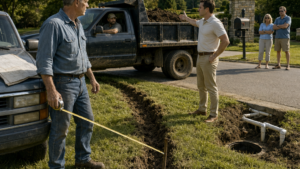
The landscaping crew was still working near the clubhouse. Their truck stood beside the curb, its open bed piled with cut branches. Carolyn carried the yellow notice with her.
The supervisor listened without interrupting. He wore hearing protection around his neck and kept glancing toward the clubhouse windows.
“We didn’t know those roses were private,” he said.
“They’re inside my yard.”
“We were told that strip was the association maintenance edge.”
“By whom?”
He hesitated. “The board president marked it.”
“Nicole?”
He nodded toward the grass. Small spots of orange marking paint were visible beside the curb, continuing past the clubhouse and toward Carolyn’s garden.
“She walked it with us,” he said. “Said anything on the clubhouse side of the marks could be cleared.”
“The marks are inside my flower bed.”
“I’m telling you what we were given.”
Carolyn asked him to put that in writing.
His expression closed at once. “You’ll need to talk to the company office.”
“Will the work order show who gave the instruction?”
“It should.”
When she turned back toward her house, Nicole was standing outside the clubhouse entrance with a phone against one ear. Their eyes met across the grass.
Nicole did not wave.
Carolyn appealed the bin citation that afternoon. She attached the camera image, collection schedule, and photographs. She also submitted a separate damage complaint with a request for the landscaping work order.
Four days passed.
Then a white envelope arrived acknowledging the citation appeal but not the roses. Carolyn sent a second email. The automated response said the board had thirty days to reply.
On the ninth day, she saw Nicole collecting mail from the clubhouse office.
“Did you receive my landscaping complaint?” Carolyn asked.
Nicole did not stop walking. “All correspondence goes through the management process.”
“There is no management company listed on the response.”
“The board is transitioning administrative functions.”
“So who is reviewing it?”
Nicole turned then. “Carolyn, people see you working around the clubhouse, and I think that has blurred some boundaries.”
The word caught Carolyn’s attention.
“What boundaries?”
“Between helping and assuming authority.”
“I’m not assuming authority. I’m asking who authorized damage to my yard.”
Nicole tucked the mail against her side. “The association maintains common areas. If plantings extend into them, removal may be permitted.”
“They don’t.”
“That’s your interpretation.”
Carolyn almost said, My mother knew exactly where the line was.
Instead, she held the words behind her teeth.
Ruth had disliked disputes. When neighbors argued over fences or parking spaces, she carried lemonade outside and gave them time to become embarrassed by their own voices. Carolyn had inherited neither the lemonade habit nor Ruth’s ease with people. What she had inherited was the conviction that making a conflict public meant something had already been lost.
So she documented.
She photographed the orange marks. She printed every email. She placed the broken cane in a shallow tray near the kitchen window and wrapped its base in a damp towel.
The appeal decision never arrived.
At the next board meeting, Nicole announced the additional fee.
The morning after that meeting, Carolyn prepared a second appeal packet. She included proof that the first decision had not been mailed: the association’s online account showed no uploaded letter, and the postal preview service showed no HOA envelope during the relevant week.
Paul answered the clubhouse door when she delivered it.
“I need a stamped copy,” she said.
He looked over his shoulder. “Nicole handles compliance.”
“I’m leaving it with the board treasurer.”
“I don’t really have intake authority.”
“Then write the date and your initials.”
He lowered his voice. “This is getting bigger than an eighty-dollar fine.”
“It became bigger when they put yard waste on my mother’s roses.”
Paul looked toward the damaged bed through the glass door. “I’m sorry about those.”
“Were you at the appeal review?”
His silence answered.
“Was there a review?”
“Carolyn.”
“Was there?”
He rubbed one hand across his mouth. “Send the packet by certified mail.”
Then he closed the door.
The second appeal was rejected two days later. The notice stated that photographic evidence did not establish continuous compliance and that the administrative fee would remain.
There was still no answer regarding the landscaping work order.
Carolyn read the decision at her kitchen table. Beside it lay Ruth’s old pruning shears and the damaged cane. The pale bud had begun to darken at its outer petals, but the wood beneath it was green.
She trimmed the break cleanly.
As she worked, she remembered Ruth kneeling in the same bed, tapping soil around a new plant with the back of her glove.
“Keep these on our side of the line,” Ruth had told her.
Carolyn had been twenty-six and impatient. “What line? There’s no fence.”
“There doesn’t have to be a fence for a line to matter.”
At the time, Carolyn had assumed Ruth meant neighborly respect.
Now she was less certain.
She went to the hall closet and pulled out the cedar chest Ruth had kept beneath winter blankets. Inside were tax receipts, old photographs, appliance manuals, and bundles of letters tied with fading ribbon.
At the bottom, under the deed to the house, Carolyn found the corner of a thick paper folded into a narrow rectangle.
A county seal was visible near the edge.
Across the fold, in Ruth’s handwriting, were four words:
Clubhouse—keep with land papers.
Chapter 3: The Folded Line Beneath Ruth’s Handwriting
The crease opened directly across the clubhouse.
Carolyn spread the county plat over the kitchen table, holding down its corners with a coffee mug, Ruth’s pruning shears, the appeal decision, and the shallow tray containing the rose cutting.
The paper was older than Maple Court’s current entrance sign. Parcel numbers had been typed in uneven ink. Roads appeared as paired black lines, with measurements written along their edges. Ruth’s lot was outlined in pencil, then traced again in blue.
The clubhouse footprint had been drawn later in red.
Its eastern wall crossed the blue boundary.
Carolyn leaned closer.
At first she thought the red outline might represent a planned building rather than the completed one. Then she saw Ruth’s note beside it: Community room after flood. Temporary permission.
No date. No signature. No explanation.
Carolyn found the current parcel map online and printed it. The modern version showed cleaner graphics but less detail. The clubhouse appeared to sit entirely inside the association’s common parcel because the structure itself obscured the underlying line.
She placed the maps side by side.
If the older measurements were correct, the clubhouse occupied a strip of Baker land nearly twelve feet wide. The side entrance, utility room, and part of the long meeting wall stood over it.
The same wall beside which Nicole had ordered her to arrange chairs.
Carolyn’s first feeling was not triumph. It was a cold recognition that Nicole’s access form might not be routine at all.
She reread the language.
Continued association access across areas historically used for common purposes.
No parcel number. No map attached. No limit on duration. No acknowledgment of ownership.
At nine the next morning, Carolyn carried the original plat, the deed, and a copy of the access form into the county recorder’s office.
The clerk at the public counter examined the plat beneath a sheet of clear protective film.
“This is an original subdivision survey copy,” she said. “Not the recorded master, but it has the surveyor’s stamp.”
“Can you tell whether that boundary is still valid?”
“I can tell you what’s recorded. For a boundary opinion, you’ll need a licensed surveyor.”
The clerk searched the parcel index. She entered the Baker lot number, then the association’s common parcel, then the clubhouse address.
A list of instruments appeared: subdivision declaration, utility easement, drainage agreement, amended restrictions, tax releases.
“Is there an easement for the clubhouse?” Carolyn asked.
“Not under this parcel.”
“A lease?”
The clerk searched again. “Nothing recorded.”
“Could ownership have transferred without showing here?”
“Not if it was properly recorded.”
The words gave Carolyn a brief, dangerous sense of certainty.
She imagined returning to the clubhouse, placing the plat before Nicole, and asking who was now standing where she did not belong.
The clerk turned the original over. “There’s a reference number written on the back.”
Carolyn had missed it. Ruth’s handwriting ran faintly along the lower edge: See Baker letter, community room file 14-B.
“Is that a county file?”
“Maybe an old planning attachment. Let me check.”
The clerk disappeared into the records area.
Carolyn waited beside a rack of property-transfer forms. Through the glass doors, people came and went carrying folders much like hers. Nothing in the building resembled revelation. Fluorescent lights hummed. A printer clicked. Someone argued quietly about a filing fee.
When the clerk returned, she carried a slim archive box.
“File fourteen-B isn’t a recorded instrument,” she said. “It’s supporting correspondence from a permit review.”
Inside were inspection notes from more than two decades earlier, photographs of water damage in Maple Court’s original community room, and an application to convert a storage building into a temporary meeting facility.
The permit sketch showed the proposed clubhouse crossing the same line.
Attached to it was an unsigned copy of a letter attributed to Ruth Baker.
The copy ended after the first paragraph.
Carolyn read it twice.
I have no objection to temporary use of the ground adjoining my parcel while repairs and community needs are being addressed.
“Where’s the rest?” she asked.
“That’s all in this file.”
“It says adjoining my parcel.”
“It does.”
“But the sketch shows the building on it.”
The clerk studied the sketch. “That would be a question for planning or a surveyor.”
“Does this letter create an easement?”
“I can’t give legal advice. But it isn’t recorded, and this copy isn’t signed.”
The small payoff Carolyn had felt a moment earlier narrowed into something less satisfying but more useful. The county had no deed transfer, no lease, and no recorded easement. The plat was authentic. Yet Ruth had apparently known about the construction and allowed some form of use.
Carolyn requested certified copies of the index and permit file. While the clerk prepared them, she examined the original plat again.
Near the bottom, beneath the legend, Ruth had written another note so lightly it was almost invisible:
Full letter in cedar chest.
Carolyn’s pulse changed.
She drove home without stopping for groceries. The access form lay on the passenger seat, sliding slightly whenever she turned.
At the cedar chest, she removed every bundle in order. Tax papers. Insurance policies. Correspondence from the developer. At last she found an envelope pressed flat beneath the wooden lining.
MAPLE COURT COMMUNITY ROOM was written across the front.
Inside was Ruth’s carbon copy, signed and dated.
The first paragraph matched the archive copy. The second did not sound like a deed, a lease, or a gift. It sounded like Ruth: generous, plainspoken, and far too trusting that other people would understand the limits she had not formalized.
The neighborhood may use the ground without charge during the present need. This permission does not transfer ownership and should be reviewed when permanent community arrangements become possible.
Below that, Ruth had added a handwritten sentence.
You may use the ground while the neighborhood still needs it.
Carolyn sat with the letter in both hands.
The clubhouse had not appeared through trespass alone. Ruth had opened the door.
What Carolyn could not yet tell was whether she had also left it open forever.
Chapter 4: The Permission That Was Never Ownership
The clubhouse doors opened at ten on Saturday morning, and a family carried framed photographs inside.
Carolyn watched from her kitchen window as folding tables were covered with white cloths. A man in a dark sweater brought in a tray of coffee. Two children followed an older woman across the parking lot, each holding one end of a poster board filled with pictures.
A memorial gathering.
The neighbor who had rented the room paused beside Carolyn’s rose bed and looked down at the damaged bushes. She seemed about to cross the yard, then someone called her from the clubhouse.
Carolyn moved away from the window.
Ruth’s letter lay unfolded on the kitchen table beneath the access acknowledgment. One document offered permission in language shaped by trust. The other asked Carolyn to certify that the association possessed continuing rights across land it did not name.
She read Ruth’s letter again.
The neighborhood may use the ground without charge during the present need. This permission does not transfer ownership and should be reviewed when permanent community arrangements become possible.
Present need.
Permanent arrangements.
The words were not technical, but they were not limitless.
Carolyn searched the old permit file for dates. The original community room had flooded twenty-seven years earlier after a drainage failure. Maple Court’s developer had proposed repairing it within eighteen months. The temporary clubhouse had been approved as an interim solution.
The old community room was never restored. The developer dissolved. The temporary structure received new siding, a kitchen renovation, and a wider entrance. Each improvement made it look less temporary without changing the ground beneath it.
Carolyn looked toward the parking lot again.
The memorial guests were arriving now. A man carried a box of programs. The older woman stood near the door, greeting people with both hands. Whatever had happened between Ruth and the first board, none of these people had caused it. They had rented a room listed on the HOA website. They believed the association had the right to offer it.
Carolyn imagined taping a notice to the door.
Private property. Access revoked.
The thought gave her no satisfaction.
She returned to the rose cutting. The damaged cane had one green section below the broken bud. Carolyn trimmed away the darkened wood, dipped the base into rooting powder, and pressed it into a small clay pot filled with damp soil.
Ruth had shown her the method years ago.
“Not every cutting takes,” she used to say. “You give it what it needs and then you wait without pretending you control it.”
Carolyn set the pot beside the window.
A car door closed outside.
Nicole crossed the lawn toward the clubhouse carrying a clear plastic box of serving utensils. She wore jeans and a navy sweater instead of her meeting clothes. At the entrance, she stopped to help the older woman adjust the photograph display.
For several minutes, Nicole looked nothing like the person who had read Carolyn’s fines aloud.
She held the door for guests. She found extra chairs. When one of the children dropped a stack of programs, Nicole knelt to gather them.
Carolyn disliked how much that mattered.
It would have been easier if Nicole were cruel in every room.
By early afternoon, the memorial gathering ended. Guests carried flowers and empty trays to their cars. The older woman remained behind, speaking quietly with Nicole near the entrance.
Carolyn stepped outside to inspect the rose bed.
The neighbor noticed her and approached.
“I heard what happened to these,” she said. “I’m sorry.”
“Thank you.”
“My husband’s service was in there.” She glanced toward the clubhouse. “He coached half the children in Maple Court when they were little.”
Carolyn nodded. She remembered him sweeping leaves from the basketball court each fall.
“The room was all we could afford,” the woman continued. “Nicole waived the extra cleaning deposit.”
Carolyn looked at the building.
Through the open door, she could see the long meeting wall standing across the line on Ruth’s plat.
“I’m glad you had the room,” Carolyn said.
The woman touched Carolyn’s arm once before leaving.
That evening, Carolyn assembled her first formal complaint packet. She included the certified parcel index, original plat, photographs of the roses, rejected appeal, and access acknowledgment. She did not include Ruth’s full letter.
She told herself the omission was temporary.
The letter complicated the issue before the association had admitted the basic facts. It confirmed permission, but it also confirmed retained ownership. Carolyn wanted the board to answer one question first: what recorded right did it claim?
Still, when she sealed the packet, she felt the weight of what she had withheld.
On Sunday morning, George Nelson found her measuring from the side of her house toward the clubhouse with a hardware-store tape.
“You’ll make yourself crazy doing it that way,” he said from the sidewalk.
Carolyn straightened. “I know it isn’t a survey.”
“Good.”
George had retired from the county years earlier. He had a habit of speaking as if every sentence might someday be quoted in a dispute.
She showed him a copy of the plat but kept Ruth’s letter in the folder.
He studied the measurements without touching the page.
“This line is credible,” he said. “But old plats can be interpreted badly when monuments are gone.”
“There’s no recorded easement.”
“That doesn’t prove where the field line sits today.”
“Can lines move?”
“No. Evidence of them can be misunderstood.”
He pointed toward the clubhouse corner. “You need a licensed surveyor, not a tape measure and not me.”
“Would you look at the documents at the meeting?”
“I’ll look. I won’t endorse a conclusion without fieldwork.”
It was not the support Carolyn wanted, but it was more useful than agreement.
That afternoon, she placed Ruth’s letter in a separate envelope and returned it to the cedar chest.
At four-thirty, the doorbell rang.
Nicole stood on the porch beside a notary carrying a leather case.
“I thought it would be easier to handle this privately,” Nicole said.
She held out a fresh copy of the access acknowledgment.
Carolyn did not take it.
“Why is a notary here?”
“To verify signatures. It protects everyone.”
“Which parcel does this cover?”
Nicole glanced at the notary. “It simply confirms historic use.”
“Historic use of what?”
“The clubhouse access area.”
“Who owns that area?”
Nicole’s polite expression sharpened. “Carolyn, this is not a transfer document.”
“That wasn’t my question.”
The notary shifted her case from one hand to the other.
Nicole lowered her voice. “The association’s insurance renewal is under review. We need routine confirmations from adjacent owners.”
“Then attach a map.”
“That would delay the process.”
“Attach the recorded easement.”
Nicole said nothing.
Carolyn looked past her toward the clubhouse, where the last memorial flowers were still visible through a window.
“What happens if I don’t sign?”
“Coverage questions become more complicated.”
“For whom?”
“For the entire community.”
There was truth in the answer. Carolyn heard it beneath the pressure.
Nicole extended the document again.
“Sign it today,” she said, “and we can resolve the fines as a courtesy.”
The offer settled between them.
The bin violation. The administrative fee. The roses. None of it was separate.
Carolyn closed her hand around the edge of the door.
“No.”
Nicole’s face changed—not into anger, but urgency.
“You may not understand what refusing could cost your neighbors.”
“You may not understand what signing could cost me.”
Carolyn shut the door before the notary opened her case.
Chapter 5: Three Minutes Before the Board Cut Her Off
“Carolyn, we need six more chairs along the wall.”
Nicole did not look up when she said it.
The Monday meeting had drawn more residents than the clubhouse could comfortably hold. Word had spread that Carolyn was disputing association access, though no one seemed to know exactly what that meant.
Carolyn stood just inside the door with the brown folder under one arm. The damaged rose cutting lay wrapped in a damp cloth inside it. Ruth’s full letter remained at home.
“I’m a homeowner attending the meeting,” Carolyn said.
Nicole glanced up. “And chairs still need moving.”
Several conversations stopped.
Carolyn crossed the room, lifted one chair from a stack, and placed it beside the wall. She checked that it did not block the exit. Then she returned to the board table.
“I’m signed in for homeowner comments.”
“You have three minutes.”
“I also submitted a records request.”
“That is not on tonight’s agenda.”
Carolyn placed the folder on the table. “Then please start the clock.”
Nicole leaned back. “Homeowner comments occur after committee reports.”
“I’ll wait.”
Carolyn took a seat in the front row.
The meeting moved slowly. Nicole discussed pool repairs, mailbox paint, and a proposed increase in late fees. Paul read a reserve summary without raising his eyes. George sat near the aisle with his arms folded.
When homeowner comments finally began, Nicole checked the wall clock.
“Ms. Baker,” she said. “Three minutes. Please limit your remarks to matters within board authority.”
Carolyn walked to the table.
She removed the rose cutting first.
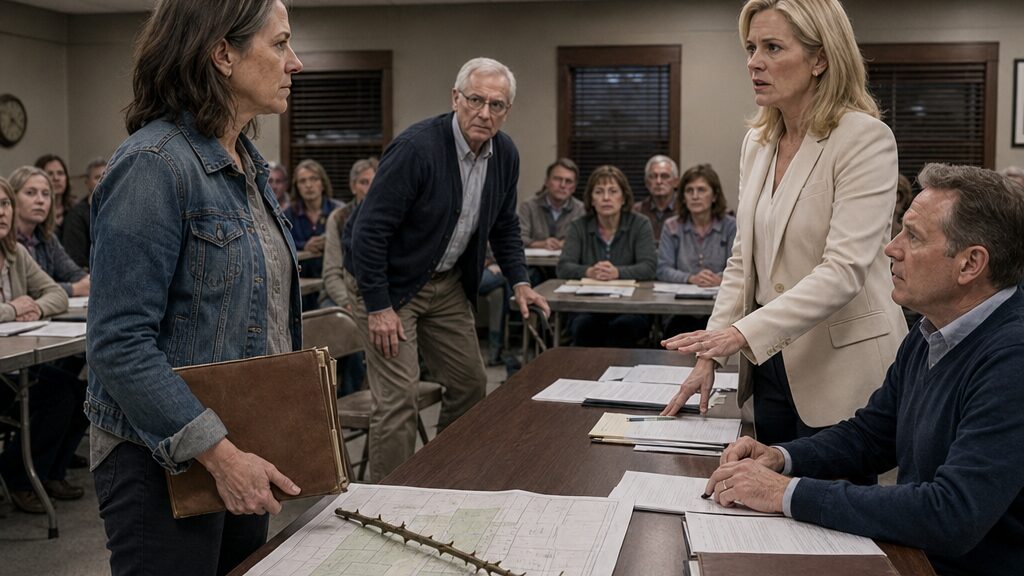
A few residents shifted forward. The cane was dry now, its thorns dull, one broken end cut clean. Carolyn laid it across the folded county plat.
“This came from the rose bed damaged by the association’s landscaping contractor,” she said. “The board has not answered my complaint or produced the work order.”
Nicole reached toward the microphone. “That matter is under review.”
Carolyn opened the plat.
The paper spread across the table, forcing Nicole to move her agenda packet. Its old crease ran through the red outline of the clubhouse.
“This is an authenticated copy of the original subdivision survey,” Carolyn said. “The county index shows no recorded deed transfer, lease, or easement allowing the association permanent use of the part of my parcel beneath this building.”
The room became still enough for the ventilation fan to be heard.
Nicole looked at the map without bending closer.
“Old surveys are often superseded,” she said.
“Then produce the newer instrument.”
“We are not conducting a title hearing.”
“No,” Carolyn said. “I’m asking what right the association claims.”
Nicole tapped the timer on her phone. “You have one minute remaining.”
George stood.
“May I see the plat?”
Nicole’s irritation flashed. “George, this is homeowner comment, not an open discussion.”
“I’m asking to examine a survey document being presented to the board.”
Carolyn slid the map toward him.
George put on his glasses. He studied the seal, bearings, distances, and later red outline. He turned the paper toward the room, then compared it with the copy Carolyn had made of the current parcel map.
“This is not proof of the exact modern field location,” he said. “But it is credible evidence of a boundary conflict.”
Nicole seized on the first sentence. “Exactly. It proves nothing.”
George looked at her over his glasses.
“That is not what I said.”
A murmur moved through the residents.
He placed one finger beside the clubhouse wall. “The original line appears to cross the structure. A licensed field survey is required before anyone should make a final claim.”
Carolyn felt something loosen in her chest. Not victory. Recognition that the question could no longer be dismissed as personal resentment.
Nicole folded her hands.
“Property lines are adjusted all the time during development.”
“Recorded boundaries can be amended,” George said. “They do not shift because a building is convenient.”
Carolyn met Nicole’s eyes.
“Lines don’t move to fit buildings.”
The sentence landed without force, which gave it more weight.
Paul stopped turning pages.
Nicole’s timer sounded.
“Three minutes,” she said. “Thank you.”
“I’m not finished.”
“The rule applies to everyone.”
“Then enter my unanswered question into the minutes.”
Nicole’s jaw tightened. “The board will consult counsel.”
Carolyn began folding the plat.
“Before you do that,” Nicole said, “residents should understand that Ms. Baker has omitted relevant history.”
She opened a white folder from beneath the table.
Carolyn recognized the permit-file number printed on its tab.
Nicole removed a copy of Ruth’s letter.
“This document,” she said, “shows that Carolyn Baker’s mother expressly authorized community use of the property.”
The reaction in the room changed at once. Residents who had leaned toward Carolyn now looked between her and Nicole.
George held out his hand. “Let me see the entire letter.”
Nicole gave him the copy.
It included both paragraphs.
Carolyn’s face warmed.
Nicole turned toward her. “Did you possess this letter when you submitted your complaint?”
Carolyn could have lied about when she found it. The thought lasted less than a second.
“Yes.”
“And you chose not to provide it.”
“I asked the board to identify its recorded property right.”
“That wasn’t my question.”
“Yes,” Carolyn said. “I withheld the letter.”
The admission disturbed the room more than Nicole’s accusation. Carolyn heard a chair scrape behind her.
Nicole’s posture changed. For the first time that night, she looked secure.
“This is exactly why the board cannot respond to selective documents and emotional claims,” she said. “The association has used the property with permission for decades.”
“Temporary permission,” Carolyn said.
Nicole lifted the letter. “It says the neighborhood may use the ground while it still needs it.”
“It also says no ownership transfers and the arrangement must be reviewed.”
“That review can occur through the access acknowledgment you refused to sign.”
Carolyn looked around the room. Some residents seemed disappointed in her. Others looked uncertain. The sharp clarity she had brought into the meeting had fractured because she had concealed part of the truth.
She had wanted Nicole to answer first. In doing so, she had made it easier for Nicole to suggest that no answer was owed.
George read the letter again.
“This confirms consent at the time,” he said. “It does not establish a permanent easement.”
Nicole’s smile faded slightly.
He continued, “And it makes the independent survey more necessary, not less.”
One of the dissenting board members asked who had authorized Nicole to bring a notary to Carolyn’s home.
Nicole ignored the question.
Paul had been staring at the bottom corner of the copied letter. A string of numbers appeared beneath the page stamp.
He stood and leaned toward Nicole.
“Where did you get this copy?”
“From association files.”
“No.” He tapped the number. “That’s an insurance counsel file reference.”
Nicole closed the folder.
Paul did not sit down.
“Our renewal attorney uses that sequence,” he said. “This document came through the title review.”
The room went quiet again, differently this time.
Nicole’s eyes moved toward the door.
Paul’s voice dropped, but everyone heard him.
“How long have you known there was a title problem?”
Chapter 6: The Ledger Behind the Missing Easement
The first survey stake appeared six inches from the clubhouse wall.
It was a narrow wooden marker with a strip of orange flagging tied near the top. The independent surveyor placed a second stake beside Carolyn’s damaged rose bed and stretched a line between them.
Residents watched from sidewalks and driveways.
Nicole stood near the clubhouse entrance with her arms crossed. She had objected to the survey company, then to the appointment date, then to allowing Carolyn on the site. The HOA attorney overruled each objection in writing.
Carolyn stayed beside George while the crew checked measurements against recorded monuments.
“Don’t celebrate a preliminary stake,” George said.
“I’m not.”
“You’re staring at it.”
“It’s in my roses.”
“That does make it difficult to ignore.”
The surveyor moved to the far corner of the building. After another hour, three orange flags marked a line passing through the rose bed and along the clubhouse wall. Part of the utility room and side entrance stood inside Carolyn’s parcel.
The surveyor approached with a field tablet.
“The boundary aligns closely with the original plat,” he said. “We’ll issue the signed report after calculations are reviewed.”
“How closely?” Nicole asked.
“The structure encroaches between eleven feet four inches and eleven feet nine inches, depending on the wall segment.”
Nicole’s face remained composed, but one hand tightened around her phone.
The field survey did not decide what Ruth’s permission meant. It did decide where the building stood.
Carolyn looked at the nearest flag. Its orange ribbon moved above the broken rose stems.
For the first time, Ruth’s line existed in the present—not as handwriting, memory, or accusation, but as a measured place.
That afternoon, the board opened its records room under pressure from counsel. The room was a windowless office behind the clubhouse kitchen. Metal cabinets filled one wall. Banker’s boxes were stacked beneath a folding table.
Nicole remained outside with the attorney.
Paul unlocked the first cabinet.
“I should have done this months ago,” he said.
Carolyn did not answer.
He removed ledgers, rental logs, bank statements, and insurance correspondence. His movements were too careful, as if neatness could reduce what the papers contained.
George sat at the table reviewing the surveyor’s preliminary notes. Two board members sorted files by year.
Carolyn found the insurance letter in a folder labeled RENEWAL—PROPERTY SCHEDULE.
The first page was dated four months earlier.
Counsel had flagged a discrepancy between the legal description of the common parcel and the clubhouse footprint. The letter requested proof of ownership, leasehold interest, or recorded easement before renewal.
A handwritten note in Nicole’s writing appeared in the margin:
Get adjacent-owner acknowledgment before board discussion.
Carolyn read the sentence twice.
Beneath it was a draft access acknowledgment almost identical to the one taped to her door.
Nicole had known before the first parking citation.
Before the bin fine.
Before the landscaping crew marked the rose bed.
Paul stood behind her.
“I saw that letter,” he said.
Carolyn turned.
“When?”
“The week it arrived.”
“And you said nothing.”
“I asked Nicole whether it needed to go to the full board. She said counsel was asking for routine documentation.”
“You’re the treasurer.”
“I’m not the president.”
“That didn’t prevent you from reading my fine into the ledger.”
He flinched.
Carolyn placed the insurance letter flat on the table. “Did you know she was fining me to force a signature?”
“No.”
“Did you wonder why the acknowledgment and the fines arrived together?”
Paul looked toward the open doorway.
“I didn’t want the answer.”
The honesty was smaller than courage, but it was not nothing.
He pulled a thick ledger from the cabinet and opened it to the clubhouse rental account. Each month showed deposits: birthday parties, memorials, homeowner workshops, holiday events. Many entries were fourteen hundred dollars in combined fees and deposits. Some months were higher.
“How long has the clubhouse generated this income?” Carolyn asked.
“Years.”
“Where did it go?”
“Operations, utilities, repairs. Some into reserves.”
“How much is left?”
Paul turned to the reserve summary.
The number was far lower than Carolyn expected.
A roof repair, drainage replacement, and pool equipment failure had nearly emptied the fund. The association could not repay years of rental revenue, compensate Carolyn, and correct the property issue without raising assessments.
“That’s why Nicole panicked,” Paul said.
“That’s why she should have told the board.”
“I know.”
“Do you?”
His face reddened.
He pushed the ledger toward her. “I kept thinking that if the acknowledgment got signed, no one would lose anything.”
“I would.”
“You weren’t using the strip.”
Carolyn looked through the wall toward the orange stake outside.
“That isn’t the same as not owning it.”
Paul sat down.
For years, he had treated silence as the absence of action. Carolyn had done much the same. The difference between them felt less comfortable than she wanted it to.
One of the board members opened another file and found the landscaping work order. Attached was Nicole’s marked site map. The disposal zone had been drawn deliberately across Carolyn’s rose bed.
The instruction beneath it read: Clear visual obstructions along claimed common edge before inspection.
Insurance inspection.
The roses had not been damaged by carelessness alone. They had been removed from view along the disputed line before the insurer’s visit.
Carolyn carried the work order outside.
Nicole was speaking with the attorney near the side entrance.
“You marked my garden for clearing,” Carolyn said.
Nicole read the page without taking it.
“The contractor exceeded the instruction.”
“You drew the disposal area over the roses.”
“They had spread into what the association believed was common space.”
“You had the title warning.”
Nicole’s composure cracked at the edges. “I had a letter asking for clarification. That is not the same as knowing the association lacked rights.”
“You tried to get my signature before telling the board.”
“I tried to protect coverage for sixty-four homes.”
“You fined me.”
“The compliance issues existed.”
“You offered to erase them if I signed.”
Nicole looked toward the residents gathered beyond the survey line.
“If the policy lapses, every homeowner is exposed,” she said. “Some of them cannot absorb a special assessment. Some are already behind. You think this is about my chair at the table. It is also about families who will be asked for money they do not have.”
Carolyn believed that Nicole feared those consequences.
She also believed Nicole had chosen Carolyn as the person most likely to absorb them quietly.
The HOA attorney approached holding a ring of clubhouse keys.
“The survey report will be final tomorrow,” he said. “Until the property-use question is resolved, the association cannot assume unrestricted access.”
He held the keys toward Carolyn.
Nicole stared at them.
Carolyn did not reach out.
“What are you asking me?” she said.
The attorney’s answer was measured.
“Whether you intend to lock the clubhouse within forty-eight hours.”
Chapter 7: The Door She Refused to Lock
The attorney placed the clubhouse keys in Carolyn’s palm at nine the next morning.
There were four of them on a brass ring: front entrance, side door, office, utility room. She recognized each by touch. For years she had carried an identical set while cleaning, though those keys had belonged to the association and had been returned when Nicole told her the board was “restructuring volunteer access.”
These felt heavier.
“The survey report is final,” the attorney said. “The association has no recorded easement and no current written license. Until that is corrected, access depends on your consent.”
They stood at Carolyn’s kitchen table. The signed survey lay beside Ruth’s letter and the pot containing the rose cutting. A small green leaf had opened from the cane overnight.
“What does restricting access mean?” Carolyn asked.
“You may lock the doors. You may allow limited use. You may negotiate temporary terms. Counsel for the insurer needs a written position within forty-eight hours.”
“And if I do nothing?”
“The insurer will likely suspend clubhouse coverage.”
Carolyn closed her fingers around the keys.
By noon, Maple Court had divided the future into two rumors. In one, Carolyn planned to chain the doors and demand years of rent. In the other, the board intended to take her land through court proceedings. Neither rumor came from Carolyn, but both arrived at her porch in the form of careful questions.
A neighbor asked whether a child’s birthday party scheduled for Saturday would be canceled.
Another wanted to know whether homeowners would receive a special assessment.
The older woman who had held the memorial did not ask for anything. She brought Carolyn a covered bowl and said, “You shouldn’t have to feed yourself while everyone decides what kind of person you are.”
Carolyn almost laughed.
Instead, she put the bowl in the refrigerator and returned to the table.
She wrote three headings on a yellow legal pad.
Ownership.
Past harm.
Future use.
Under ownership, she wrote recognition of Baker parcel and no permanent right without written consent.
Under past harm, she listed the rose bed, rejected appeal, administrative fee, unpaid maintenance, and rental income.
Under future use, she stopped.
Ruth’s letter lay beside her hand.
You may use the ground while the neighborhood still needs it.
The sentence had been generous because Ruth believed need would be met by honesty. Carolyn had spent years honoring the generosity while avoiding the honesty.
She had never told residents why she kept cleaning. She had never asked the board to define her role. When people called her the helper, she swallowed the correction because explaining Ruth’s arrangement felt too private and too complicated.
Her silence had not caused Nicole’s choices. It had made the ground easier to take.
At the mediation room that afternoon, Nicole sat across from Carolyn with the HOA attorney and two board members between them. Paul occupied the far end of the table, a file box at his feet.
Nicole looked tired. Without her meeting jacket, she seemed less armored but no less controlled.
“The insurer has given us until tomorrow at five,” the attorney said. “Without a temporary agreement, the clubhouse closes.”
Nicole turned to Carolyn. “That means no meetings, no rentals, no after-school program, and no coverage for anyone entering the structure.”
“Then stop entering it,” Carolyn said.
One board member inhaled sharply.
Nicole’s expression hardened. “Is that what you want?”
Carolyn felt the keys in her coat pocket.
“No.”
The answer unsettled the room more than a threat would have.
Nicole leaned back. “Then sign a temporary acknowledgment while counsel drafts something permanent.”
“The document you brought to my house gives the association broad historic access without identifying my ownership.”
“It was intended to preserve coverage.”
“It was intended to preserve coverage by making the title problem mine.”
Nicole looked toward the attorney. He did not interrupt.
Carolyn placed the landscaping order on the table.
“You marked my rose bed for clearing before the insurance inspection.”
“I marked what appeared to be the common edge.”
“You had the warning letter.”
“I had a question from counsel.”
“You had enough of a question to seek my signature.”
Nicole’s hands remained flat on the table.
“Yes,” she said. “Because I knew what would happen if the board heard ‘property dispute’ before we had an answer.”
“What would happen?”
“Panic. Threats. People demanding refunds. People who already struggle with dues being told they may owe thousands.”
Her voice was quiet now, stripped of its meeting cadence.
“The reserve fund is weak,” Nicole continued. “The roof repair took more than expected. The pool system failed. If the insurer walked away and the clubhouse closed, property values would be affected. Families use that room because private venues cost too much.”
“All of that may be true.”
“It is true.”
“And it still doesn’t explain the fines.”
Nicole looked directly at her.
“I thought pressure would get the acknowledgment signed before renewal.”
One of the board members lowered her eyes.
The admission did not sound dramatic. That made it worse.
“The parking notice?” Carolyn asked.
“Supported by a photograph.”
“Taken while I unloaded groceries.”
“The bin?”
“A technical violation was available.”
“It wasn’t a violation.”
Nicole did not answer.
“The roses?”
“The crew was supposed to clear sight lines. Not destroy them.”
“You drew the line.”
“I believed the association needed the strip.”
“You believed the community needed it,” Carolyn said. “So you decided I should be the one person who didn’t get to say no.”
Nicole’s mouth tightened.
“I protected sixty-four homes.”
“You protected them by making one homeowner easier to ignore.”
For the first time, Nicole looked away.
There was no apology.
Carolyn had expected that. Still, its absence clarified something. Nicole could explain fear. She could admit strategy. She could not yet admit that Carolyn’s consent mattered independently of what the majority wanted.
The attorney turned to Carolyn. “What temporary terms would you accept?”
Carolyn looked at Paul.
He had not spoken since entering the room.
“How much of this did you know?” she asked.
Paul rubbed the seam of the file box with his thumb.
“I knew about the title warning,” he said. “I knew Nicole wanted the acknowledgment before the full board saw it.”
“Did you know about the fines?”
“Not at first.”
“And when you did?”
“I told myself compliance was separate.”
“Was it?”
“No.”
He lifted his eyes.
“I was afraid of the assessment. I was afraid people would say I failed as treasurer. So I let Nicole call decisions administrative when I knew they were financial.”
The surprise was not that Paul possessed another document. It was that he had no defense left and knew it.
Carolyn nodded once.
“I also kept something back,” she said.
Nicole looked at her.
“I found Ruth’s full letter before the meeting. I withheld it because I wanted the board to answer the ownership question first.”
“You concealed evidence,” Nicole said.
“I concealed part of the history. And that damaged my credibility.”
The room stayed silent.
Carolyn continued before she could retreat into qualification.
“I also let people misunderstand why I cared for the clubhouse. I told myself I was protecting my mother’s promise. Mostly, I was avoiding the conversation that promise required.”
She removed the keys from her pocket and set them on the table.
“I will not lock the building during the forty-eight-hour period.”
The attorney began to speak, but Carolyn raised one hand.
“That is not permission for unrestricted use. Existing scheduled events may proceed. No new rentals. No alterations. No claim that temporary access establishes a permanent right.”
Nicole exhaled through her nose. “That buys two days.”
“It buys enough time for me to offer terms.”
“You’re not counsel.”
“No. I’m the owner.”
The words came without anger. Carolyn heard how different they sounded from Nicole’s claim that she was the board.
Ownership was not the right to silence a room. It was the duty to state where permission began and ended.
At home that night, Carolyn drafted a land-use license from the attorney’s sample language. She crossed out clauses she did not understand and marked questions in the margins. She required independent review, public accounting, defined boundaries, annual payment, maintenance obligations, and a termination process.
For the past, she did not demand every dollar the clubhouse had ever earned. She proposed that disputed rental proceeds be audited and placed into escrow until damage, maintenance, and association obligations were calculated.
For Nicole, Carolyn wrote no punishment. That belonged to the board and the homeowners.
At the bottom, she added one sentence of her own:
Continued community use exists by express consent and shall never be treated as ownership by habit.
The next evening, the clubhouse was full again.
Carolyn entered carrying a folder thick with marked pages.
The keys were in her pocket.
There was no padlock in her hand.
Chapter 8: A Boundary Marked by Something Living
Carolyn placed the clubhouse keys beside the unsigned license.
The sound of metal against the table drew every eye in the room.
Nicole sat at the far end with the remaining board members. The HOA attorney occupied the chair beside Paul. George stood near a mounted copy of the final survey, where the boundary line cut visibly through the clubhouse footprint.
No one asked Carolyn to move chairs.
She remained standing.
“This agreement begins with ownership,” she said. “The clubhouse crosses my parcel by eleven feet and several inches. The association has no deed, lease, or recorded easement for that strip.”
Nicole folded her arms.
Carolyn opened the license.
“I am willing to permit continued use. Not because the board is entitled to it. Because residents use this building, and because my mother intended the ground to serve a community need.”
A murmur moved through the room, then settled.
“The permission will be written, limited, reviewed annually, and tied to specific obligations.”
She read them without flourish.
The HOA would formally acknowledge the Baker parcel. The association would pay a modest annual land-use fee. Maintenance crews could not enter Carolyn’s garden without written notice and consent. Any future alteration to the building required her approval and a current survey.
Past clubhouse rental income would be independently audited. The disputed portion would go into escrow, not directly to Carolyn, while the parties determined compensation for unpaid maintenance, documented garden damage, legal review, and necessary reserve obligations.
A board member interrupted. “You’re not asking for all the past rental money?”
“No.”
“Why not?”
“Because the clubhouse had expenses, and residents paid for use they believed was legitimate. The audit should separate benefit from liability.”
Paul looked down at the ledger before him.
Carolyn continued.
“The fines against my home will be withdrawn. The administrative fee will be refunded. The rose bed will be restored by a contractor I approve. My years of maintenance will be valued from records and receipts, not treated as proof that I agreed to work indefinitely.”
The neighbor who had held the memorial raised her hand.
“What happens to events already booked?”
“They proceed while the temporary agreement remains in effect. New bookings resume after insurance confirms coverage.”
“And if the board refuses?”
Carolyn touched the keys.
“Then access ends when the temporary period expires.”
The room absorbed the answer.
Not revenge. Not surrender. A boundary.
Nicole reached for the license and turned several pages.
“This is not a community agreement,” she said. “It is private control over a common facility.”
“It is private ownership under a community facility.”
“You can cancel with notice.”
“Yes.”
“That means every future board operates at your discretion.”
“It means every future board remembers that use depends on consent.”
Nicole pushed the document away.
“This creates instability.”
“The instability already existed,” George said. “It was hidden.”
Nicole looked at him. “And now we are formalizing one homeowner’s leverage over everyone else.”
Carolyn felt the old instinct to soften her answer before speaking. She let the silence remain instead.
“My mother’s generosity became invisible because it lasted too long,” she said. “I helped make that happen. I kept cleaning. I kept quiet. I let people assume the building and the work behind it belonged to the association.”
Nicole’s expression shifted slightly.
“But generosity is not ownership,” Carolyn continued. “And silence is not permanent consent.”
There was no applause. Several residents looked uncomfortable. One whispered to another about annual fees. Someone near the rear asked whether dues would rise.
The questions were real. Carolyn preferred them to admiration.
The attorney summarized the insurance deadline. Without an executed temporary license, coverage would lapse at five the following afternoon.
Nicole shook her head.
“I will not sign this as president.”
Paul closed the ledger.
“You may not have that authority much longer,” he said.
Nicole turned toward him.
One of the dissenting board members opened the governing documents. “A temporary removal procedure can be invoked when an officer exposes the association to unapproved liability.”
“You cannot remove me because you dislike a negotiation position.”
“This is not about the position,” the board member said. “It is about withholding counsel’s warning, directing selective enforcement, and seeking an owner’s signature without board authorization.”
The second board member supported the motion.
Nicole looked around the table as if waiting for the familiar structure to reassemble itself around her.
It did not.
The vote removed her from negotiations pending a recall meeting and independent financial review. She remained a homeowner and board member until that process concluded, but she no longer spoke for the association on the land dispute.
When the vote passed, Nicole gathered her papers carefully.
At the door, she stopped beside Carolyn.
“You think this will make them grateful,” she said quietly.
“No.”
“They’ll resent every fee and every restriction.”
“Some will.”
“And when the roof needs replacing?”
“They’ll have to discuss the real cost.”
Nicole’s face tightened. “You make that sound simple.”
“It isn’t.”
Nicole looked toward the room, where residents were already arguing about escrow, oversight, and insurance.
For a moment, she seemed less angry than afraid.
Then she left.
The remaining board approved the temporary license that night. The permanent agreement required two more weeks of legal revisions and one open meeting. During that time, the rental account was audited, the landscaping order was confirmed, and Carolyn’s cleaning receipts were compared with years of clubhouse schedules.
The final settlement did not make her wealthy.
It reimbursed the fines and fees, paid for the rose restoration, compensated part of her unpaid maintenance, and placed the disputed rental balance into escrow for repairs and obligations identified by the audit. The association accepted independent oversight of clubhouse income.
Nicole faced a recall vote. She did not attend the meeting where residents removed her as president. Paul testified about the insurance letter and his own failure to bring it forward. He kept his treasurer position only until the audit concluded, then resigned from the board.
In early spring, the contractor Carolyn selected rebuilt the rose bed.
George supervised the placement of permanent boundary markers, though he reminded everyone twice that he was not acting as the surveyor of record.
Carolyn carried the rooted cutting outside in its clay pot.
The damaged cane had produced four new leaves.
She knelt beside the nearest marker, where the garden met the strip of land under the clubhouse wall. The soil was dark and loose from repair work. She eased the young roots from the pot and set them into the ground.
The memorial neighbor stood nearby holding a watering can.
“Here?” she asked.
Carolyn looked at the metal marker, then at the clubhouse.
“Here.”
Together they pressed soil around the cutting.
Later that afternoon, the new oversight committee met for the first time. Its members included homeowners, a board representative, and one resident unaffiliated with either side of the dispute.
Carolyn attended only long enough to explain the access conditions.
When the meeting ended, she took the brass key ring from her pocket.
For years, keys had meant she was expected to enter quietly, clean what others left behind, and return the room to order without asking who had defined her place.
Now she separated the front-door key from the ring.
She handed it to the committee representative.
“This one opens the building,” Carolyn said. “The agreement tells you when.”
The representative accepted it with both hands.
Outside, the rose cutting stood beside the boundary marker. It was too young to bloom and too small to hide the line.
That was why Carolyn had planted it there.
The story has ended.