The HOA Called Her Orchard Dead Space Until One Boundary Marker Threatened the Entire Subdivision
Chapter 1: The Orange Line Through the Oldest Apple Row
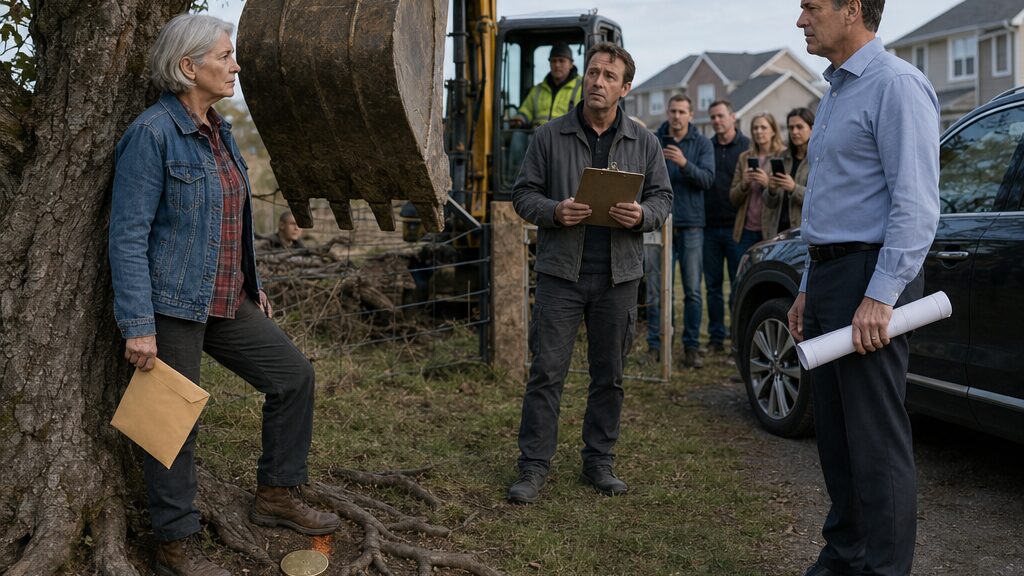
The backhoe bucket dropped until its steel teeth hovered inches above the oldest apple tree’s exposed roots.
Laura Mitchell stepped beneath it before anyone could warn her away.
The operator froze with both hands on the controls. Diesel rattled through the morning air. Beyond the orchard fence, garage doors stood open along the subdivision road, and residents watched from driveways with coffee mugs and folded arms.
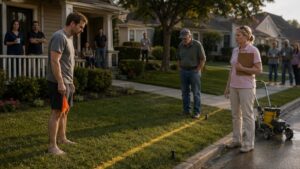
A stripe of orange paint ran from the gate, across the grass, and through the first row of trees. It passed directly over the round brass marker set low beside the oldest trunk.
Laura planted one boot on the painted line.
“Raise it,” she said.
The excavation contractor looked toward Christopher Hall instead of answering her.
Christopher stood beside a dark SUV with a rolled plan under one arm. He wore pressed slacks and a pale blue shirt, his sleeves buttoned despite the heat. Beside him, James Robinson held a clipboard against his chest as though it might stop an argument.
“Laura,” Christopher said, “the crew is clearing a drainage corridor. They are not removing the tree.”
“The paint goes through its root plate.”
“The engineer marked the approved route.”
“The engineer marked my land.”
Christopher exhaled through his nose. “This has been discussed for six months.”
“It has been discussed as if discussion were permission.”
One of the nearby homeowners shifted closer to the fence. Another lifted a phone, then lowered it when Laura looked over.
James stepped forward. “Mrs. Mitchell, the work order authorizes surface clearing and access preparation along the eastern boundary.”
Laura’s eyes moved to the sheet clipped beneath his hand.
“Read me the parcel number.”
James hesitated.
Christopher’s face tightened. “That is not relevant to safety.”
“It is relevant to ownership.”
“The title summary is in the board packet.”
“I didn’t ask what was in the packet.” Laura lifted her chin toward James. “Read the number on the work order.”
James looked at Christopher, then down at the page. “Parcel 18-B-04.”
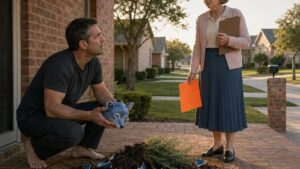
Laura bent, brushed dirt from the brass marker with two fingers, and read the stamped number aloud.
“Seven-C-11.”
The backhoe engine continued to throb.
James glanced at the work order again. “That may be an old reference number.”
“It is the number on the county marker.”
Christopher unrolled the plan across the hood of his SUV. “The subdivision was replatted. Numbers change.”
“Then someone should be able to show when this one did.”
The orange paint cut over the marker and disappeared beneath a mat of clover. Laura had rubbed that brass disk clean every spring since she was twelve. Her father used to tap it with the heel of his boot when he explained where their land ended and other people’s promises began.
Christopher leaned over the plan. “The stormwater channel is backing up behind the western cul-de-sac. Three homes took water last month. The insurer gave us a deadline. This route is the approved route.”
“Approved by whom?”
“The board, the engineer, and county planning.”
“County planning approved a design. They did not give you my ground.”
“The HOA has access rights.”
“Then produce them before you lower another bucket.”
The contractor muttered something to the operator. The bucket lifted several feet, but the machine remained in place.
Christopher checked his watch. “You have until noon to step aside voluntarily.”
A murmur passed among the people near the fence.
Laura heard one man say, “She doesn’t even live in the association.”
A woman answered, “But our water has to go somewhere.”
Christopher lowered his voice. “This is not about punishing you.”
“No. It is about making your cheapest route somebody else’s problem.”
“It is about protecting homes.”
“And you decided that made the boundary optional.”
James moved between them before Christopher could reply. “No one is saying that.”
Laura reached into the pocket of her denim jacket and removed an unopened envelope. Christopher’s company logo was printed in one corner. Inside was the latest offer for the narrow strip and an additional two acres beyond it.
She held it up.
“This arrived Friday.”
Christopher’s jaw shifted. “That is a separate proposal.”
“It buys the land your work order says you already have the right to enter.”
“It gives you compensation and resolves uncertainty.”
“It resolves your uncertainty.”
A car door slammed behind the watching residents.
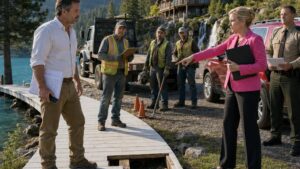
Pamela Clark came down the road in low heels unsuitable for orchard ground, carrying her work tote against her side. Her gaze moved from the backhoe to Laura beneath the raised bucket.
“Mom.”
Laura did not step away from the marker.
Pamela approached slowly. “What are you doing?”
“Keeping them from clearing before they prove where they are.”
“You’re standing under machinery.”
“The operator has better judgment than the board.”
Christopher looked away, but not before Laura saw the flash of offense.
Pamela stopped beside her. “Can we talk without an audience?”
“There would not be an audience if they had not brought a backhoe at eight in the morning.”
“Please don’t make this worse.”
Laura felt the sentence land harder than Christopher’s deadline.
“Worse for whom?”
Pamela glanced toward the neighbors. She knew many of them through the school district. Parents, volunteers, people who greeted her in grocery aisles and expected calm explanations.
“For everyone,” she said quietly.
Christopher rolled the plan again. “The crew will stand down until noon. After that, the board’s authorization remains in effect.”
“You said the board already authorized it.”
“It did.”
“Then why wait?”
His eyes settled on the brass marker. “Because I am giving you one final opportunity to cooperate.”
Laura folded the envelope once, sharply, but did not tear it.
“If you cross that marker without a recorded easement matching this parcel, cooperation will be the least of your problems.”
Christopher signaled to the contractor. The backhoe reversed a few yards, leaving deep tread marks in the grass. The residents began to disperse, though several stayed near the fence.
James removed the posted notice from the gate and replaced it with another sheet from his clipboard.
“What is that?” Laura asked.
“Notice of emergency meeting.”
Pamela took the paper before Laura could.
The meeting was scheduled for seven that evening at the HOA clubhouse. The stated purpose was to ratify temporary access authority, address stormwater risk, and consider legal enforcement against obstruction of essential maintenance.
Christopher opened his vehicle door.
“At seven,” he said, “the board will vote in public. Bring whatever you think that marker proves.”
Laura looked down at the orange line crossing the brass disk.
She knew what her father had told her about it.
She did not yet know whether the county still agreed.
Chapter 2: The Check Pamela Wanted Her Mother to Take
Pamela placed the past-due tax notice beneath Christopher’s purchase check and flattened both papers with the palm of her hand.
“Which one were you planning to tell me about first?”
Laura stood at the kitchen counter scraping mud from the edge of her boot with a butter knife. Outside the window, the backhoe remained parked beyond the gate like an animal told to wait.
“The taxes are handled.”
“The notice says they are not.”
“It says there is a balance.”
“It says there is a deadline.”
Laura set the knife in the sink. “I know how to read it.”
Pamela pulled out a chair but did not sit. The kitchen table was crowded with old survey notes, a pencil rubbing of the brass marker, and the unopened offer Christopher had delivered.
“You know how to read it,” Pamela said. “You just don’t know how to tell anyone else.”
Laura reached for the notice. Pamela kept her hand on it.
“How much did you pay?” Laura asked.
Pamela’s expression changed by a fraction.
“That is not the point.”
“How much?”
“Three thousand in February. Another twelve hundred last month.”
Laura let go of the paper.
Pamela finally sat. “I found the first notice in your truck when I took it for inspection. I called the county. They said you had been making partial payments.”
“I was catching up.”
“With what?”
“The spring market.”
“The spring market barely covered pruning.”
Laura looked through the window toward the oldest row. The tree nearest the gate had lost one heavy limb two winters earlier. She had sold fewer bushels every year since.
Pamela tapped Christopher’s check. “This would clear the taxes, replace the irrigation pump, and leave enough to reduce the orchard to something you can actually manage.”
“The strip he wants is not harmless.”
“Neither is losing the whole property because you refuse to look at numbers.”
“I looked at numbers for thirty-eight years.”
“For other people. You retired from bookkeeping and stopped keeping honest books for yourself.”
The words were too accurate to dismiss. Laura picked up the pencil rubbing instead. The marker number showed in reversed gray impressions: 7-C-11.
“Your grandfather said that marker belonged to the original north plat.”
Pamela leaned back. “Grandpa also thought duct tape could repair a tractor seat forever.”
“He was right for eleven years.”
“That is not an answer.”
Laura folded the rubbing and slid it beneath the check.
Pamela watched her. “I’m not asking you to sell the orchard. I’m asking you to stop acting as though every compromise is surrender.”
“Their compromise begins with a bucket over the roots.”
“And your answer begins with standing under it.”
At six thirty they drove separately to the HOA clubhouse.
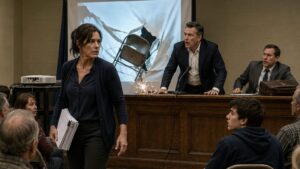
The meeting room was already full. Folding chairs faced a long table where Christopher sat between James and Joshua Smith, the association’s attorney. Two board members sorted packets beneath fluorescent lights.
A projector displayed a photograph of brown water pooled against a garage door.
Laura stopped in the aisle.
The image was followed by another: soaked drywall removed from the lower half of a family room. Then a third showed children’s bicycles stacked on a porch above muddy water.
Christopher waited until the room settled.
“This is not a hypothetical problem,” he said. “Three households experienced water intrusion during the last storm. The insurer has requested corrective action before renewal review.”
A homeowner in the front row raised her hand. “We were told the drainage plan was approved when we bought.”
“The original system met the county standard at the time,” Christopher said. “Development uphill increased runoff beyond projections.”
Laura looked toward him. “Development approved by the same company that sold the common parcels to the association.”
Joshua leaned toward his microphone. “Tonight is not a hearing on developer liability.”
“No,” Laura said. “It is a vote on whether to enter land you may not control.”
Several heads turned.
Christopher asked James to present the work plan. James described a shallow drainage swale and a compacted emergency lane along the orchard’s eastern edge. He spoke carefully, avoiding the word clearing.
When he finished, Christopher displayed a map. A red band ran through Laura’s first row of trees.
“The proposed corridor follows what our title summary identifies as a shared maintenance boundary,” he said.
Laura stood.
“The work order uses parcel 18-B-04. The county marker uses 7-C-11. Show the recorded document connecting them.”
Joshua answered. “Older marker numbers frequently remain after replats.”
“Then show the replat.”
“It is referenced in the title packet.”
“Referenced is not recorded.”
A man two rows back spoke without raising his hand. “My deductible is ten thousand dollars. Are we really stopping this over a stamp in the dirt?”
Laura turned toward him. “I’m stopping machinery until someone proves it is allowed to be there.”
“Our houses flooded.”
“I saw the photographs.”
“Then you know what delay costs.”
She did know now. That was the problem.
Christopher allowed the silence to sit before he continued. “The board is proposing temporary access only, pending complete title review. No tree removal. No root cutting. Survey, staking, and surface preparation.”
Laura looked at the red band on the screen. Surface preparation meant scraping vegetation, compacting soil, and bringing equipment into the root zone. It was a softer phrase for damage that might not show until the following season.
Pamela leaned close. “A limited easement might buy time.”
Laura kept her eyes on the map. “Once they are in, time belongs to them.”
“It could also keep those houses dry.”
Laura turned.
Pamela’s face held no accusation now, only exhaustion.
“I may support temporary access,” she said. “If they agree to independent title review and no cutting.”
“You do not own the land.”
“I may inherit the burden.”
The room seemed to contract around that sentence.
Christopher called for public comment. Homeowners spoke about mold, insurance claims, elderly parents, children sleeping upstairs during storms. One board member warned that delay could lead to a special assessment.
When Laura’s turn came, she placed the unopened purchase check on the table in front of Christopher.
“You offered to buy the same strip you say the association already has authority to enter,” she said. “That tells me your own people are not certain.”
Christopher did not touch the envelope.
“It tells you we preferred a negotiated solution.”
“Then negotiate after the title is clear.”
Joshua whispered to him. Christopher listened, then addressed the room.
“The motion is temporary access for survey and noninvasive preparation, subject to immediate suspension if county records show the corridor lies outside association rights.”
Laura raised her hand. “Define noninvasive.”
Joshua answered, “No cutting of roots larger than two inches. No tree removal. No excavation deeper than six inches.”
“Compaction can kill roots without cutting them.”
“We can add protective matting.”
Pamela looked at Laura.
For one moment, Laura considered accepting. It would calm the room. It would keep Pamela beside her rather than across from her. It might even be enough.
Then she saw James slide the same incomplete map back into his packet.
“No,” she said.
The board voted anyway.
Four in favor. One opposed.
Temporary access was approved pending title review, effective at eight the next morning.
As chairs scraped and neighbors clustered around Christopher, Laura took the check from the table. She folded it along the center crease and put it in her pocket.
At the door, James caught up with her.
“The contractor has been told not to touch the trees.”
“That is not what your vote allows.”
“I’ll be there.”
Laura studied him. “Will the correct map?”
He had no answer.
By the time she reached her truck, the backhoe’s work lights were glowing beyond the orchard gate.
Chapter 3: The Plat Map That Did Not Match the Fence
Angela Moore laid two plats beneath the records-room lamp and said, “They cannot both be complete.”
Laura had arrived before the county offices opened and waited on the concrete steps until a clerk unlocked the doors. Now the brass-marker rubbing lay between a yellowed survey from 1949 and a crisp subdivision plat recorded less than twenty years earlier.
Both carried the same modern tract name.
Only one showed the orchard.
Angela adjusted her glasses. “This is the original parent parcel.” Her finger followed a thin ink line around Laura’s eleven acres. “Here is your marker number. Seven-C-11.”
Laura leaned closer.
Beside the orchard boundary, three narrow parcels were shaded with diagonal lines. A handwritten notation crossed the margin, faded but legible enough to make out the words reciprocal use and drainage.
“What does that mean?”
“I can tell you what the record says,” Angela replied. “I cannot tell you what rights remain enforceable.”
“Tell me what it says.”
Angela traced the shaded parcels. “The orchard owner allowed drainage and seasonal passage across this edge. In return, the adjoining parcels retained shared maintenance obligations and could not obstruct the established flow.”
Laura looked at the newer plat. The three shaded parcels had become landscaped common areas within the subdivision. The notation was gone.
“Where did it go?”
Angela turned the newer sheet sideways. “It may have been carried into another instrument. Sometimes notes are omitted from a display plat but preserved in title documents.”
“And sometimes?”
“Sometimes they are missed.”
The records room was quiet except for the hum of fluorescent lights and the soft movement of paper.
Laura placed Christopher’s corridor map over the historical plat. The red drainage band covered the same edge, but it began farther inside the orchard than the old shared-use strip.
“There,” she said.
Angela held the sheets against the light.
The modern route crossed the historical line, then widened around the oldest row to create the emergency lane. Its eastern half followed the old drainage notation. Its western half entered land shown only as orchard.
“The work plan is not using one corridor,” Laura said. “It is joining two.”
Angela nodded slowly. “That appears to be what the drawings show.”
For the first time since the backhoe arrived, Laura felt the ground settle beneath her.
“Can you certify this?”
“I can provide recorded copies. A surveyor would have to establish the line on the ground.”
“I need something before eight.”
Angela checked the wall clock. “It is seven forty-three.”
Laura gathered the copies while Angela stamped each page. Her phone vibrated twice in her pocket. James had left one message. Pamela had left three.
At the counter, Angela lowered her voice. “Mrs. Mitchell, there is one more index reference.”
She turned the original plat over and pointed to a later notation.
Temporary access consent, recorded fourteen years earlier.
Laura stopped moving.
Angela entered the reference into the terminal. “Do you recognize the date?”
Laura did.
A flood had washed out the county road that spring. The subdivision had been smaller then, only one finished cul-de-sac and a row of framed houses. Emergency equipment could not reach a damaged drainage pipe from the paved side.
Laura had opened the orchard gate.
“Print it,” she said.
The consent was only two pages. Her signature appeared at the bottom in blue ink.
The language permitted temporary entry for drainage repair, equipment staging, maintenance access, and related protective work. There was a start date but no clear termination date. A handwritten note in the margin narrowed the purpose to the storm emergency, but the note was not initialed by the HOA representative.
Her late husband’s handwriting.
Laura folded the copy before Angela could study her face.
At eight twelve, she returned to the orchard.
The backhoe had not crossed the gate. Protective mats lay stacked beside the fence, and James stood with the contractor near the orange line.
Christopher’s SUV was gone.
Laura handed James the two plats.
“The route on your plan extends beyond the recorded shared-use strip.”
James spread the pages across the hood of his pickup. The contractor leaned over his shoulder.
“This is the old alignment,” James said.
“It is the recorded alignment.”
“We were told the replat absorbed it.”
“The replat does not show the notation at all.”
James compared the marker number to the old plat. His expression changed.
“I need to call Christopher.”
“Call the county surveyor first.”
Her phone rang before he could answer.
Joshua Smith.
Laura stepped away from the gate.
“Mrs. Mitchell,” he said, “I understand you obtained historical plats this morning.”
“You understand quickly.”
“The association was already reviewing them.”
“After voting to enter.”
“The temporary authorization includes a suspension provision.”
“Then suspend it.”
There was a pause.
“We are prepared to suspend excavation pending a survey,” Joshua said. “However, your position that the association lacks access rights is not supported by the full record.”
Laura looked toward the folded consent in her hand.
“You found it.”
“It was in our file.”
“Then why was your work order based on the replat instead of the consent?”
“Because the consent provides broader access than the historical notation.”
“It was temporary.”
“The recorded document does not contain an expiration date.”
“It was for an emergency repair.”
“It says maintenance access and related protective work.”
Laura closed her eyes briefly.
Across the fence, a resident pointed at the idle backhoe and demanded an explanation from James.
Joshua continued. “We would prefer to resolve this without emergency litigation. But if you obstruct work the association believes is authorized, we will seek enforcement.”
“You approved the route before reviewing the old plat.”
“And you signed access rights before claiming none existed.”
The line went quiet.
Laura unfolded the consent and looked at her own signature. She remembered the rain that year, the washed-out road, and the equipment sinking axle-deep beside the ditch. She remembered telling the crew to use whatever ground they needed until the water was moving again.
She had believed the emergency ended when the road reopened.
She had never recorded a termination.
James approached cautiously. “Laura?”
She handed him the historical plat but kept the consent.
“The route is wrong,” she said. “Even if access exists, your plan goes beyond the old strip.”
“That should stop work until the survey is done.”
It was a small victory, and it lasted less than a minute.
Her phone chimed with an email notification.
Joshua had attached a formal notice stating that the HOA would petition the county court for emergency enforcement of recorded access rights. The hearing request cited flood risk, insurance deadlines, and obstruction by the property owner.
At the bottom was a copy of the consent.
Her signature appeared larger on the screen than it had on paper.
Pamela’s car turned into the orchard lane.
Laura folded the document again and slid it beneath the rubbing of the brass marker.
For fourteen years she had told herself she had merely helped during a storm.
By noon, the HOA would tell a judge she had given them the right to return whenever they chose.
Chapter 4: The Signature Laura Never Told Pamela About
Pamela recognized the handwriting before Laura could turn the page over.
“That’s Dad’s.”
They stood at the workbench inside the orchard shed, where dust had settled into every seam of the old boards. The temporary access consent lay between them, folded along the same crease Laura had made fourteen years earlier. In the margin, beside the phrase related protective work, Pamela’s father had written three words in blue ink.
For storm repair only.
Pamela touched the note but not the signature beneath it.
“Why didn’t you tell me?”
Laura looked toward the open shed door. Outside, survey flags had appeared along the orange line. The court hearing was scheduled for ten the next morning. The backhoe remained beyond the gate, but the contractor had been allowed to measure and place stakes.
“It was an emergency,” Laura said. “The road washed out. Water was running through the subdivision foundations.”
“That isn’t what I asked.”
Laura folded the document once, then opened it again.
“Your father was sick by then.”
Pamela’s face hardened. “He was sick, not absent.”
“He had just started treatment. I handled the county, the contractor, the neighbors. I thought I was protecting him from one more problem.”
“And after he wrote this?”
“We believed the note was enough.”
“You believed.”
Laura said nothing.
Pamela picked up the pencil rubbing of the brass marker. Dirt from the shed floor had smudged its edge.
“You let them use the orchard.”
“For four days.”
“And you never ended the agreement in writing.”
“I did not know I needed to.”
“You were a bookkeeper.”
“I was not a lawyer.”
“No. You were someone who thought asking for help meant losing control.”
Laura felt the words find their place.
Pamela stepped away from the bench. “All these years, you made it sound as if the subdivision just kept taking. You never said you opened the gate.”
“They needed a way in.”
“And now they say that means they can come back.”
“They are wrong.”
“They may be wrong. But you helped create the argument.”
The survey crew moved outside the window, stretching a tape between two stakes. Laura watched one worker step over the roots of the oldest tree.
“I know,” she said.
Pamela’s anger did not disappear, but it lost some of its edge.
At the preliminary hearing the next morning, Joshua Smith placed the recorded consent on an overhead display before Laura had settled into her chair.
The county courtroom was smaller than she expected. Christopher sat behind Joshua with two board members. James occupied the end of the bench, holding a file on his knees. Pamela sat beside Laura but kept her hands folded in her lap.
Joshua spoke first.
“The association is not seeking tree removal today. It is asking the court to enforce recorded access rights for essential stormwater work while the parties complete a title review.”
He described the flooded homes, the insurer’s deadline, and the emergency board vote. Then he pointed to Laura’s signature.
“The property owner granted access for drainage repair, equipment staging, maintenance access, and related protective work.”
Laura’s attorney was not a named partner from a large firm. She had hired a local property lawyer recommended by the county bar referral line. He rose and placed the historical plat beside the consent.
“The document was executed during a specific flood emergency fourteen years ago. The handwritten limitation confirms the parties’ intent.”
Joshua looked at the margin note.
“It is not initialed by an association representative, and no termination instrument was recorded.”
The judge leaned forward. “Mrs. Mitchell, did you sign this?”
Laura stood.
“Yes.”
“Did you allow association contractors onto the property?”
“Yes.”
“For drainage work?”
“Yes.”
The admissions felt like boards removed one by one from beneath her feet.
Her lawyer asked permission for her to explain.
Laura described the washed-out road, her husband’s illness, the four days of repair, and the handwritten note. She did not embellish. She did not say she had been tricked.
When she finished, the judge looked at both maps.
“The historical plat raises a legitimate boundary question,” he said. “The consent raises a legitimate access question. Neither can be resolved fully at a preliminary hearing.”
Joshua requested permission for survey work and surface preparation.
Laura’s lawyer objected. “Surface preparation within a mature root zone may cause irreversible harm before ownership and scope are determined.”
The judge considered the contractor’s plan.
“No excavation. No root cutting. No compaction outside temporary protective mats. Survey and non-destructive staking may continue.”
Laura’s lawyer asked for a complete work halt.
The judge shook his head.
“I am not voiding the consent today. I am preserving the property while the parties establish what rights attach to which land.”
It was not defeat. It was not victory.
Outside the courtroom, Christopher approached Laura near the steps.
“This gives us room to solve it,” he said.
“You had room before you painted my trees.”
“The insurer does not measure good intentions.”
“Neither does a boundary.”
He glanced toward Pamela. “The board is willing to discuss compensation.”
Pamela answered before Laura could.
“This is not the place.”
Christopher nodded and walked toward the parking lot.
James remained by the courthouse doors. He looked as though he wanted to say something, but Joshua called him away.
On the drive home, Pamela held the copy of the consent in her lap.
“Did Dad know you never closed it out?”
“No.”
“Would you have told him?”
Laura gripped the steering wheel.
“I kept waiting until the problem was settled.”
Pamela gave a tired, humorless laugh. “That is what you do. You call silence temporary until it becomes history.”
At the orchard, protective mats now covered a narrow path along the boundary. The crew had stayed clear of the oldest roots, exactly as ordered. That should have relieved Laura.
Instead, she saw how easily temporary things began to resemble permanent ones.
Late that afternoon, every subdivision homeowner received an email from the HOA.
Pamela read it aloud from her phone at the kitchen table.
“Insurance renewal remains conditional. If corrective drainage work is delayed beyond thirty days, the association may require an emergency special assessment.”
She stopped.
Laura asked, “How much?”
Pamela scrolled lower.
“Estimated range per household: eleven thousand to sixteen thousand dollars.”
Through the window, Laura could see residents gathering near the clubhouse notice board.
This time, none of them were looking at the backhoe.
They were looking toward her house.
Chapter 5: When the Neighborhood Learned What Delay Would Cost
“One tree,” the homeowner said, “or twenty mortgages. Which one are we supposed to choose?”
The question came before Laura had taken her coat off.
The HOA clubhouse was packed beyond the folding chairs. Residents stood along the walls and near the doorway. On the projector screen, a photograph of the brass marker appeared beside a chart listing flood repairs, engineering fees, insurance reserves, and the estimated special assessment.
Christopher stood at the front with a remote in his hand.
Laura found a place near the back. Pamela remained beside her, though the space between their shoulders felt deliberate.
“It is not one tree,” Laura said.
The homeowner turned. Mud-stained drywall photographs were spread across his lap.
“It is one strip of land.”
“It is a boundary, an easement, and a drainage system that does not match the recorded plat.”
“My daughter sleeps in the basement.”
Laura held his gaze. “Then the system should be fixed correctly.”
“Before or after we lose coverage?”
Christopher raised one hand.
“This meeting is informational. We will not turn it into a confrontation.”
Laura almost answered that bringing her marker photograph into a room full of frightened homeowners had already done that. She stopped herself.
The insurance adjuster spoke next by video call. If the drainage plan remained unresolved, the carrier might renew with exclusions, increase premiums, or decline the policy. None of those outcomes was certain. All were possible.
That uncertainty frightened the room more than a fixed number would have.
Joshua explained the legal dispute in careful terms. He did not call Laura unreasonable. He called the title record incomplete.
Then Christopher presented the cost alternatives.
The orchard route was the least expensive. A second route along the subdivision’s southern edge required retaining walls and relocation of landscaping. A third required reconstruction of part of the entrance road.
Laura studied the figures.
“Why is the southern route listed as removing warrantied landscaping?” she asked.
Christopher paused.
A board member answered. “The common-area plantings are still under the developer’s establishment warranty.”
“For how long?”
“Eighteen months.”
“And if you disturb them now?”
“The association assumes replacement costs.”
Laura looked at Christopher. “So the orchard route does more than save construction money.”
“It avoids unnecessary loss.”
“It protects the developer’s warranty.”
“It protects the association from paying twice for landscaping.”
“Who selected the contractor?”
Joshua leaned toward the microphone. “Laura, the contractor selection is not relevant to the title dispute.”
“It is relevant to why my trees became the cheapest thing in the room.”
Christopher’s mouth tightened.
“The developer is still responsible for common-area establishment,” he said. “If we disrupt those parcels before the warranty period closes, the cost shifts to homeowners. That is not concealment. It is fiscal reality.”
“You never mentioned it at the vote.”
“The board packet included the cost comparison.”
“The warranty was buried in an appendix.”
A few residents began flipping through printed packets.
The homeowner with the flooded basement looked from Laura to Christopher. His anger had not softened, but it had changed direction enough to make the room less certain.
James stood near the side wall, holding a folder.
Laura noticed him before he raised his hand.
“Mr. Hall,” he said, “I need to clarify the work sequence.”
Christopher stared at him. “What sequence?”
“The contractor was scheduled before the board ratified access.”
A chair scraped across the floor.
Christopher lowered the remote. “The contractor was placed on tentative hold.”
James opened the folder. “The mobilization order was issued Friday afternoon.”
“The board had already discussed emergency authority.”
“But title review was not complete.”
Joshua said, “James, this may be better addressed in counsel session.”
James did not sit.
“The crew was told to arrive Monday at seven thirty. The county title pull was requested Monday at nine fifteen.”
The projector screen still showed the brass marker beside the assessment estimates.
Laura felt the pieces align.
Christopher had not arrived Monday expecting to decide whether the crew could work. He had arrived expecting Laura to step aside.
“You knew the map had not been checked,” she said.
“I knew the association had a recorded access consent.”
“You knew the parcel number did not match?”
“No.”
“Did you ask?”
Christopher’s face reddened, but his voice stayed level.
“I had three flooded households, an insurance deadline, and a contractor who could hold pricing for forty-eight hours. I relied on the association’s title summary and counsel.”
Joshua shifted in his chair.
James looked down at the folder. “The title summary did not include the historical plat.”
Christopher turned toward him. “You did not raise that Friday.”
“I did not see the marker number until Laura asked me to read the work order.”
The admission did not absolve James. It did make him sound like the first person in the room willing to name his own failure.
Laura looked again at the flood photographs.
The homeowner’s daughter slept in the basement. Christopher had not invented the water. James had not invented the deadline. The insurer had not painted the orange line, but it had helped narrow the choices until Laura’s orchard looked expendable.
Pamela stood.
“My mother has not disclosed everything either.”
Laura turned sharply.
Pamela’s hands were trembling, though her voice was controlled.
“She signed the access consent. She did not formally terminate it. She also did not tell the board or me that the orchard is behind on taxes.”
A low murmur spread through the room.
Christopher looked at Laura, and for once there was no satisfaction in his expression. Only surprise.
Pamela continued.
“That does not make the current route legal. It does mean this is not a story where one side has clean hands and the other does not.”
Laura felt heat rise in her face.
She wanted to tell Pamela that private debts did not belong on a projector screen. She wanted to say the taxes were almost handled, that the access had been temporary, that none of it excused the backhoe.
Instead, she remembered the folded consent in the shed.
Pamela was not betraying her. She was refusing to continue the silence Laura had built around them.
Laura faced the room.
“The taxes are behind,” she said. “The consent exists. I should have recorded its end. I did not.”
The room quieted.
“But the work route still crosses beyond the historic access strip. And the board still scheduled machinery before checking the title.”
Christopher set the remote on the table.
“What are you asking for?”
“A correct survey. Full drainage alternatives. The warranty terms. And the actual timeline.”
“We have shown the timeline.”
“No. James has shown part of it.”
After the meeting, residents left in small groups. Some avoided Laura. Others asked restrained questions about the old plat. The homeowner with the flooded basement did not apologize, but he said, “I don’t want your trees dead. I want my house dry.”
“So do I,” Laura answered.
Christopher remained inside with Joshua and the board members.
James met Laura near the parking lot.
He held out a single printed page.
“What is this?” she asked.
“The original mobilization order.”
At the top was Friday’s date. Below it, the contractor’s arrival time: Monday, 7:30 a.m.
Near the bottom was an authorization line bearing Christopher’s initials.
A handwritten note beside it read: Proceed pending final title confirmation.
Laura looked toward the clubhouse windows.
“What did he know when he signed this?”
James glanced back at the lit room.
“He knew confirmation had not come.”
Chapter 6: The Promise Was Never to Freeze the Land
Pamela dropped the orchard ledger on the kitchen table hard enough to shake the salt cellar.
“It cannot survive another year like this.”
The book opened to a column of red figures. Equipment repairs, taxes, pruning labor, insurance, pump replacement. Laura had written every number herself in small, disciplined script, then closed the cover as if arithmetic could be contained by leather.
Pamela pushed the ledger toward her.
“You were not catching up.”
“I had a plan.”
“You had hope.”
“There is a difference.”
“Not on a tax notice.”
Laura stood with a rag in one hand. She had brought the brass marker rubbing inside to compare it with the plats again, but the actual marker was still caked with orange paint at the edge of the orchard.
Pamela tapped the ledger.
“If you stop the HOA completely, what happens next year?”
Laura looked away.
“Do you sell apples until the pump fails? Do I keep paying taxes without knowing what you promised or what I’m inheriting? Do we wait until the county sells a lien?”
“I never asked you to pay.”
“That is not the same as making it unnecessary.”
Laura folded the rag into quarters.
Outside, the protective mats had been removed after the meeting. The survey stakes remained. A shallow ditch along the orchard’s lower edge held muddy water from the previous storm.
“Come with me,” she said.
They walked past the oldest row, through grass still flattened by equipment tires, and down toward the drainage ditch. Laura knelt beside the brass marker and began rubbing away the orange paint.
Pamela watched.
“You always treated that like a grave marker.”
“It felt like one.”
“For Grandpa?”
“For everyone who left me something I could not afford to lose.”
The paint came away in dull flakes. The stamped number emerged beneath it.
Laura sat back on her heels.
“Your grandfather did not ask me to preserve every tree.”
Pamela waited.
“He asked me to keep the orchard useful.”
“To whom?”
“To people who did not own much.”
Laura looked across the fence at the subdivision roofs.
When her father was dying, the orchard had still hosted school harvest days, church pantry collections, and families who paid by the bag. He had feared that the land would be sold, fenced, and turned into something ordinary people could only look at from the road.
“He said land that feeds only its owner is already half lost,” Laura said.
Pamela’s expression softened, but only slightly.
“You never told me that.”
“I shortened it in my own mind.”
“Into never sell.”
“Into never change.”
They followed the ditch farther south. The ground dipped beyond the oldest root zone, then rose near the subdivision’s landscaped common area.
Pamela stopped beside a rusted metal box half-hidden in weeds.
“What is that?”
Laura pulled it free. Inside were rolled irrigation sketches from before the newer pump system. Her father had stored copies in the shed, but this box held an older field plan.
They carried it to the kitchen and spread it beside the historical plat, Christopher’s drainage map, and the brass-marker rubbing.
A pale blue pencil line curved through the lower orchard, following a natural swale outside the oldest row.
Pamela aligned the edge with the current flood map.
“This connects to the southern common parcel.”
Laura nodded.
“It would need to widen here.”
“And cross your land here.”
“Not through the roots.”
The route was longer than Christopher’s. It would require grading, a permeable emergency path, and a permanent strip dedicated to shared maintenance. It also crossed ground where Laura grew fewer marketable trees.
Pamela traced the line.
“It still changes the orchard.”
“Yes.”
“It gives the HOA permanent access.”
“Yes.”
“And you would have to maintain the edges.”
“Shared maintenance, if the old notation means anything.”
Pamela looked at her. “You are considering it.”
Laura placed the clean brass rubbing at the start of the blue line.
“I am considering the promise I actually made.”
They spent the morning walking the route. Laura marked tree roots, low points, and the remnants of an older stone channel. Pamela photographed each section and entered measurements into a spreadsheet.
Near noon, Christopher arrived alone.
He stopped at the gate rather than entering.
“I received a copy of the mobilization order,” Laura said.
“I assumed you would.”
“You authorized work before title confirmation.”
“I authorized mobilization. Not excavation.”
“You painted a line and lowered a bucket.”
“The contractor exceeded what I intended.”
“You stood beside him.”
Christopher looked past her toward the flooded ditch.
“The insurer was preparing to treat delay as board inaction. If we lost renewal, some owners could not close sales or refinance. I made a decision.”
“You made it on my land.”
“Yes.”
The word came without defense.
Laura unfolded the old irrigation sketch across the gate rail.
“There may be another route.”
Christopher stepped closer but did not cross the threshold.
She showed him the swale, the root zones, and the connection to the southern common parcel.
He studied it for a long time.
“This costs more.”
“It also preserves the warranty landscaping if you keep the outlet north of it.”
“The grade may not work.”
“Then test it.”
“The emergency path would still need access.”
“I know.”
Christopher looked up.
Laura continued before she could retreat into refusal.
“I will consider a permanent easement along this route. Permeable surface only. No heavy compaction near the oldest row. Shared maintenance. Recorded limits. Orchard stewardship funding as part of the agreement.”
His expression changed.
“Stewardship funding?”
“The association benefits from the land. The orchard cannot carry the cost alone.”
“You are asking homeowners to fund private property.”
“I am offering land for infrastructure that protects their homes.”
Pamela came to stand beside Laura.
Christopher folded his arms. “The board will say this rewards obstruction.”
“The board can also explain why it authorized work before title confirmation.”
Silence settled between them.
“This goes to mediation,” he said.
“Yes.”
“And your prior consent will be part of the record.”
“Yes.”
Christopher seemed more unsettled by that answer than by the threat.
After he left, Laura returned to the kitchen. She placed the old consent on top of the drainage proposal, then scanned both into the mediation request.
Pamela read over her shoulder.
“You are including the consent yourself?”
“It belongs there.”
“You know Joshua will use it.”
“He already has.”
Laura attached the work-order timeline, both plats, the insurance notice, and the proposed route. In the final section, she acknowledged that she had granted access during the earlier flood and failed to record a termination.
Her finger rested over the send button.
For years, she had believed truth was safest when held close until she could control its use.
Now the only proposal with a chance of saving the orchard required her to give away the part that weakened her most.
She pressed send.
Chapter 7: The Boundary They Chose to Share
Laura placed the temporary access consent on the mediation table before Joshua could remove his copy from his briefcase.
“My signature is valid,” she said. “My failure to close the agreement properly is part of this dispute. I will not pretend otherwise.”
The mediator looked from the document to Laura, then toward Christopher and the two HOA board members seated across the room.
Joshua stopped arranging his files.
Pamela sat beside Laura with the orchard ledger, the historical plat, and the revised drainage proposal stacked in front of her. James occupied a chair near the wall. He had been asked to attend because his work orders and emails formed part of the record, but he carried no clipboard that morning.
The mediator adjusted her glasses. “Mrs. Mitchell, you understand that acknowledging the consent may weaken your argument against association access.”
“It weakens one argument,” Laura said. “It does not move the boundary or widen the permission.”
Christopher folded his hands on the table. He looked tired rather than polished. The insurance deadline was five days away.
Joshua opened the historic plat.
“The association accepts that the original drainage notation was omitted from the display plat,” he said. “We do not accept that the omission eliminates later access rights.”
“And I am no longer asking you to accept that,” Laura replied.
She unrolled the old irrigation sketch and placed it over the current drainage map.
The mediator leaned forward.
Laura traced the pale blue line through the lower orchard.
“This swale predates the subdivision. It avoids the oldest root zone, reaches the southern common parcel, and can carry the modeled flow if it is widened here and here.”
Christopher studied the route.
“The engineer’s preliminary review says it can work,” he said. “At additional cost.”
“One hundred and eighty thousand additional,” a board member said.
“Less than the lowest projected special assessment,” Pamela replied.
“That depends on maintenance.”
Laura turned to the final page of her proposal.
“I will grant a permanent drainage easement along this route. The emergency path must be permeable. Equipment width will be limited. No staging beneath the oldest row. The association and orchard will share maintenance responsibilities.”
Joshua read silently.
Christopher stopped at one paragraph.
“You are also requiring annual orchard funding.”
“Stewardship funding,” Laura said. “Pruning along the shared edge, drainage inspections, replacement of damaged trees, and public harvest days.”
A board member frowned. “Homeowners should not subsidize a private orchard.”
“The orchard would be carrying association infrastructure.”
“We could pay an easement fee once.”
“A single payment does not maintain a living boundary.”
Christopher looked at Laura. “How much?”
Pamela answered with a figure lower than the annual landscaping contract for the subdivision entrance.
The board members exchanged a glance.
Laura continued. “The stewardship payment ends if the orchard closes to neighborhood harvest access or if the land is developed for another use.”
Joshua looked up. “You are proposing a covenant restricting your own property.”
“Yes.”
Pamela’s head turned slightly toward her, though they had discussed the provision the night before. Hearing it spoken aloud made the commitment feel heavier.
The mediator asked, “Who succeeds Mrs. Mitchell as orchard steward?”
Pamela placed one hand on the ledger.
“I will co-sign.”
Laura looked at her daughter.
Pamela did not smile. She did not need to. Her signature would not mean she had promised to preserve every tree forever. It meant she had agreed to carry a defined obligation instead of inheriting an unnamed burden.
Christopher pushed his chair back.
“The board cannot approve this without full disclosure of the project timeline.”
The room went still.
Joshua lowered his pen. “Christopher.”
“They already have the mobilization order.”
“They have an interpretation of it.”
“They have my initials.”
The mediator waited.
Christopher looked toward the board members.
“I authorized contractor mobilization before title confirmation was complete. I believed the recorded consent gave us sufficient access and that delaying would jeopardize insurance negotiations and locked pricing.”
One board member stared at him. “You told us counsel had cleared entry.”
“I said counsel believed access was supportable.”
“That is not what you said at the executive meeting.”
Christopher’s face tightened.
“No,” he said. “It is not.”
James looked down at his hands.
The mediator asked, “Did you authorize excavation?”
“No. I authorized mobilization, marking, and preparation.”
“You were present when the bucket was lowered over the root zone.”
“Yes.”
“And you did not stop it until Mrs. Mitchell challenged the parcel number.”
Christopher’s answer came after a pause.
“Yes.”
Laura had imagined hearing that admission in a courtroom. In those imaginings, it had felt like triumph.
In the small mediation room, it sounded more like a man setting down a weight he had carried badly.
Christopher turned to her.
“I thought if I lost the contractor window, we would lose the insurer. I treated the title question as a delay tactic because I had already decided what the answer needed to be.”
Laura kept her hands flat on the table.
“You decided the orchard was the cheapest loss.”
“I did.”
The mediator gave the room several minutes of silence before moving them back to the proposal.
The agreement took six hours.
The HOA would fund the rerouted channel through reserves, a smaller assessment, and a contribution recovered from the developer under the landscaping warranty. The path would remain narrow and permeable. An independent arborist would mark protected roots before construction.
The orchard’s eastern edge would become a recorded stewardship strip. Laura would retain ownership. The HOA would receive limited drainage and emergency access, with equipment restrictions written into the easement.
Christopher would disclose the premature authorization to the full membership and step down as project liaison. He would remain on the board until the corrective plan and insurance renewal were completed.
Joshua drafted the terms without his earlier condescension. He still objected to several phrases. Laura still refused two broad access provisions. The final document pleased no one completely, which the mediator called a promising sign.
Near dusk, Pamela signed beneath Laura’s name.
Laura placed the pen down.
For the first time, the paper beside her was not an offer to buy the orchard or a consent she had failed to limit. It was an agreement that named who could enter, where they could go, what they must protect, and who would remain responsible after she was gone.
Construction began three weeks later.
The same backhoe returned, but the contractor had replaced the wide bucket with a smaller one. White stakes marked the revised route through the lower field. The orange line near the oldest row had faded to scattered traces in the grass.
Christopher stood outside the gate until Laura waved him through.
They did not speak about the first morning.
An arborist directed the operator around the protected roots. James checked each equipment mat against the recorded plan. Pamela photographed the work and updated the stewardship file.
When the crew reached the old brass marker, Laura stopped them.
The disk had tilted during the earlier survey. Under Angela’s supervision and the surveyor’s measurements, it was reset at the edge of the new permeable path.
Laura knelt and wiped the last soil from its face.
Seven-C-11.
The number no longer marked only the place where her land resisted someone else’s plan. It marked the point where the two responsibilities met.
By early autumn, grass had taken along the new swale. The first hard rain sent water through it in a controlled brown ribbon, away from the cul-de-sac and past the orchard without touching the oldest roots.
Laura stood beneath the gate awning with Pamela and watched it move.
“No calls about flooded basements,” Pamela said.
“Not yet.”
“You are allowed to call that good news.”
Laura looked at her. “It is good news.”
The first neighborhood harvest took place the following Saturday.
There were no speeches. Folding tables held paper bags, pruning demonstrations, and a donation jar for the food pantry. Homeowners who had once watched from their driveways walked the permeable path into the orchard.
The man whose daughter slept in the basement carried two full bags toward his car. Before leaving, he stopped beside Laura.
“The swale held.”
“I saw.”
“My daughter wants to help next year.”
Laura nodded toward Pamela. “She is making the list.”
Christopher arrived late and stayed near the edge of the crowd. His project-liaison resignation had been read at the previous board meeting. Some residents thanked him for finishing the insurance work. Others did not speak to him.
He approached the marker after most people had moved deeper into the orchard.
“The renewal came through,” he said.
“With the drainage endorsement?”
“Yes.”
Laura looked toward the path. “Then the work did what it was meant to do.”
Christopher glanced at the oldest tree.
“I called it dead space in the first engineering meeting.”
“I know.”
“I was wrong.”
“It was easier to call it empty than to count what was already there.”
He accepted that without reply.
A child ran past them chasing an apple that had rolled from an overfilled bag. It stopped against the brass marker. The child picked it up, polished it on a sleeve, and hurried back toward the trees.
Pamela stood beneath the oldest branches, showing two children how to twist an apple without tearing the spur. Fallen fruit rested in the grass around her shoes.
Beyond them, stormwater moved quietly through the new swale.
Laura placed her boot beside the marker, not over it.
Then she stepped onto the shared path and went to help.
The story has ended.