The Medal on the Glass Counter
The Medal on the Glass Counter
Part I — The Price of Pride
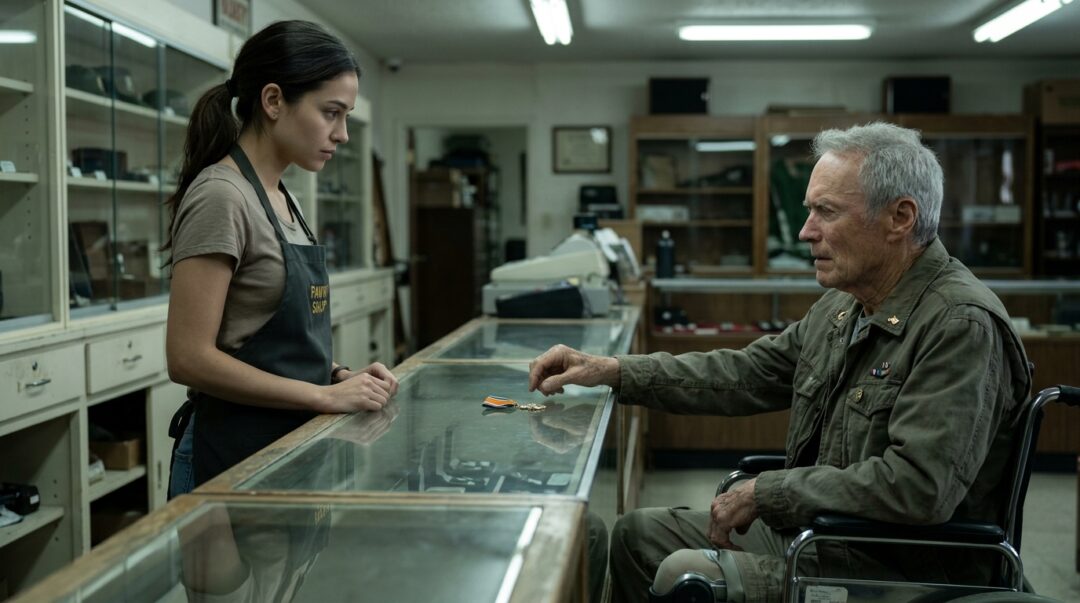
The medal made a hard, lonely sound when it hit the glass.
Not loud. Not dramatic. Just enough to make the man waiting behind the counter lift his head and the woman standing there stop breathing for half a second.
Marisol had spent three years working at Bell Street Exchange, and she had learned to recognize desperation by the way people handled what they were about to sell. Wedding rings were placed carefully, as if the owner still hoped to take them back. Phones were tossed down in frustration. Family watches arrived wrapped in old handkerchiefs. Guns came in stiff cases. Tools came in greasy hands.
But this was different.
The medal landed in front of her with a small shove, almost as if its owner wanted to get rid of it before his courage failed.
“How much for this?” the man asked.
He sat in a wheelchair with the rigid posture of someone who had spent years forcing his body to obey him. His hair was clipped short and silver. His face was cut with deep lines that made him look both stern and tired. Below the knees, his prosthetic legs caught the pale overhead light in dull metal flashes.
Marisol looked from the medal to the man and back again.
“For the medal?” she asked.
The man did not blink. “Just tell me.”
Behind him, a customer in a blue work jacket shifted his weight and crossed his arms, suddenly very interested in a shelf full of old radios. He was close enough to hear every word and polite enough to pretend he wasn’t.
Bell Street Exchange was that kind of place. Not big enough for privacy. Not loud enough for people to hide in noise. Every bad day arrived under fluorescent lights.
Marisol picked up the medal carefully. It was heavier than it looked. The ribbon was faded in one corner, and the metal had been polished many times over the years. Not recently. Carefully. Habitually. The sort of polishing done by someone who believed memory should never be allowed to tarnish.
She had seen military medals before, but never one brought in like this.
“You’re selling that?” she asked, quieter now.
The man’s jaw tightened.
“I need cash today.”
Marisol lifted her eyes to him again.
The words were plain. No speech. No plea. No explanation. But something in the way he said them made the air in the shop feel tighter. He was not asking for sympathy. He was trying to complete a transaction before sympathy had the chance to humiliate him.
On the wall behind Marisol, a cheap clock ticked past noon. Outside the front window, the strip mall parking lot shimmered under a hard white sky. Two blocks away, the grocery store would be doing its lunch rush. At the laundromat next door, someone had already left a basket of damp clothes on the folding table because the dryer cost too much to run twice.
This neighborhood had a thousand ways to tell a person what they were worth.
Marisol turned the medal over in her hand.
“Where did you get it?”
The question had barely left her mouth before she regretted it. Not because it was rude. Because she already knew.
The man’s fingers tightened around the armrests of his wheelchair.
“I earned it.”
He said it without anger.
That made it worse.
Marisol felt heat rise in her face. The man behind him looked away, embarrassed on behalf of everyone in the room.
The older man in the wheelchair kept staring straight ahead, but there was something strained in his stillness, something in the set of his shoulders that told her he was not as steady as he looked. The jacket he wore was old, neatly brushed, and decorated with small pins over one side of the chest. Not enough to look ceremonial. Just enough to suggest history. On his wrist, a battered watch hugged a wrist gone thin with age.
He had prepared himself for this.
That was what broke her.
Not the medal. Not the chair. Not even the prosthetic legs shining below the hem of his trousers.
It was the effort in him. The terrible, disciplined effort of a man determined not to let the room see what this was costing him.
Marisol had grown up with pride that looked like that.
Her father had worked roofing jobs until a bad fall took the strength out of his back. After that, he accepted smaller and smaller jobs and called each compromise temporary. He sold his truck before he admitted they were in trouble. Sold his tools after that. When her mother cried over the old socket set he had inherited from his brother, he told her metal was metal. He said it like a man who wanted the sentence to turn true if he repeated it enough.
Sometimes dignity didn’t leave all at once.
Sometimes it went piece by piece.
Marisol looked down at the medal again and knew with sharp certainty that if she named a price, the room would become unbearable.
The man in the wheelchair waited.
So did the customer behind him.
And in that waiting, the whole moment seemed to stand on a wire.
Part II — What Money Can’t Touch
Marisol set the medal back on the counter between them.
“I can’t take this,” she said.
For one suspended second, the only sound in the shop was the hum of the old refrigerator by the front door.
The man in the wheelchair—she did not yet know his name—did not argue. That was the cruelest part. He did not plead. Did not ask her to reconsider. He only lowered his eyes once, as if something inside him had folded in on itself, then reached forward and took the medal back.
“Right,” he said. “I understand.”
There was no bitterness in the words.
Only exhaustion.
He slipped the medal into the inside pocket of his jacket with slow, precise movements. Then he turned the chair.
The customer near the counter stepped aside without a word. Marisol watched the older man guide himself toward the door, every push of the wheel deliberate, every inch of movement too controlled to be natural. He did not hurry. He would never give the room that satisfaction. But the dignity in his posture now looked less like strength and more like something fragile being carried across a dangerous floor.
The door chimed when he left.
Sunlight poured into the shop and then vanished again.
For half a beat, Marisol stayed where she was.
Then she moved.
She yanked open the register drawer, reached beneath it for the envelope where she kept the cash tips customers sometimes insisted she accept for carrying heavy boxes, and counted without thinking. Not enough.
She opened the second drawer where the owner kept small bills for change. Her hand stopped above it.
This was stupid. Risky. Possibly a firing offense if her boss came back early from lunch and decided principles mattered more than context.
But even as the thought passed through her, she was already pulling bills free.
She did not take enough to look grand. Just enough to matter.
Then she rushed around the counter and pushed through the door.
The heat hit her first. Then the brightness.
The older man had made it only halfway down the walkway in front of the neighboring stores. He was moving toward the curb cut that led to the parking lot, shoulders still straight, face turned forward. There was something devastating in that image: a man trying to leave humiliation behind him by moving a little faster than his body wanted to go.
“Sir, wait!”
He stopped, but he did not turn right away.
When he did, his expression was guarded. Not angry. Wary. As if he had already braced himself for one wound and could not imagine what shape the next one might take.
Marisol came to a halt in front of him, slightly out of breath.
Up close, he looked older than he had inside the shop. The lines around his mouth were deeper. His skin carried the pale, strained look of someone who had not been sleeping enough. His eyes, though steady, had the flatness of a man who had spent too much time reducing need into numbers.
For a moment, neither of them spoke.
Then Marisol held out the money.
He looked at it, then at her. “What is this?”
“Take it.”
His expression hardened in confusion. “I’m not asking for charity.”
“I know.”
The words came out firmer than she expected. Good. Firm was easier for proud people to accept.
“This isn’t for the medal,” she said. “And I’m not taking it.”
He stared at her.
Traffic moved beyond the parking lot. Somewhere down the walkway, a metal cart rattled over cracked pavement. Life kept going with its usual indifference, which made the stillness between them feel even more exposed.
Marisol lowered her hand and stepped closer so he would not have to reach far.
“Keep it,” she said quietly. “And take this.”
The man looked down at the folded bills in her hand as if they belonged to somebody else’s life. For a second, Marisol thought he would refuse on instinct. Pride was fast that way. Faster than need, sometimes.
Then his eyes flickered to her face.
Not to test her. To understand her.
“Why?” he asked.
Marisol could have said a dozen things. Because no one should have to put a price on a medal. Because she had seen what it did to a person to sell the last object that still connected them to who they had been. Because the world had already taken enough from him.
Instead she said the only sentence that felt clean enough to survive the moment.
“You earned that.”
Something shifted in his expression then. Not a collapse. Not tears. He looked like a man who had spent a long time preparing himself to lose one more thing and had no immediate use for mercy when it arrived.
His right hand came off the wheel slowly.
The hand trembled only once before he closed it around the money.
Part III — The Weight He Carried
His name was Walter Keene.
Marisol learned that two minutes later, when he finally spoke again and told her so as if offering identification after crossing an invisible border. He said it with the formality of another era.
“Walter,” he repeated when she gave him her own name in return. “Marisol.”
As if names, too, should be handled carefully.
He looked down at the money again. Not counting it. Just looking. Then he gave a short breath that might once have been a laugh but had too much ache in it to become one.
“I told myself I wouldn’t do this,” he said.
Marisol leaned one hand on the handle of his wheelchair, not touching him, only grounding herself beside him. “Do what?”
“Bring it in.”
He touched the inside of his jacket where the medal rested.
“The first month after the hospital bills, I sold the television,” he said. “Then some tools. Then my wife’s china, and I told myself she would have hated it sitting in boxes anyway.” He swallowed once. “You make bargains with yourself. That’s how it starts.”
There was no self-pity in his voice. That was what made it land so hard. He spoke like a man giving a weather report from inside a storm he had stopped expecting anyone else to notice.
Marisol said nothing.
Walter looked past her toward the storefront, the bright windows reflecting both of them back in thin, warped shapes.
“My son would be furious if he knew,” he said.
“Then don’t tell him.”
That finally earned a real smile, small and crooked and gone almost as soon as it appeared.
“He’s in Colorado,” Walter said. “Two jobs. Three kids. Calls on Sundays and apologizes for calling so late, like I don’t know what life costs.”
The parking lot wind pushed warm air against them. A fast-food wrapper skidded across the asphalt and caught under a parked truck. Somewhere nearby, a child laughed, and the sound felt almost offensive in its innocence.
Walter turned the folded bills once in his hand. “I can pay you back.”
Marisol shook her head. “No.”
“At least let me—”
“No.”
She smiled then, just enough to take the edge off the refusal.
For a long moment, he studied her face as if trying to place her in a world he understood. Maybe he was measuring whether she was young enough to be reckless, old enough to know what she was doing, kind enough to regret it later. Maybe he was simply trying to memorize the moment without letting it become sentimental.
Finally he tucked the money into the same inner pocket as the medal.
Not on top of it. Beside it.
The care of that gesture nearly undid her.
“What did you need it for?” she asked before she could stop herself.
Walter did not seem offended. “Groceries. Prescription refill. Maybe the electric bill, if I did the math kindly.”
The answer was so ordinary that it hurt more than anything else he had said. There was no dramatic emergency. No cinematic catastrophe. Just the slow, humiliating arithmetic of staying alive.
Marisol nodded once.
She wanted to ask about the medal. What it had been awarded for. When. Who had pinned it on him. Whether the ceremony had mattered or if the meaning came later, carried across the years until it became something quieter and heavier than honor. But the questions felt greedy. The medal had already had enough taken from it for one day.
So she only said, “I’m glad you kept it.”
Walter looked at her for a long time before answering.
“I almost forgot why I did.”
Part IV — The Thing That Remains
Marisol walked him as far as the curb.
Not because he needed help. Walter made it clear, gently but unmistakably, that he managed fine. But he allowed her to walk beside him, and that small permission felt like a kind of trust.
At the edge of the lot, he paused and looked out over Bell Street—the traffic lights, the narrow sidewalks, the pharmacy sign blinking in daylight, the heat shimmering above the road. It was not a beautiful street. Nothing about it had been designed to carry meaning. And yet the two of them stood there as if some invisible ceremony had just ended.
“I used to think pride was what kept a man upright,” Walter said.
Marisol said nothing. She had learned that silence, when offered correctly, was not absence. It was room.
He rested one hand over the pocket inside his jacket.
“Maybe it’s memory,” he said instead.
Then he surprised her by adding, “My wife used to polish it every Veterans Day. Not because she cared about medals. She cared about me remembering I had once been more than my bad knee and my temper.”
Marisol smiled.
“She sounds smart.”
“She was exhausting,” Walter said, and this time his smile lasted.
When he rolled away, he did not look smaller.
That was what Marisol noticed first.
Inside the shop, before she had run after him, he had carried himself like a man balancing a wound no one was allowed to see. Now the same narrow shoulders seemed easier in the sunlight. Not healed. Not free. Just less burdened by the worst part of the day.
Marisol stood by the curb until he reached a weathered sedan parked under the one patch of shade at the far end of the lot. He folded himself into the driver’s seat with the careful patience of someone long acquainted with pain. Before closing the door, he looked back once and lifted two fingers from the steering wheel in a quiet salute.
Then he was gone.
Marisol returned to the shop.
The man in the work jacket was still there, though now he was pretending to examine a cordless drill with theatrical concentration. When she stepped behind the counter, he set it down.
“You do that often?” he asked.
“No.”
He nodded, once, as if that was the right answer.
Then he reached into his pocket, pulled out a few folded bills, and slid them onto the counter. “For the till,” he said.
Before Marisol could reply, he added, “My old man was Navy.”
He bought nothing. He simply left.
Marisol stared at the money for a moment, then laughed softly to herself—a startled, private sound. She replaced what she had taken. Her hands were still shaking a little.
The owner came back twenty minutes later with a coffee and a bag of takeout and complained about parking. The afternoon customers arrived in their usual shapes: a man with a leaf blower, a woman with a bracelet, a teenager with a gaming console and a story that changed twice in thirty seconds. The day resumed its normal speed. Receipts printed. The cash drawer opened and closed. Dust floated through the light.
And yet something had shifted.
Not in the world. The world remained perfectly capable of asking impossible things from people and calling it routine.
But inside Marisol, some small hard place had loosened.
That evening, after her shift, she sat in her car for a long time before turning the key. She called her father and asked whether he still had the old socket set he’d sold years ago. He laughed and told her no, of course not, why would he? Then he asked why she was asking in a voice too casual to trust.
“No reason,” she said.
But after they hung up, she sat with her phone in her lap and thought of Walter’s hand resting over the medal in his pocket, as if he had needed to feel it there every few seconds just to believe the day had turned.
A week later, he came back.
Not to sell anything.
He rolled through the front door carrying a paper bag from the bakery across the street. He looked freshly shaved. The lines in his face had not disappeared, but they no longer seemed carved there by the same weight.
“For you,” he said, placing the bag on the counter.
Marisol opened it to find two cinnamon rolls still warm in the middle.
“You didn’t have to do this.”
“No,” Walter said, “but it seemed wiser than arguing with you.”
She laughed.
There was no long speech after that. No grand declaration. Walter stayed ten minutes, maybe twelve. He told her the electric bill had been paid. The prescription had been picked up. He had called his son on Sunday and, for once, told the truth when asked how he was doing. His son had not been furious, only hurt that his father had tried to disappear the problem alone.
“They’re coming next month,” Walter said, almost shyly. “The kids want to see the medal.”
Marisol leaned against the counter and smiled at him.
“Good.”
Walter nodded. Then, after a moment, he reached into his jacket and pulled the medal out.
For an instant Marisol’s stomach tightened.
But he was not offering it.
He simply laid it in his own palm and looked down at it under the fluorescent lights.
“It looked different in here last time,” he said. “Like it had become a thing.”
He closed his hand around it again.
“Now it doesn’t.”
When he left, Marisol watched him through the front window until he disappeared into the afternoon.
The bakery bag still smelled faintly of sugar and butter. The register drawer stuck on the second slide the way it always did. Outside, Bell Street went on being Bell Street—uneven, noisy, expensive, indifferent.
But on some days, even in places built for transactions, something refused to be reduced to a price.
And sometimes all it took to save a person from selling the last piece of themselves was another person who knew the difference.