The HOA Treasurer Said the Ledger Was Final Until One Homeowner Opened Every Version
Chapter 1: The Notice Was Already Folded Before Anyone Spoke
“You have until Friday to pay forty-two thousand dollars.”
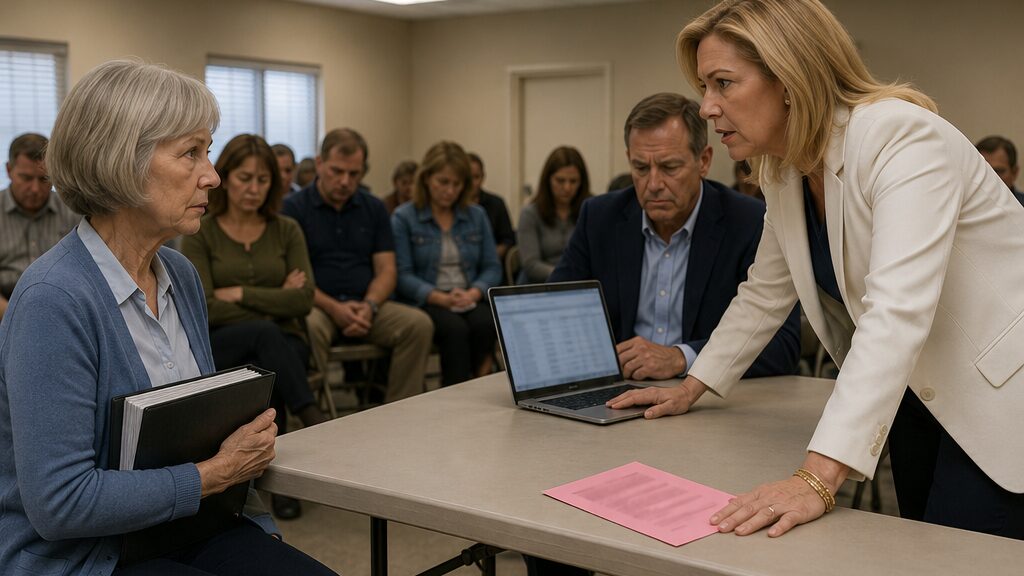
Jessica Taylor placed one polished fingernail on the pink notice and pushed it across the clubhouse table.
“If the balance is not received by five o’clock, foreclosure counsel will proceed against your property.”
The folding chair beneath Nancy Mitchell gave a small metallic complaint when she shifted. Around her, Maple Court residents sat in two uneven rows beneath fluorescent lights, holding meeting packets they had stopped pretending to read.
Nancy looked at the number printed in the center of the page.
$42,186.73.
For a moment, the digits seemed less like money than a measurement of how thoroughly a life could be misunderstood.
“My quarterly assessments are paid,” Nancy said.
Jessica remained standing over her. The white blazer, gold bracelets, and rectangular name badge gave her the polished appearance of someone conducting official business, though she was an unpaid volunteer like the rest of the board.
“The ledger says otherwise.”
Nancy reached into the canvas tote at her feet and removed a narrow receipt binder. Its plastic sleeves held bank confirmations, canceled-check images, and the association’s emailed acknowledgments in date order.
“I have every payment going back six years.”
Jessica smiled without looking at the binder. “Receipts people keep at home are not the association’s books.”
A few residents moved in their chairs. No one spoke.
Nancy set the binder beside the pink notice. “What portion of the forty-two thousand is unpaid assessment?”
Jessica glanced toward the open laptop in front of her. “The total includes assessments, late charges, interest, collection costs, attorney preparation, and administrative penalties.”
“How much principal?”
“The total is what matters.”
“It matters how the total was built.”
Jessica lowered her voice, though not enough to make the exchange private. “Nancy, we have gone over this. The board cannot recalculate an account every time a homeowner dislikes the result.”
Across the aisle, an elderly widower stared at the rubber toes of his shoes. A younger man folded his arms and looked toward the exit. Brian Scott, seated at the board table, pressed his lips together but did not interrupt.
Nancy had known Brian for nineteen years. He had once held a ladder while her husband cleaned the second-story gutters. He had brought soup after the funeral. Now, as HOA president, he kept one hand on the meeting agenda and the other flat against the table.
Nancy turned to him. “Has the board authorized foreclosure counsel?”
Brian cleared his throat. “The account was referred last week.”
“That wasn’t my question.”
His eyes flicked toward Jessica.
“Yes,” he said. “The board authorized the referral.”
A tight warmth rose beneath Nancy’s collar. She could feel people watching her now, not as a neighbor but as a homeowner whose private failure had been displayed in public numbers.
Years earlier, in a municipal conference room, she had once presented a preliminary audit finding before all the reconciliations were complete. The clerk involved had been cleared three days later, but not before whispers spread through the department. Nancy still remembered the woman carrying a cardboard box to her car, believing she had been fired.
Nancy had apologized. It had not repaired what public suspicion had done.
Since then, she had learned to wait until the record was whole.
Jessica tapped the notice again. “The ledger is final.”
Nancy looked past the pink paper to the spreadsheet open on Jessica’s laptop. The visible columns were narrow. Account numbers ran down the left side. A bold total appeared near the right edge.
“What is the file name?” Nancy asked.
Jessica frowned. “Excuse me?”
“The workbook you’re using. What is the file name?”
“That is not relevant.”
“What is its revision date?”
Jessica’s fingertip stopped on the notice.
One of the board members leaned toward the laptop. Brian looked down at the screen as if he had never considered that a ledger might have more than one version.
Jessica straightened. “It is the current ledger.”
“Current as of when?”
“It was circulated before tonight’s meeting.”
“By whom?”
“By me.”
“What was the opening balance on my account in the previous version?”
Jessica’s smile disappeared. She touched the trackpad and clicked once, then again. “I don’t have to answer an impromptu audit in the middle of a homeowner meeting.”
“No,” Nancy said. “You don’t.”
The room remained still.
Nancy closed her receipt binder. She did not explain that revised financial files were never merely current or old. Each version carried choices. A changed formula, a copied row, a reclassified payment—small acts that left traces if earlier files still existed.
Jessica slid the notice closer. “Friday, Nancy.”
Nancy lifted it. The paper was heavier than ordinary printer stock, bright pink with black type and a block of legal language at the bottom.
She folded it once, cleanly through the center of the amount.
Jessica watched the crease form. “Walking away will not stop the process.”
Nancy placed the notice inside her binder.
“I know.”
She stood, picked up her tote, and walked toward the door. No one stopped her. Behind her, Jessica announced the next agenda item in the composed voice of someone reclaiming a room.
Outside, the clubhouse windows glowed against the dark parking lot. Nancy sat in her car with both hands on the steering wheel until the meeting ended and people emerged in small groups.
No one approached her.
By ten-thirty, the pink notice lay on the desk in Nancy’s spare bedroom, aligned beside her keyboard. She had turned the room into a home office after retirement, though she had not opened the municipal auditing manuals in years.
Her first search was not for foreclosure law.
It was for the oldest HOA email that contained a financial attachment.
Jessica sent monthly spreadsheets to the board and occasionally to homeowners before budget meetings. Nancy searched her mailbox for “Maple Court financials,” then sorted the results by date.
Forty-seven messages appeared.
She downloaded the newest workbook first and saved a copy without opening it. Then she downloaded the version from three months earlier.
The file names were nearly identical.
MapleCourt_Financials_March_Final.xlsx.
MapleCourt_Financials_June_Final2.xlsx.
Nancy opened both in read-only mode.
In the June workbook, her account showed the balance printed on the pink notice. She traced the number backward through late fees, collection charges, and a large entry labeled PRIOR ASSESSMENT CORRECTION.
Then she opened March.
Her account appeared on row 118.
The quarterly dues column contained four payments.
The balance column showed zero.
At the far right, under status, one word appeared in green.
PAID.
Nancy sat back.
The clubhouse humiliation had been built from a number that had not existed three months earlier.
She brought the two spreadsheets side by side and looked again at the pink notice, folded through the demand.
Someone had not merely failed to credit her payment.
Someone had removed credit that had already been there.
Chapter 2: Forty-Seven Files Could Not All Be Right
The payment existed in March and vanished in June.
Nancy printed both rows and laid them beneath the desk lamp. On the first page, the April assessment carried a bank confirmation number. On the second, that same confirmation number appeared nowhere on her account.
She checked May.
Paid.
She checked the first June file.
Paid.
Then she opened a second June attachment sent six days later.
The balance had changed.
Nancy studied the formula bar. The total did not come from unpaid dues alone. It pulled from a separate worksheet, one that was hidden from ordinary view.
She right-clicked the row of sheet tabs.
A list appeared.
Summary.
Accounts.
Collections.
Reserves.
Adjustments.
Nancy selected the last one.
The worksheet opened to hundreds of lines of manual entries. No formulas. No automatic imports. Each row contained an account number, an amount, a date, and a short description.
Her own account appeared three times.
PAYMENT REALLOCATION.
LEGAL RESERVE.
CONTRACTOR ESCROW.
Nancy read the labels twice.
The amounts added to exactly the sum of the payments removed from her account.
She did not feel triumphant. She felt the slow, cold tightening that came when a discrepancy stopped being an error and became an act.
Before retirement, she had trained junior auditors to resist the pleasure of finding what they expected. An unusual entry was not fraud. A hidden tab was not guilt. A manual adjustment could correct a faulty import, reverse a duplicate payment, or temporarily classify money while documentation caught up.
So she did what she had always taught.
She built a timeline.
Each of the forty-seven attachments went into a separate folder named with the email date. She recorded the sender, recipients, file name, file size, and modified timestamp. She opened copies, never originals. She exported the relevant worksheets to PDF and printed only the pages that changed.
By dawn, three stacks had formed on the desk.
Versions before her payment disappeared.
Versions after it disappeared.
Versions in which the balance continued to grow.
The pink notice remained between the first and second stacks, its crease now marking the date the altered number had become a threat.
At seven-fifteen, Nancy made coffee and stood at the kitchen window. Across the street, a lawn service unloaded two mowers. Farther down, a school bus stopped beside the community entrance.
Maple Court looked exactly as it had the day before.
That was what unsettled her most.
By Wednesday afternoon, Nancy had traced the first change to a workbook circulated on June 14 at 11:42 p.m. Jessica had sent it to the board with a brief note: Updated delinquency figures after reconciliation.
Nancy compared the June 8 and June 14 files line by line.
Her payments were not deleted from the entire workbook. They had been moved.
The bank references appeared in the adjustment worksheet, linked to a line called Special Project Escrow. The entries carried no board resolution number and no explanation of which special project they funded.
Nancy searched the county records portal for Maple Court liens and foreclosure notices. Public filings appeared slowly, one document at a time.
Three homeowners had active liens.
Two had released liens after payment.
One property had received a notice of intent to sell.
Nancy recognized the address. The elderly widower lived there.
She wrote the account numbers on a yellow pad but did not call him.
Not yet.
The impulse to stay quiet felt professional. Responsible. Familiar.
It also kept her alone.
At two-thirty, the doorbell rang.
A certified-mail carrier stood on the porch holding a white envelope and a signature pad.
Nancy signed.
The return address belonged to the law firm the board had authorized. Inside was a formal demand stating that if the balance was not paid, disputed through counsel, or resolved by written agreement, foreclosure proceedings would continue.
The deadline remained Friday.
Nancy placed the letter beside the pink notice and read the enclosed account statement.
The figures matched Jessica’s latest workbook exactly.
That mattered. It meant the altered ledger had left the clubhouse and entered a legal process.
She called the law firm and asked for the source documents supporting the balance.
The clerk who answered sounded tired rather than hostile.
“We rely on the association’s certified ledger,” the clerk said.
“Certified by whom?”
“The treasurer and board president.”
“Do you have the underlying transaction history?”
“We have the statement provided.”
“Do you have bank records?”
“No, ma’am.”
“Board resolutions authorizing payment reallocations?”
A pause.
“You would need to request association records.”
Nancy thanked the clerk and ended the call.
Then she reopened the Adjustments worksheet.
She sorted the entries by account number.
Her own account was not isolated.
A second account showed PAYMENT REALLOCATION.
Then a third.
A fourth.
The pattern was inconsistent enough to avoid immediate notice. Some adjustments were hundreds of dollars. Others were several thousand. In several cases, payments disappeared for one month and returned later under a different category. In others, they never returned.
Nancy created a filtered list.
Seventeen unique homeowner accounts appeared.
She began matching them to addresses using old association directories and public lien filings. A young family on Hawthorn Lane. The widower near the entrance. A woman who had sold her house the previous winter. Two owners Nancy barely knew.
She examined dates.
The reallocations clustered around three periods: after a severe spring storm, before the association’s insurance renewal, and just ahead of year-end reporting.
At nine that evening, she found a transfer summary buried beneath the adjustment rows.
Several homeowner payments had been moved into a line labeled CONTRACTOR ESCROW.
The receiving reference did not identify a contractor. It contained only initials.
M.H.
Nancy knew the initials before she admitted that she knew them.
Matthew Hill.
Jessica’s husband.
She leaned away from the screen.
Her first conclusion arrived too quickly: Jessica had taken homeowner money and routed it to her husband.
Nancy closed the workbook.
A conclusion was not proof. Not yet.
She went to the kitchen, rinsed her coffee cup, and stood with both hands against the counter. The memory of the municipal clerk returned—not the accusation itself, but the clerk’s face when Nancy had found her outside the building afterward.
You were supposed to know before you said it.
Nancy had known enough to ask questions then. She had mistaken enough for certainty.
She would not do that again.
Back at the desk, she reopened the workbook and traced every adjustment attached to M.H. Some had invoice numbers. Some had none. Several invoices predated the transfers. Others appeared weeks afterward.
She printed the filtered list.
Seventeen account numbers filled two pages.
The first belonged to her.
The fifth belonged to the widower.
The twelfth belonged to the young family on Hawthorn Lane.
Nancy slid the pages into her receipt binder behind the folded pink notice.
Until that moment, she had been building a defense for her house.
Now she was holding evidence that the same ledger might have been used against sixteen others.
Chapter 3: The Neighbors Who Would Not Meet Her Eyes
“I took out a loan against my truck.”
The elderly widower said it without looking at Nancy.
They stood beside his mailbox Thursday morning while a sprinkler clicked across the lawn behind him. He wore work pants stained at one knee and held an unopened envelope from the association.
“How much did they say you owed?” Nancy asked.
“Eleven thousand, after everything.” He rubbed the edge of the envelope with his thumb. “I paid seven to stop the lien. Still making payments on the rest.”
“Did they give you a transaction history?”
“They gave me a balance.”
Nancy felt the binder under her arm grow heavier.
“Do you have bank statements from when you paid your dues?”
“Probably.”
“Would you be willing to show them to an attorney?”
That made him look at her.
“Are you saying they did this wrong?”
Nancy could have told him about the adjustment worksheet. She could have shown him his account number on the printed list.
Instead, she said, “I’m saying the records should be checked.”
His disappointment was small but visible.
“People have been saying that about your account,” he said. “That you think the board made a mistake.”
Nancy waited.
He lowered his voice. “Jessica said the system is old. Said sometimes residents remember paying when they only meant to.”
“I remember.”
“I didn’t mean you.”
“You did.”
He looked toward the house. “I have to find the statements.”
Nancy walked away before he could apologize.
At the end of the block, Brian was rolling his trash cart toward the garage. He saw her and briefly raised one hand. Then his phone rang—or he pretended it did—and he turned inside.
The avoidance that had humiliated her at the clubhouse now looked different. Some neighbors were afraid of being associated with a delinquent homeowner. Others were afraid their own records would be questioned. A few may simply have wanted the unpleasantness to remain someone else’s problem.
Nancy understood that instinct too well.
Angela Baker’s office occupied the second floor of a legal-aid building between a tax preparer and an insurance agency. There was no polished conference table, only a desk crowded with files and two mismatched chairs.
Angela read the pink notice first.
Then the certified letter.
Then Nancy’s comparison sheets.
“You preserved the original email attachments?” she asked.
“Yes.”
“Did you alter the files?”
“I opened copies in read-only mode. I retained the originals and logged the metadata.”
Angela looked up. “What did you do before retirement?”
“Municipal audit.”
“For how long?”
“Twenty-two years.”
“That would have been useful information at the beginning.”
“It doesn’t change the records.”
“No. It changes how much confidence I place in your handling of them.”
Nancy did not answer.
Angela studied the adjustment worksheet. “This is enough to challenge your balance and ask for a temporary halt.”
“But not enough to prove why it was changed.”
“Correct.”
“The money was moved into contractor escrow.”
“That label may mean exactly what it says.”
“The contractor initials match Jessica’s husband.”
“An initial match is not a bank trail.”
“Seventeen accounts were adjusted.”
“That may establish a pattern. It does not establish theft.”
Nancy looked toward the window. “I didn’t say theft.”
“You came close without using the word.”
The comment landed harder because it was true.
Angela placed one hand on the binder. “Your strongest case today is narrow. Your payments were credited, later reclassified, and then used to support a foreclosure demand without adequate explanation. That can stop the immediate action.”
“And the others?”
“We need their statements, their payment records, and the association’s bank records.”
“The board will know I’m asking.”
“Yes.”
Nancy thought of the clerk from years ago. She had spent decades believing caution meant keeping accusations private until every line reconciled. Angela was telling her that caution could also mean bringing others into the process before the answer was complete.
“I can ask them quietly,” Nancy said.
Angela leaned back. “Quietly is fine. Alone is not.”
That afternoon, Nancy visited the young family on Hawthorn Lane.
The mother answered with a toddler balanced on one hip. When Nancy explained that she was reviewing possible account discrepancies, the woman’s face closed.
“We settled ours.”
“You paid it?”
“We signed a plan.”
“Do you know what the original charge was for?”
“Late assessments.”
“Were the assessments actually late?”
The woman shifted the child higher. “Jessica said arguing would add legal fees.”
Nancy nearly told her everything then.
Instead, she asked for one bank statement showing the disputed period.
The woman hesitated, then returned with a tablet. She scrolled through transactions until she found a payment to Maple Court. The amount and date matched an entry Nancy had seen in the older workbook.
In the newer version, that payment was missing from the family’s account.
Nancy photographed the screen with permission and wrote down the confirmation number.
There it was: independent proof.
Not merely a spreadsheet difference. Not memory. Not inference.
A payment had cleared the family’s bank, appeared in the association’s earlier ledger, then disappeared before the family was billed again.
The woman stared at the confirmation.
“We paid that twice,” she said.
Nancy felt the words move through her like a charge.
“Yes.”
“Did they do this to you too?”
Nancy touched the binder under her arm.
“Yes.”
“Who else?”
“I don’t know enough yet.”
The woman’s expression sharpened. “You know something.”
“I know records were changed. I don’t yet know why.”
“You should have told us.”
Nancy had no defense that did not sound like the excuses of every official who had ever waited for certainty while someone else absorbed the harm.
“I should have told you sooner that I was checking,” she said.
When Nancy returned home, a courier envelope rested against her front door.
Inside was a settlement proposal from the HOA’s attorney.
The association would reduce her balance from forty-two thousand dollars to six thousand in administrative and legal costs. The remainder would be waived. Foreclosure activity would stop if she paid within thirty days.
Nancy read the first page twice.
It was not an admission. It was an exit.
For several minutes, she imagined signing it. Six thousand dollars would hurt, but she could pay it without selling the house. The public embarrassment would fade. Jessica would say the board had compromised. Neighbors would stop avoiding her.
Then Nancy reached the final page.
A confidentiality clause prohibited her from discussing the settlement, the association’s internal accounting methods, or “the alleged account status of any other owner.”
Another paragraph required her to release the board, its officers, agents, vendors, and related contractors from all claims connected to the ledger.
Nancy laid the agreement beside the young family’s payment confirmation.
The clause did not merely ask her to stop fighting over her own account.
It asked her to remain silent about everyone else’s.
Chapter 4: The Repairs Were Real but the Records Were Not
The drainage channel behind Hawthorn Lane had been rebuilt.
Nancy stood at the edge of the easement with the pink foreclosure notice tucked inside her binder and watched clear water move through a new concrete throat beneath the access road. Fresh riprap lined the banks. Sections of sod had not yet rooted, and the raw earth showed where machinery had cut through the slope.
Jessica had not invented the storm damage.
Two months earlier, rain had overwhelmed the old culvert and pushed muddy water into three backyards. Nancy remembered residents stacking sandbags near the sidewalk and a maintenance crew working past dark.
She raised her phone and photographed the repaired channel.
A metal project marker had been wired to a fence post. The contractor name printed across it was Hill Property Maintenance.
Matthew Hill.
Nancy crouched beside the outlet and photographed the concrete seams, the replaced pipe, and the gravel bed. The work was substantial. It had required equipment, labor, and materials. Whatever else the ledger concealed, this project had cost real money.
A pickup slowed on the service road.
Matthew leaned through the open window. He was broad-shouldered, sunburned at the neck, and wearing a faded work shirt with dust ground into the cuffs.
“You inspecting my concrete?” he asked.
“I’m documenting the association’s repair.”
“You with the board now?”
“No.”
He switched off the engine but remained behind the wheel. “Jessica said you were making claims about our invoices.”
“I haven’t made claims about your invoices.”
“You’ve been asking people for bank statements.”
“I’ve been checking account balances.”
Matthew opened the truck door and stepped down. His work boots sank slightly into the soft shoulder.
“You know that channel was days from collapsing?”
“I can see the work was necessary.”
“Then you understand why we did it.”
“I understand why the channel needed repair. I don’t understand how it was authorized or paid.”
His jaw shifted.
“The board called us after the first washout. We brought in pumps that night. Dug the failed pipe out the next morning.”
“Was there a contract?”
“There were emails.”
“Was there a board vote?”
“You’d have to ask the board.”
“Was your relationship to the treasurer disclosed?”
Matthew looked toward the water. “Everybody knows Jessica is my wife.”
“Knowing you are married is not the same as approving a related-party contract.”
“We didn’t have time for three bids while people’s yards were filling up.”
“That explains emergency work. It doesn’t explain homeowner payments being moved into contractor escrow.”
His eyes returned to her.
“So that’s what you think happened.”
“That is what the records show.”
“The records don’t show us carrying pumps through waist-deep water at two in the morning.”
“No. They also don’t show an authorization number.”
Matthew gave a short, humorless breath. “Paper is easier to keep dry than a basement.”
Nancy closed the binder.
There was enough truth in his anger to make the exchange uncomfortable.
“Do you have your invoices?” she asked.
“All of them.”
“May I see them?”
“Why would I show you?”
“Because if the payments were legitimate, the dates should support you.”
“And if they don’t?”
“Then the dates still matter.”
Matthew studied her for a moment. “Come by the yard at four.”
His contractor yard sat behind a row of small warehouses near the interstate. Pipes, pallets, and a mud-streaked excavator occupied most of the gravel lot. Matthew led Nancy into a narrow office that smelled of coffee and damp work gloves.
He placed a box on the desk.
“Original invoices, equipment tickets, supply receipts,” he said. “Jessica wanted scans. I keep paper.”
Nancy put on her reading glasses.
The earliest invoice predated the first contractor-escrow transfer by eleven days. It covered pump rental, emergency labor, and temporary barriers. A second invoice covered excavation and pipe replacement. Both matched visible work at the easement.
“These were unpaid?” Nancy asked.
“For weeks.”
“Why did you continue?”
“Because the work couldn’t stop halfway.”
A supply receipt showed that Matthew had used his company credit line to purchase the pipe. A handwritten note documented additional labor after a second storm.
The amounts were not neat, but they were plausible.
Jessica’s financial pressure suddenly had a shape. Matthew’s company had advanced tens of thousands of dollars. The association’s reserves were already low. If the board had refused a special assessment or delayed authorization, Jessica may have believed she was preventing both the contractor’s collapse and further property damage.
Nancy turned another page.
The third invoice was dated after the corresponding escrow transfer.
Then the fourth.
She placed them side by side.
“Why was the association paying you before these invoices existed?”
Matthew leaned over the desk.
“That one was probably an advance.”
“Probably?”
“We had an estimate.”
“Where is it?”
He searched the box. Then a folder. Then his email on his phone.
“I don’t have it here.”
Nancy pointed to another transfer. “This payment was made eighteen days before the invoice.”
“We were buying materials.”
“Do you have a purchase order?”
“No.”
“Board approval?”
“I told you. Ask the board.”
“You accepted association money without one.”
Matthew straightened. “I accepted money for work already done and work we were still doing.”
“That is not the same answer.”
His face hardened. “You think Jessica and I sat around planning how to steal your dues?”
“I think money was moved out of paid homeowner accounts without disclosure.”
“And I think half the people in Maple Court would have sued the board if that channel had failed.”
Both could be true. That was the difficulty.
Nancy photographed each invoice with Matthew’s permission and left with copies of the equipment tickets. On the drive home, she passed the repaired drainage line again. Children rode bicycles over the road above it without knowing what supported the pavement beneath them.
At home, she placed the project photographs beside the pink notice.
One showed a flooded yard before the work, taken from an HOA email. Another showed the finished channel. The repairs were neither fictional nor cosmetic.
She began matching invoices to transfers.
The first two could be reasonably connected to emergency work. The amounts were close, and the timing made sense.
The later transfers did not.
Several homeowner payments had moved into contractor escrow before Matthew’s invoices were created. Two transfers exceeded the invoices they supposedly covered. One had no corresponding invoice at all.
Nancy called Angela.
“We need the association bank statements,” she said.
“Do you have something beyond the spreadsheet?”
“Real repairs, real invoices, and transfers that do not line up with either.”
“That makes the case harder.”
“It makes it accurate.”
Angela was silent for a moment. “Good.”
Nancy looked at the total amount of questionable transfers.
“If the association has to reverse all of these before recovering anything, it could be insolvent.”
“That is possible.”
“They still have insurance due next month.”
“That does not make false balances lawful.”
“No.”
But it meant the consequences would not fall only on Jessica and Matthew. They would fall on every homeowner through higher assessments, reduced services, or unpaid obligations.
Nancy had wanted a clean answer: stolen or not stolen, paid or unpaid, guilty or mistaken.
The records refused to provide one.
Near midnight, she sorted the transfers by date instead of account.
A new pattern emerged.
On three occasions, homeowner payments moved into contractor escrow several days before Matthew generated invoices for matching amounts. The amounts were too precise to be estimates. They looked less like reimbursement than targets—money moved first, paperwork created later to explain it.
Nancy printed the schedule.
At the bottom of the third page, one transfer had been made six weeks before any invoice existed.
The memo line read EMERGENCY REIMBURSEMENT.
The emergency had not yet happened.
Chapter 5: The Board Signed Reports It Never Read
Brian arrived at Nancy’s house carrying a stack of reports with his signature at the bottom of every page.
He did not remove his jacket.
“I need to know what you’ve found,” he said.
Nancy stepped aside and let him into the kitchen. He set the reports on the table carefully, as if the paper might accuse him on contact.
“These are the monthly certifications Jessica sent to the law firm,” he said. “My name is on all of them.”
“Did you review the underlying ledgers?”
Brian pulled out a chair but did not sit. “I reviewed the summaries.”
“That isn’t what I asked.”
“No.”
Nancy opened her binder and placed the folded pink notice on top.
Brian looked at it, then away.
“When did you first notice the totals changing?” she asked.
His expression tightened.
“I didn’t say I noticed.”
“You came here before eight in the morning with four months of signed reports. You noticed something.”
He sat at last.
“In April, the delinquency total jumped by almost sixty thousand dollars. Jessica said old balances had been imported from the property manager’s previous system.”
“Did you verify that?”
“She showed me a reconciliation summary.”
“Not the transaction history.”
“No.”
“And in June?”
“The total moved again.”
“Did you ask why?”
Brian rubbed both hands over his face. “We were trying to renew the master insurance policy. The carrier wanted proof that the association could cover the deductible. The reserves were low. Jessica said the corrected receivables would satisfy the requirement.”
“So a larger delinquency balance made the association appear to have more collectible assets.”
“That is how she explained it.”
“And you signed.”
“I believed her.”
Nancy turned one of the reports toward him. His signature sat beneath language certifying that the information was accurate to the best of the board’s knowledge.
“Did you open the workbook?”
Brian’s voice dropped. “No.”
“Any of them?”
“No.”
The refrigerator motor clicked off, leaving the kitchen too quiet.
Brian reached for the pink notice. He unfolded it halfway, then pressed his palm across the crease as though flattening the paper might undo the meeting.
The line remained.
“I should have stopped her from saying it in front of everyone,” he said.
“Yes.”
His hand stilled.
Nancy had not raised her voice. She did not need to.
“I thought if I interrupted, it would look like the board wasn’t united,” he said.
“It wasn’t united.”
“It needed to appear stable.”
“To whom?”
“The homeowners. The insurer. The attorney. Everyone.”
“That appearance cost people money.”
Brian looked toward the window over the sink. “You think I don’t know that now?”
“I think you knew enough to ask questions earlier.”
He pushed back from the table. “And you knew enough last week to tell people their accounts might be wrong.”
The words landed cleanly.
Nancy closed the binder.
Brian continued before she could answer. “The family on Hawthorn signed a payment plan three days after your meeting. You had the adjustment list by then, didn’t you?”
“I did not know what the entries meant.”
“You knew their account was on it.”
“Yes.”
“But you waited.”
“I needed independent proof.”
“And while you were getting it, they signed.”
Nancy looked at the folded notice between them.
He was not excusing himself. That made the accusation harder to reject.
“I was afraid of naming people before I could support it,” she said.
Brian gave a tired laugh. “I was afraid of asking questions before I knew the answer.”
The difference between them no longer felt as large as Nancy wanted it to.
At noon, the board held an emergency session in the clubhouse. Jessica sat at the center of the table with two file boxes beside her. Matthew was not present.
Angela attended with Nancy but spoke only when the board’s attorney addressed her directly.
Jessica began with a prepared statement.
“Maple Court faced urgent infrastructure expenses, declining reserves, and widespread delinquency. Temporary reallocations were used to maintain cash flow while account reconciliations were completed.”
Nancy watched Brian.
He did not look at Jessica.
One board member asked whether paid homeowner assessments had been moved without notice.
Jessica answered, “Entries were reclassified, not removed.”
“Why were homeowners then billed again?” Nancy asked.
The board’s attorney raised a hand. “Questions should come through counsel.”
Jessica turned toward Nancy anyway. “Because not every payment was applicable to the period residents claimed.”
“The bank references were already matched to their accounts.”
“Some matches were provisional.”
“Then why were legal fees added before the reconciliation was complete?”
Jessica’s composure slipped for less than a second.
“Because the association could not freeze collections every time a homeowner disputed an entry.”
Angela spoke. “No one is asking you to freeze ordinary collections. We are asking why altered entries were certified as final balances.”
The room tightened around the word certified.
Brian opened the reports he had brought to Nancy’s house.
“I signed these,” he said.
Jessica looked at him. “Yes.”
“You told me the underlying accounts had been reconciled.”
“They had been.”
“Then why do the versions change afterward?”
“Because reconciliation is ongoing.”
Brian’s fingers curled around the edge of the paper. “You said they were complete.”
Jessica leaned back. “We were about to lose insurance coverage. Matthew’s company had carried the drainage work for weeks. Half the community objected to a special assessment, and the other half was already behind. I made decisions because no one else would.”
The statement was not an apology. It was also not entirely false.
A board member asked for a recess.
After twenty minutes behind closed doors, the board returned.
Brian read the motion himself.
Foreclosure activity against Nancy Mitchell would be suspended pending independent review. Her account would be placed on administrative hold. No additional legal fees would accrue.
Nancy waited for the rest.
There was none.
“What about the other adjusted accounts?” she asked.
The board’s attorney answered. “Those accounts are not before us today.”
“They are in the same worksheet.”
“Each matter requires separate review.”
“The sale notice on the property near the entrance—”
“Ms. Mitchell,” the attorney said, “the board has provided the relief you requested.”
Nancy looked at Brian.
He lowered his eyes.
A private victory. Narrow, defensible, and nearly useless to everyone else.
Jessica gathered her files. As she passed Nancy, she paused.
“You wanted your house protected,” she said quietly. “It is protected.”
“For now.”
“That is more than most people would have risked the association to get.”
Nancy watched her leave.
Outside the clubhouse, the young mother from Hawthorn Lane stood beside the bulletin board holding a certified envelope. Her child waited in a stroller while she read.
Nancy recognized the law firm’s letterhead.
“What is it?” she asked.
The woman handed her the notice.
A trustee sale date had been requested for the following month unless the payment plan default was cured by nine o’clock the next morning.
Inside the clubhouse, the board was still discussing confidentiality.
Outside, another family had been given a date to lose its home.
Chapter 6: She Refused the Deal That Saved Only Her House
Angela placed the settlement agreement in front of Nancy and turned it to the signature page.
“If you sign today, your account goes to zero.”
The mediation room had no windows. A square table filled most of the space, and a clock above the door made each second audible.
Jessica sat across from them with the board’s attorney. Her white blazer had been replaced by a dark blue jacket, but her posture was unchanged.
“No administrative costs?” Nancy asked.
“None,” Angela said. “No legal fees, no lien, no foreclosure. The association files a corrected statement within five business days.”
“And the release?”
“Still broad.”
Nancy read the confidentiality paragraph again.
She could leave the room with her home secured. No hearing. No more certified letters. No risk that a judge might decide the association’s records were wrong but not unlawful. No public testimony about why she had waited.
Jessica folded her hands.
“This is a complete resolution of your dispute,” she said.
“Only mine.”
“You are the claimant.”
“The other accounts were altered through the same worksheet.”
“That has not been established.”
“The family on Hawthorn has a sale referral.”
“They defaulted on a signed payment plan.”
“For a balance that included a payment they already made.”
Jessica’s attorney intervened. “We are not mediating third-party claims.”
Nancy looked at Jessica. “Why did you move the money?”
Jessica’s face remained composed, but her fingertips pressed together.
“I have explained the reclassifications.”
“No. You have described them.”
The clock clicked.
Jessica glanced at the attorney, then back at Nancy.
“Matthew’s company paid for pumps, pipe, labor, and equipment when the association did not have the cash,” she said. “The board refused an emergency assessment because residents threatened to vote them out. The insurer gave us thirty days to prove reserves. I shifted funds into project escrow until collections caught up.”
“Paid homeowner funds.”
“Association funds.”
“Assigned to individual accounts.”
“Temporarily.”
“Then you billed those homeowners again.”
“I billed delinquent balances based on the reconciled ledger.”
“You created the balances.”
Jessica’s control thinned. “I kept this community from losing insurance and from flooding again.”
“You also kept your husband’s company from defaulting.”
“He had employees to pay.”
“And the homeowners you threatened?”
“They had obligations too.”
Nancy heard the contempt beneath the justification—not hatred, but a settled belief that some residents were less responsible, less organized, and therefore easier to use.
“Did Matthew know where the money came from?” she asked.
“He knew the association owed him.”
“That wasn’t my question.”
Jessica looked down at the agreement. “He knew I was managing cash flow.”
The answer was incomplete, but it was enough to show the shape of their arrangement.
Angela leaned toward Nancy. “We can continue the case, but the temporary hold on your property does not automatically protect anyone else.”
“What protects the Hawthorn property?”
“A separate emergency petition, if we can establish common accounting defects.”
“How long?”
“Possibly tomorrow, if we file tonight.”
Jessica’s attorney checked his phone.
“The next foreclosure referral is scheduled for nine tomorrow morning,” he said. “After that, the association’s counsel may incur additional costs.”
He meant to create pressure.
He succeeded.
Nancy turned to Angela. “Can we file before then?”
“Yes, but we need your declaration, the original file archive, and permission to identify the other affected accounts.”
The old fear rose immediately.
Once Nancy identified them publicly, she could not control what people would assume. Some entries might have legitimate explanations. Some homeowners might not want their finances discussed. Her own delay would become part of the record.
The municipal clerk’s face returned to her—not as a warning against speaking, but as a warning against speaking carelessly.
Carefully did not have to mean never.
Nancy picked up the settlement agreement.
Jessica’s shoulders eased.
Nancy tore no pages. She made no speech.
She set the unsigned agreement beside the folded pink notice.
“No.”
Jessica stared at her. “You would risk your own house over accounts that are not yours?”
“They became mine when you used the same false method.”
“That is not how ownership works.”
“No,” Nancy said. “It is how responsibility works.”
By seven that evening, the Maple Court clubhouse was full.
Nancy had asked Brian to call an open informational meeting. He resisted until Angela sent him a copy of the emergency petition naming the association. Then he agreed, though the board’s attorney warned him not to admit liability.
Residents stood along the walls. The young family sat near the front. The elderly widower held a folder of bank statements against his chest.
Jessica did not attend.
Nancy stood beside the same table where the foreclosure notice had first been pushed toward her.
The room looked smaller from this side.
She placed the pink paper on the tabletop and unfolded it completely. The crease divided the forty-two-thousand-dollar demand into two uneven halves.
“I need to tell you what I know,” she began, “and what I failed to tell you soon enough.”
The murmuring stopped.
She explained that earlier ledger versions showed payments credited before later versions moved them into adjustment accounts. She did not call it theft. She did not name Matthew’s company until she described the legitimate drainage repairs and the invoices that did not align with later transfers.
Then she looked at the family from Hawthorn Lane.
“I had reason to believe your account was affected before you signed the payment plan,” she said. “I waited because I did not yet have independent proof. That caution protected me from making an unsupported accusation. It did not protect you.”
The young mother’s face remained still.
“You should have told us,” she said.
“Yes.”
Nancy did not soften the answer.
The elderly widower opened his folder. “My payment is in the old ledger too.”
Another resident raised a hand. Then another.
Brian sat at the board table with the certification reports in front of him. When residents asked how the altered balances had passed board review, he said, “I signed summaries I did not verify.”
The admission changed the room more than an accusation would have. People stopped looking only toward Jessica’s empty chair.
They looked at the whole table.
At eight-forty, Angela’s phone vibrated.
She read the message and motioned Nancy aside.
“The county judge will hear the emergency petition tomorrow afternoon.”
“After the nine-o’clock referral.”
“We asked for an immediate administrative stay. The judge granted it for the identified properties until the hearing.”
Nancy released a breath.
Angela did not smile.
“There is a condition.”
“What?”
“The court wants the complete unedited file history. Not your printouts. Every original attachment, every email header, every metadata record.”
“I have them.”
“Jessica’s counsel says your archive may be selective.”
“It isn’t.”
“They will argue that opening the files changed them.”
“I preserved the originals.”
“We will have to prove that.”
Nancy looked across the clubhouse. Residents were exchanging statements, dates, and letters. The silence Jessica had relied on was breaking into specific questions.
For the first time, Nancy understood that evidence was not simply something she possessed.
It was something she would have to submit to examination, along with her methods, her judgment, and her delay.
Angela closed her phone.
“The judge has frozen the referrals until tomorrow’s hearing,” she said. “But if the archive fails authentication, the stay can be dissolved immediately.”
Nancy looked at the unfolded notice on the table.
The crease remained visible, even laid flat.
“So we bring every version,” she said.
Angela nodded. “And this time, you explain all of it.”
Chapter 7: Every Revision Left Something Behind
“The files on Ms. Mitchell’s computer are not the association’s original records.”
Jessica’s attorney said it before Nancy had finished taking her seat.
The county courtroom was smaller than she had imagined. No jury box, no polished drama—only two counsel tables, a raised bench, and a monitor mounted on a rolling stand. The pink foreclosure notice rested inside a clear evidence sleeve beside Angela’s laptop.
Jessica sat across the aisle with her hands folded. Matthew occupied the bench behind her. Brian sat alone in the second row, the signed monthly certifications stacked on his knees.
The judge looked toward Angela. “Can you authenticate the archive?”
“Yes, Your Honor.”
Jessica’s attorney stood. “We dispute that. Ms. Mitchell opened, sorted, renamed, and analyzed the attachments. There is no neutral chain of custody.”
Nancy felt every eye turn toward her.
The judge did not. He kept reading the emergency petition.
“Then we will hear how the records were preserved.”
Angela called Nancy first.
After she was sworn in, Nancy moved to the witness chair with the stiff awareness that she had spent most of her career sitting on the other side of tables, asking people to explain what they had done. She had rarely been the person whose methods were being examined.
Angela approached the monitor.
“What did you download?”
“Forty-seven spreadsheet attachments sent from the treasurer’s association email account over a period of four years.”
“What did you do with each original?”
“I saved it in a directory named for the date and time of the source email. I did not rename the original attachment.”
“Did you edit any of those original files?”
“No.”
“How can you demonstrate that?”
Nancy explained the email headers, attachment sizes, system-created timestamps, and cryptographic checksums she had generated after download.
Jessica’s attorney rose. “Objection. Expertise.”
Angela looked toward Nancy. “What was your occupation?”
“I audited municipal accounts for twenty-two years.”
The attorney’s expression changed slightly.
The judge allowed her to continue.
Nancy described the process without embellishment. Every original attachment remained in a read-only archive. Working copies were created separately. The checksum generated for each original could be compared with the same attachment retrieved from the email server. If even one character, formula, or hidden value had changed, the checksum would differ.
Angela asked the bank records custodian to confirm the attachments received under subpoena. One by one, the checksums appeared on the monitor.
They matched.
The judge leaned forward.
“So the copies obtained independently from the server are identical to the files Ms. Mitchell preserved?”
“Yes, Your Honor.”
Jessica’s attorney turned a page in his notes.
The first attack had failed, but Nancy knew better than to mistake admissibility for victory.
Angela displayed the March workbook.
Nancy’s account showed four credited payments and a zero balance.
Then the June 8 workbook.
Still paid.
Then June 14.
The account changed. Payments moved from the homeowner ledger into contractor escrow. Late charges appeared afterward, followed by legal fees calculated from the manufactured delinquency.
Angela clicked the hidden worksheet.
Seventeen account numbers filled the screen.
The courtroom remained silent except for the ventilation fan.
“Were all adjustments improper?” Angela asked.
“No.”
Jessica looked up.
Nancy continued. “Some reflected genuine corrections. Two appear connected to emergency drainage work supported by contemporaneous invoices and equipment records.”
Angela displayed photographs of the repaired channel.
“Why does that matter?”
“Because the records must distinguish legitimate association expenses from unsupported transfers. The existence of improper entries does not make every expense false.”
The judge glanced toward Jessica.
For the first time that morning, the rigid line of her shoulders eased.
Then Angela displayed the payment schedule.
Three transfers into contractor escrow preceded the invoices said to support them. One exceeded its later invoice. Another had no invoice. A sixth was labeled emergency reimbursement six weeks before the second storm.
Matthew shifted on the bench.
“Can you identify where those transferred funds went?” Angela asked.
“Not from the ledgers alone.”
Angela introduced the subpoenaed bank records.
The first two payments went to Hill Property Maintenance and matched emergency labor and material purchases.
A third also went to the company but was deposited two days before payroll. That could still have been a business expense.
The fourth moved from the company account to a commercial credit card carrying both equipment charges and personal expenditures.
The fifth was followed, within twenty-four hours, by a payment on Matthew’s private vehicle loan.
Jessica’s attorney stood. “Temporal proximity is not proof that association funds paid the vehicle debt.”
“I agree,” Nancy said.
He paused.
Angela looked at her. “What can you conclude?”
“That funds were commingled. The accounting does not permit a reliable claim that every dollar was used for association work.”
It was less dramatic than an accusation. It was also harder to dismiss.
Jessica testified next.
She described the spring storm, the damaged culvert, the insurer’s reserve requirement, and the board’s refusal to impose an emergency assessment. She spoke of residents threatening to withhold dues if landscaping was cut and board members asking her to solve problems without creating visible costs.
“I used temporary classifications,” she said. “I expected collections to normalize.”
“Why were homeowners billed for payments already received?” Angela asked.
“To preserve collectible balances until the project expenses were reconciled.”
“You knew the balances were not true.”
“I knew they were provisional.”
“Did the foreclosure notices say provisional?”
Jessica looked toward the evidence table.
“No.”
“Did you disclose that your husband’s company received the transfers?”
“Everyone knew who he was.”
“That was not the question.”
Jessica’s mouth tightened. “There was no formal disclosure form.”
“Did you tell homeowners their credited payments had been moved?”
“No.”
“Did you certify the adjusted ledgers to foreclosure counsel?”
“Yes.”
“Why?”
Jessica looked toward the judge rather than Angela.
“Because the association was weeks from losing its insurance. Because the board wanted the drainage fixed but would not approve the money. Because Matthew had already put his company at risk, and because residents only paid attention when there were consequences.”
There it was: fear, urgency, loyalty, and contempt, wound together until Jessica could no longer tell where necessity ended and entitlement began.
“You believed false foreclosure balances were an acceptable consequence?” Angela asked.
“I believed the community would survive.”
“At whose expense?”
Jessica did not answer.
On cross-examination, Nancy’s own silence became evidence.
Jessica’s attorney approached the witness stand holding Nancy’s timeline.
“You identified seventeen affected accounts on Thursday of the first week?”
“Yes.”
“You did not notify all seventeen owners that day.”
“No.”
“You did not notify the family on Hawthorn Lane before they signed a payment agreement.”
“No.”
“You allowed them to act without information you possessed.”
“I had evidence of alterations, not yet the reason for them.”
“But you knew their payment appeared in one ledger and vanished in another.”
“Yes.”
“So while criticizing the board for withholding material information, you withheld material information yourself.”
Angela objected.
The judge overruled her.
Nancy looked toward the young mother seated in the back row. The woman did not look away.
“Yes,” Nancy said.
The attorney seemed surprised by the answer.
“You admit that?”
“I admit that I should have told them I had found a discrepancy and was investigating it. I was afraid of making a public accusation before the record was complete.”
“And yet you accuse my client now.”
“I am describing what the complete record shows.”
“After your delay harmed other residents.”
“Yes.”
The courtroom remained still.
Nancy could have explained the municipal clerk. She could have offered the old mistake as context. Instead, she let the answer remain what it was: responsibility without disguise.
The attorney returned to his table.
The judge spent nearly an hour reviewing the exhibits. He asked about reserve balances, contractor invoices, lien procedures, and the board’s certification process. Brian was called briefly and confirmed that he had signed reports without opening the underlying workbooks.
“I relied on the treasurer,” he said.
“Reliance is not review,” the judge replied.
When testimony ended, the judge removed his glasses.
“This court is not prepared today to determine the final ownership of every disputed dollar,” he said. “Some expenditures were plainly for necessary work. Some transfers may be recoverable. Others require further accounting.”
Jessica held herself very still.
“But this case concerns more than missing money.”
His gaze moved from Jessica to Brian, then to Nancy.
“It concerns the use of records known to be unresolved as the basis for threatening people with the loss of their homes. It concerns related-party payments concealed from the members whose funds were being moved. It concerns a board that certified figures it did not examine.”
He paused.
“And it concerns the danger of silence—whether that silence comes from authority, fear, or caution.”
Nancy felt the words reach her too.
The judge ordered every pending Maple Court foreclosure frozen. All collection fees tied to adjusted accounts were suspended. An independent forensic accountant would reconstruct the seventeen accounts and examine contractor transfers. Jessica’s access to association funds and records was revoked pending review. The board was prohibited from altering or destroying any financial file.
No one applauded.
The young mother lowered her head into her hands.
Brian stared at the certifications on his lap.
Jessica turned toward Matthew. He reached for her, but she stood before his hand reached her sleeve.
As the courtroom emptied, Nancy approached the evidence table. The clerk returned the pink notice inside its clear sleeve.
The paper was still folded down the middle.
Her house was no longer under immediate threat, but the judge had not declared anyone wholly innocent or wholly guilty. The accounts remained damaged. The money remained partly missing. Neighbors still owed legitimate assessments alongside charges they should never have received.
Angela closed her laptop.
“This stops the sales,” she said.
“It doesn’t repair the ledger.”
“No.”
Nancy looked toward the door where Jessica had disappeared.
“What happens now?”
“Now every number has to be rebuilt.”
Chapter 8: The Ledger Closed but the Crease Remained
The corrected statements arrived in plain white envelopes.
No bright paper. No bold foreclosure warning. No legal language visible through the window.
Nancy carried hers to the kitchen table and opened it with a letter knife.
Previous balance: $42,186.73.
Verified homeowner balance: $0.00.
Improper late fees removed.
Improper legal fees removed.
Payments restored.
She read the page once, then set it aside.
Across Maple Court, other envelopes were being opened.
The elderly widower’s verified balance was reduced to zero, though the independent accountant found that he had overpaid by several thousand dollars. The association owed him a refund it did not yet have enough cash to issue in full.
The young family’s payment plan was canceled. Their duplicate payment became a credit against future assessments.
Other residents received less satisfying answers. Some accounts contained legitimate unpaid dues mixed with false penalties. One homeowner who had blamed every charge on Jessica learned that two years of assessments truly had gone unpaid. Another received only a partial refund because records from the previous management company could not be reconstructed.
Truth did not distribute relief evenly.
Three months after the hearing, the clubhouse filled again.
This time, the long table held no open laptop controlled by one person. The independent accountant sat at one end with printed summaries. A temporary property-management representative sat at the other. The association attorney occupied a chair against the wall rather than the center.
Jessica’s seat remained empty.
Brian stood behind the table holding a single sheet of paper.
“I signed reports I did not review,” he began.
No one interrupted him.
“I told myself I was preserving stability. I was preserving the appearance of stability. Those are not the same thing.”
He looked toward the residents rather than the attorney.
“When the delinquency totals changed, I accepted explanations because challenging them would have forced the board to admit we had failed to plan for repairs and insurance costs. I allowed one officer to control information the board was required to understand.”
His voice did not break. He offered no excuse disguised as emotion.
“I am resigning as president after tonight’s votes.”
A man near the back asked whether Brian expected to avoid liability by resigning.
“No,” Brian said. “I expect the review to determine that.”
The answer did not satisfy everyone. It was not meant to.
The independent accountant presented the final reconstruction.
Most contractor invoices connected to the first drainage emergency were valid. Matthew’s company would retain payment for documented labor, equipment, and materials. Several later transfers lacked authorization or adequate support. Matthew had agreed to repay the disputed portion through a structured settlement, though the amount would not immediately cover all homeowner refunds.
Jessica had been formally removed as treasurer. The matter had been referred to county investigators and the association’s insurer. Her attorney had submitted a written statement maintaining that she acted to preserve the community and denying that she intended personal theft.
Nancy read the statement in the meeting packet.
Jessica still believed intention could carry more weight than the methods she chose.
Perhaps it always would.
The temporary manager proposed new controls: outside bookkeeping, monthly bank reconciliation by a person who did not issue payments, electronic access for every board member, mandatory related-party disclosures, and homeowner account histories available upon request.
The measures passed without celebration.
Then came the special assessment.
Because some money could not be recovered immediately, and because the association still owed legitimate repair and insurance expenses, every homeowner would pay a limited additional amount over twelve months.
The room reacted at once.
“So we pay again for what they did?”
“Why should people with clean accounts cover this?”
“Take it from the board members.”
The temporary manager waited.
Nancy understood the anger. A clean ending would have required the disputed money to reappear exactly when needed, every responsible person to pay every consequence, and every innocent resident to walk away untouched.
The ledger could identify harm.
It could not make the cost vanish.
Nancy raised her hand.
The room gradually quieted.
“The assessment should be smaller after recovered funds are credited,” she said. “The monthly reports should show that reduction.”
The manager nodded. “They will.”
“And hardship plans should not include legal fees or liens while refunds remain unpaid.”
“That can be added.”
A resident turned toward Nancy. “Are you supporting this?”
“I’m supporting paying the bills that are real,” she said. “I am not supporting hiding them inside someone else’s account.”
No one applauded.
Several people still voted against the assessment. It passed narrowly.
Afterward, the young mother from Hawthorn Lane approached Nancy near the coffee station.
“Our statement is fixed,” she said.
“I’m glad.”
The woman glanced toward the folding chairs. “I was angry with you.”
“You had reason.”
“I still think you should have told us sooner.”
“So do I.”
The woman adjusted the strap of her bag. “But you told the judge.”
Nancy waited.
“That mattered.”
She gave a small nod and walked back toward her family.
The elderly widower came next. He had received the first installment of his refund and used it to pay down the truck loan.
“I brought my statements to the accountant myself,” he said.
“That was the right thing.”
“Wouldn’t have done it before.”
“Neither would a lot of us.”
He smiled without pretending the past months had been repaired by the exchange.
When the room emptied, Brian remained beside the board table collecting unsigned ballots.
“You taking my seat?” he asked Nancy.
“No.”
“You’d be good at it.”
“That isn’t the same as wanting it.”
He stacked the ballots. “The nominations committee will ask.”
“I’ll help review the first six monthly reconciliations. After that, someone else needs to know how.”
Brian looked relieved and disappointed at once.
“That’s probably wiser.”
Nancy took the pink notice from her binder.
She had brought it to every meeting, consultation, mediation, and hearing. The crease had softened from handling, but it had never disappeared.
She laid it on the table between them.
Brian ran one finger along the fold.
“I tried to flatten that once,” he said.
“I remember.”
“It didn’t work.”
“No.”
He withdrew his hand.
Nancy folded the notice along the existing line, not to hide the amount but because that was now the shape the paper carried.
At home, she opened the archive box in her office.
The forty-seven original files remained on two encrypted drives. The printed comparison sheets filled three labeled folders. Bank statements, invoices, court orders, and the accountant’s final report occupied the rest.
She placed the pink notice in a sleeve at the front.
For months, it had sat beside her keyboard as an active threat. Then it had become a map back to the first altered balance. In court, it had marked the moment provisional numbers were turned into official harm.
Now it was evidence of something completed, though not erased.
Nancy closed the box and moved it from the desk to the bottom shelf.
The doorbell rang.
Through the front window, she saw the young mother from Hawthorn Lane standing on the porch with the elderly widower. Between them was a cardboard file box.
Nancy opened the door.
“We have the first outside bookkeeping report,” the woman said. “The manager said homeowners can review it before next week.”
The widower lifted the box slightly. “We thought you might show us what to look for.”
Nancy glanced back at her quiet office.
For years, quiet had felt like care. Then it had become concealment without her noticing.
She stepped aside.
“Bring it in,” she said.
The story has ended.