The HOA Drilled Beneath His Ranch, Then Nine Hundred Homes Lost Their Water
Chapter 1: The Drill Was Already Turning
Andrew Miller felt the drilling through the soles of his boots before he saw the machine.
The tremor traveled up from the hard ground in a steady metallic pulse, too regular to be a truck on the county road and too deep to be fence work. Dust shivered from the lower wire beside him. A grasshopper sprang from a post and vanished into the dry weeds.
Andrew stopped with one hand on the fence.
Beyond the low rise, an engine strained against stone.
He climbed through the gate and followed the vibration south. The sound thickened with every step until the top of a drilling mast appeared above the ridge. Then came the white service trucks, a mud tank, coils of black hose, and six men moving around a bore rig that stood on his side of the fence.
For a moment Andrew did nothing.
The drill turned against the pale morning sky. Wet cuttings spilled over a steel grate, darkening soil that had not seen real rain in weeks.
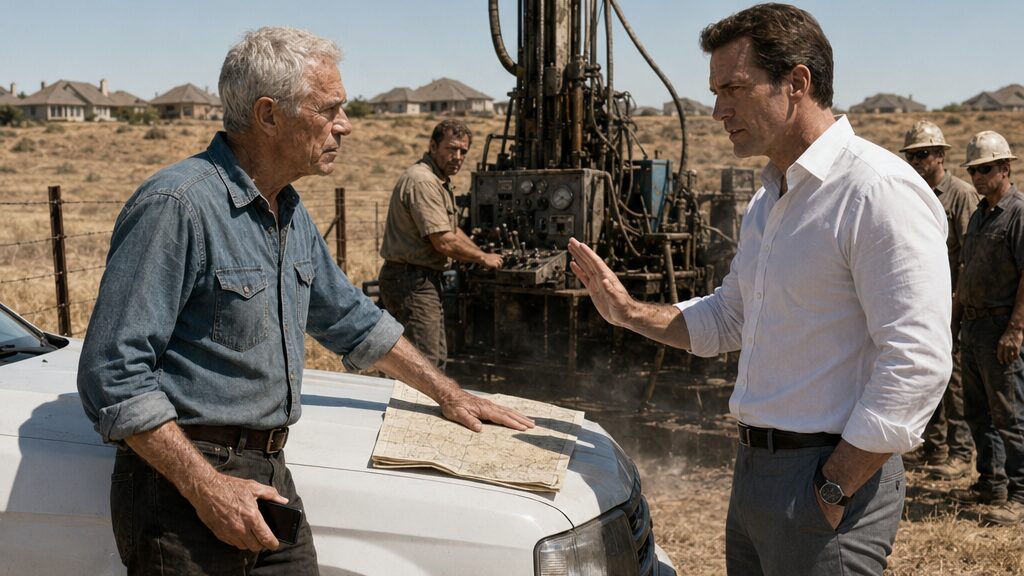
A white SUV sat beside the rig with its driver’s door open. A man in pressed gray slacks and a white shirt was speaking into a phone, one finger pressed to his other ear. Andrew recognized him from two letters and one unwanted visit to the ranch house.
Kevin Hall ended the call when he saw him.
“Mr. Miller,” Kevin said, as if Andrew had arrived late to an appointment. “I was going to have someone come up and let you know.”
Andrew looked past him to the bore.
“How deep?”
Kevin gave a small professional smile. “Good morning to you too.”
“How deep are they?”
The drilling contractor glanced over from the control panel. He was broad through the shoulders, with dust stuck to the sweat on his neck.
Kevin stepped between Andrew and the rig. “This is a test operation. Nothing permanent.”
“You’re on my land.”
“We’re inside the utility easement.”
Andrew studied Kevin’s face. No uncertainty showed there. Either he believed what he was saying, or he had practiced saying it until belief no longer mattered.
“Show me.”
Kevin’s smile tightened. “We’ve been through the county packet. The HOA has lawful access along this corridor.”
“For utilities.”
“Water is a utility.”
“Not water under my ground.”
The contractor reduced the drill speed. The engine dropped to a heavy idle.
Kevin turned toward him. “Keep going, Mark.”
Mark Davis held Andrew’s gaze for half a second, then looked back at his gauges.
The rig accelerated again.
Andrew felt the vibration in his teeth.
Kevin lowered his voice. “I understand you’re protective of the ranch. But we have more than nine hundred households across that ridge. Demand is exceeding projections. This bore could stabilize service for everyone.”
Andrew looked toward the line of tiled roofs visible beyond the distant slope. Once, that land had been scrub pasture. Now sprinklers ran there before sunrise, and blue rectangles of swimming pools flashed between walls.
“You asked to buy this strip in April,” Andrew said.
“We asked to discuss options.”
“I said no.”
“This isn’t a purchase issue.”
“You moved a drilling rig onto it.”
Kevin exhaled through his nose. “We have an easement.”
Andrew took out his phone and opened the camera.
Kevin noticed. “You can record if you want.”
“I am.”
“This project has been reviewed.”
“By who?”
“The board, counsel, our engineers, and the county.”
“Which county office?”
Kevin’s expression changed by a degree. “The appropriate office.”
Andrew held the phone steady. “What parcel number is written on the easement?”
Kevin glanced toward the SUV. “I don’t carry parcel numbers in my head.”
“I do.”
He walked to his pickup while the drill continued behind him. Under the bench seat, inside a cracked leather folder, lay a photocopy he had made years ago from the original map. Most of the sheet stayed folded. He exposed only the lower corner and carried it back.
Kevin placed both palms on the hood of his SUV.
Andrew spread the map between them.
The paper trembled against the white metal with every rotation of the drill.
“This black line is the old service corridor,” Andrew said. “County water planned it in seventy-eight and abandoned it in eighty-one.”
Kevin leaned closer without touching the page.
Andrew followed the line with one blunt fingernail. “It ends here.”
He tapped a survey monument north of the fence.
Then he pointed toward the drill.
“You’re over three hundred feet past it.”
Kevin looked toward Mark. “The updated exhibit extends the corridor.”
“Then show me the updated exhibit.”
“I don’t have to litigate this beside a machine.”
“No. You just have to stop the machine until you know where it is.”
Kevin straightened. “Stopping now costs thousands of dollars an hour.”
“That makes it expensive trespassing.”
A crewman turned his face away, hiding something that might have been a smile.
Kevin saw it. Color rose along his collar.
“Mr. Miller, the community cannot be held hostage because an old map is missing an amendment.”
Andrew refolded the paper, leaving one shaded corner visible for an instant before closing it. A gray, irregular band crossed beneath the marked bore field.
Kevin’s eyes paused on it.
“What’s that?”
“Something your engineers should have asked about before they brought a rig.”
“What does it indicate?”
Andrew slipped the map back into its folder. “Identify your parcel first.”
Kevin stared at him. “You know, people warned me you were difficult.”
“People who wanted my land?”
“People trying to keep water running.”
Kevin turned toward the rig and raised his hand.
“Mark, take it another hundred feet.”
Mark did not move immediately. “We’ve got a change in returns.”
“How serious?”
“Could be a cavity. Could be fractured material.”
Kevin looked at Andrew, then at the phone recording in Andrew’s hand.
“Is the casing stable?”
“At the moment.”
“Then proceed.”
Mark rubbed his jaw. “I’d rather circulate and check.”
“We are already behind. Proceed to the target interval.”
Andrew moved the phone slightly, making sure Kevin’s face and the rig were both in frame.
“Say that again,” he said.
Kevin looked directly at the camera.
“I am authorizing the contractor to continue within the HOA’s recorded easement.”
Andrew did not answer. The anger inside him had gone cold enough to use.
Mark signaled to his crew. The drill bit descended.
For thirty seconds, nothing changed except the pitch of the engine. Then one of the hoses jerked. The dark stream crossing the grate thinned to a rope.
Mark leaned over the panel.
“Pump rate’s steady,” a crewman called.
The mud level dropped again.
Mark reached for the throttle.
“Shut it down.”
Kevin stepped toward him. “What happened?”
Mark watched the gauge fall.
“We lost circulation.”
The last of the drilling mud vanished into the ground as if the earth beneath Andrew’s fence had opened its mouth.
Chapter 2: The Easement That Stopped Short
The safe had not been opened since Andrew buried his wife.
Its dial resisted his fingers, stiff from dust and years without use. He turned past the first number, swore under his breath, and began again while the rig’s distant engines idled beyond the kitchen window.
When the lock finally released, the door opened with a dry metal sigh.
Inside were deeds, tax records, his county retirement papers, and a cedar box containing things that had belonged to his wife. Andrew kept his hand away from the box. He removed a wide survey envelope tied with faded green string.
The original 1978 water map lay inside.
He carried it to the kitchen table and unfolded it beneath the hanging lamp. Creases divided the county into rectangles. Blue pencil marked the abandoned utility corridor. Red ink showed test holes, well depths, pressure readings, and ownership boundaries.
Across the southern part of his ranch, a gray band curved under the proposed corridor and widened near the old bore field.
FRACTURED FORMATION—NO ADDITIONAL PENETRATION, someone had written in block letters.
Andrew had helped make that notation.
He stood over it until his phone rang.
Kevin’s name appeared on the screen.
Andrew let it stop.
A message followed.
Our counsel confirms access. Work is temporarily paused while the contractor resets circulation. I suggest we discuss this reasonably.
Andrew photographed the map, the deed, and the easement description. Then he called Catherine White at the county water-resources office.
She answered on the fourth ring. “Water records.”
“It’s Andrew.”
Silence lasted just long enough to tell him she had heard his tone.
“What happened?”
“There’s a drilling rig south of marker fourteen.”
“Whose?”
“The Ridgeview association’s contractor.”
Catherine’s chair creaked. “On the abandoned corridor?”
“Past it.”
“How far?”
“Three hundred feet, maybe more.”
“Tell me they haven’t started.”
“They lost circulation.”
Catherine stopped breathing for a moment.
“I need the easement book and the seventy-eight field map,” Andrew said.
“I can pull the recorded book. The field map may still be in archive storage.”
“I have the original.”
Another silence.
“You kept it?”
“It was issued to the landowner.”
“You were also the field technician.”
“And it was issued to the landowner.”
Catherine did not argue. “Bring everything.”
The county building had once been a bank. Its thick walls trapped afternoon heat, and the records room smelled of paper, toner, and old carpet. Catherine met Andrew at the counter before the clerk could ask him to take a number.
Her hair had gone nearly white since he last saw her outside a retirement luncheon. She wore reading glasses on a cord and carried two oversized folders against her chest.
“Conference room,” she said.
She locked the door behind them.
Andrew opened his map while Catherine spread certified copies of the easement and subdivision plats beside it. For several minutes they worked without speaking.
The legal description was narrow and plain. A twenty-foot access strip followed an anticipated county utility line across the original ranch parcel. The line terminated at a survey monument well north of the current bore site. No language granted groundwater extraction. No amendment extended the corridor.
Catherine placed one finger on the final coordinate.
“It stops here.”
“I told him.”
“Did he show you another instrument?”
“No.”
“Then there isn’t one recorded.”
The satisfaction Andrew expected never came. The map beneath their hands seemed heavier than paper.
Catherine noticed where he was looking.
Her finger moved to the gray band.
“Oh, Andrew.”
He folded his arms.
“You knew.”
“I knew what it looked like in seventy-eight.”
“You knew enough to mark it.”
“We had a collapse during the second test.”
“I remember the report. I didn’t remember the location.”
“They abandoned the corridor because the formation wouldn’t hold pressure.”
Catherine looked up. “Did you tell them that this morning?”
“I told Hall his engineers should have checked.”
“That isn’t what I asked.”
“They were already drilling.”
“Before today. He contacted you about water access in April.”
“He contacted me about buying land.”
“And groundwater?”
Andrew looked at the certified easement instead of her.
Catherine removed her glasses. “You could have brought this to us.”
“I brought warnings to this county twelve years ago when they rezoned that ridge.”
“I know.”
“They approved nine hundred houses against a municipal line sized for half that.”
“I know.”
“You signed off on the archive transfer.”
Her face tightened. “And I have regretted how that office handled it every summer since.”
The words struck harder because she did not defend herself.
A clerk knocked and opened the door a few inches. “Catherine? There’s a contractor on line two asking for confirmation of a drilling permit.”
She reached for the desk phone and pressed the blinking button.
“This is Catherine White.”
She listened, asked for the bore number, then wrote it down.
“What depth are you at?”
Her pen stopped.
“Repeat that.”
Andrew watched the color leave her face.
“No. Do not resume. I’m issuing a verbal hold pending state review. Send me the complete drilling log now.”
She hung up and turned to him.
“They filed for a shallow geotechnical test. Maximum depth two hundred feet.”
“How deep?”
“Four hundred sixty.”
Andrew looked again at the gray zone. The old failed test had collapsed at four hundred twelve.
Catherine picked up another phone. “I’m calling the state inspector.”
“He won’t get here before dark.”
“He’ll come if I tell him they penetrated a restricted formation.”
“Restricted on an internal field map that was never attached to the public plat.”
Her hand froze above the keypad.
That was the weakness. The easement violation was clear. The hydrogeological warning was not. It existed in county technical archives and on Andrew’s original, but years of incomplete transfers had left it outside the documents Kevin’s attorneys likely reviewed.
Catherine set the receiver down slowly.
“The county attorney will want authentication.”
“He can have my field notes.”
“Do you still have them?”
“In the safe.”
“You kept everything except the part where you told anyone who needed it.”
Andrew met her eyes.
She looked tired rather than angry. That made it worse.
“The easement is enough to stop them,” she said. “But if the formation has opened, we need to know whether sealing the casing will isolate it or trap pressure where it shouldn’t be.”
Andrew traced the old contour marks. The bore sat near the edge of the fractured band, where two pressure zones met.
“Depends how they cased the upper section.”
Catherine called the state.
The inspector arrived at the ranch just before sunset in a mud-streaked truck with government plates. Mark Davis had shut down the rig, but Kevin remained beside his SUV with an attorney on speakerphone. The inspector examined the easement, the permit, Andrew’s map, and the drilling log Mark had finally emailed.
Kevin argued that the bore could be brought into compliance.
The inspector read the depth twice.
“No,” he said. “The casing gets sealed tonight.”
Kevin stepped forward. “You understand this test is part of an emergency supply plan?”
“I understand you drilled more than twice your authorized depth on land your easement does not reach.”
“Our counsel disputes the boundary interpretation.”
“Your counsel can dispute it after the bore is secured.”
Floodlights came on around the rig as daylight drained from the field. The crew lowered equipment into the casing. Andrew stood outside the work area, the map rolled under one arm.
The inspector joined him while the first sealing material was mixed.
“If this old notation is accurate,” he said, “shutting it now is our safest option.”
“Safest isn’t the same as safe.”
“No.”
From the rig came the clang of steel and the hiss of a pump engaging.
Kevin watched with both hands on his hips. For the first time that day, he looked less angry than afraid.
The inspector’s radio crackled. He answered, listened, and turned toward the subdivision lights appearing beyond the ridge.
“When did their storage pressure start falling?” he asked.
Andrew looked at the sealed casing, then at the old gray band on the map.
The inspector lowered the radio.
“They’re reporting fluctuations across the entire upper zone.”
Chapter 3: The Night Every Faucet Coughed
Lisa Garcia turned the kitchen faucet and got a burst of rusty water, two violent coughs of air, and silence.
She tried it again.
The pipe behind the wall knocked once.
From the hallway, her daughter called, “Mom?”
“Stay out of the shower.”
“I already put shampoo in my hair.”
Lisa stared at the dry sink. On the counter sat a half-filled coffee pot and a bowl of vegetables she had started washing. The refrigerator dispenser made a low grinding noise when she pressed her glass against it.
Her phone began vibrating.
The board group chat filled faster than she could read.
NO WATER ON CANYON VIEW.
PRESSURE LOW ON JUNIPER.
IS THIS MAINTENANCE?
POOL PUMPS ARE SUCKING AIR.
A message from Kevin appeared above the rest.
Temporary pressure disruption related to county action at supplemental test site. Maintenance evaluating.
Lisa called him.
He answered with machinery roaring behind him. “We’re handling it.”
“What does county action mean?”
“They forced the contractor to seal the test bore.”
“What test bore?”
A pause.
“The supplemental-water investigation discussed in executive session.”
“We approved a feasibility study.”
“That’s what this was.”
“Feasibility studies don’t shut off nine hundred houses.”
“The shutdown is a separate operational issue.”
Lisa opened the cabinet beneath the sink and checked the valves, though she knew every house on her street could not have closed its own supply at once.
“Did we have permission to drill?”
“We had an easement opinion.”
“That is not the same sentence.”
“Lisa, I need you to keep the board calm. Residents are already drawing conclusions.”
Her daughter appeared in the doorway with a towel around her shoulders and white foam in her hair.
Lisa lowered her voice. “My child has shampoo on her head. Tell me when water comes back.”
“We’re working on it.”
Kevin ended the call.
Across the subdivision, automatic sprinklers clicked on and died. Faucets sputtered. Toilets refilled halfway and stopped. The maintenance supervisor watched the digital pressure reading at the main pump station descend, stabilize, then descend again.
At the ranch, Andrew stood beside the state inspector while Mark’s crew secured the sealed casing. The drilling rig was quiet now, but the quiet carried its own pressure. Without the engine, Andrew could hear the wind moving through dry grass and the intermittent radio traffic from the inspector’s truck.
“Upper-zone reading is down another six pounds,” the inspector said.
“That system shouldn’t be tied directly to this formation.”
“Shouldn’t be.”
Kevin walked toward them holding his phone. “Pressure is collapsing across Ridgeview.”
Andrew looked at him. “Then your municipal feed is failing.”
“It was functioning before you called the state.”
“I didn’t seal your bore.”
“You produced the map that shut this operation down.”
“The map showed you had no right to be here.”
Kevin stepped closer. “Nine hundred families had water this morning.”
“And you drilled four hundred sixty feet into a formation your permit limited to two hundred.”
“We were trying to secure redundancy.”
“You were trying to manufacture it before anyone could tell you no.”
Kevin’s jaw worked. “Can you reverse this?”
“The county sealed it.”
“I’m asking whether you can restore pressure.”
Andrew took out his phone and opened the video from that morning. Kevin’s voice came through the speaker, thin but clear.
I am authorizing the contractor to continue within the HOA’s recorded easement.
Andrew stopped the recording.
“I don’t control a single valve in your development.”
Kevin stared at the screen.
The inspector said, “Mr. Hall, we need your system diagrams and the last thirty days of municipal inflow data.”
Kevin did not look away from Andrew. “You knew this could happen.”
Andrew rolled the map tighter under his arm.
“I knew drilling there was dangerous.”
“And you let us proceed.”
“I told you to stop.”
“You told me the easement was short. You never said nine hundred homes could lose water.”
The accusation landed because it contained enough truth to hurt.
Before Andrew could answer, Mark came from the rig carrying a clipboard.
“The lower return didn’t come back after sealing,” he said.
The inspector took the sheet. “Meaning?”
“Meaning the formation was accepting everything we pumped before shutdown. Could be void space. Could be a connection we didn’t know existed.”
Kevin turned on him. “You told me it was manageable.”
“I told you I wanted to circulate and inspect.”
“You said the casing was stable.”
“At the moment. Those were my words.”
The inspector read the entries. “Did you encounter artesian pressure?”
“No. We encountered loss.”
Andrew looked toward the ridge. If Ridgeview’s municipal system had already been relying on declining reservoir pressure, the bore had not switched off their water. It had disturbed a weak groundwater contribution—or exposed a leak between pressure zones—that the development had quietly come to depend on.
“How much storage do they have?” Andrew asked.
Kevin hesitated.
The inspector noticed. “Answer him.”
“Normally, a day and a half.”
“Normally?”
“Current levels are lower.”
“How much lower?”
Kevin rubbed a hand over his face. “Peak demand exceeded forecast. The upper tank was at thirty-eight percent this afternoon.”
Andrew felt the situation rearrange itself.
“You were already close to rationing.”
“We had a plan.”
“This was the plan.”
“This was one part of it.”
The inspector requested tanker support through the county emergency line. The first dispatcher reported that regional haulers were committed to wildfire staging and agricultural contracts. The earliest confirmed deliveries would arrive after dawn.
Kevin began calling private vendors.
Andrew drove home shortly after midnight with the map on the passenger seat. The ranch house was dark except for the porch lamp. He washed his hands at the mudroom sink and listened to the water strike the basin with full, steady force.
The sound seemed indecent.
He shut the faucet.
Across the ridge, the subdivision lay in scattered darkness. Porch lights moved as residents carried bottled water between houses. A line of cars had formed outside the only open grocery store in town.
Andrew spread the map beside a legal pad and wrote down pressure zones from memory. Ridgeview’s main line crossed the old county corridor near his northeast pasture. There had once been a capped service connection there, installed before the project was abandoned.
He had covered it with a steel box and then with soil.
His phone rang again.
This time Lisa Garcia’s name appeared. He knew it from HOA letters bearing her signature as treasurer.
He did not answer.
A truck approached along the ranch drive ten minutes later, moving slowly between the fence posts. Its headlights stopped at the house.
Andrew stepped onto the porch.
Lisa climbed out carrying a clear plastic water jug. It was small enough for a child, decorated with faded cartoon stars. Empty, it knocked lightly against her leg.
She came to the bottom of the steps and looked at him without greeting.
“My daughter asked me whether the rancher turned off our water because he hates us,” she said.
Andrew rested one hand on the porch rail.
“What did you tell her?”
“I told her I didn’t know.”
Lisa lifted the empty jug between them.
“Then tell me now.”
Chapter 4: What Andrew Chose Not to Say
Lisa kept the empty jug raised between them.
“Did you turn it off?”
“No.”
“Did you know it could fail?”
Andrew looked past her toward the ridge. The subdivision lights were scattered now, some houses bright with generators, others dark except for phone screens moving behind windows.
“That is not the same question,” Lisa said.
“No,” he answered. “It isn’t.”
She climbed the porch steps before he invited her. Up close, she looked less like the signature at the bottom of HOA notices and more like someone who had been awake too long. Her hair was tied back with a rubber band. One sleeve of her sweatshirt was damp where her daughter’s wet head had rested against it.
Andrew opened the door.
In the kitchen, the 1978 map covered most of the table. Pressure-zone numbers filled the legal pad beside it. Lisa set the jug near the edge and leaned over the faded sheet.
“What is the gray part?”
Andrew did not answer immediately.
She pointed to the irregular band crossing the southern pasture. “This. The mark under the drilling site.”
“A fractured formation.”
“What does that mean?”
“It means the rock below that line does not behave like one solid layer.”
“Does it connect to our system?”
“It should not.”
“But it might.”
“It might affect pressure between shallow and deeper zones. Depends on casing, faults, old test holes, how your development draws water.”
Lisa straightened. “You knew this before they drilled.”
Andrew folded his hands against the chair back.
“I knew what happened there in seventy-eight.”
“And you did not tell Kevin.”
“I told him to stop.”
“You told him he was trespassing.”
“He was.”
“That is not what I asked.”
Her words were nearly the same as Catherine’s. Andrew disliked her for that, though she had no way of knowing.
“He came here in April talking about buying the strip,” Andrew said. “Not asking for technical advice.”
“He asked about groundwater.”
“He asked whether I would sell access.”
“And you knew why.”
“I knew what he wanted.”
Lisa stared at the map. “My daughter is sleeping with conditioner in her hair because both of you decided the other man did not deserve the whole truth.”
Andrew’s jaw tightened. “Hall ordered the drill past its permit.”
“I am not defending him.”
“You are an HOA officer.”
“I am a treasurer. I approve invoices, insurance renewals, landscaping contracts. I approved money for a feasibility study because Kevin said the municipal connection might need backup. I did not approve a four-hundred-foot bore on private land.”
“You signed the budget.”
“Yes.”
The answer came without excuse.
Lisa touched the cartoon stars on the jug with one thumb. “And I did not read the technical appendix.”
The kitchen went quiet.
Andrew had expected accusation from her. He had not expected admission.
She looked at the sink. “Can I fill this?”
He turned the faucet. Water struck the metal basin in a clear, steady stream. Lisa’s face changed at the sound. Not envy exactly. Something closer to anger at how ordinary it was.
Andrew filled the jug and shut the water off before it reached the rim.
Lisa screwed on the cap.
“Is there any way to get water to us before the tankers arrive?”
Andrew looked down at the map.
The old county corridor ran northeast from his pasture toward what was now Ridgeview’s lower service road. Near the ranch boundary, a capped connection had once been installed for a future transmission line. The line had never been completed, but the stub remained beneath a steel box buried under two feet of soil.
“There may be a temporary point,” he said.
Lisa’s shoulders loosened.
“May be,” he repeated. “It was capped more than forty years ago. It would need pressure testing. The county would have to authorize it. Your board would have to accept liability in writing.”
“Liability for what?”
“Contamination. Breakage. Damage to my line. Damage to yours. And water use.”
“How much water?”
“Enough for basic household pressure if your people stop irrigating and filling pools.”
“They will.”
“You cannot promise that for nine hundred homes.”
“I can shut common irrigation down tonight.”
“Private systems will still run.”
“Then we issue an emergency rule.”
Andrew gave her a hard look. “That word is how this started.”
Lisa absorbed it.
“Then call it what it is,” she said. “A restriction because we ran out of water.”
Headlights swept across the kitchen window.
Catherine’s county sedan stopped beside Lisa’s truck. She came in carrying a laptop case and a rolled set of system diagrams. She saw the jug, the open map, and Lisa standing at the table.
“Good,” Catherine said. “You are both here.”
She spread Ridgeview’s utility plan over the far end of the table. The municipal supply entered through the north booster station. Storage fed three pressure zones. A thin dashed line showed the abandoned county corridor near Andrew’s northeast pasture.
“That connection still exists?” Lisa asked.
“On paper,” Catherine said.
“In the ground too,” Andrew said.
Catherine looked at him. “You checked it?”
“Not in eight years.”
“Then we inspect it at first light.”
Lisa glanced between them. “Why not now?”
“Because opening a buried forty-year-old fitting in the dark is how emergencies multiply,” Andrew said.
Catherine connected her laptop to a hotspot. “The county attorney is drafting access and liability language. The state inspector will require a supervised pressure test.”
Andrew followed the dashed line with his finger. The temporary connection could supply Ridgeview’s lower zone from the ranch’s permitted well and storage system. But his water served livestock troughs, the house, and a small pond that carried the cattle through late summer.
“How long?” he asked.
“Until tankers stabilize storage,” Catherine said. “Possibly several days.”
Lisa watched him understand the cost.
“You have enough?”
“That depends on demand.”
“We can ration.”
“You can ask. That is not the same as controlling it.”
Catherine closed the laptop halfway. “Andrew, there is something else.”
He did not look up.
“You knew the fracture zone was there. You knew Kevin was considering groundwater access. Why did you not bring the map to the county in April?”
“Because the county already had it.”
“In a box nobody had indexed correctly.”
“That was not my doing.”
“No. But you knew it.”
He looked at her then.
Catherine’s voice remained low. “You wanted them to come ask properly. When they did not, you let them keep being wrong.”
Lisa said nothing.
Andrew heard his wife’s voice from years earlier, not as memory but as pressure behind his ribs. You cannot keep waiting for people to become decent before you tell them the truth.
He pushed the thought away.
“They crossed my fence,” he said.
“Yes,” Catherine replied. “And now a child carried an empty jug to your porch.”
A truck door slammed outside.
Mark Davis entered the mudroom with dust still on his clothes and a leather binder under one arm. He stopped when he saw Lisa.
“I was told the county clerk was here.”
“Water-resources clerk,” Catherine said. “What do you have?”
Mark placed the binder on the table but kept one hand on it.
“The complete field log.”
“You already emailed a log,” Catherine said.
“I emailed the digital summary.”
“What is different about this one?”
Mark opened the binder.
Handwritten entries filled the pages: pump rates, depth changes, sample notes, casing pressure. At four hundred eight feet, a line had been underlined twice.
TOTAL LOSS OF RETURNS. RECOMMEND HALT AND CIRCULATION TEST.
Below it, in darker ink, someone had written:
PROCEED TO TARGET. AUTHORIZATION CONFIRMED.
Lisa leaned closer. “Who wrote that?”
Mark looked at Andrew, then Catherine.
“I wrote the first line,” he said. “The second was added after I called Kevin.”
Chapter 5: The Warning Buried in the Log
The words in the drilling log were still damp enough to smear.
Lisa rubbed the edge of the page between her fingers and saw a faint black mark transfer to her skin. The notation had not been made at the site that morning. Someone had rewritten it after the fact or copied it from another sheet.
“Is this the original?” she asked.
Mark looked toward the dark window. “It is the binder we keep in the truck.”
“That was not my question.”
“No.”
Catherine pulled on her reading glasses. “Where is the original?”
“A carbon field sheet. In the rig cab.”
“Get it.”
Mark did not move.
“If I hand that over,” he said, “my insurer sees it before my lawyer does.”
Lisa closed the binder. “Nine hundred homes have no water.”
“And eleven people on my payroll may have no jobs.”
Andrew stood at the end of the table, silent.
Mark turned to him. “You think I do not understand where we were drilling? I asked for the easement. I asked for the permit. Kevin gave me both.”
“The permit said two hundred feet,” Andrew said.
“The contract target said five hundred.”
“Which one did you choose to follow?”
Mark’s face tightened. “The one tied to payment.”
No one answered.
He reached into his shirt pocket and removed a folded sheet of yellow carbon paper. He set it beside the copied log.
The original entry was shorter.
LOSS OF RETURNS AT 408. HALT ADVISED.
Beneath it was Mark’s signature and a time.
No authorization line appeared.
Lisa felt her stomach settle into a cold, clear place.
“You added the authorization note later.”
“Kevin called after the shutdown order. He told me our record needed to reflect the instruction he gave.”
“Did he tell you to change the log?”
“He told me to make it complete.”
Catherine photographed both pages.
Lisa asked, “Why bring this now?”
Mark looked at his hands. The skin around his nails was black with drilling mud.
“Because I can lose the company for doing what he told me. I can also lose it for admitting I knew better.”
It was not courage. It was calculation under pressure. Lisa trusted it more for being honest.
By sunrise, the county emergency center had become a room of folding tables, extension cords, printed maps, and coffee nobody finished. The state inspector reviewed the original field sheet. The county attorney drafted preservation notices. The emergency dispatcher worked three phones at once, trying to redirect tanker trucks from distant agricultural routes.
Lisa sat across from Kevin at a plastic table.
His white shirt from the day before had been replaced by a blue one, but the collar was already creased. He looked as if he had slept sitting up.
“The field log was altered,” Lisa said.
“Clarified.”
“After the fact.”
“To reflect a verbal authorization.”
“Your authorization.”
“Yes.”
“You told him to drill after he recommended stopping.”
Kevin pressed both palms flat against the table. “The formation change was not necessarily catastrophic. Loss of circulation happens.”
“Then why was it left out of the board update?”
“Because it was an operational detail.”
“Water disappearing into the ground was an operational detail?”
His control slipped. “Do you think I wanted this?”
The room quieted around them, though no one stopped working.
Kevin lowered his voice.
“For three weeks, the municipal inflow has been below contract minimum. The city kept telling us it was temporary. The north booster was overheating. The upper tank could not recover overnight. If we announced mandatory rationing without a backup plan, residents would panic, values would take a hit, and the lender would freeze the final construction release.”
Lisa stared at him.
“You knew we were days from rationing.”
“I knew we were approaching the threshold.”
“You let us keep watering common areas.”
“The board insisted the entrances remain presentable.”
“I am on the board.”
“Not every decision is made in open session.”
There it was: the language of control dressed as protection.
Kevin looked toward Andrew, who stood over the old map with Catherine and the inspector.
“We were trying to create redundancy,” Kevin said. “If that test produced, we could have stabilized the system before anyone lost service.”
“You were trying to solve a public failure before the public learned it existed.”
“I was trying to prevent a public failure.”
“And when Mark warned you?”
Kevin’s gaze dropped to the table.
“The contractor believed the casing remained stable.”
“That is not an answer.”
“No,” he said quietly. “It is the answer I used.”
For the first time, Lisa saw the scale of his fear. Not just for his title. For the subdivision built around promises he had repeated until every family treated them as infrastructure: reliable water, stable fees, protected values, controlled growth. If those promises failed, his entire authority failed with them.
Understanding did not soften what he had done.
Across the room, Andrew placed his phone beside the drilling log. He played the recording from the fence line. Kevin’s voice filled the emergency center.
I am authorizing the contractor to continue within the HOA’s recorded easement.
The inspector stopped writing.
The county attorney asked for the file.
Andrew ended the playback and looked at Kevin.
Kevin did not deny it.
Catherine aligned the 1978 map with Ridgeview’s utility plan and the drilling log. The bore mark sat inside the gray fracture zone. The old capped connection sat miles of pipe away from the damaged area, linked instead to Andrew’s permitted ranch system.
“The temporary route is technically possible,” the inspector said. “But only at restricted volume.”
“How restricted?” Lisa asked.
“Enough for sanitation, drinking, and short household use. Not landscape irrigation. Not pools. Not full normal pressure.”
“And the ranch?” Andrew asked.
The inspector pointed to his well and storage pond. “Your drawdown will increase immediately.”
“How much?”
“With nine hundred connections, even under rationing, your pond could fall below livestock reserve within a week.”
Lisa looked at Andrew.
He was studying the map as if the paper had made the choice for him.
“We have tanker deliveries beginning this afternoon,” she said. “Could they reduce the draw?”
“Yes,” Catherine said. “If deliveries stay on schedule and residents comply.”
Andrew’s phone remained beside the altered log. The evidence was enough to protect him legally. Perhaps enough to punish Kevin. It did nothing for the houses across the ridge.
Lisa said, “I will shut down every HOA irrigation line. We will publish the storage readings. We will post tanker schedules by street.”
Kevin looked at her. “You cannot release internal system data without board approval.”
“I can call an emergency vote.”
“You will trigger claims.”
“There will be claims.”
He leaned toward her. “Think about what that does to assessments.”
“I am thinking about what lying does to them.”
Andrew rolled the map slowly. “Your board signs access. Full liability. County supervision. No future groundwater work within the protected zone.”
Lisa nodded. “Agreed.”
“And one more condition.”
Kevin’s eyes narrowed. “What?”
Andrew picked up the field log.
“At the resident meeting tomorrow, the entire authorization record gets read. The easement. The permit. Mark’s warning. Your instruction. My map.”
Lisa studied him. “All of it?”
“All of it.”
Andrew’s thumb rested on the gray fracture band.
He knew what else all of it would eventually include.
His silence.
He signed the temporary access agreement before he could retreat from the decision.
Chapter 6: Nine Hundred Homes in One Room
The first tanker invoice appeared on the clubhouse screen, and the room erupted.
Residents stood in aisles and along the walls. More watched through open doors from the parking lot, where portable speakers carried the meeting into the heat. The invoice listed emergency mobilization, overnight hauling, driver premiums, sanitation testing, and fuel.
The total covered six hours.
Someone shouted, “Who approved this?”
Another voice answered, “Who approved the drilling?”
A woman near the front held up a bag of paper plates. “We cannot wash dishes.”
The HOA president struck the table with a wooden gavel that sounded too small for the room.
Lisa sat at the board table with a stack of printed records in front of her. Kevin sat two chairs away, separated from her by the county attorney. His face remained composed, but he had stopped correcting people when they called the bore illegal.
Andrew stood near the rear wall with Catherine.
The 1978 map had been scanned and projected behind the board. Enlarged across the screen, its faded lines looked almost new. The blue corridor ended before the drilling site. The gray fracture band curved beneath the red bore mark.
It was the same map that had trembled on Kevin’s SUV while the rig turned.
Now nine hundred households stared at it.
Lisa raised the microphone.
“The easement did not authorize groundwater extraction at the drilling location.”
The room surged again.
“The contractor’s permit was limited to two hundred feet. The bore reached four hundred sixty feet. At four hundred eight feet, the contractor recommended stopping because drilling returns were lost.”
She lifted Mark’s original field sheet.
“The instruction to continue came from the development director.”
Every face turned toward Kevin.
He leaned toward his microphone.
“The board needs to understand the context. Ridgeview’s municipal supply had fallen below expected delivery. The test bore was part of an emergency redundancy strategy intended to prevent exactly the service failure we are now experiencing.”
A man in the aisle shouted, “Then why did you not tell us?”
Kevin waited for the noise to fall.
“Because preliminary system fluctuations are managed operationally. Announcing unconfirmed shortages could have created unnecessary panic.”
Lisa’s mouth hardened.
Kevin continued. “We had a legal opinion supporting access. We had an engineering target. We had hundreds of families facing potential rationing. I made a decision under time pressure.”
“You made it on somebody else’s land,” a resident called.
Another voice came from the parking lot speaker. “Did the rancher shut us off?”
The question moved through the room.
Andrew felt Catherine look at him.
Lisa answered first. “No. Mr. Miller controls no Ridgeview valve. The state sealed the bore after confirming the permit and easement violations.”
A few people turned to find him against the wall.
Lisa went on. “He also provided the records that allowed the county to identify the protected formation and locate a possible emergency connection.”
The room changed, not toward applause but toward a simpler arrangement of blame. Kevin at the table. Andrew by the wall. One man reckless, the other vindicated.
Andrew could have let it remain that way.
He stepped forward.
Catherine caught his sleeve. “You do not have to do this tonight.”
“Yes,” he said. “I do.”
Lisa saw him approaching and moved away from the microphone.
Andrew stood before the projected map. Under the bright screen, every crease and handwritten note showed behind him.
“I did not shut off your water,” he said.
His voice did not carry to the parking lot until someone raised the microphone closer.
“I did not authorize the drill. I told them they were outside the easement. I recorded Mr. Hall directing the contractor to continue.”
Kevin stared at the table.
Andrew looked across the room. Parents held bottled water. An older resident sat with a battery-powered oxygen unit beside her chair. A maintenance worker still wore a reflective vest from the tanker station.
“But I knew that ground was unstable.”
The room became quiet enough for the portable air conditioner to be heard struggling near the door.
Andrew pointed to the gray band on the screen.
“I helped mark that fracture zone in 1978. We lost a test hole there. The formation took drilling fluid and would not hold pressure. The county abandoned the planned corridor.”
Lisa watched him closely.
“Mr. Hall asked about groundwater access in April,” Andrew said. “I did not give him this map.”
A voice from the front asked, “Why not?”
Andrew kept his eyes on the gray band.
“Because twelve years ago, during rezoning, I warned the county that the municipal line could not support the development as proposed. I was dismissed. The project went forward. Later, the HOA tried to buy part of my ranch. I believed any information I gave them would be used to push farther onto my land.”
“That does not answer why,” someone said.
“It does,” Andrew replied. “It just does not excuse it.”
The words settled badly, as truth sometimes did.
Kevin raised his head.
“You knew the bore could affect the system,” he said.
“I knew it could damage pressure zones. I did not know your municipal storage was already failing.”
“You could have prevented this.”
“I could have warned the county sooner.”
Kevin’s voice sharpened. “And you chose not to.”
“Yes.”
The admission seemed to surprise him more than denial would have.
Andrew faced the residents again.
“Mr. Hall had the legal duty to verify the easement and obey the permit. The contractor had the duty to stop at the warning. I had knowledge that might have stopped this before the rig arrived, and I kept it locked in my safe.”
No one applauded. No one shouted for several seconds.
The blame did not disappear. It divided into its proper shapes.
Lisa took the microphone.
“The county has approved a temporary emergency connection from Mr. Miller’s permitted ranch system. It can restore limited household pressure if the board accepts liability, shuts down irrigation, publishes daily use, and maintains tanker deliveries.”
A resident asked, “When does it start?”
The state inspector stood near the side door. “Only if Mr. Miller identifies the buried connection and supervises the opening. The fitting is old, and the county will not authorize excavation without someone who knows the original installation.”
Every face turned toward Andrew again.
Catherine handed him a written permit.
He read the restrictions. Maximum flow. Continuous pressure monitoring. Mandatory shutdown if the ranch well dropped below the livestock reserve threshold.
“How long can it run?” Lisa asked.
Andrew answered without looking up. “If people obey the restrictions, several days. Maybe longer with tankers.”
“And if they do not?”
“My pond drops first.”
The HOA president called for the emergency vote.
Hands rose along the board table. Lisa voted yes. Two members hesitated, then followed. Kevin did not vote; the county attorney had advised him to abstain from decisions connected to the bore.
The measure passed.
Residents began checking their phones as the new restrictions arrived by text: no outdoor watering, no pool filling, no vehicle washing, limited household use, tanker collection by assigned street.
Kevin stood as the room shifted around him.
“You think public confession makes you responsible?” he asked Andrew quietly.
“No.”
“Then what does?”
Andrew folded the permit and put it in his shirt pocket.
“Opening the line.”
He left the clubhouse before the meeting ended.
Outside, tanker pumps thudded in the parking lot. Their hoses pulsed under floodlights while residents waited with containers. Beyond the subdivision wall, the ranch lay dark.
Lisa followed him to the steps.
“You are doing this after what they did.”
“I am doing it because of what I did not do.”
She looked back through the doors at the map glowing behind the board.
“Will your cattle have enough?”
“I will know when the gauge moves.”
Andrew walked toward his pickup.
At the ranch, the buried connection waited beneath dry soil, holding a line he had once promised would never carry subdivision water.
Before dawn, he would open it.
Chapter 7: The Water He Refused to Waste
Andrew turned the emergency valve one quarter rotation, then stopped.
The pressure gauge climbed from zero to twelve pounds. A county technician watched the needle while the state inspector held a radio near his mouth. On the opposite side of the fence, Ridgeview’s maintenance supervisor stood beside the temporary manifold with both hands raised, waiting for permission to open the subdivision line.
“Hold there,” Andrew said.
The old fitting groaned beneath the steel box. Rust flaked from one bolt. Water moved through pipe that had been buried before most of the houses beyond the ridge existed.
Lisa stood several feet back with Catherine and two board members. She had tied her hair up again, though loose strands clung to her face. Behind them, the first tanker of the morning rolled along the service road, its engine laboring under a full load.
The gauge reached fifteen.
Andrew listened.
The line gave a low, steady hum instead of the hammering knock he had feared.
“Open the Ridgeview side ten percent,” he said.
The maintenance supervisor moved the handle.
The needle dipped, steadied at thirteen, then began to rise.
The inspector spoke into his radio. “Confirm pressure at lower-zone station.”
Static answered. Then a voice reported nine pounds and increasing.
Across the subdivision, toilets began to refill. Faucets that had produced only air released brown spurts, then thin streams. Residents had been warned to flush lines and boil water until testing cleared the connection, but lights came on in windows as people heard the pipes wake.
Lisa’s phone filled with messages.
She read one and looked at Andrew. “A house on Canyon View has flow.”
“Tell them not to celebrate with a shower.”
She typed the warning.
The supply was never meant to carry so many connections. Andrew kept the valve below half-open and watched three numbers: line pressure, well drawdown, and pond level. The pressure could not fall too low without risking contamination. The well could not run continuously without overheating the pump. The pond could not drop below the mark painted on the measuring post near the cattle trough.
Every gallon had a destination now.
By noon, Ridgeview had limited service in the lower and central zones. The upper streets still relied on tankers and household storage. Outdoor irrigation valves were locked. Pool pumps were shut down. The HOA sent maintenance crews door to door where private sprinkler systems continued operating.
Some residents cooperated immediately. Others argued that they had paid for water and could use it.
Lisa stood beside one homeowner’s running side-yard sprinkler while the maintenance supervisor closed the private shutoff.
“You cannot touch that,” the homeowner said.
“We issued an emergency restriction.”
“My landscaping warranty requires daily watering.”
“Then send the HOA the warranty claim.”
The sprinkler stopped.
Brown water drained from the grass into the gutter.
Andrew saw the video later on Lisa’s phone while they checked tanker volumes. She looked embarrassed.
“You were right,” she said. “I could not promise compliance.”
“You shut it down.”
“After it ran for twenty minutes.”
“That is still different from leaving it on.”
The tanker schedule became a discipline of its own. Trucks entered Ridgeview at three-hour intervals, filling storage tanks while residents collected drinking water from marked stations. The HOA published daily use figures, system pressure, and costs. Each new invoice produced another wave of anger, but the anger no longer had one easy target.
On the fourth day, the county held a preliminary hearing in a room smaller and quieter than the clubhouse. Kevin sat with counsel at one table. Mark sat at another with an insurance representative. Andrew testified about the easement, the old fracture zone, and his decision not to bring the map forward when Kevin first discussed groundwater.
No one thanked him for admitting it.
That was not why he did it.
The drilling recording was entered into the record. So were the original field sheet and the altered binder log. The state inspector described the permit violation. Catherine explained how the technical map had been stored without proper indexing during an archive transfer.
Responsibility did not settle on one person. It accumulated.
During a recess, Kevin approached Andrew in the hallway.
“You got what you wanted,” he said.
Andrew leaned against the wall, arms folded. “Did I?”
“The bore is closed. The HOA accepts the easement does not reach your land. My authority is suspended.”
“You still think this was about winning.”
Kevin looked through the glass door toward the hearing room.
“I thought if I solved the water problem before the board saw the numbers, I could protect the community.”
“You were protecting your position.”
“Both can be true.”
Andrew considered that.
Kevin’s face looked thinner than it had beside the drilling rig. The polish had not disappeared, but it no longer concealed the strain beneath it.
“I had three choices,” Kevin said. “Mandatory rationing, delayed construction with lender penalties, or a test bore our counsel said was defensible. Every choice hurt someone.”
“You chose the one where somebody else carried the risk.”
Kevin did not answer.
The hearing resumed without him.
His attorney returned alone and handed the HOA president a letter. Kevin had resigned as development director, effective immediately. He did not admit liability. He did not remain to hear the letter read.
Lisa folded the paper and placed it with the public record.
By the seventh day, the emergency arrangement had become almost routine. Tankers arrived. The ranch pump ran in timed cycles. Residents planned laundry and bathing around pressure windows. The lower tank recovered to half capacity overnight.
Then Andrew found the livestock pond below the red mark.
The exposed bank formed a dark ring around the water. Cattle crowded near the remaining shallows, stirring mud with their hooves. The measuring post showed a loss greater than his calculations had allowed.
He checked the well meter twice.
Ridgeview’s draw had remained within the county limit. The problem was not theft or a hidden valve. The ranch’s shallow recharge had weakened after the drilling disturbance, just as the old map suggested it might.
Catherine joined him at the pond.
“We can reduce the connection another twenty percent,” she said.
“The upper zone loses household pressure.”
“Tankers can cover more.”
“If they keep coming.”
She followed his gaze to the cattle.
“You have already given more than the agreement requires.”
“That does not put water back.”
“No.”
Andrew closed the ranch valve slightly that afternoon. Ridgeview pressure fell. Complaints arrived within minutes.
Lisa did not ask him to reopen it.
Instead, she revised the tanker routes and added another public notice explaining that ranch livestock reserves had reached the emergency threshold. The notice included the pond measurement, the connection rate, and the county limit.
For once, no information stayed hidden because it was inconvenient.
On the eleventh day, municipal inflow stabilized enough to end the ranch connection. Andrew closed the valve in stages. The temporary line fell silent.
The subdivision continued under restrictions, but the crisis had shifted from immediate failure to long repair.
That evening Lisa came to the ranch carrying a thick document folder instead of an empty jug.
She placed it on Andrew’s kitchen table beside the 1978 map.
“What is it?” he asked.
“A draft groundwater protection agreement. Independent monitoring, permanent no-drill zone, public system reporting, county oversight, and reimbursement for your livestock losses.”
Andrew opened the folder.
At the back was a proposed map showing a protected boundary around the fractured formation. The line extended across HOA land as well as his own.
“You drew this from my map.”
“With Catherine’s office. It is a draft.”
Andrew read the first page again.
“And the emergency connection?”
“It remains capped. Future use only with your written approval and a declared county emergency.”
He looked toward the dark window where the ridge lights had returned to their ordinary pattern.
“Your board agreed to this?”
“Not yet.”
Lisa sat across from him.
“I need to know whether you will.”
Chapter 8: The Map No Longer Stayed Locked Away
The abandoned casing came out of the ground in three rust-streaked sections.
Andrew watched from the fence while a remediation crew lifted each length with a hydraulic boom and lowered it onto a flatbed. No drill mast towered over the field now. The soil around the bore had been excavated, tested, and packed with approved sealing material under state supervision.
When the final section cleared the hole, muddy water dripped from its end and darkened the dust.
The state inspector made a note on his clipboard.
“That is the last of it,” he said.
“The hole is still there.”
“Not as a usable well.”
Andrew understood the distinction. Removing the machinery did not restore the formation. Closing the bore did not restore trust. It only stopped the damage from being repeated in the same place.
Several months had passed since the night Ridgeview’s faucets coughed air. The subdivision remained under seasonal restrictions. Its municipal contract had been renegotiated at a higher rate, and two planned construction phases were delayed. Emergency tanker costs appeared as a separate line on every HOA financial statement.
The board’s insurer disputed part of the claim. Mark’s company accepted partial liability through a settlement that allowed him to keep operating under additional state monitoring. Kevin’s authorization was still under administrative review, though he no longer worked for Ridgeview.
No one escaped untouched.
Andrew’s pond recovered slowly after autumn rains, but the waterline remained below where it had stood the previous year. He sold part of the herd earlier than planned to protect the remaining cattle. The HOA reimbursed the documented loss under the emergency agreement.
The check stayed on his desk for three days before he deposited it.
The permanent groundwater protection agreement went through seven drafts. Andrew rejected language that implied shared ownership beneath his ranch. The board rejected language that gave him unilateral authority over monitoring on HOA land. Catherine’s office forced both sides to replace broad promises with coordinates, inspection schedules, and public reporting deadlines.
By the final county planning session, the agreement no longer sounded generous.
It sounded enforceable.
Andrew sat at the long table with the original 1978 map rolled inside its old envelope. Lisa sat two chairs away with the adopted HOA resolution. Catherine stood beside a wall display showing the proposed no-drill zone and monitoring wells outside the damaged formation.
The county attorney read the final conditions.
The HOA accepted responsibility for the unauthorized bore and emergency response costs. Independent groundwater monitoring would continue for five years. All pressure and storage reports would be published quarterly. No drilling, trenching, or utility penetration could occur within the protected zone without state review and notice to every affected landowner.
The abandoned corridor easement would be formally corrected in the county record.
When the attorney finished, the HOA president slid a separate document toward Andrew.
“This is not part of the agreement,” she said.
It was another offer to purchase the southern strip.
The price was higher than the first one.
Andrew read it once.
Lisa did not look at him. Catherine watched without expression.
“The board believes consolidated ownership would reduce future access disputes,” the president said.
“It would reduce them by removing the owner who objects.”
“That is not how I intended it.”
“It is how the paper works.”
Andrew returned the offer unsigned.
“The ranch is not for sale.”
The president nodded, disappointed but unsurprised.
Catherine moved to the next item. “The county is establishing a groundwater advisory council for the Ridgeview basin. One landowner seat remains open.”
Andrew looked at her.
She met his eyes with the calm patience of someone who had arranged the agenda deliberately.
“No,” he said.
Lisa turned in her chair. “You have not heard the duties.”
“I have served on county committees.”
“Thirty years ago,” Catherine said.
“That was enough.”
“The council reviews monitoring data before permits are issued.”
“Then hire qualified people.”
“We intend to.”
“I am retired.”
Lisa placed one hand on the adopted agreement. “You said at the clubhouse that keeping the map locked away was part of the failure.”
Andrew’s gaze moved to the envelope beside him.
“I said keeping the warning locked away was.”
“What is the difference if nobody understands the warning without you?”
The room remained quiet.
Andrew disliked public decisions. They turned private conviction into performance. He had spent years avoiding rooms where people confused patience with consent and polished language with fact.
But the agreement in front of him existed because the room had forced every side to name its obligations.
“What authority does the seat have?” he asked.
Catherine handed him a one-page charter.
“Review, recommendation, site inspection, and a written dissent included in every permit record.”
“No ceremonial votes?”
“No ceremonial anything.”
“One-year term.”
“Renewable.”
“One year,” Andrew repeated.
Catherine smiled slightly. “One year.”
He signed the acceptance beneath the word advisory, then signed the protection agreement on the line marked landowner.
Lisa added her signature for the HOA.
No one applauded. Pens moved, pages were dated, and the clerk applied the county seal.
After the session, Catherine asked Andrew to stay.
A large framed copy of the 1978 map leaned against the wall. The county’s archive staff had cleaned the scan, preserved the original annotations, and added a transparent overlay showing current property boundaries, the protected zone, and the new monitoring points.
“We want this displayed in the planning room,” Catherine said.
Andrew examined the copied handwriting. His younger self had marked pressure readings in red pencil. Beside the fracture band, another technician had written the warning that later disappeared into storage.
“They corrected the date on test hole three,” he said.
“You always said it was wrong.”
“It was.”
Lisa stood in the doorway holding a smaller folder.
“We added the emergency connection too,” she said. “As inactive infrastructure.”
Andrew looked at the new symbol near his northeast pasture.
The line no longer appeared as a route waiting to be taken. It appeared with conditions, limits, and ownership clearly marked.
“A map should show where people cannot go,” he said.
Catherine lifted one side of the frame. “It should also show where they have already been.”
Together they hung it on the wall.
The county issued its final aquifer assessment two weeks later. Pressure had stabilized, but full recovery was uncertain. The fractured zone would require years of monitoring. Some seasonal decline might never reverse.
The finding did not satisfy anyone. It was too slow for outrage and too uncertain for relief.
Andrew carried the original map home.
At the repaired southern fence, new posts stood where the drilling trucks had crossed. Grass had not yet returned around the sealed bore pad. A small state marker identified the site and prohibited disturbance.
Beyond the ridge, Ridgeview’s lawns were less green than before. Several pools remained covered. The houses had not disappeared, and neither had the ranch.
Lisa’s truck approached along the county road and stopped outside the gate.
Her daughter sat in the passenger seat holding the same plastic jug with faded cartoon stars. This time it was full.
Lisa lowered the window. “Quarterly monitoring meeting is Thursday.”
“I know.”
“You are coming?”
“I signed the paper.”
“That was not what I asked.”
Andrew looked at her, recognizing his own words returned without malice.
“Yes,” he said. “I am coming.”
The child lifted the jug as if showing him proof.
Andrew opened the gate and let the truck pass through to the county monitoring well on the far side of the pasture.
That evening, he unrolled the original 1978 map across his kitchen table. The crease along the old corridor had begun to split. He repaired it carefully with archival tape Catherine had given him.
When he finished, he did not return the map to the safe.
He placed it in a flat wooden drawer beneath the table, close enough to reach without unlocking anything.
The story has ended.