The HOA Ordered Him to Stop Clearing the Gate Before Anyone Asked Why It Had Failed
Chapter 1: The Red Machine Beneath the Frozen Gate
Emergency lights flashed through the blowing snow before anyone could see the vehicle they belonged to.
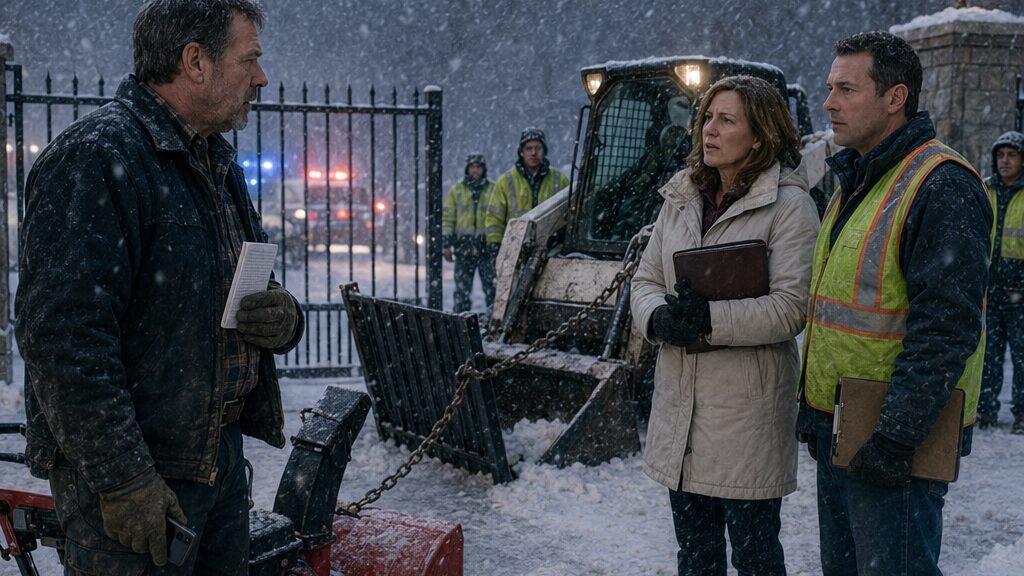
Gregory Miller heard the siren first, then the angry grinding sound of tires spinning against packed ice somewhere beyond the black metal entrance gate. His red snowblower kept throwing a steady stream of white over the side of the road, its engine fighting against the storm that had buried the community overnight.
The machine sat sideways across the entrance lane.
Not because Gregory wanted it there.
Because the gate would not open.
The black metal panels had shifted only a few inches before freezing solid in the track. The heated cable beneath the rail had failed sometime during the night, leaving a ridge of ice exactly where the gate needed to slide. The snowblower was the only thing wide enough and strong enough to clear the narrow channel around it.
Behind him, a line of vehicles waited.
A delivery truck.
Two residents trying to leave for work.
A small maintenance vehicle.
And farther back, an ambulance that had arrived after the driver called ahead about a resident needing an urgent supply delivery.
Gregory turned the snowblower slightly and cleared another strip beside the frozen rail.
The snow fell faster than he could remove it.
That was how winter worked. It did not care about schedules, meetings, or approval forms.
It only cared whether something had been prepared.
“Gregory!”
The voice cut through the wind.
He looked up.
Cynthia Jones walked toward him wearing a bright winter coat that looked almost too clean for the storm. She held a plastic folder against her chest with one gloved hand. The other hand pointed directly at the machine.
Not at him.
At the snowblower.
“Turn that off.”
Gregory released the handle but kept the engine running.
“Not yet.”
Cynthia stopped several feet away.
“Excuse me?”
“The gate track is frozen. If I shut this down now, nobody gets through.”
“That is exactly why I am telling you to stop.”
Gregory stared at her.
Behind Cynthia, residents watched from their vehicles. Some lowered their windows slightly. Others simply looked through the glass, waiting to see which person would win the argument.
Gregory had lived in the community for twenty-three years.
He knew most of those faces.
He had fixed their drainage problems, helped clear their driveways, and repaired the small things nobody wanted to call a contractor for.
But today he was standing beside a red machine, and somehow that made him the problem.
“Cynthia,” he said, keeping his voice level, “the gate is stuck.”
“I know the gate is stuck.”
“Then you know why I’m here.”
“I know you are operating equipment on common property without authorization.”
Gregory looked down at the snowblower.
Then back at her.
“The road is common property too.”
“That does not give you permission to modify access areas.”
“I cleared snow.”
“You installed those side panels.”
The sentence landed differently.
Gregory did not answer immediately.
The side panels were visible now beneath the snow near the gate. Black against white. Temporary. Cleanly cut. Designed to be removed when the permanent repair was completed.
Cynthia lifted the folder.
“You received a notice.”
Gregory reached into his jacket pocket and pulled out the paper.
The stop-work notice was folded from being carried through the storm. The corners were damp. His thumb covered the signature line.
“I received it.”
“Then you understand.”
“I understand you want me to stop.”
“Yes.”
“And what happens after?”
Cynthia looked toward the gate.
“Maintenance will handle the situation.”
“After the storm?”
“That is not your decision to make.”
Gregory looked past her.
The ambulance lights reflected against the snow.
The driver stood outside the vehicle, watching the frozen entrance.
Gregory lowered his voice.
“This is not about my decision.”
Cynthia stepped closer.
“This machine is not approved for common property.”
Gregory almost laughed, but there was no humor in it.
“Neither was the ice.”
Several residents looked away.
Cynthia’s expression tightened.
“Do not make this personal.”
“It became personal when you told me to stop clearing the only open path.”
She placed one hand against his chest, not hard, but enough to make her point.
“Gregory. Shut. It. Down.”
The snowblower continued to roar between them.
For a moment, nobody moved.
Gregory looked at her hand, then at the emergency lights behind the gate.
Then he did something that surprised everyone.
He reached forward and turned off the machine.
The sudden silence felt heavier than the engine.
Snow landed on the red housing.
The waiting vehicles remained trapped.
Cynthia lowered her hand.
“Thank you.”
Gregory did not answer.
He walked around the machine and kicked away a small pile of snow near the gate opening. Then he pulled a measuring tape from his jacket pocket and placed it beside the cleared strip.
Cynthia watched.
“What are you doing?”
“Showing you.”
“Showing me what?”
“That the route is already there.”
Gregory pointed.
“The main opening is frozen. This side path is clear enough for a vehicle.”
Cynthia looked down.
The cleared section was narrow but deliberate.
A vehicle could pass.
Not easily.
But safely.
“Gregory, you cannot just decide that.”
“No.”
He looked at the paper in his hand.
“That’s what the notice says.”
He stepped closer.
“But if you are ordering me to stop, I need you to sign that you are ordering the stop.”
Cynthia frowned.
“You already have the notice.”
“I need the order attached to the consequence.”
The wind pushed snow between them.
“You think this is a game?”
“No.”
Gregory looked toward the trapped vehicles.
“I think everyone keeps pretending a locked gate is paperwork.”
Cynthia stared at him for several seconds.
Then she took the notice.
She signed.
Gregory watched her write her name.
The red snowblower sat silent beside the black gate.
The emergency lights kept flashing.
When Cynthia handed the paper back, Gregory folded it carefully.
“Then nobody leaves until you sign that order.”
And now she had.
The question was no longer whether Gregory had permission.
The question was why he had been ready for the gate to fail before anyone else knew it would.
Chapter 2: The Notice She Signed in the Snow
The paramedic looked at the silent snowblower and asked the question nobody wanted to answer.
“Who told him to stop?”
Gregory stood beside the gate holding the signed notice.
Nobody spoke.
Cynthia looked toward the ambulance, then back at Gregory.
“This is not the time.”
“That’s exactly why it is the time,” Gregory said.
The paramedic walked closer.
“I need access through that entrance.”
“I know,” Gregory replied.
“Then why is the equipment off?”
Gregory held up the paper.
“Because the HOA president ordered it.”
Cynthia’s face changed slightly.
Not anger.
Something closer to discomfort.
“Do not reduce a complicated safety issue to one sentence.”
Gregory looked at the notice.
“That is what this paper does.”
The paramedic looked between them.
“Can someone open the gate?”
Nobody answered immediately.
That silence was the first thing Gregory noticed.
Not the snow.
Not the vehicles.
Not Cynthia’s frustration.
The silence.
Because everyone was waiting for someone else to solve the problem.
Gregory turned away and walked toward the side of the gate.
The black panels were partly hidden beneath snow. He brushed the surface with his glove until the edges appeared.
Cynthia followed.
“Do not touch those.”
Gregory stopped.
“They are mine.”
“They are attached to community property.”
“They are removable.”
“That does not make them approved.”
Gregory looked at her.
“No. It makes them removable.”
The distinction bothered her because it was true.
He had designed them that way.
No drilling.
No permanent changes.
No damage to the existing structure.
Just a temporary extension beside the frozen track.
A way around the failure.
He pulled a small shovel from the storage box near his truck and began clearing a pedestrian path.
“Gregory.”
He kept working.
“Gregory, this is another violation.”
He stopped only long enough to answer.
“Then write another one.”
Cynthia stared at him.
“You think collecting violations proves something?”
“No.”
He pushed the shovel into the snow.
“I think eventually someone has to write down what happened.”
That was when Donna Williams opened her car door.
She moved slowly but firmly, carrying herself with the irritation of someone who disliked being treated as fragile.
“Stop talking about me like I’m a reason.”
Both of them turned.
Donna closed the door behind her.
“My oxygen delivery is late because of the gate. Fine. That is a fact.”
She pointed at Gregory.
“But I do not need you using my situation to win an argument.”
Gregory lowered the shovel.
“I wasn’t.”
“Yes, you were about to.”
Donna looked at Cynthia.
“And you were about to use the rule book to avoid admitting the gate failed.”
Neither answered.
Donna adjusted her coat.
“I am seventy-two years old. I can tell when two people are arguing around me instead of speaking to me.”
Gregory looked down.
That was harder to hear than Cynthia’s accusations.
Because it was fair.
“I’m sorry,” he said.
Donna nodded once.
“Good. Now fix the access problem.”
The simple statement almost made him smile.
Almost.
Gregory finished clearing the pedestrian route. It was not enough for vehicles, but it allowed residents to move around the gate.
The ambulance crew used it to bring equipment through temporarily.
The immediate crisis eased.
But the larger one remained.
Cynthia stood near the gate with her phone in hand.
“You should know the board will review this.”
Gregory looked at her.
“Fine.”
“And the side panels will be included.”
“Included in what?”
“The violation.”
Gregory folded the notice.
“You’re adding the thing that let people through?”
“I’m documenting unauthorized construction.”
“Temporary access.”
“Unauthorized.”
He studied her face.
For the first time that morning, he noticed something beyond confidence.
Pressure.
She was not enjoying this.
She looked tired.
But tired people could still make dangerous decisions.
“When?” he asked.
“What?”
“When will you review it?”
“Emergency board meeting this afternoon.”
Gregory nodded.
“Good.”
Cynthia turned away, then stopped.
“You really believe you did nothing wrong.”
The sentence was quieter.
Not an accusation.
A question.
Gregory looked at the black panels.
“I believe I should have told people sooner.”
Cynthia looked surprised.
It was not the answer she expected.
“But I also believe this gate was going to fail.”
“You don’t know that.”
“I reported it.”
“When?”
Gregory did not respond quickly enough.
Cynthia noticed.
That was enough.
“How many times?”
Gregory looked toward the road.
“Three.”
“Three written reports?”
“Yes.”
“And you never received approval to build this?”
“No.”
There it was.
The first crack.
Not in the gate.
In his argument.
He had been right about the danger.
But he had still crossed a line.
Cynthia saw it too.
“Then you understand why this cannot continue.”
Gregory looked back at her.
“No.”
She waited.
“I understand why you can say that.”
The difference mattered.
That evening, Gregory returned home carrying the signed notice.
He placed it on the kitchen counter beside the old maintenance folder where he kept copies of every repair request he had ever submitted.
Three warnings.
Three dates.
Three unanswered follow-ups.
He opened the folder.
The oldest one was from eight months earlier.
He remembered writing it.
He remembered the cold.
He remembered standing beside the gate and hearing his own voice say the same thing he had said that morning.
This needs attention before winter.
He had assumed the records would speak for themselves.
They had not.
His phone buzzed.
An email.
From the community manager.
Gregory opened it.
The message was short.
The HOA has authorized a contracted crew to remove the unauthorized gate-side modifications at first light.
Gregory read it twice.
Then he looked through the window toward the entrance road.
The snow had not stopped.
And neither had the problem.
Chapter 3: They Arrived Before the Storm Ended
The loader chain tightened around the first black panel before Gregory reached the gate.
He heard the metal strain from halfway down his driveway.
By the time he stepped into the snow, the removal crew had already started.
A compact loader idled beside the entrance.
The red snowblower sat untouched near the fence.
Silent.
Watching.
Timothy Green stood beside the machine with a clipboard and a reflective jacket covered in snow.
“Mr. Miller?”
Gregory kept walking.
“Turn that off.”
Timothy looked toward the loader.
“It’s already secured.”
“The chain.”
Timothy glanced back.
“We have authorization from the HOA.”
Gregory stopped several feet away.
“That wasn’t my question.”
The chain pulled tighter.
The black panel lifted slightly from the frozen ground.
Cynthia stood behind Timothy.
She had arrived prepared.
Folder.
Documents.
Photographs.
Everything organized.
“You had your opportunity yesterday.”
Gregory looked at her.
“I had a stop-work order.”
“Yes.”
“And now you’re removing the thing that made the work possible.”
“It is an unauthorized modification.”
Timothy looked between them.
His expression changed slightly.
He had expected an angry homeowner.
Not a discussion about authority.
Gregory stepped closer.
“Timothy, did you verify who owns the structure you are removing?”
“The HOA contracted the work.”
“That is not what I asked.”
Cynthia interrupted.
“This is unnecessary.”
“No,” Gregory said. “This is exactly necessary.”
The loader engine continued running.
Snow fell around them.
Gregory pointed toward the panel hanging from the chain.
“You are removing property access equipment during an active storm.”
Cynthia held up a photograph.
“This.”
She tapped the image.
“This is what you installed without approval.”
Gregory looked at it.
The photograph showed the side panels clearly.
The angle made them appear larger.
More permanent.
More invasive.
A problem.
Not a solution.
“I installed a temporary access path.”
“You altered shared property.”
“Yes.”
The answer surprised her.
He did not deny it.
“I did.”
Timothy lowered his clipboard slightly.
Gregory continued.
“But the question is whether you have the authority to remove it right now.”
Cynthia’s jaw tightened.
“We have an HOA work order.”
“An HOA work order is not the same thing as legal authority to enter and dismantle.”
The snow seemed quieter for a moment.
Timothy looked at Cynthia.
She looked back at him.
A small exchange.
A question neither wanted to ask.
Gregory saw it.
That was why he had waited.
Not because he wanted a confrontation.
Because he wanted the machine to stop long enough for someone to think.
“Timothy,” Gregory said, “ask yourself one thing.”
The crew supervisor looked at him.
“If this panel is removed and someone cannot get through that gate during the storm, who made that decision?”
Timothy did not answer.
Cynthia stepped forward.
“You are making this emotional.”
“No.”
Gregory reached into his pocket and pulled out his phone.
He started recording.
“I’m making it documented.”
Cynthia’s expression hardened.
“You are filming?”
“Yes.”
“Do you think that changes anything?”
“No.”
Gregory held the phone steady.
“I think it remembers what we say.”
Timothy looked at the screen.
Then at the panel.
Then at the snow-covered entrance.
“Mr. Miller,” he said carefully, “we do have a signed work order.”
“Read it.”
Timothy hesitated.
“Why?”
“Because I want to know whether it says removal of a temporary emergency-access structure during active weather conditions.”
Nobody moved.
Timothy looked down.
The answer was clear.
Cynthia stepped closer.
“The board approved removal.”
Gregory looked at her.
“The board also approved ignoring the repair.”
Her face changed.
Only slightly.
But enough.
Timothy noticed.
Gregory reached down and brushed snow away from the inside edge of the panel.
A series of reflective markings appeared.
Measurements.
Spacing.
Width indicators.
“This is why I built it.”
Cynthia looked down.
“What is that?”
“Emergency clearance.”
Gregory pointed.
“The width of a stretcher.”
Silence.
Not dramatic.
Not complete.
Just enough.
Enough for the truth to become harder to ignore.
“You built this for an ambulance?” Timothy asked.
Gregory looked toward the frozen gate.
“I built it because I know what happens when a road closes and everyone assumes someone else will fix it.”
Cynthia folded her arms.
“You still did not have approval.”
“No.”
Gregory looked at her.
“I didn’t.”
It was the second time he had admitted it.
“I should have pushed harder for a formal emergency plan.”
The admission did not help Cynthia.
It made the situation worse.
Because now the problem was no longer a stubborn resident refusing to cooperate.
It was a resident who had acted outside procedure because procedure had not moved fast enough.
Cynthia looked at Timothy.
“Continue.”
Timothy did not move.
“Timothy.”
He looked at the panel.
Then at Gregory’s phone.
Then back at the gate.
Finally, he lowered the clipboard.
“Before I continue, I need clarification on authority.”
Cynthia stared at him.
The loader remained still.
The chain hung loose.
Gregory thought the moment might end there.
He was wrong.
Cynthia opened her folder and pulled out another document.
Not the notice.
A report.
She held it up.
“You want to discuss responsibility?”
Gregory looked at the paper.
“Fine.”
She stepped closer.
“Your own inspection report said the heating cable failure was unlikely.”
The words settled over the snow.
Gregory did not answer.
Because he remembered writing them.
And suddenly the frozen gate was not only a failure everyone else ignored.
It was also a warning he had described too carefully.
Cynthia lowered the paper.
“Maybe you were right that something needed attention.”
She looked at the broken gate.
“But maybe you also helped everyone believe there was more time.”
The loader remained silent.
The red snowblower sat beside the entrance.
And for the first time since the storm began, Gregory wondered if the gate had failed before anyone noticed.
Or if everyone had simply learned to live with the warning signs.
Chapter 4: The Report That Proved Too Little
Gregory found his own sentence before he found the mistake.
The highlighted line sat in the HOA denial packet on his kitchen table, printed in black ink and surrounded by yellow marker.
“Complete heating cable failure unlikely under normal winter conditions.”
He stared at the words.
Not because they were false.
Because they were incomplete.
The kitchen was quiet except for the small ticking sound of the wall clock. Outside, the snow continued covering the driveway where his truck sat buried halfway to the tires.
Gregory kept the packet open with one hand and held the old maintenance folder with the other.
The folder had followed him through three houses, two marriages, and twenty years of community meetings.
Every repair request.
Every photograph.
Every conversation he thought mattered enough to keep.
He had always believed records were protection.
Now one of his own records was being used as a shield for someone else.
He turned the page.
The HOA had attached his inspection notes.
Not the entire report.
Only the part that supported their position.
He read the next paragraph.
“The gate system should continue functioning if routine maintenance is performed and drainage remains clear.”
His jaw tightened.
That was the sentence.
The one after the sentence they highlighted.
He remembered writing it.
He remembered standing at the gate eight months earlier with a flashlight, checking the track after a heavy rain. He remembered seeing water collecting beneath the rail. He remembered telling the board that the drainage channel needed attention before freezing temperatures arrived.
He had not written “the gate will fail.”
He had written “the gate requires attention.”
There was a difference.
A difference everyone had used.
Gregory closed the folder.
Then he opened it again.
Because anger was easy.
Facts were harder.
He pulled out the first maintenance request.
Then the second.
Then the third.
The dates lined up.
The warnings lined up.
But the responses were missing.
No approval.
No repair schedule.
No contractor appointment.
Only the same phrase repeated in different emails.
Under review.
He looked toward the window.
For years, he had taken pride in solving problems before they became emergencies.
But maybe that pride had become part of the problem.
He had seen the warning signs.
He had assumed someone else would understand them.
And when nobody did, he had built his own solution without telling anyone.
The knock at the door came before he expected it.
Gregory looked through the window.
Lisa Moore stood outside holding a folder.
He opened the door.
“You’re here about the report.”
Lisa looked down.
“Yes.”
“Come in.”
She stepped inside and removed her gloves.
Unlike Cynthia, Lisa never looked comfortable in conflict. She had the careful expression of someone who had spent years trying to keep disagreements from becoming fights.
Gregory placed the highlighted packet on the table.
“Why was this the only sentence included?”
Lisa looked at the page.
“I don’t know.”
“You’re the treasurer.”
“I’m not the person who prepared the response.”
“But you approved the records.”
Lisa paused.
“Yes.”
The honesty made him look up.
“Then tell me.”
Lisa sat down.
“The board believed the issue was manageable.”
“That is not what I asked.”
She folded her hands.
“The heating cable was expensive.”
Gregory waited.
Lisa looked away.
“Replacing it required a special assessment.”
There it was.
Not the whole answer.
But a piece.
“How long did you know?”
Lisa did not respond.
Gregory’s voice lowered.
“How long did you know the repair was delayed?”
She looked at the folder.
“Since last summer.”
The room became still.
“You knew.”
“Yes.”
“And nobody told residents?”
“We were trying to avoid panic.”
Gregory almost interrupted.
Then stopped.
Because he understood the sentence.
He did not agree with it.
But he understood it.
“How does keeping people uninformed prevent panic?”
Lisa looked tired.
“It prevents people from making decisions before we have options.”
Gregory leaned back.
“And did you have options?”
Lisa did not answer.
That answer was enough.
He looked down at the maintenance requests.
“The drainage work was in my report.”
“Yes.”
“The heating cable inspection was in my report.”
“Yes.”
“So why is this being treated like I caused the problem?”
Lisa looked at him.
“Because you changed the gate.”
Gregory nodded.
There it was.
The part he could not avoid.
“I did.”
“And you did it without approval.”
“Yes.”
Lisa’s expression softened slightly.
“Gregory, I am not saying you were wrong about the danger.”
“But?”
“But you cannot decide that being right about the problem gives you permission to ignore the process.”
The words stayed with him.
Because he had said similar things to other people when he was still working for the city.
A homeowner could not dig up a road because they knew where the pipe was.
A contractor could not skip inspection because the repair was obvious.
Rules existed because people were not always careful.
He had believed that.
Until he became the person waiting for the rule to move.
“What happens now?” he asked.
Lisa looked toward the window.
“The removal order.”
“Is happening.”
“Yes.”
“When?”
“Tomorrow morning if the weather allows.”
Gregory looked at the papers.
“The panels come out.”
“Yes.”
“And the gate stays broken.”
Lisa did not answer.
That silence bothered him more than anything else.
Because it meant everyone knew the risk.
They just disagreed about who had to carry it.
Gregory stood and walked back to the table.
“What else is missing?”
Lisa looked confused.
“What?”
“You came here because you know something else is missing.”
She hesitated.
Then reached into her folder.
She placed a copy of an invoice on the table.
Gregory looked at it.
Gate heating cable replacement.
Drainage channel repair.
Approved estimate.
His eyes moved to the date.
Approved.
Then canceled.
Two days later.
He looked at Lisa.
“Who canceled this?”
Lisa swallowed.
“I don’t know.”
Gregory turned the paper over.
A handwritten note was attached to the back.
Not from the contractor.
From the board.
He read the first line.
Budget adjustment required.
Then the second.
Delay until next fiscal review.
Gregory looked at the date.
The review was scheduled for after winter.
The storm outside suddenly felt heavier.
Not because of the snow.
Because the failure had not appeared overnight.
Someone had seen it coming.
And someone had decided there was still time.
Chapter 5: What the Reserve Fund Was Protecting
Gregory found Cynthia measuring the damaged panel behind the clubhouse.
She was kneeling in the snow with a tape measure stretched across the black metal frame.
For a moment, neither of them spoke.
Gregory had expected a confrontation.
An argument.
A prepared explanation.
Instead, he found her studying the exact thing she had ordered removed.
“You’re checking the dimensions.”
Cynthia stood slowly.
“I’m checking whether your measurements were accurate.”
Gregory looked at the panel leaning against the building.
“You expected them not to be?”
“No.”
The answer surprised him.
She rolled up the tape measure.
“That’s part of the problem.”
Gregory waited.
Cynthia looked at the panel.
“You usually know what you’re doing.”
The admission was quiet.
Not forgiveness.
Not agreement.
Just a fact.
“And that makes this harder.”
“Because I was right?”
“Because you were wrong too.”
Gregory nodded.
That was fair.
He picked up the invoice copy from his folder.
“I found this.”
Cynthia saw it.
Her expression changed.
Only slightly.
But enough.
“You shouldn’t have access to board documents.”
“Lisa gave it to me.”
Cynthia looked away.
That answered another question.
“She wasn’t supposed to.”
“Neither was the repair canceled.”
The wind moved snow across the ground between them.
Cynthia took the paper.
“You don’t understand the entire situation.”
“Then explain it.”
She looked at him.
For several seconds, Gregory thought she would refuse.
Instead, she sat down on the clubhouse steps.
“I became president because nobody else wanted the job.”
Gregory remained standing.
“The first month, I discovered we were already behind.”
“Behind how?”
“Reserve funds.”
She looked at the invoice.
“The gate repair was not the only thing that needed replacement. Roof sections. Drainage work. Exterior lighting. Several things were reaching the end of their life at once.”
Gregory folded his arms.
“So you chose which ones waited.”
“Yes.”
The honesty caught him off guard.
Cynthia did not try to avoid it.
“We had residents already struggling with dues.”
“And you thought delaying this was better.”
“I thought one more winter was possible.”
Gregory looked toward the gate.
“One more winter.”
Cynthia nodded.
“I know how that sounds.”
“It sounds like the exact phrase people use right before something fails.”
She accepted that.
“I know.”
The answer removed some of his anger.
Not all of it.
But some.
Because Cynthia was not pretending.
She was not saying she had made no decision.
She had.
She was saying she believed it was the least damaging one.
“That doesn’t explain the removal,” Gregory said.
Cynthia looked at him.
“The removal protects the HOA.”
“No.”
She frowned.
“What?”
“The removal protects the board.”
The distinction landed.
Gregory continued.
“If you remove the panels, the record says I created the problem.”
Cynthia looked down.
“And if we leave them, the record says we approved an unauthorized structure.”
“So the structure matters more than the people using it.”
“That is not what I said.”
“It is what happens.”
Cynthia stood.
“You think I don’t understand consequences?”
“No.”
Gregory looked at the panel.
“I think you understand them too well.”
She did not respond.
Because maybe she did.
Maybe she had spent so long calculating risks that she had forgotten which risks belonged to actual people.
The clubhouse door opened.
Donna Williams stepped outside carrying a small envelope.
Both of them turned.
“I was looking for both of you.”
Gregory immediately noticed her expression.
Not angry.
Disappointed.
Donna walked toward them.
“I heard about the meeting.”
Cynthia straightened.
“Donna, we were going to discuss—”
“No.”
Donna held up the envelope.
“You were going to discuss me again.”
Neither answered.
She handed the envelope to Gregory.
“My oxygen delivery receipt.”
He looked at it.
“Donna—”
“I am not giving this to you so you can prove you were right.”
She looked at Cynthia.
“And I am not giving it to you so you can prove you were protecting people.”
The two women stared at each other.
Donna continued.
“I need a gate that works.”
Simple.
Direct.
No speech.
No accusation.
“I don’t need one person to win.”
Gregory looked down.
That was the part he had been avoiding.
He had spent months proving the problem existed.
But proving a problem was not the same as solving it.
Cynthia looked at the panel.
Then at the receipt.
“How many deliveries have been affected?”
Donna hesitated.
“Three.”
Gregory looked up.
“Three?”
She nodded.
“I didn’t report the first two.”
“Why?”
Donna gave him a tired look.
“Because I knew exactly what would happen.”
“What?”
“You would both start arguing about me.”
The statement hurt because it was true.
Gregory looked away.
Cynthia was quiet.
For the first time, neither of them had a document to hide behind.
No notice.
No invoice.
No violation.
Just the actual consequence.
That evening, Gregory entered the clubhouse for the emergency board meeting carrying three things.
The signed stop-work notice.
The canceled repair invoice.
And the measurements from the black panel.
Cynthia was already inside.
The board members sat around the table.
Nobody looked comfortable.
Good, Gregory thought.
Comfort was what had brought them here.
Before he could speak, the door opened.
The community manager walked in holding another folder.
“Gregory Miller?”
He turned.
“Yes?”
The manager placed the folder on the table.
“Official notice.”
Gregory opened it.
His eyes moved across the page.
The HOA had scheduled the removal.
Tomorrow morning.
Before the storm ended.
He looked up.
The conflict was no longer about whether the gate had failed.
Everyone knew it had.
Now the question was whether they were willing to admit why.
Chapter 6: The Winter He Never Put in Writing
Cynthia opened the emergency board meeting by reading Gregory’s violation before Gregory had a chance to speak.
“The homeowner installed unauthorized structures on common property, operated unapproved equipment, and created a potential liability exposure during severe weather conditions.”
The words sounded different inside the clubhouse.
Less like a notice.
More like a verdict.
Gregory sat at the end of the table with the signed stop-work paper beside him. The paper that had started everything rested under his gloved hand.
Around the room, board members avoided looking at the gate photographs spread across the table.
Lisa sat near the corner, holding the reserve records she had finally brought.
Cynthia stood at the front.
She looked composed.
But Gregory noticed the small things.
The way she kept touching the edge of the folder.
The way she avoided looking at the canceled invoice.
She was afraid.
Not of him.
Of what happened when everyone stopped pretending the problem was smaller than it was.
“Gregory,” Cynthia said, “you will have an opportunity to respond.”
He nodded.
“Thank you.”
That was all.
No argument.
No interruption.
It almost seemed to disappoint her.
Gregory stood and placed the first document on the table.
“The violation is accurate in one part.”
Several board members looked up.
Cynthia paused.
“What part?”
“I installed the panels without written approval.”
The room became quiet.
Lisa looked at him.
He continued.
“I did.”
Cynthia’s expression changed.
Not because he admitted it.
Because he did it before she could use it.
“I should have requested emergency authorization before making the modification,” Gregory said. “I did not.”
He placed another document beside it.
“But this violation does not explain why I made it.”
Cynthia folded her arms.
“Because you believed you were correct.”
“No.”
Gregory looked at the table.
“Because I believed waiting was more dangerous.”
The sentence stayed there.
Not dramatic.
Not a speech.
Just a statement.
He opened the maintenance folder.
“I submitted three warnings about the gate system.”
The board members looked through the pages.
“Drainage issue.”
He placed down the first page.
“Heating cable inspection.”
The second.
“Track freezing risk.”
The third.
Cynthia stepped closer.
“And your report said failure was unlikely.”
Gregory nodded.
“Yes.”
Several people looked at him.
He did not avoid it.
“I wrote that.”
Lisa watched him carefully.
“Then why should the board accept your interpretation over the report you provided?”
Gregory looked at her.
“They shouldn’t.”
The answer surprised everyone.
He tapped the papers.
“The report was incomplete because I wrote it that way.”
Cynthia’s expression softened slightly.
Only for a moment.
“I knew the system was aging. I knew the drainage needed attention. I knew the heating cable was not something we could ignore forever.”
He looked at the gate photographs.
“But I did not write what I should have written.”
“What should you have written?” Lisa asked.
Gregory took a breath.
“That failure was unlikely if maintenance happened.”
Nobody spoke.
He looked around the room.
“Maintenance did not happen.”
The sentence changed the room.
Not because it proved everything.
Because it removed the simple version of the story.
Gregory was not standing there claiming he had done everything right.
He was admitting where he had failed.
“I spent years working on roads,” he said. “I know the difference between a problem that exists and a problem that is about to become dangerous.”
He looked at Cynthia.
“I assumed everyone else saw the same thing.”
Cynthia looked away.
“That was my mistake.”
For the first time that night, nobody had a document to point at.
Only choices.
The community attorney, who had been silent near the wall, finally spoke.
“Mr. Miller, even if we accept your explanation, the association still cannot approve an emergency access system without inspection.”
Gregory nodded.
“I agree.”
The attorney looked surprised.
“You do?”
“Yes.”
Gregory moved the panel measurements forward.
“I am not asking for approval because I built something.”
He pointed to the documents.
“I’m asking for a temporary emergency protocol because people need access.”
Cynthia looked at the measurements.
“You want the board to approve something that already exists.”
“No.”
Gregory shook his head.
“I want the board to inspect something that already exists and decide what version of it is safe.”
Lisa leaned forward.
“That is different.”
“Yes.”
Gregory looked at the signed notice.
“This is not about whether rules matter.”
He touched the paper.
“It is about whether the rule is protecting the person or only protecting the organization.”
Nobody responded immediately.
Then Cynthia did.
“You are asking us to admit the board made a mistake.”
Gregory looked at her.
“Yes.”
A few people shifted in their seats.
“And you are asking us to admit you did too.”
“Yes.”
That answer stopped the room.
Because it was not what anyone expected from him.
Cynthia looked down at the notice.
“What happened?”
Gregory knew the question was not about the gate anymore.
It was about why he cared so much.
Why he had refused to stop.
Why he had built something without permission.
He looked at the old paper beneath his hand.
“My wife died during a winter emergency.”
Nobody moved.
Gregory did not look for sympathy.
He hated when people turned pain into a reason someone should win.
“She had a medical emergency years ago. The road conditions delayed help. The gate was not the only reason. It was not even the biggest reason.”
He paused.
“But I remember standing outside waiting.”
The room was silent.
“I remember thinking afterward that there had to be something I could have done differently.”
Cynthia lowered her eyes.
Gregory continued.
“I know this gate is not the same situation.”
He looked at Donna, who sat quietly near the back.
“I know people are not problems to solve.”
Donna nodded once.
“That matters.”
Gregory returned his attention to the board.
“But I also know what it feels like to hear someone say there is still time when the conditions are already changing.”
Nobody spoke.
The emotional weight was there.
But Gregory did not let it replace the facts.
“I am not asking you to approve my grief.”
He pointed to the measurements.
“I am asking you to evaluate the route.”
The attorney looked through the documents.
“If the county inspector confirms the measurements and the temporary modification can be documented, there may be a path forward.”
Cynthia stared at the papers.
Then she looked at Lisa.
Lisa slowly nodded.
“The reserve records should also be discussed.”
Cynthia closed her eyes briefly.
There it was.
The other thing she had been trying to avoid.
The room changed.
The gate was no longer the only failure.
The delay was now part of the record.
Cynthia stood.
“I call for a vote on the temporary emergency access proposal.”
Gregory sat back down.
The board members voted one by one.
Lisa voted yes.
Two others voted yes.
Then Cynthia raised her hand.
“No.”
The room froze.
Gregory looked at her.
Not angry.
Just disappointed.
Cynthia lowered her hand.
“I believe the risk is still too high without inspection.”
The attorney nodded.
“That is a reasonable concern.”
Gregory looked at the panel measurements.
The proposal was not dead.
But it was not approved.
Not yet.
Cynthia called for the remaining vote.
And Gregory realized the hardest part was not proving the gate had failed.
It was convincing people to act before the next failure arrived.
Chapter 7: The Gate Opened Under New Rules
Gregory waited beside the silent red snowblower while the board completed the second vote inside the gatehouse.
The machine had not moved since the storm.
Snow covered the top.
The handle was frozen.
The red paint looked dull beneath the morning light.
For years, Gregory had considered the machine a tool.
Nothing more.
Now it represented every decision that had brought them there.
His decision to act.
The board’s decision to wait.
Everyone’s decision to assume there was more time.
The gatehouse door opened.
Lisa stepped outside first.
She held a folder.
Gregory looked at her face.
“Did it pass?”
She nodded.
“Barely.”
He waited.
“The county inspector reviewed the temporary route.”
“And?”
“He approved a limited emergency-access plan.”
Gregory looked toward the gate.
“Limited?”
“Inspected hours only. Marked route. Maintenance records. Shared responsibility.”
He nodded.
That sounded right.
Not perfect.
Right.
Cynthia stepped outside behind Lisa.
She looked different.
Not defeated.
Not embarrassed.
Just tired.
She held the original violation notice.
The paper that had followed Gregory through the entire storm.
“We are withdrawing the violation.”
Gregory looked at her.
“Completely?”
“No.”
The answer surprised him.
Cynthia handed him the paper.
“The violation is revised.”
He read the new wording.
Unauthorized installation replaced with temporary modification requiring inspection and documentation.
Gregory looked up.
“You kept it.”
“Yes.”
“Why?”
“Because it happened.”
The honesty mattered.
Cynthia continued.
“You were right about the access problem.”
She looked toward the gate.
“But you were wrong to make a shared change without approval.”
Gregory nodded.
“I know.”
“And I was wrong to treat the procedure as if it solved the emergency.”
Neither of them apologized.
Neither of them pretended the conflict had not happened.
That was what made it feel real.
Timothy Green arrived with the crew shortly afterward.
This time, he was not carrying a removal order.
He was carrying tools.
The same black panel that had hung from the loader chain the day before was placed back beside the gate.
“Ready?” Timothy asked.
Gregory looked at the panel.
Then at Cynthia.
She nodded.
Together, they watched the crew reinstall it.
No crowd gathered.
No one applauded.
No one celebrated.
A repair was not a victory.
It was a repair.
When the panel locked into place, Timothy stepped back.
“Route is clear.”
Gregory walked to the red snowblower.
He checked the fuel.
Checked the controls.
Then stopped.
Cynthia noticed.
“What?”
Gregory looked at the machine.
“For twenty-three years, I thought being responsible meant handling things myself.”
Cynthia waited.
“I was wrong.”
She looked surprised.
Gregory continued.
“Sometimes it means making sure other people know what needs to be handled.”
Cynthia nodded.
“That is probably something the board needs to remember too.”
The first vehicle moved toward the gate.
The black metal panels opened.
This time, smoothly.
The sound was simple.
Mechanical.
Ordinary.
But everyone stopped to watch.
Donna’s delivery truck arrived later that morning.
She stepped outside before the driver unloaded.
She looked at the open path.
Then at Gregory.
“You two finally fixed the gate?”
Gregory smiled slightly.
“We started.”
Donna nodded.
“Better answer.”
The permanent repair began several weeks later.
The reserve records were released.
The canceled invoice was explained.
The community approved a transparent repair schedule.
Nobody forgot what happened.
That was the point.
The new system was not built on pretending mistakes never occurred.
It was built on recording them.
Months later, when the first heavy snow of the next winter arrived, Gregory stood near the entrance with the red snowblower.
But this time, a document was clipped inside the gatehouse.
Emergency access protocol.
Approved route.
Inspection schedule.
Shared responsibility.
Cynthia had placed it there herself.
Not as an apology.
As a reminder.
The machine started.
The gate opened.
And Donna drove through without anyone needing to clear a path around her.
Gregory watched the black gate disappear behind the snow.
For a long time, he had believed the strongest person was the one who could handle everything alone.
The winter had taught him something different.
Sometimes the hardest thing to repair was not a gate.
It was the belief that needing others meant failing.
The red snowblower moved forward.
The road stayed open.
And this time, everyone knew why.
The story has ended.