She Paid Him to Protect the Boat, Then Watched One Loose Hook Destroy It
Chapter 1: The Hook Was Open Before the Boat Fell
The first thing Linda Hall noticed was not the boat moving.
It was the hook.
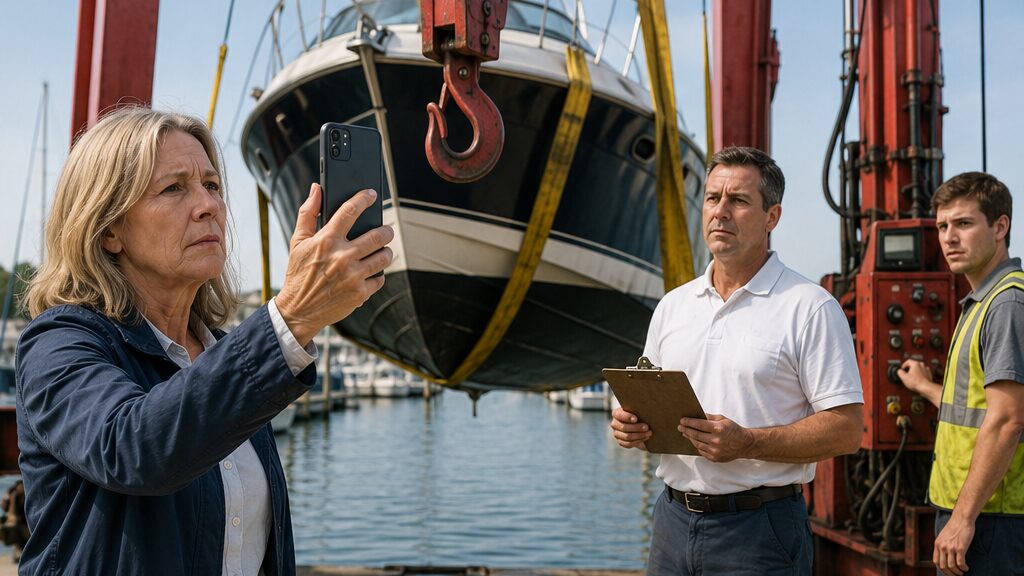
The red lifting hook hanging above the marina service dock had a small metal latch that should have been closed over the opening. Instead, it sat loose, leaving a dark gap beneath the curved steel throat. The yellow strap running through it looked tight, but the connection holding her thirty-foot motorboat above the water looked wrong.
Wrong enough that she stopped walking.
“Scott,” Linda called.
The noise of the marina swallowed part of her voice. Engines idled at nearby slips. A pressure washer hummed behind the service building. The red hoist above the dock groaned as it held her boat in the air.
Scott Miller turned from the control station.
He wore the same clean white polo shirt he wore whenever he met customers. The shirt made him look more like a manager than the man who spent his days around grease, cables, and wet decks. Linda had liked that about him when she first hired Miller Marine Service. He seemed organized. Careful.
That was why she had trusted him.
“That hook,” she said, pointing upward. “The latch isn’t closed.”
Scott glanced at the hook for barely a second.
“It’s fine.”
Linda looked back at the boat suspended over the water.
Her boat.
The Second Morning.
The name was painted in small letters along the stern, chosen years earlier with her husband before he became too sick to finish their restoration plans. After he died, the boat had become the project she could not let go of. It was the last thing they had built together.
She had paid Scott $26,000 to prepare it for the summer season.
Now it hung above open water on a piece of equipment that did not look secure.
“I’m serious,” she said. “That latch is open.”
Joseph King, the younger operator standing beside the controls, looked up.
For a moment, he did not answer.
That silence bothered Linda more than Scott’s confidence.
Scott stepped closer, lowering his voice as if she were embarrassed rather than concerned.
“Linda, I’ve lifted boats heavier than yours for years.”
“That doesn’t answer my question.”
“It’s seated correctly.”
“But the latch is open.”
Scott sighed.
“Boat owners see one thing and assume they understand the whole system. That’s how people get nervous for no reason.”
The words landed harder than he probably intended.
Linda had heard versions of them before. Not from Scott specifically, but from people who knew more than she did. Mechanics. Contractors. Specialists. People who could point at a machine and explain why a concern was unnecessary.
She had always believed asking too many questions made things harder.
But the boat was still hanging there.
And the hook was still open.
She reached into her pocket and pulled out her phone.
Scott noticed.
“What are you doing?”
“Taking a picture.”
“Why?”
“Because I’m concerned.”
He stared at her.
The dock suddenly felt quieter.
Joseph looked away toward the water.
Linda moved closer, keeping the phone pointed at the hook.
“I do not consent to continuing this lift until that connection is checked.”
Scott’s expression changed slightly.
Not anger.
Something more controlled.
“You signed the service agreement.”
“Yes.”
“You gave us authority to handle the operation.”
“Not to ignore a safety concern.”
Scott walked toward the boat, then toward the hook.
“The contract gives us operational discretion.”
Linda captured the image.
The red hook.
The missing latch.
The yellow strap twisted slightly under the weight.
The exact thing she knew she would need later if someone told her she imagined it.
Joseph touched the control panel.
“Scott…”
The hesitation was brief.
But it was there.
Scott looked at him.
“Finish the lift.”
Joseph did not move immediately.
“Maybe we should reset the strap.”
“We have another appointment after this,” Scott said. “We don’t have time to start over because someone is worried about a latch.”
Linda lowered her phone.
“I said stop.”
Scott looked at her.
“You’re delaying your own repair.”
“I’m protecting my boat.”
For a second, nobody moved.
Then Scott nodded toward Joseph.
The hoist motor started again.
The sound made Linda’s stomach tighten.
The boat rose only slightly.
Then the yellow strap shifted.
A sharp metallic crack cut through the marina.
The hook jerked.
The entire boat dropped several inches before the remaining straps caught the weight.
People on nearby docks turned.
Someone shouted.
The transport cradle beneath the boat took the impact with a violent crash.
The Second Morning slammed down hard.
Not into the water.
Not completely.
But hard enough that Linda felt the damage before she saw it.
The dock shook beneath her feet.
The marina went silent.
Scott walked forward first.
“Everyone calm down.”
Linda stared at the boat.
A scrape ran along the lower side of the hull. One corner of the transport cradle had shifted. The boat sat unevenly, like something inside it had moved.
“What happened?” she asked.
Scott looked at the equipment.
“Minor issue.”
“Minor?”
“It landed on the cradle.”
“You dropped my boat.”
Scott’s face tightened.
“No one dropped anything. The equipment reacted under weight.”
Linda looked at the open hook again.
The picture was still on her phone screen.
The proof of the moment before everything changed.
“Was the latch supposed to be closed?”
Scott ignored the question.
“The damage is cosmetic. We’ll inspect it and continue repairs.”
Linda looked at him.
Continue?
As if nothing had happened.
As if the boat was just another item on a schedule.
“I’m not agreeing to anything else until I know what happened.”
Scott picked up a clipboard from the dock.
“Then we have a problem.”
“What problem?”
“The repair cannot continue without additional work.”
Linda felt the answer before he said it.
“How much?”
Scott flipped through the papers.
“Not sure yet. We’ll need to stabilize it, move it, and replace some equipment.”
“Equipment you were already supposed to provide.”
His eyes met hers.
The confidence was still there.
“Let’s not make this complicated.”
Linda looked past him at her damaged boat.
She had paid him to protect it.
Now he was telling her that protecting it would cost more.
And somehow, she was the person making things difficult.
By the time the afternoon ended, the boat was no longer hanging above the dock.
It was sitting behind the service area, surrounded by equipment and workers who spoke around her instead of to her.
When Linda finally drove home, she opened the photo on her phone again.
The hook.
The gap.
The moment before the fall.
She enlarged the image until the missing latch filled the screen.
Then she saved a second copy.
Because for the first time since hiring Scott Miller, she wondered if the person she trusted most was the person she needed to question.
Chapter 2: The Boat Was Gone but the Invoice Remained
The empty space at the marina looked larger than Linda remembered.
The next morning, she stood at her usual berth and stared at the water.
The Second Morning should have been there.
Even unfinished, even covered in dust from repairs, it had always been part of the view. She had spent years walking down this dock and seeing the boat waiting for her.
Now there was only a rectangle of calm water between two other vessels.
An absence.
Linda took out her phone and opened the photograph again.
The hook.
The strap.
The moment before everything disappeared from her daily life.
A marina worker passing nearby glanced at the empty berth.
“Scott moved it last night.”
Linda turned.
“Moved it where?”
The worker pointed toward the far side of the property.
“The storage shed.”
“Did he ask me?”
The worker looked uncomfortable.
“No.”
Linda walked straight toward Miller Marine Service.
Scott’s office door was open.
He was already sitting behind his desk.
That bothered her.
He looked prepared.
“Where is my boat?”
Scott did not look up immediately.
“Good morning to you too.”
“Where is my boat?”
“In the secured repair shed.”
“Why?”
“Because it isn’t safe sitting outside after the impact.”
Linda stared at him.
The explanation sounded reasonable.
That was the problem.
Scott always had an explanation ready.
“What happened to continuing the repair?”
“We can continue once we resolve the additional work.”
He slid a document across the desk.
Linda looked down.
An invoice.
The number at the bottom made her stop.
$14,800.
She looked up.
“You’re charging me fourteen thousand eight hundred dollars?”
“For necessary stabilization, equipment replacement, storage preparation, and labor.”
“I already paid twenty-six thousand.”
“And that covered the original scope.”
“The original scope included lifting the boat safely.”
Scott leaned back.
“Linda, accidents happen.”
She felt the word settle between them.
Accidents.
Not mistakes.
Not decisions.
Not warnings ignored.
Just accidents.
“I have a photograph of the hook.”
Scott’s expression barely changed.
“Of the equipment.”
“Of the condition before the lift.”
“Which proves nothing.”
Linda reached into her folder and placed the original contract on his desk.
“Show me where this additional work is listed.”
Scott tapped the page.
“There.”
She followed his finger.
A paragraph near the bottom.
Operational adjustments. Yard discretion. Additional stabilization if required.
She read it twice.
She remembered signing it.
She remembered the meeting.
The rush.
The deadline.
She remembered thinking Scott was the expert.
“What does this mean?” she asked.
“It means we can make necessary decisions.”
“Does it mean you can use unsafe equipment?”
Scott’s jaw tightened.
“No one used unsafe equipment.”
Linda looked at the invoice.
Then back at him.
“Then why did the boat fall?”
Scott stood.
“Because equipment sometimes moves under load.”
“Did the latch fail?”
“Linda.”
“Did it fail?”
He did not answer.
That silence became another piece of information.
Scott walked toward the door.
“You need to understand something. The boat is in my facility. I’m responsible for protecting it.”
“Then let me see it.”
“Not until we resolve payment.”
Linda stopped.
“Are you holding my boat?”
“I’m protecting my property from unpaid storage and repair costs.”
“Your property?”
“The equipment. The yard space. The work already performed.”
The wording was careful.
Every sentence sounded like it had been practiced.
“What happens if I don’t pay?”
Scott opened a drawer and removed another paper.
“I would prefer not to go there.”
Linda looked at the document.
A storage notice.
A warning about a potential lien.
The boat she owned.
The boat she paid him to repair.
Now trapped behind his paperwork.
She left without signing anything.
At home, she spread everything across her kitchen table.
The contract.
The invoice.
The photograph.
The service agreement.
For years, she had organized school records, budgets, and retirement documents. She knew how to manage paperwork.
She just had not expected to need those skills against someone she hired.
She opened the contract again.
The phrase that bothered her was not the one Scott pointed out.
It was another line.
New certified lifting rigging included.
Linda stared at it.
New.
Certified.
Included.
She looked at the photograph of the hook.
Then she looked at the revised invoice demanding payment for replacement equipment.
Something did not fit.
She called Scott.
He answered on the third ring.
“Yes?”
“When did you purchase the new rigging?”
A pause.
“What?”
“The contract says new certified lifting rigging was included. When did you purchase it?”
Scott’s voice became colder.
“We’re not doing this.”
“I’m asking a question.”
“You’re questioning work you don’t understand.”
“I’m asking when the equipment was purchased.”
Another pause.
Then:
“You should be careful, Linda.”
The warning was quiet.
Not threatening.
Almost concerned.
That made it worse.
“Careful about what?”
“Making this more expensive than it needs to be.”
He ended the call.
Linda sat at the table.
The empty berth.
The invoice.
The hook photograph.
All of it pointed toward the same problem.
She did not know enough about boats to prove what happened.
But she knew enough about people to recognize when someone did not want a question answered.
The next morning, an email arrived from Scott.
Attached were three photographs.
The subject line read:
Documentation of Customer-Supplied Equipment.
Linda opened the first image.
Her own boat.
The second image.
The lifting area.
The third image.
The hook.
Scott claimed the damaged equipment belonged to her.
Linda stared at the screen.
Then she looked back at the contract.
Because if Scott was right, she had a problem.
But if he was wrong, she needed to find out why.
Chapter 3: The Damage Went Deeper Than the Scratched Hull
Rachel Adams placed her hand against the side of the boat and knocked twice.
The sound was not loud.
But Linda saw her expression change.
“What is it?”
Rachel knocked again, several feet away from the first spot.
This time the sound was different.
A dull vibration.
Not the solid response Linda expected.
Rachel stepped back.
“Has anyone told you the damage is only cosmetic?”
“Scott.”
Rachel looked at her.
“That is not what I’m seeing.”
They stood inside the locked repair shed where Scott had moved the Second Morning. The boat was surrounded by tools, ladders, and half-finished work from other projects.
Linda had needed special permission to bring Rachel inside.
Even then, Scott had insisted on having someone from his yard present.
Watching.
Listening.
Making sure nobody touched anything without him knowing.
Rachel walked along the hull.
She was not dramatic.
That was one of the reasons Linda hired her.
Rachel did not arrive angry.
She arrived with a notebook, a camera, and questions.
“The impact point is consistent with a sudden load shift,” Rachel said.
“Meaning?”
“Meaning the boat experienced force it should not have experienced during a controlled lift.”
Linda looked toward the entrance.
A yard employee stood outside.
“I need you to tell me if Scott caused this.”
Rachel paused.
“I need to tell you what I can prove.”
The answer was not what Linda wanted.
But it was honest.
“The hull has stress damage near the lifting area,” Rachel continued. “The cradle impact caused visible damage, but the larger concern is what happened when the weight shifted.”
“Could the hook have caused it?”
Rachel looked at the photograph Linda had printed.
The red hook.
The open latch.
“The hook condition is important.”
“Important how?”
“It supports your concern that the lift should have stopped.”
“But?”
Rachel looked back at the boat.
“But a photograph of a bad connection does not automatically prove who created that condition.”
Linda understood.
That was becoming the hardest part.
Being right was not the same as proving why.
Rachel continued the inspection.
She measured areas along the hull.
She photographed the lifting points.
She checked the hardware near the storage area.
Then she stopped.
“Where did this come from?”
She pointed toward a metal rack near the wall.
An old hook sat there among straps and chains.
Linda walked closer.
The paint was worn.
A section of red coating had chipped away.
Near the opening was the same missing latch.
Her stomach tightened.
“Is that the hook?”
Rachel compared it with Linda’s printed photograph.
“I don’t know yet.”
“But?”
“But the condition is similar.”
Linda took another picture.
The old hook.
The photograph.
The same red paint.
The same damaged area.
A pattern she could feel but could not yet name.
The door opened.
Scott walked in.
“I heard the inspection was getting interesting.”
Rachel turned.
“I’m documenting damage.”
Scott looked at Linda.
“You hired someone without telling me.”
“I told you I needed an independent inspection.”
“You don’t trust my assessment?”
Linda almost answered the way she always had.
Politely.
Carefully.
Trying to avoid conflict.
Instead, she looked at the boat.
“No. I need more than your assessment.”
The sentence surprised even her.
Scott noticed.
His expression changed.
Not because she was loud.
Because she was not.
Rachel closed her notebook.
“Scott, do you have the purchase records for the new lifting equipment listed in the contract?”
Scott looked at her.
“What?”
“The new certified rigging.”
“We discussed this already.”
“I’m asking for documentation.”
Scott folded his arms.
“The contract does not require me to provide every internal business record.”
Linda stepped closer.
“But it does say the equipment was new.”
Scott looked at her.
Then at Rachel.
“You’re turning a repair problem into an accusation.”
“No,” Rachel said calmly. “I’m determining what happened.”
Scott laughed once.
A short sound without humor.
“You both think paperwork explains everything.”
Linda looked down at the folder in her hand.
The contract.
The invoice.
The photograph.
For the first time, she realized paperwork did not explain everything.
But missing paperwork explained something.
Rachel finished her inspection an hour later.
Outside the shed, Linda waited beside the marina walkway.
“What do you think?”
Rachel closed her case.
“I think your boat needs significant repairs.”
Linda swallowed.
“And Scott?”
“I think he is making conclusions faster than the evidence allows.”
That was not the answer she wanted.
But it was enough.
“Can you prove the rigging was unsafe?”
Rachel looked back toward the shed.
“I can prove the damage pattern. I can prove the lift was not performed correctly. I can tell you what equipment was present.”
She held up the photograph.
“But if you want to prove fraud, you need to know whether the equipment he billed you for ever existed.”
Linda looked toward her empty berth.
The water was calm.
The space where the Second Morning belonged remained empty.
“What do I do now?”
Rachel handed back the photograph.
“Find the receipt.”
“The equipment receipt?”
“Yes.”
“And if there isn’t one?”
Rachel met her eyes.
“Then you have a different problem.”
That evening, Linda opened Scott’s invoice again.
She read every line.
Every charge.
Every description.
Then she stopped at one sentence.
Certified lifting equipment replacement.
She looked at the date beside it.
Then at the photograph of the hook.
A question formed that she could no longer ignore.
If the new equipment had been purchased for her boat, why did the old equipment still look familiar?
Rachel’s final message arrived before midnight.
Three words.
No explanation.
No warning.
Just a request.
Send me the receipt for the new rigging.
Chapter 4: The New Equipment Had Been Used Before
The sentence from William Baker stopped Linda before she could finish explaining.
“That hook was on my boat last summer.”
She had only shown him the photograph for three seconds.
No accusations.
No theory.
Just the image.
The red hook.
The chipped paint.
The missing latch.
William stood beside his boat at the neighboring berth, staring at Linda’s printed copy as if he had recognized something he hoped never to see again.
“You’re sure?” Linda asked.
William did not answer immediately.
He looked toward the water.
Then back at the picture.
“I wish I wasn’t.”
Linda tightened her grip on the folder in her hand.
“You used Miller Marine?”
William nodded.
“Last year.”
“And they used this equipment?”
“I don’t know if it was this exact piece.” He took the photograph again. “But the mark on the paint. The missing latch. That looks familiar.”
Linda felt a strange mixture of relief and frustration.
Relief because she was no longer alone.
Frustration because every answer seemed to create a larger question.
“Why didn’t you say anything?”
William gave a small, uncomfortable laugh.
“About what?”
“About the equipment.”
He looked down.
“Because Scott had an explanation.”
Linda almost smiled.
Not because it was funny.
Because it was the same explanation she had received.
“The equipment was fine?”
“Something like that.”
William placed the photograph on the dock railing.
“He told me the boat’s movement was caused by weather and weight distribution. Said older boats react differently.”
“And you believed him?”
William looked at his own vessel.
“I wanted to.”
That answer stayed with Linda.
Because she understood it.
She had wanted to believe Scott too.
Believing him had been easier than imagining she needed to challenge him.
“Do you have any records?”
William hesitated.
“Linda…”
“I’m not asking you to fight my battle.”
“That’s exactly what you’re asking.”
“No,” she said. “I’m asking if you remember yours.”
William looked at her.
The marina noise continued around them. Boats leaving slips. Workers moving supplies. People living normal days while Linda’s entire summer had become paperwork and questions.
Finally, William reached into the storage compartment beside his boat.
He pulled out his phone.
“I took pictures during the lift.”
Linda watched as he scrolled.
“Why?”
“Because my son told me to.”
He looked slightly embarrassed.
“He said I should stop assuming professionals always document everything correctly.”
The first photograph appeared.
A boat suspended above the dock.
A red hook.
A yellow strap.
Linda felt the air leave her chest.
The image was older.
The angle was different.
But the equipment was unmistakable.
Rachel had said she needed more than a feeling.
This was more.
Not enough.
But more.
“Can you send this to me?”
William stared at the picture.
“I signed a settlement with Scott.”
“What?”
“After my repair was delayed. He refunded part of the money. I agreed not to make public complaints.”
“Why?”
William looked away.
“Because I was tired.”
The honesty of it made Linda quiet.
He was not protecting Scott.
He was admitting that he had accepted an imperfect ending because fighting felt worse.
“How long did you have the boat out of service?” Linda asked.
“Almost three months.”
Linda looked toward the empty space where her own boat belonged.
Three months.
A lost summer.
A delayed repair.
A problem that might have ended quietly if nobody asked the next question.
William sent the photographs.
A few seconds later, Linda’s phone buzzed.
Rachel.
She had received them too.
Then another message appeared.
Call me when you can.
Linda called immediately.
Rachel answered.
“Where did you get these?”
“A customer who used Scott before me.”
There was silence.
Then:
“Linda, I need you to understand something.”
“What?”
“This does not prove Scott intentionally damaged your boat.”
“I know.”
“It does not prove he knowingly billed you for equipment he never bought.”
“I know.”
Rachel paused.
“That’s good.”
“Why?”
“Because the strongest cases are not built by deciding the ending first.”
Linda looked at William’s photograph.
The same hook.
The same kind of lift.
The same explanation.
“What does it prove?”
Rachel answered carefully.
“It proves the equipment history needs to be examined.”
That was enough.
Linda spent the next week asking questions she would have avoided a month earlier.
She contacted the marina manager.
She requested copies of service records.
She asked the yard bookkeeper for itemized documentation.
Each request made her uncomfortable.
Each one also became easier.
Scott responded differently.
At first, he ignored her messages.
Then he became defensive.
Then he stopped answering directly.
When Linda requested serial numbers for the “new certified lifting equipment” listed in the contract, Scott replied with a single sentence.
All equipment used was appropriate for the job.
Not the answer.
Just another explanation.
Rachel helped Linda compare the invoice against the records she received.
The problem appeared in small pieces.
The invoice listed new straps.
The records listed no serial numbers.
The invoice listed replacement hardware.
The purchase documentation was incomplete.
The invoice described equipment as purchased specifically for Linda’s boat.
But the dates did not match.
One afternoon, Linda sat at her kitchen table surrounded by papers.
The same table where she had signed the original contract.
The same place where she had believed she was protecting her boat by choosing a professional.
Now she understood something different.
Scott had not needed her to be careless.
He only needed her to trust that asking questions was unnecessary.
A knock came at her door.
It was the marina manager.
Linda opened it.
His expression told her before he spoke.
“Scott filed the lien paperwork.”
She looked down at the papers in his hand.
“How much?”
“Storage and repair charges.”
Linda took the document.
The number was higher than before.
“He’s trying to force me to pay.”
The manager did not argue.
“He has that option under the agreement.”
Linda looked at the empty berth visible beyond the marina road.
The place where her boat should have been.
The place that had become a daily reminder of what she had lost.
“What happens now?”
The manager hesitated.
“You’ll need to challenge it.”
Linda looked back at the paperwork.
A month ago, that sentence would have frightened her.
Now it felt different.
Not easier.
Just clearer.
Because she finally understood the thing Scott had counted on.
He believed the technical details belonged to him.
The equipment.
The records.
The language.
But every question she asked took a small piece of that control away.
The next morning, Linda opened her email.
A new message waited.
From Scott.
Subject:
Final Resolution Offer.
She opened it.
The first line made her stop.
Release of vessel available upon acceptance of attached terms.
Attached was a document.
A waiver.
And at the bottom was a deadline.
Forty-eight hours.
Chapter 5: The Paper He Wanted Signed Erased Everything
The damaged boat sat on the trailer outside Scott’s workshop like a reminder placed there on purpose.
Linda saw it before she saw him.
The Second Morning.
The hull marked.
The repairs unfinished.
The boat that had once represented a future summer now represented a negotiation.
Scott stood beside his truck holding a folder.
“You received my email.”
Linda looked at the folder.
“I did.”
“Then you understand I’m trying to resolve this.”
She almost believed him.
That was what made him effective.
Scott never sounded like someone creating a problem.
He sounded like someone cleaning one up.
“What is this?”
“A practical solution.”
He handed her the papers.
Linda did not take them.
“Explain it.”
Scott lowered the folder slightly.
“I release the boat. You remove it from my property. We close the account.”
“And the charges?”
“Adjusted.”
“How much?”
“Less than what you currently owe.”
Linda looked at the boat.
“And the damage?”
Scott sighed.
“Linda.”
“No. The damage.”
He looked toward the workshop.
“The boat was damaged during a complicated operation.”
“That is not an answer.”
“It’s the truth.”
She watched his face.
A month earlier, she might have apologized for pressing.
Now she waited.
Scott noticed.
“The waiver protects both of us.”
“Protects?”
“It prevents this from becoming a longer dispute.”
Linda finally took the folder.
The first page looked simple.
The language was not.
She read slowly.
The owner accepts responsibility for equipment supplied or requested by the owner.
She looked up.
“What does this mean?”
“It means we both move forward.”
“It says the equipment was mine.”
Scott shook his head.
“It’s standard wording.”
“My contract says new certified rigging was included.”
He looked away for a moment.
A small movement.
But Linda saw it.
“Then why does this say I supplied it?”
Scott’s expression hardened.
“You’re focusing on one sentence.”
“Because that sentence changes who is responsible.”
The wind moved across the marina.
A few dock workers passed nearby.
Linda placed the waiver on the hood of her car.
Then she placed her photograph beside it.
The open hook.
Then William’s photograph.
The older hook.
“Can you explain why this equipment appears in another customer’s lift?”
Scott looked at the images.
His silence lasted longer than his answer.
“I don’t know what that is.”
“You said the equipment belonged to me.”
“It’s possible the image is misleading.”
“Is it?”
Scott picked up the older photograph.
“This proves nothing.”
Linda nodded.
That was the first thing he had said that sounded honest.
Because he was right.
It did not prove everything.
It only proved something had changed.
“Who purchased the replacement rigging?” she asked.
Scott put the picture down.
“You’re not qualified to evaluate marine equipment.”
Linda looked at him.
“I’m qualified to ask whether I paid for something I received.”
For the first time, Scott looked frustrated.
Not angry.
Frustrated.
As if the conversation had moved into a place where his usual answers no longer worked.
“You want to make me the villain.”
“No.”
“Then what do you want?”
Linda looked at the boat.
“I want to know what happened.”
Scott’s voice softened.
“You’re making this harder than it needs to be.”
There it was again.
The suggestion that peace was available if only she stopped asking.
Linda folded the waiver.
“I’m not signing this.”
Scott stared at her.
“You understand what happens next?”
“Yes.”
“You could lose more money.”
“I know.”
“You could wait months.”
“I know.”
He looked at her carefully.
Maybe he expected fear.
Maybe he expected the same hesitation that had helped him from the beginning.
But Linda had spent too many nights looking at that open hook.
She had spent too many hours wondering if she should have spoken louder.
“I’m not signing a document that says something happened differently than it did.”
Scott took the folder back.
“Then I hope you’re prepared for the consequences.”
After he left, Linda stood beside her car for a long time.
The boat remained behind him.
The problem remained.
Nothing had been solved.
But something had changed.
She had finally stopped trying to make the conflict disappear.
That evening, her phone rang from an unknown number.
She almost ignored it.
Then she answered.
“Linda?”
She recognized the voice.
Joseph.
The young operator from the lift.
“Joseph?”
“I shouldn’t be calling you.”
“Then why are you?”
Silence.
Then:
“Because I saw what happened before the boat moved.”
Linda sat down.
“What do you mean?”
Joseph breathed out slowly.
“I saw the hook.”
Her hand tightened around the phone.
“The latch?”
“Yes.”
“Was it open?”
“Yes.”
The answer was quiet.
Certain.
“Did Scott know?”
Another pause.
Longer.
“He told me to continue.”
Linda closed her eyes.
The image returned.
The hook.
The boat.
Scott standing there.
“Can you prove it?”
Joseph did not answer immediately.
Then he said:
“I took a picture before the lift started.”
Linda stood.
“Why?”
“I don’t know.”
The honesty surprised her.
“Maybe because I knew something was wrong.”
“Where is it?”
“I have it.”
“Joseph, I need you to send it.”
“I’m not trying to hurt him.”
Linda softened slightly.
“Then why are you helping me?”
The answer came after several seconds.
“Because I already stayed quiet once.”
The call ended.
A minute later, a message arrived.
An image attachment.
Linda opened it.
And felt the room become still.
The photograph showed the equipment rack twenty minutes before the lift.
The red hook.
The missing latch.
Already open.
Before her boat ever moved.
Before the accident.
Before Scott said it was unexpected.
Linda stared at the screen.
The question had changed.
It was no longer whether the hook had failed.
It was whether Scott knew it would.
Chapter 6: The Warning Came Before the Order to Continue
Joseph King looked like someone who had spent several days deciding whether to make one difficult phone call.
When Linda met him at the quiet fuel dock, he kept looking over his shoulder.
Not because someone was following him.
Because he was still afraid of what would happen after he spoke.
“I almost didn’t come,” he said.
Linda nodded.
“I understand.”
Joseph looked surprised.
“Do you?”
“Yes.”
He studied her.
A month earlier, Linda might have thought understanding meant forgiving.
Now she knew there was a difference.
“I need the truth,” she said. “Not a story that makes you look innocent.”
Joseph lowered his eyes.
“I’m not innocent.”
The answer was immediate.
That mattered.
He took out his phone.
The photograph was still there.
The same image he had sent her the night before.
The equipment rack.
The red hook.
The missing latch.
Before the lift.
“I took this because I noticed it.”
Linda looked at the screen.
“Why?”
Joseph rubbed his hand over his face.
“Because Scott had been telling us to move faster.”
“Us?”
“The crew.”
“How long?”
Joseph hesitated.
“Months.”
The word settled between them.
“Months of what?”
“Using equipment longer than it should have been used.”
Linda looked away toward the water.
She had wanted this moment to feel like a solution.
A person.
A photograph.
A clear answer.
Instead, it felt heavier.
“Did you tell him the hook was unsafe?”
Joseph nodded.
“Yes.”
“When?”
“Before your lift.”
Linda looked back at him.
“Exactly what happened?”
Joseph stared at the dock boards.
“Scott was already behind schedule. Another boat was waiting. He was angry because replacing the hook would mean shutting down the lift.”
“Did he say that?”
“Not exactly.”
“Then what did he say?”
Joseph swallowed.
“He said we could not stop every time someone got nervous.”
Linda thought of herself standing there.
Her phone raised.
Her voice telling him she did not consent.
Scott had not looked surprised.
He had looked annoyed.
“What happened after you warned him?”
Joseph looked at her.
“He told me to continue.”
The answer was quiet.
But it was the answer she needed.
“You operated the lift.”
“Yes.”
“Even after that?”
“Yes.”
Linda did not look away.
She wanted to.
Part of her wanted Joseph to be the person who saved her.
The person who made the whole situation simple.
But he had already taken that away.
“I was scared,” he said.
Linda waited.
“I have a kid. I needed the job.”
“That explains why you stayed.”
Joseph nodded.
“It doesn’t excuse it.”
The honesty made the silence between them less hostile.
Not easier.
Just more honest.
“Why did you take the picture?”
Joseph looked at his phone.
“Because I knew I was doing something wrong.”
“You knew before the lift?”
“Yes.”
“Then why not stop it?”
His face tightened.
“Because Scott was my boss.”
Linda looked at the marina.
The boats.
The workers.
The normal movement of a place where everyone depended on someone else.
She understood something uncomfortable.
The problem was not only one person making one bad decision.
It was people deciding a small wrong was easier to carry than a large confrontation.
“What will you do now?” she asked.
Joseph looked at her.
“I don’t know.”
“Will you give a statement?”
His hesitation returned.
“I can tell the truth.”
“That’s not what I asked.”
Joseph looked down.
“I don’t want to say I was forced.”
Linda was quiet.
“Why?”
“Because I wasn’t.”
The answer surprised her.
“I made a choice too.”
She looked at him carefully.
That was the part Scott would never admit.
The system had depended on people making small choices.
A worker continuing.
A customer trusting.
A question being ignored.
A signature being given.
Everyone had a reason.
That did not make every choice acceptable.
But it explained how the damage happened.
“I need your statement,” Linda said.
Joseph nodded slowly.
“I’ll give you what I know.”
“Not what helps me win?”
“No.”
He looked toward the marina office.
“What helps prove what happened.”
That afternoon, Linda met Rachel again.
She placed Joseph’s photograph on the table.
Rachel studied it carefully.
“This changes things.”
“How?”
“It establishes timing.”
Linda nodded.
“Before the lift.”
“Yes.”
“So Scott knew?”
Rachel chose her words.
“It shows he was aware of the equipment condition before the operation continued.”
Linda looked at the photograph.
The open hook.
The same object that had started everything.
Rachel continued.
“But remember, intent is difficult.”
Linda understood.
The photograph was powerful.
But it was not magic.
It did not erase every question.
It did not repair the boat.
It did not return the summer.
Later that day, Linda submitted the documents to the bonding company.
The contract.
The photographs.
Rachel’s survey.
William’s photographs.
Joseph’s statement.
She expected an immediate answer.
Instead, she received another request.
Formal mediation.
The review would continue only if the dispute moved through the proper process.
Linda read the message twice.
A month ago, she would have seen that as another delay.
Another obstacle.
Now she saw something else.
A process.
Slow.
Imperfect.
But not controlled by Scott.
She looked out the window at the marina.
The empty berth was still there.
The boat was still locked away.
Nothing physical had changed.
But the balance had.
For the first time since the accident, Scott was no longer the only person who knew what had happened.
The night before mediation, Linda placed every document into one folder.
Not because she expected one page to save her.
Because she had learned there was never just one page.
There was the hook.
The photographs.
The invoice.
The missing records.
The people who had stayed silent.
The people who finally spoke.
The next morning, she received a message from the mediation office.
Scott had agreed to attend.
But he had attached one condition.
He was still offering a settlement.
And he still expected Linda to sign a release.
Chapter 7: The Second Lift Began Only After Every Latch Closed
Scott Miller arrived at mediation carrying the same folder he had carried for weeks.
Linda noticed that first.
Not his expression.
Not his suit.
The folder.
The same place where he had kept invoices, explanations, and solutions that always seemed to protect him more than anyone else.
The mediation officer looked between them.
“We are here to resolve the dispute.”
Scott nodded.
“That’s what I’ve wanted from the beginning.”
Linda almost responded.
Almost.
Then she stopped.
She had learned that arguments were not always won by answering every sentence.
Sometimes they were won by letting the record speak.
The mediation officer opened the file.
“Ms. Hall has submitted photographs, a marine survey, contract documents, and statements from additional parties.”
Scott leaned back.
“Additional parties?”
Linda looked at him.
“Other customers.”
His expression changed slightly.
Only slightly.
But enough.
The officer reviewed the documents.
“The primary concerns appear to involve equipment condition, billing descriptions, and responsibility for damage.”
Scott folded his hands.
“Again, this was an unfortunate accident.”
Linda looked at the table.
The word still bothered her.
Accident.
A word that removed decisions.
A word that made everything sound like it happened by itself.
The officer turned to her.
“Ms. Hall, what outcome are you seeking?”
A month ago, she would have answered quickly.
Fix my boat.
Give me my money back.
Make him admit what happened.
But now she understood the limits.
“I want the boat released,” she said.
Scott nodded slightly.
“Good.”
“And I want the repair costs addressed based on what actually happened.”
His expression changed.
“There it is.”
Linda looked at him.
“What?”
“You don’t want a resolution.”
“I want an accurate one.”
Scott opened his folder.
“I have already offered to reduce the invoice.”
“You offered a waiver.”
“A standard agreement.”
“A document saying the damage came from equipment I supplied.”
Scott looked toward the mediator.
“She’s misunderstanding the language.”
Linda placed a copy of the contract on the table.
Then the photograph of the hook.
Then William’s photograph.
Then Joseph’s statement.
Not dramatically.
Not like a final reveal.
Just one item after another.
The way the truth had actually appeared.
Piece by piece.
The mediator studied the documents.
“Mr. Miller, can you provide purchase records for the replacement equipment listed in this contract?”
Scott looked at the papers.
Then at Linda.
“We had equipment changes.”
“Were those changes documented?”
“They were necessary adjustments.”
“Were they billed as new equipment?”
Scott did not answer.
The silence was enough.
Later that afternoon, the review expanded.
The bonding company requested additional records.
The licensing board opened an inquiry into the yard’s lifting practices.
William submitted his complaint.
Not because he wanted revenge.
Because he realized his silence had allowed the same pattern to continue.
Joseph provided his statement.
He did not describe himself as a victim.
He admitted operating the lift.
He admitted ignoring the warning.
But he confirmed the warning existed.
And that Scott chose to continue.
Scott never gave a full confession.
Linda had expected that by now.
The truth rarely arrived in the shape people wanted.
Sometimes it came as missing records.
Sometimes as a changed explanation.
Sometimes as someone finally admitting they should have spoken sooner.
Several weeks later, the boat was released.
Scott agreed to return part of Linda’s payment and cover a portion of the structural repairs.
It was not everything.
The repair costs were still higher than she hoped.
The months she lost were gone.
The trust she gave Scott would not return.
But the boat was no longer trapped.
The first morning the replacement repair crew arrived, Linda stood beside the new hoist.
The red equipment looked different.
New paint.
New hardware.
A different feeling.
The crew stopped before lifting.
One worker checked every strap.
Then every connection.
Then every latch.
He looked at Linda.
“We don’t move until you see it.”
She nodded.
The hook closed.
Completely.
The latch locked into place.
Only then did the lift begin.
Linda watched the Second Morning rise slowly.
No sudden movement.
No rushed order.
No person telling her that her concern was unnecessary.
The boat moved exactly as it should have the first time.
Rachel stood beside her.
“Different feeling?”
Linda looked at the water below.
“Yes.”
“Because it’s safer?”
Linda thought about that.
Then shook her head slightly.
“Because I’m paying attention.”
Rachel smiled faintly.
The boat was eventually repaired.
Not perfectly.
Not without cost.
Some damage could be fixed with money.
Some could not.
The empty berth remained in Linda’s memory longer than she expected.
The place where she had stood and wondered if she had lost something she could never recover.
But she also remembered what happened after.
The questions.
The photographs.
The documents.
The moment she stopped believing that expertise belonged only to people who sounded certain.
Months later, Linda passed the old Miller Marine building.
The sign was still there.
But the yard was quieter.
The investigation continued.
The lifting authorization remained suspended during review.
There was no public celebration.
No crowd.
No dramatic apology.
Just consequences.
The kind that arrived slowly.
The kind that could not erase what happened but could prevent someone else from standing beside a suspended boat and being told not to worry.
Linda returned to the marina one evening.
She stood beside the Second Morning.
The repaired hull reflected the fading light.
She ran her hand along the side.
She still missed the summer she lost.
She still wished she had asked more questions before the lift began.
But regret no longer felt like weakness.
It felt like knowledge earned the hard way.
The next morning, another boat owner approached her near the dock.
“I heard you know a little about marine repairs.”
Linda looked at the boat behind him.
Then at the equipment nearby.
She smiled slightly.
“I know enough to ask who checked the latch.”
The owner laughed.
Linda did not.
Not because she was afraid.
Because she understood something now.
A person did not need to be an expert to demand proof.
The Second Morning moved away from the dock under a closed hook and secured straps.
This time, Linda watched every connection.
Not because she expected something to go wrong.
Because she had learned that trust was not the absence of questions.
It was knowing the answers were there when you asked.
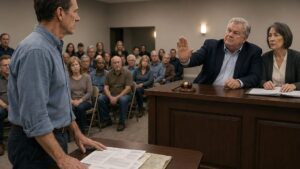
The story has ended.