The Contractor Left The Wall Open For Weeks Then Came Back Asking For More Money
Chapter 1: The Wall He Paid To Fix Stayed Open
Samuel Harris knew the exact sound a house made when it was waiting for someone to finish what they promised.
It was not the sound of silence.
It was the drip of water that should have been behind a sealed wall. It was the hollow knock of exposed framing where insulation should have been. It was the wind pushing through a space that had once been covered and protected.
It was the sound of money disappearing.
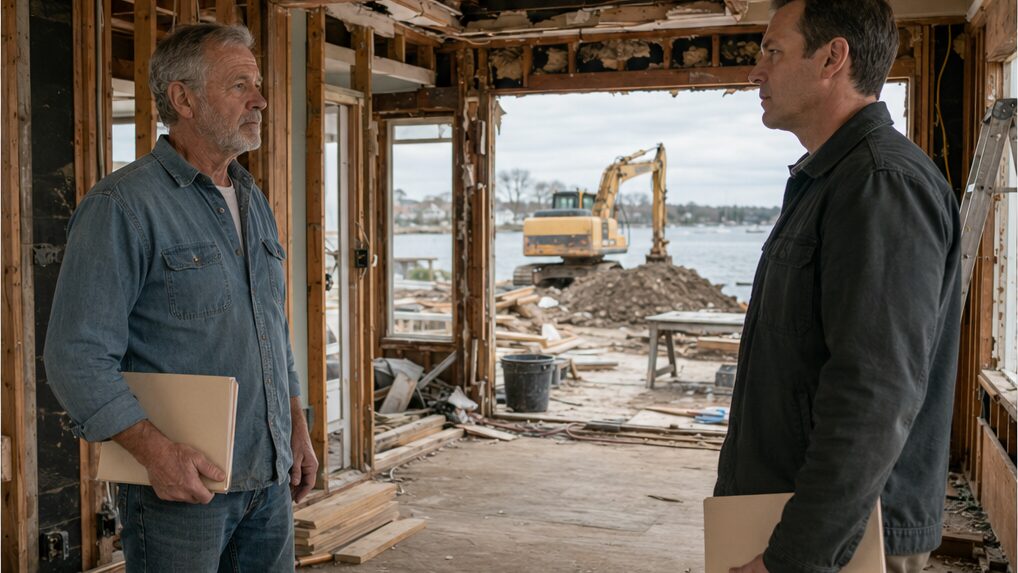
Samuel stood inside the unfinished addition on the back of his waterfront home, staring at the wall that had been open for six weeks.
The room was supposed to become a bright family space overlooking the water. That was how Daniel Walker had described it on the first day.
“By the end of summer, you’ll forget this was ever construction,” Daniel had said.
Samuel remembered the confidence in his voice. The certainty.
That was what made everything harder to understand.
Because Daniel had not looked like someone who was going to leave a job behind.
He had looked like someone who knew exactly what he was doing.
Now the room looked abandoned.
The drywall was missing from one side. Electrical wires hung where finished fixtures were supposed to be. The floor remained covered with protective sheets that had collected dust instead of being removed.
A stack of materials Daniel claimed had been ordered never arrived.
Samuel reached out and touched the edge of the unfinished wall.
The exposed wood was rough beneath his fingers.
This was the part he could not explain to people.
The money was one thing.
The wall was another.
The wall was proof.
His phone buzzed on the kitchen counter.
For a moment, Samuel thought it might be Daniel.
He had been waiting for a call for four days.
Instead, the message was from his wife.
Susan: Any update?
Samuel stared at the screen before typing.
Samuel: Nothing yet. I’m checking the room again.
He almost added, I think something is wrong.
But Susan already knew.
She had known the moment Daniel stopped arriving every morning.
At first, they had both made excuses.
A supplier delay.
A scheduling problem.
A subcontractor issue.
Construction always had complications.
That was what Daniel told them.
And Samuel wanted to believe him.
Because believing him was easier than admitting they might have made a mistake.
The project had started after a storm damaged part of the rear structure of the house. The repairs were not optional. Water had found its way inside, and they needed someone experienced.
Daniel had arrived with a clean truck, a professional folder, and answers to every question.
He had walked through the damaged area, measured everything, and explained the process.
Samuel remembered feeling relieved.
Not excited.
Relieved.
Someone had shown up.
Someone knew what needed to be done.
Daniel’s estimate had been higher than some others, but he explained why.
“Cheap work costs more later,” Daniel had said.
Samuel had agreed.
He had paid the initial deposit.
Then the next payment.
Then another.
Because each time Daniel asked, he had a reason.
Materials had increased.
The supplier needed confirmation.
The crew needed to be scheduled.
A delay would cost everyone more.
Samuel had believed that being cooperative was the responsible thing to do.
Now he stood in a room that looked almost exactly like it had weeks earlier.
Almost.
Except the damage had become worse.
Another buzz came from his phone.
This time, it was Daniel.
Samuel opened the message immediately.
For several seconds, he simply stared.
It was not an apology.
It was not an update.
It was an invoice.
A new one.
Samuel scrolled down.
The amount was larger than the original agreement.
Much larger.
His stomach tightened.
There was a note attached.
Additional costs due to material increases and project delays. Payment required before work can continue.
Samuel read it twice.
Then a third time.
He looked around the unfinished room.
The room that had not changed.
The room where the work had stopped.
The room Daniel was now using as a reason to demand more money.
Samuel called him.
The phone rang once.
Twice.
Three times.
Then voicemail.
He waited.
He tried again.
Voicemail.
A year earlier, Samuel would have told himself not to overreact.
He would have waited.
He would have assumed there was a reasonable explanation.
That instinct was still there.
That was the problem.
He wanted Daniel to be wrong.
He wanted this to be a misunderstanding.
Because if it was a misunderstanding, then Samuel had not trusted the wrong person.
He walked back to the kitchen and opened the folder where he kept the paperwork.
The original agreement was on top.
The pages were slightly worn from being handled so often.
The total price was written clearly.
The scope of work was written clearly.
The payment schedule was written clearly.
Samuel placed Daniel’s new invoice beside it.
The numbers did not match.
The promises did not match.
The reality did not match.
Susan came into the room quietly.
She looked toward the unfinished addition.
Neither of them spoke for a moment.
Finally, she said, “He wants more?”
Samuel nodded.
“How much?”
Samuel handed her the paper.
Susan read it.
Her expression changed.
Not anger.
Not yet.
Something worse.
Disappointment.
“He hasn’t even finished what we already paid for.”
“I know.”
“Then why is he asking?”
Samuel looked back toward the open wall.
“I don’t know.”
That answer bothered him more than anything.
Because he was beginning to realize that Daniel did know.
Daniel knew exactly why he was asking.
He knew Samuel did not understand construction.
He knew Samuel wanted the house finished.
He knew starting over with someone else would be expensive.
The unfinished wall was not just a construction problem.
It was leverage.
Later that evening, Samuel sent Daniel one final message.
Samuel: We need to discuss the invoice. The original agreement has not been completed.
Daniel replied twenty minutes later.
Daniel: I can finish the job, but I need you to understand that projects change. If you don’t approve the additional payment, I cannot guarantee when we return.
Samuel read the message slowly.
The words were polite.
That was what bothered him.
There was no anger.
No threat.
Just a calm statement that placed the entire problem on Samuel.
He looked again at the open wall.
The room Daniel promised to complete.
The room Samuel had already paid to repair.
For the first time, he wondered if Daniel had ever intended to finish it.
And that thought was more frightening than the invoice.
Because if Daniel was not struggling to complete the job…
Then maybe he had planned all along to leave Samuel standing in a damaged room, waiting for him to come back.
Chapter 2: The Invoice That Changed The Agreement
The next morning, Samuel placed Daniel’s new invoice beside the original contract and realized the two papers were telling completely different stories.
One described a completed project.
The other described a project that had somehow become Samuel’s responsibility again.
He sat at the dining table with both documents spread out in front of him.
The original agreement had Daniel’s signature at the bottom.
The payment schedule.
The materials list.
The timeline.
Everything they had discussed before work began.
The new invoice had none of that.
Just additional charges.
Samuel traced the numbers with his finger.
The difference was not small.
It was enough to make him wonder how many people simply paid because they were afraid of losing everything they had already invested.
His phone sat beside the papers.
He wanted to call Daniel again.
But he stopped himself.
For the first time, he wondered if every unanswered call gave Daniel exactly what he wanted.
Time.
Samuel opened the folder where he kept receipts.
He found the payment records.
The checks.
The transfers.
The dates.
He arranged them beside the contract.
The amount already paid was nearly the full cost of the original agreement.
His chest tightened.
Daniel was not asking for the first payment.
He was asking for more after receiving almost everything.
Susan stood behind him.
“You’re finally looking at it like a problem,” she said.
Samuel looked up.
“What does that mean?”
“It means before today, you were looking at it like a delay.”
Her words landed harder than she intended.
Because they were true.
Samuel had been waiting for Daniel to fix the problem.
He had not considered that Daniel might be the problem.
“I wanted to give him a chance,” Samuel said.
“I know.”
Susan softened.
“That’s who you are.”
Samuel looked back at the papers.
“And maybe that’s why this happened.”
He did not mean it as self-pity.
It was simply a fact he did not want to admit.
His patience had become something someone else could use.
Samuel returned to the job site and began taking photographs.
Not dramatic photographs.
Not pictures meant for social media.
Just evidence.
The open wall.
The unfinished electrical work.
The missing fixtures.
The exposed areas where Daniel claimed materials were already ordered.
He photographed the date on his phone.
Then he photographed the room again.
Same angle.
Same damage.
Weeks apart.
The lack of progress was impossible to ignore.
While he was taking pictures, he noticed something near the side entrance.
A delivery label.
It was attached to an empty packaging box.
Samuel picked it up.
The name on it was not his.
The company was not familiar.
He called the supplier listed on the label.
After explaining who he was, he asked about the materials Daniel claimed had been ordered.
The answer came quickly.
“No order under that name.”
Samuel felt a strange calm settle over him.
Not relief.
Not anger.
Something between the two.
Because one question had been answered.
The materials were not delayed.
They had never existed.
That evening, Samuel sent Daniel the photos.
He attached the original contract.
Then he wrote:
Samuel: The additional charges do not match the agreement. Please explain the missing materials and unfinished work.
For almost an hour, there was no response.
Then Daniel called.
Samuel answered immediately.
“Daniel.”
“Samuel, I think you’re making this more complicated than it needs to be.”
Samuel looked toward the unfinished room.
“I’m asking about materials you said were ordered.”
“There are supplier issues.”
“I contacted the supplier.”
A pause.
Only a second.
But Samuel noticed.
“What did they tell you?” Daniel asked.
“They said there was no order.”
Daniel sighed.
“Samuel, you don’t understand how construction works.”
The sentence was calm.
Almost patient.
But Samuel heard what was underneath it.
You don’t know enough to challenge me.
“I understand that I paid for work that isn’t finished,” Samuel said.
Daniel’s voice changed slightly.
“You’re focusing on the wrong thing.”
“The wrong thing?”
“Yes. The project has changed. If you want it completed, we need to adjust.”
Samuel looked at the contract again.
“What about the original agreement?”
Another pause.
“The original agreement was based on different circumstances.”
Samuel felt his grip tighten around the phone.
“When did we agree to change it?”
Daniel did not answer immediately.
Then:
“Samuel, I’m trying to help you here.”
That was the moment something shifted.
Not because Daniel admitted anything.
Because he did not.
He turned every question into a favor.
Every problem into Samuel’s misunderstanding.
Every missing piece into another reason Samuel needed to cooperate.
“I’ll send you the updated paperwork,” Daniel said.
“No.”
The word surprised Samuel.
It surprised Daniel too.
“No?”
“I’m not agreeing to anything new until the original work is completed.”
Silence.
Then Daniel spoke more slowly.
“Be careful with that decision.”
Samuel felt the old instinct return.
The instinct to soften the conversation.
To avoid conflict.
To say something that would keep things calm.
But he looked at the open wall.
And he remembered what calm had gotten him.
“I’m asking you to finish what you agreed to finish.”
Daniel did not respond.
The call ended.
The next morning, Samuel opened his email expecting Daniel’s response.
Instead, there was nothing.
No message.
No update.
No explanation.
He called.
Voicemail.
He called again.
Voicemail.
By noon, Daniel’s company website was gone.
By afternoon, the phone number listed on the business card went directly to a disconnected message.
Samuel stood in the unfinished room holding the original contract.
The same paper that had made him trust Daniel now felt like the only thing protecting him.
Then another notification appeared.
An automated message.
A formal document had been sent.
Samuel opened it.
His face changed as he read the first line.
Daniel was not just disappearing.
He was preparing to fight back.
Chapter 3: The Contractor Who Came Back Asking Again
The letter Daniel Walker sent did not accuse Samuel of anything.
That was what made it worse.
It was written in careful language, the kind of language that sounded reasonable when someone read it quickly.
Notice of Intent to File Claim for Unpaid Project Costs.
Samuel read the title three times before he continued.
Daniel claimed that delays had been caused by “client-side decisions” and “unexpected changes in project requirements.” He stated that additional work had been performed beyond the original agreement and that payment was necessary before the project could continue.
Samuel lowered the paper slowly.
The room around him felt different.
Not because anything had changed.
The unfinished wall was still there.
The exposed framing was still there.
The empty spaces where materials should have been were still there.
But now Daniel was trying to rewrite the story.
Samuel looked at the original contract sitting beside him.
A few weeks ago, it had represented trust.
Now it represented a question.
Which version would someone else believe?
The one with the official-looking letter?
Or the one with the photographs of a room that had barely changed?
Susan watched him from across the table.
“What does it say?”
Samuel handed her the paper.
She read silently.
Then she looked up.
“He’s blaming you?”
Samuel nodded.
“He says I changed the project.”
“Did you?”
“No.”
The answer came quickly.
Too quickly.
Samuel paused.
Then he added, “Not exactly.”
Susan waited.
Samuel looked away.
“We did ask about changing the window placement.”
“That was before the work started.”
“I know.”
“And did that change the cost?”
“Daniel said it wouldn’t.”
Susan placed the paper down.
“That’s not the same thing as what he’s saying.”
Samuel knew that.
But the fact that he had to explain it to himself bothered him.
Daniel’s advantage was not just construction knowledge.
It was confidence.
He spoke as if every answer already belonged to him.
Samuel had spent his life believing that if two people sat down and looked at the facts, they could find a fair solution.
Daniel was counting on that belief.
Samuel opened his laptop.
He created a folder.
Photos.
Contracts.
Payments.
Messages.
Every conversation he could find.
He stopped when he reached the first message Daniel had ever sent after the project began.
Daniel: Don’t worry. I’ll take care of everything.
Samuel stared at those words.
They looked different now.
Not reassuring.
Almost careless.
Over the next few days, Samuel stopped waiting for Daniel to explain.
Instead, he started building a record.
He photographed the unfinished addition every morning.
He saved every message.
He wrote down dates.
Not because he wanted a fight.
Because he was beginning to understand that memory was not enough.
The person with the strongest confidence was not always the person with the strongest truth.
Three days later, Daniel finally called.
Samuel almost did not answer.
But he did.
“Samuel.”
Daniel sounded exactly like he had before.
Calm.
Controlled.
Like nothing had happened.
“I received your notice,” Samuel said.
“I was hoping we could avoid making this complicated.”
Samuel looked toward the unfinished wall.
“You sent a claim against me.”
“I sent a warning.”
“A warning?”
“Yes. Because I don’t want this to become a bigger issue.”
Samuel almost laughed.
The situation was already bigger.
His home was damaged.
His money was spent.
The person who caused the problem was telling him not to make it worse.
“What do you want, Daniel?”
A pause.
Then:
“I want to finish the project.”
Samuel waited.
“But?”
Daniel sighed.
“But I need you to be realistic.”
There it was again.
The word Daniel used whenever Samuel questioned him.
Realistic.
As if the unfinished room was imaginary.
As if the missing materials were a misunderstanding.
As if asking someone to complete paid work was unreasonable.
“I already paid almost the full agreement amount,” Samuel said.
“And the project has changed.”
“No. Your explanation has changed.”
Silence.
For the first time, Daniel did not immediately have an answer.
Samuel heard movement on the other end.
Then Daniel said, “You should think carefully before refusing to work with me.”
The sentence was quiet.
Almost friendly.
But Samuel understood it.
Daniel was not offering a solution.
He was reminding Samuel that leaving would cost him.
That was the trap.
The work was unfinished.
Starting over meant more money.
Waiting meant more damage.
Daniel believed Samuel had nowhere else to go.
Samuel looked at the open wall.
Then at the folder of evidence on his desk.
“I’m not refusing to work with you,” Samuel said.
“I’m asking you to finish the work you agreed to do.”
Daniel exhaled.
“I don’t think you understand how this works.”
Samuel closed his eyes for a moment.
That sentence had once made him feel embarrassed.
Now it made him angry.
Not because Daniel said it.
Because Samuel had believed it.
“I understand enough,” Samuel replied.
The call ended shortly after.
Not with an agreement.
Not with a resolution.
Just silence.
The next morning, Daniel’s truck appeared.
Samuel saw it from the window.
For a moment, relief came before suspicion.
Maybe Daniel was coming to fix things.
Maybe this had all gone too far.
Maybe they could still solve it.
Samuel stepped outside.
Daniel stood near the unfinished addition holding a folder.
He was not carrying tools.
He was carrying paperwork.
“I thought we should talk in person,” Daniel said.
Samuel stopped a few feet away.
“What’s that?”
“The updated agreement.”
Samuel looked at the folder.
“No.”
Daniel blinked.
“No?”
“I’m not signing a new agreement.”
Daniel’s expression changed slightly.
Not anger.
Surprise.
Like Samuel had done something unexpected.
“You haven’t even looked at it.”
“I don’t need to.”
Daniel stepped closer.
“Samuel, you’re making an emotional decision.”
Samuel looked past him toward the open wall.
The room that had been waiting.
The room that had become a reminder.
“No,” Samuel said quietly.
“I’m making a documented decision.”
For a second, neither man moved.
Then Daniel smiled faintly.
A small smile.
The kind someone gave when they believed they were still in control.
“Fine,” he said.
“But don’t say I didn’t warn you.”
He turned and walked back toward his truck.
Samuel watched him leave.
He expected to feel victorious.
He did not.
Because Daniel had not looked worried.
He had looked prepared.
And that scared Samuel more.
That night, while organizing the documents again, Samuel noticed something he had missed before.
A payment receipt attached to an email.
The receipt was for materials Daniel claimed were already included in the next phase of construction.
Samuel opened the attachment.
The company name looked familiar.
He searched through his previous notes.
Then he found the same supplier name on the empty box from the side entrance.
The box that had no order connected to it.
Samuel stared at the screen.
One question changed.
It was no longer:
Where are the materials?
It was:
Who paid for materials that never arrived?
Chapter 4: The Names Hidden Behind Other Repairs
Samuel found Margaret Davis because Daniel’s company name appeared in a place Daniel probably never expected anyone to look.
A local neighborhood forum.
Not a complaint board.
Not a legal website.
Just a simple community page where homeowners discussed repairs.
Samuel had searched Daniel’s company name again and again.
Most results were ordinary.
Advertising.
Old photos.
Promotional messages.
Then one comment appeared.
A woman had written:
“Has anyone actually finished a project with Walker Home Solutions?”
Samuel stared at the screen.
He clicked.
The post was from eight months earlier.
The replies were mixed.
Some people defended Daniel.
Some said they had never heard of him.
Then one reply caught Samuel’s attention.
“I wish I had seen this before I hired him.”
The name attached was Margaret Davis.
Samuel sent a private message.
He almost deleted it before sending.
He did not want to become the kind of person who immediately assumed the worst.
But he had learned something.
Waiting for certainty could become another way of avoiding action.
Margaret replied two hours later.
They spoke by phone that evening.
“I’m guessing he told you the supplier was delayed,” Margaret said.
Samuel sat down.
“Yes.”
A long silence followed.
Then Margaret said, “He told me the same thing.”
Samuel looked toward Susan.
She was sitting nearby, listening without interrupting.
“What happened?”
Margaret explained.
She had hired Daniel after storm damage affected part of her home. She needed repairs quickly. The damage was not something she could ignore.
Daniel arrived within days.
He seemed prepared.
Experienced.
Helpful.
The exact words Samuel would have used months earlier.
“He was good at making you feel like you were lucky he showed up,” Margaret said.
Samuel looked down.
Because he understood that feeling.
“He started the work,” Margaret continued. “Then everything slowed down.”
“What happened after that?”
“He said materials were delayed. Then he said costs changed. Then he said he needed more money to finish.”
Samuel closed his eyes.
The pattern was becoming clearer.
“But you didn’t report him?”
Margaret was quiet.
“I thought it was my fault.”
Samuel looked up.
“What?”
“I thought maybe I was being difficult. Maybe I misunderstood. He always sounded so certain.”
The answer stayed with Samuel.
Because that was the part he had not expected.
He thought finding another victim would make him feel stronger.
Instead, it made him realize how carefully Daniel had built the situation.
Daniel did not just take money.
He created doubt.
Margaret continued.
“I eventually hired someone else to look at the work.”
“And?”
“He said some of what Daniel did had to be redone.”
Samuel looked toward the unfinished room.
The same possibility had been sitting there all along.
The problem might not only be that Daniel stopped.
The problem might be that what he left behind was worse than nothing.
“Do you still have your paperwork?” Samuel asked.
“Yes.”
“Photos?”
“Yes.”
“Messages?”
“Yes.”
Samuel opened his folder.
For the first time, he was not looking at evidence of his own problem.
He was looking at a pattern.
Over the next week, Samuel and Margaret compared details.
Different homes.
Different projects.
Same phrases.
Same excuses.
Same delays.
Same request for more money.
Daniel had not invented a new explanation for Samuel.
He had reused an old one.
Samuel printed the documents.
He placed them beside his original contract.
The unfinished wall remained in the background.
Still open.
Still waiting.
But it no longer looked like proof of Samuel’s mistake.
It looked like proof that something larger was happening.
Then Margaret sent him one more file.
A screenshot from an official licensing database.
Samuel opened it.
The result appeared on the screen.
Daniel Walker’s contractor license status.
Expired.
Samuel stared at the word.
Expired.
Not missing.
Not delayed.
Not pending.
Expired.
He felt the room become strangely quiet.
Because now there was another question.
Not whether Daniel had failed.
But whether Daniel had been allowed to do the work at all.
Samuel picked up his phone.
He looked at Daniel’s contact.
For months, that name had represented the person who would fix his home.
Now it represented something else.
A person he needed to stop.
He opened the licensing office website.
His cursor hovered over the complaint form.
Then he clicked.
For the first time since the wall had been left open, Samuel was not waiting for Daniel to come back.
He was moving forward without him.
Chapter 5: The Evidence He Thought They Would Never Find
The inspector looked at the open wall for almost a full minute before saying anything.
Samuel noticed that immediately.
Everyone else who had seen the damage reacted quickly.
They looked surprised.
They looked concerned.
They looked confused.
The inspector did not.
He simply walked closer, crouched near the exposed section of the structure, and examined the work with the quiet attention of someone who had seen the same mistake before.
Samuel stood behind him holding the folder that had grown heavier over the past few weeks.
The contract.
The receipts.
The photographs.
The messages.
The things Daniel Walker had assumed Samuel would never collect.
Finally, the inspector stood.
“When was this supposed to be completed?”
Samuel answered.
“Six weeks ago.”
The inspector looked toward the unfinished area again.
“And when was the last time anyone worked here?”
Samuel hesitated.
“Daniel came by about two weeks ago.”
“Did he complete anything?”
“No.”
The inspector nodded slowly.
That simple movement made Samuel nervous.
He had expected anger.
He had expected someone to immediately say Daniel was wrong.
Instead, the inspector returned to his notes.
“What did he tell you he completed?”
Samuel opened his folder.
“He said materials were ordered. He said the delay was because of suppliers. He said additional work was needed.”
The inspector looked at the documents.
Then he looked at the room.
Then back at the documents.
“Did he provide documentation for the additional work?”
“No.”
“Did he provide updated drawings?”
“No.”
“Change orders?”
“No.”
The inspector closed the folder.
“Then the first thing you need to understand is that a contractor saying something happened and proving something happened are two different things.”
Samuel felt something shift.
For weeks, he had been trying to convince people that Daniel’s words did not match reality.
Now someone else was saying it.
Not because they trusted Samuel.
Because the evidence showed it.
The inspector continued examining the addition.
After several minutes, he pointed toward a section near the floor.
“This area concerns me.”
Samuel stepped closer.
“What is it?”
“The way this was left exposed.”
“Is it dangerous?”
The inspector looked at him.
“It can become dangerous.”
That answer was worse than a simple yes.
Because it meant the damage was not frozen in place.
Every day the project remained unfinished, the risk increased.
Samuel looked around the room.
The place where his family had expected to gather.
The place Daniel had promised to protect.
Instead, it had become something they had to protect from him.
Later that afternoon, Samuel received a message from Daniel.
Daniel: I heard you had someone inspect my work. I hope you understand that involving outsiders makes things harder.
Samuel stared at the message.
The wording bothered him.
Not because it was aggressive.
Because it was familiar.
Daniel never said, You are wrong.
He always said, You are making this harder.
Samuel typed a response.
Then stopped.
The old version of himself would have written an explanation.
He would have defended his choices.
He would have tried to convince Daniel to understand.
Instead, he wrote:
Samuel: The inspection was necessary because the work remains incomplete.
Daniel responded almost immediately.
Daniel: You are damaging my reputation.
Samuel read that sentence twice.
Then he looked at the photographs from Margaret.
Different house.
Different project.
Same unfinished promises.
He replied:
Samuel: I am documenting my property.
There was no response.
That evening, Samuel and Susan sat at the kitchen table.
The same table where they had reviewed Daniel’s first estimate.
The same table where they had celebrated when they thought the project was finally going to be finished.
Susan looked at the papers spread around them.
“You realize what this means?”
Samuel nodded.
“It wasn’t just us.”
“No.”
She touched one of Margaret’s documents.
“He did this to other people.”
Samuel looked at the open folder.
That was the part that stayed with him.
Not the money.
Not even the damage.
The fact that someone could walk into someone’s home, see their trust, and treat it like an opportunity.
The next morning, Samuel filed the complaint.
He expected relief.
Instead, he felt exposed.
Submitting the documents meant accepting that the situation was real.
There was no going back to a simple conversation.
No more waiting for Daniel to suddenly become the person Samuel thought he hired.
The complaint confirmation appeared on his screen.
Then another email arrived.
This one was from Daniel.
Samuel opened it carefully.
The message was shorter than usual.
I think you should understand that this can affect both of us.
Samuel almost closed it.
Then he read the next line.
There are things about this project you may not know.
Samuel froze.
For the first time, Daniel was not talking about money.
Not materials.
Not delays.
Something else.
Samuel looked toward the unfinished wall.
The same wall that had started this entire fight.
He had spent weeks asking what Daniel had failed to do.
Now he wondered what Daniel had been hiding.
Chapter 6: The Contractor Standing Beside His Own Damage
Daniel Walker arrived at the hearing carrying the same confidence he had carried on the first day he walked into Samuel’s home.
A folder under his arm.
A calm expression.
A belief that he could explain everything.
Samuel noticed that before anything else.
Daniel was not nervous.
He was prepared.
The licensing office meeting room was small.
There were no dramatic speeches.
No crowd.
No moment where someone immediately declared one person right and the other wrong.
Just documents on a table.
Facts waiting to be compared.
Daniel sat across from Samuel.
For a few minutes, Samuel saw the old version of him.
The person who had believed Daniel knew what he was doing.
The person who had been grateful someone showed up after the storm damage.
Then Samuel remembered the open wall.
The unpaid workers.
The missing materials.
The invoice.
The threat.
The silence.
The official began reviewing the complaint.
Daniel listened quietly.
When it was his turn, he leaned forward.
“I think this situation has been misunderstood.”
Samuel expected that sentence.
Daniel continued.
“I never abandoned the project. There were delays.”
The official looked down at the documents.
“Were additional payments requested?”
“Yes.”
“Before the original agreement was completed?”
Daniel paused.
“Because circumstances changed.”
Samuel watched him carefully.
That was Daniel’s pattern.
Never a direct answer.
Always a reason.
Always something slightly outside his control.
The official asked about the missing materials.
Daniel explained supplier problems.
Then the official asked about the supplier records.
Daniel became quieter.
Samuel noticed.
Not because Daniel admitted anything.
Because for the first time, his confidence had a crack.
The official placed another document on the table.
“This was submitted by another homeowner.”
Daniel looked at it.
His expression changed.
Only briefly.
But Samuel saw it.
Margaret’s name was not the only one.
There were more complaints.
Different dates.
Different projects.
Same pattern.
Daniel leaned back.
“These are unrelated situations.”
The official looked at him.
“Are they?”
Daniel did not answer.
Samuel thought about what Margaret had said.
How Daniel made people feel lucky he had shown up.
How he made them question themselves.
Now Samuel understood something.
Daniel’s greatest advantage was not construction knowledge.
It was making ordinary people doubt their own judgment.
The official reviewed the records.
Then asked Daniel a simple question.
“Why did you continue requesting payment when previous work remained incomplete?”
Daniel looked toward Samuel.
For a moment, Samuel expected anger.
Instead, he saw something else.
Frustration.
Not because Daniel felt sorry.
Because he felt cornered.
“I was trying to keep the project moving,” Daniel said.
Samuel almost believed him for half a second.
Then he remembered the empty material box.
The unfinished wall.
The revised agreement.
The photographs.
Trying to keep a project moving was not the same as leaving someone’s home exposed.
The meeting continued.
It did not end with a dramatic confession.
Daniel did not suddenly admit everything.
That would have been easier.
Instead, the truth came slowly.
Through contradictions.
Through paperwork.
Through repeated explanations that no longer matched.
By the end, the official requested additional records from Daniel.
A formal review would continue.
Samuel left the building feeling something unexpected.
Not victory.
Not yet.
More like balance.
For months, Daniel had controlled every conversation because Samuel had lacked the language to challenge him.
Now Samuel had learned the language.
The next afternoon, Samuel returned home.
He walked into the unfinished addition.
The wall was still open.
The damage was still there.
Nothing had magically changed.
But for the first time, the room did not feel like a place where he had lost.
It felt like a place where the truth had started.
His phone rang.
It was the inspector.
Samuel answered.
“Hello?”
“I wanted to update you,” the inspector said.
Samuel listened.
The inspection report had been completed.
Several parts of Daniel’s work required correction.
Not cosmetic correction.
Actual repair.
Samuel closed his eyes.
The evidence was no longer just about what Daniel failed to finish.
It was about what Daniel had done incorrectly.
Then the inspector added one more thing.
“There’s another homeowner asking about your complaint.”
Samuel looked around the room.
“Another one?”
“Yes.”
The line went quiet.
Then the inspector said:
“They recognized the company name.”
Samuel lowered the phone.
The question that had followed him from the beginning had finally changed.
It was no longer:
How do I prove Daniel hurt me?
It was:
How many people did he hurt before someone stopped him?
Chapter 7: The Repair That Came After The Trust Was Gone
The wall was closed again, but Samuel Harris still noticed it every morning.
That surprised him.
For months, the open structure had been the first thing he saw when he walked into the addition. It had become part of the house’s identity.
A reminder.
A warning.
A question.
Now the drywall was finished. The electrical work had been corrected. The room no longer looked abandoned.
A different contractor had completed the repairs after the inspection confirmed what Samuel had feared.
Some of Daniel Walker’s work had not only been incomplete.
Some of it had been wrong.
The room was becoming what it was supposed to be.
But Samuel knew better than anyone that fixing a wall did not erase what happened behind it.
The new contractor had been honest from the beginning.
He explained each step.
He showed Samuel what needed to be replaced.
He answered questions without making Samuel feel like he was wasting his time.
That was the part Samuel noticed most.
Not the speed.
Not the materials.
The honesty.
A few months earlier, he would have considered that a normal expectation.
Now it felt like something valuable.
Susan walked into the room carrying two cups of coffee.
She looked around.
“It’s strange.”
Samuel turned.
“What is?”
“Seeing it finished.”
He nodded.
“I thought I’d feel happier.”
Susan handed him a cup.
“You do.”
“Do I?”
She smiled slightly.
“Yes.”
Samuel looked at the repaired wall.
“But?”
He looked down.
“But I still think about how long it was open.”
Susan understood.
They both knew the repair had cost more than money.
There were nights when they sat at the table wondering what else Daniel had hidden.
There were days when Samuel checked every message before opening it.
There were moments when he questioned his own judgment.
That was the part no invoice showed.
The cost of wondering whether your own trust had made you vulnerable.
A week earlier, the licensing board had issued its final decision.
Daniel’s license was suspended pending additional review.
Several complaints had been connected.
The evidence Samuel collected helped establish a pattern.
The photographs.
The contracts.
The messages.
The records from other homeowners.
No single piece had solved everything.
That was what Samuel had learned.
Truth rarely arrived as one perfect document.
It was usually built.
One detail.
One record.
One person willing to speak.
One person willing to stop pretending everything was fine.
Daniel had not apologized.
Not really.
There had been statements about misunderstandings.
About difficult circumstances.
About unfair treatment.
But there had never been a moment where Daniel simply said:
I was wrong.
Samuel had expected that to bother him more.
It did not.
Because he no longer needed Daniel to explain what happened.
The evidence had already done that.
A few days later, Samuel received a letter from the mediation office.
A settlement agreement.
Daniel would return part of the money.
Not all of it.
Not enough to recover every expense.
The lost time.
The stress.
The months of uncertainty.
But enough to acknowledge that Samuel had been right to keep fighting.
Susan read the letter beside him.
“Are you satisfied?”
Samuel thought about the question.
A few months ago, he would have answered immediately.
Yes.
Or no.
Now he understood it was more complicated.
“I’m relieved,” he said.
“That’s not the same thing.”
“No.”
He folded the letter.
“It’s not.”
That evening, Samuel walked through the finished addition alone.
The room looked different in the evening light.
The same space.
Different meaning.
The open wall had once represented everything he could not control.
Now the repaired wall represented something else.
Not victory.
Not perfection.
Proof.
Proof that damage did not have to remain damage forever.
His phone buzzed.
A message from Margaret.
She had been helping another homeowner organize documents for a complaint.
Margaret: They asked how we knew what to collect. I told them about your folder.
Samuel smiled slightly.
The folder.
A simple thing.
A place where he kept papers because he did not know what else to do.
Daniel had expected confusion.
He had expected exhaustion.
He had expected people to give up before they learned how to challenge him.
But Samuel had done the one thing Daniel did not expect.
He paid attention.
He learned.
He stopped waiting.
The next morning, Samuel placed the original contract into a drawer.
Not because he wanted to forget it.
Because he no longer needed it sitting on the table as a warning.
The paper had changed meaning.
At first, it had represented trust.
Then betrayal.
Now it represented something else.
A reminder that trust mattered.
But trust needed protection.
Samuel walked into the repaired room one last time before starting his day.
He placed his hand against the finished wall.
Months earlier, he had touched the same place and felt the rough edge of exposed wood.
He had wondered how much more he would lose.
Now the surface was smooth.
Solid.
Complete.
But Samuel knew the most important repair had not happened in the wall.
It had happened in him.
He had spent his life believing that being reasonable meant avoiding conflict.
Now he understood something different.
Sometimes being reasonable meant refusing to let someone else define reality.
Sometimes protecting your home meant more than fixing what was broken.
Sometimes it meant standing there, looking at the damage, and deciding you were not going to walk away from it.
The house was repaired.
The money was partly recovered.
The contractor was held accountable.
But Samuel carried one final lesson with him.
A person could trust someone.
They could still be careful.
They could be kind.
They could believe in people.
But they should never confuse patience with surrender.
The wall was closed.
The room was finished.
And this time, Samuel knew exactly what stood behind it.
The story has ended.