The HOA Flooded Her Family Land, Then Asked Her to Restore Their Water
Chapter 1: The Water Crossed the Fence Before Dawn
Water was moving between Sandra Anderson’s fence posts before sunrise.
Not rainwater. Not runoff sliding downhill after a storm. This water traveled with purpose, carrying pale foam, clipped grass, and the fine gray silt used around new construction. It entered her lower field through a channel that had not existed when she checked the cattle the previous evening.
Sandra stood at the edge in rubber boots, one hand resting on the weathered cedar post her father had set forty years earlier. The current pressed against it hard enough to make the wire tremble.
Beyond the flooded grass, Cedar Ridge glowed under its landscape lights. Rows of identical roofs climbed the slope. Sprinklers rotated across the common lawns, ticking steadily in the dimness.
Sandra watched one complete sweep.
Then another.
Her own creek, twenty yards behind the house, made almost no sound.
She turned away from the fence and walked uphill. The intake pipe feeding the livestock trough emerged from a stone-lined bend her father had maintained by hand. Water usually curled over its rim even in late summer. Now the current barely covered Sandra’s boot soles.
At the trough, three cattle stood with their noses over the metal edge. One bumped the float valve. It answered with a hollow knock.
Sandra removed the intake screen and found it clean.
No weeds. No collapsed pipe. No airlock.
The supply itself had changed.
She returned to the lower field with a steel tape, a shovel, and an old survey map sealed in clear plastic. She did not call Cedar Ridge. She did not call the county. Years spent modeling flood systems had taught her that people became inventive the moment they heard the word liability.
First, she followed the water.
The new flow crossed beneath the bottom fence wire, widened through the pasture, and curved toward the subdivision’s retention pond. Excavator tracks had flattened the grass along the bank. Their cleats were sharp in the mud, not softened by weather or livestock.
Someone had cut the channel recently.
Sandra crouched and pushed two fingers into the exposed soil. Dark moisture ended less than an inch below the surface. The cut was no accident caused by erosion. Its sides were too straight, the grade too even. Someone had measured the fall and aimed the water.
A white rectangle leaned against a temporary metal stake twenty feet ahead.
The sign had been laminated against the weather. Brown mud covered its lower edge, but the black capital letters remained clean.
EMERGENCY DRAINAGE EASEMENT
CEDAR RIDGE HOMEOWNERS ASSOCIATION
AUTHORIZED ACCESS ONLY
Sandra stared at it until the words lost their shape.
An easement was not created by printing one.
She pulled the sign free. The stake came up without resistance. No monument. No recorded marker. No survey ribbon bearing a license number. Just a hardware-store post driven into her soil.
A utility vehicle rolled along the gravel maintenance lane on the other side of the hedge. Its engine slowed.
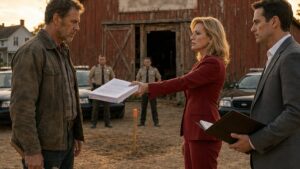
A man in a reflective vest stepped out and raised one hand. “Ma’am, you need to stay clear of that cut.”
Sandra held the sign at her side. “Who made it?”
“It’s emergency drainage work.”
“That wasn’t my question.”
He glanced toward the pond. Its surface sat higher than usual, nearly touching the stone overflow lip. “The HOA authorized it. There was a flooding concern.”
“Where?”
“In the development.”
Sandra looked at the water pouring through her field. “And now there’s one here.”
The contractor’s jaw tightened. “I’m not supposed to discuss the design. You’ll need to speak with the board.”
“Who told you this was an easement?”
“It’s marked.”
“Who told you it was recorded?”
He looked at the sign in her hand as though it had become her property only because she had touched it. “You can’t remove posted safety notices.”
“It was posted on my land.”
“That boundary’s disputed.”
Sandra almost smiled. The fence had appeared on county plats before Cedar Ridge’s first road existed. But she had learned long ago that correcting people too quickly only encouraged them to invent a second error.
“What company do you work for?” she asked.
He pointed to a logo on the utility vehicle.
Sandra photographed it, then photographed the tire tracks, the channel grade, the pond level, and the place where water crossed the fence. The contractor watched her with growing discomfort.
“You’re interfering with emergency work,” he said.
Sandra slid the sign beneath her arm. “Then you should have an emergency order.”
He did not answer.
At the house, she opened the valve beneath the kitchen sink. The pipes coughed before a thin stream appeared. Her domestic well was separate from the creek, but shallow groundwater fed both systems. A sudden diversion could alter more than surface flow.
She filled a bucket for the trough and carried it outside. One bucket would not matter. The gesture irritated her because it was useless, and Sandra disliked useless gestures.
Her phone showed three missed calls from an unfamiliar local number. The fourth came while she was measuring the fence line.
“Sandra Anderson?” a man asked.
“Yes.”
“This is Brandon Hill, president of the Cedar Ridge board. Our contractor says there was an incident near the emergency drainage channel.”
“There was a channel cut across my property.”
“We understand there’s a boundary disagreement.”
“There isn’t.”
A pause followed, practiced rather than uncertain.
“The subdivision had a serious water-management problem,” Brandon said. “The board acted to prevent damage to multiple homes. We’re operating under emergency authority.”
“Whose authority?”
“Our governing documents permit temporary action when common property is threatened.”
“My field isn’t common property.”
“No one is claiming it is.”
“You put up a sign claiming an easement.”
“We were advised one existed.”
“By whom?”
“That’s something counsel can clarify.”
Sandra looked across the field. Water had reached the base of the old equipment shed. Cedar Ridge’s sprinklers still moved in silver arcs above the hedge.
Brandon’s voice softened. “I’d rather handle this neighbor to neighbor before it becomes adversarial.”
“You began with an excavator.”
“That’s not a fair characterization.”
Sandra ended the call.
She spent the next hour locating the original pins. The northeast monument remained where the survey described it, beneath a flat stone beside the cottonwood. The second pin was buried under six inches of wet soil. She found it with a magnetic locator kept in her father’s workshop.
She ran the tape between them.
The fence stood ten inches inside her line, exactly as her father had intended, leaving room for maintenance without trespass. The new channel began beyond the fence, not on Cedar Ridge’s side, but seven feet and four inches inside Sandra’s property.
She measured twice.
Then she photographed the tape crossing the muddy cut.
By midmorning, a notice appeared in her email inviting residents and “affected neighboring owners” to an emergency HOA meeting that evening. The subject line read:
DRAINAGE DISPUTE AND THREAT TO COMMUNITY WATER OPERATIONS
Sandra read it once.
Not unauthorized excavation. Not flooding. Not possible trespass.
A dispute.
A threat.
She placed the laminated sign beside the old survey map on her kitchen table. Mud dried slowly across the word EMERGENCY.
Then she called a licensed surveyor and the county stormwater office.
Chapter 2: The Board Called Trespass a Necessary Improvement
The first image on the clubhouse screen showed Sandra’s field underwater.
Across the bottom, someone had typed: EXTERNAL DRAINAGE DISPUTE.
Sandra stopped inside the doorway while forty Cedar Ridge homeowners studied the photograph. None of them could see the cut channel beyond the frame. None could see the dry intake behind her house. They saw standing water, a crooked fence, and an old shed reflected in brown floodwater.
Brandon Hill stood beside the screen in a navy jacket with no tie. He looked composed enough to suggest that every sentence had been reviewed by counsel.
“As I was saying,” he told the room, “temporary drainage measures prevented probable damage to multiple residences along the west slope.”
A woman in the front row noticed Sandra. Heads turned in sequence.
Brandon gave her a measured smile. “Ms. Anderson. Thank you for coming.”
Sandra crossed the room carrying the laminated sign and a rolled copy of the recorded plat.
The board sat behind a long white table. Rebecca Lee, the treasurer, avoided Sandra’s eyes. Two other board members had open laptops. The HOA attorney occupied the chair nearest Brandon.
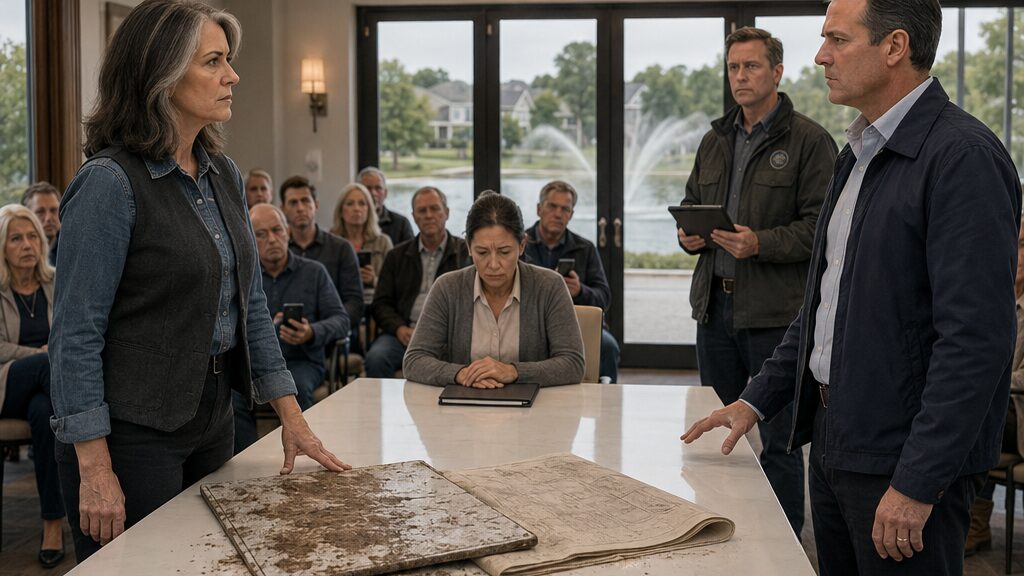
Sandra placed the muddy sign in the center of the table.
A streak of dried earth remained on the polished surface.
Whispers moved through the room.
Brandon looked down at the sign. “That notice was installed for public safety.”
“On my property,” Sandra said.
“That point is contested.”
She unrolled the plat and weighted its corners with water glasses. “Then show me the instrument that contests it.”
The attorney leaned toward his microphone. “This is not a court hearing.”
“No,” Sandra said. “It’s a board meeting. The recording number should be easier to provide here.”
Brandon folded his hands. “The association relied on an existing drainage easement identified during emergency review.”
“What recording number?”
“We don’t have the entire property file in this room.”
Sandra looked at the projection screen. “You had my flooded field.”
A few residents shifted in their chairs.
Jonathan Davis stood near the back wall with his arms crossed. His house sat closest to Sandra’s boundary, a two-story stucco home with a finished basement and a mortgage he had once mentioned refinancing. He spoke without waiting for recognition.
“Are you saying there’s no easement?”
“I’m asking them to identify it,” Sandra said.
Brandon answered for her. “We are saying the legal status is under review. What is not under review is the danger of interrupting a system that serves two hundred fourteen households.”
The next slide appeared. It showed the retention pond, pump house, and irrigation lines highlighted in blue.
“Ms. Anderson has contacted county enforcement,” Brandon continued. “If operations are suspended, common landscaping may be damaged, pond levels may become unstable, and owners could face significant unplanned costs.”
An older man near the aisle called out, “How significant?”
“We don’t have a final estimate.”
Another resident asked, “Can she just shut off our water?”
Sandra turned toward them. “I cannot shut off your household water.”
Brandon stepped closer to the microphone. “But a complaint could interrupt the shared stormwater and irrigation system.”
“That system is receiving water through a channel cut into my land.”
The attorney raised a hand. “Again, the property question is disputed.”
Sandra looked at Brandon. “Who authorized the excavation?”
“The board authorized emergency mitigation.”
“On what date?”
“That discussion occurred in executive session.”
“Before or after the contractor entered my property?”
The attorney whispered something to Brandon.
Sandra waited.
Silence was useful when someone else had filled the room with certainty.
Brandon finally said, “The board acted based on professional recommendations.”
“From whom?”
“We’re not going to litigate contractor communications in front of homeowners.”
“Then don’t ask homeowners to fund litigation against me.”
The room changed at that sentence. Not dramatically. No one applauded. But several residents looked from Sandra to the board with a different kind of attention.
Brandon clicked to the next slide.
PROPOSED ACTION: AUTHORIZE COUNSEL TO PROTECT COMMUNITY OPERATIONS
“The motion,” he said, “would allow us to seek immediate relief if an outside party interferes with infrastructure serving Cedar Ridge.”
“Outside party,” Sandra repeated.
Jonathan uncrossed his arms. “She owns the land next to us.”
“She is not a member of the association,” Brandon said.
Sandra touched the edge of the muddy sign. “Which is why your rules cannot create an easement over my property.”
The side door opened. The county stormwater inspector entered carrying a tablet and a yellow field notebook. Brandon’s expression tightened by less than an inch.
The inspector introduced himself and remained standing.
“I was asked to clarify the county’s position,” he said. “We inspected the west drainage cut this afternoon. We found no permit for the excavation and no emergency authorization issued by our office.”
Brandon spoke quickly. “The HOA’s authority may arise from private documents.”
“That is possible,” the inspector said. “We requested a recorded easement. None has been provided.”
Sandra heard someone behind her exhale.
The inspector continued. “Until ownership, authorization, and downstream impacts are established, the county has issued a temporary stop-work and operational restriction affecting the west diversion.”
“How broad a restriction?” Rebecca asked.
“The diversion pumps and connected irrigation intake must be suspended.”
The clubhouse went quiet.
Outside the glass doors, sprinklers swept across the central lawn. Their clicking seemed suddenly loud.
Brandon turned toward the inspector. “Those pumps regulate pond level.”
“Then the association should provide the approved operating plan showing how.”
“We can have counsel send materials tomorrow.”
“The order is effective now.”
A maintenance employee near the rear received a message, looked at Brandon, then left through the side door.
For several seconds nothing happened.
Then the sprinkler nearest the patio weakened. Its silver arc shortened, struck the grass, and disappeared. One after another, the sprinklers across the lawn lost pressure. Their clicking slowed and stopped.
No one in the room spoke.
Sandra looked at the silent heads outside, then at the photograph of her flooded field still glowing on the screen.
The victory felt exact and incomplete.
Brandon recovered first. “This is precisely the disruption we warned about.”
The county inspector closed his notebook. “The disruption began when an unapproved channel was excavated.”
Jonathan looked toward Sandra. “Did you know they’d shut all of it down?”
“I knew they might restrict the diversion.”
“That’s not an answer.”
“No,” she said. “I did not know the full extent.”
Brandon seized the opening. “And now two hundred fourteen households bear the risk.”
Sandra faced him. “Because you connected their risk to water taken through my field.”
The meeting dissolved into overlapping questions. Residents asked about lawns, pond pumps, insurance, and assessments. The attorney requested order. Rebecca stared at the sign as if it were an accusation addressed only to her.
Sandra began rolling the plat.
A folded square of paper appeared beneath her hand.
Rebecca had moved close enough to place it there without speaking.
Sandra opened it under the edge of the table.
The handwriting was narrow and controlled.
The board knew the system failed before they cut the channel.
Sandra looked up.
Rebecca was already walking back to her chair.
Chapter 3: The Temporary Channel Had No End Date
The recorded plat contained no easement where Cedar Ridge had cut through Sandra’s land.
The county clerk enlarged the western boundary on a monitor and checked the index twice. Utility easements followed the subdivision roads. A drainage tract curved along Cedar Ridge’s southern edge. Nothing crossed Sandra’s parcel.
“No amendment?” Sandra asked.
“None recorded.”
“No emergency access agreement?”
The clerk shook her head. “Emergency orders don’t create permanent property rights anyway.”
Sandra requested certified copies of the plat, the drainage tract, and every instrument connected to Cedar Ridge’s western lots. The printer began feeding pages into a tray.
On the final sheet, a note referenced a stormwater acceptance file held by county engineering.
Sandra followed it upstairs.
The file was thicker than she expected. Inspection photographs showed Cedar Ridge before the lawns, fences, and decorative stonework. Concrete pipes lay open in red soil. The retention pond was an unfinished basin. One report, dated six months before homeowners assumed control from the developer, marked the west infiltration system as conditionally rejected.
Sandra read the paragraph twice.
Subsurface discharge exceeded the design estimate. Additional relief capacity was required before final acceptance.
A later memorandum proposed two options. The first involved rebuilding part of the underground network. The second described a temporary surface bypass during corrective construction.
Sandra turned the page.
The corrective construction had never been completed.
Attached to the memorandum was a preliminary estimate. Even before inflation and landscaping replacement, the figure was high enough to explain why a board might panic.
She copied the entire file.
At the boundary that afternoon, the surveyor drove new stakes beside the original monuments. Bright ribbon snapped above the muddy field.
“The cut starts seven feet four inches inside your line,” he said. “Then moves farther in before it turns.”
Sandra handed him the old map. “My father kept the fence inside the boundary.”
“He did you a favor.”
“He thought leaving room would prevent arguments.”
The surveyor glanced toward Cedar Ridge. “Sometimes room just gives people somewhere to stand while they argue.”
Near the pond, the laminated sign’s empty metal stake remained in the mud. Sandra photographed it again, then compared the wording on the sign with a photocopy from the engineering file.
TEMPORARY EMERGENCY DRAINAGE ACCESS.
The phrase appeared in an unsigned contractor memorandum written during the period when repairs were supposedly pending.
Cedar Ridge’s sign had removed one word.
Temporary.
That omission converted a short-term construction measure into something that looked permanent. It did not prove who had ordered the change, but it proved the language had not come from a recorded easement.
Sandra returned home to find two envelopes taped to her front door.
One was from the HOA attorney, directing her not to disturb “shared drainage infrastructure” while ownership questions were reviewed. The other announced a community information session regarding “outside interference with essential operations.”
She carried both to the kitchen and laid them beside the muddy sign.
Her father’s old wall clock ticked above the stove. In the quiet house, the absence of water became noticeable. No rush through the creek stones. No faint metallic refill from the trough outside.
Sandra opened the engineering estimate again.
The original repair cost would have required a substantial special assessment. Divided among two hundred fourteen households, it was not ruinous for everyone. But it would be ruinous for some.
She thought of Jonathan’s careful talk about refinancing. Rebecca’s old sedan. The retired couple who walked the perimeter every evening. Cedar Ridge looked affluent from a distance because its lawns matched and its roofs were new. Matching roofs did not mean matching bank accounts.
Her phone rang.
Brandon did not bother with a greeting.
“The county restriction is temporary,” he said. “Our counsel believes we can resume limited pumping under the association’s emergency authority.”
“You still haven’t produced an easement.”
“The pump station is on HOA property.”
“The intake depends on an unapproved diversion.”
“We can isolate that issue while maintaining essential operations.”
Sandra looked at the photograph showing the failed infiltration field. “Was the west system ever accepted by the county?”
A pause.
“We inherited a complicated development file.”
“That isn’t an answer.”
“The system was operating when control transferred.”
“Operating is not accepted.”
Brandon’s voice hardened. “You are not the association’s engineer.”
“No. I’m the owner of the land you used because your own system failed.”
“We acted to prevent flooding.”
“By moving it to me.”
“That was not the intended outcome.”
“But you continued after the outcome became visible.”
“We didn’t have a safe alternative.”
Sandra pressed her thumb against the unsigned memorandum. “You had a temporary bypass while permanent repairs were completed.”
Silence answered her.
“Who removed the word temporary?” she asked.
“I don’t know what document you’re referring to.”
“You will.”
Brandon lowered his voice. “Listen to me. If the pumps remain offline, pond levels could destabilize. Groundwater could move in ways no one can predict. You may think you’ve forced a clean correction, but systems like this don’t stop at property lines.”
Sandra almost told him she understood that better than he did.
Instead, she said, “Then send the county your approved operating model.”
“We need time.”
“You had years.”
After the call, Sandra studied the site plans across her kitchen table. The retention pond did more than hold irrigation water. Its pumps controlled level changes within an interconnected network of drains, shallow basins, and buried lines. Shutting the diversion stopped the trespass, but restarting the pumps without controls would resume it. The county’s narrow order had left room for argument.
A message from the HOA arrived at four twenty.
CEDAR RIDGE WILL RESUME LIMITED EMERGENCY PUMP OPERATIONS AT 8:00 A.M. THURSDAY TO PROTECT COMMUNITY PROPERTY.
Sandra read it twice.
Then she opened the county complaint portal.
A broader shutdown would suspend the pumps, the diversion intake, and connected discharge until the association produced an approved emergency plan. It would protect her field immediately. It would also remove the mechanism Cedar Ridge claimed was stabilizing the pond.
She heard her father’s voice as clearly as if he stood in the room: Never let them move the creek because it’s easier than asking.
He had meant developers. Survey lines. Men with plans who treated old land as blank space.
He had not known two hundred fourteen households would someday sit behind those plans.
Sandra attached the certified plat, the surveyor’s measurements, the failed inspection report, the unsigned temporary-bypass memorandum, and photographs of the flooded field.
In the narrative box, she wrote only what she could prove.
At five twelve, she submitted a request for immediate suspension of all connected operations pending engineering review.
The confirmation number appeared on the screen.
Outside, the trough valve struck metal again in the dry basin.
Sandra printed the filing and placed it beneath the muddy sign.
By morning, no pump connected to Cedar Ridge’s west system would be allowed to start.
Chapter 4: When the Sprinklers Stopped, Basements Began Seeping
At eight Thursday morning, the pump station lights turned red.
Sandra could see them from the upper edge of her field: three warning lamps blinking against the small concrete building beside Cedar Ridge’s pond. The sprinklers never rose. Their metal heads remained buried in the lawns while homeowners stood on sidewalks holding phones and coffee cups, watching for something to happen.
Nothing did.
The silence pleased Sandra for less than a minute.
Water no longer crossed the cut near her fence. The current thinned to separate ribbons, then stopped altogether. Mud settled between the fence posts. Her lower field would drain slowly, but at least no fresh water was being forced into it.
Behind the house, the creek gave a faint, broken murmur.
She knelt beside the livestock intake and felt cold water touch her fingers. Not enough to refill the trough yet, but more than she had seen the day before.
The cattle heard it too. They crowded the bank, restless and alert.
Sandra was cleaning the intake screen when her phone began vibrating against a rock.
There were twelve new messages.
The first came from the county: the broader operational suspension had taken effect at 7:42 a.m.
The remaining messages came from numbers she did not recognize.
One called her selfish. Another demanded to know whether she intended to reimburse the neighborhood for dead landscaping. A third included a photograph of the laminated sign lying on the clubhouse table, cropped so the recorded plat and county inspector were not visible.
The caption read:
ONE OUTSIDE OWNER SHUT DOWN WATER FOR 214 FAMILIES.
Sandra enlarged the photograph. Mud covered the word EMERGENCY. The image made the sign look official and her removal of it look reckless.
She locked the phone without replying.
By noon, Cedar Ridge’s lawns had not changed color, but the people had. Residents who usually waved from walking paths now watched her property from across the hedge. A pickup slowed twice along the county road. Someone had tied a handwritten sign to the subdivision entrance:
TURN OUR WATER BACK ON.
Sandra told herself household water was unaffected. She had explained that at the meeting. The county notice said the same thing.
Facts, however, traveled more slowly than anger.
She spent the afternoon documenting drainage across her field. The waterline on the equipment shed reached four inches above the foundation slab. Fence posts leaned where the soil had softened. She marked damaged areas on an aerial map and photographed sediment lodged in the pasture grass.
Near three o’clock, the county inspector called.
“We’re seeing unexpected level changes in two monitoring wells,” he said.
“Near the west slope?”
“Yes.”
Sandra straightened. “How fast?”
“Faster than the original operating model predicts.”
“That model assumes the infiltration bed was functioning.”
“We know.”
She looked toward the retention pond. Its surface appeared calm, but the high-water stain along the stone edge showed how much level control had depended on the pumps.
“What are you observing?” she asked.
“Groundwater rise beneath the lower row of houses. We’ve asked residents to report seepage.”
Sandra pressed the phone closer. “Any structural movement?”
“Not yet.”
The words did not reassure her.
The pumps had not merely pulled water toward the pond. They had been compensating for something beneath the subdivision—something the failed inspection report had warned about. Shutting them exposed the original defect.
Sandra had understood that possibility when she filed the complaint.
She had told herself the HOA was exaggerating it.
A vehicle door slammed beyond the hedge. Jonathan Davis came through the maintenance gate without waiting for permission. He wore work boots, sweatpants, and a shirt darkened along the chest.
“You need to see this,” he said.
“This is private property.”
“So is my basement.”
He turned back toward the gate. Sandra followed.
His house stood on the lowest Cedar Ridge street. Inside, the finished basement smelled of wet drywall. A dark line spread along the baseboard beneath a window well. Jonathan had pulled the carpet back, exposing concrete slick with water.
“It started an hour ago,” he said. “Not from the window. It’s coming through the wall.”
Sandra crouched and touched the concrete. Cold moisture formed in several narrow seams.
“Do you have a sump system?”
“It’s running.”
“Discharge location?”
“Side yard.”
“That may be feeding back toward the foundation if the common drain is saturated.”
Jonathan stared at her. “In English.”
“The groundwater is rising faster than your drainage system can carry it away.”
“Because the pumps are off.”
“Because the subdivision’s system was built with insufficient relief capacity.”
“But it didn’t come through my wall yesterday.”
Sandra stood.
“No,” she said.
That single word carried more blame than she intended.
Jonathan glanced at the exposed carpet, then back at her. “You knew this could happen.”
“I knew the board claimed it could.”
“And you filed anyway.”
“They were restarting a system using water diverted through my land.”
“So you shut down everything.”
“The county made that decision.”
“After you asked them to.”
Sandra did not answer.
Jonathan rubbed both hands over his face. “We spent nine years saving for this house. My wife wanted to wait. I told her new construction meant fewer surprises.”
From upstairs came the muffled sound of a child asking whether the water was still coming in.
Sandra looked again at the wall. The seepage did not absolve the board. It proved the buried system had never been safe.
But proof did not keep Jonathan’s drywall dry.
“Move anything stored against the outside walls,” she said. “Keep the sump running. I’ll send the inspector measurements from the failed report.”
“You’ll send measurements?”
“It may help them establish temporary pumping limits.”
“You could have warned us.”
The accusation landed because it was true.
Sandra had warned the board. She had warned the contractor. She had warned the county that the channel was unlawful.
She had not warned the homeowners.
She had grouped them behind Brandon’s table, all of them looking at her flooded field as if it were an inconvenience. She had decided they had chosen their side.
Outside Jonathan’s house, three residents waited near the sidewalk. One held up a phone and asked whether Sandra was finally seeing what she had done.
Jonathan stepped between them.
“Not now,” he said.
It was not a defense of Sandra. It was only exhaustion.
By Friday morning, seepage had been reported in six basements. The county installed temporary monitoring equipment near the pond and allowed no pumping while engineers reviewed the data. Cedar Ridge’s social page filled with photographs of wet walls, red pump lights, and Sandra’s muddy sign.
A board member posted that one neighboring landowner had refused cooperative solutions.
Sandra read the sentence from her kitchen table.
She could have replied with the failed inspection report. She could have posted the plat, the channel photographs, the temporary-bypass memo.
Instead, she closed the page.
Her silence had once felt disciplined. Now it gave other people room to define her.
Late Saturday afternoon, a black sedan stopped beside her porch. Brandon Hill stepped out alone, carrying a thick leather folder.
He did not bring the HOA attorney.
Sandra remained seated at the table beneath the porch roof.
Brandon climbed the steps and placed the folder in front of her.
“This compensates you fully,” he said. “Pasture restoration, fence repair, the creek bank, all of it.”
Sandra did not open it.
“What do you want?”
“Withdraw the county complaint. Let us resume controlled operations.”
“And the failed system?”
“We address that separately.”
“Publicly?”
His eyes moved toward the field.
“The settlement would be confidential.”
Chapter 5: The Settlement Folder Left Every Neighbor Exposed
Brandon’s folder was heavy enough to suggest generosity before Sandra opened it.
The first page offered payment for pasture remediation. The second covered fence replacement, creek-bank stabilization, livestock water expenses, and engineering consultation. The number at the bottom exceeded Sandra’s preliminary estimate.
A final clause required her to withdraw all pending complaints, return the laminated sign, release the association from future claims connected to the diversion, and refrain from disclosing settlement terms or internal HOA documents.
Sandra read the clause again.
“You want the sign.”
“It belongs to the association.”
“It was planted on my land.”
“It was installed by our contractor.”
“That does not make the claim printed on it true.”
Brandon sat across from her. Without the clubhouse table or attorney beside him, he looked older. His collar was open, and a pale line of fatigue ran beneath each eye.
“The sign is becoming a distraction,” he said.
“No. It is becoming evidence.”
He looked toward the dry channel behind the house. “Six homes have water intrusion.”
“I know.”
“We may have more by tomorrow.”
“I know that too.”
“Then you understand why we need the pumps.”
“I understand why you needed a functioning drainage system before selling people homes.”
Brandon’s mouth tightened. “I didn’t build Cedar Ridge.”
“You inherited the defect. You chose what to do with it.”
“We inherited more than a defect.”
He reached into the folder and removed a spreadsheet. Columns of figures covered the page: reserves, insurance deductibles, projected legal costs, assessment scenarios.
“The permanent repair estimate was revised after the board took control,” he said. “Not the number you saw in the county file. The real one.”
Sandra examined the final column.
It was nearly double.
“Why?”
“Excavation under finished streets. Utility conflicts. Rebuilding landscape walls. Temporary relocation for several homes if the lower system had to be opened.”
“You had a developer bond.”
“Restricted. And the developer disputed responsibility.”
“So you made the homeowners vote.”
Brandon looked down at the spreadsheet. “We presented an assessment.”
“How much?”
“For some households, more than twenty thousand dollars.”
Sandra said nothing.
“People were already stretched,” he continued. “Rates had gone up. Property taxes had gone up. Rebecca’s husband had been out of work for months. Jonathan had just refinanced. Retirees stood in that room asking whether they would have to sell.”
“And you told them the repair was optional.”
“We told them the system remained operational.”
“That was not the same thing.”
“No.”
The admission came quietly.
Sandra closed the folder.
“What happened after they rejected the assessment?”
“We asked the contractor for a temporary measure.”
“The bypass.”
“Yes.”
“Across my land.”
“We believed the old drainage corridor extended farther west.”
“You believed that before or after the survey?”
Brandon looked toward the field again.
“There was no survey,” Sandra said.
“We did not have time.”
“You had time to print a sign.”
His expression sharpened. “You think this was easy?”
“I think you chose the only person outside your voting district to carry the cost.”
“That was not how we saw it.”
“That is how systems excuse themselves. They stop seeing the person under the water.”
Brandon stood and walked to the porch rail. Cedar Ridge’s rooftops rose beyond the cottonwoods. A pump alarm sounded faintly from the pond, three short tones repeated every minute.
“When the contractor cut the channel,” he said, “the basement readings dropped within hours. The pond stabilized. No homes flooded. The board thought we had bought enough time to pursue the developer.”
“How much time?”
“Three months.”
“It has been almost two years.”
“We kept expecting the claim to move.”
“And when my field flooded?”
“The contractor said the flow would spread across pasture and return to the creek.”
“He knew it was my property.”
Brandon did not answer.
Sandra pushed the settlement folder toward him. “You knew too.”
“I knew where the fence was.”
“The boundary is beyond the fence.”
“Yes.”
There it was—not a document, not a recording number, not an accident of paperwork. A choice.
Brandon had known enough.
He returned to the table but did not sit.
“If you reject this, the county may keep the pumps off for weeks. More houses could be damaged. Insurance may deny parts of the claims because the board knew about the defect. The association could become insolvent.”
“And if I accept?”
“We restart controlled pumping. We stabilize the neighborhood. Then we negotiate repairs.”
“Behind closed doors.”
“We prevent panic.”
“You prevent accountability.”
His voice rose for the first time. “Accountability does not repair a basement.”
“No. Neither does pretending my field was free.”
The pump alarm sounded again.
Brandon lowered his voice. “I am trying to keep people in their homes.”
“By making sure they never learn what they are standing on.”
He gathered the spreadsheet but left the folder open.
“You have until tomorrow evening,” he said. “After that, counsel withdraws the offer.”
Sandra looked at the payment figure.
It would restore every damaged acre. It would rebuild the creek bank properly. It would pay for years of maintenance. She could protect the land without spending another month in hearings.
All she had to do was make Cedar Ridge’s defect invisible again.
“No,” she said.
Brandon studied her as though he expected a longer answer.
“No to the amount?”
“No to the structure.”
He closed the folder.
“You are willing to let homes flood to make a point.”
Sandra stood. “You flooded my land to avoid making one.”
He left without another word.
On Monday morning, Sandra drove to Cedar Ridge’s finance office at Rebecca’s request. The small room behind the clubhouse smelled of toner and stale coffee. Boxes of annual reports lined one wall.
Rebecca locked the door after Sandra entered.
“I should have spoken at the meeting,” she said.
“Yes.”
Rebecca flinched, but Sandra did not soften it.
“I voted against the channel,” Rebecca said. “Then I signed the minutes approving it.”
“Why?”
“Because the attorney said the vote had passed. Because Brandon said dissent in the final record would weaken our position with the developer. Because my husband had been laid off and I could not pay the assessment either.”
She opened a filing cabinet and removed a red folder.
Inside were executive-session minutes, a contractor email, and the revised repair estimate Brandon had shown Sandra. One email warned that the surface bypass crossed land not owned by the association and should not remain active beyond ninety days without written permission.
Rebecca’s initials appeared beside the receipt line.
“You had this for two years,” Sandra said.
“I kept telling myself the developer claim would settle.”
“And when my field flooded?”
“I asked Brandon to stop the diversion.”
“What did he say?”
“That shutting it down would expose the whole neighborhood.”
Rebecca pressed both palms against the desk. “He wasn’t wrong.”
“No. He was incomplete.”
Tears gathered in Rebecca’s eyes but did not fall. “If this becomes public, people will lose everything.”
“Some may lose money.”
“That is everything to some people.”
Sandra looked at the boxes of financial records. “And what is my land to me?”
Rebecca nodded once. “I know.”
“No. You calculated it.”
The words left Rebecca pale.
Sandra regretted them immediately, not because they were false, but because they were too easy.
Rebecca had not cut the channel. She had remained silent. Silence had consequences, but it was not the same act.
Sandra picked up the contractor email.
“Will you provide these to the county?”
Rebecca’s breath caught. “Under subpoena?”
“Voluntarily.”
“That could expose me too.”
“Yes.”
For a long moment, only the pump alarm sounded beyond the wall.
Then Rebecca slid the entire red folder across the desk.
Sandra did not take it immediately.
“I need copies,” Rebecca said. “And I need it noted that I voted no.”
“You signed the final minutes.”
“I know.”
“That will be noted too.”
Rebecca closed her eyes, then nodded.
That evening, Sandra emailed Brandon, the county inspector, the HOA attorney, and every board member.
She rejected the confidential settlement. She attached the suppressed minutes, the contractor warning, and the failed-system report. She requested an open meeting with the complete engineering record available to all homeowners.
Her final sentence was brief.
No pump should restart under a plan that requires the people paying for it to remain uninformed.
Chapter 6: Sandra Drew a Repair Plan No Side Wanted
The county gave Sandra one hour to choose.
At ten Tuesday morning, the hearing officer placed two draft orders on the table. One extended the full shutdown until Cedar Ridge produced a permanent repair design. The other allowed limited pumping under temporary controls, provided Sandra consented to monitored access across her boundary.
“The county cannot authorize use of private land,” the officer said. “Without an agreement, the broader suspension remains.”
Sandra looked through the hearing-room windows toward the parking lot. Cedar Ridge homeowners stood in small groups beneath the shade trees. Some carried folders. Others held photographs of wet basements.
Brandon sat across from her beside the HOA attorney. Rebecca occupied a chair at the end of the table, separated from the rest of the board.
The county inspector pushed a technical summary toward Sandra.
“Groundwater is still rising,” he said. “Slowly now, but the lower homes remain at risk.”
“And my field?”
“No new inflow. Surface drainage is improving.”
The choice looked simple on paper.
Protect her land completely and leave the defective subdivision system shut down.
Or permit temporary operation and risk making the illegal channel useful again.
Sandra had spent the previous night drawing a third option.
She opened her folder.
“Neither order is sufficient,” she said.
The HOA attorney sighed. “Ms. Anderson, those are the available enforcement paths.”
“They are the available administrative forms. They are not the only engineering paths.”
She unfolded a site plan across the table.
Her proposal allowed limited pumping from the pond but prohibited intake through the cut on her land. Temporary relief wells would be installed along the lower street. Portable discharge lines would route excess water to the approved southern drainage tract. Independent monitors would report daily levels to the county and residents. The illegal channel would be blocked immediately, then restored under supervision.
Brandon scanned the first page. “This is not financially possible.”
“It is less expensive than keeping six basements open to groundwater.”
The attorney pointed to the funding section. “You assume recovery from the developer bond.”
“I assume a claim should be filed before declaring homeowners solely responsible.”
“The bond administrator rejected the initial demand.”
“The initial demand did not include the suppressed inspection report.”
Rebecca spoke from the end of the table. “It does now.”
Brandon turned toward her. “You had no authority to release privileged records.”
“I had an obligation to stop hiding them.”
The room went still.
Sandra continued. “The cost can be divided among the developer bond, the association’s liability coverage, reserve funds, and a limited assessment. Not one emergency charge. A staged obligation tied to verified work.”
A board member shook his head. “Residents will still pay.”
“Yes,” Sandra said.
The bluntness drew several angry murmurs from the hallway.
The hearing officer opened the door and invited the assembled homeowners into the larger adjoining room. Within minutes, every chair was filled. People stood along the walls.
Sandra carried her plan to the front.
Brandon spoke first. He described the proposal as untested, expensive, and dependent on uncertain recoveries. He emphasized that Sandra’s complaint had caused the current shutdown.
He was not entirely wrong.
When Sandra’s turn came, she placed the laminated sign on the evidence table.
Mud still marked its lower edge.
Several phones rose.
Sandra looked at the room, then at Jonathan, who stood beside a photograph of his stripped basement wall.
“I asked the county to shut down the entire connected system,” she said. “I did it because the board announced it would restart pumps without resolving the unlawful diversion.”
Someone called out, “And our houses started leaking.”
“Yes.”
The room quieted.
Sandra had prepared an explanation of the failed infiltration bed, hydraulic pressure, and emergency controls. She set it aside.
“I knew a full shutdown could expose weaknesses in the system,” she said. “I believed the board was using that risk to frighten me into accepting trespass. I did not believe the effects would reach homes as quickly as they did.”
Jonathan stared at her.
“I should have warned residents directly,” Sandra continued. “I warned the board. That was not enough.”
Brandon leaned toward his microphone. “So you admit responsibility.”
“I accept responsibility for the decision I made. I do not accept responsibility for the defect, the concealed reports, or the channel cut through my land.”
The distinction held.
No applause followed. A woman near the aisle looked down at her hands. Someone behind Jonathan whispered that at least Sandra had said it plainly.
Jonathan stepped forward.
“My basement is one of the six,” he said. “I blamed her first.”
He nodded toward Sandra without looking at her.
“But the report says this system failed inspection before most of us closed on our homes. The contractor warned the board the bypass crossed property we didn’t own. I never saw either document.”
Brandon stood. “Those communications are being taken out of context.”
“Then give us the context,” Jonathan said.
The room shifted again—not toward Sandra exactly, but away from certainty.
The county inspector presented the monitoring data. Limited pumping could reduce groundwater pressure, he said, but only if separated from the illegal intake and paired with temporary relief measures. Sandra’s plan was technically workable, though it required rapid contracting and strict oversight.
The HOA attorney requested a recess.
During it, Brandon found Sandra beside the empty coffee station.
“You designed a plan no contractor can price in a day,” he said.
“They can price the first stage.”
“You’ve made yourself the gatekeeper.”
“My land is the gate.”
“You want me removed.”
“I want you to disclose what you approved.”
His face tightened. “The bond claim could fail if I admit the board knowingly used an unapproved bypass.”
“The claim may already fail because you concealed it.”
“You think honesty is free.”
“No.”
Sandra looked through the glass doors at the homeowners gathered around Rebecca and Jonathan.
“I think dishonesty sends the bill to someone who never agreed to pay it.”
When the hearing resumed, the county accepted the staged operating plan in principle. Insurance representatives would review emergency costs. The developer bond claim would be reopened. Residents would receive the full engineering file.
One issue remained.
The proposed agreement required the board president to sign a factual disclosure stating that the channel had been authorized as a temporary measure despite the absence of a recorded easement, and that operation had continued beyond the contractor’s recommended period.
Brandon refused.
“My signature creates personal exposure,” he said.
The hearing officer folded her hands. “The county requires an accountable signatory.”
“Another board member can sign.”
Rebecca shook her head. “The vote was yours to implement.”
“The board approved it.”
“You recommended it,” she said. “You directed the contractor.”
Brandon looked toward the homeowners. His fear was no longer abstract. Sandra could see it in the way he gripped the table edge.
If he signed, he might lose his position, his insurance protection, perhaps more. If he refused, the pumps would remain silent and groundwater would keep pressing against foundations.
The HOA attorney whispered to him.
Brandon shook his head.
Sandra gathered her papers.
“What are you doing?” the hearing officer asked.
“Removing my conditional consent.”
A wave of voices rose from the room.
Sandra waited until they settled.
“The temporary plan requires trust, access, and accurate disclosure. I will not grant access under another version of the same concealment.”
Brandon stared at her. “You would let this continue over one signature?”
“No,” Sandra said. “You are letting it continue over one signature.”
She placed the muddy easement sign between them.
“No pump restarts,” she said, “until the person who authorized that sign tells the people behind him what it was hiding.”
Chapter 7: The Creek Returned Without Asking Permission
The excavator bucket lifted the first section of illegal channel before sunrise.
Wet soil folded inward with a sound like heavy cloth tearing. Under the county inspector’s direction, the operator worked from Cedar Ridge’s side of the boundary, removing the straight cut in short measured lengths while a surveyor checked every stake.
Sandra stood near the broken fence post with both hands around a metal travel mug. No equipment crossed onto her land without her written approval. No soil left the site without being tested. No pipe opened without an inspector present.
Three weeks earlier, she would have considered those conditions obvious.
Now each one existed in writing.
The temporary relief wells had been installed along Cedar Ridge’s lower street. Thick hoses ran beneath protective ramps and discharged toward the approved southern drainage tract. Their pumps produced a low mechanical hum, less dramatic than the old pond system but steady enough to keep groundwater below Jonathan’s basement slab.
The illegal intake remained closed.
The retention pond sat lower than before. Brown rings marked the stone edging where the water had receded. Common lawns had faded in broad patches, and several homeowners had stopped pretending the landscaping was the most urgent thing at stake.
The work crew reached the place where the false channel crossed Sandra’s fence line.
The operator stopped.
The surveyor motioned Sandra forward.
“We can restore the grade from here,” he said. “But the old post is too loose to hold tension.”
Sandra touched the cedar. Mud had darkened the lower half. When she pressed it, the post shifted in the ground.
Her father had set it when she was twenty-four. He had rejected pressure-treated lumber because he disliked the chemical smell and trusted cedar to age honestly.
Sandra had promised to keep the line.
She had not promised to keep every piece of wood.
“Remove it,” she said.
The excavator set the post gently beside the fence rather than dropping it into the spoil pile.
Across the boundary, Jonathan watched with his hands in his coat pockets. His basement walls had been opened to the studs. Industrial fans ran day and night. Insurance had agreed to cover part of the damage, though the final amount remained under review.
He waited until the machinery moved farther downstream.
“They start the permanent system next week,” he said.
“So the schedule says.”
“You think they’ll finish before winter?”
“If the contractor follows the revised design.”
“That wasn’t what I asked.”
Sandra looked toward the relief hoses. “Yes. I think they can.”
Jonathan nodded. “That sounds almost optimistic.”
“It is an engineering opinion.”
“Of course.”
The corner of his mouth moved, not quite a smile.
For days after the hearing, residents had avoided Sandra unless they needed something explained. Then questions began arriving by email. Not accusations. Questions about monitoring wells, bond claims, drainage maps, and why the original system had failed.
At first Sandra answered with attachments.
Jonathan finally wrote back: I can read the report. I am asking what it means for my house.
After that, she began answering differently.
The developer bond administrator reopened the claim once the suppressed inspection report and contractor warning became part of the county record. The developer disputed the amount but could no longer argue that the defect had been discovered only after control transferred to the homeowners.
The insurer agreed to cover emergency groundwater measures and part of the restoration. Cedar Ridge’s reserves covered another portion. The homeowners still faced an assessment, but it was less than a third of the figure Brandon had once used to frighten the board into silence.
It was still painful.
A retired couple listed their second vehicle for sale. One family requested a payment plan. Rebecca spent long evenings in the clubhouse finance office building hardship schedules and answering questions she had once avoided.
No one called the outcome free.
By late morning, the crew had filled most of the cut. They rebuilt the creek bank with layered stone, native soil, and anchored vegetation rather than the compacted slope the HOA contractor had left behind.
The county inspector handed Sandra a clipboard.
“Final boundary-access acknowledgment,” he said. “This closes today’s entry.”
She checked the times, equipment list, and restoration limits before signing.
He smiled faintly. “You read every line.”
“I have had mixed results trusting signs.”
He glanced toward the clubhouse, where the laminated easement notice was no longer displayed.
Sandra had been asked what she wanted done with it after the county hearing. Brandon’s attorney suggested destroying it once photographed. Jonathan thought it ought to hang in the clubhouse as a reminder. One resident proposed nailing it to Sandra’s fence with the word FALSE painted across it.
Sandra refused all three.
The sign belonged in the case file with the plat, minutes, contractor warning, and repair agreement. Not as a trophy. Not as decoration. Evidence did not become more truthful because people enjoyed looking at it.
That afternoon, Cedar Ridge held the meeting Brandon had postponed twice.
Sandra entered through the same clubhouse doors she had used the night her flooded field appeared on the screen. The white board table had been rearranged into a shallow arc. No presentation labeled her an outside threat.
Brandon sat at the center with the disclosure document before him.
He had already signed the restoration agreement. This document was separate. It stated that he had recommended and directed the temporary bypass, knew no recorded easement had been confirmed, and allowed its use beyond the contractor’s ninety-day warning period.
The room filled quietly.
Rebecca read the financial plan. She described the bond claim, insurance contribution, reserve transfer, and reduced assessment. She also stated that the board had withheld material information from homeowners.
Her voice trembled once. She did not stop.
Then Brandon stood.
He looked across the room without the practiced smile he had worn at the first meeting.
“I believed delay protected this community,” he said. “I told myself a temporary measure was acceptable because the permanent repair would cost people more than they could afford.”
He placed one hand on the disclosure.
“I also knew the burden of that decision fell on property the association did not own.”
No one interrupted.
“I treated one owner’s loss as smaller because fewer votes were attached to it.”
Sandra felt the sentence settle in the room.
Brandon signed.
He did not ask for forgiveness. He did not receive applause.
He announced that he would resign as president and withdraw from all drainage oversight once the transition was complete. He would remain personally available for the county investigation and insurance review.
After the meeting, he found Sandra near the doors.
“I signed what you wanted,” he said.
“You signed what happened.”
His eyes moved toward the pond. “Do you think that makes it right?”
“No.”
“Then what does?”
“The repair. The disclosure. Not doing it again.”
He absorbed that without relief.
“I was trying to keep people in their homes,” he said.
“I know.”
It was the first time Sandra had said those words to him without using them as an accusation.
By early autumn, the permanent relief system was operating. Monitoring data appeared each week on the HOA website. Cedar Ridge hired an independent engineer who did not report to the board president. The county required annual inspections for five years.
Sandra’s field recovered unevenly.
Some pasture grass returned in bright green strips. Other areas remained thin where silt had smothered the roots. The association paid the documented restoration costs and replaced the damaged fence.
The morning water reached the livestock trough again, Sandra heard it from the porch.
First came the creek over stone, no longer forced into a straight mechanical course. Then the intake pipe gave a low rush. The metal trough answered with a clean rising note as water struck its bottom.
The cattle approached slowly, suspicious of abundance after weeks of hauling and temporary tanks.
Sandra followed them.
Jonathan stood outside the new boundary gate holding a clipboard.
“The inspector is due at nine,” he said. “I didn’t want to come through without asking.”
Sandra looked at the gate.
The new cedar post stood exactly on the surveyed maintenance line. Beside it, the crew had installed a narrow access gate required under the restoration agreement. Sandra had chosen the latch herself.
Her father would have understood the post.
She was less certain about the gate.
For most of her life, keeping the land meant keeping people from taking pieces of it. A road widened by a foot. A utility trench placed where permission was assumed. A drainage channel labeled after the fact.
The gate did not erase the boundary.
It made crossing it deliberate.
Sandra opened the latch.
“You can wait by the creek,” she said.
Jonathan stepped through and closed the gate behind him.
They stood beside the trough as the float rose. Across the fence, Cedar Ridge’s remaining sprinklers began their reduced morning cycle. Their arcs no longer drew from Sandra’s diverted water.
The creek continued between the cottonwoods, following the low ground it had chosen long before plats, boards, assessments, or promises.
Sandra rested one hand on the new cedar post.
The line remained.
So did the opening.
The story has ended.