The HOA President Broke His Porch Planter, Then Her Own Records Exposed Thirty-Seven Unlawful Fines
Chapter 1: The Orange Notice Beneath the Broken Fox
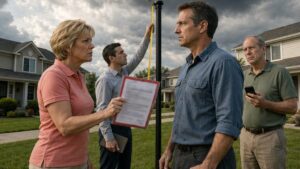
Cynthia Roberts’s shoe caught the fox planter just as Jason Adams opened his front door.
The ceramic figure tipped from the porch step, struck the edge of the welcome mat, and split along one ear. Dark soil scattered across the concrete. A small succulent rolled free and landed beside a bright orange notice that Cynthia had just placed against the threshold.
For a moment, neither of them spoke.
Cynthia looked down at the broken planter, then back at Jason. She wore a pink cardigan over a white blouse, pearl earrings, and the expression of someone inconvenienced by another person’s property.
“You shouldn’t leave objects in the inspection path,” she said.
Jason kept one hand on the doorframe. “You stepped around it when you came up.”
“That isn’t the issue.”
She bent, retrieved the orange notice, and held it toward him. The paper was stiff, preprinted, and already marked with a fine amount in black ink.
Jason took it without looking away from her.
The porch had been quiet when he heard the taping sound against the door. He had expected a delivery driver or one of the neighborhood children collecting donations for school. Instead, Cynthia stood in the morning light with a clipboard tucked beneath one arm and his planter broken at her feet.
“What’s the violation?” he asked.
“The display is not compliant with exterior presentation standards.”
“The planter?”
“The entire arrangement.”
There were two rocking chairs, one doormat, and a potted fern on the far side of the porch. Nothing had changed in months.
Jason lowered his eyes to the notice. The description read: Unauthorized decorative object visible from common roadway. A fine of three hundred dollars had been assessed, payable within ten business days.
In the upper corner, the violation code was listed as 8.14-C.
He knew that code.
It covered temporary storage of refuse containers.
He read the line again.
Cynthia shifted her clipboard. “You can appeal according to the instructions.”
“Which committee approved this?”
Her chin lifted slightly. “I approved it.”
“You’re the acting board president.”
“Yes.”
“That wasn’t my question.”
The first crack in her composure was small enough that another person might have missed it. Jason had spent eighteen years sitting across tables from homeowners, vendors, board members, and attorneys. He knew the pause people used when they were choosing between an answer and an assertion.
“The president’s signature is sufficient for an aesthetic violation,” she said.
Jason looked at the broken planter, then took out his phone.
Cynthia frowned. “What are you doing?”
“Documenting the condition.”
“You’re making this unnecessarily confrontational.”
He photographed the planter where it lay over the orange notice. Then he photographed the soil, the succulent, and the scrape her shoe had left across the ceramic glaze.
“I asked which committee approved the citation,” he said. “You said your signature was sufficient.”
“It is.”
“Thank you.”
Her face tightened. “For what?”
“For answering clearly.”
He did not tell her that Northstar Residential Group, the company contracted to administer the subdivision’s accounts, notices, vendor payments, and compliance records, belonged partly to him.
Most of the neighborhood knew Jason as the quiet man in the brick house at the end of the cul-de-sac. They saw him leave in a dark sedan some mornings and work from home on others. He did not attend block parties. He rarely corrected people when they assumed he worked in finance or software.
The anonymity had once felt useful. He had believed distance kept his professional decisions clean.
Cynthia glanced toward the street, where two neighbors were collecting their bins. “This community has standards. Some residents have become careless.”
Jason folded the notice once.
“Breaking the object doesn’t improve the standard.”
“I did not break it intentionally.”
“You still broke it.”
Her mouth flattened. “Appeal if you disagree.”
She turned and walked down the path, her low heels clicking against the concrete. At the sidewalk, she stopped long enough to write something on her clipboard before continuing toward the next house.
Jason watched until she disappeared behind a row of trimmed hedges.
Then he crouched beside the planter.
The fox had been a gift from his father during the last summer they spent together. It was inexpensive, bought from a roadside garden store, and painted with a drowsy expression Jason had once thought ridiculous. After his father died, the planter became one of the few objects Jason moved from house to house without questioning whether it belonged.
He picked up the broken ear and placed it in his palm.
The anger arrived late.
It was not the kind that raised his voice. It sharpened things. The wrong code. The immediate fine. Cynthia’s refusal to name an architectural review committee. The confidence with which she had treated the porch as if it existed for her inspection.
Inside, Jason set the planter pieces on the kitchen counter and washed the soil from his hands. He made coffee out of habit, though he left it untouched beside his laptop.
He signed into Northstar’s resident portal through the public interface first.
The violation was already there.
It had been posted at 7:18 that morning, fourteen minutes before Cynthia reached his porch. A three-hundred-dollar charge appeared beneath his regular assessment balance. The image attached to the file showed the fox planter intact.
Jason enlarged it.
The photograph had been taken from the sidewalk. The timestamp read 6:52 a.m.
Beneath the image, the system listed the same incorrect refuse-container code printed on the orange notice. The approval field contained Cynthia Roberts’s name. The committee review field was blank.
Jason’s coffee cooled beside him.
He opened the association’s governing documents. Exterior modifications required review by an architectural committee unless the condition involved an immediate health or safety risk. Decorative objects could be restricted under certain circumstances, but no fine could be imposed without notice, a cure period, and documented approval.
None of that had happened.
He called Robert Nelson, Northstar’s senior community manager.
Robert answered on the fourth ring. “You’re early.”
“I need you to preserve every compliance record submitted by Cynthia Roberts this month.”
There was a pause.
“Preserve as in routine export?”
“As in nobody edits, deletes, or corrects anything until we know what happened.”
“What happened?”
Jason looked toward the kitchen counter. The fox planter lay in two pieces, the succulent propped temporarily in a drinking glass.
“She issued a fine against my house.”
Robert gave a short breath that was not quite a laugh. “Does she know who you are?”
“No.”
“That may be the first useful fact in this conversation.”
Jason forwarded the notice and photographs. “The citation uses the wrong code, has no cure period, and no committee approval.”
“I’ll pull the file.”
“Pull all of hers.”
“Jason.”
“All of them, Robert.”
The line went quiet again.
“You’re a resident in this one,” Robert said. “That matters.”
“I know.”
“You sound like you don’t.”
Jason looked at Cynthia’s signature on the screen.
“I want the records preserved,” he said. “Nothing else yet.”
Robert agreed, reluctantly.
Jason logged into the administrative dashboard. He had no intention of changing anything. He wanted only to see whether the notice was an isolated mistake.
He filtered the records by association, submitting officer, and date.
The screen refreshed.
Rows of orange-coded entries filled the page.
Jason leaned closer.
Cynthia Roberts had submitted thirty-seven violations in eleven days.
More troubling than the number was the repetition beneath it.
The same five addresses appeared again and again.
Chapter 2: Thirty-Seven Violations Against the Same Quiet Houses
Mary Rivera had been fined twice for the same faded garden bench.
Jason found the first notice in the system at 8:04 Tuesday morning and the second three days later. Both used different violation codes. Both included photographs taken from nearly the same angle. The bench had not moved between them.
The first notice called it an unauthorized exterior furnishing. The second called it deteriorated property visible from the street.
Together, the charges totaled five hundred dollars.
By noon, Jason had printed a list of the five addresses that appeared most often in Cynthia’s submissions. He drove to Northstar’s office, where Robert had reserved a small conference room and placed the exported files on a secure drive.
Robert stood at the end of the table with his sleeves rolled up. “You said preserve. You didn’t say investigate residents in person.”
“I’m verifying whether the conditions still exist.”
“You’re also the owner of the company that processed the fines.”
“Co-owner.”
“That distinction will comfort nobody.”
Jason looked down at the spreadsheet. Mary Rivera’s house had nine entries. Brian Clark’s had seven. The remaining citations were divided among three other households, all clustered within four blocks.
Most concerned subjective appearance standards: a bench, a porch drawing, a garden hose, faded edging, a mobility ramp with a planter near it.
“These aren’t random,” Jason said.
“No,” Robert replied. “They’re easy.”
Jason looked up.
“Easy to photograph. Easy to describe vaguely. Easy to defend as judgment calls.”
“Easy residents?”
Robert did not answer.
That was answer enough.
Mary’s house sat beneath two live oaks at the far edge of the subdivision. Jason had passed it countless times without stopping. The garden bench stood beneath the front window, its green paint worn pale along the seat. A cushion had been removed, leaving the wood exposed.
Mary opened the door but kept the storm door latched.
“Yes?”
“Mrs. Rivera, I’m Jason Adams. I live on Hawthorne Court.”
“I know where you live.”
Her tone carried no warmth.
“I’m reviewing several violation notices.”
“Then you work for them.”
“I work with the management company.”
She gave him a long look. “That isn’t better.”
Jason held up the printed ledger without moving closer. “Were you cited twice for this bench?”
Mary’s eyes shifted toward the paper.
“Three times,” she said.
“The system shows two.”
She disappeared from the doorway. Jason heard a drawer open inside. When she returned, she carried a white utility-bill envelope folded at the corners.
Three orange notices were tucked inside.
The third had never been entered into the portal.
Mary unlocked the storm door but did not invite him in. She handed the papers through the opening.
The unrecorded notice threatened an additional daily charge if the bench was not removed within forty-eight hours. It carried Cynthia’s signature but no date of committee review.
“Why didn’t you appeal?” Jason asked.
Mary’s expression changed.
Not much. Just enough for him to hear the question as she had heard it.
“Because the appeal instructions said to send it to the board president.”
Jason looked at the signature again.
Mary folded her arms. “And because I didn’t want her walking around my house every morning looking for something else.”
The bench had belonged to her husband. Jason learned that without asking. Mary’s eyes went to it when she spoke, and her fingers tightened around the envelope.
“I sanded it last year,” she said. “I planned to repaint it. Then my property taxes went up, and the air conditioner failed, and somehow the bench became the emergency.”
“I’m not here to tell you what should matter.”
“No. You’re here after your company charged me.”
The words landed with more force than Cynthia’s accusation had.
Jason knew the accounting structure. Northstar did not keep the fine revenue. The money went to the association. Northstar collected a fixed management fee.
The distinction suddenly felt defensive and useless.
“Did Cynthia inspect the house herself?”
“Every time.”
“Did anyone else contact you?”
“No.”
Mary took the notices back. “Are you canceling them?”
“I’m not authorized to do that alone.”
A bitter smile crossed her face. “Then you are exactly as useful as the last person who came with a clipboard.”
Jason left with copies and no permission to reassure her.
Brian Clark was waiting at the edge of his driveway when Jason reached the next address. Two children had drawn a sun, a dog, and a crooked blue house across the porch with washable chalk. Most of it had already faded.
Brian held an orange notice in one hand.
“You here to photograph what’s left?” he asked.
“I’m reviewing the citation.”
“Cynthia said the management company approved it.”
Jason looked at the paper. The alleged violation was permanent alteration of a visible surface.
“It’s chalk.”
“I know what chalk is.”
A child watched through the front window.
Brian lowered his voice. “Their mother died last year. Drawing out here is one of the few things they do without asking whether it costs money.”
Jason did not know where to put his eyes.
“Did Cynthia issue this personally?”
“She came at six-thirty in the morning. Took pictures. Told me community appearance wasn’t optional.”
Brian turned the notice over. “Then your office added two hundred dollars.”
“The association added the charge through our portal.”
Brian’s gaze sharpened. “Our portal?”
Jason realized the mistake as soon as he said it.
Brian studied him for another second, then took out his phone.
“Jason Adams,” he said slowly. “Northstar Residential Group.”
Jason did not deny it.
Brian laughed once, without humor. “You own the company.”
“I’m reviewing what happened.”
“You processed the fines, and now you’re reviewing them?”
“I didn’t personally approve these.”
“But you built the machine.”
The child behind the window placed a palm against the glass.
Brian stepped closer. “Do you get a percentage?”
“No.”
“A bonus for collections?”
“No.”
“Then what do you get?”
Jason looked at the chalk house on the porch. Its blue roof had been blurred by a damp shoeprint.
“We get paid to make sure the process is followed.”
Brian held up the notice. “Then you didn’t earn it.”
By late afternoon, Jason had visited all five homes. The details varied, but one fact did not: Cynthia had personally inspected every property.
At Northstar, Robert was waiting beside the conference-room screen.
“I checked every file,” he said.
Jason set Mary’s unrecorded notice on the table. “There are notices outside the portal.”
“That’s not the worst part.”
Robert opened the audit export. Thirty-seven entries appeared in a column. Beside each one, the architectural committee field was empty.
“Not one approval?” Jason asked.
“Not one.”
“Then the system should have rejected them.”
“It should have.”
Robert clicked into the first record. The submission history showed Cynthia’s login, the uploaded photograph, the fine amount, and a green status marker reading Accepted.
Jason stared at the word.
“How?”
“I don’t know yet.”
Robert moved to the next file. The same green marker appeared. Then the next.
All thirty-seven citations had entered the system without committee review.
Chapter 3: The System Accepted What No Committee Approved
Robert locked Jason out of the audit folder at 8:17 Wednesday morning.
Jason knew the exact time because the access-denied message appeared while his hand was still on the trackpad.
He looked across the conference table. “Restore it.”
“No.”
Robert sat opposite him with a legal pad, two coffees, and the patience of a man who had expected the argument before arriving.
“I created that folder.”
“You’re also the homeowner whose property was damaged, the owner whose company processed the fine, and the person who opened an internal review without notifying counsel.”
“I preserved records.”
“You interviewed residents.”
“I verified facts.”
“You asked employees for system logs.”
“I asked you.”
“And I’m telling you the review is no longer informal.”
Jason closed the laptop halfway. “Cynthia is still issuing notices.”
“Her account was placed in read-only mode at seven this morning.”
That stopped him.
Robert slid a printed memo across the table. It documented the restriction, the evidence hold, and the appointment of an outside compliance reviewer.
“I did that before you arrived,” Robert said. “Because somebody in this room still has to understand conflicts of interest.”
Jason read the memo twice.
His first impulse was to point out that Robert worked for him. The thought embarrassed him before it reached his mouth.
“What access do I retain?”
“Resident-level access to your own account. Executive access to unrelated associations. Nothing inside this audit until the reviewer releases it.”
“You’re shutting me out of my own company.”
“I’m protecting it from you.”
The words were not hostile. That made them harder to dismiss.
Robert turned the conference-room display toward him. “I can show you the preliminary system history because you need to understand why this isn’t just Cynthia.”
A timeline filled the screen.
Nine months earlier, Northstar had migrated several associations to a new compliance platform. During the transition, committee rosters had not transferred correctly. To avoid freezing legitimate safety notices, the software team created a temporary exception allowing a board president to submit a violation without completing the committee field.
The exception was supposed to expire after thirty days.
It had not.
“Who authorized it?” Jason asked.
Robert did not answer immediately.
He opened the approval log.
At the bottom of the page was an electronic signature.
Jason Adams.
The meeting room seemed to narrow around the screen.
Jason remembered the migration. Forty-six associations had moved during the same quarter. A vendor had missed deadlines. Residents could not view balances. Board members complained that urgent notices were stalled.
He remembered a stack of digital approvals arriving late one evening. He had signed them between calls, trusting department notes and temporary-control labels.
He did not remember this one.
“That was presented as a short-term continuity measure,” he said.
“It was.”
“And operations never closed it.”
“No.”
“Why?”
Robert’s jaw tightened. “Because nobody assigned ownership of the expiration task.”
Jason leaned back.
There were many ways to describe the failure. A migration error. A missed control. A vendor oversight. A staffing gap.
The signature belonged to him.
“Did Cynthia know the exception existed?”
“We don’t know.”
“She used it thirty-seven times.”
“That proves she used it.”
“It proves intent.”
“It proves access. Intent requires more.”
Jason looked at the signature again. His name appeared clean and decisive beneath language he had not read carefully enough.
Years earlier, his father had sat at a kitchen table beneath a flickering light, trying to understand notices from a lender and an association at the same time. Jason remembered columns of fees, references to sections nobody had provided, and his father saying, They make the paper look certain so you feel foolish asking questions.
Northstar had been built partly from that memory.
Now Jason’s own name had made the paper certain.
Robert closed the approval log. “There’s another issue.”
He opened Cynthia’s inspection archive.
Each file contained the original photograph submitted before a notice. Jason’s appeared halfway down the list.
The image showed his front porch at 6:52 Tuesday morning. The fox planter sat intact beside the welcome mat. The succulent leaned from the top, green against the ceramic orange.
Jason enlarged the photograph.
Cynthia could not claim the planter had already been broken. Her own inspection image established its condition before she reached the door.
“That helps with the damage,” Robert said. “It doesn’t solve the compliance failure.”
“I know.”
“Do you?”
Jason turned from the screen.
Robert’s expression softened slightly. “You keep talking as though we’re building a case against her. We may be building one against ourselves.”
Before Jason could answer, his phone vibrated.
Brian Clark had sent a message.
I’m done waiting. If Northstar won’t tell people what happened, I will.
Below it was a draft post containing screenshots of three violation notices, Jason’s ownership profile from Northstar’s website, and the words THIRTY-SEVEN FINES PROCESSED BY THE SAME COMPANY THAT CLAIMS TO BE INVESTIGATING.
Jason called him.
Brian answered immediately. “You have ten minutes before I send it to the neighborhood group.”
“The review is active.”
“That’s what companies say while they decide how much truth is affordable.”
“You have unverified records.”
“I have my notice. Mary’s notices. Your name.”
“You also have residents’ addresses visible in two screenshots.”
Silence.
Jason continued. “Remove the addresses and the account numbers.”
“So you admit the rest is real.”
“I’m telling you not to expose your neighbors while accusing someone else of mistreating them.”
Brian’s breathing changed. Some of the anger left it, but not enough.
“Are the fines invalid?” he asked.
“We have evidence that required approvals are missing.”
“Was it your system?”
“Yes.”
“Was it your signature?”
Jason looked at Robert.
“Yes.”
Brian was quiet for several seconds.
“That’s more than anybody told us yesterday,” he said.
“I’m not asking you to trust me.”
“Good.”
“I’m asking you to wait until the independent reviewer secures the records.”
“How long?”
“Until Friday.”
“You get until noon.”
The call ended.
Robert gathered the papers. “He gave you two days.”
“He gave the residents two days before this becomes public without context.”
“Maybe context is what companies call delay.”
Jason looked at him.
Robert did not withdraw the remark.
At eleven, Northstar’s compliance clerk brought in an export of all administrator activity associated with the temporary exception. Cynthia’s login appeared repeatedly. Two other board presidents had used it once each for emergency hazards. Cynthia had used it forty-one times over nine months, including the thirty-seven recent citations.
Four earlier entries had been withdrawn.
Jason asked why.
The clerk pointed to the notes. “Board objection.”
The withdrawn files involved large homes on the central avenue.
Jason read the names of the violation categories. Holiday lighting. A visible trailer. A temporary basketball goal. Conditions more obvious than Mary’s bench or the children’s chalk.
“Who objected?” he asked.
“Two board members.”
“And the later targets?”
“No board comments.”
The pattern was no longer only about weak controls. Cynthia had retreated when challenged and continued where resistance was less likely.
Still, the system had made that choice easy.
At 4:36, as Jason prepared to leave, an email appeared from Angela Perez, the HOA treasurer.
No greeting. No signature beyond her name.
I understand you accessed the compliance files. The board does not know yet. I have records that are not in Northstar’s portal.
Meet me at the clubhouse tonight at seven. Come alone.
Below that, Angela had added one final sentence.
Before you accuse Cynthia, you need to know what the fines were paying for.
Chapter 4: The Treasurer Who Protected the Board by Staying Silent
Angela Perez arrived carrying a ledger Cynthia had told the board did not exist.
She held it against her chest with both arms as Jason unlocked the clubhouse side door. The building had closed at six. Its lobby lights were off, and the empty meeting room smelled faintly of floor cleaner and coffee left too long in a metal urn.
“You came alone?” Angela asked.
“Yes.”
She looked past him toward the parking lot before stepping inside.
Jason locked the door again. “What’s in the ledger?”
“Not here.”
“We’re already here.”
“I mean not standing beside a window.”
She crossed the dark lobby and entered the boardroom without turning on the overhead lights. Jason followed and switched on the small lamp near the secretary’s desk. Its yellow circle reached only halfway across the long table.
Angela placed the ledger inside it.
The cover was blue vinyl, worn white along the corners. She opened it to a page marked with a grocery-store receipt. Columns of handwritten numbers filled both sides. Beside them lay printed invoices from the landscaping contractor and a stack of orange violation notices bound with a rubber band.
Jason sat across from her.
“You said the fines were paying for something.”
Angela removed the rubber band. “They were covering something.”
“That isn’t the same.”
“No.”
She turned the ledger toward him.
The association’s landscaping account was nearly twenty-eight thousand dollars behind. Irrigation repairs, tree trimming, and two months of grounds maintenance remained unpaid. A separate estimate showed that every homeowner would need to pay a special assessment of almost four hundred dollars if the shortfall could not be closed before the next quarter.
Jason scanned the dates. “How did the budget get this far off?”
“Storm cleanup cost more than expected. Insurance denied part of the claim. Then three owners stopped paying assessments while they were in foreclosure.”
“The board should have amended the budget.”
“The board could barely agree on replacing a pool pump.”
“And Cynthia decided fines were revenue.”
Angela flinched at the bluntness.
“She decided stronger enforcement would do two things,” she said. “Correct the neighborhood and bring in money without a special assessment.”
“Fines aren’t a funding strategy.”
“I told her that.”
“Did you vote on it?”
“There was no vote.”
“Did you document your objection?”
Angela lowered her eyes to the ledger. “Not in the minutes.”
Jason leaned back. “Then you didn’t tell her in a way that mattered.”
“I told her privately.”
“That protected you, not the residents.”
Her face tightened, but she did not argue.
Jason picked up the top orange notice. It belonged to Mary Rivera. Beneath the amount, someone had written paid in blue ink.
“She didn’t pay this.”
“She paid the first one.”
Jason looked again.
Mary had never mentioned it.
“How much?”
“Two hundred dollars.”
“From what account?”
Angela hesitated.
“Angela.”
“She used a credit card.”
The room seemed to go still around the paper.
Jason remembered Mary’s faded bench, the utility-bill envelope, and the pride in her voice when she refused to explain why she had not painted it. She had been choosing between repairs, taxes, and air-conditioning while the association converted her fear into operating cash.
“How many paid?” he asked.
“Eleven notices. Seven households.”
“There are only five households in the recent group.”
“The others were earlier.”
Angela opened the ledger to another marked page. Cynthia’s enforcement had started months before the concentrated eleven-day run. Most earlier citations had been canceled after objections from board members. The people who argued loudly had escaped. Those who complied quietly remained in the books.
Jason read the names and amounts.
“Why the sudden increase?”
“The landscaping contractor threatened to stop service.”
“So Cynthia issued thirty-seven notices.”
“She believed visible deterioration would spread if she backed down.”
“She chose people who wouldn’t fight.”
Angela rubbed one thumb along the ledger’s edge. “She chose conditions she could document.”
“That is not the same thing.”
“No.”
The answer came softly.
Jason watched her. “Why are you showing me this now?”
“Because she intends to make you the issue.”
“That doesn’t answer the question.”
Angela pushed the invoices aside. “Cynthia’s husband handled most of their finances. After he died, she learned their house was carrying more debt than she knew. She could not afford a special assessment without drawing from what little she had left.”
Jason said nothing.
“She was terrified the board would approve one,” Angela continued. “She kept saying half the neighborhood would blame her, and the other half would decide she was weak.”
“Fear explains why she wanted another source of money. It doesn’t explain why she targeted Mary.”
“She thought Mary would correct the bench rather than appeal.”
“That explains it perfectly.”
Angela closed her eyes for a moment.
Jason looked at the unpaid invoices. Cynthia’s motive was not imaginary. A special assessment would hurt residents. Landscaping neglect could affect property values. She had not invented the pressure.
She had simply decided that other people should bear it quietly.
“When was the architectural committee dissolved?” he asked.
“It wasn’t formally dissolved.”
“You said there was no committee.”
“The chair moved away. Another member resigned. The third stopped attending.”
“Then the board was required to appoint replacements.”
“We tried.”
“Did Cynthia bring nominees?”
“She said nobody qualified was willing.”
“And continued enforcement anyway.”
Angela nodded.
“Did she know committee review was mandatory?”
“Yes.”
The word was almost inaudible.
Jason tapped the ledger. “Did you?”
“Yes.”
“And you kept posting the receipts.”
“I kept the association solvent.”
“No. You kept the numbers balanced.”
Her chair scraped as she sat straighter. “You think I don’t know the difference?”
“I think you brought me a private ledger after residents were charged through a system you knew was incomplete.”
“I thought if the board failed publicly, the city might appoint outside management. Legal fees would follow. Property owners would panic. People would stop paying. I thought keeping the association stable gave us time to fix it.”
“You protected the institution from the people it was harming.”
Angela’s eyes shone, but her voice remained level. “And you protected your company by never asking why one president was submitting violation after violation.”
The sentence crossed the table cleanly.
Jason did not defend himself.
Angela drew a folded printout from the back of the ledger. “I sent this to Northstar six months ago.”
It was an email addressed to the association’s assigned community manager. The subject line read Committee Approval Fields Missing. Angela had written that Cynthia was submitting fines without architectural review and asked whether the portal should block them.
The reply thanked her for the message and said the matter had been forwarded to operations.
There was no later response.
Jason recognized the employee’s signature. The manager had left Northstar three months earlier.
“Was this escalated?” he asked.
“You tell me.”
He photographed the email and sent it to Robert with a request for the internal ticket history.
Angela gathered the notices into a neat stack. “I’ll provide copies to the independent reviewer. But I want until the meeting before anything goes public.”
“Why?”
“Because if Brian posts fragments tonight, Cynthia will claim the records were altered or stolen. The board will stop listening.”
“You’re asking for caution after months of silence.”
“I’m asking for one day to put evidence where denial cannot move it.”
Jason studied her. The request sounded reasonable. It also sounded like every argument he had used to justify distance: preserve the process, avoid confusion, wait until the system is ready.
His phone buzzed before he could answer.
A new email had arrived from the HOA distribution address.
EMERGENCY BOARD MEETING—FRIDAY, 6:30 P.M.
The agenda contained four items.
The first concerned compliance procedures.
The second concerned unauthorized access to association records.
The third named Northstar Residential Group’s contractual performance.
The fourth named Jason Adams’s personal conflict of interest and potential retaliatory conduct against the acting board president.
Cynthia had called the meeting first.
Chapter 5: She Put the Investigator on Trial Before He Could Speak
Every homeowner received Cynthia’s email at 6:12 Thursday morning.
Jason read it at his kitchen counter while holding the broken ear of the fox planter against the crack to test the fit.
The message was titled A Necessary Statement Regarding Contractor Conduct. It described him as a dissatisfied resident who had used executive access to inspect confidential HOA files after receiving a lawful violation. It warned that Northstar’s owner had attempted to pressure volunteers and interfere with normal enforcement.
Attached to the email was the approval page for the software exception.
Jason’s electronic signature appeared at the bottom.
Cynthia had highlighted it in yellow.
She had omitted the temporary expiration language and every record showing her repeated use of the bypass, but the signature was authentic. That was enough to make the accusation dangerous.
Jason’s phone began vibrating before he finished reading.
Robert called first.
“Do not respond to the neighborhood list.”
“I wasn’t planning to.”
“Good. Counsel wants you in the office at nine.”
“Did we find Angela’s ticket?”
“Yes.”
“And?”
“It reached operations. Someone marked it resolved after confirming the portal was functioning.”
“Functioning isn’t the same as compliant.”
“I know.”
“Who closed it?”
“An operations supervisor.”
“Did I receive it?”
“No.”
Jason set down the ceramic ear. Relief rose for half a second, then embarrassed him.
The failure did not disappear because it had stopped one desk short of his inbox.
Robert continued. “The outside reviewer has enough to confirm the committee fields were missing. Not enough yet to confirm every fine was invalid under the governing documents.”
“Cynthia knew approval was required.”
“Angela says she knew. We need corroboration.”
“What about the withdrawn citations?”
“Useful pattern, not conclusive intent.”
Jason looked at the orange notice lying beside the unopened tube of ceramic adhesive. “Brian’s going to publish.”
“He already posted Cynthia’s email with a comment asking whether Northstar is investigating itself.”
That made the pressure immediate.
By eight, replies filled the neighborhood group. Some residents accused Cynthia of retaliation. Others asked why Jason had hidden his ownership. Several defended strict enforcement and said the subdivision had declined since the last board president resigned.
One comment appeared repeatedly in different forms.
If he lived here and owned the management company, why didn’t he know?
Jason had no answer that made him look better.
At Northstar’s office, the business attorney placed a settlement letter in front of him.
“We cancel your violation,” she said. “The HOA reimburses the planter. Northstar appoints an outside reviewer and suspends enforcement pending completion. You recuse yourself from the board meeting.”
“And the other fines?”
“Reviewed in ordinary course.”
“How long?”
“Thirty to sixty days.”
“Mary paid with a credit card.”
The attorney’s expression did not change. “Then reimbursement can include documented interest if the fine is reversed.”
Jason looked at the letter.
“You want me to sign away the personal claim.”
“I want the company owner to stop appearing like he launched an investigation because a board volunteer broke his decoration.”
“She did launch thirty-seven unsupported fines.”
“And your signature enabled her.”
Robert sat beside the window, silent.
The attorney pushed the letter closer. “A private settlement narrows the conflict. It protects the audit from the appearance of retaliation.”
“It protects Northstar.”
“Yes,” she said. “That is part of my job.”
Jason left without signing.
When he returned home, Mary was waiting on his porch. She stood beside the planter pieces with her arms folded.
“You sent me a refund offer,” she said.
“Northstar’s counsel did.”
“It covers the two notices in the portal.”
“The third wasn’t charged.”
“It threatened daily charges.”
“I know.”
Mary held up the envelope. “This says accepting payment resolves my account.”
Jason read the language. It was narrower than the settlement offered to him, but the effect was the same: close one resident’s complaint before the wider review.
“I didn’t approve this.”
“That sentence is becoming a habit.”
He met her eyes.
Mary placed the envelope beside the broken planter. “I don’t want my two hundred dollars if Brian’s children still have a fine and the others have to argue alone.”
“You’re entitled to the refund.”
“I’m entitled to know whether the same rule applies at every door.”
Jason looked toward the street. Two houses away, a curtain moved.
“You may not receive anything quickly if this goes into a formal review.”
“I have already waited.”
She glanced at the planter. “Are you going to repair that?”
“I was.”
“Don’t make it look new.”
“Why?”
“Because new lets people say nothing happened.”
After she left, Jason glued the broken ear into place. He fitted the larger crack carefully but stopped before painting over the seam. A pale line remained visible from the fox’s brow to its cheek.
He set the planter on the porch beside the unsigned settlement letter.
At noon, Brian published twelve screenshots.
He had removed addresses and account numbers as Jason requested, but he included Cynthia’s notices, the blank committee fields, and Jason’s signature on the bypass exception. His caption accused the HOA and Northstar of collecting money through a process neither had bothered to make legal.
Within an hour, a local neighborhood page had shared it.
The independent reviewer called Robert and warned that public circulation could contaminate witness accounts. Cynthia sent a second email stating that confidential records had been misrepresented. One board member asked to postpone Friday’s meeting.
Cynthia refused.
By Thursday evening, the conflict was no longer about whether a planter belonged on a porch. It was about whether any record could be trusted once every side had selected the piece that helped them most.
Jason spent Friday morning with the reviewer.
He answered questions about the migration, the exception, his signature, internal oversight, and why he had not disclosed his ownership role to neighbors.
“That last issue isn’t a compliance violation,” the reviewer said.
“No.”
“But it affected how residents interpreted the company’s conduct.”
“Yes.”
“Why did you keep it private?”
Jason considered saying that he valued boundaries.
Instead he said, “Because I preferred being unaccountable socially while remaining responsible on paper.”
The reviewer stopped writing for a moment.
“That is unusually direct.”
“It took longer than it should have.”
At five, Robert delivered two bound reports.
The first documented Cynthia’s enforcement pattern, missing approvals, withdrawn citations, financial motive, and the planter photograph.
The second documented Northstar’s failed software control, mishandled warning email, and executive approval of the temporary exception.
“Counsel still recommends presenting only the independent report,” Robert said.
“And the self-report?”
“Submit it privately to the board and insurer.”
“That repeats the problem.”
Robert looked at him. “It also limits damage to employees who didn’t create this.”
“Employees did close Angela’s warning.”
“One employee. Under pressure. In a bad system.”
Jason rested a hand on the second report. “That is what Cynthia will say about herself.”
At six-twenty, residents crowded the clubhouse lobby. No one applauded when Jason entered. Conversations thinned, then resumed in lower voices.
Mary stood near the rear wall. Brian waited beside the double doors, his face guarded. Angela sat at the board table with the blue ledger closed in front of her.
Cynthia occupied the center chair. She wore the same pearls and pink cardigan she had worn on Jason’s porch.
On the table before her lay a copy of his signed software exception.
Jason took a seat facing the board.
He placed both reports in front of him.
Chapter 6: The Audit That Named Both Sides of the Failure
Cynthia opened the emergency meeting by holding Jason’s signature above her head.
“This document,” she said, “shows that the very person accusing this board authorized the process he now calls improper.”
The clubhouse held more residents than chairs. People stood along the walls and behind the open doors. The air-conditioning hummed above the silence.
Jason sat at the witness table with the two reports stacked before him.
Cynthia lowered the approval page but kept one finger pressed over his name.
“Before Mr. Adams is permitted to present confidential association material,” she continued, “I move that he be removed from the meeting for conflict of interest and retaliatory conduct.”
One board member shifted in his chair. The other looked toward Angela.
Angela did not raise her eyes from the ledger.
The association’s attorney, attending by speakerphone, reminded the board that homeowners could not be removed from an open meeting without cause. Cynthia replied that Jason was present as a contractor, not merely as a resident.
Jason spoke for the first time.
“I am here as both.”
“That is precisely the problem,” Cynthia said.
“Yes.”
The answer unsettled her more than an objection would have.
Jason took the second report from the stack—the one bearing Northstar’s name—and slid copies toward the board members.
“This should be entered first.”
Cynthia stared at the cover. “That is not the report concerning my enforcement actions.”
“No. It concerns mine.”
A murmur moved through the room.
Jason opened the report.
“Nine months ago, Northstar authorized a temporary software exception that allowed an HOA president to submit compliance notices without completing the architectural committee field. I approved that exception electronically.”
Cynthia leaned back, certainty returning to her face.
Jason continued.
“The exception was intended to expire after thirty days. It remained active because Northstar failed to assign and verify the closure task. Six months ago, the treasurer notified our staff that committee fields were missing. The message was improperly closed without escalation.”
He looked toward Mary.
“Northstar’s system accepted charges that should have been blocked for review. Our company failed this association and the residents whose accounts were affected.”
Nobody interrupted.
Robert stood against the side wall. His arms were folded, but his expression had changed from guarded to attentive.
Jason placed his signed approval page on the projector. His name filled the screen.
“We have notified our insurer, preserved the records, restricted the submission function, and commissioned an independent audit. Northstar will accept contractual penalties and the cost of reconstructing every affected account.”
Cynthia’s finger slipped from the page in front of her.
“You are admitting your company caused this,” she said.
“I am admitting what it caused.”
“Then there is no basis for blaming a volunteer who relied on your system.”
“There is a difference between a system permitting an action and governing documents authorizing it.”
Jason replaced the displayed page with Cynthia’s inspection photograph.
The intact fox planter appeared on the screen beside his welcome mat. He advanced to the photograph taken after it broke, the orange notice trapped beneath the cracked ceramic.
“This was my property Tuesday morning. It is not the most serious harm in the audit. It is simply where I began paying attention.”
Cynthia’s cheeks colored.
“I have already explained that was accidental.”
“The damage is not the central finding.”
Jason opened the first report.
“The central finding is that thirty-seven violations were submitted in eleven days against five households. No architectural committee approvals exist for any of them. Required cure periods were omitted or shortened. Several notices used codes unrelated to the conditions described.”
He displayed a chart showing the repeated addresses.
Brian’s house appeared seven times. Mary’s appeared nine.
“Four earlier citations against other properties were withdrawn after board members objected,” Jason said. “The later citations concentrated on households that had not previously appealed.”
“That is interpretation,” Cynthia said.
“It is a pattern.”
“I inspected visible violations.”
“Why did you withdraw the trailer notice?”
“A board member provided additional information.”
“The trailer remained for twelve more days.”
“It belonged to a contractor.”
“Why did you withdraw the holiday-lighting citation?”
“The owner agreed to a removal date.”
“Mary Rivera agreed to repaint her bench.”
Mary spoke from the back. “I said I would when I could afford paint.”
Cynthia turned toward her. “And the community cannot suspend standards according to every owner’s personal schedule.”
Mary’s face remained still. “But it could suspend them for the largest house on the avenue.”
The room stirred again.
Cynthia gripped the table edge. “Property values affect everyone. The board faced unpaid vendors and a possible special assessment. Residents demanded that we maintain appearances while refusing to serve on committees or accept increased costs.”
There it was—not an excuse invented for the meeting, but the pressure she had carried into every inspection.
Jason did not dismiss it.
“The landscaping shortfall was real,” he said. “A special assessment would have burdened homeowners.”
Cynthia looked briefly surprised.
“But fines cannot be substituted for a budget vote,” he continued. “And financial pressure does not authorize selective enforcement.”
“You think I enjoyed walking this neighborhood at sunrise?”
“I think you convinced yourself that the people least likely to resist were the safest people to charge.”
Her face hardened. “You cannot prove that.”
Angela finally opened the blue ledger.
“I can confirm she knew committee approval was required.”
Every face turned toward her.
Cynthia’s voice dropped. “Angela.”
Angela placed meeting notes and printed emails beside the ledger. Her hands shook, though her speech did not.
“I told Cynthia the committee no longer had enough members to act. She said enforcement could not stop while residents ignored standards.”
“That was not authorization to abandon the process,” Cynthia said.
“No. It was my warning not to.”
Angela pushed another page forward.
“I also recorded the fine revenue separately because it was being used to delay a special assessment. I should have objected in the minutes. I did not.”
Cynthia stared at her. “You agreed that the association could not survive another increase.”
“I agreed we had a problem. I did not agree that Mary’s credit card should solve it.”
Mary looked down.
The admission changed the room. Until then, Cynthia had faced records and conclusions. Now she faced a person who had helped preserve her authority and was refusing to preserve it further.
Cynthia turned to Jason. “And what happens when your company’s failure costs this association thousands? Who pays then?”
“Northstar will forfeit part of its management fee and fund the independent account review.”
“That will not repair the budget.”
“No.”
“So the residents may still face an assessment.”
“Yes.”
Several people reacted at once.
Jason let them.
The truth did not become fair simply because he presented it openly.
“The board must address the actual shortfall through lawful notice and a vote,” he said. “Hiding the cost inside targeted fines did not remove it. It transferred it to people who were easier to pressure.”
Brian raised his voice from beside the door. “What about the fines already paid?”
“All disputed charges are recommended for immediate suspension,” Jason said. “Paid amounts will be reviewed for refunds, including documented interest or collection costs.”
“Recommended by your company?”
“Recommended by the independent reviewer and funded initially by Northstar while liability is allocated.”
Cynthia looked around the room. Her authority had not vanished in a dramatic instant. It was leaving more slowly, as each procedural claim she had relied on became something another person could examine.
One board member cleared his throat.
“I move that all disputed violations submitted without committee review be suspended immediately.”
The second board member agreed.
The vote passed with Cynthia opposed and Angela abstaining because of her role in the records.
The first board member then moved to appoint an interim resident review panel and prohibit president-only submissions. That passed unanimously.
Cynthia sat very straight.
The association’s attorney spoke through the phone. “The remaining issue is enforcement authority pending the investigation.”
The board member beside Angela turned toward Cynthia.
“Will you resign enforcement duties voluntarily before we conduct a formal removal vote?”
For the first time since Jason had opened his front door, Cynthia had no paper raised between herself and the question.
Chapter 7: The Planter Stayed Cracked After the Fines Were Returned
Mary Rivera received the first refund check and refused to call it an apology.
She stood in Northstar’s conference room with the envelope open in one hand and the reimbursement statement in the other. The payment covered her two-hundred-dollar fine, the credit-card interest, and the fee charged when she carried the balance into the next month.
“This is accurate,” she said.
Jason waited.
“It is not an apology.”
“No.”
Mary looked up, apparently expecting him to soften the answer.
He did not.
Six weeks had passed since the emergency meeting. During that time, the disputed fines had been suspended, then reviewed one account at a time. Twenty-nine were voided. Six were converted into warnings with full cure periods. Two involved conditions the independent panel determined required correction, but both fines were removed because the original process had been invalid.
Northstar had advanced the refunds while the HOA’s insurer and legal counsel argued over final responsibility. The revised management contract reduced Northstar’s monthly fee for the remainder of the year and required outside testing of every compliance control.
The company had lost money.
Jason had stopped thinking of that as the cost.
Mary folded the statement along its existing crease. “Angela called me about the new review panel.”
“She said you agreed to serve.”
“I said I would attend the first meeting.”
“That sounds less permanent.”
“It is.”
A faint smile reached her mouth.
On the table between them sat a draft procedure requiring two resident reviewers and one board member to approve nonemergency violations. The president could no longer submit a fine alone. Every notice had to state the rule, include the evidence, allow a cure period, and identify the people who approved it.
Mary tapped the page.
“This part says reviewers must disclose disputes with the homeowner.”
“Yes.”
“And if I dislike someone’s hedge?”
“You recuse yourself.”
“What if the hedge is terrible?”
“Then you recuse yourself while thinking terrible things about it.”
Mary gave him the first full smile he had seen from her.
It vanished when she reached the door.
“Brian is still angry with you,” she said.
“He has reason.”
“He also agreed to serve.”
“I heard.”
“He said he plans to check every sentence Northstar sends.”
“That may improve our writing.”
Mary opened the door, then glanced back. “Do not mistake participation for forgiveness.”
“I won’t.”
She nodded once and left with the check.
That afternoon, Jason joined Robert in the operations room, where a wall screen displayed the new approval workflow. A compliance clerk submitted a test notice. The system stopped at the committee field and refused to continue without two valid reviewers.
Robert clicked through the audit log.
“Nothing can be deleted,” he said. “Corrections create a new record. Emergency submissions expire after seventy-two hours unless independently confirmed.”
“And the old exception?”
“Removed from every association.”
Jason studied the screen. “How many others used it?”
“Two associations had one emergency submission each. Both were legitimate hazards. No fines.”
“So this was contained here.”
“This version of the problem was.”
Robert closed the test account. “The revised contract came back.”
Jason already knew the number.
Northstar would lose nearly a quarter of its management fee for the subdivision. The HOA would also have the right to terminate without penalty if the next audit found another unresolved control failure.
“You still think we should accept it?” Robert asked.
“Yes.”
“That wasn’t a moral question. It was an operational one.”
“It is operationally expensive.”
“And?”
“And earned.”
Robert leaned against the desk. “People will treat that answer as permission to demand more.”
“Then we decide whether more is justified.”
“You used to hate sentences like that.”
“I used to think clarity came before accountability.”
“And now?”
“Now I think clarity sometimes arrives because accountability is already late.”
Robert considered him for a moment, then handed him the revised contract.
“Sign at the flagged pages.”
Jason did.
Near sunset, he returned home and found a small nursery pot on the porch.
The succulent was young, with thick green leaves arranged in a tight rosette. There was no card. Beside it lay a folded receipt from the garden store across town.
Jason checked the doorbell camera.
Cynthia had come at 3:14.
She wore a plain gray blouse instead of the pink cardigan. She set down the plant, adjusted it twice so it would not block the doorway, and stood looking at the repaired fox planter.
The ceramic seam remained visible from its brow to its cheek. Jason had replaced the soil and returned it to the porch, but the original succulent had not survived.
On the recording, Cynthia lifted one hand as if she might knock.
She did not.
She walked away without looking toward the camera.
Cynthia had resigned all enforcement authority the night of the meeting, just before the board voted. She had not resigned from the association because membership belonged to the property, not the office. She remained in the same house, paid the same assessments, and received the same notices as everyone else.
The independent report stated that her actions were knowing, selective, and procedurally improper. It also documented the unpaid vendors, the failed committee, the budget shortfall, and the years of board vacancies that had concentrated work in too few hands.
She had sent no formal apology.
Jason had stopped expecting one.
He removed the replacement succulent from its plastic pot and set it inside the fox planter. The leaves rose above the cracked ear.
For a few seconds, he considered repainting the seam.
Mary had been right. A perfect surface would have made the object easier to admire and easier to misunderstand.
He left the crack visible.
The first meeting of the resident review panel began that evening in the clubhouse. Jason arrived carrying no laptop and no company folder. He had brought only a printed copy of the rules and a pen.
At the front, Angela arranged the financial records for the special-assessment discussion. She had accepted a formal censure and remained treasurer only until the next election so the books could be transferred properly.
Brian sat at the review table with the draft procedures covered in handwritten notes. He acknowledged Jason with a brief nod, neither welcoming nor dismissive.
Mary occupied the chair beside him.
A board member motioned toward the management table. “Mr. Adams, we saved you a seat.”
Jason looked at the place where Northstar representatives usually sat, facing the residents.
Then he walked to the rows of folding chairs and sat beside a neighbor whose name he had learned only the week before.
The meeting began with the real budget shortfall.
No fines disguised it. No private ledger carried it. The amount appeared on the screen, divided honestly across the choices available to the community.
People objected. They asked sharp questions. Some accused the board of waiting too long. Others demanded cheaper landscaping or a smaller reserve contribution. Nothing about the discussion was graceful.
Jason remained in his chair.
When his turn came, he raised his hand and waited to be recognized like everyone else.
Outside, on his porch, the fox planter held its new succulent beneath the visible crack.
The story has ended.