Fourteen Neighbors Used His Lawn as a Shortcut Until the Quiet Homeowner Changed the Entire Association
Chapter 1: The Tire Tracks Were Back Before Sunrise
The taillights were still visible when Timothy Miller stepped onto his porch.
They floated red at the far end of the subdivision, shrinking between two rows of dark houses, while a broken sprinkler head hissed at his feet. Water shot sideways across the curb in a silver fan. One stream struck the remains of his warning sign and made the flattened plywood shiver in the mud.
Timothy did not call after the vehicle.
He stood in his socks and watched it disappear.
The grass along the corner had been pressed into two black trenches. Wet soil curled over the tire edges like torn carpet. One landscape light lay on its side with the wire pulled out, and the sprinkler head nearest the street had been crushed low enough that only a jagged ring remained above the ground.
He went inside, put on his work boots, and returned with the red-handled shutoff key he kept beside the garage door.
The valve box was buried under a layer of runoff. Timothy knelt, pushed two fingers through the muddy water, found the brass stem, and turned until the spraying stopped.
The silence that followed felt worse.
Across the street, a porch light came on. A curtain shifted, then settled.
Nobody opened a door.
Timothy lifted the broken sprinkler head from the soil. The plastic housing had split lengthwise. Packed inside it were grass roots, pale gravel, and a thin strip of black rubber scraped from a tire.
He turned it once in his hand.
Three years earlier, when he had still worked for the municipal water department, he could identify most irrigation failures by sound alone. A cracked riser clicked under pressure. A loose seal sputtered. A crushed head gave a blunt, uneven hiss.
He had heard this one before he reached the porch.
He carried the sprinkler head to the driveway and set it beside the flattened sign.
KEEP VEHICLES ON ROAD, the sign had once said in block letters. The word ROAD was now hidden beneath a tread mark.
Timothy took out his phone.
He photographed the corner from the street, then from the side yard, then close enough to show the crushed light and the tire rubber inside the broken housing. He placed a metal ruler beside each rut and took two more photographs.
Only after that did he walk beneath the eaves and look up at the camera mounted over the garage.
A small green indicator glowed back at him.
Inside, the kitchen clock read 5:43.
Timothy left his boots on the mat and carried the broken sprinkler head to the table. Mud dripped onto yesterday’s newspaper. He did not wipe it away.
He opened the security application on his laptop.
The front camera had triggered at 5:31. A pale sport utility vehicle entered the frame too quickly, its right tires already over the curb. The driver cut the corner, crossed six feet of Timothy’s lawn, and bounced hard enough to flash the brake lights. Water erupted behind the rear wheel.
The vehicle paused.
For half a second, the passenger-side window caught the light from Timothy’s porch. The license plate appeared in the lower corner of the frame, blurred by motion.
Timothy leaned closer.
He replayed the clip at half speed. Then at quarter speed.
The first three characters sharpened. He switched to the side camera, which had caught the vehicle leaving from another angle. On that recording, the plate was visible for less than a second before the driver accelerated toward the interior streets.
Timothy froze the frame.
Every letter was readable.
He sat back.
The vehicle had not come from the county road beyond the subdivision entrance. It had turned left after crossing the lawn and continued deeper into Cedar Ridge. Whoever had been driving either lived there or had been visiting someone who did.
That mattered.
For months, the board had treated the damage as if it were caused by strangers passing through. Delivery trucks. Lost drivers. Teenagers from outside the neighborhood.
This vehicle belonged inside.
Timothy created a new folder and named it with the date and time. He saved the front-camera clip, the side-camera clip, the still image of the plate, and the photographs from the yard.
Then he opened a spreadsheet.
The columns were already prepared: incident number, date, time, vehicle description, plate, visible damage, estimated repair, contact status.
He entered the new information in the fourteenth row.
Incident 14.
Pale SUV.
One sprinkler head.
One landscape light.
Approximately thirty-eight square feet of sod damage.
He stopped before typing the estimate.
The first thirteen incidents filled the rows above it.
A pickup backing onto the grass during a neighborhood yard sale.
A sedan cutting the corner after rain.
A contractor van parked with two wheels over the irrigation line.
A delivery vehicle that crossed the same strip twice in six minutes.
A dark coupe whose driver had turned toward the camera and raised one hand in a gesture Timothy had not been able to interpret.
Some plates were incomplete. Some were clear. Several vehicles had appeared more than once.
He scrolled through the dates.
Six months of damage reduced to clean cells and attachments.
That should have made him feel steadier.
Instead, he looked toward the window.
The corner was visible from the kitchen. Before the ruts, before the cameras, before the handwritten signs, the curve of grass had been the cleanest part of the yard. He had laid the irrigation line himself, adjusting each head until the spray patterns overlapped without wetting the street. His wife had teased him for measuring the distance between the lights twice.
You know grass doesn’t care if it’s symmetrical, she had said.
He had told her the water did.
Now the lowest section had become a churned strip where strangers acted as though the curb were optional.
Timothy closed the laptop and went outside with marking flags.
He did not begin repairs.
That was new.
Usually he restored the damage as quickly as possible, before morning traffic and before anyone could see how badly the lawn had been torn. He cut away the mangled sod, replaced the sprinkler head, reset the light, leveled the soil, and washed the mud from the street.
By eight o’clock, most people driving past would see only a damp patch and a man with a shovel.
This time he left everything where it was.
He placed a yellow flag at the start of the first rut, another at the crushed sprinkler, and a third beside the flattened sign. He tied a short length of string between them, not as a barrier but as a reference line for photographs.
A pickup slowed beside him.
Brian Lewis leaned across the cab and lowered the passenger window.
“You lose another one?”
Timothy looked at him.
Brian’s contracting logo covered the truck door. A ladder rack rattled above the bed. He lived next door and had once borrowed Timothy’s post-hole digger without asking, then returned it cleaned and sharpened. That had been before the cameras.
“Sprinkler and a light,” Timothy said.
Brian glanced toward the ruts. “You know those signs are too close to the curb.”
“The sign was three feet inside my property.”
“I’m just saying people come around that turn tight.”
“They come around it on the grass.”
Brian drummed his fingers on the steering wheel. “County should’ve made the entrance wider.”
“Maybe.”
“You get the plate?”
Timothy watched his face.
Brian’s expression did not change, but his fingers stopped moving.
“Yes,” Timothy said.
The pickup remained beside the curb for another second.
Then Brian nodded once. “Hope it helps.”
He drove away.
Timothy stood with the broken sprinkler head in his palm.
By noon, he had a clear plate, fourteen organized incident files, and three contractor estimates from earlier repairs. He also had a yard that looked like evidence instead of a home.
He went into the garage and opened the gray storage bin beneath his workbench.
Inside were the broken parts he had kept from previous incidents: cracked light housings, bent stakes, fragments of irrigation fittings, and thirteen damaged sprinkler heads labeled in black marker.
He placed the newest one beside them.
Fourteen.
For the first time, the number did not feel like a record of what had happened to him.
It felt like a decision waiting to be made.
Chapter 2: Four Cameras Watched What Neighbors Denied
The driver waved at the camera before putting two tires onto Timothy’s lawn.
Timothy found the clip while reviewing footage from three months earlier. A dark coupe entered the subdivision, slowed near the corner, and drifted across the grass as casually as if the curb had been painted there for decoration.
The driver looked directly toward the camera mounted under the eave.
Then he lifted one hand and waved.
Timothy paused the recording on the raised palm.
The gesture could have meant apology. It could have meant recognition. It could have meant that the driver knew exactly what he was doing and considered the camera powerless.
Timothy saved the frame under Incident 8.
By then, his four-camera system covered every useful angle: the garage, the porch, the side yard, and the corner itself. Motion alerts reached his phone even when he was buying groceries or sitting in the dentist’s waiting room. He had learned which shadows triggered false alarms, which delivery trucks kept to the pavement, and which residents slowed when they noticed the lenses.
The cameras gave him what the conversations had not.
Dates. Times. Plates. Direction of travel.
They also changed the way people looked at his house.
Neighbors who once stopped to ask about his grass now waved from farther away. Children pointed at the cameras. One resident joked at the mailbox cluster that Timothy was building “his own little surveillance state.”
Timothy heard about the comment from Margaret.
“You could take one of them down,” she said over the phone.
“And lose the west angle.”
“You know that isn’t what I meant.”
He was in the garage, labeling the broken sprinkler heads by incident number. “The west angle caught three plates the other cameras missed.”
There was a pause.
“You’re keeping the broken ones?”
“For documentation.”
“All of them?”
He looked into the bin.
“Yes.”
Margaret exhaled quietly. “Just don’t let proving it happened become the only thing you do.”
Timothy capped the marker. “I have to go.”
The first useful estimate came from a landscaping contractor who walked the corner with a tablet and measured each damaged section.
The contractor pressed a boot beside one rut and looked toward the road.
“This isn’t just surface tearing,” he said. “They’re compacting the soil. You can replace sod, but if you don’t loosen underneath it, the roots won’t take.”
He entered figures into the tablet.
One sprinkler head: eighty-two dollars installed.
One low-voltage landscape light: forty-seven dollars, assuming the buried wire remained intact.
Sod, soil preparation, labor, cleanup: between one hundred forty and two hundred ten dollars per rut, depending on length.
Timothy had expected validation. Instead, the numbers unsettled him. They turned every crossing into an invoice before the driver even left the frame.
The contractor looked at the flattened corner. “Why don’t you put in stone?”
“My irrigation line runs there.”
“Move the line.”
“It was designed for the lawn.”
The contractor gave him a careful look. “Design isn’t helping you much now.”
Timothy said nothing.
Two days later, Brian came through the side gate without knocking.
Timothy was at the workbench printing still images. Brian stopped when he saw the rows of license plates spread across the surface.
“You got my truck in there?”
Timothy kept the printer running. “Was your truck on my lawn?”
“You tell me. You’re the one photographing everybody.”
“The cameras record my property.”
“They record the street.”
“They record the approach to my property.”
Brian stepped closer. “My boy says you’ve got a plate picture of his car.”
Timothy looked up. “What kind of car?”
“You know what kind.”
“If it crossed the lawn, I documented it.”
“That’s a yes.”
“It’s an answer.”
Brian’s jaw tightened. “He’s seventeen.”
“Seventeen is old enough to stay on pavement.”
“You don’t know what happened.”
“The video shows what happened.”
“A video shows tires.”
“It shows damage.”
Brian looked toward the gray bin. Several broken sprinkler heads were visible beneath the lid.
“You planning to sue half the neighborhood?”
“I haven’t decided what I’m planning.”
“That’s not what people are saying.”
“People haven’t paid for anything they broke.”
Brian’s expression changed—not softer, but less certain.
“You used to knock on doors,” he said. “You used to talk to people.”
“I put up signs.”
“Signs aren’t talking.”
“One of them was driven over.”
Brian glanced away.
The movement was small, but Timothy noticed it.
“Did you know who did that?” Timothy asked.
Brian turned back. “I know people are tired of being filmed.”
“That wasn’t my question.”
Brian walked out without answering.
That afternoon Timothy called the HOA management office. He had already emailed three incident summaries and two repair estimates. The representative found the file after several minutes.
“Yes, Mr. Miller,” she said. “The board reviewed your concerns.”
“And?”
“The damaged area is privately owned.”
“The vehicles belong to residents.”
“That does not automatically make the association responsible.”
“I asked the association to tell residents to stop crossing the property.”
“The board does not mediate individual property-damage disputes.”
Timothy looked through the kitchen window at the turn. A delivery van approached, swung wide, and remained on the road.
“What does the board mediate?” he asked.
“Covenant enforcement, common-area maintenance, assessments, architectural matters—”
“My warning posts are temporary.”
There was a pause. “I don’t have anything here about posts.”
“They’re three feet inside the boundary.”
“I can only speak to the damage complaint currently in the system.”
“Then put in the system that the board has fourteen documented incidents.”
“Fourteen?”
“Yes.”
The representative’s voice changed slightly. “I’ll note that.”
Timothy ended the call without feeling heard.
Four days later, a white envelope appeared in his mailbox.
The Cedar Ridge Homeowners Association logo was printed in green at the top. Beneath it, in bold type, were the words NOTICE OF EXTERIOR VIOLATION.
The letter cited unauthorized roadside objects and unapproved signage. A color photograph showed Timothy’s replacement warning sign and two reflective marker posts he had installed near the damaged irrigation line.
The image had been taken from the street.
The date on the photograph was the morning after Incident 14, while the tire ruts were still visible behind the posts.
The notice ordered him to remove the objects within ten days or attend a violation hearing.
Timothy read the letter twice.
Then he went to the garage, opened the gray bin, and took out the mud-packed sprinkler head from Incident 14.
He placed it beside the glossy notice on his workbench.
The association had managed to photograph his warning posts.
It had simply aimed past the damage.
Chapter 3: He Brought the Damage Into Their Meeting
“Mr. Miller’s additions create a visual hazard at one of the most prominent entrances in Cedar Ridge.”
Michelle Clark said it as though Timothy were not sitting ten feet away.
She stood beside a portable screen in the clubhouse meeting room, one hand resting on the back of a folding chair. On the screen was the HOA’s photograph of his warning sign and reflective posts. The picture had been cropped tightly enough that the deepest tire rut was no longer visible.
“Residents expect consistent appearance standards,” Michelle continued. “Whatever private concerns exist, roadside objects cannot be installed without approval.”
Timothy sat at the end of the front row with a document box between his shoes.
Around him, nearly thirty residents occupied metal chairs. Some had come for the hearing. Others had come because word had spread that the man with the cameras was bringing evidence.
Anna Perez sat at the board table with a calculator and a yellow legal pad. She had not looked at Timothy since the meeting began.
Brian stood against the back wall with his arms folded.
The management representative finished reading the violation language.
Michelle turned toward Timothy. “You may respond.”
He lifted the box onto the chair beside him and opened it.
“I have one question first.”
Michelle’s smile held. “You may make a statement.”
“Was this photograph taken by the management company or a board member?”
The representative checked the file. “A board submission.”
“Who submitted it?”
“That information isn’t relevant to the violation.”
“It’s relevant to what the camera was pointed at.”
A murmur moved through the room.
Michelle tapped the photograph on the screen. “The image shows the unapproved objects clearly.”
“It also showed the damage before it was cropped.”
Her eyes narrowed. “Do you have proof of that?”
Timothy reached into the box.
He removed the broken sprinkler head from Incident 14 and placed it on the board’s table beside the glossy violation notice.
Dry mud flaked onto the polished surface.
Michelle stared at it.
“This was under the right rear tire of the vehicle that crossed my property at five thirty-one on September seventeenth,” Timothy said. “The vehicle entered from the county road and continued to a home inside Cedar Ridge.”
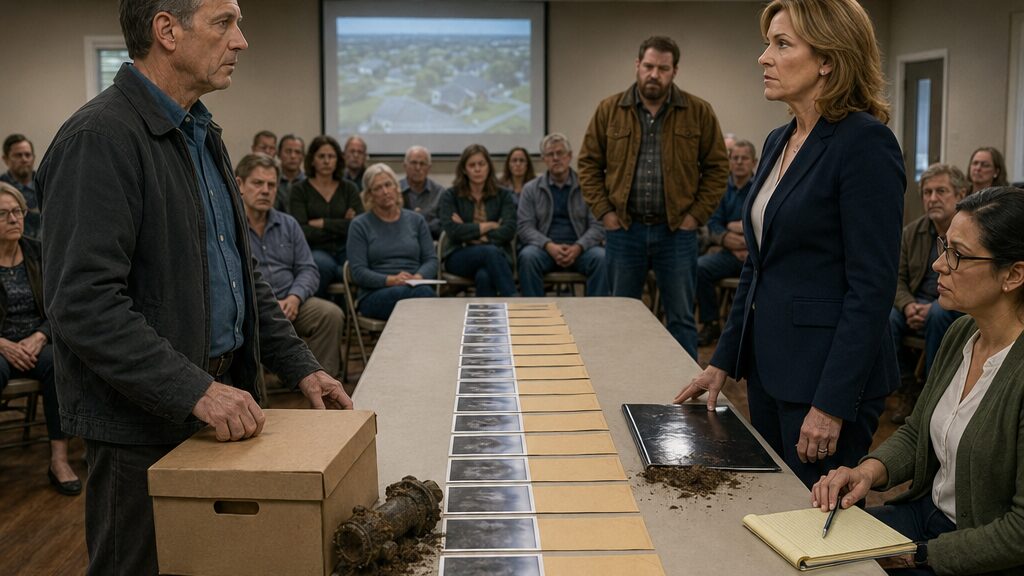
He took out the first photograph.
Then the second.
Then the third.
He laid them in a straight line across the table, each inside a clear sleeve. Dates and times appeared in black type beneath the images.
A pickup on the grass.
A sedan crossing the irrigation line.
A delivery van stopped over the corner.
A coupe with its driver’s hand raised toward the camera.
By the seventh photograph, the room had become quiet.
By the tenth, Brian had unfolded his arms.
By the fourteenth, the row stretched nearly the length of the board table.
Behind each photograph, Timothy placed a corresponding repair estimate.
Michelle looked down the line. “No one is disputing that vehicles may have crossed your property.”
“Then have the manager read the time stamps.”
“That isn’t necessary.”
“It was necessary to photograph my sign.”
A board member shifted in his chair.
The management representative looked toward Michelle, then toward the photographs.
Timothy kept his voice level. “Read the dates.”
Michelle’s fingers tightened against the chair.
Anna spoke before she could answer.
“I’d like them entered into the meeting record.”
Michelle turned. “Anna—”
“If we’re deciding enforcement based on that location, the surrounding condition is relevant.”
The room changed in a way Timothy could feel but not yet trust. Residents leaned forward. Someone at the back asked whether all fourteen vehicles belonged to homeowners.
“Some do,” Timothy said. “Some belong to guests or service drivers. Every incident includes direction of travel, plate information when visible, and corresponding property damage.”
Brian pushed away from the wall.
“You don’t know why every one of those cars went over,” he said.
Timothy looked at him. “I know where the tires went.”
“That’s not the same thing.”
“No. It’s the part that damaged my property.”
Michelle raised one hand. “Let’s keep this orderly.”
Timothy almost laughed. The sound reached his throat and stopped there.
Michelle continued, “The association cannot assume liability for individual drivers. Nor can residents install obstacles near a roadway in a way that may create additional risk.”
“They are reflective posts,” Timothy said.
“They are unapproved.”
“They are on my property.”
“Exterior changes remain subject to covenant standards.”
“And vehicles crossing my property?”
“As management has already explained, that is a private matter.”
The words landed exactly as the phone call had.
Private damage. Public violation.
Timothy looked at the fourteen photographs. He had imagined this moment during every hour spent naming files, measuring ruts, and preserving broken parts. He had thought evidence would narrow the room until only one conclusion remained.
Instead, Michelle had built a wall between responsibility and authority.
One resident near the aisle raised her hand. “Why do so many people cut that corner?”
Michelle answered quickly. “Poor driving choices.”
“The turn is tight,” Brian said.
Several heads turned toward him.
He shrugged, uncomfortable with the attention. “Work trucks have trouble making it without crossing the center line. If somebody’s coming out while you’re going in, you either stop hard or swing wide.”
Timothy studied him.
That was the first time Brian had described the problem instead of defending a driver.
Anna wrote something on her legal pad.
Timothy said, “If the turn is unsafe, why wasn’t it addressed?”
Michelle’s expression remained controlled. “The association has received no formal engineering finding that the entrance is unsafe.”
“You received fourteen incident reports.”
“Those are reports about your lawn.”
“They happened because of the entrance.”
“That is your interpretation.”
The management representative cleared her throat. “There is another issue. Some residents have expressed concern that Mr. Miller’s cameras capture license plates and portions of the roadway.”
Timothy looked at her. “License plates are visible from the street.”
“That may be true, but the association must consider privacy concerns.”
A man in the second row asked, “Are the cameras pointed into houses?”
“No,” Timothy said.
“Windows?”
“No.”
“Then what privacy?”
Michelle gave the man a warning look. “This is not an open debate.”
“It became one when fourteen of us got photographed,” Brian said.
The word fourteen shifted attention toward him.
Timothy noticed.
“You recognize one of the vehicles?” he asked.
Brian’s face hardened. “I recognize a lot of vehicles in this neighborhood.”
“That wasn’t my question.”
Michelle struck the table lightly with a pen. “Mr. Miller, this hearing concerns your violation.”
Timothy looked down at the sprinkler head.
Mud had fallen onto the HOA notice, covering part of the association logo. He brushed none of it away.
“You’re right,” he said. “The hearing concerns what the association chose to identify as the violation.”
He gathered the repair estimates but left the photographs in place.
“For six months, I asked drivers to stay off the property. I put up signs. I reported damage. I supplied video. The association told me it was private. Then someone photographed the objects I installed to protect the same area and made that public.”
Michelle’s voice softened, which made it more dangerous. “No one is targeting you, Timothy.”
The use of his first name irritated him more than the accusation would have.
“Then withdraw the notice.”
“We cannot make exceptions based on emotion.”
He lifted the broken sprinkler head.
“This isn’t emotion.”
“No,” Michelle said. “It’s a damaged irrigation component. And you have remedies available against whoever caused it.”
Something inside Timothy settled.
Not calmed. Settled.
She had finally given him a straight answer.
Use the remedies.
He placed the sprinkler head back on the table.
“Then I will.”
Anna looked up from her notes. “What does that mean?”
“It means I’ll stop asking the association to address the individual incidents.”
For the first time that evening, Michelle seemed uncertain.
Timothy began collecting the photographs, one by one.
The residents watched the evidence disappear into the box.
Brian stepped away from the wall. “You planning to send bills?”
Timothy slid the last image into place. “I have plates, dates, repair estimates, and video.”
“That isn’t an answer.”
“It’s enough for one.”
The board postponed a decision on his violation for fourteen days. Michelle called it an opportunity for informal resolution. Timothy heard it as an effort to see what he would do next.
He carried the document box to his truck.
Brian followed him into the parking lot.
“Tim.”
Timothy opened the driver’s door.
“You send something to my boy, you come to me first.”
“Was his car on the lawn?”
Brian looked toward the clubhouse windows. “I said come to me.”
“You had six months to come to me.”
“That isn’t fair.”
“No,” Timothy said. “It isn’t.”
He got into the truck.
At home, he set the document box on the kitchen table and called the property-damage attorney whose number he had saved two weeks earlier.
The attorney answered on the fourth ring.
“I have fourteen documented incidents,” Timothy said. “I want certified demands prepared for every registered owner.”
There was a brief silence.
“All fourteen?”
Timothy looked through the window at the corner, where his reflective posts stood in the headlights of an approaching car.
The driver slowed and stayed on the pavement.
“Yes,” he said. “Every one.”
Chapter 4: The Letters Arrived at Fourteen Front Doors
The postal carrier began at the far end of Cedar Ridge and worked toward Timothy’s corner.
By three that afternoon, white certified envelopes stood upright in mailboxes, waited under brass door knockers, or rested in the hands of residents who had signed for them without knowing what they contained.
Timothy watched none of it directly.
He sat at his kitchen table with a copy of each demand arranged in a single stack. The attorney’s letterhead made the pages look impersonal. Beneath it, every claim followed the same structure: date, time, vehicle, documented damage, repair estimate, thirty-day response period.
Fourteen incidents.
Fourteen registered owners.
Fourteen identical opportunities to pay, dispute, or provide insurance information.
The attorney had called the method clean.
Timothy liked that word.
At 3:17, his phone rang.
The caller lived two streets over and owned the dark coupe from Incident 8—the driver who had waved at the camera.
“I got your letter,” the man said.
“I assumed you would.”
“You’re charging me for a light and sod.”
“That is what your vehicle damaged.”
“It was already muddy.”
“The footage shows the light upright before your front tire crossed it.”
Silence filled the line.
Then the man said, “Send me the invoice after the repair. I’ll pay it.”
Timothy looked at the claim total. “The estimate is included.”
“I saw it.”
“You have thirty days.”
“I won’t need thirty.”
The call ended.
For several seconds, Timothy held the phone without moving.
One claim resolved.
No argument. No insult. No board meeting.
The evidence had worked exactly as intended.
He opened the spreadsheet and changed the status of Incident 8 from demand sent to payment accepted pending invoice. The new entry gave him a small, precise satisfaction.
Then someone struck his front door hard enough to shake the frame.
Brian stood on the porch with the certified envelope crushed in one hand.
Timothy opened the door but did not step aside.
“You sent this to my son.”
“I sent it to the vehicle’s registered owner.”
“The car is in his name because I made him pay for it.”
“Then the letter went to the correct person.”
Brian held the pages up between them. “Seven hundred and forty-three dollars?”
“The sod, sprinkler line, light fixture, and contractor labor are itemized.”
“He didn’t destroy all that.”
“The camera shows his tires crossing the affected area.”
“You see tires. That’s all you ever see.”
Timothy’s grip tightened on the edge of the door. “If you came to dispute the estimate, send the attorney your documentation.”
“I came to tell you what happened.”
“You had months.”
“I didn’t know you’d decided to turn the neighborhood into a courtroom.”
Brian’s voice carried across the yard. Two garage doors stood open nearby. Timothy could feel people listening without seeing them.
“What happened?” he asked.
Brian looked toward the corner.
“My son was coming home from work. A kid came off the sidewalk on a scooter, straight into the street. He swerved.”
Timothy said nothing.
Brian pulled out his phone, opened a video, and held it up.
The footage was from Timothy’s own camera, copied from the stills attached to the demand. The car entered the frame, jerked right, crossed the corner, and stopped beyond the sprinkler line.
At first, Timothy saw only the vehicle.
Then Brian dragged the play bar backward.
A child appeared at the far edge of the frame, small and blurred, rolling into the street from behind a parked SUV.
Timothy had not noticed the movement when he catalogued the incident. His camera angle cut off most of the sidewalk. By the time the child entered the visible portion, the car had already begun turning.
“He could’ve hit him,” Brian said. “He came home shaking.”
“Why didn’t he report the damage?”
“He didn’t know he’d hit anything.”
“The sprinkler ran for twenty minutes.”
“He was looking at the kid.”
Timothy looked again at the clip.
The front tires crossed the sod. The rear tire struck the light. The damage remained real. But the gesture was not impatience, contempt, or convenience.
It was avoidance.
Brian lowered the phone. “I’ll pay for what the car actually broke. I’m not letting you make him into one of your repeat offenders.”
“The estimate is for that incident.”
“The estimate assumes he chose it.”
“Intent doesn’t repair irrigation.”
“No. But it ought to matter to you.”
Timothy felt the sentence settle where the first payment had pleased him.
Brian looked down at the envelope.
“There’s something else.”
Timothy waited.
“I knocked over one of your signs.”
The admission came without preparation.
“Which one?”
“The plywood one. Not with the truck. I pulled it out and threw it down.”
“Why?”
“Because my son came home scared, and the next morning there was a sign out there like you were announcing to everybody that somebody had done it on purpose.”
Timothy stared at him.
“You destroyed my property because you were angry that your son damaged my property.”
“I said I’d pay for the sign.”
“You denied knowing anything about it.”
“I was ashamed of it.”
“No. You were angry at being seen.”
Brian’s face reddened. “Maybe both.”
A vehicle slowed near the corner. Its tires stayed on the pavement.
Brian stepped off the porch.
“I’m responsible for the sign,” he said. “My son’s responsible for the physical damage his car caused. But your letter treats him like the guy who waved at your camera.”
“The damage categories are based on invoices.”
“That’s your answer for everything.”
He walked across the lawn to his house.
Timothy remained in the doorway with the child’s blurred shape fixed in his mind.
By evening, the neighborhood message board had filled with screenshots from the letters. Residents compared totals, questioned camera angles, and accused Timothy of creating inflated claims. One person called the demands extortion before another reminded everyone that lawyers generally avoided mailing extortion on letterhead.
Michelle posted a short statement saying the HOA was not involved in private legal disputes.
That sentence drew more anger toward Timothy and less toward the board.
At seven, Anna Perez knocked lightly.
She held no envelope.
“I’m not here about my car,” she said.
“You don’t have an incident.”
“I know.”
Timothy let her into the kitchen. She noticed the stack of claims and the spreadsheet open on his laptop.
“You sent the same legal language to everyone.”
“The facts differ by incident.”
“The tone doesn’t.”
“It came from the attorney.”
“That’s what I mean.”
She sat across from him without being invited. “The board is getting demands for a special meeting. Brian is helping organize them.”
“I expected pushback.”
“Did you expect people to start reviewing old meeting records?”
Timothy closed the laptop halfway. “What old records?”
“At the last hearing, Brian said the entrance was too tight. I remembered seeing something about that when I became treasurer.”
“An invoice?”
“Not exactly.”
She removed a folded photocopy from her bag.
It was an HOA agenda from two years earlier. One item near the bottom read: Review of corner-entry safety recommendations.
Beside it, in smaller type, was a reference number for an attached memorandum.
The copy included no attachment.
Anna tapped the line.
“I checked the electronic folder,” she said. “The agenda is there. The minutes are there. The memo isn’t.”
“Maybe it was never submitted.”
“The minutes say discussion deferred after cost review.”
Timothy read the line twice.
“What cost?”
“That’s what I’d like to know.”
The fourteen demand letters had made the neighborhood angry enough to search its own history.
Anna slid the agenda toward him.
“Before you decide every driver is the whole problem,” she said, “we should find out who knew the corner was one.”
Chapter 5: The Missing Memo Changed Who Looked Guilty
The paperclip remained in the archive folder, but the document it had held was gone.
Anna lifted the empty clip with one finger.
The HOA records room occupied a narrow space behind the clubhouse kitchen. Metal shelves held tax returns, insurance binders, landscaping contracts, and meeting packets arranged by year. The air smelled of toner and cardboard.
Timothy stood beside her while she compared the physical folder with the electronic index.
“Agenda,” she said. “Minutes. Contractor quote. No safety memo.”
“Could someone have misfiled it?”
“Someone could have.”
Her tone made clear that she did not believe it.
The minutes from the meeting were brief. The board had discussed entrance landscaping, potential curbing, reflective markers, and resident concerns about turning clearance. No vote had been recorded. The final line stated that the matter would be revisited if incident frequency increased.
“What counted as increased?” Timothy asked.
Anna scanned the page. “It doesn’t say.”
“Fourteen might qualify.”
She looked at him. “Fourteen that you know about.”
The phrase widened the problem.
They searched adjacent years. Timothy pulled binders while Anna checked file names on an aging desktop computer. Near noon, she found an invoice lodged behind a reserve-study report.
The contractor had quoted low-profile curbing, relocation of two irrigation points, reflective edge markers, and removal of one decorative boulder near the entrance.
Total: $4,860.
Timothy set the invoice on the table.
His accumulated repair estimates exceeded that amount.
Not by much, but enough.
“This was rejected?” he asked.
“There’s no vote.”
“There’s a quote.”
“And there was a memo attached to the agenda.”
He traced the contractor’s proposed curb line. It followed the exact path his tires-and-damage spreadsheet had mapped.
The crossings had not been random. The subdivision entrance narrowed where the decorative island met the corner. Drivers entering while another vehicle exited had three choices: stop, cross the center line, or swing onto Timothy’s grass.
Some stopped.
Some did not.
That did not excuse them. But the pattern had been visible before his cameras.
Anna sat back. “I signed off on reserve transfers that year.”
“You weren’t president.”
“I was treasurer.”
“Did you see this?”
“No.”
“You signed the reports.”
“I saw totals. Michelle handled the meeting packets.”
The defensiveness in her voice reminded Timothy of his own.
He folded the invoice and placed it back on the table.
“You didn’t look.”
“No,” Anna said. “I didn’t.”
The answer was plain enough that he had nowhere to push it.
They found the missing memo that afternoon in a box labeled insurance correspondence.
It had been inserted between renewal notices, with no reason to be there.
The county traffic engineer’s letter was three pages long. It described the entrance as functional but constrained, especially for opposing vehicles and larger service trucks. It recommended adjusting the turning radius, lowering the curb transition, adding reflective markers, and keeping the corner clear of fixed hazards.
The final paragraph warned that repeated encroachment onto the adjacent private parcel was foreseeable if no correction was made.
Foreseeable.
Timothy read the word again.
Anna took a photograph of every page.
“Who moved it?” he asked.
“I can’t prove anyone moved it.”
“Who had access?”
“The board. Management. Me.”
“And who presented the agenda?”
Anna did not answer.
They found Michelle in the clubhouse office forty minutes later.
She stood behind the desk, reading the memo without sitting down. Her face gave little away until she reached the final page.
“Where did you get this?”
“In the insurance box,” Anna said.
Michelle closed her eyes briefly.
Timothy noticed.
“You knew it existed,” he said.
“I knew there had been a preliminary review.”
“It says repeated encroachment was foreseeable.”
“It also says the entrance remained functional.”
“Under ideal driver behavior.”
“That is how roads are evaluated.”
“No,” Timothy said. “That is how liability is avoided.”
Michelle placed the memo on the desk. “You think I wanted people driving over your lawn?”
“I think you wanted the problem to remain mine.”
Her composure tightened.
“The association had twelve thousand dollars in unrestricted reserves at the time. We had a retaining wall problem, two failed pumps at the pond, and an insurance renewal that increased almost eighteen percent. The entrance project was nearly five thousand dollars before engineering or permitting.”
“And rejecting it cost nothing?”
“We did not reject it. We deferred it.”
“For two years.”
“Because every expenditure becomes somebody’s dues.”
Anna folded her arms. “Why wasn’t the memo in the meeting file?”
Michelle looked at her. “I moved it after speaking with the insurer.”
“You hid it.”
“I prevented an unapproved draft from circulating as though it were a formal finding.”
“It came from the county traffic engineer,” Timothy said.
“It was advisory.”
“It predicted exactly what happened.”
Michelle’s eyes moved toward him. “And if we had formally accepted that prediction, every rut in your lawn could have become an association claim. Our insurer could have increased premiums or denied coverage. Residents elected me to protect the association.”
“From the truth?”
“From consequences they did not understand.”
The room went quiet.
For the first time, Timothy saw the pressure beneath her certainty. Michelle was not defending tire tracks. She was defending a structure built on avoiding costs until someone else absorbed them.
That did not make her less responsible.
It made the harm deliberate.
“You cited my warning posts,” he said.
“They were unapproved.”
“You knew why they were there.”
“Yes.”
“And you let the violation proceed.”
“If I withdrew it after your complaint, it would look like the association admitted the hazard.”
Timothy stared at her.
Michelle looked away first.
Anna picked up the memo. “There will be a special meeting.”
Michelle’s voice hardened. “You cannot call one alone.”
“I can request one. After those letters, I doubt signatures will be difficult.”
“The letters are his private action.”
“The hidden memo is not.”
Michelle looked toward Timothy. “You should consider what happens if this becomes public inside the neighborhood. Residents will want someone to pay. That may be you as much as me.”
“They already want me to pay.”
“They think your claims are excessive.”
“Some are paying.”
“And some have explanations you refused to hear.”
Brian’s son.
The child on the scooter.
Timothy felt the clean structure of his spreadsheet begin to divide into unequal pieces.
Back in his garage, he opened the gray bin and removed every broken sprinkler head.
He arranged them on the workbench by incident number. Fourteen damaged housings. Some crushed flat. Some cracked along the threads. Two still packed with old soil.
Margaret entered through the open garage door carrying groceries.
She stopped when she saw the row.
“What are you doing?”
“Checking the claims.”
“With the broken pieces?”
“They correspond to the dates.”
She set the grocery bag down. “Timothy, they look like bones.”
“They are evidence.”
“They were evidence when they were in the box.”
He lifted Incident 6. “This one may have been counted twice. The line was already weakened before the next vehicle crossed.”
“So you’ll correct it.”
“The attorney said consistency matters.”
Margaret looked at him. “Accuracy matters.”
He set the sprinkler head down harder than necessary.
She turned toward the shelves, perhaps to avoid arguing. On the top shelf sat an old green binder with a faded label: LAWN—WATERING, TREATMENT, REPAIRS.
Margaret pulled it down.
“Don’t,” Timothy said.
She looked at him, surprised by the force in his voice.
The binder slipped open in her hands.
A folded piece of yellow paper fell onto the concrete.
Timothy knew the handwriting before Margaret picked it up.
The letters leaned slightly to the right. The ink had faded where a thumb had once rested.
Margaret unfolded the note.
Her eyes moved across the first line, then stopped.
“Tim,” she said softly.
He did not reach for it.
She looked from the note to the fourteen broken sprinkler heads lined across the bench.
“This wasn’t about keeping the grass perfect.”
Chapter 6: The Lawn Was Never Only Grass
“Keep the house from falling apart,” Margaret read, “but don’t spend your life trying to make it stay the same.”
Timothy stood beside the workbench with both hands flat against the wood.
“Put it back.”
Margaret continued.
“Plant something I wouldn’t choose. Change the kitchen if you want. Let the place become yours again.”
“Margaret.”
“She knew you.”
“She was sick when she wrote that.”
“She was clear.”
“You weren’t here every day.”
“No,” Margaret said. “You made sure nobody was.”
The words struck cleanly because they were true.
Timothy turned away from her and looked through the garage door. The damaged corner lay beyond the driveway, its latest repair still lighter than the surrounding grass.
His wife had spent the final year of her illness in the front room because it received the best afternoon light. From that chair, she could see him working outside. He had aerated the lawn in narrow passes, spread seed by hand, reset irrigation heads, and rebuilt the thin section by the curb.
She had called it his campaign against entropy.
He had pretended not to know the word.
After the hospital bed arrived, she watched him adjust one sprinkler three evenings in a row.
“You can’t keep everything from breaking,” she had said.
“I can keep this from breaking.”
He had meant the line. The house. The routines.
Perhaps himself.
Margaret placed the note beside the first sprinkler head he had saved after the funeral. Its casing was sun-faded, the fracture repaired once with waterproof tape before he replaced it.
“You promised her you’d keep the home cared for,” Margaret said. “Not frozen.”
Timothy picked up the old head.
“I let things go when she was sick.”
“You cared for her.”
“The gutters clogged. The back fence leaned. The grass died along the porch.”
“She did not measure your love by the lawn.”
“I know that.”
“Do you?”
He set the sprinkler down.
Outside, a car entered Cedar Ridge. It slowed at the corner, hesitated, then turned carefully around the curve.
Timothy watched until it passed.
“The damage is still real,” he said.
“I didn’t say it wasn’t.”
“The board hid a safety memo.”
“I know.”
“Brian tore down my sign.”
“I know.”
“His son broke the light.”
“And avoided hitting a child.”
Timothy looked at the fourteen heads in their row.
Margaret moved beside him. “You don’t have to forgive everybody. You do have to look at what they actually did.”
The attorney answered Timothy’s call at eight that evening.
Timothy sat at the kitchen table with the incident files open around him. Margaret remained across the room, reading the county memo.
“I want to revise the claims,” Timothy said.
“All of them?”
“Two immediately. Possibly more.”
The attorney was silent for a moment. “On what basis?”
“Incident 6 includes a sprinkler component weakened by earlier damage. The replacement should be divided. Incident 11 involved an emergency avoidance maneuver.”
“Property damage can still be recoverable without intent.”
“I understand.”
“Then why withdraw it?”
“I’m not withdrawing all of it. I’m reducing it to the direct light and sod damage. No administrative amount. No full irrigation replacement.”
“That gives opposing owners room to argue the other estimates are subjective.”
“They are already arguing that.”
“You currently have a consistent methodology.”
“I have identical letters for unequal events.”
The attorney exhaled. “Consistency helps settlement leverage, especially if the association becomes involved.”
Timothy looked at the missing memo.
“What if leverage isn’t the only objective?”
“Then you need to decide what the objective is before tomorrow’s meeting.”
“I want the corner fixed.”
“You also want reimbursement.”
“For deliberate or careless damage, yes.”
“And the HOA?”
“I want the records released.”
“That may be a separate claim.”
“I don’t want three years of litigation.”
“Then do not weaken your position before you know what they’ll offer.”
Timothy rubbed the edge of the yellow note between two fingers.
His wife’s handwriting disappeared beneath his thumb, then returned when he moved it.
“Send the revised amounts tonight,” he said.
“You understand my advice?”
“Yes.”
“And you’re rejecting it?”
“I’m choosing something else.”
When the call ended, Timothy opened the spreadsheet.
Incident 11 had been listed at seven hundred forty-three dollars. He removed the irrigation-line replacement and reduced the sod calculation to the actual tire path. The total fell to two hundred twelve.
He added a note: emergency maneuver visible on supplementary footage.
Incident 6 required more work. He reviewed two clips, compared dates, and acknowledged that the second driver had crossed a line already damaged by the first. He split the repair estimate.
The act felt less satisfying than entering the original amounts.
It also felt more honest.
At nine thirty, Brian knocked.
Timothy met him on the porch with a revised letter.
Brian read the amount without speaking.
“This covers the light and the sod his car damaged,” Timothy said. “Nothing else.”
Brian looked at the note explaining the reduction.
“You believe me?”
“I believe the footage.”
“That isn’t what I asked.”
Timothy waited.
Brian folded the paper. “I’ll pay this. And the sign.”
“The sign was thirty-two dollars in material.”
“I’ll replace it.”
“No.”
Brian’s eyebrows lifted.
“The meeting tomorrow may change what belongs at that corner.”
“Fair enough.”
He started down the steps, then stopped.
“I was wrong to tear it out.”
Timothy nodded once. “You were.”
Brian gave a brief, humorless smile. “You could make it easier on people.”
“I could.”
“Any plans to?”
“Some.”
It was not reconciliation, but Brian left without slamming anything.
Before midnight, Timothy moved the broken sprinkler heads back into the gray bin. He kept only Incident 14 and the first one from after his wife’s death on the bench.
Margaret watched him close the lid.
“What will you say tomorrow?”
“I don’t know yet.”
“That’s new.”
He placed his wife’s note inside the county memo rather than returning it to the lawn binder.
The next evening, the Cedar Ridge clubhouse parking lot was full twenty minutes before the special meeting. Residents stood in clusters beneath the lights. Some carried demand letters. Others held copies of the HOA bylaws.
Michelle’s car occupied the space nearest the entrance.
Timothy parked at the far end.
He opened the passenger door and lifted out a thin folder.
The demand ledger remained on the seat.
Inside the folder were the suppressed traffic memo, the contractor’s preventive-work estimate, the revised claims, and his wife’s folded note.
As he crossed the parking lot, Brian stepped away from a group near the entrance.
“You bringing the fourteen files?” he asked.
“No.”
Brian glanced at the folder. “Then what are you bringing?”
Timothy looked through the clubhouse windows. Michelle stood at the board table arranging papers into perfect alignment. Anna was speaking to the management representative. Nearly every chair was occupied.
“The reason there were fourteen,” he said.
He entered carrying the memo instead of the weapon he had spent six months building.
Chapter 7: The Corner Was Rebuilt Without Erasing the Truth
“I want the violation against my sign left in the record.”
Timothy’s first sentence stopped the room before the meeting had properly begun.
Michelle stood behind the board table with one hand on the agenda. Anna sat beside her, the suppressed traffic memo already copied into separate packets. Brian had taken a chair near the aisle rather than joining the residents gathered along the back wall.
Timothy placed the mud-packed sprinkler head from Incident 14 on the table.
Then he laid the HOA violation beside it.
“I installed objects without approval,” he said. “That part is true. The record should show why I did it, but it should not pretend I followed a process I did not follow.”
A board member frowned. “You’re asking us not to dismiss your own violation?”
“I’m asking you not to correct one incomplete record by creating another.”
Michelle watched him carefully. She had expected an accusation. Perhaps she had prepared for one.
Anna distributed the memo.
Paper moved through the room in a dry, uneven wave.
The management representative read the county traffic engineer’s conclusion aloud: repeated encroachment onto the adjacent private parcel was foreseeable without changes to the entrance geometry.
No one interrupted.
When she reached the date, several residents looked toward Michelle.
The memo had been written two years before Timothy installed his cameras.
Michelle folded her hands. “The document was advisory. It was not a formal order, and the board was facing several urgent reserve expenses.”
Anna slid the contractor estimate forward. “The proposed correction was four thousand eight hundred sixty dollars.”
A man in the second row lifted one of Timothy’s demand letters. “And what are all the repairs together?”
Timothy answered. “The original estimates total a little over five thousand.”
The room stirred.
“Original?” Brian asked.
“I revised several.”
Timothy opened his thin folder. He had brought no photographs this time. Only a one-page table separated the incidents into categories: repeat or deliberate crossings, ordinary negligence, service vehicles, and emergency avoidance.
“I treated every recorded crossing as though it carried the same responsibility,” he said. “It did not.”
The admission seemed to unsettle the room more than a defense would have.
He looked toward Brian.
“Your son’s revised amount covers the light and the measured sod damage. Nothing beyond that.”
Brian nodded once. “I’ll pay it.”
“And the sign?”
“I tore it out,” Brian said, turning toward the room. “Not with my truck. With my hands. I was angry, and I lied about knowing what happened.”
A few residents shifted in their chairs.
Brian continued before anyone could rescue him from the silence. “I’ll pay for the sign and help replace whatever belongs there after this is settled.”
Timothy had expected the admission in private, not here.
It changed something small but real.
Michelle tapped the memo. “Individual responsibility does not establish association liability.”
“No,” Timothy said. “Your decision does.”
Her expression tightened.
“You received a warning that the entrance encouraged vehicles onto private property. You deferred the correction. Then you allowed my protective markers to be cited without disclosing why they were there.”
“We had insurance concerns.”
“You had cost concerns.”
“We had both.” Michelle’s voice sharpened. “If we formally accepted responsibility, dues could have increased for every household. We had a failing retaining wall and pond equipment that could not be postponed. I did not hide this because I wanted your lawn damaged. I made a decision about which problem the association could afford.”
“And you decided I could afford yours.”
The sentence remained between them.
Michelle did not deny it.
Anna opened the bylaws to the section governing special assessments. “We have three options. Use nearly all unrestricted reserves, delay other maintenance, or approve a limited assessment.”
A resident near the wall said, “Why should everyone pay when fourteen people drove over the lawn?”
“Because the entrance correction benefits everyone,” Anna replied. “Individual drivers remain responsible for their documented damage. The association is responsible for addressing the known design problem and for the portion of repeated repairs linked to its delay.”
That division satisfied no one completely.
Which, Timothy thought, might be the first sign it was fair.
The debate lasted nearly an hour.
Some residents argued that Timothy had escalated too quickly. Others wanted Michelle removed immediately. One demanded that every driver pay the full original amount. Another said the lawn should simply be replaced with gravel.
Timothy listened until the voices began repeating themselves.
Then he stood.
“I will reduce the remaining individual claims to direct, documented repair costs,” he said. “No duplicate irrigation charges. No administrative amount. No claim against the service driver whose employer has already agreed to repair the damage.”
The attorney had warned him not to bargain publicly.
Timothy continued.
“In exchange, the association funds the entrance correction recommended in the memo, reimburses the portion of preventable repeat repairs, releases the complete meeting records to residents, and adopts a written process for hazards affecting private property.”
Michelle stared at him. “You cannot condition private settlements on a board vote.”
“I can decide what I am willing to settle.”
“And if the board refuses?”
“Then the claims proceed separately, and the memo goes with them.”
There it was: not a threat shouted across the room, but a choice placed where everyone could see it.
Anna called for the vote.
It divided the board.
Two members opposed any assessment. One supported the corrective work but not reimbursement. Anna voted for the full proposal.
Michelle held the deciding vote.
For several seconds, she looked at the residents rather than the papers. Timothy saw the calculation in her face: dues, reputation, legal exposure, the certainty that no version of the evening would leave her authority untouched.
“I support the correction,” she said at last. “And release of the records.”
Anna waited.
Michelle’s voice lowered. “Including the reimbursement formula.”
The motion passed.
There was no applause.
One resident walked out before the result was recorded. Another demanded that the minutes note his objection. The management representative began listing deadlines while three people spoke over her.
Practical justice sounded like folding chairs, irritated voices, and a calculator being passed along a table.
Michelle remained after most residents had left.
She handed Anna the key to the records room.
“I should have put the memo in the packet,” she said.
Anna accepted the key. “Yes.”
Michelle looked at Timothy. “I believed I was protecting the association.”
“You were protecting it from seeing the cost.”
“And you believed fourteen identical letters were justice.”
He glanced at the sprinkler head.
“Yes.”
Neither apologized beyond that.
It was enough to prevent another lie.
The work began six weeks later.
The decorative boulder was removed. The curb transition was lowered and extended. Reflective markers were set beyond the turning path, and the irrigation line was moved inward beneath a reinforced sleeve. Timothy agreed to replace part of the damaged grass with a low stone border and a bed of native plants.
Margaret chose the first plants.
“They’re not what she would’ve picked,” she said.
Timothy pressed soil around the roots. “That may be the point.”
Brian arrived with tools and helped set the edging. They spoke mostly about measurements. When the final section aligned, Brian stood and wiped his hands on his jeans.
“My boy asks if you still have the clip.”
“Yes.”
“Will you delete it?”
Timothy considered the question.
“When the settlement is complete.”
Brian nodded. “Fair.”
It was not friendship restored. It was a boundary both men understood.
By early spring, the corner no longer looked exactly as it had before.
That had once seemed like failure.
Now the curve was wider. The stone border followed the road without inviting a tire onto the lawn. The new plants moved in the wind where the handmade sign had been flattened.
Timothy installed the final sprinkler head himself.
It sat recessed below the reinforced edge, protected from passing wheels. He adjusted the nozzle, stepped back, and opened the valve.
Water rose in an even arc across the grass.
A delivery truck approached the entrance as another car prepared to exit. The truck slowed. Its front wheel followed the rebuilt curve, remained on the pavement, and passed Timothy’s corner without touching the stone.
Timothy watched it continue into Cedar Ridge.
Then he turned back to the sprinkler.
The water did not reach every blade exactly as it once had.
It reached what was growing there now.
The story has ended.