The HOA Called Her Family Cemetery an Obstruction, Until She Refused to Move
Chapter 1: The Excavator Stopped Beneath Her Family Quilt
The sound was not loud.
A hard metallic scrape. A brittle snap. Then the small, unmistakable clatter of stone falling onto gravel.
Katherine Mitchell dropped the fabric she had been measuring and ran through the back door of the quilt shop.
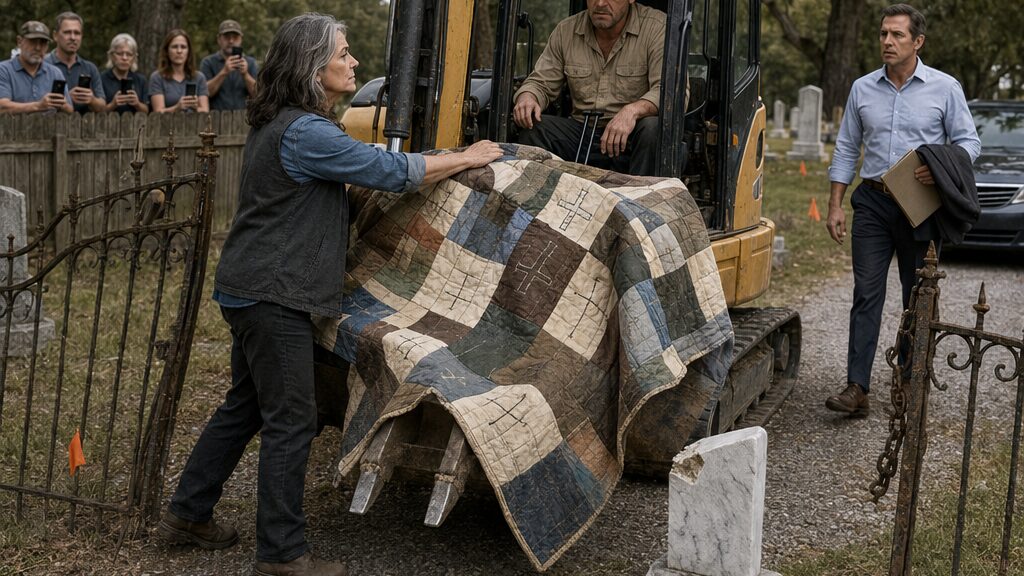
A yellow excavator was nosing through the old iron cemetery gate.
Its bucket had caught the corner of a low marble marker and shaved away a pale wedge. The broken piece lay beside a tire track, clean and white against the red Virginia dirt.
Katherine knew the marker before she could read it. Her grandmother’s younger brother had died at seven. His stone was hardly taller than a bread box.
“Stop the machine.”
The operator looked down through the glass cab. He wore a sun-faded cap and held one hand on the controls.
Katherine stepped through the gate.
“Turn it off.”
The engine continued to idle. Diesel shuddered through the ground and into her shoes.
On the subdivision side of the fence, several homeowners had come out onto their back decks. A man held up his phone. Another stood with his arms crossed as if watching a contractor remove a dead tree.
The operator opened the cab door.
“Ma’am, you need to clear the work area.”
“You struck a grave.”
He glanced toward the chipped stone. “That’s outside the marked section.”
Katherine looked at the orange flags driven through the grass. They formed a narrow corridor from the iron gate toward the shallow drainage ditch behind the newest row of houses.
One flag stood less than two feet from her great-grandfather’s marble cross.
“There is no work area inside this gate.”
He climbed down. His shirt bore the name of a regional excavation company. A folded work order stuck from the pocket above it.
“Stephen Hall,” he said, tapping the paper. “I’ve got authorization for emergency drainage access.”
“From whom?”
“The association and the developer.”
“They don’t own this land.”
“They say they have an easement.”
Katherine held out her hand. Stephen did not give her the order. He unfolded it himself and pointed to a block of typed language as though she were a child being shown a rule at school.
“Temporary access for drainage correction and site preparation.”
The page carried the Briar Glen Homeowners Association logo and Jonathan Davis’s signature.
Katherine read the line twice. Nothing on the paper identified the cemetery. Nothing showed a surveyed boundary. A rough attachment shaded a strip behind the shop in gray.
“You drove through a locked gate.”
“It wasn’t locked.”
“It was chained.”
“The chain was looped.”
Katherine looked at the iron post. The chain hung from it, one link bent open.
Stephen followed her gaze but did not apologize.
“We’re behind schedule,” he said. “The houses are taking water every time it rains. I was told the property issue was resolved.”
“It wasn’t resolved with me.”
“That’s above my pay grade.”
He turned toward the cab.
Katherine moved in front of him.
Stephen stopped. “Don’t do this.”
“You will not start that machine.”
“I’m not arguing over old stones. The actual graves are over there.”
He pointed toward the taller markers beneath the oak trees, where four generations of Mitchells stood in uneven rows.
Katherine felt something inside her go still.
“The actual graves?”
“The marked ones.”
His distinction landed harder than the scrape of the bucket.
Near the gate, the ground dipped in several places beneath wild violets and thin grass. Her father had never allowed those depressions to be filled. He had said the earth remembered weight even when people did not.
Stephen stepped around her.
Katherine returned to the shop.
She heard the excavator door close before she reached the back steps.
Inside, the burial quilt hung behind the cutting counter. Her mother had begun it after Katherine’s grandfather died, using saved pieces of clothing: a blue work-shirt square, brown calico from a Sunday dress, a strip of faded green apron cloth. Katherine’s father had finished the binding years later. Names were stitched in small dark letters across some patches, while others held only crosses or clusters of short lines.
Katherine lifted the quilt from its wooden rail.
The engine rose behind the shop.
She carried the quilt outside.
Stephen had lowered the bucket. Its steel teeth hovered above the gravel lane.
Katherine walked directly toward it.
Someone behind the subdivision fence called for her to move. Another voice said the police had been called. Katherine did not look away from the machine.
She spread the quilt across the bucket.
The yellow steel disappeared beneath old cotton, family names and worn fragments falling over the teeth.
Stephen stared through the windshield.
Katherine stepped to one side, leaving the quilt between them.
“If you intend to move that blade,” she said, “climb down first and sign your name.”
He opened the cab door. “What?”
She pointed to a brown-and-cream square near the center.
“Sign across that patch. It came from my grandmother’s burial dress. Then write that you were told what it was before you drove over it.”
The engine idled between them.
Stephen’s face changed—not into remorse, but calculation. He looked toward the phones along the fence. He looked at the broken marker. Then he looked at the work order on the passenger ledge.
“You’re obstructing authorized work.”
“I’m asking you to document your decision.”
“I’m not signing a quilt.”
“Then you are not moving the blade beneath it.”
For several seconds, nothing moved except the loose lower edge of the quilt trembling in the exhaust.
Stephen shut off the engine.
The sudden silence left Katherine aware of her own breath.
A vehicle turned into the shop’s side lot. Jonathan Davis stepped out of a dark sedan wearing pressed slacks and a pale blue shirt, his jacket folded over one arm. He had bought Christmas gifts from Katherine for years. His wife favored table runners with hand-sewn holly leaves.
“Katherine,” he said, walking quickly toward the gate. “You need to remove that.”
“You authorized him to break my chain.”
“I authorized emergency access under the recorded drainage easement.”
“Show me where it crosses a cemetery.”
Jonathan glanced at the quilt draped over the bucket. His attention lingered on the stitched blocks, then shifted to the homeowners watching from beyond the fence.
“This is becoming unnecessarily theatrical.”
“A grave marker is broken.”
His jaw tightened. “That should not have happened.”
Stephen climbed down from the cab. “The stone was outside the mapped burial area.”
Jonathan lowered his voice. “We have counsel’s review. The work corridor does not enter the legally documented cemetery parcel.”
Katherine looked at the orange flags again. Their line cut through the dips her father had protected and passed within feet of the old marble cross.
“Your map is wrong.”
“Then produce a current survey.”
“This cemetery has been here longer than every house behind that fence.”
“That is not the same as a recorded boundary.”
Jonathan opened a leather folder and removed two pages. One was the work authorization. The other was a formal notice bearing Katherine’s name.
“The board is convening at seven tonight,” he said. “You are being cited for interference with emergency common-area infrastructure and denial of lawful access.”
Katherine accepted the notice without taking her eyes from him.
“You held a hearing before you sent the machine?”
“We tried to contact you.”
“You left messages asking me to cooperate. You never said you were entering this morning.”
“The drainage failure is time-sensitive.”
“So are graves once you open them.”
A murmur passed along the fence.
Jonathan’s expression hardened, but his voice stayed controlled. “Bring whatever documentation you have. Until the board reviews it, the equipment will remain here.”
“Outside the gate.”
“The court order may not require that.”
“There is no court order.”
“Not yet.”
Katherine lifted the quilt from the bucket. Dust and a gray smear of stone marked one corner. As she folded it, the blocks formed a pattern she had known all her life without ever questioning: long rows broken by irregular spaces, small crosses repeated in groups of three and four.
For one strange moment, it looked less like a family quilt than a parcel divided by paths.
Jonathan handed the operator a quiet instruction. Stephen backed the excavator out far enough to clear the gate, but not off Katherine’s land.
At seven, Jonathan said, the board would decide whether she was protecting a cemetery or obstructing an easement.
Katherine closed the bent chain through the iron bars.
The hearing notice remained in her hand.
Chapter 2: The Board Called the Graves an Unverified Obstruction
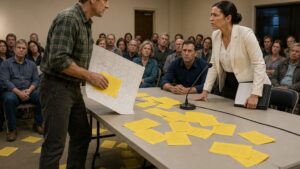
The first image on the clubhouse wall showed Katherine’s cemetery in gray.
Not the stones, the oaks, or the iron gate. Only a rectangular parcel crossed by a blue drainage line and a red band labeled TEMPORARY STAGING AREA.
Katherine sat in the front row with the burial quilt folded across her lap. Stone dust remained embedded in one corner. She had tried brushing it away, but the pale grit had settled into the stitching.
Jonathan stood beside the projected map.
“We are not voting on the removal of marked graves,” he said. “We are voting on emergency legal access to correct a drainage failure affecting twenty-three homes.”
The room was full. Homeowners lined the back wall and stood near the coffee counter. Several had attended board meetings only when dues increased or trash collection changed.
Tonight, they watched Katherine.
Jonathan advanced to a photograph of standing water behind a row of townhouses.
“The developer has agreed to fund the primary correction if access is granted during the current construction phase. If that agreement is lost, the association will be responsible for the work.”
A board member leaned toward the microphone. “Estimated cost?”
The HOA attorney answered from the end of the table.
“Between four hundred eighty and six hundred thousand dollars, depending on soil conditions.”
The room shifted.
Jonathan let the number settle before adding, “That could mean a special assessment exceeding eight thousand dollars per household.”
Katherine heard someone whisper that they had just replaced a roof. Another homeowner asked whether payment plans would be available.
The cemetery had been the moral center of the conflict that morning. In less than a minute, Jonathan had turned it into a number attached to every mortgage in the room.
He displayed the work order.
“The access corridor follows an easement referenced in the association’s development documents. The documented burial parcel begins beyond the proposed corridor.”
Katherine stood.
“The operator chipped a child’s marker.”
Jonathan nodded once. “The contractor’s conduct is being reviewed.”
“He broke my chain.”
“The chain did not define the legal boundary.”
A few people objected at once.
A homeowner near the aisle raised her voice. “He had no business driving into a cemetery before anybody settled this.”
Another said, “I saw the video. He nearly pushed the machine into her.”
Stephen was not present, but his absence did not soften the room’s anger toward him.
Jonathan waited until the voices quieted.
“No one on this board condones what happened,” he said. “But the operator’s behavior and the drainage easement are separate questions.”
Katherine knew the division was legally neat. It was also useful to him.
She carried the quilt to the front table and placed the dusty corner beneath the overhead light.
“This is what his bucket touched after it struck the stone.”
Jonathan looked at it but did not ask what the fabric meant.
“The graves do not stop where your drawing stops,” Katherine said.
The HOA attorney folded his hands. “Do you have a surveyed record establishing that?”
“I have the deed.”
“Does the deed contain metes and bounds?”
“It reserves the burial ground.”
“How much land?”
“Approximately half an acre.”
“Approximately,” he repeated. “And where does that half acre begin?”
Katherine felt the room waiting.
Her father’s papers were in the roll-top desk at the shop. Among them was an old county envelope she had not opened in years. She knew there were maps inside, but she also knew there were letters she did not want to read in front of anyone.
“The cemetery begins at the gate,” she said.
“According to what recorded instrument?”
“According to the ground.”
A silence followed. Not mocking, but uncertain.
Jonathan changed the slide to the proposed corridor.
Virginia Anderson entered through the rear door.
Katherine had not called her. Her daughter came forward carrying a leather bag, her expression set in the practical lines Katherine remembered from tax seasons and hospital waiting rooms.
Virginia sat beside her.
“You came,” Katherine said.
“You sent me a photograph of an excavator covered in Grandma’s quilt.”
“I sent it so you would know what happened.”
“And then stopped answering your phone.”
Jonathan continued speaking about stormwater capacity.
Virginia leaned close. “Do you have the deed with you?”
“Yes.”
“A survey?”
“No current one.”
“Then you need time to get one.”
“They need to leave.”
“That may not be the same thing.”
Katherine looked at her.
Virginia’s voice remained low. “I’m not saying they cross the graves. I’m saying negotiate a route until you can prove where the graves are.”
“There is no route through a cemetery.”
“What if the corridor is outside it?”
“You sound like him.”
Virginia flinched, then glanced toward the quilt.
“No. I sound like someone who doesn’t want the court ordering this while you stand in front of another machine.”
Jonathan invited public comment.
Several homeowners condemned Stephen’s conduct. One demanded that his company be removed from the project. Another said no savings justified touching human remains.
Then a man from the flooded row stood.
“My crawlspace has taken water three times,” he said. “My insurance won’t cover the next one. I respect what Mrs. Mitchell is protecting, but I need somebody to explain what happens to my family if nothing gets done.”
The room quieted again.
Katherine had no answer that did not sound like indifference.
Virginia took the microphone when her turn came.
“My mother should never have been confronted by machinery,” she said. “But the board should authorize only survey access while both sides negotiate a route. No excavation. No clearing. No assumptions about where the graves end.”
Katherine stared at her daughter.
The suggestion was reasonable. That made it feel worse.
The board withdrew into a brief closed session. When they returned, Jonathan read the motion: the association would seek emergency judicial access for surveying and drainage evaluation. Excavation would remain suspended unless authorized by the court.
The vote passed four to one.
Jonathan closed his folder. “Mrs. Mitchell will receive formal service.”
People approached Katherine afterward. Some touched her shoulder. Others avoided her eyes. Sympathy had not disappeared, but it had acquired a price.
Virginia helped carry the quilt back to the shop.
Inside the office, Katherine placed it over a chair and went to lock the front door. When she returned, Virginia was standing beside the open roll-top desk.
A cream-colored county envelope lay in her hand.
Katherine stopped.
The envelope had been hidden beneath old supplier invoices and property-tax receipts. Her father’s handwriting crossed the front.
DO NOT DISCARD—CEMETERY RELOCATION INQUIRY.
Virginia looked from the words to her mother.
“What is this?”
Katherine reached for it.
Virginia pulled it back.
“You told that room there had never been any question about the cemetery.”
“There hasn’t.”
“Then why did Grandpa keep a relocation file?”
Katherine could hear the old clock above the cutting table and, beyond the back wall, the faint settling creak of the excavator parked near the gate.
“I don’t know what he intended,” she said.
Virginia turned the envelope over. Its seal had already been opened.
“But you knew it existed.”
Chapter 3: Her Father’s Letter Seemed to Betray the Dead
Virginia read the first sentence before Katherine could stop her.
“To the county administrator: I am requesting preliminary estimates and procedural guidance for the possible relocation of remains from the Mitchell family burial ground.”
The paper trembled once in Virginia’s hand, then became still.
Katherine stood across the worktable, the burial quilt between them.
“Give me the letter.”
“You opened this before.”
“It was my father’s file.”
“That isn’t an answer.”
The date was twenty-nine years earlier. Katherine remembered the winter by the blue ink her father had used in his ledgers and by her mother’s first serious illness. She had found the envelope after both of them were gone. She had read only enough to see the word relocation, then returned it to the desk beneath a stack of invoices.
Virginia continued.
“He asked about permits, funeral-home costs, reinterment requirements, and whether descendants had to consent.”
“He never moved anyone.”
“He considered it.”
“You don’t know that.”
“The letter says possible relocation.”
Katherine took the second page. It contained a list of county offices and three handwritten cost figures. One line had been crossed out so heavily the paper had nearly torn.
“He may have been gathering information,” Katherine said.
“For what?”
“I don’t know.”
Virginia looked toward the dark shop windows. “You stood in front of a machine because you said no one in this family had ever treated those graves as negotiable.”
“They aren’t.”
“But he did.”
The words struck a place Katherine had kept sealed since her mother’s final week, when she had gripped Katherine’s wrist and made her promise that no one would move them. Not for a road. Not for money. Not because caring for the ground became inconvenient.
Katherine folded the letter.
“We’re going to the county in the morning.”
Virginia gave a short, tired laugh. “Now you want help?”
“I want the record.”
“You wanted the record yesterday. You just didn’t want anyone else to see all of it.”
At nine the next morning, they sat across from Nicole Ramirez in the county records room.
Nicole wore no expression of triumph when she examined the relocation inquiry. She read it beside the 1962 deed restriction, an old tax plat, and the HOA’s modern engineering map.
The records room smelled of paper, dust, and warm copier toner. Metal shelving divided the space into narrow aisles.
Nicole placed a clear ruler over the deed sketch.
“The reservation is valid,” she said. “The problem is the description.”
The deed referred to “the family burial ground comprising approximately one-half acre beneath the eastern oak stand.” No bearings. No distances. No fixed survey monument except a stone wall that no longer existed.
“The HOA map places the protected half acre here,” Nicole said, outlining the visible rows of larger stones. “Their access lane runs along what they consider the exterior edge.”
“They consider wrong,” Katherine said.
“I’m not saying they’re right.”
“You’re showing me their line.”
“I’m showing you why they think they can defend it.”
Nicole turned to the relocation inquiry.
“This makes the history more complicated. Your father’s request may be used to argue that the family understood the boundaries were uncertain or that removal had been contemplated.”
“He never applied for a permit.”
“Not that I can find.”
“He never hired anyone.”
“Not in the county records.”
Virginia asked, “Can you stop the work?”
“I can issue a temporary preservation hold based on possible burial disturbance. It will be narrow and time-limited. For permanent protection, we need a defensible boundary.”
Katherine pointed at the deed. “There is the boundary.”
“There is a reservation. Not a modern survey.”
“People are buried beyond those stones.”
Nicole met her eyes. “How do you know?”
“My father told me not to level the depressions near the gate.”
“Did he identify specific burials?”
“No.”
“Did he make a map?”
“Not one I have found.”
The answer tasted dishonest even though it was technically true. Katherine had never found a conventional map. She thought of the quilt’s uneven rows, the repeated clusters of stitches, and the way its blocks had resembled divided ground when folded at the gate.
Nicole noticed her hesitation.
“If there is anything else,” she said, “now is the time.”
Katherine slid the deed closer. “Issue the hold.”
Nicole watched her for another moment, then reached for a county form.
By noon, the excavator had been ordered away from the cemetery entrance. A bright notice was fastened to the iron gate prohibiting disturbance pending preservation review.
Katherine stood beneath it with Virginia.
For the first time since the machine arrived, the lane was empty.
“That buys us time,” Virginia said.
Katherine touched the chipped marker. “Time for what?”
“To survey. To find records. To stop pretending this will be settled because you say you remember where people are.”
Katherine straightened.
Virginia softened her voice. “I believe you. A court may not.”
They carried the quilt into the shop and spread it across the cutting table.
Virginia opened the family ledger. Names filled the pages in generations: births, marriages, deaths, burial dates. Some had small cloth samples pinned beside them.
She placed a faded blue square from the ledger beside the quilt.
The fabrics matched.
Katherine turned another page. A brown calico sample corresponded to the square she had identified on the excavator blade as her grandmother’s burial dress. A strip of green belonged to an aunt buried near the northern oak.
“Mother began this as remembrance,” Katherine said.
Virginia traced the stitched crosses between the named pieces. “What are these?”
“Decoration, I suppose.”
“You don’t decorate in uneven groups.”
Katherine looked closer. Three short bars beside one square. Five beside another. Empty blocks interrupted the named patches in a pattern that did not follow color or age.
Before they could examine it further, a sedan stopped outside.
The HOA attorney entered with a county deputy and handed Katherine a packet.
The association had filed an emergency petition challenging the preservation hold. Attached as an exhibit was a copy of her father’s relocation inquiry.
Jonathan had obtained it quickly.
The attorney did not gloat.
“The court will hear the matter this afternoon,” he said. “The association is requesting limited access for survey and drainage evaluation only.”
“How did you get my father’s letter?”
“It was referenced in archived correspondence between the county and the prior developer.”
Virginia looked at Katherine. The question in her face was sharper than accusation: how long had other people known what Katherine refused to face?
At the courthouse, the hearing lasted less than an hour.
The HOA argued that flooding created immediate risk and that no excavation was planned during the evaluation. Nicole confirmed that the cemetery boundary was uncertain. Katherine’s attorney argued for a complete exclusion zone until a burial survey could be performed.
The judge studied the 1962 deed and the relocation inquiry.
“The court is not authorizing disturbance of graves,” she said. “It is authorizing limited entry by licensed surveyors, with no excavation, clearing, or heavy equipment, pending expedited boundary review.”
Katherine felt Virginia’s hand touch her sleeve.
It was meant as reassurance.
It felt like restraint.
By five o’clock, the temporary victory at the gate had narrowed into a court order allowing strangers back through it.
The survey crew would arrive Wednesday morning.
And the document bearing her father’s signature—the one Katherine had hidden because she could not bear its meaning—was now the reason the HOA had been allowed inside.
Chapter 4: The First Victory Opened a More Dangerous Boundary
The orange survey stake stood less than six inches from a shallow depression in the grass.
Katherine saw it before the surveyor finished driving it.
“Pull that out.”
The surveyor straightened, one hand still wrapped around the wooden mallet. “Mrs. Mitchell, this is a reference point.”
“It is beside a grave.”
He looked down at the uneven ground, then toward the visible rows beneath the oaks.
“There’s no marker here.”
“That does not mean there is no one here.”
The court order had allowed licensed surveyors through the iron gate, but it had prohibited excavation, clearing, and heavy equipment. Two members of the crew carried electronic instruments. A third stretched bright line between the new stakes.
Virginia stood at the gate with a copy of the order. She had highlighted the restrictions in yellow.
“We can ask them to shift the reference point,” she said.
“We can tell them.”
The surveyor removed the stake, but his expression made clear that he considered the concession temporary.
Nicole Ramirez arrived twenty minutes later. She walked the proposed corridor with a clipboard, stopping at each depression and broken stone Katherine identified.
Near the northern oak, Katherine pushed aside wet leaves and revealed a dark, fist-sized rock.
Nicole crouched.
“That could be fieldstone,” she said.
“It is.”
“Fieldstone can mark a grave. It can also be fieldstone.”
Katherine nearly answered sharply, then stopped. Nicole had issued the preservation hold. She had appeared in court. She was not dismissing the cemetery; she was refusing to call uncertainty proof.
“How many depressions?” Nicole asked.
“Seven near the gate. More beyond the visible rows.”
“Your father told you that?”
“He told me never to fill them.”
Nicole marked each one on the working map.
By noon, the crew established that the modern HOA drawing and the deed sketch did not align. The old half-acre reservation could begin at the iron gate, as Katherine insisted, or nearly forty feet beyond it, as the developer claimed. The vanished stone wall named in the deed had left no reliable monument.
The uncertainty protected the graves from immediate digging.
It also protected the HOA’s argument.
Jonathan arrived while the crew measured from the shop foundation. He had removed his jacket and rolled his sleeves above his forearms. He waited until Nicole walked toward the county vehicle before approaching Katherine.
“You got your delay,” he said.
“I got a survey.”
“You know what I mean.”
Katherine folded her arms. “If your board had ordered one before sending Stephen in, you might still have a contractor.”
Jonathan glanced toward the chipped marker. Stephen’s company had removed him from the site pending its internal review.
“That was mishandled.”
“Mishandled is sending the wrong invoice. He drove through a cemetery.”
Jonathan rubbed the bridge of his nose.
For the first time, he looked less like the man standing beside a projected map and more like someone who had not slept.
“You think I wanted that machine inside the gate?”
“You signed the order.”
“I signed access authorization based on the engineer’s corridor.”
“You signed before the boundary was settled.”
“Yes.”
The admission came without excuse.
Katherine waited.
Jonathan looked toward the townhouses. Plastic sheeting covered one crawlspace vent. A portable pump sat beside another foundation.
“The reserve account has sixty-three thousand dollars,” he said.
Katherine did not understand at first. “For what?”
“For everything. Roads, roofs on the common buildings, drainage failures. Sixty-three thousand.”
“The board told homeowners the association was stable.”
“The last study assumed repairs would be phased over ten years.”
“And?”
“And the board before mine kept dues low by postponing the increases.”
“You were on that board.”
His jaw tightened. “I voted for two of those budgets.”
The confession changed his face more than any apology could have.
“If the developer withdraws its contribution,” he continued, “the assessment will put some people out of their homes. Not inconvenience them. Put them out.”
Katherine looked across the fence at the flooded row.
“You should have told them.”
“I was trying to bring them a solution before I brought them a disaster.”
“You brought the disaster to my gate.”
“Yes.”
The word sat between them.
Jonathan stepped back as Virginia approached with the folded burial quilt.
She had brought it from the shop because several fabric samples in the family ledger corresponded to the stitched blocks. They spread it across a clean sheet of plywood resting on sawhorses.
Katherine traced the rows with one finger.
The named squares did not form a chronological order. They formed clusters. Three narrow stitches beside a blue block. Two crosses beyond a brown patch. Blank pieces positioned between family names.
Virginia placed the old deed sketch beside it.
“Look at the spacing,” she said.
Katherine resisted the implication. “Mother made this from clothing. It was never meant to be a survey.”
“Grandma started it. Grandpa finished it.”
“He added the binding.”
“And these stitches?”
Katherine had no answer.
The first drops of rain struck the plywood.
The survey crew covered its equipment and packed quickly. Nicole told Katherine she would request a ground-penetrating review, but the earliest available contractor might not arrive before the next hearing.
By midafternoon, the rain had become steady.
Water gathered in the subdivision ditch, brown and fast. It rose against the clogged culvert, spilled over the bank, and spread toward the rear yards.
Katherine stood beneath the shop awning as two homeowners dragged plastic bins from a low patio. A child watched through a sliding glass door while an adult pushed towels along the threshold.
The runoff reached the iron cemetery gate near dusk.
It pressed leaves and trash against the lower bars, then curled through the gravel beneath them.
Virginia came beside Katherine.
“If the old drain fails completely, it runs through the shop lot too.”
Katherine watched water creep toward the first unmarked depression.
Her refusal had stopped the excavator. It had not stopped the rain.
“We need another route,” Virginia said.
“There may not be one.”
“Then we find out.”
Inside, they laid the damp-edged quilt across the cutting table. Virginia examined the binding under the bright task lamp.
One section was thicker than the rest.
She took a seam ripper from the tool rack.
Katherine caught her wrist. “That was my father’s stitching.”
“That may be exactly why we need to open it.”
For a moment, Katherine saw the quilt as she had at the excavator: a barrier, a promise, the last intact thing between her family and strangers.
Then water struck the back door hard enough to rattle it.
Katherine released Virginia’s wrist.
Virginia cut three small threads.
Inside the binding, hidden beneath the faded cotton, was a narrow stitched strip marked with numbers, short bars, and a tiny arrow pointing toward one corner of the quilt.
Chapter 5: The Quilt Map Revealed What the Deed Had Missed
A strip of brittle paper slipped from the opened binding and landed faceup on the cutting table.
Virginia reached it first.
The paper was no wider than two fingers. Katherine’s father had written across it in pencil.
START AT EAST GATE POST. EACH LONG STITCH FIVE FEET. CROSS MARKS STONES. PLAIN BLOCKS UNKNOWN.
Neither woman spoke.
Rain continued against the shop windows, but the room had gone so quiet Katherine could hear the fluorescent light buzzing above them.
Virginia turned the strip over.
On the back were two words.
VERIFY BEFORE DISTURBANCE.
Katherine sat down.
Her father had not left a map in the desk because he had sewn it into the quilt.
Virginia pulled the deed sketch closer. “The arrow points east.”
“The gate faces east.”
“And the first long stitch begins at the corner block.”
They aligned the quilt with the gate as shown on an old tax plat. The clusters that had seemed decorative began to form rows. Named fabric patches corresponded to marked graves. Cross stitches matched stones. Blank blocks occupied the depressions near the access corridor.
Katherine ran her fingers over one plain gray square.
“No name.”
“Unknown,” Virginia said.
“Or not confirmed.”
Her father’s caution was there in the wording. Not graves. Not empty ground. Unknown.
They worked until morning, comparing the ledger, the quilt, and the survey crew’s preliminary points. The stitched scale was imperfect. Some blocks had stretched. Others had shrunk with washing. But the overall pattern extended the burial field across the entire proposed access lane.
Nicole arrived shortly after eight.
She examined the paper strip with gloves and photographed every section of the quilt. She did not smile or declare the conflict solved.
“This is significant,” she said. “It is also a family record, not a certified survey.”
“My father made it from his measurements.”
“That makes it evidence. It does not make it final.”
Virginia asked, “What would make it final?”
“Ground verification. Radar if the soil cooperates. Possibly probing by a qualified specialist. We need enough correspondence between the stitched layout and physical anomalies to defend an expanded boundary.”
“How long?”
Nicole checked the court schedule on her phone.
“The judge set the next review for Monday. If we can get the equipment here today, we have one working day to produce preliminary findings.”
Katherine looked at the relocation inquiry on the desk.
“There is more.”
Virginia turned toward her.
Katherine had spent the night deciding whether truth could be divided into useful and dangerous pieces. Her old habit urged her to present the quilt, hide the letter, and let the stronger evidence speak first.
But the HOA already had the letter.
Nicole deserved the whole record.
“I found the relocation file eleven years ago,” Katherine said. “After my father died.”
Virginia’s face became still.
“You told me you had only seen it recently.”
“I said I knew it existed.”
“You let me believe you had not read it.”
Katherine looked at the pencil note inside the binding.
“I read the first page. I saw what he was asking. I put it away.”
“Why?”
“Because my mother made me promise no one would move them.”
“That was her fear. Not an explanation.”
Katherine folded her hands.
“I was angry with him. I thought he had considered breaking the promise before she was even gone. And I thought if I admitted he had considered it, someone would say relocation had always been acceptable.”
Virginia’s voice sharpened. “So you hid evidence and stood in front of an excavator.”
“I stopped the excavator.”
“You also made it easier for them to call you unreliable.”
Nicole stepped away from the table, giving them space without leaving.
Katherine looked at her daughter. “I believed if I kept control of the records, I kept control of what happened.”
“You kept control of me too.”
The words landed cleanly.
Virginia had asked for years to digitize the shop accounts and family records. Katherine had refused. She had called it caution. Virginia had called it distrust.
Katherine could not deny now that they had both been describing the same thing.
Nicole picked up the relocation file.
“There may be a second explanation,” she said.
She pointed to the cost figures. Beside one estimate, Katherine’s father had written a question mark. Beside another, he had written ALL REMAINS? UNKNOWN EXTENT.
Farther down, beneath the crossed-out total, was a notation Katherine had never read.
STOP—BOUNDARY LARGER THAN DEED.
Virginia leaned closer.
Nicole continued through the file. The last document was not an application but an unsigned draft letter to the county.
Recent inspection suggests additional burials outside the recorded reservation. Relocation should not proceed until all graves are identified and a corrected boundary is established.
The sentence ended there.
No signature. No mailing stamp. No county receipt.
“He did not finish it,” Katherine said.
“No,” Nicole replied. “But this suggests the inquiry changed purpose. He may have started by pricing relocation and stopped when he found the unmarked area.”
Katherine felt no sudden relief. Her father had still considered removal. The truth did not erase that. It only made him human in a way she had refused to allow.
He had looked at a problem, considered the wrong answer, then kept measuring until the ground corrected him.
By early afternoon, a ground-scanning contractor arrived with a narrow wheeled unit and a monitor mounted to its handle. The county had redirected the crew from another preservation site after Nicole documented the deadline.
The operator laid out a grid beginning at the east gate post.
Katherine held the quilt inside the fence while Virginia called out the stitched distances. Nicole marked each corresponding point on the modern survey.
The first pass showed disturbed soil near a visible marker. Expected.
The second showed nothing.
On the third, a curved reflection appeared beneath the proposed access lane.
The operator slowed.
“That could be root structure,” he said.
The fourth pass produced another anomaly, similar in size and depth, aligned with the first.
Then a third.
By late afternoon, the screen showed a pattern.
Not proof of names. Not certainty about every shape. But repeated subsurface disturbances in rows where the quilt’s plain blocks said unknown.
Jonathan arrived while the operator completed the final grid.
He stood outside the gate until Katherine nodded for him to enter.
Nicole showed him the preliminary results.
“How many?” he asked.
“Several probable burial features,” she said. “We will not state a final number until the analysis is reviewed.”
Jonathan studied the overlay. The access corridor ran directly across the strongest cluster.
“The court will accept this?”
“It will accept that excavation cannot safely proceed there without further investigation.”
He looked at Katherine.
“What happens to the drainage?”
She had spent days answering every question with the cemetery.
Now she looked beyond him, toward the flooded yards and the shop’s narrow side lot.
“I don’t know yet.”
It was the first time she had said those words without treating them as surrender.
The scanner made one last pass near the broken child’s marker.
A new reflection appeared beneath the lane, then another beside it.
The operator saved the file and removed his headphones.
“That gives you at least seven likely anomalies in the proposed corridor,” he said.
Seven places where the developer’s map had shown empty ground.
Seven reasons the excavator could not return on Monday.
Chapter 6: The Board’s Emergency Plan Collapsed in Public
By nine Saturday morning, the county had placed seven blue flags across the proposed access lane.
Each flag marked a probable grave.
They formed a quiet row from the iron gate toward the northern oak, cutting directly through the HOA’s blue drainage line.
Homeowners gathered behind the subdivision fence. No one held up a phone this time. The flags were smaller than the excavator, less dramatic than the quilt spread across steel, but they changed the ground more completely.
Jonathan stood beside Nicole with the engineering plan rolled beneath his arm.
“The preliminary report will stop this route,” Nicole said. “The county cannot approve disturbance in the flagged area.”
“For how long?”
“Until the burial boundary is formally reviewed and recorded.”
“And the emergency drainage?”
“You need another design.”
Jonathan looked toward the flooded row. Pumps still hummed behind two houses.
The emergency board meeting began at noon in the clubhouse.
Katherine brought the burial quilt and spread it across a long folding table. Over it, Virginia placed a transparent copy of the engineer’s drainage plan.
The blue route crossed seven plain quilt blocks.
Jonathan opened the meeting by confirming the county’s finding.
A board member asked whether the developer would fund a redesign.
“The agreement funds the approved route,” Jonathan said. “Any alternative requires new engineering and likely additional association contribution.”
“How much?” someone called.
“We do not have a final estimate.”
The room reacted more harshly to uncertainty than it had to the earlier numbers.
Jonathan raised one hand.
“There is another option. We can challenge the county’s preliminary interpretation and request permission for limited excavation under archaeological supervision.”
Katherine stood.
“You mean dig to learn whether they are graves.”
“I mean establish facts.”
“The ground scan established enough facts to stop your machine.”
“It established anomalies.”
“Seven of them in rows shown on a family record made before your subdivision existed.”
Jonathan’s composure cracked.
“You are using the dead to make compromise impossible.”
The room went silent.
Virginia reached for Katherine’s arm, but Katherine did not move.
Jonathan seemed to hear his own words only after they were spoken.
Katherine answered quietly.
“And you used flooded families to make a bad route look like the only route.”
His face tightened.
“Those families are real.”
“So are mine.”
A homeowner from the flooded row stood. “Then what are we supposed to do?”
The question was not hostile. That made it harder.
Katherine looked at the transparent engineering sheet over the quilt. The main drain approached from the west, bent toward the cemetery gate, then crossed behind the shop to reach the developer’s new retention system.
She lifted one corner of the plastic.
“What prevents it from turning here?”
The engineer, seated near the attorney, came forward.
“That is the shop delivery lane.”
“Yes.”
“We considered it early. The grade is workable, but it would require a deeper trench, removal of the side retaining wall, and permanent access for maintenance.”
Jonathan stared at Katherine. “It would cut off your loading entrance.”
“I know where my loading entrance is.”
The engineer traced the alternate path with one finger. It ran along the side lot, crossed behind the shop’s storage room, and joined the main line beyond the cemetery.
“It also requires an easement from Mrs. Mitchell,” he said.
Virginia looked at her mother.
The side lane was how bolts of batting, display racks, and seasonal inventory reached the rear door. Without it, deliveries would have to come through the front, where the narrow steps and small retail floor left little room.
The reroute would preserve the cemetery.
It would also change the shop permanently.
“What would it cost?” Katherine asked.
The engineer gave a cautious estimate. Less than rebuilding the whole system. More than the developer had agreed to contribute.
A board member said, “We cannot afford that.”
Jonathan responded too quickly. “Not from current reserves.”
The phrase opened the room.
A homeowner near the front asked, “What exactly is in the reserves?”
Jonathan looked toward the attorney.
Katherine watched the hesitation and understood that the cemetery was not the only boundary drawn incorrectly.
“Tell them,” she said.
“This meeting is about the emergency plan.”
“It is about why you sent a machine through my gate instead of presenting alternatives.”
Jonathan closed the folder before him.
“The association has deferred several scheduled increases.”
“How much is in the account?” the homeowner repeated.
Jonathan did not answer.
Virginia removed a blank access agreement from her bag. She had drafted it that morning after discussing the possible reroute with the engineer.
Katherine had not agreed to sign it then.
Now she placed it on the table.
“I will grant conditional access through the side lot,” she said.
Virginia looked at her, surprised despite having prepared the document.
“The cemetery boundary must be recorded first. No construction vehicle enters the burial ground. The broken marker and gate are restored. The new line must include permanent protective setbacks.”
Jonathan glanced at the agreement. “And the cost difference?”
“The developer pays what it promised. The association pays the remainder.”
“We cannot authorize that without funding.”
“Then show them why.”
The room grew still again.
Katherine continued.
“I will give up my delivery lane. I will lose part of my storage access and likely part of my business. I am not asking anyone here to pretend the solution is free.”
She slid the agreement toward Jonathan.
“But I will not sign while you hide the condition of the association from the people expected to pay.”
The HOA attorney leaned toward him and spoke too softly for the room to hear.
Jonathan looked at the homeowners: people whose dues he had promised to hold steady, people whose crawlspaces were wet, people who had trusted him because he spoke in finished answers.
His hands rested flat on the table.
“The reserve balance is sixty-three thousand dollars,” he said.
Several voices rose at once.
He continued over them.
“The board postponed increases for multiple years. I supported two of those budgets. The developer contribution was intended to correct the drainage without a full special assessment.”
A board member turned toward him. “You told us the reserve study was conservative.”
“It was outdated.”
“You knew?”
“I knew we were below target. I did not understand how exposed we were until the drainage failure accelerated.”
“That is not what you told the membership.”
“No.”
The single word stripped the authority from his voice more effectively than any accusation.
The attorney requested a recess.
Jonathan refused.
He read through Katherine’s conditions slowly. When he reached the requirement for public financial disclosure, he stopped.
“If I sign this on behalf of the board, the full reserve history goes to every homeowner.”
“Yes.”
“You understand the assessment may still be several thousand dollars.”
“Yes.”
“And your shop may not be able to receive normal deliveries.”
Katherine looked at the quilt beneath the engineering overlay.
For years, she had treated protection as refusing every loss. Her father had nearly made the same mistake in reverse, believing movement might solve what documentation had failed to protect.
There was no solution without cost.
Only a choice about what would bear it.
She signed the conditional easement.
Then she turned the paper toward Jonathan.
He remained standing for several seconds.
Finally, he picked up the pen.
“I will release the reserve records by Monday,” he said.
Katherine placed one finger on the signature line before he could write.
“Not by Monday.”
Jonathan looked at her.
“Before this meeting ends.”
Across the room, someone opened a laptop.
Jonathan drew a breath, sat down, and began pulling the financial files from the board’s private account.
Chapter 7: She Saved the Cemetery by Giving Up Her Private Gate
The excavator returned six weeks later, but this time it stopped on the far side of the restored iron gate.
Katherine stood in the open back doorway of the quilt shop and watched the operator lower the bucket into the side lot. The new trench line ran along the retaining wall, nowhere near the seven blue flags that had become permanent survey points beneath small protective covers.
The cemetery gate had been repaired and repainted. The bent chain was gone. A simple brass plaque beside the latch identified the land as the Mitchell Family Burial Ground and cited the newly recorded boundary.
The marker Stephen had chipped stood upright again near the entrance. Its repaired corner remained visible if a person knew where to look.
Katherine preferred it that way.
Behind her, the burial quilt hung on the shop wall beneath a framed copy of the official cemetery map. The irregular blocks and stitched bars no longer resembled private decoration. Their pattern had been transferred onto the survey, checked against the ground scan, and entered into the county record.
Virginia had made digital copies of everything.
Katherine had objected only once.
The first construction truck arrived through the front parking area, carrying sections of drainage pipe. With the side lane closed, deliveries to the shop now had to be unloaded near the road and carried through the retail floor.
The driver looked at the narrow entrance.
“You sure this is where you want it?”
“No,” Katherine said. “It is where it has to go.”
Virginia, standing beside a handcart, smiled without comment.
They moved the first stack of batting around the display tables and into the storage room. It took nearly twice as long as the old route. One cardboard box clipped a shelf and sent three jars of buttons rolling across the floor.
Katherine crouched to gather them.
“This will not work at Christmas,” she said.
“We will change the front layout.”
“There is nowhere to change it.”
“We will make somewhere.”
Katherine picked up a red button from beneath a chair. “You have become very generous with my floor space.”
Virginia took the button from her and dropped it into the jar. “You became generous with your delivery lane.”
Outside, machinery pressed new pipe into the trench. The vibration reached the shop as a faint tremor rather than a threat.
Jonathan arrived shortly before noon.
He wore no board jacket and carried no leather folder. At the emergency meeting, the financial records had shown years of deferred maintenance, optimistic projections, and votes Jonathan had supported. Homeowners had approved a smaller special assessment paired with the developer’s contribution. Two board members had resigned. Jonathan had remained only long enough to oversee the revised drainage agreement, then stepped down as president.
He stopped beside the restored gate.
“The county recorded the easement this morning,” he said.
Katherine nodded.
“And the cemetery trust?”
“Filed yesterday.”
Virginia had prepared it. Katherine retained use of the land during her lifetime, but stewardship would pass through a family trust with county access to the burial records. No future owner could quietly bargain away the ground. No single descendant could hide its documents in a desk.
Jonathan looked through the bars toward the oaks.
“I should have ordered the survey before signing anything.”
“Yes.”
“I kept thinking one more approval would get us past the problem.”
“It got you deeper into it.”
“Yes.”
He accepted the answer without defending himself.
A pump started along the side trench. Water moved through the temporary line toward the new retention system. Behind the townhouses, the low ditch that had overflowed during the storm began to drain.
Jonathan watched it.
“The assessment letters went out,” he said. “People are angry.”
“They should be.”
“Some of them are angry with me. Some are angry with you.”
“I know.”
“You gave them a route.”
“I gave the water a route.”
His mouth moved as if he nearly smiled, but the expression did not settle.
“The board approved the restoration costs for the gate and marker,” he said. “The contractor’s insurer will cover them.”
Katherine looked at the repaired stone.
“They sent another document.”
Jonathan handed her a white envelope.
Inside was a settlement offer from Stephen’s insurer. It covered the damaged marker, gate repairs, legal expenses, and a modest additional payment. The final page contained a confidentiality provision covering the operator’s conduct, the work order, and the claim.
Virginia read over Katherine’s shoulder.
“They want silence,” she said.
Jonathan looked uncomfortable. “The adjuster called it standard language.”
“Standard does not mean necessary,” Katherine said.
The money would help. The altered shop entrance had already reduced delivery capacity, and two wholesale suppliers had added handling fees. Winter business would be harder. The settlement could cover shelving changes and a wider front ramp.
Katherine folded the agreement.
“I will accept documented restoration costs,” she said. “I will not agree that what happened at the gate cannot be discussed.”
“They may reduce the offer.”
“Then they reduce it.”
Virginia studied her. “You do not have to refuse every compromise to prove something.”
“I am not refusing the payment. I am refusing secrecy.”
The distinction mattered.
For years, Katherine had confused control with protection. She had hidden her father’s letter because she feared what others would do with it. She had hidden her fear from Virginia for the same reason. The secrecy had not strengthened the cemetery. It had nearly left the truth undefended.
She returned the unsigned agreement to Jonathan.
“Tell the adjuster to remove that page.”
He took it. “I will.”
As he turned to leave, Katherine said, “The quilt runner your wife ordered is ready.”
Jonathan stopped.
“I assumed you had canceled it.”
“She did not.”
He glanced toward the shop, where the burial quilt hung beneath the recorded map.
“I will pick it up when the work is finished.”
“Pick it up today. Finished takes longer than people think.”
By late afternoon, the new pipe had passed the rear wall of the shop. The excavator crossed the old line only once, moving at a safe distance beyond the protected setback. Its bucket remained low. No one entered the cemetery.
Katherine stood inside the open doorway.
The burial quilt moved slightly in the air from the ceiling fan. The same brown-and-cream square she had spread across the machine’s blade now rested beneath the map legend marking a confirmed grave. Beside it, the plain gray blocks had acquired no names, only numbers tied to the county record.
Unknown did not mean empty.
Virginia joined her.
“The scanner files are backed up in three places,” she said. “The ledger is indexed. Nicole has the preservation copy.”
“You gave the county everything?”
“Everything relevant.”
Katherine heard the old resistance rise, smaller now but still familiar.
“What about family notes?”
“Copies. You still have the originals.”
“Good.”
Virginia looked at her. “That was almost reasonable.”
Katherine adjusted the lower corner of the quilt.
“Do not get used to it.”
They walked outside after the construction crew left.
The new trench had been covered, though the strip of soil remained dark and raw along the side lot. The delivery lane was gone. In its place stood two access covers for future drainage maintenance.
At the cemetery, the restored gate closed smoothly.
Katherine slipped the new key into the lock.
Her mother’s promise returned to her—not as a command to stand alone, but as a question of what it meant to keep the dead from being moved.
The graves had remained.
But keeping them had required Katherine to move: away from the side lane, away from the hidden file, away from the belief that trust always weakened a promise.
She turned the key.
Virginia held out her hand.
Katherine looked at the open palm.
“I have one,” Virginia said.
“You have the shop key.”
“I mean the cemetery.”
Katherine removed the key from the lock. “There is only one copy.”
Virginia reached into her coat pocket and produced a second brass key.
“The locksmith made two.”
“You ordered that without asking me?”
“The trust has two co-stewards.”
Katherine examined the key. It was clean and bright, without the wear of the one she had carried for years.
Virginia placed it in her hand.
For a moment, Katherine thought her daughter was returning it.
Then Virginia closed Katherine’s fingers around the old key and kept the new one.
Together they tested the lock once more.
Behind them, water moved through the buried line toward the retention basin. The sound was low and steady, almost hidden beneath the leaves.
Virginia pulled the gate closed.
Katherine turned her key from one side while her daughter turned the second from the other.
The lock caught between them with a single clear click.
The story has ended.