He Scattered the HOA’s Yellow Notices Across the Table, Then Asked Who Had Erased the Farm
Chapter 1: The Notice Nailed Beside the Honey Gate
The yellow notice had been stapled through the center of his wife’s name.
Steven Walker stood with one hand on the honey gate and stared at the metal staple driven through the weathered wooden sign: WALKER GARDEN, painted in careful green letters twelve years earlier. The paper snapped in the morning breeze, bright and clean against wood silvered by sun and rain.
FINAL WARNING OF LIEN AND REMOVAL.
Below that, in smaller type, the Magnolia Creek Homeowners Association listed the violations: poultry enclosure, apiary equipment, nonconforming agricultural beds, accessory structure, commercial-style composting, unauthorized irrigation.
At the bottom, the total had been printed in bold.
$18,460.00.
A red line had been drawn beneath it.
One of the hens scratched beside Steven’s boot. Beyond the gate, six beehives stood beneath the old pecan trees, their white boxes catching the first light. Rows of tomatoes and pole beans stretched toward the narrow equipment shed. The land did not look abandoned or neglected. It looked worked.
That, apparently, was the problem.
Steven pulled the notice free. The staple tore a pale splinter through the painted W.
He pressed his thumb over the damage.
“Sorry,” he said quietly.
The hens shifted around him, expecting feed.
He folded the notice once and put it in his shirt pocket.
By seven-thirty, the sprinklers on the neighboring lawns had begun their synchronized ticking. Magnolia Creek had been built in phases, each new street straighter than the last. Vinyl fences had replaced wire. Decorative trees had replaced the remaining orchard rows. The model homes had promised country space without country inconvenience.
Steven’s parcel had survived between two cul-de-sacs like a sentence nobody had finished editing.
He was carrying a bucket toward the hives when a pickup stopped beyond the back fence. A man in a reflective vest climbed out with a tripod and measuring wheel. Another worker opened the rear doors and removed orange flags.
Steven set down the bucket.
“This is private property.”
The first man checked a tablet. “We’re doing preliminary measurements for the drainage access route.”
“Authorized by whom?”
“Magnolia Creek.”
Steven walked to the boundary, stopping where the trimmed HOA grass met the darker soil of his beds.
The contractor pushed the wheel along the narrow strip beside the hives.
“You’re inside my line.”
The man looked at the tablet again. “I have common-area access shown through here.”
“Then your map is wrong.”
“I don’t make the maps.”
Steven almost answered that somebody had. Instead he watched the worker plant an orange flag six feet from the first hive.
The bees moved steadily through the clover. They had no concern for plats, bylaws, or reserve studies. They followed flowering distance, shade, water, season.
The contractor glanced at the boxes. “You licensed for those?”
Steven went into the shed and returned with a clear plastic folder. He opened it against the fence.
“County registration. Current inspection. Water source marked. Flight barrier meets height. Setback exceeds requirement by eight feet.”
The worker read enough to lose interest.
“All right,” he said. “We’re only measuring.”
“You’re measuring for something.”
The contractor folded the tripod. “You’ll have to ask the board.”
Steven looked toward the yellow notice in his pocket.
The Thursday meeting had been printed at the bottom. Three days away.
He had stopped attending board meetings two years earlier. The room always smelled of burnt coffee and carpet cleaner, and every question became a motion, every motion became a delay. Nancy Clark could turn a leaking gutter into a forty-minute discussion on procedure.
After his wife died, Steven had found less and less reason to sit beneath fluorescent lights while neighbors debated fence colors. He answered the first violation notice with copies of the old plat. He ignored the second after receiving no reply. By the fifth, he had begun stacking them unopened in a kitchen drawer.
He told himself records did not become less true because a board refused to read them.
At noon, Heather Martin came through the side gate without waiting for an invitation. She carried a canvas grocery bag and wore the worried expression she used before discussing money.
“I saw the contractors.”
“So did I.”
“They’re surveying drainage.”
“They’re surveying my land.”
Heather set the bag on the potting bench. “That depends on which map you’re using.”
Steven’s jaw tightened.
“I brought you copies of the meeting packet,” she said. “Nancy wants a vote authorizing the lien and removal.”
“She doesn’t have the authority.”
“Most people think she does.”
“Most people haven’t read the recorded plat.”
“Most people have read eighteen thousand dollars in fines.”
Steven took the folded notice from his pocket and laid it on the bench. Heather flattened it with her palm.
“You need to come Thursday,” she said.
“I sent the board the documentation.”
“You sent a photocopy with three sentences written across the top.”
“It was enough.”
“No, Steven. It was enough for you.”
He looked toward the hives.
Heather lowered her voice. “People are afraid this will turn into a special assessment. They think you’re forcing the HOA to spend legal fees defending rules everyone else follows.”
“Everyone else didn’t buy land with an agricultural-use covenant.”
“Then show them.”
“I already did.”
“Show them where they can’t pretend not to see it.”
He disliked the accuracy of that. It felt too much like accusation.
Heather opened the grocery bag and took out a jar of his own honey, nearly empty. “My daughter’s allergies were better this spring. I’m not against the hives.”
“But?”
“But I’m the treasurer, and the reserve account is thinner than people know. Nancy says if we don’t enforce uniformly, the association could lose its insurance defense.”
“Does she?”
Heather hesitated. “That’s what the management attorney told us.”
Steven refolded the notice.
“Thursday,” she said. “Seven o’clock.”
When she left, he carried the feed bucket down the rows. He tied the tomatoes, checked the hive entrances, and repaired a loose hinge on the chicken run. Each task delayed the one waiting inside the house.
Near dusk, he washed his hands and went to the small room at the end of the hall. His wife had used it for seed catalogs, invoices, and the volunteer garden schedules she never stopped revising.
The desk drawer was locked.
Steven stood before it for several minutes, then removed a brass key from the back of a framed photograph.
Inside lay three unopened county envelopes, the old recorded plat, and a cream-colored folder tied with green string.
He lifted the folder out.
On the front, in his wife’s handwriting, were the words:
MAGNOLIA CREEK COMMUNITY LAND TRUST — WORKING DRAFT.
Steven sat down.
Behind the proposed trust papers was a signature page.
Her name was there.
His line remained blank.
Chapter 2: The Room Where Every Fine Became Public
Nancy Clark began reading the amount before Steven reached the microphone.
“Eighteen thousand four hundred and sixty dollars in accumulated penalties,” she said, her voice carrying through the Magnolia Creek meeting room. “Exclusive of removal costs, legal review, and administrative fees.”
Steven stopped in the aisle.
Nearly every folding chair was occupied. Neighbors turned toward him, some curious, some impatient. At the front, Nancy stood behind the long meeting table in a white blazer, one hand resting beside a neat stack of yellow notices. The Magnolia Creek HOA sign hung behind her. A projector displayed a photograph of Steven’s chicken run.
Heather sat at the end of the table with the treasurer’s binder open. She met his eyes, then looked down.
Nancy continued.
“The board has attempted voluntary resolution for twenty-six months. Mr. Walker has declined compliance, declined mediation, and repeatedly asserted an agricultural exemption that is not reflected in the governing documents available to this association.”
Steven reached the microphone.
“You haven’t asked me to speak yet,” he said.
Nancy’s expression held. “Homeowner comments will follow the board presentation.”
“You’re presenting my claim incorrectly.”
“We will give you three minutes.”
“You’ve had twenty-six months.”
A murmur moved through the chairs.
The HOA vice president leaned toward Nancy. She covered the microphone with one hand while he whispered. Then she looked at Steven.
“Please take your seat.”
Steven stayed where he was.
On the projector, the photograph changed to the equipment shed. Then the hives. Then a close view of the hens.
Nancy read the individual penalties, date by date. Two hundred dollars for failure to remove the coop. One hundred for each week of continued noncompliance. Administrative charges. Inspection charges. Legal correspondence.
Each item had begun as a yellow sheet.
Steven watched the stack beside her hand.
When Nancy reached the proposed lien authorization, Heather cleared her throat.
“The board should allow his response before the vote.”
Nancy glanced at her. “He will have the same comment period afforded to every owner.”
“This concerns his property directly.”
“And we are following the agenda adopted at the start of the meeting.”
Steven felt the familiar pressure behind his ribs. Not rage exactly. Compression. Years of answering farmers, inspectors, county attorneys, and grieving families had taught him that anger made people hear the anger instead of the fact beneath it.
He walked to the side of the table.
Nancy shifted the yellow stack closer to herself.
“These are mine,” he said.
“They are association records.”
“They were addressed to me.”
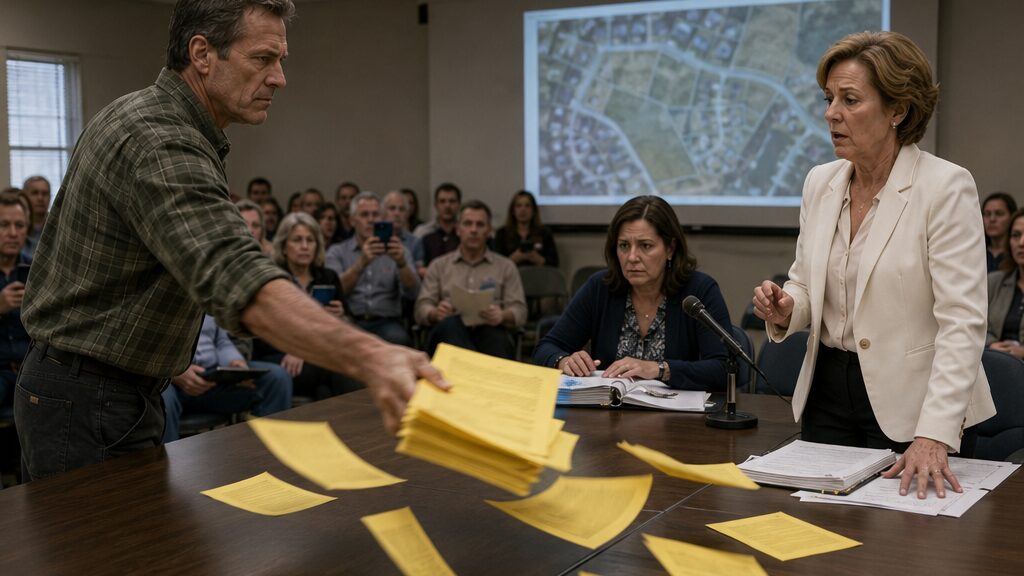
Before she could stop him, Steven lifted the stack.
He separated the notices into three rough groups and laid them across the table.
“First year,” he said. “Second year. This year.”
Nancy reached for the microphone. “Mr. Walker—”
He pushed the groups outward.
The pages slid across the polished surface. Several struck the table edge and lifted into the air. Yellow sheets fluttered toward the floor, one turning slowly beneath the fluorescent lights before landing near Nancy’s shoe.
The room went still.
Steven placed both hands on the table.
“Every one of these notices quotes the same residential-use restriction,” he said. “Every one leaves out the same recorded notation.”
Nancy’s face hardened. “Throwing documents does not change your obligations.”
“No. But erasing words might.”
A homeowner in the second row raised a phone.
Nancy noticed. “Recording is permitted, but please remain seated.”
Steven lowered his voice.
“Put the original plat on the projector.”
“The relevant plat is already included in the packet.”
“No. You included the amended landscaping sheet. Put up the recorded subdivision plat. Sheet four.”
The property-management attorney opened a laptop beside Nancy. “This is not a title hearing.”
“Then why are you asking for a lien?”
Nancy looked toward Heather. “Do we have the document he’s referring to?”
Heather turned several pages in her binder. “Not in the printed packet.”
“I submitted it twice,” Steven said.
“You submitted an illegible photocopy,” Nancy replied.
“I submitted the recording number.”
The attorney typed something. The projector went dark, then filled with a county records page. He enlarged the scan.
At first it showed only lines, parcel numbers, drainage arrows, and faded stamps.
Steven pointed.
“Lower right corner. Parcel C.”
The attorney zoomed in.
The notation appeared in gray script, faint but readable:
CONTINUED AGRICULTURAL USE RESERVED SUBJECT TO COUNTY REGISTRATION AND ACCESS CONDITIONS.
Someone in the back said, “There it is.”
Another homeowner asked, “Reserved to who?”
Nancy did not answer immediately.
Steven looked across the room.
“So an agricultural use was recorded,” he said. “Not invented after the bylaws. Not added because I wanted chickens. Recorded before Magnolia Creek sold its first finished lot.”
The tension changed. It did not disappear. It shifted sides.
Heather leaned toward the screen. “Why isn’t that language in the enforcement file?”
Nancy folded her hands.
“The notation is not a blanket exemption,” she said. “It is subject to conditions, as the language clearly states.”
“Then cite the conditions I violated.”
“We have.”
“No. You cited residential design rules.”
The attorney whispered to Nancy. She opened a white folder beneath the yellow notices.
“Mr. Walker,” she said, “did you maintain the annual county registration required by that notation?”
Steven did not move.
Nancy removed a letter and placed it beneath the document camera.
The county seal appeared on the projector.
NOTICE OF LAPSED AGRICULTURAL-USE REGISTRATION.
Effective date: eighteen months earlier.
The room’s attention returned to Steven.
Heather stared at him. “Is that accurate?”
Steven read the date twice, though he recognized it after the first glance.
One of the unopened envelopes in the desk drawer had carried that same seal.
Nancy’s voice was quieter now.
“The association did not erase the condition. Mr. Walker allowed it to lapse.”
“That doesn’t convert the land into common property,” Steven said.
“It removes the basis for his claim of active protection,” the attorney replied.
“Not automatically.”
“Perhaps not. But it makes the enforcement question legitimate.”
Steven looked at the old notation on the screen. He had expected it to stop the room. Instead it had opened beneath his feet.
Nancy gathered the nearest yellow sheets.
“The board has an obligation to act on the records currently in force,” she said. “Not on historical use alone.”
Heather’s expression had changed. Not to anger. Something worse. Disappointment.
“You knew?” she asked Steven.
“I knew there were letters.”
“That wasn’t my question.”
He could have explained the months after the funeral. The unopened mail. The way ordinary paperwork had seemed insulting beside hospital bills and condolence cards. He could have said that county offices had known him for decades, that renewal had once been routine, that the underlying covenant did not vanish because one registration expired.
All of it would have sounded like what it was: an explanation after silence.
“I didn’t renew,” he said.
Nancy nodded once, as if a procedural box had been checked.
“The motion remains before the membership.”
Steven looked at the projected letter. “You still can’t remove anything until the title and access conditions are reviewed.”
“Our attorney disagrees.”
“Then your attorney is gambling with everyone’s dues.”
Several residents began speaking at once.
Nancy struck the table with the wooden handle of a gavel.
“Order.”
Heather turned toward the attorney. “Can the board proceed while the recorded notation is unresolved?”
“We can authorize enforcement,” he said carefully. “Execution is a separate question.”
Nancy seized the distinction.
“The board proposes that removal begin Monday at eight a.m., subject to any lawful county restraint obtained before then.”
The vice president seconded the motion.
Steven stared at her. “You’re scheduling demolition with four days’ notice.”
“Removal of unauthorized structures,” Nancy said.
“My hives aren’t structures.”
“Then bring your argument to the county.”
The vote did not pass cleanly, but it passed.
Some hands rose because residents believed Nancy. Some because they feared legal expense. Some because they wanted the meeting over.
Heather did not raise hers.
Afterward, yellow notices lay beneath chairs and against the baseboard. Steven bent to collect them.
Heather crouched beside him.
“You should have told me.”
“I’m telling you now.”
“No. The county told us.”
She stood and carried her binder away.
Nancy remained behind the table, speaking with the attorney. Steven approached with the notices stacked against his chest.
“Monday,” he said.
“Eight o’clock.”
“You know the county won’t settle this by then.”
“I know you’ve had eighteen months.”
“And I know you left the plat notation out of every notice.”
For the first time that evening, her composure thinned.
“Get your registration file in order, Steven.”
“That isn’t an answer.”
“No,” she said. “It’s your deadline.”
Chapter 3: The Expired Registration in the County File
Emma Rivera placed the unopened envelope beside the recorded plat and waited for Steven to stop looking at anything else.
The county planning office was quiet except for the hum of an overhead vent and the turning pages of a clerk at the far counter. Steven sat across from Emma with the cream-colored envelope between them. His name and address were printed correctly. A postal mark showed it had been delivered fourteen months earlier.
“You brought this unopened?” Emma asked.
“I brought the whole file.”
“That was not my question.”
Steven recognized the technique. He had used it on landowners who answered around soil tests, water permits, and livestock counts.
“No,” he said. “It was in a drawer.”
Emma slid a letter opener across the desk.
He broke the seal.
Inside were a lapse notice, a renewal form, and instructions for requesting late reinstatement. A second notice had been mailed four months later.
“You had two opportunities before the designation became inactive in the county database,” Emma said.
“The recorded covenant remains.”
“The covenant remains recorded. Its active protection depends on conditions.”
“Registration is one condition.”
“And access is another. Defined use is another. Setback compliance is another.”
“My hives pass inspection.”
“I saw the certificate. Your garden beds appear consistent with historical use.”
“And the hens?”
“Possibly.”
“The shed?”
Emma turned the plat toward him. A clean county copy, sharp and white, showed lines the HOA projector had blurred.
“That depends on where it sits.”
“It sits on the parcel.”
“Which version of the parcel?”
Steven leaned back.
Emma tapped two points. “The original plat shows the agricultural strip here. A later infrastructure plan shifts the drainage corridor six to nine feet west. There is no corresponding amendment to the covenant that I can find.”
“That is the HOA’s problem.”
“It is everyone’s problem if the records conflict.”
“They scheduled removal for Monday.”
“They sent us notice this morning.”
Steven looked at her. “And?”
“And the county will issue an administrative hold on removal until ownership, access, and historical-use boundaries are clarified.”
The relief was immediate enough to embarrass him.
“So they can’t touch anything.”
“Not yet.”
Emma raised one finger before he could speak again.
“This does not validate every current use. The aerial images show the equipment shed was enlarged four years ago. The eastern chicken run was extended after the last active registration. Those improvements may sit outside the protected footprint.”
“The old shed was unsafe.”
“Replacing it did not authorize expansion.”
“It’s twelve feet.”
“It is twelve feet in the location where the documents disagree.”
Steven folded the lapse notice along its original crease.
Emma studied him. “You worked extension.”
“Twenty-three years.”
“Then you know what I’m going to say.”
“That regulations should match conditions on the ground.”
“That records matter before conditions become disputes.”
He said nothing.
She opened a digital parcel index. “Let’s trace every filing.”
For the next hour, they moved backward through deed references, subdivision approvals, drainage easements, annual registrations, and scanned correspondence. The agricultural notation began with a developer’s agreement to preserve a remnant parcel that had supplied a roadside produce stand. The agreement allowed continuing food production while reserving limited access for stormwater maintenance.
For years, the arrangement had functioned through habit rather than precision.
Then Magnolia Creek expanded.
The original drainage ditch was reshaped. Fences moved. Common lawns were installed. A path shown on one drawing appeared inside Steven’s cultivated strip on another.
Emma enlarged a recent application.
Steven saw the parcel number before she pointed to it.
“What is that?”
“Magnolia Creek HOA submitted a drainage-access modification request six weeks ago.”
“For routine maintenance?”
Emma read from the application. “Proposed transfer of limited access rights to a regional stormwater contractor.”
“Transfer?”
“An easement sale, depending on final terms.”
Steven pulled the screen closer.
A shaded corridor ran behind his hives, across the garden, and through the side of the equipment shed.
“They’re selling access across land they claim is already common area.”
“That is one interpretation.”
“What is the other?”
“That they know control is unclear and are attempting to resolve it through an easement.”
“Without notifying me.”
“The application lists the HOA as managing party. It identifies your parcel as affected property.”
“Did the county send notice?”
Emma searched the file.
“No owner-certification form is attached.”
“Then it’s incomplete.”
“Yes.”
“Was it returned?”
“Not yet. It was routed for preliminary drainage review.”
Steven looked at the submission date. It had been filed before the newest violation notice, before the lien warning, before Nancy told residents that uniform enforcement was the only issue.
The yellow papers had not merely demanded compliance. They had created pressure on the exact land the board hoped to control.
Emma printed the application.
“This doesn’t prove concealment,” she said.
“It proves motive.”
“It proves timing.”
“You always this careful?”
“Yes.”
He almost smiled, but the shaded corridor held his attention.
“How much could an access easement be worth?”
“That depends on the contractor, the project, and what problem they are trying to solve.”
“What problem?”
Emma opened an engineering attachment. Most of it was preliminary: channel capacity, recurring overflow, downstream exposure. One page included estimated correction costs.
Steven read the number.
It was several times larger than the HOA reserve fund Heather had described.
“So they need the sale.”
“Or they believe they do.”
“And if the agricultural covenant is active?”
“It could restrict the width, route, and permitted disturbance. It would not necessarily block drainage work.”
“But it could block this deal.”
“It could require negotiation with you and possibly a broader covenant amendment.”
Steven gathered the clean plat, the lapse notice, and the easement application.
Emma stopped him before he put them away.
“The administrative hold protects the site temporarily. It does not restore your registration.”
“What does?”
“A late reinstatement petition, corrected site plan, inspection, and explanation for the lapse.”
“I can do that.”
“You can apply. Approval is not automatic.”
He nodded.
“And Steven?”
He waited.
“If you ask this office to enforce every protection in the old record, be prepared for us to enforce every condition too.”
Outside, he stood beneath the concrete overhang while cars passed through the county complex. The clean plat felt heavier than the stack of yellow notices had.
His phone rang.
Heather.
He answered.
“The county stopped Monday’s removal,” he said.
“I heard.”
“How?”
“Nancy called an emergency board session.”
“For what?”
Heather was silent long enough that he looked at the phone.
“She says the enforcement delay proves the HOA needs to secure the drainage easement before your claim gets reinstated.”
Steven unfolded the application Emma had printed.
Across the top, beneath the Magnolia Creek letterhead, was the proposed sale authorization.
“How soon?”
“They want a vote next week.”
Steven looked back through the glass doors toward the records office.
The fight had never been only about chickens, hives, or an ugly shed.
Nancy had been clearing a path through the farm before anyone admitted there was still a farm to clear.
Chapter 4: What the Board Was Trying to Pay For
The rain reached the first backyard before Heather found the missing forty-two thousand dollars.
She was alone in the HOA office, bent over the reserve spreadsheet, when someone pounded on the glass door hard enough to rattle the blinds.
“Water’s coming through the Martins’ fence!”
Heather looked up. Muddy water was already spreading across the parking lot in shallow brown sheets. She grabbed the office keys and followed the homeowner into the rain.
Behind the eastern cul-de-sac, the drainage channel had climbed over its concrete lip. Water pushed through ornamental grass, curled around fence posts, and poured into three yards. A plastic playhouse floated sideways until it caught against a hedge.
Nancy stood in the runoff wearing rubber boots beneath her white raincoat. She directed the drainage contractor toward a blocked grate while two residents dragged sandbags from a pickup.
“Keep people away from the channel,” Nancy called. “The bank is soft.”
Heather waded toward her. “The reserve report says we have sixty-eight thousand available.”
Nancy’s eyes moved to the folder under Heather’s arm. “Not here.”
“The bank statement shows twenty-six.”
A gust pressed rain against Nancy’s face.
“We paid the emergency engineering deposit,” she said.
“That was fourteen thousand.”
“And the retaining-wall inspection.”
“Six.”
Nancy turned toward the flooded yards. “Heather, help with the bags.”
“Where is the rest?”
A section of sod peeled away near the channel and collapsed into the current. Both women watched it vanish.
Nancy lowered her voice. “If the main line fails, preliminary estimates start at two hundred eighty thousand. That does not include downstream claims.”
Heather had seen the number in the county attachment. Seeing Nancy say it made the threat less abstract.
“You knew before Steven’s lien vote.”
“I knew we had a risk.”
“You knew we couldn’t pay for it.”
“I knew a special assessment could put six families into default.”
The drainage contractor shouted that the grate was clear. Water spun down in a dirty funnel, but the level dropped only an inch.
Nancy pointed toward the narrow strip behind Steven’s property.
“That access route lets the contractor widen the channel without tearing through four private yards. The easement payment covers the first phase, and the long-term maintenance agreement covers the rest.”
“If the HOA owns the access.”
“The HOA has managed it for twenty years.”
“That is not ownership.”
Nancy’s mouth tightened. “This is why board work cannot be done by people who discover one document and assume it contains the whole answer.”
Heather looked at the flooded playhouse, the residents carrying sandbags, and Nancy’s soaked sleeves. For the first time, she understood why Nancy had pushed so hard.
Understanding did not improve the omission.
Back in the office, Heather spread the yellow violation notices beside the reserve statements. She sorted them by date, then opened the digital minutes from the year Steven’s agricultural registration had lapsed.
Most were routine. Landscaping approvals. Pool repairs. Delinquency reports.
Then she found a draft set of minutes stored in the management archive.
Under old business:
Discussion of agricultural notation affecting Parcel C. Counsel recommends obtaining recorded clarification before enforcement or access transfer.
The final approved minutes contained no such paragraph.
Heather checked the document history. The draft had been uploaded by the board secretary. The final version had been revised two days later from Nancy’s account.
She printed both.
Nancy entered carrying a wet cardboard box of emergency supplies. “What are you doing?”
Heather placed the pages side by side.
“Why was this removed?”
Nancy did not approach the desk. “Executive-session legal advice does not belong in open minutes.”
“The discussion happened in open session.”
“The attorney later advised us to correct the record.”
“Then where is the executive-session note?”
“There may not be one.”
“You told residents the board had never received credible evidence of an agricultural restriction.”
“We had an unreadable photocopy and an expired registration.”
“You had the recording number.”
Nancy set the box down carefully.
“You think I wanted this?” she asked. “You think I enjoy threatening liens? The management company told us uniform enforcement was the only defensible position until the county clarified the parcel. Meanwhile, every storm takes another foot of that bank.”
“You used the fines to force Steven out of the way.”
“I used the tools the association has.”
“You removed information from the minutes.”
“I removed a statement that could have frozen the only repair plan we could afford.”
Heather looked at her.
Nancy’s face had lost the boardroom polish. She looked exhausted, frightened, and still certain that fear entitled her to decide what everyone else was allowed to know.
“That was not your choice to make,” Heather said.
Nancy glanced at the yellow notices. “It becomes my choice when nobody else will vote for an assessment.”
“You never asked them.”
“I have sat in living rooms with owners who cannot absorb another hundred dollars a month. I know what they’ll say.”
“You know what you’re afraid they’ll say.”
Nancy picked up the wet box.
“If the channel fails, no one will care how transparent the minutes were.”
After she left, Heather copied the files to a flash drive and locked the originals in the treasurer’s cabinet.
That evening she carried the packet to Steven’s house.
He opened the door but did not invite her in.
“I found the altered minutes,” she said.
His expression did not change. “Good.”
“That’s all?”
“What do you want me to say?”
“That you were right about Nancy and wrong about nothing?”
“I didn’t ask for that.”
“No. You never ask. You produce one page at a time and make everyone else discover the cost.”
Rain ticked from the porch roof. Behind him, the cream-colored trust folder lay on the kitchen table.
Heather saw his hand move toward the door.
“What is that?” she asked.
“Nothing for the board.”
“It has Magnolia Creek on the cover.”
“It belonged to my wife.”
“Does it concern the parcel?”
Steven did not answer.
Heather stepped back. “Then you are doing the same thing Nancy did.”
His face hardened.
“No.”
“You both decided the rest of us could not be trusted with the whole record.”
“She was hiding a land sale.”
“And you’re hiding what?”
The question remained between them until Steven closed the door.
The next morning, Heather found George Hill trimming a hedge outside his brick ranch. He had surveyed the first phase of Magnolia Creek and still kept rolled plans in cardboard tubes along one garage wall.
She showed him the county plat.
George studied it for less than a minute before handing it back.
“You drew this,” Heather said.
“I drew the field survey.”
“Is Steven’s copy accurate?”
George looked toward the street. “Accurate is not the same as complete.”
“Will you certify it?”
“No.”
“Why?”
“Because the line on that sheet was never the line everyone used.”
Heather waited.
George removed his work gloves one finger at a time.
“The developer moved the drainage cut after the plat was recorded,” he said. “We marked it in the field. They were supposed to amend the documents.”
“Did they?”
“You already know they didn’t.”
“Then certify the original boundary.”
George shook his head.
“If I certify only that sheet, I make Steven’s version look cleaner than it is. If I certify what happened on the ground, I admit I let a construction change stand without a corrected filing.”
Heather held the plat tighter.
“What exactly crosses that parcel?”
George looked past her toward the strip of trees behind Steven’s house.
“More than one owner’s line.”
Chapter 5: The Boundary Line That Served Two Owners
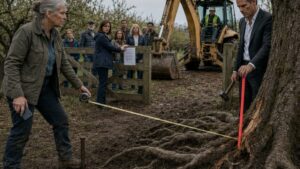
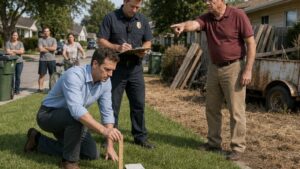
George drove the first steel survey pin through the edge of Steven’s newest chicken run.
The hammer struck twice. The hens scattered beneath the raised coop, wings beating against wire.
“You missed,” Steven said.
George crouched over the pin. “No.”
“That line belongs six feet east.”
“On the recorded agricultural plat.”
“That is the controlling document.”
George rose slowly, one hand on his knee. “And the drainage cut was built six feet west.”
Steven looked at the yellow flag tied to the pin. It stood inside the run, bright as the violation papers Nancy had stacked against him.
Along the disputed strip, more flags waited in George’s vest pocket.
Emma Rivera stood near the hives with a clipboard. Heather had brought copies of the draft minutes. Nancy had arrived with the property-management attorney and the drainage contractor. No one had wanted a joint inspection. The county had required one before considering either Steven’s reinstatement or the HOA’s easement application.
George stretched a measuring tape toward the old pecan tree.
“The agricultural boundary follows the recorded bearings,” he said. “The constructed drainage centerline follows the later field stakes. They overlap here, narrow there, and cross again near the shed.”
Nancy pointed toward the channel. “The association has maintained that corridor since the subdivision opened.”
“Maintenance does not settle title,” Emma said.
“It demonstrates accepted use.”
“It may demonstrate an access claim. It does not establish the width or permit a sale.”
Steven watched Nancy absorb the answer. She did not look surprised. She looked as if she had hoped no one would say it aloud.
George planted another yellow flag beside the tomato rows.
“This section is clean,” he said. “Original garden footprint. Same with the hives, assuming the county registration is restored.”
Steven looked toward Emma.
She nodded. “The historical photographs support continuous use.”
“And the hens?”
George walked the tape to the older half of the run. “This section is inside the strongest agricultural area.”
He moved to the newer wire extension.
“This section is not.”
The chicken run had been enlarged after Steven’s wife became too weak to carry feed far from the house. He had moved the gate, added a covered section, and later replaced the shed beside it. At the time, the changes had felt small enough to require no explanation.
Now yellow flags divided memory into permitted and unpermitted sections.
The contractor opened a rolled engineering plan on the hood of his truck.
“For the proposed channel width, we need twenty feet through here.”
“Your twenty feet takes two hives and half the garden,” Steven said.
“It avoids removing three fences downstream.”
“By removing mine.”
Nancy stepped closer. “The easement provides compensation.”
“To the HOA.”
“For repairs that benefit every property.”
“Using land you don’t own.”
“Land you failed to keep registered.”
Emma raised her hand. “Those are separate questions. Registration affects use protection. It does not transfer ownership.”
The attorney looked at the survey flags. “Can the county determine ownership?”
“No. That may require a title action. But we can determine whether either proposed use complies with recorded land-use conditions.”
The contractor traced the blue drainage line.
George leaned over the plan, then placed his finger on a bend near the shed.
“That is not where the old cut runs.”
“It was adjusted using aerial mapping,” the contractor said.
“You adjusted it onto the agricultural parcel.”
“We selected the most efficient route.”
“For your equipment.”
“For hydraulic capacity.”
George took a folded field notebook from his pocket. The pages were brittle, covered in measurements and compact pencil marks.
“The original developer moved the channel during construction because the soil collapsed near the planned route. We shifted west temporarily. They kept it there because moving it back cost money.”
Heather said, “And nobody amended the covenant.”
“No.”
“Did Steven know?”
George glanced at him.
Steven answered. “I knew the ditch wasn’t where the first drawing showed it. I didn’t know the shift had never been recorded.”
George’s silence suggested the distinction was incomplete.
“You knew enough to keep the beds away from the wet side,” he said.
“I knew where water traveled.”
“You also knew the shed expansion narrowed maintenance access.”
Steven looked at the shed.
His wife had stood in its doorway the week he finished it, wrapped in a blue cardigan despite the heat. She had said it was too large. He had told her larger meant he would not need to replace it again.
She had replied, “Larger always belongs to somebody’s future problem.”
At the time, he thought she meant his.
Emma walked the line from the hives to the channel.
“There may be a compliant route,” she said. “Protect the original agricultural footprint, dedicate a narrower maintenance corridor, reshape the downstream bank, and use planted drainage rather than a fully widened concrete cut.”
The contractor frowned. “That costs more initially.”
“Less than title litigation,” Heather said.
Nancy stared at the plans. “How much land would Steven surrender?”
“Not surrender,” Emma said. “Grant controlled access.”
“And the shed?” Steven asked.
George pointed to three flags running directly through its back wall.
“Part of it sits in the overlap.”
“I can cut it back.”
“The foundation crosses the corridor.”
Steven understood before anyone said it.
The shed had to go.
The attorney turned to Nancy. “A negotiated access agreement could preserve the sale.”
Emma shook her head. “Not in its current form. The proposed transfer grants broader construction rights than the recorded agricultural condition allows.”
Nancy’s voice sharpened. “Then how does the HOA fund the repair?”
“That is not a land-use determination.”
“It is the practical question.”
Steven looked from the hives to the shed, then to the yellow flags cutting across both the manicured grass and the dark garden soil.
For weeks, he had imagined winning as the removal of every flag, every notice, every person who claimed a right to step across his boundary.
Instead, the strongest version of his claim saved the oldest beds and the hives—but not everything he had built. It required access. Shared maintenance. Limits.
George folded his tape.
“The land has been serving two uses for twenty years,” he said. “Everyone just pretended one of them would eventually disappear.”
Heather walked toward the house to get water. The kitchen door stood open. On the table lay the cream folder Steven had refused to show her.
A gust from the storm’s trailing wind lifted the cover.
Heather reached to keep the pages from scattering.
The first page was titled Proposed Magnolia Creek Community Land Trust.
Below it, in Steven’s wife’s handwriting, was a list of purposes: food production, youth garden access, pollinator habitat, stormwater protection.
Heather read only far enough to understand.
When Steven entered, she was holding the folder.
His face changed.
“You had a structure for all of this,” she said. “Agriculture and drainage. Your wife had already put them together.”
“Put it down.”
“Why didn’t you file it?”
“That is not your business.”
“It became our business when you asked the neighborhood to defend the land.”
“I asked you to stop an illegal lien.”
“And what were you planning to do after that? Lock the gate again?”
Steven took the folder from her.
A signature page slipped free and landed between them.
His wife’s name filled one line.
His remained empty.
Heather looked down at it, then back at him.
“You didn’t fail to find the solution,” she said. “You refused to sign it.”
Chapter 6: The Promise Steven Had Kept Too Narrow
Steven’s daughter placed the unsigned page on the kitchen table and asked, “Why did you preserve the land but ignore what she wanted it preserved for?”
She had driven over after Heather called her. Steven had objected to the call, to the visit, and finally to the way both women sat at the table as if he were the only person who did not understand the document before them.
The cream folder lay open beside a yellow violation notice.
“She wanted the land worked,” Steven said.
“She wanted it shared.”
“She wanted a dozen things when she was sick.”
His daughter’s eyes narrowed. “Don’t do that.”
“Do what?”
“Turn her into someone who didn’t know her own mind.”
Steven stood and carried his coffee to the sink. Outside, the equipment shed cast a long shadow over the divided chicken run. George’s yellow flags remained in the soil.
His daughter opened the trust draft.
“She listed school garden hours. Senior plots. Pollinator beds. Drainage access.”
“It was preliminary.”
“She signed it.”
“The county had not approved it.”
“Did you submit it?”
He looked through the window.
Heather answered for him. “No.”
Steven gripped the edge of the sink. “The land was ours.”
His daughter’s voice softened, which made it harder to resist.
“It still would have been yours in a different way.”
“No. It would have belonged to committees. Meetings. People who show up twice, pull the wrong plants, and leave tools in the rain.”
Heather glanced toward the garden. “That sounds inconvenient.”
“It sounds temporary.”
His daughter closed the folder. “Mom knew she was dying. She was trying to make something continue without requiring you to hold it alone.”
“I promised her it would stay productive.”
“You kept half the promise.”
The refrigerator motor clicked off. In the sudden quiet, Steven heard bees moving beyond the screen door.
He returned to the table and turned the yellow violation notice face down. The blank reverse side looked strangely useful.
“She asked me to sign the week before hospice,” he said. “I told her we would revise it when she felt stronger.”
His daughter said nothing.
“She knew she wasn’t going to feel stronger.”
“Yes.”
“I knew too.”
The admission left no defense behind it.
He had not refused because the draft was incomplete. He had refused because signing it meant planning for a version of the land in which she was absent and other people stood where she had stood. He could discuss death with doctors, insurance representatives, and funeral staff. He could not put it into a land document.
Afterward, he kept the garden exactly as she left it. He followed her planting rows, saved her seed envelopes, repaired her sign. Each season became proof that he had not surrendered anything.
Even the county renewal letters had felt like invitations to change the arrangement.
Heather opened the folder again. “There may be enough here to solve the current problem.”
Steven looked at the yellow notice.
“With revisions,” she continued, “the trust could hold the agricultural covenant, grant limited drainage access, and keep the HOA from selling broad construction rights.”
“And the reserve shortfall?”
“The HOA still has to face it.”
“So do I.”
Heather nodded. “Your shed narrowed the access.”
His daughter slid a pen toward him. “Then stop asking whether you can win without giving anything up.”
Steven picked up the pen but did not touch the signature page.
Instead, he wrote on the back of the yellow notice.
Restore agricultural registration.
Remove shed and eastern run.
Controlled drainage access only.
Independent reserve audit.
Resident trust board.
No easement sale before county review.
He paused, then added:
Owner contribution to correction costs.
Heather read the list. “That is a beginning.”
“It isn’t a settlement.”
“No. But it’s the first paper you’ve written that tells everyone what you will do, not only what they did wrong.”
The words stung because they were true.
They spent the next hour reviewing the trust draft. Near the back, tucked behind a map, Heather found a county planning letter.
“Steven.”
He took it from her.
The letter was six years old. It acknowledged preliminary review of the proposed trust and stated that combined agricultural preservation and stormwater access could be approved with a final site plan, recorded governance terms, and owner signatures.
His wife had already taken the proposal to the county.
“She never told me she submitted this,” he said.
His daughter looked at him. “Would you have listened?”
He read the letter again.
The plan had not been a wish assembled during illness. She had spoken to planners, marked boundaries, and anticipated the exact conflict now consuming the neighborhood.
The trust was not a way to give the farm away.
It was the structure she built because she knew promises kept by one grieving man were fragile.
Heather’s phone vibrated on the table.
She read the message and went still.
“What?” Steven asked.
“Nancy called an emergency membership meeting for tomorrow night.”
“To discuss the audit?”
“To approve the easement sale.”
“She cannot complete the sale while the county hold is active.”
“She can authorize it conditionally and give the contractor the right to proceed once the hold lifts.”
Steven folded the planning letter. “She’s trying to create a signed agreement before we submit the trust.”
Heather nodded. “The packet went out ten minutes ago. She included projections showing a special assessment of forty-eight hundred dollars per home if the sale fails.”
His daughter exhaled. “That will scare people.”
“It is meant to,” Heather said.
Steven looked at the list written on the back of the violation notice. He had spent weeks preparing to prove Nancy had hidden the truth. Tomorrow, she would present his missed renewal, his unauthorized shed, and the assessment threat before he could control the order.
He could hold back the trust proposal until Nancy’s conduct was exposed. He could let Heather present the altered minutes first. He could make the room choose a villain before asking it to choose a plan.
That was how Nancy operated.
Steven placed the old county letter inside the cream folder and closed it.
“At the meeting,” he said, “I speak before you show the altered minutes.”
Heather frowned. “Why give up that advantage?”
“Because my lapse belongs in the record too.”
“They’ll use it against you.”
“They already have.”
He picked up the unsigned page, then the yellow notice carrying his handwritten terms.
For the first time, he put both in the same folder.
“Tomorrow,” he said, “they hear what I failed to do before they hear what Nancy hid.”
Chapter 7: The Meeting Where Both Sides Lost Their Story
Steven reached the microphone before Nancy could display the expired registration.
“I let it lapse,” he said.
The room had not settled yet. Folding chairs scraped. Printed packets changed hands. At the board table, Nancy stood beside a projected slide showing the proposed drainage easement and the words AVOID SPECIAL ASSESSMENT in red.
Steven’s admission quieted the room faster than the gavel had.
“My agricultural registration expired eighteen months ago,” he continued. “The county sent two notices. I opened neither one.”
Nancy’s hand remained on the presentation remote.
The property-management attorney leaned toward her, but she did not look away from Steven.
A homeowner near the aisle said, “Then why are we here?”
“Because my mistake did not give the HOA ownership of the parcel,” Steven said. “And the board’s mistake did not erase the conditions attached to it.”
He placed the cream folder on the long table.
Nancy spoke into her microphone. “Mr. Walker, this meeting concerns authorization of an easement sale. Personal statements can be made during homeowner comment.”
“This is homeowner comment.”
“You were not recognized.”
Heather opened the treasurer’s binder. “I move that he be recognized before the vote.”
The vice president hesitated, then seconded.
Nancy’s expression tightened, but she called for a show of hands. The motion passed.
Steven looked at the residents. Many had come because of the figure printed on the first page of the packet: $4,800 per home. Some held the paper as if it were already an invoice.
“The board says the sale is the only way to avoid that assessment,” he said. “It isn’t. It is the fastest way to sign away rights no one has finished identifying.”
Nancy clicked the remote. A map filled the screen.
“The proposed corridor follows the most efficient route for emergency drainage correction,” she said. “Without it, Magnolia Creek faces structural failure, downstream liability, and immediate funding needs.”
“All true,” Steven said.
That answer unsettled her more than denial would have.
He opened the folder.
“The old agricultural covenant is real. So is the drainage obligation. So is the fact that I expanded my shed into the disputed corridor. If the county reinstates the agricultural use, I still have to remove that shed and part of the chicken run.”
A low murmur moved across the room.
Nancy recovered. “Then you acknowledge noncompliance.”
“I acknowledge mine.”
He laid the yellow violation notice on the table, blank side facing up. His handwritten terms covered it in dark ink.
“I am offering controlled drainage access through a resident-governed land trust. The original garden and hives remain protected. The shed comes down. The channel is redesigned within a narrower corridor. The HOA does not sell construction rights it may not own.”
A homeowner raised a hand. “Who pays for the redesign?”
“I contribute to the portion caused by my encroachment.”
“How much?”
“As determined by the county plan and an independent estimate.”
Nancy stepped toward her microphone.
“And the remaining quarter-million dollars?”
Heather stood.
“That number needs an audit before this membership relies on it.”
She carried two sets of minutes to the document camera. The screen showed nearly identical pages.
“This draft records a board discussion of the agricultural notation and recommends clarification before enforcement or transfer,” Heather said. “The final approved minutes omit the discussion.”
Nancy’s face went still.
The property-management attorney whispered, “Executive-session advice.”
Heather looked at him. “The draft identifies open session. There is no corresponding executive-session record.”
Nancy pressed the microphone button.
“I removed language that misstated preliminary legal advice. The board had no confirmed active agricultural registration.”
“You told us the board had never received credible notice of the restriction,” Heather said. “That was not true.”
“I told you the claim was unenforceable.”
“You told us it did not exist.”
Several residents began flipping through the packets.
Heather replaced the minutes with reserve statements.
“The emergency estimate may be accurate. The way we arrived here is not. Engineering deposits, inspections, and management charges reduced available reserves, but the board did not disclose the full shortfall before using Steven’s fines and the easement sale as the solution.”
Nancy looked across the room.
“You want disclosure?” she said. “Fine. The main channel can fail. Three properties flooded this week. Six households have already told me privately they cannot afford a special assessment. The reserve study was underfunded for years before I became president. We had one practical offer on the table.”
Her voice did not rise. It thinned.
“I was trying to prevent people from losing their homes over a drainage ditch.”
The room changed again.
Steven saw residents who had been ready to condemn her lower their eyes. Nancy had concealed information. She had also been carrying a number none of them wanted to face.
Heather said, “Fear does not authorize you to rewrite the record.”
“No,” Nancy replied. “But a failed channel will not wait for everyone to become comfortable with the truth.”
Steven rested his hand on the cream folder.
“My wife understood that,” he said.
He placed the trust proposal beneath the document camera. The title appeared on the screen, followed by her list of purposes: food production, youth access, pollinator habitat, stormwater protection.
“She wrote this six years ago. She took it to the county. They gave preliminary approval.”
Someone asked, “Why wasn’t it filed?”
Steven looked directly at the room.
“Because I would not sign it.”
The admission drew no murmur. It landed too plainly.
“I told myself I was protecting the land. What I was protecting was my control of it. After she died, I ignored the county letters. I enlarged the shed. I kept the gate locked. Then I expected an old promise to excuse every choice I made afterward.”
He slid the unsigned signature page forward.
“That was wrong.”
Nancy watched him, her face unreadable.
Steven continued. “The trust proposal is not a free solution. I lose the shed. I pay part of the correction cost. The HOA still has to repair the channel, and owners may still face an assessment. But it will be based on audited numbers, not a rushed sale and not fines designed to make one owner step aside.”
The vice president asked the attorney, “Can we postpone the easement authorization?”
“We can,” he said. “The contractor’s offer may expire.”
“Then it expires,” Heather said. “We should not sell rights before determining who holds them.”
A homeowner in the front row lifted the packet. “I move to reject the lien authorization and table the easement sale pending county review, independent audit, and evaluation of the trust.”
Another resident seconded.
Nancy closed her eyes briefly.
The vote was not unanimous. Several owners feared delay. Others feared the assessment. But the motion passed by a clear margin.
No one applauded.
The room filled instead with the practical sounds of consequence: pages turning, calculators opening on phones, neighbors whispering about payment plans and contractor bids.
Heather carried a new stack of yellow sheets from the printer. They were correction forms identifying penalties subject to review, possible refunds, and legitimate charges still unresolved.
She placed them where the violation notices had scattered days earlier.
Nancy looked down at the forms.
“The audit authorization needs the president’s signature,” Heather said.
Nancy took the pen.
For several seconds, it hovered above the line.
Then she signed.
“I removed the minutes paragraph,” she said without looking up. “The attorney did not instruct me to do it.”
The attorney leaned back from the microphone.
Nancy signed the second page. “I believed delay would destroy the drainage offer and leave us with nothing. I made the record fit the decision I had already made.”
She pushed the papers toward Heather.
“My resignation is effective when this meeting adjourns.”
The vice president said her name, but she shook her head.
Steven expected satisfaction. Instead he saw the wet raincoat from the flooded yards, the sandbags, and the woman who had tried to solve a shared failure by controlling the truth.
Nancy gathered her presentation remote and stepped away from the board table before the final vote count was read.
The yellow correction sheets remained behind, divided into columns for money owed, money returned, and facts still requiring proof.
Chapter 8: The First Harvest After the Lines Were Redrawn
The children arrived with baskets before Steven had unlocked the garden gate.
They pressed against the fence in a loose row, pointing toward the tomatoes and arguing over which cucumbers were large enough to pick. Where the equipment shed had once stood, a gravel path curved through young switchgrass and shallow stone basins designed to catch runoff.
Steven held the key in his hand.
“Wait for the others,” he said.
One child peered through the wire. “Heather said we could start at nine.”
“It is eight fifty-six.”
The child looked at the clock on a phone. “It says eight fifty-eight.”
Steven checked his watch and found that it agreed.
Behind the children, Heather approached carrying the trust ledger and a box of gloves. Four months of county review, contractor bids, amended maps, and evening meetings had not made her walk any slower.
“You can let them in,” she said.
“They need instructions.”
“They can receive instructions inside.”
Steven unlocked the gate.
The children entered too quickly, then slowed when the bees became audible beneath the pecan trees. He showed them where to walk, how to hold the baskets, and why tomatoes were twisted rather than pulled. He corrected three hands in the first five minutes.
Heather watched him from the new tool rack.
“You said this was a harvest morning,” she said.
“It is.”
“It resembles an inspection.”
“They break stems.”
“They learn.”
Steven looked toward the missing shed.
Its removal had cost more than the first estimate. The concrete foundation crossed the old drainage cut, exactly as George had said. Steven paid the agreed share from savings he had once reserved for replacing the roof.
The audit canceled most of the accumulated fines because the enforcement notices had relied on incomplete land-use records. It upheld smaller charges connected to the shed expansion and an unapproved fence extension.
He had paid those too.
The trust now held the agricultural-use registration. Steven retained a permanent stewardship seat but not unilateral control. Heather chaired the resident board. George had certified the corrected site plan with a written explanation of the old construction change. Emma had recorded the county conditions and made clear that future neglect would not be forgiven merely because the history was complicated.
Nancy no longer attended meetings. She had remained in Magnolia Creek, though she entered and left through the side streets and kept her yard as precise as before. The audit found poor disclosure and improper record changes, but not theft. The reserve shortfall belonged to years of low dues and postponed work, not one person.
Every household paid something toward the drainage repair.
The amount was painful, but smaller than the number used to frighten them into the sale.
A child held up a tomato with a split along one side. “Is this bad?”
Steven took it.
“It is still good. Put it in the sauce basket.”
“There are different baskets?”
“There should be.”
Heather laughed under her breath.
By late morning, clouds gathered above the western roofs. The contractor had finished the planted channel two weeks earlier, but it had not yet faced a hard storm.
The first drops struck the pecan leaves while the children carried baskets beneath the covered work area. Rain darkened the gravel path. Water began moving from the uphill lawns toward the garden.
Steven stood at the channel’s edge.
The old system had forced water through a narrow concrete cut. The new one spread it across shallow planted basins before guiding it beneath the road. Switchgrass bent under the flow. Stones disappeared, then reappeared as the first basin filled and released into the second.
Heather joined him beneath an umbrella.
“Is it supposed to rise that high?”
“Yes.”
“You answered too quickly.”
“I helped design it.”
“That does not mean you are incapable of being wrong.”
Water reached the marked overflow stone, held there, and then dropped as the lower channel accepted the flow. No muddy sheet crossed the garden. No fence posts shook loose. Beyond the trees, the three yards that had flooded remained clear.
Steven let out a breath.
Heather noticed but said nothing.
When the rain passed, the children returned to the rows. One resident moved the basil containers from the position Steven’s wife had always used and placed them beside the tomatoes.
Steven crossed the path.
“Those belong near the south fence.”
“They were getting too much shade,” the resident said.
“They have always been there.”
The resident stopped with one container in her hands.
Steven could see the old arrangement as clearly as if it remained: his wife kneeling beside the fence, pinching flower heads, leaving the strongest plant for seed. For years, maintaining that placement had felt like maintaining her judgment.
Now another person stood in the same soil and had noticed that the pecan canopy had widened.
Steven looked at the basil leaves. They were thin and leaning toward the light.
“Put two beside the tomatoes,” he said. “Leave one near the fence and compare them.”
The resident nodded.
It was a small surrender. It did not feel small.
In the afternoon, Heather opened the trust ledger on the worktable. Inside the front cover was one yellow correction notice, folded twice. It showed the canceled penalties, the legitimate charges, and the final balance Steven had paid.
“You still keeping that?” she asked.
“It is part of the record.”
“You once threw a whole stack of them across a table.”
“They were poorly organized.”
Heather closed the ledger.
The children had finished harvesting. Their baskets held crooked cucumbers, tomatoes of uneven color, peppers, herbs, and several vegetables Steven would not have chosen.
At the gate, Heather waited while he checked the hive latches.
“You locking up?” she asked.
Steven looked at the key.
The trust rules required two stewards to have access. Heather had never asked when he would give her the duplicate. She had simply left a labeled hook empty in the shared cabinet.
Steven held the key out.
Heather did not take it immediately.
“You sure?”
“No,” he said.
That made her smile.
She accepted the key and placed it on the empty hook.
Steven looked through the open gate toward the working beds, the drainage grasses, and the place where the shed had stood. The land no longer followed every line his wife had planted. It no longer belonged to memory alone.
Behind him, Heather began closing the ledger.
“Leave the gate open,” Steven said. “The evening group is coming at six.”
He walked home without turning the lock.
The story has ended.