The HOA President Quoted an Old Property Law Until the Homeowner Opened His Own Drafting Notes
Chapter 1: The Notice Delivered Before Breakfast
The county vehicle was parked sideways across Frank Miller’s driveway before the sun had cleared the ridge.
Its amber light turned slowly without a siren, washing the mailbox, the white fence posts, and the lower branches of the pecan tree in brief pulses of yellow. Frank stood behind the screen door with one hand on the latch and listened to three men’s shoes cross the gravel.
Only two men came up the porch steps.
The third remained near the gate, where two women and another man from Briar Glen had gathered as if they had been told there would be something worth watching.
Frank opened the door.
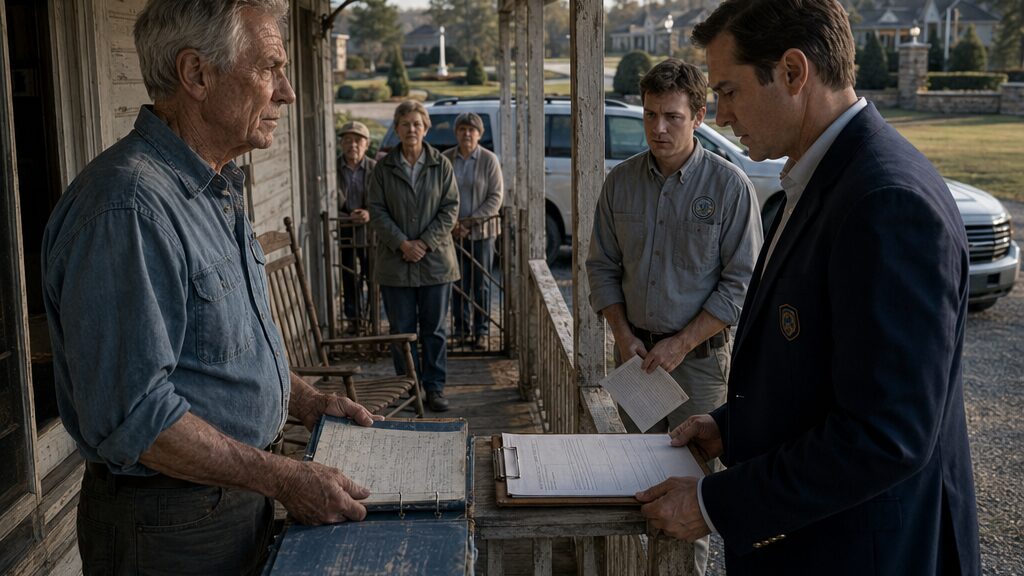
Richard Clark smiled first. He wore a navy blazer with the Briar Glen crest stitched over the breast pocket, though the development’s entrance stood nearly a quarter mile away. His leather folder was tucked beneath one arm. Beside him stood a younger county officer in khaki work pants and a green environmental-health shirt.
“Morning, Mr. Miller,” Richard said.
Frank looked at the county vehicle. “Not yet.”
The younger man shifted his weight.
Richard held out a white envelope. “We’re here regarding a septic setback violation affecting the adjoining residential community.”
Frank did not take the envelope.
“Who’s ‘we’?”
“Richard Clark, president of the Briar Glen Homeowners Association. This is Jacob Moore with county environmental health.”
Jacob gave a small nod. He looked younger than Frank had expected from the signature on the notice—early thirties, maybe. His eyes moved once toward the neighbors by the gate, then down to the porch boards.
Frank unhooked the screen and stepped outside. The boards were cool beneath his bare feet. “Briar Glen has no authority over this parcel.”
Richard’s smile narrowed without disappearing. “The county does.”
He placed the envelope on the arm of the nearest rocking chair.
Frank’s name showed through the plastic window. Beneath it, in bold print, were the words NOTICE OF VIOLATION.
“Your drain field appears to lie within the required setback from the common boundary,” Richard said. He made sure his voice carried. “You have thirty days to correct the condition. After that, penalties may accrue at two hundred dollars per day.”
One of the women near the gate folded her arms more tightly. Frank recognized her as Ruth Jones, from the house with the brick retaining wall and two crepe myrtles clipped into exact domes.
Frank looked at Jacob. “You inspected my system?”
Jacob’s mouth opened, but Richard answered.
“The county reviewed the evidence.”
“That wasn’t what I asked.”
Jacob rubbed his thumb against the edge of his clipboard. “I reviewed a complaint, parcel records, and site photographs.”
“You set foot on my property?”
“No, sir.”
Richard drew a breath through his nose. “No one needs to enter your home to see water surfacing along the lower boundary.”
Frank glanced toward the field. From the porch, the slope disappeared behind broom sedge and a line of walnut saplings. Nothing unusual was visible.
Richard continued. “This could affect neighboring wells, foundations, and property values. We’re trying to address it before it becomes more serious.”
“We?”
“The association has a duty to protect its residents.”
“Your duty ends at your recorded line.”
“Contamination doesn’t.”
The words were reasonable. Richard delivered them with the satisfaction of a man who knew it.
Frank picked up the envelope and opened it with his thumb. The notice cited Buncombe County Residential Septic Ordinance, Section 14, Paragraph B. Thirty days. Corrective work subject to inspection. Civil penalties beginning on the thirty-first day.
At the bottom was Jacob Moore’s electronic approval.
Frank read the signature twice.
Behind Richard, one of the board members near the gate murmured something. Ruth’s expression remained stiff, but her eyes were fixed on Frank’s house: the worn siding, the gutter he had patched with mismatched metal, the porch rail that needed paint.
Richard glanced back at them before speaking again.
“There may be another option.”
Frank waited.
“If correcting the system is more than you want to take on at this stage, there are buyers interested in larger parcels. Someone with the resources to maintain the land properly.”
The words settled on the porch with more weight than the notice.
Jacob looked up sharply.
Frank folded the paper once, then again. “At this stage.”
Richard’s face changed by less than an inch. “I meant no disrespect.”
“You brought an audience before breakfast.”
“The residents asked to be informed.”
“You told them to come.”
“I told affected homeowners there would be an official visit.”
Frank could feel the old quick anger in his hands, the urge to point Richard back down the steps and let the door close on all of them. For years, that had been his preferred answer to people who arrived carrying forms. His late wife had called it his drawbridge.
Instead, he looked at the citation.
“Read me Paragraph B.”
Richard blinked. “It’s printed there.”
“I asked you to read it.”
Richard opened his folder. His copy was clean, freshly printed, held in a clear sleeve. He flipped to a tab marked SEPTIC.
“Section 14, Paragraph B,” he began. “‘No subsurface wastewater disposal area shall be located within fifty feet of a residential property boundary where drainage or groundwater migration may reasonably affect an adjoining occupied parcel.’”
He closed the sleeve with one finger pressed against the text.
“Clear enough.”
Frank turned toward the front door. “Wait.”
He went inside, leaving the screen ajar.
In the hall closet, behind an old raincoat and a box of Christmas lights, was the blue binder. Its vinyl cover had faded at the corners until the cardboard showed through. A strip of masking tape across the spine read 2008—RURAL WASTEWATER DRAFTS in Frank’s own block printing.
He carried it outside.
Richard gave a quiet laugh. “Mr. Miller, this is the current ordinance.”
“So is this.”
Frank set the binder on the porch rail and opened it. Pages swollen by years of humidity shifted beneath his fingers. The margins were crowded with arrows, deletions, and notes in black ink.
He turned to Section 14.
Richard placed his clean copy beside it.
The two versions matched until Frank put his finger beneath the line Richard had read.
“Keep going.”
Richard stared down.
Jacob stepped closer.
Richard read more slowly. “‘For the purposes of this paragraph, residential property boundary shall mean a boundary between separately occupied parcels of two acres or less, or a boundary adjoining a regulated community water source.’”
Silence moved from the porch to the gate.
Frank tapped the second sentence.
“My parcel is three point zero eight acres. It has been one parcel since before Briar Glen existed. There’s no community well on that line.”
Richard turned one page back, then forward again.
“That may be an earlier draft.”
Frank lifted the front sheet. Beneath the ordinance number was a list of the drafting committee. His name appeared halfway down.
Frank Miller, P.E.
County Planning Commission
Jacob leaned over the binder. His face lost color.
Richard said, “Serving on a committee doesn’t mean your interpretation controls.”
“No,” Frank said. “The adopted language controls.”
He looked toward the neighbors. He disliked that they were there. He disliked even more that some part of him wanted them to hear the next sentence.
“I wrote that paragraph.”
Ruth’s arms loosened.
Frank continued before Richard could respond. “We added the parcel definition because old rural systems were being treated like subdivision lots, even when distance and slope made the risk different. The setback wasn’t written to make aging houses easier to pressure. It was written to follow water.”
Richard’s jaw tightened. “Then you understand why surfacing water matters.”
“I understand that you cited a rule that doesn’t say what you told these people it says.”
Jacob removed the notice from his clipboard and read it again. “The parcel acreage should have been verified.”
Richard turned on him. “It was verified.”
“Not in the approval notes.”
The neighbors could hear that too.
For the first time, Richard stopped performing for them.
He lowered his voice. “The legal interpretation can be settled by the county. The physical condition remains.”
Frank closed the blue binder. “Then show me the physical condition.”
Richard reached into his folder and removed a color photograph.
The image showed dark water shining through flattened grass beside a band of fresh orange marking paint. A length of exposed pipe or root crossed the upper corner. In the background stood the lower section of Frank’s split-rail fence.
The date stamp was from three days earlier.
Frank took the photograph.
He knew that fence. He knew the bend in the slope and the walnut trunk at the edge of the frame.
But he had never seen the orange paint.
And he had never seen water standing there.
Richard watched him recognize the place.
“This,” he said quietly, “is why the county signed the notice.”
Chapter 2: The Photograph Beneath the Wrong Boundary
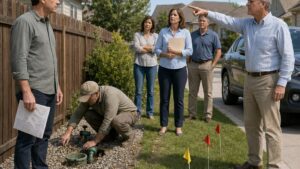
The orange line began ten feet below Frank’s tool shed and ran crookedly across the lower pasture.
Someone had sprayed it directly over the grass, over stones, and across the exposed roots of a sourwood tree. It did not follow the fence. It did not follow the ditch. It seemed to follow an idea of where the boundary ought to be.
Frank stood above it with Richard’s photograph folded in his shirt pocket.
By eight thirty, the county vehicle and the Briar Glen spectators were gone. Richard had left with a promise that the enforcement schedule remained active unless the county withdrew it. Jacob had said little. Before getting into the truck, he had looked back once at Frank’s blue binder.
Frank carried a surveyor’s spade, a steel tape, and the old parcel plat in a clear sleeve. He had not called Mary. He had not called the county. There was no reason to involve anyone until he knew what the paint marked.
That was what he told himself.
The pasture dropped toward a shallow swale between his land and Briar Glen. When Frank had bought the property, the lower acre had been hayfield. Now broom sedge grew chest-high in places, and young trees had narrowed the view of the development’s back lots.
He found the wet patch from the photograph within minutes.
It was real.
The ground gave slightly under his boot. Water had darkened the soil in an oval roughly six feet across. There was no sewage odor. No gray film. No pale fungal growth typical of a failing drain field. The water smelled of clay and leaves.
Frank crouched and pressed two fingers into the mud.
Cold.
Surface runoff or shallow groundwater, not warm effluent. That did not prove enough. A damaged line could cool underground.
He unfolded the plat against his knee. The recorded boundary ran from a stone near the road to a brass pin at the lower corner, then turned east toward the creek. The fence had been built several feet inside Frank’s property because the original owner had avoided a steep patch.
The orange paint treated the fence as the property line.
Frank measured from the nearest fence post.
Twenty-two feet.
He measured again from the sourwood shown in the photograph, then followed the plat bearing through the sedge. The brass pin should have been beneath an old line of fieldstones almost fifteen feet downhill from the paint.
The stones were half buried and tangled in honeysuckle.
Frank removed his gloves and pulled vines free by hand. Damp earth packed beneath his fingernails. He dug beside the largest stone, careful not to strike metal.
At seven inches, the spade scraped something hard.
He knelt and worked the soil away with his fingers.
The top of the brass pin emerged, green at the edges and stamped with a survey number Frank remembered from the 1979 closing.
He sat back on his heels.
The wet patch lay beyond it.
Not on his side.
The water was inside a narrow drainage easement recorded with Briar Glen’s final plat.
Frank looked uphill. Through the trees, he could see the pale stone edge of the development’s ornamental pond. The water itself was hidden, but a pump hummed faintly beyond the slope.
Richard’s photograph was not false. It was worse than false. It showed a real condition from an angle that made the fence appear to be the legal boundary.
Frank photographed the pin, the tape measurements, the wet soil, and the orange line. He placed the plat beside the exposed marker and took another image.
Only then did he call Mary.
She answered on the fourth ring. “What happened?”
Frank looked toward the house. “Why do you assume something happened?”
“Because you don’t call before lunch unless a tree is down or someone is threatening litigation.”
“County was here.”
There was a pause. “I’m coming.”
“You don’t need to.”
“I wasn’t asking.”
She arrived forty minutes later in work clothes, carrying a laptop bag and the expression she used in court when someone had already wasted her time.
Frank met her in the kitchen. The blue binder lay open on the table. Beside it were the notice, Richard’s photograph, Frank’s new photographs, and the parcel plat.
Mary took in the arrangement.
“Tell me everything in order.”
Frank told her most of it.
When he repeated Richard’s suggestion that he sell, Mary stopped typing.
“He said that in front of the county officer?”
“And the neighbors.”
“Good.”
Frank frowned. “What’s good about it?”
“It establishes motive.”
“I established motive when I showed him he couldn’t read.”
“That establishes embarrassment. Not motive.”
Mary compared the photographs. She zoomed in on the brass pin, then on Richard’s image.
“You’re right about the boundary.”
“I know.”
“That’s not a legal argument.”
“It’s a brass pin.”
“It becomes a legal argument when a licensed surveyor confirms it.”
Frank folded his arms. “The survey number is visible.”
“And Richard will say you disturbed the marker.”
“I uncovered it.”
“He’ll still say it.”
Mary closed the laptop halfway. “This is why you call before you start digging.”
“I dug seven inches.”
“You also confronted an HOA president, a county inspector, and three witnesses using a thirty-year-old binder you pulled from a closet.”
“It worked.”
“For one sentence.”
Frank looked out the kitchen window. The county notice was still visible on the table between them.
Mary opened the binder and turned through the handwritten drafts. Her movements slowed when she reached the section on repair procedures.
“What work have you done on the system?”
“Maintenance.”
“What kind?”
“Normal.”
“Frank.”
He disliked hearing his first name from her when she used that tone. It sounded too much like her mother.
“The distribution box cracked,” he said. “Six years ago. A root pushed the corner in.”
“Who repaired it?”
“I did.”
Mary stared at him.
“It was precast concrete,” he said. “I replaced it with an approved box, reset the outlets, checked the fall, and backfilled with clean stone.”
“Was there a permit?”
“It was a repair, not a replacement.”
“That is not what I asked.”
Frank turned a binder page that did not need turning.
Mary pulled the county repair guidance from her laptop. “Any repair affecting distribution components requires notice and post-work inspection.”
“The ordinance changed after the system was installed.”
“The notice provision applied when you repaired it.”
“The work was correct.”
“Did you file?”
“No.”
Mary leaned back.
The room became quiet except for the refrigerator motor and the faint tick of the clock above the sink.
Frank said, “That has nothing to do with where the boundary lies.”
“It has everything to do with what the county can do next.”
“The alleged violation is a setback.”
“Today it is. Tomorrow Richard asks why an uninspected repair was made uphill of surfacing water.”
“The water is on his easement.”
“And he will say the source is your line.”
“It isn’t.”
“You know that because you know your work. The county knows only that you changed a regulated system and never told them.”
Frank closed the binder.
Mary put her hand on the cover before he could take it away.
“You don’t get to use the ordinance as a shield only where it suits you.”
His face warmed. “I’m not using anything as a shield.”
“You opened with your committee credentials.”
“After he threatened my home.”
“And now there is a fact you left out because it weakens you.”
Frank pulled the binder from beneath her hand.
“I did not leave it out. It wasn’t asked.”
Mary gave him a tired look. “That distinction may be the whole problem.”
She reopened her laptop and found the county’s enforcement procedure.
“If they connect the unreported repair to a possible discharge, they can order dye testing, soil evaluation, and full access to the disposal area. If they claim an immediate health concern, they can ask for emergency authorization.”
“They have no basis.”
“They have a photograph, wet ground, and your missing filing.”
Frank looked again at the photograph. The angle now seemed deliberate in every detail: the fence centered in the background, the orange paint implying a line, the wet patch placed just below it.
Mary slid the blue binder toward herself and checked the inside pocket. A folded county form protruded from beneath several old meeting agendas.
She pulled it out.
The paper had yellowed around the edges, but the heading was clear: On-Site Wastewater Repair Notification.
Frank recognized it.
His wife had brought it home from the county office after the distribution box cracked. She had placed it on the kitchen counter and told him to mail it.
He had filled in the parcel number. He had signed the bottom.
He had never sent it.
Mary looked at the signature, then at him.
“You knew.”
Frank said nothing.
“The county can reopen the entire system because of this.”
Chapter 3: The Repair Frank Never Reported
The county clerk searched the database three times before she turned the monitor toward Mary.
“No repair update,” she said. “Nothing under the parcel number after the original installation record.”
Frank stood beside Mary at the counter, his blue binder tucked under one arm.
The environmental-health office occupied the rear of a low brick county building where every sound seemed designed to carry: printers, ringing phones, chair legs, the cough of a man waiting near the wall. A poster above the counter showed a cheerful diagram of a septic tank and drain field, all clean arrows and bright green grass.
Mary pointed to the screen. “Could it have been indexed under the installer?”
“If there was an application, I’d still see the parcel.” The clerk checked again. “There isn’t one.”
Frank shifted the binder higher against his ribs.
Mary had spent the previous day preparing a corrective disclosure. Frank had spent the same day refusing to sign it.
Now they had come to inspect the file in person, though Mary suspected Frank’s real purpose was to prove the county had misplaced something he knew he had never submitted.
The clerk brought out the paper record. The folder contained the original 1970s permit, a hand-drawn site sketch, a soil evaluation, and two inspection cards. No repair notice.
Mary thanked her.
Frank said, “Who supervises field approvals?”
The clerk hesitated. “Environmental-health manager.”
“I want to speak to whoever reviewed the current complaint.”
Mary touched his sleeve. “We’re not here to argue at the counter.”
“We’re here because the counter says I didn’t file.”
“You didn’t.”
The clerk looked down at the folder.
Frank’s jaw tightened, but before he could answer, Jacob Moore appeared through the secured door.
He had no clipboard today. Without Richard beside him, he looked less official and more tired.
“Mr. Miller. Ms. Miller.”
Mary introduced herself as counsel, though she did not say she was Frank’s daughter. Jacob seemed to understand anyway.
“I was going to call,” he said.
“Before or after the thirty-day clock expired?” Mary asked.
Jacob accepted the question without complaint. “I asked that the notice be placed under review.”
“Was it withdrawn?”
“No.”
“Then it’s still active.”
“Yes.”
Frank set the blue binder on the counter. “You approved a notice using acreage that wasn’t checked.”
Jacob glanced toward the clerk. “Can we use a conference room?”
The room had no windows and a table marked with pale rings from coffee cups. Jacob shut the door but remained standing.
Mary placed the corrective disclosure in front of Frank.
He ignored it.
Jacob opened a county tablet. “The complaint included a photograph, approximate coordinates, and a parcel overlay supplied by the HOA.”
“Supplied by Richard Clark,” Mary said.
“Yes.”
“And you relied on it.”
“I compared it to the county GIS layer.”
Frank gave a short, humorless breath. “The layer that shifts six to twelve feet on that slope.”
Jacob’s eyes flicked toward him. “I know that now.”
“You knew it then.”
Jacob did not answer immediately.
Mary watched his hands. He kept one thumb pressed against the side of the tablet hard enough to whiten the nail.
“Mr. Moore,” she said, “did you notice the acreage problem before you signed?”
Jacob pulled out a chair but did not sit. “The system flagged the parcel as over three acres.”
Frank leaned back.
Jacob continued. “I asked whether Section 14-B applied. My supervisor said the complaint was being processed under the migration-risk language, not the small-parcel presumption.”
“That isn’t what the notice says,” Frank said.
“No, sir.”
“Did you read the full paragraph?”
“Yes.”
“And still signed.”
Jacob finally sat. “I’m in my probationary year.”
Mary said nothing.
“My wife was laid off in March,” he continued. “We have a child in speech therapy. County insurance covers most of it. I raised the question once. I was told the HOA had provided enough information for preliminary enforcement and that delaying a possible health complaint would be worse than correcting the citation later.”
Frank’s expression remained hard.
“So you decided I could carry the mistake.”
Jacob looked at him. “Yes.”
The plainness of the answer changed the room.
Frank had expected an excuse, perhaps a chain of policy language. He had not expected Jacob to name the choice.
Mary asked, “Did you inspect the wet area?”
“No. The photograph was submitted late Friday. The manager wanted the notice issued Monday.”
“Why the urgency?”
“The HOA requested expedited action.”
“On what basis?”
Jacob hesitated. “Repeated water intrusion in two homes and concern about bacterial contamination.”
Frank’s eyes narrowed. “Two homes?”
“The complaint packet referenced them.”
“Did it include test results?”
“No laboratory results. Statements and photographs.”
“Then the county threatened two hundred dollars a day without sampling water, locating my system, or confirming the boundary.”
Jacob lowered his eyes. “The notice should have required investigation before correction. I’ve put that in writing.”
“Where?”
“In an internal review email.”
Mary leaned forward. “Preserve it.”
“I already forwarded it to records.”
That was the first useful thing Jacob had done, and they all knew it.
Mary pushed the corrective form closer to Frank.
“Now our part.”
Frank looked at Jacob. “The repair was sound.”
“I’m not qualified to accept that without inspection.”
“I set the box level within an eighth of an inch.”
“I believe you may have.”
“Belief has nothing to do with it.”
“No, sir. That’s why notice was required.”
Frank looked down at the form.
The blue binder lay beside it, thick with the history of rules he had helped shape. The blank spaces on the county form seemed smaller and more accusing than Richard’s entire complaint.
Mary softened her voice. “Sign it. We disclose the date, the component, the materials, and the fact that no inspection occurred. Then we ask for a limited review tied to the actual repair.”
Frank’s fingers rested on the binder’s cover.
“If I sign that, Richard will use it.”
“Yes.”
“You’re asking me to hand him proof.”
“I’m asking you not to become him.”
The words landed harder than she intended. Frank looked at her, and for a moment Mary saw not anger but injury.
She almost took them back.
Then Frank said, “Your mother filled out the first page.”
Mary looked at the yellowed form.
“She brought it home,” he continued. “The week after her second surgery. She said mail it before I forgot. I told her I wouldn’t forget.”
Mary waited.
“I put it in the binder. Then she got worse.”
His gaze had gone to the wall, though there was nothing there except a fire evacuation plan.
“Afterward, I found it. I could have sent it late. I decided the work had been done right and nobody needed another piece of paper.”
Mary understood then that the form had not simply been neglected. It had become attached to a room, a voice, a promise he had failed in a smaller way while failing to stop something much larger.
Frank closed the binder over it.
“I’ll think about it.”
Mary’s patience broke. “The hearing clock is already running.”
“What hearing?”
Jacob’s head lifted.
Mary turned to him. “There’s a hearing?”
He tapped the tablet. A new document had appeared in the case file less than an hour earlier.
Richard Clark, acting for the Briar Glen association, had filed a petition alleging an immediate environmental-health risk. The petition requested an expedited county hearing, authority for comprehensive inspection, and temporary compulsory access over the lower portion of Frank’s parcel.
Mary read the access description twice.
It extended far beyond the septic tank, distribution box, and mapped drain field.
It included nearly the entire downhill acre.
Frank came around the table and read over her shoulder.
“That area has nothing to do with inspecting my system.”
Jacob looked at the map attached to the petition. “No, sir.”
Mary zoomed in. A proposed access corridor crossed Frank’s lower field, followed the swale, and ended near the development’s ornamental pond.
Richard was not merely trying to prove a septic violation.
He was trying to get onto the land below it.
Chapter 4: Water Moving Uphill on Paper
Ruth Jones arrived carrying a mason jar of cloudy water in both hands.
Frank saw her through the screen door before she knocked. She stood rigidly on the porch, dressed as if she had come from a meeting, not a basement—pressed slacks, low shoes, a raincoat buttoned despite the dry morning. The jar was capped with a square of wax paper and a rubber band.
“This came through my foundation wall last night,” she said when Frank opened the door.
He looked at the water. Fine brown particles drifted inside it, settling slowly toward the bottom.
“You should call the county.”
“I did.”
“And?”
“They told me the complaint was already under review.”
Frank almost closed the door.
Ruth raised the jar. “Richard says it’s from your septic system.”
“Richard says a great many things before anyone measures them.”
Her mouth tightened. “My basement smells wrong. The carpet is wet. I have photographs from three separate storms.”
“That doesn’t make my system the source.”
“No. But standing on your porch telling me that doesn’t make it safe either.”
The words stopped him.
Ruth was not smiling with Richard’s practiced confidence. There were dark half-moons beneath her eyes. One sleeve of her raincoat bore a chalky smear where it had rubbed against concrete.
Frank opened the screen wider.
“Come in.”
She placed the jar on his kitchen table beside the blue binder. Frank pulled a white sheet of printer paper beneath it and held the glass against the morning light. The water was not black or gray. No surface sheen. It carried suspended red clay and a few pale grains that looked like crushed limestone.
“When did it enter?”
“Around two in the morning. The storm had been going maybe an hour.”
“From a floor drain?”
“The rear wall. Near the corner below the pond.”
Frank looked up. “Your house is below the ornamental pond?”
“Three lots down.”
“Not directly downhill from my drain field.”
Ruth folded her hands. “I don’t know what’s directly downhill from anything anymore. The developer’s map says one thing. Richard says another. The county sent us a letter about possible contamination and told us not to let children play in standing water.”
“Do you have the letter?”
She removed it from her purse.
The warning was general, not a finding. It referred to reports of discolored water and advised residents to avoid contact until sampling could be completed. Richard’s name appeared at the bottom as the association contact.
Frank read it twice.
“Who else has water coming in?”
“A family on Hawthorn Court. Their finished basement was damaged last month.”
“Before the complaint against me?”
Ruth looked toward the jar. “Yes.”
“How long before?”
“About six weeks.”
Frank opened the blue binder and found the old contour map. The paper had split at one fold, repaired years ago with transparent tape that had turned amber. He spread it across the table and set two salt shakers on the corners.
“Show me your house.”
Ruth leaned over the map. The development was not drawn in detail, only the original tract lines and elevation contours from before construction. Frank gave her a pencil. She marked the approximate location of her lot, then the ornamental pond.
Frank placed the jar over the map between them.
Water distorted the contour lines beneath the glass.
“My septic field is here,” he said, touching a slope west of the house. “Your basement is here. For discharge from my field to reach you, it would have to cross the swale, pass beneath the development’s compacted roadbed, then move against the preconstruction grade.”
“Water follows cracks.”
“It does. It also follows fill, trenches, pipes, and places people have changed the ground.”
Ruth’s eyes moved to a handwritten note in the binder margin.
Groundwater will follow disturbed fill before native slope.
“Did you write that?”
“Yes.”
“When?”
“Before Briar Glen.”
Frank closed the binder halfway. “I need to see your basement.”
Ruth seemed surprised by how quickly he said it.
“You’ll come?”
“I’ll look. I’m not promising an answer.”
Her shoulders lowered slightly. “That’s more than anyone else has done.”
Ruth’s basement smelled of wet carpet adhesive and cold concrete. A dehumidifier rattled beside the stairs. Towels had been packed along the rear wall, but water still darkened the seam where the slab met the block foundation.
Frank crouched near the corner.
The residue left on the wall was orange-brown with pale mineral crystals. He scraped a little onto a clean envelope. The entry point sat nearly level with a buried utility trench that ran toward the pond.
“Was this wall dry before the development finished the landscaping?”
“It was dry for twelve years.”
“When did the first leak happen?”
“Last fall. After they rebuilt the pond edge.”
Frank looked at her. “Rebuilt?”
“The water kept dropping. They brought in trucks, relined part of it, and raised the overflow stones.”
“Who approved that work?”
“The board said it was maintenance.”
Richard had not mentioned pond work at the porch or in the complaint packet Jacob described.
Outside, Ruth led Frank uphill through a narrow common area. Decorative grasses lined the walking path. Beyond them, the pond looked still and polished, reflecting the roofs around it.
The overflow channel should have carried excess water into a lined swale east of the houses.
Instead, Frank found damp mulch beneath a row of shrubs on the western bank. The stone lip had been raised with a fresh course of mortar, directing overflow toward a shallow depression. Beneath the depression, the soil had sunk along a buried line.
He pressed his boot into it. Water rose around the sole.
“That’s not your property,” Ruth said.
“No.”
“Then why did Richard take the photograph by your fence?”
Frank followed the depression downhill. It ran toward the drainage easement where he had uncovered the brass pin. The ornamental pond was feeding water into disturbed fill, and the fill was guiding it along a route the original contour map did not show.
At the lowest point, partly hidden by ivy, he found a section of black corrugated pipe. It had been cut short and capped with a flattened piece of plastic.
Frank stared at it.
Ruth stood behind him. “Is that bad?”
“It means something that was designed to carry water no longer does.”
“Could it be from the original development?”
“The pipe is newer than the houses.”
He photographed the cap, the sunken trench, the pond edge, and the mineral deposits in Ruth’s basement. Then he called Mary.
She arrived with legal pads and less patience than the day before, but she listened while Frank traced the water route on the old map.
“You’re saying the pond overflow enters a buried trench and follows it toward Ruth’s foundation.”
“I’m saying that is more consistent with what we saw than a septic plume moving uphill.”
“Can you prove it?”
“Not without samples, elevations, and the development’s drainage plans.”
Ruth stood near the kitchen counter, arms folded again, though now the gesture seemed to hold her together rather than shut Frank out.
“I can ask for the plans,” she said.
“Richard controls board records,” Mary replied.
“I was a school administrator for thirty-one years. I know how to request a document people would rather not provide.”
Frank looked back at the map. Near the pond, his younger handwriting filled the margin beside a penciled arrow.
Do not approve western overflow without downstream access and monitored outlet.
Mary read it over his shoulder.
“You objected to this design?”
“The first version.”
“What happened?”
“The final plan came after I left the commission.”
Ruth’s phone vibrated. She read the message and went still.
“What is it?” Mary asked.
Ruth turned the screen toward them. It was an email from Richard to the HOA board, sent that morning.
Residents are reminded that unauthorized contact with Mr. Miller may compromise the association’s coordinated legal response.
Below the message was a forwarded attachment Ruth had opened before coming. The file name read CONFIDENTIAL DRAINAGE RESOLUTION—EXECUTED.
Mary downloaded it.
The first page described recurrent pond overflow, subsurface migration, and potential structural damage inside Briar Glen. The agreement had been signed three months earlier.
At the bottom of the signature page was Richard Clark’s name.
Chapter 5: The Agreement Hidden Behind the Fines
Ruth placed the copied board minutes on Mary’s desk as if they might stain the wood.
“He told us not to print them,” she said.
Mary closed her office door.
The pages had been folded inside a grocery circular and carried beneath Ruth’s raincoat. Several lines were highlighted in yellow. One recorded a closed board session with the developer’s representative. Another authorized Richard to negotiate “downstream mitigation access.” A third warned that disclosure could weaken the association’s position in pending warranty discussions.
Frank stood by the window, reading without touching anything.
The meeting had taken place eleven weeks before Richard filed the septic complaint.
Mary turned to the attached proposal.
The developer had offered to rebuild the pond outlet, install a monitored drainage line, and contribute toward basement repairs—on one condition. The HOA had to secure a permanent easement across Frank’s lower acre so the new line could discharge beyond the development boundary.
If the HOA failed, the developer reserved the right to argue that off-site conditions caused the damage.
“They needed my land before they accused my system,” Frank said.
Ruth nodded. “Richard told us the easement was a separate long-term option.”
“It wasn’t separate,” Mary said. “It was the condition.”
Frank’s face did not change, but Mary saw his fingers press against the windowsill.
The records did not turn Richard into a simple liar. They made his choices worse in a more believable way.
A reserve report estimated that major drainage repairs could require a special assessment of more than eighteen thousand dollars per household. Several owners were already behind on dues. Ruth’s basement claim alone exceeded the association’s annual insurance deductible.
Richard had been trying to keep the development from falling into a financial hole.
Then he had chosen Frank as the ground beneath the bridge.
Ruth sat down. “He told the board that if the county confirmed a health violation, access could be ordered without us buying an easement.”
Mary looked at her. “Was that recorded?”
“Not in the minutes. He said it after the meeting.”
Frank turned from the window. “And the board agreed?”
“Some did. Some thought he meant access only for inspection. I wanted the water stopped. I didn’t ask enough questions.”
Her voice had lost the firm edge it carried on Frank’s porch.
Mary separated the documents into two stacks. “The hearing chair will care about the timing, but these records do not erase Frank’s missing repair notice.”
“I’m aware,” Frank said.
“Are you?”
He gave her a look.
Mary held up the corrective disclosure. It had remained unsigned through two meetings and three phone calls.
“If Richard introduces this first, he frames it as concealment. If you submit it yourself, it becomes a compliance issue we can narrow.”
“It is already a compliance issue.”
“Then sign it.”
Frank looked toward Ruth. “I’d like to speak with my daughter alone.”
Ruth stood immediately. “I’ll wait outside.”
When the door closed, Mary said, “Do not punish the one person who brought us the records.”
“I’m not punishing anyone.”
“You sent her out because you don’t want a neighbor hearing that you made a mistake.”
“I sent her out because this is family business.”
“The county form is not family business.”
Frank picked up one page of the drainage proposal. “They engineered a complaint to take part of my land.”
“Yes.”
“And your response is to help them.”
“My response is to remove the one honest weapon they have.”
Frank put the page down. “You sound like your mother.”
Mary went quiet.
He seemed to regret the sentence at once, but he did not withdraw it.
“What does that mean?” she asked.
“She believed every form deserved an answer.”
“She believed ignored forms became larger problems.”
“She trusted offices too much.”
“And you trust silence too much.”
Frank walked to the far end of the room. On the wall hung Mary’s law degree and a framed photograph of the farmhouse porch before the siding began to peel. Her mother stood beside the railing, one hand raised against the sun.
Mary had not noticed where Frank was looking until his voice changed.
“The development should have been delayed.”
She waited.
“I reviewed the preliminary drainage plan when I was still consulting for the commission. The western overflow had no lawful downstream outlet. I wrote that it should not be approved without access, monitoring, and a lined route.”
“That note is in the binder.”
“The full report isn’t.”
“Where is it?”
“I withdrew it.”
Mary stared at him. “Why?”
“Your mother’s cancer came back the week of the technical review. I resigned before the hearing. The commission treated my comments as incomplete because I wasn’t there to defend them.”
“You could have resubmitted.”
“Yes.”
“Or sent the report to the new engineer.”
“Yes.”
“But you didn’t.”
Frank looked again at the photograph.
“I told myself someone else would see the same problem.”
Mary’s anger shifted. It did not disappear; it became heavier.
The missing appendix in the blue binder was no accident. Frank had removed the report because it marked the moment he abandoned public work to care for his wife. After she died, returning to it would have meant admitting that the world had continued making decisions without him.
“You blamed the county for forgetting,” Mary said quietly.
“They did forget.”
“You also stopped reminding them.”
Frank sat in the chair Ruth had left.
For the first time since the notice arrived, he looked his age.
Mary placed the unsigned repair form in front of him. “Richard used fear to justify taking a shortcut. You used grief.”
“That is not the same thing.”
“No. But both left other people carrying consequences they didn’t understand.”
Frank’s eyes hardened, then lowered.
Outside the office, Ruth’s shoes moved once against the hallway floor.
Mary uncapped a pen.
“The hearing is in two days. We disclose the repair. We attach the component specifications and request a limited inspection. Then we show that the access demand predates the complaint.”
Frank did not take the pen.
“What happens to the people with water in their homes?” he asked.
“The county orders testing.”
“And if the developer fights?”
“They will.”
“How long?”
“Months. Maybe longer.”
Frank picked up the drainage proposal again. The planned route crossed his lower acre for four hundred feet before reaching a stable outfall near the creek buffer. A permanent easement would reduce his control over that part of the property. It could also prevent more water from entering Ruth’s basement.
“They don’t get ownership,” he said.
“No one said ownership.”
“A permanent utility easement is ownership with better manners.”
Mary allowed herself a small breath. “Then propose something narrower after we establish the facts.”
Frank took the pen.
He filled in the date of the repair, the distribution box model, the aggregate depth, and the reason no inspection occurred. At the bottom, he signed his name.
Ruth came back inside when Mary called her.
Frank slid the form across the desk.
“I’m filing this today.”
Ruth read the heading. “Does it hurt your case?”
“It tells the truth about my part.”
She looked at him for a long moment. “Richard will use it.”
“I expect he will.”
At the county office, the clerk stamped the disclosure at 4:17 p.m. The sound was small and final.
Mary requested a copy. Frank watched the red filing date appear beneath his signature.
By the time they reached the parking lot, Richard was standing beside Mary’s car.
He held a hearing packet under one arm.
“I heard you filed a repair admission,” he said.
Frank stopped several feet away.
Richard’s expression carried no triumph now, only exhaustion sharpened into purpose.
“Those families cannot wait for you to work through your pride,” he said. “If the county gives us access, the developer can start repairs.”
“You knew the pond was failing before you complained about my septic system.”
“I knew water was entering homes.”
“You knew the developer wanted my land.”
“I knew the association could not afford eighteen thousand dollars per household.”
“And that made a false notice acceptable?”
Richard looked toward the county building. “You have three acres and no mortgage. Some of those people used everything they had to buy those houses.”
Frank took one step closer.
“That does not give you the right to rewrite my boundary.”
“No,” Richard said. “But your unreported repair gives the county the right to inspect it.”
He walked away before Frank answered.
Mary unlocked the car.
On the windshield beneath the wiper was the amended hearing notice. Richard had already attached Frank’s corrective disclosure as evidence of concealed work.
Chapter 6: The Hearing Where Both Maps Were Opened
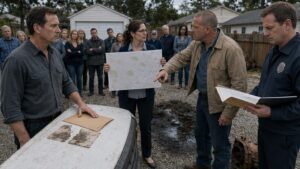
Richard held Frank’s signed repair disclosure above the hearing table before Frank had taken his seat.
“This document was filed only after enforcement began,” he said. “It confirms that regulated work occurred without notice or inspection.”
The county meeting room was nearly full. Briar Glen residents occupied two rows behind Richard. Ruth sat among them, though she had left the chair beside her empty. Jacob waited near the wall with a folder pressed against his leg.
Frank placed the blue binder on the table.
Mary sat to his right. She had arranged the evidence in narrow stacks: parcel records, photographs, board minutes, the drainage agreement, water-sample reports, and two maps.
The hearing chair adjusted the microphone.
“Mr. Clark, this is not a trial. The issue is whether emergency inspection and compulsory access are justified.”
Richard lowered the form. “The association believes they are. We have surfacing water, two damaged homes, and an uninspected septic repair uphill.”
Frank looked past him at Ruth. She did not look away.
The hearing chair turned to Mary. “Does Mr. Miller contest the repair violation?”
“No,” Frank said before Mary could answer.
The room shifted.
He continued. “I replaced a failed distribution box six years ago. The work should have been reported. It was not.”
Richard glanced toward the residents, as if inviting them to understand the admission.
Frank opened the blue binder but did not yet turn the pages.
“I will accept the county’s inspection of that repair and any lawful filing penalty.”
Mary’s hand remained still beside her notes.
The chair nodded. “Then the unreported work is established. The remaining question is scope.”
Richard displayed the photograph of wet ground beside Frank’s fence.
“The discharge appeared within the affected boundary area.”
Frank placed his own photograph next to it. In his image, the brass survey pin was visible beneath the measuring tape.
“The fence is not the boundary.”
A county survey map appeared on the wall screen. Mary had arranged for a licensed surveyor to confirm the marker that morning. The wet patch lay fourteen feet inside Briar Glen’s recorded drainage easement.
Richard said, “Water can cross property lines.”
“It can,” Frank replied. “That is why source matters.”
He unfolded the old contour map and placed it beside Briar Glen’s current grading plan.
The first showed the land before construction: long, unbroken elevation lines descending east and south. The second showed roads, filled lots, the ornamental pond, buried utilities, and the swale beside Frank’s parcel.
Frank set Ruth’s first jar of cloudy water near the old map. Beside it, he placed three labeled county sample bottles collected from Ruth’s wall, the wet patch, and the inspection port above his distribution box.
“The sample near my system shows normal bacterial levels for groundwater adjacent to an operating residential field,” he said. “The samples from the wet patch and Mrs. Jones’s basement share elevated suspended clay, limestone fines, and treatment compounds associated with pond maintenance.”
Richard rose. “Mr. Miller is not a laboratory specialist.”
“The county laboratory issued the results,” Mary said. “He is explaining the physical route.”
The chair looked at Frank. “Proceed, but distinguish your interpretation from the laboratory findings.”
Frank nodded.
He used a transparent ruler to connect the pond, the sunken trench, and Ruth’s basement.
“The original overflow was designed to move east into a lined channel. After the pond edge was raised, overflow entered disturbed fill on the western bank. Water followed a capped drainage trench downhill.”
He placed a photograph of the cut black pipe beside the maps.
“It then surfaced near the fence and entered utility backfill leading toward the affected homes.”
Richard shook his head. “That is speculation.”
Frank turned the blue binder to a handwritten margin note.
Groundwater will follow disturbed fill before native slope.
“I wrote that during the 2008 septic revisions because county enforcement had been treating distance as if it mattered more than flow. The purpose statement required inspectors to consider slope, soil disturbance, and artificial drainage.”
He opened Richard’s clean ordinance copy, which Mary had obtained through discovery, to the same section.
Richard’s version included the words but none of the drafting notes that explained them.
Frank placed his unreported repair disclosure beside the confidential drainage agreement.
“One document shows what I failed to do. The other shows what the HOA was trying to obtain before it accused my system.”
Mary distributed copies of the board minutes.
The hearing chair read silently. Her expression changed when she reached the date.
“Mr. Clark, the land-access proposal predates the septic complaint by nearly three months.”
Richard remained standing. “Because the water problem predates the complaint.”
“Why was the proposal not included in your petition?”
“It was a confidential developer negotiation.”
“You asked the county to compel access along substantially the same route.”
“The route is the most practical solution.”
“That was not my question.”
Richard looked at the residents behind him. Several held repair estimates or insurance folders on their laps.
“If I disclosed the developer’s condition before we had leverage,” he said, “they would walk away. The association does not have the reserves to rebuild the outlet. Some owners cannot survive another assessment.”
His voice had lost its polished cadence.
“I was trying to keep families in their homes.”
Frank believed him.
That did not make the notice honest.
The chair turned toward Jacob. “Mr. Moore, did county staff know the parcel exceeded two acres when the violation was approved?”
Jacob came forward.
“Yes.”
“Did you raise the issue?”
“Yes.”
“Was the complaint independently inspected?”
“No.”
“Why did you sign?”
Jacob swallowed. He looked once at his supervisor seated near the rear wall.
“I was instructed to process the notice as a preliminary health action. I knew the citation did not fully match the parcel. I signed because I was afraid refusing would cost me my probationary position.”
The room became very quiet.
Jacob removed a printed email from his folder.
“I documented the mismatch after the porch visit. I also noted that the requested access corridor exceeded the mapped septic area.”
He handed the email to the chair.
Richard sat down.
The chair reviewed the page, then looked at Frank. “Your technical explanation is persuasive, but the record shows you raised concerns about western drainage before Briar Glen was approved. Why is that report absent from the county file?”
Mary turned toward him.
Frank had known the question might come. Knowing did not make the answer easier.
“My wife became ill during the review,” he said. “I withdrew from the commission and did not complete the presentation.”
“Did you provide your supporting calculations to the engineer who replaced you?”
“No.”
“Why not?”
Frank looked down at the blue binder.
“Because after she died, I wanted nothing more to do with the county, the development, or anybody who believed a meeting could wait while a person could not.”
No one moved.
He continued. “That decision was mine. The design problem was not mine, but my silence made it easier to forget the warning.”
Ruth stood from the second row.
“May I speak?”
The chair allowed it.
Ruth described the water in her basement, the board’s warnings about property values, and her decision to support Richard’s complaint because she believed Frank’s old system was threatening her home.
“Mr. Miller came into my basement after I stood at his gate and watched him be humiliated,” she said. “He did not ask me to apologize first.”
She sat down.
The chair recessed for fifteen minutes.
When the hearing resumed, she denied the request for compulsory access based on a septic emergency. She ordered a limited inspection of Frank’s repaired component, suspended the daily fines, and referred Briar Glen’s drainage system for independent review.
The decision should have felt like victory.
Instead, Frank looked at the residents behind Richard. Relief had not reached them. The ruling proved what was not causing the water. It did not remove one gallon from Ruth’s basement.
The chair gathered her papers. “Until the review is complete, the county has no authority to impose a drainage route across private land without consent.”
Frank stood.
Mary caught his sleeve. “Think before you speak.”
He did.
Then he opened the blue binder to the original downstream-access appendix he had reconstructed from his notes.
“I will consent to a temporary route.”
Richard looked up.
Frank faced the chair.
“Not a permanent easement. A monitored line for emergency overflow only, installed at the developer’s expense, with county sampling points, restoration bonds, and automatic termination when a lawful permanent system is completed.”
Mary’s grip loosened.
“The route stays inside a marked corridor,” Frank continued. “No transfer of ownership. No expansion without written consent. The brass pin remains the boundary.”
The chair studied him. “You understand that allowing access may complicate later litigation.”
“Yes.”
Richard rose slowly. “Why would you agree now?”
Frank closed the binder.
“Because being right about where the water came from does not make the water stop.”
Chapter 7: The Boundary That Became a Promise
The survey crew stopped ten feet short of the brass pin and waited.
Frank watched from the lower pasture as the lead surveyor raised both hands away from the equipment, making it clear no one intended to cross the line without permission. Behind the crew sat a compact excavator, two county trucks, and a flatbed carrying black drainage pipe wrapped in plastic.
Six weeks earlier, men had painted across his grass before sunrise.
Now they stood outside the boundary until he walked down.
The brass pin had been cleaned and capped with a bright protective marker. Frank disliked the color, but he had approved it. Temporary construction stakes followed a narrow corridor through the lower acre, avoiding the walnut saplings and stopping well above the creek buffer.
The surveyor held out a revised access plan.
“Twenty-foot working width during installation,” he said. “Eight-foot monitored corridor afterward. No equipment storage outside the marked area. Restoration bond is posted.”
Frank checked the bearings against the copy in his blue binder.
Mary had taught him not to answer before reading the last page.
He turned to the termination clause. The temporary license would expire when the county approved a permanent stormwater system or after eighteen months, whichever came first. Any extension required Frank’s written consent. The HOA received no development rights, no utility expansion rights, and no claim of adverse use.
“The sampling vault moved three feet east,” Frank said.
“To avoid the root zone.”
“Good.”
He signed the field authorization.
Only then did the crew cross the pin.
Work began with less drama than the dispute that had made it necessary. The excavator peeled away strips of grass. The soil technician checked each layer. County staff photographed the trench depth and bedding material. Frank remained nearby, not as an owner defending a siege but as a man unwilling to let another important detail become someone else’s assumption.
The temporary line intercepted overflow below the ornamental pond and carried it through a sealed pipe to a monitored outlet above the creek buffer. Automatic valves would close if the water exceeded agreed contamination thresholds. The developer had paid for the installation while formally denying responsibility.
Their lawyers had made certain that sentence appeared on every document.
The county’s independent review was not finished. Early findings identified unauthorized changes to the pond lip, a capped drainage segment, and inadequate records for the maintenance work. The developer blamed a subcontractor. The subcontractor blamed instructions from the HOA’s former landscape committee. The liability dispute would continue long after the trench grass grew back.
Frank found that unsatisfying.
He also found he could live with it.
At noon, Ruth came down the path carrying sandwiches and a thermos. She had stopped wearing the expression of someone waiting to be contradicted.
“My basement stayed dry through Tuesday’s storm,” she said.
Frank looked toward the development. Tuesday had brought nearly two inches of rain.
“That’s one storm.”
“It’s the first one in nine months I didn’t spend moving boxes.”
She handed him a sandwich wrapped in wax paper.
“Then it’s a useful storm.”
Ruth smiled. “You could simply say you’re glad.”
“I’m eating your sandwich. Don’t ask for two miracles.”
Mary arrived while the crew was setting the sampling vault. She carried a county envelope and the blue binder’s missing appendix in a new archival sleeve.
“The final septic determination came,” she said.
Frank wiped his hands before taking the envelope.
The county had withdrawn the setback violation in full. The limited inspection found the replacement distribution box level, sound, and properly connected. No discharge had been detected from Frank’s system.
A separate administrative order imposed a four-hundred-dollar penalty for failing to file the repair notice.
Frank read that paragraph twice.
Mary watched him. “You can appeal.”
“No.”
“I thought you might say that.”
“I should have filed.”
“That sentence would have saved us several meetings.”
“It would have deprived you of professional exercise.”
She folded her arms, but the corner of her mouth moved.
A vehicle came slowly down the service road and stopped near the pasture gate.
Richard Clark stepped out.
He wore an open-collar shirt instead of the navy blazer. The Briar Glen crest was nowhere on him. Two weeks after the hearing, the board had removed him as its representative in the drainage negotiations. He remained a resident, but not president. The board minutes described the change as a temporary governance measure pending review.
No one believed it was temporary.
Richard carried a document folder, though not the leather one he had brought to Frank’s porch.
Ruth became still.
Richard approached the brass pin and stopped on the other side.
“I was told the access agreement needs my signature as prior negotiating representative,” he said.
Mary held out the signature page across the line. “It confirms that the earlier proposal is superseded and carries no continuing claim.”
Richard read it without stepping forward.
Beyond him, the ornamental pond had been lowered by eighteen inches. Its stone edge looked unfinished, almost honest.
“You got what you wanted,” Richard said to Frank.
Frank glanced at the trench cutting through his own field. “No.”
Richard followed his gaze.
Frank continued. “What I wanted was for none of you to come onto my property.”
“And yet here they are.”
“They asked.”
Richard looked toward Ruth. “The board would have approved repairs sooner if people had understood the cost.”
Ruth answered before Frank could.
“We understood the cost you showed us. We did not understand the bargain you hid.”
Richard’s face tightened. “I was trying to prevent families from losing their homes.”
“And nearly took part of his to do it,” she said.
For several seconds, only the excavator’s idling engine filled the space between them.
Richard signed.
He returned the page to Mary and looked at Frank.
“I still think you could have helped earlier.”
Frank felt the old defense rise—the report he had written, the commission he had left, the wife he had been losing while other people discussed drainage slopes under fluorescent lights.
This time, he did not use any of it as a wall.
“You’re right,” he said. “I could have.”
Richard seemed unprepared for the answer.
Frank added, “That did not give you the right to lie about my septic system.”
“No.”
It was not an apology. Frank had not expected one.
Richard walked back toward his car without offering his hand.
By late afternoon, the crew had covered the pipe and spread seed over the restored corridor. The brass pin remained visible at the edge, untouched.
Frank climbed the hill with Mary after the last truck left. The farmhouse looked no newer than it had on the morning of the notice. The gutter still needed replacing. Paint still peeled beneath the eastern window.
On the porch, Mary opened the blue binder.
Frank had agreed to let the county scan the drafting notes, amendment history, and reconstructed drainage appendix for staff training. The original pages would stay with him. A clean digital copy would be placed in the county archive where a young inspector would not have to rely on someone’s memory or an HOA’s cropped map.
Mary slid the county filing receipt behind the repaired-system inspection.
“You should keep this one where you can find it,” she said.
“I found the last one.”
“Six years late.”
She closed the binder.
Frank rested his hand on its weathered cover. For years it had been proof that he had once mattered in rooms where decisions were made. Then it became a shield against people who arrived carrying newer paper.
Now it held something less flattering and more useful: the rule he had written, the warning he had withdrawn, the repair he had failed to report, and the agreement that let water pass without surrendering the land beneath it.
Mary placed the binder on the porch table between the two rocking chairs.
Below them, the restored corridor followed the slope in a straight dark line. At its edge, the brass pin caught the last light.
It still marked where Frank’s property ended.
It no longer marked where his responsibility did.
The story has ended.