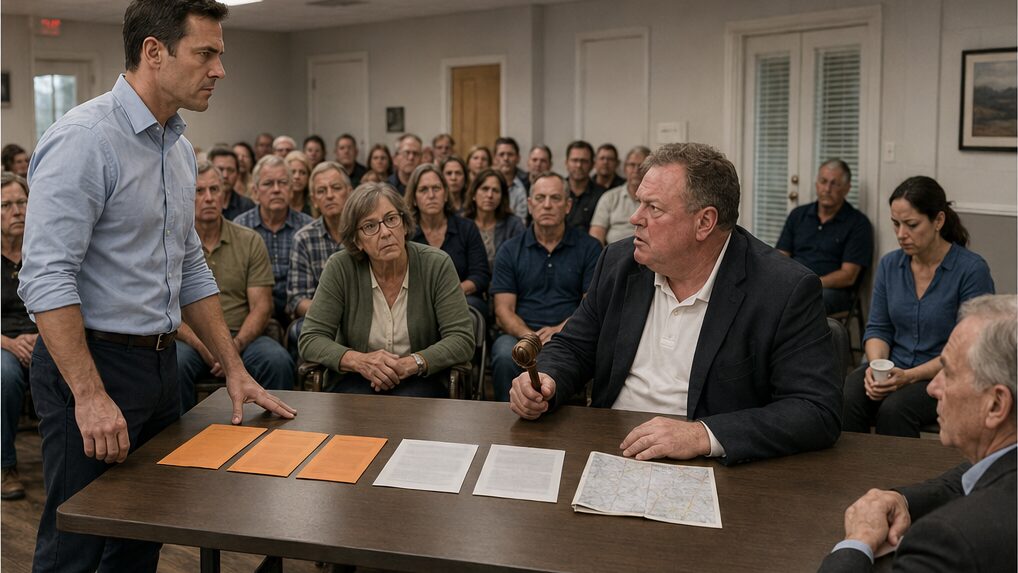
The HOA Fined His Empty Driveway Until He Read Their Own Numbers Aloud
Chapter 1: The Orange Notice Beneath His Windshield
Amanda Lee raised her phone before Jacob Carter had finished pulling the orange notice from beneath his windshield wiper.
The camera shutter clicked.
“What are you photographing?” Jacob asked.
“The violation,” she said.
“You’re photographing me.”
Amanda lowered the phone only slightly. Her reflective vest hung open over a gray T-shirt, and a clipboard was tucked against her ribs. Beyond her, half the street had disappeared beneath the neighborhood’s summer block event. Folding tables crowded one curb. Aluminum trays steamed beneath foil. A blue-and-yellow inflatable castle shuddered beside the sidewalk, fed by an orange extension cord stretched across the grass.
Cars lined both sides of the road.
Robert Hill’s black pickup sat nearest the intersection with two tires over the painted edge of a fire-access zone. His wife’s SUV was angled behind it, close enough to the corner that a turning vehicle would have to swing wide.
Jacob’s sedan stood alone in front of his own house.
And it had a ninety-dollar citation under the wiper.
Amanda looked toward the tables. Robert was standing beside a cooler with one hand on his belt, watching them.
Jacob held up the notice. “Why is my car the only one with a ticket?”
“The event zone was posted.”
“Where?”
“On the community calendar and at the entrances.”
“That doesn’t answer the question.”
A few heads turned. The nearest table quieted just enough for Jacob to feel the silence gather around him.
Amanda glanced at Robert again. “Your vehicle was in a restricted area.”
Jacob looked past her. “His truck is half in the fire lane.”
Robert pushed away from the cooler and approached without hurrying. He was broad through the shoulders, his white polo stretched across his stomach, his expression arranged into the patience of someone who expected to be obeyed.
“The restricted zone is clearly posted,” he said. “We’ve sent three emails.”
Jacob tapped the notice with one finger. “Then ticket everyone in it.”
“This isn’t the place for an argument.”
“You made it the place when you put this on my windshield.”
Robert’s eyes narrowed. “You’ve had concerns before about event access.”
Jacob knew what he meant. In May, Robert had wanted to stage delivery vans along the curb in front of Jacob’s driveway during the neighborhood yard sale. Jacob had objected because his garage was the only practical entrance to the house for his father’s wheelchair when he visited. Robert had called him inflexible. Jacob had called the plan careless.
The disagreement had never quite ended.
Amanda shifted her clipboard. “You can appeal online.”
“Did you write this ticket?”
“I processed it.”
“That isn’t what I asked.”
Her face hardened. “My name is on the notice.”
“So you wrote a citation for a zone that somehow excludes every board member’s car?”
Robert stepped between them by half a pace. “Watch your tone.”
The words struck harder than they should have. Jacob felt the old heat rise behind his ribs—the same heat that had ruined a meeting at work two years earlier, when he had been correct about a corrupted traffic dataset and still became the person everyone remembered as difficult.
He unfolded the notice instead of answering.
The citation listed the event restriction as Palmer Lane, east side, from Brookfield Drive to the cul-de-sac.
Jacob read it twice.
His house was on Larkspur Court.
He turned toward the corner. Palmer Lane began two streets away.
“This isn’t even my block.”
Amanda’s lips parted, but Robert spoke first.
“The event zone covers connected access streets.”
“Not according to this.”
“The posted map governs.”
“Then show me the map.”
Robert gestured toward the clubhouse end of the street. “It’s on the board.”
Jacob walked past them.
The event swallowed him as he moved between coolers, lawn chairs and children carrying paper plates. People watched without appearing to watch. Near the inflatable castle, a temporary bulletin board held a laminated map beneath the heading SUMMER SOCIAL TRAFFIC PLAN.
Jacob stopped in front of it.
The marked restriction ran along Palmer Lane and Brookfield Drive. A blue line ended at the corner before Larkspur Court.
His street was not shaded, circled or labeled.
He took out his phone and photographed the entire board, then the map, then the nearest curb sign in front of his house. The metal sign read NO PARKING WITHIN 15 FEET OF INTERSECTION. His car was more than forty feet from the corner.
When he returned, Amanda was writing something on her clipboard.
Jacob held the phone where she could see it. “The map ends before my street.”
Robert barely looked. “That may be an outdated copy.”
“It’s the one posted at the event.”
“The online version may be current.”
“May be?”
Robert’s jaw tightened. “Submit your appeal.”
Jacob looked at Amanda. She would not meet his eyes.
“You knew this address wasn’t on the map,” he said.
“I entered the violation I was assigned.”
“You photographed my car. You put your name on the ticket.”
“I did my job.”
“No. You falsified a citation.”
The words landed in the open space between them.
Amanda’s head snapped up. Her expression changed from defensive to wounded, then sealed over.
“I didn’t falsify anything.”
“You cited a location that isn’t here.”
“I said you can appeal.”
Robert stepped closer. “That accusation is inappropriate.”
Jacob heard someone behind him murmur his name. Across the street, Catherine Mitchell stood at the edge of her driveway with a grocery bag in each hand. Her eyebrows had drawn together, not in support but warning.
Jacob should have stopped.
Instead, he pointed toward Robert’s truck. “If this is about access, start there.”
Robert turned enough to follow his gesture. “Board vehicles are supporting the event.”
“Then the rule isn’t about access. It’s about permission.”
“You’re disrupting a community function.”
“And you’re charging me ninety dollars for parking at my own curb.”
Robert’s voice dropped. “Use the process.”
Jacob folded the orange notice along its original crease. “I will.”
He walked back to his house while conversations restarted behind him in scattered pieces. The inflatable blower droned steadily. Someone turned the music louder.
Inside, he laid the citation on the kitchen counter and opened the HOA portal.
The appeal form allowed five hundred characters and one attachment. Jacob uploaded a photograph combining the ticket, the posted map and the curb sign. He wrote that the cited restricted segment did not include Larkspur Court, that his vehicle was legally parked, and that comparable vehicles inside the marked zone had not been cited.
He deleted the sentence accusing the board of retaliation.
Then he typed it again.
He deleted it a second time before submitting.
At 4:18 p.m., the portal confirmed receipt.
By six, the event had begun to thin. Robert’s truck remained at the corner. No orange notice appeared beneath its wipers.
At 10:27 that night, Jacob’s phone vibrated on the coffee table.
APPEAL DECISION AVAILABLE.
He opened the message.
Violation upheld. Posted restrictions deemed sufficient. Administrative review fee: $15.
Total due: $105.
Jacob stared at the timestamp. Six hours and nine minutes had passed since submission, most of them outside the management office’s posted business hours.
At the bottom of the decision was a reviewer code rather than a name.
RV-04.
He read the message once more, then looked toward the kitchen counter where the orange notice lay beneath the light.
Someone had reviewed his appeal very quickly.
Or no one had reviewed it at all.
Chapter 2: Three Tickets That Could Not All Be True
The second orange notice was fastened to Jacob’s driveway gate on a morning when there was no car in the driveway.
He found it at 6:40 on his way to work, folded beneath the metal latch as neatly as a restaurant receipt.
VIOLATION: OBSTRUCTION OF COMMUNITY CLEANUP ACCESS.
DATE OBSERVED: 6:15 A.M.
Jacob looked through the gate at the empty concrete leading to his garage.
His sedan was parked three miles away at a repair shop, where it had spent the night for a brake replacement.
He photographed the gate, the driveway and the notice before touching anything. Then he called the repair shop and asked the service clerk to email confirmation of the vehicle’s overnight intake.
Only after the message arrived did he remove the citation.
The fine was eighty-five dollars.
By eight, a cleanup crew had begun stacking branches near the clubhouse. Robert’s pickup sat partly across the loading lane with a magnetic HOA sign fixed to its door. Two volunteers were hauling bags around it.
Jacob stood at the curb taking photographs until Catherine crossed the street in gardening gloves.
“You planning to document the whole neighborhood?” she asked.
“Just the parts that keep charging me money.”
She looked at the notice in his hand. “Another one?”
“They cited my empty driveway.”
Catherine removed one glove finger by finger. She had served as HOA treasurer years earlier and still carried herself like someone who expected columns to balance.
“Show me.”
Jacob handed her the notice and the repair-shop email.
She read both. “The cleanup access line is along the clubhouse lot.”
“Exactly.”
“Your driveway isn’t part of it.”
“Exactly.”
Catherine glanced toward Robert’s truck. “That vehicle has been in the loading lane since before seven.”
“And no ticket.”
“That doesn’t prove your ticket was deliberate.”
Jacob laughed once. “What would?”
“A pattern that survives your anger.”
He took the notice back. “You think I’m imagining this?”
“I think you were loud enough last Saturday that half the block stopped listening to the facts.”
“He ticketed me outside my house.”
“And you accused Amanda of falsifying a government document in front of her neighbors.”
“It isn’t a government document.”
“You know what I mean.”
Jacob did know. That made it worse.
Catherine pointed toward the truck. “Photograph the obstruction. Save the service record. Contest the ticket. Don’t give Robert a reason to make your behavior the subject.”
“My behavior isn’t the subject.”
“Then stop helping him change it.”
At work, Jacob placed the first two notices side by side inside a clear folder.
His office occupied the third floor of the municipal services building, far from the public counters. Most of his day involved identifying anomalies in traffic-enforcement feeds before they entered monthly reports: duplicate plates, impossible coordinates, timestamps outside patrol shifts, addresses that accumulated unusual volumes.
He understood what a bad record looked like.
He also understood the difference between understanding a system and having permission to search it.
The HOA citations were private records, not city violations. He could not use municipal databases to investigate neighbors, and he would not risk his job pretending otherwise.
He built a personal log instead.
Date. Time. Claimed location. Actual vehicle location. Posted restriction. Comparable vehicles. Appeal status. Reviewer code.
The first appeal listed RV-04.
When the second appeal was denied the following afternoon, it carried the same code.
The management company added another fifteen-dollar review fee.
Total due: $205.
That evening, Robert sent a community email reminding residents that accounts with unpaid balances could lose certain membership privileges, including voting eligibility where permitted by the bylaws.
Jacob read the sentence three times.
It did not mention him.
It did not need to.
He forwarded the message to a private folder and added a note to his log: possible consequence beyond fines.
Four days later, Jacob drove to a regional training conference in Oakridge, nearly two hundred miles away. He bought gas at 7:12 Saturday morning, checked into the conference center before nine and paid for lunch with his credit card at 12:43. His sedan remained in the hotel lot until Sunday.
When he returned home, a third orange notice was waiting in his mailbox.
IMPROPER EVENT-ZONE PARKING.
DATE OBSERVED: SATURDAY, 1:10 P.M.
LOCATION: LARKSPUR COURT.
Jacob stood beneath the porch light with the envelope open in one hand and his overnight bag in the other.
For several seconds, he felt nothing.
Then the stillness broke into a clean, almost calming certainty.
He carried the notice inside and arranged all three across the kitchen table.
The first claimed his car was in a restricted zone that ended two streets away.
The second claimed his empty driveway obstructed cleanup access.
The third placed his vehicle on Larkspur Court while it was sitting in a hotel parking lot in Oakridge.
He laid the gas receipt, hotel receipt and conference badge beside it.
Three tickets.
Three different failures.
A total of $295 once the latest fee was assessed.
Catherine came over after he texted her a photograph. She stood at the table without removing her coat.
“You have the hotel receipt?”
He slid it toward her.
“Gas?”
He added that too.
“Conference registration?”
He opened the confirmation on his phone.
Catherine studied the documents, then looked at the orange notices arranged like warning flags.
“All right,” she said.
It was the first time she had sounded convinced.
Jacob leaned against the counter. “All right what?”
“This is not normal.”
He waited for satisfaction. Instead, he felt tired.
Catherine tapped the second notice. “During the cleanup, Robert’s truck blocked the loading lane for at least an hour. I watched volunteers carry bags around it.”
“Would you put that in writing?”
Her expression tightened.
Jacob saw the hesitation before she answered.
“I’ll confirm what I saw. I won’t say why anyone did anything.”
“That’s enough.”
“Is it?”
“It has to be.”
The next morning, Jacob called the property-management company.
A representative listened while he recited the three notice numbers.
“I’m requesting the name or title of the person associated with reviewer code RV-04,” he said.
“We don’t disclose individual staff assignments.”
“Then disclose whether it was reviewed by staff or by the HOA board.”
“I can’t provide internal workflow information.”
“One citation says my car was at home when I was two hundred miles away.”
“You may submit supporting documentation.”
“I already did on the other two.”
“Then the board will consider it.”
“The board?”
There was a pause.
“The association’s designated reviewer.”
“Is that a board member?”
“I’m not authorized to answer that.”
Jacob gripped the phone tighter. “Who is authorized?”
“You may submit a records request through the portal.”
“How long does that take?”
“Up to thirty business days.”
“The fines are due before then.”
“I understand your concern.”
“No, you understand the sentence you’re trained to say when you don’t intend to answer.”
The representative’s tone cooled. “Mr. Carter, I have explained the process.”
Jacob closed his eyes.
There it was again—the moment when being right became less useful because of the way he carried it.
He lowered his voice. “Please note that I requested the reviewer’s identity and that the company declined.”
“I can note your call.”
When the line disconnected, Jacob opened his log and added one more entry.
Reviewer identity requested. Refused.
He stared at the three orange notices.
Until then, he had been trying to prove the tickets were wrong.
Now he needed to know whether they were wrong in the same way by accident—or wrong in different ways for the same reason.
Chapter 3: The Pattern Hidden Inside Eleven Events
The reviewer code was identical on all three denials.
Jacob noticed it at 7:18 on a Monday morning, under the fluorescent lights of his office, while pretending to prepare a routine quality report.
RV-04.
The same code appeared beneath the first decision issued after business hours, the empty-driveway citation and the notice from the Saturday he had spent in Oakridge.
He wrote the code on a yellow legal pad, then drew a box around it.
A shared reviewer did not prove targeting. It might mean one employee handled every HOA appeal. It might be an automated account. It might be a generic login used by the property manager.
But sameness inside otherwise inconsistent records mattered.
Jacob minimized the file when a coworker passed his desk.
He had already decided what he would not do. He would not search municipal plate data. He would not run neighbors through city systems. He would not use restricted tools merely because the HOA had made him angry.
Instead, during lunch, he submitted a public-records request for event permits, temporary traffic plans and fire-access notices associated with his subdivision over the previous eighteen months. Those records were open to anyone.
For HOA data, he used the association’s member portal, archived newsletters and meeting packets. Citation totals appeared in monthly financial summaries without resident names. Event schedules identified dates. Board directories and publicly visible vehicles supplied household categories, but Jacob reduced them to labels before analysis: board household, non-board household, unknown.
He wanted a result another person could reproduce without trusting him.
That evening, his kitchen table disappeared beneath printouts.
Catherine sat opposite him with reading glasses low on her nose.
“You counted this one twice,” she said.
Jacob leaned over. “No, those are separate events.”
“Same date.”
“One is the spring cleanup. One is the food drive.”
“Then your event unit is unclear.”
He took the page back, irritated. “The HOA listed them separately.”
“And if Robert says you inflated the count?”
Jacob crossed out one row.
Catherine continued working.
For eleven events, they compared enforcement totals by address category. Some months included only revenue figures. Others listed notice counts. Jacob reconciled them against appeal logs and event summaries, marking every uncertain entry rather than forcing a conclusion.
At 10:30, Catherine tapped two dates.
“You didn’t own the sedan yet.”
Jacob checked the purchase record.
She was right.
The HOA ledger showed enforcement activity associated with his address during two events before he had bought the vehicle named in the later citations.
“That could be the previous owner’s car,” Catherine said.
“The previous owner moved six months earlier.”
“Could be a guest.”
“Could be.”
“Mark it uncertain.”
Jacob did, though the word felt like surrender.
By midnight, they had excluded the two questionable events, removed one duplicate and separated warnings from fines.
The pattern remained.
His address had received nine enforcement flags across eleven community events.
No other household on his block had more than four.
Three households associated with current board members had received none.
Zero warnings. Zero citations. Zero appeal fees.
Catherine took off her glasses.
“Well,” she said quietly.
Jacob looked at the spreadsheet, waiting for triumph.
What came instead was a pressure behind his sternum.
The numbers were cleaner than his anger had been.
He printed a summary, then stopped before sending it.
At the top of the page he had written SELECTIVE TARGETING BY BOARD LEADERSHIP.
He deleted the title.
In its place, he typed PARKING ENFORCEMENT DISTRIBUTION: ELEVEN ASSOCIATION EVENTS.
Catherine noticed.
“That’s better.”
“It says less.”
“It claims only what you can prove.”
He knew she was right, which made him resent her for several seconds.
The next morning, Amanda emailed him.
The subject line read: NOTICE OF FORMAL COMPLAINT.
Her message was brief. She stated that Jacob had publicly accused her of falsifying citations, that the accusation had harmed her reputation, and that she was requesting the board address his conduct at the next meeting.
Jacob read it twice.
Then a third time.
His first reaction was contempt. Three impossible citations had been issued in her name, and she was complaining about reputation.
His second reaction was less comfortable.
He had accused her before checking how the process worked.
He opened a reply.
Your name appears on documents containing false information.
He deleted it.
He tried again.
The citations contain factual errors that require explanation. I should not have stated publicly that you personally falsified them before knowing the review process.
He stared at the sentence.
It felt like conceding ground Robert would use.
He saved the reply as a draft.
That afternoon, the public-records response arrived from the city. The temporary traffic plan matched the map Jacob had photographed. Larkspur Court was not included in the approved event restriction.
The city’s fire-access advisory applied only to Palmer Lane and the clubhouse approach.
The first ticket was not merely inconsistent with a neighborhood sign. It contradicted the submitted plan.
Jacob added the city record to his evidence file.
Then he compared timestamps.
The first citation had been entered at 2:14 p.m. The appeal was denied at 8:27 p.m. The management office closed at five.
The second and third denials were also issued outside business hours.
All three bore RV-04.
The code had become the most important unanswered line in the file.
At dinner, Catherine returned with a notebook.
“I asked around without asking around,” she said.
Jacob raised an eyebrow.
“People remember which events had parking notices. They don’t remember exact plates. Don’t turn gossip into data.”
“I wasn’t planning to.”
“You always say that after you look interested.”
She opened the notebook. Two neighbors recalled seeing orange notices near Jacob’s house during events when Jacob’s own vehicle was absent. Another remembered Amanda walking with a handwritten sheet rather than checking every curb.
“A handwritten sheet?” Jacob asked.
“That’s what she thinks she saw.”
“Who gave it to Amanda?”
“She doesn’t know.”
Jacob looked toward the legal pad where RV-04 sat inside its box.
The question had shifted.
It was no longer simply who reviewed the appeals.
Someone might have selected vehicles before Amanda ever reached the street.
The HOA meeting packet arrived by email the following morning.
Jacob opened the agenda.
Landscaping contract. Pool maintenance. Holiday lighting bids. Resident conduct complaint regarding public accusations.
His parking-enforcement presentation appeared last, beneath OTHER BUSINESS, with five minutes allocated.
Amanda’s complaint appeared near the beginning.
Robert had arranged the evening so Jacob would be discussed before his evidence was heard.
At the bottom of the packet, a note stated that meetings could be adjourned at the chair’s discretion if business exceeded the reserved clubhouse time.
Jacob printed the agenda and placed it beside the two-page statistical summary.
Then he opened the draft to Amanda.
He removed the defensive first line and sent the rest.
I should not have said you personally falsified the citation before I understood the process. The citations still contain serious factual errors, and I intend to address them. But that accusation went beyond what I could prove.
Amanda did not reply.
An hour later, Robert sent a community-wide reminder that personal attacks would not be tolerated at the meeting.
Jacob folded the curb-zone map along its worn creases. He placed it in a folder with the three orange notices and the two pages of totals.
Robert had given him five minutes at the end of the night.
The unanswered question was whether he intended to let those five min
Chapter 4: Nine Citations Against One Address
Robert Hill announced the two-minute speaking limit before Jacob had even reached the front table.
“The clubhouse reservation ends at nine,” Robert said, tapping the printed agenda with the wooden handle of his gavel. “To ensure every resident has an opportunity to be heard, comments under Other Business will be limited to two minutes.”
The clock above the exit read 8:31.
Jacob stopped beside the last row of folding chairs.
Amanda’s complaint had taken seventeen minutes.
Robert had read her written statement aloud, then allowed the board vice president to ask questions about civility, volunteer protection and the dangers of “publicly maligning residents who serve this community.” Amanda sat near the wall in a plain blue blouse, hands clasped around a paper cup. She had not looked at Jacob once.
When Robert asked whether Jacob wished to respond, Jacob had stood and said only, “I sent Ms. Lee a correction regarding the accusation I could not support. I stand by the factual errors in the citations.”
Robert had leaned toward the microphone. “This agenda item concerns conduct, not parking.”
Now parking had been pushed to the final half hour, behind landscaping amendments and a debate about whether holiday lights could remain on porch railings past January fifteenth.
Jacob walked forward carrying a black folder.
Catherine sat three rows behind him. As he passed, she said quietly, “Facts first.”
He nodded.
The clubhouse smelled of burnt coffee and the lemon cleaner used on the tile floor. Nearly every chair was occupied. Some residents had come because of the community email. Others had come because arguments in a small neighborhood traveled faster than official notices.
Robert looked at the folder. “You have two minutes, Mr. Carter.”
“The agenda gives me five.”
“The chair has adjusted the limit.”
“After the earlier item received seventeen?”
A few residents shifted.
Robert’s expression did not change. “Would you like to use your time debating procedure?”
The old heat pressed into Jacob’s throat.
He placed the folder on the table instead.
“No.”
He removed the three orange notices and laid them in date order. Then he unfolded the curb-zone map and placed it beside them. Last came two printed pages, each held flat beneath a paper clip.
Robert glanced toward the meeting parliamentarian, who started a timer.
Jacob faced the room.
“I reviewed eleven association events over the last eighteen months using meeting packets, financial summaries, event dates and publicly available city traffic plans.”
“Mr. Carter,” Robert said, “the board has not verified your methodology.”
“I’m not asking anyone to trust a conclusion.”
The timer showed 1:42.
Jacob lifted the first notice.
“This citation says my car was parked inside a restricted event zone. The city-approved map ends two streets before my house.”
He lifted the second.
“This citation says my driveway obstructed cleanup access at 6:15 in the morning. My car had been at a repair shop overnight.”
He lifted the third.
“This one places my car on Larkspur Court while I was attending a conference in Oakridge.”
Robert folded his arms.
Jacob set the notices down.
“Those are the individual records. These are the totals.”
He touched the first printed page.
“Nine enforcement flags against one address.”
No one moved.
He touched the second line.
“Zero against three board households whose vehicles were present at multiple events.”
The timer emitted a soft electronic beep.
Robert reached for the gavel.
Jacob did not raise his voice.
“Nine against one address. Zero against three board households.”
The gavel struck once.
“Your time has expired.”
A woman near the back said, “Wait.”
Robert looked toward her. “There will be no interruptions.”
“Were board cars exempt?” another resident asked.
Robert’s hand remained on the gavel. “Operational vehicles supporting association events may receive practical accommodations.”
“Where is that written?” Catherine asked.
Robert found her in the crowd. “Former board members should know that event operations require discretion.”
Catherine stood. “I know exactly what the old policy said. It did not create household exemptions.”
The room changed.
Until that moment, the residents had been watching Jacob present a complaint. Now they began looking toward the board table.
Sharon Baker sat to Robert’s right with the meeting minutes open in front of her. She turned one page, then another, too carefully.
Jacob noticed.
A man in the second row raised his phone and began recording. The screen cast a pale rectangle across his face.
Robert’s cheeks darkened.
“What Mr. Carter has presented is cherry-picked data,” he said. “He has no access to complete enforcement records, no authority to determine event exemptions and no basis for assigning motive.”
“I didn’t assign motive,” Jacob said.
“You accused a volunteer of falsification.”
“I corrected that accusation.”
“You made it publicly.”
“And I corrected it in writing.”
Robert leaned forward. “After the damage was done.”
Amanda looked down at her cup.
Jacob felt the room turning toward the part of the story he wanted least to defend. Robert had chosen his strongest point.
Jacob could attack him. He could say the complaint was a diversion. He could remind everyone that three impossible citations remained impossible no matter how badly he had behaved.
Instead, he looked toward Amanda.
“I was wrong to say she personally falsified the first notice before I knew how the process worked.”
Amanda finally raised her eyes.
Jacob continued. “That does not make the location accurate. It does not put my car in an empty driveway. It does not move me back from Oakridge.”
The silence returned, but it was different now. Less eager. More attentive.
Catherine sat down.
A resident near the aisle lifted a copy of the meeting packet. “Can we see the exemptions?”
Robert answered without looking at him. “They were operational decisions.”
“Then show us the decisions.”
“They may not exist as separate documents.”
“So they were verbal?”
Robert’s mouth tightened. “They were reasonable accommodations made in real time.”
Jacob slid the curb map toward the board table.
“Then why was my plate cited before anyone confirmed where the car was?”
Robert’s eyes flicked toward him.
It was a small reaction, but Jacob saw it.
“So you agree the plate was selected?” Jacob asked.
“I agree with nothing in that phrasing.”
Sharon’s pen stopped moving.
Amanda shifted in her chair.
The board vice president leaned toward Robert and whispered something. Robert listened, then struck the gavel twice.
“This meeting is no longer productive. I move to adjourn.”
Several voices rose at once.
“You can’t close it now.”
“We haven’t voted.”
“Answer the question.”
Robert spoke over them. “The chair has made a motion.”
The parliamentarian cleared his throat. “A motion to adjourn requires a second and a vote.”
The board vice president seconded.
Robert called for votes.
Three hands rose in favor: Robert’s, the vice president’s and one board member at the far end.
Sharon kept both hands on the table.
Six hands rose against.
For a moment, Robert appeared not to understand the count.
The parliamentarian said, “The motion fails, six to three.”
A low movement passed through the room—not applause, not celebration, but the sound of people sitting differently in their chairs.
Robert released the gavel.
The woman in the back said, “I want the same eighteen-month review for every board vehicle.”
Another resident added, “And the appeal reviewer identified.”
Robert looked toward Sharon. “The records are incomplete.”
Sharon’s face had gone pale. “Some records are incomplete.”
The distinction hung there.
Jacob watched her close the minutes binder.
Robert turned to her. “What does that mean?”
She did not answer him directly.
“It means,” she said, “we should not make further statements until the source files are checked.”
Robert stared at her.
Jacob looked at Amanda. Her cup had collapsed slightly beneath her grip.
The room had kept the meeting open. The totals had survived Robert’s attack. Residents now knew the exemptions were unwritten and the records uncertain.
But Jacob still did not know who had selected his plate.
As the board began arguing over a records review, Amanda rose from her chair and walked toward the side exit.
She passed Jacob without stopping.
At the door, she said under her breath, “You’re looking at the wrong part of the process.”
Then she stepped outside.
Chapter 5: The Volunteer Who Never Chose the Cars
At 6:12 the next morning, Jacob found a photocopied sheet pushed halfway beneath his front door.
No envelope. No note.
Just a list of license plates written in blue ink beneath the heading SUMMER SOCIAL—PRIORITY.
Jacob locked the door behind him before picking it up.
His plate appeared fourth.
Beside it was his address and the word CHECK, underlined twice.
Two board household plates appeared lower on the page. Beside both, someone had written EVENT SUPPORT—DO NOT CITE.
At the bottom was a date.
Three days before the summer social.
Jacob stood in the entryway wearing one shoe, the other still in his hand.
The list did not prove who had written it. It did prove that vehicle selection had occurred before Amanda photographed his sedan and before anyone could claim it was obstructing event access.
He laid the sheet on the kitchen table beside the three orange notices.
The handwriting was unfamiliar. The copy included the shadow of a torn spiral edge, as though the original had come from a notebook.
He called Amanda.
She did not answer.
He sent one message.
I received the list. I need to confirm what it is.
Her reply came ten minutes later.
Clubhouse parking lot. Noon. Do not bring anyone.
Jacob considered asking Catherine to wait nearby. Then he remembered Amanda’s complaint, the public accusation and the way Robert had used both to shift attention away from the records.
At noon, Amanda was sitting in her car beneath the clubhouse’s only shade tree.
Jacob parked three spaces away and approached on foot. She lowered the passenger window but did not unlock the door.
“You copied it,” he said.
“I copied several.”
“Where are the others?”
“Safe.”
“Safe from whom?”
Her eyes sharpened. “Don’t make this dramatic.”
“You put a list under my door before sunrise.”
“Because I don’t want Robert seeing me hand it to you.”
“That sounds dramatic.”
Amanda looked toward the clubhouse windows.
Jacob held the photocopy against the open window. “What does ‘priority’ mean?”
“It means plates he wanted checked.”
“He?”
She ignored the question.
“Did you choose any of these vehicles?”
“No.”
“Who did?”
“I didn’t.”
“That isn’t what I asked.”
Amanda pushed her sunglasses onto her head. Fatigue showed around her eyes.
“You really don’t know when to stop pressing.”
“I have three false citations.”
“And I have neighbors acting like I invented a private police force.”
“Your name is on them.”
“I know.”
The force in her voice surprised him.
She looked down at her hands on the steering wheel.
“I was hired as an event assistant,” she said. “Not hired exactly. A stipend. Three hundred dollars a month during the busy season. Set up cones, photograph obstructions, enter warning notices, keep the emergency route open.”
“Three hundred dollars.”
“I need the money.”
Jacob waited.
Amanda continued. “Before events, Robert gave me lists. Sometimes printed. Sometimes handwritten. He said they were recurring problem vehicles or residents who had ignored prior warnings.”
“And the board plates?”
“Operational exemptions.”
“Did you verify any of it?”
“At first.”
“At first?”
“I checked the obvious ones. Fire lane, hydrant, blocked driveway. Then there were too many things happening. Tables arriving. Vendors calling. Parents asking where to plug in equipment. Robert would point to a car or hand me a plate number.”
“The Oakridge citation.”
Amanda closed her eyes briefly.
“That was entered from a list after the event.”
“My car wasn’t here.”
“I know that now.”
“You didn’t photograph it?”
“No.”
“The empty driveway?”
“The notice system required an address. The list said obstruction at Carter property.”
“There was no car.”
“I didn’t drive by.”
Jacob stepped back from the window.
For weeks, he had imagined Amanda walking from car to car, selecting his windshield because Robert had told her to. The truth was less deliberate and, in another way, worse. She had entered consequences without looking.
“You issued fines from paper,” he said.
“Yes.”
“You denied my appeals?”
“No.”
“RV-04?”
“I don’t know who that is.”
“All three denials have the same code.”
“I never had access to appeals.”
“Who did?”
“Robert said the management company handled them.”
“The management company said the association’s designated reviewer handled them.”
Amanda’s expression changed.
Not surprise exactly. Recognition without confirmation.
“What?” Jacob asked.
“Nothing.”
“You know something.”
“I know Robert used the office laptop after hours.”
“For appeals?”
“I don’t know.”
“You just reacted.”
“I reacted because you’re trying to turn every pause into evidence.”
Jacob felt his voice rising. “People have charged me almost three hundred dollars for things that did not happen.”
“And you think that gives you permission to interrogate everyone until someone says the sentence you want.”
The words struck close enough to make him stop.
Amanda breathed out through her nose.
“I should have checked the cars,” she said. “Every one of them. I didn’t. I signed into the system and entered what I was given because Robert said the board had already verified the locations.”
“You’re saying you were only following instructions.”
“No.” She looked directly at him. “I’m saying the instructions were his. The entries were mine.”
Jacob lowered the photocopy.
That was not the excuse he had expected. It made it harder to keep her in the simple place he had assigned her.
“Why tell me now?”
“Because last night he said the volunteers acted independently.”
“When?”
“After the meeting. In the hallway. He told the vice president that if there were documentation problems, they came from field staff.”
Amanda’s fingers tightened around the steering wheel.
“He is preparing to say I chose the plates.”
“Did Sharon hear him?”
“I don’t know.”
“Will you give me the originals?”
“No.”
“Then he’ll call this fake.”
“I know.”
“Will you speak at the next meeting?”
“No.”
Jacob stared at her.
Amanda’s mouth hardened. “I have a child in the swim program. I live here. Robert can make every committee application, pool reservation and architectural request miserable without ever breaking a written rule.”
“And he can blame you if you stay quiet.”
“I know that too.”
For several seconds, neither spoke.
Then Amanda reached into the passenger footwell and handed him a carbon-copy logbook page.
It showed citation numbers, dates and entry initials. Beside Jacob’s first notice was her initials. Beside the appeal column was RV-04.
“Why does your log have the reviewer code?”
“The software printed it when the decision synced.”
“So the decision came back through the same system.”
“Yes.”
“Who had access?”
“Me, Robert and the property-management account.”
Jacob folded neither document. He kept both flat.
“Are there logs for the other events?”
“There were.”
“Were?”
“When I looked this morning, six were missing from the clubhouse file cabinet.”
A car turned into the lot.
Amanda immediately started her engine.
“Go,” she said.
Jacob looked over his shoulder. It was only a delivery vehicle, but Amanda had already shifted into reverse.
“Wait. Who wrote the priority list?”
She looked at him through the open window.
“I never saw Robert write one.”
“That isn’t an answer.”
“It’s the only answer I can prove.”
She backed out, leaving him beneath the tree with the photocopy and carbon sheet.
At home, Jacob scanned both pages and stored copies in three separate locations. He compared the dates against his spreadsheet.
His plate appeared on two priority lists before the corresponding events. One was the summer social. The other was the cleanup morning when his vehicle had been at the repair shop.
The selection had not followed observation.
It had preceded it.
By late afternoon, Jacob had drafted a factual correction for Amanda’s complaint. He stated that she had entered unverified citations but that available evidence did not show she selected the target vehicles or reviewed the appeals.
He had not yet decided whether to send it when his phone vibrated.
The message came from Sharon Baker.
I believe Amanda spoke with you. I retained the original meeting attachments. They are not in the association file anymore.
A second message followed.
Do not email me. Come alone tomorrow at four.
Chapter 6: The Rule Robert Changed Without a Vote
Sharon placed a printed email on her dining-room table and covered the subject line with her palm.
“Before you read this,” she said, “you need to understand why I kept it.”
Jacob remained standing.
The table was polished dark wood, bare except for a glass of water, a closed laptop and a stack of documents held by a brass clip. Family photographs lined the room’s sideboard. In one, Sharon stood beside several board members at a holiday food drive. Robert had one arm around her shoulder.
“You kept it because you knew something was wrong,” Jacob said.
Her expression tightened. “That is exactly the kind of sentence that makes people stop talking to you.”
Jacob pulled out a chair.
Sharon did not remove her hand from the page.
“I kept copies because attachments disappeared from meeting packets after approval,” she said. “I was secretary. If anyone later asked why the minutes referenced documents that were no longer present, my name would be attached to the record.”
“So you protected yourself.”
“Yes.”
The answer came without apology.
“Not me. Not Amanda. Yourself.”
“Yes.”
Jacob sat back.
Sharon lifted her hand.
The subject line read PRIORITY PLATES—EVENT ENFORCEMENT.
The sender was Robert Hill.
The recipients included Sharon, Amanda and the property-management account.
Jacob read the first paragraph.
Due to repeated obstruction concerns, the following vehicles should receive priority review during upcoming community events. Board operational vehicles are exempt when supporting setup, safety or vendor access.
Attached was a spreadsheet.
Jacob’s plate appeared on the first tab.
The date was one week after the May driveway dispute.
“Why is my address marked recurring noncooperation?” he asked.
Sharon looked toward the window. “Robert believed you created a safety problem during the yard sale.”
“I refused to let delivery vans block my driveway.”
“He said you interfered with the event plan.”
“My father uses that driveway when he visits.”
“I know that now.”
“You knew then that the board had never voted on household exemptions.”
“Yes.”
“And you let the policy operate.”
“I recorded what Robert described as an implementation detail.”
Jacob looked at her.
“Cowardice in procedural language,” he said.
Sharon’s face went still.
He regretted it immediately, but not enough to take it back.
She reached for the stack. “Perhaps this was a mistake.”
Jacob pressed both palms against his knees.
At work, he had once watched a room close around him after a single contemptuous remark. The corrupted data had remained corrupted, but everyone left discussing his temperament.
He looked at Sharon’s carefully aligned papers.
“I’m sorry,” he said. “That was unnecessary.”
“It was accurate.”
“That doesn’t make it useful.”
For the first time, her expression softened.
She slid the rest of the stack toward him.
The records showed how the policy had changed.
The city had issued a legitimate fire-access advisory after an ambulance was delayed during a holiday event two years earlier. The HOA responded with a temporary traffic plan for Palmer Lane and the clubhouse approach. The board had approved cones, warning signs and removal requests for vehicles physically blocking marked access.
Months later, Robert began describing “priority enforcement” in operational emails.
No vote.
No policy amendment.
No published appeal standard.
Board vehicles supporting events were exempted by custom. Residents who had argued over staging plans, trash collection or committee decisions appeared on recurring-review lists.
Jacob found his name beside the phrase driveway resistance.
“What was he trying to prevent?” Jacob asked.
“Another emergency delay,” Sharon said. “At first.”
“And later?”
“Disorder. Complaints. People questioning volunteers in the street. Robert believes if exceptions are debated publicly, every rule becomes negotiable.”
“That doesn’t explain my empty driveway.”
“No.”
“Or Oakridge.”
“No.”
“Then why defend him last night?”
Sharon folded her hands. “Because I have spent four years signing minutes that treated his instructions as ordinary administration. If his process was improper, I was not outside it.”
There it was—the part no email could reveal.
She was not protecting Robert because she thought he was innocent. She was protecting the version of herself that had remained neutral while the system hardened around her.
Jacob read the remaining attachments.
One email instructed Amanda to enter citations from the prepared list if event congestion prevented immediate photographs. Another told the property-management representative that appeals involving “repeat resistance addresses” should be routed to association review.
The initials beneath the message were R.H.
“RV-04,” Jacob said.
Sharon shook her head. “I don’t know what code the system assigned him.”
“But Robert had association review access.”
“Yes.”
“Did anyone else?”
“The vice president, technically. He says he never used it.”
Jacob photographed each document with Sharon’s permission, then watched her export the original attachments to a storage drive. She insisted on keeping possession of the files.
“I will provide them to an independent reviewer,” she said. “Not to a neighborhood email chain.”
“I wasn’t planning to circulate them.”
She gave him a look.
He conceded with a small nod.
The next morning, Jacob took the approved traffic plan and Robert’s expanded map to the city offices. A parking liaison reviewed both at the public counter.
“The association can enforce private covenants,” the liaison said, “but this city advisory applies only to the marked emergency route.”
“Can they extend it to connected streets?”
“Not under this authorization.”
“Can they issue municipal parking citations?”
“No. These appear to be association penalties.”
Jacob pointed to Larkspur Court. “So the city never instructed them to include this block.”
The liaison shook his head. “Not in the plan I’m looking at.”
The distinction mattered. Robert’s original safety concern had been real. The ambulance delay had happened. The fire-access route had a legitimate purpose.
But Robert had used that purpose as a foundation for authority the board never formally granted.
That evening, Robert came to Jacob’s house.
He did not step onto the porch. He stood on the walkway with both hands visible, as if approaching a difficult animal.
“We should resolve this privately,” he said.
Jacob remained behind the screen door.
“How?”
“The board will cancel all three citations and associated fees.”
“In exchange for what?”
“You withdraw the audit request and stop distributing incomplete records.”
“I haven’t distributed anything.”
“You have approached volunteers and officers.”
“I filed public requests.”
Robert looked past him into the house. “You work with data. You know how dangerous partial sets can be.”
“So open the complete set.”
“The complete set contains resident information.”
“Redact it.”
“It is not that simple.”
“It became simple when you charged me.”
Robert’s jaw tightened, then relaxed.
“For two years,” he said, “I have had residents complain that events block streets, that children run between cars, that emergency access is ignored. The moment we enforce anything, the same people accuse us of overreach.”
“Then enforce the written rule equally.”
“Events cannot operate without practical exemptions.”
“Publish them.”
“Then everyone claims to be operational.”
Jacob studied him through the mesh.
Robert did not look like a man who believed he had invented corruption. He looked like a man who had solved small problems through discretion until discretion became ownership.
“You put my plate on a list before the events,” Jacob said.
Robert’s eyes sharpened. “Who told you that?”
“You did not answer.”
“You have been confrontational at multiple community functions.”
“That is not a parking violation.”
“It becomes a safety issue when volunteers are intimidated.”
“I apologized for accusing Amanda of falsification.”
“After you humiliated her.”
“Yes.”
The admission seemed to interrupt Robert’s prepared argument.
Jacob continued. “I was wrong about her role. That does not make your list legitimate.”
Robert stepped closer to the porch.
“Take the cancellation,” he said. “You pay nothing. This ends.”
“And the other addresses?”
“This concerns your account.”
“No. That is what you need it to concern.”
Robert’s patience finally cracked.
“You think a spreadsheet makes you the only adult in the room.”
Jacob felt the answer form—sharp, satisfying and useless.
He let it pass.
“I think the rules should exist before the penalties.”
Robert looked at him for several seconds.
“If you continue,” he said, “you will divide this neighborhood over three fines that I am offering to erase.”
“You divided it when you decided some households were subject to rules and others were useful enough to excuse.”
Robert turned away.
At the end of the walkway, he stopped.
“The board will not accept stolen documents.”
Then he left.
Jacob closed the door and returned to the kitchen table.
The private offer would erase every dollar he owed. It would restore his voting eligibility before the next annual meeting. It would also leave Amanda exposed, Sharon silent and the priority lists intact.
He opened the HOA bylaws and found the provision for a special membership meeting.
Twenty percent of households had to sign.
By nine that night, Catherine had agreed to be the first.
By the following afternoon, eleven more residents had signed after reviewing only the city-approved map, the citation totals and Jacob’s three notices. He did not show them Sharon’s archive. He did not name Amanda as a source.
The final required signature came from a resident whose vehicle had received two warnings during events while Robert’s truck sat in the same restricted lane.
Jacob submitted the petition to the property-management company.
The special meeting request demanded three things: independent review of event enforcement, suspension of association-issued parking penalties pending that review, and a vote on a written appeals process.
An hour later, the portal confirmed receipt.
Robert’s private cancellation offer remained open in Jacob’s inbox.
Jacob selected it, typed one sentence and pressed send.
I decline an individual settlement and request that the full enforcement process be reviewed.
For the first time since the orange notice appeared beneath his windshield, Jacob had been offered exactly what he originally wanted.
He had refused it.
Chapter 7: The Vote That Left No One Innocent
Robert read the settlement offer aloud before Jacob had taken his seat.
“The association offered to cancel all citations and fees associated with Mr. Carter’s account,” he said into the clubhouse microphone. “He declined.”
A murmur moved through the room.
Robert set the printed email on the table as though it were evidence of generosity.
The special meeting had drawn more residents than the first. Folding chairs filled the clubhouse and continued along the back wall. A property-management representative sat beside the meeting parliamentarian. Amanda occupied an aisle seat near the exit. Sharon sat at the board table with a sealed storage drive beside her minutes binder.
Jacob stood near the front holding the same black folder.
Robert looked at him. “Before we spend association funds on an external review, members deserve to know that the original account dispute could have been resolved.”
Jacob felt the room’s attention settle on him.
A month earlier, he would have answered with the sharpest sentence available. He would have made Robert’s private offer sound like a confession and watched the room decide what kind of man offered silence in exchange for relief.
Instead, he walked to the table and placed the three orange notices in a row.
“I declined because the offer corrected my balance,” he said. “It did not correct the process.”
Robert leaned back. “That is your interpretation.”
“Yes.”
The simplicity seemed to irritate him more than an argument would have.
The parliamentarian reminded the room that the meeting had been called to consider three motions: independent review, suspension of association parking penalties and adoption of a new appeal procedure.
Robert lifted a hand. “Those motions presume misconduct before any complete record has been examined.”
Sharon opened her binder.
“The complete record is why review is necessary,” she said.
Every face turned toward her.
Robert did not.
Sharon inserted the storage drive into the property-management representative’s laptop. Her hands trembled once, then steadied.
“I retained original attachments to board emails and meeting packets,” she said. “Several were later absent from the association archive.”
The representative looked at her sharply. “Were these documents altered?”
“I cannot say when or by whom they were removed.”
“But you had copies.”
“Yes.”
Robert’s voice remained controlled. “You kept unofficial duplicates outside association custody.”
“I kept records referenced in minutes bearing my signature.”
“You violated document protocol.”
“I may have.”
The admission changed the room. Sharon was not asking to be treated as blameless.
She continued. “I also allowed enforcement instructions to be described as administrative details when they should have come before the board for a vote.”
Robert finally looked at her.
“You recorded the decisions,” he said.
“I recorded your descriptions of them.”
“And approved the minutes.”
“Yes.”
The property-management representative opened the first attachment.
A spreadsheet appeared on the projector screen.
PRIORITY PLATES—EVENT ENFORCEMENT.
Jacob’s plate sat near the top. Board vehicles appeared beneath the heading OPERATIONAL EXEMPTIONS.
Someone in the back whispered, “There it is.”
Robert turned toward the room. “Priority review does not mean automatic citation. We had legitimate emergency-access concerns after the ambulance delay.”
Jacob unfolded the city-approved curb map.
“That concern was legitimate,” he said.
Robert’s expression shifted, as though he had expected denial.
Jacob placed the map beneath the projector light.
“The city authorized restrictions on Palmer Lane and the clubhouse approach. It did not authorize Larkspur Court. It did not authorize citations based on lists prepared before events.”
He glanced toward Amanda.
She sat rigidly, both hands in her lap.
Jacob could have ended the sentence there. The records were enough to make her role look smaller than Robert’s and still leave residents to condemn her.
Instead, he lifted the carbon-copy log she had given him.
“Amanda entered the notices.”
She looked at him.
“She did not verify every vehicle or location. She entered one citation when my car was at a repair shop and another when I was in Oakridge.”
Amanda closed her eyes briefly.
“That was her responsibility,” Jacob said. “She has acknowledged it.”
Robert seized the opening. “Then field errors explain the discrepancies.”
“No,” Jacob said. “They explain how false records entered the system. They do not explain who selected the plates.”
He placed the priority list beside the notices.
“Amanda did not create this list.”
Robert’s mouth tightened.
“She received it from the board president before the event.”
The room became still.
Jacob continued before anyone could turn Amanda into either a villain or a hero.
“She accepted instructions she should have questioned. Sharon withheld records she should have disclosed. The property manager routed appeals through an association account without identifying the reviewer. And I accused Amanda publicly before I knew which part of the process she controlled.”
Catherine watched him from the third row, her expression unreadable.
Robert folded his arms. “This is a performance of balance. It does not change the fact that you disrupted volunteers and resisted safety planning.”
“No,” Jacob said. “It does not.”
A few residents shifted in surprise.
“I was angry. Sometimes I made it easier to discuss my tone than the records. But none of that moved my house into the approved zone. None of it put my car in an empty driveway. None of it drove my sedan back from Oakridge.”
He touched the orange notices one by one.
“The facts remain after every person in this room receives the share of responsibility that belongs to them.”
Robert looked toward the board members, searching for the authority the room had once supplied automatically.
“The exemptions were necessary,” he said. “Volunteers cannot run an event if every operational vehicle is treated like a visitor’s car.”
“Then write the exemption,” Catherine said. “Vote on it. Publish it. Apply it by function instead of friendship.”
A resident near the wall added, “And don’t let the same person select plates and review appeals.”
The property-management representative cleared her throat. “Our company can administer appeals through a reviewer who has no board affiliation. Photographic evidence and precise location data can be required for every penalty.”
Amanda stood.
Her chair scraped loudly across the tile.
“I won’t continue in the enforcement role,” she said. “Even if the board keeps the stipend.”
Robert looked at her. “No one asked you to resign.”
“You said field staff acted independently.”
“I said errors may have occurred in the field.”
“You gave me the lists.”
Robert’s face reddened.
Amanda’s voice remained level. “I entered them. That part is mine. The lists are yours.”
She sat down again.
There was no applause. Only the uncomfortable silence of a room losing the ability to assign all guilt to one person.
The parliamentarian called the first motion.
Independent review of eighteen months of event enforcement, including board and volunteer actions.
The motion passed.
The second suspended association parking penalties until the review was complete.
It passed by a wider margin.
The third required photographic proof, exact location, written exemptions and appeal review by a neutral administrator.
Robert voted against it.
Sharon voted for it.
The motion passed.
The board vice president then moved to remove Robert from enforcement oversight pending the audit. He would remain HOA president unless a separate removal process was initiated, but he would no longer direct plate lists, event citations or appeals.
Robert stared at the table during the vote.
When the motion passed, he gathered his papers into a single uneven stack.
“This neighborhood will discover,” he said, “that rules are easy to criticize and difficult to enforce.”
Jacob believed him.
That was part of what made the ending feel less clean than he had imagined.
Over the next month, the independent reviewer invalidated Jacob’s three citations and six additional penalties issued without photographs or verified locations. Amanda’s enforcement position ended. Sharon submitted a written correction to the association records. The management company changed the reviewer account and disclosed that RV-04 had been used through the HOA’s after-hours login.
Robert did not resign.
Some neighbors stopped greeting him.
Others stopped greeting Jacob.
One man told Jacob at the mailbox that the entire conflict should have ended when the fines were offered back. A woman whose warning had been canceled thanked him, then asked him not to mention her name at future meetings.
The neighborhood remained a neighborhood. Trash bins appeared on Thursdays. Children left bicycles near driveways. Committee emails continued to arrive with too many people copied.
One evening, Catherine crossed the street carrying an envelope.
Inside were Jacob’s three orange notices, each stamped VOID by the independent reviewer, and a copy of the new parking policy.
“You won,” she said.
Jacob looked at the notices.
“I’m not sure that is the word.”
“No,” Catherine said. “Probably not.”
She glanced toward Robert’s house. His pickup was parked correctly along the curb.
“You made the system better,” she said. “You also made people choose where they stood.”
“They were already standing somewhere.”
“They just didn’t have to admit it.”
Jacob folded the new policy along the same crease as the old curb map.
He threw away two of the voided notices.
The first one—the ninety-dollar citation Amanda had photographed beneath his windshield—he placed in the bottom drawer of his desk.
Not framed.
Not displayed.
Not saved as proof that he had defeated anyone.
He kept it because the orange paper no longer meant what it had meant on the afternoon he found it. Then it had been humiliation. Later it became evidence. Now it was a warning about how easily certainty could become permission—Robert’s certainty that control justified exemptions, Amanda’s certainty that instructions transferred responsibility, Sharon’s certainty that neutrality protected her, and Jacob’s certainty that being right excused the damage done while proving it.
He closed the drawer.
Outside, the curb in front of his house was empty.
For the first time, that emptiness did not need to prove anything.
The story has ended.