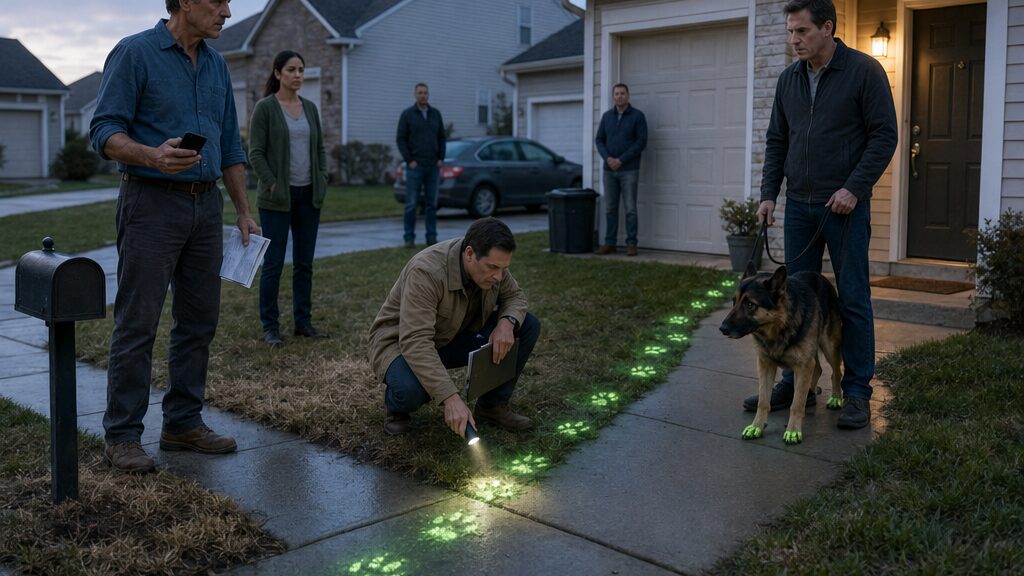
He Marked His Own Lawn to Prove the Neighbor Everyone Chose to Excuse
Chapter 1: The Violation Notice Beside the Fresh Paw Prints
The yellow violation notice had been driven into the ground six inches from a fresh pile of dog waste.
Robert Jackson stood at the edge of his driveway with one hand still wrapped around his coffee mug. The other hung at his side, fingers curling slowly against his palm.
The notice was bright enough to catch the porch light. PROPERTY MAINTENANCE VIOLATION appeared across the top in block letters. Beneath it, the management company had cited thinning turf, discoloration, and failure to maintain a uniform lawn standard.
Around the stake, the Bermuda grass had gone gray-brown in an oval nearly four feet wide.
Across that same dead patch ran five muddy paw prints.
Robert set the mug on the mailbox post before he dropped it.
The dog waste was still damp. A dark shoe mark pressed into the soil near the curb, where someone had stepped off the sidewalk and then back onto it. Robert crouched, careful not to touch anything, and took out his phone.
One photograph showed the notice and the paw prints together. Another showed the damaged grass. A third framed the route from the sidewalk to the mailbox and back.
He had spent thirty-two years supervising public grounds crews. He knew the difference between heat stress, fungus, irrigation failure, chemical burn, and repeated animal damage. The patch beside the mailbox carried all the signs he had described in his emails: concentrated nitrogen burn, compacted soil, torn runners, and repeated traffic along the same narrow approach.
The HOA had apparently diagnosed neglect.
Robert photographed the time on his phone screen: 6:14 a.m.
Behind him, a sprinkler head clicked awake and sent a clean fan of water across the healthy side of the lawn. The dead patch absorbed almost nothing. Water collected in shallow depressions left by paws, then slid toward the curb.
He pulled the yellow notice from the stake.
A deadline had been printed at the bottom.
Ten days to restore the lawn.
A fine would begin after that.
Robert looked across the street. Curtains remained closed. Garage doors were down. The neighborhood still had the false order of early morning, every roofline neat, every trash bin hidden, every problem waiting behind a front door.
Christopher Moore’s house stood next door, separated from Robert’s by a narrow side yard and two ornamental trees. A porch light glowed above Christopher’s welcome mat.
Robert went inside without cleaning the waste.
At the kitchen table, he opened the folder on his laptop marked PROPERTY—NORTHWEST TURF. Inside were dated photographs, email receipts, and short entries typed in the same spare language he had used for municipal work orders.
June 8, 2023. Large dog entered lawn at 6:09 a.m. Owner present.
June 11. Waste left beside mailbox.
June 19. Verbal request made. Owner replied that verge was common area.
There were entries from three summers.
Robert opened the doorbell-camera archive and moved the timeline back to 5:55 that morning. At 6:07, the German shepherd appeared at the edge of the frame, head low, leash extending toward the sidewalk.
Christopher followed.
He wore a dark jacket and held his phone near his chest. When the dog crossed onto Robert’s lawn, Christopher looked up. Not for long, but long enough.
He saw the animal circle the damaged patch.
He saw it squat.
He waited.
Then he glanced toward Robert’s dark front window and guided the dog back to the sidewalk without cleaning anything.
Robert replayed the moment twice. The second time, he paused when Christopher lifted his head.
That look removed the last excuse.
It was not distraction. It was a decision.
Robert exported the clip, labeled it with the date and time, and attached it to a new email.
Amanda Lee, the community manager, had answered his earlier messages with courteous phrases that seemed designed to leave no fingerprint.
Thank you for bringing this to our attention.
We encourage neighbors to resolve minor concerns directly.
The common-area committee will review any verified violation.
Robert had resolved it directly. He had spoken to Christopher at the curb, at the mailbox, and once on Christopher’s porch. Each time, Christopher had listened with the patience of a man waiting for an unreasonable person to tire himself out.
Robert attached the photographs and wrote:
The condition cited this morning is the same condition reported repeatedly since June 2023. Attached is video showing the cause at 6:07 a.m. today. Please suspend the violation pending review and confirm receipt of prior complaints.
He read the message once, removed the word repeatedly from the second sentence, then put it back.
At 8:42, Amanda replied.
Mr. Jackson,
Thank you for the documentation. Our system does not show an active or historical pet-nuisance complaint associated with your property. The turf violation remains in effect. You may submit a formal dispute through the resident portal.
Robert stared at the sentence until the words lost their shape.
No active or historical complaint.
He opened his sent folder. There were eleven messages to the management address. Four had replies. Two included case numbers. One contained a photograph of Christopher standing on the sidewalk while the dog occupied Robert’s lawn.
He printed Amanda’s email and placed it beside the yellow notice.
At ten, he called the management office. Amanda’s voice was calm, slightly rushed.
“I’m looking at the account now,” she said. “There’s nothing under pet nuisance.”
“I have case numbers.”
“They may have been categorized differently.”
“Then search the numbers.”
A pause followed. Robert heard keyboard clicks.
“Those cases aren’t appearing in the current system.”
“They appeared when your office sent them to me.”
“I understand why that’s frustrating.”
“No,” Robert said. “You understand the word frustrating. I’m asking where the records went.”
Her silence tightened.
“You can bring copies to the office,” she said. “I’ll review them.”
Robert ended the call before his voice changed.
Near noon, he carried a small shovel and plastic bag outside. He removed the waste, sealed it, and washed the tool at the side spigot. As he crossed back toward the garage, Christopher came along the sidewalk with the German shepherd.
The dog pulled toward Robert’s grass out of habit.
Christopher shortened the leash this time, but only because Robert was standing there.
“You got your sign,” Christopher said.
Robert looked at him. “You knew about it?”
“It’s hard not to notice a yellow stake.”
“It was placed before sunrise.”
Christopher shrugged. “Inspection team comes early.”
Robert held the sealed bag at his side. “Your dog did this again this morning.”
“He’s a dog, Robert.”
“And you’re holding the leash.”
Christopher’s jaw moved. The shepherd stood between them, alert but quiet.
“That strip by the sidewalk isn’t your living room,” Christopher said. “Every dog in the neighborhood steps on it.”
“This one stops there almost every morning.”
“Then put up a little fence.”
“The covenants prohibit fences in front setbacks.”
“So apply for one.”
“You sit on the committee that rejects them.”
Christopher gave a short laugh, but no humor reached his eyes. “This is why nobody wants to deal with you.”
Robert felt the words land where Christopher intended.
“Who is nobody?”
“You know how the board sees these things.”
“How does the board see me?”
Christopher adjusted the leash around his wrist. The dog took one step toward the dead patch, then stopped when he pulled it back.
“As a nuisance complainant,” he said. “Someone who turns every minor inconvenience into a file.”
Robert did not answer immediately.
The phrase sounded administrative, not casual. It belonged in a meeting note or an email subject line. Christopher seemed to realize he had said too much, because he shifted his weight and looked toward his house.
Robert raised the sealed bag slightly.
“Was that phrase used before or after my complaints disappeared?”
Christopher’s expression closed.
“You should fix your grass,” he said.
He walked away, the shepherd moving beside him.
Robert remained near the yellow stake hole long after they reached the next driveway.
The board considered him a nuisance complainant.
The management system contained no complaints.
And Christopher, who was not supposed to see enforcement matters outside his committee, knew both facts.
Chapter 2: The Complaint Log That Officially Never Existed
Amanda Lee’s screen showed a blank space where three years of Robert’s complaints should have been.
She turned the monitor slightly toward him, as though a different angle might soften what it displayed.
Resident: Robert Jackson.
Property: 1847 Linden Trace.
Open cases: 1.
Historical cases: 0.
The single open case was the violation against his lawn.
Robert placed his folder on the desk between them. The management office occupied a converted model home near the community entrance, where the former dining room held two workstations and a printer that hummed every few minutes. Framed photographs of green lawns and smiling families covered the walls.
He opened the folder.
“These are your replies.”
Amanda looked at the first page. “I see that.”
“These are your case numbers.”
“I see those too.”
“And your system says they never existed.”
“I didn’t say they never existed.”
“What would you call it?”
She kept her hands folded near the keyboard. She appeared younger than Robert had expected, perhaps in her late thirties, but the caution in her face belonged to someone accustomed to being blamed from both directions.
“We changed software eighteen months ago,” she said. “Some records were migrated as attachments rather than cases.”
“Then search the attachments.”
“I have.”
He slid a printed email toward her. “Search the subject line.”
Amanda typed. Nothing appeared.
Robert gave her the next one.
She searched the date, then the address, then the old case number.
Nothing.
The office printer released a page behind them. Neither moved to collect it.
Amanda read the email more carefully. “This response wasn’t sent from my account.”
“It came from the management address.”
“It was routed through a committee mailbox.”
Robert leaned forward. “Which committee?”
“The header doesn’t say.”
“Then open the full routing information.”
Her eyes lifted to his. “I can’t provide internal metadata without authorization.”
“You can look at it.”
“That isn’t the same as giving it to you.”
“Look.”
The word came out harder than Robert intended.
Amanda sat back. For a moment, he saw exactly how he appeared to her: gray-haired man with a thick folder, clipped voice, and a list long enough to make any ordinary disagreement feel like litigation.
He lowered his hands to his lap.
“Please,” he said.
Amanda reopened the message file and expanded a section of technical fields. The page filled with addresses, time stamps, and routing codes.
Halfway down was a forwarding line.
ARC-COMMITTEE-CM.
Amanda stopped scrolling.
Robert did not need her to explain the initials.
“Christopher Moore,” he said.
“It could refer to something else.”
“Does it?”
She looked at the screen.
“No.”
The room seemed to grow quieter around the printer’s low mechanical hum.
Christopher served on the architectural review committee. Residents sent that committee paint colors, fence plans, roof samples, and requests for exterior changes. It had no authority over pet complaints.
“Why was a dog complaint routed through architecture?” Robert asked.
Amanda opened another email.
The same code appeared.
A third showed a response drafted from the committee mailbox and sent through the general management address. The language was familiar: neighbors were encouraged to resolve minor concerns directly.
Amanda pressed her lips together.
“That should not have happened.”
“But it did.”
“Yes.”
“How many of my complaints went through him?”
“I don’t know yet.”
“Did he close them?”
“I don’t know.”
“Did Nancy authorize it?”
“I said I don’t know.”
Robert heard the strain in her voice and forced himself to pause. He had spent decades asking employees for facts after equipment failures. Push too softly and people hid inside uncertainty. Push too hard and they defended themselves instead of the truth.
Amanda was not the person walking the dog.
But she had been the one telling him the record was empty.
“What can you confirm?” he asked.
She studied the routing history.
“I can confirm at least one complaint was diverted outside the normal process. Possibly three. I can also confirm that the current database does not preserve the original case status.”
“That’s not a migration problem.”
“No.”
“What is it?”
“I need time to review it.”
Robert closed the folder halfway. “The violation clock is running.”
“I can request a temporary hold.”
“Request from whom?”
“Nancy Anderson.”
“The board president.”
“Yes.”
“The same board Christopher sits under.”
“He isn’t a board member.”
“He has committee access.”
Amanda looked toward the closed office door. “Committee members sometimes receive resident messages relevant to pending applications.”
“My dog complaint was not relevant to an application.”
“I agree.”
The words were quiet, but they were the first clean admission Robert had heard from anyone in management.
Amanda printed the routing page and marked the code with a pen. She did not hand it to him.
“I’ll speak with Nancy today,” she said.
Robert nodded toward the page. “I want a copy.”
“I can’t release internal routing data yet.”
“You can release my own complaint.”
“I can release what you sent. Not necessarily what happened after it entered our system.”
There it was again: the clean wall of procedure.
Robert packed his papers slowly.
Outside, the noon sun exposed every flaw in the lawn. The yellow notice had been replaced in the same hole while he was at the office. Its corners moved in the light breeze.
Kathleen Rivera arrived that evening carrying takeout containers and found him at the kitchen table cutting printed emails into uniform stacks.
“You’re using the paper cutter,” she said.
“It keeps the dates visible.”
“That wasn’t praise.”
She set the food beside the sink and picked up one page. Robert had clipped each complaint to its reply, then attached a narrow incident note with the date, time, weather, location, and observed damage.
Kathleen read two entries.
“You have all this already saved electronically.”
“Screens can be changed.”
“Paper can be ignored.”
“Not when it’s in front of them.”
She looked toward the dark window over the sink. “What do you want them to do?”
“Cancel the violation. Restore the record. Stop routing complaints through Christopher.”
“And the dog?”
“Keep it off my property.”
“That part I understand.”
Robert aligned another stack.
Kathleen pulled out the chair across from him. “I also understand why a management office might see this and decide you’ve made the lawn your full-time job.”
His hand stopped on the cutter.
“You think I’m overreacting.”
“I think you’re right about the damage. I think Christopher is wrong. I also think you’ve spent three years building a case against a man who lives twenty feet away instead of deciding what outcome you can live with.”
“I decided the first week.”
“No. You decided what he should do. That isn’t the same thing.”
Robert resumed cutting.
Kathleen let out a breath. “Did you ask for my help, or did you call because you wanted someone to witness how organized you are?”
“I didn’t call.”
“Exactly.”
She stood and opened the takeout containers. The smell of roasted chicken filled the kitchen.
Robert’s phone rang before either of them served a plate.
Amanda’s name appeared.
He answered on speaker.
“I spoke with Nancy,” she said. “She will not suspend the violation based on routing irregularities alone.”
“Routing irregularities.”
“That is her phrasing.”
“What evidence does she want?”
“Physical confirmation that a specific animal caused the current damage.”
“I sent video.”
“She says the footage shows trespass but not a direct connection to the full turf condition.”
Robert looked at Kathleen. Her face tightened.
“The dog is standing in the dead patch,” he said.
“Nancy says multiple animals and environmental factors could contribute.”
“For three years, at 6:07 in the morning?”
“I’m telling you her position, not mine.”
“Then what would satisfy her?”
Amanda hesitated.
“Something contemporaneous and independently observable.”
Robert almost laughed.
After the call, he went to the front window.
Christopher was passing under the streetlight with the shepherd. The dog strained toward Robert’s lawn. Christopher glanced at the house and pulled it onward.
Kathleen joined Robert at the glass.
“Don’t do anything stupid,” she said.
“I don’t do stupid things.”
“You do precise things when you’re angry. That can be worse.”
The next afternoon, Robert drove to a landscaping supply warehouse on the county road. He asked the clerk about non-toxic turf-marking products used to trace irrigation coverage and foot traffic.
The clerk showed him a concentrated fluorescent colorant designed for athletic fields and landscape applications. Safe after dilution. Temporary. Visible under low light and ultraviolet illumination. Not intended for direct application to animals.
Robert read every line on the label.
He bought two containers, disposable gloves, a hand sprayer, and a small ultraviolet flashlight.
He told himself the material would touch only his grass.
He told himself the dog would carry no more than residue from walking through a treated area.
He told himself this was physical confirmation, exactly as Nancy had demanded.
On Wednesday evening, a delivery box sat on his porch containing an additional container he had ordered from the manufacturer, along with printed safety documentation.
Kathleen arrived as he cut the tape.
She watched him lift out the bottle of fluorescent turf dye.
“What,” she asked, “are you planning to prove that the videos don’t already prove?”
Robert turned the bottle until the safety label faced him.
“That they can see the route,” he said.
Kathleen did not look at the label.
She looked at him.
Chapter 3: The Bright Trail Reached the Wrong Front Door
The first green paw print glowed beneath the landscaping inspector’s flashlight.
He had arrived before sunrise to photograph Robert’s dead grass for the violation file. Instead, he stood motionless beside the mailbox, directing the narrow beam toward a luminous mark on the damp turf.
Another print shone two feet beyond it.
Then another.
The trail crossed the entire damaged patch.
Robert watched from his front step, camera already in hand. The fluorescent dye had dried nearly colorless on the grass the night before. Under the inspector’s light, however, each paw print burned green against the gray-blue morning.
The inspector followed the marks toward the sidewalk.
They continued across the concrete.
Robert felt a brief, hard pulse of satisfaction.
There it was. No explanation required. No missing email. No committee routing code. The dog had stepped in the treated area, crossed the walk, and carried the evidence home.
The inspector crouched over the first print on the sidewalk. “What is this?”
“Temporary landscape marker,” Robert said.
“You applied it?”
“To my lawn.”
The inspector straightened.
At the far end of the trail, Christopher’s front door opened.
The German shepherd emerged first, pulling against the leash. Faint green residue marked the fur around its paws. Christopher looked down, then across the sidewalk toward the inspector.
His face changed.
“What did you put on my dog?”
The question traveled farther than it needed to in the still morning. A porch light came on across the street. Someone lifted a blind.
Robert stepped off his porch but did not approach the animal.
“I put non-toxic turf dye on my grass.”
Christopher came down the walkway. The glowing tracks were visible behind him, ending beside his welcome mat in a confused cluster where the dog had apparently paced before going inside.
“You put chemicals where you knew he would walk.”
“I put a landscape product on private property after asking you repeatedly to keep him off it.”
“You targeted him.”
“I marked the area under dispute.”
Christopher raised his phone and began recording. “Say that again.”
Robert felt the trap in the invitation.
He took the folded safety sheet from his jacket pocket instead.
“Manufacturer specifications. Non-toxic at the applied dilution. Temporary. Used on athletic fields and turf.”
Christopher did not take it.
The inspector did.
He read the first page under his flashlight, then examined the dog from a distance.
“Was it sprayed directly on the animal?”
“No,” Robert said.
“Yes,” Christopher said at the same time.
Robert looked at him.
Christopher’s voice sharpened. “You knew exactly when we walked. You covered the route to get it on him.”
“I covered the damaged section of my lawn.”
“You planned this.”
“Yes.”
The admission silenced the little gathering more effectively than denial would have. Two nearby residents stood in separate driveways, pretending to check trash bins. A garage door began to rise across the street and stopped halfway.
The inspector lowered the paper. “Mr. Jackson, do you have the product container?”
Robert retrieved it from the garage. He had kept the original label intact and measured the dilution in a marked jug. The inspector photographed both.
Christopher crouched beside the shepherd and wiped one paw with a white cloth. A pale green smear appeared.
“Look at that,” he said. “You think this is normal?”
“No,” Robert replied. “I think letting your dog use the same person’s lawn every morning for three years is not normal.”
Christopher stood so quickly the shepherd stepped back.
“You could have hurt him.”
“The label says otherwise.”
“You don’t know that.”
“I called the manufacturer.”
“You called them because you were planning this.”
Robert’s satisfaction began to sour.
The dog was not frightened, but it was restless now, moving between Christopher and the open door. It did not understand why the morning routine had become a ring of voices and cameras.
Robert had thought of the prints.
He had thought of the route.
He had thought of the board’s demand for contemporaneous physical proof.
He had not pictured the green stain against the animal’s fur while neighbors watched.
The inspector handed the safety sheet back. “I’m documenting the entire condition. I’m not making a safety determination.”
“Call animal control,” Christopher said.
“I already am,” Robert replied.
Christopher stared at him.
Robert had filed the online report at 6:18, attaching the doorbell clip, the first photographs, and the product documentation. He had wanted the complaint time-stamped before anyone could clean the trail away.
“You reported me?” Christopher asked.
“I reported the repeated trespass.”
“You’re trying to have my dog taken.”
“No.”
“That’s what happens when people like you start a file.”
The phrase caught Robert off guard. People like you. Start a file.
Behind Christopher’s anger was something more immediate than embarrassment. His hand tightened around the leash until the leather creased.
Robert lifted his camera and photographed the trail from the dead patch to the walkway. Christopher stepped into the frame.
“Stop taking pictures of my house.”
“I’m photographing the path.”
“You got what you wanted.”
“Move aside.”
“No.”
The inspector intervened. “Mr. Moore, don’t disturb the area until I finish.”
Christopher turned on him. “You’re treating this like he’s the victim?”
“I’m recording what is here.”
“That stuff is on my dog.”
“And the tracks begin on Mr. Jackson’s lawn.”
Christopher looked toward the glowing prints, then toward the residents watching from their driveways. The public clarity of the trail seemed to anger him more than the dye itself.
He pulled the shepherd inside and shut the door.
The inspector completed his photographs in silence.
By seven-thirty, the sun had weakened the fluorescence, but the prints remained visible in shaded sections of the sidewalk. Robert downloaded his images, placed them beside the incident log, and sent everything to Amanda.
For twelve minutes, he believed the dispute had turned.
Amanda called at 8:03.
“Robert, what did you apply?”
He repeated the product name and dilution.
“Did management approve it?”
“It’s legal landscape dye on my property.”
“That wasn’t my question.”
“Nancy demanded physical confirmation.”
“She did not authorize an application designed to transfer onto an animal.”
“It wasn’t designed for the animal.”
“It was designed to record the animal’s movement.”
Robert looked through the front window. Christopher was scrubbing his walkway with a hose. Green water ran toward the gutter.
“And it did,” Robert said.
Amanda went quiet.
When she spoke again, her voice had lost its earlier neutrality.
“Christopher submitted an emergency complaint alleging animal endangerment, targeted harassment, and intentional contamination of adjoining property.”
“The adjoining property was contaminated by his dog carrying material off mine.”
“Please listen. Nancy has called a special conduct review.”
“For him?”
“For you.”
Robert gripped the phone.
Amanda continued. “You are instructed not to apply any additional substance to the front yard until the review is complete.”
“The dye is approved for turf.”
“This is now about intent.”
At 9:20, a uniformed animal-control officer arrived. He inspected the label, watched the video, and photographed the dog through Christopher’s open garage. He found no visible distress and advised Christopher to wash the paws with mild soap.
He also advised Robert not to repeat the method.
“Is it illegal?” Robert asked.
“That isn’t what I said.”
“Then what did you say?”
“I said you’ve created a situation where everyone is going to argue about the dye instead of the trespass.”
The officer’s tone held no accusation, which made the sentence harder to dismiss.
By noon, photographs of the green trail had moved through the neighborhood message group. Robert was not part of the group, but Kathleen sent him screenshots.
Some residents called the method clever.
Others called it cruel.
One message claimed Robert had sprayed the dog directly.
Another said the animal had been rushed to an emergency veterinarian. Christopher’s own photograph, posted beneath the claim, showed the shepherd standing calmly in his kitchen.
Robert enlarged the image until the pixels broke apart.
The truth was visible.
So was the version people preferred.
At three, a courier delivered a white envelope from the HOA.
NOTICE OF EMERGENCY CONDUCT HEARING.
The document proposed fines for creating a nuisance, interfering with another resident’s peaceful enjoyment, and engaging in retaliatory conduct. It also warned that repeated violations could result in suspension of voting privileges and use of community facilities.
Robert laid it beside the yellow turf notice.
The first notice blamed him for damage caused by Christopher’s dog.
The second blamed him for proving it.
Kathleen arrived before dinner and found the fluorescent photographs spread across the table in a precise line. At one end, the prints began beside the mailbox. At the other, they stopped at Christopher’s welcome mat.
“You were right,” she said.
Robert waited.
She placed the emergency hearing notice on top of the photographs.
“And you gave them a better story.”
“I used a safe product.”
“I know.”
“He walked the dog onto my property after years of requests.”
“I know.”
“They erased the complaints.”
“I know, Dad.”
“Then why are you talking like I caused this?”
Kathleen pulled out a chair but did not sit.
“Because you wanted proof,” she said. “But that isn’t all you wanted.”
Robert’s jaw tightened.
“You wanted Christopher to open his door and see the trail pointing back at him. You wanted the neighbors to see it too.”
“He denied it.”
“So you made denial impossible.”
“Yes.”
“And humiliation public.”
Robert looked down at the photographs.
The green prints seemed brighter on paper than they had in the morning.
Kathleen touched the image showing the shepherd’s stained paws.
“Did proving Christopher wrong matter more to you than keeping the dog out of the fight?”
Robert opened his mouth.
No answer came that did not sound like an excuse.
Chapter 4: The Hearing Was Scheduled Before the Evidence Arrived
The notice proposed a five-hundred-dollar conduct fine and suspension of Robert’s voting rights before the board had received the animal-control report.
He read the page twice at the kitchen counter.
Emergency review: Tuesday, 6:30 p.m.
Written evidence due: Monday, noon.
The animal-control officer had said his report might not be completed until Tuesday afternoon.
Robert set the notice beside the photographs of the fluorescent trail. The sequence was almost elegant in its clarity: dead grass, green paw prints, sidewalk, Christopher’s walkway, welcome mat. Beneath each image, Robert had typed the time and camera source.
Kathleen stood across the counter with her arms folded.
“You’re arranging them like the hearing is about whether the dog crossed the lawn.”
“It is.”
“No. That’s what it should be about.”
Robert lifted the conduct notice. “This says retaliatory action involving an animal.”
“Exactly.”
“The product was non-toxic.”
“You keep answering the safest question.”
“It is the relevant question.”
“It’s one relevant question.”
He returned the notice to the counter. Kathleen had brought a legal pad and a pack of adhesive tabs. She placed both beside his incident log.
“Start with what you did,” she said.
“I applied turf dye to my property.”
“Why?”
“To produce physical confirmation.”
“Why that way?”
“Because every other form of confirmation was dismissed.”
Kathleen waited.
Robert looked at her. “What?”
“You’re still talking like a maintenance report.”
“That is what happened.”
“That is the sequence. It isn’t the whole thing.”
He pushed the photographs into alignment. “I’m not going to confess to harming an animal when I didn’t.”
“No one asked you to.”
“It’s what they want.”
“What they want is for you to sound cold enough that they can stop listening.”
Robert’s fingers remained on the top photograph.
Kathleen pulled out a chair. “Read me your statement.”
He opened the draft on his laptop.
The first paragraph cited the manufacturer’s safety information. The second identified the boundary of Robert’s lot. The third listed eleven complaint dates and four corresponding management responses. By the fifth paragraph, he had moved into the HOA’s failure to maintain records and Christopher’s unauthorized access to complaint routing.
Kathleen listened without interrupting.
When Robert finished, she asked, “Where is the dog?”
“In the photographs.”
“I mean in what you wrote.”
“This is not about the dog’s behavior. It’s about the owner’s.”
“And where is Christopher?”
“Also documented.”
“He’s a routing code and a leash in your statement.”
“That is what matters.”
Kathleen closed the laptop.
Robert’s hand tightened around the edge of the counter. “I wasn’t finished.”
“You were. You just don’t like the result.”
A knock sounded at the front door.
Christopher stood outside alone.
Robert opened the door but did not invite him in.
Christopher looked past him toward the kitchen table, where the enlarged photographs were visible.
“My dog is fine,” he said.
Robert waited.
“The vet rinsed his paws. No reaction.”
“You told the neighborhood group he went to an emergency clinic.”
“My son panicked. We called ahead.”
“That isn’t what was posted.”
“I didn’t write every post.”
“You submitted the emergency complaint.”
“Yes.”
Christopher kept his hands in his jacket pockets. Without the shepherd beside him, he seemed less certain of where to stand.
“I’m asking you to withdraw the animal-control report,” he said.
“No.”
“They said another documented incident could trigger a formal nuisance classification.”
“Then keep him off my lawn.”
“It’s not that simple.”
Robert almost closed the door.
Christopher stepped closer. “My hours were cut in January. The company vehicle is leased through my employer, and their policy requires disclosure of municipal citations tied to home liability. I don’t know what animal control sends to whom.”
“A nuisance report is not a vehicle citation.”
“I don’t know that.”
“You could have asked.”
Christopher laughed once, bitterly. “You think I haven’t spent the last six months asking questions?”
Robert said nothing.
“My son’s attached to that dog,” Christopher continued. “If the association starts building a file and animal control adds one, then the insurance company gets involved. If they call him aggressive because he’s a shepherd, we lose every argument before it starts.”
“No one called him aggressive.”
“Not yet.”
Robert studied him. Christopher’s fear was real. It did not make the paw prints disappear. It did not explain three years of waste left beside the mailbox. But it changed the shape of the refusal.
“You knew my complaints were being diverted,” Robert said.
Christopher looked toward the street.
“Christopher.”
“I saw some of them.”
“How?”
“The architecture mailbox gets copied on property-impact complaints. It shouldn’t, but it does.”
“You answered them.”
“I answered two.”
“You closed them?”
“I marked them neighbor-resolved.”
“They were not resolved.”
“I thought if it stayed informal, it wouldn’t become a pet-enforcement matter.”
“You used your access to make that decision for me.”
“I was trying to keep it from becoming bigger.”
“You let them cite me for the damage.”
Christopher’s expression hardened again. “I didn’t inspect your lawn.”
“But you knew why it was damaged.”
“I knew what you believed.”
Robert took one step onto the porch. “You watched him do it.”
Christopher met his eyes.
“Yes.”
The word landed without resistance.
Robert had expected another denial. Instead, Christopher looked tired.
“He started pulling toward that spot when my wife was still here,” he said. “She used to walk him before work. After she left, I kept the same route because it was one less thing to change for my son.”
Robert had known Christopher’s wife no longer lived there. He had not known when she left.
“That explains the route,” Robert said. “It does not excuse what you did.”
“I know.”
Yet Christopher still had not apologized.
He asked again for the report to be withdrawn.
Robert refused again.
When Christopher walked home, Kathleen remained behind Robert in the doorway.
“You heard him,” Robert said.
“I did.”
“He admitted intercepting the complaints.”
“He also told you why he was afraid.”
“Fear does not grant committee authority.”
“No. But it means your hearing statement should describe a person, not just a violation.”
Friday afternoon, Amanda called and asked Robert to meet at the clubhouse before the building closed.
Nancy Anderson was already there.
She sat at the long board table beneath framed photographs of former presidents. Two empty chairs separated her from Amanda.
Nancy wore a navy jacket and placed Robert’s conduct notice squarely in front of her.
“The hearing will address your use of the dye,” she said. “It will not become a general review of management systems.”
“The missing complaints are why the dye was used.”
“They are separate matters.”
“They are the same chain of events.”
Nancy’s face remained composed. “Mr. Jackson, the board must consider whether your conduct endangered an animal or created a hostile condition.”
“The officer found no injury.”
“We do not have that report.”
“You scheduled the hearing before it could arrive.”
“We scheduled it because photographs were circulating publicly.”
“I did not circulate them.”
“Intent does not erase community impact.”
Robert glanced at Amanda. She looked down at a folder.
“What evidence would have been acceptable?” Robert asked Nancy.
“Appropriate evidence submitted through appropriate channels.”
“I submitted video.”
“Video that did not establish sole causation for the turf damage.”
“So I established the route physically.”
“With a substance applied in anticipation of contact with an animal.”
“To my lawn.”
Nancy placed one hand over the conduct notice. “This is the tone that concerns people.”
Robert felt Kathleen’s warning return.
The tone.
Not the dog. Not the missing complaints. Not Christopher’s access.
His tone.
He opened his folder and removed the draft statement.
“I will submit this Monday.”
Amanda took it before Nancy could.
She read the first page, then the second. Her expression grew more guarded.
“This is aggressive,” she said.
“It is factual.”
“You accuse the board of deliberate evidence suppression.”
“The complaints disappeared.”
“You don’t yet know how.”
“Christopher admitted redirecting them.”
Nancy turned toward Amanda. “He admitted what?”
Robert answered. “He said he marked complaints neighbor-resolved.”
Nancy’s composure slipped for half a second.
“That is not committee procedure,” she said.
“It happened under your administration.”
“Do not confuse unauthorized conduct with board policy.”
“Then investigate it.”
“I intend to.”
“Before or after you suspend my vote?”
Nancy stood. “The hearing remains scheduled.”
Robert gathered his papers. Amanda followed him into the hallway.
“Your statement is going to make this harder,” she said quietly.
“For whom?”
“For everyone who might be willing to correct something without being publicly accused of corruption.”
“Is that what you call deleting complaints?”
“I didn’t say they were deleted.”
“You said they weren’t migrated. Then you said they were diverted. Now Christopher says he closed them.”
Amanda’s eyes flashed. “I am trying to find out what happened.”
“And while you try, I am the only person facing sanctions.”
He left before she could answer.
At home, Kathleen read the statement and returned it without comment.
“You agree with her,” Robert said.
“I agree that it sounds like you want to leave no room for anyone to admit they were wrong unless they admit they were malicious.”
“What difference does motive make to the damage?”
“It determines whether anything can be repaired.”
Robert folded the statement in half, then unfolded it and smoothed the crease.
Kathleen picked up her bag.
“I’ll help you prepare,” she said. “But I won’t help you turn the hearing into a public execution.”
After she left, Robert sat alone at the kitchen table.
He removed the first page of the statement and began again.
At 9:16 that evening, his phone rang.
Amanda spoke before he could greet her.
“I found the inspection history.”
Robert straightened.
“The dates in your current violation file do not match the original upload dates.”
“What does that mean?”
“It means two inspections were entered after Christopher accessed the complaint folder, but the system displays them as earlier.”
Robert looked at the yellow notice on the table.
“How many records were changed?”
Amanda’s answer came slowly.
“I don’t know yet.”
Chapter 5: The Missing Records Protected More Than One Neighbor
Amanda arrived carrying a stack of paper marked for destruction.
She stood just inside Robert’s garage on Sunday morning, holding the pages against her coat as if someone might try to pull them away.
“I was told to remove duplicate migration files from the archive,” she said. “These were in the batch.”
Robert closed the garage door.
A workbench lamp illuminated the stack. Across the top page ran a sequence of case numbers, dates, user logins, and status changes. Several resident names had been blacked out with marker. Robert’s address remained visible.
Amanda placed the pages beside his incident log.
“This is an audit export from the old platform,” she said. “It records actions even after a case is archived.”
“Deleted?”
“The company avoids that word. The visible case can be removed from the resident history, but the action trail stays in a system backup.”
Robert ran his finger down the first column.
His complaint from June 8 had been opened, forwarded to the architecture committee mailbox, marked neighbor-resolved, and hidden from migration.
The user identifier beside the status change ended with CM.
Another complaint had been reassigned by a management login. A third had been relabeled landscaping inquiry before the software migration.
“Who used the management login?” Robert asked.
Amanda did not answer.
He looked at her.
“I did.”
The confession was nearly inaudible.
Robert withdrew his hand from the page.
“You closed one?”
“I changed the category.”
“Why?”
“Christopher emailed that the issue had been handled directly. The complaint had been open for twenty-six days. My regional supervisor was asking why our closure rate was falling.”
“You never called me.”
“No.”
“You had my number.”
“Yes.”
“Then you knew it wasn’t resolved.”
Amanda’s face tightened. “I knew I had not confirmed it.”
“That is not the same answer.”
“No,” she said. “It isn’t.”
The workbench lamp buzzed above them.
Robert had imagined discovering a clean line between people who caused the harm and people who concealed it. Instead, Amanda stood in his garage admitting that the missing record had been partly erased by someone who had also spent the last week helping him recover it.
“How many others?” he asked.
She turned to another page.
“Seven complaint categories show similar status changes over two years. Pet nuisance, drainage, parking, exterior lighting. Some may have been legitimately resolved. Some were moved because the board did not want open enforcement disputes appearing during the insurance renewal.”
“Who told you that?”
“Nancy.”
The name carried less surprise than weight.
Amanda continued. “The carrier had asked about selective enforcement claims. Nancy believed a high number of unresolved resident complaints would increase the premium or trigger an outside review.”
“So the board reduced the number.”
“They closed what they called low-level interpersonal matters.”
“Without resolving them.”
“In some cases.”
Robert examined the redacted rows. His complaint was not an exception. It was evidence of a method.
A knock sounded on the garage door.
Robert and Amanda looked at each other.
He opened it halfway.
Nancy stood outside.
She noticed Amanda first, then the audit pages on the bench.
“No,” she said.
Amanda’s shoulders lowered, but she did not step away from the papers.
Nancy entered when Robert raised the door.
“You were specifically instructed not to distribute archived exports,” she told Amanda.
“I haven’t distributed them.”
“You brought them to a resident’s home.”
“I brought records relevant to his hearing.”
“Those records contain confidential information.”
“The names are redacted.”
“That does not make this authorized.”
Robert lowered the door again. “Did you order the complaints closed?”
Nancy looked at him. “I directed management to distinguish enforceable covenant violations from neighbor disputes.”
“You used that distinction to erase them.”
“We did not erase anything.”
“You made them disappear from the official history.”
“We prevented unverified allegations from being treated as established violations.”
“My complaint included video.”
“Video of an animal crossing a lawn.”
“And stopping there.”
Nancy removed her gloves finger by finger. “Do you understand what happens when a board formally recognizes selective enforcement?”
“The enforcement becomes fair?”
“The association becomes vulnerable to every claim that was handled inconsistently over the previous five years. Insurance reserves change. Legal expenses increase. Assessments rise. People who had nothing to do with your dispute pay for it.”
Robert looked at the audit export.
“So you protected the community.”
“We protected its ability to function.”
“By deciding which residents could be ignored.”
Nancy’s expression sharpened. “You think leadership means preserving every grievance indefinitely. It doesn’t. It means making judgments with incomplete information and limited resources.”
“And when the judgment is wrong?”
“You correct it without creating a larger injury.”
Robert glanced at the fluorescent photographs arranged beside the pages. “That is what you accuse me of failing to do.”
Nancy followed his eyes.
“Yes,” she said. “It is.”
The answer unsettled him because it was not entirely false.
Amanda stepped toward the bench. “His complaint was mishandled.”
Nancy turned to her. “And you are prepared to risk your position by admitting you changed the category?”
Amanda’s face went pale.
The HOA attorney had called her Saturday evening, she explained. He had warned that internal exports might be privileged and that disclosure outside formal channels could violate her employment agreement. If she used the documents publicly, she could lose her job before any investigation determined whether the records had been handled improperly.
Nancy had not made the threat herself.
She did not need to.
Robert looked at Amanda’s hands. They trembled slightly against the edge of the workbench.
He had wanted someone inside management to choose the truth. Now that she had, the cost was standing in his garage with them.
Nancy gathered the top pages into a square stack.
“These can be reviewed confidentially,” she said. “Robert’s lawn violation can be rescinded. The conduct matter can be reduced to a written warning. Christopher can be removed from complaint routing.”
“And the other records?” Robert asked.
“Reviewed internally.”
“By the people who changed them.”
“By counsel.”
Robert had drafted a demand that Christopher be removed from every committee and fined for each documented trespass. Another paragraph requested reimbursement for three years of lawn care, camera storage, testing materials, and personal time.
He pictured Christopher’s teenage son at the front window while the animal-control vehicle sat in the street.
He also pictured the dog’s green-stained paws.
“I don’t want Christopher expelled from the committee as punishment,” Robert said.
Nancy looked surprised.
Amanda did too.
“I want him removed from reviewing complaints that involve him,” Robert continued. “I want the lawn restored. I want the violation canceled. And I want a process that does not let committee members close neighbor complaints.”
“That is achievable,” Nancy said quickly.
“I’m not finished.”
Her expression closed.
“The other cases need an outside review.”
Nancy set the papers down. “That demand changes the legal posture.”
“The records changed it.”
“You could receive everything you originally requested.”
Robert looked at the incident log he had built over three years. Until that morning, it had been armor—proof that he had not imagined the pattern, proof that his memory was reliable, proof that someone else was at fault.
Now its pages sat beside seven redacted complaints belonging to people he did not know.
The log no longer showed only what had been done to him.
It showed what a system had learned it could do when each resident stood alone.
Nancy left without taking the audit pages.
Amanda remained near the workbench.
“The attorney is right,” she said. “If I present these, I could be fired.”
“I won’t use your copies without your consent.”
“That lets them say you have no foundation.”
“You can provide them through the hearing process.”
“They control the hearing process.”
Robert knew the truth of that before she finished.
He removed his draft demand from the folder and crossed out the paragraph seeking Christopher’s expulsion. Then he crossed out the request for compensation beyond turf restoration and direct costs.
Amanda watched him.
“You’re reducing your claim?”
“I’m changing it.”
“To what?”
“A record correction.”
“That sounds smaller.”
“It isn’t.”
By evening, Kathleen had spread the hearing materials across the garage floor in four columns: the lawn damage, the complaint history, the fluorescent test, and the audit irregularities.
She read Robert’s revised opening.
It began with manufacturer data again.
“No,” she said.
“I need to establish safety.”
“Later.”
“The conduct accusation comes first.”
“Then answer the conduct accusation.”
“I do.”
“You answer whether the product was toxic. You don’t answer why you chose a method that would leave a trail to Christopher’s door.”
Robert stood over the papers.
Kathleen picked up the photograph showing the final cluster of green prints beside the welcome mat.
“You wanted this image.”
He did not deny it.
“You wanted him to see that every step pointed back to him.”
“Yes.”
“Say that.”
“At a formal hearing?”
“Especially there.”
“It weakens my position.”
“It makes the rest believable.”
Robert walked to the open garage doorway. Across the narrow strip between houses, Christopher was washing his driveway. The shepherd lay behind the closed gate, watching.
Years earlier, a municipal mower had thrown a broken metal fragment through a safety shield and injured a grounds worker’s hand. Robert had documented the worn housing two weeks before the accident. He had also allowed the repair request to remain informal because his supervisor did not want another equipment shutdown during budget review.
When the investigation came, the work order was missing.
The injured man had been blamed for operating too close to debris.
Robert had brought his personal notes to the first meeting.
Then he had said nothing when the supervisor called them unofficial.
He had told himself the evidence should have been enough.
He had carried the shame of that silence longer than he had carried anger at the supervisor.
Kathleen came to stand beside him.
“What happens if you tell them the truth about why you did it?” she asked.
“They may fine me.”
“They may fine you anyway.”
“They may dismiss everything else.”
“They’re already trying.”
Robert looked back at the four columns of evidence.
The cleanest strategy was to appear blameless.
The honest one was harder.
He returned to the workbench, pulled a blank page from the printer tray, and wrote the first sentence by hand.
I applied the dye because I wanted proof, and because part of me wanted Christopher publicly embarrassed by it.
Kathleen read over his shoulder.
Robert placed the sentence at the front of the hearing folder.
His own mistake would be the first evidence he presented.
Chapter 6: He Admitted the Part That Could Cost Him Everything
“I wanted Christopher embarrassed.”
Robert’s voice carried through the clubhouse before Nancy could finish introducing the conduct charge.
The two board members seated beside her looked up. The HOA attorney stopped writing. Christopher sat in the first row with his arms folded, while Amanda occupied a chair near the side wall.
Kathleen stood at the back.
Robert placed the enlarged photograph of the fluorescent paw-print trail on the presentation easel.
“I applied a non-toxic turf marker to my lawn because three years of complaints had failed,” he continued. “I wanted physical proof. I also wanted the route visible enough that Mr. Moore could not deny where his dog had been.”
Nancy leaned toward the microphone. “Mr. Jackson, you will have an opportunity to respond after the charge is read.”
“That is my response.”
The room held perhaps twenty residents, more than usually attended a conduct hearing. Many had seen the photographs online. They watched Robert now with the alert stillness of people waiting to learn whether the image meant what they had decided it meant.
Robert held up the product label.
“The material was not sprayed on the dog. Animal control found no injury. I diluted and applied it according to the manufacturer’s turf instructions. Those facts matter.”
He lowered the label.
“But they do not erase intent. I knew the dog followed the same route every morning. I expected the paws to carry residue. I did not expect the photographs to become neighborhood entertainment, but I did want Mr. Moore confronted by a trail leading to his own door.”
Christopher shifted in his chair.
Robert looked directly at him.
“That was not fair to the animal.”
The admission changed the room. Several residents glanced at one another. Nancy’s prepared expression faltered, as though Robert had stepped outside the shape of the defense she knew how to oppose.
Christopher unfolded his arms.
Robert continued. “It was also not the beginning of this matter.”
He placed the yellow lawn violation on the table beneath the photograph.
“This was.”
Then came the first photograph: fresh waste beside the notice.
The second: muddy prints across dead Bermuda grass.
The third: doorbell footage showing Christopher looking toward the window while the shepherd stood in the damaged patch.
Robert did not describe Christopher as cruel. He did not call the board corrupt. He gave dates, actions, and consequences.
When he reached the complaint history, he placed eleven printed emails in a row.
“These were submitted through the management address. The current resident system shows none of them.”
Nancy interrupted. “The board has acknowledged migration irregularities.”
Robert turned toward the easel and added the routing page beneath the photographs.
“One complaint was forwarded to the architectural committee mailbox. Christopher Moore accessed it.”
Christopher stood. “I didn’t have authority to issue fines or animal-control reports.”
“No,” Robert said. “You had enough access to mark the complaint resolved.”
Christopher’s face tightened.
The attorney leaned toward Nancy, but Christopher spoke before either could stop him.
“I did it.”
A stir passed through the room.
Christopher looked toward Robert, not the board.
“I marked two complaints neighbor-resolved,” he said. “I thought if they stayed informal, they wouldn’t become part of an enforcement record.”
“You never resolved them,” Robert said.
“I asked my son to change the route.”
“He didn’t walk the dog in the mornings.”
“No. I did.”
Christopher gripped the back of the empty chair beside him.
“My work hours were cut. My wife had left. My son thought the dog was the only thing in the house that wasn’t changing. I was afraid one official complaint would become five, and someone would decide a German shepherd was automatically dangerous.”
The room no longer felt like a hearing with two clean sides.
“You could have picked up after him,” Robert said.
“Yes.”
“You could have kept him off the lawn.”
“Yes.”
“You could have spoken to me instead of using committee access.”
Christopher looked down.
“Yes.”
The third answer was quieter than the others.
Robert nodded once. The admission did not repair the grass, but it removed the last useful lie.
Nancy called for order and turned toward Amanda.
“Management’s internal review is incomplete,” she said. “Any discussion of archived records should occur in executive session.”
Amanda rose.
Her face was pale, but her hands were steady.
“I changed one of Mr. Jackson’s complaints from pet nuisance to landscaping inquiry,” she said.
The HOA attorney spoke sharply. “Ms. Lee, I advise you not to characterize internal actions outside the scope of your employment review.”
Amanda looked at him. “That is why I need to characterize it myself.”
She faced the board.
“I did not verify that the issue had been resolved. I relied on a committee message and changed the category because our unresolved-case numbers were under review. Other complaints were handled similarly.”
Nancy’s hand tightened around the gavel.
“Those decisions were made to distinguish covenant matters from interpersonal disputes.”
Amanda reached into her folder.
“Some upload dates were altered after the files were accessed. The audit export shows it.”
The attorney stood. “Do not distribute that document.”
“I am not distributing it.”
She placed a sealed copy on the board table.
“I am submitting it into the hearing record.”
Robert watched Nancy look at the envelope.
The fluorescent photograph had begun as proof of one route across one lawn. Now, aligned with the complaint dates, it showed something larger: each morning’s trespass had been followed by a message; each message had entered a system; each system action had moved the complaint farther from public view.
The trail did not end at Christopher’s welcome mat.
It ended at the board table.
Nancy requested a recess.
Residents moved toward the coffee station, speaking in low voices. Robert remained beside the easel.
Kathleen approached him.
“You said it,” she murmured.
“I may have handed them the conduct charge.”
“You stopped them from using it to erase everything else.”
Across the room, Christopher stood with his teenage son near the exit. The boy said something Robert could not hear. Christopher shook his head and stayed.
After twenty minutes, the board returned.
Nancy did not sit immediately.
“Mr. Jackson,” she said, “the association is prepared to rescind the turf-maintenance violation, waive conduct fines, arrange restoration of the affected lawn, and establish a written pet-management agreement with Mr. Moore.”
A murmur moved through the room.
Robert waited.
“In exchange,” Nancy continued, “the parties would treat the matter as resolved. The audit concerns would be reviewed confidentially by association counsel.”
The offer was nearly everything Robert had wanted on Monday morning.
No fine.
New grass.
Christopher’s dog kept away.
He could go home before the meeting became uglier.
The attorney slid a one-page settlement toward him.
Kathleen did not speak.
Amanda remained near the wall, exposed now in a way no private agreement could undo.
Robert read the page.
The final paragraph required withdrawal of any claim regarding complaint handling and prohibited public discussion of internal records.
He imagined the grounds worker from years before sitting alone during the safety investigation while Robert’s notes remained folded in his pocket.
Back then, he had believed silence preserved his job, his department, and the chance to fix things quietly.
The only thing it preserved was the official version.
Robert placed the settlement back on the table.
“I will accept restoration of the lawn,” he said. “I will accept a neutral pet-management agreement. I will not accept payment beyond direct repair costs.”
Nancy’s shoulders eased slightly.
“But I will not withdraw the governance complaint.”
The ease vanished.
“Mr. Jackson,” the attorney said, “you should understand that an external review may increase association expenses.”
“I understand.”
“It may affect every homeowner.”
“So did the decisions that made the review necessary.”
Nancy looked toward the residents, then back at Robert. “What exactly are you requesting?”
“Rescind the violation openly. Remove Mr. Moore from any complaint review involving himself or adjacent properties. Preserve the audit records. Create a neutral pet-nuisance procedure. And authorize an outside compliance review of altered or hidden complaints.”
“That is not a conduct-hearing remedy.”
“Then put it to the members as a governance motion.”
One board member leaned toward Nancy. The other studied the sealed audit envelope.
The attorney objected again.
Robert remained standing.
He had spent three years collecting evidence because he believed proof should speak for itself. It never had. People spoke for it, around it, and over it. They decided what it meant according to what they feared losing.
This time, Robert had attached his own truth to the record, including the part that made him look smaller than he wanted.
He turned toward the residents.
“I’m requesting an open vote.”
Nancy stared at him for several seconds.
Then she reached for the gavel.
Chapter 7: The Grass Returned Before the Trust Did
The landscaping contractor cut the first strip of dead Bermuda from Robert’s yard while Christopher watched from the sidewalk.
The sod came up in a brittle rectangle, roots thin and dark beneath it. Where the contractor’s blade passed through the soil, a faint green stain appeared along one compressed paw print.
Six weeks had not erased it completely.
Robert stood near the mailbox with the original yellow violation notice folded inside his back pocket. He had considered throwing it away after the board rescinded it. Instead, he kept it with the incident log, the hearing record, and the animal-control report.
Not as ammunition.
Not anymore.
The contractor rolled the dead grass toward the curb. “You’ll see the seams for a month or two.”
“I know.”
“Keep foot traffic off it.”
Robert looked toward Christopher.
The German shepherd sat behind the neighboring front gate, watching the work. A leash hung from Christopher’s hand.
“He won’t be on it,” Christopher said.
It was the first thing he had said to Robert that morning.
Robert nodded once.
The association had approved the restoration by open vote after nearly an hour of procedural argument. The vote authorized an outside compliance review, preserved the archived complaint records, and removed Christopher from any complaint process involving adjacent properties.
Nancy had voted against the external review.
The motion passed anyway.
Two days later, the board formally rescinded Robert’s turf violation. The conduct charge was replaced with a written acknowledgment that the dye had been applied to private property using a non-toxic product, along with a warning against repeating the method.
Robert signed the acknowledgment.
He did not object to the warning.
The landscaping contractor fitted fresh sod into the exposed strip. New grass covered the exact route the fluorescent prints had crossed, from the mailbox toward the sidewalk. The pieces were brighter than the surrounding lawn and almost too perfect, their edges sharp as lines on a diagram.
Christopher’s teenage son opened the gate and clipped the leash to the shepherd’s collar.
“I’ve got him,” Christopher said.
His son handed over the leash without argument and went back inside.
Christopher no longer walked the old route. Under the written pet-management agreement, he used the opposite side of the street until he reached the common greenway. He also carried disposal bags visibly tied to the leash handle.
The change looked small from a distance.
Robert knew how much pressure it had required.
The contractor tamped down the final seam and collected his tools.
“Association’s covering the invoice?” he asked.
“Partly,” Robert said.
Christopher spoke from the sidewalk. “I’m paying the rest.”
The contractor glanced between them, decided the arrangement required no comment, and drove away.
Christopher remained.
Robert tested the irrigation head nearest the repair. A low fan of water spread across the sod. No pooling. No runoff. The new roots would need shallow watering twice a day for the first week.
“You still keep a schedule for everything?” Christopher asked.
“For things that die when people guess.”
Christopher looked toward the lawn.
“I deserved that.”
“It wasn’t aimed at you.”
“That’s what you always say.”
Robert shut off the sprinkler.
For a moment, Christopher seemed almost ready to smile. Then the expression disappeared.
“The review team contacted me yesterday,” he said. “They want every committee email from the last three years.”
“Do you have them?”
“Most.”
“You should give them everything.”
“I am.”
Robert waited for the qualification.
None came.
Christopher rubbed the leash between his fingers. “I resigned from architecture.”
“The board removed you from complaint review, not the committee.”
“I know.”
“Then why resign?”
“Because my son asked whether I only followed rules when they helped me.”
Robert looked toward Christopher’s house. The boy’s bedroom curtain moved slightly above the garage.
“That wasn’t the reason I expected,” Robert said.
“It wasn’t the reason I expected either.”
The shepherd shifted behind the gate, impatient to leave.
Christopher opened it and guided the dog toward the street without letting it approach Robert’s lawn.
“I’ll pay the contractor directly,” he said.
“The agreement allows the association to collect your portion.”
“I’d rather pay it myself.”
“Why?”
Christopher looked at the new sod.
“So it doesn’t become one more thing somebody else handled for me.”
He began the longer walk toward the greenway.
Robert watched until they turned the corner.
That evening, the community clubhouse filled again, though this meeting carried none of the charged silence of the hearing. Printed copies of the interim compliance findings had been placed on every chair.
Amanda stood near the side wall where she had stood before.
She still had her job, though the management company had placed a formal reprimand in her file. The outside reviewer concluded that she had improperly reclassified Robert’s complaint but had acted within an informal closure practice encouraged by performance targets and board direction.
Several archived cases had been reopened.
Two homeowners had received violation refunds. A drainage complaint, ignored for nearly a year, had been referred to an engineer. The board approved a new pet-nuisance process requiring complaints to be handled by management staff with no personal connection to either property.
Nancy waited until the final agenda item before speaking.
“I am resigning from complaint oversight,” she said.
The room remained quiet.
Her voice was controlled, but she kept one hand flat against the table.
“The review found that our procedures prioritized exposure management over consistent resident access. I believed I was protecting the association from costs that would affect every homeowner.”
She paused.
“That belief does not excuse the result.”
No one applauded.
Robert was grateful for that.
Nancy looked toward him. “Mr. Jackson’s original complaint should have been addressed when it was first documented. The board’s delay increased the property damage and contributed to the later conflict.”
The apology was administrative in shape, but it was public and entered into the minutes.
Robert accepted it with a nod.
After the meeting, Amanda met him near the exit.
“You could still request reimbursement for your time,” she said.
“I’m not billing anyone for making folders.”
“You made a lot of folders.”
“I noticed.”
She smiled, then grew serious.
“The company is offering to remove the reprimand if I complete additional compliance training.”
“Will you?”
“Yes.”
Robert opened the clubhouse door.
Amanda stopped him. “Why didn’t you ask for more at the hearing?”
“I did ask for more.”
“You declined compensation.”
“I asked them to keep the records from disappearing.”
“That wasn’t what you wanted at the beginning.”
“No.”
“What changed?”
Robert looked through the open door toward the dark lawn outside.
“At the beginning, I wanted Christopher to admit I was right.”
“And now?”
“Now I want the next person to be heard before they feel they have to paint the ground.”
Amanda considered that, then nodded.
The restored grass rooted quickly.
By the third week, its edges had softened into the older Bermuda. Robert reduced the watering and raised the mower blade a quarter inch to protect the new growth.
Kathleen came by on Saturday and found him removing adhesive tabs from the incident log.
“You’re dismantling the archive?” she asked.
“Condensing it.”
“That sounds emotionally dangerous.”
He handed her a smaller binder.
The first page contained the final board resolution. Behind it were the complaint record, the animal-control findings, and the restoration invoice. The daily entries had been boxed for storage.
Kathleen turned to the photograph of the fluorescent trail.
“You kept this one.”
“It explains the rest.”
“It also explains you.”
Robert took the binder back.
“That is less flattering.”
“It’s more useful.”
They sat on the porch steps. Across the street, children rode bicycles around the cul-de-sac. A mower started two houses away.
Kathleen rested her elbows on her knees.
“Are you and Christopher friends now?”
“No.”
“Good.”
Robert glanced at her.
“I didn’t want a sentimental answer.”
“He apologized.”
“That wasn’t my question.”
Robert looked at Christopher’s driveway. “I believe he understands what he did.”
“Do you trust him?”
“No.”
Kathleen nodded. “That sounds honest.”
The following Monday, Christopher approached while Robert was checking the repaired strip.
The shepherd walked beside him on a short leash. Christopher stopped at the curb, leaving the full width of the sidewalk between the dog and the grass.
“I owe you an apology without an explanation attached,” he said.
Robert straightened.
Christopher’s eyes moved toward the lawn and back.
“I kept using the route because it was convenient. I ignored you because admitting the problem meant changing more than I wanted to change. Then I used committee access because I was afraid of consequences I had not even tried to understand.”
The shepherd sniffed the air.
Christopher shortened the leash.
“I told myself I was protecting my son and the dog,” he continued. “Mostly, I was protecting myself from being the person at fault.”
Robert waited.
“I’m sorry,” Christopher said.
The apology did not repair the three years behind it. It did not remove Amanda’s reprimand, Nancy’s resignation, or Robert’s own decision to turn the dog into a carrier of proof.
It did not need to.
“I accept that you said it,” Robert replied.
Christopher absorbed the distinction.
“That’s fair.”
He started to walk on, then stopped.
“I still think the dye was too far.”
Robert looked at him. “So do I.”
Christopher gave a small nod.
It was the closest they came to agreement.
Later that week, Robert found a faint green mark beneath the edge of the new grass where rain had exposed compacted soil. He crouched beside it, remembering the morning the trail had glowed all the way to Christopher’s door.
At the time, the prints had felt like victory.
Later, they had felt like evidence of his anger.
Now they seemed like neither.
They were simply the route the truth had taken when every ordinary route had been blocked.
Robert covered the mark with soil and pressed the grass back into place.
At 6:07 the next morning, the German shepherd appeared at the corner.
Robert was standing near the mailbox with an untouched cup of coffee. Christopher walked beside the dog, phone in his pocket and disposal bags tied to the leash.
The shepherd recognized the old patch.
Its ears lifted. It leaned toward the property line and placed one front paw near the edge of the sidewalk.
Christopher did not look toward Robert.
He did not need to.
He shortened the leash, turned his body toward the greenway, and guided the dog away before the paw touched the grass.
Robert watched them continue down the street.
Then he stepped onto the restored lawn and adjusted the sprinkler so the water reached the last narrow seam.
The story has ended.