He Let the Neighborhood Children Cross His Yard Until Their Father Claimed It as His Own
Chapter 1: The Swing Set That Appeared Before Breakfast
The man kneeling in Andrew Moore’s grass had a socket wrench in one hand and a steel anchor between his boots.
Andrew stopped in the doorway with his coffee halfway to his mouth.
Beyond the porch steps, a blue-and-red swing set stood where there had been open lawn the night before. One end sat near David Clark’s yard. The other stretched across the pale dirt track that neighborhood children had worn through Andrew’s grass and into a patch Andrew had reseeded twice that spring.
A second installer braced a plastic support while the first tightened a bolt.
“Morning,” Andrew said.
Both men looked up.
The kneeling installer gave him the cautious smile of someone unsure whether he was speaking to the customer or a neighbor. “Morning.”
Andrew stepped off the porch. Coffee moved against the rim of his mug, but none spilled. He walked past the slide, past two unopened bags of rubber mulch, and stopped beside the nearest support.
The metal anchor had already been driven several inches into his soil.
“Who authorized this?”
The installer stood. “Mr. Clark.”
“I know who bought it. Who authorized you to install it here?”
The men exchanged a glance.
The second one pointed toward David’s house. “He said the boundary had been cleared.”
Andrew looked toward the property line. There was no fence, only a row of low shrubs farther back and the worn path cutting diagonally across his corner lot. David’s yard began somewhere beyond the swing set’s left support. Andrew knew where. He had paid attention when he bought the house. He had watched the survey crew locate the pins twenty-three years earlier.
“How far along are you?” Andrew asked.
“Almost done.”
“Stop.”
The installer lowered his wrench. “You’ll need to take that up with Mr. Clark.”
“I am taking it up with the men anchoring equipment into my property.”
A screen door opened next door.
David came across his patio in athletic shorts and a gray T-shirt, carrying his phone. He was smiling before he reached them.
“What’s going on?”
Andrew pointed at the closest support. “This is in my yard.”
David glanced at the grass as if the statement were too small to deserve concern. “It’s right along the edge.”
“It is not along the edge.”
“It’s three feet, maybe.”
“You knew that?”
David laughed once. Not loudly, but with enough ease to make the installers look away.
“Andrew, it’s a swing set. The kids already use this strip.”
“They cross it.”
“Exactly.”
“That doesn’t make it yours.”
David’s smile tightened. “Nobody said it was mine. We’re using the space that’s already being used.”
Andrew looked at the bright plastic seats hanging above the path. A child’s purple ball lay near the porch. A crushed juice bottle rested beside the hydrangeas. The objects had appeared so gradually over the last two years that he had stopped reacting to each one.
The anchor was different. It had weight, depth, permanence.
“Move it,” Andrew said.
David slipped his phone into his pocket. “Let’s not make this into something.”
“You installed permanent equipment on my lot.”
“This neighborhood has always worked things out without people waving deeds around.”
Andrew felt the old impulse to soften his tone. He had done it at work, at family dinners, in hospital corridors during his wife’s final year. He knew how to make discomfort disappear from a room, even when the discomfort belonged there.
This time he looked at the anchor instead.
“I’ll be back.”
He went inside, set the coffee on the kitchen counter, and opened the bottom drawer of the desk in the spare bedroom. Insurance papers filled the front. Appliance warranties sat behind them. At the bottom was a long cream envelope stamped with the county recorder’s seal.
The property survey had not been opened in years.
He carried it to the dining table and unfolded it beneath the hanging light. The paper resisted at the creases. His lot appeared as a clean set of black lines, the corner widened where the neighborhood street met the collector road. Measurements ran along each edge. A small iron-pin symbol marked the rear corner.
Andrew placed one finger on the line nearest David’s property and traced it toward the street.
The swing set’s nearest support was not close.
He found a red pen in the desk drawer, circled the approximate location, then stopped. The survey was a recorded copy, not a sheet for angry marks. He put the pen down and took photographs with his phone instead.
Outside, the installers had resumed tightening bolts.
“I told you to stop,” Andrew said.
David answered before either worker could. “And I told them to finish. We can sort out your concern afterward.”
Andrew opened the survey across the top of a plastic picnic table that had arrived with the swing set. The wind lifted one corner. He held it down with his mug.
“This is the recorded boundary.”
David barely looked. “Those things can be off.”
“By three feet?”
“They can be old.”
“The lot has not moved.”
One installer leaned over the page. His expression changed.
David noticed. “You’re not a surveyor.”
“No,” Andrew said. “But I can read a dimension.”
He pointed toward the rear pin, then along the black line. The swing-set support stood well inside it.
David folded his arms. “The kids have crossed here for years. You gave permission.”
“I said they could cut through occasionally.”
“And you never took it back.”
The words landed more sharply than Andrew expected.
He looked toward the dirt path. It ran from the sidewalk opening near the common landscaping, across his yard, and into David’s side. In places, no grass remained. What had begun as two children passing through after school had become bicycles, scooters, balls, wrappers, shouting, and parents calling from the curb.
Andrew had photographed the damage.
He had never said stop.
“That was permission to walk across,” he said. “Not to build.”
David’s expression hardened. “You’re splitting hairs.”
“I’m drawing a boundary.”
By ten that morning, the installers had left. The swing set remained assembled but unfinished, one anchor secured and another lying beside a shallow hole. David had covered the tools with a tarp.
Andrew called a licensed fence contractor and asked for the earliest available estimate. Monday, the contractor said. Andrew accepted.
At noon, David came to the front door.
“You really called a fence company?”
“Yes.”
“You’re going to wall off the route over this?”
“I’m going to protect my property.”
“You know what the other route is. The kids would have to go along Greenway Road.”
Andrew did know. Cars entered the subdivision too fast from Greenway, especially after school.
“That does not authorize you to build in my yard.”
David stared at him for a moment. “You’re going to make yourself the man who put children next to traffic over three feet of grass.”
Andrew closed the door before answering.
At 4:17 that afternoon, an email arrived from the HOA property manager. The subject line read: URGENT—ACCESS AREA DISPUTE.
Andrew opened it standing at his kitchen counter.
Pending review by the board, both homeowners were instructed to avoid removing structures, installing fencing, disturbing landscaping, or otherwise altering what the message called “the established pedestrian access area between the Clark and Moore residences.”
Andrew read the sentence twice.
Then he looked through the kitchen window at the swing set planted in his lawn.
His own association had just described part of his deeded property as an established access area.
Chapter 2: The Permission Andrew Never Clearly Withdrew
The photograph showed grass where the path now ran.
Andrew found it in a folder labeled SPRING YARD, taken two months after his wife died. The lawn had been unbroken then, except for a narrow shadow cast by the maple tree. No bare soil. No bicycle tracks. No plastic bottles caught under the shrubs.
He placed the photograph beside the survey on the dining table.
The difference was undeniable.
So was the date.
Two years earlier, David’s oldest child had first asked whether he could cross Andrew’s corner to reach the small playground behind the row of homes. The boy had stood at the edge of the driveway with one hand on his bicycle.
“Just once?” he had asked.
Andrew had looked toward Greenway Road, where afternoon traffic streamed past the subdivision entrance.
“Occasionally is fine,” Andrew had said. “Stay away from the flower beds.”
The boy had thanked him.
For several weeks, only David’s children crossed. Then another child followed. Then three. By summer, they traveled in a loose group, cutting from the sidewalk across Andrew’s lawn because it shortened the route and kept them off Greenway.
Andrew noticed the first tire groove after rain. He filled it with soil.
He noticed the first wrapper beneath the hydrangeas. He threw it away.
When a soccer ball struck his siding, David retrieved it and waved from the yard.
“Sorry about that.”
Andrew had waved back.
He had wanted to be the neighbor who did not complain. After his wife’s death, people had brought casseroles, cut his grass, and checked whether he needed anything from the store. Their kindness had embarrassed him and sustained him in equal measure. He did not want repayment to become a ledger of grievances.
So when the children began leaving bicycles on his grass, he moved them aside.
When the path widened, he photographed it.
When the noise lasted past dinner, he closed the windows.
He kept believing someone would notice.
No one did.
Thursday afternoon, Andrew scrolled through the photographs on his phone. Mud tracked across the lawn. A split sprinkler head. A shallow rut near the maple roots. Two crushed drink bottles beside the porch. Each picture had a date. None had been sent to David.
A knock sounded at the front door.
Mary Allen stood outside with her arms folded against the breeze. Her home was three houses down. She had two children who used the path, though Andrew could not remember ever directly granting them permission.
“I heard about the swing set,” she said.
“That was fast.”
“The neighborhood group is not subtle.”
Andrew stepped onto the porch and closed the door behind him.
Mary glanced toward the backyard. The top bar of the swing set was visible above the shrubs.
“David says you’re putting up a six-foot fence.”
“I requested an estimate.”
“He says you’re cutting off the safe route.”
“He put a structure on my property.”
“I’m not defending that.”
Her tone suggested she was about to defend something near it.
Andrew waited.
Mary looked toward Greenway Road. “Parents thought the crossing was approved.”
“By whom?”
“You.”
“I never approved a community route.”
“You let everyone use it.”
“I allowed David’s children to cut through occasionally.”
Mary’s brows drew together. “That’s not what people understood.”
“What did they understand?”
“That you were okay with the shortcut. David told us you had no problem with it as long as the kids stayed off the porch.”
Andrew felt irritation rise, then falter. “He told you I formally approved it?”
“Not formally. Just—approved.” She hesitated. “Some of us assumed the HOA had worked it out because that opening in the landscaping leads straight to your lot.”
Andrew turned toward the neighborhood entrance. Beyond his side yard, a gap between two beds of decorative grasses formed the beginning of the worn route. He had always thought children chose it because it was convenient.
“You thought that gap was a path?”
“It looks like one.”
“It ends on my property.”
“I know that now.”
Her answer carried no accusation, which made it harder to dismiss.
“Did you ever ask me?” Andrew said.
Mary looked down. “No.”
“Did any parent?”
“No.”
“And you all decided silence was permission.”
She met his eyes. “You never told anyone it wasn’t.”
The same point David had made, stripped of his laughter.
Andrew gripped the porch rail. “That doesn’t make what he did legal.”
“No. It doesn’t.”
Mary looked toward David’s house. “But people are scared about the road. Last fall a car jumped the curb near the entrance. Nothing happened, but everybody saw it.”
“I remember.”
“If the fence goes up Monday, where are the kids supposed to go?”
Andrew wanted to say that was not his responsibility. The words formed cleanly in his mind. They did not leave his mouth.
Mary exhaled. “I’ll tell people the swing set is a separate issue. It should not be on your land.”
“Thank you.”
“But you should know what David posted.”
She held out her phone.
The neighborhood group displayed a photograph of the unfinished swing set, taken from an angle that hid the property line. Beneath it, David had written that a longtime resident was threatening to close a child-safe access route “without warning” because families had placed play equipment near the path.
He did not name Andrew.
He did not need to.
Comments multiplied below.
Some urged compromise. Others asked whether the HOA could protect the route. One resident wrote that certain people became territorial after retirement. Another said children’s safety mattered more than unused grass.
Andrew handed the phone back.
“He knew exactly where he installed it,” he said.
Mary’s face tightened. “Then he should say that.”
“He won’t.”
“Maybe not.”
After she left, Andrew returned to the dining table. The old photograph lay beside the survey. For the first time, he saw not only the damage others had caused but the record of everything he had refused to say.
He could have walked next door when the second family began using the route.
He could have placed a small sign.
He could have emailed the board.
Instead, he had collected evidence as though evidence might eventually speak for him.
His phone chimed.
An email from Kimberly Lopez, the HOA board president, announced an emergency on-site inspection at nine the next morning. The board president, property manager, and available directors would meet at the disputed area. Both homeowners were asked to attend. Residents were requested not to gather, a request Andrew knew would ensure that several did.
At the bottom, Kimberly had added a separate sentence.
Please bring any deeds, surveys, approvals, or correspondence concerning the pedestrian route.
Andrew looked at the folded survey.
David had public confidence, neighborhood habit, and frightened parents.
Andrew had a line on paper and two years of silence.
Chapter 3: Three Feet of Grass Before the Whole Neighborhood
The parents arrived before the board.
By eight forty-five Friday morning, five adults stood near the edge of Andrew’s driveway pretending not to form a group. Two had coffee cups. One held a phone at chest level. Their children remained farther back near David’s patio, close enough to see the swing set and hear raised voices.
Andrew carried the survey under one arm and a steel tape measure in his hand.
David stood beside the unfinished structure. Overnight, he had removed the tarp, making the bright plastic look deliberate and complete. Only the loose anchor beside the shallow hole suggested the installers had stopped.
“Quite an audience,” Andrew said.
David glanced toward the residents. “People care about access.”
“They care about the version you posted.”
“I posted what happened.”
“You left out the property line.”
“I said it was near the path.”
“It is on my lot.”
Before David answered, a gray SUV pulled up. Kimberly Lopez stepped out with a binder and a rolled site map. The property manager followed, carrying a tablet. Two board members came separately and joined them near the swing set.
Kimberly was in her early fifties, dressed for an office despite standing in wet grass. She greeted both men with the same controlled nod.
“Let’s keep this factual,” she said. “No one is making a final legal determination this morning.”
Andrew looked at the anchor in his soil. “The county already made one when it recorded my lot.”
David gave a soft laugh.
Several residents turned toward him.
Kimberly’s expression sharpened. “David.”
“What? We’re talking about three feet of unused grass.”
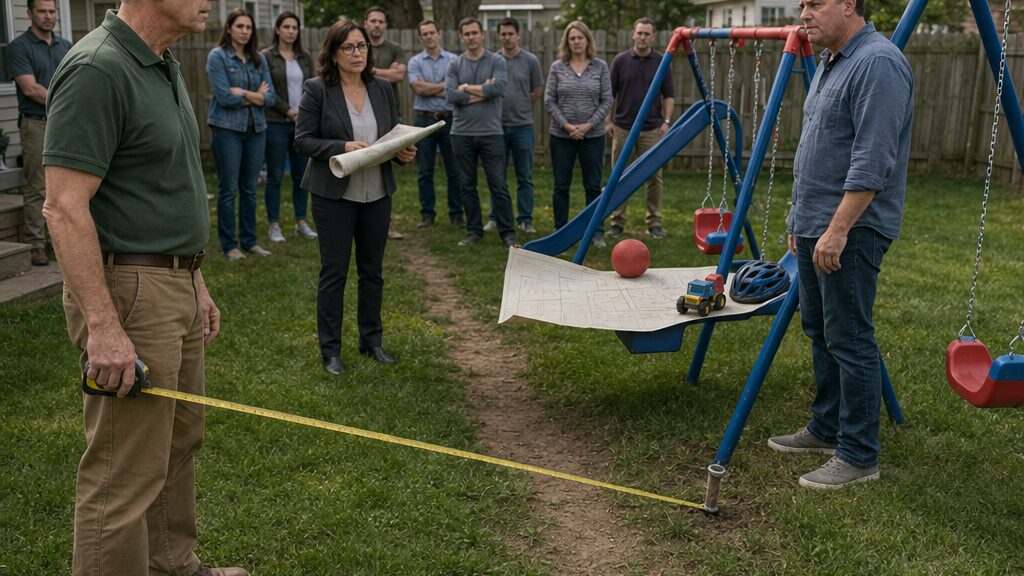
Andrew unfolded the survey across one of the plastic swing seats. Wind lifted the corners. A red foam ball lay nearby, along with a yellow toy truck and a bicycle helmet left beside the path. He placed one object on each corner until the paper stayed flat.
The absurdity of it held everyone’s attention: children’s toys pinning a recorded survey beneath the structure at the center of the dispute.
“This is the rear property pin,” Andrew said, indicating the symbol. “This is the side boundary. The measurement runs from the pin toward the front corner.”
The property manager leaned closer.
David remained where he was. “Those surveys aren’t always exact.”
“This one includes monument references.”
“You’re not licensed.”
“No. That’s why I’m measuring only what is printed.”
Andrew walked to the back corner, where the iron pin sat beneath a cap of soil near the shrubs. He had uncovered it before the meeting. He hooked the tape measure against it and drew the metal blade toward the swing set.
The tape clicked as it extended.
Nobody spoke.
At the printed boundary distance, Andrew stopped and pressed one shoe into the grass. The line fell well short of the nearest support.
He continued to the anchor.
“Thirty-seven inches,” he said.
David shook his head. “So you really are doing this. You’re standing here with a tape measure to punish children over three feet.”
Andrew let the tape retract slowly.
“I am measuring a structure you authorized on land you do not own.”
“The kids have used this area for years.”
“Walking across land does not transfer title.”
“This is exactly what people are talking about,” David said, turning slightly toward the parents. “Nobody had a problem until he decided to build a wall.”
Andrew felt the familiar pressure to defend his character instead of his boundary. To explain that he had fixed bicycles, returned balls, tolerated noise, and never once yelled at a child.
He refused the invitation.
“Who authorized permanent construction on my deeded lot?” he asked.
David’s jaw shifted.
Andrew looked at Kimberly. “Was there an HOA approval?”
Kimberly turned to the property manager.
The manager tapped through files on the tablet. “I have no architectural application for a play structure at this location.”
“Any access agreement?”
“No.”
“Easement?”
“Not in the current property records.”
“Consent form signed by me?”
“No.”
The small answers changed the air. The parents no longer looked only at Andrew.
David shoved his hands into his pockets. “I was told the area was community access.”
“By whom?” Andrew asked.
“The route has been there longer than some of these residents.”
“That is not an answer.”
Mary Allen stepped away from the group. “David, did Andrew tell you the swing set could go there?”
David looked at her. “He gave permission for the route.”
“That wasn’t her question,” Andrew said.
Kimberly lifted one hand. “We are not going to cross-examine each other in the yard.”
“Then make the factual determination,” Andrew said. “Does the swing set cross my recorded boundary?”
One board member crouched beside the survey. The other checked the tape’s endpoint.
Kimberly exchanged a look with the property manager.
“Based on the materials in front of us,” she said carefully, “the equipment appears to extend into Andrew’s parcel.”
A murmur moved through the residents.
David’s face reddened. “Appears?”
Kimberly ignored him. “The board has not authorized construction on Andrew’s property. The swing set cannot remain in its current position.”
Andrew felt the first clean release of pressure since Thursday morning.
It lasted less than ten seconds.
The property manager unrolled the HOA site map across the slide platform. Unlike Andrew’s survey, it showed common landscaping, drainage areas, sidewalks, and planting beds. A pale dashed line ran from the internal sidewalk toward the corner lots.
Kimberly bent over it.
“What is that?” Mary asked.
The manager zoomed in on a digital copy. “It’s labeled pedestrian connection.”
“Across Andrew’s lot?” David said.
“No,” Kimberly replied.
She traced the faded line with one finger. It passed through what was now a dense bed of ornamental grasses on HOA common land, then stopped near the edge of Andrew’s parcel.
The worn dirt track began almost exactly where the dashed route ended.
Andrew looked from the map to the landscaping gap near the entrance. What he had assumed was an accidental opening suddenly looked like the unfinished mouth of something planned.
“When was this map created?” he asked.
The manager checked the title block. “Fourteen years ago.”
“Before I was on the board,” Kimberly said.
“Was the connection built?” Andrew asked.
“Not according to the current layout.”
David stepped closer. “But it was supposed to be.”
“On common land,” Andrew said. “Not mine.”
“The intention was clearly access.”
“The intention stopped at my boundary.”
Kimberly rolled part of the map back, then opened it again, as if the paper might offer a less expensive answer.
One of the board members pointed to a shaded area. “Wasn’t there a drainage redesign near the entrance?”
The property manager nodded slowly. “There may have been.”
“May?”
“I need the archived project files.”
David seized the uncertainty. “So the HOA removed the route, everyone used the next logical path, and now Andrew wants to fence it.”
Andrew looked at him. “That still does not explain why you anchored a swing set in my yard.”
David did not answer.
The gathering dissolved into overlapping conversations. Parents discussed Greenway Road. One board member spoke quietly with the manager. Mary told another resident that the equipment had no approval. Someone across the driveway said the board should have fixed the route years ago.
Andrew had won the point he came to prove.
Yet the story moving through the group was already changing. The swing set was becoming evidence of a planning failure. His boundary was becoming an obstacle between families and something they believed had once been promised.
Kimberly asked him to step toward the porch.
Away from the others, she lowered her voice.
“The swing set has to move. I will put that in writing today.”
“Good.”
“But I need you to delay the fence.”
“The contractor comes Monday.”
“I understand.”
“Then you understand my answer.”
She held the rolled map against her side. “If the association removed or failed to complete a pedestrian connection, this may be bigger than David’s structure.”
“It is not bigger than my deed.”
“No. But it may explain why use became established.”
“That word again.”
“I’m not saying legally established. I’m saying practically.”
Andrew watched David speaking to the parents beside the swing set. He was no longer laughing. He was pointing toward Greenway Road.
“How long?” Andrew asked.
“Give me until Monday morning.”
“The posts arrive Monday morning.”
Kimberly looked toward the old landscaping beds, then back at him.
“We may have created this problem, Andrew.”
For the first time since he had found the swing set, the line on his survey did not look like the end of the dispute.
It looked like the place where an older mistake had been pushed onto his land.
Chapter 4: The Fence That Solved the Wrong Problem
The fence posts arrived at seven forty Monday morning, stacked on a flatbed before Kimberly sent a single archived record.
Andrew watched the truck reverse along the curb, its warning signal repeating through the quiet street. Cedar panels lay strapped behind the posts. Bags of concrete shifted against one another each time the driver braked.
The contractor stepped out and unfolded a work order on the hood.
“You still want the full run?” he asked.
Andrew looked toward David’s yard.
The swing set had been moved Sunday evening. Its nearest support now stood several feet beyond the survey line, squeezed beside David’s patio. Fresh holes remained in Andrew’s lawn where the anchors had been pulled. Dark soil showed through the grass like punctures.
“The full run,” Andrew said.
The contractor studied him. “Association approval came through?”
“It is within my lot and meets the recorded setback.”
“That wasn’t my question.”
Andrew folded his arms. “The board has not produced a valid reason to stop it.”
The contractor gave a small nod that carried neither agreement nor objection. “We’ll set the corners from your survey.”
By eight, bright string ran between wooden stakes along Andrew’s boundary. The line cut straight across the worn dirt path.
David came outside as the crew unloaded an auger.
“You couldn’t wait three days?”
“I waited two years.”
“You waited without saying anything.”
Andrew felt the accuracy beneath the accusation and disliked David more for using it.
“The swing set is moved,” David continued. “That was your complaint.”
“It was the last complaint.”
David glanced at the contractor. “Kimberly asked you to hold.”
“She asked. She did not show me an easement.”
“This is not just about an easement.”
“No. It is also about you installing equipment on my property.”
David stepped closer to the string line but did not cross it. “My youngest has to ride beside Greenway now.”
“Then ask the HOA why it never built the route on its own land.”
“I’m asking you not to make it worse while they investigate.”
Andrew looked at the empty anchor holes.
“I did that already,” he said. “It got me a swing set.”
The auger engine started, ending the conversation.
Each hole came up in a dark spiral of soil. The crew worked from the rear corner toward the street, setting posts at measured intervals. Andrew stood on his porch with the survey folded beneath his arm. Every post landed on his side of the black line. Every measurement was exact.
At eleven, an email from Kimberly arrived.
The archived project files showed that fourteen years earlier, the HOA had approved a drainage improvement near the subdivision entrance. The work rerouted runoff through a shallow common-land swale and replaced a proposed pedestrian connector with ornamental grasses and stone. The connector had been removed from the construction phase to reduce costs.
The final paragraph asked Andrew again to suspend the fence.
He read the message twice.
So the path had existed only on paper. The HOA had erased it before pouring a single foot of pavement, then allowed the opening to remain pointed at his yard. Years later, families had followed the shortest line through private grass.
Andrew forwarded the email to the contractor without comment.
The contractor read it from his phone and approached the porch. “This doesn’t say they have rights over your lot.”
“I know.”
“It does say they’re looking at an access issue.”
“I know that too.”
“We can stop after the rear section. You’d have privacy without closing the path today.”
Andrew looked toward the line of unset posts. The compromise was practical. It would preserve his property claim while leaving time for the board to respond.
Then a bicycle came across the path.
A boy slowed at the machinery, lifted his front wheel over a pile of dirt, and continued between Andrew’s porch and the unfinished fence line without asking. Another child followed on a scooter.
Neither looked at Andrew.
The habit seemed stronger than the dispute, stronger than the survey, stronger than the crew drilling holes around them.
“Finish it,” Andrew said.
By midafternoon, cedar panels stood shoulder to shoulder from the rear corner toward the sidewalk. The open lawn became enclosed space. The worn track ended at smooth new boards.
The contractor installed a gate near the porch for Andrew’s mower. It opened inward and locked with a simple latch.
Andrew ran his hand along the top rail.
For the first time in years, no path crossed his grass.
David’s children appeared after school with two others. They came through the gap in the HOA landscaping as they always had, moving quickly until the fence filled their route.
The oldest stopped first.
The younger child nearly struck him from behind. A bicycle tipped onto the common grass.
They stared at the boards.
One child walked along the fence, searching for an opening. Another touched the cedar with his fingertips. No one shouted or kicked it. Their confusion was quieter than anger and harder for Andrew to watch.
David came down his driveway.
“Go around,” he told them.
“Which way?” the younger child asked.
David pointed toward the neighborhood entrance and Greenway Road.
The children turned their bicycles. Andrew watched them travel along the sidewalk toward the collector road, where traffic moved in brief, fast bursts between stoplights.
A car entered the subdivision too quickly and crossed the painted edge of the lane before correcting. The children stopped at the curb.
David looked across the fence at Andrew.
He said nothing.
The silence should have felt like victory. Instead, Andrew heard the traffic more clearly than he had before.
That evening, the neighborhood group filled with photographs of the fence. Some comments accused Andrew of acting before the board completed its review. Others blamed the HOA for eliminating the planned walkway. Mary wrote that the swing-set encroachment and the safety problem were both real and should not be collapsed into one accusation.
David did not reply publicly.
At nine, an envelope was hand-delivered beneath Andrew’s front door.
The letterhead belonged to the HOA’s management company. It directed him to cease obstruction of a historically used pedestrian route and attend mandatory dispute resolution. It warned that the association reserved the right to pursue enforcement remedies if he refused temporary access.
Andrew carried the letter to the dining table and placed it beside the survey.
The county document showed no route.
The HOA’s demand spoke as if one already existed.
For the first time, Andrew wondered whether the letter was an empty threat—or whether the board believed years of silence had given it something his deed did not.
Chapter 5: The Map the Board Stopped Showing Residents
The county clerk laid a certified plat on the counter and tapped Andrew’s parcel with one square fingernail.
“There is no pedestrian easement here,” she said.
Andrew leaned closer. “Not current, not expired, not proposed?”
“Proposed improvements would not appear as a recorded burden unless they were dedicated or granted. I can search the prior instruments again.”
She did.
The terminal produced drainage agreements, utility access, setback notes, and the original subdivision declaration. None crossed Andrew’s lot. The black boundary line remained clean.
The clerk printed the index and stamped it.
“If someone claims a private access right,” she said, “they should be able to identify the recorded instrument.”
Andrew folded the certified copy into a protective sleeve. The answer was exactly what he had expected.
It did not make him feel settled.
Benjamin Davis met him outside the records office. The surveyor was compact, gray-haired, and careful with words. He had lived in the subdivision years earlier and still remembered the entrance before the ornamental grasses matured.
They drove back separately and met at Andrew’s dining table. Benjamin spread the recorded plat beside the HOA site plan Kimberly had finally released.
“They are different kinds of documents,” Benjamin said. “This controls ownership. That one shows design intent.”
He pointed to the dashed pedestrian connector.
Andrew watched the line travel across common land and stop near his boundary.
“So it proves nothing.”
“It proves no easement over your property.”
“That is what I said.”
Benjamin looked up. “It also proves someone designed a route to this exact location.”
“Then failed to build it.”
“Yes.”
“And people used my lot instead.”
“Yes.”
Andrew disliked the rhythm of the answers.
Benjamin took a transparent ruler from his case and aligned it with the dashed line. “The original route would have continued through the current planting bed, curved behind the drainage swale, and connected with the interior sidewalk. It never needed to touch your parcel.”
“Can the HOA force my gate open?”
“Not from anything I’ve seen.”
The answer gave Andrew the small relief he had wanted.
Then Benjamin turned the site map over.
A photocopy request form was clipped to the back. The property manager had included it by accident when providing the archived file.
The request was dated four months earlier.
Requested by: David Clark, Grounds and Safety Committee.
Andrew read the line twice.
“What was he looking for?” he asked.
Benjamin examined the listed materials. “Old entrance plans, pedestrian layouts, drainage revisions.”
“Before he installed the swing set.”
“Months before.”
The HOA meeting that evening was held in the small clubhouse near the mailboxes. Every folding chair was occupied. Residents stood along the rear wall. The fence photographs had turned a private dispute into the only issue anyone wanted to discuss.
Kimberly sat at the front table beside the property manager and two board members. David occupied the first row with a folder on his lap. Mary sat farther back.
Andrew placed the certified plat and survey in front of him.
Kimberly called the meeting to order.
She began with the drainage project. Fourteen years earlier, the board had approved a pedestrian connector and later removed it from construction after bids exceeded the project budget. The association had never amended the conceptual site map used in later landscape planning. As a result, the open alignment remained visible even though the route did not legally exist.
A resident near the wall asked why no one had corrected the map.
Kimberly paused.
“The records do not explain that.”
“You mean the board didn’t want to pay for it,” someone said.
“The decision predates the current board.”
“But the current board sent Andrew a demand.”
Kimberly’s jaw tightened. “The demand preserved the status quo while we investigated.”
“The status quo was people crossing his yard,” Mary said.
“And the fence changed that overnight,” David replied.
Andrew stood before Kimberly could redirect the exchange.
“The county found no easement,” he said. “My survey confirms the equipment crossed thirty-seven inches into my property. The association approved neither the swing set nor access over my lot.”
The property manager nodded reluctantly. “Those points are accurate.”
A murmur moved through the room.
Andrew turned toward David. “Why did you request the old site map four months ago?”
David’s expression changed before he answered.
Kimberly looked down at her binder. “What request?”
Andrew held up the photocopy form.
The room quieted.
David rose slowly. “I was on the Grounds and Safety Committee. Parents kept complaining about Greenway.”
“So you found a proposed route ending beside my lot.”
“Yes.”
“And you knew there was no completed path.”
“I knew the design intended a connection.”
“On common land.”
David pressed his lips together. “The practical route was already across your yard.”
“That is not what I asked.”
“No,” David said. “I did not have a document granting access over your parcel.”
The admission landed without drama. No one applauded. Several residents simply lowered their eyes.
Andrew felt something colder than satisfaction.
“You knew the line,” he said.
“I knew roughly where it was.”
“You told the installers it had been cleared.”
“I told them the play area followed the route.”
“You anchored it across my boundary.”
David’s hand tightened around his folder. “Because every private conversation about reopening the connector went nowhere. The board said it had no money. Parents complained and then stopped showing up. You let the children cross, so everyone pretended the problem was solved.”
“You thought building on my property would force an easement.”
“I thought it would force a real discussion.”
The answer was worse because it made sense inside David’s fear. He had not mistaken the boundary. He had chosen to violate it, believing Andrew’s reluctance to confront anyone could be turned into public pressure.
“You used your children to create leverage,” Andrew said.
David’s face reddened. “I was trying to keep them off Greenway.”
“You could have asked me.”
“I did ask you about the route.”
“You asked whether they could cross occasionally.”
“And you said yes.”
“That was not forever.”
“Then you should have said when it stopped.”
The room became still again.
Andrew could deny the accusation, but the photographs in his phone proved otherwise. He had watched the path deepen and said nothing. David had exploited that silence, but he had not invented it.
Kimberly brought the meeting back to order. She acknowledged that the HOA’s demand letter overstated the association’s authority and announced it would be suspended pending mediation.
Then she added a condition.
“The board is prepared to withdraw enforcement entirely if Andrew agrees to a written temporary license allowing pedestrian passage while we study a permanent common-land route.”
Andrew looked at the same people who had treated his patience as permission. Now they wanted him to sign a document giving formal shape to the arrangement that had already failed.
“How temporary?” he asked.
“Ninety days, renewable by agreement.”
“Through my gate?”
“A controlled opening could be established.”
“Who carries liability?”
“The association would obtain coverage.”
“Who supervises use?”
“We would develop rules.”
David turned in his chair. “It keeps the kids safe while the board fixes this.”
Andrew looked at the certified plat on the table. It had confirmed everything he claimed. His lot was his. The swing set had crossed the line. The HOA had no recorded right.
Yet the offer required him to reopen the very path he had just closed.
Kimberly slid a draft license across the table.
“If you sign before mediation,” she said, “the association will withdraw its demand immediately.”
Andrew left the document untouched.
Chapter 6: The Offer That Sounded Like the Same Mistake
The bicycle lay on its side against Andrew’s new fence, its front wheel still spinning.
He found it Tuesday afternoon beside the common landscaping gap. A child stood several yards away near Greenway Road, pale and breathing hard. A delivery van had stopped at an angle near the subdivision entrance.
Mary Allen was running toward them.
“What happened?” Andrew asked.
“The van turned in while he was crossing,” she said. “It didn’t hit him.”
The driver stepped out, shaken and defensive. “He came off the sidewalk too fast. I barely saw him.”
The child’s knee was scraped. Nothing appeared broken. Mary checked him, then led him back from the road.
Andrew picked up the bicycle. One handlebar grip was torn. He carried it to the fence and set it upright.
The cedar boards were doing exactly what he had paid them to do.
They were keeping people off his property.
Mary waited until the driver left.
“This is what everyone was afraid of,” she said.
“I did not remove the common path.”
“No. But the path they were using is closed.”
Andrew looked at her. “You want me to open the gate.”
“I want the HOA to fix the route. Today, not after another committee study.”
“That is not an option they offered.”
“I know.”
The child took the bicycle and walked it home. Mary watched until he disappeared around the corner.
“David says you never warned anyone before the fence,” she said.
Andrew’s shoulders stiffened.
“He told the neighborhood group you went from friendly permission to a locked wall without one conversation.”
“I spoke to him when the swing set appeared.”
“That was after he installed it.”
“You agree he was wrong.”
“Yes.”
“Then why repeat his argument?”
“Because two things can be true.”
Andrew looked at the dirt beside the fence. The old path ended beneath the boards, pressed into the earth by hundreds of crossings he had allowed and resented.
Mary folded her arms. “Did you ever tell the parents the route was becoming a problem?”
“No.”
“Did you tell David before the swing set?”
“Not directly.”
“Did you tell the board?”
“I documented the damage.”
“That is not the same as telling someone.”
The words were plain, without cruelty.
Andrew unlocked his gate and rolled the bicycle marks out of the grass with the sole of his shoe. “I thought people would notice.”
Mary waited.
“I thought David would see the bare lawn. I thought parents would see the trash. I thought someone would ask whether it was still all right.”
“And when nobody did?”
“I took pictures.”
“Why?”
“So I would have proof.”
“For whom?”
Andrew did not answer.
The photographs had not been for court, not at first. They had been a private record of being wronged. Each image allowed him to preserve his patience while adding another entry to an invisible case against everyone around him.
He had wanted them to recognize his generosity without making him risk the embarrassment of asking for respect.
Mary seemed to understand before he said it.
“You wanted them to know better,” she said.
“They should have.”
“Yes. They should have.”
The agreement did not absolve him.
That evening, Andrew covered the dining table with documents. The survey lay at the center. Beside it were the certified plat, the obsolete site map, the temporary license, photographs of the lawn, and the HOA’s suspended demand.
For weeks, the survey had functioned as a shield. Then as a blade.
He made three copies.
On the first, he drew the fence exactly where it stood.
On the second, he traced the failed common-land connector through the ornamental grasses and around the drainage swale. The route could reach the interior sidewalk without touching his parcel, but the turn was narrow.
On the third, he drew a wider option that required removing part of the stone landscaping near the entrance and relocating two mature shrubs.
Benjamin arrived after dinner with measuring tools and reviewed the alternatives.
“The narrow route meets minimum width if they install fencing along the swale,” he said. “The wider one is safer for bicycles.”
“Cost?”
“More than the board wants.”
“How much more?”
Benjamin named a range.
Andrew leaned back. “They’ll say the reserves cannot support it.”
“They may be right.”
“They found money for decorative stone.”
“Fourteen years ago.”
“They still maintain it.”
Benjamin capped his pen. “Being right about their priorities does not make the money appear.”
Andrew looked at the temporary license. “Would you sign this?”
“I would not advise any owner to grant recurring access without clear limits, insurance, maintenance responsibility, and an end date that does not renew automatically.”
“That sounds like no.”
“It sounds like not this document.”
Andrew pushed it aside.
The next evening, several parents met informally near the blocked path. David spoke first, describing Andrew’s fence as a unilateral act that had endangered children. Mary interrupted him.
“He did not act without warning,” she said.
David stared at her.
“He objected when you installed the swing set. The equipment crossed his line, and you knew there was no easement.”
“That does not change the safety problem.”
“No. But stop telling people he created all of it.”
The other parents shifted uneasily.
Mary continued. “We used his yard because it was easier. None of us asked him. We let David’s permission stand in for Andrew’s.”
David’s voice lowered. “Whose side are you on?”
“The side where we stop pretending only one person made a mistake.”
Andrew stood behind his fence, unseen from where they gathered. He heard every word.
For the first time, someone publicly defended his boundary without denying the children’s risk. The two truths did not cancel each other. They made the solution harder.
At the HOA office the next morning, Kimberly reviewed Andrew’s sketches.
“The wider route requires removing the entrance landscaping,” she said.
“Yes.”
“That bed is part of the community appearance plan.”
“It is also sitting where the approved connector was supposed to go.”
“The reserve account is already under pressure.”
“Then the board will have to explain why decoration remains funded while a child-safety route does not.”
Kimberly looked at him for a long moment. “You know a special assessment will make residents angry.”
“They are already angry.”
“Some of them will blame you.”
“They already do.”
She tapped the temporary license. “This is less expensive.”
“For the association.”
“It is immediate.”
“And it transfers the burden back to me.”
“We can improve the terms.”
Andrew gathered the pages. “I will not reopen my property under another arrangement people can stretch later.”
“Then what are you offering?”
He placed two proposals on her desk.
The first demanded full reimbursement for lawn restoration, survey costs, fence expenses, and damage caused by the swing-set anchors.
The second reduced the claim substantially. In exchange, the HOA would withdraw its access demand, publish a written correction acknowledging that no easement crossed his lot, and fund the permanent common-land route. David would pay for the damaged lawn and part of the surveying expense.
Kimberly read both documents.
“You are willing to waive money for the route?”
“I am willing to stop treating those as separate problems.”
“And temporary access?”
“No.”
She looked toward the fence plan. “David will fight this.”
“Then he can explain in mediation why he requested the map before installing the swing set.”
Andrew left the office with the survey copies beneath his arm.
Two days later, he entered the mediation room carrying the full damages claim in one folder and the common-path proposal in another.
For the first time since the dispute began, he was not waiting for anyone to notice what he needed.
Chapter 7: A Boundary Kept and a Safer Path Built
David began mediation by pointing at Andrew’s fence.
“The route existed before those boards went up,” he said. “Whatever the paperwork says, families used it for years.”
The mediator, a quiet woman with a legal pad, looked toward Andrew. Kimberly sat between the two men at the opposite side of the table, the HOA property manager beside her. The room had no windows. Fluorescent light flattened every document spread across its surface.
Andrew placed his hand on the folder containing the recorded survey.
“The route existed because I allowed people to cross,” he said. “That did not make it permanent.”
David leaned forward. “You allowed it until the moment it became inconvenient.”
“Until you installed a swing set on my land.”
“We moved it.”
“After I produced the survey.”
The mediator lifted one hand. “We are not here to repeat every accusation. We are here to identify what can be resolved.”
David sat back, but his knee continued moving beneath the table.
Kimberly opened with the HOA’s position. The association would withdraw its enforcement demand. It acknowledged that no recorded easement crossed Andrew’s parcel and that the old site plan did not create private access rights.
Andrew listened without interrupting.
It was the statement he had wanted from the beginning.
Then Kimberly continued.
“The board remains concerned about the immediate safety consequences of closing the route. We propose a ninety-day pedestrian license while bids are obtained for a permanent solution.”
“No,” Andrew said.
David let out a breath through his nose. “There it is.”
The mediator looked at Andrew. “You are rejecting temporary access under any terms?”
“Across my property, yes.”
“Even with insurance and limited hours?”
“Yes.”
David turned toward Kimberly. “Then he is not interested in solving anything.”
Andrew opened the first folder. Inside were photographs of the worn lawn, the broken sprinkler head, the anchor holes, and the unfinished swing set. Behind them sat estimates for reseeding, grading, surveying, and the fence.
“I am prepared to pursue the full claim,” he said. “Lawn restoration, survey costs, fence expenses, and damage from the installation.”
David stared at the total. “You chose to build that fence.”
“I chose it after you treated my silence as an opportunity.”
“You expect me to pay for your decision?”
“I expect you to pay for the damage you caused.”
The mediator reviewed the photographs. “The fence cost is likely to be disputed. The direct property damage is clearer.”
Andrew nodded. “I understand.”
He closed the folder.
Then he placed the second one on the table.
“This is my alternative.”
Kimberly had seen it before. David had not.
Andrew unfolded a clean copy of the survey beside the obsolete HOA site map. On the survey, his boundary remained marked in black. The fence followed it precisely. On the HOA map, a new line curved through common land, around the drainage swale, and connected the interior sidewalk to the neighborhood entrance.
The two maps touched at their edges without crossing.
“I will reduce my claim,” Andrew said. “David pays for the anchor damage, lawn restoration, and half the independent survey. The HOA withdraws its demand in writing, corrects the community records, and builds the common-land path.”
David studied the line. “And your gate stays locked.”
“My gate stays mine.”
“The kids still have no route while construction happens.”
“The board can expedite the work.”
Kimberly looked at the estimated cost attached to the proposal. “This requires removing landscaping, adding a safety rail, and adjusting drainage protection.”
“Yes.”
“It may require a special assessment.”
“Yes.”
Several seconds passed.
The mediator asked Andrew, “You are willing to waive the fence reimbursement and part of the remaining damages if the association funds this project?”
“I am.”
David frowned. “Why?”
Andrew looked at the survey between them.
For weeks, he had used the document to prove where obligation ended. Now the same lines showed where a solution could begin without erasing him.
“Because the children need a route,” he said. “They do not need my yard.”
David looked away.
Kimberly tapped the cost sheet. “Residents will object to paying for a problem they believe two neighbors created.”
“The board removed the planned connector,” Andrew said.
“A prior board.”
“The association inherited the landscaping. It also inherited the unfinished obligation.”
Kimberly’s mouth tightened. “That is not a legal admission I am prepared to make.”
“It does not need to be. The corrected record can state that the route was planned, removed during the drainage redesign, and never replaced.”
The property manager whispered something to her.
David picked up the proposed settlement. “You still want me to admit I knew the swing set crossed the line.”
“I want you to accept responsibility for placing it there.”
“I was trying to force the board to deal with the route.”
“You used my property to force that conversation.”
David’s voice rose. “Because nobody listened. I brought up Greenway at three committee meetings. Parents complained. The board said there were no funds. You let everyone cross and acted as if it was fine.”
Andrew felt the old urge to retreat into certainty. David was wrong. The survey proved it. The photographs proved it. The installers’ statement proved it.
But another truth remained.
“I should have told you to stop sooner,” Andrew said.
The room went still.
David’s expression changed, suspicion replacing anger.
Andrew continued. “I watched the path widen. I took pictures instead of speaking. I expected everyone to understand a limit I never stated clearly.”
David glanced at Kimberly, then back at him.
“That does not excuse what you did,” Andrew said. “You knew the boundary and crossed it intentionally. But I will not pretend my silence helped.”
The mediator wrote something on her pad.
David rubbed one hand across his jaw. “If I pay for the lawn and survey, you drop the rest?”
“If the HOA approves the permanent path and corrects the record.”
“And no access through the gate.”
“No.”
The answer was firm, but it no longer carried the heat it once had.
Kimberly requested a private break with the property manager. They left the room with Andrew’s proposal.
David remained seated across from him.
For several minutes, neither man spoke.
Finally David said, “My youngest freezes at Greenway.”
Andrew looked at him.
“He sees a car coming and cannot judge whether it is slowing down. That near miss was not the first time he panicked there.”
“You should have told me.”
David gave a bitter laugh without humor. “Maybe we both expected the other person to notice.”
Andrew did not forgive him. Not then.
But for the first time, David’s fear appeared without the neighborhood group, the committee title, or the swing set standing between them.
When Kimberly returned, she did not sit immediately.
“The board will put the common-land path to an emergency vote,” she said. “The association will withdraw the demand and issue a written correction regardless of the vote.”
Andrew waited.
“If the path is approved, we accept the settlement structure. The special assessment will be limited by using part of the landscape reserve.”
David asked, “How soon?”
“Construction can begin within six weeks if permitting is straightforward.”
The mediator looked from David to Andrew. “Is that sufficient to continue settlement?”
Andrew nodded.
After a pause, David did too.
The written agreement took another two hours.
David accepted responsibility for the swing-set encroachment, anchor damage, and lawn repair. He agreed to pay half of Benjamin’s surveying fee. Andrew waived reimbursement for the fence and withdrew the broader claim once the path project received final approval.
The HOA acknowledged in writing that no pedestrian easement or community access right crossed Andrew’s property. It also agreed to remove the obsolete map from resident materials and replace it with an accurate site plan.
The permanent route would remain entirely on common land.
Three residents spoke against the special assessment at the emergency meeting. One accused the board of rewarding Andrew for building an unfriendly fence. Another said parents should supervise their own children rather than charging everyone for a sidewalk.
Mary stood and reminded them that the original connector had been removed to save money.
“We have been borrowing one homeowner’s yard ever since,” she said. “Now we are paying for the route we should have built.”
The vote passed by one.
Six weeks later, crews removed the decorative stone and two overgrown shrubs near the entrance. They cut a narrow path through the common landscaping, installed a low safety rail along the drainage swale, and connected the pavement to the interior sidewalk.
Benjamin checked the final measurements.
Andrew stood beside him holding the same recorded survey he had unfolded across the swing-set seat months earlier. Benjamin marked the new common path on a separate site drawing, leaving Andrew’s boundary untouched.
“Nothing crosses your line,” he said.
Andrew folded the survey carefully.
The bare patches in his lawn had begun to fill. David had paid the restoration invoice on time. The swing set remained crowded beside his patio, entirely on his own property.
He and Andrew exchanged brief nods when they saw each other. They did not return to friendly driveway conversations. Neither pretended the dispute had cost nothing.
On the afternoon the path opened, a group of children approached the entrance on bicycles. They slowed where the old dirt route had begun.
For a moment, habit pulled their eyes toward Andrew’s fence.
Then Mary pointed to the new pavement.
The children turned onto it, single file at first, tires whispering over the clean surface. The route curved safely behind the swale and carried them away from Greenway Road.
David’s youngest rode near the middle. As he passed the point closest to Andrew’s yard, he looked through the safety rail.
Andrew raised one hand.
The child raised his in return and kept riding.
Andrew walked back to his gate. The latch rested beneath his fingers, neither a weapon nor an apology. He closed it until the metal caught with a quiet click.
The path beyond his fence continued toward the playground.
His yard remained his.
This time, both truths had been stated clearly.
The story has ended.