The Night the Police Came for His Blue Truck and Found the Wrong Neighbor Guilty
Chapter 1: The Patrol Car Stopped Beside the Blue Pickup
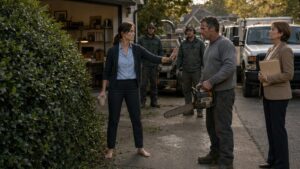
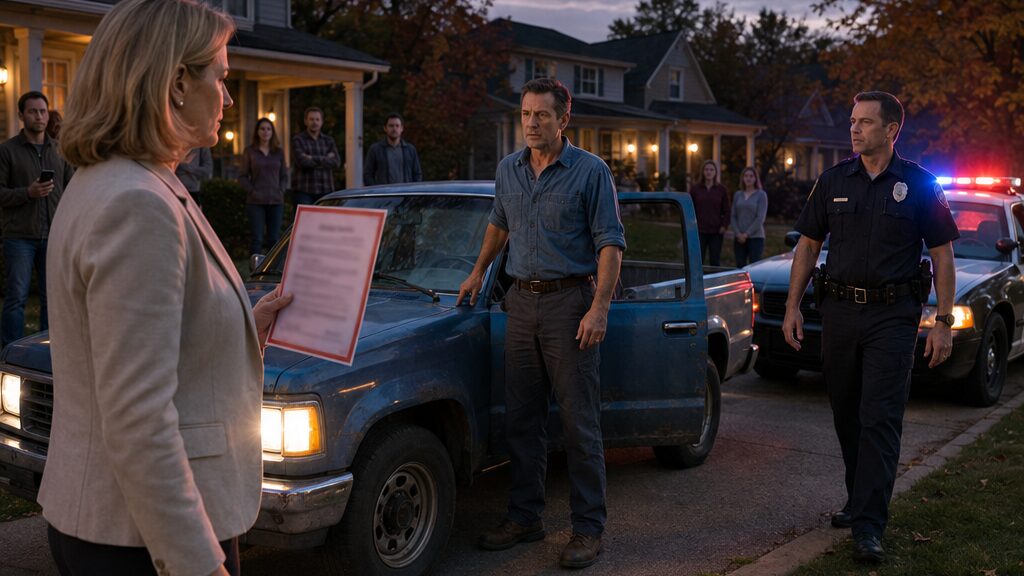
Red and blue light swept across the white violation notice in Carol Thompson’s hand before Stephen Carter heard the patrol car turn onto the street.
The colors slid over the paper, across Carol’s pale jacket, and up the front of Stephen’s house. Several porch lights came on almost at once. A curtain shifted across the street. Someone farther down the block stepped onto a driveway with a phone held low against one leg.
Carol looked past Stephen toward the approaching car.
“Well,” she said. “Someone finally decided to take it seriously.”
Stephen had been standing beside his blue pickup with the driver’s door open. A canvas tool bag rested on the seat, and a pair of insulated gloves lay on the floorboard. He had returned less than ten minutes earlier from an after-hours call near the water tower. He had not yet gone inside.
He glanced at the truck, then at Carol.
“Take what seriously?”
She lifted the notice between two fingers.
“You know what this is about.”
The patrol car slowed in front of his house. Its lights remained active, washing the pickup’s faded paint in alternating color. Stephen felt the attention gathering around the scene before he saw the faces. The neighborhood had a particular way of watching without appearing to watch.
Carol had come over carrying the newest HOA warning after seeing him park. She had begun with the driveway boundary, moved to the truck’s appearance, then to the reflective strips on the tool case visible through the rear window. According to her, those details supported the board’s suspicion that he was operating a commercial service from his property.
Stephen had answered none of it.
That silence had irritated her more than an argument would have.
The patrol car stopped at the curb.
Carol’s shoulders settled as if a vote had gone her way.
The officer stepped out without urgency. He was broad through the chest, close to Stephen’s age, and smiling faintly as he closed the door.
“Evening,” he said.
“Officer,” Carol replied before Stephen could speak. “I’m Carol Thompson, compliance chair for the Brookstone Ridge Homeowners Association.”
The officer looked at her notice, then at Stephen.
“Dennis Williams,” he said. “Is that your blue pickup?”
Carol turned her head toward Stephen. Her expression held no surprise, only satisfaction.
Stephen closed the driver’s door.
“Yes.”
A neighbor across the street raised his phone slightly.
Dennis nodded toward the truck. “You just get home?”
“About ten minutes ago.”
“Thought so.”
Carol crossed her arms. “There have been repeated concerns regarding that vehicle.”
Dennis looked at her. “Concerns?”
“Parking compliance. Possible commercial use. Exterior condition. We have documentation.”
Stephen kept his eyes on Dennis. The officer’s gaze moved briefly toward the truck’s windshield, then down toward the grille.
For one second, Stephen wondered whether he had missed something at the work site. A loose cover. A damaged lamp. A municipal tag still clipped to the bumper. His stomach tightened despite his effort to remain still.
Dennis pointed.
“Your headlights are on.”
Stephen looked back.
Both beams shone steadily into the deepening dusk.
He had left them burning when Carol approached with the notice.
Dennis gave a small shrug. “I recognized the truck when I came around the corner. Figured I’d save you a dead battery in the morning.”
The silence that followed seemed louder than the patrol lights.
Stephen reached through the open window and turned the switch. The headlights went dark.
“Appreciate it,” he said.
“No problem.”
Carol stared at Dennis. “That’s why you stopped?”
“That’s why I stopped.”
“There wasn’t a call?”
“Not one assigned to me.”
She looked toward the watching houses and then back at the officer. “So you’re not here concerning the vehicle violations?”
Dennis glanced at the pickup again. “I’m not here concerning any HOA matter.”
The neighbor across the street lowered his phone.
Stephen allowed himself half a breath of amusement. It was not enough to become a smile, but Carol saw it.
Her mouth tightened.
Dennis stepped closer to the truck, his attention catching on the canvas tool bag through the window.
“Long one?” he asked Stephen.
“Transformer alarm near the water tower.”
“Everything clear?”
“Bad sensor. No heat damage.”
Dennis nodded as if that explained more than Carol understood.
“You still taking the overnight rotation?”
“When they need somebody.”
Carol’s eyes moved between them. “You two know each other?”
“Mostly from scenes where people are happier to see him than me,” Dennis said.
Stephen wished he had not.
Carol lowered the notice to her side.
Dennis gave Stephen a casual wave. “Get some rest. And maybe check those lights before you go in.”
“I will.”
The officer returned to the patrol car. The lights stopped flashing, and the street fell back into ordinary evening colors. Engines hummed softly. Sprinklers clicked somewhere behind a fence.
Stephen waited until Dennis pulled away.
Carol remained beside the driveway.
“You could have told me,” she said.
“About the headlights?”
“About the officer.”
“I didn’t know why he was stopping.”
She looked at the truck as if it had embarrassed her personally. “This changes nothing about the notice.”
“I didn’t say it did.”
“You park a work vehicle in plain view. You come and go at irregular hours. There are tools visible from the street. Residents have asked questions.”
“Then answer the questions the rules actually cover.”
“I am trying to.”
“No,” Stephen said. “You’re trying to make the truck mean something.”
Carol’s expression hardened. “Rules apply whether you explain yourself or not.”
Stephen took the notice from her hand. A red border surrounded the words FINAL COMPLIANCE WARNING. The allegations beneath it included commercial activity, nuisance lighting, and repeated failure to cooperate with inspection requests.
He folded the paper once.
“Good night, Carol.”
She did not move.
Stephen opened the truck door to retrieve his tool bag. On the passenger seat lay the old brass key he used for the truck, separate from the newer keys on his municipal ring. Its edges had been worn smooth by another man’s hand long before it came to his.
Carol noticed him looking at it.
“What is it about that truck?” she asked.
Stephen closed his fingers around the key.
“It gets me where I need to go.”
“That isn’t an answer.”
“It’s the one you’re getting.”
He walked toward the house.
Behind him, Carol’s phone made the soft artificial click of a camera shutter.
Stephen turned.
She stood near the curb, framing the rear of the departing patrol car with his pickup in the foreground. The HOA notice was tucked beneath her arm.
“What are you doing?”
“Documenting the interaction.”
“There was no interaction.”
“There was police presence at a property already under review.”
Dennis’s car turned at the end of the street and disappeared.
Carol looked down at her screen. Her thumb moved twice.
Stephen felt the last of his amusement leave him.
Inside his house, he set the tool bag by the door and placed the brass key on the kitchen counter. The folded violation notice remained in his pocket.
Across the narrow side yard, light glowed in Carol’s home office. Her silhouette passed in front of the blinds.
A few minutes later, Stephen’s phone vibrated.
The message came through the HOA resident portal. It had been sent to the board, the property manager, and Stephen.
Attached was Carol’s photograph: the blue pickup under red and blue light, the patrol car stopped at the curb, Stephen standing between them.
The subject line read: SUPPLEMENTAL EVIDENCE.
Carol’s message consisted of two words.
Police involvement.
Chapter 2: A Courtesy Call Becomes an Official Violation
The final-notice envelope had been wedged beneath the driver’s-side wiper so tightly that the corner tore when Stephen pulled it free.
He stood in the driveway before sunrise, wearing his work boots and an unbuttoned municipal jacket. Moisture had gathered on the pickup’s hood. The envelope was dry.
Someone had placed it there after the dew settled.
Through the clear address window, Stephen could see his name printed above the words FORMAL ENFORCEMENT ACTION.
He set his coffee on the roof of the truck and opened the envelope.
Three pages slid out.
The first assessed two hundred dollars in cumulative fines. The second demanded removal of the pickup within ten calendar days. The third was a color copy of Carol’s photograph from the previous evening.
Under the image, the property manager had written:
Repeated complaints have now resulted in visible law-enforcement attention at the property.
Stephen read the sentence twice.
The notice listed three categories of violation: unauthorized commercial vehicle storage, nuisance lighting, and failure to provide requested operational documentation. It also warned that the association might recover towing and legal costs if he did not comply.
The headlights had been on for less than fifteen minutes.
The police had issued no warning, citation, or report against him.
Yet the photograph made a cleaner argument than the truth did.
Stephen folded the pages and placed them on the passenger seat beside the brass key.
At the municipal maintenance yard, the blue pickup looked smaller among the bucket trucks and utility vans. Stephen backed it into the employee row, then carried his tool bag toward the service building.
His supervisor was waiting beside the roll-up door.
“You see the email?” the supervisor asked.
Stephen stopped. “What email?”
“The one your property association sent the city.”
A pressure settled behind Stephen’s ribs.
“What did they ask?”
“Whether you’re using municipal equipment for private business.”
“I’m not.”
“I know that.”
“Then answer them.”
“I did. But they attached a picture of a patrol unit outside your house and asked if there had been an incident.”
Stephen looked through the open bay toward the pickup.
The supervisor lowered his voice. “What exactly is going on?”
“Neighbor doesn’t like the truck.”
“That truck is yours.”
“The tools aren’t.”
“And that distinction matters only while everyone understands it.”
The supervisor led him into the small office beside the parts cage. A copy of Stephen’s personal-vehicle equipment agreement lay on the desk. It allowed him to transport limited municipal emergency gear in his own truck while assigned to after-hours rotation. The city reimbursed mileage but did not own, register, or insure the vehicle.
The agreement also included a public-perception clause.
Stephen read the paragraph without touching the paper.
The supervisor tapped it. “If this turns into a public complaint about private work, procurement can pull the authorization.”
“I don’t do private electrical work.”
“You carry jump leads, barricade lamps, insulated cutters, a meter, first-aid equipment, and temporary hazard tape.”
“For callouts.”
“I know.”
Stephen looked up.
The supervisor held his gaze. “But you also help people.”
“That isn’t a business.”
“No. It isn’t. But somebody asking the wrong questions can make it look like one.”
Stephen thought of Carol standing under the patrol lights with the notice in her hand. He thought of the photograph cropped tightly enough to exclude Dennis’s relaxed posture.
“What does the city need from me?”
“Nothing yet. I can confirm your status if the HOA asks the right question.”
“They won’t.”
“Then you may need to give them the agreement yourself.”
Stephen shook his head.
“Why not?”
“Because it includes my rotation schedule, equipment list, and incident references.”
“You can redact those.”
“They’re not entitled to any of it.”
The supervisor leaned back in his chair. “Maybe not. But entitlement and consequence aren’t always the same thing.”
Stephen picked up the agreement.
He knew the document could weaken the commercial-use accusation. It would establish that the tools belonged to the municipality and that his after-hours travel had an official purpose.
It would also open a door.
Carol would ask where he went. Who called. Why neighbors had seen him kneeling beside cars after midnight. Why he had carried temporary lamps into houses during outages that were not municipal incidents.
Once a person like Carol received one explanation, she treated it as permission to demand the next.
Stephen placed the agreement back on the desk.
“I’m not submitting it.”
The supervisor’s disappointment was quiet. “Then keep the truck away from anything that looks like side work until this settles.”
Stephen said nothing.
“Stephen.”
“I heard you.”
The morning passed through small failures. A corroded terminal at the library. A damaged photocell near the municipal court. A false alarm at a lift station. Each problem had a measurable cause and a repair that could be tested.
At lunch, Stephen returned to the pickup and found a missed call from Melissa.
He called back.
“You sound cheerful,” she said.
“Busy.”
“Carol sent me the police picture.”
“How did she get your number?”
“She didn’t. A neighbor posted it in the community group. Somebody sent it to me.”
Stephen closed his eyes briefly.
“What does the caption say?”
“That the HOA is cooperating with local law enforcement regarding an ongoing vehicle issue.”
“There is no cooperation.”
“I figured that out when Dennis called me laughing.”
Stephen looked toward the maintenance building. “Why did Dennis call you?”
“He didn’t call me about you. We were both at the same crash scene this morning.”
“Don’t get involved.”
“I’m already related to you.”
“This isn’t your problem.”
“That line has never stopped you from making other people’s problems yours.”
Stephen’s grip tightened around the phone.
Melissa let the silence sit for a second.
“Send them the vehicle agreement,” she said.
“No.”
“Then at least send Dennis’s incident note.”
“There isn’t an incident note.”
“There’s a contact entry. Every stop gets logged.”
“I’m not building a defense against something that didn’t happen.”
“They’re building a case out of it anyway.”
Stephen ended the call sooner than he meant to.
When he returned home that evening, another envelope waited inside the mailbox. This one carried the HOA’s certified-mail sticker.
The brass key lay on the kitchen counter where he had left it. He placed the unopened envelope beside it and heated yesterday’s coffee in the microwave.
For almost an hour, he did not touch either object.
Then the resident portal chimed.
The property manager had uploaded the same notice electronically. At the bottom of the message was a new paragraph.
Because the homeowner disputes the association’s findings, this matter has been scheduled for a public compliance hearing.
Stephen opened the attached agenda.
His name appeared beneath three separate violations.
The hearing would be held the following Thursday at seven in the HOA clubhouse. Residents could submit statements in advance. The board could suspend fines, uphold them, or authorize removal of the vehicle after the compliance period.
Beneath the agenda was Carol’s photograph again.
Stephen picked up the brass key and rolled it between his fingers.
Melissa was right about one thing. Silence had not kept strangers out of his life.
It had simply allowed Carol to write the explanation for him.
Chapter 3: The Hearing Where Silence Looked Like Guilt
Carol projected the patrol-car photograph onto the clubhouse wall before the board allowed Stephen to speak.
The image stretched nearly six feet wide. Under the fluorescent ceiling lights, the red and blue reflections looked harsher than they had in the driveway. Stephen’s pickup filled the center of the frame. He stood beside it with his shoulders squared, while Dennis’s patrol car occupied the curb.
From a distance, it resembled evidence of an arrest that had not happened.
“This image was taken during the most recent documented incident,” Carol said.
Stephen sat at the end of the first row with Melissa beside him. His hand rested beneath the folding table, where he turned the worn brass key slowly against his palm.
Ronald Lopez, the board treasurer, adjusted his glasses.
“For clarity,” Ronald said, “was a citation issued?”
Carol faced the board. “The association has not received a police report.”
“That wasn’t my question.”
“No citation has been provided to us.”
Stephen looked at her.
She did not look back.
The clubhouse was fuller than usual. Residents occupied almost every metal chair. A few stood against the rear wall. Public hearings drew people who avoided regular board meetings. A possible tow was easier to understand than reserve budgets or drainage repairs.
The property manager read the alleged violations in a flat voice: commercial vehicle storage, nuisance lighting, irregular nighttime activity, and failure to cooperate with documentation requests.
When she finished, Carol clicked to the next slide.
A photograph showed Stephen’s truck parked with its rear hatch open. Coiled cables and a portable work lamp were visible.
“This was taken at twelve forty-three in the morning,” Carol said. “The vehicle returned after one and remained in the driveway.”
Stephen recognized the date. A storm had knocked a tree limb across a feeder line near the elementary school. He had finished the municipal callout shortly after midnight.
On the way home, he had stopped for a stalled car near the subdivision entrance.
He did not say that.
Carol displayed another photograph. This one showed him kneeling beside a neighbor’s electrical panel with a flashlight between his teeth.
A man in the second row raised his hand.
The board chair called on him.
“I took that,” the resident said. “He was at the house across from mine after midnight. There were tools everywhere. If that isn’t running a repair operation, I don’t know what is.”
Stephen remembered the house. An elderly resident had smelled hot plastic near the breaker box. Stephen had shut off a failing circuit and told her to call a licensed electrician in the morning.
He had charged nothing.
Melissa leaned toward him. “Say it.”
He kept his eyes on the screen.
Carol clicked again. “We are not questioning whether Mr. Carter has technical knowledge. The issue is whether a residential property is being used to support commercial or quasi-commercial activity.”
“Quasi-commercial?” Melissa whispered.
Stephen closed his fingers over the key.
The board chair finally looked at him. “Mr. Carter, you may respond.”
Stephen stood.
The room shifted with him. Folding chairs creaked. Someone near the back stopped whispering.
“The police officer came to tell me my headlights were on,” he said. “There was no complaint, investigation, warning, or citation.”
Carol folded her hands.
Stephen continued. “The truck is personally owned. It is registered, insured, and operational. I do not run a business from my house.”
Ronald looked down at the paperwork. “Why do you carry municipal equipment?”
“I’m assigned to emergency electrical rotation.”
“Do you have documentation?”
“Yes.”
“Did you provide it?”
“No.”
A murmur moved through the room.
Carol’s expression changed almost imperceptibly. She had expected resistance; the admission gave her something firmer.
The board chair asked, “Why not?”
“The agreement includes information unrelated to the HOA.”
“You were offered the opportunity to redact it,” Carol said.
Stephen looked at her. “You were offered the opportunity to ask whether the officer cited me.”
“I asked for documentation.”
“You used a photograph after you knew why he stopped.”
Carol’s jaw tightened. “The photograph documents police presence.”
“It documents headlights.”
A few people laughed softly.
Carol waited until the sound died. “Headlights that were left shining into the street during an ongoing compliance dispute.”
“For fifteen minutes.”
“Long enough for an officer to stop.”
Dennis’s written contact note lay in Stephen’s folder. Melissa had obtained it through a routine records request after Stephen refused to ask. The note contained four useful lines: observed headlights active; contacted owner; no violation observed; owner turned lights off.
Melissa slid the paper toward him.
Stephen placed it on the table.
“The officer’s entry,” he said.
Ronald took it first. His eyes moved quickly down the page.
“No violation observed,” he read aloud.
The room quieted.
The board chair passed the note to Carol. “Was this in the materials you reviewed?”
“No,” Carol said. “It was not provided to the association before tonight.”
“It was available,” Stephen said.
Carol looked at him over the paper. “We are not responsible for finding documents you refuse to submit.”
The board chair raised one hand. “The police issue appears resolved. The remaining question concerns commercial activity.”
A woman near the aisle spoke without waiting to be called on.
“I’ve seen him working from that truck three times.”
The chair asked her to stand.
She did. “Once near the east gate. Twice on Willow Bend. Always late.”
“Did you pay him?” Stephen asked.
The woman hesitated. “I didn’t hire him.”
“Did you see money change hands?”
“No.”
“Did you ask what he was doing?”
“No.”
Carol stepped slightly forward. “Payment is not the only standard. Repeated service activity can still constitute prohibited use.”
Stephen felt Melissa watching him.
He could explain the east-gate stop. A delivery driver’s battery had died while blocking the entrance. He could explain Willow Bend. One call involved a tripped main breaker after a surge; the other involved a carbonized extension cord behind a refrigerator.
None had been municipal assignments.
None had been paid.
Each explanation would lead to a name, a house, a reason, another piece of a private night he had never intended to turn into testimony.
The board chair asked, “Mr. Carter, do you perform private emergency work from this vehicle?”
Stephen could feel the brass edge pressing into his skin.
“Sometimes people need help,” he said.
Carol’s eyes sharpened.
“That was not the question,” the chair said.
Stephen looked at the residents who had photographed him, discussed him, and arrived to watch the truck be judged. Some appeared curious. Others looked almost disappointed that the police note had removed the simplest accusation.
“I don’t operate a business,” he said.
“But you do answer private calls?” Ronald asked.
“Sometimes.”
“For compensation?”
“No.”
“Then why conceal it?” Carol asked.
Stephen turned toward her.
The room seemed to lean with the question.
“Because helping someone at midnight doesn’t make their problem neighborhood property.”
Carol looked briefly toward the board before answering. “Privacy cannot be used to prevent reasonable enforcement.”
“And enforcement can’t be used to demand every private fact you’re curious about.”
The board chair called for order before either could continue.
For the next twenty minutes, the discussion narrowed into procedure. The property manager cited covenant sections. Ronald asked about definitions. One board member worried about unequal treatment. Another asked whether the truck’s height exceeded a limit that did not apply to open driveways.
Stephen answered what he could without opening the part of his life he had kept sealed.
Each refusal sounded worse than the last.
At the end, the board withdrew into a brief closed discussion at the front table while residents remained seated.
Melissa leaned toward Stephen. “You gave them just enough truth to make the rest look suspicious.”
“They aren’t entitled to the rest.”
“No. But you knew what Carol would do with the empty space.”
Stephen looked at the key in his palm. A shallow red mark crossed his skin.
The board chair called the meeting back to order.
“The association acknowledges that the police contact did not result in a citation,” she said. “However, concerns regarding repeated after-hours service activity, visible equipment, and incomplete cooperation remain unresolved.”
Carol stood very still beside the projector.
“The board is approving a conditional removal order,” the chair continued. “Mr. Carter will have seven days to establish compliant vehicle use or relocate the pickup. If he fails to do so, the association may arrange towing under the enforcement provisions.”
Melissa exhaled sharply.
Stephen slipped the brass key into his pocket.
The chair’s gavel struck once, but the sound did not end the matter. It merely turned suspicion into a deadline.
As residents began gathering their coats, the woman from Willow Bend approached Melissa near the aisle.
“I didn’t know he wasn’t charging people,” she said quietly.
Melissa looked toward Stephen.
Neither did most of them.
And within seven days, unless he finally told them who he had been helping after midnight, Carol would have his father’s truck removed from the driveway.
Chapter 4: The People He Helped Never Knew His Name
Carol Thompson’s address appeared halfway down the first call sheet Melissa pulled from the municipal records folder.
She stopped with one hand on the page.
The entry was dated ten months earlier, during the January ice storm that had darkened half the subdivision. The official line recorded a damaged feeder beyond Brookstone Ridge. Below it, in the handwritten field reserved for field observations, someone had added:
Temporary household hazard check requested. No charge. Resident advised to contact licensed contractor.
The address belonged to Carol.
Melissa read the note twice before carrying the folder to the county clerk’s counter.
“Are these all the after-hours sheets for that week?”
The clerk looked over the rim of her glasses. “Those are the ones released under your request.”
“Do they show who completed each stop?”
“Initials in the final column.”
Melissa looked down.
S.C.
The clerk watched recognition pass across her face. “Family?”
“My brother.”
“That explains why you knew what to request.”
Melissa closed the folder.
Stephen had not told her about Carol’s house. He had not told her about most of the addresses scattered through the paperwork. The official calls were easy to distinguish: damaged streetlights, transformer alarms, downed service lines, failed traffic signals. The private stops had been added in smaller handwriting, usually after the municipal work was complete.
Dead battery near east gate.
Burning odor at breaker panel.
Extension cord overheating behind refrigerator.
Medical equipment outlet checked during outage.
No invoice. No payment. No business name.
Only S.C.
Melissa photographed the relevant pages and returned the folder.
By afternoon, she had spoken with three residents.
The first was the delivery driver whose van had died across the entrance lane. He remembered a blue pickup pulling behind him with its headlights angled away from traffic.
“He didn’t say much,” the driver told her. “Just asked if I had jumper cables.”
“You didn’t?”
“No. He did.”
The second resident was an older woman from Willow Bend. She remembered waking to the smell of hot plastic. Her husband had been recovering from surgery, and she had not wanted to call emergency services unless she was certain.
“Mr. Carter shut off one breaker,” she said. “Told me not to touch it until an electrician came. He waited until my daughter arrived.”
“Did he charge you?”
“He wouldn’t even take gas money.”
The third resident remembered less. Only the truck’s beams across the garage door and a man in a municipal jacket checking whether a temporary oxygen machine could be moved safely to another outlet.
Each account changed the same image.
The headlights Carol called a nuisance had illuminated dark driveways while Stephen worked.
Melissa found him that evening at the municipal yard, loading insulated gloves into the pickup.
“You helped Carol’s household during the ice storm.”
Stephen did not turn around.
“You went to her house after the feeder failed.”
He closed the tool compartment. “Her husband called the city number.”
“It wasn’t a city-side problem.”
“No.”
“You checked their panel anyway.”
“He was using a portable heater on an extension cord.”
“And you never told her?”
“I told him what was wrong.”
“That isn’t what I asked.”
Stephen finally faced her. “What are you doing?”
“Finding out why half the neighborhood thinks you run a business.”
“I told you not to get involved.”
“You’re seven days from losing the truck.”
“Six.”
“That correction is not helping.”
He reached for the driver’s door.
Melissa stepped in front of it. “Carol knows someone helped them that night. She just doesn’t know it was you.”
“Then leave it that way.”
“Why?”
“Because I didn’t do it for credit.”
“This isn’t about credit. She’s using the same truck that helped her family as evidence against you.”
Stephen’s expression remained controlled, but his eyes moved toward the brass key hanging from his fingers.
Melissa noticed.
“You keep doing that,” she said.
“Doing what?”
“Looking at the key whenever someone asks why.”
He slipped it into his pocket. “Move.”
She did, but only after saying, “I’m going to talk to her.”
Stephen opened the door. “That would be a mistake.”
“Maybe. At least it’ll be mine.”
Carol answered her door wearing reading glasses and holding a stack of association envelopes. She looked past Melissa toward the street before opening the storm door.
“Stephen isn’t here,” Melissa said.
“I assumed that.”
“I need five minutes.”
“If this is about the hearing, communications should go through the property manager.”
“It’s about January.”
Carol’s hand tightened around the envelopes.
Melissa saw the change and knew she had found the right pressure point.
“The ice storm,” she continued. “Your husband smelled something near the panel.”
Carol’s face lost some of its formality. “How do you know that?”
“Because Stephen answered the call.”
For several seconds, Carol said nothing.
A clock ticked somewhere inside the house. Beyond the entryway, the hallway was neat and softly lit. A framed photograph showed Carol beside a gray-haired man in front of a lake.
“He wasn’t the technician who repaired the feeder,” Carol said.
“No. He came afterward.”
“My husband said a city worker checked the heater circuit.”
“That was Stephen.”
Carol’s gaze shifted toward the neighboring driveway, where the blue pickup sat behind Stephen’s closed garage door.
“He never identified himself.”
“He told your husband his first name.”
“My husband was unwell. He may not have remembered.”
“He remembered the truck.”
Carol lowered the envelopes. “What exactly are you asking me to do?”
“Withdraw the tow order.”
“That decision belongs to the board.”
“You pushed for it.”
“I enforced an existing rule.”
“You called his headlights a nuisance after those same headlights lit your driveway while he kept your house from catching fire.”
Carol’s expression sharpened. “That is an emotional argument, not a compliance standard.”
“It’s context.”
“Context does not erase repeated violations.”
Melissa stepped closer to the storm door. “No, but it tells you what kind of person you’re accusing.”
Carol looked tired rather than angry now. It lasted only a moment.
“You believe I enjoy this,” she said.
“I believe you enjoyed the patrol car.”
Carol’s face flushed.
Melissa continued before she could answer. “You stood there waiting for an officer to punish him. Then you used the picture after you knew he had only stopped to help.”
“You were not present for months of complaints.”
“I was present for years of Stephen refusing to explain himself. That doesn’t make your version true.”
Carol set the envelopes on a small entry table.
“Two years ago,” she said, “residents complained about an RV parked near the south entrance. The board delayed action because the owner said it was temporary. Then there was a second vehicle, then equipment in the yard, then customers arriving. When the association finally enforced the rule, the owner claimed selective treatment. I was blamed by both sides.”
“That wasn’t Stephen.”
“No. But standards fail one exception at a time.”
“And people fail when rules become an excuse not to look at them.”
Carol’s mouth pressed into a narrow line.
Melissa took out her phone and showed her the photographed call sheet. Carol read the address and Stephen’s initials.
For the first time, certainty left her face completely.
“He came here after another call,” Melissa said. “He didn’t charge you. He didn’t report you. He didn’t mention it at the hearing even while you projected that photograph.”
Carol looked again toward Stephen’s house.
“He should have disclosed the activity.”
“Why? So you could decide whether helping your husband counted as commercial work?”
“That is not fair.”
“No,” Melissa said. “It isn’t.”
Carol handed back the phone.
“The tow order remains.”
Melissa stared at her. “You know now.”
“I know he performed an unlicensed household check using equipment stored in a vehicle already under review.”
“He prevented a hazard.”
“He also concealed the scope of what he does.”
“What do you think he is hiding?”
Carol’s eyes stayed on the blue pickup.
“When my husband thanked him,” she said slowly, “the man told him he did not leave people stranded.”
Melissa felt the words settle differently from the rest.
Carol turned back to her.
“He said it as if it were not a kindness. He said it like a debt.”
Melissa thought of the brass key in Stephen’s hand. The way he had closed his fingers around it at the hearing until it marked his skin.
Carol lifted the envelopes again.
“Helping people does not erase what he is hiding.”
The storm door closed between them.
Melissa remained on the porch, looking across the narrow strip of grass toward Stephen’s garage.
For the first time, her anger at his silence gave way to something colder.
Carol did not know the truth.
But she had recognized the shape of it.
Chapter 5: The Missed Call Inside the Brass Key
Melissa took the brass key from Stephen’s hand before he could put it into the ignition.
He stared at her across the open driver’s door.
“Give it back.”
“No.”
The garage light buzzed overhead. Beyond the door, the pickup waited beneath the motion lamp, its hood silvered by the cold night. The tow deadline would begin at six the following morning.
Stephen held out his palm.
Melissa closed her fist around the key.
“I spoke to Carol.”
His hand dropped.
“I told you not to.”
“She knows you helped her husband.”
“That was not yours to tell.”
“She also remembers what you said.”
Stephen looked toward the truck.
Melissa watched the answer arrive before he spoke.
“What did I say?”
“That you don’t leave people stranded.”
He stepped away from the door. “Give me the key.”
“Why?”
“I have a call.”
“You’re not on rotation.”
“It’s private.”
“Of course it is.”
He moved toward her, not threatening, but with enough force in his posture that she took one step back.
“Melissa.”
She pulled out her phone.
On the screen was an old voicemail entry she had restored from a family cloud backup. No message played. Only a date, a time, and their father’s number.
Stephen stopped.
The call had come six years earlier at 9:17 p.m.
Melissa did not press play.
She did not need to.
“You kept it,” she said.
Stephen’s face changed slowly, as though something beneath it had become too heavy to hold in place.
“Put that away.”
“You never listened to the whole message.”
“You don’t know that.”
“I know because Dad called me afterward.”
The garage seemed to contract around them.
Stephen turned toward the workbench. On its top shelf sat an old metal flashlight with a dented barrel. Their father had carried it in the truck for nearly twenty years.
Melissa placed the brass key beside it.
“He called you first,” she said.
Stephen rested both hands on the bench.
They had argued that afternoon. Their father wanted Stephen to take the truck because his eyesight was worsening. Stephen had accused him of inventing reasons to control where the vehicle went. Their father had said the truck would rot in the driveway before Stephen admitted he cared about anything attached to the family.
Stephen had driven away angry.
Hours later, the phone rang.
He saw the name.
He let it stop.
“He always called after an argument,” Stephen said. “Usually to continue it.”
“This time he was on County Road Eight.”
“I know where he was.”
“He said the truck felt wrong. Then he said his chest hurt.”
Stephen’s shoulders tightened.
Melissa lowered her voice. “He called me when you didn’t answer.”
“You were working.”
“I answered.”
“But you were forty minutes away.”
The words came out harder than he intended.
Melissa absorbed them without moving. “Yes.”
Stephen stared at the old flashlight.
Their father had pulled onto the shoulder near a drainage bridge. By the time a passing driver noticed him, he was unconscious. The hospital had called Stephen from the emergency department shortly before midnight.
He arrived after the physician had stopped speaking in the present tense.
For months afterward, Stephen told himself the call would not have changed anything. The ambulance report supported that. The physician had said the same. Even Melissa had repeated it until the words sounded polished from use.
None of it altered the image he carried: the phone lighting beside him, his father’s name on the screen, his own hand turning it facedown.
“I thought he wanted to fight,” Stephen said.
Melissa stood beside him now, not touching him.
“So you decided never to miss another call.”
He gave a small, humorless breath. “Someone stranded at night usually isn’t calling for conversation.”
“You answer people who aren’t even calling you.”
“They need help.”
“Sometimes. Sometimes they need a tow company. Sometimes they need an electrician. Sometimes they need to learn not to run a heater through a cheap extension cord.”
“And sometimes waiting makes it worse.”
“That doesn’t mean every dark driveway belongs to you.”
Stephen looked at her.
Melissa nodded toward the brass key.
“You didn’t keep the truck because Dad loved it. You kept it because it gives you somewhere to put the guilt.”
He pushed away from the bench. “You came here to help Carol take it?”
“I came here to stop you from losing it for the wrong reason.”
“She wants it gone.”
“And you’re making that easy.”
He began pacing the narrow strip between the truck and the shelves.
“I could submit the city agreement,” he said. “Then they ask for call records. I give them those, they ask why I stopped at private homes. I explain that, and suddenly every person I helped becomes a witness in a neighborhood dispute.”
“You don’t owe them every name.”
“They’ll say the records are incomplete.”
“Then admit what is true.”
Stephen stopped.
Melissa pointed toward the driveway. “You park too close to the sidewalk when the utility trailer is attached. The rear bumper crosses the setback line.”
He said nothing.
“That is the actual violation, isn’t it?”
“Yes.”
The admission seemed to alter the air.
“How long have you known?”
“Since the second notice.”
“And you never corrected it.”
“The trailer was there two nights.”
“You could have said that.”
“They weren’t asking about two nights. They wanted the truck.”
“So you refused everything.”
“Yes.”
“And now they have a conditional tow order.”
Stephen looked toward the old flashlight. “Rules are easier when you don’t let people use them to search your life.”
“They searched it anyway.”
He had no answer.
Melissa picked up the key but did not return it.
“Come with me.”
“Where?”
“You know.”
County Road Eight was nearly empty at that hour. Melissa drove. Stephen sat in the passenger seat with his arms folded while the blue pickup remained locked in the garage.
They stopped beside a small roadside memorial near the drainage bridge. There was no formal marker, only a weathered wooden cross maintained by someone in the county road crew and a reflector fixed to the guardrail.
Melissa turned off the engine.
For a while, neither moved.
Then she set the phone on the center console. The old voicemail entry glowed between them.
“I am not asking you to play it,” she said.
Stephen watched the date.
“What are you asking?”
“To stop answering it.”
He looked at her.
“Every time a stranger’s battery dies,” she said, “every time someone smells hot wiring, every time you see headlights on in a driveway—you answer Dad’s call. But it never becomes answered.”
Stephen pressed his thumb against the red mark the brass key had left in his palm at the hearing.
“I should have picked up.”
“Yes,” Melissa said.
The directness struck harder than comfort would have.
“You should have. You were angry, and you made a choice you regret. That does not mean you caused his heart to fail.”
Stephen turned toward the guardrail.
Melissa continued. “You can admit the first without sentencing yourself for the second.”
A truck passed in the opposite lane, its headlights briefly filling the car. The beams moved over the wooden cross and disappeared.
Stephen sat in darkness again.
When they returned to his garage, he placed the brass key beside the old flashlight.
Then he opened the certified notice and read the towing provisions from beginning to end.
The association required an independent review before removing an operable vehicle from an owner’s driveway. The hearing decision referenced the review but did not identify who had completed it. A second clause allowed the owner to request an emergency board session when enforcement risked interference with documented employment use.
Stephen took out a legal pad.
He wrote three headings.
What they are entitled to.
What I did wrong.
What I will disclose.
Melissa watched from the doorway.
“You’re going to the board?”
“Yes.”
“You’ll tell them about Dad?”
“No.”
She looked disappointed until he added, “Not unless it becomes necessary to explain my decision. They are entitled to the vehicle facts. They are not entitled to my grief.”
Melissa nodded slowly.
Stephen wrote beneath the second heading:
Trailer placement crossed setback line on two dates.
Beneath the third:
Municipal authorization.
No compensation for private assistance.
Police contact involved headlights only.
He looked at the key beside the flashlight.
For years, silence had felt like the only part of his life no one could take.
Now he saw what it had cost him.
At 11:38 p.m., Stephen submitted a formal request for an emergency board session. He attached the municipal agreement with schedules and names removed, Dennis’s no-violation entry, photographs showing the truck’s legal dimensions, and his written acknowledgment of the two parking breaches.
In the final paragraph, he proposed a limited emergency-use variance and agreed to keep the truck fully behind the setback line.
Then he added one sentence he nearly deleted.
I will answer relevant questions directly, but I will not allow speculation to stand in place of evidence.
He pressed submit.
The portal confirmed receipt.
Outside, the pickup waited in darkness.
At dawn, Stephen intended to stand before the board and tell them everything that belonged to them.
Nothing more.
Nothing less.
Chapter 6: The Tow Truck Arrived Before the Board Could Decide
The tow truck began backing toward Stephen’s driveway at 5:42 in the morning.
Its reverse alarm cut through the dark in short mechanical bursts. Amber lights rotated across the garage door, the hedges, and Carol Thompson’s front windows.
Stephen was already outside.
He had heard the diesel engine from the kitchen and reached the driveway before the driver lowered the wheel lift. The blue pickup stood entirely behind the sidewalk line. Its headlights were off.
Stephen held the brass key in one hand and the printed tow order in the other.
“You Stephen Carter?” the driver asked.
“Yes.”
“I have authorization from the Brookstone Ridge association.”
“The authorization is under emergency review.”
The driver looked at the paper. “They told me it was active.”
“Who did?”
The driver checked his phone. “Compliance chair.”
Across the side yard, Carol’s porch light came on.
Stephen looked toward her house.
She opened the door wearing a dark coat over her clothes. Her hair had not been fully arranged, but a folder was tucked beneath her arm.
“You requested a hearing after business hours,” she said as she crossed the lawn. “The existing order remains enforceable until the board acts.”
“The deadline was six.”
“It is nearly six.”
Stephen checked his watch. “Eighteen minutes is not nearly six when you’re taking someone’s vehicle.”
Carol stopped at the edge of the driveway. “The tow company had an available window.”
“You accelerated it.”
“I scheduled enforcement.”
The driver shifted his weight. “I’m going to need somebody to decide whether I’m hooking this thing.”
Stephen handed him a copy of the vehicle registration and proof of insurance.
“You can inspect the truck,” he said. “You may verify the identification number and operability. You do not have permission to remove it.”
The driver looked at Carol.
She opened her folder. “The association has authority under the recorded covenants.”
“After independent review,” Stephen said.
Carol’s eyes flickered.
He held up the tow order. “Who performed it?”
“The property manager confirmed the violation.”
“That is not independent review.”
“The board approved removal.”
“Conditional removal.”
“The conditions were not satisfied.”
“I submitted the employment agreement, the police contact note, and an acknowledgment of the actual parking violation.”
“At eleven thirty-eight last night.”
“Before the deadline.”
The driver stepped away from the wheel lift. “I can wait ten minutes. After that I have another job.”
Carol turned to him. “Proceed with the inspection.”
Stephen unlocked the pickup.
The brass key slid into the door with the familiar resistance at the final turn. He opened the cab, released the hood, and stepped back.
The driver checked the registration plate, tire condition, and vehicle identification number. Stephen started the engine when asked. It caught immediately.
“No leaks,” the driver said. “Operable.”
Carol wrote something on a form.
Stephen switched off the engine and removed the key.
“Inspection complete,” he said.
“The violation is not mechanical,” Carol replied.
“No. The actual violation was two nights with the trailer crossing the setback.”
“And repeated evidence of service activity.”
“Unpaid assistance is not a home business.”
“That determination belongs to the board.”
“Then why is the tow truck here before the board meets?”
The question carried across the driveway.
Two residents had appeared on the sidewalk. Another stood in a robe near the corner, watching over a mug.
Carol lowered her voice. “Because when enforcement is delayed, people learn that deadlines are optional.”
Stephen studied her face.
“You knew Dennis found no violation.”
“I knew no citation was issued.”
“You had his note before the hearing.”
She said nothing.
That silence was different from his. It was not protection. It was calculation.
Stephen opened his folder and removed the board packet he had downloaded after midnight.
“Page fourteen references the police photograph,” he said. “Page fifteen summarizes the contact as unresolved law-enforcement attention. Dennis’s note is not included.”
“I did not prepare the final packet.”
“You submitted the exhibits.”
Carol’s chin lifted. “The note arrived late.”
“It was sent to the property manager three hours before the hearing.”
The tow driver looked between them. “I’m out of my depth here.”
A car turned into the street and stopped behind the tow truck. Ronald Lopez emerged wearing a sweater over an open-collared shirt. He carried no briefcase, only his phone and reading glasses.
“Do not hook that vehicle,” he said.
Carol turned sharply. “Ronald, the order remains active.”
“Not if the required review did not occur.”
“It occurred.”
“By whom?”
“The property manager.”
Ronald rubbed one hand over his face. “That is administration, not independent review.”
“The board discussed the evidence.”
“We discussed what was in the packet.”
Stephen handed him Dennis’s contact note.
Ronald read it beneath the amber light.
“No violation observed,” he said. Then he looked at Carol. “Why wasn’t this included?”
Carol’s answer came carefully. “Mr. Carter refused to cooperate throughout the process. The association received fragments of information at different times. We could not suspend enforcement every time he chose to disclose another piece.”
“That does not answer the question.”
Her voice tightened. “Because the police note did not resolve the vehicle-use issue.”
“But it resolved the implication attached to the photograph.”
Carol glanced toward the residents watching from the sidewalk.
Stephen understood then that she was no longer defending only the tow. She was defending the version of herself she had shown the neighborhood—the person who noticed risks early, acted firmly, and never allowed disorder to become precedent.
Ronald turned to the driver. “Please hold.”
“My ten minutes are nearly gone.”
“The association will pay the standby charge.”
Carol stared at Ronald. “You cannot suspend enforcement alone.”
“No,” he said. “But I can refuse to expose the association to a wrongful-removal claim before a recorded vote.”
The emergency meeting convened twenty-five minutes later in the clubhouse. The tow truck remained at the curb, its wheel lift raised but empty.
Stephen sat at the same table where Carol had projected the patrol-car photograph. This time, he placed his documents in front of him before she spoke.
The board chair joined remotely on a laptop. One board member arrived in person; the other called by phone.
Ronald began with the towing procedure.
“The vehicle is operable, registered, and insured,” he said. “No independent review was documented. Material information concerning the police contact was absent from the hearing packet. We need to decide whether the removal order was valid.”
Carol sat rigidly at the opposite end.
“The owner still violated the covenants,” she said.
Stephen answered before Ronald could.
“Yes.”
Everyone looked at him.
Stephen placed two photographs on the table. Each showed the pickup attached to the municipal trailer, its rear bumper extending beyond the marked driveway setback.
“These were taken on the dates listed in the first and second notices. The trailer placement crossed the line. I knew that after the second notice. I should have corrected it immediately and responded directly.”
Carol appeared almost unsettled by the admission.
Stephen continued. “I did correct it. The trailer is stored at the municipal yard. The truck itself does not exceed the setback.”
The board chair asked, “What about private service activity?”
Stephen unfolded the redacted city agreement.
“I transport emergency equipment during after-hours rotation. I have also stopped to help residents with dead batteries, overheating cords, and immediate safety concerns. I accept no payment. I do not advertise. I do not schedule customers. I do not perform contracted repairs.”
“Why did you refuse to explain this earlier?” Ronald asked.
Stephen looked down at the brass key on the table.
“Because I believed the association was using a parking complaint to demand private information. I still believe some requests exceeded what was necessary.”
Carol crossed her arms. “That is not an explanation.”
“It is the relevant one.”
“You permitted suspicion to grow while accusing the board of acting without context.”
“Yes,” Stephen said.
The word stopped her.
“I was stubborn,” he continued. “I treated every question as intrusion, including questions I could have answered. That made the process harder. It did not make false evidence true.”
Ronald looked toward Carol. “Was Dennis Williams’s note omitted because it arrived late, or because you considered it irrelevant?”
Carol’s eyes moved to the blank projection wall.
“When the RV case occurred,” she said, “the board delayed for months. Residents accused us of favoritism. The owner expanded the use while we waited. By the time we acted, every decision looked selective.”
“That was another property,” Ronald said.
“I know.”
“Then why apply it here?”
“Because this began the same way. Irregular hours. Equipment. Partial answers. Neighbors being told not to ask questions.”
Stephen watched her hands. One thumb pressed repeatedly against the folder’s edge.
Carol looked at him.
“When the officer stopped, I thought the uncertainty was finally over. Then he said it was only the headlights, and everyone looked at me as though enforcement itself were foolish.”
“So you used the photograph anyway,” Stephen said.
“Yes.”
The honesty cost her. It showed in the way her shoulders dropped after the word.
The board chair spoke through the laptop. “Did you know the contact note stated no violation?”
Carol looked toward Ronald.
“Yes.”
A quiet settled over the room.
Stephen did not feel victorious. He felt the boundary shift from suspicion to responsibility.
Ronald removed his glasses.
“We have two failures,” he said. “Mr. Carter failed to correct and disclose a limited parking issue promptly. The association then expanded that issue using an incomplete representation of police contact and attempted removal without independent review.”
Carol’s face hardened again. “What are you proposing?”
Stephen slid one final page across the table.
“A six-month emergency-use variance,” he said. “The truck remains behind the setback line. No trailer storage at the residence. No paid service activity. Equipment secured from public view. Review at the end of the period.”
The board chair read silently.
“You are requesting an exception.”
“I am requesting a narrow classification based on documented use. I am also accepting the conditions.”
Carol looked at him. “And if residents continue calling you?”
“I decide whether to answer.”
Something in his own words surprised him.
Not I have to.
Not I always do.
I decide.
Ronald reached for the meeting recorder and switched it on.
“For the record,” he said, “I move that the board rescind the current tow order, suspend related fines pending recalculation of the admitted parking violation, consider the proposed variance, and open a review into the omission of the police contact note.”
Carol’s certainty did not disappear. It fractured into something more human and less defensible.
Outside, the tow truck’s amber lights continued turning against the windows.
Ronald looked around the table.
“This will be a recorded vote.”
Stephen closed his hand around the brass key, but this time he did not squeeze.
The truck was still in his driveway.
Whether the truth would remain there with it depended on what each of them was willing to admit next.
Chapter 7: The Rule Changed, but the Street Remembered
The corrected notice arrived without an apology.
Stephen found it folded inside his mailbox three weeks after the tow truck left his street empty-handed. The envelope bore the same association logo, the same formal type, and the same red reference number as the documents that had threatened removal.
Only the result had changed.
The conditional tow order was rescinded. The commercial-use fines were withdrawn. One reduced fine remained for the two documented nights when the utility trailer had crossed the driveway setback.
Below that, the board granted a six-month emergency-use variance for the pickup under four conditions: no trailer storage at the residence, no paid service activity, all equipment secured from public view, and the vehicle parked entirely behind the sidewalk line.
A second page announced a new enforcement procedure. Any future removal of an operable vehicle from an owner’s property would require review by a board member who had not submitted or investigated the original complaint.
Stephen read both pages at the curb.
The language acknowledged no wrongdoing by the association. It did not mention Carol’s photograph, Dennis’s omitted note, or the tow truck that had arrived before the deadline.
At the bottom, beneath the property manager’s signature, one line had been added:
This resolution closes the current matter.
Stephen folded the notice and carried it inside.
The brass key lay in a ceramic bowl near the door. For years, he had kept it in his pocket even when he was not driving. Since the emergency meeting, he had begun leaving it there overnight.
He placed the corrected notice beneath the bowl and went to work.
The neighborhood did not close the matter as efficiently as the letter did.
Some residents waved at Stephen more often. Others avoided looking toward his driveway. The woman from Willow Bend left a paper bag of muffins on his porch with no note. A man near the east gate asked whether Stephen could “take a quick look” at a garage outlet, then appeared offended when Stephen gave him the number of a licensed electrician.
The patrol-car photograph disappeared from the community group, but not before someone had saved it. Stephen knew because it resurfaced in a private message with a new caption:
Apparently the HOA had the wrong story.
Melissa sent him a screenshot and added, You don’t have to answer this either.
He did not.
At the next monthly board meeting, Stephen sat in the back row rather than at the compliance table.
The room was less crowded than it had been for his hearing. Vehicle enforcement had drawn forty people. A revised review policy drew twelve.
Ronald read the new procedure into the record. His delivery was dry, almost aggressively ordinary.
“All evidence used in enforcement must be included in the owner’s packet,” he said. “Material corrections received before a hearing must be distributed to the board. Emergency removal may not precede the written deadline.”
One board member asked whether the policy created too much delay.
Ronald looked at Stephen before answering.
“It creates enough delay to make sure we are towing the right vehicle for the right reason.”
No one applauded.
The motion passed four votes to one.
Carol sat at the far end of the table, no longer holding the compliance chair’s folder. She had retained her board seat but stepped down from leading enforcement reviews while the omission of Dennis’s note was examined.
When the meeting ended, residents gathered near the coffee urn and spoke in the low, drifting clusters Stephen had always disliked.
He waited until the aisle cleared.
Carol approached before he reached the door.
“Mr. Carter.”
He stopped.
She held a slim folder against her side. Without the compliance materials stacked in front of her, she looked smaller, though not softer.
“The review is complete,” she said.
“I heard.”
“The board determined that the police note should have been included.”
Stephen waited.
“I was formally censured for omitting it.”
He had not known the exact consequence.
Carol’s gaze moved toward the empty projection wall. “I told them I did not consider it relevant to the commercial-use question.”
“But you knew how the photograph was being used.”
“Yes.”
The word came more quickly than it had at the emergency meeting.
Stephen looked toward the exit. Outside, evening had begun to settle over the parking lot.
Carol tightened her hold on the folder. “I should not have characterized the officer’s stop as enforcement.”
“No.”
“I should not have scheduled the tow before the deadline.”
“No.”
Her face hardened slightly at his refusal to make the conversation easier.
“I am apologizing for those decisions.”
“I know.”
She waited for something in return.
Stephen gave her none.
After a moment, she said, “I am not apologizing for raising the vehicle issue.”
“The trailer crossed the line.”
“And the truck carried equipment visible from the street.”
“It doesn’t now.”
“That is because the process required correction.”
Stephen studied her.
She still needed the rules to have been useful, even when her use of them had not been. Perhaps without that belief, the censure would become something larger than a procedural failure. It would become a question about the person she had been while everyone watched.
“You were right about the trailer,” he said.
Carol’s shoulders eased by a fraction.
“You were wrong about what the truck meant.”
Her expression closed again, but she did not argue.
They walked outside together without intending to.
At the edge of the parking lot, Carol stopped beside Stephen’s pickup. The headlights reflected faintly in the glass doors of the clubhouse.
“My husband remembers you now,” she said.
Stephen rested one hand on the driver’s door.
“He remembered the flashlight first. Then the truck.”
Stephen said nothing.
“He said you stayed until the extension cord cooled.”
“It was hot enough to damage the outlet.”
“He said you told him not to leave the heater running.”
“He should not have.”
Carol looked toward the hood. “Were you the one who came to our house?”
Stephen could have let her remain uncertain. Months earlier, that would have felt like control.
“Yes.”
She breathed in quietly.
“Why didn’t you say so at the hearing?”
“Because your husband’s medical condition was not evidence for the HOA.”
“You could have said you had helped us without discussing that.”
“I could have.”
Carol looked at him. “You chose not to.”
“Yes.”
There was no triumph in the admission. Only ownership.
She glanced across the lot, where Ronald was locking the clubhouse door.
“My husband wanted me to thank you.”
“You don’t owe me anything.”
“That is what he said you would say.”
Stephen almost smiled.
Carol noticed, but the expression vanished before either of them could decide what it meant.
“I still believe rules matter,” she said.
“So do I.”
“You did not act as though you did.”
“I acted as though admitting one violation would give you permission to invent the rest.”
“And I acted as though your refusal proved the rest.”
They stood with that between them.
Carol opened her folder and removed a copy of the revised procedure. Her censure letter was visible beneath it.
“I am sorry I omitted the note,” she said. “Not because the board punished me. Because I knew it made the photograph less useful, and I wanted the photograph to remain useful.”
Stephen looked at her then.
It was not a complete apology. It did not erase the public hearing, the photographs, or the tow truck’s reverse alarm before dawn.
But it was the first thing she had said that did not hide behind procedure.
“Thank you for saying it plainly,” he said.
Carol nodded once.
She walked toward her car.
Stephen unlocked the pickup and sat behind the wheel. The brass key turned with its familiar resistance. For a moment, he remained there without starting the engine.
His phone vibrated in the cup holder.
A resident from the next block had sent a message.
Car won’t start near the mailboxes. Do you have cables?
Stephen stared at the screen.
The old answer rose before he chose it. Go now. Do not leave anyone waiting. Make the missed call mean something different this time.
His hand tightened around the key.
Then he loosened it.
He checked the time, the address, and the municipal rotation schedule. He was not on duty. The resident was safe, close to home, and not blocking traffic.
Stephen typed:
Are you in a safe spot?
The response came immediately.
Yes. Just embarrassed.
He wrote:
I’ll be there in ten minutes.
Not because he had to.
Because he had decided to.
At home, he changed out of his work jacket and secured the municipal equipment beneath the locked bed cover. The jumper cables belonged to him. He placed them behind the seat.
As he stepped back into the driveway, Melissa called.
“You busy?”
“About to help someone with a battery.”
There was a pause.
“Do they actually need you?”
“No.”
“Are you going anyway?”
“Yes.”
Another pause, warmer this time.
“Good.”
Stephen ended the call and stood beside the truck.
Across the narrow yard, Carol was carrying groceries from her car. She saw the cables in his hand.
For an instant, the old alertness returned to her face. Then she looked away from the equipment and toward him.
“Everything all right?” she asked.
“Dead battery near the mailboxes.”
“Do they have someone with them?”
“They’re safe.”
Carol nodded.
She did not ask whether the call was municipal. She did not photograph the truck. She carried her groceries inside.
Stephen opened the driver’s door.
The corrected notice remained beneath the ceramic bowl in his entryway. The brass key no longer felt like evidence, punishment, or promise. It was only a key worn smooth by his father’s hand and then by his own.
He started the engine.
At the end of the driveway, he stopped and switched on the headlights.
Their beams reached across the quiet street, illuminating the pavement ahead without washing over anyone’s windows. The blue pickup moved past Carol’s house and toward the stranded neighbor.
The street remembered the patrol car, the tow truck, and the accusations.
Stephen remembered them too.
But this time, when the headlights turned into the dusk, he was not answering a call from six years ago.
He was answering the one in front of him.
The story has ended.